September 22, 1776 One Life to Lose

The young and unseasoned Patriot-turned spy placed his trust, where it did not belong. It would prove to be a fatal decision.

From the earliest days of the American war for independence, the nine Hale brothers of Coventry Connecticut fought on the Patriot side.  Five of them helped to fight the battles at Lexington and Concord.  The youngest and most famous brother was home in New London at the time, finishing the terms of a teaching contract.

Nathan Hale’s unit participated in the siege of Boston. Hale himself joined George Washington’s army in the spring of 1776, as the army moved to Long Island to block the British move on the strategically important port city of New York.

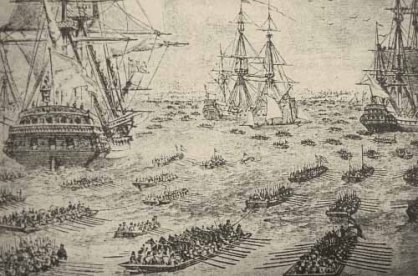
General Howe appeared at Staten Island on June 29 with a fleet of 45 ships.  By the end of the week he’d assembled an overwhelming fleet of 130.

There was an attempt at peaceful negotiation on July 13, when General Howe sent a letter to General Washington under flag of truce. The letter was addressed “George Washington, Esq.”, intentionally omitting Washington’s rank of General. Washington declined to receive the letter, responding there was no one there by that address. Howe tried the letter again on the 16th, this time addressing it to “George Washington, Esq., etc., etc.”.  Again, Howe’s letter was refused.

British Landing
British Landing on Long island

The next day, General Howe sent Captain Nisbet Balfour in person, to ask if Washington would meet with Howe’s adjutant, Colonel James Patterson.  A meeting was scheduled for the 20th.

Patterson told Washington that General Howe had come with powers to grant pardons.  Washington refused. “Those who have committed no fault” he said, “want no pardon”.

Patriot forces were comprehensively defeated at the Battle of Brooklyn, fought on August 27, 1776. With the Royal Navy in command on the water, Howe’s army dug in for a siege, confident the adversary was trapped and waiting to be destroyed at their convenience.

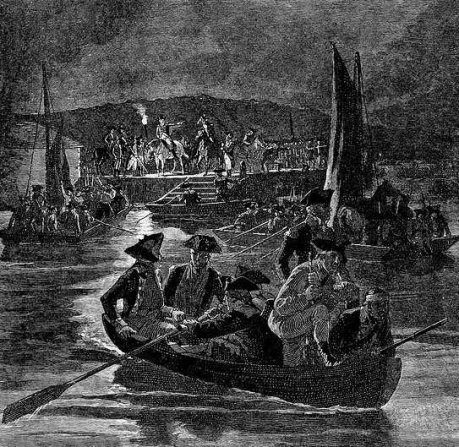
Retreat-from-LI
British retreat from Long Island

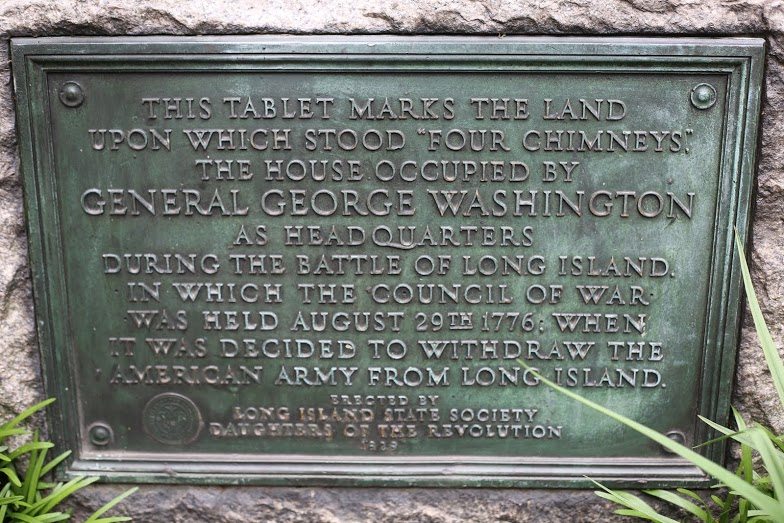
On the night of August 29-30, Washington withdrew his army to the ferry landing and across the East River, to Manhattan.

With horse’s hooves and wagon wheels muffled, oarlocks stuffed with rags, the Patriot army withdrew as a rearguard tended fires, convincing the redcoats in their trenches that the Americans were still present.

The surprise was complete for the British side, on waking for the morning of the 30th.  An entire army had vanished.

The Battle of Long Island would almost certainly have ended in disaster for the Patriot cause, but for that silent evacuation over the night of August 29-30.

Following evacuation, the Patriot army found itself isolated on Manhattan island, virtually surrounded.  Only the thoroughly disagreeable current conditions of the Throg’s Neck-Hell’s Gate segment of the East River, prevented Admiral Sir Richard Howe (William’s brother), from enveloping Washington’s position.

Expecting a British assault in September, General Washington grew increasingly desperate for information on British movements.

Nathan Hale Capture

The general asked for volunteers for a dangerous mission, to go behind enemy lines, as a spy.  Up stepped a volunteer.  His name was Nathan Hale.

Hale set out on his mission on September 10, disguised as a Dutch schoolmaster. He was successful for about a week but appears to have been something less than “street smart”.  

The young and unseasoned Patriot-turned spy placed his trust, where it did not belong.

Major Robert Rogers was an old British hand, a leader of Rangers during the earlier French and Indian War.  Rogers must have suspected that this Connecticut schoolteacher was more than he pretended to be and intimated that he himself, was a spy in the cause of Liberty.

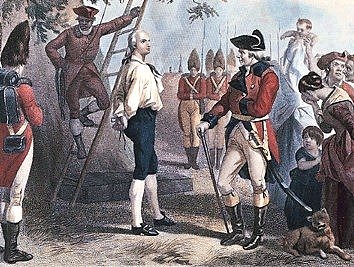
The hanging of Nathan Hale

Hale took Rogers into his confidence, believing the two to be playing for the same side. It was a fatal error in judgement.

Barkhamsted Connecticut shopkeeper Consider Tiffany, a British loyalist and himself a sergeant of the French and Indian War, recorded what happened next: “The time being come, Captain Hale repaired to the place agreed on, where he met his pretended friend” (Rogers), “with three or four men of the same stamp, and after being refreshed, began [a]…conversation. But in the height of their conversation, a company of soldiers surrounded the house, and by orders from the commander, seized Captain Hale in an instant. But denying his name, and the business he came upon, he was ordered to New York. But before he was carried far, several persons knew him and called him by name; upon this he was hanged as a spy, some say, without being brought before a court martial.”

The “stay behind” spy Hercules Mulligan would have far greater success reporting on British goings-on, from the 1776 capture of New York to the ultimate withdrawal seven years later.  But that must be a story for another day.

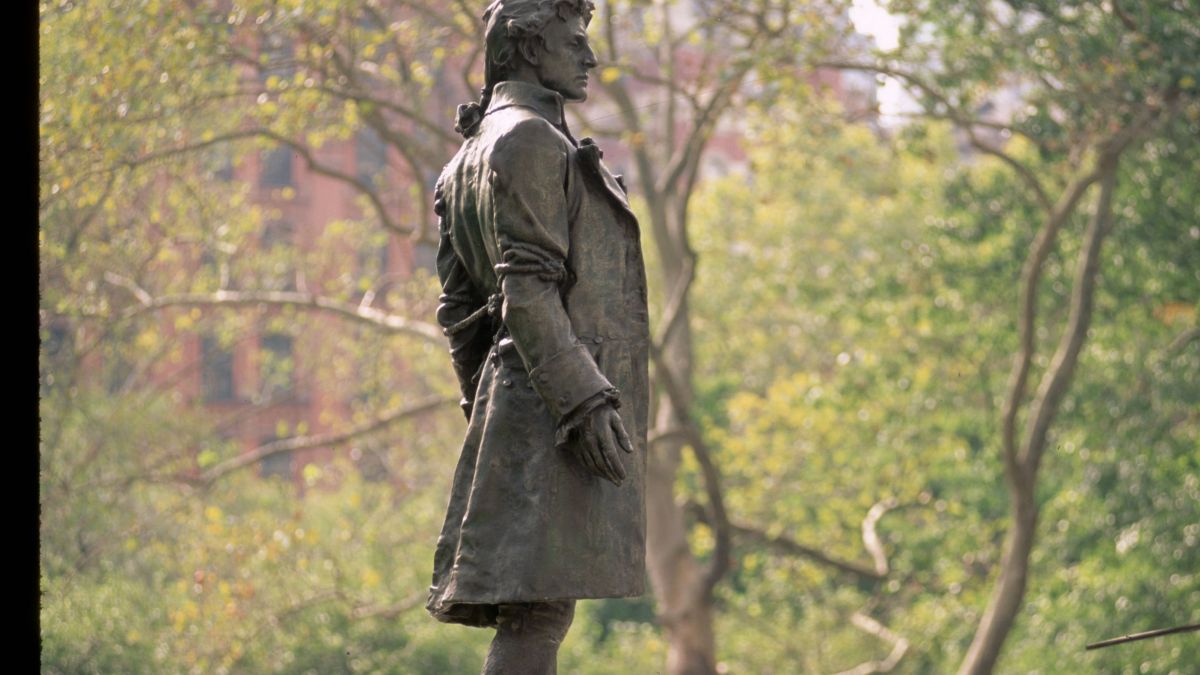
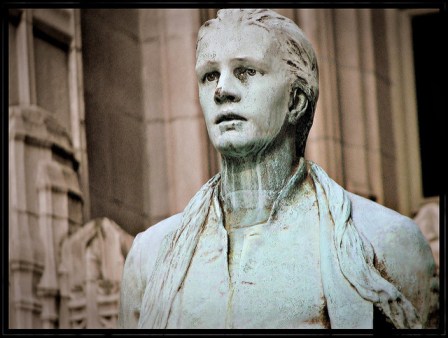
Nathan Hale was brought to the gallows on September 22, 1776 and hanged as a spy.  He was 21.  CIA.gov describes Nathan Hale as “The first American executed for spying for his country”.

Nathan Hale

There is no official account of Nathan Hale’s final words, but we have an eyewitness statement from British Captain John Montresor, who was present at the hanging.

Montresor spoke with American Captain William Hull the following day under flag of truce, where he gave the following account: “‘On the morning of his execution, my station was near the fatal spot, and I requested the Provost Marshal to permit the prisoner to sit in my marquee, while he was making the necessary preparations. Captain Hale entered: he was calm, and bore himself with gentle dignity, in the consciousness of rectitude and high intentions. He asked for writing materials, which I furnished him: he wrote two letters, one to his mother and one to a brother officer.’ He was shortly after summoned to the gallows. But a few persons were around him, yet his characteristic dying words were remembered. He said, ‘I only regret, that I have but one life to lose for my country‘.

George-Washington-Brooklyn-Heights

September 20, 451 Attila the Hun

“He was a man born into the world to shake the nations, the scourge of all lands, which in some way terrified all mankind by the dreadful rumours noised abroad concerning him.” The Origin and Deeds of the Getae [Goths]

In the 5th century, the migration of warlike Germanic tribes across northern Europe culminated in the destruction of the Roman Empire in the west.  That much is well known but the “why”, less so.  What would a people so fearsome as to bring down an empire, have to flee from?

The Roman Empire was split in the 5th century and ruled by two separate governments.  Ravenna, in northern Italy, became capital to the Western Empire in 402 and would remain so until the final collapse, in 476.  1,200 miles to the east Constantinople, destined to become modern day Istanbul, ruled the Byzantine Empire.

Attila Bronze

Vast populations moved westward from Germania during the early fifth century, and into Roman territories in the west and south. They were Alans and Vandals, Suebi, Goths, and Burgundians. There were others as well, crossing the Rhine and the Danube and entering Roman Gaul. They came not in conquest:  that would come later.

These tribes were fleeing the Huns:  a people so terrifying that whole tribes agreed to be disarmed, in exchange for the protection of Rome.

Rome itself had mostly friendly relations with the Hunnic Empire, which stretched from modern day Germany in the west, to Turkey and most of Ukraine in the east. The Huns were nomads, mounted warriors whose main weapons were the bow and javelin. Huns frequently acted as mercenary soldiers, paid to fight on behalf of Rome.

Atilla_fléau_de_dieu

Rome looked at such payments as just compensation for services rendered.  To the Huns this was tribute, tokens of Roman submission to the Hunnic Empire.

Nestorius, Patriarch of Constantinople, described the Roman-Hun problem, succinctly:  “They have become both masters and slaves of the Romans”.

Relations were strained between the two powers in the time of the Hunnic King, Rugila.

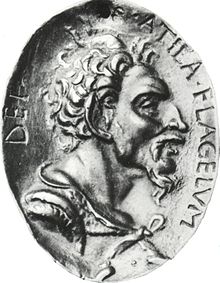
Attila

Rugila’s death in 434 left the sons of his brother Mundzuk, Attila and Bleda, in control of the united Hunnic tribes. The brothers negotiated a treaty with Emperor Theodosius of Constantinople the following year, giving him time to strengthen the city’s defenses. This included building the first sea wall, the formidable Theodosian Wall.

The city would be forced to defend this structure a thousand years later in the Islamic conquest of 1453, but that must be a story for another day.

The priest of the Greek church Callinicus wrote what happened next, in his “Life of Saint Hypatius”. “The barbarian nation of the Huns, which was in Thrace, became so great that more than a hundred cities were captured and Constantinople almost came into danger and most men fled from it. … And there were so many murders and blood-lettings that the dead could not be numbered. Ay, for they took captive the churches and monasteries and slew the monks and maidens in great numbers“.

Bleda died sometime in 445, possibly murdered by his brother, leaving Attila sole King of the Huns.  Relations with the Western Roman Empire were relatively friendly at this time.  That changed in 450 when Emperor Valentinian’s sister Justa Grata Honoria attempted to flee a forced marriage to the former consul, Herculanus.  Honoria sent the eunuch Hyacinthus with a note to King Attila, asking the Hunnic king to intervene on her behalf.  She enclosed her ring in token of the message’s authenticity.

Attila took the ring to be an offer of marriage.

Attila_in_Gaul_451

Valentinian was furious with his sister.  Only the influence of the siblings’ mother Galla Placidia convinced the emperor to exile his sister rather than have her put to death. Meanwhile, frantic letters were scribbled off and dispatched to King Attila, explaining that it was all just a misunderstanding.

The king of the Huns wasn’t buying it. He sent an emissary to Ravenna, to claim what was his.  Attila demanded delivery of his “bride” along with half the empire, as dowry.

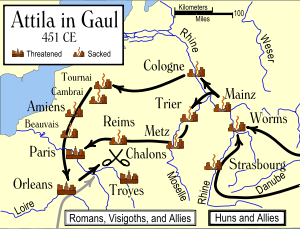
In 451, Attila gathered his vassals and began a march to the west. The Hunnic force was estimated to be half a million strong, though that number is probably exaggerated. The Romans hurriedly gathered an army in opposition, while the Huns sacked the cities of Mainz, Worms and Strasbourg. Trier and Metz fell in quick succession, followed by Cologne, Cambrai, and Orleans.

The Roman army, allied with the Visigothic King Theodoric I, finally stopped Attila’s army at the Battle of the Catalaunian Plains, near Chalons.   Some sources date the Battle of Chalons to June 20, 451, others, September 20.  Even the outcome of the battle is open to interpretation.  Sources may be found to support the conclusion that it was a Roman, a Gothic or a Hunnic victory, as you choose.

Appearing to be a Pyrrhic victory, Chalons was one of the last major military operations of the Roman Empire, in the west. The Roman alliance had stopped the Hunnic invasion in Gaul but the military capacity of Roman and Visigoth both, was destroyed.

The Hunnic Empire itself was dismantled by a coalition of Germanic vassals at the Battle of Nedau, in 454.

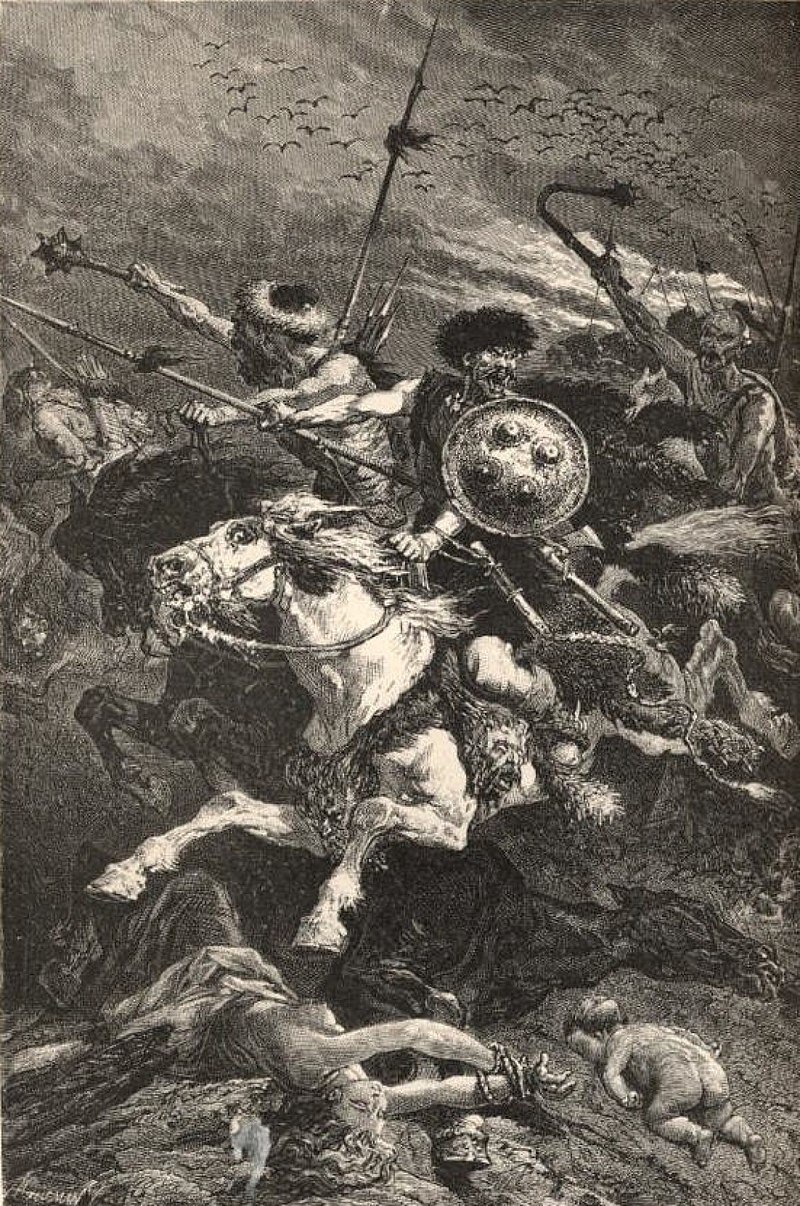
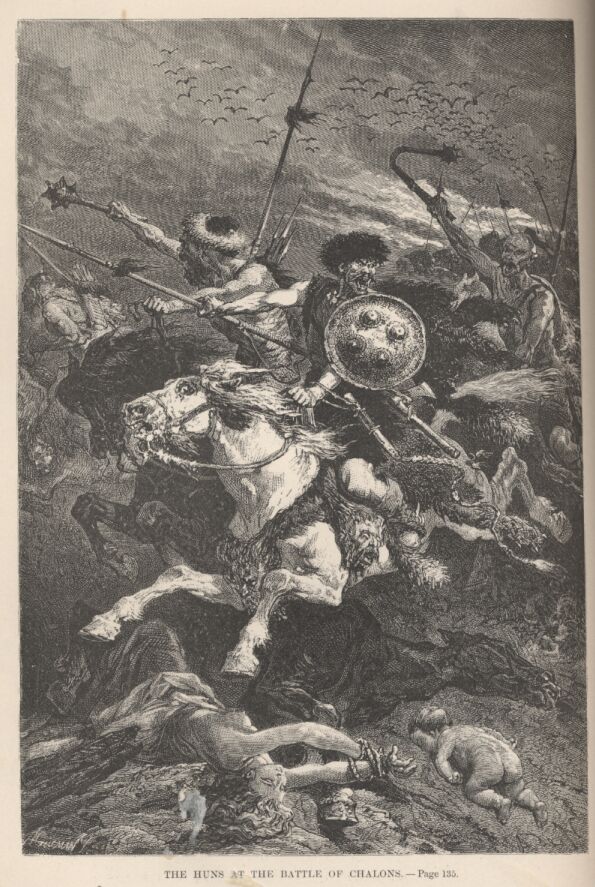
800px-De_Neuville_-_The_Huns_at_the_Battle_of_Chalons
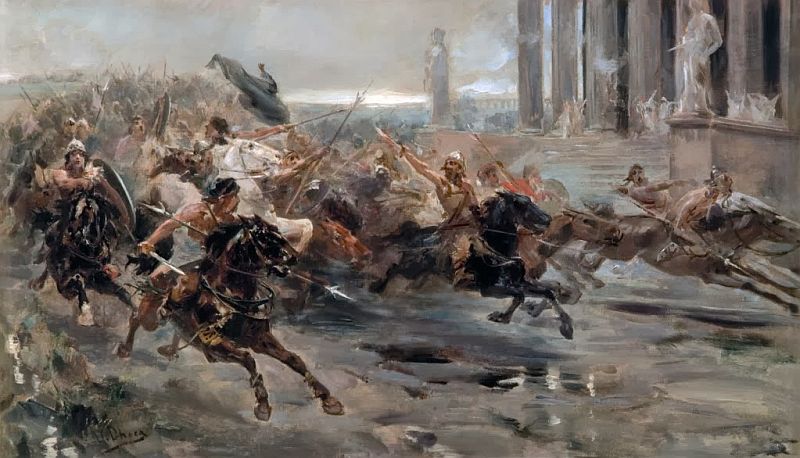
“The Huns at the Battle of Chalons” from page 135 of A Popular History of France From The Earliest Times Volume I of VI (en:Project Gutenberg e-text). Illustration by A. De Neuville (1836-1885). img url: http://www.gutenberg.org/dirs/1/1/9/5/11951/11951-h/images/135.jpg

Attila would return to sack much of Italy in 452, this time razing Aquileia so completely that no trace was left behind. Legend has it that Venice was founded at this time when local residents fled the Huns, taking refuge in the marshes and islands of the Venetian Lagoon.

Attila died the following year at a wedding feast celebrating his marriage to the beautiful young Ostrogoth, Ildico.  The King of the Huns died in a drunken stupor from a massive nosebleed, or possibly esophageal bleeding. 

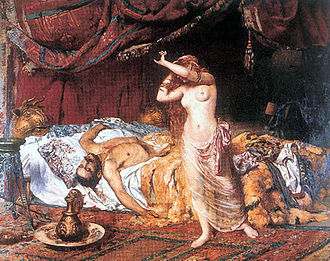
The eastern Roman and Greek historian Priscus wrote: “Shortly before he died, he took in marriage a very beautiful girl named Ildico, after countless other wives, as was the custom of his race. He had given himself up to excessive joy at his wedding, and as he lay on his back, heavy with wine and sleep, a rush of superfluous blood, which would ordinarily have flowed from his nose, streamed in deadly course down his throat and killed him, since it was hindered in the usual passages. Thus did drunkenness put a disgraceful end to a king renowned in war. On the following day, when a great part of the morning was spent, the royal attendants suspected some ill and, after a great uproar, broke in the doors. There they found the death of Attila accomplished by an effusion of blood, without any wound, and the girl with downcast face weeping beneath her veil“.

Morte di Attila, a fanciful depiction of the death of Attila by the Hungarian artist, Ferenc Paczka

The Hunnic Empire died along with Attila the Hun as he choked to death, on his own blood.

September 16, 1906 One of a Kind

A child was born on this day in 1906.  He was John Malcolm Thorpe Fleming Churchill, the first son and grandson of British employees of the Ceylon Civil Service.  The family lived in Hong Kong at the time and returned to England in 1917.  “Jack” graduated from the Royal Military College at Sandhurst, serving in Burma with the Manchester Regiment before leaving the military, ten years later.

Churchill worked as a newspaper editor for a time in Nairobi Kenya, along with an occasional career as male model, and a couple appearances in motion pictures.  From there he may have faded into obscurity (unlike his fellow Englishman of no relation), with the same last name.  Then came World War II, when John Churchill earned the name, “Mad Jack”.

It was around this time that Churchill learned to play bagpipes, a bit of an eccentricity for an Englishman of his era, but Mad Jack was nothing if not eccentric.  He taught himself to shoot a bow and arrow, becoming quite good at it.  Good enough to represent his country in the world archery championship in Oslo, in 1939.

Jack-Churchill

Churchill resumed his military commission and rejoined the Manchester Regiment later that year, when Germany invaded Poland.  Part of the British Expeditionary Force to France in 1940, Churchill signaled an ambush on a German unit, by taking out its sergeant with a broadhead arrow.  No one could have been more surprised than that German himself: How the hell did I get an ARROW in my chest?

Such were the dying thoughts of the only combatant in all World War 2 to be felled, by an English longbow.

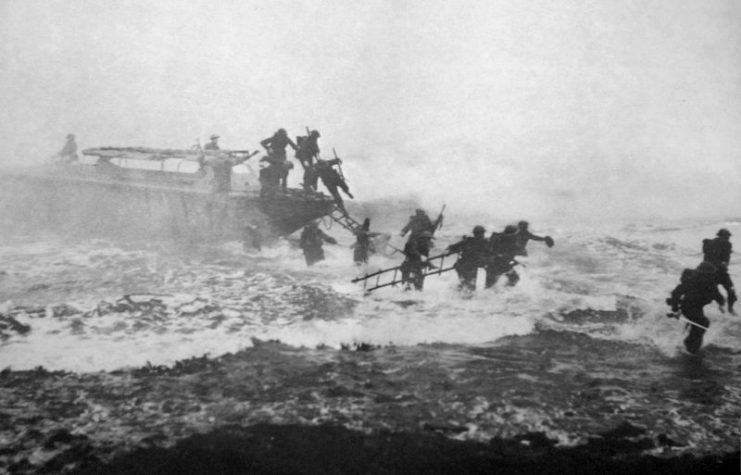
Jack Churchill (far right) leads a training exercise, sword in hand, from a Eureka boat in Inveraray. H/T warhistoryonline.com

Soon thereafter, allied military forces were hurled from the beaches of Europe.  The only way back in was via those same beaches. 

We’ve all seen the D-Day style waterborne assault:  invading forces pouring out of Higgins Boats and charging up the beaches.  Amphibious landings were carried out from the earliest days of WWII, from Norway to North Africa, from the Indian Ocean to Italy.  In all that time there’s likely no other soldier who stepped off a Higgins Boat, armed with bow and arrows.

On December 27, 1941, #3 Commando raided the German garrison at Vågsøy, Norway. As the ramp dropped on the first landing craft, out jumped Mad Jack Churchill playing “March of the Cameron Men” on the bagpipes, before throwing a grenade and charging into battle.  Mad Jack made several such landings, usually while playing his bagpipes, that Scottish broadsword at his side .

Jack-Churchill-Speaks-During-a-Landing-Exercise
“Mad Jack” Churchill, speaking at a landing exercise

Churchill was attached to that sword, a basket hilted “Claybeg”, a slightly smaller version of the Scottish Claymore.  He said “Any officer who goes into action without his sword is improperly dressed.” Mad Jack could be seen at the Catania (Sicily) and Salerno landings of 1943, trademark broadsword at his belt, bagpipes under an arm and an English longbow and arrows, around his neck.

Churchill lost his sword one time in confused hand to hand fighting around the town of Piegoletti, for which he received the Distinguished Service Order.  Almost single-handed but for a corporal named Ruffell, Churchill captured 42 Germans including a mortar squad.   “I always bring my prisoners back with their weapons”, he explained.  “It weighs them down. I just took their rifle bolts out and put them in a sack, which one of the prisoners carried. [They] also carried the mortar and all the bombs they could carry and also pulled a farm cart with five wounded in it….I maintain that, as long as you tell a German loudly and clearly what to do, if you are senior to him he will cry ‘Jawohl’ and get on with it enthusiastically and efficiently whatever the … situation. That’s why they make such marvelous soldiers…”  It looked, he said, like “an image from the Napoleonic Wars.

He later trudged back to town, to collect his sword.  Encountering a lost American squad Churchill informed the NCO they were headed, toward German lines. The soldier refused to change direction so Churchill took his leave, saying, he “wouldn’t come back for a bloody third time”.

07_Hugh-4-bows-1
Archery historian Hugh Soar pictured with four of “Mad Jack’s” English longbows

Mad Jack’s luck ran out in 1944 on the German held, Yugoslavian island of Brac.  He was leading a Commando raid at the time, coordinating with a unit of Josip Broz Tito’s Partisans.  Churchill and six others managed to reach the top of hill 622 when a mortar shell killed or wounded everyone but Churchill himself.  He was knocked unconscious by a grenade and captured.

He’d been playing “Will Ye No Come Back Again?” on his pipes.

Hitler’s infamous ‘Commando Order” had long since taken effect, requiring the instant execution of captured commandos. Churchill and his men escaped execution at the hands of the Gestapo, thanks only to the human decency of one Wehrmacht Captain named Thuener. “You are a soldier“, he said, “as I am. I refuse to allow these civilian butchers to deal with you. I shall say nothing of having received this order.”

After the war Churchill paid back Thuener’s act of kindness, keeping him out of the clutches of the merciless Red Army. But I digress.

Churchill was flown to Berlin and interrogated on suspicion that he might be related to the more famous Churchill, and later sent off to Sachsenhausen concentration camp in Oranienburg, Germany.  There, Mad Jack and Royal Air Force officer Bertram James escaped in September, slipping under the wire and crawling through an abandoned drain before walking all the way to the Baltic coast. They almost made it, too, but the pair was captured near the coastal city of Rostock, just a few miles from the coast.

churchill2

following the defeat of Nazi Germany, Mad Jack was sent off to Burma. He was bitterly disappointed by the swift end of the war in the Pacific, brought about by the American bombings at Hiroshima and Nagasaki. “If it wasn’t for those damn Yanks” he complained, “we could have kept the war going another 10 years!”

As a Seaforth Highlander, Mad Jack was posted to the British Mandate in Palestine, in 1948. He was one of the first to the scene of the ambush and massacre of the Haddassah medical convoy that April, banging on a bus and offering evacuation in an armored personnel carrier. His offer was refused in the mistaken belief that Hadassah was mounting an organized rescue.

No such rescue ever arrived. Churchill and a team of 12 British Light Infantry were left to shoot it out with some 250 Arab insurgents, armed with everything from blunderbusses and old flintlocks, to Sten and Bren guns. Seventy-eight Jewish doctors, nurses, students, patients, faculty members and Haganah fighters were killed along with one British soldier. Dozens were burned beyond recognition and buried in mass graves. Churchill later coordinated the evacuation of 700 Jewish patients and medical personnel from the Hadassah hospital at Hebrew University, in Jerusalem.

Churchill served as an instructor at the land-air warfare school in Australia, where he became passionately devoted to surfing.  Returning to England upon his retirement, he became the first to surf the 5-foot tidal surge up the River Severn, on a board of his own design.

Tidal Bore
Surfing the Tidal Bore, up the Severn River

Mad Jack Churchill remained an eccentric, even in his later years.   He loved sailing radio controlled model warships on the Thames. Little brought him more apparent joy than to horrify fellow train passengers, opening the window and hurling his briefcase into the darkness.

No one ever suspected that he threw it into the garden of his own back yard.  It saved him the trouble of carrying the thing home from the station.

He scribbled a couplet once on a postcard bearing regimental colors, and mailed it to a friend.

On the back o, Mad Jack Churchill had written fifteen words:

“No Prince or Lord has tomb so proud / As he whose flag becomes his shroud.”

He may have been talking about himself.

September 14, 1752 Double Dating

Confusion reigned as legal contracts, civic calendars and the payment of rents and taxes were all complicated by having two calendars. Military campaigns were won or lost due to confusion, over dates.


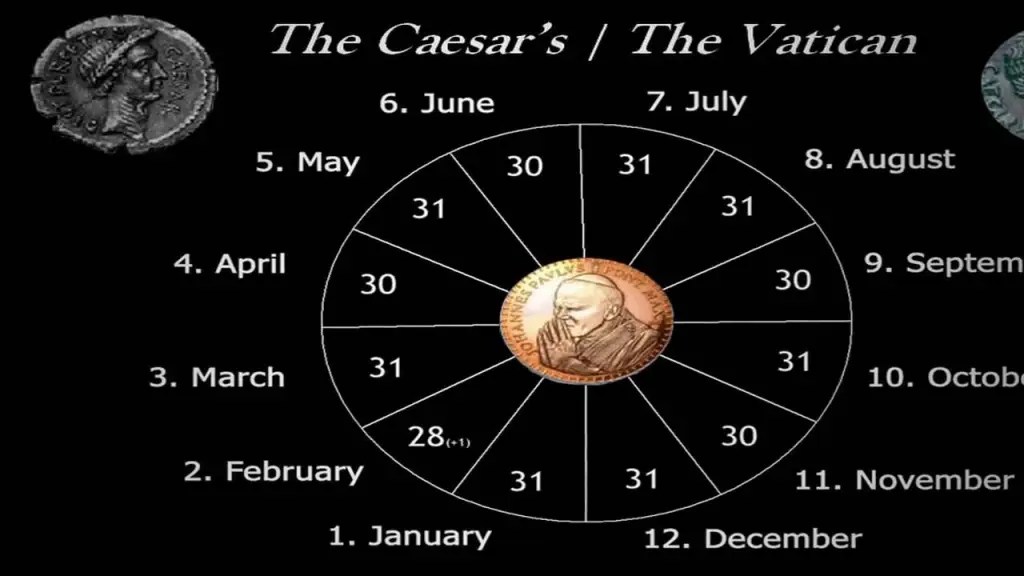
From the 7th century BC onward, the Roman calendar attempted to follow the cycles of the moon. The method often fell out of phase with the change of seasons, requiring the random addition of days. The Pontifices, the body charged with overseeing the calendar, made matters worse. Days were added to extend political terms, and to interfere with elections. Military campaigns were won or lost due to confusion over dates. By the time of Julius Caesar, things needed to change.
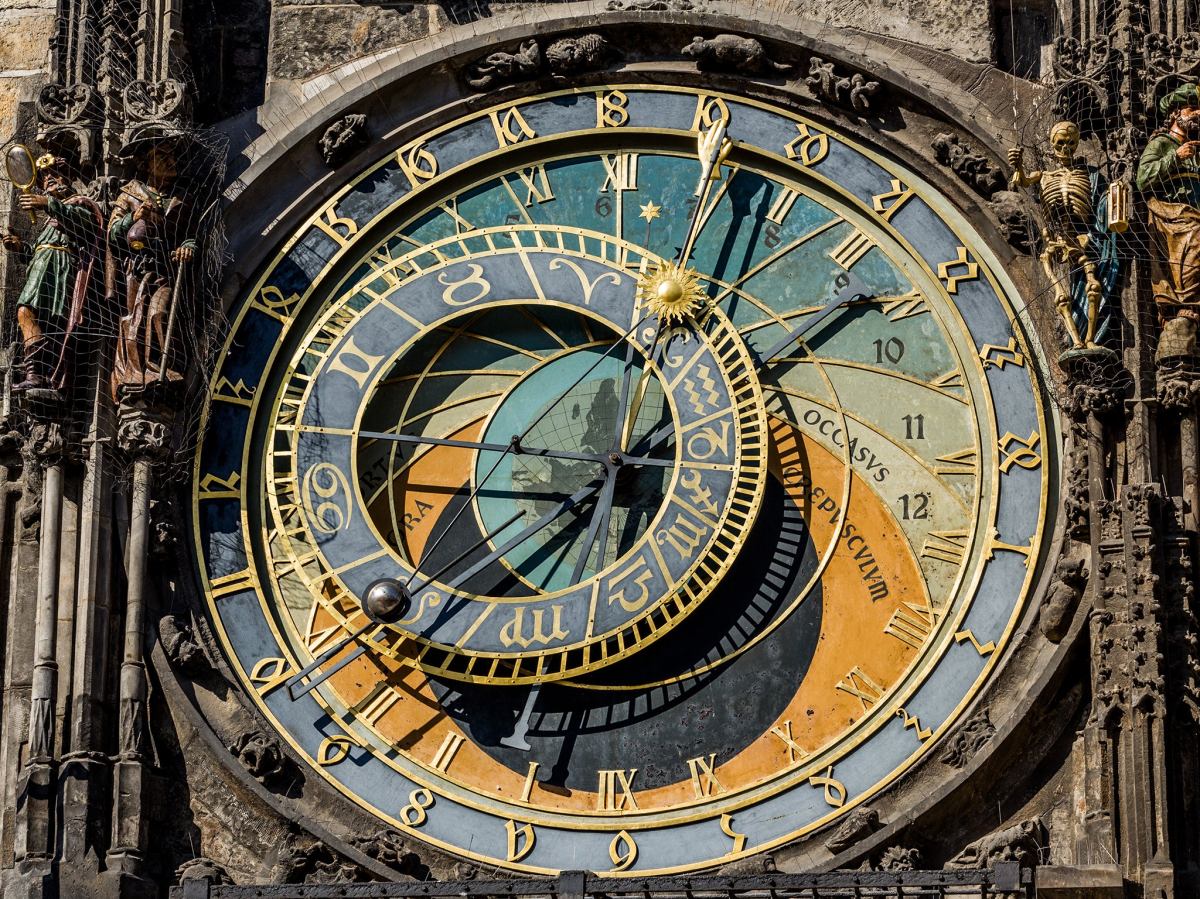
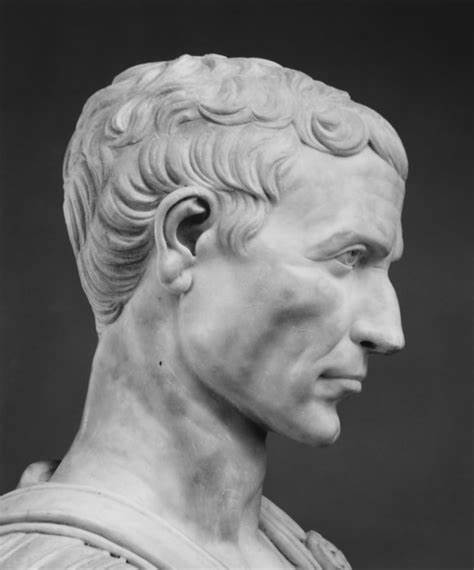
When Caesar went to Egypt in 48BC, he was impressed with the way the Egyptians handled the calendar. The Roman statesman hired the Alexandrian astronomer Sosigenes to help straighten things out. The astronomer calculated a proper year to be 365¼ days, more accurately tracking the solar and not the lunar year.

“Walk like an Egyptian” he may have said.

The new “Julian” calendar went into effect in 46BC. Caesar decreed that 67 days be added that year, moving the New Year’s start from March to January 1.

Rank hath its privileges.

This “Julian” calendar miscalculated the solar year by 11 minutes every year, resulting in a built-in error of 1 day for every 128 years.   By the late 16th century, the seasonal equinoxes were ten days out of sync, causing a problem with the holiest days of the Roman church.

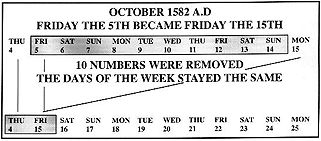
October 1582 missing days

In 1579, Pope Gregory XIII commissioned the Jesuit mathematician and astronomer Christopher Clavius, to devise a new calendar to correct this “drift”.  The “Gregorian” calendar was adopted on this day in 1582, omitting ten days that October and changing the manner in which “leap” years were calculated.

The Catholic countries of Europe were quick to adopt the Gregorian calendar, Portugal, Spain, pontifical states, but England and her overseas colonies continued to use the Julian calendar. Confusion reigned well into the 18th century.  Legal contracts, civic calendars, and the payment of rents and taxes were all complicated by the two calendar system. Military campaigns were won or lost, due to confusion over dates. Sound familiar?

Between 1582 and 1752, many English and colonial records included both the “Old Style” and “New Style” year.  The system known as “double dating” resulted in date notations such as March 19, 1602/3.  Others merely changed dates. Keyword search on “George Washington’s birthday” for instance, and you’ll be informed that the father of our country was born on February 22, 1732.  The man was actually born on February 11, 1731 but, no matter.  Washington himself recognized the date of his birth to be February 22, 1732, following adoption of the Gregorian Calendar.

virginia-almanack-1752
Virginia almanack of 1752

Tragically, the exploding heads of historians and genealogists alike, are lost to history.

The “Calendar Act of 1750” set out a two-step process for adoption of the Gregorian calendar.  Since the Roman calendar began on March 25, the year 1751 was to have only 282 days so that January 1 could be synchronized with that date.  That left 11 days to deal with.

So it was decreed that Wednesday, September 2, 1782, would be followed by Thursday, September 14.

You can read about “calendar riots” around this time, though such stories may be little more than urban myth.

Philip Stanhope, 4th Earl of Chesterfield, was a prime sponsor of the calendar measure.  His use of the word “Mobs” was probably a description of the bill’s opponents in Parliament.   Even so, some believed their lives were being shortened by those 11 days, while others considered the new calendar to be a “Popish Plot”.  The subject was very real campaign issue between Tories and Whigs in the elections of 1754.

There’s a story of one William Willett, who lived in Endon. Willett bet that he could dance non-stop for 12 days and 12 nights, starting his jig about town the evening of September 2, 1752. He stopped the next morning, and went out to collect his bets.

I am unable to determine how many actually paid up.

Ever mindful of priorities, the British tax year was officially changed in 1753, so as not to “lose” those 11 days of tax revenue.  Revolution was still 23 years away in the American colonies, but the reaction “across the pond” could not have been one of unbridled joy.

The last nation to adopt the Gregorian calendar was Turkey, formally doing so in 1927.

ben franklin

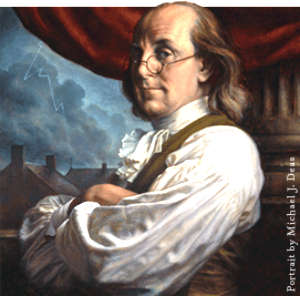
Back in the American colonies, Ben Franklin seems to have liked the idea of those “lost days”. “It is pleasant for an old man to be able to go to bed on September 2″ he wrote, “and not have to get up until September 14.”

Much to the chagrin of Mr. Clavius, the Gregorian calendar still gets out of whack with the solar cycle by about 26 seconds, every year.  Clever methods have been devised to deal with the discrepancy and several hours have already been added, but we’ll be a full day ahead by the year 4909.

I wonder how Mr. Franklin would feel to wake up and find out…it’s still yesterday.

September 13, 1501 David

If you look at the ceiling of the Sistine Chapel, you would never guess the artist who produced such a work didn’t care for painting.

Masters of Italian Art

Historians have variously described the Renaissance as an advance beyond the “dark ages”, and a nostalgic period looking back to the Classical age. Whatever it was, the 15th and 16th centuries produced some of the most gifted artists, in history.

None more so than the Italian Masters.

There was the polymath Leonardo and the Florentine sculptor, Donatello. There was Raphael, that prodigiously talented architect and painter whose enormous body of work belies an early death, at the age of 37. We remember Brunelleschi and Botticelli but only one had his biography written, while he was still alive. Not once, but twice. Only one of these men would have his home town renamed…after himself.  Today, the Tuscan village of Caprese is known as Caprese Michelangelo.

He was Michelangelo di Lodovico Buonarroti Simoni.

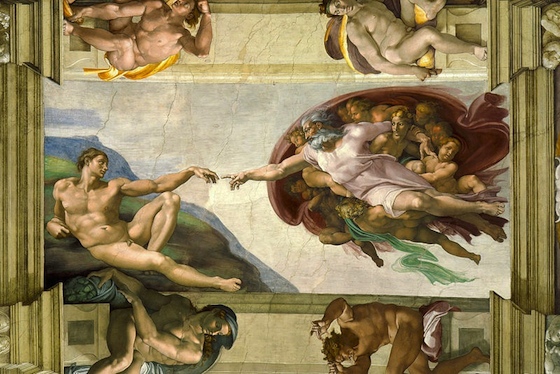
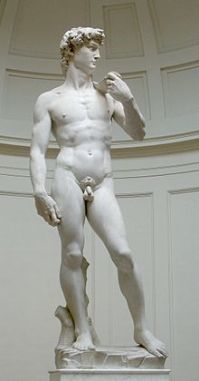
If you look at the ceiling of the Sistine Chapel, you would never guess the artist who produced such a work didn’t care for painting. “Along with the milk of my nurse,” he would say, “I received the knack of handling chisel and hammer, with which I make my figures”. Michelangelo was a sculptor.

Sistine Chapel
Sistine Chapel

He was “Il Divino”, “The Divine One”, literally growing up with the hammer and chisel. He had a “Terribilità”, a sense of awe-inspiring grandeur about him that made him difficult to work with, but he was widely admired and imitated. He was that insufferably cocky kid who wasn’t bragging, because he could deliver.

Michelangelo-David-rear

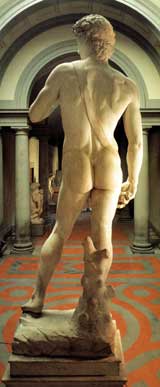
A massive block of Carrara marble was quarried in 1466, nine years before Michelangelo was born. That same year a commission to produce the work we now know as “David” went to the artist Agostino di Duccio. So difficult was this particular block that he never got beyond roughing out the legs and draperies.

Antonio Rossellino took a shot at it 10 years later, but he didn’t get much farther.

25 years later, the Guild of Wool Merchants decided to revive the abandoned project and went looking for an artist. The now infamously difficult slab had deteriorated for years in the elements, when Michelangelo stepped forward at the age of 26.  The prevailing attitude seems to have been yeah, give it to him.  That might even take him down a few pegs.

The sculptor began work on September 13, 1501. His master work would take him three years to complete.

David, Michelangelo

The 17-foot, six-ton David was originally intended for the roof of the Florence Cathedral, but it wasn’t feasible to raise such an object to such a great height. A committee including Leonardo da Vinci and Sandro Botticelli was formed to decide on an appropriate site for the statue. The committee chose the Piazza della Signoria outside the Palazzo Vecchio, the town hall of Florence.

It took four days on a specially constructed cart to move the David statue into position, the unveiling taking place on September 8, 1504.

Among the dignitaries gathered for the occasion was the Mayor of Florence, Vasari Pier Soderini, who complained that David’s nose was “too thick”.

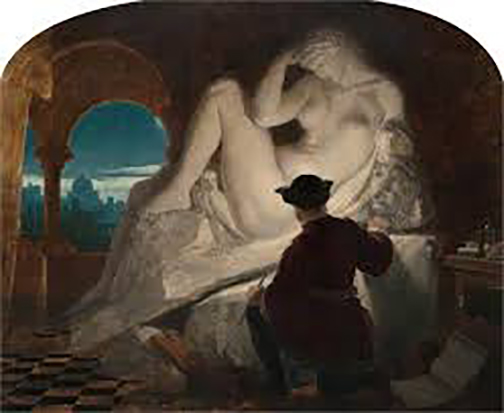
Michelangelo at Work

Michelangelo climbed the statue with a handful of marble dust, sending down a shower of the stuff as he pretended to work on the nose. After several minutes, he stepped back and asked Soderini if it was improved. “Yes”, replied the Mayor, now satisfied. “I like it better. You have given it life”.

September 12, 1940 A Different Perspective

History has no single narrative.  It is a thousand times a thousand, each layered and intertwined with the other.

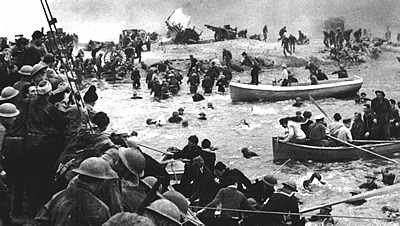
The Battle of France began on May 10, 1940 with the German invasion of France and the Low Countries of Belgium, Luxembourg and the Netherlands. By the end of May, German Panzer columns had hurled the shattered remnants of the allied armies into the sea, at a place called Dunkirk.

dunkirk1

The speed and ferocity of the German Blitzkrieg left the French people shocked and prostrate in the wake of surrender, that June.  All those years their government had told them, the strength of the French army combined with the Maginot Line was more than a match for the German military.

The country had fallen in six weeks.

dunkirk2

On June 18, Charles DeGaulle addressed the French nation from his exile in Great Britain, exhorting his countrymen to fight on.  Resist.  The idea caught on quickly in occupied regions.

Germany installed a Nazi-approved French government in the southern part of “La Métropole” that July, headed by WW1 hero Henri Pétain.  Resistance against this new government in Vichy was slower to form.  This was, after all a French government, and French attitudes took a decidedly anti-English turn with the July 3 British attack on the French fleet, at Mers-el-Kébir.

Before long, Vichy’s collaborationist policies hardened French attitudes against itself. The French Resistance was born.

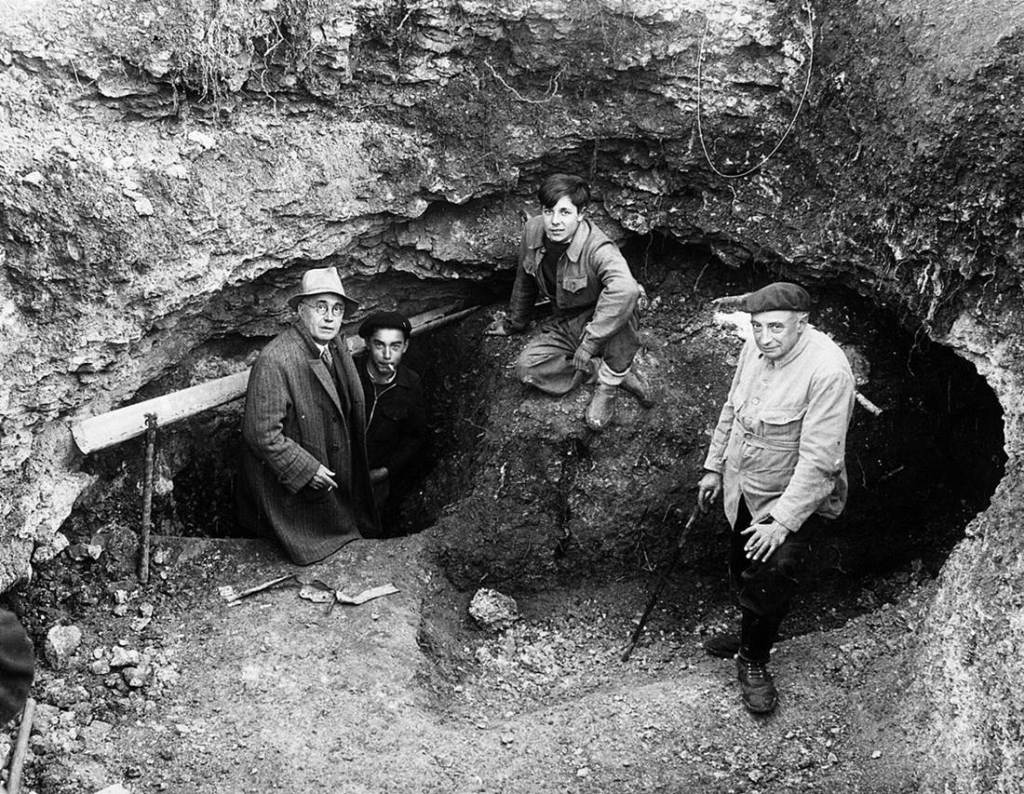
Sometime around this period a tree fell unseen near the French village of Montignac.  On September 12, 1940, 18-year old Marcel Ravidat was walking his black & white mongrel dog “Robot”, in the woods.  Coming upon the downed tree, the pair noticed a deep hole had opened up, where the tree had once stood.  Stories differ as to which of the two went down the hole first, but it soon became clear.  Marcel Ravidat and his dog had discovered more than just a hole in the ground.

The boy returned to the site with three buddies: Jacques Marsal, Georges Agnel, and Simon Coencas.  Entering via a long tunnel, the boys discovered what turned out to be a cave complex, its walls covered with depictions of animals.  Hundreds of them.

History has no single narrative.  It is a thousand times a thousand, each layered and intertwined with the other.  Here, four teenagers in Nazi occupied France had discovered some of the oldest and finest prehistoric art, in the world.

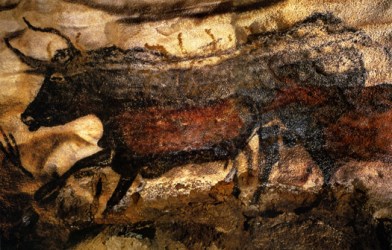
Lascaux 1The Lascaux Caves are located in the Dordogne region, in Southwestern France.  Some 17,000 years ago, upper Paleolithic artists mixed mineral pigments such as iron oxide (ochre), haematite, and goethite, suspending pigments in animal fat, clay or the calcium-rich groundwater of the caves themselves.  Shading and depth were added with charcoal.
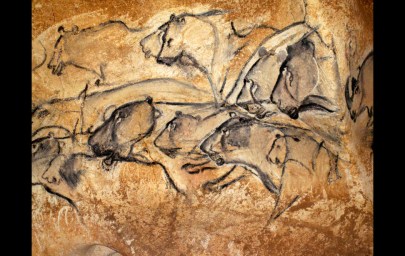
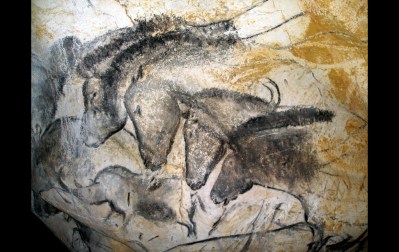
Colors were swabbed or blotted onto surfaces.  There is no evidence of brushwork.  Sometimes, pigments were placed in a hollow tube, and blown onto the wall.  Where the cave rock is softer, images are engraved.

The color, size, quality and quantity of the images at Lascaux, are astonishing.  Abbé Breuil, a Catholic priest and the first expert to examine its walls, called it the “Sistine chapel of prehistory”.

Lascaux 3

The artist or artists who created such images, nearly 2,000 of them occupying some 37 chambers, would have been recognizable as modern humans.  Living as they did some 5,000 years before the Holocene Glacial Retreat, (yes, they had “climate change” back then), these cave-dwellers were pre-agricultural, subsisting on what they could find, or what they could kill.

More than 900 images are recognizable as animals. 605 of them have been precisely identified. Hundreds of pictures depict horses, stag, cattle, lions and bison.  Other subjects appear with less frequency.  There are seven cats, a bird, a bear, a wooly rhinoceros, and one human.

Lascaux

The purpose served by these images is unclear.  Perhaps they tell stories of past hunts, or maybe they were used to call up the spirits for a successful hunt.  At least one professor of art and archaeology postulates that the dot and lattice patterns overlying many of these paintings may reflect trance visions, similar to the hallucinations produced by sensory deprivation.

36 animals occupy the “Great Hall of Bulls”, including a single black Auroch specimen measuring some 17-feet, the largest such image ever discovered in cave art.  One semi-spherical chamber, the “Apse”, is covered from the floor to its 8-foot 9-inch vaulted ceiling with overlapping, entangled drawings and engravings, demonstrating that these people erected scaffolding to create such work.

lascaux4b

The Lascaux caves were used by the French Resistance for weapons storage during the war, and opened to the public in 1948.  It would prove to be a mistake.

The underground environment had been stable for all those thousands of years.  Now the light, the air circulation, and exhalations of thousands of visitors every day, were irreparably changing the cave environment.  By the 1950s, colors had noticeably changed and faded.  Crystals and lichens began to grow on the walls, black and white molds grew quickly throughout the cave complex.

The cave was closed to the public in 1963, the paintings restored and a monitoring system installed.  To this day molds, lichens and crystallized minerals bedevil the art of the Lascaux caves.  Only a handful of scientific experts are now permitted access to the site, and that’s only for a few days per month.  Some of the most eminent preservation specialists on the planet continue to wrestle with the problem.

The prehistory buff can find a lot to like in the Vézère region of France.  The valley has 147 prehistoric sites, 15 of them listed as Unesco World Heritage sites.

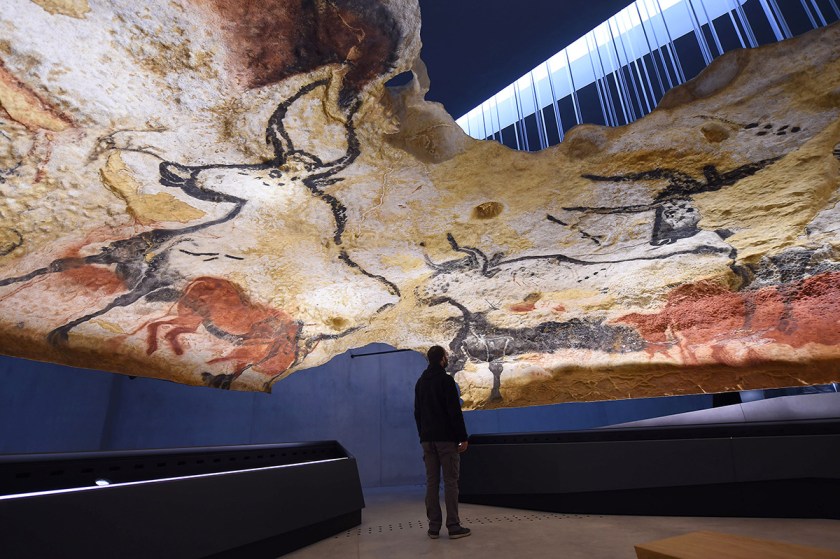
“Lascaux II” opened in 1983, an exact replica of the Hall of the Bulls and the “Painted Gallery” areas at the original, educating and informing the public without further harm to the original.

Lascaux-4-3_1200
Inside the museum that houses Lascaux 4 (Mehdi Fedouach/AFP/Getty Images)

An 800 square meter mobile “Lascaux 3” began a world tour in 2012, a series of five reproductions bringing a taste of the original, to visitors from around the world.  Most recently, the €57 million ($68 million), multi-media Lascaux IV opened last December, 8,500 square meters of high-tech exhibit space where each visitor is free to explore four exhibition rooms, equipped with an electronic compagnon de visite, a tablet-like device which looks like it’s been flaked and formed out of slate, Fred Flintstone style.

If you would permit me personal note, years ago, the Long family convened our annual “Blue Gray Ramble” at the Petersburg battlefield, in Virginia.  There’s a cut running parallel to the battle lines there, not far from the crater.  The ravine is 12 feet deep in places, narrowing downward to a hard, dry stream bed.

Working our way down the bottom of the cut, my son Dan discovered an archaeologist’s dream of fossils:  Gastropods, scallop shells, copepods and shark’s teeth.  The denizens of a long forgotten sea, cast in stone and exposed on the light of a Civil War battlefield.

We were there that weekend to discover history. What we found brought a new and unexpected perspective.

September 11, 2001 Ogonowski

Twelve days a month John Ogonowski would leave the farm in his Captain’s uniform to fly jumbo jets out of Logan Airport, but he always returned to the land he loved.

A great wave of immigrants came into the United States around the turn of the 20th century, 20 million Europeans or more making the long journey to become Americans.

Among these was the Ogonowski family, who emigrated from Poland to make their home in Massachusetts’ Merrimack Valley, along the New Hampshire line.

The earliest members of the family received invaluable assistance from Yankee farmers, well acclimated to growing conditions in the harsh New England climate. Four generations later the Ogonowski family still tilled the soil on their 150 acre “White Gate Farm” in Dracut, Massachusetts.

Ogonowski 2

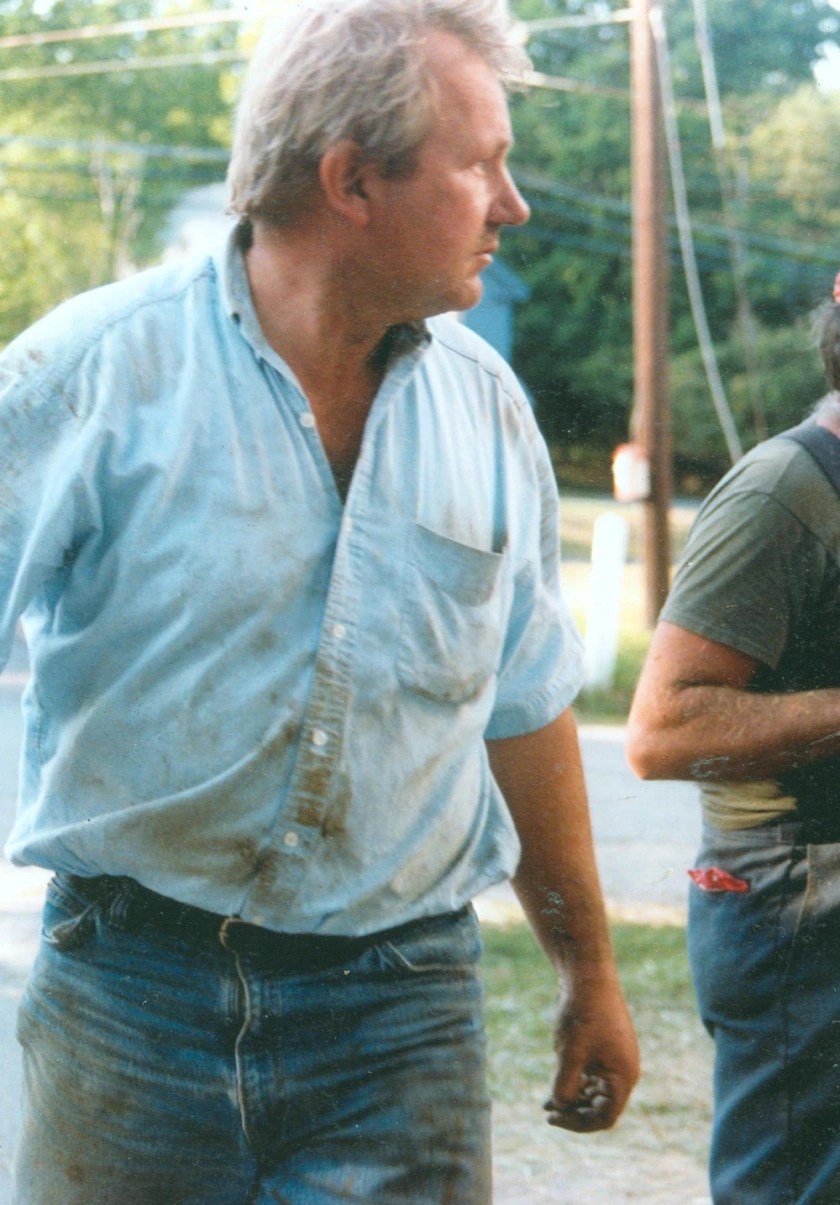
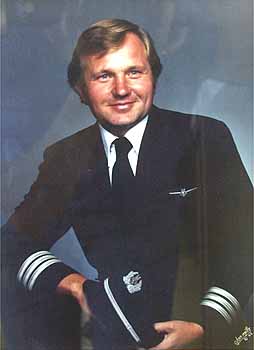
Graduating from UMass Lowell in 1972 with a degree in nuclear engineering, John Ogonowski joined the United States Air Force.  During the war in Vietnam, the farmer-turned-pilot would ferry equipment from Charleston, South Carolina to Southeast Asia, sometimes returning with the bodies of the fallen aboard his C-141 transport aircraft.

Ogonowski left the Air Force with the rank of Captain, becoming a commercial pilot and joining American Airlines in 1978. There he met Margaret, a flight attendant, “Peggy” to her friends. The two would later marry, and raise three daughters.

Twelve days a month Ogonowski would leave the farm in his Captain’s uniform to fly jumbo jets out of Logan Airport, but he always returned to the land he loved.

Family farming is not what it used to be, as suburban development and subdivisions creep into what used to be open spaces. “When you plant a building on a field” he would say, “it’s the last crop that will ever grow there”.

Ogonowski 3

Ogonowski helped to create the Dracut Land Trust in 1998, working to conserve the town’s agricultural heritage. He worked to bring more people into farming as well.  The bumper sticker on his truck read “There is no farming without farmers”.

That was the year when the farm Service Agency in Westford came looking for open agricultural land, for Southeast Asian immigrants from Lowell.

mrkimcilantro

It was a natural fit. Ogonowski felt a connection to these people, based on his time in Vietnam. He would help them, here putting up a shed, there getting a greenhouse in order or putting up irrigation. He would help these immigrants, just as those Yankee farmers of long ago had helped his twice-great grandfather.

Cambodian farmers learned to grow their native vegetables in an unfamiliar climate. They would lease small plots growing water spinach, lemon grass, pigweed, Asian basil, and Asian squash. There was taro and Laotian mint, coconut amaranth, pickling spices, pea tendrils and more. It was the food they grew up with, and they would sell it into nearby immigrant communities and to the high-end restaurants of Boston.

Ogonowski farm

The program was a success.  Ogonowski told The Boston Globe in 1999, “These guys are putting more care and attention into their one acre than most Yankee farmers put into their entire 100 acres.”

So it was that, with the fall harvest of 2001, Cambodian immigrants found themselves among the pumpkins and the hay of a New England farm, putting on a special lunch spread for visiting agricultural officials from Washington, DC.  It was September 11.

By now you know that John Ogonowski was flying that day, Senior Captain on American Airlines flight 11.

He was one of the first to die, murdered in his cockpit by Islamist terrorist Mohammed Atta and his accomplices.

It’s a new perspective on a now-familiar story, to think of the shock and the grief of those refugees from the killing fields of Pol Pot, on hearing the news that their friend and mentor had been hijacked and flown into the World Trade Center.

The White Gate Farm was closed for a week, but the Ogonowski family was determined that John’s dream would not die.  Peg said it best:  “This is what he was all about. He flew airplanes, he loved flying, and that provided all the money, but this is what he lived for. He was a very lucky man, he had both a vocation and an avocation and he loved them both.”

John Ogonowski had been working with the Land Trust to raise $760,000 to purchase a 34 acre farm in Dracut, previously slated to be developed into a golf course with housing.  Federal funds were raised with help from two members of Congress.  The “Captain John Ogonowski Memorial Preservation Farmland” project was dedicated in 2003, a living memorial to Captain John Ogonowski.  The pilot, and the farmer.

September 10, 1813 We Have Met the Enemy, and They are Ours

The war of 1812 was fought in a series of land and sea battles along three fronts: The Atlantic Ocean & East Coast, the Southern States, and the Great Lakes & Canadian Frontier.


In June 1812, neither the United States nor the British Empire were prepared for war. Most of the British war machine was busy with a “Little Corporal” whose “Waterloo” lay two years into in an uncertain future.  

The Fledgling United States had only just disbanded the National Bank and now had no means of paying for war, while private northeastern bankers were reluctant to provide financing.

Support for the War of 1812 was bitterly divided, between the Democratic-Republicans of President James Madison, and the Federalist strongholds of Connecticut, Massachusetts and Rhode Island.  Of the six New England states, New Hampshire alone complied with President Madison’s requests for state militia.

War-of-1812-Hartford-Convention-2
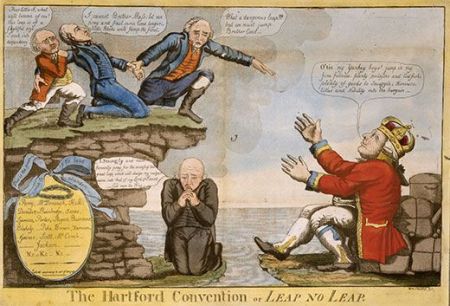
William Charles certoon, satirizing Thomas Pickering and the radical secessionist movement discussed at the Hartford Convention. H/T Smithsonian Magazine, for the image

It may have been the most unpopular war in United States’ history.  Much of New England threatened to secede, their position bolstered by the sack of Washington in August, 1814.

New England may have followed through with secession following the Hartford Convention of 1814, had not the Federalist position been made risible by future President Andrew Jackson’s overwhelming victory at the Battle of New Orleans.

Hartford Convention delegates ended with a formal report, resolutions from which would resurface decades later in a doctrine we know as nullification.

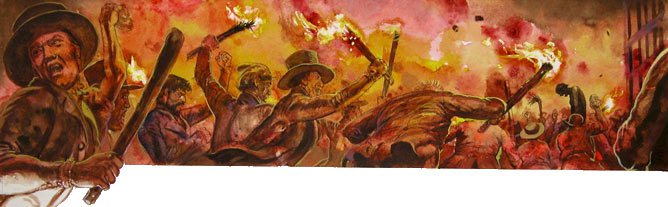
Opposition to America’s first declared war was vehement, and often bloody.  Four days after it began, the office of the Baltimore Federal Republican newspaper was burned to the ground by an angry mob, infuriated by the anti-war editorials of Alexander Contee Hanson.

settingstage2_stsp
Tip of the hat to historiograffiti, for this image

Hanson reopened his paper a month later, shielded by Revolutionary War veterans James Lingan and “Lighthorse Harry Lee”, father of Civil War General Robert E. Lee. The armed protection did him little good. Another mob formed within hours, this time torturing and severely beating Hanson, Lignan and Lee, before leaving them for dead.

James Lignan died of his injuries. Hanson recovered and went on to serve in the House of Representatives. Lee survived the beating but remained partially blind from hot wax poured into his eyes by the mob.

Baltimore Mayor Stephanie Rawlings-Blake claimed 200 years later, that, “Our city has a long history of peaceful demonstrations.”  With all due respect to Stephanie Rawlings-Blake, Baltimore has been known as “Mobtown”, for at least that long.

The war of 1812 was fought in a series of land and sea battles along three fronts: The Atlantic Ocean & East Coast, the Southern States, and the Great Lakes & Canadian Frontier.

The British Navy had virtually unchallenged control of the Great Lakes in 1812, with several warships already on station. The only American warship on Lake Erie was the brig USS Adams, pinned down in Detroit and not yet fitted for service.

War of 1812

Detroit fell almost immediately and remained in British hands for over a year. The Adams was captured along with the town and renamed “HMS Detroit”.

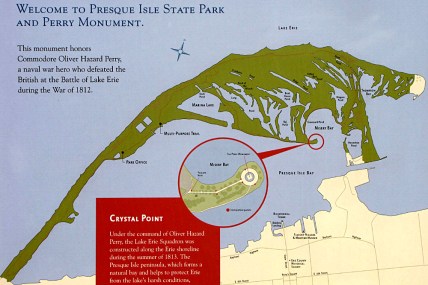
Meanwhile, Americans captured an English brig, the Caledonia, and acquired three civilian vessels, the schooners Somers and Ohio and the sloop-rigged Trippe. All four were converted into warships, which Master Commandant Oliver Hazard Perry had towed by oxen up the Niagara River. The operation which took six days. Once in Lake Erie they sailed down the coast to Presque Isle, on the Pennsylvania coast.

Chesapeake Bay and Pittsburgh foundries produced guns and fittings, while two more warships were ordered built at Presque Isle. Meanwhile, Perry drafted 50 experienced sailors from USS Constitution, then undergoing refit in Boston Harbor.

Presque Isle, Pennsylvania

The American squadron was almost complete by mid-July, but there was a problem. The sand bar at the mouth of Presque Isle Bay is only 5-feet deep. This sand bar kept the British blockade at bay, with a little help from 2,000 Pennsylvania militia and several shore batteries. Once ready though, American ships had to contend with the same obstacle.

British Commander Robert Heriot Barclay was forced to lift his blockade on July 29, due to a supply shortage and bad weather. Perry immediately began the exhausting process of moving his vessels across the sandbar. Guns had to be removed, the larger boats raised between “camels”:  barges lashed together and emptied of ballast to lift the ships high in the water. When Barclay returned four days later, he found the Americans had nearly completed the task.

What followed was one of history’s great head fakes. Naval warfare in the age of sail was typically conducted by two parallel lines of ships, pounding one another with cannon until one side could no longer take the punishment. Perry’s largest brigs were unready when the British fleet returned, yet the American gunboats formed into line of battle so quickly and with such confidence, that Barclay withdrew to await completion of HMS Detroit.

Put-In-Bay

Perry’s fleet established anchorage at Put-in-Bay on the Ohio coast. It was there that Barclay’s fleet came for them on September 10.

Battle lines converged outside the harbor shortly after 11:00am. Perry’s flagship USS Lawrence took a savage beating, the longer guns of HMS Detroit having 20 minutes to do their work before Lawrence could effectively reply.

Imacon Color Scanner
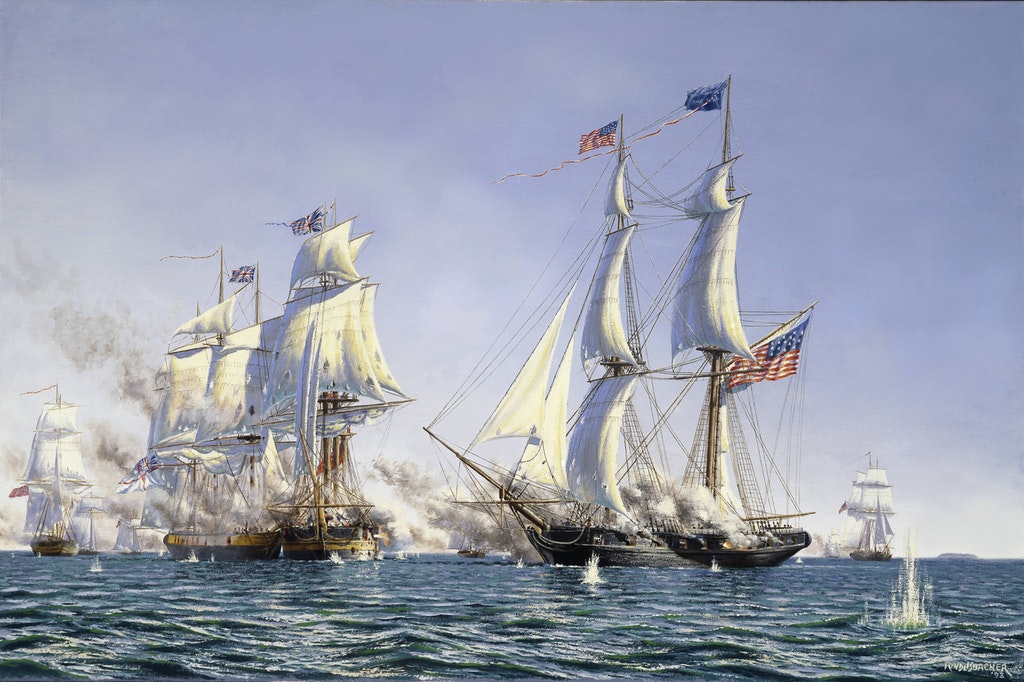
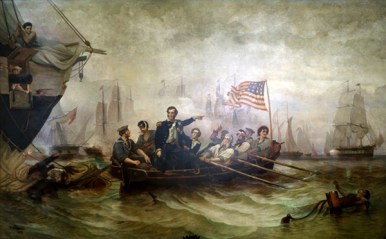
Battle of Lake Erie by William Henry Powell, painted 1865, shows Oliver Hazard Perry transferring from Lawrence to Niagara

HMS Queen Charlotte added her gunfire to that of Detroit. Soon the American flagship was a wreck, with 80% casualties. Perry transferred his flag and rowed to the USS Niagara half a mile away, the brig being almost unscathed in the action, up to this point.

Damaged masts and rigging on the British side resulted in collision between Detroit and Queen Charlotte. They were still snarled up as Niagara broke through the British line, pounding them with broadsides from 18 32-pounder carronades and two 12-pounder long guns. Smaller English ships attempted to flee but were quickly overtaken.

U.S. Brig Niagara
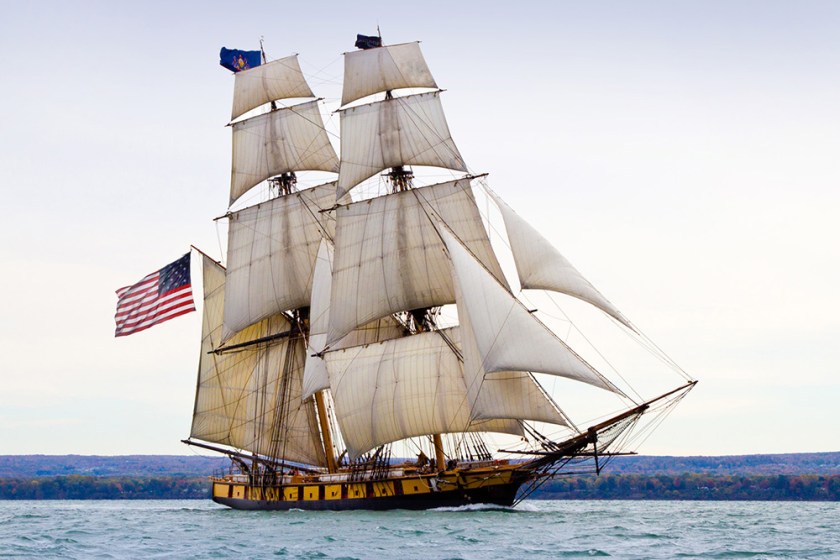
Brig USS Niagara, 2013

That afternoon American and English vessels, the latter now prizes of war, were anchored with hasty repairs already underway. Oliver Hazard Perry took an old envelope and scrawled his now famous message to future President William Henry Harrison. “Dear General, We have met the enemy and they are ours. Two ships, two brigs, one schooner and one sloop. Yours with great respect and esteem, O.H. Perry“.

Niagara remains in service to this day, a Coast Guard sail trainer and outdoor exhibit for the Erie Maritime Museum.  One of the last surviving ships, from the War of 1812.

September 9, 490BC Marathon

It has been said that western culture stands with one foot in Athens and the other, in Jerusalem. The stakes of what was about to happen on the beaches at Marathon, are difficult to overstate.  Arguably, the future of western civilization hung in the balance.

King Darius I, third King of the Achaemenid Empire of Persia ruled over an area stretching from North Africa to the Indian sub-continent, from Kazakhstan to the Arabian Peninsula.   200 years before the classical age of Greece, several Anatolian coastal polities rebelled, with support and encouragement from the mainland city states of Athens and Eritrea.

Achaemenid_Empire
Achaemenid Empire

The year was 499BC and this “Ionian Revolt” lasted, until 493BC.  Though ultimately unsuccessful, the Greeks had exposed themselves to the wrath of Darius.  Every night before dinner according to Herodotus, Darius required one of his servants three times, to say to him “Master, remember the Athenians“.

Darius
Darius I

The Persian “King of Kings” sent emissaries to the Greek city states demanding gifts of earth and water, signifying Darius’ dominion over all the land and sea. Most capitulated, but Athens put Darius’ emissaries on trial and executed them.  Sparta didn’t bother with a trial.  They threw the ambassadors down a well. “There is your earth”, they called down. “There is your water”.

Athens and Sparta were now effectively at war with the Persian Empire.

25 centuries ago, Darius sent an amphibious expedition to the Aegean, attacking Naxos and sacking Eritrea.   A force of some 600 triremes commanded by the Persian General Datis and Darius’ brother Artaphernes then sailed for Attica, fetching up in a small bay near the town of Marathon, about 25 miles from Athens.

Pheidippides

An army of 9,000-10,000 hoplites (armored infantry) marched out of Athens under the leadership of ten Athenian Strategoi (Generals), to face the 25,000 infantry and 1,000 cavalry of the Persians.  The Athenian force was soon joined by a full muster of 1,000 Plataean hoplites, while Athens’ swiftest runner Pheidippides was dispatched to Lacedaemon, for help.

The festival of Carneia was underway at this time, a sacrosanct religious occasion during which the Lacedaemonian (Spartan) army would not fight, under any circumstance.   Sparta would be unavailable until the next full moon, on September 9.  With 136 miles to Marathon, Spartan reinforcement was unlikely to arrive for a week or more.

The Athenian force arrived at the Plain of Marathon around September 7, blocking the Persian route into the interior.

Facing a force more than twice as large their own, ten Greek Generals split 5 to 5 whether to risk battle.

Greco Persian

A “Polemarch” is an Athenian civil dignitary, with full voting rights in military matters.  General Miltiades, who enjoyed a degree of deference due to his experience fighting Persians, went to the Polemarch Callimachus, for the deciding vote.

The stakes of what was about to come are difficult to overstate.  Arguably, the future of western civilization hung in the balance.

Athens itself stood defenseless, with every warrior here on the plain of Marathon. Miltiades spoke.  ‘With you it rests, Callimachus, either to bring Athens to slavery, or, by securing her freedom, to be remembered by all future generations…We generals are ten in number, and our votes are divided.  Half of us wish to engage, half to avoid a combat. Now, if we do not fight, I look to see a great disturbance at Athens which will shake men’s resolutions, and then I fear they will submit themselves. But, if we fight the battle…we are well able to overcome the enemy.’

With less than a mile between them, the two armies had faced one another for five days and five nights.  On September 12, 490BC, the order went down the Athenian line.  “At them!”

Marathon Charge

Weighed down with 70lbs per man of bronze and leather armor, the Greek line likely marched out to 200 yards, the effective range of Persian archers.  Greek heavy infantry closed the last 200 meters at a dead run, the first time a Greek army had fought that way.

Persian shafts flew by the thousands, yet the heavy armor and wooden shields of the hoplite formation, held.  Bristling with arrows yet seemingly unhurt, the Greek phalanx smashed into the Persian adversary, like an NFL front line into an “Antifa” mob.

Tom Holland, author of Persian Fire, describes the impact.  “The enemy directly in their path … realized to their horror that [the Athenians], far from providing the easy pickings for their bowmen, as they had first imagined, were not going to be halted … The impact was devastating. The Athenians had honed their style of fighting in combat with other phalanxes, wooden shields smashing against wooden shields, iron spear tips clattering against breastplates of bronze … in those first terrible seconds of collision, there was nothing but a pulverizing crash of metal into flesh and bone; then the rolling of the Athenian tide over men wearing, at most, quilted jerkins for protection, and armed, perhaps, with nothing more than bows or slings. The hoplites’ ash spears, rather than shivering … could instead stab and stab again, and those of the enemy who avoided their fearful jabbing might easily be crushed to death beneath the sheer weight of the advancing men of bronze“.

Darius’ force was routed, driven across the beach and onto waiting boats.  6,400 Persians lay dead in the sand. An unknown number were chased into coastal swamps, and drowned.  Athens lost 192 men that day, Plataea, 11.

Marathon Battle

In the popular telling of this story, Pheidippides ran the 25 miles to Athens and announced the victory with the single word “Nenikēkamen!” (We’ve won!”), and dropped dead.

That version first appeared in the writings of Plutarch, some 500 years later.  It made for a good story for the first Olympic promoters too, back in 1896, but that’s not the way it happened.

Herodotus of Halicarnassus, described by no less a figure than Cicero as the “Father of History”, tells us that Pheidippides was already spent.  No wonder.  The man had run 140 miles from Athens to Lacedaemon, to ask for Spartan assistance.

Despite the exhaustion of battle and the weight of all that armor, the Athenian host marched the 25 miles back home, arriving in time to head off the Persian fleet.  The Spartans arrived at Marathon the following day, having covered 136 miles in three days.

Though a great victory for the Greeks, Darius’ loss at Marathon barely put a dent in the vast resources of the Achaemenid Empire.  The Persian King, would return.

September 8, (est) 480BC The Battle of Thermopylae

Simonides’ famous encomium to the dead was inscribed on a commemorative stone at Thermopylae, atop a hill where the Greeks made their final stand.  The original stone is gone now, but the epitaph was engraved on a new stone in 1955.

In 490BC, the Persian King Darius I sent an amphibious expedition into the Aegean, only to be defeated by a far smaller force of Athenians at the Bay of Marathon.

As Achaemenid Emperor, leader of the most powerful state of his time, King Darius I was sovereign over 21 million square miles and more.  He had more to deal with than a handful of malcontents in the Peloponnese.  At the moment, Darius had an Egyptian revolt to put down, but the “King of Kings’” would be back.  He had a score to settle with the Greeks.   King Darius died before he was through, so it was that the Persian King Xerxes would return to finish what his father had begun, ten years before.

In 480BC, news of a massive Persian army on the move reached Lacedaemonia, principal region of the Spartan state.  De facto military leaders of the Greek alliance, the Spartans were then celebrating the religious festival of Carneia.  Lacedaemonian law forbade military activity at this time, the same reason the Spartans had shown up late at Marathon, ten years earlier.  

Spartan leaders went to the Temple of Apollo at Delphi, for advice.

The-Oracle-of-Delphi-Apollo-Talks-2
The Temple of Apollo, at Delphi

The Oracle at Delphi was a seer, usually selected from among epileptics, as the Greeks believed seizures were evidence that the sufferer was in touch with the Gods. A careful ritual was observed, before the Priestess would speak.  First she would bathe in the Castalian Spring, before drinking from another stream. A priest would then pour ice water over a goat, to determine the presence of Apollo. The goat’s shivering was understood to indicate that the God was present, and that he had invested his powers in the Oracle. If the signs were fortuitous, the Oracle would then inhale the gas emitted from a chasm near the temple.  With volcanic gasses rising from the ground beneath her, the “Pythia” would then mount to the Tripod.  Only then would she speak.

Priestess of Delphi
Oracle at the Temple of Apollo, at Delphi

“Hear your fate”, said the oracle, “O dwellers in Sparta of the wide spaces.  Either your famed, great town must be sacked by Perseus’ sons, or, if that be not, the whole land of Lacedaemon shall mourn the death of a king of the house of Heracles. For not the strength of lions or of bulls shall hold him, strength against strength; for he has the power of Zeus, and will not be checked until one of these two he has consumed.”

For King Leonidas of Sparta, the meaning was clear.  He himself would have to die to fulfill the Oracle’s prophesy.

Leonidas gathered a small blocking force of 300 Spartan Peers, all of them “Sires”. This was understood to be a suicide mission. Leonidas wanted only those warriors who would leave behind, a son.

Several Greek city states were technically at war with one another in 480BC, but that was dropped, as preparations were made for a two-pronged defense. An allied Greek navy would meet the Persian triremes at the straits of Artemisium while an army of Hoplites, Greek heavy infantry, would meet the Persian army at the narrow pass known as the “Hot Gates”.  Thermopylae.

Thermopylae topo

The 300 marched out at the head of an allied army of 7,000, to meet a Persian horde modern estimates put at 100,000 to 150,000. A native of Trachis told the Spartan General Dienekes, that Persian archers were so numerous their arrows would block out the sun. “Good”, replied the general. “Then we shall fight in the shade”.

When the overwhelming Persian army demanded the Spartans lay down their arms, Leonidas’ response was short and sweet.  “Molon Labe”, he said.  Come and get them.

The two armies collided on or about the 8th of September, 480BC.  Thermopylae, a mountain pass delineated by the Phocian Wall on one side and the Aegean Sea on the other, measured the width of two carts abreast, negating the Persian numerical advantage. Great piles of Persian dead choked the pass by the end of the 9th. Nothing that Xerxes could throw at the Greek heavy infantry could break their phalanx.

A traitor to his people then rose among the local population, Ephialtes of Trachis, who led the Persians through a narrow path to come around behind the Greek line.

Thermopylae

Knowing he was betrayed and would soon be surrounded, Leonidas sent most of the allied soldiers away.  They would be needed for the battle yet to come.

On day three, King Leonidas was left with his 300 Spartans, 700 Thespian allies and an unreliable contingent of 400 Thebans.  True to form, the Theban band defected en masse to the Persian side, at the earliest opportunity.  Still, the hordes of Xerxes were unable to break through the Greek line, even on two fronts.  They backed off and rained down arrows from a distance, until no Greek was left standing.

Artemisium devolved into a meaningless stalemate, and yet the Greek alliance had demonstrated itself more than capable of standing up to the mightiest empire of its time.   Athens, lacking the manpower to fight simultaneously on land and at sea, abandoned their city to be burned to the ground.  The regrouped Greek Navy crushed the Persians at Salamis.  The last Persian invader was driven off the Greek mainland the following August, following Greek victory at a place called Plataea.

Simonides’ famous encomium to the dead was inscribed on a commemorative stone at Thermopylae, atop a hill where the Greeks made their final stand.  The original stone is gone now, but the epitaph was engraved on a new stone in 1955.

“Go tell the Spartans, stranger passing by, that here, obedient to Spartan law, we lie.”

battlefield-of-thermopylae