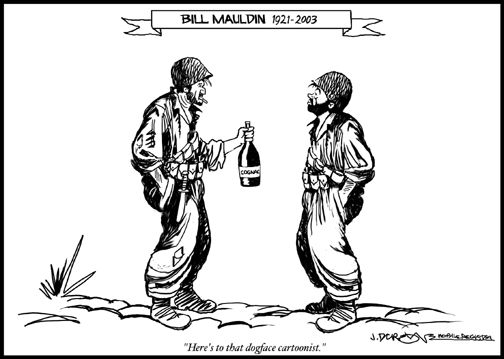
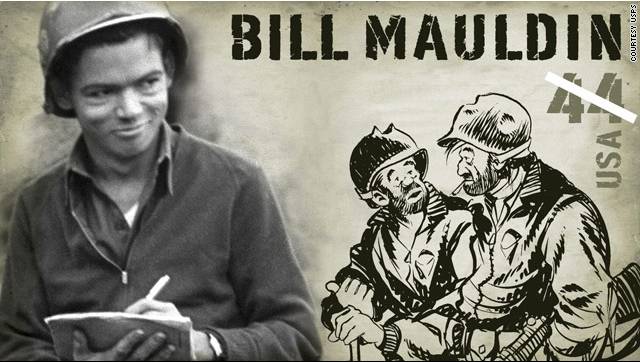
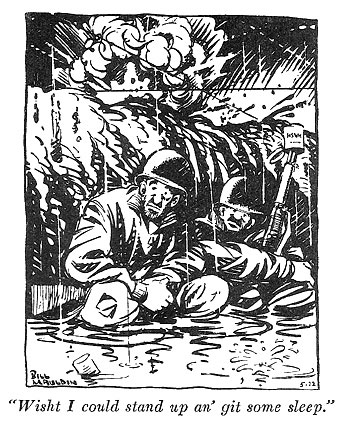
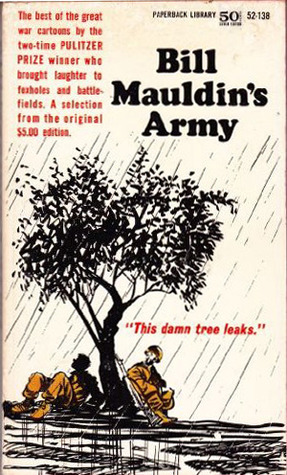
Mauldin told the story of the common soldier, usually at the rate of six per week. His medium was the cartoon.
Born on October 29, 1921 in New Mexico and brought up in Arizona, William Henry “Bill” Mauldin was part of what Tom Brokaw once called, the “Greatest Generation”.
When the United States entetef World War 2, He enlisted in the 45th Infantry Division. Mauldin was a talented artist, trained at the Chicago Academy of Fine Arts. So it was he volunteered to work for the unit’s newspaper, as a cartoonist.
As a sergeant of the 45th Division’s press corps and later for Stars & Stripes, Mauldin took part in the invasion of Sicily and later Italian campaign. He was given his own jeep and allowed to go wherever he pleased, which was usually out in front.
Mauldin told the story of the common soldier, usually at the rate of six per week. His medium was the cartoon.
Mauldin developed two infantry characters and called them “Willie and Joe” and told the story, through their eyes. He became extremely popular within the enlisted ranks, as much of his humor poked fun at the “spit & polish” of the officer corps. He even lampooned General George Patton one time, for insisting that his men be clean shaven all the time. Even in combat.
Patton summoned the cartoonist to his to “throw his ass in jail” for “spreading dissent”. Commander in Chief Dwight Eisenhower himself set Old Blood and Guts straight telling Patton, to leave the man alone. According to the Supreme Allied Commander, Mauldin’s cartoons gave the soldiers an outlet for their frustrations. He was good for morale.
Mauldin later told an interviewer, “I always admired Patton. Oh, sure, the stupid bastard was crazy. He was insane. He thought he was living in the Dark Ages. Soldiers were peasants to him. I didn’t like that attitude, but I certainly respected his theories and the techniques he used to get his men out of their foxholes”.
His was no rear echelon assignment. Mauldin’s fellow soldier-cartoonist, Gregor Duncan, was killed in Anzio in May 1944. Mauldin himself was wounded in a German mortar attack near Monte Cassino. By the end of the war he had received the Army’s Legion of Merit for his drawings.
Mauldin tried to revive Willy & Joe after the war, but found they didn’t assimilate well into civilian life.
“Peanuts” cartoonist Charles M. Schulz was himself a veteran of World War II. Schulz paid tribute to Rosie the Riveter and Ernie Pyle in his strip but more than any other, he paid tribute to Willy & Joe. Snoopy visited with Willie & Joe no fewer than 17 times over the years. Always on Veterans Day.
Bill Mauldin passed away on January 22, 2003, killed by a bathtub scalding exacerbated by complications of Alzheimer’s disease.
Bill Mauldin drew Willie & Joe for last time in 1998, for inclusion in Schulz’ Veteran’s Day Peanuts strip. Schulz had long described Mauldin as his hero.
He signed that final strip Schulz, as always, to which he added “and my Hero“. Bill Mauldin’s signature, appears underneath.
In New York city and state alike, economic ties with the south ran deep. 40¢ of every dollar paid for southern cotton stayed in New York in the form of insurance, shipping, warehouse fees and profits.
By the early 1830s, cotton exceeded the value of all other American exports, combined. As secession loomed over the nation, one Chicago Daily Times editorial warned that if the South departed “in one single blow, our foreign commerce must be reduced to less than one half of what it is now”.
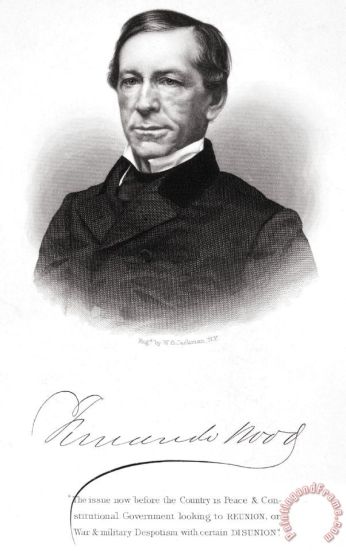
Fun Fact: South Carolina seceded in December 1860, and the world waited to see who’d follow. New York City became the next to call for secession on January 6, when Mayor Fernando Wood addressed that city’s governing body. “When Disunion has become a fixed and certain fact”, he cried, “why may not New York disrupt the bands which bind her to a venal and corrupt master…and destroyed the Confederacy of which she was the proud Empire City?”
In New York city and state alike, economic ties with the south ran deep. 40¢ of every dollar paid for southern cotton stayed in New York in the form of insurance, shipping, warehouse fees and profits.
30 minutes’ east of Buffalo, the village of Lancaster contemplated staying with the Union. 500 miles from the nearest Confederate state, George Huber remembered the time. “When war was declared, Lancaster seethed with the news, and many were the nights we stayed up as late as 12 o’clock to talk things out. I was twelve years old at the time, but I remember the stern faces of the elders and the storm of passionate and angry discussion. Soon the town split into two factions, it was a very tense situation…Often the excitement ran so high that if a man in either group had made the slightest sign, neighbors would have been at each other’s throats and fists would have taken the place of words.”
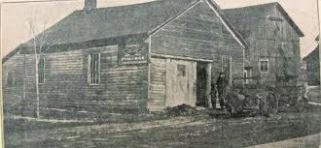
The old blacksmith shop
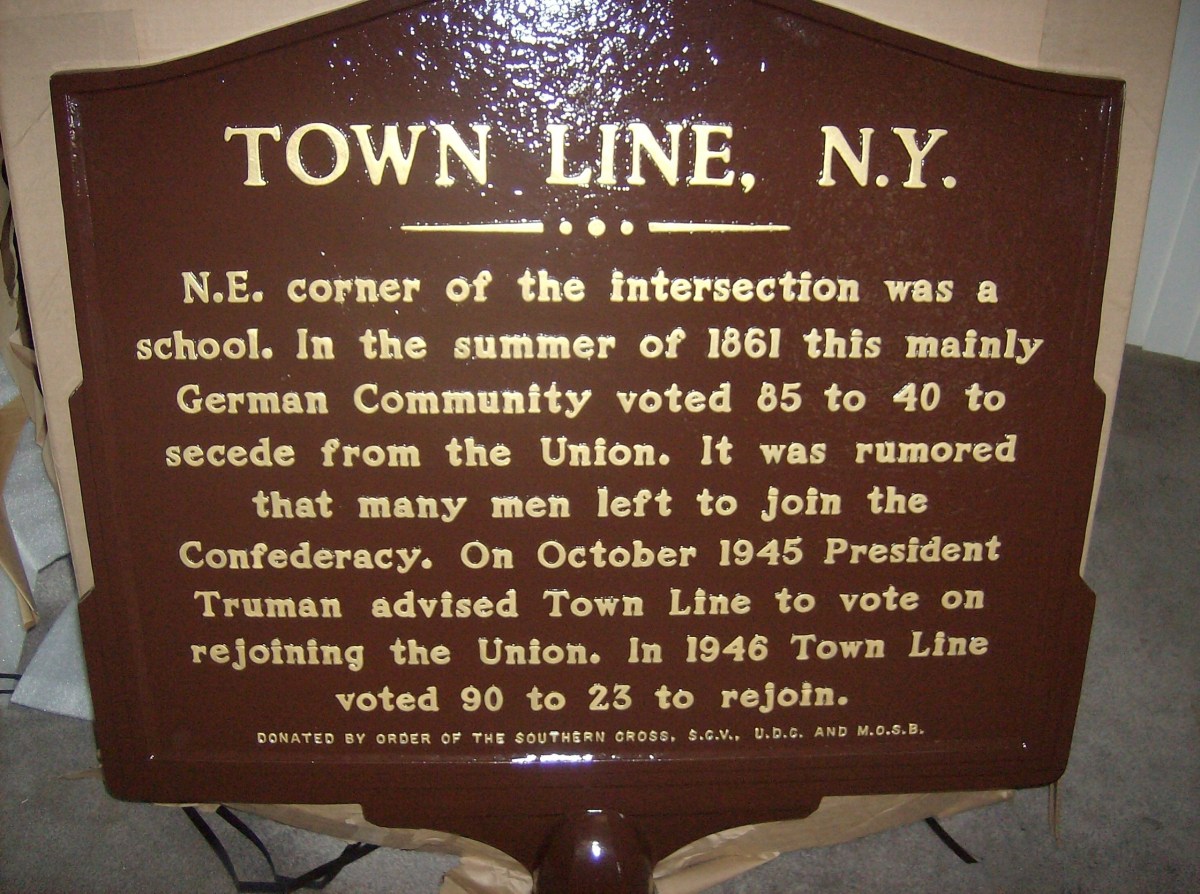
“Town Line”, a hamlet on the village’s eastern boundary, put the matter to a vote. In the fall of 1861, residents gathered in the old schoolhouse-turned blacksmith’s shop. By a vote of 85 to 40, Town Line voted to secede from the Union.
As casualty reports came back from the front there was angry talk of arresting “Copperheads” for sedition. “Seceders” grew quiet, afraid to meet in public places amidst angry talk of lynching. A half-dozen or so of the more ardent secessionists actually went south to fight for the Confederacy. Others quietly moved north, to Canada. Outside of Lancaster, no one seemed to notice. Taxes continued to be paid. No federal force ever arrived to enforce the loyalty of the small village.
A rumor went around in 1864, that a large Confederate army was building in Canada, poised to invade from the north. Town Line became a dangerous place for the few southern sympathizers left. Most of those remaining moved to Canada and, once again, Lancaster became the quiet little village in upstate New York, that nobody ever heard of.
Impatient to get on with it, Dade County Georgia “symbolically” seceded both from the state as well as the Union, back in 1860. Officially, Dade County seceded with Georgia in 1861, and rejoined with the rest of the state in 1870, but the deal was sealed on July 4, 1945 when a telegram from President Harry S. Truman was read at a celebration marking Dade County’s “rejoining” the Union.
The “Confederate Gibraltar”, Vicksburg Mississippi, fell on July 4, 1863. The city wouldn’t celebrate another Independence Day for 80 years.
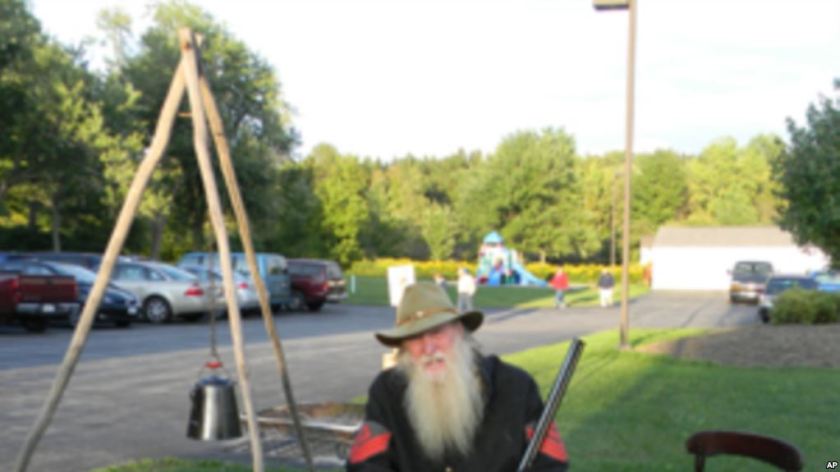
In 2011, the residents of Town Line, New York dressed up to mark the town’s sesquicentennial of secession from the Union
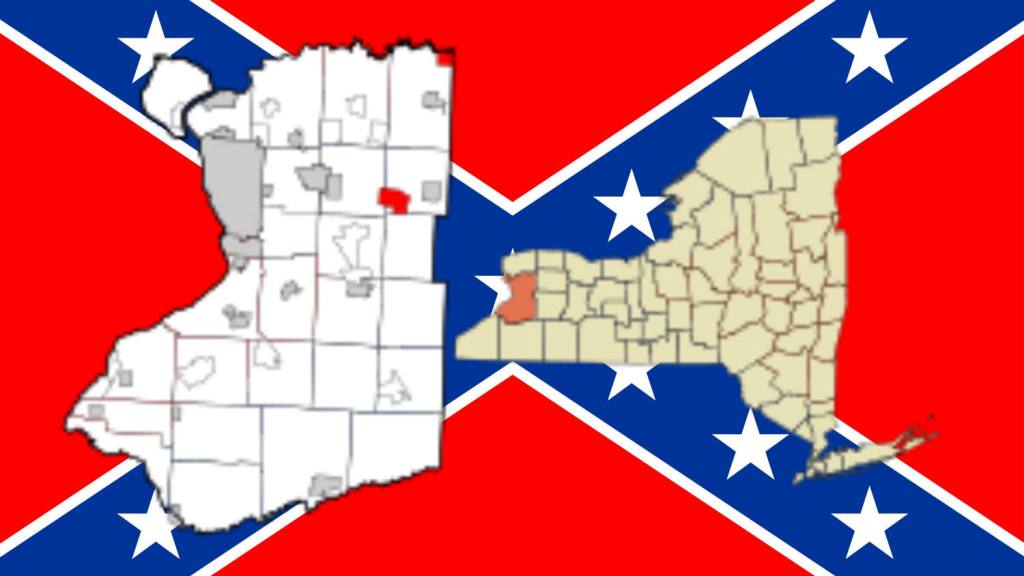
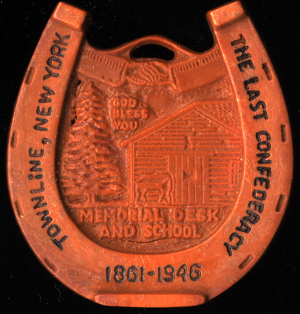
By October 1945 there legally remained only one part of the former Confederate States of America. The little hamlet of Town Line, New York.
Even Georgians couldn’t help themselves, from commenting. 97-year-old Confederate General T.W. Dowling opined: “We been rather pleased with the results since we rejoined the Union. Town Line ought to give the United States another try“. Judge A.L. Townsend of Trenton Georgia commented “Town Line ought to give the United States a good second chance“.
On October 7, 1945 there arrived a note by courier express. “There are few controversies that are not susceptible to a peace time resolution” read the note, “if examined in an atmosphere of tranquility and calm rather than strife and turmoil. I would suggest the possibility of roast veal as a vehicle of peace. Why don’t you run down the fattest calf in Erie County, barbecue it and serve it with fixin’s in the old blacksmith shop where the ruckus started? Who can tell? The dissidents might decide to resume citizenship.” The note was signed “Very Sincerely Yours, Harry Truman”.
Fireman’s Hall became the site of the barbecue, as “the old blacksmith shop where the ruckus started” was too small for the assembled crowd. On October 28, 1945 residents adopted a resolution suspending the 1861 ordinance of secession by a vote of 90-23. The Stars and Bars of the Confederate States of America was lowered for the last time, outside the old blacksmith shop.
Alabama member of the United States House of Representatives John Jackson Sparkman, may have had the last word: “As one reconstructed rebel to another, let me say that I find much comfort in the fact that you good people so far up in Yankee land have held out during the years. However, I suppose we grow soft as we grow older.”
Boss Tweed’s system of corruption inflated the cost of the New York County Courthouse to nearly $13 million, more than the Alaska purchase. One carpenter billed $360,751 (equivalent to $4.9 million today), for one month’s work. A plasterer got $133,187 for two days.
Before the first Europeans arrived in the “new world”, descendants of the Nanticoke inhabited a region from present-day Delaware north through New Jersey and southern New York, and eastern Pennsylvania. The Europeans called them “Delaware”. These indigenous Americans called themselves “Lenni-Lenape” which literally means “Men of Men”, but is translated to mean “Original People.” (Hat tip, http://www.nanticoke-lenape.info).
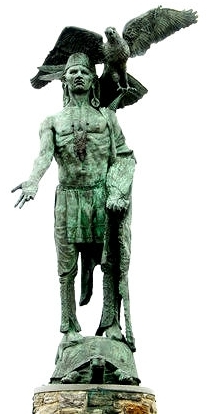
In the early 1680s, Chief Tammamend (“The Affable”) of the Lenni-Lenape nation took part in a meeting with the English colonists, where he is supposed to have said that his people and the newcomers would “live in peace as long as the waters run in the rivers and creeks and as long as the stars and moon endure.”
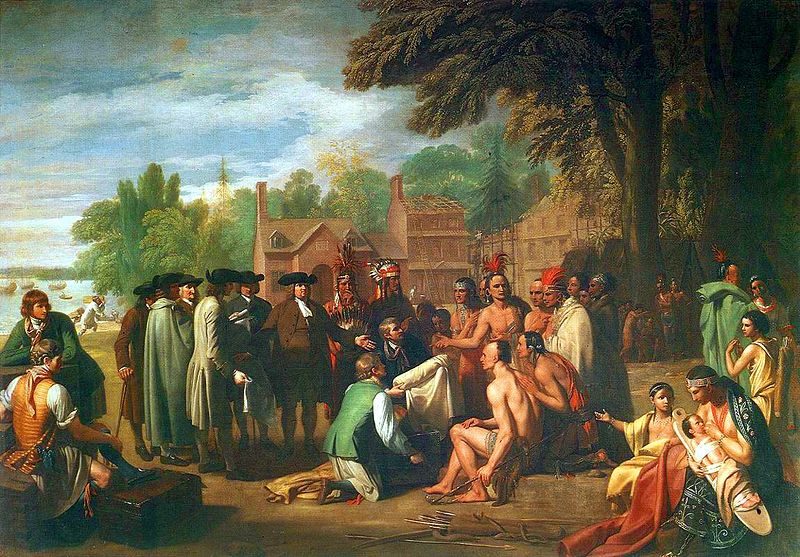
Treaty of Penn with Indians, by Benjamin West
“Tammany” to the settlers, Chief Tammamend became a living symbol of peace and friendship, between the two peoples. He died in 1701, but his legend lived on. In the next one-hundred years Tammany societies were established from Georgia to Rhode Island.
Tammany Societies adopted a number of native terms, with leaders calling themselves Grand Sachem, and meeting in halls called “Wigwams”. The most famous of these was incorporated in New York on May 12, 1789.
Within ten years, what had begun as a social club had morphed into a political machine. Tammany helped Aaron Burr counter Alexander Hamilton’s Society of the Cincinnati, and Burr went on to win New York’s two electoral votes in 1800. Without help from “Tammany Hall”, many historians believe that John Adams would have been re-elected to a second term.
Tammany Hall expanded its connections within New York Democrat party politics. After Andrew Jackson’s victory in 1828, the Tammany machine all but owned the government in New York city and state, alike.
Fun fact: On December 20, 1860, the Secession convention of South Carolina unanimously asserted an end to Union proclaiming that “We…have solemnly declared that the union heretofore existing between this State and the other States of North America, is dissolved, and that the State of South Carolina has resumed her position among the nations of the world, as a separate and independent State…” In the following days, the world waited to see who would follow. The next governing entity to actually do so was the state of Mississippi, but the first to discuss the idea (after South Carolina) was New York, in the person of Tammany Hall’s own mayor, Fernando Wood.
The 19th century was a time of massive immigration, providing an ever-expanding base of political and financial support for urban politicians. Political machines helped new arrivals with jobs, housing and citizenship, providing a patina of “constituent service” and hiding a dark under-belly of graft and corruption.
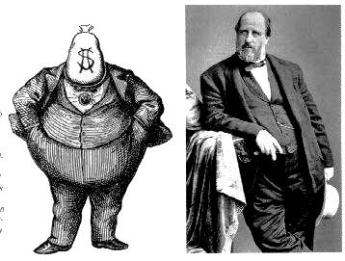
Boss Tweed
In the 1860s, Tammany Hall politician William Magear Tweed established a new standard in public self-dealing. Biographer Kenneth Ackerman wrote: “The Tweed ring at its height was an engineering marvel, strong and solid, strategically deployed to control key power points: the courts, the legislature, the treasury and the ballot box. Its frauds had a grandeur of scale and an elegance of structure: money-laundering, profit sharing and organization“.
New York contractors were instructed to multiply invoices. Checks were cashed through a go-between, settling with the contractor and dividing the rest between “Boss” Tweed and his cronies. This system of corruption inflated the cost of the New York County Courthouse to nearly $13 million, more than the Alaska purchase. One carpenter billed $360,751 (equivalent to $4.9 million today), for one month’s work. A plasterer got $133,187 for two days.
Some among the self-styled “Uppertens”, the top 10,000 amid New York’s socioeconomic strata, fell in with the self-dealing and corruption of the Tammany Hall machine. Others counted on an endless supply of cheap immigrant labor.
The system worked while Tweed’s Machine kept “his people” in line, until the “Orange Riots” of 1870-71 broke out between Irish Catholics and Protestants, killing 70.
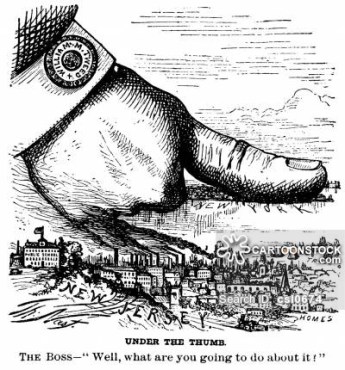
Harper’s Weekly editorial cartoonist Thomas Nast, creator of the modern American Santa Claus and the Republican Elephant, was the scourge of Tammany Hall. Following the Orange riots, the New York Times added its voice to that of the cartoonist.
Boss Tweed, the third-largest landowner in New York City, Director of the Erie Railroad, the Tenth National Bank, and the New York Printing Company, Proprietor of the Metropolitan Hotel, former State Senator and former Member of the United States Congress, was arrested on October 27, 1871, and tried on charges of public corruption. An 1877 aldermen’s committee estimated that Boss Tweed’s graft cost New York taxpayers between $25 and $45 million. Later estimates ranged as high as $200 million, equivalent to an astonishing $2.8 Billion, today.
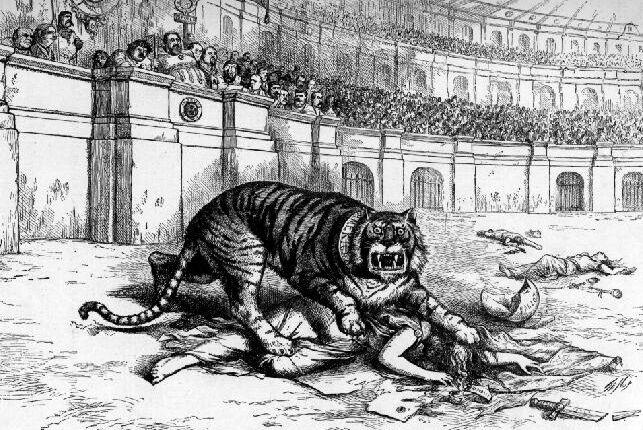
Cartoonist Thomas Nast denounced the Tammany machine as a ferocious tiger, devouring democracy.
The Tammany Hall political machine, moved on. By the end of the 19th century, ward Boss Richard Croker ran a system of graft and corruption the likes of which Boss Tweed could have only dreamed.
In the end, three things killed the Tammany Hall system. Early Irish arrivals had been primary beneficiaries and major supporters of Tammany’s patronage system, but there are only so many favors to go around. Continued immigration diluted Tammany’s base, and later arriving Irish, Italian and eastern European immigrants found themselves frozen out.
Next is the spoils system, itself. To this day, too many think it’s government’s job to “Bring home the Bacon”, not seeming to realize that they are themselves, the hogs. The Roosevelt administrations’ efforts to fix the Great Depression resulted in a blizzard of bacon from an increasingly Nationalized federal government, separating the local machines from their proximate base of support.
Last came “reformers” such as New York governor and future President of the United States Franklin Delano Roosevelt, who occasionally built enough steam to hurt the Tammany machine. Manhattan District Attorney Thomas E. Dewey, he of the famous “Dewey Wins!” photograph, managed to put several Tammany Hall leaders in jail, along with such unsavory supporters as “Lucky Luciano”.
Republican Fiorello La Guardia served three terms as New York mayor between 1934-’45, the first anti-Tammany mayor ever, to be re-elected. A brief resurgence of Tammany power in the 1950s met with Democratic party resistance led by the likes of Eleanor Roosevelt, and party politician Herbert Lehrman. By the mid-1960s, the Tammany Hall system, was dead.
Tammany Hall was a local manifestation of a disease afflicting the entire country. Boston, Chicago, Cleveland, Kansas City, Philadelphia, St. Louis and others: all suffered their own local outbreak.
Tammany Hall, Union_Square
The Ward Boss still lives in places like Chicago but, like the Jeffersons, the corruption has “moved on up”. Today, rent seekers and foreign powers pay tens of millions in “speaking fees” and other “pay-for-play” schemes.
A hundred years ago, Ambrose Bierce (my favorite curmudgeon) described politics as “A strife of interests masquerading as a contest of principles. The conduct of public affairs for private advantage“. Boss Tweed could tell you. It’s as true now, as it was in his time.
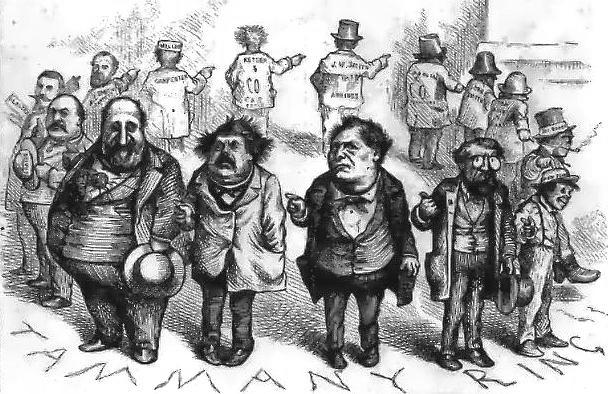
Featured image, top of page: Harper’s Weekly cartoonist Thomas Nast’s depiction of the Tammany ring: Who stole the people’s money? T’was him!
The history of the Navajo Code Talkers of WWII is relatively well known. A number of books have been written about the subject. Less well known is the code talk emerging from World War 1, based on the language of the Choctaw.
Between 1942 and 1945, “code talkers” of the Navajo Nation took part in every assault conducted by the United States Marine Corps. From Guadalcanal to Tarawa, Peleliu to Iwo Jima, Navajo code talkers served with all six Marine divisions in the Pacific theater, of World War 2.
Theirs was a language with no alphabet or symbols, a language with such complex syntax and tonal qualities as to be unintelligible to the non-speaker. The military code based on such a language proved unbreakable in WWII. Japanese code breakers never got close.
The history of the Navajo Code Talkers of WWII is relatively well known. A number of books have been written about the subject. Less well known is the code talk emerging from World War 1, based on the language of the Choctaw.
The government of the Choctaw Nation will tell you that they were the first native code talkers who ever served in the United States military.
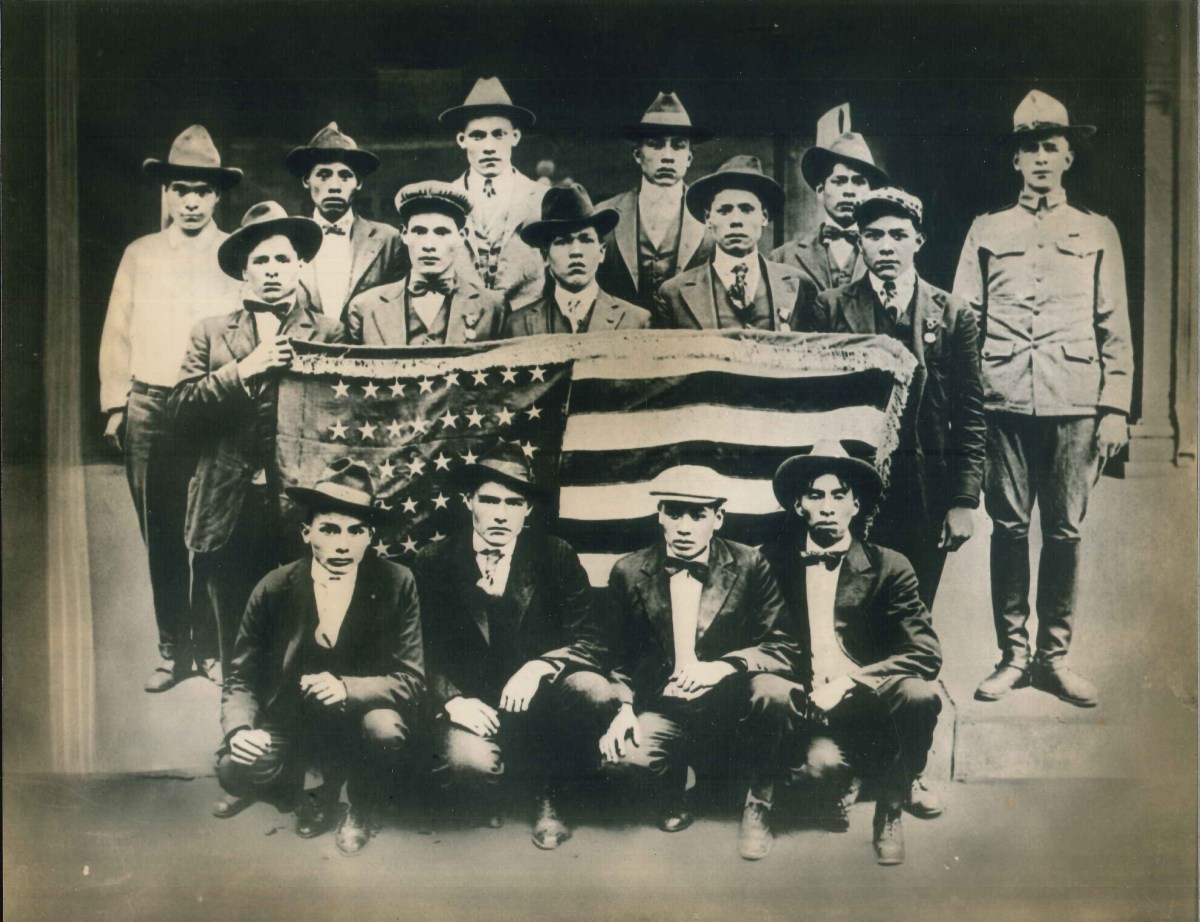
Late in 1917, Colonel A. W. Bloor was serving in France with the 142nd Infantry Regiment. This was a Texas outfit, constituted in May of that year and including a number of Oklahoma Choctaws.
By now the Allies had learned the hard way, that many among the German adversary spoke excellent English. German code breakers had intercepted and broken several English-based codes.
Bloor heard two of his Choctaw soldiers talking to each other, and realized he didn’t have the foggiest notion of what they were saying. If he didn’t understand their conversation he thought, no German could possibly have a clue.
The first test under combat conditions took place on October 26, 1918, as two companies of the 2nd Battalion performed a “delicate” withdrawal from Chufilly to Chardeny, in the Champagne sector. One captured German officer avowed the Choctaw code to have been a complete success. We were “completely confused by the Indian language”, he said, “and gained no benefit whatsoever” from wiretaps.
Choctaw soldiers were placed in multiple companies of infantry. Messages were transmitted via telephone, radio and runner, many of whom were themselves Native Americans.
The Choctaw would improvise when their language lacked the proper word or phrase. When describing artillery, they used the words for “big gun”. Machine guns were “little gun shoot fast”.
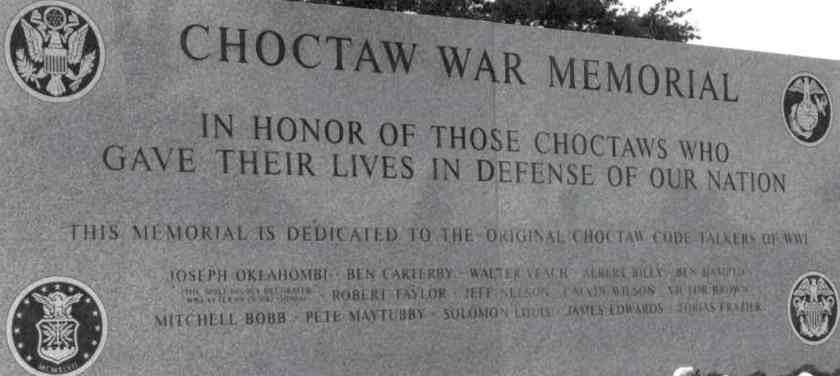
The Choctaw themselves didn’t use the term “Code Talker”, that wouldn’t come along until WWII. At least one member of the group, Tobias W. Frazier, described what he did as, “talking on the radio”. Of the 19 who served in WWI, 18 were native Choctaw from southeast Oklahoma. The last was a native Chickasaw.
Youngest of the group was Benjamin Franklin Colbert, Jr., the son of Benjamin Colbert Sr., one of Teddy Roosevelt’s “Rough Riders” of the Spanish American War. Born September 15, 1900 in the Durant Indian Territory, he was 16 the day he enlisted.
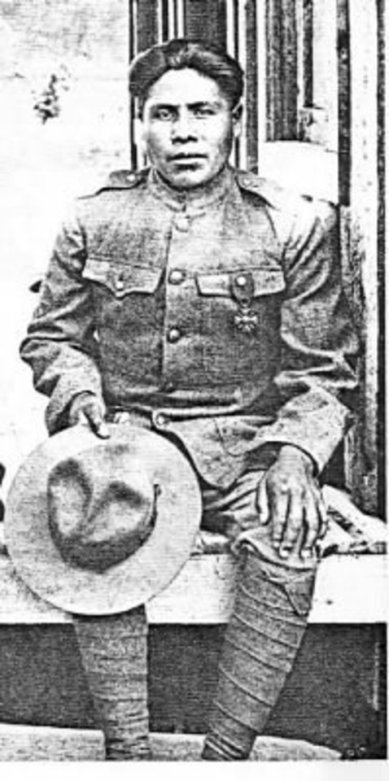
Joseph Oklahombi
Another was Choctaw Joseph Oklahombi, whose name means “man killer” in the Choctaw language.
Six days before Sergeant York’s famous capture of 132 in the Argonne Forest, Joseph Oklahombi charged a strongly held German position, single-handed. Oklahombi’s Croix de Guerre citation, personally awarded by French Marshall Philippe Pétain, tells the story: “Under a violent barrage, [Pvt. Oklahombi] dashed to the attack of an enemy position, covering about 210 yards through barbed-wire entanglements. He rushed on machine-gun nests, capturing 171 prisoners. He stormed a strongly held position containing more than 50 machine guns, and a number of trench mortars. Turned the captured guns on the enemy, and held the position for four days, in spite of a constant barrage of large projectiles and of gas shells. Crossed no man’s land many times to get information concerning the enemy, and to assist his wounded comrades“.
Unconfirmed eyewitness accounts report that some 250 Germans occupied the position, and that Oklahombi killed 79 of them before their comrades decided it was wiser to surrender.
Passing between two lines of French and American officials, Sgt. Younger entered the room, alone. Slowly, he circled the four caskets, three times, before at last stopping at the third from the left. “What caused me to stop” he later said, “I don’t know. It was as though something had pulled me”. Younger placed the roses on the casket, drew himself to attention, and saluted. This was the one.
Many years ago, Prussian Chancellor Otto von Bismarck remarked, “If a general war begins, it will be because of some damn fool thing in the Balkans“.
The Chancellor got his damn fool thing on a side street in Sarajevo, when a tubercular 19-year old leveled his revolver and murdered the heir-apparent to the Austro-Hungarian throne and his wife on June 28, 1914.
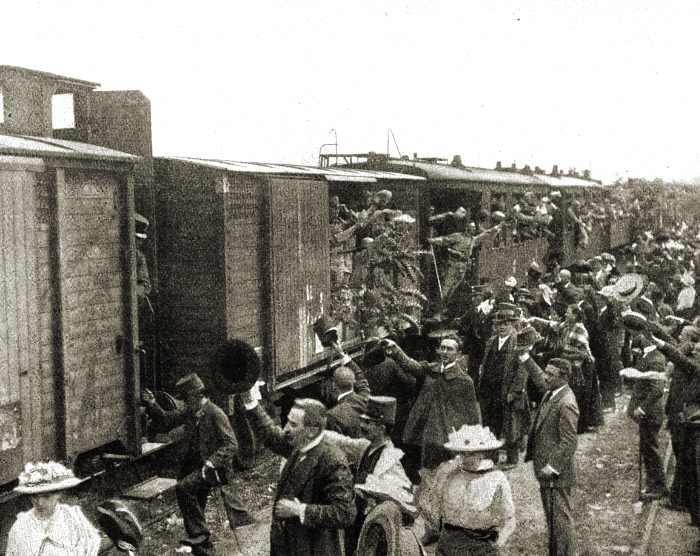
In another time and place, such an event may have led to limited conflict. A policing action, in the Balkans. Instead, mutually entangling alliances brought mobilization timetables into effect, dictating the movement of men and equipment according to precise and predetermined schedules.
German troops, leaving for the front
The hippie subculture of the 1960s produced an antiwar slogan based on the title of a McCall’s Magazine article by Charlotte E. Keyes. “Suppose They Gave a War and No One Came.” In 1914, the coming war Had to happen. If only because everyone was there.
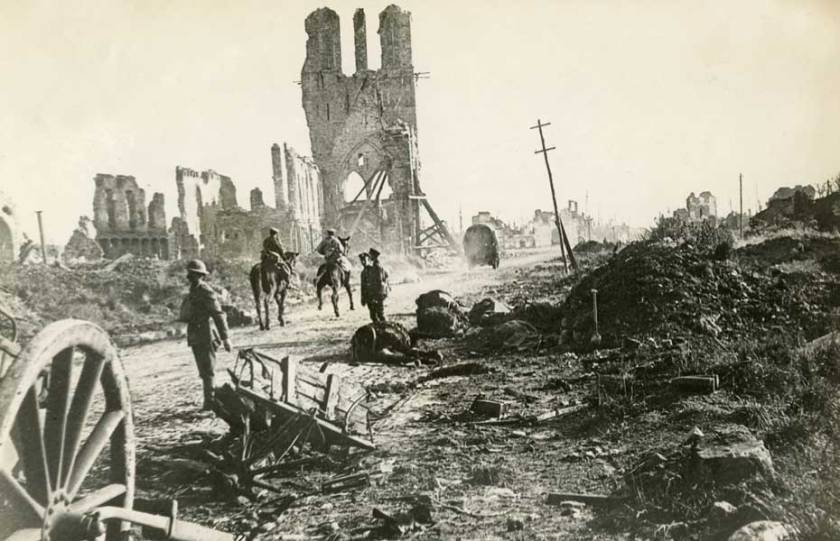
The cataclysm could have been averted, as late as the last day of July. By the first of August, mutual distrust had brought events past the point of no return. By the time it was over a generation was shattered, a continent destroyed and a new century, set on a difficult and dangerous course. Some 40 million were killed in the Great War, either that or maimed or simply,…vanished.
It was a mind bending number, equivalent to the entire population in 1900 of either France, or the United Kingdom. Equal to the combined populations of the bottom two-thirds of every nation on the planet. Every woman, man, puppy, boy and girl.
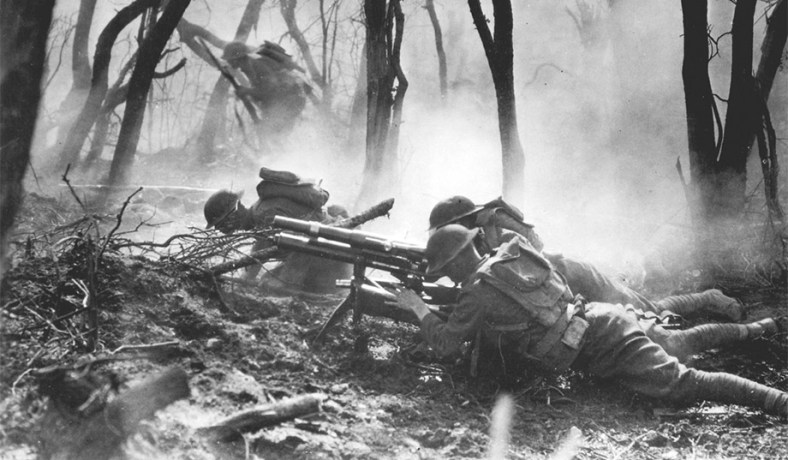
The United States entered the conflict in 1917, suffering casualties of 320,518 in only a few short months.
The idea of honoring the unknown dead from the “War to end all Wars” originated in Europe. Reverend David Railton remembered a rough cross from somewhere on the western front, with the words written in pencil: “An Unknown British Soldier”.
In November 1916, an officer of the French war memorial association Le Souvenir Français proposed a national-level recognition for the unknown dead of the Great War. Across the English Channel, Reverend Railton proposed the same.
The two nations performed ceremonies on the first anniversary of Armistice Day, the Unknown Warrior laid to rest at Westminster Abbey on November 11, 1920.
La Tombe du Soldat Inconnu was simultaneously consecrated under the Arc de Triomphe with the actual burial taking place, the following January.
Left to Right: Tomb of the Unknown Warrior, Westminster Abbey, London. La Tombe du Soldat Inconnu. lArc de Triomphe, Paris.
That was the year, the United States followed Great Britain and France in honoring her own, unknown dead.
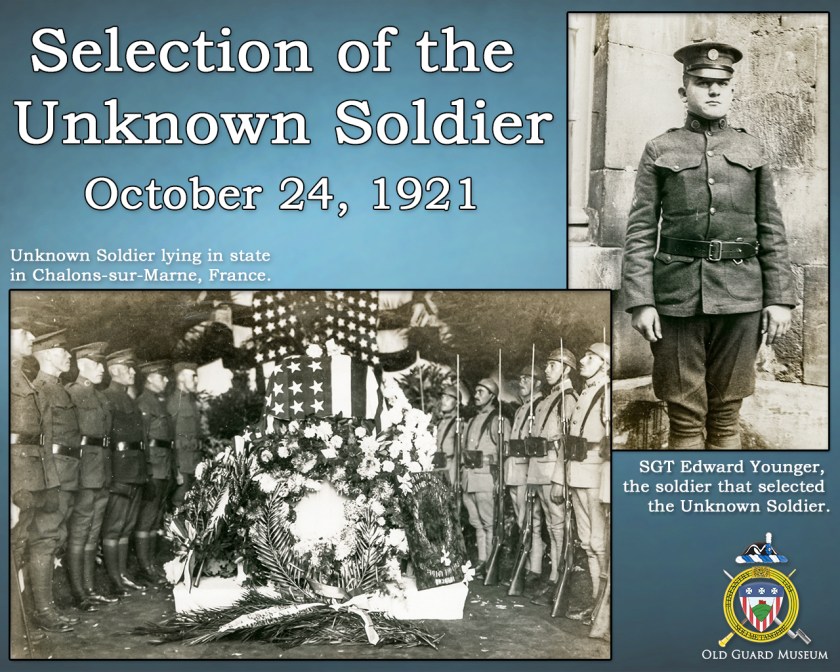
Four unidentified bodies were selected from the Aisne-Marne, Meuse-Argonne, Somme and St. Mihiel cemeteries and carefully examined, lest there be any clues to identity. The four were then transported to the Hôtel de Ville at Châlons-sur-Marne, and placed in a makeshift chapel.
Six soldiers were invited to act as pallbearers, each man a highly decorated and respected member of his own unit.
Outside the chapel, Major Harbold of the Graves Registration Office handed a large spray of pink and white roses to twice-wounded Sergeant Edward F. Younger, of the American Expeditionary Force (AEF). It was he who would perform the final selection.
Passing between two lines of French and American officials, Sgt. Younger entered the room, alone. Slowly, he circled the four caskets, three times, before at last stopping at the third from the left. “What caused me to stop” he later said, “I don’t know. It was as though something had pulled me“. Younger placed the roses on the casket, drew himself to attention, and saluted. This was the one.
The body was transferred to a black casket bearing the inscription: “An Unknown American who gave his life in the World War”.
The casket passed from French soil on October 25, 1921. Up the gangplank to the the protected cruiser USS Olympia, even as the band segueued from La Marseilles, to the Star Spangled Banner.
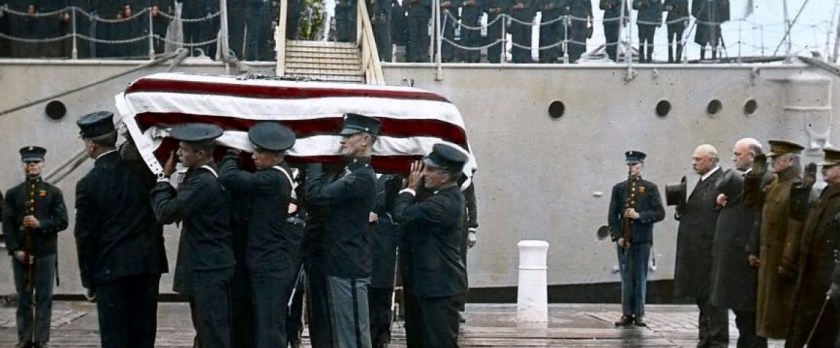
Flags at half-mast with stern bedecked with flowers, Commodore George Dewey’s former flagship at the Battle of Manila Bay received the precious cargo and returned to the United States, arriving in the Navy Yard in Washington DC on November 9, 1921.
There the flag draped casket was solemnly transferred to the United States Army, and placed under guard of honor on the catafalque which had borne the bodies of three slain Presidents: Abraham Lincoln, James Garfield, and William McKinley.
On November 11, the casket was removed from the Rotunda of the Capitol and escorted under military guard to the amphitheater at Arlington National Cemetery. In a simple ceremony, President Warren G. Harding bestowed upon this unknown soldier of the Great War, the nation’s highest military decorations. The Medal of Honor. The Distinguished Service Cross.
Special representatives of foreign nations then bestowed each in turn, his nation’s highest military decoration. The Croix de Guerre of Belgium. The English Victoria Cross. Le Medaille Militaire & Croix de Guerre of France. The Italian Gold Medal for Bravery. The Romanian Virtutes Militara. The Czechoslavak War Cross. The Polish Virtuti Militari.
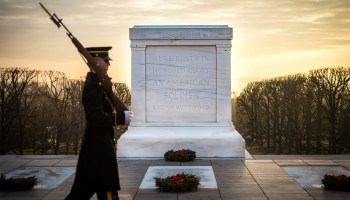
With three salvos of artillery, the rendering of Taps and the National Salute, the ceremony was brought to a close and the 12-ton marble cap placed over the Tomb of the Unknown Soldier. The west facing side bears this inscription:
“Here Rests In Honored Glory An American Soldier Known But To God”
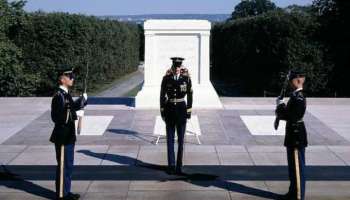
Two years later, a civilian guard was placed at the tomb of the unknown. A permanent Military guard took its place in 1926 and there remains, to this day.
In 1956, President Dwight David Eisenhower signed a bill to select and pay tribute to the unknown dead of WW2 and the American war in Korea. Selection and interment of these Unknowns took place in 1958.
The Unknown from the American war in Vietnam was selected on May 17, 1984, but wouldn’t remain unknown, for long.
Advances in mitochondrial DNA led to the exhumation and identification of Air Force 1st Lt. Michael Joseph Blassie of St. Louis, Missouri, shot down near An Lộc, in 1972.
The Tomb of the Unknown from the Vietnam conflict remains empty. It is unlikely any future war is capable of producing a truly “Unknown”.
Sharing Today in History:
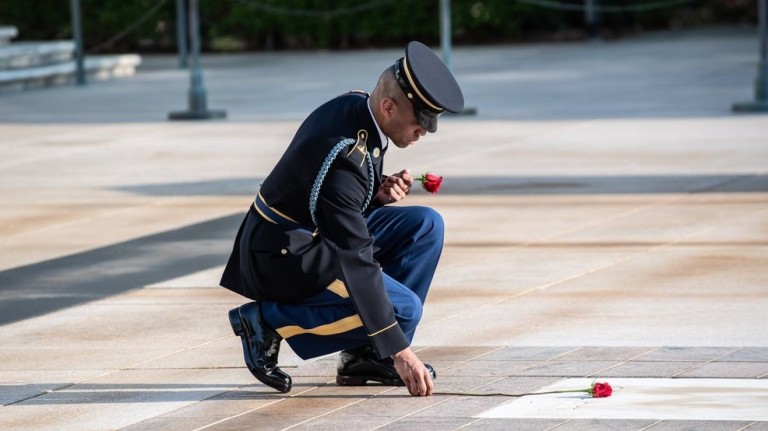
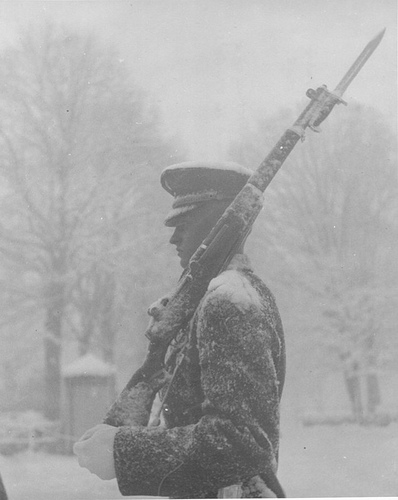
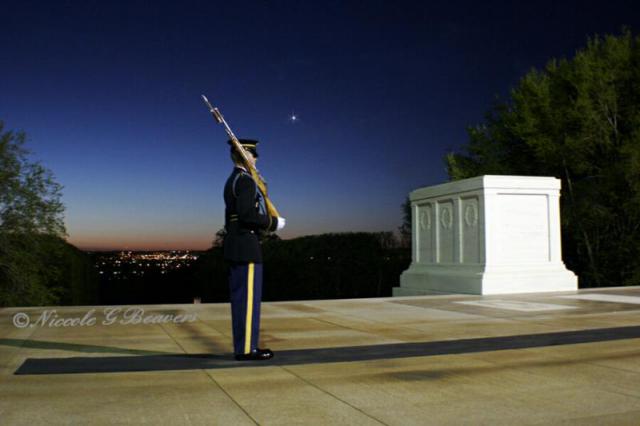
So it is through bitter cold and scorching heat, through hurricanes and blizzards and irrespective of day or night or whether Arlington is open or closed, the Tomb of the Unknown Soldier stands under guard.
This Guard of Honor is performed by a carefully selected elite body of the 3rd Infantry Division. The “Old Guard”. In service since 1784, the Tomb Guard is part of the longest-serving active infantry unit in the United States military.
Since the 14th-century, the cannon salute signified the recognition of a sovereign state and a peaceful intent, among nations. The 21-gun salute is the highest military honor, a nation can bestow. The Tomb Sentinel who “walks the mat” walks precisely 21 steps down the 63-foot black mat laid across the Tomb of the Unknown, signifying that 21-gun salute. The Guard then turns east to face the Tomb, pauses another 21-seconds, before beginning the return walk of 21-steps.
The Tomb Sentinel will continue in this manner for a half-hour, one hour or two depending on the time of day, and the season of the year. If you have witnessed the Changing of the Guard, you are not likely to forget it. My brother and I were once privileged to experience the moment, in the company of an Honor Flight of World War 2 veterans. If you’ve never seen the ceremony, I recommend the experience.
Back in 1919, AEF commander General John Pershing and Allied Supreme Commander Marshall Ferdinand Foch of France were adamantly opposed to the treaty, at Versailles. Germany had been defeated they argued, but not Beaten. Without destroying the German war machine on its own soil, Pershing believed the two nations would once again find themselves at war. Marshall Foch agreed, reading the treaty with the remark: “This isn’t a peace. It’s a cease-fire for 20 years!”
“Let Peace Take Root”
The Cedar of Lebanon tree grows in living memory of the Americans killed in the Beirut terrorist attack and all victims of terrorism throughout the world.
Dedicated during the first memorial ceremony for these victims.
Given by: No Greater Love
October 23, 1984
A time of remembrance
The Oxford English Dictionary defines Monument as “A statue, building, or other structure erected to commemorate a notable person or event”.
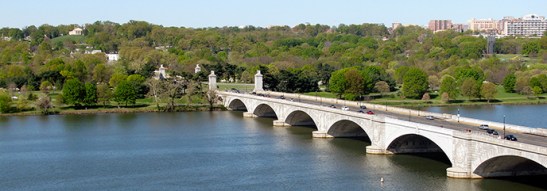
Our nation’s most hallowed ground is itself, such a monument; Memorial Avenue extending across the Potomac connecting Arlington House, the former home of Confederate General Robert E. Lee with the Lincoln Memorial at the opposite end symbolizing the immutable bond, between North and South.
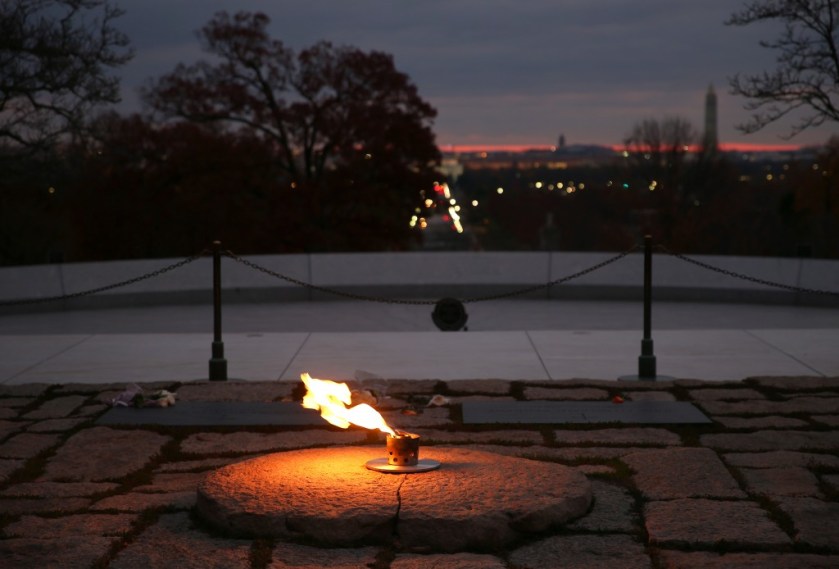
Approach Arlington at night and the eternal flame marking the grave of President John Fitzgerald Kennedy may be seen on the hillside, as if some faraway beacon of light.
A list of memorials at Arlington National Cemetery reads like a history of the nation itself.
The Argonne Cross commemorates the honored dead of the “War to end all Wars” in 1917-1918, some 2,100 of whom were re-interred in Section 18, following the war.
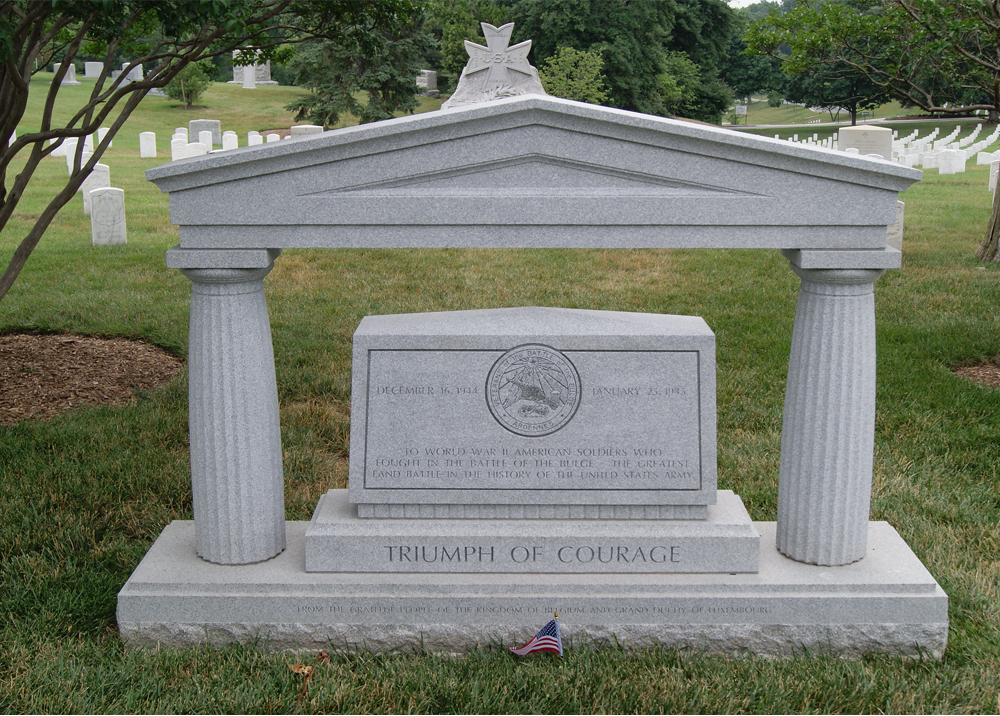
The Battle of the Bulge memorial reads, “To World War II American Soldiers who fought in the Battle of the Bulge- The greatest Land Battle in the history of the United States Army”.
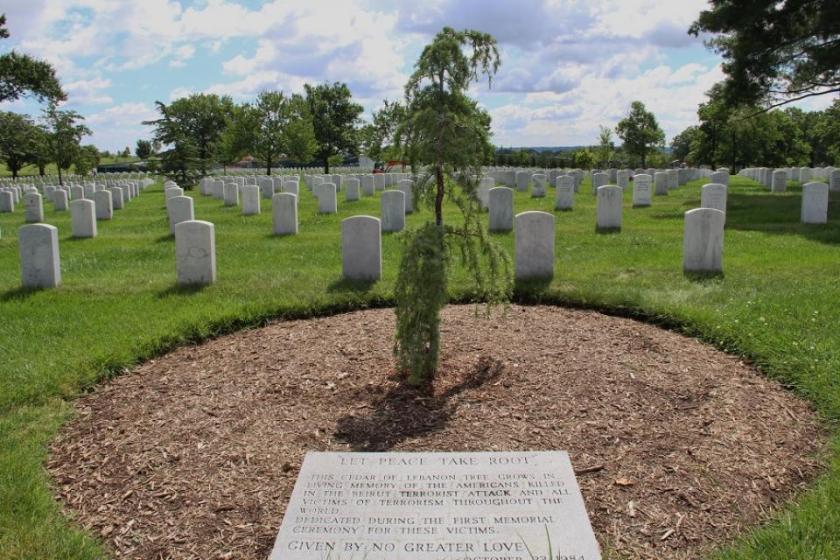
The Beirut Memorial honors 241 American service members killed in the October 23, 1983 bombing of the Marine barracks in Lebanon, twenty-one of whom went to their final rest, at Arlington National Cemetery. The inscription reads:
“Let Peace Take Root”
This Cedar of Lebanon tree grows in living memory of the Americans killed in the Beirut terrorist attack and all victims of terrorism throughout the world. Dedicated during the first memorial ceremony for these victims.
Given by: No Greater Love October 23, 1984 A time of remembrance
“This Cedar of Lebanon tree grows in living memory of the Americans killed in the Beirut terrorist attack and all victims of terrorism throughout the world. Dedicated during the first memorial ceremony for these victims”.
On Chaplain Hill stands four memorials bearing the name of of a military Chaplain, who laid down his lives in each of wars. The Cenotaph, (an empty tomb or a monument erected in honor of a person or group whose remains lie elsewhere) bears this inscription: “Greater Love Hath No Man Than This, That A Man Lay Down His Life For His Friends.”
Written there are the names of the only two chaplains to be awarded the Medal of Honor: Major Charles Joseph Watters, killed in Vietnam while rendering aid to fallen comrades, and Captain Emil Joseph Kapaun, the “Shepherd in Combat Boots” who remains to this day, in some unmarked North Korean grave.
I have barely scratched the surface of the Cs. Altogether there are 28 major and 142 minor memorials and monuments at Arlington, to say nothing of 400,000+ military grave sites, stretching across the landscape. Each of them across the 624 acres of Arlington, equivalent to 472 football fields, is dedicated to a person, place or event which has earned the right to be remembered.
It has long seemed to this writer that, irrespective of political persuasion, a free citizen of a Constitutional Republic cannot cast an informed ballot, cannot know where he wants his country to go, without an understanding of where it’s been. If you haven’t had the opportunity to visit Arlington National Cemetery recently, I highly recommend the trip. Leave yourself plenty of time to take it all in. It would be hard to find more heritage, tradition and history, in any other single place.
The St. Albans raid of October 19 1864 formed the northernmost land action of a Confederate force, as well as a final impetus toward the uniting of our northern neighbor.
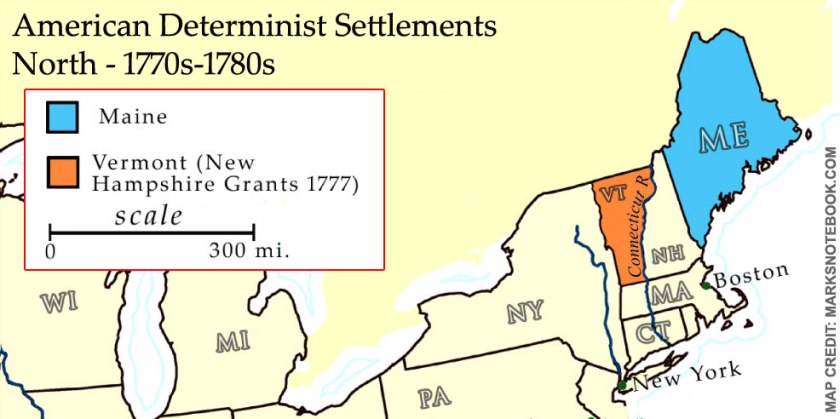
The name of Vermont conjures many things, the forested landscapes, ski slopes, maple syrup and mountain trout brooks. The first state to be admitted into the union formed by the 13 former colonies, the 14th state existed for as many years as an independent Republic, a distinction shared with only three other states: Texas, Hawaii and California.
Fun Fact: For a time, western districts of Florida also formed their own sovereign state: the Republic of West Florida. If you ever want to get a Texan going, ask them about the Original “Lone Star Republic“.
In the late 18th century, lands granted by the governor of New Hampshire led the colony into conflict with the neighboring province of New York. Conflict escalated over jurisdiction and appeals were made to the King, as the New York Supreme Court invalidated the “New Hampshire grants”.
Infuriated residents of the future Vermont Republic including Ethan Allen and his “Green Mountain Boys”, rose up in anger. On March 13, 1775, two Westminster Vermont natives were killed by British Colonial officials. Today we remember the event as the “Westminster Massacre”.
The battles at Lexington and Concord broke out a month later, ushering in a Revolution and eclipsing events to the north. New York consented to admitting the “Republic of Vermont” into the union in 1790, ceding all claims on the New Hampshire land grants in exchange for a payment of $30,000. Vermont was admitted as the 14th state on March 4, 1791, the first state so admitted following adoption of the federal Constitution.
Organized in 1785, the city of St. Albans forms the county seat of Franklin County, Vermont. 15 miles from the northern border and located on the eastern shore of Lake Champlain, it’s not the kind of place you’d expect for a Civil War story.
St. Albans Vermont, 1864
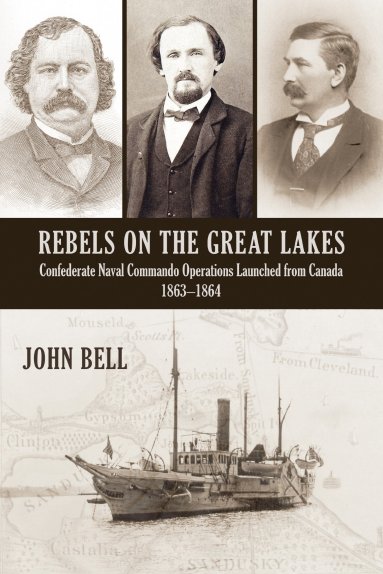
The Confederate States of America maintained government operations north of the border, from the earliest days of the Civil War. Toronto was a logical relay point for communications with Great Britain, from which the Confederate government unsuccessfully sought to gain support.
Secondly, the future Canadian nation provided a safe haven for prisoners of war, escaped from Union camps.
Former member of Congress and prominent Ohio “Peace Democrat” Clement Vallandigham fled the United States to Canada in 1863, proposing to detach the states of Illinois, Indiana and Ohio from the Union in exchange for sufficient numbers of Confederate troops, to enforce the separation. Vallandigham’s five-state “Northwestern Confederacy” would include Kentucky and Missouri, breaking the Union into three pieces. Surely that would compel Washington to sue for peace.
In April 1864, President Jefferson Davis dispatched former Secretary of the Interior Jacob Thompson, ex-Alabama Senator Clement Clay, and veteran Confederate spy Captain Thomas Henry Hines to Toronto, with the mission of raising hell in the North.
This was no small undertaking. A sizeable minority of Peace Democrats calling themselves “Copperheads” were already in vehement opposition to the war. So much so that General Ambrose Burnside declared in his General Order No. 38, that “The habit of declaring sympathy for the enemy will not be allowed in this” (Ohio) “department. Persons committing such offenses will be at once arrested with a view of being tried. . .or sent beyond our lines into the lines of their friends. It must be understood that treason, expressed or implied, will not be tolerated in this department“.
Hines and fellow Confederates worked closely with Copperhead organizations such as the Knights of the Golden Circle, the Order of the American Knights, and the Sons of Liberty, to foment uprisings in the upper Midwest.
In the late Spring and early Summer of 1864, residents of Maine may have noted an influx of “artists”, sketching the coastline. No fewer than fifty in number, these nature lovers were in fact Confederate topographers, sent to map the Maine coastline.
The Confederate invasion of Maine never materialized, thanks in large measure to counter-espionage efforts by Union agents.
J.Q. Howard, the U.S. Consul in St. John, New Brunswick, informed Governor Samuel Cony in July, of a Confederate party preparing to land on the Maine coast.
The invasion failed to materialize, but three men declaring themselves to be Confederates were captured on Main Street in Calais, preparing to rob a bank.
Disenchanted Rebel Francis Jones confessed to taking part in the Maine plot, revealing information leading to the capture of several Confederate weapons caches in the North, along with operatives in Maine, Massachusetts, New York, Pennsylvania, Maryland, Illinois, Kentucky, Tennessee and Ohio.
Captain Hines planned an early June uprising in the Northwest, timed to coincide with a raid planned by General John Hunt Morgan. Another uprising was planned for August 29, timed with the 1864 Democratic Convention in Chicago. The conspirators’ actions never lived up to the heat of their rhetoric, and both operations fizzled. A lot of these guys were more talk than action, yet Captain Hines continued to send enthusiastic predictions of success, back to his handlers in Richmond.
“Canada” itself was a loose confederation of independent provinces in 1864. At the September 1, Charlottetown Conference, politicians from the United Province of Canada and Britain’s Maritime colonies discussed a possible union.
The Toronto operation tried political methods as well, supporting Democrat James Robinson’s campaign for governor of Illinois. If elected they believed, Robinson would turn over the state’s militia and arsenal to the Sons of Liberty. They would never know. Robinson lost the election.
Bennett Henderson Young
All this fomenting cost money, and lots of it. In October 1864, the Toronto operation came south to St. Albans, to make a withdrawal.
Today, St. Albans is a quiet town of 6,869. In 1864 the town was quite wealthy, home to manufacturing and repair facilities for railroad locomotives. Located on a busy rail line, St. Albans was also home to four banks.
Nicholasville, Kentucky native Bennett Henderson Young was a member of the Confederate 8th Kentucky Cavalry, captured during Morgan’s 1863 raid into Ohio. By January, Young escaped captivity and fled to Canada. On October 10, Bennett crossed the Canadian border with two others, taking a room at the Tremont House, in St. Albans. The trio claimed they had come for a “sporting vacation”.
Small groups filtered into St. Albans in the following days, quietly taking rooms across the town. There were 21 altogether, former POWs and cavalrymen, hand selected by Young for their daring and resourcefulness.
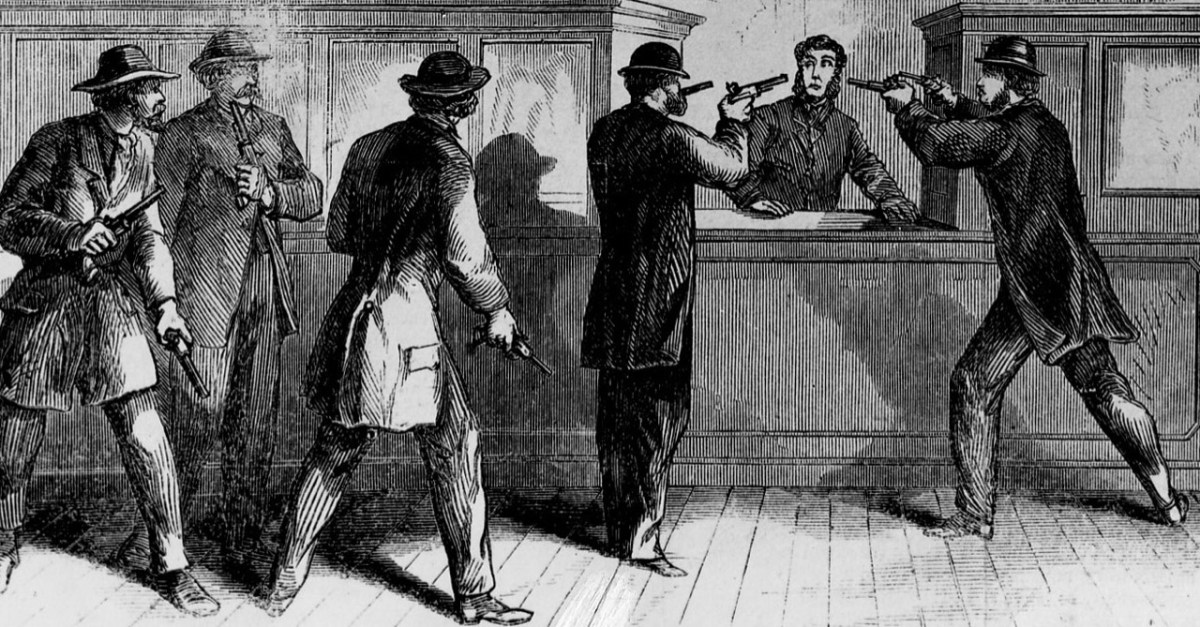
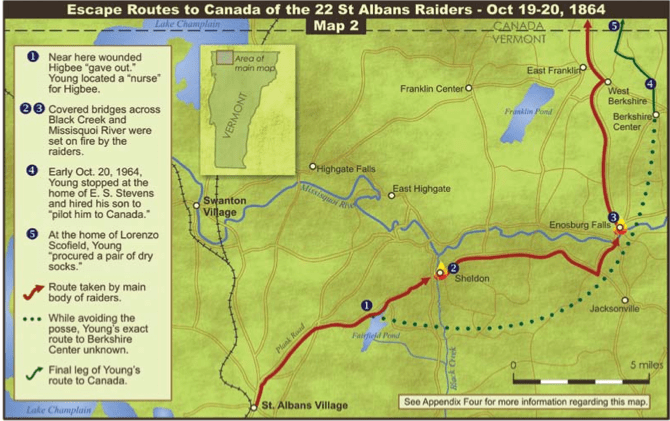
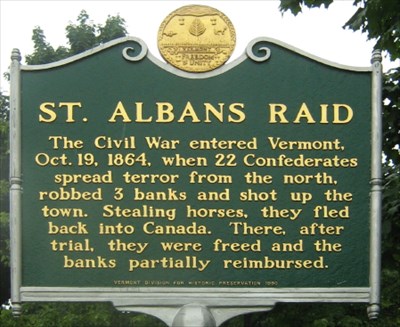
On October 19, 1864, the group sprang into action. Splitting into four groups and declaring themselves Confederate soldiers, the groups simultaneously robbed three of St. Albans’ four banks while eight or nine held the townspeople at gunpoint, on the village green. One resident was killed before it was over and another wounded. Young ordered his troops to burn the town, but bottles of “Greek Fire” carried for the purpose, failed to ignite. Only one barn was burned down and the group got away with a total of $208,000, and all the horses they could muster. It was the northernmost Confederate action by land, of the Civil War.
The group was arrested on crossing the border and held in Montreal. The Lincoln administration sought extradition but Canadian courts decided otherwise, ruling that the raiders were under military orders at the time and neutral Canada could not extradite them to America. The $88,000 found with the raiders, was returned.
American sensibilities were outraged. At least, those in the north. The Chicago Tribune urged the Northern states to invade, to “…take Canada by the throat and throttle her as a St. Bernard would a poodle pup.” President Abraham Lincoln announced that our neighbors to the north would now be required to produce passports, to travel south. The Reciprocity Treaty of 1854 abolishing duties on cross-border imports, was abolished.
33 delegates were in Quebec City at this time, deadlocked over the Maritime Provinces’ objections to the proceedings.
Upper Canadian politician John A Macdonald declared, “For the sake of securing peace to ourselves and our posterity we must make ourselves powerful…The great security for peace is to convince the world of our strength by being united.” MacDonald, the only member of the Quebec Conference with a background in constitutional law drafted 50 of the 72 resolutions, emerging from the meeting.
So it is a Confederate robbery of a Vermont bank provided the final impetus, toward a united Canada. The dominion of Canada was established on July 1, 1867.
The million dollars the Confederate government sank into its Canadian office, probably did more harm than good. Those resources could have been put to better use, but we have the advantage of hindsight. Neither Captain Hines nor Jefferson Davis could know how their story would turn out. In the end, both men fell victim to that greatest of human weaknesses: of believing to be true, that which they wanted to believe.
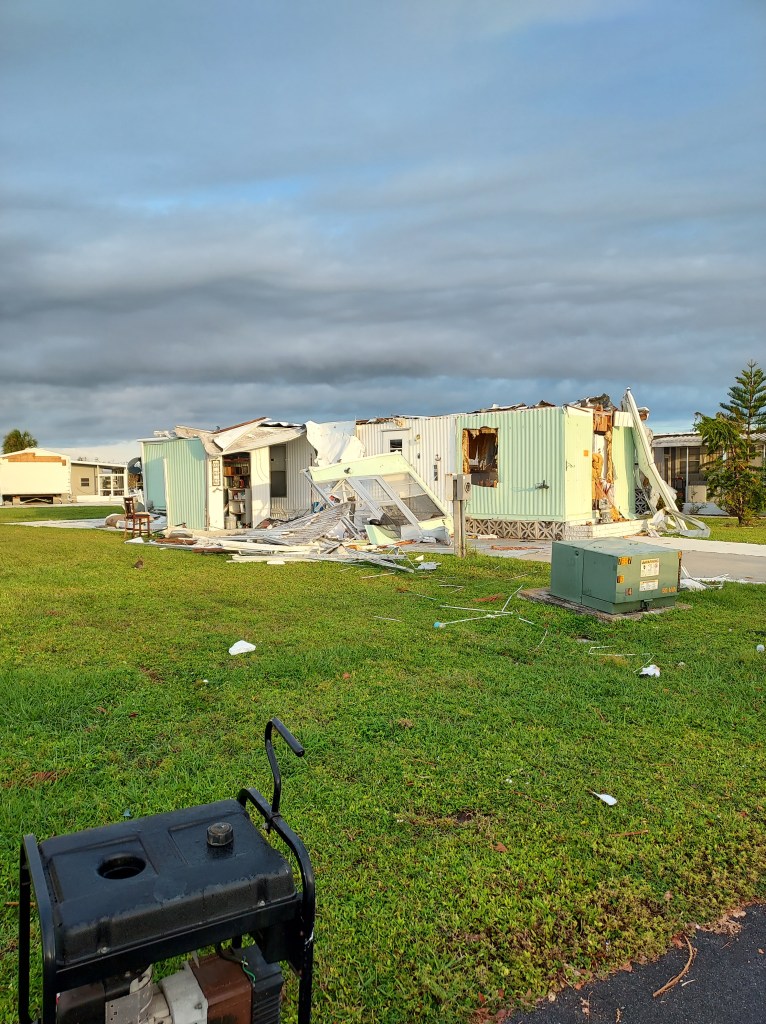
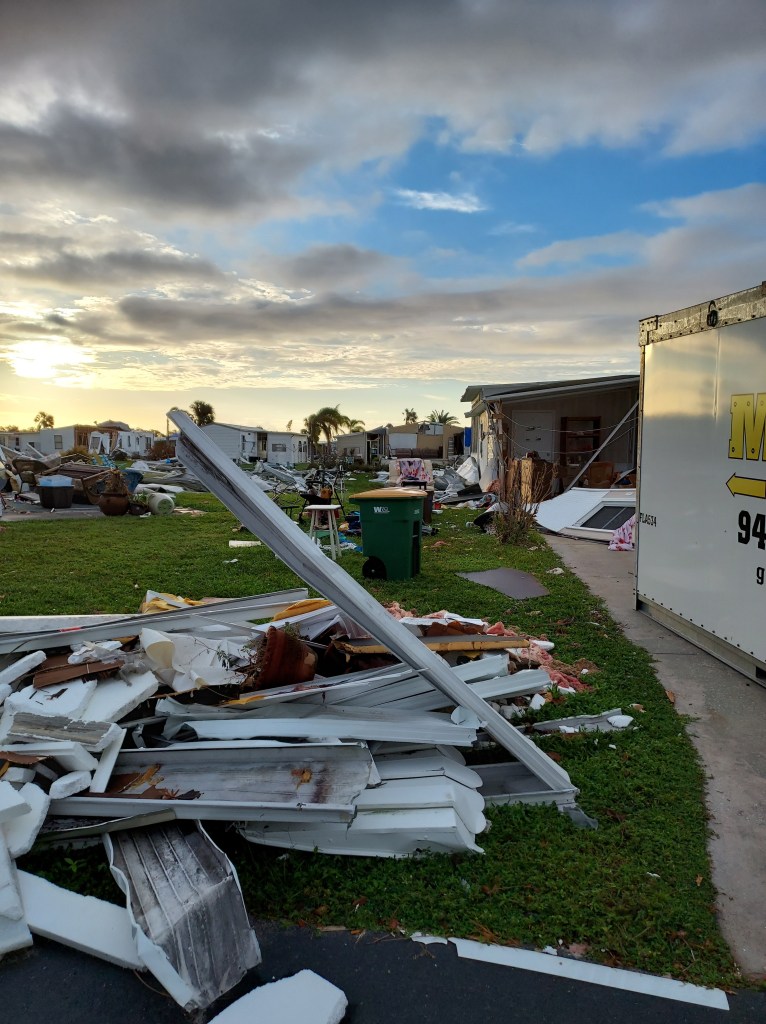
One day Hurricane Ian will become “history”. For now, kindly permit me this personal tale.
This was Mom’s place before and after the Long brothers arrived, to rebuild.
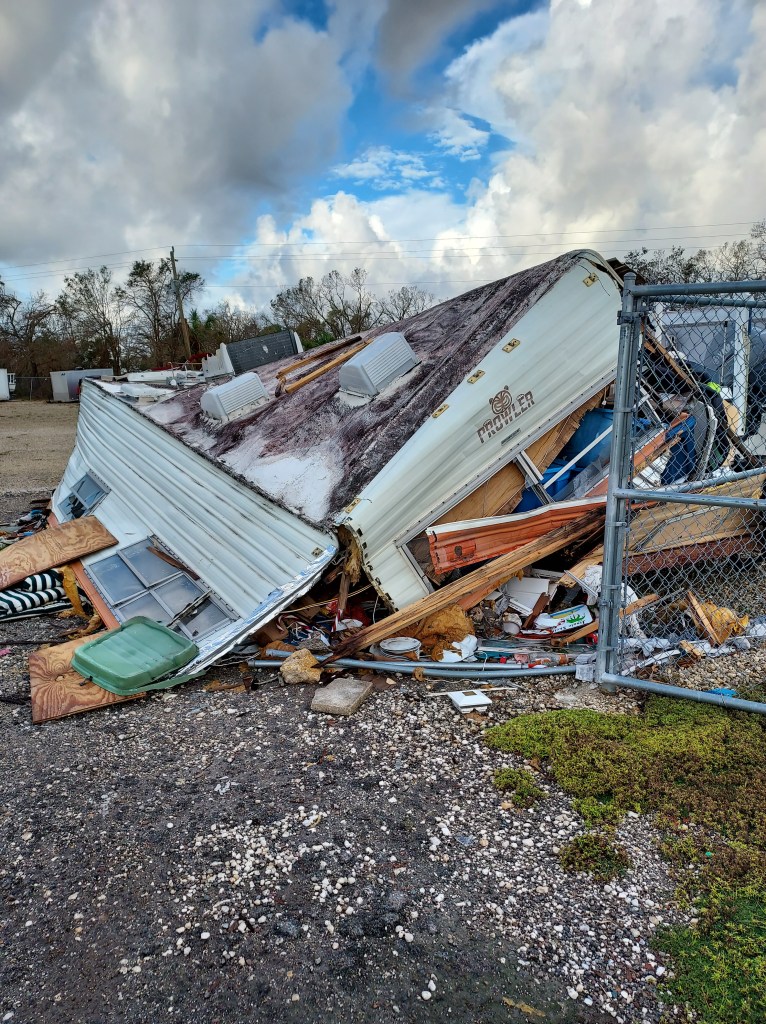
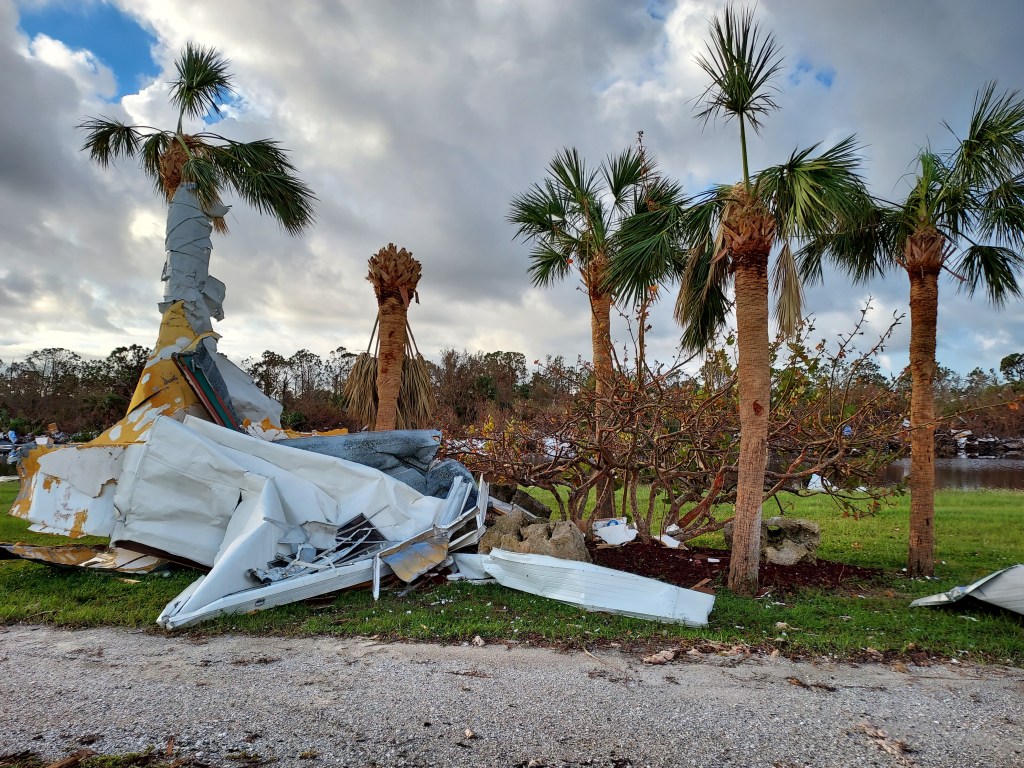
The sights would break your heart. This is a middle income retirement community already victim of a January tornado, now literally torn to bits. Some folks will never be back. They have nothing to return to.
I have to say though after a week there, a disaster like Hurricae Ian brought out the best in most everyone I met.
FEMA and state agencies, Salvation Army, all did an amazing job but it wasn’t just the large organizations.
Struggling with a 200-pound generator two different guys stopped their trucks, to help me out. Church and civic groups, even private individuals from the Northeast to Texas came to pitch in. There were squadrons of utility trucks and caravans of semi rigs. It seemed the cavalry was riding to the rescue.
Everyday Home Depot, Publix and Winn Dixie employees worked brutal hours to bring folks the necessities even though they themselves had messes to deal with, back at home.
After a week in the hurricane zone I could tell you stories, and they all amount to this. There is more that’s right with the world than the Evening News would have you believe.
He asked not that his life be spared, but only that he be executed by firing squad, a more worthy death for a gentleman, than hanging.
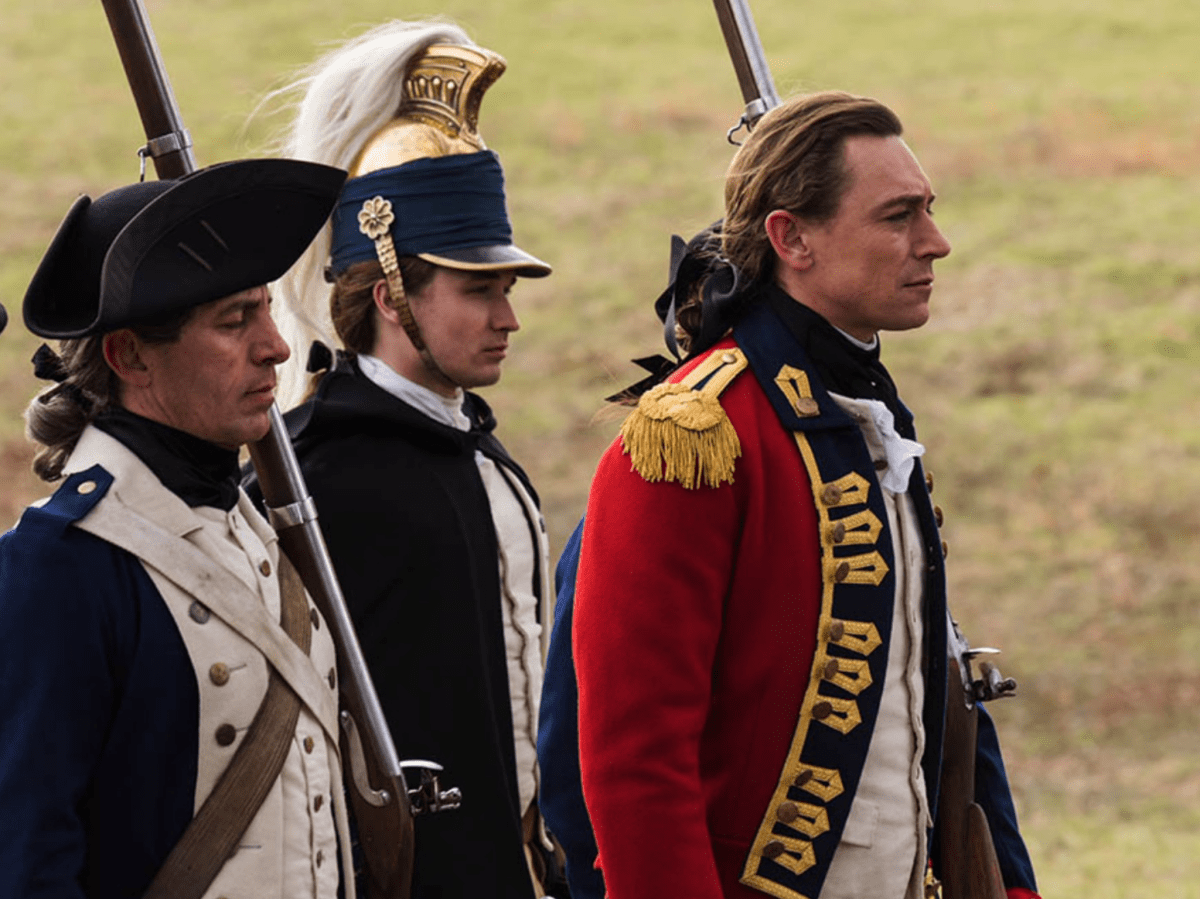
In an age before radio or television, John André was an interesting man to be around. A gifted story teller with a great sense of humor he could draw, paint and cut silhouettes. He was an excellent writer, he could sing, and he could write verse. John André was a British Major at the time of the American Revolution, who took part in his army’s occupations of Philadelphia and New York.
Adjutant General John André
He was also, a spy.
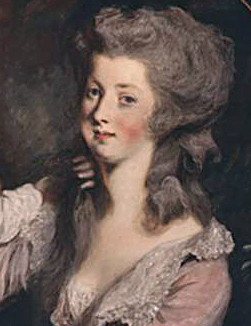
Major André was a favorite of Colonial-era Loyalist society. For a time he dated Peggy Shippen, the daughter of a prominent Philadelphia loyalist. She married an important Patriot General in 1779, a relationship which would later provide the connection between the British spy and a man who should have gone into history as one of the top tier, of American founding fathers.
Until that is, this man turned his coat. Today the stone monument erected to the man’s greatness near a place called Saratoga, declines to mention his name.
Peggy Shippen
Peggy Shippen’s husband was Benedict Arnold.
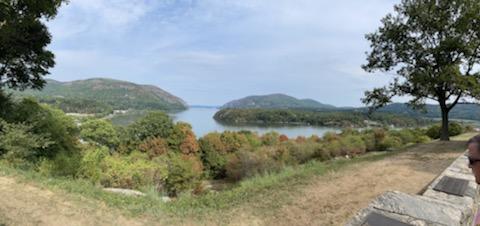
Arnold was Commandant of West Point at the time, the future location of one of our great military academies. At the time, West Point was a strategic fortification on high ground, overlooking the Hudson River. The British capture of West Point would have split the colonies in half.
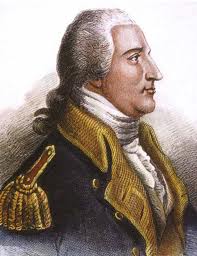
General Benedict Arnold
John André struck a bargain with Benedict Arnold which would turn a Hero of the Revolution into a name synonymous with “Traitor”. General Arnold would receive £20,000, over a million dollars today, in exchange for which he would give up West Point.
André sailed up the Hudson River in the Sloop of War HMS Vulture on September 20, 1780. Dressed in civilian clothes, Major André was returning to his own lines on the 23rd, six papers written in Arnold’s hand hidden in his sock.
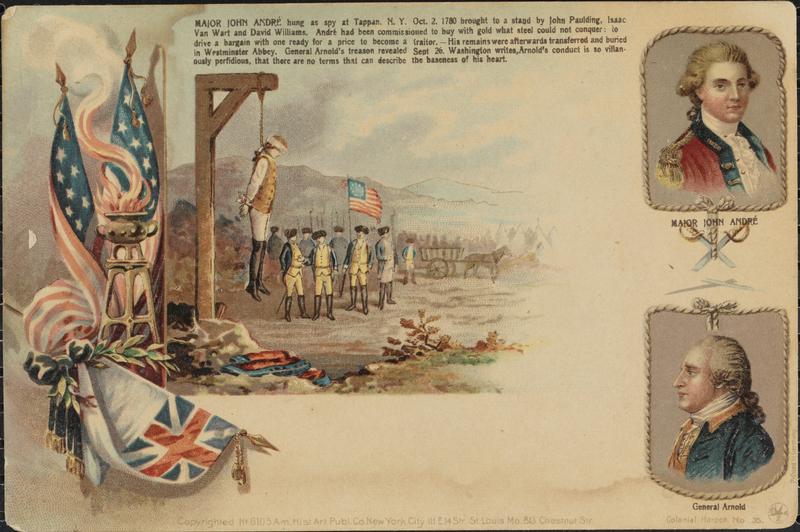
Major André was stopped by three Patriot Militiamen; John Paulding, David Williams and Isaac Van Wart. One of them was wearing a Hessian overcoat, and André thought they were Tories. “Gentlemen”, he said, “I hope you belong to our party”. “What party”, came the reply, and André said “The lower (British) party”. “We do”, they said, to which André replied that he was a British officer and must not be detained. That was as far as he got.
You need not be a military strategist to recognize the importance, of the commanding heights at West Point.
The discovery of those papers brought Benedict Arnold’s treachery to light. Arnold immediately fled on hearing of André’s arrest, even as George Washington was headed to his place for a meeting over breakfast.
John André was tried and sentenced to death as a spy, and jailed on September 29. He asked if he could write a letter to General Washington. In it he asked not that his life be spared, but that he be executed by firing squad, a more worthy death for a gentleman, than hanging.
General Washington believed that Arnold’s crimes to be far more egregious than those of John André. Furthermore he was impressed with the man’s bravery. So he wrote to General Sir Henry Clinton, asking for an exchange of prisoners.
Having received no reply, Washington wrote in his General Order of October 2, “That Major André General to the British Army ought to be considered as a spy from the Enemy and that agreeable to the law and usage of nations it is their opinion he ought to suffer death. The Commander in Chief directs the execution of the above sentence in the usual way this afternoon at five o’clock precisely.”
John André was executed by hanging in Tappan, New York on October 2, 1780. He was 31.
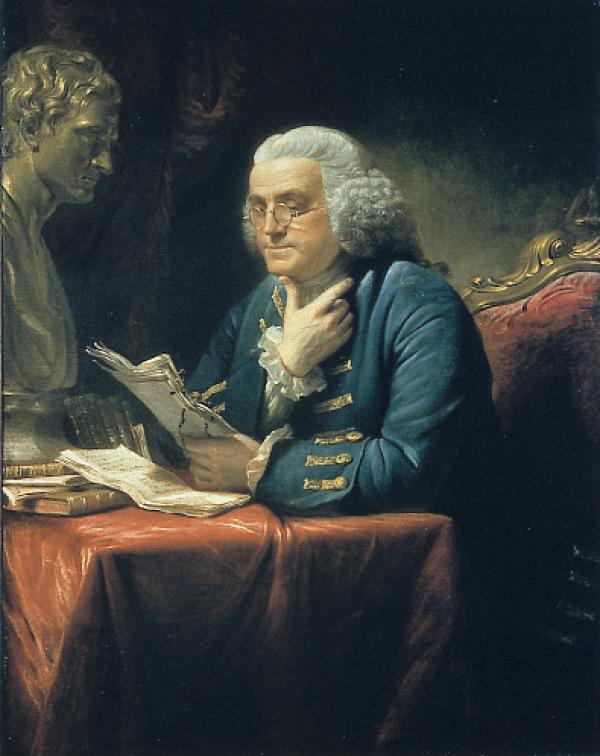
John André had lived in Benjamin Franklin’s house during a nine month stay in Philadelphia, while the British army occupied the city. As they were packing to leave, a Swiss-born citizen named Pierre Du Simitiere came to say goodbye. He was shocked to find such a Gentleman as John André looting the home of Benjamin Franklin. For a man known for extravagant courtesy, this was way out of character. He was packing books, musical instruments, scientific apparatus and an oil portrait of Franklin, all while offering no explanation nor even response, to Simitiere’s protests.
Nearly two hundred years later, the descendants of Major-General Lord Charles Grey returned the painting to the United States, explaining that André had probably looted Franklin’s home under direct orders from the General himself. A Gentleman always, it would explain the man’s inability to defend his own behavior.
Today that oil portrait of Benjamin Franklin, hangs in the White House.
World War 2-era reporter Ernie Pyle lamented “The daily record for forty-four years, one of the most legendary figures of the Seven Seas, kept in her own hand, gone up in smoke in two minutes”.
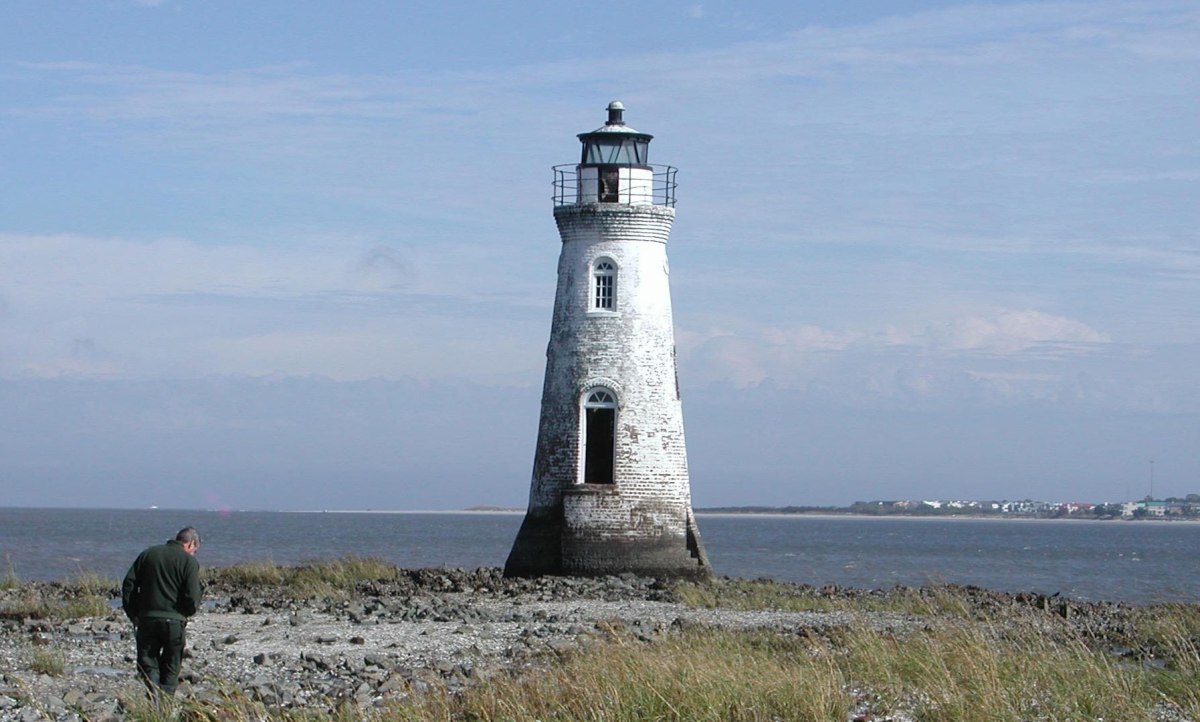
Following the War of 1812, President James Madison ordered a series of coastal fortifications to be built, to protect the young nation from foreign invasion. Fort Pulaski, located on Cockspur Island between Savannah and Tybee Island, Georgia, is one of them.
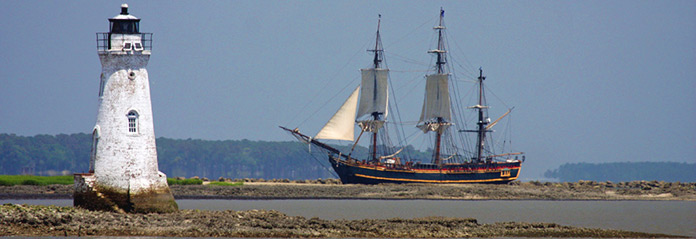
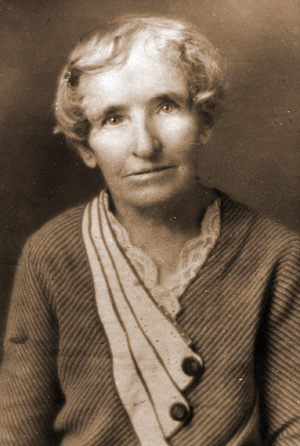
Florence Margaret Martus was born there in 1868 where her father was an ordnance sergeant. She spent her childhood on the south channel of the Savannah River, at 17 moving in with her brother, keeper of the Cockspur Island Lighthouse.
Sometime around 1887 while still a young girl, Florence began waving at ships passing by. By night she’d use a lantern and a white handkerchief, by day.
It started with friends, working the river. Harbor masters, bar pilots and tugboat captains. Before long, “the waving girl” and her collie were familiar figures, greeting every ship that came or left the port of Savannah. Sailors would look for her and salute in return. Vessels would blow their horns, but few ever met her in person.
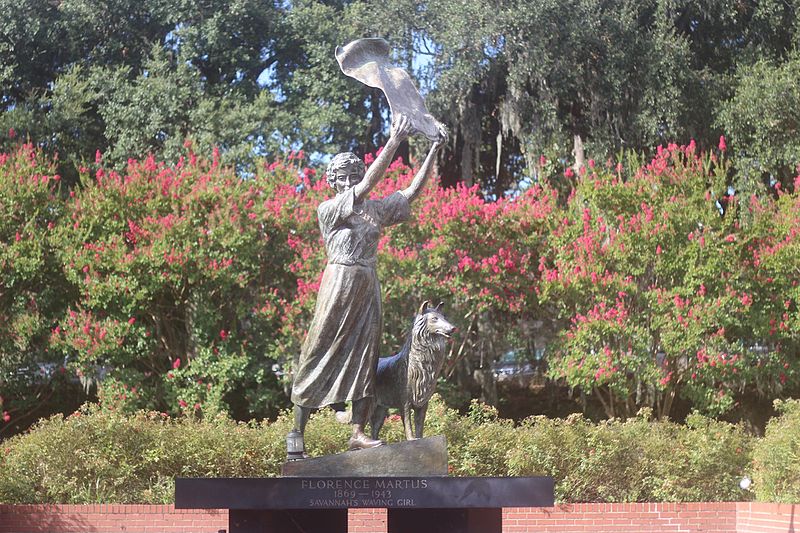
The Waving Girl Statue
Legends grew up around her. She had fallen in love with a sailor. She wanted him to find her when he returned buy he’d been lost at sea.
The sweet, sad truth was less dramatic than that. Florence later said, “That’s a nice story. But what got me started – I was young and it was sort of lonely on the island for a girl. At first I would run out to wave at my friends passing, and I was so tickled when they blew the whistle back at me“.
And so, Miss Martus would take out her handkerchief by day or light her lantern by night, and she would greet every vessel that came or went from the Port of Savannah. Every one of them. Some 50,000, over 44 years.
Florence Margaret Martus
In 1893, Martus and her brother braved hurricane conditions, rowing out to save several men from a sinking boat.
She waved an American flag at the troop ship St. Mihiel after WWI, on its return to Savannah carrying the United States Army of the Rhine.
“The Waving Girl” had taken it upon herself to greet every single ship entering or leaving the Port of Savannah, from a young girl until her old age.
She stopped only when she was forced to do so when her brother, then 70, had to leave his lighthouse job and the home that went with it.
All that time she kept a careful record of every ship: name, date, where it was from and the type of vessel. It must have broken her heart to move because she burned the entire record, one night. 44-years’ worth. World War 2-era reporter Ernie Pyle lamented “The daily record for forty-four years, one of the most legendary figures of the Seven Seas, kept in her own hand, gone up in smoke in two minutes”.
Martus never reconciled herself to the move, saying, “It’s just like trying to dig up that big oak tree and get it to take root someplace else.”
The artist Felix de Weldon, who sculpted the United States Marine Corps Memorial outside Arlington National Cemetery erected a statue of the Waving Girl and her collie. You can see it in Morrell Park, on the west bank of the Savannah River.
Florence Martus passed away on February 8, 1943, following a brief bout with bronchial pneumonia. One of many Liberty ships built in Savannah during World War II, was named in her honor. The SS Florence Martus was officially christened seven months later, September 27, 1943.




![4b4cf0f864c3dabcdb_IMG_7326[1]](https://todayinhistory.blog/wp-content/uploads/2018/10/4b4cf0f864c3dabcdb_img_73261.jpg?w=684&h=513)
























 Historical Easter Eggs - Today in History
You must be logged in to post a comment.