Romulus and Remus founded a town on the site of their salvation, the traditional date being April 21, 753BC. Romulus later murdered his brother after some petty quarrel, making himself sole ruler of the settlement. He modestly called the place “Rome”, after himself.
According to legend, Romulus and Remus were the sons of Rhea Silvia, the daughter of King Numitor of Alba Longa, a mythical city located in the Alban Hills southeast of what would become Rome. Numitor was deposed by his younger brother Amulius, who forced Rhea to become a vestal virgin so that she would not give birth to rival claimants to his title. However, Rhea was already pregnant by the war god Mars, and destined to give birth to Romulus and Remus.
Learning of the birth, Amulius ordered the infants drowned in the Tiber river but, the pair survived, washing ashore at the foot of the Palatine hill where the two were suckled by a she-wolf.
Later discovered by Faustulus, the boys were reared by the shepherd and his wife. Much later, the twins became leaders of a band of young shepherd warriors. On learning their true identity, the twins attacked Alba Longa, killed King Amulius, and restored their grandfather to the throne.
Romulus and Remus founded a town on the site of their salvation, the traditional date being April 21, 753BC. Romulus later murdered his brother after some petty quarrel, making himself sole ruler of the settlement. He modestly called it “Rome”, after himself.
No new town would last long without women, so Romulus invited the neighboring Sabines to a festival, where he kidnapped their women. A war ensued, but the Sabine women persuaded the Sabine men away from seizing the place. They drew up a peace treaty, merging the two communities under the joint rule of Romulus and the Sabine king, Titus Tatius.
The Romulus and Remus mythology developed in the 4th century BC, the exact date of the founding set by the Roman scholar Marcus Terentius Varro, in the first century BC.
There would be six more kings of Rome, the last three believed to be Etruscan. The Roman Republic was formed around 509 BC, and ended around the time of the murder of Julius Caesar in 44BC.
The Roman Imperial period which emerged would later split in two, ending in the final dissolution of the Western Roman Empire on September 4, 476, when Romulus Augustus, the last Emperor of the Western Empire, was deposed by the Germanic chieftain, Odoacer.
The Eastern Empire, originally known as Byzantium, would last for another thousand years. The end came on May 29, 1453, when the capital city of Constantinople fell to the Ottoman Turks, who came to call the city “Istanbul”.
Constantinople
If you enjoyed this “Today in History”, please feel free to re-blog, “like” & share on social media, so that others may find and enjoy it as well. Please click the “follow” button on the right, to receive email updates on new articles. Thank you for your interest, in the history we all share.
The disease process unfolded with horrifying rapidity. The Italian writer Boccaccio wrote that plague victims often “ate lunch with their friends and dinner with their ancestors in paradise.”
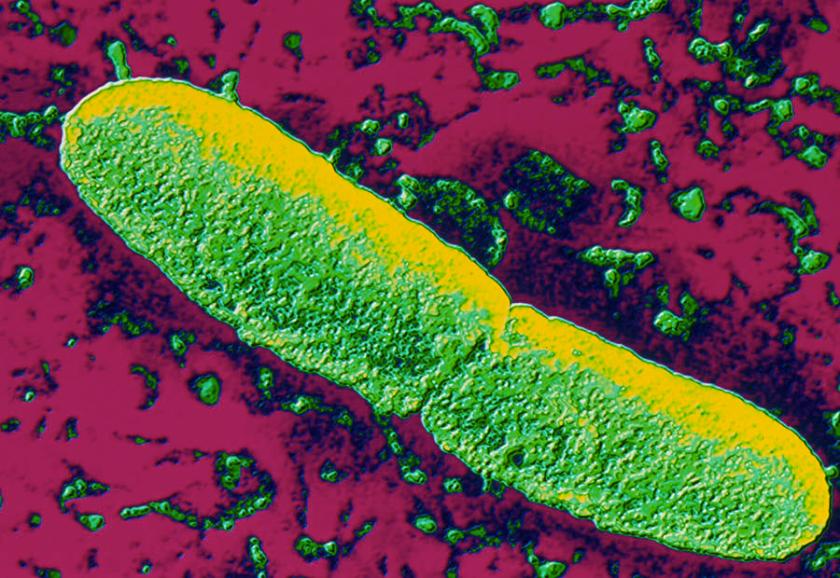
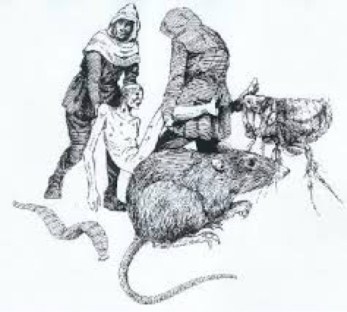
In the early 1330s, a deadly plague broke out on the steppes of Mongolia. The gram-negative bacterium Yersinia Pestis preyed heavily on rodents, the fleas from which would transmit the disease to people, the infection then rapidly spreading to others.
High fever would precede the appearance of “buboes”, a painful swelling of the lymph glands, especially in the armpit, neck and groin. Spots appeared on the skin turning from red to black, often accompanied by necrosis and gangrene in the nose, lips, fingers and toes.
In some cases, Bubonic plague will progress from the lymphatic system to the lungs, resulting in Pneumonic plague. Y. Pestis can progress to the blood stream as well, a condition known as septicemic plague. In medieval times, septicemic mortality rates ran from 98% to 100%.
The disease process unfolded with horrifying rapidity. The Italian writer Giovanni Boccaccio wrote that plague victims often “ate lunch with their friends and dinner with their ancestors in paradise.”
Plague broke out among a besieging force of Mongols on the Black Sea city of Caffa, in 1346. Italian merchants fled with their ships in the Spring of 1347, carrying in their holds an untold number of rats and the fleas that came with them. One-third of the world’s population died in the five-year period which followed, equivalent to over two Billion today.
The Black Death of the 14th century is far and away the most famous, but it’s not the first. The Plague of Justinian, 541-542AD, centered mostly around the Eastern Roman (Byzantine) and Sassanid Empires, the disease resulting in the death of 25 million individuals. Roughly 13% of the world’s population, at that time.
The Black death of 1346-’53 was a catastrophe unparalleled in human history, but it was by no means the last such outbreak. The Third Pandemic began in China in 1855, spreading to Hong Kong and on to British India. In China and India alone the disease killed 12 million people. It then spread to parts of Africa, Europe, Australia, and South America.
In the newly formed Territory of Hawaii, the first signs of the plague began to appear in Honolulu in December, 1899. Not sure how to control the outbreak, city health officials decided to burn infected houses. Changing winds soon fanned the flames out of control. On January 20, 1900, an inferno consumed nearly all of Chinatown, 38 acres, leaving 6,000 homeless.
In January 1900, Honolulu’s Chinatown burned down in an effort to control bubonic plague.
In 1900, The ship Australia brought Yersinia Pestis with it from Hong Kong into San Francisco. The ship was immediately quarantined and, despite the escape of two stowaways confirmed to have the bacilli, there was no immediate outbreak. The quarantine seemed to work for a time, but there was no way to contain the rats on board. They are probably the reason that plague spread to the city.
The body of an elderly Chinese man was discovered in a Chinatown basement. An autopsy found the man to have died of plague. There were more than 18,000 Chinese and another 2,000 Japanese living in the 14-block Chinatown section of the city. Many called for a quarantine of Chinatown, but Chinese citizens objected, as did then-Governor Henry Gage, who tried to sweep the whole outbreak under the carpet. Business interests likewise objected to the quarantine. Except for the Hearst Newspapers, not much was heard about it.
100 confirmed cases of plague were discovered by the end of 1902, but Governor Gage was still denying its existence. There were a total of 121 cases with 113 deaths by 1904, but the outbreak seemed to be contained.
San Francisco was hit by a massive earthquake on April 18, 1906, followed by a great fire. Thousands of San Franciscans were crowded into refugee camps with an even higher number of rats. For the first time, the disease now jumped the boundaries of Chinatown.
On May 27, 1907, a San Francisco sailor was diagnosed with bubonic plague. The epidemic spread aggressively over that summer, the New York Times reporting in November that “the disease increased with such virulence that it looked for a time as if the city were to be decimated as were medieval Europe”.
The plague popped up one last time, but local, state, and federal health officials combined to all-but eradicate the rat population, and with it the disease. It was all over by 1909.
Reported cases of human plague in the United States, 1970 – 2012
Or was it. Nothing could stop the fleas from infected rats from transferring to wild rodents, squirrels, and prairie dogs, and permanently establishing plague bacilli in the western United States.
In 2015, the CDC reported 15 cases of Bubonic plague in the United States, as of October. Four of them were fatal. The bacterium is treatable with modern antibiotics, but I can’t help thinking about the massive quantity of anti-microbials used in livestock production. Given the apparent increase in multiple-drug resistant “superbugs”, I hope that people far smarter than I am, are thinking about it too.
If you enjoyed this “Today in History”, please feel free to re-blog, “like” & share on social media, so that others may find and enjoy it as well. Please click the “follow” button on the right, to receive email updates on new articles. Thank you for your interest, in the history we all share.
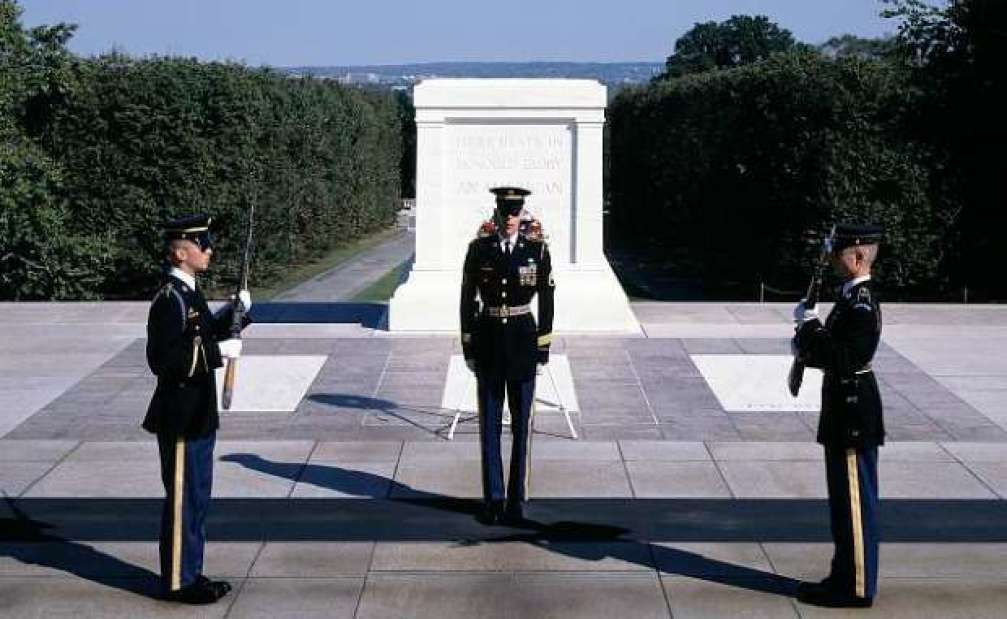
The Tomb of the Unknown Soldier has been under 24/7 guard since 1937, heedless of hurricanes, howling blizzards and bone-chilling cold. Guards come from the 3rd Infantry Regiment, “The Old Guard”. Established in 1784, the Old Guard is the oldest active infantry unit in the United States military.
Many years ago, Prussian Chancellor Otto von Bismarck said “If a general war begins, it will be because of some damn fool thing in the Balkans”.
On June 28, 1914, a tubercular 19 year old leveled his revolver in Sarajevo, and murdered the heir-apparent to the Austro-Hungarian throne, Archduke Franz Ferdinand, and his wife, Sophie.
What followed should have been at worst a regional conflict between Austria-Hungary and Serbia, as the two settled issues going well beyond the scope of this essay. Instead, mutually entangling national alliances were invoked, as mobilization timetables moved vast armies according to predetermined schedules.
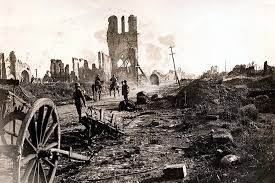
The coming cataclysm would lay waste to a generation, and to a continent.
The catastrophe of WW1 could have been averted as late as the last day of July. By the first of August, mutual distrust had gone past the point of no return. By the time it was over, 18 million were dead or vanished and presumed dead, and another 23 million, maimed.
The United States entered the conflict on April 2, 1917, leading to casualties of its own numbering 321,467.
The idea of honoring the unknown dead of the “War to End Wars” originated in Europe. A British Commonwealth soldier was the first to be so honored, laid to rest in Westminster Abbey on Armistice day, November 11, 1920.
In 1921, the United States followed Great Britain and France in honoring its unknown dead. One unidentified soldier was selected each from the Aisne-Marne, Meuse-Argonne, Somme and St. Mihiel American cemeteries, and carefully examined in case there be any clues to their identities. The remains were transported to the Hotel de Villes, where wounded combat veteran and recipient of the Distinguished Service Medal Sergeant Edward F. Younger, had the honor of performing the final selection.
Edward F Younger recreates his selection of the Unknown
Passing between two lines of French and American officials, Younger entered the room. Slowly, he circled the four caskets three times, finally stopping at the third one from the left. There Sgt. Younger placed a spray of white roses, drew himself to attention, and saluted.
With flags at half-mast and its stern decked with flowers, the cruiser USS Olympia received the precious cargo and returned to the United States, arriving in the Navy Yard in Washington DC on November 9, 1921. There the flag draped casket was solemnly transferred to the United States Army, and placed under guard of honor on the same catafalque which had borne the bodies of three slain Presidents: Abraham Lincoln, James Garfield, and William McKinley.
On November 11, Armistice Day, the casket was removed from the Rotunda of the Capitol and escorted under military guard to the amphitheater at Arlington National Cemetery. In a simple ceremony, President Warren G. Harding bestowed on this unknown soldier the Medal of Honor, and the Distinguished Service Cross.
Special representatives of foreign nations then bestowed, each in their turn, their nation’s highest military decoration: the Croix de Guerre of Belgium, the English Victoria Cross, le Medaille Militaire & Croix de Guerre of France, the Italian Gold Medal for Bravery, the Romanian Virtutes Militara, the Czechoslavak War Cross, and the Polish Virtuti Militari.
With three salvos of artillery, the rendering of Taps and the National Salute, the ceremony was brought to a close and the 12 ton marble cap placed over the tomb of the unknown. On the west facing side there is an inscription:
Here Rests In
Honored Glory
An American Soldier
Known But To God
Two years later, a civilian guard was placed on the tomb of the unknown. A permanent Military guard would take its place in 1926.
The Tomb of the Unknown Soldier has been under 24/7 guard since 1937, heedless of hurricanes, howling blizzards and bone-chilling cold. Guards come from the 3rd Infantry Regiment, “The Old Guard”. Established in 1784, the Old Guard is the oldest active infantry unit in the United States military.
Every movement of the guard is a series of “twenty-ones”, in deference to the 21-gun salute:
Tombguard.org explains: “The Sentinel does not execute an about face, rather they stop on the 21st step, then turn and face the Tomb for 21 seconds. They then turn to face back down the mat, change the weapon to the outside shoulder, mentally count off 21 seconds, then step off for another 21 step walk down the mat. They face the Tomb at each end of the 21 step walk for 21 seconds. The Sentinel then repeats this over and over until the Guard Change ceremony begins“.
In 1919, both AEF commander General John Pershing and Allied supreme commander Ferdinand Foch of France had been adamantly against the treaty at Versailles. Germany had been defeated, they argued, but not Beaten. The failure to defeat Imperial Germany on German soil the pair believed, would once again lead the three nations to war. Meanwhile in Germany, the “Stab in the Back” fiction destined to become Nazi party mythology, was already taking shape.
On reading the treaty, Foch said “This isn’t a peace. It’s a cease-fire for 20 years!”
He was wrong. By 36 days.
If you enjoyed this “Today in History”, please feel free to re-blog, “like” & share on social media, so that others may find and enjoy it as well. Please click the “follow” button on the right, to receive email updates on new articles. Thank you for your interest, in the history we all share.
Most of us remember the names, of the great monsters of history. Who remembers the name of the man who saved the lives of seven times the number, of this whole Parade of Horribles, put together?
Too often, history is measured in terms of its monsters.
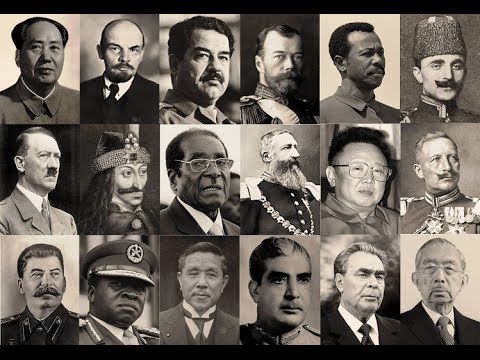
President Robert Mugabe of Zimbabwe once orchestrated the murder of 20,000 civilians from a single province, after failing to receive a single vote. Josef Stalin deliberately starved as many as ten million Ukrainians, in a “terror famine” known as Holodomor. Pol Pot and a Communist cadre of nine – the Ang-Ka – killed between 1.7 and 2.5 million fellow citizens of 1970s Cambodia: about a fifth of the population. Mao Tse-Tung’s policies and political purges killed between 49 and 78 million of his own people, between 1949 and 1976.
You’re really playing in the Big Leagues when they can’t get your body count any closer than the nearest twenty-nine million.
From Adolf Hitler to Idi Amin, from Enver Pasha to Hideki Tojo and Leopold II of Belgium, the top ten dictators of the last 150 years account for the loss of nearly 150 million souls. Most of us remember the names, of the great monsters of history. Who remembers the name of the man who saved the lives of seven times the number, of this whole Parade of Horribles, put together?
Today, we live in a time and place where the National Institutes of Health (NIH) writes “The U.S. is one of the wealthiest countries in the world and accordingly has high obesity rates; one-third of the population has obesity plus another third is overweight”.
It wasn’t always so. In 1820, 94% of the world’s population lived in “absolute poverty.” The American economic historian and scientist Robert Fogel, winner (with Douglass North) of the 1993 Nobel Prize in Economics, wrote that: “Individuals in the bottom 20% of the caloric distributions of France and England near the end of the eighteenth century, lacked the energy for sustained work and were effectively excluded from the labor force.”
It’s hard to get our heads around the notion of “food insecurity”. I’m not talking about what’s in the fridge. This is the problem of acute malnutrition, of epidemic starvation, of cyclical famine and massive increases in mortality due to starvation and hunger-induced disease.
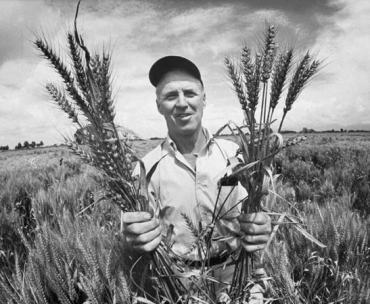
Norman Borlaug
Norman Ernest Borlaug was born this day in 1914, on his grandparents’ farm near Cresco, Iowa. The boy’s grandfather, Nels Olson Borlaug, once told the boy “You’re wiser to fill your head now if you want to fill your belly later on.”
A farm kid educated during the Great Depression, Borlaug periodically put his studies on hold, in order to earn money. As a leader in the Civilian Conservation Corps working with unemployed people on Federal projects, many of his co-workers faced near-catastrophic levels of hunger. He later recalled, “I saw how food changed them … All of this left scars on me”.
Borlaug earned his Bachelor of Science in Forestry, in 1937. Nearing the end of his undergraduate education, he attended a lecture by Professor Elvin Charles Stakman, discussing plant rust disease, a parasitic fungus that feeds on phytonutrients in wheat, oats, and barley crops. Stakman was exploring special breeding methods, resulting in rust-resistant plants. The research greatly interested Borlaug, who later enrolled at the University of Minnesota, to study plant pathology under Stakman. Borlaug earned a Master of Science degree in 1940, and a Ph.D. in plant pathology and genetics, in 1942.
Borlaug attempted to enlist in the military following the attack on Pearl Harbor, but his application was rejected under wartime labor regulations. He was put to work in a lab, doing research for the United States armed forces.
Between 1939 and ’41, Mexican farmers suffered major crop failures, due to stem rust. In July 1944, Borlaug declined an offer to double his salary, traveling instead to Mexico City, heading a new program focusing on soil development, maize and wheat production, and plant pathology.
“Pure line” (genotypically identical) plant varieties possess only one to a handful of disease-resistance genes. Random mutations of rusts and other plant diseases overcome pure line survival strategies, resulting in crop failures. “Multi-line” plant breeding involves backcrossing and hybridizing plant varieties, transferring multiple disease-resistance genes into recurrent parents. In the first ten years Borlaug worked for the Mexican agricultural program, he and his team made over 6,000 individual crossings of wheat. Mexico transformed from a net-importer of food, to a net exporter.
In the early sixties, Borlaug’s dwarf spring wheat strains went out for multi-location testing around the world, in a program administered by the US Department of Agriculture. In March 1963, Borlaug himself traveled to India with Dr. Robert Glenn Anderson, along with 220lbs of seed from four of the most promising strains.
The Indian subcontinent experienced minor famine and starvation at this time, limited only by the US shipping 1/5th of its wheat production into the region in 1966 – ’67. Despite resistance from Indian and Pakistani bureaucracies, Borlaug imported 550 tons of seeds.
Biologist Paul Ehrlich wrote in his 1968 bestselling book The Population Bomb, “The battle to feed all of humanity is over … In the 1970s and 1980s hundreds of millions of people will starve to death in spite of any crash programs embarked upon now.” Ehrlich said, “I have yet to meet anyone familiar with the situation who thinks India will be self-sufficient in food by 1971…India couldn’t possibly feed two hundred million more people by 1980.”
He could not have been more comprehensively wrong.
Borlaug’s initial yields were higher than any other crop, ever harvested in South Asia. Countries from Pakistan to India to Turkey imported 80,000 tons and more of seeds. By the time of Ehrlich’s book release in 1968, William Gaud of the US Agency for International Development was calling Borlaug’s work a “Green Revolution”. Massive crop yields substituted famine and starvation with a host of new problems. There were labor shortages to harvest crops, and insufficient numbers of bullock carts to haul it to the threshing floor. Jute bags were needed, along with trucks, rail cars, and grain storage facilities. Some local governments even closed school buildings, to use them for grain storage.
Borlaug won the Nobel Peace Prize in 1970, for his contributions to the world food supply. The man’s name is nearly synonymous with the Green Revolution.
According to former Director General of the International Water Management Institute David Seckler, “The environmental community in the 1980s went crazy pressuring the donor countries and the big foundations not to support ideas like inorganic fertilizers for Africa.” The Rockefeller and Ford foundations withdrew funding, along with the World Bank.
Well fed environmentalist types congratulated themselves on their “success”, as the Ethiopian famine of 1984-’85 destroyed over a million lives. Millions more were left destitute, on the brink of starvation.
Borlaug became involved in 1984, at the invitation of Ryoichi Sasakawa, chairman of the Japan Shipbuilding Industry Foundation (now the Nippon Foundation). Sasakawa wondered why methods used so successfully in Asia, were not being employed in Africa. Since that time, the Sasakawa Africa Association (SAA) has trained over 8 million farmers in SAA farming techniques. Maize crops developed in African countries have tripled, along with increased yields of wheat, sorghum, cassava, and cowpeas.
Norman Ernest Borlaug died of Lymphoma in 2009, at the age of 95. Prime Minister of India Manmohan Singh and President Pratibha Patil paid tribute, saying “Borlaug’s life and achievement are testimony to the far-reaching contribution that one man’s towering intellect, persistence and scientific vision can make to human peace and progress”. The United Nations’ Food and Agriculture Organization (FAO) described Borlaug as “… a towering scientist whose work rivals that of the 20th century’s other great scientific benefactors of humankind”. American author and journalist Gregg Easterbrook wrote in 1997, “[The] form of agriculture that Borlaug preaches may have prevented a billion deaths.”
The world population when Ehrlich released his book in 1968, was about 3.53 billion. Today, that number stands at 7.6 billion and, when we hear about starvation, such events are almost exclusively man-made. The American magician and entertainer Penn Jillette described Norman Borlaug as “The greatest human being who ever lived…and you’ve probably never heard of him.” Let that be the answer to the self-satisfied and well-fed, environmentalist types.
“I now say that the world has the technology—either available or well advanced in the research pipeline—to feed on a sustainable basis a population of 10 billion people. The more pertinent question today is whether farmers and ranchers will be permitted to use this new technology? While the affluent nations can certainly afford to adopt ultra low-risk positions, and pay more for food produced by the so-called ‘organic’ methods, the one billion chronically undernourished people of the low income, food-deficit nations cannot.” – Norman Borlaug, 2000
Think of the OJ trial, only in this case, the killer was a former First Lady. This one had everything: Left vs. Right, the fall of the powerful, and all the salacious detail anyone could ask for. French public and media alike were riveted by the Caillaux affair, disinterested and unheeding of the European crisis barreling down on them, like the four horsemen of the apocalypse.
We hear a lot in election years, about “Left” and “Right”. “Liberal” and “Conservative”.
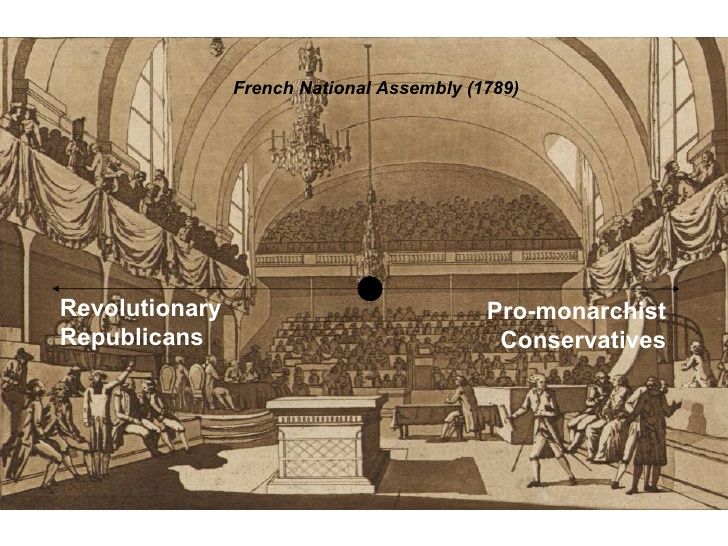
The terms have been with us a long time, originating in the early days of the French Revolution. In those days, National Assembly members supportive of the Monarchy sat on the President’s right. Those favoring the Revolution, on the left. The right side of the seating arrangement began to thin out and disappeared altogether during the “Reign of Terror”, but re-formed with the restoration of the Monarchy, in 1814-1815. By that time it wasn’t just the “Party of Order” on the right and the “Party of Movement” on the left. Now, the terms began to describe nuances in political philosophy, as well.
200 years later, philosophical differences between the Left and Right of the period, would be recognizable to political observers today.
Joseph Cailloux
Joseph Cailloux (rhymes with “bayou”) was a left-wing politician, appointed Prime Minister of France in 1911. The man was indiscreet in his love life, even for a French politician. Back in 1907, Cailloux had paraded about with a succession of mistresses, finally carrying on with one Henriette Raynouard, while both were married to other people. By 1911, both were divorced. That October, Henriette Raynouard became the second Mrs. Cailloux.
The political right considered Cailloux to be far too accommodating with Germany, with whom many felt war to be all but inevitable. While serving under the administration of President Raymond Poincare in 1913, Cailloux became a vocal opponent of a bill to increase the length of mandatory military service from two years to three, intended to offset the French population disadvantage conferred by France’s 40 million, compared with 70 million Germans.
Madame Cailloux
Gaston Calmette, editor of the leading conservative newspaper Le Figaro, threatened to publicize love letters between the former Prime Minister and his second wife, written while both were still married for the first time.
Henriette Cailloux was not amused.
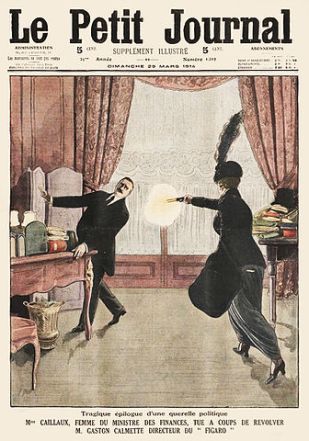
On March 16, 1914, Madame Cailloux took a taxi to the offices of Le Figaro. After being shown into Calmette’s office, the pair spoke briefly, before Henriette withdrew the Browning .32 automatic. Cailloux fired six rounds at the editor. Two missed, but four were more than enough to do the job. Gaston Calmette was dead within six hours.
German Chancellor Otto von Bismarck once said the next great European war would begin with “some damn fool thing in the Balkans”. No one realized it at the time, but Bismarck got his damn fool thing on June 28, when a Serbian Nationalist assassinated the heir apparent to the Austro-Hungarian throne, the Archduke Franz Ferdinand.
The July Crisis of 1914 was a series of diplomatic maneuverings, culminating in the ultimatum from Austria-Hungary to the Kingdom of Serbia. Vienna, with tacit support from Berlin, made plans to punish Serbia for her role in the assassination, while Russia mobilized armies in support of her Slavic ally.
There is a common but mistaken notion that Imperial Germany “started” World War I, but it isn’t so. Kaiser Wilhelm was a famous “saber rattler”, but actually going to war with the other major European powers, was another matter.
It was Germany’s weaker ally Austria-Hungary which, having received vague assurances of German support, pursued a policy of unreasoning belligerence against Serbia.
German Foreign Minister Gottlieb von Jagow was away on honeymoon, during key periods of the July crisis. The Kaiser himself was out of touch, cruising the Norwegian fjords. That cruise has been called the most expensive maritime disaster, in history.
On being informed of the decision to mobilize, the Kaiser told his General Staff “Gentlemen, you will regret this.”
SMY Hohenzollern II, which Emperor Wilhelm II used on annual extended Nordlandfahrt cruises to Norway. All told, he spent four years living on board.
Meanwhile, England and France looked the other way. In Great Britain, officialdom was focused on yet another home rule crisis concerning Ireland, while all of France was distracted by the “Trial of the Century”.
Madame Caillaux’s trial for the murder of Gaston Calmette began on July 20. Think of the OJ trial, only in this case, the killer was a former First Lady. This one had everything: Left vs. Right, the fall of the powerful, and all the salacious detail anyone could ask for. French public and media alike were riveted by the Caillaux affair, disinterested and unheeding of the European crisis barreling down on them, like the four horsemen of the apocalypse.
The trial ended in acquittal on July 28, the jury ruling the murder to have been a “crime passionnel”. A crime of passion. That same day, Austria-Hungary declared war on Serbia.
In the days that followed, the Czar would begin the mobilization of men and machines which would place Imperial Russia on a war footing. Kaiser Wilhelm’s Germany invaded Belgium, in pursuit of the one-two punch strategy by which it sought first to defeat France, before turning to face the “Russian Steamroller”. England declared war in support of a 75-year-old commitment to protect Belgian neutrality, a treaty obligation German diplomats had dismissed as a “scrap of paper”.
An event which could have resulted in little more that a policing action in the Balkans, was about to explode into the “War to End All Wars”. Edward Grey, 1st Viscount Grey of Fallodon said “The lamps are going out all over Europe: we shall not see them lit again in our life-time.” Eleven million military service members and seven million civilians who were alive in July 1914, would not live to see the other side.
If you enjoyed this “Today in History”, please feel free to re-blog, “like” & share on social media, so that others may find and enjoy it as well. Please click the “follow” button on the right, to receive email updates on new articles. Thank you for your interest, in the history we all share.
Even a former adversary couldn’t help but admire the feat. Days later, British Vice Admiral Lord Horatio Nelson called Decatur’s raid the “most bold and daring act of the age.”
Historic accounts differ as to the early success of the Islamic conquests. Contemporary Christian sources saw them as God’s punishment for the sins of fellow Christians. Early Muslim sources describe the rising empire as evidence of divine favor, reflections of the religious zeal of the conquerors.
Be that is it may, Islamic expansion enveloped the Arabian Peninsula in the last ten years of the life of Muhammad (622-632), at the expense of the Roman Byzantines and the Sassanid Empire of the Persians. Syria fell in 634, followed by Egypt, Mesopotamia and Persia. By 750, the Umayyad Caliphs had subjugated much of the Balkan states, part of the Indian sub-continent, all of North Africa, most of Spain, and parts of Southern France and Sicily. By the age of Columbus, the Mediterranean was a place where you traveled at your own risk.
Those of us of European ancestry owe our heritage, if not our existence, to the Christian warriors who defeated the Jihadist time after time. There was Pelagius, who stopped a military force of the Umayyad Caliphate at Covadonga in 722, without which there would be no Reconquista, no Ferdinand and Isabella, and we wouldn’t know the name of Christopher Columbus.
The father of Charlemagne, Charles “The Hammer” Martel, blocked the Muslim advance into Western Europe at the Battle of Tours, in 732.
If Marcantonio Bragadin is remembered at all, it is for being betrayed, tortured and skinned alive by Lala Mustafa Pasha. Yet, it is Bragadin’s stubborn defense of the eastern Mediterranean outpost of Famagusta in 1571, which gave European principalities time to assemble naval forces in numbers sufficient to defend the European coast, near a place called Lepanto.
The 1683 Siege of Vienna, at the crossroads of eastern and western Europe, was a hard fought contest which could have gone either way, until the arrival of a Polish army under King Jan Sobieski. The Ottomans were defeated and turned back from the conquest of Eastern Europe by the largest cavalry charge in all of history, 18,000 horsemen of the Polish King and the Holy Roman Emperor, thundering down the hill and into the lines of Mustafa Pasha.
Throughout the period, “Saracens” plundered everything that could be carried away: animals, provisions, fabrics, precious metals and money: especially men, women and children who could be sold for a good price at the slave markets. Redemption of captives being among the corporal works of mercy, the “Mathurins” Order of the Holy Trinity was founded in 1198 for the purpose of paying the ransom of Christians held captive by non-Christians, as a consequence of crusading and pirating along the southern European coastline.
Even Ireland, with its northern latitude, wasn’t immune to such raids. The renegade Dutchman-turned Barbary pirate Murat Reis attacked the village of Baltimore in County Cork, in 1631. With him were pirates from Algiers and armed troops of the Ottoman Empire, who captured all the villagers they could find, taking 107 away to the slave markets of North Africa. Years later, three women were ransomed and returned to Ireland. The rest lived out their lives as slaves, or locked away in harems or inside the walls of the sultan’s palace.
“Engraving of a Moorish slave auction from Pierre Dan’s Historie van Barbaryan en des zelfs Zee-Roovers (Amsterdam, 1684). There they were paraded, chained and nearly naked, while prospective buyers inspected the merchandise”. H/T Historyireland.com
Sidi Muhammad ibn Abdallah, Sultan of Morocco, opened his ports to trade with the fledgling United States in 1777, making Morocco the first country whose head of state publicly recognized the United States. Abdallah saw the future for his country in foreign trade, and actively sought a treaty relationship with the US, well before war ended with Great Britain. The treaty signed by Thomas Barclay and Sultan Muhammad III in 1786 and ratified by the Confederation Congress the following July is still in effect today, the longest continuous treaty relationship in United States history.
Diplomacy had succeeded with Morocco, but not with Algiers, Tunis or Tripoli, each of which demanded $660,000 in tribute.
Algeria captured the schooners Maria and Dauphin in 1785, the captured crews held in conditions of slavery for over a decade. The sum negotiated for their release exceeded $1 million, more than 1/6th the entire budget of the United States. Eleven American ships were captured in 1793 alone, their crews and stores held for ransom.
Yusuf Karamanli, Pasha of Tripoli, demanded $225,000 in tribute on President Jefferson’s inauguration, in 1801. At this time, Federal revenues were barely over $10 million. Jefferson refused, resulting in the first Barbary War, a conflict memorialized in a line from the Marine Corps Hymn “From the Halls of Montezuma to the Shores of Tripoli”.
USS Enterprise, Barbary war
Limited to small confrontations for the first two years, more sustained combat began in June 1803 when a small American force attacked Tripoli Harbor in modern Libya.
While giving chase and firing on a pirate vessel, USS Philadelphia ran aground on an uncharted reef, two miles outside of Tripoli. Fearing the 1,240 ton, 36-gun frigate would be captured and added to the Tripolitan navy, Lieutenant Stephen Decatur led a daring expedition into Tripoli harbor to destroy the captured vessel.
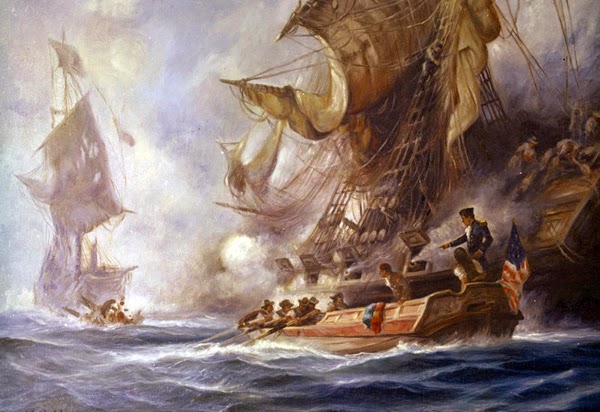
On the evening of February 16, 1804, Decatur entered Tripoli Harbor with a force of 74 Marines. With them were five Sicilian volunteers, including pilot Salvador Catalano, who spoke fluent Arabic. Disguised as Maltese sailors and careful not to draw fire from shore batteries, Decatur’s force boarded the frigate, killing or capturing all but two of its Tripolitan crew. Decatur and his marines had hoped to sail Philadelphia out of harbor, but soon found she was in no condition to leave. Setting combustibles about the deck, they set the frigate ablaze. Ropes burned off, setting the Philadelphia adrift in the harbor. Loaded cannon cooked off as the blaze spread, firing random balls into the town. It must have been a sight, when gunpowder stores ignited and the entire ship exploded.
By that time Decatur and his men had slipped away, without the loss of a single man. Even a former adversary couldn’t help but admire the feat. Days later, British Vice Admiral Lord Horatio Nelson called Decatur’s raid the “most bold and daring act of the age.”
A popular story has Martin Luther nailing his “95 theses” to the door of the Wittenberg Palace Church, but it likely never happened that way. Luther had no intention of confronting Church authorities. This was intended to be an academic work, 95 topics offered for scholarly debate.
Hans Luder sent his son Martin to a series of Latin schools beginning in 1497, where the boy learned the so-called “trivium” – grammar, rhetoric, and logic. He entered the University of Erfurt in 1501 at age 19, receiving his master’s degree in 1505. The elder Luder (“Luther”) intended that his son become a lawyer, but the boy wanted none of it.
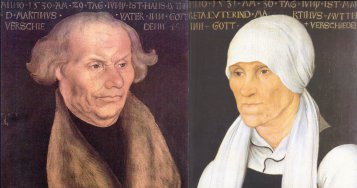
Hans & Margarethe Luder by Lucas Cranach, the Elder
Years later, the younger Luther described his Latin school education as time spent in purgatory, and his University as a “beerhouse” and a “whorehouse”. Martin Luther was cut out for different things.
Luther entered Law School in 1505 and dropped out, almost immediately. His father was furious over what he saw as a wasted education. Martin entered an Augustinian cloister that July, saying “This day you see me, and then, not ever again.”
16th century Church doctrine taught that the Saints built up a surplus of good deeds, over a lifetime. Sort of a moral bank account. Like “carbon credits” today, positive acts of faith and charity could expiate sin. Monetary contributions to the church could, it was believed, “buy” the benefits of the saint’s good works, for the sinner.
Luther came to believe that the church had lost sight of the central truths of Christianity. The Grace of God wasn’t a medium to be exchanged, he believed. Rather, such grace was attained through faith in Jesus Christ, as the Messiah. “This one and firm rock”, he wrote, “which we call the doctrine of justification, is the chief article of the whole Christian doctrine, which comprehends the understanding of all godliness”.
Papal “Commissioner for Indulgences” Johann Tetzel came to Wittenberg in 1516, selling expiation to raise money to rebuild St. Peter’s Basilica, in Rome. A saying attributed to the Dominican friar went “As soon as the coin in the coffer rings, the soul from purgatory springs.”
Martin Luther wrote to Archbishop Albrecht on October 31, 1517, objecting to this sale of indulgences. He enclosed a copy of his “Disputation of Martin Luther on the Power and Efficacy of Indulgences”, a document which came to be known as his “95 Theses”.
A popular story has Martin Luther nailing the document to the door of the Wittenberg Palace Church, but it likely never happened. Luther had no intention of confronting the Church. This was intended to be an academic work, 95 topics offered for scholarly debate.
Martin Luther’s ideas would rock the Christian world.
What seems to the modern mind as mere doctrinal differences, were life and death matters in the late middle and early modern ages. Archbishop Albrecht forwarded Luther’s note to Pope Leo X, who responded slowly and “with great care as is proper”.
Three theologians drafted heresy cases against Martin Luther. In 1520, the Papal Bull (edict) “Exsurge Domine” commanded the Professor of Theology to recant under pain of excommunication.
Luther stood on dangerous ground. In 1415, the Czech priest Jan Hus had been burned at the stake for such heresy. Pope Martinus I called for a crusade against his followers, the “Hussieten”, five years later.
King Henry VIII’s famous break with the church over his divorce from Catherine of Aragon was still years in the future in 1521, the year Pope Leo X named Henry “Fidei Defensor”. “Defender of the Faith”. Nine years later, French theologian Jean Calvin was forced to flee for his life, from a deadly outbreak of violence against Protestant Christians.
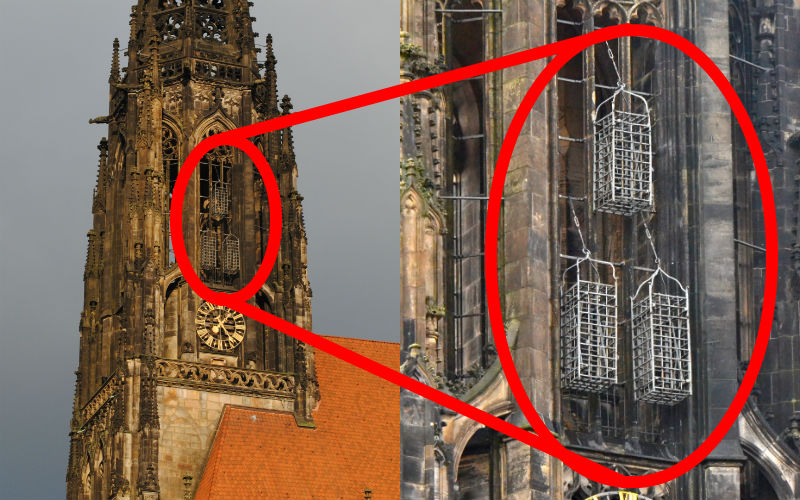
Anabaptists Jan van Leiden, Bernhard Knipperdolling and Bernhard Krechting were tortured in the public square for their heresies, with white-hot pliers. Their corpses were placed in cages and hanged from the steeple of St. Lambert’s Church, in Münster. The bones were removed some fifty years later, but those three cages remain there, to this day.
The Papal edict had the effect of hardening Luther’s positions, and he publicly burned the document. Twenty-four days later, Martin Luther was excommunicated.
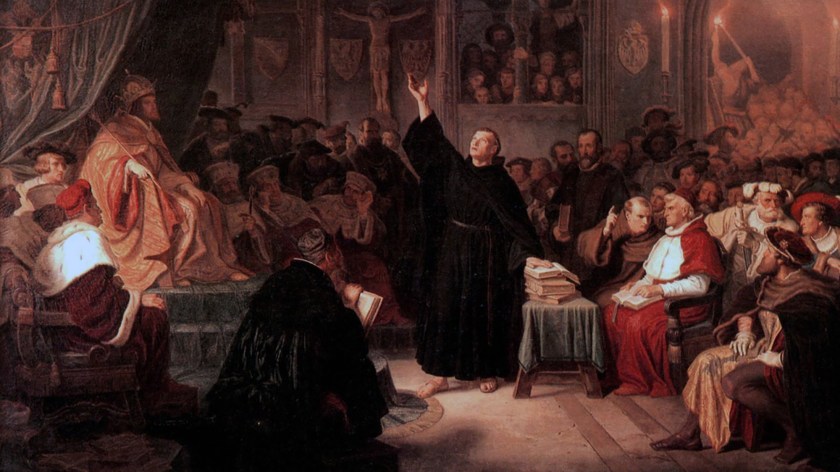
On this day in 1521, Emperor Charles V convened the Diet, the deliberative assembly of the Holy Roman Empire, in the upper-Rhine city of Worms. Luther was summoned to defend himself in April.
With copies of his writings laid before him on a table, Luther was asked if the books were his, and if he stood by their contents. He affirmed that yes, they were his, but asked time to consider his second answer.
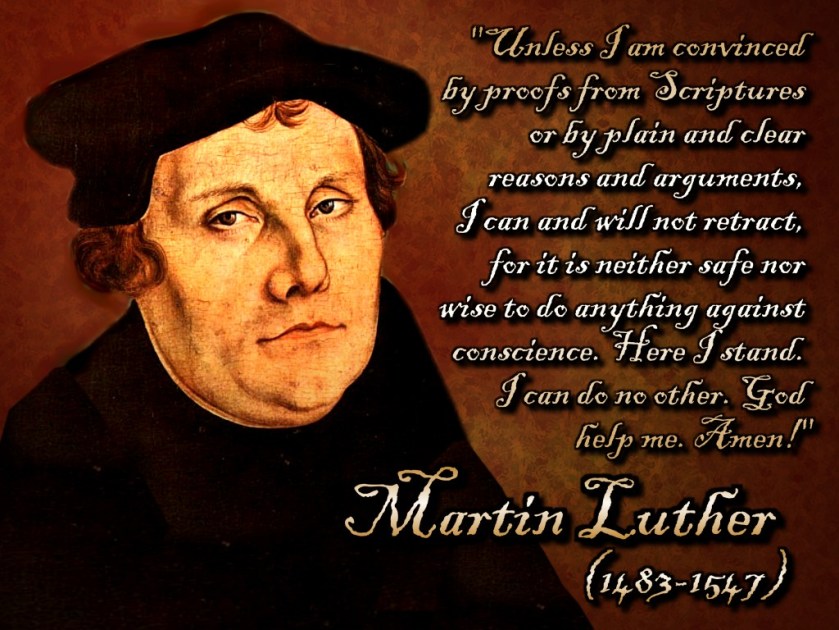
The following day, Luther gave his response. “Unless I am convinced by the testimony of the Scriptures or by clear reason (for I do not trust either in the Pope or in councils alone, since it is well known that they have often erred and contradicted themselves), I am bound by the Scriptures I have quoted and my conscience is captive to the Word of God. I cannot and will not recant anything, since it is neither safe nor right to go against conscience. May God help me. Amen”.
Martin Luther testifies before the Diet of Worms, 1521
The “Edict of Worms” of the following month declared Luther an outlaw, ordering that he “be apprehended and punished as a notorious heretic”. Anyone who wished to do so was now permitted to kill the monk, without legal consequence.
Five years earlier, Erasmus of Rotterdam had expressed the wish that the holy text should be available in every language, “so that even Scots and Irishmen might read it”. Luther went into hiding at Wartburg Castle. It was there that he translated the New Testament from Greek into German, laying the foundation for other vernacular translations and, for the first time, making the bible accessible to the common man.
Radical sects took Luther’s teachings far beyond his intentions, and Luther found himself in the odd position of defending the faith against more radical reformers. The Zwickau Prophets rejected holy scripture in favor of direct revelations from the Holy Spirit. The Anabaptists took the “equality of man” in radical egalitarian directions, sounding very much like the principles Karl Marx would write about, in 1848.
The Protestant Reformation launched by Martin Luther plunged Europe into a series of wars. The Peasant’s War of 1524-’25 alone killed more Europeans than any conflict prior to the 1789 French Revolution. The established church would respond with counter-reformation, but the idea that Christian faith was more than the exclusive province of a special, segregated order of men, was here to stay.
On October 31, 1999, 482 years to the day from Martin Luther’s letter to Archbishop Albrecht, leaders of the Roman Catholic and Lutheran Churches signed the “Joint Declaration on the Doctrine of Justification”, ending the half-century old doctrinal dispute, once and for all.
If you enjoyed this “Today in History”, please feel free to re-blog, “like” & share on social media, so that others may find and enjoy it too. Please click the “follow” button on the right, to receive email updates on new articles. Thank you for your interest, in the history we all share.
The science is politicized. Vast sums of public largesse and political capital are lavished on the climate. We are told to expect global warming, and warned of a coming ice age. The skeptical taxpayer who has to pay for it all is forced to wade through competing narratives, in an exercise not unlike taking a sip from a fire hose.
Over the past two weeks, temperatures have dipped near 0° Fahrenheit, as far south as Alabama. The capital of Florida awoke only yesterday to snow in the palm trees, as frozen iguanas fell to the ground. Ice hangs from the Spanish mosses of Savannah, as something called a “bomb cyclone” worked its way toward the New England coast.
Yikes.
In July 1983, temperatures of -129° were recorded at the Soviet Vostok Station in Antarctica, the coldest temperature ever measured by ground instruments. NASA satellite data recorded a low temperature of -135.8°F in August, 2010.
Four years later, a Russian research ship full of environmental, scientific and activist types, the Akademik Shokalskiy, got stuck in Antarctic ice, as did the Chinese icebreaker Xue Long, which had come to their rescue.
Very few media outlets got around to reporting that they were there to study “global warming”.
The environmental activist types would object to my use of the term, preferring what they feel to be the more descriptive “climate change”. They’re right to prefer the term. We can all agree that climate is changing, five ice ages demonstrate that much, but it does beg the question. How, exactly, will we know we’ve reached climate optimum?
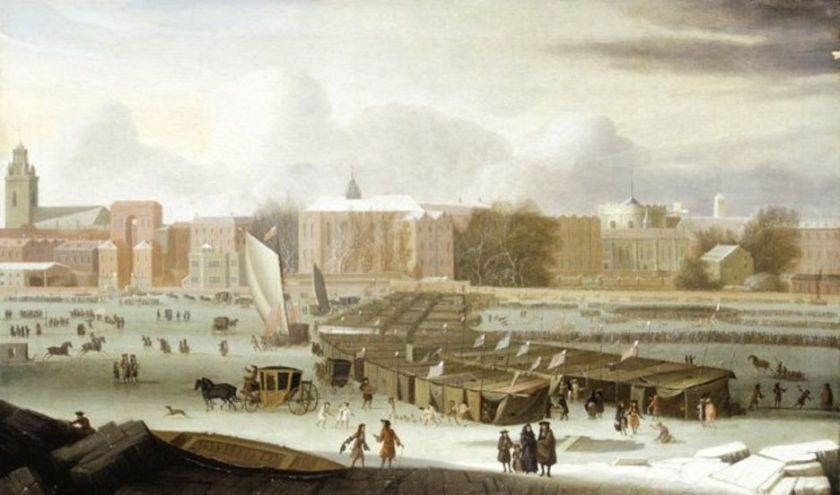
In England, accounts of the River Thames freezing over date back as early as 250AD. The river was open to wheeled traffic for 13 weeks in 923 and again in 1410. That time, the freeze lasted for 14 weeks. By the early 17th century, the Thames became a place of “Frost Fairs”.
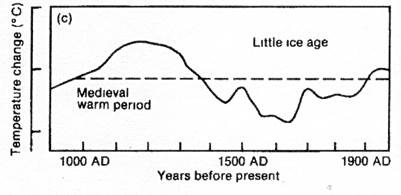
The “Medieval Warm Period” lasting from 950 to 1250 was followed by the “Little Ice Age”, a 300-year period beginning in the 16th century. King Henry VIII rode a sleigh down the Thames from London to Greenwich in 1536. Elizabeth I was out on the ice shooting at archery targets, in 1564.
English writer John Evelyn describes the famous “Frost Fair” of the winter of 1683-’84: “Coaches plied from Westminster to the Temple, and from several other stairs too and fro, as in the streets; sleds, sliding with skeetes, a bull-baiting, horse and coach races, puppet plays and interludes, cooks, tipling and other lewd places, so that it seemed to be a bacchanalian triumph, or carnival on the water”.
The Great Frost of the winter of 1708-09 was held in the coldest winter Europe had seen in 500 years. William Derham, an English clergyman and natural philosopher best known for calculating a reasonably accurate estimate of the speed of sound, recorded a low of −12°C (10 °F) on the night of January 5, 1709. It was the lowest he’d measured since beginning readings in 1697, prompting the comment that “I believe the Frost was greater than any other within the Memory of Man”.
24,000 Parisians died of cold in the next two weeks. Animals froze in their stalls and crops planted the prior year, failed. The resulting famine killed an estimated 600,000 in France alone while, in Italy, the lagoons and canals of Venice, froze solid.
Breaks in cold weather inevitably marked the end of the frost fairs, sometimes all of a sudden. In January 1789, melting ice dragged a ship with it, while tied to a riverside tavern, in Rotherhite. Five people were killed when the building was pulled down on their heads.
The last Thames River frost fair took place in 1814, the year someone led an elephant across the ice, below Blackfriar’s Bridge. Structural changes in river embankments and the demolition of the medieval London Bridge have increased water flow in the Thames, making it possible that the river will never freeze again.
Today, many blame weather extremes on “anthropogenic” (human) causes, associating what used to be called global warming”, with CO2. Others contend the reverse: that historic increases in carbon do not precede but rather result from, climate extremes. A third group associates the sun with climate change (imagine that), linking an extended period of low solar activity called the “Maunder Minimum”, with the brutal cold of 1645-1715.
The science is politicized. Vast sums of public largesse and political capital are lavished on the climate. We are told to expect global warming, and warned of a coming ice age. The skeptical taxpayer who has to pay for it all is forced to wade through competing narratives, in an exercise not unlike taking a sip from a fire hose.
Meanwhile, the sun is going to do what the sun is going to do, which at the moment appears to be another quiet period in solar activity. Very quiet. Before it’s over, we may find ourselves wishing for a little Global Warming.
Feature image, top: The Battery, Charleston SC, January 2, 2018
Aside from some of the most dismal economic conditions in American history, the Iranian hostage crisis did more than anything else to doom Jimmy Carter, to a single term.
Ruhollah Mousavi, the name translates as “inspired of God”, was born in the Iranian village of Khomein, on September 24, 1902. Born into a family of Shi’ite religious scholars, Mousavi was raised by his mother and aunt after his father was murdered while the boy was still an infant. The mother and the aunt died in a cholera outbreak when he was 16. After that he was raised by his brother, Seyed Mourteza.
The family claimed to be directly descended from Muhammad, and both brothers were avid religious scholars, attaining the status of Ayatollah: Shi’ite scholars of the highest knowledge.
As King of Persia (Iran) since the 1920s, Rezā Shāh Pahlavi weakened the powers of religious leaders and pushed for a more secularized country. Pahlavi’s reign was largely a force for modernization, but was often despotic, and failure to modernize a large peasant population paved the way to the Iranian Revolution.
Mohammad Reza Pahlavi
Mohammad Reza Pahlavi came to power in 1941, following the Commonwealth/Soviet invasion of the Empire of Iran which forced the abdication of his father.
The years following WW2 saw a “growing nationalist mobilization against foreign domination” across the Middle East. In Iran, increasingly politicized Shiʿite “Islamic Fundamentalist” sentiment took the form of the Fadā’iyān-e Islam, literally “Self-Sacrificers of Islam”, an activist organization founded by theology student Navvab Safavi and dedicated to “purifying” Islam through the assassinations of leading intellectual and political leaders.
Prime Minister Haj Ali Razmara was assassinated by Fadā’iyān-e Islam radicals in 1951, the organization’s spiritual leader Ayatollah Abol-Qassem Kashani becoming Speaker of the National Parliament.
In the early 50’s, secular Prime Minister Mohammad Mosaddegh enjoyed an alliance of convenience with the hard-liner Kashani, mentor to the future Ayatollah Khomeini, at the same time seeking to blunt the political power of the Shah, believing that the Persian King should “reign, but not rule” in the manner of the constitutional monarchies of Europe.
In 1901, Mozzafar al-Din Shah Qajar, King of Persia, granted a 60-year petroleum search concession to British investor William Knox D’Arcy for £20,000, equivalent to $166 million in 2016. By the WW2 period, support was building for state control of foreign-owned oil assets, many believing such policies to be the way forward to greater wealth and self-determination. Mossadegh attempted to negotiate a 50/50 split of oil profits, but the British controlled Anglo-Iranian Oil Company (AIOC) balked.
Mohammad Mossadegh
Contrary to the American position at that time, the UK government began plans to undermine and overthrow the Iranian government.
AIOC refusal to submit to audit of its books led to the “Nationalization Crisis” of 1951, and the near-unanimous vote in the majlis to nationalize Iranian oil assets. Foreign-owned oil executives were expelled from the country, the British government enforcing an Iranian oil embargo while Prime Minister Mossadegh talked of a “cruel and imperialistic country” stealing from a “needy and naked people.”
With the United States fighting a war in Korea, the American government was deeply entrenched in a cold war mindset. Mossadegh had lost the support of Islamist hardliners by this time, for his failure to move the nation toward sharia-based theocratic government.
The communist-supporting Tudeh party began to infiltrate the Iranian military, persuading American Secretary of State John Foster Dulles that the Iranian government was “falling” to the Soviet Union.
Tehran University students, in the time of the shah
Before long, economic and political isolation severely weakened the Mossadegh government, as the American government switched sides on the question of Iranian overthrow. Two UK/US-backed coup attempts followed in 1953, along with the temporary expulsion of the Shah. The government was done for good that August. Mohammad Mossadegh would spend the rest of his life under house arrest.
Grand Ayatollah Ruhollah Khomeini
Ayatollah Khomeini had formed very different views by this time from those of his teachers, concerning the separation of church and state. Khomeini dedicated himself to teaching, cultivating a group of dedicated students who would one day become his staunchest supporters. By the time of JFK’s election to the Presidency, Shi’ite Iranians regarded Khomeini as “Marja-e Taqlid”. A person to be imitated.
Khomeini gained prominence in 1962, opposing a law which would remove the requirement that elected officials be sworn in on the Qu’ran. In 1963, he gave a speech suggesting the Shah could leave if he didn’t like the political direction of the country, a speech which earned him a stay in prison.
Khomeini was arrested again in 1964, after pronouncing his belief that Jews would take over Iran, and that the US considered all Iranians to be little more than slaves. Khomeini was deported to Turkey, later taking up residence in Iraq because Turkish law prevented him from wearing the traditional clothes of a Shi’ite cleric and scholar.
During his years in exile, Khomeini developed his ideas on the structure of an Islamic state, which he called “Velayat-e faqeeh”. He would lecture on his religious theories, videotapes of which were smuggled into Iran and sold at bazaars, making Khomeini the leader of Iranian opposition to the Shah’s government.
Military force had to be called out in 1975, to dispel crowds at a religious school in Qom. Khomeini declared it the beginning of “Freedom and liberation from the bonds of imperialism”. By this time Khomeini was too hot to handle even for the Iraqis, and he moved to Paris. It was only a few short months before his triumphant return.
Thousands were killed in riots and demonstrations throughout 1978, which the Shah first tried to quell, and later to embrace. “As Shah of Iran as well as an Iranian citizen”, Pahlavi said on November 5, “I cannot but approve your revolution”.
It was too little, too late. Weeks later the Shāhanshāh, the “King of Kings”, left his country for good.
Khomeini re-entered Iran in February, as the Shah went from country to country, looking for a place to stay. With the now-former King of Kings suffering from a form of non-Hodgkins Lymphoma, President Jimmy Carter reluctantly allowed the Shah into the US for surgery. Pahlavi left on December 15, 1979 for Panama.
Meanwhile, now “Grand Ayatollah” Khomeini was denouncing what he saw as an American plot. Revolutionaries stormed the American embassy and seized 66 hostages. 13 women and black Americans were released. Richard Queen, a white man sick with Multiple Sclerosis, was released nine months later. The remaining 52 hostages would be 444 days in captivity, paraded before television cameras in blindfolds as Khomeini denounced “The Great Satan”.
The US attempted a rescue on April 24, 1980. “Operation Eagle Claw” ended in collision between aircraft and the death of eight American servicemen, an Iranian civilian, and the destruction of two aircraft.
Aside from some of the most dismal economic conditions in American history, the Iranian hostage crisis did more than anything else to doom Jimmy Carter, to a single term.
Iranian revolutionaries wanted the Shah to stand trial for atrocities committed by his secret police, the SAVAK, but the Islamic Republic of Iran would easily match the worst of the Shah’s reign when it came to brutality.
Ayatollah Ruhollah Khomeini is gone now, but his influence is very much alive. If you want a fun read sometime, download the constitution of the Islamic Republic of Iran. Khomeini is personally named in the document. Three times.
There is a quote, attributed to the Ayatollah, which says “We do not worship Iran, we worship Allah. For patriotism is another name for paganism. I say let this land burn. I say let this land go up in smoke, provided Islam emerges triumphant in the rest of the world”.
A 2007 article in the Economist calls the authenticity of this quote into question, noting that the Mullahs like to build up bank accounts in Dubai and Switzerland, behavior hardly consistent with such an apocalyptic world view.
As South Korean intelligence officials warn of a madman neighbor to the north “bartering” nuclear weapons for oil, the previous administration concluded a comprehensive “Nuclear Agreement” with Iran, replete with secret side deals, including $400 billion in cash flown into Tehran in the middle of the night.
While the current administration mulls over the re-certification of that deal, it would be nice to settle the authenticity question on that Khomeini quote, once and for all.
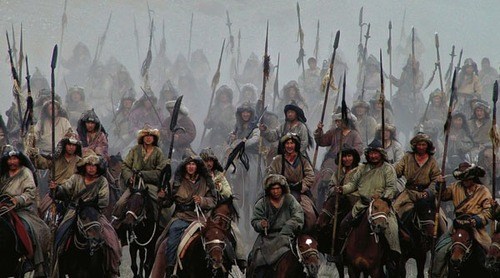
Imagine an army of circus riders, equipped with composite bows and a minimum of 60 arrows apiece, each capable of hitting a bird in flight. Each rider has have no fewer than 3-4 small, fast horses, and is able to transfer mounts in mid-gallop in order to keep his horses fresh. In this way, riders could cover 100 miles and more in a day. Stirrups allowed them to fire in any direction, including to the rear.
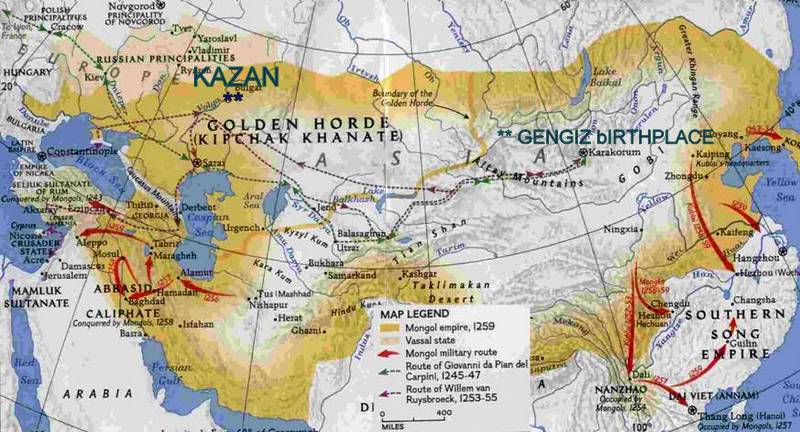
The Eurasian Steppe is a vast region of grasslands and savannas, extending thousands of miles east from the mouth of the Danube, nearly to the Pacific Ocean. There’s no clearly defined southern boundary, as the land becomes increasingly dry as you move south. To the north are the impenetrable forests of Russia and Siberia.
The 12th century steppe was a land of inter-tribal rivalry, immersed in a poverty so profound that many of its inhabitants went about clad in the skins of field mice. Ongoing acts of warfare and revenge were carried out between a kaleidoscope of ever-changing tribal confederations, compounded and egged on by the interference of foreign powers such as the Chinese dynasties of the Song and the Jurchen, to the south.
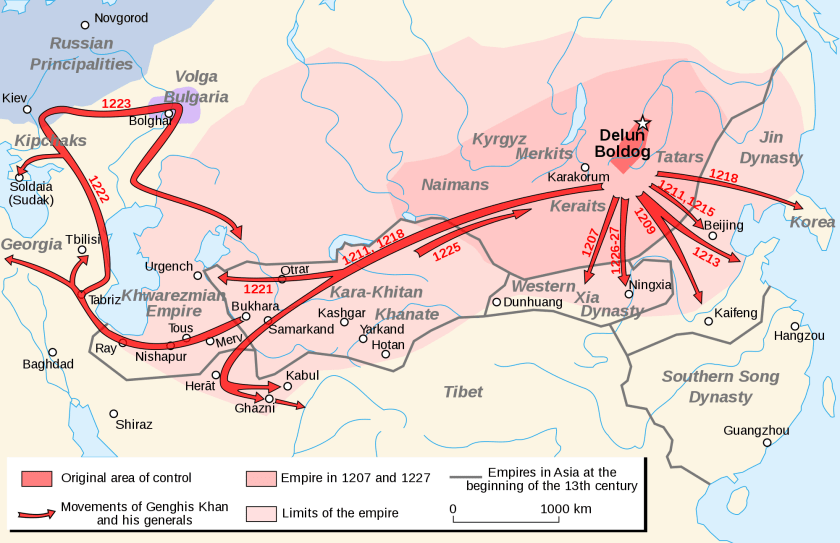
Into this land was born the son of the Mongol chieftain Yesügei, born with a blood clot grasped in his fist. It was a sign, they said, that this child was destined to become a great leader. By 1197, the boy would unite the nomadic tribes of northeast Asia into the largest contiguous empire in history, extending from Korea in the east, through Baghdad and Syria all the way into eastern Europe. One-fifth of the inhabited land area, of the entire planet.
His name was Temujin. He is known to history as the Great Leader of the Mongol Empire, Genghis Khan.
The Steppes have long been a genetic crossroad, the physical features of its inhabitants as diverse as any in the world. The word “Rus”, from which we get Russia, was the name given to Viking invaders from earlier centuries. History does not record what Genghis himself looked like, though he’s often depicted with Asian features. There is evidence suggesting he had red hair and green eyes. Think of that beautiful young Afghan girl, the one with those killer eyes on that National Geographic cover, a few years back.
The Mongols called themselves “Tata”, while others called them after the people of Tartarus, the Hell of Roman mythology. They were the “Tatars” to the people they terrorized: “Demons from Hell”.
The two most prominent weapons in the Mongol arsenal can be found in the words “Horse Archer”. Imagine an army of circus riders, equipped with composite bows and a minimum of 60 arrows apiece, each capable of hitting a bird in flight. Each rider has have no fewer than 3-4 small, fast horses, and is able to transfer mounts in mid-gallop in order to keep his horses fresh. In this way, riders could cover 100 miles and more in a day. Stirrups allowed them to fire in any direction, including to the rear.
The bow, a laminated composite of wood, horn and sinew, combined the compression of the interior horn lamina with the stretching of animal sinews, glued to the exterior. The weapon was capable of aimed shots at five times the length of a football field. Ballistic shots into large groups were common as far as 2½ times that distance. The average draw weight of a first-class English longbow is 70-80 lbs. The Mongol composite bow ranged from 100 to 160 lbs, depending upon the physical strength of its user.
After the death of Genghis’ eldest son Jochi, who pre-deceased his father, the Great Khan installed his grandson Batu as Khan (Chief of State) of the Kipchak Khanate to the north. In 1235, the Great Khan Ögedei, who had succeeded his father on Genghis’ death in 1229, ordered his nephew Batu and an army of 130,000 of these circus riders to conquer Europe, beginning with the Rus.
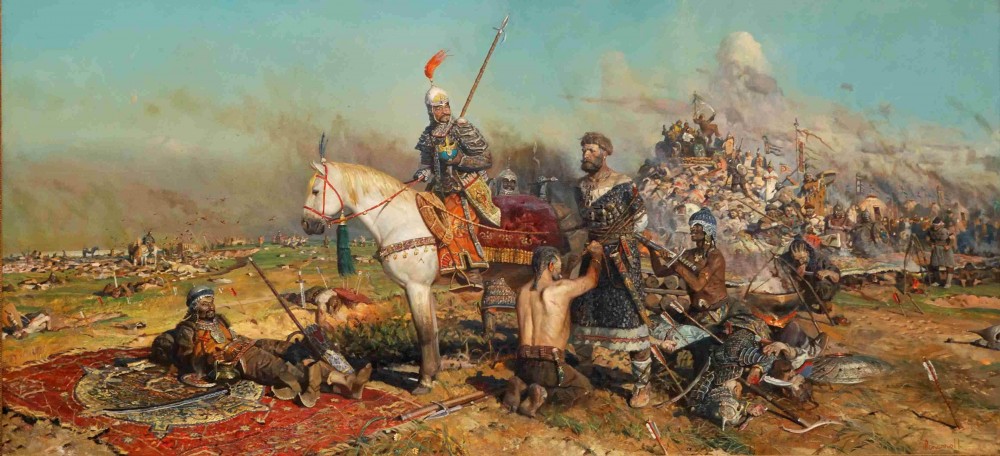
13th century Russia was more a collection of principalities than it was a single nation. One by one these city-states fell to the army of Batu, known as the “Golden Horde”. Ryazan, Kolomna and Moscow. Vladimir, Rostov, Uglich, Yaroslavl, and a dozen others. Some of the names are familiar today, others were extinguished for all time. All fell to the Golden Horde. Smolensk alone escaped, having agreed to submit and pay tribute. The city of Kitezh, as the story goes, submerged itself into a lake along with its inhabitants, at the approach of the Horde. On this day, December 6, 1240, Mongols under Batu Khan occupied & destroyed Kiev, following several days’ struggle.
By the end of 1241, Mongol armies had crushed opposing forces from the Plains of Hungary, to Eastern Persia, to the outskirts of Austria. That December, plans were being laid for the invasion of Germany, Austria and Italy, when news arrived informing the Mongol host of the death of the Great Khan, Ögödei. Batu wanted to continue, but the Law of Yassa required that all Princes of the Blood return to Karakorum and the Kurultai, the meeting of Mongol Chieftains.
The Abbasid Caliphate of Islam, descended from the uncle of Muhammad Al-Abbas ibn Abd al-Muttalib and established in 750, was the third Islamic Caliphate since the time of Muhammad. Centered in Baghdad, the Abbasid Caliphate became a center of science, culture, philosophy and invention, during what has come to be known as the Golden Age of Islam.
Since 1241, the Abbassids paid tribute to the Khanate in the form of gold, military support, and, according to rumors, Christian captives of the Crusades. That came to a halt in 1258, when Caliph Al-Musta’sim refused to continue the practice. The Abbassid Caliphate ceased to exist on February 10, following a twelve-day siege by the Mongol army of Hulagu Khan, brother of the Khagan (great kahn) Möngke.
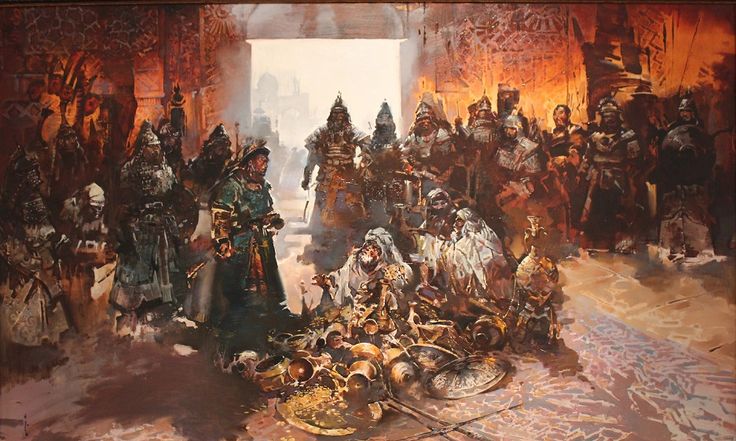
The Mongols first looted and then destroyed mosques, palaces and hospitals. The “House of Wisdom”, the grand library of Baghdad, compiled over generations and comparable in size and scope to the modern-day Library of Congress, the British Library in London or the Nationale Bibliotheque in Paris, was utterly destroyed. Survivors said that the muddy waters of the Tigris ran black with the ink of the books hurled into its waters, and red from the blood of the slain.
Estimates of the number killed in the fall of Baghdad, range from 90,000 to one million. Hulagu needed to move his camp to get upwind, so overwhelming was the stench of the dead.
Believing the earth to be offended by the spilling of royal blood, Mongols rolled Caliph Al-Musta’sim himself up in a carpet and trampled him to death, with their horses.
In 1281, a massive Mongol fleet of some 4,000 ships and 140,000 men set out under Kublai Khan, to invade Japan. This was the second such attempt, the largest naval invasion in history and not to be eclipsed until the 20th century D-Day invasion, of Normandy. As with the previous attempt, a great typhoon came up and destroyed the Mongol fleet. As many as 70,000 men were captured. The Golden Horde never again attempted the invasion of Japan. To this day, we know this “Divine Wind”, as “Kamikaze”.
Tamerlane
Berke, grandson of Ghenghis and brother of Batu, converted to Islam, creating a permanent division among the descendants of the Great Khan.
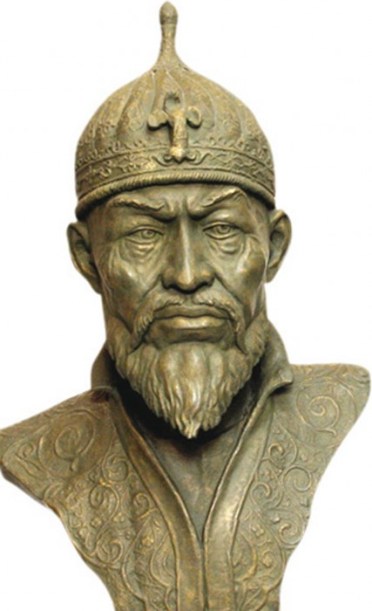
Timur-i-leng, “Timur the Lame”, or “Tamerlane”, professed to be a good Muslim, but had no qualms about destroying the capitals of Islamic learning of his day. Damascus, Khiva, Baghdad and more he destroyed. Many, have never entirely recovered. Best known for the pyramids of skulls he left behind, as many as 19 million fell to the murderous regime, of Tamerlane.
The violence of the age was so vast and horrific that it’s hard to get your head around. WWII, the deadliest conflict in human history, was a time of industrialized mass slaughter. From the battlefields to the death camps, WWII ended the lives of 40 to 72 million souls, killed in a few short years. Roughly 3% of the inhabitants of earth. By comparison, the Mongol conquests killed 30 million over 162 years, mostly one-by-one with edged or pointed weapons. When it was over, 17% of the entire world’s population, had vanished.
The Celtic warrior Calgacus once said of the Roman conquests that “They make a desert, and they call it peace”. It was likewise for the Mongol Empire; a time of peace for those who would submit and pay tribute. A time when “A maiden bearing a nugget of gold on her head could wander safely throughout the realm.”
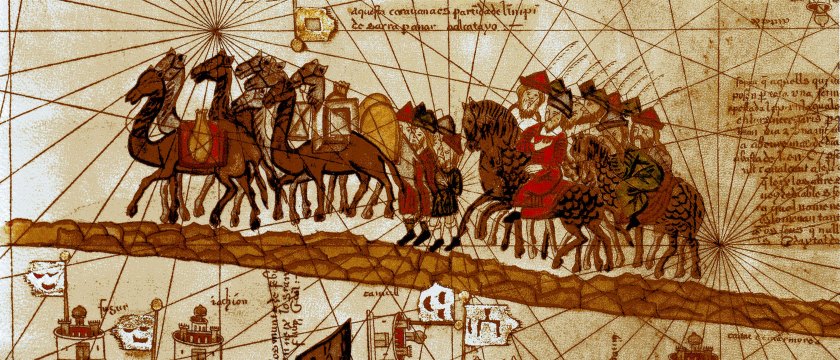
The Catalan Atlas depicts Marco Polo traveling to the East during the ‘Pax Mongolica’.
This “Pax Mongolica” lasted through the reign of the Great Khan and his several successors, making way for the travels of Marco Polo. The 4,000-mile long “Spice Roads”, the overland trade routes between Europe and China, flourished throughout the 14th and 15th centuries under Mongol control.
In the 14th century, the “Black Death” began to change the balance of power on the Eurasian steppe. 100 years later, the fall of Byzantium and marauding bands of Muslim brigands were making the east-west overland trade routes increasingly dangerous. In 1492, the Spanish Crown hired an Italian explorer to find a water route to the east.
The Mongols would never regain the lost high ground of December 1241, as chieftains fell to squabbling over bloodlines.
The Golden Horde ruled over parts of Russia until the time of Ivan IV “Grozny” (The Terrible), in the 1550s.
The Mongol hordes never went away, not entirely. Modern DNA testing reveals that up to 8% of certain populations across the Asian subcontinent, about one-half of one per cent of the world’s population, descends directly from that baby with the blood clot, grasped in his fist. Genghis Khan.
If you enjoyed this “Today in History”, please feel free to re-blog, “like” & share on social media, so that others may find and enjoy the same. Please click the “follow” button on the right, to receive email updates on new articles. Thank you for your interest, in the history we all share.


 Later discovered by Faustulus, the boys were reared by the shepherd and his wife. Much later, the twins became leaders of a band of young shepherd warriors. On learning their true identity, the twins attacked Alba Longa, killed King Amulius, and restored their grandfather to the throne.


 In the early 1330s, a deadly plague broke out on the steppes of Mongolia. The gram-negative bacterium Yersinia Pestis preyed heavily on rodents, the fleas from which would transmit the disease to people, the infection then rapidly spreading to others.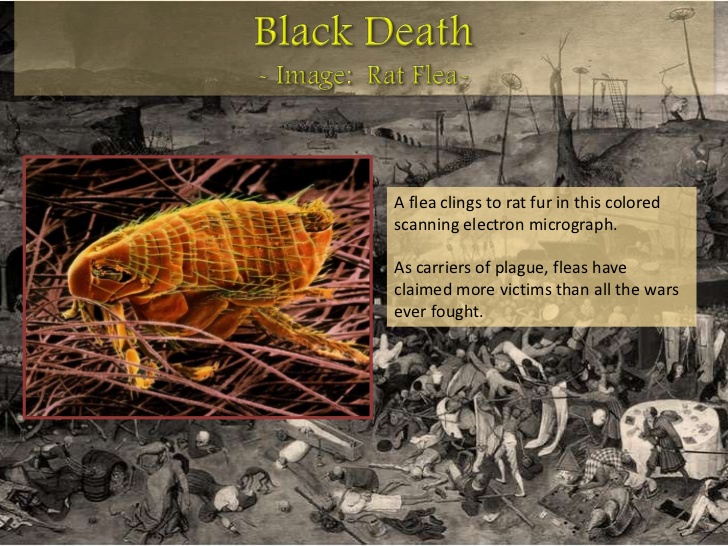
 The Black death of 1346-’53 was a catastrophe unparalleled in human history, but it was by no means the last such outbreak. The Third Pandemic began in China in 1855, spreading to Hong Kong and on to British India. In China and India alone the disease killed 12 million people. It then spread to parts of Africa, Europe, Australia, and South America.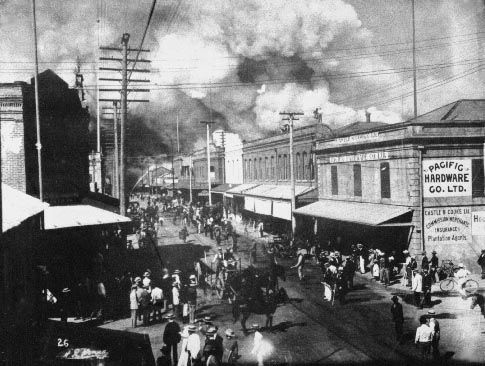
 The body of an elderly Chinese man was discovered in a Chinatown basement. An autopsy found the man to have died of plague. There were more than 18,000 Chinese and another 2,000 Japanese living in the 14-block Chinatown section of the city. Many called for a quarantine of Chinatown, but Chinese citizens objected, as did then-Governor Henry Gage, who tried to sweep the whole outbreak under the carpet. Business interests likewise objected to the quarantine. Except for the Hearst Newspapers, not much was heard about it.
 San Francisco was hit by a massive earthquake on April 18, 1906, followed by a great fire. Thousands of San Franciscans were crowded into refugee camps with an even higher number of rats. For the first time, the disease now jumped the boundaries of Chinatown.

 The coming cataclysm would lay waste to a generation, and to a continent.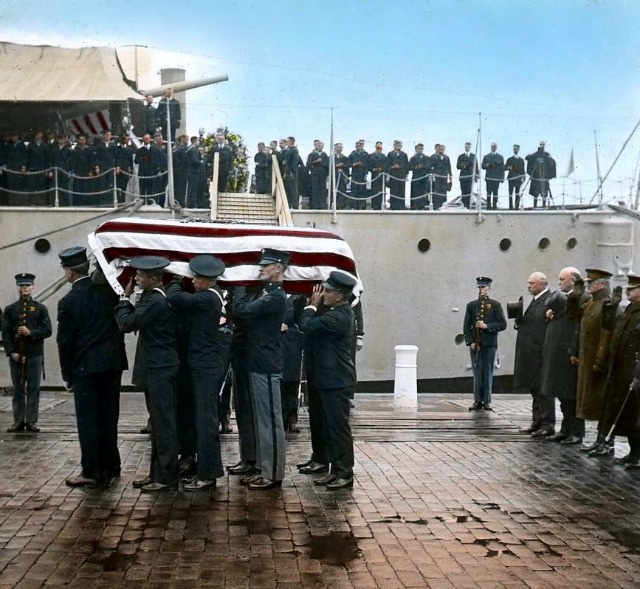

 On November 11, Armistice Day, the casket was removed from the Rotunda of the Capitol and escorted under military guard to the amphitheater at Arlington National Cemetery. In a simple ceremony, President Warren G. Harding bestowed on this unknown soldier the Medal of Honor, and the Distinguished Service Cross.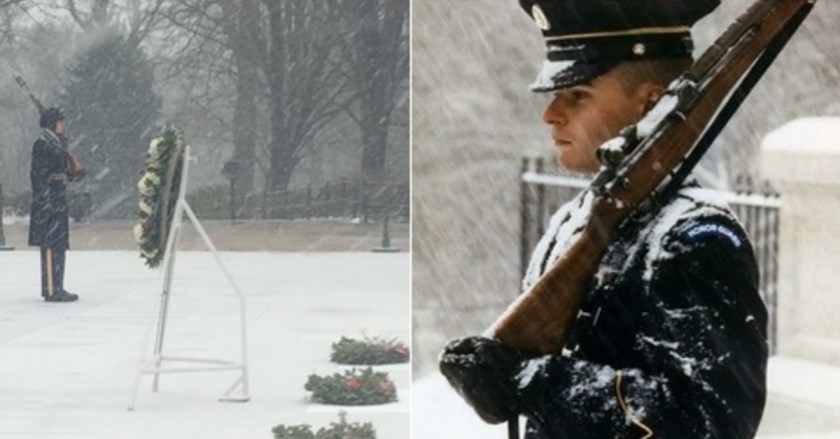



 Between 1939 and ’41, Mexican farmers suffered major crop failures, due to stem rust. In July 1944, Borlaug declined an offer to double his salary, traveling instead to Mexico City, heading a new program focusing on soil development, maize and wheat production, and plant pathology.
 The Indian subcontinent experienced minor famine and starvation at this time, limited only by the US shipping 1/5th of its wheat production into the region in 1966 – ’67. Despite resistance from Indian and Pakistani bureaucracies, Borlaug imported 550 tons of seeds.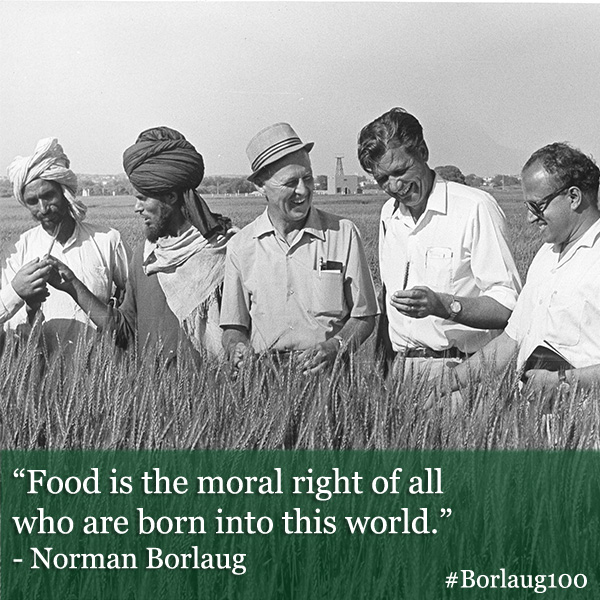
 According to former Director General of the International Water Management Institute David Seckler, “The environmental community in the 1980s went crazy pressuring the donor countries and the big foundations not to support ideas like inorganic fertilizers for Africa.” The Rockefeller and Ford foundations withdrew funding, along with the World Bank.


 By that time it wasn’t just the “Party of Order” on the right and the “Party of Movement” on the left. Now, the terms began to describe nuances in political philosophy, as well.

 The July Crisis of 1914 was a series of diplomatic maneuverings, culminating in the ultimatum from Austria-Hungary to the Kingdom of Serbia. Vienna, with tacit support from Berlin, made plans to punish Serbia for her role in the assassination, while Russia mobilized armies in support of her Slavic ally.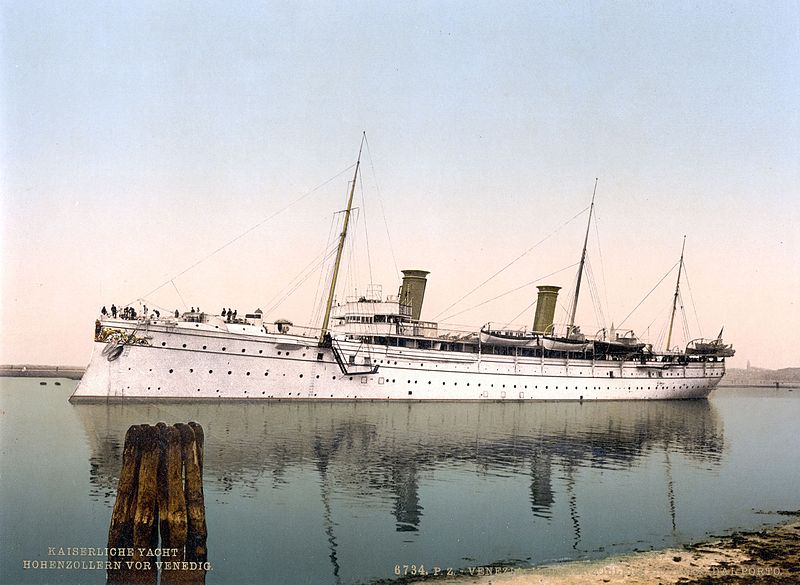
 In the days that followed, the Czar would begin the mobilization of men and machines which would place Imperial Russia on a war footing. Kaiser Wilhelm’s Germany invaded Belgium, in pursuit of the one-two punch strategy by which it sought first to defeat France, before turning to face the “Russian Steamroller”. England declared war in support of a 75-year-old commitment to protect Belgian neutrality, a treaty obligation German diplomats had dismissed as a “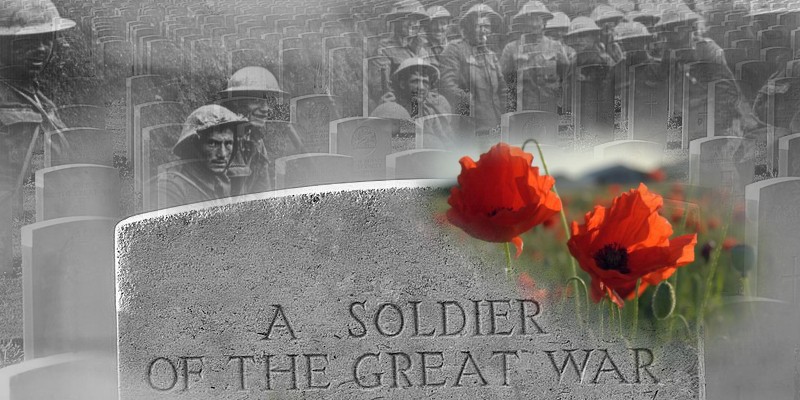


 On the evening of February 16, 1804, Decatur entered Tripoli Harbor with a force of 74 Marines. With them were five Sicilian volunteers, including pilot Salvador Catalano, who spoke fluent Arabic. Disguised as Maltese sailors and careful not to draw fire from shore batteries, Decatur’s force boarded the frigate, killing or capturing all but two of its Tripolitan crew. Decatur and his marines had hoped to sail Philadelphia out of harbor, but soon found she was in no condition to leave. Setting combustibles about the deck, they set the frigate ablaze. Ropes burned off, setting the Philadelphia adrift in the harbor. Loaded cannon cooked off as the blaze spread, firing random balls into the town. It must have been a sight, when gunpowder stores ignited and the entire ship exploded.

 Martin Luther wrote to Archbishop Albrecht on October 31, 1517, objecting to this sale of indulgences. He enclosed a copy of his “Disputation of Martin Luther on the Power and Efficacy of Indulgences”, a document which came to be known as his “95 Theses”.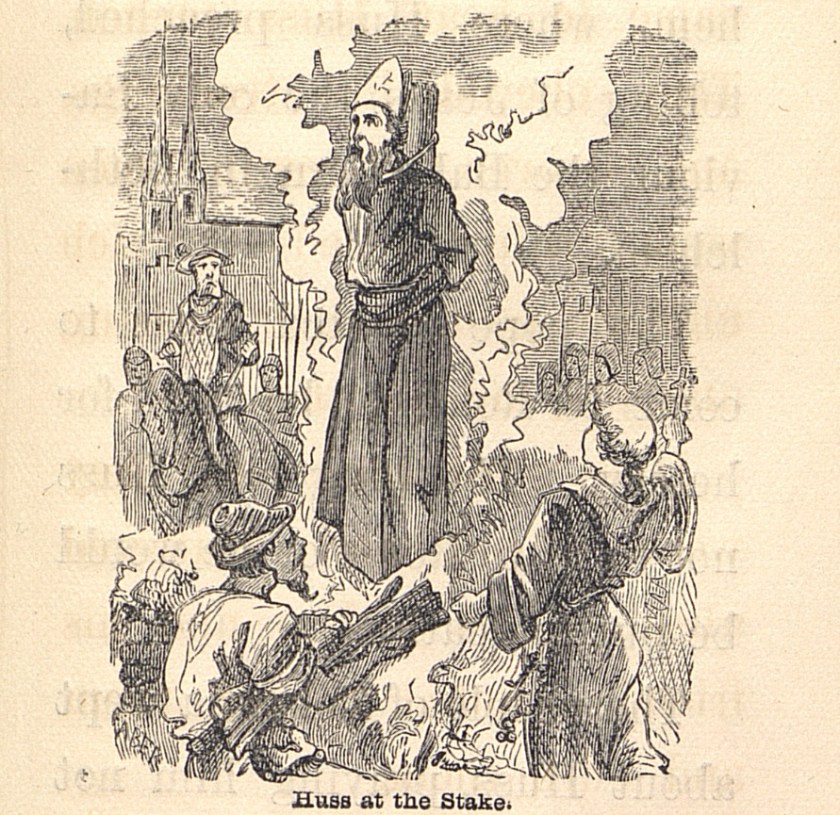




 Breaks in cold weather inevitably marked the end of the frost fairs, sometimes all of a sudden. In January 1789, melting ice dragged a ship with it, while tied to a riverside tavern, in Rotherhite. Five people were killed when the building was pulled down on their heads.


 Military force had to be called out in 1975, to dispel crowds at a religious school in Qom. Khomeini declared it the beginning of “Freedom and liberation from the bonds of imperialism”. By this time Khomeini was too hot to handle even for the Iraqis, and he moved to Paris. It was only a few short months before his triumphant return.
 Khomeini re-entered Iran in February, as the Shah went from country to country, looking for a place to stay. With the now-former King of Kings suffering from a form of non-Hodgkins Lymphoma, President Jimmy Carter reluctantly allowed the Shah into the US for surgery. Pahlavi left on December 15, 1979 for Panama.
 Meanwhile, now “Grand Ayatollah” Khomeini was denouncing what he saw as an American plot. Revolutionaries stormed the American embassy and seized 66 hostages. 13 women and black Americans were released. Richard Queen, a white man sick with Multiple Sclerosis, was released nine months later. The remaining 52 hostages would be 444 days in captivity, paraded before television cameras in blindfolds as Khomeini denounced “The Great Satan”.
 Aside from some of the most dismal economic conditions in American history, the Iranian hostage crisis did more than anything else to doom Jimmy Carter, to a single term.
 The Steppes have long been a genetic crossroad, the physical features of its inhabitants as diverse as any in the world. The word “Rus”, from which we get Russia, was the name given to Viking invaders from earlier centuries. History does not record what Genghis himself looked like, though he’s often depicted with Asian features. There is evidence suggesting he had red hair and green eyes. Think of that beautiful young Afghan girl, the one with those killer eyes on that National Geographic cover, a few years back.
 The Mongols would never regain the lost high ground of December 1241, as chieftains fell to squabbling over bloodlines.
 Historical Easter Eggs - Today in History
You must be logged in to post a comment.