January 25, 1890 Nellie Bly

“Could I pass a week in the insane ward at Blackwell’s Island? I said I could and I would. And I did”. – Nellie Bly

Born May 5, 1864, Elizabeth Jane Cochran was one of fifteen children born to Michael Cochran, and two wives. Michael died in 1870 leaving a modest legacy. It didn’t amount to much, split fifteen ways.

As a teenager in western Pennsylvania, Elizabeth adopted an “e” believing that “Cochrane” sounded more sophisticated. She enrolled at the Indiana Normal School in 1879 (now Indiana University of Pennsylvania) but dropped out after one semester, for lack of funds. In 1880 her mother moved the family, to Pittsburgh.

According to an article in the Pittsburg Dispatch entitled “What girls are for” the answer appears to be, not very much. Making babies and keeping house. Elizabeth didn’t appreciate that and wrote to the paper, to say so. She signed her letter, “Lonely Orphan Girl”.

If writing well is the sign of an organized thought process, the mind of Elizabeth Cochrane was in good working order. Impressed with the anonymous letter, Editor George Madden ran an advertisement asking that the writer, identify herself.

That she did. Madden offered the opportunity to write a piece for publication, under the same pseudonym. Cochrane called that first piece “The Girl Puzzle”, describing how divorce effected women and arguing for reform of marital laws.

Madden was even more impressed and hired Elizabeth, full-time. In those days, women who wrote for newspapers generally did so, under a pseudonym. The Editor suggested “Nelly Bly” after the subject of a popular minstrel song, from 1850. Cochrane liked “Nelly” but her editor spelled it with an ‘ie’.

Nellie Bly would go on to be one of the most famous journalists of the age.

She first came to widespread notice with a series of investigative articles, focused on poor working conditions and the plight of female factory workers. Factory owners complained. Bly was reassigned to a role more typical of female reporters: Gardening. Society. Fashion.

She didn’t want any of it. Still only 21, she wanted “to do something no girl has done before.” She traveled to Mexico and became a foreign correspondent, writing about the Mexican people and criticizing the dictatorship, of President Porfirio Diaz.

Nellie Bly, in Mexico

Stung by what she had written, Mexican authorities threatened to throw her in jail. Bly was forced to flee. Back in Pittsburg, it wasn’t long before she’d had enough of theater and arts reporting. She resigned her job in 1887 and moved to New York.

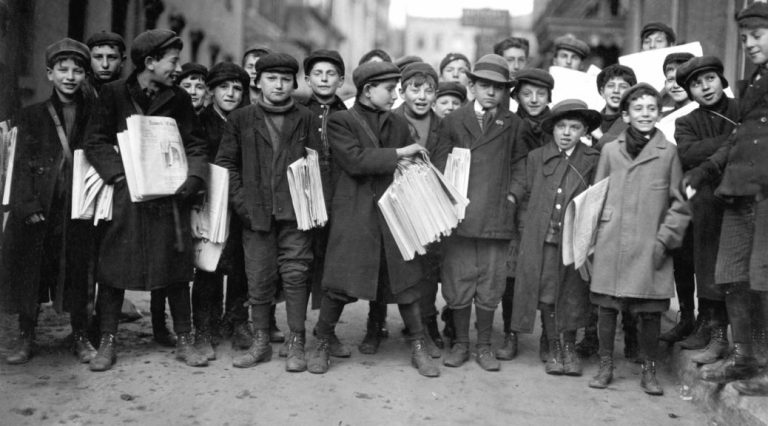
This was the age of lurid headlines, of sensational if not always accurate stories and homeless street waifs called “Newsies“, hawking newspapers: “Extra Extra, read all about it!” Within the next five years, San Francisco publisher William Randolph Hearst would buy crosstown rival New York Journal sparking a newspaper war and a new style of news we now call “Yellow Journalism“.
Penniless after four months without income, Cochrane walked into the office of New York World publisher, Joseph Pulitzer. Pulitzer had purchased the company four years earlier promising to root out corruption, expose fraud and ferret out public abuse, at all levels.

Bly was hired to cover theater and the arts but the pair soon concocted an undercover assignment. Nellie Bly would feign insanity, with the aim of being committed to the notorious women’s insane asylum on Blackwell’s Island.

It was a dangerous ruse but it worked. The “pretty crazy girl” fooled the New York press and mental health “experts” alike, culminating in Bly’s incarceration at Blackwell’s Island. She was released at the behest of the New York World, ten days later.

Bly’s exposé was a sensation. First in a series of stories and then in a book entitled Ten Days in a Madhouse, Nellie Bly told tales of torture, of ice cold baths in used and filthy water, rancid food and the rats, vermin and brutality suffered by women she was convinced were every bit as sane, as herself.

Public outrage prompted a grand jury investigation culminating in an $800,000 increase in public funding to the Department of Public Charities and Corrections.

Bly’s caper sparked a new form of “stunt journalism”, a new breed of female reporters with secret identities like “Florence Noble” and “Dorothy Dare” tackling subjects like disaster victims, the plight of factory workers and other subjects previously considered “unfit for ladies”.

Every major newspaper in the nation wanted a “stunt girl” on the staff.

In 1872, novelist Jules Verne published the fictional tale of the gambler Phileas Fogg and the trip he went on, to win a bet. The story was called Around the World in 80 Days. In 1888, Nellie Bly pitched the same trip to her editor. For real.

With two days’ notice, Nellie Bly boarded the Hamburg America Line steamer Augusta Victoria in November 1889 to begin her 25,000-mile adventure. She took an overcoat, the dress she was wearing, a few changes of underwear and a travel bag with a few essentials. A bag with £200 in English bank notes, some gold and American currency hung around her neck.

Unknown to Nellie at this time, Cosmopolitan magazine was sponsoring reporter Elizabeth Bisland to take the same trip, in the opposite direction.

She departed the same day.

New underwater cables enabled Bly to send short progress reports though longer dispatches had to travel by mail. From her first stop in England she traveled to France where she met Jules Verne himself and on to Brindisi, the Suez Canal, Ceylon and the Far East. She visited a leper colony in China. In Singapore, she bought a monkey.

The New York World sponsored a “Nellie Bly Guessing Match”. Who could predict to the second, the journalist’s return. The grand prize was an all-expense paid trip to Europe. Spending money was tossed in, later on. A rough Pacific passage on board the Steamer RMS Oceanic put the trip two days behind schedule but Pulitzer’s newspaper made that up, hiring a private train from San Francisco.
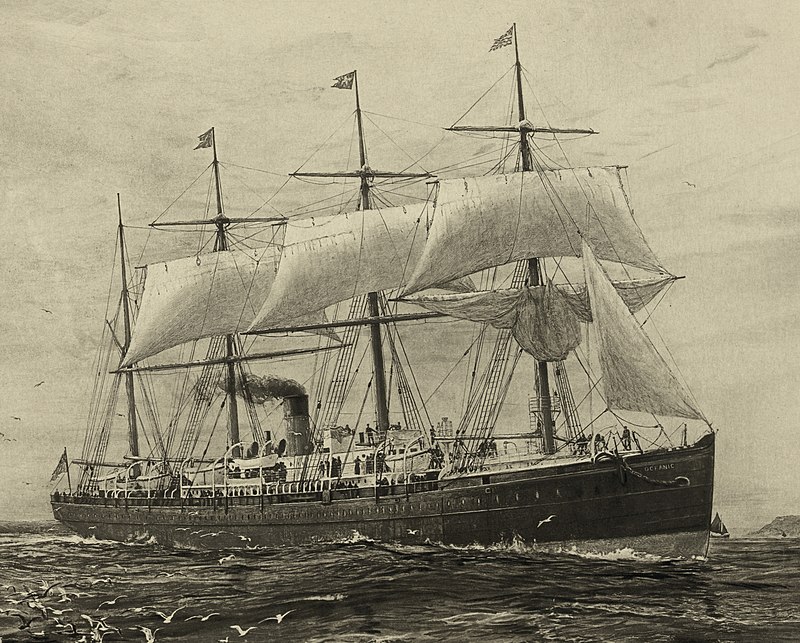
RMS Oceanic

Nellie Bly arrived in New York on January 25, 1890 at 3:51pm, besting Phileas Fogg’s time, by eight days. Over at Cosmo, Bisland was still crossing the Atlantic, with 4½ days to go.

At 31, Nellie Bly married 73-year old metal container manufacturer Robert Seaman in 1895, and left journalism. Seaman died in 1904 and, for a time, Elizabeth was one of the leading female industrialists, in the country.
She ran the company as “a model of social welfare, replete with health benefits and recreational facilities“, according to biographer, Brooke Kroeger.

But Bly was hopeless at understanding the financial aspects of her business and ultimately lost everything. Unscrupulous employees bilked the firm of hundreds of thousands of dollars, troubles compounded by a protracted and costly bankruptcy litigation“.

Back in journalism, Bly traveled to Europe to cover the Great War. She was the first woman and one of few foreigners to visit the war zone between Austria, and Serbia.

In 1913, Nelly Bly covered the first suffragist parade in Washington. She predicted women would have the vote, by 1920.

The 19th Amendment giving (white) women the vote was certified on August 26, 1920, by US Secretary of State Bainbridge Colby.

In practice, voting restrictions against non-white men now extended to non-white women. The crusade to protect the voting rights of ALL American citizens would last, another 40 years.

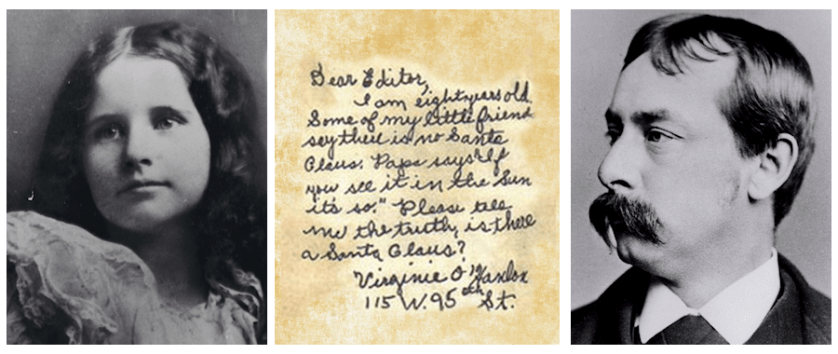
December 27, 1897 Yes Virginia, there IS a Santa Claus

History fails to record the conversation nor the exact time, or place. Perhaps the little girl went for a walk with her father, on the streets of Manhattan’s upper west side. Maybe it was over dinner or perhaps tucked into bed after a goodnight story and a kiss on the forehead. Papa, is there a Santa Claus? My little friends say he isn’t real.

In the summer of 1897, the 25th President of the United States William McKinley, had barely moved into the White House. The nation’s first subway opened in the city of Boston while, in Seattle, the Klondike gold rush was just getting underway. Thomas Edison was granted a patent for an early projector called a Kinetoscope. Mark Twain penned a rebuttal as only Mark Twain could, to his own obituary in the pages of the New York Journal: “The report of my death was an exaggeration.”

(Left: Laura Virginia O’Hanlon. around 1895)

One day there came the Dread Question asked by eight-year-olds the world over and answered by fathers since the dawn of time: “Go ask your mother”.

Just kidding. This was the Other dread question. The Santa Claus question.

History fails to record the conversation nor the exact time, or place. Perhaps the little girl went for a walk with her father, on the streets of Manhattan’s upper west side. Maybe it was over dinner or perhaps tucked into bed after a goodnight story and a kiss on the forehead. Papa, is there a Santa Claus? My little friends say he isn’t real.

He was coroner’s assistant, Dr. Philip O’Hanlon. She was 8-year-old Laura Virginia O’Hanlon.

Dr. O’Hanlon neither sent his little girl to ask her mother nor did he try to answer, himself. He suggested she write the New York Sun newspaper. “If you see it in The Sun”, he said, “it’s so.”

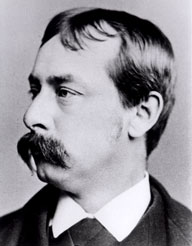
So it is a little girl’s note made its way across the city to the New York Sun, to the desk of Edward Page Mitchell. The hard core science fiction buff will remember Mitchell for tales about time travel, invisibility and man-computing-machine cyborgs long before the likes of H.G. Wells ever thought about such things but on this day, the editor and sometimes author had a job to do.

Mitchell believed the letter was worthy of reply and brought the assignment to copy writer Francis “Frank” Pharcellus Church.

It was a curious choice.

Church was not the dilettante, partisan idler who’d style himself today, as “journalist”. This was a hard-bitten News Man of the old school, a cynic, street reporter, atheist and former Civil War correspondent who’d seen it all and didn’t believe the half of it.

Picture Perry White, the irascible editor-in-chief of the fictional Daily Planet newspaper in the old Superman series, and you’ve got a pretty good picture of Frank Church. You can almost hear the walrus-mustachioed old curmudgeon grumbling across the ages on the way back to his desk, a little girl’s note in his hand. “Why me”?

The old grump didn’t even want his name associated with the reply.

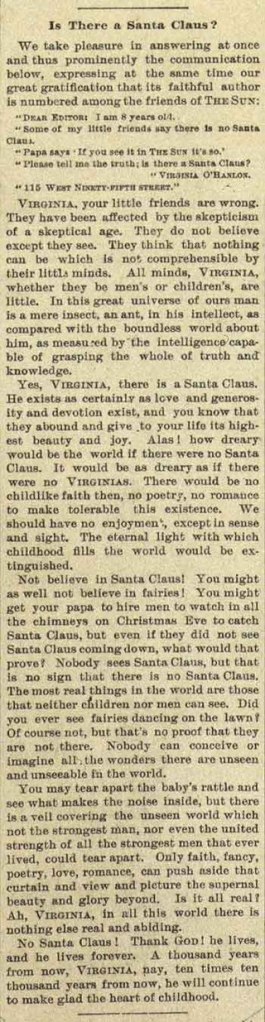
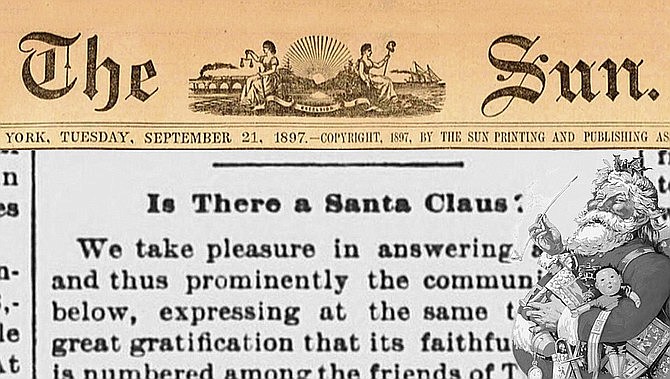
The New York Sun published Church’s reply on September 21, 1897.

Dear Editor, I am 8 years old.
Some of my little friends say there is no Santa Claus.
Papa says, “If you see it in The Sun, it’s so.”
Please tell me the truth, is there a Santa Claus?
Virginia O’Hanlon
115 W. 95th St.

Virginia, your little friends are wrong. They have been affected by the skepticism of a skeptical age. They do not believe except they see. They think that nothing can be which is not comprehensible by their little minds. All minds, Virginia, whether they be men’s or children’s, are little. In this great universe of ours man is a mere insect, an ant, in his intellect, as compared with the boundless world about him, as measured by the intelligence capable of grasping the whole truth and knowledge. You tear apart the baby’s rattle and see what makes the noise inside, but there is a veil covering the unseen world which not the strongest man, nor even the united strength of all the strongest men that ever lived, could tear apart.

Only faith, fancy, poetry, love, romance can push aside that curtain and view and picture the supernal beauty and glory beyond. Is it all real? Ah, Virginia, in all this world there is nothing else real and abiding. No Santa Claus! Thank God he lives and he lives forever. A thousand years from now, Virginia, nay 10 times 10 thousand years from now, he will continue to make glad the heart of childhood”.

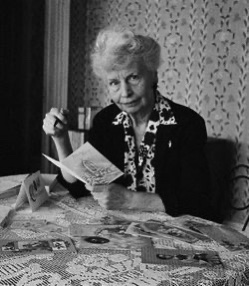
Church’s friends, family and colleagues scarcely knew the man had it in him. You can almost imagine the excitement of a little girl, scouring the pages of The Sun for two months to find nothing and then…THAT. Through the rest of that Christmas season to this day and on for the rest of her 81 years she would never forget, that reply.

Frank Church’s letter would become the most widely reprinted editorial in the history of the English language albeit anonymously until the year of his death, in 1906. According to New York Sun internal policies, that’s when Church was finally revealed as responding editor and author of that timeless response.

Virginia went on to marry one Edward Douglas in 1910, a man who stuck around just long enough to abandon her with the couple’s first child, as yet unborn. Not exactly a credit to his sex, that one.

Perhaps the childlike sense of delight in that newspaper column is what helped the young mother through her darkest hours. Laura Virginia O’Hanlon Douglas went on to devote her life’s work to children.   Following Bachelor’s, Masters and Doctorate degrees at Hunter, Columbia and Fordham University, O’Hanlon went on to become a lifelong teacher, assistant principal and finally principal.

Virginia’s childhood home is now a school called The Studio School offering an academic scholarship, called the Virginia O’Hanlon.

In 1932, The Sun’s response was adapted to a cantata, the only known newspaper editorial ever set to classical music.  The 1989 film Prancer contained a fictional editorial entitled “Yes, Santa, there is a Virginia“.
Every year at Christmas, Virginia’s letter and Frank’s response are read aloud at a Yule log ceremony at Church’s alma mater, Columbia College.

In a 1960 appearance on the Perry Como Show, Virginia told the host her letter has been “answered for me thousands of times.”

Laura Virginia O’Hanlon Douglas kept the name of her long-since absconded husband for the rest of her life, according to the custom of the day. She passed away on May 13, 1971, at the age of 81.

She received a steady stream of mail about her letter throughout her long life and never failed to pen a personal reply, including a copy of Church’s column. She was quite sickly toward the end but, throughout countless interviews over the course of her 81 years she’d always credit the Sun’s editorial with changing her life, for the better.

Perhaps it was that Christmas Spirit or whatever you’d like to call it, which most of us have learned to experience, but one time a year. For Virginia O’Hanlon that sense of warmth, of generosity and kindness to be found at the bottom of all human hearts but one time a year, never really seems to have gone away.

So, may all the cynics come to understand, at this Christmas season and beyond. Yes, Virginia, there really IS a Santa Claus.

December 22, 1944 Forgotten Angel

The Battle of the Bulge is a familiar tale: The massive German offensive bursting out of the frozen Ardennes forest. December 16, 1944. The desperate drive to capture the Belgian port of Antwerp, vital to German re-supply efforts.

Battle of the Bulge

The terrain was considered unsuitable for such an attack. The tactical surprise was complete, British and American forces separated and driven back, their positions forming an inward “bulge” on wartime battle maps.

The story of the “Battered Bastards” is likewise, well known. 22,800 Americans, outnumbered five to one in some places and surrounded, in the do-or-die fight to hold the indispensable crossroads, of Bastogne. The German demand to surrender, of December 22. The response from American General Anthony McAuliffe. The one word response, “Nuts”, the American slang, confusing to the German delegation.

The siege of Bastogne would last another four days, the German encirclement at last broken by elements of George S. Patton’s 3rd Army. By the end of January, the last great effort of German arms was spent and driven back behind original lines.

Bastogne

Historian Stephen Ambrose wrote “Band of Brothers” nearly fifty years later, a non-fiction account later broadcast as an HBO mini-series, of the same name. The story refers to a black nurse named Anna. There is a brief appearance and then she is gone. No one knew who Anna was, or even if she was real.

Sixty-one years after Bastogne, military historian Martin King was conducting research for a book, Voices of the Bulge.  The knock on the door came in October 2007, in a geriatric home outside of Brussels.

In the months following the Great War, Henri Chiwy (pronounced “SHE-wee”) was a veterinarian, working in the Belgian colony of the Congo Free State. The name of the Congolese woman who bore his child is unrecorded, the name of their baby girl, Augusta Marie.

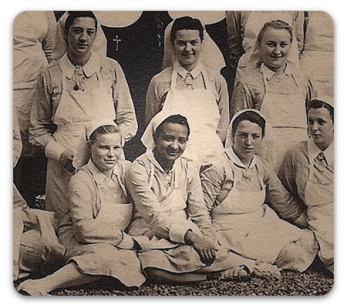
Nurses

Augusta Chiwy came back to Belgium when she was nine, one of the luckier of thousands born to European fathers, and African mothers. Back to the doctor’s home in Bastogne, a small town of 9,000 where Augusta was loved and cared for by her father and his sister, whom the girl knew as “aunt Caroline”.

Augusta was educated and raised a Catholic. She always wanted to teach but, due to the rancid racial attitudes of that time and place, it would not do to have a black woman teaching white children. She became a nurse instead, on the advice of her father and his brother, a well-known Bastogne physician.

Nursing school was about 100 miles north. Augusta became a qualified nurse in 1943 and returned home the following year for Christmas. She arrived on December 16, the day Adolf Hitler launched his surprise offensive.

Bastogne was soon surrounded, part of one of the fiercest and bloodiest battles, of WW2. Poorly equipped American GIs were outnumbered five to one. These guys didn’t even have winter uniforms.

Bastogne

US Army Doctor Jack Prior was desperate, the abandoned building serving as military aid station, home to some 100 wounded GIs. Thirty of those were seriously wounded. With virtually no medical equipment or medicine and the only other medical officer an Ohio dentist, Dr. Prior badly needed nursing help.

Augusta Chiwy did not hesitate to volunteer, knowing full well that she would be executed, if caught.

2BAF80BC00000578-3211358-image-a-42_1440616862244
Scene from the HBO mini series, “A Band of Brothers”

Working conditions were grisly in the weeks that followed. With no surgical instruments and no anesthesia, amputations and other procedures were performed with an army knife, with cognac to dull the patient’s pain. On Christmas eve, a direct hit from a 500-pound bomb hit one hospital building, instantly killing dozens of wounded GIs and the only other nurse, Renée Lemaire.  She would be remembered as “The Angel of Bastogne.”

Bastogne building

Augusta Chiwy was in a neighboring building at the time. The explosion blew the petite nurse through a wall but, unhurt, she picked herself up and went back to work.  There were grisly injuries and many died due to inadequate medical facilities, but many lived, their families reunited thanks to the tireless work of Dr. Jack Prior, and nurse Augusta Chiwy.

Given the month of hell the pair had been through, Augusta was heartbroken when Dr. Prior had to move out, in January.  The pair exchanged addresses and stayed in touch, writing letters and exchanging small gifts, of candy.  They last saw each other in 2004, when Dr. Prior returned from his home state of Vermont, for the 50th anniversary of the Battle of the Bulge.

Prior, Chiwy

Augusta Chiwy suffered symptoms of post-traumatic stress disorder, a condition poorly understood at that time.  She would go long periods without speaking, becoming quiet and withdrawn even years later.  She married a Belgian soldier in 1959 and the couple had two children.  It would be twenty years, before  she resumed her nursing career.  She almost never spoke of her experience in Bastogne.

The forgotten angel of Bastogne was eighty-six when the knock came on the door of that Belgian nursing home.  It took months for the Scottish historian to coax the story out of her.

Thanks to King’s efforts, Augusta Chiwy would finally receive the recognition she had earned.

Chiwy and King

“On June 24, 2011, she was made a Knight in the Order of the Crown by King Albert II of Belgium. Six months later she received the U.S. Army’s Civilian Award for Humanitarian Service. And on March 21, 2014, Augusta was recognized by her hometown as a Bastogne Citizen of Honor”.  http://www.augustachiwy.org

When asked about her heroism, she’d always say the same thing: “I only did what I had to do.”

Augusta Marie Chiwy died peacefully in her sleep at the age of 94, on August 23, 2015. How many lives would have been cut short, will never be known.  But for the selfless and untiring efforts, of the Forgotten Angel of Bastogne.

Hat tip to http://www.augustachiwy.org, for most of the images used in this essay

If you enjoyed this “Today in History”, please feel free to re-blog, “like” & share on social media, so that others may find and enjoy it as well. Please click the “follow” button on the right, to receive email updates on new articles. Thank you for your interest, in the history we all share.

November 21, 1916 Unsinkable

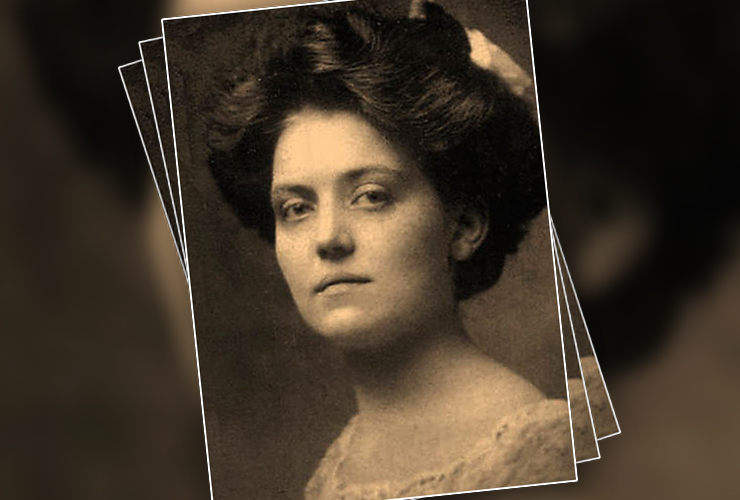
There was denial aplenty that night, from the well dressed passengers filing onto the decks. Violet Jessop counted the lighted portholes as the small boat creaked ever downward. One row, then two: every abandoned stateroom a tableau. Three, and four: feathered hats on dressers, scattered jewels, sparkling abandoned, on table tops. Five and then six: each lighted circle revealing a snapshot, a last glimpse, soon to slip out of sight.

The maiden voyage of the largest ship afloat left the port of Southampton, England on April 10, 1912, carrying 2,224 passengers and crew. An accident was narrowly averted only minutes later, as Titanic passed the moored liners SS City of New York and Oceanic.

The smaller ships lifted in the bow wave formed by Titanic’s passing, then dropped into the trough. New York’s mooring cables snapped, swinging her about, stern-first. Collision was averted by a bare 4-feet as the panicked crew of the tugboat Vulcan struggled to bring New York under tow.

Edward Smith

By the evening of the 14th, Titanic was 400 miles off the coast of Newfoundland, conditions clear, calm and cold. There were warnings of drifting ice from other ships in the area, but it was generally believed that ice posed little danger to large vessels at this time. 

Captain Edward Smith opined that he “[couldn’t] imagine any condition which would cause a ship to founder. Modern shipbuilding has gone beyond that.”

Lookout Frederick Fleet alerted the bridge of an iceberg dead ahead at 11:40pm. First Officer William Murdoch ordered the engines put in reverse, veering the ship to the left. Lookouts were relieved, thinking that collision was averted. Below the surface, the starboard side ground into the iceberg, opening a gash the length of a football field.

Violet_jessop_titanic

The ship was built to survive flooding in four watertight compartments. The iceberg had opened five. As Titanic began to lower at the bow, it soon became clear. The great ship was doomed.

Those aboard were poorly prepared for such an emergency. The vessel was built for 64 wooden lifeboats, enough for 4,000, but the White Star Liner carried only 16 wooden lifeboats and four collapsibles.

Regulations then in effect required enough room for 990 people. Titanic carried enough to accommodate 1,178.

As it was there was room for over half of those on board, provided that each boat was filled to capacity. So strictly did Royal Navy officer Charles Lightoller adhere to the “women and children first” directive, that evacuation took the form of women and children, only. Many boats were launched, half-full. The first lifeboat in the water, rated at 65 passengers, launched with 28 aboard.

Lightoller himself survived, only by clinging to the bottom of an overturned raft.

titanic-01-wallpaper

Violet Jessop was among those first to leave. A man tossed her a bundle with the words, “ look after this, will you?“. It was a baby.

As ship’s nurse, Jessop was there to look after the comfort of the White Star Line passengers. Now, this small boat full of disoriented women was being lowered into the cold and darkness of night, while all aboard the great vessel was light, and comfort, and warmth.

Denial is a funny thing, that psychological defense mechanism described by Sigmund Freud, in which a person rejects a plain fact too uncomfortable to contemplate. There was denial aplenty that night, from the well dressed passengers filing onto the decks. Violet Jessop counted the lighted portholes as the small boat creaked ever downward. One row, then two: every abandoned stateroom a tableau. Three, and four: feathered hats on dressers, scattered jewels, sparkling abandoned, on table tops. Five and then six: each lighted circle revealing a snapshot, a last glimpse, soon to slip out of sight.

Floating on the still, frigid waters of the north Atlantic, Jessop must have wondered about Captain Smith. This was not their first cruise together. This wasn’t even their first shipwreck.

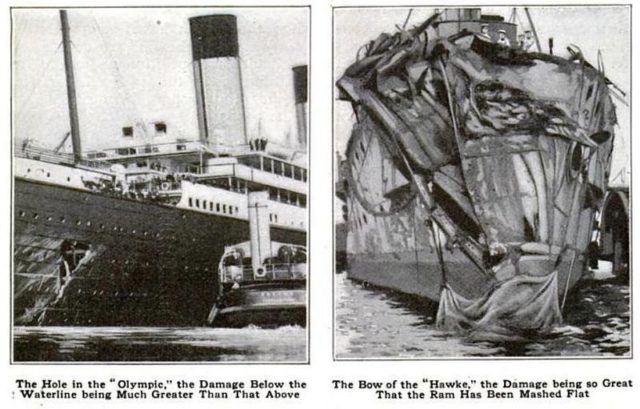
The White Star Line’s RMS Olympic set sail for New York seven months earlier with Captain Edward Smith, commanding. Violet Jessop was on duty as the Royal Navy cruiser HMS Hawke performed mechanical tests, on a course parallel to the trans-Atlantic liner. Something went wrong and the tiller froze, swinging the bow of the Edgar-class cruiser toward the liner. Hydrodynamic forces took over and the two ships collided, just after noon. The hull of the cruiser was smashed, two great gashes carved into the side of Olympic. One was below the water line.

Two compartments flooded, but the watertight doors did their job. Olympic limped back to Southampton for repairs. Captain Smith and Violet Jessop moved on to the maiden voyage of her sister ship, the unsinkable RMS Titanic.

197-640x409

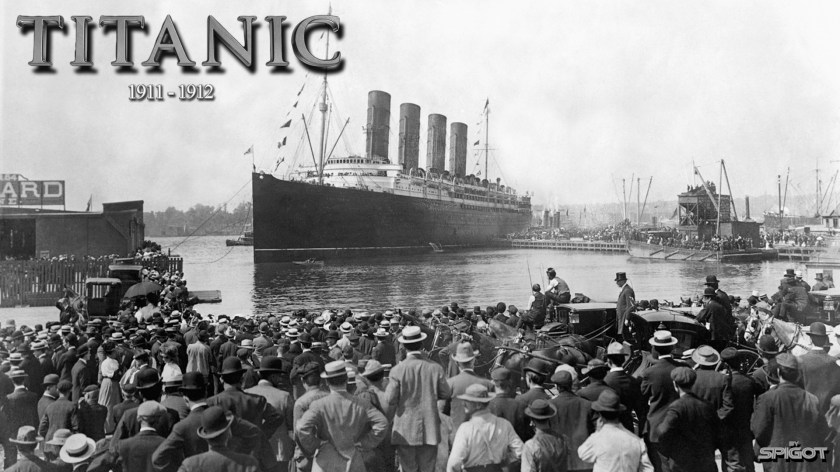
Denial turned to horror that frigid April night in 1912, when six rows of lights became five and then four, and Titanic began to rise by the stern.  RMS Carpathia arrived on the scene around 4am in response to distress calls, and diverted to New York with survivors.  Four days later, a crowd of 40,000 awaited the arrival of 705 survivors , in spite of a cold, driving rain.  It would take four full days to compile and release the list of casualties.

Violet Jessop survived that night.  Captain Smith, did not.

Back in 1907, Director General of the White Star Line J. Bruce Ismay planned a series of three sister ships, to compete with the Cunard lines’ Mauritania, and Lusitania. What these lacked in speed would be made up in size, and luxurious comfort. The three vessels were to be named OlympicTitanic and Gigantic.

800px-Britannic_Funnel_in_transport
One of Britannic’s funnels, in transit to the ship

That last name was quietly changed following the Titanic disaster and, on December 12, 1915, the newly christened Britannic was ready for service.

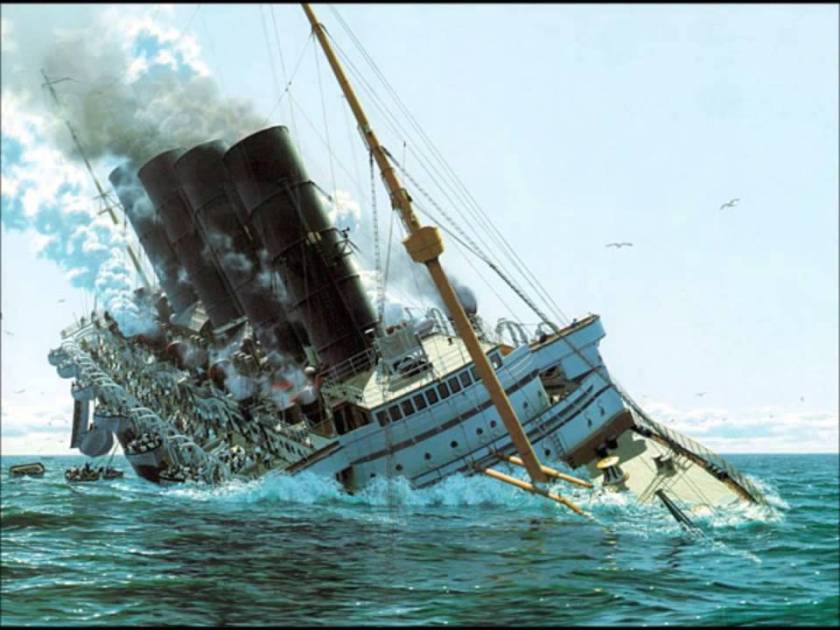
Two years later, the world was at war. Nurse Jessop was working aboard HMHS (His Majesty’s Hospital Ship) Britannic. On November 21, 1916, HMHS Britannic was on station near Kea in the Aegean Sea when she was struck by a German mine, or torpedo. Violet Jessop calmly made her way to her cabin, She’d been here, before. There she collected a ring, a clock and a prayer book, and even helped another nurse collect her composure.

maxresdefault

After the Carpathia rescue, Jessop complained to friends and family that she missed her toothbrush. Her wisecracking brother Patrick had quipped next time you wreck, “look after your toothbrush”.

This time, she didn’t forget her toothbrush.

Britannic should have survived even with five watertight compartments filled, but nurses defied orders and opened the windows, to ventilate the wards.   In fifty-five minutes, HMHS Britannic replaced her sister ship Titanic, as the largest vessel on the bottom of the sea.

Fortunately, daytime hours combined with warmer weather and more numerous lifeboats, to lessen the cost in lives.  1,035 were safely evacuated from the sinking vessel, keeping the death toll in the Britannic wreck, to thirty.

Violet Jessop survived three of the most famous shipwrecks of her age, and never tired of working at sea. She returned to work as stewardess aboard RMS Olympic after the war, before retiring to private life and passing away, in 1971.

John Maxtone-Graham, editor of “Titanic Survivor”, the story of Jessop’s life, remembers one last story about “Miss Unsinkable”. Fifty-nine years after the wreck, the phone rang late one night, during a violent thunderstorm. A woman’s voice at the other end asked “Is this the Violet Jessop who was a stewardess on the Titanic and rescued a baby?” “Yes” came the reply, “who is this?” The woman laughed: “I was that baby.”

November 5, 2004 I did not die

The elegy has been set to music and featured in television series and movies the world over and even appears in the multi-player on-line game, World of Warcraft. Even so, the name and even nationality of the author, remained unknown.

For many among us, 2020 has been a time of grievous loss. My family is no exception.

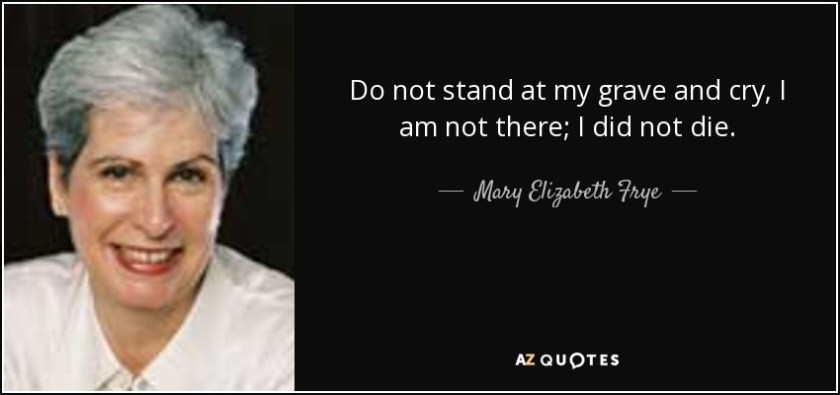
During the 1930s, Mary Elizabeth Frye was a Baltimore housewife and amateur florist, the wife of clothing merchant, Claud Frye.

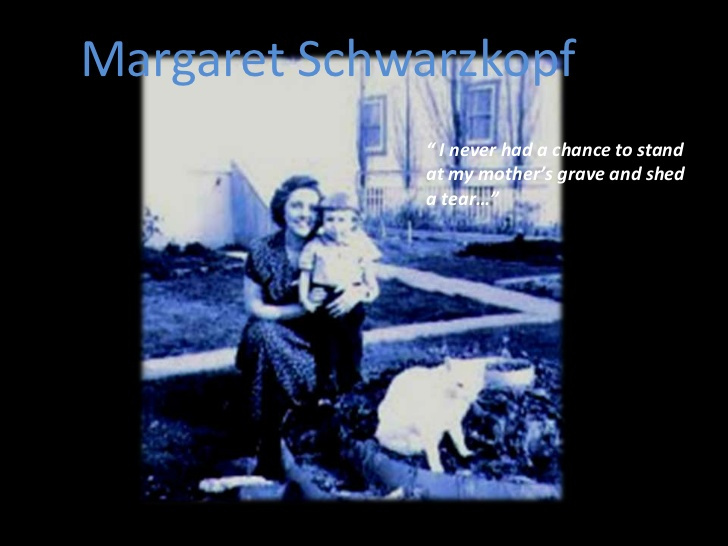
A young Jewish woman was living with the couple at this time, unable to visit her sick mother in Germany, due to anti-Semitic violence of the pre-war period.  Her name was Margaret Schwarzkopf.

Margaret was bereft when her mother died, heartbroken that she could never “stand by my mother’s grave and shed a tear.” Mrs. Frye took up a brown paper shopping bag, and wrote out twelve lines. Eighty-seven words arranged in iambic tetrameter, save for two lines.

She didn’t title the poem, nor did she ever publish, or copyright the work.  People heard about it and liked it. Frye would make copies and send them to those who asked, but that’s about it.

Do not stand at my grave and weep…

The short verse came to be read at funerals and similar occasions, the world over. The first four lines appear on the Chukpi Lhara, that cold and silent memorial to climbers who never returned, from the slopes of Everest. “Desperate Housewives” character Karen McClusky recited the verse as she spread the ashes of her best friend on a baseball field and yet, for three-score years and more, few knew from whence the elegy had come.

Chukpi Lhara

There were many claims to authorship, including attributions to traditional and Native American origins.

I am not there. I do not sleep...

The unknown poem has been translated into Danish, Dutch, French, German, Hebrew, Ilocano, Japanese, Korean, Russian, Spanish, Tagalog and other languages, appearing on countless bereavement cards and read over untold services.

In the United Kingdom, many heard it for the first time in 1995, when a grieving father read it over BBC radio in honor of his son, a soldier slain by a bomb in Northern Ireland. The son had left the poem with a few personal effects and marked the envelope ‘To all my loved ones’.

I am a thousand winds that blow…

For that year’s National Poetry Day, the British television program The Bookworm conducted a poll to learn the nation’s favorite poems. The top picks were published in book form, the preface describing the untitled work as “the unexpected poetry success of the year…despite it being outside the competition.”

The elegy has been set to music and featured in television series and movies and even appears in the multi-player on-line game, World of Warcraft.

Even so, the name, even nationality of the author, remained unknown.

I am the diamond glints on snow…

Abigail Van Buren, better known as “Dear Abby”, researched the history of the poem in 1998 and determined that Mrs. Frye was, after all, the author.

Mary Elizabeth Frye passed away in Baltimore Maryland on September 4, 2004. She was ninety-eight.

The Times of Great Britain published the work on November 5, as part of Frye’s obituary. ‘The verse demonstrated a remarkable power to soothe loss”, wrote the Times. “It became popular, crossing national boundaries for use on bereavement cards and at funerals regardless of race, religion or social status”.

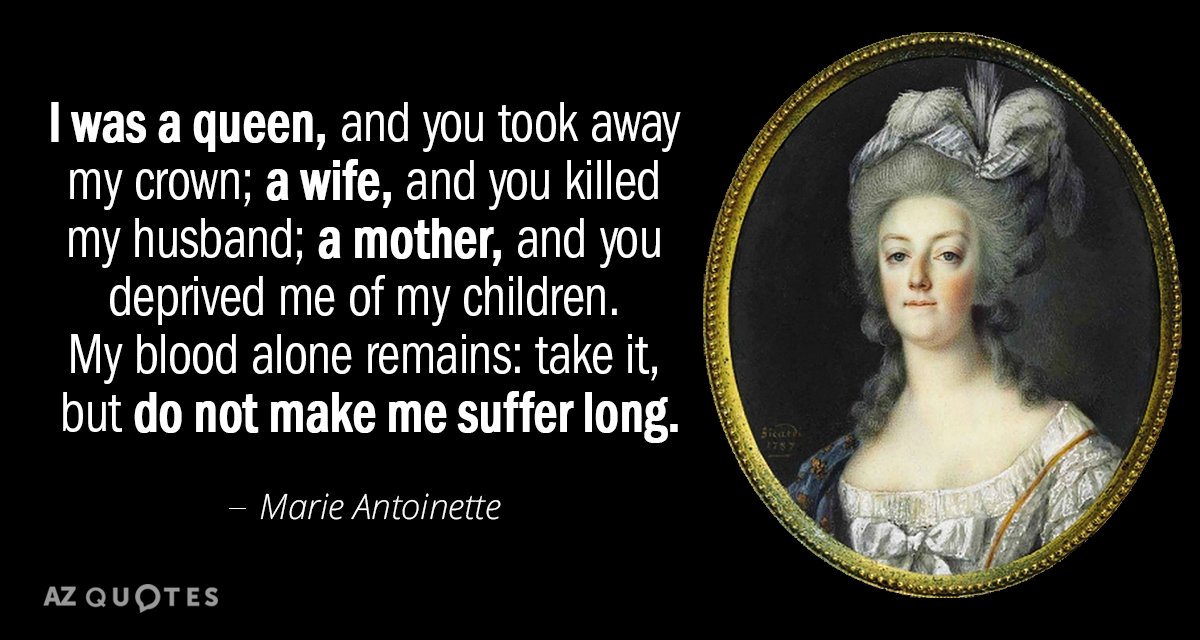
October 16, 1793 Let them eat Cake

At first the people liked their new Queen-to-be, but the Royal Court was another story. A shark tank of grasping ambition, this crowd had promoted several Saxon Princesses for the match and called the Dauphine “The Austrian Woman”. She would come to be called far worse.

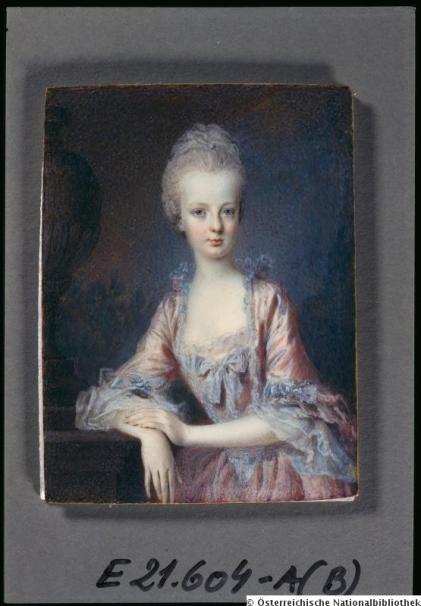
Political alliances came and went throughout 18th century Europe, with treaties often sealed by arranged marriages. One such alliance took place in 1770. Francis I, Holy Roman Emperor and Queen Maria Theresa, the formidable Sovereign of Hungary and Bohemia, married their little girl to Louis-Auguste, the son of Louis XV, King of France. Her name was Maria Antonia. She was twelve years old.

The happy couple had yet to meet when the marriage was carried out by proxy, the bride remaining in Vienna with the groom near-800 miles away, in Paris. She was now the Dauphine, Marie Antoinette, pre-teen wife of the 14-year-old Dauphin, future King of France.

Marie_Antoinette_girl

There was a second, ceremonial wedding held in May, after which came the ritual bedding. This wasn’t the couple quietly retiring to their own private space.  Ohhhhh, no. This was the bizarre spectacle of courtiers crowding into the bedchambers, peering down at the frightened couple to be sure the marriage was consummated.

Unsurprisingly, it was not. In time, that failure would do damage to both their reputations.

At first the people liked their new Dauphine, but the Royal Court was another story. A shark tank of grasping ambition, this crowd had promoted several Saxon Princesses for the match and called the French Queen-to-be “The Austrian Woman”.  She would come to be called far worse.

The stories you read about 18th century Court intrigue make you wonder how anyone lived like that. Antoinette was naïve of the vicious circles into which she was cast. Relations were especially difficult with the King’s mistress, the Comtesse du Barry, and Antoinette was somehow expected to work them out. The King’s daughters on the other hand, didn’t care for du Barry or their unsavory relations, with their father. She literally couldn’t win. The sisters bellyached about feeling “betrayed” one time, when Antoinette commented to the King’s mistress: “There are a lot of people at Versailles today”.

Court intrigues were accompanied by reports to Antoinette’s mother in Vienna, the Empress responding with her own stream of criticism. The Dauphin was more interested in lock making and hunting she wrote, because Antoinette had failed to “inspire passion” in her husband. The Empress even went so far as to tell her daughter she was no longer pretty. She had lost her grace. Antoinette came to fear her own mother more than she loved her.

Marie_Antoinette_by_Joseph_Ducreux

Louis-Auguste was crowned Louis XVI, King of France, on June 11, 1775. Antoinette remained by his side though she was never crowned Queen, instead remaining Louis’ “Queen Consort”.

With her marriage as yet unconsummated, Antoinette’s position became precarious when her sister in law gave birth to a son and possible heir to the throne. Antoinette spent her time gambling and shopping, while wild rumors and printed pamphlets described supposedly bizarre sexual romps.

The French government was staggered by debt at this time, the result of endless foreign wars, but Antoinette received more than her share of the blame. As first lady to the French court, Antoinette was expected to be a fashion trendsetter. Her shopping was in keeping with the role but rumors wildly inflated her spending habits. Her lady-in-waiting protested that her habits were modest, visiting village workshops in a simple dress and straw hat. Nevertheless, the Queen Consort was rumored to have plastered the walls of Versailles with gold and diamonds.

The difficult winter of 1788-89 produced bread shortages and rising prices as the King withdrew from public life. The marriage had produced children by this time, but the legend of the licentious spendthrift and empty headed foreign queen had taken root as government debt overwhelmed the economy.

French politics boiled over in June 1789, leading to the storming of the Bastille on July 14. Much of the French nobility fled as the newly formed National Constituent Assembly conscripted men to serve in the Garde Nationale, while the French Constitution of 1791 weakened the King’s authority.

Bastille

Food shortages magnified the unrest. That October, the King and Queen were placed under house arrest in the Tuileries Palace. They attempted to flee the escalating violence the following June, but were caught and returned within days. Radical Jacobins exploited the escape attempt as a betrayal, and pushed to have the monarchy abolished altogether.

marie-antoniette-french-history

Unrest turned to barbarity as Antoinette’s friend and supporter, the Princesse de Lamballe, was taken by the Paris Commune for interrogation. She was murdered at La Force prison, her head fixed on a pike and marched through the city.

Louis XVI was charged with undermining the First Republic in December 1792, found guilty and executed by guillotine on January 21, 1793. He was 38 years old.

Marie-Antoinette was now prisoner #280, her health deteriorating in the following months. She suffered from tuberculosis by this time and suffered frequent bleeding, possibly as the result of uterine cancer.

Antoinette was taken from her cell on October 14 and subjected to a sham trial whose outcome was never in doubt. She was accused of molesting her own son, a charge so outrageous that even the market women who had stormed the palace demanding her entrails in 1789, spoke out in her support. “If I have not replied”, she said, “it is because nature itself refuses to respond to such a charge laid against a mother.”

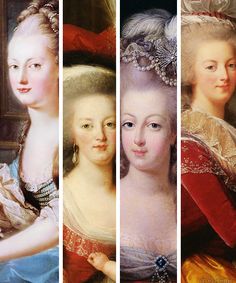
marie-antoinette over the years

On October 16, 1793, Marie-Antoinette’s hair was cut off. She was paraded through Paris in an ox cart, taken to the Place de la Révolution, and decapitated. On mounting the scaffold, she accidentally stepped on the executioner’s foot.  The last words of the most hated woman in Paris, were “Pardon me sir, I meant not to do it”.

“Let them eat cake” is often attributed to Marie Antoinette, but there’s no evidence that she ever said it. The phrase appears in “Les Confessions”, the autobiography of Jean-Jacques Rousseau, attributed to a “Grande Princesse” whom the book declines to name. Considering the lifetime of cheap and mean-spirited gossip to which the woman was subjected, it’s easy to believe this was just more of the same.

July 28, 1866 The President’s Sculptor

Every year, millions of visitors to the Rotunda of the Capitol stop to admire the work. Few possess so much as the foggiest notion that the artist, was an 18-year-old girl.

She was about 5-feet tall when her parents moved to Washington, a mere wraith of a girl of 14 summers, as yet unable to tip the scales at 90 pounds.    Her father Robert was a surveyor, come to the capital for a job in the cartography office.

Her brother Robert headed south to Arkansas, to join with Woodruff’s Battery in service to the Confederate Army.  The year was 1861.  The District of Columbia was the capital in name only, of a nation at war with itself.

The elder Robert took ill and times got tough for the Ream family.  Despite her diminutive stature, Lavinia Ellen, “Vinnie“ to friends and family, took a job to help with family finances.  She was working in the dead letter office at the post office, one of the first women ever hired by the federal government.

Missouri Congressman James Rollins introduced Vinnie to sculptor Clark Mills in 1863, the artist who produced that statue of President Andrew Jackson, the one we’ve heard so much about recently, there in Lafayette square.

Washington, DC - June 02, 2018: Andrew Jackson's statue in Lafay
Washington, DC – June 02, 2018: Andrew Jackson’s statue in Lafayette Square and the White House.

The artist was amused when the young girl remarked “I can do that myself” and handed her a pail of clay with an invitation to try.  He was delighted when she returned a month later, this time with a surprisingly good likeness of an Indian Chieftain.  It wasn’t long before she became Mills’ apprentice.

Stories spread concerning the remarkable abilities of this young artist.  Vinnie’s talents blossomed and she left the post office to pursue her art, full time.  Senators and Members of Congress were her subjects.  Her faithful likeness of the glowering visage of that fierce opponent of slavery Thaddeus Stevens, the Pennsylvania Republican Congressman who would one day lead the impeachment effort against President Andrew Johnson, earned her an important and powerful ally.

It must have been an exciting time for a young girl in Washington DC, the horse-drawn ambulances, the ever-present blue-clad soldiers and more than anything, the raw-boned figure of the President of the United States, his carriage invariably accompanied by a squadron of brightly caparisoned, mounted Army officers.  Vinnie was interested in the figure of Abraham Lincoln.  The desire to sculpt the man’s likeness blossomed to an obsession as the titanic weight of office and crushing grief following the death of Lincoln’s 12-year-old son Willy, seemingly etched themselves across the President’s face.

Raised as she was on the western prairies of Wisconsin, Kansas, and Missouri, Vinnie was unacquainted with the “way things were done” in the nation’s capital.   Petite, quick with a smile and not a little ambitious, she could often get to “yes” where others hadn’t so much as a chance.

So it was in 1864, Vinnie was granted permission which would have been denied, to an older artist.  She herself explained “Lincoln had been painted and modeled before, and when friends of mine first asked him to sit for me he dismissed them wearily until he was told that I was but an ambitious girl, poor and obscure. … Had I been the greatest sculptor in the world I am sure that I would have been refused.”

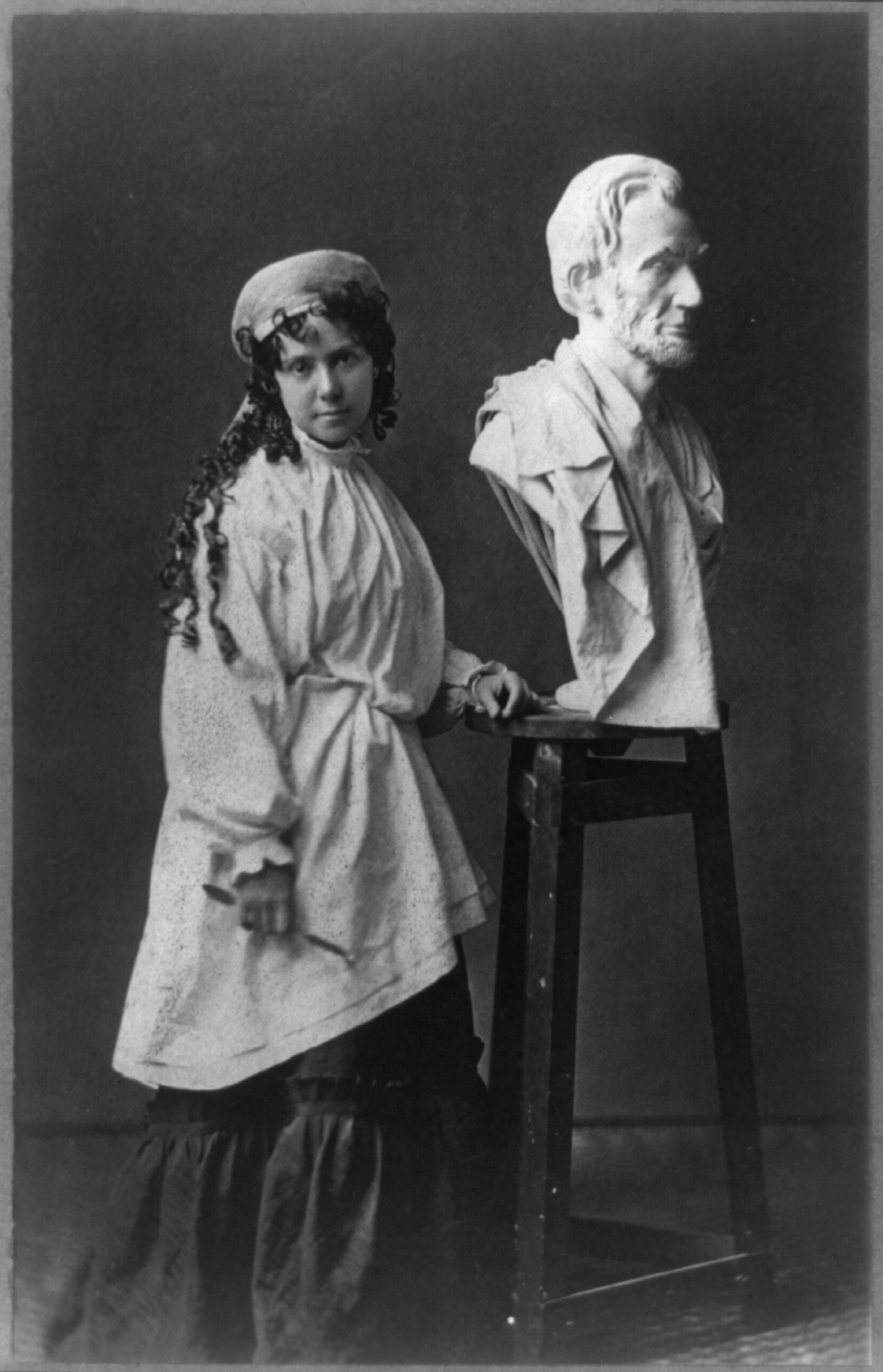
Every day for five months, Vinnie Ream had a private half-hour with the President of the United States, the two speaking but infrequently as she set her hands about the work.  She was performing the final touches on the bust you see below, the morning of April 14, 1865.  General Robert. E. Lee had surrendered to General Ulysses Grant only five days earlier.  The most catastrophic war in American history was winding to a close.  That night, the President planned a welcome break from the cares of office, at a place called Ford’s theater.

Vinnie_Ream_with_her_bust_of_Abraham_Lincoln

A nation was stunned following the Lincoln assassination.  Vinnie herself, prostrate at the death of her friend and hero.

There arose a movement in Congress, to honor the Great Man with a full-length statue, to be placed in the Rotunda of the Capitol.  A competition would be held, to determine the artist.  Washington was then as it is now, but Vinnie had learned a political lesson or two since those naive days of five years earlier.  The petition attesting to her talents and worthiness for the project was signed by Andrew Johnson, Ulysses Grant, 31 Senators and 110 members of the House of Representatives.

SAAM-1917.11.1_1Then as now, Washington was a “Swamp” and a cesspit for the venal and self-interested. Now grown to an attractive young woman, Vinnie Ream was not without critics.  Kansas Senator Edmund Gibson Ross boarded with the Ream family during Johnson’s impeachment trial and cast the one vote absolving the President of “High Crimes and Misdemeanors”.

Imagine how THAT must’ve sounded.

There were sleazy insinuations that she was a “lobbyist” or even a “Public Woman” (prostitute).

Newspaper columnist Mrs. Jane Grey Swisshelm sniffed about how Vinnie “carries the day” with members of Congress: “Miss .… Ream … is a young girl of about twenty who has been studying her art for a few months, never made a statue, has some plaster busts on exhibition, including her own, minus clothing to the waist, has a pretty face, long dark curls and plenty of them. … [She] sees members at their lodgings or in the reception room at the Capitol, urges her claims fluently and confidently, sits in the galleries in a conspicuous position and in her most bewitching dress, while those claims are being discussed on the floor, and nods and smiles as a member rises…

e05a173b8e8f1c1360a5e523c3ec3604One editor had the last word, however, printing Swisshelm’s column under the headline “A Homely Woman’s Opinion of a Pretty One.”

Ouch.

On this day in 1866, Vinnie Ream was awarded by vote of Congress, the commission to create a full-size statue of Abraham Lincoln. She was 18 years old, the first woman to receive a such a commission as an artist and the youngest of either sex, to create a statue for the United States government.

Even then, Vinnie was not without detractors.  Michigan Senator Jacob Merritt Howard remarked, “Having in view the youth and inexperience of Miss Ream, and I will go further, and say, having in view her sex, I shall expect a complete failure in the execution of this work.”

Miss Lavinia Ream survived an effort to have her removed from her own studio by a vindictive House of Representatives, to enjoy the last word.  Her depiction of the Great Emancipator sculpted from a flawless block of Carrara marble stands in the Rotunda of the Capitol where it is seen by millions of visitors, from that day to this.

Ream-Lincoln


May 25, 61 Boudicca

Apoplectic with rage and determined to avenge her family, Boudicca was not a woman to be trifled with. She led the Iceni, the Trinovantes and others among the Celtic, pre-Roman peoples of Britain, in a full-scale, bloody revolt.

The “Pax Romana” (“Roman Peace”) refers to a period between the 1st and 2nd century AD, when the force of Roman arms subdued most everyone who stood against it. Historians speak in terms of Great Empire. For most, the mountains of dead become cold statistics, themselves dead and bereft of human experience. There is no quantifying the mass of human misery left in the wake of such a regime. The conquered peoples of the time, who would tell you a different tale. Sometime circa 84AD, Calgacus of the Caledonian Confederacy in Northern Scotland, described the Pax Romana: “They make a desert and call it peace“.

paxIn the Roman imagination, Britain was a faraway and exotic place, a misty, forested land inhabited by fierce, blue painted warriors.

Caesar himself invaded the place in 55BC and again in 54 with little to show for it.  100 years later, the Roman empire stretched from the beaches of modern-day Normandy to Asia, from the Sahara desert to the northern Rhineland.   In 9AD, the destruction of three legions led by Publius Quinctilius Varus in the Teutoberg forest served as a sharp reminder.  That was about as much as even the Roman empire, could handle.

display-2255Militarily, there was no reason to attack the British home isles.  The channel itself formed as fine a protector of the western flank, as could be hoped for.

Even so, the assassination of the mad emperor Caligula in 41 and the ascension to the Royal Purple of a minor member of the Claudian family, led to strong resistance in the Roman senate.   If he was to survive, emperor Claudius had to prove himself worthy.  The Roman culture of antiquity revered nothing so much as military conquest and what could be better, than the glorious subjugation of Britannia.   So it was, Claudius set about to invade Britain in the year 43.

1200px-Roman.Britain.campaigns.43.to.60

20,000 citizen-legionaries and another 20,000 auxiliaries recruited from the wild fringes of the empire, had their work cut out subjugating the iron age hill fortifications, of the British interior.  Wales would prove all but impenetrable behind the anti-Roman front erected by the Welsh tribes following Prince Caratacus.

Before achieving the defeat of the west, the invader had to contend with a force which came closer than any other, to throwing the Italians out of the place, altogether.  A threat in the person of Queen Boudicca, of the Iceni people.

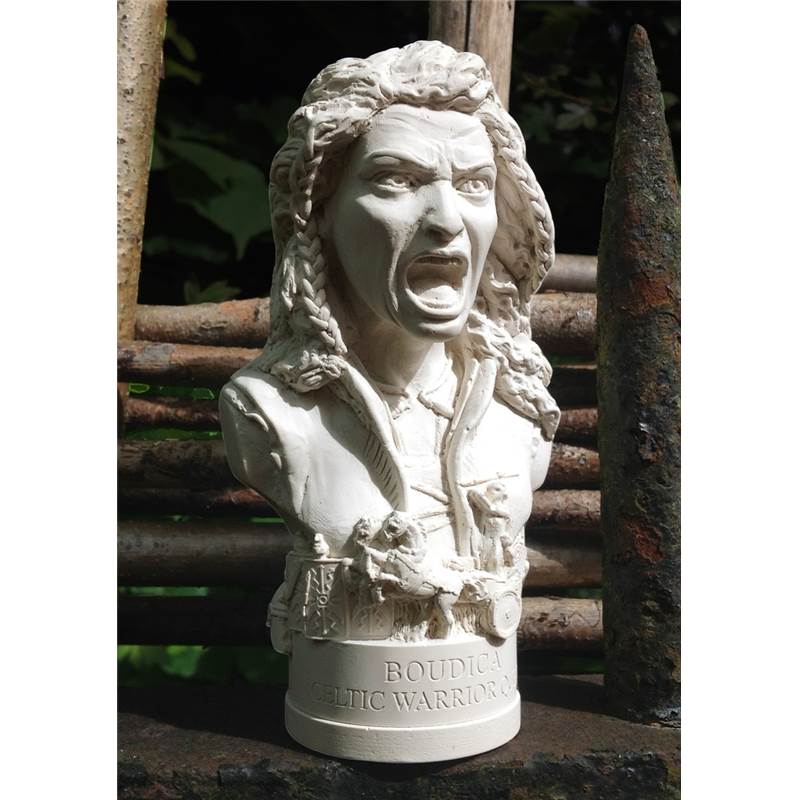
RAB-Boudica-bust-2x800

Boudicca (a.k.a. Boudica, Boudicea, Boadicea, Buddug) reigned over the Iceni tribe of East Anglia, co-ruler with her husband, Prasutagus. A nominally independent kingdom and ally of the Romans, King Prasutagus believed himself the protector of his people when he willed the kingdom jointly, to his two daughters and to the Roman emperor. Prasutagus lived a long and prosperous life but, when he died, that all changed.

With the arrogance of unchecked and unlimited power, emperor Nero moved to take what was His. Prasutagus’ will was ignored and his kingdom annexed and all his property, forfeit.  Financiers from the Roman statesman Seneca to emperor Nero himself called in their loans but worst of all, Queen Boudicca was publicly flogged, her two daughters, raped.

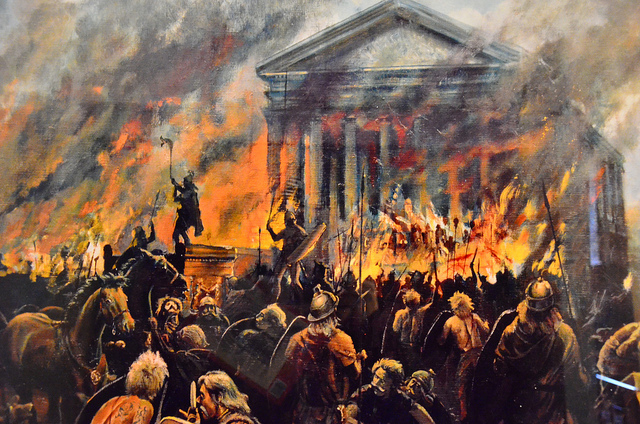
s-960230fdc4350d3f3c28bb087385c273e4311848Apoplectic with rage and determined to avenge her family, Boudicca was not a woman to be trifled with. She led the Iceni, the Trinovantes and others among the Celtic, pre-Roman peoples of Britain, in a full-scale, bloody revolt.

Emperor Claudius himself had once overseen the invasion of Camulodunum in what is now Colchester, in Essex.  Then a Roman province and home to the only classical-style temple in Britain, in British eyes the thing was arx aeternae dominationis (“stronghold of everlasting domination”).

tumblr_nblk7dxpGw1rwjpnyo2_1280For the Celtic peoples, the hour of payback had arrived.  For the seizure of lands to provide estates for Roman veterans to their own forced labor in building the Temple of Claudius to the sudden recall of loans and destruction of estates and properties.  The Roman historian Tacitus writes of the last stand at the Temple of Claudius: “In the attack everything was broken down and burnt. The temple where the soldiers had congregated was besieged for two days and then sacked“.

Everything that could be taken up was smashed, the population slaughtered and the city burnt to the ground.  A relief army rushing to the assistance of Camulodunum was itself destroyed, before ever reaching the town.

The archaeological record backs it all up.  The “Boudican destruction layer” forms a thick deposit of ash, human bones, shattered buildings, smashed pottery, furniture and glasswork at Camulodunum, Verulamium (St Albans) and Londinium (London).  An estimated 70,000-80,000 Romans and British citizens were slaughtered and many tortured, within the smoking ruins of the three cities.

Nero himself contemplated removing his entire force from the British home islands as Governor Gaius Suetonius Paulinus gathered his forces to strike back.

Sometime in 60 or 61, the precise date is unknown and this one is as good as any, the decisive battle for British if not western history was fought between Celtic followers of the warrior queen Boudicca, and the most powerful military on the planet.

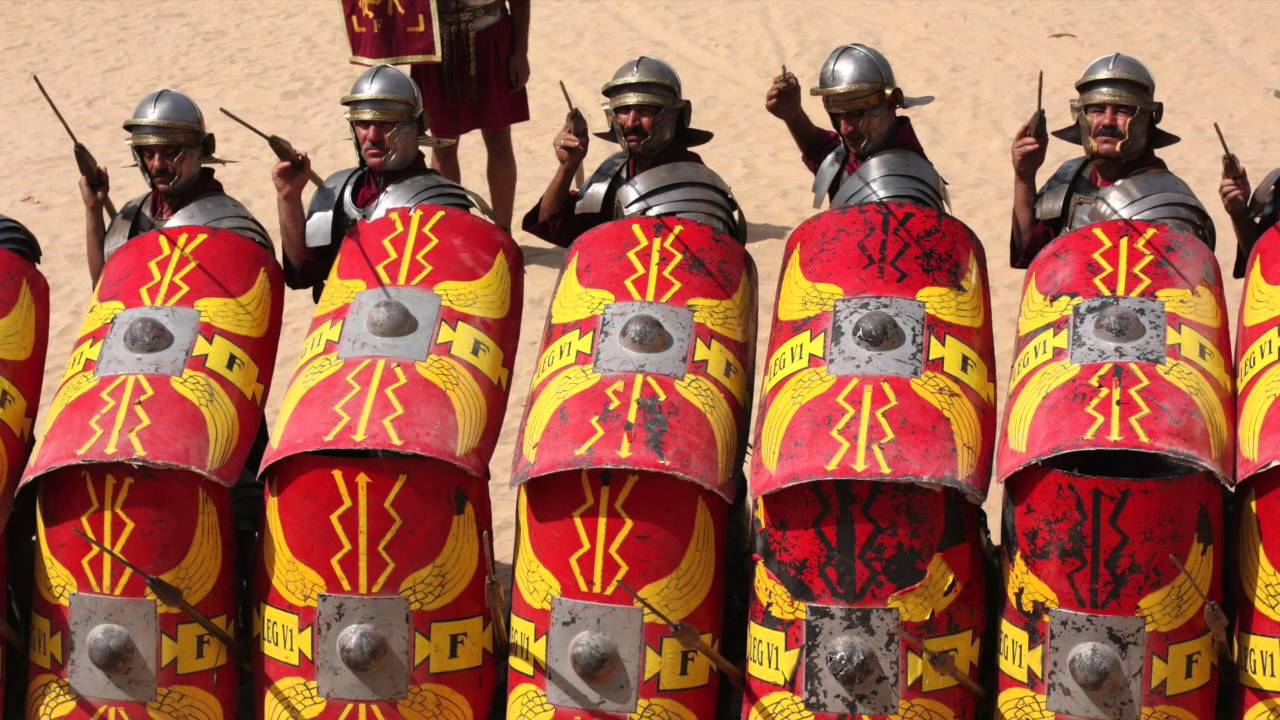
Roman Shield WallOutnumbered 23 to 1, the 10,000 strong Roman legion was battle hardened, well-equipped and disciplined, facing off against a mob of nearly a quarter-million unarmored, poorly disciplined individuals.

Suetonius chose the ground carefully for the fight we remember today, as the battle of Watling Street. Backed into a narrow gorge with thick forests protecting his sides, Suetonius enemy was made to approach across an open plain, narrowing in the front so as to nullify numerical advantage. Like the Germanic chieftains Boiorix of the Cimbri and Ariovistus of the Suebi before their own battles against Gaius Marius and Julius Caesar, Boudicca’s forces arrayed their wagons in a tight circle to the rear, the better for family to watch what was about to happen.  It was a deadly trap they had laid for themselves, should things go wrong.

FilmWhat must it look like, when 230,000 screaming warriors charge a fixed force of 10,000 disciplined soldiers.  First came the Pila, the Roman javelins tearing into the tightly packed front, of the adversary.  Then the Legion advanced, shields out front with the short swords, the long swords and farm implements of the Celts unable to move in the crush of humanity.  The wedge formation advanced unbroken, slaughtering all who came before it as a scythe before the grass.  The turning and the attempt to flee, only to be boxed in by their own tightly packed crescent formed wagon train.

Street-680,000 of Boudicca’s men lay dead before the slaughter was ended, against 400 dead Romans.  Queen Boudicca poisoned herself according to Tacitus, Cassius Dio claims she became ill.

Romans never did subdue the wild tribes to the north, the Scots, the Picts and the Scoti (modern Irish).  By 122, Hadrian had begun construction on a wall.

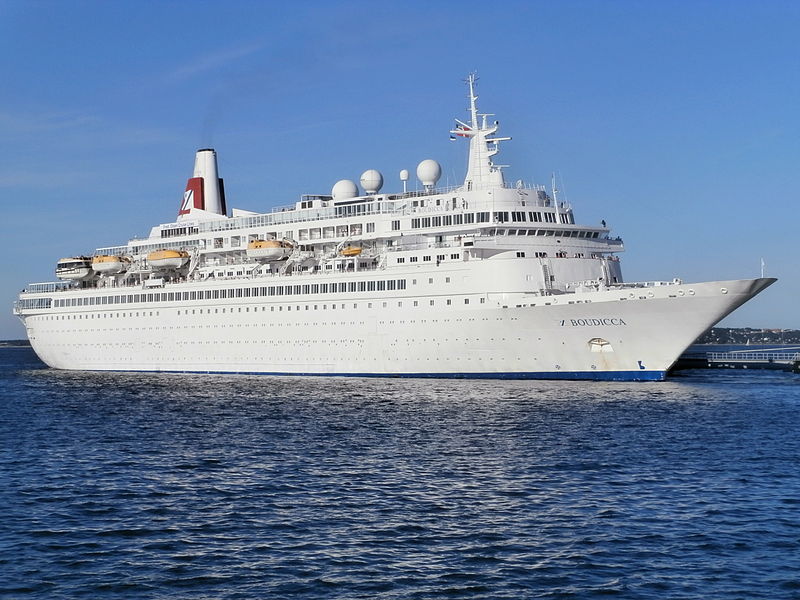
Boudicca’s gone now but her name lives on. On this day in 1972, the cruise ship Royal Viking Sky launched from drydock at the Wärtsilä Hietalahti shipyard in Helsinki, Finland.  In 2005, the thousand passenger liner was sold to Fred. Olsen Cruise Lines and renamed MV Boudicca.  She remains active, to this day.

Boudicca_departing_Tallinn_7th_September_2013
MV Boudicca in Talinn Estonia, in 2013

May 19, 1944 The Seven Dwarves of Auschwitz

One day of fresh horrors ended to reveal the next, and still they lived.  It was unusual for even two or three siblings to survive the Auschwitz death camp.  I don’t believe there was another instance where an entire family lived to tell the tale.

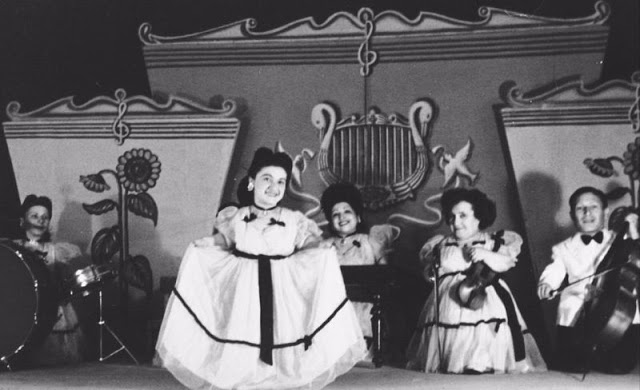
Shimson Eizik Ovitz was a Romanian rabbi, and a WWI-era “merrymaker’ or traveling entertainer.  He was also a man afflicted with pseudoachondroplasia.  Shimson Eizik Ovitz was a dwarf.  Ovitz fathered 10 children by two normal sized wives:  Brana Fruchter and Batia Bertha Husz.  All ten survived to adulthood.  Three grew to normal height.  The other seven were “little people”, the largest dwarf family unit, in history.

On her death bed in 1930, Batia gave the kids a piece of advice that stuck with them, all their lives: “through thick and thin” she said, “never separate. Stick together, guard each other and live for one another”.

war2_1687882aCircus-like performing dwarves were common enough at this time but the Ovitz siblings were different.  These were talented musicians playing quarter-sized instruments, performing a variety show throughout the 1930s and early ’40s as the “Lilliput Troupe”.  The family performed throughout Romania, Hungary and Czechoslovakia, with their normal height siblings serving as “roadies”.   And then came the day.  The whole lot of them were swept up by the Nazis and deported to the concentration camp and extermination center, at Auschwitz-Birkenau.

The train arrived around midnight on May 19, 1944.  Thoroughly accustomed to a degree of celebrity, one of them began to give out autographed cards. The family would soon be disabused of any notions of celebrity.

flat,800x800,070,f
The “death gate” of Auschwitz-Birkenau

Even so, cultural currents run deep.  Not even concentration camp guards could resist the irony of seven dwarves.   Knowing of his perverse fascination with the malformed and what he called “blood” (family) experiments, Dr. Josef Mengele was immediately awakened.  The “Angel of Death”was delighted, exclaiming “I now have work for 20 years!”

The ten siblings were spared from the gas chamber that night, along with two more family members, a baby boy and a 58-year old woman. Families of their handyman and a neighbor were also spared, as all insisted they were close relatives.    All told, there were 22 of them.

the-dwarves-of-auschwitz-4
Ovitz family performers, before the war

The family was housed in horrific conditions, yet seven dwarves didn’t come along every day.  Where others were directed to the gas chambers, these were kept alive for further use.  As bad as it was, the food and clothing was better than that received by most camp inmates. Mengele even allowed them to keep their hair, and arranged special living quarters.

The bizarre and hideous “experiments” Mengele performed in the name of “science” were little more than freakish torture rituals.  Three dwarf skeletons were on prominent display, the bones of earlier arriving little people, ever-present reminders of what could be.  Boiling water was poured into their ears, followed by freezing.  Eyelashes and teeth were pulled without anesthesia.  Blood was the holy grail in the mind of Josef Mengele, and the stuff was drawn until each would throw up and pass out, only to be revived to have more blood drawn.the-ovitzs-leaving-the-ca-008On one occasion, the Angel of Death told the family they were “going to a beautiful place”. Terrified, the siblings were given makeup, and told to dress themselves. Brought to a nearby theater and placed onstage, the family must have thought they’d be asked to perform.  Instead, Mengele ordered them to undress, leaving all seven naked before a room full of SS men.  Mengele then gave a speech and invited the audience onstage, to poke and prod at the humiliated family.

One day of fresh horrors ended to reveal the next, and still they lived.  It was unusual for even two or three siblings to survive the Auschwitz death camp.  I don’t believe there was another instance where an entire family lived to tell the tale.

Auschwitz_I_(22_May_2010)
Before becoming an industrialized extermination center, Auschwitz I was a slave labor camp for Polish and later Russian prisoners. The words over the gate, “Arbeit Macht Frei”, translate: “Work Makes You Free”.

Auschwitz was liberated by the Soviet Red Army on January 27, 1945.

Traveling by foot to their Transylvanian home village of Rozavlea, the family found the place ruined.  The gold coins buried for safekeeping before the war were right where they had left them.  Otherwise, there was no future in this place.

ba132f2b89040eef0fb0b59e29512baf Only 50 of the 650 Jewish inhabitants of the village ever returned.  In 1949, the family emigrated to Israel and resumed their musical tour, performing until the group retired in 1955.

Josef Mengele never did face justice. The man who had directed victims by the hundreds of thousands to the gas chamber, fled to South America after the war.  He was living under a false name in Brazil in 1979 when he suffered a stroke, while enjoying an afternoon swim.  The cause of death for one of the great monsters of modern history, was accidental drowning.

The youngest and last of the Ovitz dwarves, Piroska or “Perla” to her friends, passed away two days before the terrorist attack on the World Trade Towers. She spoke for the whole family, I think, when she said “I was saved by the grace of the devil”.

The hour-long film “Standing Tall at Auschwitz” fills in a lot of the details.  It’s worth watching.

May 9, 1914 Mother’s Day

In 1872, American poet and author Julia Ward Howe proposed that the second of June be set aside each year, as a “Mother’s Day for Peace”.  While Howe’s effort proved unsuccessful, the modern conception of Mother’s Day was established 36 years later, by Anna Jarvis.

CybeleThe earliest discernible Mother’s day dates back to 1200-700BC and descending from the Phrygian rituals of modern day Turkey and Armenia. “Cybele” was the great Phrygian goddess of nature, mother of the Gods, of humanity, and of all the beasts of the natural world, her cult spreading throughout Eastern Greece with colonists from Asia Minor.

Much of ancient Greece looked to the Minoan Goddess Rhea, daughter of the Earth Goddess Gaia and the Sky God Uranus, mother of the Gods of Olympus.

Over time the two became closely associated with the Roman Magna Mater, each developing her own cult following and worshiped through the period of the Roman Empire.

In ancient Rome, women partook of a festival, strictly forbidden to Roman men. So strict was this line of demarcation that only women were permitted even to know the name of the deity. For everyone else she was simply the “Good Goddess”. The Bona Dea.

Mothering-Sunday_ss_458703388In the sixteenth century, it became popular for Protestants and Catholics alike to return to their “mother church” whether that be the church of their own baptism, the local parish church, or the nearest cathedral. Anyone who did so was said to have gone “a-mothering”. Domestic servants were given the day off and this “Mothering Sunday”, the 4th Sunday in Lent, was often the only time when whole families could get together. Children would gather wild flowers along the way, to give to their own mothers or to leave in the church. Over time the day became more secular, but the tradition of gift giving continued.

Julia Ward Howe, the American poet and author best known for writing “The Battle Hymn of the Republic”, wrote an impassioned “Appeal to womanhood” in 1870, a pacifist reaction to the bloodshed of the Civil War, and the Franco-Prussian War.Julia-Ward-howe-2015-1030x623Two years later, Howe proposed that the second of June be set aside each year, as a “Mother’s Day for Peace”.  While Julia Ward Howe’s effort proved unsuccessful, the modern conception of Mother’s Day was established 36 years later, by Anna Jarvis.

Ann Maria Reeves JarvisAnn Maria Reeves Jarvis was a social activist in mid-19th century western Virginia. Pregnant with her sixth child in 1858, she and other women formed “Mothers’ Day Work Clubs”, to combat the health and sanitary conditions leading at that time to catastrophic levels of infant mortality.  Jarvis herself gave birth between eleven and thirteen times in a seventeen year period.

Only four lived to adulthood.

Jarvis had no patience for the sectional differences that led the nation to Civil War, or which led her own locality to secede and form the state of West Virginia in order to rejoin the Union. Jarvis refused to support a measure to divide the Methodist church into northern and southern branches. She would help Union and Confederate soldier alike if she could. It was she alone who offered a prayer when others refused for Thornsbury Bailey Brown, the first Union soldier killed in the vicinity.

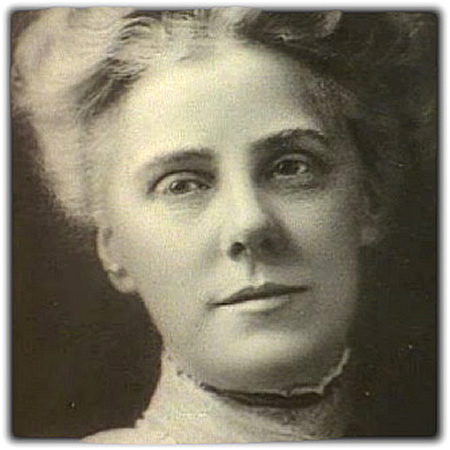
Anna JarvisFollowing Jarvis’ death in 1905, her daughter Anna conceived of Mother’s Day as a way to honor her legacy and to pay respect for the sacrifices made by all mothers, on behalf of their children.

Obtaining financial backing from Philadelphia department store owner John Wanamaker, Anna Jarvis organized the first official Mother’s Day celebration at a Methodist church in Grafton, West Virginia. That same day, thousands attended the first Mother’s Day event at Wanamaker’s store in Philadelphia.

Anna Jarvis resolved that Mother’s Day be added to the national calendar and a massive letter writing campaign, ensued. On May 9, 1914, President Woodrow Wilson signed a measure declaring the second Sunday of May, to be Mother’s Day.

Anna Jarvis believed Mother’s Day to be a time of personal celebration, a time when families would gather to love and honor their mother.

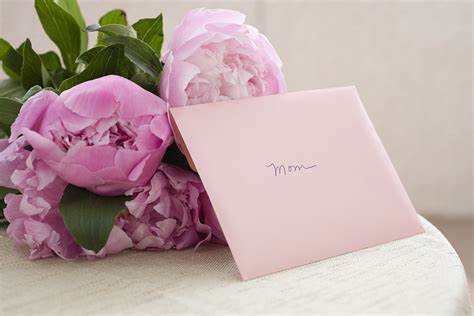
She’d worked with the floral industry in the early days, to help raise the profile of Mother’s Day. By 1920, Jarvis had come to resent what she saw as the commercialization of the day. Greeting cards seemed a pale substitute for the hand written personal notes she’d envisioned.anna-jarvis-was-sorry-she-ever-invented-mothers-d-2-27089-1431107892-11_dblbig

Jarvis protested at a Philadelphia candy maker’s convention in 1923, deriding confectioners, florists and even charities as “profiteers”. Carnations had by this time become symbolic of Mother’s Day.  Jarvis resented that they were being sold at fundraisers. She protested at a meeting of the American War Mothers in 1925 where women were selling carnations, and got herself arrested for disturbing the peace.

Soon she was launching an endless series of lawsuits against those she felt had used the “Mother’s Day” name in vain.

During the last years of her life, Anna Jarvis lobbied the government to take her creation off of the calendar, gathering signatures door-to-door to get the holiday rescinded. The effort was obviously unsuccessful.  The mother of the modern Mother’s Day died broke and childless in a sanitarium in 1948, her personal fortune squandered on legal fees.

Today, some variation of Mother’s Day is observed from the Arab world to the United Kingdom. In the United States, Mother’s Day is one of the most commercially successful days of the year for flower and greeting card sales, and the biggest day of the year for long-distance telephone calls. Church attendance is the third highest of the year, behind only Christmas and Easter. Many churchgoers celebrate the day with carnations: colored if the mother is still living and white if she has passed on.Screen-Shot-2014-03-19-at-11.32.55This story is dedicated to two of the most beautiful women in my life.  Ginny Long, thanks Mom, for not throttling me all those times you could have.  And most especially, for all those times when you SHOULD have.  Sheryl Kozens Long, thanks for 25 great years.  Rest in peace, sugar.  I wish you didn’t have to leave us, quite so soon.