January 27, 1945  The Great Raid

Today, Cabanatuan calls itself the “Tricycle Capital of the Philippines”, with about 30,000 motorized “auto rickshaws”. 72 years ago, it was home to one of the worst POW camps of WWII

Today, Cabanatuan calls itself the “Tricycle Capital of the Philippines”, with about 30,000 motorized “auto rickshaws”.  72 years ago, it was home to one of the worst POW camps of WWII.

bataan1942 was a bad year for the allied war in the Pacific.  The Battle of Bataan alone resulted in 72,000 prisoners being taken by the Japanese, marched off to POW camps designed for 10,000 to 25,000.

20,000 of them died from sickness or hunger, or were murdered by Japanese guards on the 60 mile “death march” from Bataan, into captivity at Cabanatuan prison and others.

Cabanatuan held 8,000 prisoners at its peak, though the number dropped considerably as the able-bodied were shipped out to work in Japanese slave labor camps.

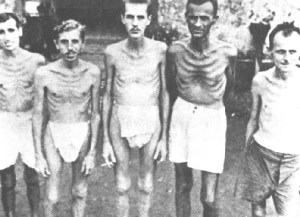
Two rice rations per day, fewer than 800 calories, were supplemented by the occasional animal or insect caught and killed inside camp walls, or by the rare food items smuggled in by civilian visitors.  2,400 died in the first eight months at Cabanatuan, animated skeletons brought to “hospital wards”, which were nothing more than 2’x6′ patches of floor where prisoners waited to die.  A Master Sergeant Gaston saw one of these wards in July 1942, saying: “The men in the ward were practically nothing but skin and bones and they had open ulcers on their hips, on their knees and on their shoulders…maggots were eating on the open wounds. There were blow flies…by the millions…men were unable to get off the floor to go to the latrine and their bowels moved as they lay there”.
pows-cabanatuan
Cabanatuan Prisoners

The war was going badly for the Japanese by October 1944, as Imperial Japanese High Command ordered able bodied POWs removed to Japan.  1,600 were taken from Cabanatuan, leaving 500 weak and disabled prisoners.  The guards abandoned camp shortly after, though Japanese soldiers continued to pass through.  POWs were able to steal food from abandoned Japanese quarters; some even captured two water buffalo called “Carabao”, which were killed and eaten.  Many feared a trick and never dared to leave the camp.  Most were too sick and weak to leave in any case, though the extra rations would help them through what was to come.

On December 14, units of the Japanese Fourteenth Area Army in Palawan doused 150 prisoners with gasoline and burned them alive, machine gunning any who tried to escape the flames.   The atrocity sparked a series of raids at Santo Tomas Internment Camp, Bilibid Prison, Los Baños and others.  The first such behind-enemy-lines rescue, was Cabanatuan.

alamoscoutsraidoncabanatuan
Alamo Scouts, After Raid

On the evening of January 27, 1945, 14 individuals separated into two teams, beginning the 30 mile march behind enemy lines to liberate Cabanatuan. They were an advance team, formed from the 6th Ranger Battalion and a special reconnaissance group called the Alamo Scouts. The main force of 121 Rangers moved out the following day, meeting up with 200 Filipino guerrillas, who served as guides and helped in the rescue.

Other guerrillas assisted along the way, muzzling dogs and corralling chickens so that Japanese occupiers would hear nothing of their approach.  Japanese soldiers once again occupied the camp, with 1,000 more camped across the Cabo River outside the prison and as many as 7,000 deployed just a few miles away.

p61-black-widow
Northrup P-61 Black Widow

On the night of the 30th, a P-61 Black Widow piloted by Captain Kenneth Schrieber and 1st Lt. Bonnie Rucks staged a ruse.  For 45 minutes, the pair conducted a series of aerial acrobatics, cutting and restarting engines with loud backfires while seeming to struggle to maintain altitude. Thousands of Japanese soldiers watched the show, as Rangers belly crawled into positions around the camp.

Guard towers and pillboxes were wiped out in the first fifteen seconds of the assault.  Filipino guerrillas blew the bridge and ambushed the large force across the river while one, trained to use a bazooka only hours earlier, took out four Japanese tanks.

In the camp, all was pandemonium as some prisoners came out and others hid, suspecting some trick to bring them out into the open.  They were so emaciated that Rangers carried them out two at a time.cabanatuan-prison-camp
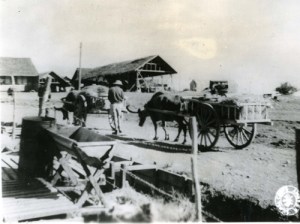
The raid was over in 35 minutes, POWs brought to pre-arranged meet-up places with dozens of carabao carts.   A long trek yet remained, one POW said “I made the Death March from Bataan, so I can certainly make this one!”  Over three days, up to 106 carts joined the procession, their plodding 2 MPH progress covered by strafing American aircraft.

Two American Rangers and two prisoners were killed, another 4 Americans and 21 Filipinos wounded, compared with 500-1,000 Japanese killed and four tanks put out of action.  464 American military personnel were liberated, along with 22 British and 3 Dutch soldiers, 28 American civilians, 2 Norwegians and one civilian each of British, Canadian and Filipino nationalities.
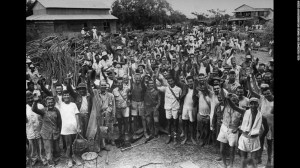
cabanatuan-rescued
Rescued POWs from Cabanatuan

One POW was left behind, a British soldier named Edwin Rose.  Rose heard the firing and thought the Americans were there to stay, so he went back to sleep.  When he woke the next morning and realized he had “Cabanatuan all my own”, he shaved, put on his best clothes, and walked out of camp.  Passing guerrillas found him and passed him to a tank destroyer.  Give the man points for style.  A few days later, Rose strolled into 6th army headquarters, a cane tucked under his arm.

The Cabanatuan raid of January 30, 1945 liberated over 500 allied prisoners, from virtually every state in the Union. Begging pardon for any mistakes in rank and/or spelling, the following represents those from my home state of Massachusetts:

  • Lieutenant Commander Robert Strong, Jr., Arlington
  • Captain John Dugan, Milton
  • 2nd Lieutenant John Temple, Pittsfield
  • Sergeant Richard Neault, Adams
  • Sergeant Stanislaus Malor, Salem
  • Private, 1st Class Joseph Thibeault, Lawrence
  • Private Edward Searkey, Lynn
  • USN C/QM Martin Seliga, Fitchburg
  • USN 1/C PO J.E.A. Morin,Danvers
  • USN AC MM Carl Silverman, Wareham

I hope I didn’t leave anyone out.  These guys have earned the right to be remembered.

January 26, 1945 Audie Murphy

These days, you hear a lot about Post-Traumatic Stress Disorder (PTSD). In Murphy’s Day, they called it “Battle Fatigue”, or “Shell Shock”. Murphy would spend a 21-year post-war career in Hollywood and, until his death in a plane crash in 1971, his post-war life was never free of it

Audie Leon Murphy attempted to enlist in the Armed Services after the Japanese attack on Pearl Harbor, but the Marine Corps, Navy and the Army all turned him down for being underweight and under age. After a change in diet to “fatten” up, Murphy appeared at a Dallas recruiting station on June 30, 1942 with a sworn affidavit from his sister, inflating his age by a year. It was 10 days past his 17th birthday when Murphy, all 5’5½” and 112 lbs of him, enlisted in the US Army.

Murphy’s company commander thought he was too small for infantry service, and attempted to transfer him to cook and bakers’ school. Murphy refused.  He wanted to become a combat soldier.

amphibious-landingJoining the 3rd Infantry Division of George S. Patton’s 7th Army, Murphy participated in amphibious landings in Sicily in July, fighting in nearly every aspect of the Italian campaign. From Palermo to Messina and on to Naples, Anzio and Rome, the Germans were driven out of the Italian peninsula in savage and near continuous fighting that killed a member of my own family.  By mid-December, the 3rd ID suffered 683 dead, 170 missing, and 2,412 wounded. Now Sergeant Murphy was there for most of it, excepting two periods when he was down with malaria.

Two months after the “Overlord” landings in the north of France, elements of the 7th Army landed in southern France in an operation called “Dragoon”. By mid-September, only three of Company B’s original roster remained, the rest either killed or removed due to wounds or illness. It was around this time when Murphy received his first Purple Heart.  A mortar blast resulted in a heel wound that wasn’t very serious, but a far more dangerous hip wound followed from a sniper in December. He repaid it with a bullet between the German’s eyes.

Murphy was still in the hospital when his unit moved into the Vosges Mountains. The colmar_pocket“Colmar Pocket” was an 850 square mile area held by German troops: Murphy described it as “a huge and dangerous bridgehead thrusting west of the Rhine like an iron fist. Fed with men and materiel from across the river, it is a constant threat to our right flank; and potentially it is a perfect springboard from which the enemy could start a powerful counterattack.”

Rejoining his unit in January, now Lieutenant Murphy became Company Commander, being the only officer remaining in the Company. Disease, wounds and casualties had reduced company B’s fighting strength by this time from an original 235 to 18.

What remained of the unit was awaiting reinforcements on January 26, 1945, as a combined force of German infantry and armor assembled itself outside of town. “I see the Germans lining up for an attack”, said Murphy. “Six tanks rumble to the outskirts of Holtzwihr, split into groups of threes, and fan out toward either side of the clearing. Then wave after wave of white dots, barely discernible against the background of snow, start across the field. They are enemy infantrymen”.

audie_murphyLet Murphy’s Medal of Honor Citation describe what happened next: “Second Lieutenant Audie L. Murphy, 01692509, 15th Infantry, Army of the United States, on 26 January 1945, near Holtzwihr, France, commanded Company B, which was attacked by six tanks and waves of infantry. Lieutenant Murphy ordered his men to withdraw to a prepared position in a woods while he remained forward at his command post and continued to give fire directions to the artillery by telephone. Behind him to his right one of our tank destroyers received a direct hit and began to burn. Its crew withdrew to the woods. Lieutenant Murphy continued to direct artillery fire which killed large numbers of the advancing enemy infantry. With the enemy tanks abreast of his position, Lieutenant Murphy climbed on the burning tank destroyer which was in danger of blowing up any instant and employed its .50 caliber machine gun against the enemy. He was alone and exposed to the German fire from three sides, but his deadly fire killed dozens of Germans and caused their infantry attack to waver. The enemy tanks, losing infantry support, began to fall back. For an hour the Germans tried every available weapon to eliminate Lieutenant Murphy, but he continued to hold his position and wiped out a squad which was trying to creep up unnoticed on his right flank. Germans reached as close as 10 yards only to be mowed down by his fire. He received a leg wound but ignored it and continued the single-handed fight until his ammunition was exhausted. He then made his way to his company, refused medical attention, and organized the company in a counterattack which forced the Germans to withdraw. His directing of artillery fire wiped out many of the enemy; he personally killed or wounded about 50. Lieutenant Murphy’s indomitable courage and his refusal to give an inch of ground saved his company from possible encirclement and destruction and enabled it to hold the woods which had been the enemy’s objective”.

These days, you hear a lot about Post-Traumatic Stress Disorder (PTSD).  In Murphy’s Day, they called it “Battle Fatigue”, or “Shell Shock”.  Murphy would spend a 21-year post-war career in audie-murphy-gravesiteHollywood and, until his death in a plane crash in 1971, his post-war life was never free of it.

Data from the National Vital Statistics System, a collaboration of the National Center for Health Statistics of the Department of Health and Human Services, reveals a suicide rate among veteran populations approximately twice that in comparable civilian populations.

I wonder about the term, “Disorder”.  That makes it sound like there’s something wrong with these guys.

When a soldier experiences an event, so traumatic that the very memory of it causes pain, I don’t understand how that can be characterized as a “disorder”. To me that seems like the properly functioning conscience of a good man, recoiling in horror at what he’s seen in service to his country.

I don’t know the answer to PTSD-related suicide, I don’t even know the right question.  It seems to me that the only “disorder” belongs to that fraction of a percent who remain unaffected by the horrors of war.

January 24, 1776 A Noble Train of Artillery

It must have been a sight when that Noble Train of Artillery entered Cambridge on this day in 1776

The American Revolution began with the “Shot Heard Round the World” on the morning of April 19, 1775. Within days of the Battles of Lexington and Concord and the subsequent British withdrawal to Boston, over 20,000 men poured into Cambridge from all over New England. Abandoned Tory homes and the empty Christ Church became temporary barracks and field hospitals.  Even Harvard College shut down, its buildings becoming quarters for at least 1,600 Patriots.

The Continental Congress appointed George Washington General of this “Army” on June 15, two days before the British assault on Farmer Breed’s hill. An action which took its name from that of a neighboring farmer, going into history as the Battle of Bunker Hill.

At the time, Boston was a virtual island, connected to the mainland by a narrow strip of land. Shortly after his arrival in July, General Washington discovered that his army had enough gunpowder for nine shots per man, and then they’d be done. British forces were effectively penned up in Boston, by a force too weak to do anything about it.

timberlakephoto-ticonderoga
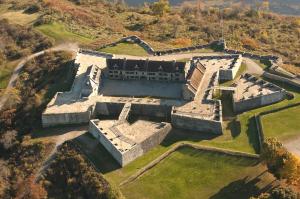
Fort Ticonderoga

The stalemate dragged on for months, when a 25 year old bookseller came to General Washington with a plan. His name was Henry Knox. His plan was a 300-mile, round trip slog into a New England winter, to retrieve the guns of Fort Ticonderoga. Washington’s advisors derided the idea as hopeless, but the General approved. Henry Knox set out with a column of men on December 1.

Located on the New York banks of Lake Champlain, Fort Ticonderoga was captured by a small force led by Ethan Allen and Colonel Benedict Arnold, in May of that year. In it were brass and iron cannon, howitzers, and mortars, 59 pieces in all. Arriving on December 5, Knox and his men set about disassembling the artillery, making it ready for transport. A flotilla of flat bottom boats was scavenged from all over the countryside, the guns loaded and rowed the lengthcolonel-knox-bringing-the-cannons-from-fort-ticonderoga-1 of Lake George, arriving barely before the water began to freeze over.
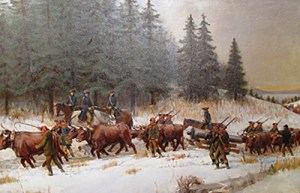
Local farmers were enlisted to help and by December 17, Knox was able to report to General Washington “I have had made forty two exceedingly strong sleds & have provided eighty yoke of oxen to drag them as far as Springfield where I shall get fresh cattle to carry them to camp. . . . I hope in 16 or 17 days to be able to present your Excellency a noble train of artillery.”

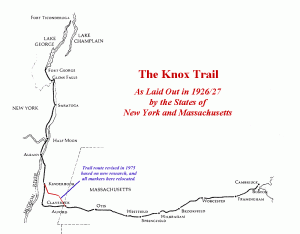
Bare ground prevented the sleds from moving until Christmas morning, when a heavy snow fell and the column set out for Albany. Two attempts to cross the Hudson River on January 5 each resulted in cannon being lost to the river, but finally Knox was able to write “Went on the ice about 8 o’clock in the morning & proceeded so carefully that before night we got over 23 sleds & were so lucky as to get the Cannon out of the River, owing to the assistance the good people of the City of Albany gave.”knoxtrailmap

Continuing east, Knox and his men crossed into Massachusetts, over the Berkshires, and on to Springfield. With 80 fresh yoke of oxen, the 5,400lb sleds moved along much of what is modern day Routes 9 and 20, passing through Brookfield, Spencer, Leicester, Worcester, Shrewsbury, Northborough, Marlborough, Southborough, Framingham, Wayland, Weston, Waltham, and Watertown.

It must have been a sight when that noble train of artillery entered Cambridge on this day in 1776. By March, Henry Knox’ cannon would be manhandled to the top of Dorchester Heights, resulting in the British evacuation of Boston and a peculiar Massachusetts institution which exists to this day, known as “Evacuation Day”: March 17.

It is doubtful whether Washington possessed either powder or shot for a sustained campaign, but British forces occupying Boston didn’t know that. The mere presence of those guns moved British General Howe to weigh anchor and sail for Nova Scotia, but that is a story for another day.

January 23, 1795 Cavalry 1, Navy 0

The history of human conflict is hardly a subject for mirth, yet there are times when the irony has risen to the level of the sublime

War and warfare has never been the source of a great deal of humor.  The history of human conflict is hardly a subject for mirth, yet there are times when the irony has risen from the ridiculous to the sublime.

In 585BC, the battle between the Medes and the Lydians was stopped in its tracks, on account of a solar eclipse.  In the 3rd Mithradatic War of 76-63BC, a meteor was enough to do the trick.

In the middle ages, a handful of French soldiers once saw fit to mouth off to an Italian woman on her way home from church, and France ended up losing Sicily, to Spain.

At least one WWI battle was called, on account of an amphibious landing force being attacked, by bees.

120,000 Chinese troops poured into North Korea between November 27 and December 13 1950, overwhelming 20,000 American and United Nations forces at the Chosin Reservoir.  Desperately low on ammunition, one Marine Corps mortar division called in re-supply, by parachute.  The battle of the “Frozen Chosin” might have ended differently, had some supply clerk understood that the code-name for mortar shells was “Tootsie Rolls”, and not sent candy into the combat zone.  At least those guys had something to eat, as they broke through their encirclement and retreated south.

zuiderzeeIn all the annals of warfare, there may be nothing more ironic, than the time a naval force was defeated by men mounted on horseback.
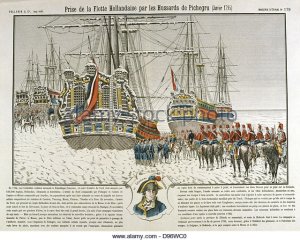
In early 1793, Austria, Prussia, Spain, Great Britain and the Dutch Republic formed the first of seven coalitions, that would oppose the French Republic over the next 23 years.  France declared war on its neighbor to the north.  By the end of the following year, many of Holland’s provinces as well as those of the Austrian Netherlands, had been overrun.

The winter of 1794-95 was particularly severe.  A number of Dutch ships sought shelter near the North Sea village of den Helder, becoming icebound near the mouth of a shallow bay called the Zuiderzee.capture

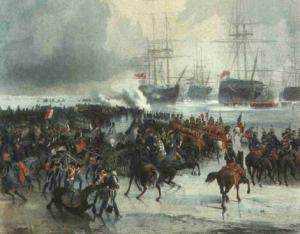
General Johan Willem de Winter, a former Dutch naval officer, had been in service to the French since 1787.  On the night of January 23, de Winter arrived at the head of a regiment of French light cavalry.  The following morning, a number of these “hussars” rode out over the ice, to the Dutch ship-of-the-line “Admiraal Piet Heyn”, demanding its surrender.   The surgeon aboard another ship, the “Snelheid”, later wrote “On Saturday morning, my servant informed me that a French hussar stood near our ship. I looked out my porthole, and indeed, there stood an hussar.”

This was a significant part of the Dutch fleet, 15 ships, 11 of which were manned and seaworthy, and it was now in the hands of French horsemen.

capture-of-the-dutch-fleet-frozen-in-at-den-helder-by-the-french-hussarsAt least one source will tell you that this event never occurred, or at least it’s an embellished version, as retold by the hussars themselves.   I guess you can take your pick.  A number of 19th century authors have portrayed the episode as unvarnished history, as have a number of paintings and sketches.

In February 1846, French Lieutenant-General Baron Lahure published a letter in the newspaper “Echo de la Frontière”, describing the event.  “I departed immediately with a company of tirailleurs in wagons and a squadron of light cavalry; before dawn I had taken position in the dunes. When the ships saw us, they prepared their defences. I sent some tirailleurs ahead, and followed with the rest of my forces. The fleet was taken. The sailors received us ‘de bonne grace’ on board… This is the true story of the capture of the Dutch fleet, devised and executed by a 23 year old Chef de Bataillion”.

Archibald Gordon Macdonell included the episode in his 1934 “Napoleon and his Marshals”.  It’s one of those stories that I Want to be true, even if it isn’t.  “(when) the ragged men” Macdonell  wrote, “thundered on their horses across the ice to capture with naked swords the battlefleet of Holland”.  The only time in recorded history, when a naval fleet was captured, by a cavalry charge.

January 21, 1968 Blue House Raid

On January 17, 1968, Unit 124 infiltrated the 2½ mile demilitarized zone (DMZ), cutting the wire and entering South Korea. Their mission was to assassinate ROK President Park Chung-hee in his home, the South Korean Executive Mansion known as “Blue House”

By 1967, the Republic of Korea (ROK) had some 44,829 South Korean forces in Vietnam. An overwhelming force of NVA and Vietcong had the misfortune of surrounding a platoon of “Blue Dragon” Marines on February 15 of that year, near the village of Trà Bình. Poor visibility precluded air support, and the fighting that followed was close and personal. When it was over, 243 NVA lay dead. Korean Marines lost fewer than a dozen men.

Any combat veteran of the war in Southeast Asia will tell you, in Vietnam they faced a tough and disciplined soldier. POW interrogations of captured NVA revealed one bluedragonpatchLieutenant Trung to be particularly hard core, a tough guy in a world of tough guys. A US Marine Corps Lieutenant of Korean ancestry, dressed in the uniform of the Blue Dragon Marines, and paid a visit to Lt. Trung’s cell. Not a word or gesture passed between the two, the mere presence of a Blue Dragon was enough to get this guy talking. Korean fighters are no joke.

For two years, an elite, all-officer force of 31 North Korean commandos were trained in infiltration and exfiltration techniques, weaponry, navigation, concealment and hand-to-hand combat, with particular emphasis on knife fighting. They were “Unit 124”, highly trained and fanatically loyal soldiers, tough as rawhide and each prepared to die for the supreme leader of the Democratic People’s Republic of Korea, (DPRK), Kim Il-Sung.

On January 17, 1968, Unit 124 infiltrated the 2½ mile demilitarized zone (DMZ), cutting the wire and entering South Korea. Their mission was to assassinate ROK President Park Chung-hee in his home, the South Korean Executive Mansion known as “Blue House”.

It’s hard to think of anything goofier, and at the same time more lethal, than the hare-korea1brained political calculations of DPRK leadership. Somehow it made sense to these guys, that to assassinate the South Korean President and hurl his head out of the official residence, would start a popular uprising leading to the re-unification of the Korean peninsula under DPRK government.

On the 19th, four brothers of the Woo family were out gathering firewood, when they stumbled upon Unit 124. A fierce debate ensued among the commandos, as to what to do with these guys. Training dictated that they be immediately killed, yet somehow that didn’t seem right. Wasn’t communist ideology supposed to be a “people’s movement”?  Besides, it would have taken too long to bury their bodies in the frozen ground.

The decision was made to convert them on the spot. Talk about goofy. After a suitably long harangue on the wonders of communism, the Woo brothers wisely proclaimed themselves converts. Whereupon they were released, and went directly to the authorities.

Unit 124 broke camp, for the next two days averaging 10kph over mountainous terrain, despite carrying an average 70lbs apiece in equipment.

Commandos made it to within 100 meters of Blue House on January 21, when they were challenged at a road block. The firefight broke out without warning, dissolving into a running gunfight and manhunt lasting until the 29th. When it was over, 26 Southkim-shin-jo Korean military and police personnel were killed along with two dozen civilians, and 66 wounded. Four Americans were killed in efforts to prevent Unit 124 members from re-crossing the DMZ.

29 commandos were killed or committed suicide. One escaped, back into North Korea. Only one, Kim Shin-jo, was captured alive.

History has a way of swallowing some events whole. The Battle of Khe Sanh started in Vietnam the same day as the raid.  Two days later a US Navy technical research ship, the USS Pueblo, was captured by North Korean forces. The Tet Offensive broke out all across South Vietnam on January 31st.  Soon the Blue House raid was all but forgotten.

Kim Shin-Jo was interrogated for a year, to learn how the raid had been carried out. Meanwhile, ROK authorities “recruited” their own commando assassination squad, as a bit of payback. The 31 members of “Unit 684” were recruited from South Korean death row unit-684and other hardened prisoners, possibly due to the suicidal nature of their mission. The “training” they were subjected to on Silmido Island, off the coast of Inchon, was beyond brutal. Seven of them would not survive it.

The raid was never carried out. North-South relations were thawing by August of 1971, as the Silmido Island recruits staged an insurrection. How it started is unclear, but 20 inmate/recruits were dead before it was over, along with a number of their overseers. The four surviving Unit 684 recruits were tried for their role in the uprising by a military tribunal, and executed in 1972.

In May of 2010, Seoul courts ordered the government to pay $231 million to the families of 21 members of Unit 684.

Kim Shin-jo’s parents were murdered by North Korean authorities and his relatives “purged”, after he became a citizen of the ROK in 1970. Now a married father of two, Kim renounced his communist ideology, since becoming a pastor of the Seoul “Sungrak” (“Holy Joy”) Baptist Church.

I’m indebted for this story to a man who was a family friend, almost before my parents decided to start a family. I have known this man longer than I can remember, and flatter myself to regard him as a personal friend. He was one of the interrogators, during both the Trung and the Kim episodes related above. Thank you, Victor, for your story, and for your service.

January 19, 1977 Tokyo Rose

Either all convicts are guilty as charged, or someone, at some time, has been wrongly convicted

There’s an old cliché that, if you speak with those who are convicted of a crime, all of them say they are innocent. It’s an untrue statement on its face, but there are only two possible conclusions in the alternative. Either all convicts are guilty as charged, or someone, at some time, has been wrongly convicted.

To agree with the former is to accept the premise that what government does is 100% right, 100% of the time.

Iva Ikuko Toguri was born in Los Angeles on July 4, 1916, the daughter of Japanese immigrants. She attended schools in Calexico and San Diego, returning to Los Angeles where she enrolled at UCLA, graduating in January, 1940 with a degree in zoology.
iva-toguri

In July of the following year, Iva sailed to Japan without an American passport. She variously described the purpose of the trip as the study of medicine, and going to see a sick aunt. In September, Toguri appeared before the US Vice Consul in Japan to obtain a passport, explaining that she wished to return to permanent residence in the United States. Because she had left without a passport, her application was forwarded to the State Department for consideration. It was still on someone’s desk when Imperial Japan attacked Pearl Harbor, fewer than three months later.

Iva later withdrew the application, saying that she’d remain in Japan voluntarily for the duration of the war. She enrolled in a Japanese language and culture school to improve her language skills, taking a typist job for the Domei News Agency. In August 1943, she began a second job as a typist for Radio Tokyo.

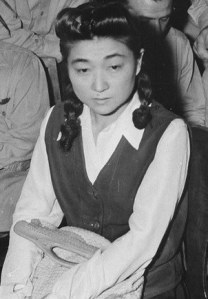
In November of that year, Toguri was asked to become a broadcaster for Radio Tokyo on theiva-toguri-at-the-mic “Zero Hour” program, part of a Japanese psychological warfare campaign designed to lower the morale of US Armed Forces. The name “Tokyo Rose” was in common use by this time, applied to as many as 12 different women broadcasting Japanese propaganda in English. Toguri DJ’d a program with American music punctuated by Japanese slanted news articles for 1¼ hours, six days a week, starting at 6:00pm Tokyo time. Altogether, her on-air speaking time averaged 15-20 minutes for most broadcasts.

Toguri called herself “Orphan Annie,” earning 150 yen per month (about $7.00 US). She wasn’t a professional radio personality, but many of those who later recalled hearing her enjoyed the program, especially the music.

Shortly before the war ended, Toguri married Felipe Aquino, a Portuguese citizen of Japanese-Portuguese ancestry. The marriage was registered with the Portuguese Consulate, though she didn’t renounce her US citizenship, continuing her Zero Hour broadcast until after the war was over.

iva_toguri_mug_shotAfter the war, a number of reporters were looking for the mythical “Tokyo Rose”, and two of them found Iva Aquino. They were Henry Brundidge and Clark Lee, and they offered her a significant sum for her story. The money never materialized, but she signed a contract giving the two rights to her story, and identifying herself as Tokyo Rose.
FBI.gov states on its “Famous Cases” website that, “As far as its propaganda value, Army analysis suggested that the program had no negative effect on troop morale and that it might even have raised it a bit. The Army’s sole concern about the broadcasts was that “Annie” appeared to have good intelligence on U.S. ship and troop movements”.

US Army authorities arrested her in September, while FBI and the Army Counterintelligence investigated her case. By the following October, authorities decided that the evidence did not merit prosecution, and she was released.

Matters may have ended there, except for the public outcry that accompanied Aquino’s return to the US. Several groups, along with the noted broadcaster Walter Winchell, were outraged that the woman they knew as “Tokyo Rose” wanted to return to this country, instead demanding her arrest on treason charges.

Department of Justice sent attorneys to Japan to interview witnesses, one of whom was the reporter, Henry Brundidge. Once again quoting FBI.gov, “Problematically, Brundidge enticed a former contact of his to perjure himself in the matter”.tokyo-rose-conviction

The trial began on July 5, 1949, lasting just short of three months. The jury found Aquino guilty on one of fifteen treason charges, ruling that “[O]n a day during October, 1944, the exact date being to the Grand Jurors unknown, said defendant, at Tokyo, Japan, in a broadcasting studio of the Broadcasting Corporation of Japan, did speak into a microphone concerning the loss of ships.”

Aquino was sentenced to ten years and fined $10,000 for the crime of treason, only the seventh person in US history to be so convicted. She was released from the Federal tokyo-rose-pardonReformatory for Women at Alderson, West Virginia in 1956, having served six years and two months of her sentence.
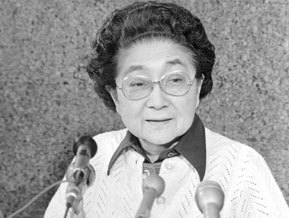
President Gerald Ford pardoned her on January 19, 1977, 21 years almost to the day after her release from prison. Iva Toguri Aquino passed away in 2006, at the age of 90. Neither perjury nor suborning charges were ever brought against Brundidge or his witness.

January 13, 1842 Last Man Standing

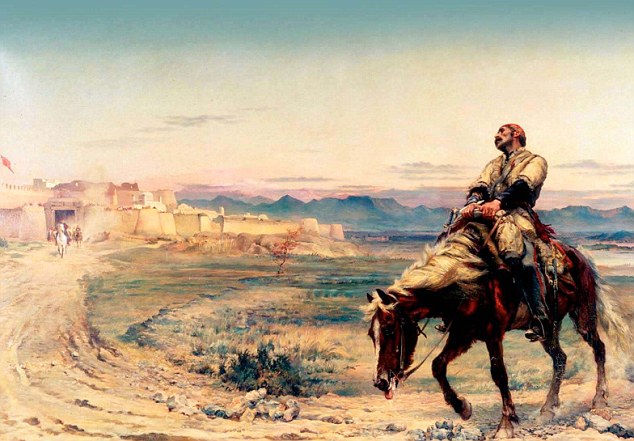
That afternoon, one mangled soldier rode into Jalalabad on a wounded horse. He was Dr. William Brydon. When asked where the army was, Brydon replied “I am the Army”

The British East India Company was a British joint stock company, chartered by Queen Elizabeth in 1600 with a trade monopoly in Southeast Asia and India. It was the first of several such companies established by European powers, followed closely by the East India Companies of the Dutch, Danish, Portuguese, French and Swedish, and associated with the valuable trade in such commodities as cotton, silk, indigo, salt, saltpeter, tea and opium.

These organizations were much more than what we associate with the word “company”. In their day they could raise their own armies, enforce the law up to and including trial and execution of accused wrong doers, and largely functioned outside the control of the governments that formed them. By the early 19th century, the British East India Company ruled over large areas of India with its own private armies.

Firmly entrenched by the 1830s and wary of Russian encroachment south through Afghanistan, the British tried without success to form an alliance with the Emir of Afghanistan, Dost Mohammad Khan.

Lord Auckland’s “Simla Manifesto” of October 1838 laid out a justification for British intervention in Afghanistan, based on the need for a trustworthy ally on India’s western frontier. The pro-British, Shuja Shah Durrani was installed as ruler, backed up by an army of 21,000 British and Indian troops under the command of Lieutenant General John Keane, 1st Baron Keane, veteran of the Peninsular War, and the battle of New Orleans.

Most of these troops returned to India the following year, as Dost Mohammad unsuccessfully attacked the British and their Afghan protégé, only to be defeated and exiled to India in late 1840.

wazir_akbar_khan
Prince Akhbar Khan

By 1841, disaffected Afghan tribesmen were flocking to support Dost Mohammad’s son, Akbar Khan, against what they saw as an occupying force. There were warning signs of the deteriorating situation as the spring of 1841 turned to summer, and British freedom of movement around Kabul became increasingly restricted. The British government in India was dismayed at the cost of keeping the Kabul Garrison, when they cut off funds, ending the stream of bribes that all but kept the tribes in check.

It was around this time that Sir William Elphinstone stepped in as commander of the Kabul Garrison. Described by fellow General William Nott as “the most incompetent soldier who ever became General”, Elphinstone found himself in charge of 4,500 Indian and British troops, along with 12,500 camp followers: families, servants and civilian workers.

On November 2 1841, Akbar Khan proclaimed a general revolt. Several British officers were murdered along with their families, servants and staff. Afghan leaders invited Civil servant Sir William Hay MacNaghten for tea in December to discuss the situation; only to seize and murder them as the delegation dismounted their horses.

On January 1, Elphinstone agreed to hand over all powder, his newest muskets and most of his cannon, in exchange for “safe passage” out of Kabul, guaranteed by Akbar Khan along with the protection of the sick, wounded and infirm left behind. 16,000 soldiers and civilians moved out on January 6, heading for Jalalabad, 90 miles away.

Akbar Khan’s safe passage lasted as long as it took the column to get out in the open, when Afghans moved in firing at the retreating troops while setting fire to garrison buildings containing those left behind. At one point Akbar Khan met with Elphinstone, claiming ignorance of any betrayal. He claimed that he had been unable to provide the promised escort because they had left earlier than expected, and then asked Elphinstone to wait while he went ahead and negotiated safe passage with local tribesmen.

The delay accomplished nothing more than to allow Akbar Khan time to set up the next ambush. By the evening of the 9th, the column was only 25 miles outside of Kabul. 3,000 people were dead, mostly killed in the fighting or frozen to death, while a few had taken

last-stand
The Last Stand of Jan. 13, 1842

their own lives. By January 12, the column was reduced to only 200 soldiers and 2,000 camp followers

The last stand took place on a snow-covered hill near the village of Gandamak, on the morning of January 13, 1842. 20 officers and 45 British soldiers were surrounded, with an average of two rounds apiece. That afternoon, one mangled soldier rode into Jalalabad on a wounded horse. He was Dr. William Brydon. Brydon had part of his skull sheared off by an Afghan sword. He was only alive because of a Blackwood’s Magazine, stuffed into his hat to fight off the cold of the Hindu Kush. When asked where the army was, Brydon replied “I am the Army”.

In the end, 115 captured officers, soldiers, wives and children lived long enough to be released. Around 2,000 Sepoys and Indian camp followers eventually made their way back to India. According to legend, Brydon’s horse lay down on arrival in Jalalabad, and never got up again.

January 12, 1968 The Strangest Dogfight

Theirs was a secret war, waged in the mists of the Annamite Mountains. Two months later, North Vietnamese commandos attacked and destroyed Site 85, inflicting the largest loss of US Air Force personnel of the war in Vietnam

To the extent that most of us think about aerial combat, at least the non-pilots among us, I think we envision some variation of the dog fights between Snoopy and the Red Baron. Two aircraft, bobbing and weaving through the sky, each attempting to get the other in his sights.

red-baron
Manfred von Richtofen

In the real world, Manfred von Richthofen, the most prolific ace of WWI with 80 confirmed kills, was killed by a single bullet fired from the ground, while pursuing Canadian pilot Wilfred May behind Allied lines. The Red Baron landed his red Fokker tri-plane in a beet field and died moments later, and was buried with full military honors, by his enemies.

Possibly the strangest dogfight of WWII took place on August 17, 1943, between two German long-range “Condor” maritime patrol bombers, and an American B-24D Liberator bomber in the skies over the Atlantic Ocean.

Twenty-eight ton, four-engine bombers were never meant for diving attacks and multiple-G banking turns. It must have looked like a motocross race between cement mixers.

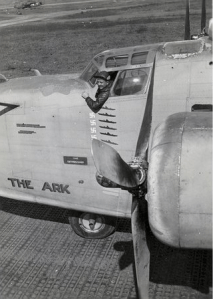
Stripped of armor to increase range and carrying a full load of depth charges, the American anti-submarine bomber with its 10-man crew dove out of the clouds at 1,000 feet, throttles open and machine guns firing. The first Condor never came out of that diving turn, while machine gun fire from the second tore into the American bomber. Rear-gunners returned fire, as Liberator pilot Hugh Maxwell Jr. crash landed in the water, his aircraft breaking into three pieces.the-ark

Maxwell had named his B-24 “The Ark”, explaining that “it had a lot of strange animals aboard, and I hoped it would bring us through the deluge”. It must have worked, seven out of ten crew members lived to be plucked from the water. The second Condor made it back to Bordeaux, where it crashed and burned on landing.

Surviving Liberator crew members were rescued by the British destroyer Highlander, along with three Germans from that first Condor. It was all the Highlander crew could do, to keep the soaking wet combatants apart on the decks of the destroyer.

On the first night of the Gulf War in 1991, an Iraqi Mirage fighter intercepted an American EF-111, an unarmed F-111 bomber modified for radar-jamming patrol. Flying at 200′ and equipped with sophisticated terrain-following radar, the bomber was able to climb up and over hilltops, while the French-made Mirage fighter had no such systems. The last that was seen of that Iraqi fighter, was when he plowed his aircraft into that same hillside.

f-15eLater in the same conflict, an Iraqi Hughes 500 helicopter was taken out by bombs dropped from an American Air Force F-15E bomber. At least one Iraqi PC-7 Turboprop pilot got spooked, bailing out of a perfectly good aircraft before a shot was fired in his direction.

The strangest dogfight in history took place on January 12, 1968, when four Soviet-made Antonov AN-2 Colt biplanes took off from their base in North Vietnam, headed west toward Laos.

Only 125 nautical miles from Hanoi, Phou Pha Thi mountain had long been used as a staging base for CIA directed Hmong guerilla fighters and Thai security forces. Lima Site 85 was the American radar facility, perched atop the 5,800′ mountain.

CIA-operated “Air America” captain Ted Moore was flying a UH-1D Huey helicopter at the

phou_pha_thi
Lima site 85, atop 5,800 Phou Pha Thi Mountain

time, carrying a load of ammunition to Phou Pha Thi. Moore arrived to see two North Vietnamese biplanes, dropping 122mm mortar shells through holes in the floor and strafing the mountaintop with 57mm rockets. “It looked like WWI,” he later recalled. Moore gave chase, positioning his helicopter above one biplane, as flight mechanic Glenn Woods fired an AK-47 rifle down from above.

Moore and Woods dropped back to the second biplane, as the first crashed into a ridge west of the North Vietnamese border. Moments later, the second crashed into a mountainside, as the other two slipped back into North Vietnamese air space. The entire chase had taken about 20 minutes.

Theirs was a secret war, waged in the mists of the Annamite Mountains. Two months later, North Vietnamese commandos attacked and destroyed Site 85, inflicting the largest loss of US Air Force personnel of the war in Vietnam.

On July 27, 2007, Air America veterans Marius Burke and Boyd Mesecher presented the CIA with “An Air Combat First”, an oil on canvas painting by Keith Woodcock, depicting the shoot-down. The event was attended by members of the Air America Board, pilot Ted Moore, wife of flight mechanic Glenn Woods Sawang Reed, CIA paramilitary veteran Bill Lair; and the painting’s donors. Presumably, the painting hangs at CIA Headquarters in Langley, Virginia. A testament to the only time in the history of the Vietnam war, that an enemy fixed-wing aircraft was shot down, by a helicopter.

January 4, 1642 The Great Rebellion

Agree or disagree with US war policy, what we do in this country we do as a nation. It would seem absurd to us to see the President and the Congress raise separate armies to go to war with one another

Agree or disagree with US war policy, what we do in this country we do as a nation.  It would seem absurd to us to see the President and the Congress raise separate armies to go to war with one another, but that’s just what happened in 17th century England.

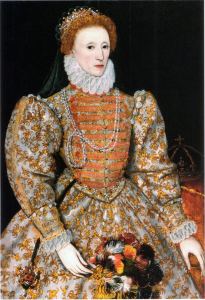
Queen Elizabeth I passed away without issue in 1603, succeeded by her first cousin, twice

elizabeth-1
Elizabeth I

removed, King James VI of Scotland.  For the first time, the Kingdoms of England and Scotland were united under single rule.

The English Parliament of the age didn’t have a permanent role in government, instead being a temporary advisory body, summoned and dismissed at the will of the King.  Practically speaking, the King had no means to enforce his will on matters of taxation, without the consent of the “gentry”, the untitled land owning classes who were the primary means of national tax collection.  This gave rise to an elected “House of Commons”, joining the House of Lords to form a Parliament.

James thought of Kings as “little Gods on Earth”, and had long gotten whatever he wanted from a supine Scottish Parliament.  The English Parliament was another matter.  James’ entire reign and that of his son Charles I was one long contest of wills with the English governing body.

three_faces_van_dyck
The Three Faces of Charles I

Charles’ 1625 marriage to a Roman Catholic, French princess Henrietta Maria, did little to win him support in Protestant England.  His interventionist policies in the 30 years’ war made things worse, ending with Parliament bringing impeachment proceedings against his minister, the Duke of Buckingham.  Parliament drew up the “Petition of Right”, invoking the Magna Carta and severely limiting the King’s right of non-Parliamentary taxation, along with other restrictions on the Royal Prerogative.  Charles looked to the House of Lords to check the power of the Commons, but both houses ratified the measure by the end of May.

The King dissolved this first Parliament in 1629, putting nine of its leaders in prison and unwittingly making them martyrs for their cause.  The following 11 years are sometimes called “the personal rule” or the “eleven years’ tyranny”.  Charles had severe money problems by 1640, forcing him to call another Parliament.   The King wanted a more docile body this time, so he appointed many of his adversaries as Sheriffs, knowing that this would require them to stay within their counties, making them ineligible for election.  To others he bestowed aristocratic titles, making them ineligible for the House of Commons.  Of course, that only moved them to the House of Lords.

What the King saw as reasonable, the legislative body saw as opportunity to negotiate, and this “Short Parliament” was dissolved within a month.  That was May 1640, and Charles once again called a Parliament in November.  This was to be his “Long Parliament”, proving as uncooperative as any before it.

attempted_arrest_of_the_five_members_by_charles_west_cope
Lenthall kneels to Charles during the attempted arrest of the Five Members

In January, Charles directed Parliament to surrender five members of the Commons and one Peer on grounds of high treason.  On the following day, January 4, 1642, the King himself entered the House of Commons with an armed guard of 400, demanding that the offenders be handed over.  The Speaker, William Lenthall, replied, “May it please your Majesty, I have neither eyes to see nor tongue to speak in this place but as the House is pleased to direct me, whose servant I am here.”  He might as well have told the King “I work for these people.  I don’t work for you”.

It was a grave breach of protocol, no King had ever entered the House of Commons.  Making things worse, the botched arrest had cut the feet out from under Charles’ supporters.  The two sides began to arm themselves that summer.  Full-scale civil war broke out that October.

when_did_you_last_see_your_father
The son of a Royalist is questioned by Parliamentarians during the English Civil War, in “And when did you last see your father?” by William Frederick Yeames

What’s been variously described as one or two separate civil wars ensued, in which 300,000, 6% of the country’s population or roughly twice the percentage lost in the American Civil War, lost their lives.  A “Rump” House of Commons indicted the King on treason charges, in a trial which was never recognized by the upper house.  Charles maintained that he was above the law, while the court argued that “the King of England was not a person, but an office whose every occupant was entrusted with a limited power to govern by and according to the laws of the land and not otherwise”. Execution of Charles I

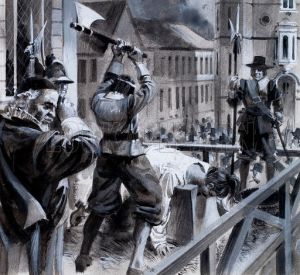
Charles I was found guilty of treason and sentenced to die by decapitation.   Clothed in two shirts by his own request, lest any shiver of cold be misinterpreted as a sign of fear, the King of England put his head on the block on January 30, 1649.  “A subject and a sovereign are clean different things,” he said. “I shall go from a corruptible to an incorruptible Crown, where no disturbance can be”.  With that, he extended his hands to signal he was ready, and his head was parted with a stroke.

The Rump House of Commons disbanded the House of Lords and England was briefly governed as a Commonwealth, but Charles soon came to be seen as a Martyr King.  Oliver Cromwell established a Protectorate with himself as Lord Protector.  He was briefly succeeded by his son on his death in 1658, but the son was not the equal of his father.  Parliament was reinstated and the monarchy restored to Charles’ eldest son, who became Charles II in 1660.billofrights

In the American colonies, Charles II renamed a slice of southern Virginia after his father “Carolus”, the Latin for Charles, and North and South Carolina were born. The Petition of Right would pop up 129 years later, reflected in the Third, Fifth, Sixth and Seventh amendments of the United States’ Constitution, part of what we now know as the Bill of Rights.

December 26, 1776 Trenton

Washington himself, who had become Commander-in-Chief of an Army with an average of nine rounds’ powder per man, feared they may have reached the end, writing to his cousin in Virginia “I think the game is pretty near up”.

1776 started out well for the Patriot cause, with the British evacuating Boston in March, the June defeat of the British Navy at Fort Moultrie South Carolina, and the Continental Congress adopting the Declaration of Independence on July 4.

Things took a turn for the worse in August, with General George Washington’s defeat at the Battle of Long Island, and the loss of the strategically important port of New York that September. It wasn’t all bad, Benedict Arnold’s October defeat at Valcour Island in Vermont, cost the British dearly enough that they had to turn back, buying another year of life for the Patriot cause.

By the end of November, General Howe pushed the last American troops out of New York, chasing Washington’s shrinking army through New Jersey and across the Delaware River into Pennsylvania.

Washington’s men gathered up or destroyed every boat they could find for miles, while across the Delaware, British General Lord Cornwallis established outposts from New Brunswick to Burlington, including one at Trenton, New Jersey.

Camping on the western banks of the Delaware, Washington was in desperate straits. Food, ammunition and equipment were in short supply, men were deserting as the string of defeats brought morale to a new low.  Most of his troops were about to end their enlistments, effective at the end of the year. Washington himself, who had become Commander-in-Chief of an Army with an average of nine rounds’ powder per man, feared they may have reached the end, writing to his cousin in Virginia “I think the game is pretty near up”.

The Americans needed a decisive victory, and quickly, if their cause was to survive. Washington planned a three-pronged attack on the Hessian garrison at Trenton, himself at the head of a 2,400 man army, flanked by a 1,900 man diversionary force under Colonel John Cadwalader and a blocking move by 700 men under General James Ewing.

march-on-trenton-webAs the army began the famous crossing of the Delaware that Christmas night, the
password was “Victory”. There was only one recognized response:  “Or Death”.

Washington’s three-pronged assault soon dissolved into one, as Cadwalader and Ewing both turned back. The weather that night was dreadful.  A howling ‘nor-easter’ came up at 11:00, hampering the crossing as freezing rain changed to sleet and sleet to snow. Horses balked at being led onto flat-bottom barges, while cannon had to be tied down to prevent capsize. With visibility near zero, several men fell overboard during the crossing.  One soldier said “it blew a perfect hurricane”.

Two froze to death on the overnight march to Trenton. Men were so poorly equipped that washington-delaware-lmany of them lacked boots, the soaked and freezing rags wrapped around their feet not enough to keep them from leaving bloody footprints in the snow.

Loyalists had warned the Hessian commander, Colonel Johann Rall, that American forces were planning an action. As late as December 22, a spy had warned British General James Grant that Washington was holding a war council.  His warning to the Hessian commander was “Be on your guard”.

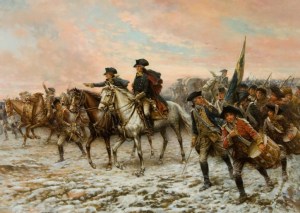
Approaching Trenton along parallel roads, General John Sullivan sent word to Washington that the weather was wetting his men’s gunpowder. Washington responded, “Tell General Sullivan to use the bayonet. I am resolved to take Trenton.”

trentonThe Patriot force arrived at Trenton at 8am December 26, completely surprising the Hessian garrison. There is a story about the Hessians being drunk or hungover after Christmas celebrations, but the story is almost certainly untrue. Unaware of Washington’s march on Trenton, 50 Americans had attacked a Hessian outpost earlier that morning. While Washington worried that his surprise was blown, Colonel Rall apparently believed that this was the attack he’d been warned about. He expected no further action that day.

The tactical surprise was complete for the American side. Hessian soldiers spilled out of their quarters and tried to form up, but most were shot down or dispersed. A few American civilians, residents of Trenton, even joined in the fight. All told, Hessian losses were 22 killed, 92 wounded, 918 captured and 400 escaped. Four Hessian colonels were killed, including Rall himself. The Americans suffered the two who had frozen to death, and five wounded. They had won the first major victory of the Revolution.

On December 30, the Americans once again crossed the Delaware, eluding a main forcetrenton-1 under Generals Cornwallis and Grant, proving on January 3rd at a place called Princeton, that they could defeat a regular British army in the field.

Encouraged by these victories, many of Washington’s men extended their terms of enlistment, and new enlistments flooded in. The American Revolution would slog on for almost six more years, but for today, it had lived to fight another day.