Despite two disastrous test runs, there was no shortage of volunteers. Once again, the Hunley was fished up from the bottom
In the 1850s, the economy of the southern United States was mostly agrarian. When civil war broke out in 1861, the Confederacy depended to a greater degree on imported manufactured goods than the more industrialized states to the north. For the Union, there was strategic advantage in cutting off this flow of manufactured goods, and so the “Anaconda Plan” was created, to choke off traffic to southern ports and harbors.
Few in the Confederacy understood the need to keep southern ports open as well as the planter, legislator, and southern Patriot Horace Lawson Hunley.
In 1861, Hunley joined forces with James McClintock and Baxter Watson to design and build a secret Super Weapon for the Confederacy. A submarine. They completed construction on their first effort, the “Pioneer”, that same year in New Orleans. The trio went on to build two more submarines in Mobile, Alabama, the “American Diver”, and their last and most successful creation, the “Fishboat”, later renamed HL Hunley.
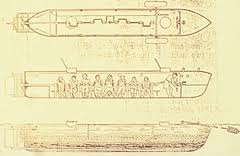
After a short sea trial in Mobile, the Hunley was put on a train and shipped up to Charleston, South Carolina, to help break the blockade. Arriving on August 12, 1863, she was 40′ long by 4′ wide, displacing about 7½ tons. She was designed for a crew of 8, with 7 operating a hand crank and the 8th steering the boat.
A test run on August 29 ended in disaster, when Skipper John A. Payne accidentally stepped on the lever controlling the diving planes with the hatches open. Payne and two others escaped, but the other five crew members went to the bottom.
A second crew tested the submarine on October 15, this one including Horace Hunley himself. The submarine conducted a mock attack but failed to surface afterward, this time drowning all 8 crew members.
Despite those two disastrous test runs, there was no shortage of volunteers. Once again, the Hunley was fished up from the bottom.
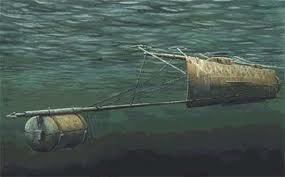
The original plan was to tow a floating mine called a “torpedo”, with a contact fuse. They would dive beneath their victim and surface on the other side, pulling the torpedo into the side of the target.
Tide and current conditions in Charleston proved to be very different from those in Mobile. On several test runs, they found the torpedo floating out ahead of the sub. That wouldn’t do, so they fashioned a spar and mounted it to the bow. At the end of the spar was a 137lb waterproof cask of powder, attached to a harpoon-like device with which Hunley would ram its target.
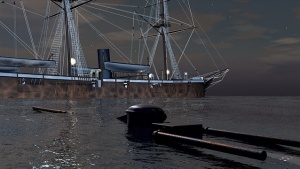
Hunley made her first live attack run four miles outside of Charleston Harbor, on the night of February 17, 1864. Lieutenant George Dixon and a crew of seven attacked USS Housatonic, a 1,240 ton steam powered sloop of war, embedding the spar torpedo into Housatonic’s hull. It must have been a sight to see. The torpedo ignited a 4,000 lb store of black powder in the hull of the ship, exploding with a deafening roar and a towering column of flame that lit up the night.
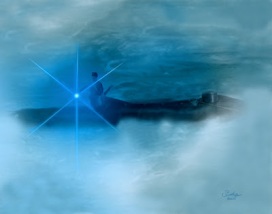
Housatonic was gone in three minutes, killing five sailors. What happened next, is a mystery. The first successful attack sub in history showed the signal for success, a blue lantern, to their comrades on shore. And then it vanished.
Hunley would not be seen again for 131 years.
Author and adventurer Clive Cussler found the sub in 1995, buried in silt under 32′ of water. A painstaking, five year effort was launched to bring Hunley to the surface, and on August 8, 2000, HL Hunley returned to the light of day. The sub was moved to the Warren Lasch Conservation Center in the Charleston Navy Yard, and submerged in 55,000 gallons of chilled, fresh water, where scientists and historians worked on unlocking its secrets.
There was an old rumor that Lt. Dixon left a girlfriend in Mobile, Alabama, named Queenie Bennett. She had given him a $20 gold piece, a good luck charm and token of her affection. Dixon was shot in the hip at Shiloh, the story goes, a wound that should have killed him. If the bullet hadn’t struck the gold piece in his pocket.
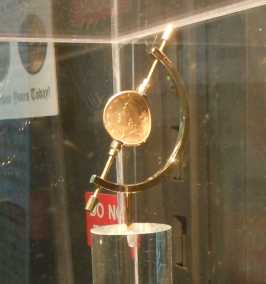
No one knew if the story was true, until excavation started inside the sub. Senior Archaeologist Maria Jacobsen found the coin, next to the remains of George E. Dixon. “Some people may think this is a stroke of luck,” she said, “but perhaps it’s something else. They tell me that Lt. Dixon was a lady’s man, perhaps he winked at us yesterday to remind us that he still is”.
On the coin, clearly showing signs of having been struck by a bullet, are inscribed these words:
Shiloh
April 6, 1862
My life Preserver
G. E. D.
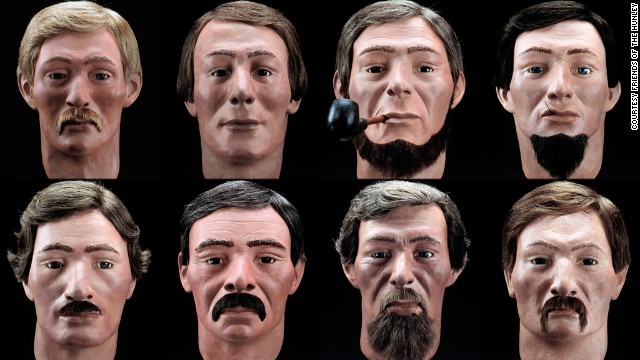
Facial reconstruction techniques reveal the faces of the HL Hunley commander Lt. George Dixon and crewmembers Arnold Becker, Lumkin (first name unknown), Joseph Ridgaway, Frank Collins, Miller (first name unknown), Cpl. J.F. Carlsen and James A Wicks.
Even a former adversary couldn’t help but admire the feat. Days later, British Vice Admiral Lord Horatio Nelson called it the “most bold and daring act of the age.”
Historic accounts differ as to the early success of the Islamic conquests. Contemporary Christian sources saw them as God’s punishment for the sins of fellow Christians. Early Muslim sources describe them as evidence of divine favor, reflections of the religious zeal of the conquerors. Be that is it may, Islamic expansion enveloped the Arabian Peninsula in the last ten years of the life of Muhammad (622-632), at the expense of the Roman Byzantines and the Sassanid Empire of the Persians. Syria fell in 634, followed by Egypt, Mesopotamia and Persia. By 750 the Umayyad Caliphs had subjugated much of the Balkan states, part of the Indian sub-continent, all of North Africa, most of Spain, and parts of Southern France and Sicily. By the age of Columbus, the Mediterranean was a place where you traveled at your own risk.
Those of us of European ancestry owe our heritage, if not our existence, to the warriors who defeated the Jihadist time after time. There was Pelagius, who stopped a military force of the Umayyad Caliphate at Covadonga in 722, without which there would be no Reconquista, no Ferdinand and Isabella, and we wouldn’t know the name of Christopher Columbus.
The father of Charlemagne, Charles “The Hammer” Martel, blocked the Muslim advance into Western Europe at the Battle of Tours, in 732.
If Marcantonio Bragadin is remembered at all, it is for being betrayed, tortured and skinned alive by Lala Mustafa Pasha. Yet, it is Bragadin’s stubborn defense of the eastern Mediterranean outpost of Famagusta in 1571, which gave European principalities time to assemble naval forces in numbers sufficient to defend the European coast, near a place called Lepanto.
The 1683 Battle of Vienna, at the crossroads of eastern and western Europe, was a hard fought contest which could have gone either way, until the arrival of a Polish army under King Jan Sobieski. The Ottomans were defeated and turned back from the conquest of Eastern Europe on a date which grates the Jihadist memory to this day: September 11.
“Saracens” plundered everything that could be carried away: animals, provisions, fabrics, precious metals and money, especially men, women and children who could be sold for a good price at the slave markets. Redemption of captives being among the corporal works of mercy, the “Mathurins” Order of the Holy Trinity was founded in 1198 for the purpose of paying the ransom of Christians held captive by non-Christians, as a consequence of crusading and pirating along the southern European coastline.
Even Ireland, with its northern latitude, wasn’t immune from these raids. Murat Reis attacked the village of Baltimore in County Cork in June 1631. With him were pirates from Algiers and armed troops of the Ottoman Empire, who captured all the villagers they could find and took them away to a life of slavery in North Africa. They lived out their lives chained to oars as galley slaves, or spent long years locked away in harems or inside the walls of the sultan’s palace. Only two of them ever saw Ireland again.
The fledgling United States found itself under attack by the “Barbary States” of North Africa almost immediately following the Revolution, and the subsequent lifting of France’s protection. Spain, France and other European Powers advised the US to pay tribute.
Sidi Muhammad ibn Abdallah, Sultan of Morocco, added the United States of America to a list of countries for which his ports were open in December 1777, making Morocco the first country whose head of state publicly recognized the United States. Abdallah saw the future for his country in foreign trade, and actively sought a treaty relationship with the US, well before war ended with Great Britain. The treaty signed by Thomas Barclay and Sultan Muhammad III in 1786, and ratified by the Confederation Congress in July 1787, is still in effect today, the longest continuous treaty relationship in United States history.
Diplomacy had succeeded with Morocco, but not with Algiers, Tunis or Tripoli, each of which demanded $660,000 in tribute.
Algeria captured the schooners Maria and Dauphin in 1785, the captured crews held in conditions of slavery for over a decade. The sum negotiated for their release exceeded $1 million, more than 1/6th the entire budget of the United States. Eleven American ships were captured in 1793 alone, their crews and stores held for ransom.
Yusuf Karamanli, Pasha of Tripoli, demanded $225,000 in tribute on President Jefferson’s inauguration, in 1801. At this time, Federal revenues were barely over $10 million. Jefferson refused, resulting in the first Barbary War, a conflict memorialized in a line from the Marine Corps Hymn “From the Halls of Montezuma to the Shores of Tripoli”.
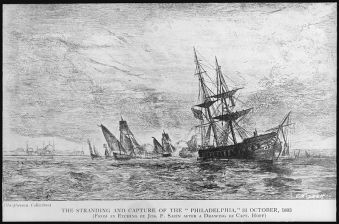
The grounded USS Philadelphia is captured, October 31, 1803
Limited to small confrontations for the first two years, more sustained combat began in June 1803 when a small American force attacked Tripoli Harbor in modern Libya.
While giving chase and firing on a pirate vessel, USS Philadelphia ran aground on an uncharted reef, two miles outside of Tripoli. Fearing the 1,240 ton, 36-gun frigate would be captured and added to the Tripolitan navy, Lieutenant Stephen Decatur led a daring expedition into Tripoli harbor to destroy the captured vessel.
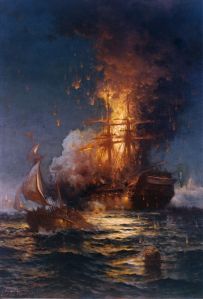
Burning of the USS Philadelphia
On the evening of February 16, 1804, Decatur entered Tripoli Harbor with a force of 74 Marines. With them were five Sicilian volunteers, including pilot Salvador Catalano, who spoke fluent Arabic. Disguised as Maltese sailors and careful not to draw fire from shore batteries, Decatur’s force boarded the frigate, killing or capturing most of its Tripolitan crew, before the remainder jumped overboard. Decatur and his marines had hoped to sail Philadelphia out of harbor, but soon found she was in no condition to leave. Setting combustibles about the deck, they set the frigate ablaze. Ropes burned off, setting the Philadelphia adrift in the harbor. Loaded cannon cooked off as the blaze spread, firing random balls into the town. It must have been a sight, when gunpowder stores ignited and the entire ship exploded.
By that time Decatur and his men had slipped away, without the loss of a single man. Even a former adversary couldn’t help but admire the feat. Days later, British Vice Admiral Lord Horatio Nelson called it the “most bold and daring act of the age.”
Their job is to honor, not to grieve, but it doesn’t always work out that way
The first military burial at Arlington National Cemetery was that of Private William Henry Christman, 67th Pennsylvania Infantry, interred on May 13, 1864. Two more joined him that day, the trickle soon turning into a flood. By the end of the war between the states, that number was 17,000 and rising.
In modern times, an average week will see 80 to 100 burials in the 612 acres of Arlington.
Twelve years ago, a news release from the Department of Defense reported that “Private First Class Michael A. Arciola, 20, of Elmsford, New York, died February 15, 2005, in Al Ramadi, Iraq, from injuries sustained from enemy small arms fire. Arciola was assigned to the 1st Battalion, 503d Infantry Regiment, 2nd Infantry Division, Camp Casey, Korea”.
Private Arciola joined a quarter-million buried in our nation’s most hallowed ground on March 31. Two hundred or more mourners attended his funeral. A tribute befitting the tragedy of the loss of one so young.
Sixteen others were buried there that same Friday, most of them considerably older. Some of them brought only a dozen or so mourners. For others, no friends or family members were on-hand to say goodbye.
Former Tuskegee Airman Benjamin O. Davis Jr. is laid to rest, Saturday, July 6, 2002
In 1948, Air Force Chief of Staff General Hoyt Vandenberg and his wife, Gladys, regularly attended funeral services at Arlington National cemetery. Sometimes, a military chaplain was the only one present at these services. Both felt that a member of the Air Force family should be present at these funerals, and Gladys began to invite other officer’s wives. Over time, a group of women from the Officer’s Wives Club were formed for the purpose. In 1973, General Creighton Abram’s wife Julia did the same for the Army, forming a group calling itself the “Arlington Ladies”. Groups of Navy and Coast guard wives followed suit, in 1985 and 2006. Traditionally, the Marine Corps Commandant sends an official representative of the Corps to all Marine funerals. The Marine Corps Arlington Ladies were formed in 2016.
Margaret Mensch, April 22, 2010
Arlington Ladies’ Chairman Margaret Mensch said “We’ve been accused of being professional mourners, but that isn’t true. I fight that perception all the time. What we’re doing is paying homage to Soldiers who have given their lives for our country.”
Air Force Ladies’ Chairman Sue Ellen Lansell spoke of a service where the only other guest was “one elderly gentlemen who stood at the curb and would not come to the grave site. He was from the Soldier’s Home in Washington, D. C. One soldier walked up to invite him closer, but he said no, he was not family”.
Traditionally, the organization was made up of current or former military wives. Today their number includes daughters, and even one “Arlington Gentleman”. Their motto, “No Soldier will ever be buried alone.”
44 years ago they came alone, or in pairs. Today, the 145 or so volunteers from the four branches are a recognized part of funeral ceremonies, operating out of a joint office in the cemetery’s administration building.
The volunteer arrives with a military escort from the Navy or the United States Army 3rd Infantry Regiment, the “Old Guard”. The horse-drawn caisson arrives from the old post chapel, carrying the flag draped casket. Joining the procession, she will quietly walk to the burial site, her arm inside that of her escort. A few words are spoken over the deceased, followed by the three-volley salute. Somewhere, a solitary bugler sounds Taps. The folded flag is presented to the grieving widow, or next of kin. Only then will she break her silence, stepping forward with a word of condolence and two cards: one from the service branch Chief of Staff and his wife, and a second from herself.
Joyce Johnson buried her husband Lt. Col. Dennis Johnson in 2001, a victim of the terrorist attack on the Pentagon. She remembers the Arlington Ladies volunteer as “a touchingly, human presence in a sea of starched uniforms and salutes”. Three years later, Joyce Johnson paid it forward, becoming one herself.
A funeral may be for a young military service member killed in the wars in Iraq or Afghanistan, or a veteran of Korea or WWII, who spent his last days in the old soldier’s home. It could be a four-star General or a Private. It doesn’t matter.
Individual volunteers attend about five funerals a day, sometimes as many as eight. As with the Tomb of the Unknown sentinels who keep their guard heedless of weather, funeral services disregard weather conditions. The funeral will proceed on the date and time scheduled regardless of rain, snow or heat. An Arlington Lady Will be in attendance.
Their job is to honor, not to grieve, but it doesn’t always work out that way. Linda Willey of the Air Force ladies describes the difficulty of burying Pentagon friends after 9/11, while pieces of debris still littered the cemetery. Paula McKinley of the Navy Ladies still chokes up, over the hug of a ten-year old who had just lost both of her parents. Margaret Mensch speaks of the heartbreak of burying one of her own young escorts, after he was killed in Afghanistan, in 2009.
Army Arlington Lady Anne Lennox with letters of condolence for the widow of Brigadier General Henry G. Watson.
Barbara Benson was herself a soldier, an Army flight nurse during WWII. She is the longest serving Arlington Lady. “I always try to add something personal”, Benson said, “especially for a much older woman. I always ask how long they were married. They like to tell you they were married 50 or 60 years…I don’t know how to say it really, I guess because I identify with Soldiers. That was my life for 31 years, so it just seems like the natural thing to do.”
Elinore Riedel was chairman of the Air Force Ladies during the War in Vietnam, when none of the other military branches had women representatives. “Most of the funerals were for young men,” she said. “I saw little boys running little airplanes over their father’s coffins. It is a gripping thing, and it makes you realize the awful sacrifices people made. Not only those who died, but those left behind.”
Mrs. Reidel is a minister’s daughter, who grew up watching her father serve those in need. “It doesn’t matter whether you know a person or not”, she said, “whether you will ever see them again. It calls upon the best in all of us to respond to someone in deep despair. I call it grace…I honestly feel we all need more grace in our lives.”
The “Battle of the Atlantic” lasted 5 years, 8 months and 5 days, ranging from the Irish Sea to the Gulf of Mexico, from the Caribbean to the Arctic Ocean
The impending Nazi invasion of Poland was an open secret in 1939. That August, the first fourteen “Unterseeboots” (U-boats) left their bases, fanning out across the North Atlantic. On the 25th the Polish-British Common Defense Pact was added to the Franco-Polish Military Alliance. Should Poland be invaded by a foreign power, England and France were now committed to intervene.
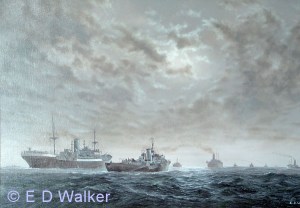
Hitler’s invasion of Poland began on September 1. Even then, he believed that war with England and France could be avoided, the “Kriegsmarine” under strict orders to follow the “Prize Regulations” of 1936. England and France declared war on Nazi Germany on the 3rd. Hours later, U-30 Oberleutnant Fritz Julius Lemp fired a torpedo into the British liner SS Athenia. Lemp had mistakenly believed it to be an armed merchant vessel and fair game under Prize Regulations, but the damage was done. The longest and most complex naval battle in history, had begun.
As in WWI, both England and Germany were quick to implement blockades on one another. For good reason. By the time that WWII was in full swing, England alone would require over a million tons a week of imported goods, in order to survive and to fight the war.
The “Battle of the Atlantic” lasted 5 years, 8 months and 5 days, ranging from the Irish Sea to the Gulf of Mexico, from the Caribbean to the Arctic Ocean. Winston Churchill would say “The Battle of the Atlantic was the dominating factor all through the war. Never for one moment could we forget that everything happening elsewhere, on land, at sea or in the air depended ultimately on its outcome”.
Thousands of ships were involved in over a hundred convoy battles, with over 1,000 single ship encounters unfolding across a theater thousands of miles wide. According to www.usmm.org, the United States Merchant Marine suffered the highest percentage of fatalities of any service branch, at 1 in 26 compared to one in 38, 44, 114 and 421 respectively, for the Marine Corps, Army, Navy and Coast Guard.
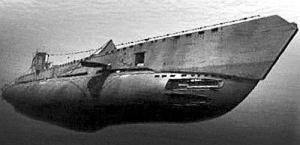
New weapons and tactics would shift the balance in favor of one side and then to the other. In the end over 3,500 merchant ships and 175 warships would be sunk to the bottom, compared with the loss of 783 U-boats.
The most unusual confrontation of the war occurred on this day in 1945, in the form of a combat action between two submerged submarines. Submarines operate in 3-dimensional space, but their most effective weapon does not. The torpedo is a surface weapon, operating in two-dimensional space: left, right and forward. Firing at a submerged target requires that the torpedo be converted to neutral buoyancy, introducing near-insurmountable complexity into firing calculations.
U-864
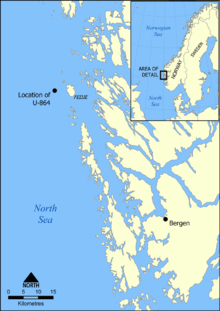
The war was going badly for the Axis Powers in 1945, the allies enjoying near-uncontested supremacy over the world’s shipping lanes. At this time, any surface delivery between Nazi Germany and Imperial Japan was likely to be detected and stopped. The maiden voyage of the 287’, 1,799 ton German submarine U-864 departed on “Operation Caesar” on December 5, delivering Messerschmitt jet engine parts, V-2 missile guidance systems, and 65 tons of mercury to the Imperial Japanese war production industry.
The mission was a failure, U-864 having to retreat to the submarine pens in Bergen, Norway, for repairs after running aground in the Kiel Canal. The sub was able to clear the island of Fedje off the Norway coast undetected on February 6. By this time British MI6 had broken the German Enigma code. They were well aware of Operation Caesar.
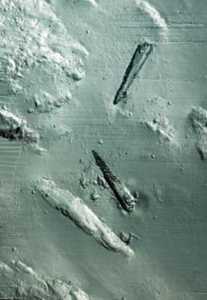
The British submarine Venturer, commanded by 25-year-old Lieutenant Jimmy Launders, was dispatched from the Shetland Islands, to intercept and destroy U-864.
ASDIC, an early name for sonar, would have been far more helpful in locating U-864, but at a price. That familiar “ping” would have been heard by both sides, alerting the German commander that he was being hunted. Launders opted for hydrophones, a passive listening device which could alert him to external noises. Calculating his adversary’s direction, depth and speed was vastly more complicated without ASDIC, but the need for stealth won out.
Developing an engine noise which he feared might give him away, U-864’s commander, Ralf-Reimar Wolfram decided to return to Bergen for repairs. German submarines of the age were equipped with “snorkels”, heavy tubes which broke the surface, enabling diesel engines and crews to breathe while running submerged. Venturer was on batteries when the first sounds were detected, giving the British sub the stealth advantage but sharply limiting the time frame in which it could act.
A four dimensional firing solution accounting for time, distance, bearing and target depth was theoretically possible, but had rarely been attempted under combat conditions. Plus, there were unknown factors which could only be approximated.
A fast attack sub, Venturer only carried four torpedo tubes, far fewer than her much larger adversary. Launders calculated his firing solution, ordering all four tubes and firing with a 17½ second delay between each pair. With four incoming at different depths, the German sub didn’t have time to react. Wolfram was only just retrieving his snorkel and converting to electric, when the #4 torpedo struck. U-864 imploded and sank, instantly killing all 73 aboard.
Surface actions were common enough between all manner of vessels, but a fully submerged submarine to submarine kill occurred only once in WWI, on October 18, 1914, when the German U-27 torpedoed and sank the British sub HMS E3 with the loss of all 28 aboard. To my knowledge, such an action occurred only this one time, in all of WWII.
In the United States, the political tide was turning. The combination of events was the last straw. The United States entered WWI about a month later
On June 28, 1914, the assassination of Archduke Franz Ferdinand began a cascade of events that would change the course of the 20th century. Entangling alliances and mutual suspicion led to the mobilization and counter-mobilizion of armies. No one wanted to show up late, in the event of war. And so there was war. By October, the “Great War” had devolved into the trench-bound hell which would characterize the next four years.
The German and British economies were heavily dependent on imports to feed their populations and prosecute the war effort. By February 1915, both were attempting to throttle the other through naval blockade.
Great Britain’s Royal Navy had superior numbers, while the Imperial German Navy’s surface fleet was restricted to an area of the North Sea called the German Bight. In other theaters, Germans augmented their small navy with commerce raiders and “unterseeboots”. More than any other cause, it was the German policy of unrestricted submarine warfare, which would bring the United States into the war two years later.
On February 4, 1915, Imperial Germany declared a naval blockade against shipping to Britain, stating that “On and after February 18th every enemy merchant vessel found in this region will be destroyed, without its always being possible to warn the crews or passengers of the dangers threatening”. “Neutral ships” it continued, “will also incur danger in the war region”.
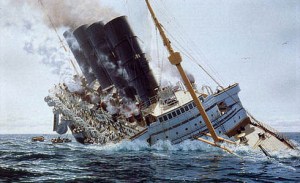
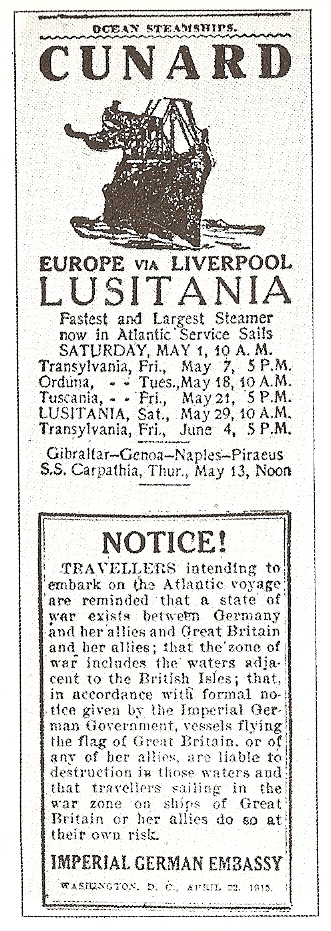
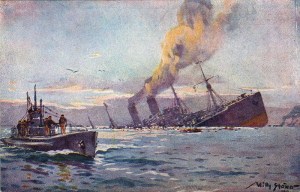
As the war unfolded, German U-boats sank nearly 5,000 ships, close to 13 million gross register ton, including the Cunard Liner Lusitania, which was torpedoed and sunk off Kinsale, Ireland, on May 7, 1915. 1,198 were drowned, including 128 Americans. 100 of the dead, were children. .
The reaction in the US and UK was immediate and vehement, portraying the sinking as the act of barbarians and Huns. Imperial Germany maintained that Lusitania was illegally transporting munitions intended to kill German boys on European battlefields. Furthermore, the embassy pointed out that ads had been taken out in the New York Times and other newspapers, specifically warning that the liner was subject to attack.
Unrestricted submarine warfare was suspended for a time, for fear of bringing the US into the war. The policy was reinstated in January 1917, prompting then-Chancellor Theobald von Bethmann Hollweg to say, “Germany is finished”. He was right.
SS Housatonic was stopped off the southwest coast of England, and boarded by German submarine U-53. American Captain Thomas Ensor was interviewed by Kapitänleutnant Hans Rose, who said he was sorry. Housatonic was “carrying food supplies to the enemy of my country”, and would be destroyed. The American Captain and crew were allowed to launch lifeboats and abandon ship, while German sailors raided the American’s soap supplies. Apparently, WWI vintage German subs were short on soap.
Housatonic was sunk with a single torpedo, U-53 towing the now-stranded Americans toward the English coast. Sighting the trawler Salvator, Rose fired his deck guns to be sure they’d been spotted, and then slipped away. It was February 3, 1917.
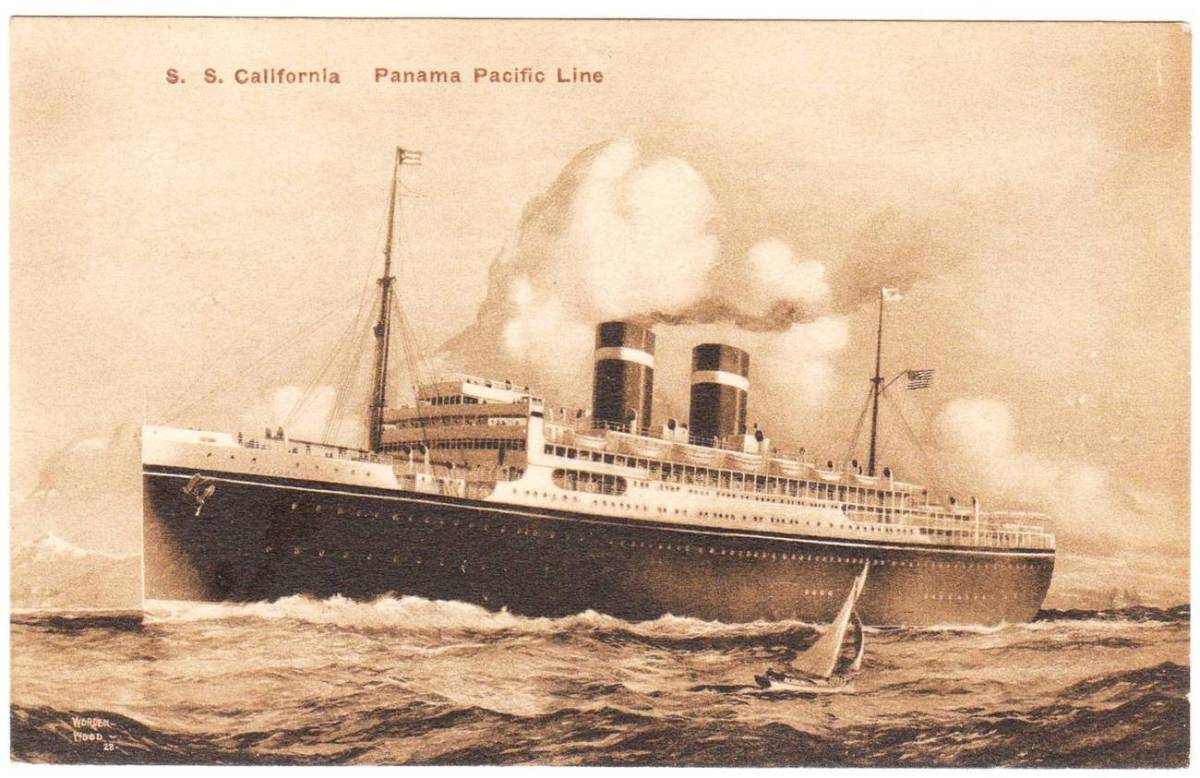
President Woodrow Wilson retaliated, breaking off diplomatic relations with Germany the following day. Three days later, on February 7, a German U-boat fired two torpedoes at the SS California, off the Irish coast. One missed, but the second tore into the port side of the 470-foot, 9,000-ton steamer. California sank in nine minutes, killing 43 of her 205 passengers and crew.
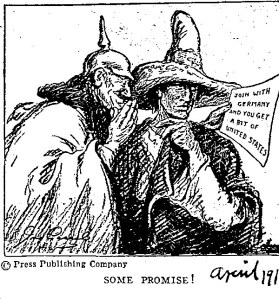
Two weeks later, British Intelligence divulged the Zimmermann note to Edward Bell, secretary of the United States Embassy in Britain. This was an overture from German Foreign Minister Arthur Zimmermann to the Mexican government , promising American territories in exchange for a Mexican declaration of war against the US.
In the United States, the political tide was turning. The combination of events was the last straw. The United States entered WWI about a month later.
At the time, the German claim that Lusitania carried contraband munitions seemed to be supported by survivors’ reports of secondary explosions within the stricken liner’s hull. In 2008, the UK Daily Mail reported that dive teams had reached the wreck, lying at a depth of 300′. Divers reported finding tons of US manufactured Remington .303 ammunition, about 4 million rounds, stored in unrefrigerated cargo holds in cases marked “Cheese”, “Butter”, and “Oysters”.
If there was ever a “window of opportunity”, the siege of Yorktown was it. Fully ½ of Cornwallis’ troops were sick with Malaria during the siege, a disease to which the Americans had built some degree of immunity. Most of the French were newly arrived, so they had yet to go through the disease’ one-month gestation period.
On July 4, 1776, the Continental Congress declared the 13 American Colonies to be a free and independent nation. That same day and an ocean away, a business was formed by Spain and the French House of Bourbon, which would aid in the enterprise.
The Rodrigue Hortalez Trading Company was a ruse, organized by the French playwright, politician and spy, Pierre-Augustin Caron de Beaumarchais. Beaumarchais had obtained one million livres from France and the same amount from Spain in May of 1776, before the Declaration of Independence was even signed. With it were muskets, cannon, gunpowder, bombs, mortars, tents, and enough clothing for 30,000 men, traveling from French ports to the “neutral” Netherlands Antilles island of St. Eustatius.
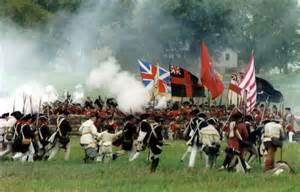
The delivery could not have been more timely. When General Washington took command on July 3, 1775, the Continental Army had about enough powder for nine rounds per man.
Interestingly, it was little St. Eustatius which first openly recognized American Independence, firing their “First Salute” on November 16 of that year, in recognition of the visit of the American Brig Andrew Doria. Hortalez & Co. was one of four channels of Spanish aid. New Orleans Governor Luis de Unzaga began providing covert aid to the American rebels in 1776, expanding the following year under his successor, Bernardo de Gálvez y Madrid, Count of Gálvez. It is he who gives Galveston, Texas its name.
Meanwhile, the Spanish port at Havana was opened to the Americans under Most Favored Nation status, and further Spanish aid flowed in from the Gardoqui family trading company in Bilbao, whose Patriarch, Don Diego de Gardoqui, would become Spain’s first Ambassador to the United States. According to the Ambassador, the House of Gardoqui alone supplied the American patriots with 215 bronze cannon, 30,000 muskets, 30,000 bayonets, 51,314 musket balls, 300,000 pounds of powder, 12,868 grenades, 30,000 uniforms, and 4,000 field tents. The Spanish Prime Minister, José Moñino y Redondo, Count of Floridablanca, wrote in March 1777, “the fate of the colonies interests us very much, and we shall do for them everything that circumstances permit”.
The American Victory at Saratoga in October of 1777 opened the door to more overt aid from the French, thanks largely to the tireless diplomacy of Benjamin Franklin and the Marquis du Lafayette. Representatives of the French and American governments signed the Treaties of Alliance and Amity and Commerce on February 6, 1778.
The “Southern Strategy” of 1778-80 may have cost the British army and their Hessian allies more casualties from disease than from Patriot bullets. About 1,200 Hessian soldiers were killed in combat over the course of the war. By contrast, 6,354 more died of disease, and 5,500 deserted, later settling in America.
In February 1781, General Washington sent Lafayette south at the head of a handpicked force of 1,200 New England and New Jersey troops, and 1,200 French troops. Washington himself lead an army he described as “not strong enough even to be beaten”.
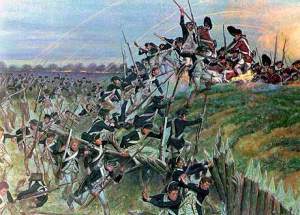
5,500 French Army troops led by the Comte de Rochambeau landed in Rhode Island that summer, linking up with General Washington’s Patriot army. Meanwhile, Lafayette harassed and shadowed Cornwallis’ much larger force, as it moved up through North Carolina and east toward the Chesapeake Bay.
Cornwallis was looking for a deep water port from which to link up with his ships. It was at this time that Lafayette received help from a slave named James, on the New Kent Armistead Farm. James pretended to serve Cornwallis in Yorktown while sending valuable military information to Lafayette and Washington, who was now moving south through New Jersey with Rochambeau. James would later legally change his name to James Lafayette.
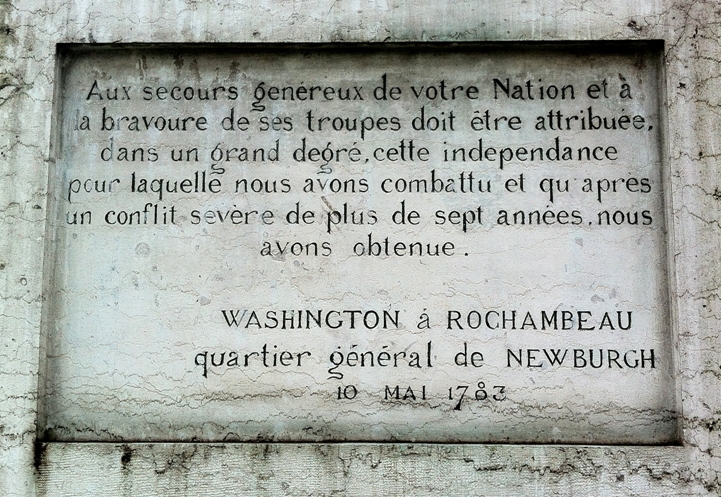
“To the generous help of your Nation and to the bravery of its troops must be attributed in a great degree to that independence for which we have fought, and which after a severe conflict of more than five years have been obtained”.
Meanwhile, Rear Admiral Francois Joseph Paul, the Comte de Grasse, was in Santo Domingo, meeting with the representative of Spain’s King Carlos III, Francisco Saavedra de Sangronis. De Grasse had planned to leave several warships in Santo Domingo, now capital of the Dominican Republic, to protect the French merchant fleet. Saavedra promised assistance from the Spanish navy, enabling de Grasse to sail north with all of his warships. He needed those ships. The crucial Naval battle of the Revolution took place on September 5, when de Grasse defeated the British fleet of Rear Admiral Sir Thomas Graves, cutting Cornwallis off from the sea.
French Admiral de Barras arrived from Newport a few days later, carrying vital siege equipment, while de Grasse himself carried 500,000 silver pesos from Havana to help with the payroll and siege costs at the final Battle of Yorktown.
If there was ever a “window of opportunity”, the siege of Yorktown was it. Fully ½ of Cornwallis’ troops were sick with Malaria during the siege, a disease to which the Americans had built some degree of immunity. Most of the French were newly arrived, so they had yet to go through the disease’ one-month gestation period. The British relief force sailing out of New York Harbor wouldn’t leave until October 19, 1781, the day Cornwallis was forced to surrender.
Over the course of the Revolution, the Patriot cause received aid from sources both sought after and providential. Ben Franklin, John Jay and John Adams would negotiate through two more years and four British governments before they were through. The Treaty of Paris was signed on September 3, 1783, formally ending the American Revolution.
With arms linked and leaning against the slanting deck, their voices offered prayers and sang hymns for the dead and for those about to die
The Troop Transport USAT Dorchester sailed out of New York Harbor on January 23, 1943, carrying 902 service members, merchant seamen and civilian workers. They were headed for the Army Command Base in southern Greenland, part of a six-ship convoy designated SG-19, together with two merchant ships and escorted by the Coast Guard Cutters Comanche, Escanaba and Tampa.
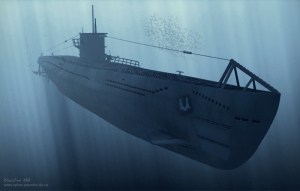
Built in 1926 as a coastal liner, Dorchester was anything but graceful, bouncing and shuddering its way through the rough seas of the North Atlantic. Several ships had already been sunk by German U-Boats in these waters. One of the Cutters detected a sub late on February 2, flashing the light signal “we’re being followed”. Dorchester Captain Hans Danielson ordered his ship on high alert that night. Men were ordered to sleep in their clothes with their life jackets on. Many disregarded the order. It was too hot down there in the holds, and those life jackets were anything but comfortable.
The Four Chaplains
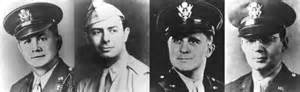
Some of those off-duty tried to sleep that night, while others played cards or threw dice, well into the night. Nerves were understandably on edge, especially among new recruits, as four Army chaplains passed among them with words of encouragement. They were the Jewish Rabbi Alexander D. Goode, the Catholic priest John P. Washington, the Dutch Reformed Church Minister Clark V. Poling and the Methodist Minister George L. Fox.
At 12:55am on February 3rd, the German submarine U-223 fired a spread of three torpedoes. One struck Dorchester amidships, deep below the water line. A hundred or more were killed in the blast, or in the clouds of steam and ammonia vapor pouring from ruptured boilers. Suddenly pitched into darkness, untold numbers were trapped below decks. With boiler power lost, there was no longer enough steam to blow the full 6 whistle signal to abandon ship, while loss of power prevented a radio distress signal. For whatever reason, there never were any signal flares.
Those who could escape scrambled onto the deck, injured, disoriented, many still in their underwear as they emerged into the sub-arctic cold.
The four chaplains must have been a welcome sight that night, guiding the disoriented and the wounded, offering prayers and words of courage. They opened a storage locker, and handed out life preservers until there were no more. “Padre,” said one young soldier, “I’ve lost my life jacket and I can’t swim!” Witnesses differ as to which of the four it was who gave this man his life jacket, but they all followed suit. One survivor, John Ladd, said “It was the finest thing I have seen or hope to see this side of heaven.” Rabbi Goode gave his gloves to Petty Officer John Mahoney, saying “Never mind. I have two pairs”. It was only later that Mahoney realized, Rabbi Goode intended to stay with the ship.
Dorchester was listing hard to starboard and taking on water fast, with only 20 minutes to live. Port side lifeboats were inoperable due to the ship’s angle. Men jumped across the void into those on the starboard side, overcrowding them to the point of capsize. Only two of fourteen lifeboats launched successfully.
Private William Bednar found himself floating in 34° water, surrounded by dead bodies and debris. “I could hear men crying, pleading, praying,” he recalled. “I could also hear the chaplains preaching courage. Their voices were the only thing that kept me going.”
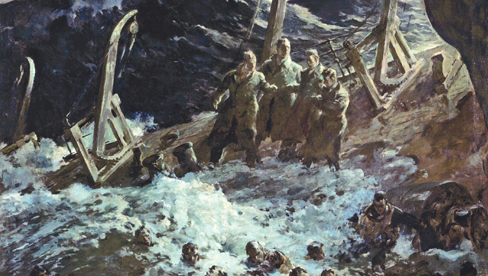
As the ship upended and went down by the bow, survivors floating nearby could see the four chaplains. With arms linked and leaning against the slanting deck, their voices offered prayers and sang hymns for the dead and for those about to die.
Rushing back to the scene, coast guard cutters found themselves in a sea of bobbing red lights, the water-activated emergency strobe lights of individual life jackets. Most marked the locations of corpses. Of the 902 on board, the Coast Guard plucked 230 from the water, alive.
The United States Congress attempted to confer the Medal of Honor on the four chaplains for their selfless act of courage, but strict requirements for “heroism under fire” prevented them from doing so. Congress authorized a one time, posthumous “Chaplain’s Medal for Heroism”, awarded to the next of kin by Secretary of the Army Wilber M. Brucker at Fort Myer, Virginia on January 18, 1961.
John 15:13 says “Greater love hath no man than this, that a man lay down his life for his friends”. Rabbi Goode did not call out for a Jew when he gave away his only hope for survival, Father Washington did not ask for a Catholic. Neither minister Fox nor Poling asked for a Protestant, they gave their life jackets to the nearest man.
Carl Sandburg once said that “Valor is a gift. Those having it never know for sure whether they have it until the test comes.” If I were ever so tested, I hope that I would prove myself half the man, as those four chaplains.
In 2003, author Richard Rubin set out to interview the last surviving veterans of WW1. The people he sought were over 101, one was 113
In 2003, author Richard Rubin set out to interview the last surviving veterans of World War One. The people he sought were over 101, one was 113.
It could not have been easy, beginning with the phone call to next of kin. There is no delicate way to ask the question, “Is he still with us?” Invariably, the answer was “no”.
Sometimes, the answer was “yes”, and Rubin would ask for an interview. The memories these people sought to bring back were 80 years old and more, and some spoke only sparingly. Others were fountains of information, speaking as clearly as if their memories were from yesterday.
Rubin writes “Quite a few of them told me that they were telling me things that they hadn’t talked about in 50, 60, 70 years. I asked a few of them why not, and the surprising response often was that nobody had asked.”
Anthony Pierro at 107
Anthony Pierro of Swampscott, Massachusetts, served in Battery E of the 320th Field Artillery, and fought in several major battles of 1918, including Oise-Aisne, St. Mihiel, and Meuse-Argonne. Pierro recalled his time in Bordeaux, as the best time of the war. “The girls used to say, ‘upstairs, two dollars.'” His nephew Rick interrupted the interview. “But you didn’t go upstairs.” Uncle Anthony’s response was classic. “I didn’t have the two dollars”.
They’re not all men, either. 107-year-old Hildegarde Schan of Plymouth, Massachusetts talks about taking care of the wounded in the post-war years.
Hildegarde Schan
Howard Ramsey started the new burial ground in France that we now know as the Meuse-Argonne American Cemetery. “So I remember one night”, he said, “It was cold, and we had no blankets, or nothing like that. We had to sleep, we slept in the cemetery, because we could sleep between the two graves, and keep the wind off of us, see?”
Arthur Fiala
Kewaunee, Wisconsin native Arthur Fiala traveled across France in a boxcar marked “40-8″, (40 men or eight horses).
There was J. Laurence Moffitt of Orleans, Massachusetts. Today, we see the “Yankee Division” on highway signs. At 106, this man was the last surviving member of his generation, with a memory so clear that he could recall every number from every fighting unit of the 26th Division.
George Briant
George Briant was caught in an open field with his battery, with German planes dropping bombs on them. He thinks he was hit by every one of them. After several months in the hospital, he begged to go back to the front. On the last night of the war, November 10, 1918, Briant came upon the bodies of several men who had just been shelled. “Such fine, handsome, healthy young men”, he said, “to be killed on the last night of the war. I cried for their parents. I mean it’s a terrible, terrible thing to lose anyone you love in a war, but imagine knowing precisely when that war ends, and then knowing that your loved one died just hours before that moment.”
In all, Rubin interviewed dozens of these men, and a handful of women. Their stories can be found on their own You Tube channel, https://www.youtube.com/user/LastOfTheDoughboys. I highly recommend it. Their words are far more powerful than anything I could write about them.
Frank Woodruff Buckles, born Wood Buckles, is one of them. Born on this day in 1901, Buckles joined the Ambulance Corps of the American Expeditionary Force (AEF) at the age of 16. He never saw combat against the Germans, but he would escort 650 of them back home as prisoners.
Buckles was a civilian in 1940, working for the White Star Lines and the WR Grace shipping companies. His work took him to Manila, in the Philippines, where he remained after the outbreak of WWII. Buckles was helping to resupply U.S. troops when he was captured by Japanese forces in January 1942, spending the next three years and two months as a civilian prisoner in the Santo Tomas and Los Baños prison camps.
Corporal Frank Buckles passed away on February 27, 2011 at the age of 110, and was buried in Arlington National Cemetery, the President of the United States in attendance. The Last of the Doughboys, the last American veteran of WWI, was gone. The last living memory of the war to end all wars.
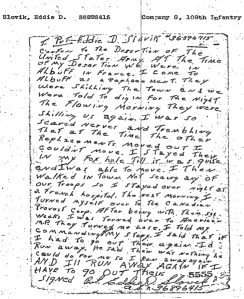
“I told my commanding officer my story. I said that if I had to go out there again I’d run away. He said there was nothing he could do for me so I ran away again AND I’LL RUN AWAY AGAIN IF I HAVE TO GO OUT THERE. — Signed Pvt. Eddie D. Slovik A.S.N. 36896415”
When he was little, his neighbors must have considered him a bad kid. His first arrest came at the age of 12, when he and some friends were caught stealing brass from a foundry. There were other episodes between 1932 and ’37: petty theft, breaking & entering, and disturbing the peace. In 1939 he was sent to prison, for stealing a car.
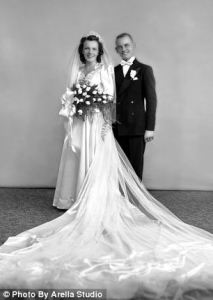
Edward Donald “Eddie” Slovik was paroled in 1942, his criminal record making him 4F. “Registrant not acceptable for military service”. He took a job at the Montella Plumbing and Heating company in Dearborn, Michigan, where he met bookkeeper Antoinette Wisniewski, the woman who would later become his wife.
There they might have ridden out WWII, but the war was consuming manpower at a rate unprecedented in history. Shortly after the couple’s first anniversary, Slovik was re-classified 1A, fit for service, and drafted into the Army. Arriving in France on August 20, 1944, he was part of a 12-man replacement detachment, assigned to Company G of the 109th Infantry Regiment, US 28th Infantry Division.
Slovik and a buddy from basic training, Private John Tankey, became separated from their detachment during an artillery attack, and spent the next six weeks with Canadian MPs. It was around this time that Private Slovik decided he “wasn’t cut out for combat”.
The rapid movement of the army during this period caused many replacements difficulty in finding their units. Edward Slovik and John Tankey finally caught up with the 109th on October 7. The following day, Slovik asked his company commander Captain Ralph Grotte for reassignment to a rear unit, saying he was “too scared” to be part of a rifle company. Grotte refused, confirming that, were he to run away, such an act would constitute desertion.
That, he did. Eddie Slovik deserted his unit on October 9, despite Private Tankey’s protestations that he should stay. “My mind is made up”, he said. Slovik walked several miles until he found an enlisted cook, to whom he presented the following note.
“I, Pvt. Eddie D. Slovik, 36896415, confess to the desertion of the United States Army. At the time of my desertion we were in Albuff [Elbeuf] in France. I came to Albuff as a replacement. They were shelling the town and we were told to dig in for the night. The following morning they were shelling us again. I was so scared, nerves and trembling, that at the time the other replacements moved out, I couldn’t move. I stayed there in my fox hole till it was quiet and I was able to move. I then walked into town. Not seeing any of our troops, so I stayed over night at a French hospital. The next morning I turned myself over to the Canadian Provost Corp. After being with them six weeks I was turned over to American M.P. They turned me loose. I told my commanding officer my story. I said that if I had to go out there again I’d run away. He said there was nothing he could do for me so I ran away again AND I’LL RUN AWAY AGAIN IF I HAVE TO GO OUT THERE. — Signed Pvt. Eddie D. Slovik A.S.N. 36896415”.
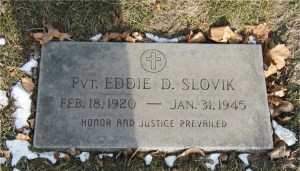
Slovik was repeatedly ordered to tear up the note and rejoin his unit, and there would be no consequences. Each time, he refused. The stockade didn’t scare him. He’d been in prison before, and it was better than the front lines. Beside that, he was already an ex-con. A dishonorable discharge was hardly going to change anything, in a life he expected to be filled with manual labor. Finally, instructed to write a second note on the back of the first acknowledging the legal consequences of his actions, Eddie Slovik was taken into custody.
1.7 million courts-martial were held during WWII, 1/3rd of all the criminal cases tried in the United States during the same period. The death penalty was rarely imposed. When it was, it was almost always in cases of rape or murder.
2,864 US Army personnel were tried for desertion between January 1942 and June 1948. Courts-martial handed down death sentences to 49 of them, including Eddie Slovik. Division commander Major General Norman Cota approved the sentence. “Given the situation as I knew it in November, 1944,” he said, “I thought it was my duty to this country to approve that sentence. If I hadn’t approved it–if I had let Slovik accomplish his purpose–I don’t know how I could have gone up to the line and looked a good soldier in the face.”
On December 9, Slovik wrote to Supreme Allied Commander Dwight D. Eisenhower, pleading for clemency. Desertion was a systemic problem at this time. Particularly after the surprise German offensive coming out of the frozen Ardennes Forest on December 16, an action that went into history as the Battle of the Bulge. Eisenhower approved the execution order on December 23, believing it to be the only way to discourage further desertions.
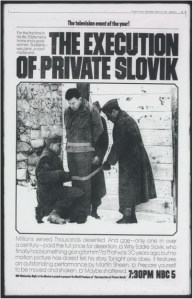
Slovik movie poster
His uniform stripped of all insignia with an army blanket draped over his shoulders, Slovik was brought to the place of execution near the Vosges Mountains of France. “They’re not shooting me for deserting the United States Army”, he said, “thousands of guys have done that. They just need to make an example out of somebody and I’m it because I’m an ex-con. I used to steal things when I was a kid, and that’s what they are shooting me for. They’re shooting me for the bread and chewing gum I stole when I was 12 years old.”
Army Chaplain Father Carl Patrick Cummings said, “Eddie, when you get up there, say a little prayer for me.” Slovik said, “Okay, Father. I’ll pray that you don’t follow me too soon”. Those were his last words. A soldier placed the black hood over his head. The execution was carried out by firing squad. It was 10:04am local time, January 31, 1945.
Edward Donald Slovik was buried in Plot E of the Oise-Aisne American Cemetery, his marker bearing a number instead of his name. Antoinette Slovik received a telegram informing her that her husband had died in the European Theater of war, and a letter instructing her to return a $55 allotment check. She would not learn about the execution for nine years.
In 1987, President Ronald Reagan ordered the repatriation of Slovik’s remains. He was re-interred at Detroit’s Woodmere Cemetery next to Antoinette, who had gone to her final rest eight years earlier.
In all theaters of WWII, the United States military executed 102 of its own, almost always for the unprovoked rape and/or murder of civilians. From the Civil War to this day, Eddie Slovik’s death sentence remains the only one ever carried out for the crime of desertion. At least one member of the tribunal which condemned him to death, would come to see it as a miscarriage of justice.
Nick Gozik of Pittsburg passed away in 2015, at the age of 95. He was there in 1945, a fellow soldier called to witness the execution. “Justice or legal murder”, he said, “I don’t know, but I want you to know I think he was the bravest man in that courtyard that day…All I could see was a young soldier, blond-haired, walking as straight as a soldier ever walked. I thought he was the bravest soldier I ever saw.”
“Consider yourself dead. Some of you won’t come back from this. Some of you will, but you’ll be the lucky ones.” – Briefing officer, 97th BG, 15th AAF, Foggia Italy, to B-17 Navigator Lt. Mike Scorcio and crew before a mission to Germany
Under the terms of the tripartite pact with Fascist Italy and Imperial Japan, Nazi Germany was obliged to render aid in the event that either ally was attacked. On December 8, 1941, the day after the Japanese attack on Pearl Harbor, Ambassador Hiroshi Ōshima came to Joachim von Ribbentrop, looking for a commitment of support from the German Foreign Minister.
Ribbentrop balked. Germany was under no obligation to intervene with their ally having been the aggressor. Adolf Hitler thought otherwise. He couldn’t stand Roosevelt, and thought it was just a matter of time before the two countries were at war. He might as well beat the American President to the punch.
It was 9:30am Washington time on December 11, when German Chargé d’Affaires Hans Thomsen handed the note to American Secretary of State Cordell Hull. For the second time in the diplomatic history of the United States and Germany, the two nations were in a state of war.
48 days later, at Hunter Field in Savannah, the Eighth Bomber Command was activated as part of the United States Army Air Forces. It was January 28, 1942.
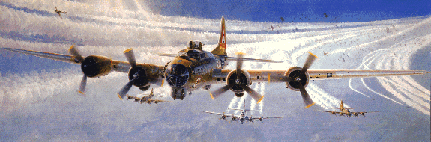
The 8th was intended to support operation “Super Gymnast”, the invasion of what was then French North Africa. Super Gymnast was canceled in April. By May, the 8th Bomber Command had moved its headquarters to a former girls’ school in High Wycombe, England, from where it conducted the strategic bombing campaign against Nazi Germany.
Re-designated the Eighth Air Force on February 22, 1944, at its peak the “Mighty Eighth” could dispatch over 2,000 four engine bombers and more than 1,000 fighters on a single mission. 350,000 people served in the 8th AF during the war in Europe, with 200,000 at its peak in 1944.
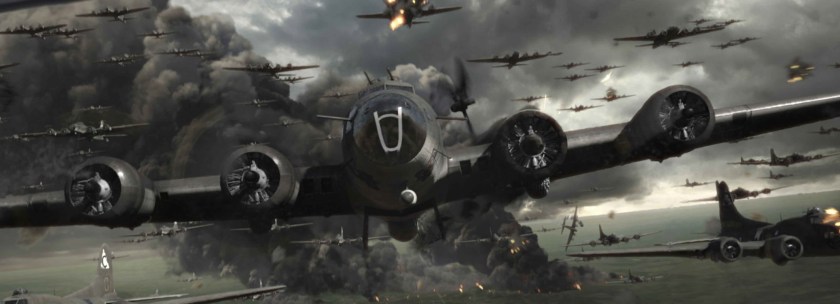
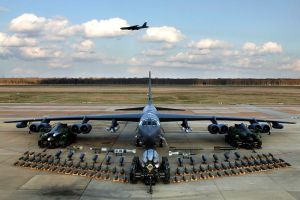
By 1945, the Wehrmacht had a new joke to tell itself: “When we see a silver plane, it’s American. A black plane, it’s British. When we see no plane, it’s German”. American aviation paid a heavy price for it.
Half of the US Army Air Force casualties in World War II were suffered by the 8th, over 47,000 casualties, with more than 26,000 killed. By war’s end, 8th Air Force personnel were awarded 17 Medals of Honor, 220 Distinguished Service Crosses, and 442,000 Air Medals. There were 261 fighter aces in the 8th, 31 of them with 15 or more kills apiece. Another 305 gunners were also recognized as aces.
After victory in Europe, 8th AF Headquarters was reassigned to Sakugawa (Kadena Airfield), Okinawa, under the command of Lieutenant General James H. Doolittle. Tasked with organizing and training new bomber groups for the planned invasion of Japan, the 8th received its first B-29 Superfortress on August 8. Seven days later, the war in the pacific had come to an end..
With the onset of the jet age, the 8th Air Force moved to Westover Air Force Base in Massachusetts on June 13, 1955, the second of three Numbered Air Forces of the newly constituted Strategic Air Command (SAC).
Since then, the Mighty 8th has been called on to perform combat missions from Southeast Asia to the Middle East to the Federal Republic of Yugoslavia, flying out of its current headquarters at Barksdale Air Force Base, Louisiana.
If you’re ever in Savannah, do yourself a favor and pay a visit to the National Museum of the Mighty Eighth Air Force (http://www.mightyeighth.org/). Not only will you experience an incredible story well told, but you will meet some 90+ year old veterans who walk as straight and tall today as they did, 75 years ago. Happy Birthday, Mighty Eighth.
You must be logged in to post a comment.