December 4, 1966  War Dogs of Vietnam

A Military Working Dog (MWD) is anything but a “disposable” asset.  It is a highly trained, specialized soldier who complements and adds to the abilities of his human partner, as that two legged soldier complements those of the dog.

There are times when two highly trained individuals are able to function at a level higher than the sum of their parts.  Professional athletes like NFL linemen and NHL forwards are two examples.  Another is often the partnership formed between law enforcement officers.

On the battlefield, few assets are more powerful than a well equipped and highly trained soldier. Unless we’re pairing that soldier with a Military Working Dog.

A Military Working Dog (MWD) is anything but a “disposable” asset.  It is a highly trained, specialized soldier who complements and adds to the abilities of his human partner, as that two legged soldier complements those of the dog.

nemo-official-photo

“Nemo”, born in October 1962, entered the United States Air Force as a sentry dog in 1964, at the age of 1½ years.  After an 8-week training course at Lackland AFB Sentry Dog Training School in San Antonio, Texas, the 85-pound German Shepard was assigned to Airman Leonard Bryant Jr., and sent to Fairchild Air Base in Washington for duty with Strategic Air Command.

The pair was transferred to the Republic of South Vietnam with a group of other dog teams, and assigned to the 377th Security Police Squadron, stationed at Tan Son Nhut Air Base.  Six months later, Bryant rotated back to the States, and Nemo was paired with 22-year-old Airman 2nd Class Robert Thorneburg.

Early on the morning of December 4, 60 Vietcong guerrillas emerged from the jungle, setting off a near-simultaneous alarm from several sentry dogs on perimeter patrol.

Nemo3-vi

Three dogs, Rebel, Cubby and Toby, were killed with their handlers in a hail of bullets.  Several other handlers were wounded, including one who was able to maintain contact with the enemy, notifying Central Security Control of their location and direction of travel.

Thanks to the early warning, a machine gun team was ready and waiting when 13 infiltrators approached the main aircraft parking ramp.  None of them lived to tell the story.  Security forces quickly deployed around the perimeter, driving some infiltrators off and others into hiding.  Daylight patrols reported that all VC infiltrators were gone, either killed or captured, but they had made a big mistake.  They should have brought the dogs with them.

nemo-house

That night, Thorneburg and Nemo were out on patrol near an old Vietnamese graveyard, about ¼ mile from the air base’ runways.  Nemo alerted on something.  Before Thorneburg could radio for backup, that something started shooting.  Thorneburg released the dog and charged in shooting, killing one Vietcong before being shot in the shoulder.  Nemo was badly wounded, shot in the face, the bullet entering below his eye and exiting his mouth.  Ignoring the injury, Nemo attacked the four enemy soldiers hiding in the brush, giving his partner time to call for reinforcements.

Reichenbach, Major, 2Four additional Vietcong were discovered hiding underground, as quick reaction teams scoured the area.  They found Nemo and Thornburg, both seriously wounded, together on the ground.  Both would survive, though Thorneburg was shot a second time, while returning to base.

I’m sure that individual dog handlers were as good to their dogs as they knew how to be, during the Vietnam era.  That’s a guess, but having an MWD handler in the family, I think it’s a good one.  The Department of Defense bureaucracy was another matter.

Roughly 4,000 dogs served in Vietnam, leading patrols through the dense jungle terrain.  Overall, these animals are credited with saving close to 10,000 lives.

When Marine Corps handler Steve Reichenbach arrived in country in 1966, he was paired with a cream colored Great Dane-German Shepherd mix.  “Major”, whose previous handler had been killed only weeks before, was an excellent match for Reichenbach, both being “mellow, relaxed, even-keeled types” who bonded, almost immediately.

Reichenbach, Major
Marine dog handler Steve Reichenbach with his dog, Major, on a patrol north of Danang in late 1966. PHOTOGRAPH COURTESY OF STEPHEN K. REICHENBACH, with a tip of the hat to National Geographic

At 90 pounds, Major’s size alone seemed to intimidate the enemy, often leading VC to trip off ambushes, too early.

A land mine exploded on the Marine’s last day in country, killing four and wounding six.  Though badly wounded, Reichenbach would survive the war.  Major was unhurt, but he wasn’t so lucky.  The last the pair saw of one another, was in the medevac chopper.  Major still had Reichenbach’s blood on his fur, when he was paired with his next handler.  The marine never saw his “battle buddy” after that, but later heard the dog had succumbed to some tropical disease.

Nemo on the PlaneThe vast majority of MWDs who served in Vietnam, were left behind as “surplus equipment”.  Left to succumb to tropical disease, to be euthanized by the South Vietnamese Army, or worse.  Nemo was one of the few lucky ones.  He came home.

MWD Nemo was officially recognized for having saved the life of his handler, and preventing further destruction of life and property.   He was given the best of veterinary care and, on June 23, 1967, USAF Headquarters directed that he be returned to the United States.  The first sentry dog officially retired from active service.

The C124 Globemaster touched down at Kelly Air Force Base, Texas, on July 22, 1967.  Nemo lived out the seven years remaining to him in a permanent retirement kennel at the DoD Dog Center at Lackland Air Force Base.


If you enjoyed this “Today in History”, please feel free to re-blog, “like” & share on social media, so that others may find and enjoy the same. Please click the “follow” button on the right, to receive email updates on new articles.  Thank you for your interest, in the history we all share.

December 1, 2013 Sacred Soil

ICYMI – I can’t think of anything more fitting than that it was children, our future and posterity, who retrieved the sacred soil of Flanders and installed it at that garden. It is now for that posterity to keep our history alive, and to never let it fade, into some sepia-toned and forgotten past.

November 11, nineteen short days ago, marked the 99-year anniversary of the end of World War One.

Before they had numbers, this was “The Great War”.  The “War to end all Wars”.

There is barely a piece of 20th or 21st century history, which cannot be traced back to it.

International Communism was borne of the Great War, without which there would have been no cold war, no Korean War, no war in Vietnam. The killing fields of Cambodia would have remained mere rice fields.  The spiritual descendants of Chiang Kai-shek’s brand of capitalism would be running all of China, instead of only Taiwan.

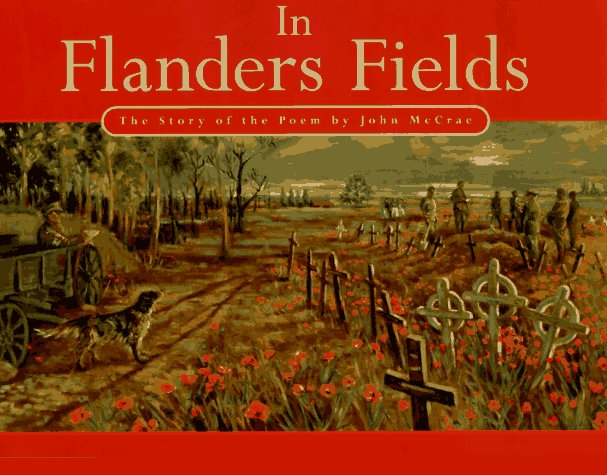
In Flanders Fields

The current boundaries of the Middle East arose from the Great War. While the region’s tribal alliances and religious strife is nothing new, those conditions would have taken a very different form, had it not been for those boundaries.

World War II, a conflagration which left more dead, wounded or missing than any conflict in world history (WWI is only #5), was little more than the Great War, part II. A Marshall of France, on looking at the Versailles Treaty formally ending WWI, said “This isn’t peace. This is a cease-fire that will last for 20 years”. He was off, by something like 36 days.

I’ve long believed that we can’t be participating citizens of a self-governing Republic, we can’t know where we want our country to go, if we don’t understand where it’s been.  It’s one of the principle reasons for examining history.  It’s why I think something wonderful happened four years ago, and I don’t think many of us heard about it.

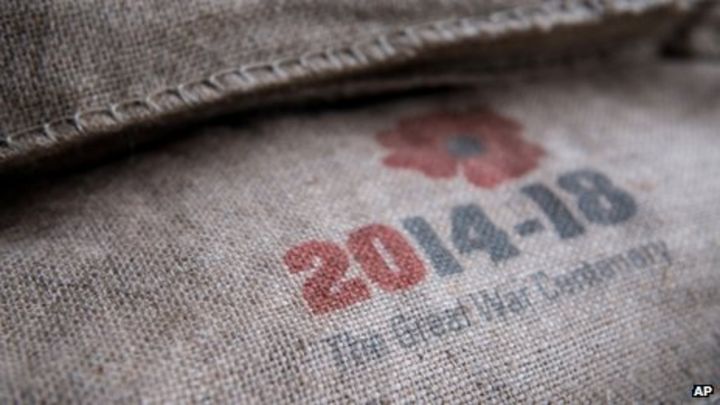
In the summer of 2013, over 1,000 British and Belgian schoolchildren visited 70 battlefields of the Great War.  Ypres.  Passchendaele.  Verdun.  The Somme.  All over Northern France and Belgium, the region known as “Flanders”.  There these children collected samples of the sacred soil of those fields of conflict.

_77985394_020167620-1

The soil from those battlefields was placed in seventy WWI-style burlap sandbags, each stenciled with a red poppy, where it came from, and the dates.  Those sandbags were transported to London, and installed with great care at Wellington Barracks, the central London home of the Grenadier Guards, Coldstream Guards and Scots Guards.

There the soil of the Great War will nourish and support a garden.  Ready for the following year, a solemn remembrance of the centenary of that war.

That day, December 1, 2013, was for the Flanders Fields Memorial Garden, the first full day of forever.

I can’t think of anything more fitting than that it was children, our future and posterity, who retrieved the sacred soil of Flanders and installed it at that garden. It is now for that posterity to keep our history alive, and never to let it fade, into some sepia-toned and forgotten past.


If you enjoyed this “Today in History”, please feel free to re-blog, “like” & share on social media, so that others may find and enjoy the same. Please click the “follow” button on the right, to receive email updates on new articles.

Thank you for your interest, in the history we all share.

November 30, 1953 Dien Bien Phu

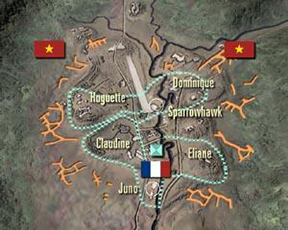
ICYMI – Under the command of Colonel Christian de Castries, French forces built seven fortified positions to defend the base, each allegedly named after one of his mistresses. 10,800 French troops were committed, with another 16,000 in reserve.

If you speak of France, most of us think of the five-sided country between Spain and Germany. That would be partly correct, but “la Métropole” or “Metropolitan France” today accounts for only 82.2% of the landmass and 95.9% of the population, of la République Française. The overseas departments and territories which make up “la France d’outre-mer”, “Overseas France”, account for the rest.

That overseas percentage would have been higher in the mid-20th century, with many former colonial territories added in, among them Laos, Cambodia and Vietnam.

Japanese occupation of southeast Asia caused the Europeans to leave French Indochina during WWII. Within a year of re-occupation, the French faced virulent opposition from the Nationalist-Communist Viet Minh, led by Ho Chi Minh and Vo Nguyen Giap. Theirs was a low level, rural insurgency at first, later becoming a full-scale modern war when Chinese Communists entered the fray in 1949.

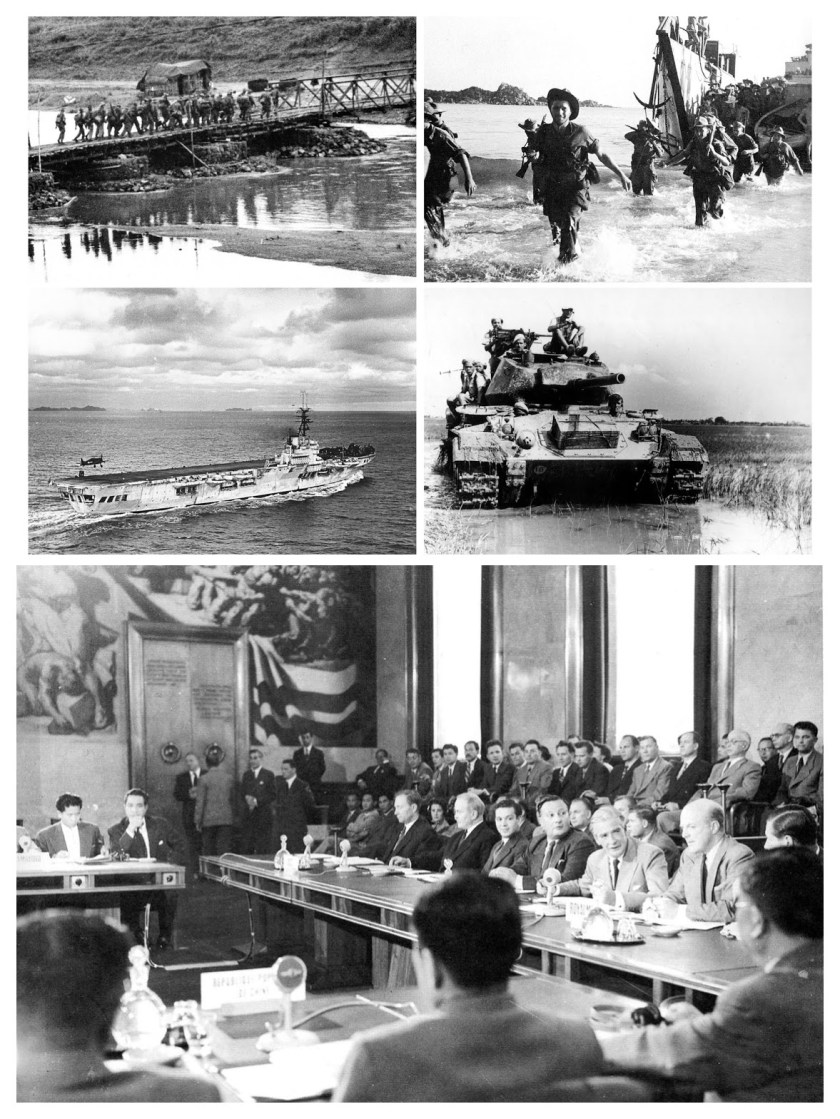
First_Indochina_War_COLLAGEWhat historians call the First Indochina War, many contemporaries called “la sale guerre”, or “dirty war”. The government forbade the use of metropolitan recruits, fearing that that would make the war more unpopular than it already was. Instead, French professional soldiers and units of the French Foreign Legion were augmented with colonial troops, including Moroccan, Algerian, Tunisian, Laotian, Cambodian, and Vietnamese ethnic minorities.
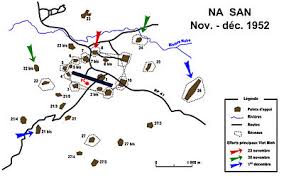
Na SanThe war went poorly for the French.  By 1952 they were looking for a way out. Premier René Mayer appointed Henri Navarre to take command of French Union Forces in May of that year, with a single order. Navarre was to create military conditions which would lead to an “honorable political solution”.
In November and December of the previous year, the French army had air lifted soldiers into a fortified position at Na San, adjacent to a key Viet Minh supply line to Laos. Superior French fire power, armor and air resources had driven Vo Nguyen Giap’s forces back with heavy losses, in what French planners called the “hérisson” or “hedgehog” strategy.

Dien_Bien_Phu, baseIn June, Major General René Cogny proposed a “mooring point” at Dien Bien Phu, creating a lightly defended point from which to launch raids. Navarre wanted to replicate the Na San strategy, and ordered that Dien Bien Phu be taken and converted into a heavily fortified base.
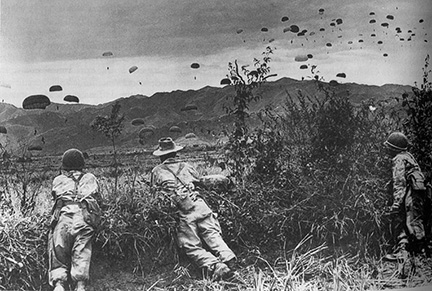
“Operation Castor” began on the 20th of November, with three parachute infantry battalions dropping into Dien Bien Phu. The operation was completed with minimal French casualties on November 30, as they continued to land supplies, troops, and engineering equipment into the isolated base.

Under the command of Colonel Christian de Castries, French forces built seven fortified positions to defend the base, each allegedly named after one of his mistresses. 10,800 French troops were committed, with another 16,000 in reserve.

Vo felt that he had made a serious mistake at Na San, rushing his troops in piecemeal against French defenses. This time, he carefully prepared his positions, moving 50,000 men into position around the valley, meticulously stockpiling ammunition and placing his anti-aircraft and heavy artillery, with which he was well supplied.

dien_bien_phu-resupplyThe French staff made their battle plan, based on the assumption that it was impossible for the Viet Minh to place enough artillery on the surrounding high ground, due to the rugged terrain. The communists didn’t possess enough artillery to do serious damage anyway, or so they thought.
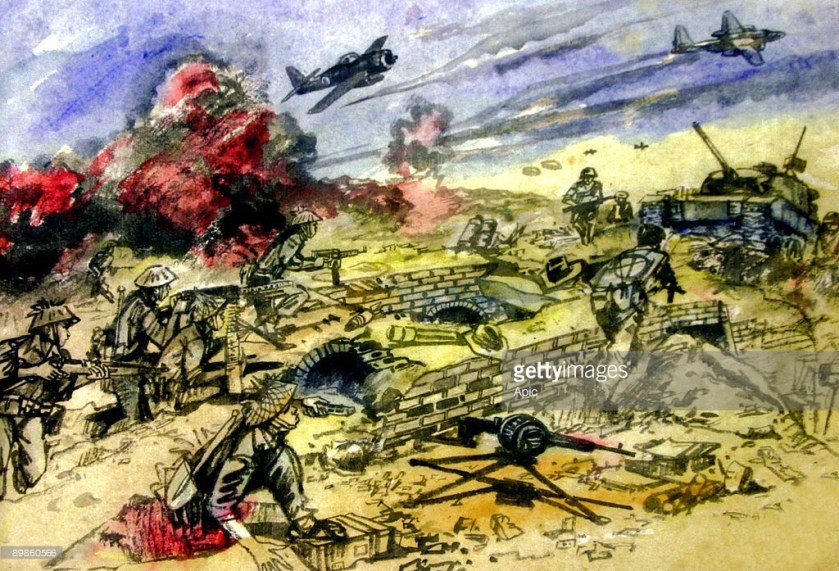
French officers quickly learned how mistaken they had been. The first sporadic artillery fire began on January 31, around the time that patrols discovered the enemy’s presence in every direction. Heavy artillery virtually ringed the valley in which they found themselves, and air support was quickly nullified by the enemy’s well placed anti-aircraft fire.

The Viet Minh assault began in earnest on March 13, when several outposts came under furious artillery barrage. Air support became next to impossible, and counter-battery fire was next to useless against Giap’s fortifications.

Lieutenant Colonel Charles Piroth commanded the French artillery at Dien Bien Phu. He was a professional soldier and no lightweight, having had his arm amputated in 1946 with no anesthesia. When it became clear how wrong his assumptions had been, Piroth circled the camp making apologies to his officers, returned to his tent, and killed himself with a hand grenade.

Last moments
Last moments of the Battle of Dien Bien Phu, 1954, as depicted by North Vietnamese artist Huy Toan

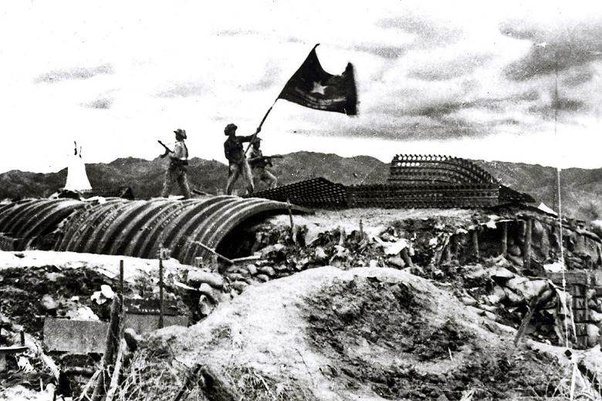
“Beatrice” was the first fire base to fall, then “Gabrielle” and “Anne-Marie”. Viet Minh controlled 90% of the airfield by the 22nd of April, making even parachute drops next to impossible. On May 7, Vo ordered an all-out assault of 25,000 troops against the 3,000 remaining in garrison. By nightfall, it was over.  The last words from the last radio man were “The enemy has overrun us. We are blowing up everything. Vive la France!”

Military historian Martin Windrow wrote that Dien Bien Phu was “the first time that a non-European colonial independence movement had evolved through all the stages from guerrilla bands to a conventionally organized and equipped army able to defeat a modern Western occupier in pitched battle”.

The Geneva conference opened the following day, resulting in a Vietnam partitioned into two parts. In the north was the “Democratic Republic of Vietnam” administered by the communists, and the State of Vietnam in the south, under Emperor Bao Dai and Prime Minister Ngo Dinh Diem. The North was supported by both the People’s Republic of China and the Soviet Union, and continued to terrorize patriots in the north and south alike.

US support for the south increased as the French withdrew theirs.  By the late 50s, the US was sending technical and financial aid in expectation of social and land reform. By 1960, the National Front for the Liberation of South Vietnam (NLF, or “Viet Cong”) had taken to murdering Diem-supported village leaders.  President John F. Kennedy responded in 1961, sending 1,364 American advisers into South Vietnam.

The next war in Indochina, had begun.


If you enjoyed this “Today in History”, please feel free to re-blog, “like” & share on social media, so that others may find and enjoy the same. Please click the “follow” button on the right, to receive email updates on new articles.

Thank you for your interest, in the history we all share.

November 29, 1890 Singing Second

In 1944 and ’45 with the country at war, Army and Navy both entered that final game of the season,with perfect records.  Army finished both of those seasons, undefeated.

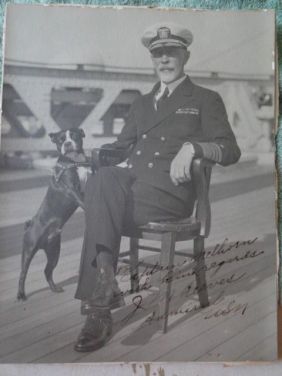
Bull Reeves
Admiral Joseph Mason “Bull” Reeves

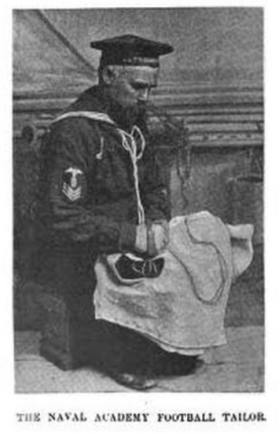
Sometime during the 1893 football season, a navy doctor told Midshipman Joseph Reeves that another kick to the head could result in “instant insanity”, even death.

Reeves commissioned an Annapolis-area shoemaker to build him a leather covering, thus making himself the father of the modern football helmet. Years later, this man of the battleship era became an ardent supporter of naval air power. Today, Admiral “Bull” Reeves is widely known as the “Father of Carrier Aviation”.

The naval academy’s football program is one of the oldest in the country, dating back to 1879.

The Army got into the game in November 1890, when Navy challenged Army cadets in what was then a relatively new sport.

First College Football Uniform
The naval academy introduced a canvas jersey in 1879, believed to be the first college football uniform, in history. Photo by Caspar W. Whitney – Whitney, Caspar W. (May 21, 1892). “The Athletic Development at West Point and Annapolis”. Harper’s Weekly XXXVI (1848): 496., Public Domain, https://commons.wikimedia.org/w/index.php?curid=51990735

That first Army-Navy game was played on November 29, when the Midshipmen humiliated the Army cadets at West Point, 24-0.

The Black Knights had their revenge the following year, defeating Navy at Annapolis, 32-16.

The two teams met some 30 times between 1890 and 1930, when the game became an annual event.

More than inter-service “bragging rights” are at stake.  Only 17 schools can boast Heisman Trophy winners. Army and Navy, combine for five.

West Point and Annapolis fielded some of the best teams in college football, during the first half of the 20th century.  In 1944 and ’45 with the country at war, Army and Navy both entered that final game of the season,with perfect records.  Army finished both seasons, undefeated.

Today, size and weight restrictions combine with a five-year military service commitment, while dreams of NFL careers draw some of the best football talent in college ball away from the service academies.  Since 1963, only four seasons have seen both teams enter the Army-Navy game with winning records.   Yet, the  game remains a college football institution, receiving radio coverage every year since the late ’20s, and broadcast on national television, since 1945.

The first instant replay in American football history, made its debut during the 1963 Army–Navy game.

Arguably, the Army-Navy game may be the purest such event, in all of college sports.  These are the kids who play for the love of the game, knowing that their next years are unlikely to lead to careers in sports, business, or academia.  These young men have given the next few years of their lives, to the United Sates military.

Staubach
Roger Staubach

Five-year post-graduation military service commitments preclude the NFL career aspirations of most Army-Navy game veterans, but not all.  Notable exceptions include Dallas Cowboys Quarterback Roger Staubach (Navy, 1965), New York Giants Wide Receiver and Return Specialist Phil McConkey (Navy, 1979), and (then) LA Raiders Running back Napoleon McCallum (Navy, 1985).

President Dwight Eisenhower earned the distinction of being the only future President in history to play the Army-Navy game in 1912, alongside future General of the Army, Chairman of the Joint Chiefs of Staff and teammate, Omar Bradley.

Most games are played in a neutral city, almost always on the east coast. Most often in Philadelphia.  The Army-Navy game has appeared west of the Mississippi only twice, first for the national dedication of Chicago’s Soldier Field, in 1926.  The second was in 1983, when the Department of Defense earned Wisconsin Democratic Senator William Proxmire’s not-so-coveted “Golden Fleece” award, for spending $100,000 to transport cadets, midshipmen and mascots, to play in Pasadena, California’s Rose Bowl.

HeismanOh, for the days when the government pretended to look out for our money.
With capacities of only 38,000 and 34,000 respectively, Army’s Michie Stadium and Navy’s Navy–Marine Corps Memorial Stadium are far too small, to hold the assembled crowd.  Out of 117 games, only six have been played on either campus.  Two of those (1942-’43), were due to WWII travel restrictions.

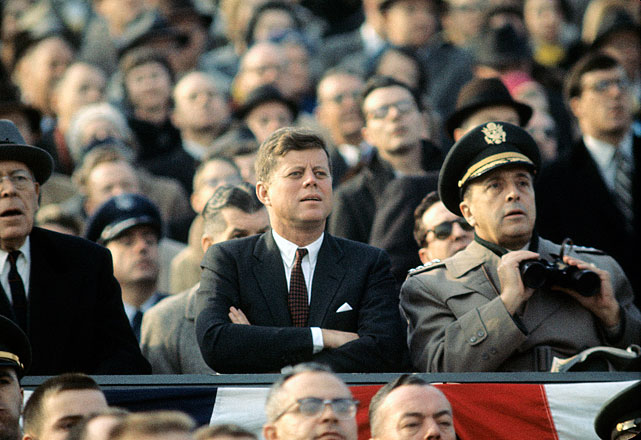
In 1963, the Army-Navy game was canceled in observation of a 30-day period of mourning, following the assassination of president John Fitzgerald Kennedy.  Knowing her now-deceased husband to be a big fan, First Lady Jacqueline Kennedy requested that the game go on, and so it was, quarterback Roger Staubach leading his #2 nationally ranked team in a 34-14 Navy romp.

Kennedy, army navy game

For most seniors, the “First Classmen” of either academy, the Army-Navy game carries special meaning.   Some may go on to play in a bowl game, but for most, this is the last regular season football game, each will ever play.  In times of war, they and others like themselves will be among the first to go, in defense of the country.  Some will not return home, alive.

Navy FootballThe game is particularly emotional for this reason.  Despite intense rivalry, it would be hard to find a duel in all of  sports, where the two sides hold the other in higher respect and esteem.
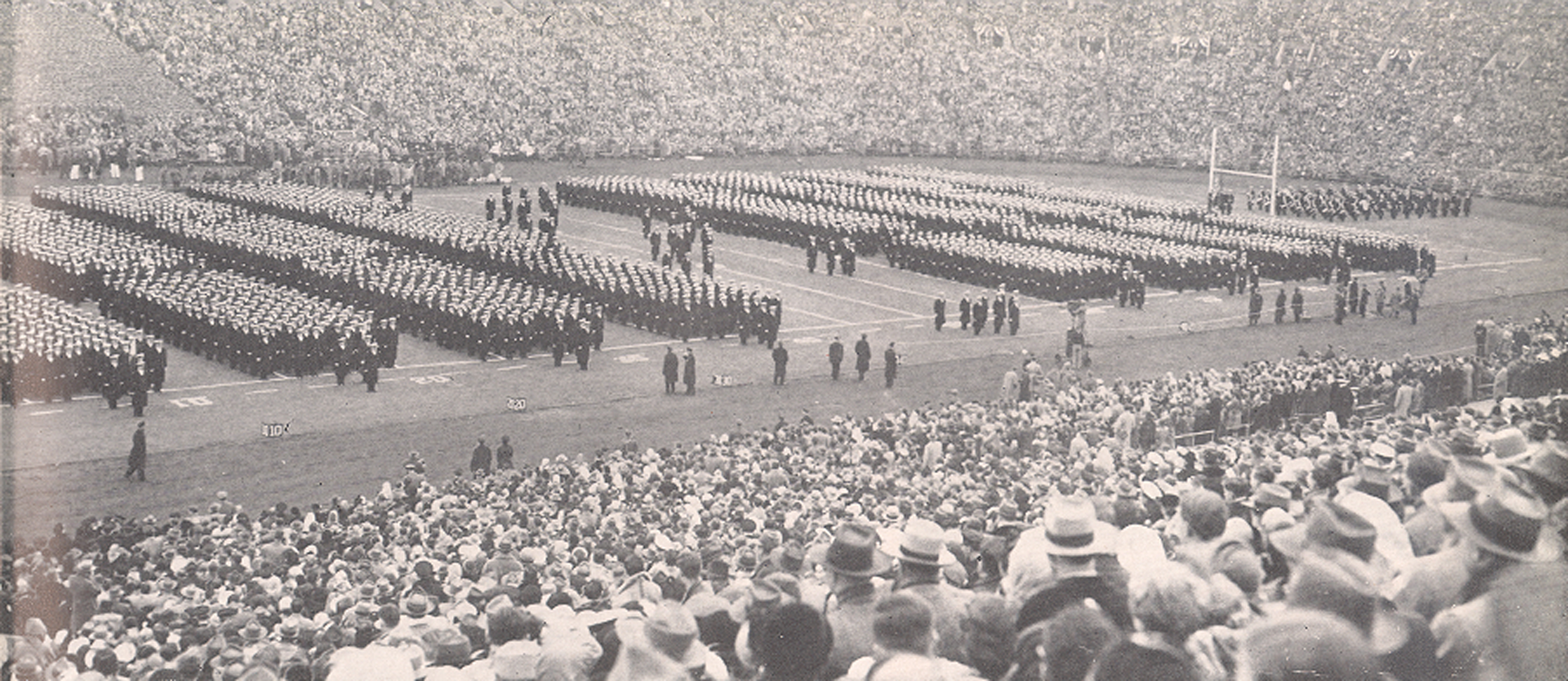
The game is steeped in tradition.  As their opposites cheer them on, each side takes the field in a spectacle of precision drill, unmatched in any venue outside of the military.  After the game, both teams assemble to sing the almae matres (‘On Brave Old Army Team’ and ‘Anchors Aweigh’) of each institution, to the assembled students and fans.

Precision
Navy marches on the field, 1950

The first such serenade is always performed for those of the losing academy, hence the coveted position of “singing second”, signifying the victor of this, the oldest sports rivalry in service academy history.

Respect and tradition is all well and good, but such rivalries do not come without a share of debauchery. During junior year, selected “Middies” and Cadets attend courses with the opposite military academy. On game day, each is restored in a “prisoner exchange”, returning from their semester in “enemy territory”.

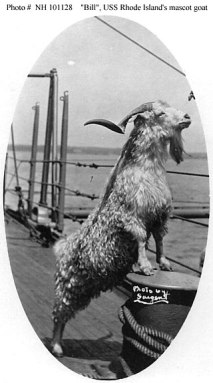
Billthegoat
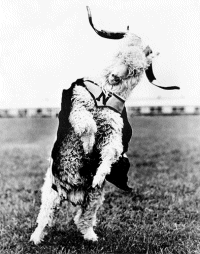
“Bill the goat”, mascot of BB-17 USS Rhode Island, circa 1913

Goats have a long history with all things maritime, having gone to sea since the age of sail and eating all manner of garbage and other undesirable food, in exchange for which, usually “she”, provided companionship, milk and butter. Sir Joseph Bank’s nanny goat was the first creature two-legged or four, to circumnavigate the planet, twice.

Navy had multiple mascots during the early years, including a gorilla, two cats, a bulldog, and a carrier pigeon. Legend has it that a beloved goat once died aboard a Navy cruise, and two ensigns cavorted about wearing the skin during half-time, before making their way to the taxidermist.

Navy won that game, and a live goat named “El Cid” (The Chief) appeared at the fourth Army-Navy game, in 1893. Navy won that game too, its third victory of those first four games. Small wonder that Billy goats have been the Navy mascot, since 1904.

The 2016 matchup was attended by “Bill” the Goat #XXXVI and his backup, Bill #XXXVII.bill-01

Small wonder too, why Army cadets will go to any length, to kidnap that goat.  The first such kidnapping of the modern era, took place in 1953.

On November 5, 1995, US Military Academy cadets staged a pre-dawn raid at the Naval Academy Dairy Farm in Gambrills, Maryland, kidnapping Bill the Goat #s XXVI, XXVII and XXIX.  The Pentagon was notified, and the goats were returned under a joint Army/Navy policy, stipulating that the “kidnapping of cadets, midshipmen or mascots will not be tolerated”.

Cadets pulled off the caper in 2002, disguised in Grateful Dead T-shirts.  “Operation Good Shepherd” launched in 2007, to kidnap Bill #XXXII, XXXIII, and XXXIV.   The whole thing was posted, on You Tube. 

It’s been said that only the Army, would mount a military operation to kidnap a goat, and only the Navy would involve the Pentagon, to get him back.

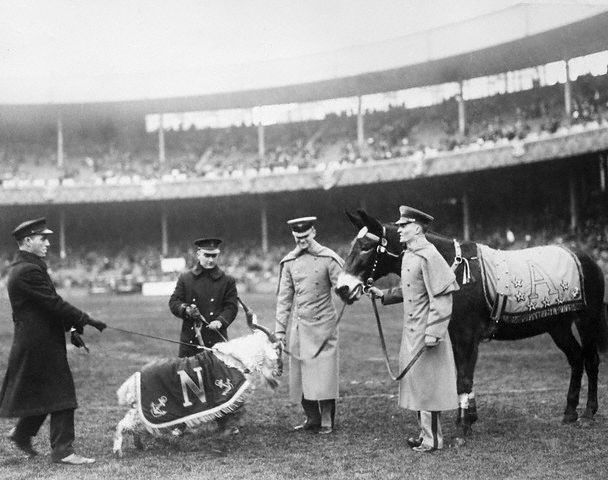
Army MuleThe Philadelphia Quartermaster Depot decided in 1899, that Army needed a mascot in response to the Navy’s goat.  Mules have a long history with the United Sates Army, going back to George Washington, the “Father of the American Mule“.  The question was self-answering.  Little is known of the “official” Army mules prior to 1936, when former pack mule “Mr. Jackson” (named for Thomas Jonathan “Stonewall” Jackson), arrived from Front Royal, Virginia.
Mr. Jackson served twelve years, the first of seventeen “official” Army mules. Only one, “Buckshot”, was a female. Currently, the “Mule Corps” consists of “Ranger III”, the son of a Percheron mare standing at 16.2 hands (66″) high, his only slightly shorter half-brother “Stryker”, and “Paladin”, a half-thoroughbred, standing a full two hands shorter than either of his counterparts

Army FootballAlways the last regular-season game in Division I-A football, the next four Army-Navy games are scheduled in Philadelphia. The game site will then move to Metlife Stadium in East Rutherford New Jersey, to mark the twenty-year anniversary of the Islamist terror attacks on the World Trade Center. The 2022 game moves back to Philadelphia, marking the 91st time Army and Navy have played there.
To date, Navy leads Army in the series 60-50-7, with Army’s Black Knights ending Navy’s 14-game winning streak in 2016.  The 2017 edition is scheduled for Saturday, December 9, at Philadelphia’s Lincoln Financial Field.

This son and grandson of Army veterans going back to the Revolution and beyond, is compelled to say,  ‘Beat Navy’.

Meeting of the mascots
Meeting of the Mascots, 1939

If you enjoyed this “Today in History”, please feel free to re-blog, “like” & share on social media, so that others may find and enjoy the same. Please click the “follow” button on the right, to receive email updates on new articles.

Thank you for your interest, in the history we all share.

November 28, 1942 Cocoanut Grove

ICYMI – “Barney” Welansky, the current owner, liked to brag about his ties with the Mob and with Boston Mayor Maurice Tobin. Welansky was in Mass General Hospital that night, recovering from a heart attack. He would soon have a lot of company.

If you go behind the Hotel Radisson in Boston, over by the parking garage, you’ll find 17 Piedmont Street, in the Bay Village neighborhood. The address is a parking lot now.  75 years ago, it contained the most popular nightclub in Boston.

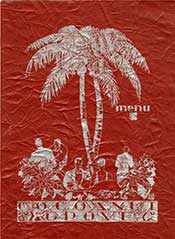
cocoanut-grove-menu
Cocoanut Grove Menu

Rumors of criminal connections followed the Cocoanut Grove for years. The former owner, gangster and bootlegger Charles “King” Solomon, had been gunned down ten years earlier in the men’s room of Roxbury’s Cotton Club. “Barney” Welansky, the current owner, liked to brag about his ties with the Mob and with Boston Mayor Maurice Tobin. Welansky was in Mass General Hospital that night, recovering from a heart attack. He would soon have a lot of company.

During prohibition, the club had been a speakeasy . Originally a garage and warehouse, Cocoanut Grove was converted into a 1½ story complex of dining rooms, bars, and lounges, offering patrons dining and dancing in a “tropical paradise” of artificial palm trees, satin bunting and paper palm fronds, complete with a roof which could be rolled back when weather permitted, for dancing under the stars.

Cocoanut_Grove_Night_Club_FireWelansky was a tough boss, maniacally determined not to be cheated out of a tab or a cover charge. He locked exit doors, concealed others with draperies, and even bricked up one emergency exit. Nobody was going to leave Cocoanut Grove without paying up.

Boston College had just ended an undefeated season, losing their slot in the Sugar Bowl in a stunning upset to Holy Cross, 55–12.

Over a thousand football fans, military service members, and Thanksgiving weekend revelers crowded into the nightclub that night.  The rated capacity was 460.

Downstairs in the Melody Lounge, Goody Goodelle played piano on a revolving stage, surrounded by paper palms. Someone, perhaps a soldier on leave with his sweetheart, had removed a light bulb to have a little privacy. 16-year old bus boy Stanley Tomaszewski climbed up to replace the bulb, lighting a match so he could see what he was doing.

Cocoanut Grove, 2The decorations ignited immediately, fire racing so fast along the satin canopy, that wooden strips suspending it from the ceiling remained unscathed.

Waiters attempted to douse the fire with water, but it spread far too quickly. Lounge patrons were overcome so rapidly by toxic smoke, that some were later found dead in their seats, drinks still in their hands.

Flames raced up the stairway to the main level, burning the hair of people trying to escape. The orchestra was just beginning its evening show as a fireball leapt across the dance floor, spreading quickly through the Caricature Bar, and down a hallway to the Broadway Lounge. Inside of five minutes, flames had spread into the main hall and the entire nightclub was ablaze.

maxresdefaultToday, fire codes require revolving doors to be flanked by doors on either side, but that wasn’t the case in 1942. Desperate to escape, patrons packed the single revolving door, their bodies jamming it so tightly that firefighters later had to dismantle the entire frame.

The bodies of club guests piled up at locked exits, as other doors, opening inward, became useless in the crush of bodies. Firefighters later testified that 300 could have been saved, if only those doors had opened to the outside.

Ambulances, taxis, newspaper delivery trucks and private cars descended on Boston City Hospital’s emergency room, the injured, dead and dying arriving at a rate of one every eleven seconds. Dr. Stanley Levenson, just a year out of Harvard Medical School and down that night with food poisoning, got the call. “I was still in bed on Saturday night, when I got a call from Dr. Charles Lund, chief of surgery, and he told me that no matter how I felt, I had to get to ER immediately, something terrible had happened”.

Cocoanut Grove3The most striking story of survival that night, was that of 21-year old Coast Guardsman Clifford Johnson, who returned to the nightclub no fewer than four times in search of his date, Estelle Balkan. He didn’t know that she had safely escaped, and each time Johnson returned with another unconscious smoke victim in his arms. Johnson himself was on fire his last time out, when he collapsed onto the sidewalk, still ablaze.
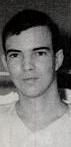
Clifford Johnson
Clifford Johnson

Three other burn victims were taken to Mass General that night, with burns over 30% of their bodies.   Johnson alone survived the ordeal, despite third degree burns over 50% of his body. Much of that, was burned to the bone.  Johnson would suffer almost two years of excruciating medical procedures, including no fewer than 30,000 skin grafts in the first year alone.

I earn my living in the Commercial Furniture business.  I can tell you from experience that Cocoanut Grove effects Boston fire code regulations, to this day. 492 died in the conflagration, the deadliest nightclub fire in American history.

cocoanut grove4Barney Welansky was tried and convicted on 19 counts of manslaughter, and sentenced to 12-15 years. Maurice Tobin, by then Governor, released him after four, his body ravaged with cancer. Welansky died 9 weeks later. Stanley Tomaszewski was exonerated.  It wasn’t he who had placed all those flammable decorations, but the bus boy was treated like a Jonah, for the rest of his life.
Clifford Johnson would be 21 months in the hospital, after which he married his nurse and returned to his home state of Missouri, the first of his era to survive such severe burns. Ironically, Johnson would be killed in a car wreck in 1956, pinned beneath an overturned Jeep, and burned to death.


If you enjoyed this “Today in History”, please feel free to re-blog, “like” & share on social media, so that others may find and enjoy the same. Please click the “follow” button on the right, to receive email updates on new articles.

Thank you for your interest, in the history we all share.

November 24, 1962 Kilroy was Here

When Truman, Stalin, and Churchill met at Potsdam, a VIP latrine was built for their exclusive use.  Stalin was the first in, emerging from the outhouse and asking his aide, in Russian, “Who is Kilroy?”

The Fore River Shipyard began operations in 1883 in Braintree, Massachusetts, moving to its current location on the Weymouth Fore River on Quincy Point, in 1901. In 1913, the yard was purchased by Bethlehem Steel, and operated under the Bethlehem Shipbuilding Corporation.

Most ships at Fore River were built for the United States Navy, including early submarines built for Electric Boat, the Battleship USS Massachusetts, and the Navy’s first carrier, the USS Lexington. In the years before WW2, non-US Navy customers included the United States Merchant Marine, the Argentine Navy, the Royal Navy of Great Britain, and the Imperial Japanese Navy.

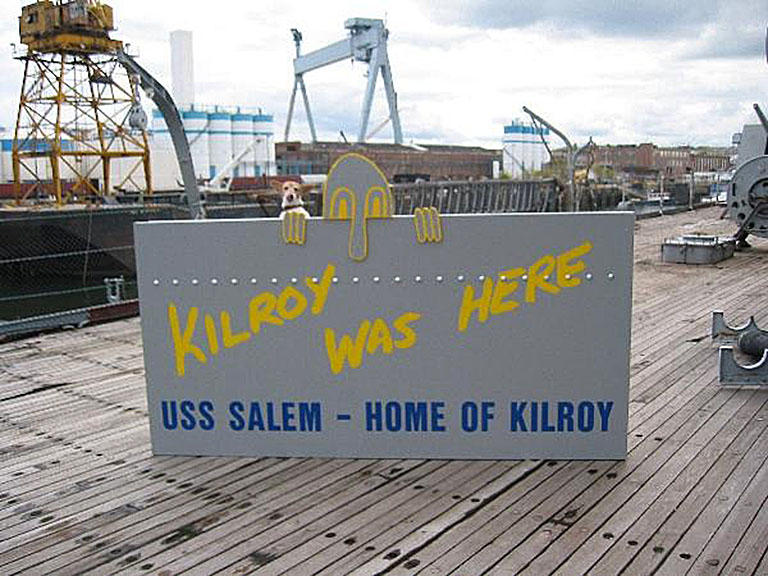
Kilroy-7
USS Salem CA-139 museum ship, Fore River Shipyard, Quincy

The Navy Act of 1938 mandated a 20% increase in American Naval strength. Much of that increase came through Fore River. The Shipyard employed 17,000 the day that Imperial Japan invaded the American Pacific anchorage at Pearl Harbor. That number increased to 32,000 by 1943, with a payroll equivalent to $9.69 Billion, in today’s dollars.

Kilroy-3Necessity became the mother of invention, and the needs of war led to prodigious increases in speed.  No sooner was USS Massachusetts launched, than the keel of USS Vincennes began to be laid. By the end of the war, Fore River had completed ninety-two vessels of eleven different classes.

Builders at the yard were paid by the number of rivets installed. Riveters would mark the end of their shift with a chalk mark, but dishonest co-workers could erase their marks, marking a new spot a few places back on the same seam.

Shipyard inspector James Kilroy ended the practice, writing “Kilroy was Here”, next to each chalk mark.

With hulls leaving the yard so fast there was no time to paint the interiors, Kilroy’s name achieved mythic proportions. The man literally seemed to be everywhere, his name written in every cramped and sealed space in the United States Navy.

For the troops inside of those ships, Kilroy always seemed to have “been there”, first.

Kilroy-1Kilroy was Here became a kind of protective talisman, and soldiers began to write it on newly captured areas and landings.  He was the “Super GI”, showing up for every combat, training and occupation operation of the WW2 and Korean war era.  The scribbled cartoon face was there before you arrived, and he was still there when you left.
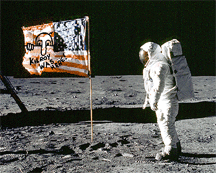
Germans thought Kilroy was some kind of  “super spook”, able to go anywhere he liked, with ease.

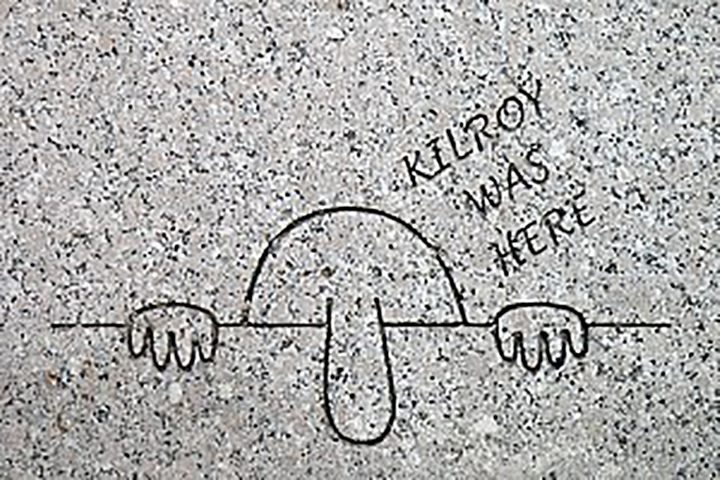
Kilroy-6The challenge became, who could put the Kilroy graffiti in the most difficult and surprising place.  I’ve never been there, but I’ve heard that Kilroy occupies the top of  Mt. Everest.  His likeness is scribbled in the dust of the moon.  There’s one on the Statue of Liberty, and another on the underside of the Arc of Triumph, in Paris.  There are two of them engraved in the granite of the WW2 Memorial, in Washington, DC.

Under Water Demolition teams, the guys who later became US Navy SEALs, swam ashore on Japanese-held Pacific islands, preparing the way for amphibious landings.  More than once, UDT divers found that Kilroy had already been there, the silly cartoon nose scribbled on makeshift signs, and even enemy pillboxes.

When Truman, Stalin, and Churchill met at Potsdam, a VIP latrine was built for their exclusive use.  Stalin was the first in, emerging from the outhouse and asking his aide, in Russian, “Who is Kilroy?”

kilroy_no_spamA Brit will tell you that “Mr. Chad” came first, cartoonist George Chatterton’s response to war rationing.  “Wot, no tea”?
The cartoon appeared in every theater of the war, but few knew the mythical Kilroy’s true identity.

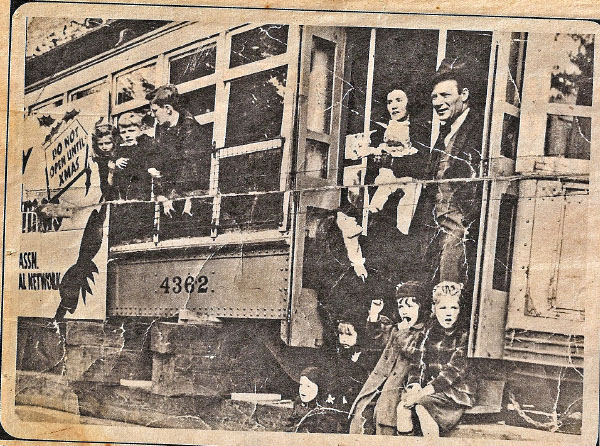
In 1946, the Transit Company of America held a contest, asking the “real” Kilroy to come forward.  Close to forty guys showed up to claim the prize, a real trolley car.  Doubtless they all felt they had legitimate claims, but James Kilroy brought a few riveters and some shipyard officials along, to prove his authenticity.  That was it.

That Christmas the Kilroy kids, all nine of them, got the coolest playhouse in all of Boston.

James Kilroy went on to serve as Boston City Council member and member of the Massachusetts house of Representatives before passing away on this day, November 24, 1962.

trolleycar2
Boston American, December 23, 1946 Image thanks to Kilroy grandson, Brian Fitzgerald

Feature image:  Kilroy, engraved on the granite of the WWII Memorial, Washington DC.

November 16, 1776 First Salute

Governor de Graaff ordered an 11-gun return salute fired from the guns of Fort Oranje, making Sint Eustatius the first nation in history to acknowledge the independence of the United States.

St Eustatius MapSint Eustatius, known to locals as “Statia”, is a Caribbean island of 8.1 sq. miles in the northern Leeward Islands.  Formerly part of the Netherlands Antilles, the island lies southeast of the Virgin Islands, immediately to the northwest of Saint Kitts.

The island had close ties with North America throughout the 18th century, becoming wealthy from the trade in a variety of goods. Sugar, molasses, gin, rum and cotton were only a few of the goods shipped from, or through, Sint Eustatius. Colonial ports from Maine to Virginia shipped products to the island in return, including barrel staves, beans, flour, cod, horses, lumber and tobacco.

At its peak, the island was handling over 3,000 ships per year, making St. Eustatius the “Golden Rock” of the Caribbean.

Golden Rock

Sint Eustatius was a Dutch Colony, and should have remained neutral during the American Revolution. The government in Holland warned Governor Johannes de Graaff to stay away from the rebels fighting for independence, but the Governor would have none of it. The trade in powder, ammunition and arms continued throughout the revolutionary period, with covert support smuggled from Spain, France and dissident interests in Holland. For a time, Sint Eustatius was the only link between Europe and the fledgling American colonies.

first_salute, 1On the 16th of November, 1776, the Brig Andrew Doria sailed into Sint Eustatius’ principle anchorage in Oranje Bay. Flying the Continental Colors of the fledgling United States and commanded by Captain Isaiah Robinson, the Brig was there to obtain munitions and military supplies. Andrew Doria also carried a precious cargo, a copy of the Declaration of Independence.

It was the Americans’ second attempt to send the Declaration to their Dutch associates, the first having been captured on the way to Holland. Seemingly wrapped in papers containing some obscure espionage code, British investigators labored in vain to unlock this strange new cipher. They could have spared themselves the effort: they were personal notes in Yiddish, greetings to some of the Jewish merchants of Holland.

It was traditional in those days, that vessels approaching a foreign harbor would fire a gun salute upon entering. Captain Robinson fired a 13 gun volley on entering the bay, representing the 13 American colonies. The commander at Fort Oranje, overlooking the anchorage, wasn’t sure how to respond.

first_saluteTradition dictated the firing of a salute in return, typically two guns fewer than that fired by the incoming vessel.  Such an act carried meaning. The firing of a return salute was the overt recognition that a sovereign state had entered the harbor. Such a salute amounted to formal recognition of the independence of the 13 American colonies.

Governor de Graaff ordered an 11-gun return salute fired from the guns of Fort Oranje, making Sint Eustatius the first nation in history to acknowledge the independence of the United States.

Playing the role of the tattle-tale younger sibling, nearby Saint Kitts immediately dispatched a vessel to England to inform the British government of the event. The British were furious, of course. The trade between St. Eustatius and the American Colonies became the principal cause of the fourth Anglo-Dutch war, begun on December 12, 1780.

Admiral George Bridges Rodney forced the surrender of Sint Eustatius in February of the following year, saying that “This rock, of only six miles in length and three in breadth, has done England more harm than all the arms of her most potent enemies, and alone supported the infamous rebellion. When I leave the island of St. Eustatius, it will be as barren a rock as the day it erupted from the sea. Instead of one of the greatest emporiums on earth, it will be a mere desert and known only by report.

St Eustatius Coat of ArmsRodney pretty much had his way. The census of 1790 shows 8,124 on the Dutch island nation. In 1950, the population stood at 790. It would take 150 years from Rodney’s departure, before tourism even began to restore the economic well-being of the tiny island.

Today, Sint Eustatius celebrates the 16th of November as “Statia America Day”, in recognition of that first salute.

An official coat of arms was designed by Walter Hellebrand, and adopted on this day in 2004. On the left is a Golden Rock, in memory of the trade which made the island rich. On the right is Fort Oranje, Sint Eustatius’ most important landmark. The angel fish of St. Eustatius is at the bottom, symbolizing the island’s future. Below that is the Latin motto, “SUPERBA ET CONFIDENS”. Proud and Confident.

November 13, 1982 The Wall

The names begin at the center and travel outward, the east wing ending on May 25, 1968. The same day continues at the far end of the west wing, moving back toward the center at panel 1W. The last name on the wall, the last casualty of the war, meets the first, and the circle is closed.

A couple of years ago, my brother was working in Washington, DC.  I was passing through, and it was a great chance to spend some time together. There were a few things we needed to see while we were there.  The grave of our grandfather, at Arlington. The Tomb of the Unknown.  The Korean and WW2 memorials.  Before the day was over, we wanted to see the Vietnam Veteran’s memorial.

images (8)“The Wall” was dedicated on this day, November 13, 1982. 31 years later, we had come to pay respects to our Uncle Gary’s shipmates, their names inscribed on panel 24E, the 134 lost in the disaster aboard the Supercarrier USS Forrestal, in 1967.

We were soon absorbed in the majesty, and the solemnity, of the memorial.

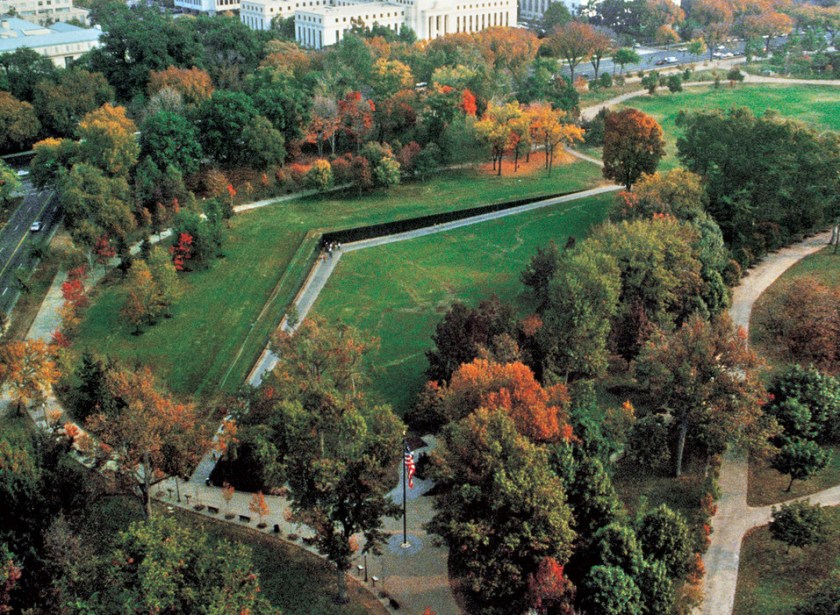
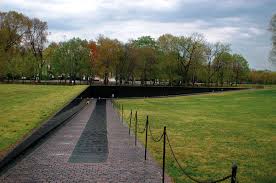
It’s a black granite wall, 493’6″ long and 10’3″ high at its peak, laid out in a great wedge of stone which seems to rise from the earth and return to it. The name of every person lost in the war in Vietnam is engraved on that wall, appearing in the order in which they were lost.

Richard B. Fitzgibbon, Jr
Lance Cpl. Richard B. Fitzgibbon, Jr

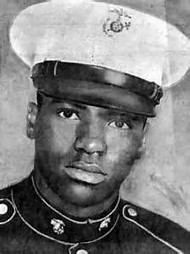
Go to the highest point of the memorial, panel 1E, the very first name is that of Air Force Tech Sgt. Richard B. Fitzgibbon, Jr., of Stoneham, Massachusetts, killed on June 8, 1956. Some distance to his right you will find the name of Marine Corps Lance Cpl. Richard B. Fitzgibbon III, killed on Sept. 7, 1965. They are one of three Father/Son pairs who are so remembered.

The names begin at the center and travel outward, the east wing ending on May 25, 1968. The same day continues at the far end of the west wing, moving back toward the center at panel 1W. The last name on the wall, the last casualty of the war, meets the first, and the circle is closed.

There, you will find the name of Kelton Rena Turner of Los Angeles, an 18-year old Marine, killed in action on May 15, 1975, in the “Mayaguez incident”, two weeks after the evacuation of Saigon. Most sources list Gary L. Hall, Joseph N. Hargrove and Danny G. Marshall as the last to die in Vietnam, though their fate is unknown. These three were United States Marines, an M-60 machine gun squad mistakenly left behind while covering the beach evacuation of Koh Tang Island. Their names appear along with Turner’s, on panel 1W, lines 130-131.

PFC Dan Bullock
PFC Dan Bullock

There were 57,939 names when the Memorial opened in 1982. 39,996 died at the age of 22 or younger, 8,283 were 19 years old. The 18-year-olds are the largest age group, with 33,103. Twelve of them were 17 on their last day on earth.  Five were 16. There is one name on panel 23W, line 096.  That of PFC Dan Bullock, United States Marine Corps.  He was 15 years old. Eight names are those of women, killed while nursing the wounded. 997 soldiers were killed on their first day in Vietnam.  1,448 died on their last. There are 31 pairs of brothers on the Wall: 62 parents who lost two of their sons.

As of Memorial Day 2015, there are 58,307, as the names of military personnel who succumbed to wounds sustained in the war, were added to the wall.

I was nine years old in May 1968, the single deadliest month of that war, with 2,415 killed. I remember the rancid political atmosphere of the time, and the national disgrace that was the way these people were treated on returning home.

I once thanked a business associate for his service in Vietnam. It stunned me to learn that in 40 years, no one had ever said that to him.

Today, I can only hope that Vietnam veterans know and understand how many of us appreciate their service.   And I wish to advance the idea that, if anyone has an issue with our country’s war policy, they need to take it up with a politician. Not with the Armed Services member who is doing what his country asked him to do.

vietnam-war-memorial

November 10, 1775 Always Faithful

Historians differ on the location of the first recruiting station. Some will tell you that it was the “Conestoga Waggon” tavern in Philadelphia. Tradition holds it to have been the “Tun Tavern”, a name coming from the Olde English “Tun”, meaning a barrel or a keg of beer.

The Navy had been in existence for less than a month and the Battles of Lexington and Concord a mere seven months in the past, when the Continental Marines were formed by an act of the 2nd Continental Congress, convened on November 10, 1775.

“Resolved, That two Battalions of Marines be raised, consisting of one Colonel, two Lieutenant Colonels, two Majors, and other officers as usual in other regiments; and that they consist of an equal number of privates with other battalions; that particular care be taken, that no persons be appointed to office, or inlisted into said Battalion, but such are good seamen, or so acquainted with maritime affairs as to be able to serve to advantage by sea when required: that they be inlisted and commissioned to serve for and during the present war between Great Britain and the colonies, unless dismissed by order of Congress: that they be distinguished by the names of the first and second battalion of American Marines, and that they be considered as part of the number which the continental Army before Boston is ordered to consist of.”

First Recruits
“The First Recruits” by Col Charles Waterhouse, USMCR (Ret)

Historians differ on the location of the first recruiting station. Some will tell you that it was the “Conestoga Waggon” tavern in Philadelphia. Tradition holds it to have been the “Tun Tavern”, a name coming from the Olde English “Tun”, meaning a barrel or a keg of beer.

Continental Marines served a number of important functions during the Revolution, including ship-board security, amphibious assault and ship-to-ship combat. Then as now, Marines were riflemen first. During naval engagements they could be found in the masts and rigging, their sharpshooters’ skills taking out opposing helmsmen, gunners and ship’s officers.

No less a figure than Admiral David G. Farragut wrote in 1862, “A ship without Marines is like a garment without buttons.”

The first Marine landing on a hostile shore took place in March 1776, when a Marine force under the former Quaker, Captain Samuel Nicholas, captured New Province Island in the Bahamas. Nicholas was the first commissioned officer in the Continental Marines, and is now remembered as the first commandant of the Marine Corps.

The Continental Congress disbanded the Marines in 1783, following their help in winning American independence. Increasing conflict and the coming “quasi-war” with revolutionary France would soon bring them back.

images (12)President John Adams signed a bill establishing the United States Marine Corps as a permanent military force under Navy jurisdiction on July 11, 1798.

The most famous action of the early period occurred during the Tripolitan War of 1801–’05, against the Barbary states of Tripoli, Algiers, Tunis, and the independent Sultanate of Morocco. US Army Lieutenant William Eaton and United States Marine Corps 1st Lieutenant Presley O’Bannon led eight Marines and 500 mercenaries on a 600-mile forced march through the desert, against a much larger force defending the city of Derna, in Libya. Ottoman viceroy Prince Hamet awarded a Mameluke sword to O’Bannon on December 8, 1805, in a gesture of respect for the Marines’ conduct. That curved, cross-hilted scimitar became the model for swords worn by Marine officers to this day, the victory at Derna memorialized in a line from the Marine Corps Hymn “From the halls of Montezuma, to the shores of Tripoli”.

ChestySince then, the Marine Corps has participated in virtually every conflict ever fought by the United States. They’re usually the first ones in. To date, United States Marines have executed over 300 landings on foreign shores.

The USMC has 182,000 active duty members as of 2016, with 38,500 in reserve. They are separated into three divisions, headquartered at Camp Lejeune, North Carolina, Camp Pendleton in California; and Okinawa, Japan. Each division maintains one or more expeditionary units, prepared for major operations anywhere in the world on two weeks’ notice.

The original Tun Tavern burned down in 1781, shortly before the end of the Revolution. Today, the site is part of Interstate 95, where it passes Penn’s landing. You can still visit the Tun Tavern styled restaurant at the National Marine Corps Museum in Quantico, where a beer and a bread pudding is always part of the lunch menu.

Happy 241st birthday, United States Marine Corps. Thank you.

Semper Fidelis.

0811061-M-3189M-001
Camp Lejeune celebrated the 233rd Marine Corps birthday with its annual Joint Daytime Ceremony at Liversedge Field, Friday. Pageant Marines wore period uniforms representing major conflicts. Attendees were reminded that throughout history, Marines continue to distinguish themselves on battlefields and foreign shores, in both war and peace.

November 9, 2013 In the Company of Heroes

On April 18, 2015, Richard Cole and David Thatcher fulfilled their original bargain, as the last two surviving members of the Doolittle raid.  Staff Sergeant Thatcher passed in June of last year, at the age of 94.  As I write this, Lieutenant Colonel Richard Cole age 102, Jimmy Doolittle’s co-pilot, is the only man in the world who has earned the right to open that bottle.

On November 9, 2013, there occurred a gathering of four, a tribute to fallen heroes. These four are themselves heroes, and worthy of tribute. It was to be their last such gathering.

This story begins on April 18, 1942, when a flight of 16 Mitchell B25 medium bombers took off from the deck of the carrier USS Hornet.   It was a retaliatory raid on Japan, planned and led by Lieutenant Colonel James “Jimmy” Doolittle of the U.S. Army Air Forces.  It was payback for the sneak attack on Pearl Harbor, seven months earlier.  A demonstration that the Japanese home islands were not immune from attack.

doolittle-raid

Launching such large aircraft from the decks of a carrier had never been attempted, and there were no means of bringing them back. This was to be a one-way mission, into enemy occupied territory.

Fearing a breach in operational security, the mission was forced to launch 200 miles before the intended departure spot.  The range now made fighter escort impossible, and left the bombers themselves with the slimmest margin of error.

Japanese Premier Hideki Tojo was inspecting military bases at the time of the raid. One B-25 came so close that he could see the pilot, though the American bomber never fired a shot.

After dropping their bombs, all but one aircraft was able to continue west into Japanese occupied China. That one landed in Vladivostok, where the pilot and crew were interned for a year by our Soviet “allies”.

A quarter of a million Chinese were murdered by Japanese soldiers, as they hunted for Doolittle’s raiders. Eight of them were captured, three were executed and one died in captivity, but most of the 80 who began the mission survived the war.

There was little serious damage done to the Japanese home islands, but the raid had a decisive effect. Japan withdrew its powerful aircraft carrier force to protect the home islands. Admiral Isoroku Yamamoto attacked Midway, thinking it to have been the jump-off point for the raid. Described by military historian John Keegan as “the most stunning and decisive blow in the history of naval warfare”, the battle of Midway would be a major strategic defeat for Imperial Japan.

The Doolittle raiders have held a reunion every year, from the late 40’s, until 2013. In 1959, the city of Tucson presented them with 80 silver goblets, each engraved with the name of one of their number. They are on display at the National Museum of the Air Force, in Dayton Ohio.

Goblets

With those goblets is a fine bottle of vintage Cognac, 1896, the year Jimmy Doolittle was born. There’s been a bargain among the Doolittle raid survivors that, one day, the last two of their number would open that bottle, and toast their comrades.

In 2013 they changed their bargain, just a bit. Jimmy Doolittle himself passed away in 1993. Twenty years later, 76 goblets had been turned over, each signifying a man who had passed on. The last four were Lieutenant Colonel Richard E. Cole, co-pilot of crew No. 1; Lieutenant Colonel Robert L. Hite, co-pilot of crew No. 16; Lieutenant Colonel Edward J. Saylor, engineer-gunner of crew No. 15; and Staff Sergeant David J. Thatcher, engineer-gunner of crew No. 7. These four agreed that they would gather one last time. It would be they who would finally open that bottle.

Doolittle_70th

Robert Hite, 93, was too frail to travel, so his son stood in for him.  So it was that a 117 year-old bottle of cognac was cracked open on this date in 2013, and enjoyed in the company of heroes. If there is a more magnificent act of tribute, I cannot at this moment think of what it might be.

On April 18, 2015, Richard Cole and David Thatcher fulfilled their original bargain, as the last two surviving members of the Doolittle raid.  Staff Sergeant Thatcher passed in June of last year, at the age of 94.  As I write this, Lieutenant Colonel Richard Cole age 102, Jimmy Doolittle’s co-pilot, is the only man in the world who has earned the right to open that bottle.