February 1, 1968 A Moment in Time

Eddie Adams won his Pulitzer in 1969, but came to regret that he had ever taken the picture. Years later he wrote in Time Magazine. ‘The general killed the Viet Cong; I killed the general with my camera. Still photographs are the most powerful weapon in the world. People believe them, but photographs do lie, even without manipulation. They are only half-truths”.

During WW2, the average infantry soldier saw 40 days of combat, in 4 years.  In Vietnam, the average combat infantryman saw 240 days of combat, in a year.

pr070711ii
Gallup poll, 1965 – 1971

By 1967, the Johnson administration was coming under increasing criticism, for what many of the American public saw as an endless and pointless stalemate in Vietnam.

Opinion polls revealed an increasing percentage believed it was a mistake to send more troops into Vietnam, their number rising from 25% in 1965, to 45% by December, 1967.

The Johnson administration responded with a “success offensive”, emphasizing “kill ratios” and “body counts” of North Vietnamese and Viet Cong fighters.  Vice President Hubert Humphrey stated on NBC’s Today show that November, that “We are on the offensive. Territory is being gained. We are making steady progress.”
download (9)In Communist North Vietnam, the massive battlefield losses of 1966-’67 combined with the economic devastation wrought by US Aerial bombing, causing moderate factions to push for peaceful coexistence with the south.  More radical factions favoring military reunification on the Indochina peninsula, needed to throw a “hail Mary” pass.  Plans for a winter/spring offensive began, in early 1967.  By the New Year, some 80,000 Communist fighters had quietly infiltrated the length and breadth of South Vietnam.

One of the largest military operations of the war launched on January 30, 1968, coinciding with the Tết holiday, the Vietnamese New Year.  In the first wave of attacks, North Vietnamese troops and Viet Cong Guerillas struck over 100 cities and towns, including Saigon, the South Vietnamese capitol.
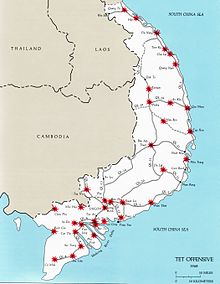
TetMapInitially taken off-guard, US and South Vietnamese forces regrouped and beat back the attacks, inflicting heavy losses on North Vietnamese forces.  The month-long battle for Huế (“Hway”) uncovered the massacre of as many as 6,000 South Vietnamese by Communist forces, 5-10% of the entire city.  Fighting continued for over two months at the US combat base at Khe Sanh.

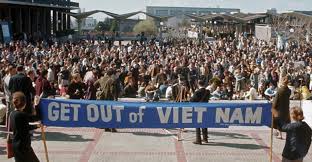
While the Tết offensive was a military defeat for the forces of North Vietnam, the political effects on the American public, were profound.  Support for the war effort plummeted, leading to demonstrations.  Jeers could be heard in the streets.  “Hey! Hey! LBJ! How many kids did you kill today?

Lyndon Johnson’s Presidency, was finished.  The following month, Johnson appeared before the nation in a televised address, saying “I shall not seek, and I will not accept, the nomination of my party for another term as your president.”

In the early morning darkness of February 1, 1968, Nguyễn Văn Lém led a Viet Cong sabotage unit in an assault on the Armor base in Go Vap.  After taking control of the camp, Nguyễn arrested Lieutenant Colonel Nguyen Tuan with his family, demanding that the officer show his guerillas how to drive tanks.  The officer refused, and the Viet Cong slit his throat, along with those of his wife and six children, and his 80-year-old mother.

The only survivor was a grievously injured 10-year-old boy.

Nguyễn was captured later that morning, near the mass grave of 34 civilians.  He said he was “proud” to have carried out orders to kill them.

AP photographer Eddie Adams was out on the street with NBC News television cameraman Võ Sửu, looking for something interesting.  The pair saw a group of South Vietnamese soldiers dragging what appeared to be an ordinary man into the road, and filmed the event.

Adams “…followed the three of them as they walked towards us, making an occasional picture. When they were close – maybe five feet away – the soldiers stopped and backed away. I saw a man walk into my camera viewfinder from the left. He took a pistol out of his holster and raised it. I had no idea he would shoot. It was common to hold a pistol to the head of prisoners during questioning. So I prepared to make that picture – the threat, the interrogation. But it didn’t happen. The man just pulled a pistol out of his holster, raised it to the VC’s head and shot him in the temple. I made a picture at the same time.”

vietnam-execution-arrest

The man with the pistol was Nguyễn Ngọc Loan, Chief of the national police.  Loan had personally witnessed the murder of one of his officers, along with the man’s wife and three small children.

Nguyễn Văn Lém was guilty of major war crimes.  He was out of uniform and not involved in combat, when he murdered the General’s own subordinates and their families.  The man was a war criminal and terrorist with no protections under the Geneva Conventions, legally eligible for summary execution.

Loan drew his .38 Special Smith & Wesson “Bodyguard” revolver and fired.  The execution was barely a blip on his radar screen.

vietnam-execution-after-shooting

General Nguyễn was a devoted Patriot and South Vietnamese Nationalist.  An accomplished pilot who led an airstrike on Việt Cộng forces at Bo Duc in 1967, Loan was loved and admired by his soldiers.

In February 1968, hard fighting yet remained to retake the capitol.  As always, Nguyễn Ngọc Loan was leading from the front, when a machine gun burst tore into his leg.

Meanwhile, Adams’ “Saigon Execution” photograph and Võ’s footage made their way into countless papers and news broadcasts.  Stripped of context, General Nguyễn came to be seen as a “bloodthirsty sadist”, the Viet Cong terrorist his “innocent victim”.

di_05292
Composite sequence published by the Dolph Briscoe Center for American History of the University of Texas, at Austin.

Adams was well on his way to winning a Pulitzer prize for that photograph, while an already impassioned anti-war movement, lost the power of reason.

The political outcry reached all the way to Australia, where General Nguyễn was recuperating from his amputation.  An Australian hospital refused him treatment, and he traveled to America, to recover.

American politics looked inward in the years to come, as the Nixon administration sought the “Vietnamization” of the war. By January 1973, direct US involvement in the war, had come to an end.

Military aid to South Vietnam was $2.8 billion in fiscal year 1973. The US Congress placed a Billion dollar ceiling on the number the following year, cutting that to $300 million, in 1975.  The Republic of Vietnam collapsed, some fifty-five days later.

d182757927d3e71bd2be3c3ce011ff94
Scenes from the final evacuation of Saigon, April, 1975

General Nguyễn was forced to flee the country he had served.  American immigration authorities sought deportation on his arrival, in part because of Eddie Adams’ picture.  The photographer was recruited to testify against the General, but Adams spoke on his behalf.

Nguyễn was permitted to stay.  He and his wife opened a pizza shop in the Rolling Valley Mall of Virginia, “Les Trois Continents”.  The restaurant was a success for a time, until word got out about the owner’s identity.  Knowing nothing about Nguyễn except for that image, locals began to make trouble.  Business plummeted as the owner was assaulted in his own restaurant, his life threatened.

The last time Adams visited Nguyễn’s pizza parlor, the words “We know who you are, fucker“, were scrawled across a toilet wall.
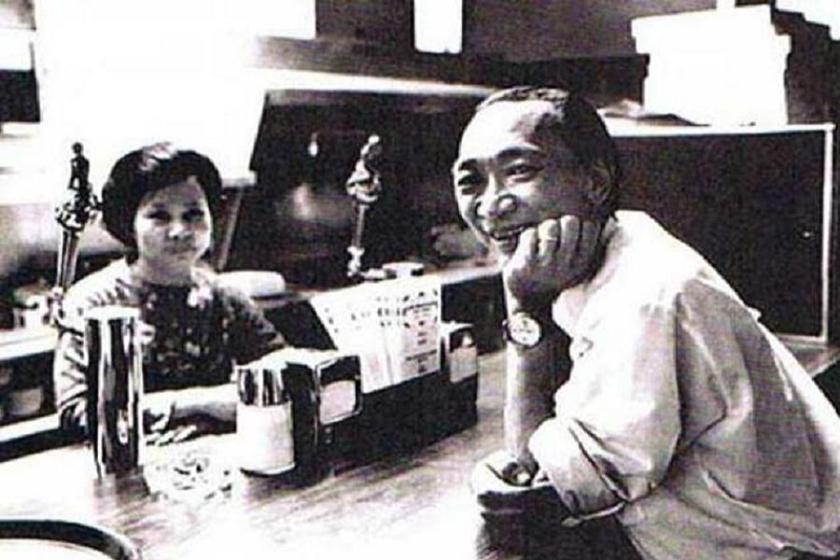
vietnam-execution-loan-restaurant

The couple was forced to close the restaurant in 1991.  Nguyễn Ngọc Loan died of cancer, seven years later.

Eddie Adams won his Pulitzer in 1969, but came to regret that he had ever taken the picture. Years later he wrote in Time Magazine. ‘The general killed the Viet Cong; I killed the general with my camera. Still photographs are the most powerful weapon in the world. People believe them, but photographs do lie, even without manipulation. They are only half-truths. What the photograph didn’t say was, “What would you do if you were the general at that time and place on that hot day, and you caught the so-called bad guy after he blew away one, two or three American soldiers?”‘

Before Nguyễn died, Adams apologized to the General and his family, for what that image had done to the man’s reputation. “The guy was a hero”, he said, after his death. “America should be crying. I just hate to see him go this way, without people knowing anything about him.”

January 29, 1944 Operation Pied Piper

In the summer of 1938, the horrors of the Great War were a mere twenty years in the past.  Hitler had swallowed up Austria, only six months earlier.   Authorities divided the British Isles into “risk zones”, identified as “evacuation,” “neutral,” and “reception.”  In some of the most gut wrenching decisions of the age, these people were planning “Operation Pied Piper”, the evacuation of millions of their own children, in the event of war.

For the people of the modern Czech Republic, the Munich agreement of 1938 was a betrayal. “O nás bez nás!” “About us, without us!”

431768
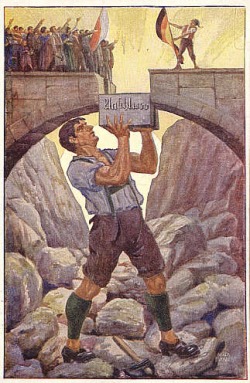
Nazi propaganda depicting German Anschluss with Austria

Intent on avoiding war with Nazi Germany, Italy, France and Great Britain had convened in Munich that September, to resolve German claims on western Czechoslovakia.  The “Sudetenland”.  Representatives of the Czech and Slovak peoples, were not invited.

On September 30, British Prime Minister Neville Chamberlain returned to London, declaring “Peace in Our Time”.  The piece of paper Chamberlain held in his hand bore the signatures of Adolf Hitler, Benito Mussolini and Édouard Daladier as well as his own, annexing the Sudetenland, to Nazi Germany.

To Winston Churchill, it was an act of appeasement.  Feeding the crocodile (Hitler), in hopes that he will eat you last.  For much of Great Britain, the sense of relief was palpable.

In the summer of 1938, the horrors of the Great War were a mere twenty years in the past.  Hitler had swallowed up Austria, only six months earlier.   British authorities divided the home islands into “risk zones”, identified as “Evacuation,” “Neutral,” and “Reception.”  In some of the most gut wrenching decisions of the age, these people were planning “Operation Pied Piper”, the evacuation of millions of their own children, in the event of war.

94330When Nazi Germany invaded Poland the following September, London mayor Herbert Morrison was at 10 Downing Street, meeting with Chamberlain’s aide, Sir Horace Wilson.  Morrison believed that the time had come for Operation Pied Piper.  A year to the day from the Prime Minister’s “Peace in our Time” declaration, Wilson protested.  “But we’re not at war yet, and we wouldn’t want to do anything to upset delicate negotiations, would we?”
Morrison was done with the Prime Minister’s dilatory response to Hitler’s aggression, practically snarling in his thick, East London accent “Look, ’Orace, go in there and tell Neville this from me: If I don’t get the order to evacuate the children from London this morning, I’m going to give it myself – and tell the papers why I’m doing it. ’Ow will ’is nibs like that?”

Thirty minutes later, Morrison had the document. The evacuation, had begun.

large_000000

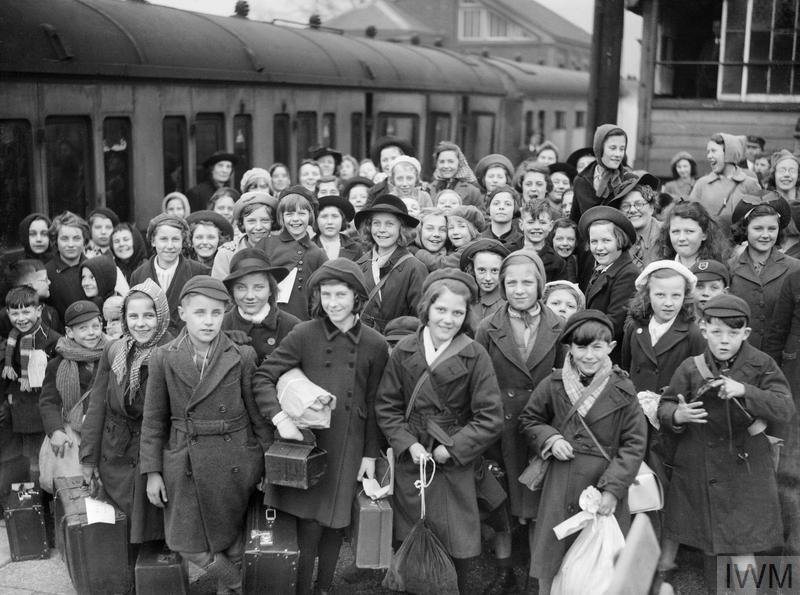
Next weekend, Superbowl 52 will be played at U.S. Bank Stadium, in front of a crowd of 66,655. In 1938, forty-five times that number were mobilized in the first four days of the evacuation, primarily children, relocated from cities and towns across Great Britain to the relative safety of the countryside. What must that have sounded like?

Operation_Pied_Piper-PosterBBC History reported that, “within a week, a quarter of the population of Britain would have a new address”.

Zeppelin raids had killed 1,500 civilians in London alone, during the ‘Great War’.  Since then, governments had gotten so much better at killing each other’s citizens.  As early as 1922, Prime Minister Lord Arthur Balfour had spoken of ‘unremitting bombardment of a kind that no other city has ever had to endure.’  As many as 4,000,000 civilian casualties were predicted, in London alone.

BBC History describes the man in charge of the evacuation, Sir John Anderson, as a “cold, inhuman character with little understanding of the emotional upheaval that might be created by evacuation”.

Children were labeled ‘like luggage’, and sent off with gas masks, toothbrushes and fresh socks & underwear. None of them knew to where, or for how long.

thumbnail_ww2evacueesThe evacuation of all that humanity ran relatively smoothly, considering.  James Roffey, founder of the Evacuees Reunion Association, recalls ‘We marched to Waterloo Station behind our head teacher carrying a banner with our school’s name on it. We all thought it was a holiday, but the only thing we couldn’t work out was why the women and girls were crying.’

Arrivals at the billeting areas, were another matter.  Many kids were shipped off to the wrong places, and rations were insufficient.  Geoffrey Barfoot, billeting officer in the seaside town of Weston-super-Mare, said ‘The trains were coming in thick and fast. It was soon obvious that we just didn’t have the bed space.’

Kids were lined up against walls and on stages, and potential hosts were invited to “take their pick”.

For many, the terrors and confusion of those first few days grew into love and friendships, that lasted a lifetime.  Others entered a hell of physical or sexual abuse, or worse.

For the first time, “city kids” and country folks were finding out how the “other half” lived, with sometimes amusing results.  One boy wrinkled his nose on seeing carrots pulled out of muddy fields, saying “Ours come in tins”.  Richard Singleton recalled the first time he asked his Welsh ‘foster mother’ for directions to the toilet.  “She took me into a shed and pointed to the ground. Surprised, I asked her for some paper to wipe our bums.  She walked away and came back with a bunch of leaves.”

John Abbot, evacuated from Bristol, had his rations stolen by his host family. He was horsewhipped for speaking out while they enjoyed his food, and he was given nothing more than mashed potatoes. Terri McNeil was locked in a birdcage and left with a piece of bread and a bowl of water.

an-evac-killed-by-bus-near-blackpoolIn the 2003 BBC Radio documentary “Evacuation: The True Story,” clinical psychologist Steve Davis described the worst cases, as “little more than a pedophile’s charter.”

Eighty years later, the words “I’ll take that one”, are seared into the memories of more than a few.

Hundreds of evacuees were killed because of relocation, while en route or during their stays at “safe havens”.  Two boys were killed on a Cornish beach, mined to defend against German amphibious assault. Apparently, no one had thought to put up a sign.

Irene Wells, age 8, was standing in a church doorway, when she was crushed by an army truck.  One MP from the house of Commons said “There have been cases of evacuees dying in the evacuation areas. Fancy that type of news coming to the father of children who have been evacuated”.

When German air raids failed to materialize, many parents decided to bring the kids back home.  By January 1940, almost half of evacuees had returned.

980xAuthorities produced posters urging parents to leave the kids where they were, and a good thing, too. The Blitz against London itself began on September 7. The city experienced the most devastating attack to-date on December 29, in a blanket fire-bombing that killed almost 3,600 civilians.

Sometimes, refugees from relatively safe locations were shipped into high-risk target areas. Hundreds of refugees from Gibraltar were sent into London, in the early days of the Blitz. None of them could have been happy to leave London Station, to see hundreds of locals pushing past them, hurrying to get out.

This story doesn’t only involve the British home islands, either.  American Companies like Hoover and Eastman Kodak took thousands of children in, from employees of British subsidiaries.  Thousands of English women and children were evacuated to Australia, following the Japanese attack on Singapore.

62d70d4914a701b66b42480e66c82105By October 1940, the “Battle of Britain” had devolved into a mutually devastating battle of attrition, in which neither side was capable of striking the death blow. Hitler cast his gaze eastward the following June, with a surprise attack on his “ally”, Josef Stalin.

“Operation Steinbock”, the Luftwaffe’s last large-scale strategic bombing campaign of the war against southern England, was carried out three years later.  285 German bombers attacked London on this day in 1944, in what the Brits called the “Baby Blitz”. You’ve got to be some tough cookie, to call 245 bombers a Baby Blitz.

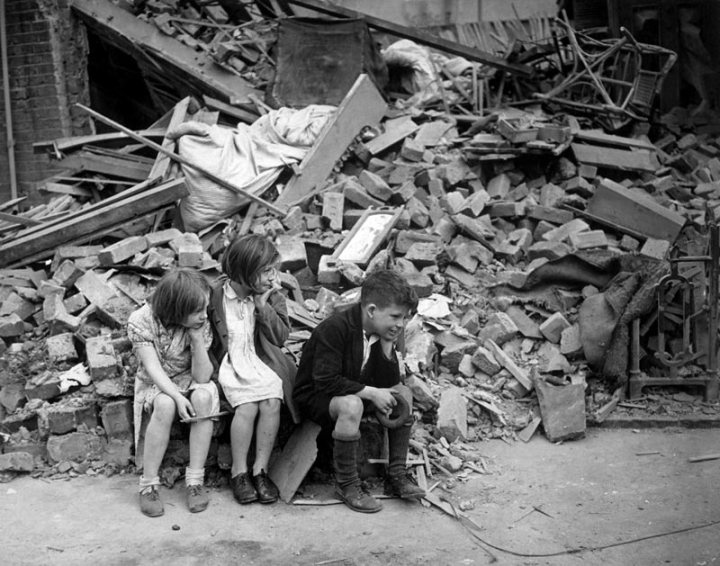
WWII_London_Blitz_East_London-Children

Late in the war, the subsonic “Doodle Bug” or V1 “flying bomb” was replaced by the terrifying supersonic V2.  1,000 or more of these, the world’s first rocket, were unleashed against southern England, primarily London, killing or wounding 115,000. With a terminal velocity of 2,386mph, you never saw or heard this thing coming, until the weapon had done its work.

15092_0In the end, many family ‘reunions’ were as emotionally bruising as the original breakup.   Years had come and gone and new relationships had formed.  The war had turned biological family members, into all but strangers.

Richard Singleton remembers the day his mother came, to take him home to Liverpool.  “I had been happily living with ‘Aunty Liz and Uncle Moses’ for four years,” he recalled. “I told Mam that I didn’t want to go home. I was so upset because I was leaving and might never again see aunty and uncle and everything that I loved on the farm.”

Douglas Wood tells a similar story.  “During my evacuation I had only seen my mother twice and my father once,” he recalls. “On the day that they visited me together, they had walked past me in the street as they did not recognise me. I no longer had a Birmingham accent and this was the subject of much ridicule. I had lost all affinity with my family so there was no love or affection.”

The Austrian-British psychoanalyst Anna Freud, daughter of Sigmund Freud, commissioned an examination of the psychological effects of the separation. After a 12-month study, she concluded that “separation from their parents is a worse shock for children than a bombing.”

January 26, 1945 Underage, and Under Weight

After the war, Audi Murphy was asked how he could have grabbed that machine gun, and taken on an entire company of German infantry.  “They were killing my friends”, he replied.

In the days following the Japanese sneak attack on Pearl Harbor, hundreds of thousands of Americans rushed to enlist in the United States’ armed services.  One of these was the son of a Hunt County Texas sharecropper family,  Audie Leon Murphy.

He went to the Marine Corps, Navy and the Army, and all turned him down, for being underweight and under age.  Murphy changed his diet to “fatten” up, and appeared at a Dallas recruiting station six months later, armed with a sworn affidavit from his sister, inflating his age by a year. It was 10 days past his 17th birthday when Audi Murphy, all 5’5½” and 112 lbs of him, enlisted in the United States Army.

f50b348dd608662fdfc1b4b1203ddf06Murphy’s company commander thought he wasn’t big enough for infantry service, and attempted to transfer him to cook and bakers’ school. Murphy refused.  He wanted to be a combat soldier.

Joining the 3rd Infantry Division of George S. Patton’s 7th Army, Murphy participated in amphibious landings in Sicily in July, fighting in nearly every aspect of the Italian campaign.

From Palermo to Messina and on to Naples, Anzio and Rome, the Germans were driven out of the Italian peninsula in savage and near continuous fighting that killed a member of my own family.

By mid-December, the 3rd ID suffered 683 dead, 170 missing, and 2,412 wounded. Now Sergeant Murphy was there for most of it, excepting two periods when he was down with malaria.

Two months after the “Overlord” landings in Normandy, elements of the 7th Army landed in southern France in an operation called “Dragoon”. By mid-September, only three of Company B’s original roster remained, the rest either killed or removed due to wounds or illness. It was around this time when Audi Murphy received his first Purple Heart.  A mortar blast resulted in a heel wound that wasn’t very serious, but a far more dangerous hip wound followed from a sniper, that December.  Murphy repaid the sniper, with a bullet between the German’s eyes.

Reduction of Colmar Pocket - January 20, 1945-February 9, 1944He was still in the hospital when his unit moved into the Vosges Mountains, in Eastern France.

The “Colmar Pocket” was an 850 square mile area held by German troops: Murphy described it as “a huge and dangerous bridgehead thrusting west of the Rhine like an iron fist. Fed with men and materiel from across the river, it is a constant threat to our right flank; and potentially it is a perfect springboard from which the enemy could start a powerful counterattack.”

Rejoining his unit in January, now Lieutenant Murphy became Company Commander, being the only officer remaining in the Company. Disease, wounds and casualties had reduced company B’s fighting strength by this time from an original 235, to 18.

What remained of the unit was awaiting reinforcements on January 26, 1945, as a combined force of German infantry and armor assembled itself outside of town. “I see the Germans lining up for an attack”, said Murphy. “Six tanks rumble to the outskirts of Holtzwihr, split into groups of threes, and fan out toward either side of the clearing. Then wave after wave of white dots, barely discernible against the background of snow, start across the field. They are enemy infantrymen”.

Let Lt. Murphy’s Medal of Honor Citation describe what happened next:

Audie-murphy-tank-scene-world-war-II-2“Second Lieutenant Audie L. Murphy, 01692509, 15th Infantry, Army of the United States, on 26 January 1945, near Holtzwihr, France, commanded Company B, which was attacked by six tanks and waves of infantry. Lieutenant Murphy ordered his men to withdraw to a prepared position in a woods while he remained forward at his command post and continued to give fire directions to the artillery by telephone. Behind him to his right one of our tank destroyers received a direct hit and began to burn. Its crew withdrew to the woods. Lieutenant Murphy continued to direct artillery fire which killed large numbers of the advancing enemy infantry. With the enemy tanks abreast of his position, Lieutenant Murphy climbed on the burning tank destroyer which was in danger of blowing up any instant and employed its .50 caliber machine gun against the enemy. He was alone and exposed to the German fire from three sides, but his deadly fire killed dozens of Germans and caused their infantry attack to waver. The enemy tanks, losing infantry support, began to fall back. For an hour the Germans tried every available weapon to eliminate Lieutenant Murphy, but he continued to hold his position and wiped out a squad which was trying to creep up unnoticed on his right flank. Germans reached as close as 10 yards only to be mowed down by his fire. He received a leg wound but ignored it and continued the single-handed fight until his ammunition was exhausted. He then made his way to his company, refused medical attention, and organized the company in a counterattack which forced the Germans to withdraw. His directing of artillery fire wiped out many of the enemy; he personally killed or wounded about 50. Lieutenant Murphy’s indomitable courage and his refusal to give an inch of ground saved his company from possible encirclement and destruction and enabled it to hold the woods which had been the enemy’s objective”.
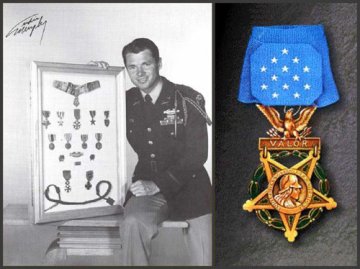
After the war, Audi Murphy was asked how he could have grabbed that machine gun, and taken on an entire company of German infantry.  “They were killing my friends”, he replied.

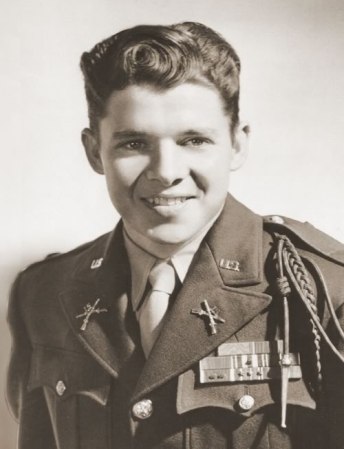
MurphyMOHThe man who had once been judged too small to fight was one of the most decorated American combat soldiers of WW2, having received every military combat award for valor the United States Army has to give, plus additional awards for heroism, from France and from Belgium.
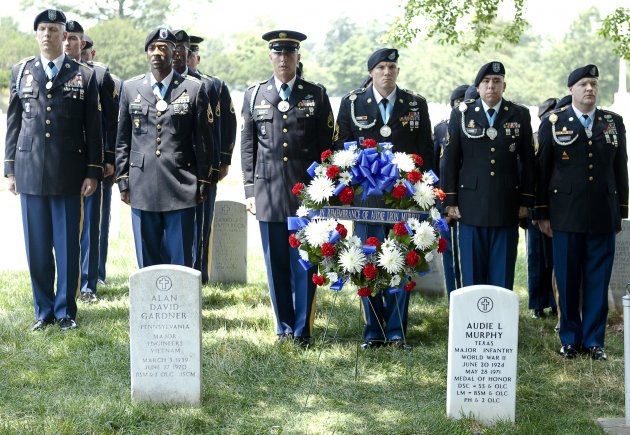
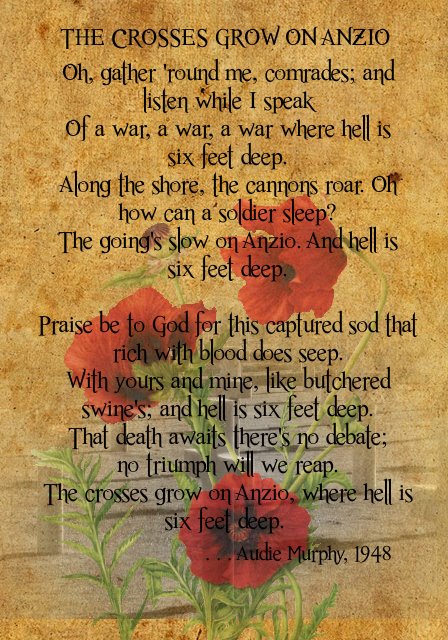
Audi Murphy returned to civil life and a 21-year career in Hollywood, starring in 40 feature films and a television series.  The transition was difficult  There were frequent bouts of depression and insomnia, and an addiction to sedatives.  He turned to poetry and songwriting for a creative outlet, but images of German war orphans could bring him to tears of guilt.  He slept with a loaded gun under his pillow, and there were episodes which professional colleagues and family members, found alarming.

In Murphy’s Day it was called “Battle Fatigue”, or “Shell Shock”.  He was candid about his own difficulties, and called on government to give increased consideration to the emotional toll inflicted on those whom it sent into combat.

Audi Murphy was killed in a plane crash near Catawba, Virginia, and buried with full military honors, in Arlington National Cemetery.  He was 45.

Audie Murphy Gravesite

Nine years later, the American Psychiatric Association recognized Post-Traumatic Stress Disorder (PTSD) in the 3rd edition of its Diagnostic and Statistical Manual of Mental Disorders.

Data from the National Vital Statistics System, a collaboration of the National Center for Health Statistics of the Department of Health and Human Services, reveals a suicide rate among veteran populations approximately twice that of comparable civilian populations.

I wonder about that term. “Disorder”.  The word makes it sound like there’s something wrong with these guys.

When a soldier experiences an event, so traumatic that the very memory of it causes pain, I don’t understand how that can be characterized as a “disorder”. To me it seems like the properly functioning conscience of a good man, recoiling in horror at what he’s seen in service to his country.

cc5083d1b7c62b153cd42c8f568de8f7

January 24, 1776 A Noble Train of Artillery

It must have been a sight when that noble train of artillery entered Cambridge on this day in 1776. By March, Henry Knox’ cannon would be manhandled to the top of Dorchester Heights, resulting in the British evacuation of Boston and a peculiar Massachusetts institution which exists to this day, known as “Evacuation Day”: March 17.

The American Revolution began with the “Shot Heard Round the World” on the morning of April 19, 1775. Within days of the Battles at Lexington and Concord and the subsequent British withdrawal to Boston, over 20,000 men poured into Cambridge from all over New England. Abandoned Tory homes and the empty Christ Church became temporary barracks and field hospitals.  Even Harvard College shut down, its buildings becoming quarters for at least 1,600 Patriots.

127472-004-69EA7B31The Continental Congress appointed George Washington General of this “Army” on June 15, two days before the British assault on Farmer Breed’s hill. An action which took its name from that of a neighboring farmer, going into history as the Battle of Bunker Hill.
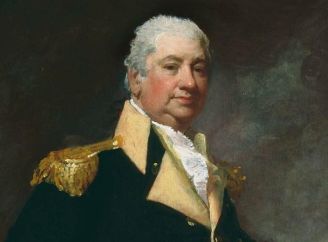
Shortly after his arrival in July, General Washington discovered that his army had enough gunpowder for nine rounds per man, and then they’d be done.

At the time, Boston was a virtual island, connected to the mainland by a narrow strip of land.  British forces were effectively penned up in Boston, by a force too weak to do anything about it.

henry-knox-large-57c4b9525f9b5855e5f5e9c7
Henry Knox

The stalemate dragged on for months, when a 25-year-old bookseller came to General Washington with a plan. His name was Henry Knox. His plan was a 300-mile, round trip slog into a New England winter, to retrieve the guns of Fort Ticonderoga.

Washington’s advisors derided the idea as hopeless, but the General approved. Henry Knox set out with a column of men on December 1.

Located on the New York banks of Lake Champlain, Fort Ticonderoga was captured by a small force led by Ethan Allen and Colonel Benedict Arnold, in May of that year. In it were brass and iron cannon, howitzers, and mortars, 59 pieces in all. Arriving on December 5, Knox and his men set about disassembling the artillery, making it ready for transport. A flotilla of flat bottom boats was scavenged from all over the countryside, the guns loaded and rowed the length of Lake George, arriving barely before the water began to freeze over.

colonel-knox-bringing-the-cannons-from-fort-ticonderoga (2)Local farmers were enlisted to help and by December 17, Knox was able to report to General Washington “I have had made forty two exceedingly strong sleds & have provided eighty yoke of oxen to drag them as far as Springfield where I shall get fresh cattle to carry them to camp. . . . I hope in 16 or 17 days to be able to present your Excellency a noble train of artillery.”
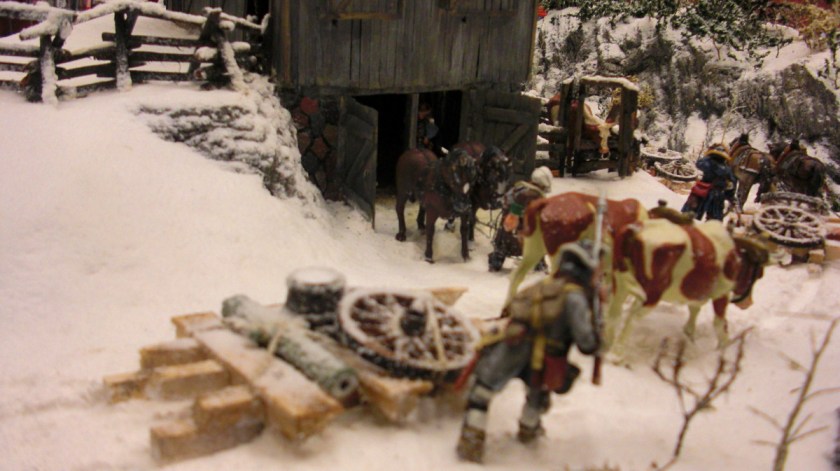
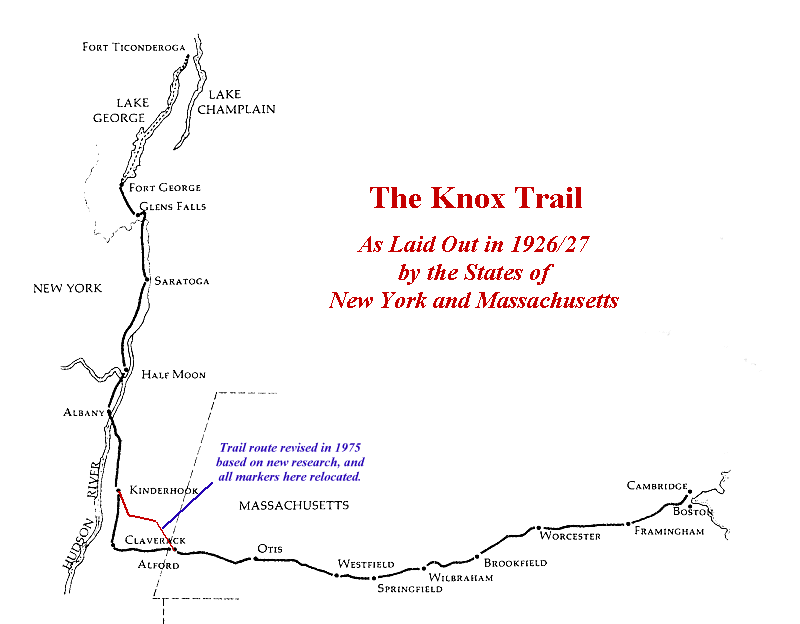
Bare ground prevented the sleds from moving until Christmas morning, when a heavy snow fell and the column set out for Albany. Two attempts to cross the Hudson River on January 5 each resulted in cannon being lost to the river, but finally Knox was able to write “Went on the ice about 8 o’clock in the morning & proceeded so carefully that before night we got over 23 sleds & were so lucky as to get the Cannon out of the River, owing to the assistance the good people of the City of Albany gave.”

CIMG5933

Continuing east, Knox and his men crossed into Massachusetts, over the Berkshires, and on to Springfield. With 80 fresh yoke of oxen, the 5,400lb sleds moved along much of what are modern-day Routes 9 and 20, passing through Brookfield, Spencer, Leicester, Worcester, Shrewsbury, Northborough, Marlborough, Southborough, Framingham, Wayland, Weston, Waltham, and Watertown.

knoxtrailmap

It must have been a sight when that noble train of artillery entered Cambridge on this day in 1776. By March, Henry Knox’ cannon would be manhandled to the top of Dorchester Heights, resulting in the British evacuation of Boston and a peculiar Massachusetts institution which exists to this day, known as “Evacuation Day”: March 17.

It is doubtful whether Washington possessed sufficient powder or shot for a sustained campaign, but British forces occupying Boston didn’t know that. The mere presence of those guns moved British General Howe to weigh anchor and sail for Nova Scotia, but that must be a story for another day.

January 21, 1824 Stonewall

Today we remember Stonewall Jackson as a brilliant military tactician and Confederate commander, second only to Robert E. Lee.  Who knew that the man was also a civil rights leader.  Real history is so much more interesting than the political and pop culture varieties.

Cheers rang out in the streets of Washington DC, as General Irvin McDowell’s Army of the Potomac marched out to meet the Confederate Army of the Shenandoah, led by Brigadier General Pierre Gustave Toutant-Beauregard.  The first major battle of the Civil War was joined on July 21, in what Confederates called the Battle of 1st Manassas, and the Federals called 1st Bull Run.

First Manassas July 21, 1861 SquareOn that July morning, no one had any idea of the years-long bloodbath that lay ahead.  35,000 Federal troops, 90-day recruits all, had arrived to crush a trifling force of rebels.  Then on to Richmond, the Confederate capitol, and the end of the uprising.

The atmosphere was festive, like a football game.  The upper crust of Washington society had turned out in their carriages.  There was wine and picnic baskets, society ladies and their beaus, congressmen and their families, all arrived to watch the show.

Green and inexperienced as they were, the fighting was at times confused, and could have gone either way.  The tide of the battle turned at 4pm, with the capture of Artillery Captain James Ricketts’ guns. An hour later the Union position began to disintegrate.  Soon, a disorderly retreat turned into a rout, a blue-clad stampede back to Washington, on roads clogged with panicked civilians, attempting to flee in their carriages.

The battle could have ended differently, when Colonel William Tecumseh Sherman struck the right flank of the Confederate defenders near Henry House Hill, collapsing the Rebel line and sending it into disorderly retreat.  The Virginia Brigade of General Thomas Jonathan Jackson came up at this point, taking a defensive position on Henry House Hill.  Brigadier General Barnard Bee exhorted his troops to reform, shouting “There is Jackson standing like a stone wall. Rally behind the Virginians.”

35aknky
Confederate General and VMI Professor Thomas Jonathan Jackson wore a blue uniform, at the Battle of 1st Manassas.  Note the 1st (of three) Confederate national flags, the “Stars and Bars”.

Some will tell you that Bee’s comment was meant to be pejorative, as in “Look at Jackson standing there like a stone wall!”  We’ll never know. General Bee was shot in the abdomen and died the next day.  The legend of “Stonewall Jackson”, was here to stay.

Born in Clarksburg Virginia on January 21, 1824, the boy lost his father at age two and his mother, five years later.  Largely self-educated, the future Civil War General went to live with an uncle.  As a boy, Jackson made a deal with one of his uncle’s slaves, to teach the man to read.  It was illegal at this time, to teach blacks to read, but Jackson was as good as his word, receiving pine knots in exchange for lessons.

Jackson16
Stonewall Jackson pictured astride his favorite mount, “Little Sorrel”

Thomas Jonathan Jackson was a devoutly religious man, said to fear only God.  “My religious belief teaches me” he said, “to feel as safe in battle as in bed.”

Jackson was educated at the United States Military Academy at West Point New York, graduating in 1846 and serving in the Mexican-American war.  Returning to civil life in 1851, Jackson moved to Lexington Virginia, where he worked as a professor of natural and experimental philosophy (Physics), and instructor of artillery at the Virginia Military Institute.

Though himself an owner of African slaves from a family of slave owners, Thomas Jackson was well regarded among the free and enslaved blacks of Lexington.  This may sound paradoxical to the modern reader, but the players in this story were products of their time.  Not ours.

sjchurJackson believed that slavery existed because the Creator willed it.  His mission was to save their souls, by teaching them the Old Testament, the Ten Commandments, the Lord’s Prayer and the Apostle’s Creed.

So it was that Jackson and his wife established the Lexington Presbyterian Church Sunday School. There, contrary to state law. the pair taught African-American children to read and write, continuing to do so until Jackson went to war, in 1861.  The next time he would visit was to be buried there, in 1863.

Jackson’s military career reads like a timeline of his era.  The Great Train Raid of 1861.  Falling Waters. Bull Run (Manassas), 1st and 2nd. The Romney Expedition.  The Valley Campaign. The Seven Days’ Battles. The Northern Virginia Campaign. The Maryland Campaign, Harpers Ferry, Antietam and Fredericksburg.  And the last.  Chancellorsville.  The Virginia town where the story of Stonewall Jackson comes to an end.

Returning to camp on May 2, 1863, Jackson and his staff were mistaken in the rain and darkness for a Union cavalry force.   A nervous sentry from the 18th North Carolina shouted, “Halt, who goes there?”, and fired before things sorted out.  Frantic shouts from Jackson’s party trying to identify themselves were met by Major John Barry, who shouted, “It’s a damned Yankee trick! Fire!”  Several of Jackson’s men were killed on the spot, along with a number of horses.  Jackson himself was shot twice in the left arm, and once in the right hand.

Robert E. Lee wrote to the General, on learning of his injuries:  “Could I have directed events, I would have chosen for the good of the country to be disabled in your stead.”

There was no saving Jackson’s arm.  The limb was amputated by Dr. Hunter McGuire, the following day  Jackson was moved to the office building at the Chandler plantation in Guinea Station.  General Lee complained, “He has lost his left arm, but I have lost my right arm.”

dsc00823

By that time, Jackson was already developing a tightness in his chest, an early sign of pneumonia.

Before antibiotics, doctors could predict the hour of death, of pneumonia patients.  On May 10, eight days after being shot, Jackson was breathing his last.  “It is the Lord’s Day; my wish is fulfilled. I have always desired to die on Sunday.”

Dr. McGuire wrote the following account of Stonewall Jackson’s last words:  “A few moments before he died he cried out in his delirium, ‘Order A.P. Hill to prepare for action! Pass the infantry to the front rapidly! Tell Major Hawks —’ then stopped, leaving the sentence unfinished. Presently a smile of ineffable sweetness spread itself over his pale face, and he said quietly, and with an expression, as if of relief, ‘Let us cross over the river, and rest under the shade of the trees.’

CW-334 Last Tribute of Respect
“Last Tribute of Respect”, by Mort Künstler

In 1906, Reverend LL Downing raised money to install a memorial window in the 5th Avenue Presbyterian Church of Roanoke, dedicated to Stonewall Jackson.  And to Reverend Dowling’s own parents, who as slave children had been educated in Jackson’s Sunday school.  It may be the only “black” church in the country, with a stain-glass window dedicated to a Confederate General.

manassas085b

CBS Sunday Morning did an interesting segment on the church and its window, amidst the current hysteria involving Confederate monuments.  Their article and the video, are linked here.

Today we remember Stonewall Jackson as a brilliant military tactician and Confederate commander, second only to Robert E. Lee.  Who knew that the man was also a civil rights leader.  Real history is so much more interesting than the political and pop culture varieties.

Feature Image, top, by 20th century artist and illustrator, N. C. Wyeth

January 20, 1940  A People, an Empire, a Drink

Coca-Cola GmbH had concocted a sweet, slightly cheesy tasting soft drink, and the German market responded. Sales rose steadily throughout the war, particularly as alternatives became increasingly scarce. People didn’t just drink the stuff, either.

In 1865, Confederate Cavalry officer John Stith Pemberton was wounded by a saber slash. Like many wounded veterans, Pemberton became addicted to the morphine given him to help ease the pain. Unlike most, “Dr.” Pemberton possessed the wherewithal to do something about it.

In civil life, Pemberton was a chemist.  After the war, the former cavalry officer experimented with non-opiate pain-killers, landing on a combination of the coca leaf and kola nut.  By 1886, he was bottling his concoction and selling it for 5¢ a bottle out of an Atlanta pharmacy.  Ten years later, Coca-Cola was available in every American state and territory.

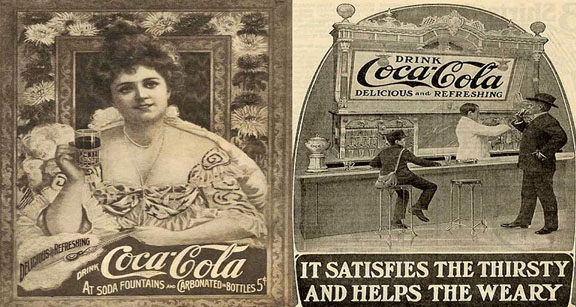
Cocaine_CocaCola2

Europeans had long believed that natural mineral waters held medicinal qualities, and favored such beverages over often-polluted common drinking water.  In 1920, the company opened its first European bottling plant, in France. By the time of Hitler’s annexation of Austria, the “Anschluss” of 1938, Coca-Cola had been in Germany for ten years.

Around the time that Hitler and the Nazi party were coming to power in 1933, German-born Max Keith (pronounced “Kite”) took over Coca-Cola’s German subsidiary, Coca-Cola Deutschland, GmbH.  Mark Pendergrast, author of For God, Country, and Coca-Cola, writes that Keith “valued his allegiance to the drink and to the company more than his allegiance to his own country”.  He had no qualms about doing business with every aspect of German society, including Nazi party members.

Ein Getrank

Bizarre though it may sound to the modern ear, a number of famous Americans and companies were involved with the European fascist regimes of the 1930s, including William Randolph Hearst, Joseph Kennedy (JFK’s father), Charles Lindbergh, John Rockefeller, Andrew Mellon (banker, head of Alcoa, and Secretary of the Treasury), DuPont, General Motors, Standard Oil (now Exxon), Ford, ITT, Allen Dulles (later head of the CIA), Prescott Bush, National City Bank, General Electric, and many in Hollywood.

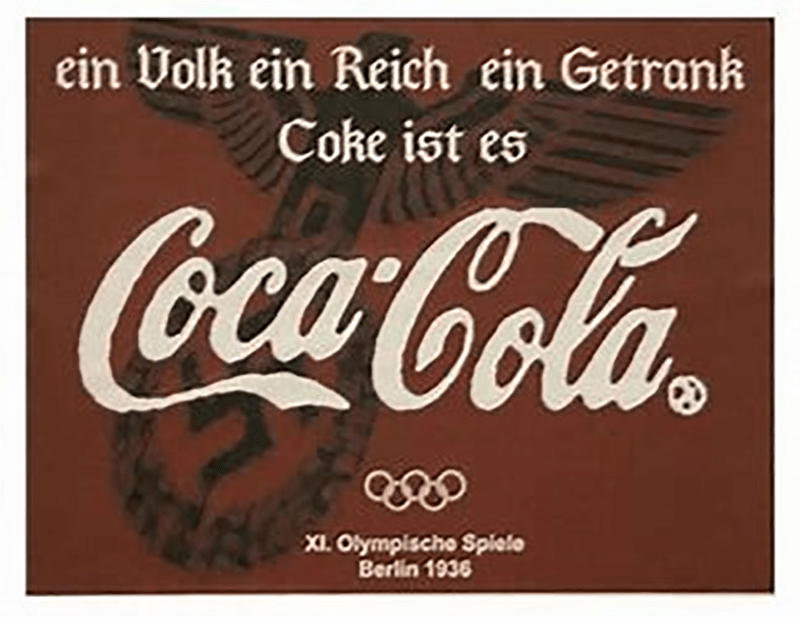
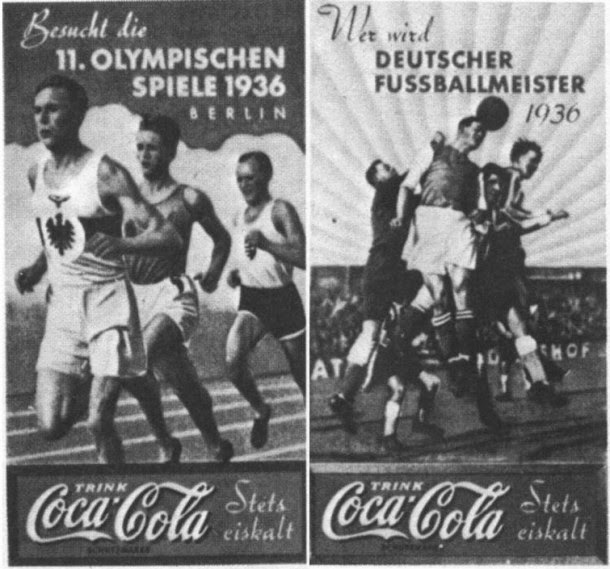
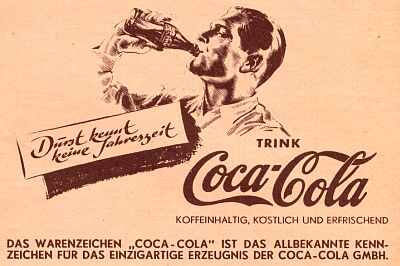
In Atlanta, Coca-Cola President Robert Woodruff was no exception.  Woodruff himself attended the 1936 Berlin Olympics, alongside banners depicting the company logo, with the slogan  “Ein Volk, ein Reich, ein Getrank – A People, an Empire, a Drink”.

Coca-Cola-Advertisements-in-Nazi-Germany-in-the-1930s-8

Woodruff used a 10th anniversary party for Coca-Cola GmbH to organize a mass Nazi salute in honor of Hitler’s 50th birthday, declaring that it was “to commemorate our deepest admiration for our Fuhrer.”

On January 20, 1940, Winston Churchill urged neutral nations to oppose the Nazi war machine, warning that, “Each one hopes that if he feeds the crocodile enough, the crocodile will eat him last.”  Meanwhile in Germany, Coca Cola was the undisputed king of the domestic soft drink market.

Memorial-Day-2010-From-Time-Mag-1942-OUT-12

That changed a year later, with the Japanese attack on Pearl Harbor, and the German declaration of war on the United States.

American entry into WW2 meant that American companies ceased business with axis powers, while the German government threatened to seize “enemy owned” businesses.  Max Keith was cut off from all communications with Coca-Cola headquarters in Atlanta, and in danger of the Nazi party nationalizing his beloved company.  As shipments of Coca-Cola’s mythical “7X’ syrup, dried up, Keith had to come up with a substitute for the domestic soft drink market.  Schnell.

Soldiers Gulp Down Coca Cola
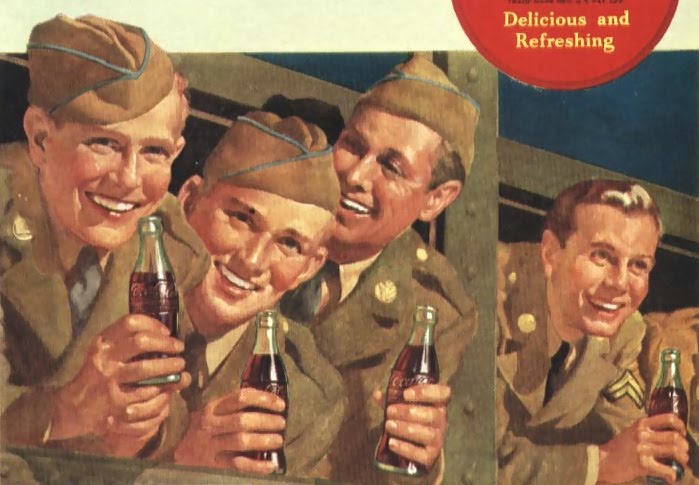
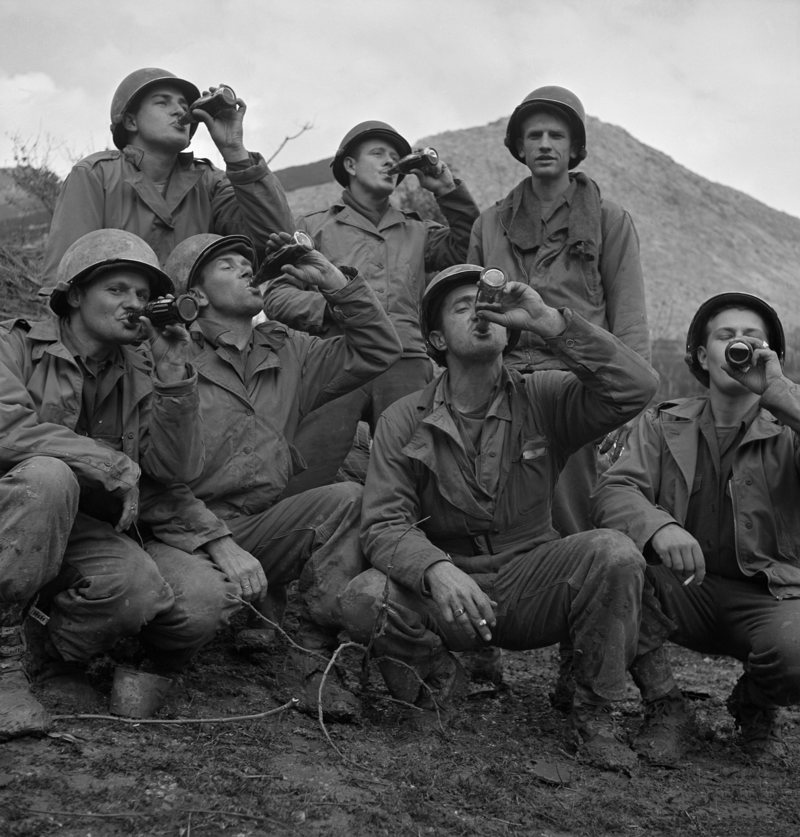
Coca-Cola worked with the U.S. government to ensure troops, including these men in Italy, had access to Coke throughout WW2. Bettmann/Getty Images

With wartime rationing already in effect, Keith and his chemists worked with what was available.  Leftovers from other food industries, apple fibers, fruit peelings, beet sugar  and whey, the liquid left over when milk was curdled and strained off to make cheese.

The result was “Fantasievoll”, “Fantastiche” (“Imaginative”, “Fantastic”).  So it is that the soft drink “Fanta”, was borne of the wartime necessities of Nazi Germany.

Coca-Cola GmbH had concocted a sweet, slightly cheesy tasting soft drink, and the German market responded. Sales rose steadily throughout the war, particularly as alternatives became increasingly scarce. People didn’t just drink the stuff, either. With sweeteners of all kinds strictly rationed, Fanta made its way into baked goods, soups and a variety of foodstuffs. By 1943, Fanta sales reached almost three million cases.

Fanta-3

Tristan Donovan, author of the book Fizz: How Soda Shook Up the World, writes “It was Fanta or nothing”. Pendergrast writes that there’s little doubt that Keith did business with Nazis, but he was more company guy than idealogue. “You could not do business inside of Nazi Germany unless you collaborated with them,” wrote Pendergrast. “There’s no question he was a Nazi collaborator. [But] he was not a member of the Nazi party. His allegiance was to Coca-Cola, not to Hitler.”

When American troops liberated Germany in the summer of 1945, legend has it that they found Keith in a half-bombed out factory, still bottling the stuff.

Fun fact: Hitler and his henchmen didn’t call themselves “Nazis”, in fact the term was frowned upon. They were the “NSDAP”, the Nazionale Socialistiche Deutsche Arbaits Partai, (National Socialist German Workers Party), the original abbreviation forwhich, was “Nasos”. The word “Nazi” derives from a Bavarian term meaning “simple minded” and was first used as a term of derision by journalist Konrad Heiden. The term was adopted by Anti-NSDAP’ers and Allied troops after war broke out, and the name stuck.

Despite being on the losing side, Keith was hailed as a hero back in Atlanta. The man who kept the company alive, in Germany. Vice President of Sales Harrison Jones called Keith a “great man”.  He was given control of Coca-Cola, in all of Europe.

coca-cola_ad_third_reich_1935

In April 1955, Coca-Cola reintroduced Fanta as an orange drink. Starting in Italy, the product made its way to the United States, in 1958. The name stuck, and why not. The company already owned the copyright.

In 2012, Fanta saw the strongest sales growth of the top 10 brands, the third Coke branded product to surpass 2 billion in case sales. Today, more than 100 flavors of Fanta are sold around the world, where customers from Latin America to Africa, to Europe, Brazil and China can say,  “Es ist die Reale Sache”.  It’s the Real Thing.


January 8, 1945 The Sub that Bagged a Train

So ended the only ground combat operation of WW2, on the soil of the Japanese homeland. And so it is, that an American submarine came to count a Medal of Honor and a Japanese locomotive, among its battle honors.

In the early phase of WW2, the traditional role of the American submarine service was to search, identify and report enemy activity to surface ships. Customary tactics emphasized stealth over offense, preferring to submerge and lie in wait over the surface attack.

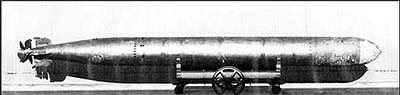
Small wonder. The Mark XIV torpedo, the primary anti-ship submarine-launched torpedo of WW2, was literally a scandal. Not only was torpedo production woefully inadequate to the needs of the war in the Pacific, but stingy pre-war budgets had precluded live-fire testing of the thing.

mk14torpedoAmong the Mark-XIV’s more pronounced deficiencies was a tendency to run about 10-ft. too deep, causing it to miss with depressing regularity. The magnetic exploder often caused premature firing of the warhead, and the contact exploder frequently failed altogether. There must be no worse sound to a submariner, than the metallic ‘clink’ of a dud torpedo bouncing off an enemy hull.
Worse still, these things tended to ‘run circular’, meaning that they’d return to strike the firing vessel.

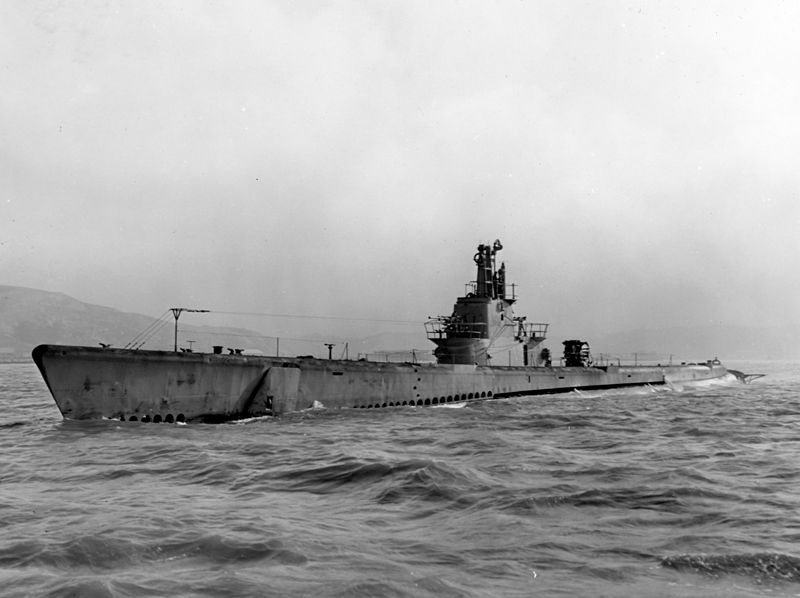
USS_Barb_(SS-220)_underway_in_May_1945
USS Barb (SS-220) underway in May, 1945

On July 24, 1943, Lawrence “Dan” Daspit commanding USS Tinosa (SS-283) attacked the 19,000-ton whale factory ship Tonan Maru III. Tinosa fired fifteen torpedoes with two stopping dead in the water and the other thirteen striking their target. Not one of them exploded. Thinking that he had a bad production run, Daspit kept his last torpedo for later inspection. Nothing out of the ordinary, was found.

Commander Eugene “Lucky” Fluckey didn’t subscribe to the conventional wisdom. WW2 vintage submarines were designed for speed on the surface, and USS Barb (SS-220) was capable of 21 knots.  Equivalent to 24mph on land. Under Commander Fluckey, Barb was for all intents and purposes, a fast-attack surface craft.

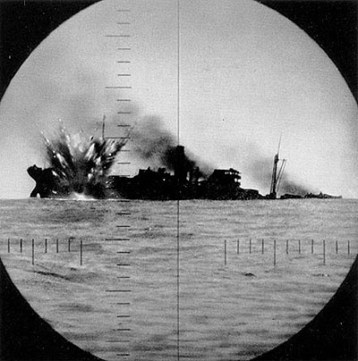
BarbperiscopeSam Moses, writing for historynet’s “Hell and High Water,” writes, “In five war patrols between May 1944 and August 1945, the 1,500-ton Barb sank twenty-nine ships and destroyed numerous factories using shore bombardment and rockets launched from the foredeck”.

In January 1945, the Barb, USS Picuda (SS-382), and the USS Queenfish (SS-393) were ordered to the China Sea, blocking the Formosa Strait to Japanese shipping.

On the 8th, the small “wolf pack” encountered eight large Japanese merchant ships, escorted by four patrol boats. In a two-hour running night battle, Barb sank merchant cargo ships Anyo Maru and Tatsuyo Maru in explosions so violent that Barb was forced to go deep, even then suffering light damage to her decks. She also sank merchant tanker Sanyo Maru and damaged the army cargo ship Meiho Maru.

The merchant tanker Hiroshima Maru ran aground in the confusion.  SS-220 returned the following day, to finish the job.

barbfastexitpaintingTwo weeks later, USS Barb spotted a 30-ship convoy, anchored in three parallel lines in Namkwan Harbor, on the China coast. Slipping past the Japanese escort guarding the harbor entrance under cover of darkness, the American submarine crept to within 3,000 yards.
Fluckey gave the order and Barb fired her six bow torpedoes at the tightly packed convoy. Swinging around, she fired her four stern torpedoes, just as the first salvo slammed home. Four ships were mortally wounded and another three heavily damaged, as a Japanese frigate opened fire.

It took a full hour to extract herself from the uncharted, heavily mined and rock-obstructed shallows of Namkwan Harbor. Torpedoes meant for the American sub struck Chinese junks instead. A Japanese aircraft appeared overhead, just as Barb slipped out into deeper water. No wonder they called him “Lucky Fluckey”.

The episode earned Commander Fluckey the Medal of Honor in March, 1945.

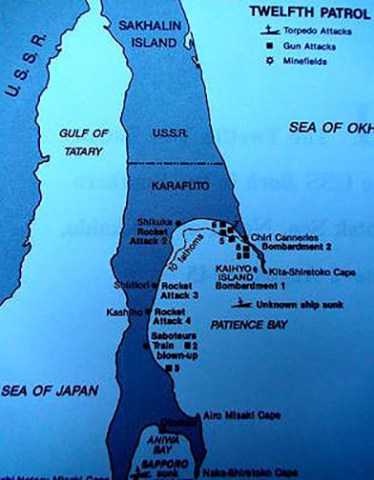
BarbOkhoskOn completion of her 11th patrol, USS Barb underwent overhaul and alterations, including the installation of 5″ rocket launchers, setting out on her 12th and final patrol in early June.
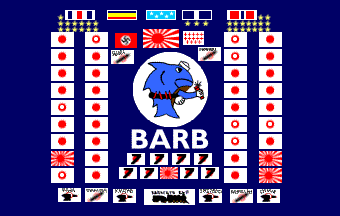
For the first time in the history of submarine warfare, rocket attacks were successfully employed against shore targets, including facilities in Shari, Hokkaido; Shikuka, Kashiho; and Shiritoru. Barb also attacked Kaihyo To with her regular armaments, destroying 60% of the town.

By mid July 1945, USS Barb had racked up one of the most successful records in the submarine service, sinking the third-highest gross tonnage of enemy shipping of the entire war, and the highest in Japanese shipping, according to the Japanese’ own records..

In poring over a coastal map of Karafuto, the Japanese end of Sakhalin island, the answer as to what to do next, soon came clear. The American sub was going to take out the supply line to enemy merchant shipping, and use a Japanese train, to do it.

Steel plates were bent and welded into crude tools, and a team of eight volunteers was selected. There was so much excitement among the crew over the idea, that even the Japanese POW on board wanted to go ashore, promising he wouldn’t try to escape.

On the night of July 22-23, Fluckey maneuvered the sub into shallow water within 950 feet of land, and put two rubber rafts ashore.

main-qimg-7d0915017cc1ad3409a1a960f4379e17Working so close to a Japanese guard tower that they could almost hear the snoring of the sentry, the eight-man team dug into the space between two ties and buried the 55-pound scuttling charge. They then dug into the space between the next two ties, and placed the battery.

At one point the team had to dive for the bushes, as a night train came through.

At last the work was done and, for the first time that night, the group disobeyed a direct order.  The other seven had been ordered to back off as Electricians Mate 3rd Class Billy Hatfield wired the switch and activated the bomb. That way only one man would die if things went wrong, but these guys weren’t going anywhere. Seven men looked on as Hatfield made the final connections, each wanting to see that this last step was done right.

Barb had worked her way to within 600′ of shore and the shore party was barely halfway back, when the second train came through. A thunderous explosion tore through the stillness, as night turned to day.  Pieces of the locomotive were thrown 200 feet in the air as twelve freight cars, two passenger cars, and a mail car derailed and piled together.

There was no further need for stealth.  With barely 6′ of water under her keel, Fluckey took up a megaphone, bellowing “Paddle like the devil!”  Five minutes later the shore party was on board.  As “The Galloping Ghost of the China Coast” slipped away, every crew member not absolutely necessary to the operation of the boat was on-deck, to witness the spectacle they had wrought.

So closes a little-known chapter of the war in the Pacific.  The only ground combat of WW2, carried out on the Japanese home islands. So it is, that an American submarine came to count a Medal of Honor and a Japanese locomotive, among its battle honors.

USS_Barb_crew_1945_i03570
Members of the USS Barb demolition squad pose with her battle flag at the conclusion of her 12th war patrol, Pearl Harbor, August 1945. Chief Gunners Mate Paul G. Saunders, USN, Electricians Mate 3rd Class Billy R. Hatfield, USNR, Signalman 2nd Class Francis N. Sevei, USNR, Ships Cook 1st Class Lawrence W. Newland, USN, Torpedomans Mate 3rd Class Edward W. Klingesmith, USNR, Motor Machinists Mate 2nd Class James E. Richard, USN, Motor Machinists Mate 1st Class John Markuson, USN; and Lieutenant William M. Walker, USNR.

In addition to Commander Fluckey’s Medal of Honor, the crew of USS Barb earned a Presidential Unit Citation, a Navy Unit Commendation, the Asiatic-Pacific Campaign Medal with eight battle stars, the World War II Victory Medal, and the National Defense Service Medal.  Of all those awards, the one of which later-Rear Admiral Fluckey was most proud, was the one he didn’t get.  In five successful combat patrols under Commander Eugene Fluckey, not one crew member of the USS Barb ever received so much as a purple heart.


If you enjoyed this “Today in History”, please feel free to re-blog, “like” & share on social media, so that others may find and enjoy it too. Please click the “follow” button on the right, to receive email updates on new articles.  Thank you for your interest, in the history we all share.

January 4, 1642  The Three Kingdoms

In the American colonies, the Petition of Right would pop up 129 years later, reflected in the 3rd, 5th, 6th and 7th amendments of the United States’ Constitution.  Four parts in ten, of what we now know as the Bill of Rights.

Agree or disagree with US government policy, what we do in this country we do as a nation.  It would seem absurd to us to see the President and Congress raise separate armies to go to war with one another, yet that’s just what happened in 17th century England.

Queen Elizabeth I passed away without issue in 1603, succeeded by her first cousin twice removed, King James VI of Scotland.  For the first time, the Kingdoms of England and Scotland were united under single rule.

Edgehill-attack-on-the-train-web
Royalist attack on the Parliamentary train at the Battle of Edgehill, October 23, 1642

The English Parliament of the age didn’t have a permanent role in government, instead being a temporary advisory body, summoned and dismissed at the will of the King.  Practically speaking, the King had no means to enforce his will on matters of taxation, without the consent of the “gentry”, the untitled land-owning classes who were the primary means of national tax collection.  This gave rise to an elected “House of Commons”, joining the House of Lords to form a Parliament.

James thought of Kings as “little Gods on Earth”, and had long gotten whatever he wanted from a supine Scottish Parliament.  The English Parliament was another matter.  James’ entire reign and that of his son Charles I, was one long contest of wills with the English governing body.

Charles’ 1625 marriage to a Roman Catholic, the French princess Henrietta Maria, did little to win him support in Protestant England.  His interventionist policies in the 30 years’ war made things worse, ending with Parliament bringing impeachment proceedings against his minister, the Duke of Buckingham.

Marston-Moor-2-web
Battle of Marston Moor, July 2, 1644

Parliament drew up the “Petition of Right”, invoking the Magna Carta and severely limiting the King’s right of non-Parliamentary taxation, along with other restrictions on the Royal Prerogative.  Charles looked to the House of Lords to check the power of the Commons, but both houses ratified the measure by the end of May.

The King dissolved this first Parliament in 1629, putting nine of its leaders in prison and unwittingly making them martyrs for their cause.  The following 11 years are sometimes called “the personal rule” or the “eleven years’ tyranny”.  By 1640 Charles had severe money problems, forcing him to call another Parliament.

The King wanted a more docile body this time, so he appointed many of his adversaries as Sheriffs, knowing that this would require them to stay within their counties, making them ineligible for election.  On others he bestowed aristocratic titles, making them ineligible for the House of Commons.  Of course, that only moved them to the House of Lords.

Measures the King saw as reasonable, the legislative body saw as opportunity to negotiate, and this “Short Parliament” was dissolved within a month.  That was May 1640, and Charles once again called a Parliament that November.  This “Long Parliament”, proved as uncooperative as any before it.

Cavalry-battle-time-of-Civil-War-web-1
A significant Parliamentary victory was won at the Battle of Cheriton, fought on March 29, 1644

In January, Charles directed the legislature to surrender five members of the Commons and one Peer on grounds of high treason.  On the following day, January 4, 1642, the King himself entered the House of Commons with an armed guard of 400, demanding that the offenders be handed over.  The Speaker, William Lenthall, replied, “May it please your Majesty, I have neither eyes to see nor tongue to speak in this place but as the House is pleased to direct me, whose servant I am here.”

Lenthall might as well have told the King “I work for these people.  I don’t work for you”.

It was a grave breach of protocol.  No King had ever entered the House of Commons.  Making things worse, the botched arrest had cut the feet out from under Charles’ supporters.  The two sides began to arm themselves that summer.  Full-scale civil war broke out that October.

Civil war ensued between Royalist and Parliamentary forces, as Ireland and Scotland broke with England’s primacy among the Three Kingdoms.

The period 1639-’51 saw a series of intertwined conflicts within and between the three kingdoms, including the Bishops’ Wars of 1639 and ’40, the Scottish Civil War of 1644–’45; the Irish Rebellion of 1641, Confederate Ireland, 1642–’49 and the Cromwellian conquest of Ireland in 1649, collectively known as the Eleven Years War or Irish Confederate Wars and finally, the first, second and third English Civil Wars of 1642–’46, 1648–’49 and 1650–’51.

A “Rump” House of Commons indicted the King on treason charges, in a trial which was never recognized by the upper house.  Charles maintained that he was above the law, while the court argued that “the King of England was not a person, but an office whose every occupant was entrusted with a limited power to govern by and according to the laws of the land and not otherwise”.

800px-Sir_Anthony_Van_Dyck_-_Charles_I_(1600-49)_-_Google_Art_Project
Charles I in Three Positions by van Dyck, 1635–36

Charles I was found guilty of treason and sentenced to die by decapitation.   Clothed in two shirts by his own request lest any shiver of cold be misinterpreted as a sign of fear, he put his head on the block on January 30, 1649.  “A subject and a sovereign are clean different things,” he said. “I shall go from a corruptible to an incorruptible Crown, where no disturbance can be”.  With that, the King of England extended his hands to signal that he was ready, and his head was parted with a stroke.

Some 300,000 citizens of what is now known as the ‘United Kingdom’ lost their lives in the series of conflicts.  Roughly 6% of the population, almost twice that lost in the American Civil War.  Nationally, the burial rate increased by 29%, between 1643-’64.

The Protestant Reformation begun some 100 years earlier was itself ‘reformed during this period, as Charles’ stranglehold on church-state policy was replaced by more individualized religious experience.  Ritual was set aside in favor of The Sermon, as individual congregations coalesced around charismatic speakers.  Gone were the days of strong opposition and religious persecution, as previously ‘lunatic fringe’ sects from Muggletonians to Puritans and Quakers expanded across the British Isles and on to Great Britain’s overseas dominions.

The Rump House of Commons disbanded the House of Lords and England briefly became a Commonwealth.  The Scottish Parliament proclaimed Charles eldest son King Charles II of Scotland a week after the execution of his father, but Royalist hopes were dashed two years later when Charles was deposed and exiled to France.

cromwell-battle-of-dunbar
Oliver Cromwell at the Battle of Dunbar, painted by Andrew Carrick Gow, 1886

“1st Lord Protector of the Commonwealth of England, Scotland, and Ireland” Oliver Cromwell became virtual dictator for much of the 1650s. Succeeded by his son Richard upon his death on 1658, the son was not the equal to his father. When the Royalists returned to power, they had Cromwell’s corpse dug up, hung in chains, and beheaded.  Parliament was reinstated, and the monarchy of the Three Kingdoms restored to Charles II, in 1660.

After that, all legal documents were dated as if Charles had succeeded his father, back in 1649.

In the American colonies, the Petition of Right would pop up 129 years later, reflected in the 3rd, 5th, 6th and 7th amendments of the United States’ Constitution.  Four parts in ten, of what we now know as the Bill of Rights.

December 26, 1776 Trenton

Most of his troops were about to end their enlistments, effective at the end of the year. A mere five days away.  Washington himself, who had become Commander-in-Chief of an Army with an average of nine rounds’ powder per man, thought they may have reached the end, writing to his cousin in Virginia “I think the game is pretty near up”.

1776 started out well for the Patriot cause, with the British evacuating Boston in March, the June victory at Fort Moultrie South Carolina, and the Continental Congress adopting the Declaration of Independence on July 4.

Valcour 1
Battle of Valcour Island

Things took a turn for the worse in August, with General George Washington’s defeat at the Battle of Long Island, and the loss of the strategically important port of New York that September. It wasn’t all bad, Benedict Arnold’s October defeat at Valcour Island in Vermont, cost the fleet of General Sir Guy Carleton dearly enough that it had to turn back, buying another year of life for the Patriot cause.

By the end of November, General Howe pushed the last American troops out of New York, chasing Washington’s shrinking army through New Jersey and across the Delaware River into Pennsylvania.

Washington’s men gathered up or destroyed every boat they could find for miles, while across the Delaware, British General Lord Cornwallis established outposts from New Brunswick to Burlington, including one at Trenton, New Jersey.

Camping on the western banks of the Delaware, Washington was in desperate straits. Most of the Patriots’ military supplies and artillery had been lost in the defense of New York.  Food, ammunition and equipment were in short supply, men were deserting as the string of defeats brought morale to a new low.

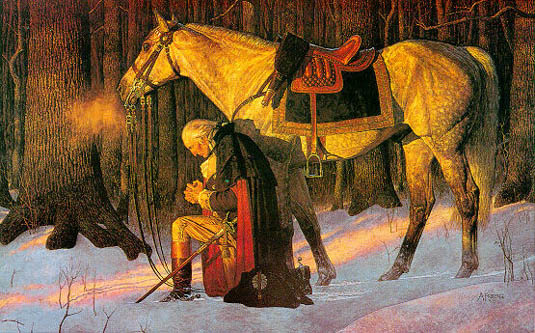
washington-praying

Most of his troops were about to end their enlistments, effective at the end of the year. A mere five days away.  Washington himself, who had become Commander-in-Chief of an Army with an average of nine rounds’ powder per man, thought they may have reached the end, writing to his cousin in Virginia “I think the game is pretty near up”.

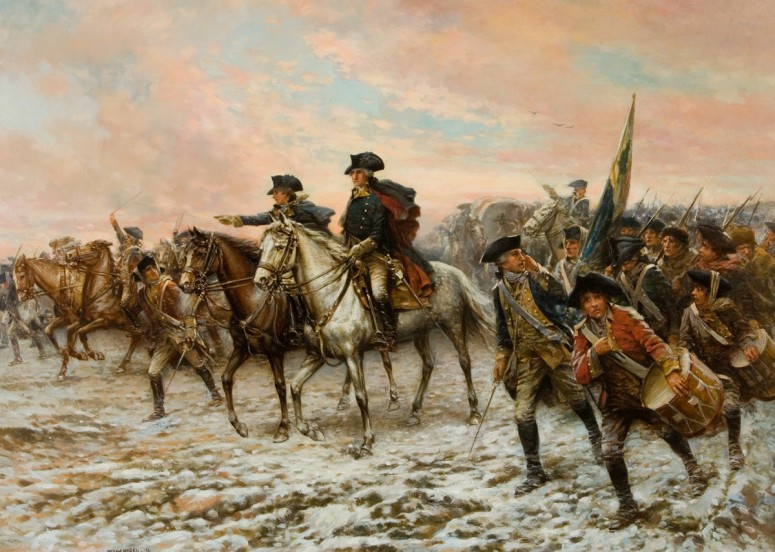
The Americans needed a decisive victory, and quickly, if their cause was to survive. Washington planned a three-pronged attack on the Hessian garrison at Trenton, himself at the head of a 2,400 man army, flanked by a 1,900 man diversionary force under Colonel John Cadwalader and a blocking move by 700 men under General James Ewing.

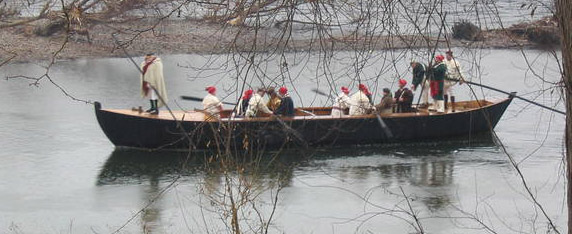
As the army began the famous crossing of the Delaware that Christmas night, the password was “Victory”. There was only one recognized response:  “Or Death”.

durham-boats-by-luke-jones-flickr-cc-cropped
Washington’s men made the crossing in 40-60′ “Durham Boats”, with flat-bottom barges transporting horses and artillery

Washington’s three crossings soon dissolved into one, as Cadwalader and Ewing both turned back. The weather that night was dreadful.  A howling ‘nor-easter’ came up at 11:00, hampering the crossing as freezing rain changed to sleet and sleet to snow. Horses balked at being led onto flat-bottom barges.  Cannon weighing as much as 1,720 lbs had to be tied down to prevent capsize. With visibility near zero, several men fell overboard during the crossing.  One soldier said it “blew a perfect hurricane”.

Washington’s crossing may have itself been forced to turn back from the difficult crossing, but for the indispensable nautical skills of Colonel John Glover’s Marblehead Militia, the “amphibious regiment”.

Two froze to death on the overnight march to Trenton. Men were so poorly equipped that many of them lacked boots, the soaked and freezing rags wrapped around their feet not enough to keep them from leaving bloody footprints in the snow.

large_di-0707-2_m-4535_march-to-trenton-web

Loyalists had warned the Hessian commander, Colonel Johann Rall, that American forces were planning an action. As late as December 22, a spy had warned British General James Grant that Washington was holding a war council.  His warning to the Hessian commander was “Be on your guard”.

Approaching Trenton along parallel roads, General John Sullivan sent word to Washington that the weather was wetting his men’s gunpowder. Washington responded, “Tell General Sullivan to use the bayonet. I am resolved to take Trenton.”

The Patriot force arrived at Trenton at 8am December 26, completely surprising the Hessian garrison. There is a story about the Hessians being drunk or hungover after Christmas celebrations, but the story is almost certainly untrue.

1200px-Battle_of_Trenton_by_Charles_McBarron

Unaware of Washington’s march on Trenton, 50 colonists had attacked a Hessian outpost earlier that morning. While Washington worried that his surprise was blown, Colonel Rall apparently believed that this was the attack he’d been warned about. He expected no further action that day.

conrad_heyer-200px
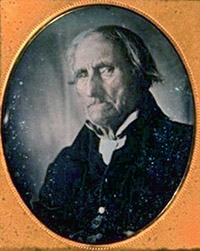
Conrad Heyer crossed the Delaware with General Washington, and lived long enough to see the dawn of the age of photography

The tactical surprise was complete for the American side. Hessian soldiers spilled out of their quarters and tried to form up, but most were shot down or dispersed. A few American civilians, residents of Trenton, even joined in the fight. All told, Hessian losses were 22 killed, 92 wounded, 918 captured and 400 escaped. Four Hessian colonels were killed, including Rall himself. The Americans suffered the two who had frozen to death, and five wounded. They had won the first major victory of the Revolution.

On December 30, the Americans once again crossed the Delaware, eluding a main force under Generals Cornwallis and Grant, proving on January 3rd at a place called Princeton, that they could defeat a regular British army in the field.

Encouraged by these victories, many of Washington’s men extended their terms of enlistment, and new enlistments flooded in. The American Revolution would slog on for almost six more years.  For today, the Patriot cause had lived to fight another day

December 25, 1914 Christmas Truce

Allied soldiers first thought it was a trick, but these Germans were unarmed, standing out in the open where they could be shot on a whim.

“Sitzkrieg”. “Phony War”. Those were the terms used to describe the September ‘39 to May 1940 period, when neither side of what was to become the second world war, was yet prepared to launch a major ground war against the other.

5739-75-dpi-1914-11-10
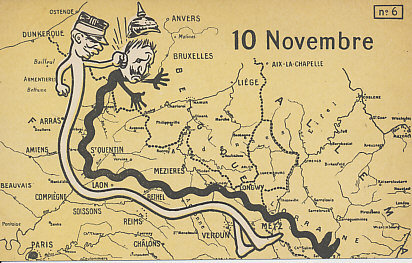
“The Blow on the Yser”, depicting the ‘Race to the Sea’. 6th in a series of postcards on the German invasion of France.

25 years earlier things had been different, at the outbreak of “The Great War”.  Had you been alive in August of 1914, you’d have witnessed what might be described as the simultaneous detonation of a continent.

When governments make war on one another, it’s the Harry and the Fritz down the street, the every day Pierre and the Ivan, who must do the fighting.  And the bleeding.  And the dying.

France alone suffered 140,000 casualties over the four day “Battle of the Frontiers”, where the River Sambre meets the Meuse.  27,000 Frenchmen died in a single day, August 22, in the forests of the Ardennes and Charleroi.

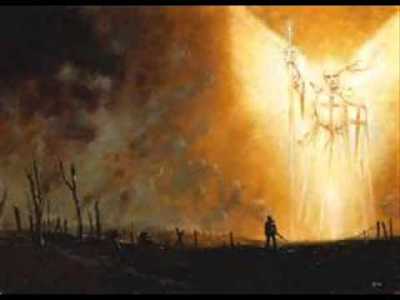
The British Expeditionary Force escaped annihilation on August 22-23, only by the intervention of mythic angels, at a place called Mons.

In the East, a Russian army under General Alexander Samsonov was encircled and so thoroughly shattered at Tannenberg, that German machine gunners were driven to insanity at the damage inflicted by their own guns, on the milling and helpless masses of Russian soldiers.  Only 10,000 of the original 150,000 escaped death, destruction or capture.  Samsonov himself walked into the woods, and shot himself.

hqdefault
Angels of Mons

The “Race to the Sea” of mid-September to late October was more a series of leapfrog movements and running combat, in which the adversaries tried to outflank one another.  It would be some of the last major movement of the Great War, ending in the apocalypse of Ypres, in which 75,000 from all sides lost their lives.  All along a 450-mile front, millions of soldiers dug into the ground to shelter themselves from what Private Ernst Jünger later called the “Storm of Steel”.

On the Western Front, it rained for much of November and December that first year.  The no man’s land between British and German trenches was a wasteland of mud and barbed wire. Christmas Eve, 1914 dawned cold and clear.  The frozen ground allowed men to move about for the first time in weeks.

That evening, English soldiers heard Germans singing a Christmas carol.  “Silent night.  The Tommies were the first to respond, singing ‘The First Noel”.  Then both sides joined together, in a rendition of ‘O Come, all ye Faithful’.

images

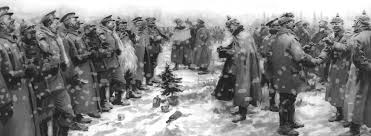
The following day was Christmas, 1914. A few German soldiers emerged from their trenches at the first light of dawn, approaching the Allies across no man’s land, calling out “Merry Christmas” in the native tongue of their adversaries.

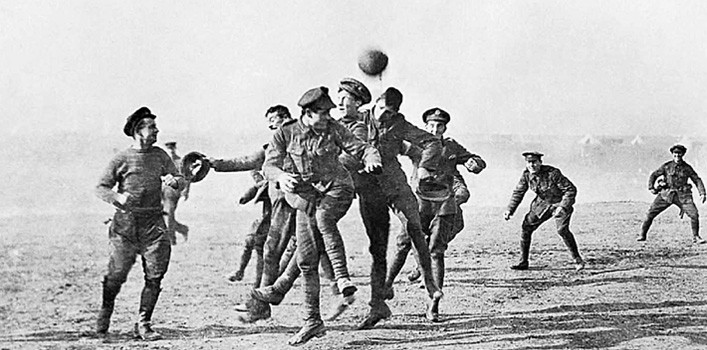
Allied soldiers first thought it was a trick, but these Germans were unarmed, standing out in the open where they could be shot on a whim. Tommies soon climbed out of their own trenches, shaking hands with the Germans and exchanging gifts of cigarettes, food and souvenirs. In at least one sector, enemy soldiers played a friendly game of soccer.

world-war-1-truce

Captain Bruce Bairnsfather later wrote: “I wouldn’t have missed that unique and weird Christmas Day for anything. … I spotted a German officer, some sort of lieutenant I should think, and being a bit of a collector, I intimated to him that I had taken a fancy to some of his buttons. … I brought out my wire clippers and, with a few deft snips, removed a couple of his buttons and put them in my pocket. I then gave him two of mine in exchange. … The last I saw was one of my machine gunners, who was a bit of an amateur hairdresser in civil life, cutting the unnaturally long hair of a docile Boche, who was patiently kneeling on the ground whilst the automatic clippers crept up the back of his neck.”

Captain Sir Edward Hulse Bart reported a sing-song which “ended up with ‘Auld lang syne’ which we all, English, Scots, Irish, Prussians, Wurttenbergers, etc, joined in. It was absolutely astounding, and if I had seen it on a cinematograph film I should have sworn that it was faked!”

Nearly 100,000 Allied and German troops were involved in the unofficial ceasefire of December 24-25, 1914, which lasted in some sectors until New Year’s Day.

christmas-truce-1914-400x186A few tried to replicate the event the following year, but there were explicit orders preventing it. Captain Llewelyn Wyn Griffith recorded that after a night of exchanging carols, dawn on Christmas Day 1915 saw a “rush of men from both sides … [and] a feverish exchange of souvenirs” before the men were quickly called back by their officers.

One German unit tried to leave their trenches under a flag of truce on Easter Sunday 1915.  They were warned off by the British opposite them.

christmas-military1-e1482512805772German soldier Richard Schirrmann wrote in December 1915, “When the Christmas bells sounded in the villages of the Vosges behind the lines …. something fantastically unmilitary occurred. German and French troops spontaneously made peace and ceased hostilities; they visited each other through disused trench tunnels, and exchanged wine, cognac and cigarettes for Westphalian black bread, biscuits and ham. This suited them so well that they remained good friends even after Christmas was over”.

Some will tell you, that the bitterness engendered by continuous fighting made such fraternization all but impossible.  Yet there are those who believe that soldiers never stopped fraternizing with their opponents, at least during the Christmas season.  Heavy artillery, machine gun, and sniper fire were all intensified in anticipation of Christmas truces, minimizing such events in a way that kept them out of the history books.

1914-christmas-eve-truceEven so, there is evidence of a small Christmas truce occurring in 1916, previously unknown to historians. 23-year-old Private Ronald MacKinnon of Princess Patricia’s Canadian Light Infantry, wrote home about German and Canadian soldiers reaching across battle lines near Arras, sharing Christmas greetings and trading gifts. “I had quite a good Christmas considering I was in the front line”, he wrote. “Christmas Eve was pretty stiff, sentry-go up to the hips in mud of course. … We had a truce on Christmas Day and our German friends were quite friendly. They came over to see us and we traded bully beef for cigars”. The letter ends with Private MacKinnon noting that “Christmas was ‘tray bon’, which means very good.”

Private Ronald MacKinnon of Toronto Ontario, Regimental number 157629, was killed barely three months later on April 9, 1917, during the Battle of Vimy Ridge.

The Man He Killed
BY THOMAS HARDY

“Had he and I but met
By some old ancient inn,
We should have sat us down to wet
Right many a nipperkin!

“But ranged as infantry,
And staring face to face,
I shot at him as he at me,
And killed him in his place.

“I shot him dead because —
Because he was my foe,
Just so: my foe of course he was;
That’s clear enough; although

“He thought he’d ‘list, perhaps,
Off-hand like — just as I —
Was out of work — had sold his traps —
No other reason why.

“Yes; quaint and curious war is!
You shoot a fellow down
You’d treat if met where any bar is,
Or help to half-a-crown.”