May 2, 1779 Mary Silliman’s War

Much is written about the history of warfare.  The strategy, the tactics, and the means of supply which make it all happen.  Far less has been written about a subject, equally important, if not more so.  The very real service to the nation, provided by the loved ones, most often the women, when the warriors leave their homes.

Sometime around 1980, Commandant of the United States Marine Corps General Robert H. Barrow captured the nature of the art of the warrior:  “Amateurs think about tactics”, he wrote, “but professionals think about logistics.”  Lieutenant General Tommy Franks, Commander of the 7th Corps during Operation Desert Storm, was more to the point:  “Forget logistics, you lose.”

Much is written about the history of warfare.  The strategy, the tactics, and the means of supply which make it all happen.  Far less has been written about a subject, equally important, if not more so.  The very real service to the nation, provided by the loved ones, most often the women, when the warriors leave their homes.

Mary Fish Noyes Silliman

In the early days of the American Revolution, Gold Selleck Silliman served as a Colonel in the Connecticut militia, later promoted to Brigadier General.  Silliman patrolled the southwestern border of Connecticut, where proximity to British-occupied New York was a constant source of danger.  Silliman fought with the New York campaign of 1776 and opposed the British landing in Danbury, the following year.

Mary (Fish) Noyes, the widow of John Noyes, was a strong, independent woman, of good pioneer stock.  She had to be.  In an age when women rarely involved themselves in the “business” side of the household, Mary’s first husband died intestate, leaving her executrix of the estate, and head of household.

Image21Gold Selleck Silliman, himself a widower, merged his household with that of Mary on May 24, 1775, in a marriage described as “rooted in lasting friendship, deep affection, and mutual respect”.  The two would have two children together, who survived into adulthood:   Gold Selleck (called Sellek) born in October 1777, and Benjamin, born in August 1779.

Understanding that the coming Revolution could take her second husband from her as well, Mary acquainted herself with Gold’s business affairs, as well as the workings of the farm.  Throughout this phase of the war, Mary Silliman ran the family farm, entertained militia officers, housed refugees of war violence, managed the labor of several slaves and that of her adult stepson, drew accounts and collected rent on her late first husband’s properties, all while her husband was away, leading the state militia.

Before the war, Gold Silliman served as Attorney for the Crown.  He returned to civil life in 1777 following the Battle of Ridgefield, becoming state’s attorney.

On May 2, 1779, nine Tories ostensibly under orders from General Henry Clinton, set out in a whale boat from Lloyd’s Neck on Long Island, rowing across Long Island sound and onto the Connecticut shore.  One of them, a carpenter, had worked on the Silliman home and knew it well.  Eight of them beat down the door in the dead of night, kidnapping Silliman and Billy,  Gold’s son by his first marriage.  Mary Silliman, six-months pregnant at the time, could do little but look on in horror.

Lloyd's Neck
Lloyd’s Neck, Long Island

The two captives were taken to Oyster Bay in New York and finally to Flatbush, and held hostage at a New York farmhouse.  Patriot forces having no hostage of equal rank with whom to exchange for the General, the two Sillimans languished in captivity for seven months.

Mary Silliman wrote letters to Connecticut Governor Jonathan Trumbull, to no avail.  At last, heavily pregnant, she set out for the headquarters of General George Washington himself.  An aide responded that…sorry…had Silliman been kidnapped while wearing the uniform, efforts could be made to intercede.  As it was, the captive was a civilian.  He was on his own.

Mary was left to run the farm, including caring for her own midwife, after the woman was brutally raped during a lighting raid in which English forces burned family buildings and crops, along with much of Ridgefield.  All the while, Mary herself wanted nothing more than the return of her husband, and to become “the living mother of a living child”.

download (70)
From the film:  Mary Silliman’s War

With all other options exhausted, Mary contracted the services of one David Hawley, a full-time Naval Captain and part-time privateer.  Hawley staged a daring raid of his own, rowing across the sound and kidnapping a man suitable for exchange with Gold Silliman, in the person of Chief Justice Thomas Jones, of Long Island.

British authorities balked at the exchange and the stalemate dragged on for months.  In the end, Mary Silliman got her wish, becoming the living mother of a living child that August.  Gold Selleck and Billy Silliman were exchanged the following May, for Judge Jones.

The 1993 made-for-TV movie “Mary Silliman’s War” tells a story of non-combatants in the American Revolution.  The pregnant mothers and farm wives, as well as Silliman’s own negotiations for her husband’s release, by his Loyalist captors.  The film is outstanding, the history straight-up and unadulterated with pop culture nonsense, as far as I can tell.  The film is available for download, I found it for nine bucks.  It was nine dollars, well spent.

Feature image, top of page:  Silliman house, ca. 1890

If you enjoyed this “Today in History”, please feel free to re-blog, “like” & share on social media, so that others may find and enjoy it as well. Please click the “follow” button on the right, to receive email updates on new articles.  Thank you for your interest, in the history we all share.

April 30, 1943 Operation Mincemeat

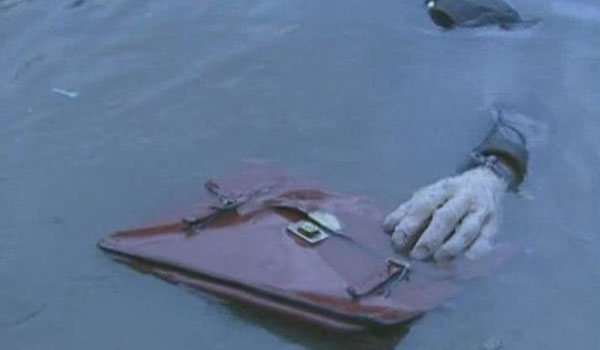
On April 30, 1943, Lieutenant Norman Jewell, commanding the submarine HMS Seraph (P219), read the 39th Psalm over the man who never was.  With briefcase containing “secret” documents padlocked to his wrist, the homeless man who in death would help defeat Nazi Germany, was gently pushed into the Atlantic, off the Spanish coast.

The idea was a head fake.  Disinformation intended to make the Nazi government believe that their adversaries intended to invade Sardinia and Greece in 1943, rather than the real targets of North Africa and Sicily.  British Military Intelligence called it “Operation Mincemeat”.

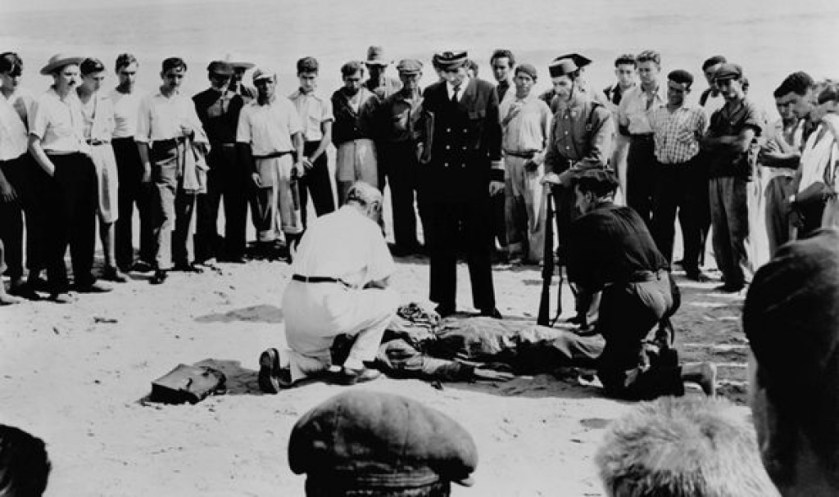
The London coroner obtained the body of 34-year-old Glyndwr Michael, on condition that his real identity never be revealed. The Welshman had died of rat poison, though it’s uncertain whether the death was accidental or suicide. This particular poison came in paste form, and was spread on bread crusts to attract rats.  The homeless man may have died, merely because he was hungry.

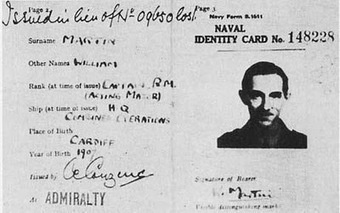
Naval identity cardBe that as it may, this cause of death is difficult to detect,  The condition of the corpse was close to that of someone who had died at sea, of hypothermia and drowning. The dead man’s parents were both deceased, there were no known relatives and the man died friendless. So it was that Glyndwr Michael became the “Man who Never Was”.
The next step was to create a “past” for the dead man. Michael became “(Acting) Major William “Bill” Martin, Royal Marines”, born 1907, in Cardiff, Wales, assigned to Headquarters, Combined Operations. As a Royal Marine, “Martin” could wear battle dress rather than a naval uniform. This was important, because Naval uniforms at the time were tailor-made by Gieves & Hawkes of Saville Row. Authorities could hardly ask Gieves’ tailors to measure a corpse, without raising eyebrows.

The rank of acting major made the fictional William Martin senior enough to be entrusted with sensitive documents, but not so prominent that anyone would expect to know him. The name “Martin” was chosen because there were several Martins of about that rank, already serving in the Royal Marines.

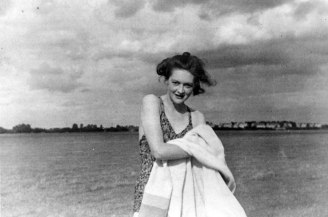
PamA “fiancée” was furnished for Major Martin, in the form of  MI5 clerk “Pam”. “Major Martin” carried her snapshot, along with two love letters, and a jeweler’s bill for a diamond engagement ring.
In keeping with his rank, Martin was given some good quality underwear, to increase his authenticity. Extremely difficult to obtain due to rationing, the underwear was purloined from the Master of the New College Oxford, who’d been run over and killed by a truck.

Made to look like the victim of a plane crash, the plan was to drop the body at sea, at a place where the tide would bring it ashore and into German Hands.

On April 30, 1943, Lieutenant Norman Jewell, commanding the submarine HMS Seraph (P219), read the 39th Psalm over the man who never was.  With briefcase containing “secret” documents padlocked to his wrist, the homeless man who in death would help defeat Nazi Germany, was gently pushed into the Atlantic, off the Spanish coast.

HMS Seraph

The hoax worked out, nicely. A Spanish fisherman recovered the body and a Nazi agent intercepted the papers, as intended. Mussolini insisted correctly that the allied attack would come through Sicily, but Hitler wasn’t buying it. He had swallowed the Mincemeat scam whole, insisting that the Sicilian attack was nothing but a diversion from the real objective.

Manwhoneverwas

When the Allies invaded Sicily on the 9th of July, the Germans were so convinced it was a feint that forces were kept out of action for a full two full weeks. After that, it was far too late to effect the outcome.

The non-existent Major William Martin was buried with full military honors in the Huelva cemetery of Nuestra Señora. The headstone reads:
“William Martin, born 29 March 1907, died 24 April 1943, beloved son of John Glyndwyr Martin and the late Antonia Martin of Cardiff, Wales, Dulce et Decorum est pro Patria Mori, R.I.P.”  “It is sweet and fitting to die for one’s country.”

In 1998, the British Government revealed Martin’s true identity, and “Glyndwr Michael; Served as Major William Martin, RM”, was added to the gravestone.

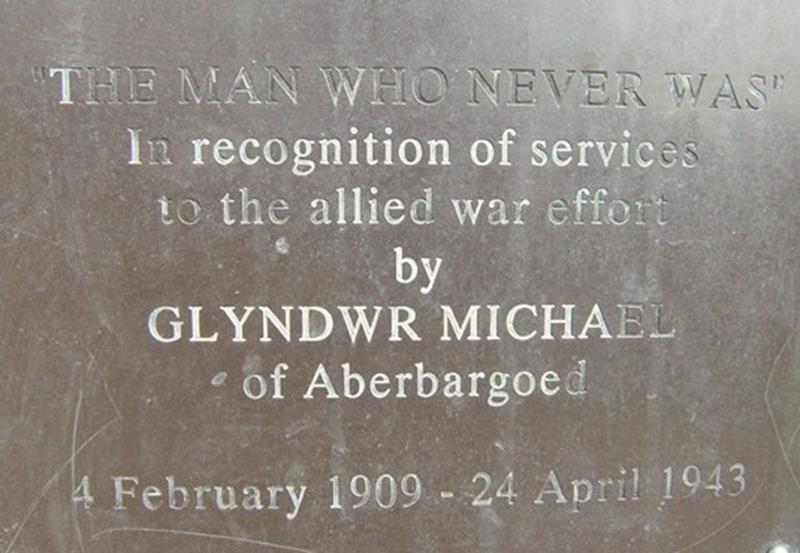
There is a war memorial in the small South Wales town of Aberbargoed, in memory of Glyndwr Michael. A plaque is inscribed with the Welsh phrase “Y Dyn Na Fu Erioed”. It means “The Man Who Never Was”.

Man who Never Was

April 29, 1915  The Wipers Times

My favorite among the classified ads has to be the “Flammenwerfer” (Flame Thrower). “Guaranteed absolutely harmless.”  “Instructive – Amusing”.

As chief of the Imperial German general staff from 1891-1905, German Field Marshal Alfred von Schlieffen devised the strategic roadmap by which Germany prosecuted the first world war. The “Schlieffen Plan” could be likened to a bar fight, where a fighter (Germany) had to take out one guy fast (France), before turning and facing his larger and somewhat slower buddy (Imperial Russia).

Schlieffen_Plan_fr.svg

Of infinite importance to Schlieffen’s plan was the westward sweep through France, rolling that nation’s ground forces into a ball on a timetable before his armies could turn east to face the “Russian Steamroller”. “When you march into France”, Schlieffen had said, “let the last man on the right brush the Channel with his sleeve.”

Ypres SalientField Marshall Helmuth von Moltke once said “No battle plan ever survives contact with the enemy”.  So it was in the tiny Belgian city where German plans met with ruin, on the road to Dunkirk. Native Dutch speakers called the place Leper.  Today we know it as Ypres (Ee-pres), since battle maps of the time were drawn up in French. To the Tommys of the British Expeditionary Force, the place was “Wipers”.

What had hitherto been a war of movement ground to a halt in the apocalyptic fighting around Ypres, in October-November, 1914. The scale of the casualties are hard to get your head around.  Over four years, several hundred thousand sons of Germany, Great Britain and France were killed in the battles for the Ypres Salient – a battlefield only 24 kilometers, square.  100 military burial grounds or more, contain their mortal remains.

YpresThe second Battle for Ypres began with a new and terrifying weapon on April 22, 1915. German troops placed 5,730 gas cylinders weighing 90 pounds apiece, along a four-mile front. Allied troops must have looked on in wonder, as that vast yellow-green carpet crept toward their lines.

Chlorine gas forms hypochlorous acid when combined with water, destroying the moist tissues of the lungs and eyes. Heavier than air, the stuff slithered along the ground and poured into trenches, forcing troops out into heavy German fire. 6,000 casualties were sustained in the gas attack alone, opening a four mile gap in the allied line. Thousands retched and coughed out their last breath, as others tossed their equipment and ran in terror.

After the war, German losses were estimated at 34,933 between April 21 and May 30.  BEF casualties numbered 59,275. The French recorded about 18,000 on April 22 alone, and another 3,973 by April 29. All told, 2nd Ypres cost allied forces 87,223 killed, wounded or missing.

The third Battle of Ypres would begin in July of 1917, lasting almost until the end of the war. 3rd Ypres would result in 570,000 losses on all sides, but in early 1916, that was all part of some unknown and terrible future.

It’s hard to imagine anything remotely humorous coming out of the horrors of this place, but such became possible in the early months of 1916.

Optimism advert

First established in 1881, the “Sherwood Foresters” were line infantry Regiments (Nottinghamshire and Derbyshire Regiments) of the British Army, at this time stationed at the front lines of the Ypres salient.  The unit came across a printing press.  Corporal George Turner, who’d been a printer in civil life, got the thing going. The Forresters began a trench magazine, a PDF of which may be downloaded HERE.  The first edition of the Wipers Times published on February 12, 1916.  The paper included poems and reflections, news, “adverts” and the blackest of humor.

Written for fellow soldiers, some of the in-jokes are so obscure that their meaning is lost to the modern reader. Others are clearly understandable, even 102 years later.

The_Wipers_Times,_issue_cover_March_1916_Wellcome_L0031562

Richly typeset advertisements for “Music Hall Extravaganzas” included “Tickling Fritz” by the P.B.I. (Poor Bloody Infantry) Film Co. of the United Kingdom and Canada, advising the enthusiast to “Book Early”. There were Real Estate ads for property in no-man’s land. “BUILD THAT HOUSE ON HILL 60. BRIGHT-BREEZY-&-INVIGORATING. COMMANDS AN EXCELLENT VIEW OF HISTORIC TOWN OF YPRES”. Another one read “FOR SALE, THE SALIENT ESTATE – COMPLETE IN EVERY DETAIL! UNDERGROUND RESIDENCES READY FOR HABITATION. Splendid Motoring Estate! Shooting Perfect !! Fishing Good!!!”

Old Masters

There were advertisements for barbed wire cutters with built-in umbrellas, for the most discerning of gentlemen.

There were news features, this one of a bungled trench raid: “”…They climbed into the trench and surprised the sentry, but unfortunately the revolver which was held to his head missed fire. Attempts were made to throttle him quietly, but he succeeded in raising the alarm, and had to be killed.” editor’s note, “This we consider real bad luck for the sentry after the previous heroic efforts to keep him alive””.

There were weather reports, laying odds on the forecast. “5 to 1 Mist, 11 to 2 East Wind or Frost, 8 to 1 Chlorine”. My favorite among the classifieds has got to be the “Flammenwerfer” (Flame Thrower). “Guaranteed absolutely harmless.”  “Instructive – Amusing”.

Miss Minnie WerferUnits of all sizes, from individual companies to army corps, lightened the load of the “War to end all Wars”, with some kind of unit journal.

Some officers were not amused by the underground paper, and thought its publication should be banned. Others believed that it kept some semblance of morale in the trenches. One pointed out that “humour is what distinguishes us from barbarism.”

The Wipers Times ran through the end of the war, with the exception of the “Operation Michael” period, the last gasp German Western Front offensive of 1918. The final edition, titled “The Better Times”, was published in December 1918, just short of two months after the armistice.   The banner headline on that final edition read “Xmas, Peace and Final Number.”

Better Times Headline

If you enjoyed this “Today in History”, please feel free to re-blog, “like” & share on social media, so that others may find and enjoy it as well. Please click the “follow” button on the right, to receive email updates on new articles.  Thank you for your interest, in the history we all share.

April 26, 1777  The Female Paul Revere

The Dutchess County Militia had to be called up.  The Colonel himself had only a single night to prepare for battle, and this rider was exhausted.  The job would have to go to Colonel Ludington’s first-born.  His daughter, Sybil.

Listen my children and you shall hear,
Of the midnight ride of…Sybil Ludington.

Paul Revere’s famous “midnight ride” began on the night of April 18, 1775.  Revere was one of two riders, soon joined by a third, fanning out from Boston to warn of an oncoming column of “regulars”, come to destroy the stockpile of gunpowder, ammunition, and cannon in Concord.

Revere himself covered barely 12 miles before being captured, his horse confiscated to replace the tired mount of a British sergeant.  Revere would finish his “ride” on foot, arriving at sunrise on the 19th to witness the last moments of the battle on Lexington Green.

download (55)Two years later, Patriot forces maintained a similar supply depot, in the southwest Connecticut town of Danbury.

William Tryon was the Royal Governor of New York, a long-standing advocate for attacks on civilian targets.  In 1777, Tryon was also a Major-General of the provincial army.  On April 25th, Tryon set sail for the Connecticut coast of Long Island Sound with a force of 1,800, intending to destroy Danbury.

Patriot Colonel Joseph Cooke’s small Danbury garrison was caught and quickly overpowered on the 26th, trying to remove food supplies, uniforms, and equipment.  Facing little if any opposition, Tryon’s forces went on a bender, burning homes, farms and storehouses.  Thousands of barrels of pork, beef and flour were destroyed, along with 5,000 pairs of shoes, 2,000 bushels of grain, and 1,600 tents.

Colonel Henry Ludington was a farmer and father of 12, with a long military career.  A long-standing and loyal subject of the British crown, Ludington switched sides in 1773, joining the rebel cause and rising to command the 7th Regiment of the Dutchess County Militia, in New York’s Hudson Valley.

In April 1777, Ludington’s militia was disbanded for planting season, returned to homes across the countryside.  Soaked to the skin and exhausted, a rider arrived at the Ludington farm on the night of the 26th, on an equally soaked and exhausted horse.  With a driving rain cascading in sheets off an empty saddle, the rider explained the purpose of his visit.  15 miles away, British regulars and a loyalist force were burning Danbury to the ground.

The Dutchess County Militia had to be called up.  The Colonel himself had only a single night to prepare for battle, and this rider was done for.  The job would have to go to the Colonel’s first-born.  That meant Ludington’s daughter Sybil, and she was barely sixteen.

download (59)

From Poughkeepsie to what is now Putnam County and back, the “Female Paul Revere” rode across the lower Hudson River Valley, covering 40 miles in the pitch darkness of night, alerting her father’s militia to the danger and urging them to come out and fight.  She’d use a stick to knock on doors, even using it once to beat back a highway bandit.

By the time that Sybil returned the next morning, cold, rain-soaked, and exhausted, most of 400 militia members were prepared to march.

35 miles east of Danbury, General Benedict Arnold was gathering a force of 500 regular and irregular Connecticut militia, along with Generals David Wooster and Gold Selleck Silliman.

download (57)

Arnold’s forces arrived too late to save Danbury, but inflicted a nasty surprise on the British rearguard as the column approached nearby Ridgefield.  Never outnumbered by less than three-to-one, Connecticut militia was able to slow the British advance until Ludington’s New York Militia arrived on the following day.  The last phase of the action saw the same type of swarming harassment, as seen on the British retreat from Concord to Boston, earlier in the war.

Though the British operation was a tactical success, the mauling suffered at the hands of colonials ensured that this was the last hostile British landing on the Connecticut coast.

The British raid on Danbury destroyed at least 19 houses and 22 stores and barns.  Town officials submitted £16,000 in claims to Congress, for which town selectmen received £500 reimbursement.  Further claims were made to the General Assembly of Connecticut in 1787, for which Danbury was awarded land.  In Ohio.

The old Keeler Tavern in Ridgefield is now a museum.  The British cannonball fired into the side of the building, remains there to this day.

download (56)

At the time, Benedict Arnold planned to travel to Philadelphia, to protest the promotion of officers junior to himself, to Major General.  Arnold, who’d had two horses shot out from under him at Ridgefield, was promoted to Major General in recognition of his role in the battle.  Along with that promotion came a horse, “properly caparisoned as a token of … approbation of his gallant conduct … in the late enterprize to Danbury.”

The pride which would one day be Arnold’s undoing, was assuaged.  For a time.

Henry Ludington became Aide-de-Camp to General George Washington, and grandfather to Harrison Ludington, future mayor of Milwaukee and the 12th Governor of Wisconsin.

Gold Silliman was kidnapped with his son by a first marriage by Tory neighbors, and held for nearly seven months at a New York farmhouse.  Having no hostage of equal rank with whom to exchange for the General, Patriot forces went out and kidnapped one of their own, in the person of Chief Justice Judge Thomas Jones, of Long Island.

download (60)Mary Silliman was left to run the farm, and negotiate for the release of her husband.  The 1993 made-for-TV movie “Mary Silliman’s War” tells a story of non-combatants, pregnant mothers and farm wives, during the Revolution.

General David Wooster was mortally wounded at the Battle of Ridgefield, moments after shouting “Come on my boys! Never mind such random shots!”  Today, an archway marks the entrance to Wooster Square, in the East Rock Neighborhood of New Haven.

Sybil Ludington received the thanks of family and friends, even George Washington himself, and then stepped off the pages of history.

Paul Revere’s famous ride would likewise have faded into obscurity, but for the poetry of Henry Wadsworth Longfellow.  86 years later.

monument-1

If you enjoyed this “Today in History”, please feel free to re-blog, “like” & share on social media, so that others may find and enjoy it as well. Please click the “follow” button on the right, to receive email updates on new articles.  Thank you for your interest, in the history we all share.

April 22, 1918 Our Gallant and Worthy Foe

The Red Baron was buried by his enemies, with honors, on April 22, 1918.  British Third Squadron officers served as pallbearers.  Other ranks from the squadron acted as a guard of honor. Allied squadrons stationed nearby presented memorial wreaths, one of which was inscribed with these words:
“To Our Gallant and Worthy Foe”.

Early in the “Great War”, Manfred Freiherr von Richtofen was a cavalry scout, serving with the 1st Regiment of Uhlans Kaiser Alexander III in the Verdun sector. Cavalry quickly became obsolete, as the war of movement ended and armies dug in to avoid what Private Ernst Jünger later called the “Storm of Steel”.

Leutnant Richtofen served as a messenger over the winter of 1914-15, but there was no glory in crawling through the mud of shell holes and trenches. He applied to the fledgling Air Corps, writing to his superiors that “I have not gone to war in order to collect cheese and eggs, but for another purpose.”

Red Baron, mascotFollowing four months of training, Richtofen began his flying career as an observer, taking photographs of Russian troop positions on the eastern front.

After transferring to Belgium and becoming bombardier, Manfred’s first air-to-air kill occurred in late 1915, while acting as observer and rear gunner on a two-seat reconnaissance plane. The French pusher bi-plane went down over unfriendly territory and couldn’t be confirmed, so the victory was never counted. Neither was his second kill, when Richtofen shot down a French Nieuport fighter from an Albatross C.III bomber. This one too went down over enemy territory, and couldn’t be confirmed.

Richtofen achieved his first official victory on September 17, 1916, after being transferred to a fighter squadron. Manfred ordered a silver cup to mark the occasion, engraved with the date and make of the aircraft he had shot down, a British F.E. 2B. Many more silver cups would be added to the collection, before he was through.

Manfred got his 5th kill to become an ace on October 16, 1916, and the coveted “Blue Max” medal for his 16th, the following January. He shot down 22 enemy planes that April alone, four of those in a single day. Richtofen was Germany’s leading living ace, fast becoming the most famous pilot of his day.  German propagandists spread the rumor that the Allies were going to award the Victoria Cross to the man who shot him down.

Red BaronEver aware of his own celebrity, von Richtofen took to painting the wings of his aircraft a brilliant shade of red, after the colors of his old Uhlan regiment. It was only later that he had the whole thing painted. Friend and foe alike knew him as “the Red Knight”, “the Red Devil”, or “’Le Petit Rouge’” and finally, the name that stuck:  “the Red Baron”.

Like Ted Williams, who was said to be able to count the stitches on a fastball, Manfred von Richtofen was blessed with exceptional eyesight. Gifted with lightning reflexes, Richtofen became the top ace of WW1. In an age when  even a few air combat victories were exceptional, Richtofen accumulated sixty engraved silver cups before the metal became unavailable in war ravaged Germany. Even then he was far from done.

Despite the popular link between Richthofen and his Fokker Dr.I, he only scored his last 19 kills while flying his famous red triplane. Three-quarters of his victories were won in different makes of the Albatross (below, left), and the Halberstadt D.II (right).

By way of comparison, the highest scoring Allied ace of the Great War was Frenchman René Fonck, with 75 confirmed victories. The highest scoring fighter pilot from the British Empire was Canadian Billy Bishop, who was officially credited with 72. The Red Baron had 80.

Richthofen sustained a serious head wound on July 6 1917, causing severe disorientation and temporary partial blindness. He returned to duty after October 23, but many believed his injury caused lasting damage, and lead to his eventual death.

Red Baron, last flight

Richthofen chased the rookie Canadian pilot Wilfred “Wop” May behind the lines on April 21, 1918, when he found himself under attack. With a squadron of Sopwith Camels firing from above and anti-aircraft gunners on the ground, the Red Baron was shot once through the chest with a .303 round, managing to land in the beet field where he died, several minutes later. He was still wearing his pajamas, under his flight suit.

Red Baron Crash SiteThe RAF credited Canadian Pilot Captain Roy Brown with shooting Richthofen down, but the angle of the wound suggests that the bullet was fired from the ground. A 2003 PBS documentary demonstrated that Sergeant Cedric Popkin was the person most likely to have killed him, while a 2002 Discovery Channel documentary suggests that it was Gunner W. J. “Snowy” Evans, a Lewis machine gunner with the 53rd Battery, 14th Field Artillery Brigade, Royal Australian Artillery. Just who killed the Red Baron, may never be known with absolute certainty.

Manfred von Richtofen was buried by his enemies, with honors, on April 22, 1918.  British Third Squadron officers served as pallbearers, other ranks from the squadron acted as a guard of honor. Allied squadrons stationed nearby presented memorial wreaths, one of which was inscribed with these words: “To Our Gallant and Worthy Foe”.


If you enjoyed this “Today in History”, please feel free to re-blog, “like” & share on social media, so that others may find and enjoy it as well. Please click the “follow” button on the right, to receive email updates on new articles.  Thank you for your interest, in the history we all share.

April 20, 1916 In Memorial

Altogether, there are 28 major and 142 minor Memorials and monuments at Arlington National Cemetery, to say nothing of the 250,000 plus military grave sites stretching across the landscape. Each of them is dedicated to a person, place or event which has earned the right to be remembered.

The Oxford English Dictionary defines Monument as “A statue, building, or other structure erected to commemorate a notable person or event”.

Arlington National Cemetery itself is such a monument:  Memorial Drive extending across the Potomac and connecting Arlington House, the former home of a Confederate general, with the Lincoln Memorial at the opposite end, symbolizing the immutable bond between North and South.

Arlington National Cemetary (5).jpg

Approach Arlington at night, and the eternal flame marking the grave of JFK can be seen on the hillside, like some faraway beacon of light.

A list of memorials at Arlington reads like a history of the nation itself. The Argonne Cross commemorates the honored dead of the “War to end all Wars” in 1917-1918, some 2,100 of whom were re-interred in Section 18, after the war. The Battle of the Bulge memorial reads, “To World War II American Soldiers who fought in the Battle of the Bulge – The greatest Land Battle in the history of the United States Army”. The Beirut Barracks Memorial honors 241 American service members killed in the October 23, 1983 bombing of the Marine barracks in Lebanon.

memorial.jpg

On Chaplain Hill stands a row of four memorials, bearing the names of Chaplains who laid down their lives in four wars. The Cenotaph, (“an empty tomb or a monument erected in honour of a person or group of people whose remains are elsewhere”), bears this inscription: “Greater Love Hath No Man Than This, That A Man Lay Down His Life For His Friends.” Written there are the names of the only two chaplains ever awarded the Medal of Honor: Major Charles Joseph Watters (January 17, 1927 – November 19, 1967), killed in Vietnam while rendering aid to fallen comrades, and Captain Emil Joseph Kapaun (April 20, 1916 – May 23, 1951), the “Shepherd in Combat Boots” who remains to this day in some unmarked North Korean grave site.

download (80)

I have barely scratched the Cs. Altogether, there are 28 major and 142 minor Memorials and monuments at Arlington National Cemetery, to say nothing of the 250,000 plus military grave sites stretching across the landscape. Each of them is dedicated to a person, place or event which has earned the right to be remembered.

arlington-national-cemetery

It has long seemed to this writer that, irrespective of one’s political persuasion, an informed and presumably voting citizen of a Free Republic cannot cast an informed vote, cannot know where he wants his country to go, without an understanding of where it has been.

download (81).jpg

If you haven’t had the opportunity to visit Arlington National Cemetery recently, I highly recommend the trip. Leave yourself plenty of time to take it all in. It would be hard to find more heritage, tradition and history, in any other single place.

Feature image, top of page:  Air Force Memorial at Arlington National Cemetery.  H/T to AF.MIL, the official website of the United States Air force

If you enjoyed this “Today in History”, please feel free to re-blog, “like” & share on social media, so that others may find and enjoy it as well. Please click the “follow” button on the right, to receive email updates on new articles.  Thank you for your interest, in the history we all share.

April 19, 1775  Shot Heard ‘Round the World

Taking positions across the village green to block the soldiers’ line of march, 80 “minutemen” turned and faced 700 of the most powerful military, on the planet.

Old-North-Church-458x600
Old North Church, Boston

The column of British soldiers moved out from Boston late on the 18th, their mission to confiscate the American arsenal at Concord and to capture the Patriot leaders Sam Adams and John Hancock, known to be hiding in Lexington.

Boston Patriot leaders had been preparing for such an event.  Sexton Robert John Newman and Captain John Pulling carried two lanterns to the steeple of the Old North church, signaling that the Regulars were crossing the Charles River to Cambridge. Dr. Joseph Warren ordered Paul Revere and Samuel Dawes to ride out and warn surrounding villages and towns, the two soon joined by a third rider, Samuel Prescott. It was Prescott alone who would make it as far as Concord, though hundreds of riders would fan out across the countryside, before the night was through.

The column entered Lexington at sunrise on April 19, bayonets gleaming in the early morning light.  Armed with a sorry assortment of weapons, colonial militia was waiting, pouring out of Buckman Tavern and fanning out across the town square.   Some weapons were hand made by village gunsmiths and blacksmiths, some decades old, but all were in good working order.   Taking positions across the village green to block the soldiers’ line of march, 80 “minutemen” turned and faced 700 of the most powerful military, on the planet.

Stand Your Ground

Words were exchanged and no one knows who fired the first shot.  When it was over, eight Lexington men lay dead or dying, another ten wounded. One British soldier was wounded.

Vastly outnumbered, the militia soon gave way, as word spread and militia gathered from Concord to Cambridge.   The King’s Regulars never did find the weapons for which they had come, nor did they find Adams or Hancock.  There had been too much warning for that.

download (69)

Regulars would clash with colonial subjects two more times that day, first at Concord Bridge and then in a running fight at a point in the road called “The Bloody Angle”.  Finally, hearing that militia was coming from as far away as Worcester, the column turned to the east and began their return march to Boston.

Photo59922
“Soldiers were often buried where they fell on the battlefield. This gravestone, located just in front of the marker, indicates that British soldiers were buried near this spot on April 19, 1775”.H/T HMdb.org, & their HISTORICAL MARKER DATABASE

Some British soldiers marched 35 miles over those two days, the final retreat coming under increasing attack from militia members firing from behind stone walls, buildings and trees.

One taking up such a firing position was Samuel Whittemore of Menotomy Village, now Arlington Massachusetts. At 80, Whittemore was the oldest known combatant of the Revolution.

Whittemore took a position by the road, armed with his ancient musket, two dueling pistols and the old cutlass captured years earlier from a French officer whom he explained had “died suddenly”.

Waiting until the last possible moment, Whittemore rose and fired his musket at the oncoming Redcoats:  one shot, one kill. Several charged him from only feet away as he drew his pistols.  Two more shots, one dead and one mortally wounded. He had barely drawn his sword when the Regulars were on him, a .69 caliber ball fired almost point blank tearing part of his face off, as the butt of a rifle smashed down on his head. Whittemore tried to fend off the bayonet strokes with his sword but he didn’t have a chance.  He was run through thirteen times, before he lay still.  One for each colony.

samuel_whittemore

The people who came out of their homes to clean up the mess afterward found Whittemore, up on one knee, trying to reload his old musket.

Doctor Nathaniel Tufts treated the old man’s wounds as best he could, but there was nothing he could do. Sam Whittemore was taken home to die in the company of loved ones, which he did.  Eighteen years later, at the age of ninety-eight.


If you enjoyed this “Today in History”, please feel free to re-blog, “like” & share on social media, so that others may find and enjoy it as well. Please click the “follow” button on the right, to receive email updates on new articles.  Thank you for your interest, in the history we all share.

April 9, 1940 “Evacuation Day”

Norway was out of the war, but not necessarily out of the fight.   A Nazi officer passed an old woman on the street, who complained at his rudeness and knocked his hat off, with her cane. The officer apologized and scurried off.  The gray-haired old matron snickered, to herself:  “Well, we’ll each have to fight this war as best we can.  That’s the fourth hat I’ve knocked into the mud this morning.”

The Encyclopedia Britannica describes Croton oil as a “poisonous viscous liquid obtained from the seeds of a small Asiatic tree…”  Highly toxic and a violent irritant, the substance was once used as a drastic purgative and counter-irritant in human and veterinary medicine, but is now considered too dangerous for medicinal use. Applied externally, Croton oil is capable of peeling your skin off.  Taken internally, the stuff may be regarded as the atomic bomb, of laxatives.

The Nazi conquest of Europe began with the annexation of the Sudetenland in 1938, the border districts of Bohemia, Moravia, and German speaking parts of Czechoslovakia. Within two years, every major power on the European mainland was either neutral, or subject to Nazi occupation.  France fell to the Nazi war machine in six weeks, in 1940.  The armed forces of the island nation of Great Britain were left shattered and defenseless, stranded on the beaches of Dunkirk.

On the Scandinavian Peninsula, longstanding policies of disarmament in the wake of WW1, left the Nordic states of Denmark and Norway severely under-strength, able to offer little resistance to the Nazi invaders.

On this day in 1940, German warships entered Norwegian harbors from Narvik to Oslo, as German troops occupied Copenhagen and other Danish cities.  King Christian X of Denmark surrendered almost immediately.  To the northwest, Norwegian commanders loyal to former foreign minister Vidkun Quisling ordered coastal defenders to stand down, permitting the German landing to take place, unopposed.  Norwegian forces refused surrender demands from the German Minister in Oslo, but the outcome was never in doubt.

Nazi Germany responded with an airborne invasion by parachute.  Within weeks, Adolf Hitler could add a second and third scalp to his belt, following the invasion of Poland, six months earlier.  The Kingdoms of Denmark and Norway, were out of the war.

Norway was out of the war, but not necessarily out of the fight.   A Nazi officer passed an old woman on the street, who complained at his rudeness and knocked his hat off, with her cane. The officer apologized and scurried off.  The gray-haired old matron snickered, to herself:  “Well, we’ll each have to fight this war as best we can.  That’s the fourth hat I’ve knocked into the mud this morning.

A Norwegian Resistance was quick to form, as patriotic locals united against the Nazi occupier and the collaborationist policies of the Quisling government.

The Norwegian secret army, known as Milorg and led by General Otto Ruge, was at first loath to engage in outright sabotage, for fear of German reprisals against innocent civilians.  Later in the war, Milorg commandos attacked the heavy water factory at Rjukan and sank a ferry carrying 1,300 lbs of heavy water, inflicting severe damage to the Nazi nuclear research program.

Sven Somme, tree
Norwegian Resistance member Sven Somme demonstrates one of the techniques by which he evaded capture in the mountains.

In the beginning, Resistance activities centered more around covert sabotage and the gathering of intelligence.  One of the great but still-unknown dramas of WW2 unfolded across the snow covered mountains of the Scandinavian peninsula, as the civilian-turned-spy Sven Somme fled 200 miles on foot to neutral Sweden, pursued by 900 Wehrmacht soldiers and a pack of bloodhounds.

Operations of all kinds were undertaken, to stymie the Nazi war effort. Some actions seem like frat-boy pranks, such as coating condoms destined for German units, with itching powder.  Hundreds of Wehrmacht soldiers (and presumably Norwegian women) showed up at Trondheim hospitals, believing they had contracted God-knows-what kind of plague.

Other operations demonstrate a kind of evil genius.  This is where Croton oil comes in.

download (61)
“Croton oil (Crotonis oleum) is an oil prepared from the seeds of Croton tiglium, a tree belonging to the order Euphorbiales and family Euphorbiaceae, and native or cultivated in India and the Malay Archipelago. Small doses taken internally cause diarrhea. Externally, the oil can cause irritation and swelling. Croton oil is used in some chemical peels, due to its caustic exfoliating effects it has on the skin”. H/T, Wikipedia

Norwegian resistance fighters, as dedicated as they were, still had to feed themselves and their families.  Many of these guys were subsistence fishermen, and that meant sardines.  For centuries, the small fish had been a staple food item across the Norwegian countryside.  It was a near-catastrophic blow to civilian and Resistance fighters alike, when the Quisling government requisitioned the entire sardine crop.

The Battle of the Atlantic was in full-swing by this time, as wolf packs of German submarines roamed the north Atlantic, preying on Allied shipping.  Thousands of tons of sardines would be sent to the French port of Saint-Nazaire, to feed U-Boat crews on their long voyages at sea.

U-864
German Type X Submarine, U-864

Norwegian vengeance began with a request to the Special Operations Executive (SOE) in Great Britain, for the largest shipment of Croton oil, possible.  The “atomic laxative” was smuggled into canneries across Norway, and used to replace vegetable oil in sardine tins.  The plan worked nicely and no one suspected a thing, the pungent taste of the fish covering the strange flavor of Croton oil.

From midget submarines such as the Biber, Hai, Molch, and Seehund models to the behemoth 1,800-ton “Type X“, the Kriegsmarine employed no fewer than fifteen distinct submarine types in WW2, including the workhorse “Type VII”, of which some 700 saw service in the German war effort.  In the North Atlantic, the battle raged on with torpedo and depth charge.  Under the surface, there unfolded a different story.

Except for the participants in this tale, no one knows what it looks like, when ten thousand submariners simultaneously lose control of their bowels. It could not have been a pretty sight.

Feature image, top of page:  “Anti-Nazi graffiti on the streets of Oslo, reading “Live” above the monogram for the Norwegian king, who had fled when the Germans invaded in 1940”. (Photo: Bettmann/Getty Images)


If you enjoyed this “Today in History”, please feel free to re-blog, “like” & share on social media, so that others may find and enjoy it as well. Please click the “follow” button on the right, to receive email updates on new articles.  Thank you for your interest, in the history we all share.

April 4, 1926 Sergeant Stubby

America’s first war dog, “Stubby”, got there by accident, and served 18 months ‘over there’, participating in seventeen battles on the Western Front.
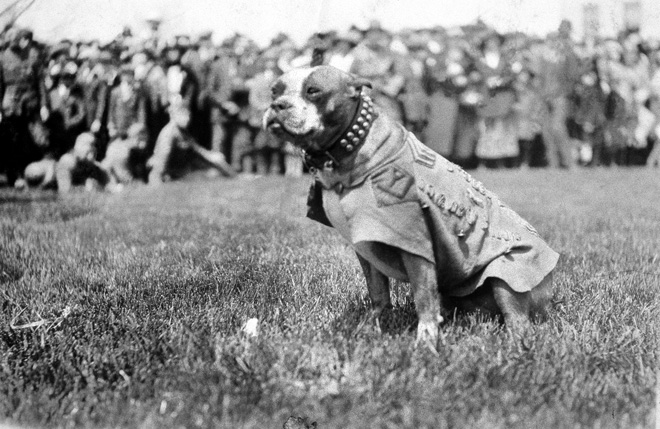
By the last year of WW1, the French, British and Belgians had at least 20,000 dogs on the battlefield, the Germans 30,000. General Headquarters of the American Expeditionary Forces recommended the use of dogs as sentries, messengers and draft animals in the spring of 1918. However, with the exception of a few sled dogs in Alaska, the US was the only country to take part in World War I with virtually no service dogs in its military.

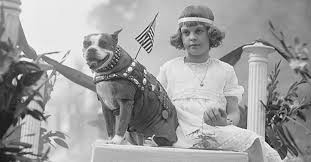
sgt_stubby_7America’s first war dog, “Stubby”, got there by accident, and served 18 months ‘over there’, participating in seventeen battles on the Western Front.

Stubby looked like a terrier of some kind, similar to a pit bull.  Nobody knows anything more about him.  He showed up a stray one day, at Yale Field in New Haven Connecticut, where a group of soldiers were training. The dog hung around as the men drilled.  One soldier, Corporal Robert Conroy, began to take care of him. when Conroy’s outfit shipped out in 1917, Stubby was hidden on board.

Stubby saved his regiment from surprise mustard gas attacks, located and comforted the wounded, and even once caught a German spy by the seat of his pants. The Hun, who’d been sneaking around behind allied lines at the time, was mapping trenches for artillery bombardment.  The Bosch was found spinning in circles with a large, muscular terrier affixed to his behind.   He was easily disarmed, but it took a considerable amount of coaxing before Stubby could be persuaded to let go of that German’s rear end.

sgt_stubby_5Stubby saw his first action at Chemin des Dames. Since the boom of artillery fire didn’t faze him, he learned to follow the example of ducking when the big ones came close. It became a great game to see who could hit the dugout, first.  After a few days, the guys were watching him for a signal. Stubby was always the first to hear incoming fire.  We can only guess how many lives were spared by his early warning.
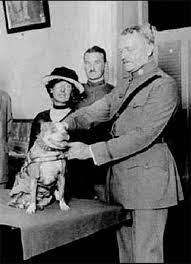
images (47)After the Armistice, Stubby returned home a nationally acclaimed hero, eventually received by both Presidents Harding and Coolidge. Even General John “Black Jack” Pershing, who commanded the AEF during the war, presented Stubby with a gold medal made by the Humane Society, declaring him to be a “hero of the highest caliber.”
Stubby toured the country by invitation and probably led more parades than any dog in American history:  he was promoted to honorary Sergeant by the Legion, becoming the highest ranking dog to ever serve in the Army.

Old age finally caught up with the small warrior on April 4th, 1926, as he took ill and died in his master’s arms.

Sergeant Stubby and a few of his contemporaries were instrumental in inspiring the creation of the US K-9 Corps, just in time for World War ll.


If you enjoyed this “Today in History”, please feel free to re-blog, “like” & share on social media, so that others may find and enjoy it as well. Please click the “follow” button on the right, to receive email updates on new articles.  Thank you for your interest, in the history we all share.

April 3, 1946 Death March

Mario “Motts” Tonelli hoped to fulfill his one years’ commitment and return to the Cardinals for the ’42 season, but it wasn’t meant to be. The radio crackled to life at 2:30am local time on December 7. “Air raid on Pearl Harbor. This is no drill!”

The game was November 27, 1937.  Late in the 4th quarter, Notre Dame was tied 6-6 with Southern California. The “Fighting Irish” needed a miracle. Notre Dame fullback #58 Mario Tonelli took the hand-off deep in Notre Dame territory and ran the ball 70 yards back before being tackled. Seconds later, the 5’11”, 195lb Tonelli, scored the game winning touchdown.

In some ways, Mario Tonelli himself was the miracle. At the age of 6, “Motts” Tonelli had been burned over 80% of his body, when a trash compactor toppled over on him. Mario’s immigrant father Celi, a laborer from a northern Italian marble quarry, refused to believe the doctor who said his son would never walk again. Fixing four wheels to a door, the elder Tonelli taught his first American-born son to move about with his arms. By 1935, Mario Tonelli was a football, basketball and track star at Chicago’s DePaul Academy.

TonelliAfter a year coaching at Providence College in 1939 and a year playing professional football for the Chicago Cardinals in 1940, Tonelli joined the Army in early 1941, assigned to the 200th Coast Artillery Regiment in Manila.

Tonelli hoped to fulfill his one years’ commitment and return to the Cardinals for the ’42 season, but it wasn’t meant to be. The radio crackled to life at 2:30am local time on December 7. “Air raid on Pearl Harbor. This is no drill!”

Bataan1Military forces of Imperial Japan appeared unstoppable in the early months of WWII, attacking first Thailand, then the British possessions of Malaya, Singapore, and Hong Kong, as well as US military bases in Hawaii, Wake Island, Guam and the Philippines.

The United States was grotesquely unprepared to fight a World War in 1942, and dedicated itself to beating Adolf Hitler first. General Douglas MacArthur abandoned the “Alamo of the Pacific” on March 11 saying “I shall return”, leaving 90,000 American and Filipino troops without food, supplies or support with which to fight off the Japanese offensive.

bataanOn April 9, 75,000 surrendered the Bataan peninsula, beginning a 65 mile, five-day slog into captivity through the heat of the Philippine jungle. Japanese guards were sadistic. They would beat the marchers and bayonet those too weak to walk. Japanese tanks  swerved out of their way to run over anyone who had fallen and was too slow in getting up. Some were burned alive. Already crippled from tropical disease and starving from the long siege of Luzon, thousands perished in what came to be known as the Bataan Death March.

Exhausted, sunburned and aching with thirst, Tonelli still refused when a Japanese soldier demanded his Notre Dame class ring. As the guard reached for his sword, a nearby prisoner shouted “Give it to him. It’s not worth dying for”.

Mario Tonelli RingMinutes later, a Japanese officer appeared, speaking perfect English. “Did one of my men take something from you?” “Yes”, Tonelli replied. “My school ring”. “Here,” said the officer, pressing the ring into his hand. “Hide it somewhere. You may not get it back next time”. Tonelli was speechless. “I was educated in America”, the officer said. “At the University of Southern California. I know a little about the famous Notre Dame football team. In fact, I watched you beat USC in 1937. I know how much this ring means to you, so I wanted to get it back to you”.

Nearly 700 Americans and over 10,000 Filipinos died on the Bataan death march. For the survivors, the ordeal was only the beginning. For 2½ years, Tonelli suffered starvation, disease and endless beatings in the squalid prison camps known as O’Donnell, Cabanatuan, and Davao. Tonelli kept his ring throughout, buried in a soap dish. He’d take it out from time to time to remind himself:  life used to be better than this. It gave him something to hope for.

tonelli2The hellish 60-day journey aboard the filthy, cramped merchant vessel began in late 1944, destined for slave labor camps in mainland Japan. Tonelli was barely 100 pounds on arrival, his body ravaged by malaria and intestinal parasites. He was barely half the man who once played fullback at Notre Dame Stadium, Soldier Field and Comiskey Park.

Arriving at Nagoya #7 prison camp, Tonelli was handed a piece of paper. Scribbled on it was a 58. He was prisoner number 58, the same number he once wore on his football Jersey. “From that point on,” he said, “I knew I was going to make it”.

An American military tribunal conducted after the war held Lieutenant General Homma Masaharu, commander of the Japanese invasion forces in the Philippines, guilty of war crimes. He was executed by firing squad on April 3, 1946.

Mario Tonelli always hoped to meet the officer who’d returned his ring, but it wasn’t meant to be. He probably didn’t survive the war. Tonelli still had that ring when he passed away, in 2003.

Last year, nearly 10,000 gathered in New Mexico, to commemorate the 75th anniversary of the Bataan death march. 7,200 retired and active duty military personnel and civilians gathered to run the 26.2 “Death March” through the hilly desert terrain of the White Sands Missile Range, a race described by DoD.mil as “one of the toughest marathon-length events in the U.S.”

handshakes-467x350
Bataan Death March survivor retired U.S. Air Force Chief Master Sgt. Harold Bergbower, 97, shakes hands with 2018 Bataan Memorial Death March participants at the race’s finish line. DoD photo by Army Staff Sgt. Bruce Petitt

Ed Broadnax of El Paso, Texas, ran the course in full uniform, boots and 45-pound backpack. “As a veteran who served 26 years in the US Army and deployed three times to combat and experienced the horrors of war, I feel pain for the men and women who suffered intensely under the deadly Japanese Imperial Forces, as they were marched through the Philippine jungle. This is what drives me to run in their honor.”

Hundreds of others walked a 14.2 mile course, including Bataan Death March survivor Ben Skardon, who turned 100 last July.  Mr. Skardon walked 8½.  “The word hero doesn’t apply to me, at all”, Skardon said.  “As I said in my talk, ‘no greater love hath any man, than to lay down his life for his friends’.  That’s in the bible”.

Seven survivors of the Death March of 1942, turned out for the March 31, 2017 event.   The 2018 edition held on March 25, had one fewer.

If you enjoyed this “Today in History”, please feel free to re-blog, “like” & share on social media, so that others may find and enjoy it as well. Please click the “follow” button on the right, to receive email updates on new articles.  Thank you for your interest, in the history we all share.