April 17, 1945 Kamikaze

What must it be like to be at sea, frantically defending yourself against a human bomb, hurtling toward you at 500 miles per hour.

By the end of 1944, a series of naval defeats had left the Imperial Japanese critically short of military aviators, and the experienced aircraft mechanics and ground crew necessary to keep them aloft.

On October 14, the Atlanta class light cruiser USS Reno was hit by a Japanese aircraft in what many believed to be a deliberate crash.  The following day, Rear Admiral Masafumi Arima personally lead an attack by 100 Yokosuka D4Y “Judy” dive bombers against a carrier task force.  Arima was killed and part of one bomber hit the USS Franklin, the Essex-class carrier known as “Big Ben”.

72nd_Shinbu_1945_Kamikaze
17-year-old Corporal Yukio Araki (holding the puppy) died the following day in a suicide attack near Okinawa. H/T Wikipedia

Japanese propagandists were quick to seize on Arima’s example.  Whether this was a deliberate “kamikaze” attack remains uncertain.  The tactic was anything but the following week, during the battle of Leyte Gulf.  Japanese aviators were deliberately flying their aircraft, into allied warships.

By the end of the war, this “divine wind” would destroy the lives of 3,862 kamikaze pilots, and over 7,000 American naval personnel.

American Marines invaded Iwo Jima in February 1945, the first allied landing on Japanese territory. It was a savage contest against a dug-in adversary, a 36-day battle costing the lives of 6,381 Americans and nearly 20,000 Japanese.

The table was set for the bloodiest battle of the Pacific war.

On April 1, Easter Sunday, 185,000 troops of the US Army and Marine Corps were pitted in the 85-day battle for Okinawa, against 130,000 defenders of the Japanese 32nd Army and civilian conscripts.  Both sides understood, the war would be won or lost in this place.

While Kamikaze attacks were near-commonplace following the October battle for Leyte Gulf, these one-way suicide missions became a major part of defense for the first time in the battle for Okinawa.  Some 1,500 Kamikaze aircraft participated in the battle for Okinawa, resulting in US 5th Fleet losses of 4,900 men killed or drowned, and another 4,800 wounded.  36 ships were sunk and another 368 damaged.  763 aircraft, were lost.

kamikaze-taking-off
Kamikaze, taking off

What must it be like to be at sea, frantically defending yourself against a flying bomb, hurtling toward you at 500 miles per hour.

On April 16, 1945, the Sumner-class destroyer USS Laffey was assigned to radar picket duty, thirty miles north of Okinawa. At 8:25 a.m., the radar operator reported a solid cluster of blips at 17,000 yards, too numerous to count and approaching fast.  165 kamikazes and 150 other enemy aircraft were coming in, from the north

The Aichi D3A “Val” dive bomber appeared near the destroyer at 8:30. This was a reconnaissance mission and, fired upon, the Val jettisoned her bombs, and departed. Four more D3As were soon to follow, tearing out of the sky in a steep dive toward USS Laffey. 20mm AA fire destroyed two while the other two crashed into the sea. Within seconds, a Yokosuka D4Y “Judy” dive bomber made a strafing run from the port beam while another approached on a bomb run, from the starboard side. These were also destroyed but, close enough to wound three gunners, with shrapnel. The flames had barely been brought under control when another Val crashed into the ship’s 40mm gun mounts, killing three sailors while another struck a glancing blow, spewing aviation fuel from a damaged engine.

kamikaze - USS Laffey

Immediately after, another D3A came in strafing from the stern, impacting a 5″ gun mount and disintegrating in a great column of fire as its bomb detonated a powder magazine. Another Val came in within seconds, crashing into the burning gun mount while yet another scored a direct hit, jamming Laffey’s rudder to port and killing several men. Within minutes, another Val and yet another Judy, had hit the port side.

It was all in the first fifteen minutes.

Soon, four FM2 Wildcats followed by twelve Vought F4U Corsair fighters from the escort carrier Shamrock Bay waded into the Kamikazes attacking Laffey, destroying several before being forced to return, low on fuel and out of ammunition.

DD-724_Laffey

By the time it was over, some fifty Kamikazes were involved with the action. USS Laffey suffered six Kamikaze crashes, four direct bomb hits and strafing fire that killed 32 and wounded another 71. Lieutenant Frank Manson, assistant communications officer, asked Commander Frederick Becton if he thought they should abandon ship. Becton snapped “No! I’ll never abandon ship as long as a single gun will fire.” He didn’t hear the comment, from a nearby lookout: “And if I can find one man to fire it.”

For USS Laffey, the war was over.  She was taken under tow the following day, April 17, and anchored near Okinawa.  She would not emerge from dry dock, until September.

Damaged-ship-Into-Seattle

Today, the WW2 destroyer is a museum ship, anchored at Patriots Point in Mount Pleasant, South Carolina.  A bronze plaque inside the ship is inscribed with the Presidential Unit Citation, received for that day off the coast of Okinawa:

For extraordinary heroism in action as a Picket Ship on Radar Picket Station Number One during an attack by approximately thirty enemy Japanese planes, thirty miles northwest of the northern tip of Okinawa, April 16, 1945. Fighting her guns valiantly against waves of hostile suicide planes plunging toward her from all directions, the U.S.S. LAFFEY sent up relentless barrages of antiaircraft fire during an extremely heavy and concentrated air attack. Repeatedly finding her targets, she shot down eight enemy planes clear of the ship and damaged six more before they crashed on board. Struck by two bombs, crash-dived by suicide planes and frequently strafed, she withstood the devastating blows unflinchingly and, despite severe damage and heavy casualties, continued to fight effectively until the last plane had been driven off. The courage, superb seamanship and indomitable determination of her officers and men enabled the LAFFEY to defeat the enemy against almost insurmountable odds, and her brilliant performance in this action, reflects the highest credit upon herself and the United States Naval Service.

For the President,
James Forrestal
Secretary of the Navy

s-l1600 (2)

The Battle for Okinawa
“The Battle of Okinawa was an intense 82-day campaign involving more than 287,000 US and 130,000 Japanese troops. It was considered the bloodiest battle of the Pacific Theater, and more than 90,000 men died from both sides, along with almost 100,000 civilian casualties. During this conflict, Kamikazes inflicted the greatest damage ever sustained by the US Navy in a single battle, killing almost 5,000 men. All told, Kamikazes sank 34 ships and damaged hundreds of others during the entire war”. H/T Listverse.com

April 16, 73 Masada

The siege of the mountaintop fortress of Masada ended this day in 73.  Two women and five children who had taken shelter in a water pipe, alone remained to tell the tale.

Built under the reign of King Solomon in the 10th century BC, Solomon’s Temple was the first holy temple in ancient Jerusalem.  According to Rabbinic sources the temple stood on part of the Temple Mount, also known as Mount Zion for 410 years, before being sacked and burned to the ground by the Babylonian King Nebuchadnezzar II, in 587 BC.

solomons-templeSo important is this event to the Jewish people that it is commemorated still as the bitterest day of the Jewish calendar, a day of fasting and mourning known as Tisha B’Av.

A second temple was built on the site in 516BC, and expanded during the reign of Herod the Great. This second temple stood until the Roman sack of Jerusalem in 70AD, according to Jewish tradition falling on the same day as the first temple.

The first Roman involvement with the Kingdom of Judea came in 67BC.  The client Kingdom of the Herodian Dynasty became a Roman Province in the year 6AD.

Long standing religious disputes erupted into a full scale Jewish revolt in 66. Thousands of Jews were executed in Jerusalem and the second temple plundered, resulting in the Battle of Beth Horon in which a Syrian Legion was destroyed by Jewish rebels. The future emperor Vespasian appointed his son Titus as second in command, entering Judea in 67 at the head of four legions of Roman troops.

Arch_of_Titus_Menorah
“Depiction of the Roman triumph celebrating the Sack of Jerusalem on the Arch of Titus in Rome. The procession features the Menorah and other vessels taken from the Second Temple”. H/T Wikipedia

A three year off and on siege followed, with Vespasian being recalled to Rome in 69 to become Emperor. The Great Jewish Revolt was now Titus’ war.

The Jewish historian Josephus acted as intermediary throughout much of the siege, though his impartiality has been questioned since he was both friend and adviser to Titus.   Josephus entered the city at one point to negotiate but later fled, wounded by an arrow in a surprise attack which very nearly caught Titus himself.

Roberts_Siege_and_Destruction_of_Jerusalem
The Siege and Destruction of Jerusalem by the Romans Under the Command of Titus, A.D. 70, Oil on canvas by David Roberts, 1850

A brutal siege of Jerusalem followed through most of the year 70, in which Jewish Zealots burned their own food supply, forcing defenders to “Fight to the End”.  During the final stages, Zealots following John of Giscala still held the Temple, while a splinter group called the Sicarii (literally, “Dagger Men”), led by Simon Bar Giora held the upper part of the city.

The Second Temple, one of the last fortified bastions of the rebellion, was destroyed on Tisha B’Av, July 29 or 30, 70AD. By September 7 the Roman army under Titus had fully occupied and plundered all of Jerusalem.

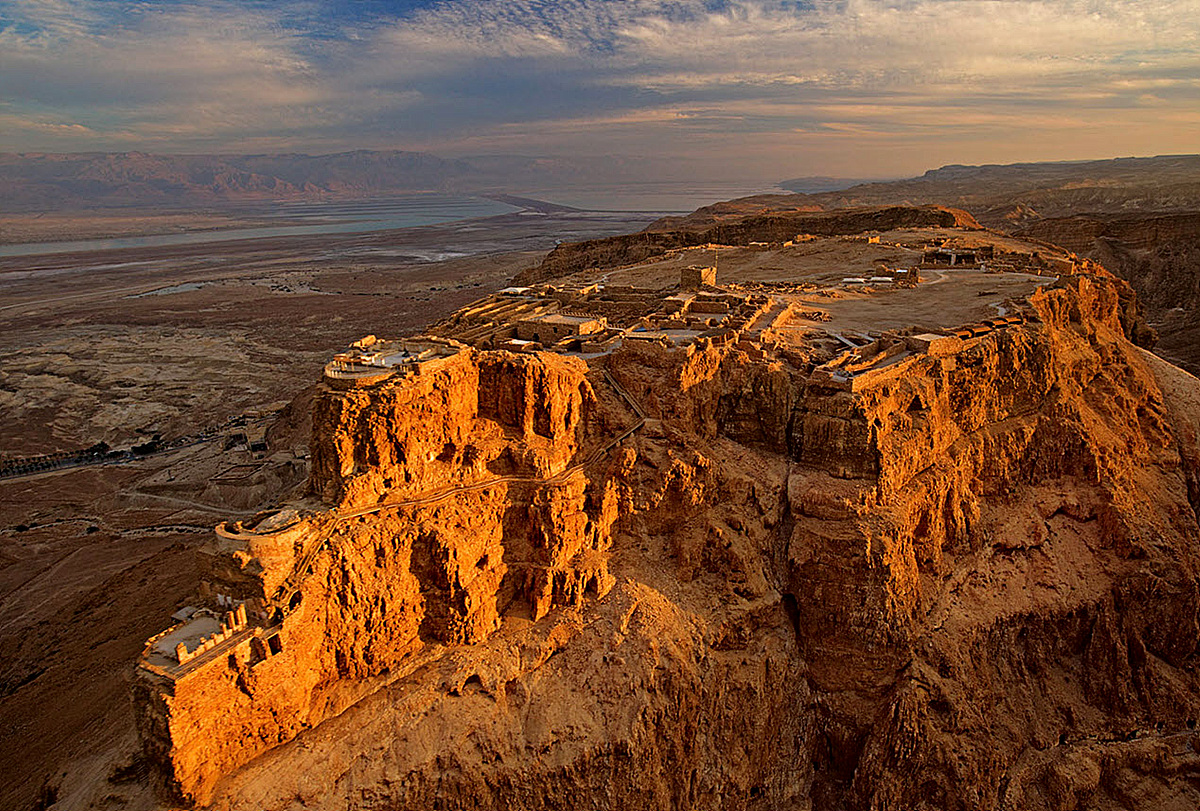
Masada
Mountain fortress of Masada. Note the siege ramp to the right, by which the besieging force gained access to the top. The Romans built that.

The first Jewish-Roman war would last for three more years, culminating in the Roman siege of the mountaintop fortress of Masada.

Masada rises nearly fifteen-hundred feet above the dead sea, occupying the 18-acre plateau of a mountain described by modern Arabs as al-Sabba. “The Accursed”.

The rhomboid-shaped mesa was briefly settled around the time of the first temple (ca. 900BC), and fortified during the Hasmonean Dynasty of ancient Judaea. The plateau ends in steep cliffs falling some 1,300 feet to the east and about 300-feet on the western side. Already a natural fortress, Herod the Great equipped the place with a 13-foot wall some 1,300-feet in length, a barracks, armory and a cistern holding 200,000 gallons of water.

4d6e5b7865f7fe3f65d6c897db1ed696Masada remained the last remnant of Jewish rule in Palestine in 70, following the fall of Jerusalem and destruction of the second temple.  A defending force of fewer than 1,000 (including women and children) held out for nearly two years as the 15,000-strong legions of General Flavius Silva placed stone upon stone, building the sloping ramp of earth and stone seen above.

In the end, Zealot defenders led by Eleazar ben Ya’ir, never had a chance.  Preferring death to enslavement, Josephus tells us of their drawing lots, each man bearing his throat to his comrade until there remained only one.

Mountaintop excavations in 1955-’56 and resumed in 1963-’66 support this version of the end, pottery shards bearing inscribed names, in Hebrew.

It was all over on this day in 73.  Two women and five children who had taken shelter in a water pipe, alone remained to tell the tale.

There would be two more Jewish-Roman wars:  Kitos War (115–117), sometimes called the “Rebellion of the Exile”, and the Bar Kokhba Revolt of 132 through 135. The wars had a cataclysmic impact on the Jewish people, the resulting diaspora transforming a major Eastern Mediterranean population to a scattered and persecuted minority.

The Jewish people would not reestablish a major presence in the Levant until the State of Israel was constituted, in 1948.

maxresdefault (25)
Old City of Jerusalem

April 13, 1861 Fort Sumter

By the time the war got going, every seceding state but South Carolina sent regiments to fight for the Union, and even that state contributed troops. A surprising number of northern soldiers resigned commissions and fought for the south, including Barre, Massachusetts native Daniel Ruggles, Ohio Quaker Bushrod Johnson and New York native Samuel Cooper, to name a few.  

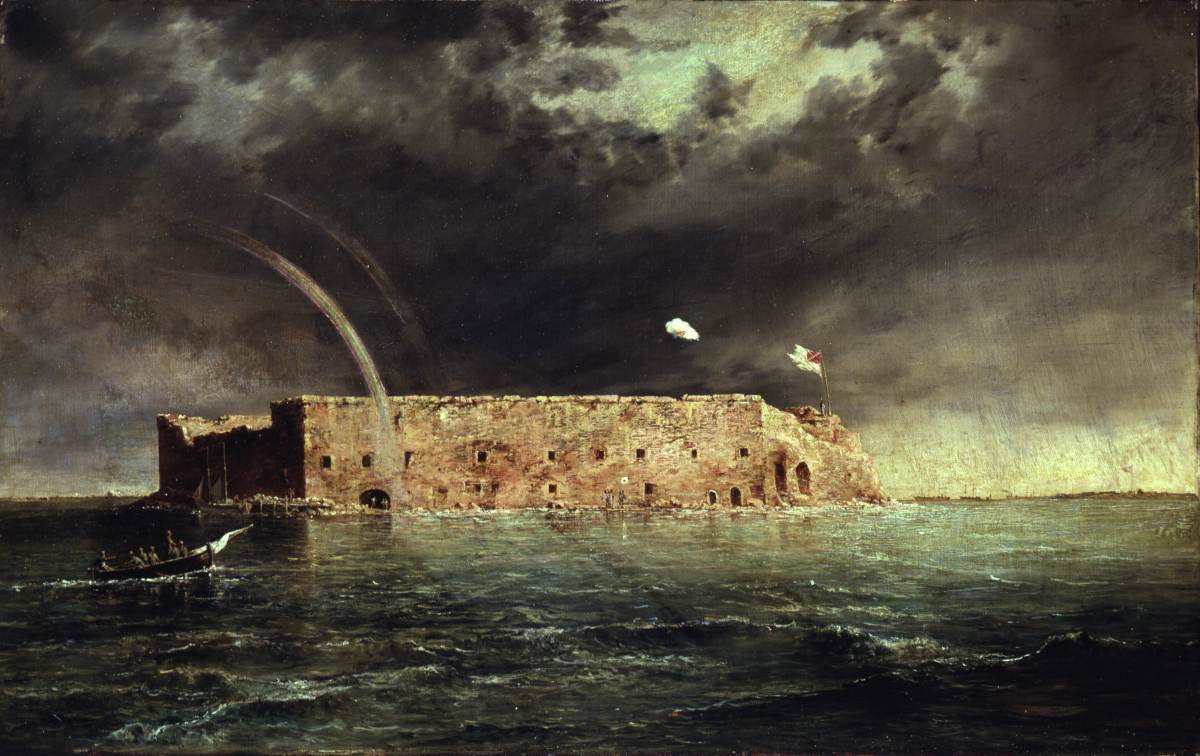
When the state of South Carolina seceded from the Union on December 20, 1860, the state government considered itself to be that of a sovereign nation. Six days later, United States Army Major Robert Anderson quietly moved his small command from the Revolution-era Fort Moultrie on Sullivan’s Island in Charleston harbor, to the as-yet to be completed Fort Sumter, a brick fortification at the mouth of the harbor.

President James Buchanan, a northern democrat with southern sympathies, believed secession to be illegal, but there was nothing he could do about it.  For months the President had vacillated, offering no resistance as local officials seized every federal government property, in the state.  Buchanan’s one attempt to intervene came in January, with the attempt to reinforce and resupply Anderson, via the unarmed merchant vessel “Star of the West”. Shore batteries opened up on the effort on January 9, 1861, effectively trapping Anderson and his garrison inside the only federal government property in the vicinity.

Overview_of_interior_of_Fort_Sumter_IMG_4543.JPG

Mississippi followed with its own ordnance of secession that same day, followed quickly by Florida, Alabama, Georgia and Louisiana. Texas seceded on February 1.

The newly founded Confederate States of America could not tolerate the presence of an armed federal force at the mouth of Charleston harbor.  Secessionists debated only whether this was South Carolina’s problem, or that of the national government, located at that time in Montgomery, Alabama.  Meanwhile, the Federal government refused to recognize the Confederacy as an independent state.

Neither side wanted to be seen as the aggressor, both needing support from the border states.  Political opinion was so sharply divided at that time, that brothers literally wound up fighting against brothers.  By the time the war got going, every seceding state but South Carolina sent regiments to fight for the Union, and even that state contributed troops.

A surprising number of northern soldiers resigned commissions and fought for the south, including Barre, Massachusetts native Daniel Ruggles, Ohio Quaker Bushrod Johnson and New York native Samuel Cooper, to name a few.  But now I’m getting ahead of the story.

Confederate Brigadier General Pierre Gustave Toutant-Beauregard (I love that name) had resigned his post as superintendent of West Point and offered his services to the Confederacy.  Beauregard was placed in charge of Charleston in March, and immediately began to strengthen the batteries surrounding the harbor.

1200px-Charleston_Harbor_1861

Fort Sumter was designed for a garrison of 650 in the service of 130 guns, nearly all of them pointed outward, positioned to defend the harbor against threats from the sea. In April 1861 there were only 60 guns, too much for Major Anderson’s 9 officers, 68 enlisted men, 8 musicians, and 43 construction workers.

Abraham Lincoln was inaugurated on March 4.  The resupply of Fort Sumter became the first crisis for the new administration. Lincoln notified South Carolina Governor Francis Pickens that he was sending supply ships, resulting in Beauregard’s ultimatum:  the Federal garrison was to evacuate immediately, or Confederate batteries would open fire.

When Major Anderson’s response was found lacking, shore batteries opened fire at 4:30 am on April 12th, 4,003 guns firing in counter-clockwise rotation. Abner Doubleday, Federal 2nd-in-command and the man erroneously credited with the invention of baseball, later wrote “The crashing of the shot, the bursting of the shells, the falling of the walls, and the roar of the flames, made a pandemonium of the fort.

Fort-Sumter-under-attack-2

Two years later at Gettysburg, Norman Jonathan Hall would lose over 200 men from his brigade, in furious fighting at a critical breach in Union lines, near the”copse of trees”.  One day, a brass plaque would mark the spot of the “High Water Mark” of the Confederacy.  On this day, Lieutenant Hall raced through flames to rescue the colors, after a direct hit on the main flagpole knocked the flag to the ground.  His eyebrows were permanently burned off his face, but Hall and two artillerymen were able to jury-rig the pole so that, once again, Old Glory flew over Fort Sumter.

Thousands of shells were fired at Fort Sumter over a period of 34 hours. Federal forces fired back, though vastly outgunned. For all that, the only casualty was one Confederate horse.

The first fatalities of the Civil War occurred after the federal surrender on April 13. Allowed a 100-gun salute while lowering the flag the following day, one cannon misfired, killing Private Daniel Hough and mortally wounding Pvt. Edward Galloway.

The following day, Colonel Robert E. Lee resigned his commission in the United States Army.  Lee’s home state of Virginia seceded three days later, followed by Arkansas, North Carolina and Tennessee.

The Civil War had begun, but few understood what kind of demons had just been unleashed. Robert Rhett, the rabble rousing editor of the Charleston Mercury Newspaper, offered to personally eat the bodies of all the slain in the coming conflict. Not wanting to be outdone, former Senator James Chesnut, Jr. said “a lady’s thimble will hold all the blood that will be shed,” promising to personally drink any that might be spilled.

The war between the states would destroy the lives of more Americans than the Revolution, WWI, WWII, and the wars in Korea, Vietnam, Iraq and Afghanistan, combined.


A Trivial Matter
Abraham Lincoln was elected in 1860 with only 39.8 per cent of the popular vote in a four-way race against Northern Democrat Stephen A. Douglas, Constitutional Unionist John Bell and Southern favorite, Kentucky Democrat John Breckenridge.  President Lincoln did not receive a single electoral vote from south of the Mason-Dixon line.

April 9, 1942 Angels of Bataan and Corregidor

77 Americans of the Army and Navy Nurse Corps and a handful of civilians were captured with the fall of Corregidor, becoming the largest group of female POWs, of the war.

Military forces of the Japanese Empire appeared unstoppable in the months following the attack on Pearl Harbor, invading first Thailand, then the British possessions of Malaya, Singapore, and Hong Kong, as well as American military bases in Wake Island, Guam and the Philippines.

The United States was grotesquely unprepared to fight a World War in 1942, and dedicated itself to beating Adolf Hitler.  General Douglas MacArthur abandoned the “Alamo of the Pacific” on March 11 saying “I shall return”, leaving 90,000 American and Filipino troops without food, supplies or support with which to fight off the Japanese offensive.

Death March

Some 75,000 American and Filipino troops surrendered on April 9, abandoning the Bataan peninsula to begin a 65-mile, five-day slog into captivity.  Starving and sick with any number of tropical diseases, Japanese guards were sadistic in the 100-degree tropical sun.  Marchers were beaten, decapitated or shot at random and bayoneted, if too weak to walk. Japanese tank drivers swerved out of the way to run over those who had fallen and were too slow in getting up. Some were burned alive.

Already crippled from tropical disease and starving from the long siege of Luzon, thousands perished in what came to be known as the Bataan Death March.

Margaret_Utinsky
Margaret Utinsky

The American nurse Margaret Elizabeth (Doolin) Rowley came to the Philippines the late 1920s, a twenty-something widow and single mother to her young son, Charles. There she met and fell in love with John “Jack” Utinsky, a former Army Captain working as a civil engineer. The couple was married in 1934, and settled down to a life in Manila.

As the likelihood of war came to the far east, the US military ordered American wives out of the Philippines. Utinsky refused and took an apartment in Manila, while Jack went to work on the Bataan peninsula.

Margaret was forced aboard the last ship to leave as Japanese troops occupied Manila on January 2, 1942, but sneaked off the ship and returned to her apartment. Years later, Margaret Utinsky wrote in her book, “Miss U”:

Miss_u_book_cover“To go into an internment camp seemed like the sensible thing to do, but for the life of me I could not see what use I would be to myself or to anyone else cooped up there. … For from the moment the inconceivable thing happened and the Japanese arrived, there was just one thought in my mind—to find Jack.”

The weeks came and went while Margaret remained undiscovered.  She ventured out in mid-March and sought help from the priests of Malate Convent, there using contacts to gain false identity papers as Rena Utinsky, a fictional nurse from the non-belligerent state of Lithuania.

On the eve of the American surrender, Lieutenant General Jonathan Wainwright ordered all military and civilian nurses off the Bataan peninsula, and onto the island of Corregidor.

77 Americans of the Army and Navy Nurse Corps and a handful of civilians were captured a month later with the fall of Corregidor, becoming the largest group of female POWs, of the war.

Angels of Bataan and Corregidor
“Known as the “Angels of Bataan and Corregidor,” the group of army nurse continues to hold the distinction of not losing a single member during their three years in internment”. H/T FoxNews.com

The group was sent to Santo Tomas prison camp in July, joining a group of Navy nurses who had been there, for six months.

Conditions were horrendous in these camps, with disease, starvation and cartoonish levels of violence from sadistic guards.  Up to and including summary execution.  Army nurse Mary Bernice Brown-Menzie entered into captivity weighing 130-pounds in 1942.  By the time of her liberation in February, 1945, she weighed 75.

marybernicebrown
Mary Bernice Brown

Brown wrote in her diary of one prisoner who was tied up for three days and nights in the burning sun before being shot in the back, and left to die.  ““Whether he died instantly or wounded and bleeding lived on until he finally died, we will never know.  But this cruel, heartless and brutal treatment filled us all with deep grief and sorrow.”

Carlos and Tina Makabali Jose talk about their mother, Adelaida Garcia Makabali, a nurse in Bataan and Corregidor. H/T BataanLegacy.org
agarcia
Adelaida Garcia, H/T Fox News Channel

Margaret Utinsky used her false identity papers to secure a position with the Red Cross by this time, and went to Bataan looking for Jack.  Dismayed by conditions among survivors of the Death march, Utinsky began to do little things for the thousands of prisoners of Camp O’Donnell.  Money.  Quinine.  A little medicine.

Learning that Jack was dead, Utinsky became part of a small clandestine network, determined to do what they could for American POWs and Filipino resistance movements.  Code named “Miss U”,  she joined with 22-year-old Filipina hairdresser Naomi Flores (code name “looter”), American club owner Claire “High Pockets” Maybelle Snyder, a number of Filipino priests and a Spaniard named Ramon Amusategui.

6f31fb4ac982b0a5ab170b72f5e46395
WW2 propaganda poster

Suspected of aiding POWs, Utinsky was arrested and brought to Fort Santiago prison. There she was sexually assaulted and tortured, for thirty-two days. When confronted with that ship’s passenger log showing her real name, she claimed she had lied in order to secure work as a nurse. Imagine being beaten, and then beaten again, and again. For thirty two days. When that failed to gain a confession, her jailers decapitated five Filipino prisoners, in front of her cell. Another night, an American POW was tied to the bars of her cell and beaten so savagely that chunks of his flesh, wound up in her hair. Even beating the man to death in front of her was not enough, and she was thrown into a dungeon.  For four days, without food or water.

Corns-bible
“This New Testament was given to US Army nurse 2nd Lt. Edith Corns by Army Chaplain Perry O. Wilcox on 16 April 1942, while both were stationed on Corregidor. Shortly thereafter, the island was surrendered. Corns spent the remainder of the war in the Santo Tomas prison camp until it was liberated by an intrepid raid in February 1945 during the Battle of Manila. She was able to hold onto the New Testament for comfort throughout her imprisonment”. H/T National WW2 Museum, of New Orleans

She was finally released, provided she sign a statement attesting to her “good treatment”.
Utinsky was six weeks in hospital, recovering from the ordeal. Doctors wanted to amputate a leg infected with gangrene but she refused. The place was teeming with Japanese spies. She feared what she might give up, while under the influence of gas. In the end, the gangrene was cut out, without benefit of anesthesia.

Amusategui was found out and executed.  Flores and Utinsky took refuge in the mountains, working with guerrilla groups for the remainder for the war.   By the time it was over, Utinsky had lost 45 pounds, 35 percent of her body weight, and lost an inch in height.  Her face was aged twenty-five years and her once auburn hair, turned white.

Back in the camps, POWs fashioned nurse’s uniforms made from khaki, under the leadership of Veteran Army Captain Maude Davison.   Despite themselves suffering from disease and starvation, each was expected to finish her shifts, providing what care they could for the “The Battling Bastards of Bataan.”

403866_592565-alice-captain-1
Army Lieutenant Alice Zwicker of Maine tells of catching sparrows to eat during three years of captivity. You can read about her story in “The Life of a World War II Army Nurse in the War Zone and at Home”, by Walter MacDougall

It was the same for Navy nurses, led by Lieutenant Laura Cobb.  In 1943, these women  volunteered for transfer to Los Baños.  The work gave them purpose.  A reason to live.

Following the December 14, 1944 massacre at Palawan, United States Army Rangers and their Filipino allies staged a daring raid on Cabanatuan on January 27 and Camp O’Donnell, three days later.  Santo Tomas was liberated on February 3, 1945 along with nearby Bilibid Prison and Los Baños on February 23.

Emaciated, tormented by tropical disease and without a day’s survival training between them, every one of the 66 Army nurses, eleven Navy nurses and one Nurse Anesthetist:   Angels of Bataan and Corregidor lived to tell the tale and continued to perform their nurse’s duties, to the end.

f6b222a16cf0c0e078ed0cd107da2d2d

On the inside, most would have told you the men they cared for were the heroes of this story.  They never sought recognition.  After the war, many of those men credited their survival to the Angels of Bataan and Corregidor.  It was they who sought the recognition these women so richly deserved.

Today, none of the Angels of Bataan and Corregidor are believed to survive. Lieutenant Colonel Nancy Cantrell is an historian with the US Army Nurse’s Corps “They were a tough bunch,” Cantrell said in an interview with Soldier’s Magazine. “They had a mission. They were surviving for the boys … and each other. That does give you a bit of added strength.”


MAMA JULIE

Without order and work we will never survive.
This camp is guarded, you see, by Japanese
but we run it ourselves. And I was the one
(though many take credit) who labelled the quinine
Soda Bicarbonate so it wouldn’t be taken
and the one who said we’d care for the internees
imprisoned with us: Aussies, Brits, French —
other enemies of the Rising Sun, men, women,
children, all of them civilians. In khaki clothes
we’ve made by hand, we work our shifts.
No days off for heat waves or monsoon.
Only the bedridden are excused. These girls
are unprepared, call me Battle-Axe, but I know
how to whip them into shape. No whining.
No complaints We may be short on emetine
or anesthetic and have no reserves of insulin,
but what we do isn’t free choice. It’s a higher calling.

From ANGELS OF BATAAN, Susan Terris (Pudding House
Publications, 1999)

A Trivial Matter
Some 76,000 prisoners of war (66,000 Filipinos and 10,000 Americans) began the Bataan death march in April 1942. There are no precise numbers of those killed over those 65-miles. Estimates of the dead range from 2,500 Filipinos and 500 Americans, to 30 per cent of the entire force.

April 8, 1740 Jenkin’s Ear

For the future Georgia colony, the War of Jenkins Ear was an existential threat.

A series of escalating trade disputes had already taken place between British and Spanish forces, when the Spanish patrol boat La Isabela drew alongside the British brig Rebecca in 1731. After boarding, Commander Juan de León Fandiño accused the British commander of smuggling.  The discussion became heated, when Fandiño drew his sword and cut off the left ear of Captain Robert Jenkins.  “Go, and tell your King that I will do the same”, he snarled, “if he dares to do the same.”jenkins-ear-1

Seven years later, Captain Jenkins was summoned to testify before Parliament where, according to some accounts, he produced his own severed ear in a pickling jar, as part of his presentation.

This and other incidents of “Spanish Depredations upon the British Subjects” were considered insults to the honor of the British nation and a provocation to war.

A squadron of three 70-gun British third-rates was patrolling off the coast of Cornwall on April 8, 1740, when a mast was sighted to the north.  What at first appeared to be a French vessel was revealed to be the 70 gun ship-of-the-line Princesa, when she struck her French colors and hoist the Spanish flag.  Outnumbered 3-to-1, Princesa put up a good fight, but the issue was never in doubt.  She was brought into Portsmouth for repairs, entering British service as HMS Princess in 1742.  What had once been described as “the finest ship in the Spanish Navy”, would serve Her Britannic Majesty for another 42 years.Princesa

For the future Georgia colony, the War of Jenkins Ear was an existential threat.  Spain had laid claim to Florida, when Ponce de Leon first mapped the territory in 1513.  The territory which later became North & South Carolina joined the British Colonies to the north in 1663, leaving the areas in-between in dispute.  James Oglethorpe founded the 13th colony of Georgia as a buffer to Spanish incursion, two years after Mr. Jenkins lost his ear. Battle of Bloody Marsh (Model)

By 1736, Oglethorpe established Fort Frederica on the barrier island of St. Simon, off the Savannah coast.  The Spanish landing force of 4,500 to 5,000 men arrived on St. Simon’s Island in July of 1742, opposed by only 950 British Rangers, Colonial Militia and Indian Allies.

Oglethorpe’s forces attacked a Spanish reconnaissance in force at the Battle of Gully Hole Creek in the early morning hours of July 7, followed by the ambush of a much larger force that afternoon, in what would be known as the Battle of Bloody Marsh.  In the smoke and confusion, the Spanish never did figure out how puny the forces were who opposed them.  These two victories were as big a boost to British morale as they were a blow to that of their adversary.  The last major Spanish offensive into Georgia ended with a complete withdrawal, a week later.

GullyHoleCreekSign

The conflict which began in 1739 ended in 1748, though major operations ceased in 1742 when the War of Jenkins Ear was subsumed by the greater War of Austrian Succession, involving most of the major powers of Europe at that time. Peace arrived with the Treaty of Aix-la-Chapelle in 1748.

April 6, 1917 US Enters WW1

In the end, the German response to anticipated US action, brought about the very action it was trying to avoid.

In the early months of the “Great War”, the British Royal Navy imposed a surface blockade on the German high seas fleet.  Even food was treated as a “contraband of war”,  a measure widely regarded as an attempt to starve the German population.   With good reason.  One academic study performed ten years after the war, put the death toll by starvation at 424,000 in Germany alone. The German undersea fleet responded with a  blockade of the British home islands, a devastating measure carried out against an island adversary dependent on massive levels of imports.

1200px-Willy_Stöwer_-_Sinking_of_the_Linda_Blanche_out_of_Liverpool
Sinking of the Linda Blanche out of Liverpoole, by Willy Stöwer

World War 2 was a time of few restrictions on submarine warfare.  Belligerents attacked military and merchant vessels alike with prodigious loss of civilian life, but WW1 didn’t start out that way.

Wary of antagonizing neutral opinion, German Chancellor Theobald von Bethmann Hollweg argued against a “shoot without warning”policy but, strict adherence to maritime prize rules risked U-Boats and crews alike.  By early 1915, Germany declared the waters surrounding the British home Isles a war zone, where even the vessels of neutral nations were at risk of being sunk.

shq-ship-gun-dropped
“Q-Ship with gun. The hidden gun emerges as the cover and sides, masquerading as a deck structure, are dropped. From “Q” Boat Adventures: The Exploits of the Famous Mystery Ships by a “Q” Boat Commander, by Harold Auten, published by Herbert Jenkins Ltd” – Hat Tip HistoricEngland.org.uk

Desperate to find an effective countermeasure to the German “Unterseeboot”, Great Britain introduced heavily armed merchant ships with concealed weaponry in 1915, phony merchantmen designed to lure submarines into making surface attacks. Britain called these secret countermeasures “Q-ships”, after their home base in Queenstown, in Ireland. German sailors called them U-Boot-Fälle. “U-boat traps”.

Lusitania warning
Notices taken out in the New York Times and others, specifically warned the Lusitania was vulnerable to attack

The “unprovoked” sinking of noncombatant vessels, including the famous Lusitania in which 1,198 passengers lost their lives, became a primary justification for war.  The German Empire, for her part, insisted that many of these vessels carried munitions intended to kill German boys on European battlefields.

Underwater, the submarines of WWI were slow and blind, on the surface, vulnerable to attack.  In 1916, German policy vacillated between strict adherence to prize rules and unrestricted submarine warfare.  The first put their people and vessels at extreme risk, the second threatened to bring neutrals like the United States and Brazil,  into the war.

In 1916, President Woodrow Wilson won re-election with the slogan “He kept us out of war”, a conflict begun in Europe, two years earlier.

In a January 31, 1917 memorandum from German Ambassador Count Johann von Bernstorff to American Secretary of State Robert Lansing, the Ambassador stated that “sea traffic will be stopped with every available weapon and without further notice”, effective the following day. The German government was about to resume unrestricted submarine warfare.

Anticipating this resumption and expecting the decision to draw the United States into the war, German Foreign Secretary Arthur Zimmermann delivered a message to the German ambassador in Mexico, Heinrich von Eckardt. The telegram instructed Ambassador Eckardt that, if the United States seemed likely to enter the war, he was to approach the Mexican Government with a proposal for military alliance, promising “lost territory” in Texas, New Mexico, and Arizona in exchange for a Mexican declaration of war against the United States.

“We intend to begin on the first of February unrestricted submarine warfare. We shall endeavor in spite of this to keep the United States of America neutral. In the event of this not succeeding, we make Mexico a proposal of alliance on the following basis: make war together, make peace together, generous financial support and an understanding on our part that Mexico is to reconquer the lost territory in Texas, New Mexico, and Arizona. The settlement in detail is left to you. You will inform the President of the above most secretly as soon as the outbreak of war with the United States of America is certain, and add the suggestion that he should, on his own initiative, invite Japan to immediate adherence and at the same time mediate between Japan and ourselves. Please call the President’s attention to the fact that the ruthless employment of our submarines now offers the prospect of compelling England in a few months to make peace”.
Signed, ZIMMERMANN

zimmerman-noteThe “Zimmermann Telegram” was intercepted and decoded by British intelligence and revealed to the American government on February 24. The contents of the message outraged American public opinion and helped generate support for the United States’ declaration of war.

In the end, the German response to anticipated US action, brought about the very action it was trying to avoid.

President Woodrow Wilson delivered his war message to a joint session of Congress on April 2, stating that a declaration of war on Imperial Germany would make the world “Safe for Democracy”. Congress voted to support American entry into the war on April 6, 1917. The “Great War”, the “War to end all Wars”, had become a World War.

At the time, a secondary explosion within the hull of RMS Lusitania caused many to believe the liner had been struck by a second torpedo.  In 1968, American businessman Gregg Bemis purchased the wreck of the Lusitania for $2,400, from the Liverpool & London War Risks Insurance Association.   In 2007 the Irish government granted Bemis a five-year license to conduct limited excavations at the site.

causes-of-ww1

Twelve miles off the Irish coast and 300-feet down, a dive was conducted on the wreck in 2008.   Remote submersible operators discovered some 4,000,000 rounds of Remington .303 ammunition in the hold, proof of the German claim that Lusitania was, in fact, a legitimate target under international rules of war.  The UK Daily Mail quoted Bemis:  “There were literally tons and tons of stuff stored in unrefrigerated cargo holds that were dubiously marked cheese, butter and oysters’”.

American historian, author and journalist Wade Hampton Sides accompanied the expedition.  “They are bullets that were expressly manufactured to kill Germans in World War I” he said, “bullets that British officials in Whitehall, and American officials in Washington, have long denied were aboard the Lusitania.‘”

Lusitania, ammunition

Montana Republican Jeannette Pickering Rankin, a life-long pacifist and the first woman elected to the United States Congress, would be one of only fifty votes against entering WWI.  Rankin would be elected to a second (non-contiguous) term in 1940, just in time to be the only vote against entering WWII, following the Japanese attack on the United States’ Pacific anchorage at Pearl Harbor.


A Trivial Matter
“Although their exact policy varied throughout the war the German U-boats racked up a total of 12,850,815 tons of shipping sunk. The highest total for a single year was 1917, when unlimited submarine warfare resumed and 6,235,878 tons was sunk”. H/T Historyhit.com

April 5, 1761 Sybil’s Ride

Sybil Ludington received the thanks of family and friends and even that of George Washington.  She then stepped off the pages of history.

“Listen my children and you shall hear,
Of the midnight ride of”…Sybil Ludington.

Wait…What?

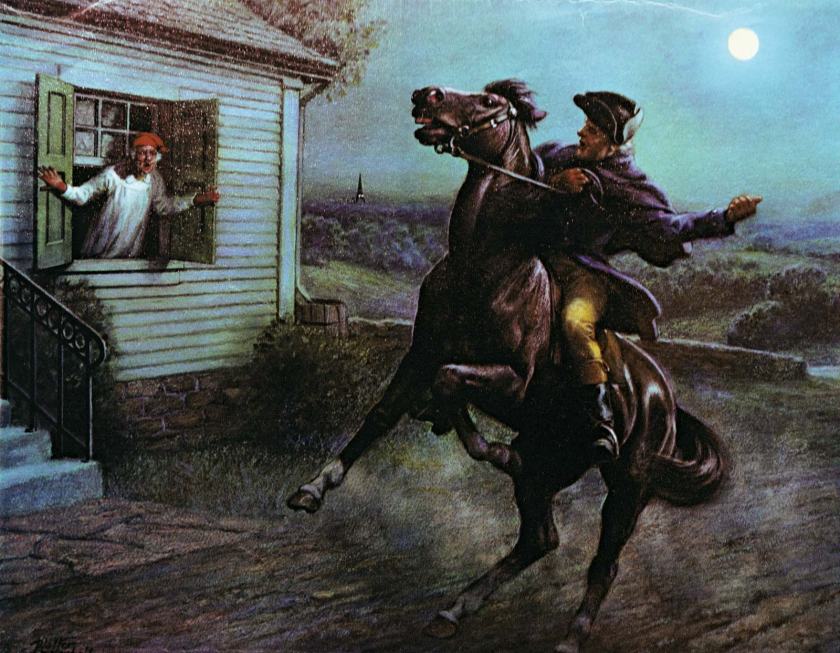
Paul Revere’s famous “midnight ride” began on the night of April 18, 1775.  Revere was one of two riders, soon joined by a third, fanning out from Boston to warn of an oncoming column of “regulars”, come to destroy the stockpile of gunpowder, ammunition, and cannon in Concord.

paul-revereRevere himself covered barely 12 miles before being captured, his horse confiscated to replace the tired mount of a British sergeant.  Revere would finish his “ride” on foot, arriving at sunrise on the 19th to witness the last moments of the battle on Lexington Green.
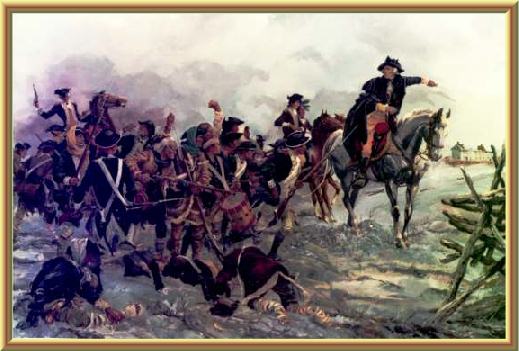
Two years later, Patriot forces maintained a similar supply depot, in the southwest Connecticut town of Danbury.

William Tryon was the Royal Governor of New York, and long-standing advocate for attacks on civilian targets.  In 1777, Tryon was major-general of the provincial army.  On April 25th, the General set sail for the Connecticut coast of Long Island Sound with a force of 1,800, intending to destroy Danbury.

Battle3

Patriot Colonel Joseph Cooke’s small Danbury garrison was caught and quickly overpowered on the 26th, trying to remove food supplies, uniforms, and equipment.  Facing little if any opposition, Tryon’s forces went on a bender, burning homes, farms and storehouses.  Thousands of barrels of pork, beef, and flour were destroyed, along with 5,000 pairs of shoes, 2,000 bushels of grain, and 1,600 tents.

Colonel Henry Ludington was a farmer and father of 12, with a long military career.  A long-standing and loyal subject of the British crown, Ludington switched sides in 1773, joining the rebel cause and rising to command the 7th Regiment of the Dutchess County Militia, in New York’s Hudson Valley.

908d9d26ffc8bb0c9e8a59b25da92429--american-revolutionary-war-paul-revereIn April 1777, Ludington’s militia was disbanded for planting season, and spread across the countryside.  An exhausted rider arrived at the Ludington farm on a blown horse, on the evening of the 26th, asking for help.  15 miles away, British regulars and a force of loyalists were burning Danbury to the ground.

The Dutchess County Militia had to be called up.  The Colonel had one night to prepare for battle, and this rider was done.  The job would have to go to Colonel Ludington’s first-born, his daughter, Sybil.

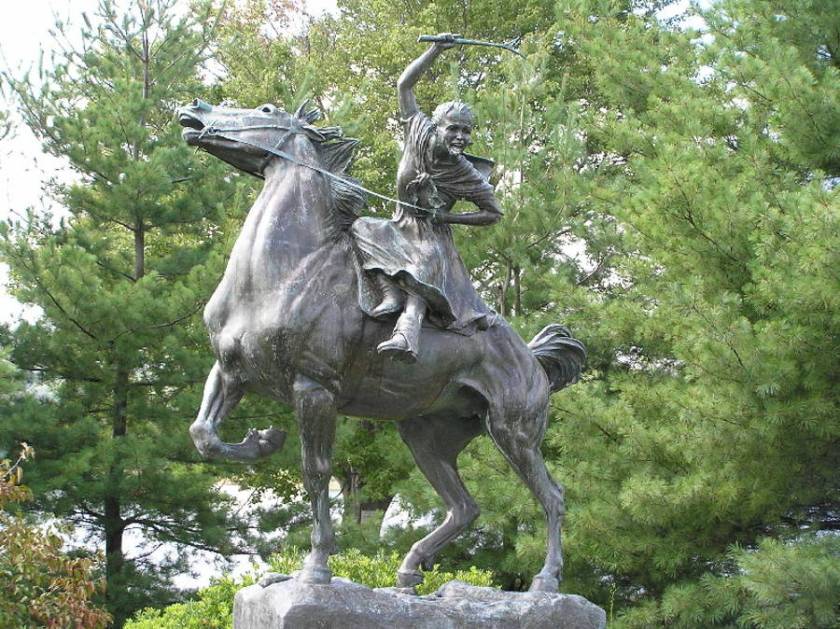
Born April 5, 1761, Sybil Ludington was barely sixteen at the time of her ride.  From Poughkeepsie to what is now Putnam County and back, the “Female Paul Revere” rode across the lower Hudson River Valley, covering 40 miles in the pitch dark of night, alerting her father’s militia to the danger and urging them to come out and fight.  She’d use a stick to knock on doors, even using it once, to fight off a highway bandit.

By the time Sybil returned the next morning, cold, rain-soaked, and exhausted, most of 400 militia were ready to march.

Arnold’s forces arrived too late to save Danbury, but inflicted a nasty surprise on the British rearguard as the column approached nearby Ridgefield.  Never outnumbered by less than three-to-one, Connecticut militia was able to slow the British advance until Ludington’s New York Militia arrived on the following day.  The last phase of the action saw the same type of swarming harassment, as seen on the British retreat from Concord to Boston, early in the war.35 miles to the east of Danbury, General Benedict Arnold was gathering a force of 500 regular and irregular Connecticut militia, with Generals David Wooster and Gold Selleck Silliman.

Though the British operation was a tactical success, the mauling inflicted by these colonials ensured that this was the last hostile British landing on the Connecticut coast.

The British raid on Danbury destroyed at least 19 houses and 22 stores and barns.  Town officials submitted £16,000 in claims to Congress, for which town selectmen received £500 reimbursement.  Further claims were made to the General Assembly of Connecticut in 1787, for which Danbury was awarded land.  In Ohio.

Keeler_tavern_ridgefield_cannonball_2006At the time, Benedict Arnold planned to travel to Philadelphia, to protest the promotion of officers junior to himself, to Major General.  Arnold, who’d had two horses shot out from under him at Ridgefield, was promoted to Major General in recognition for his role in the battle.  Along with that promotion came a horse, “properly caparisoned as a token of … approbation of his gallant conduct … in the late enterprize to Danbury.”  For now, the pride which would one day be his undoing, was assuaged.The Keeler Tavern in Ridgefield is now a museum.  The British cannonball fired into the side of the building, remains there to this day.

Henry Ludington would become Aide-de-Camp to General George Washington, and grandfather to Harrison Ludington, mayor of Milwaukee and 12th Governor of Wisconsin.

Gold Silliman was kidnapped with his son by a first marriage by Tory neighbors, and held for Nearly seven months at a New York farmhouse.  Having no hostage of equal rank with whom to exchange for the General, Patriot forces went out and kidnapped one of their own, in the person of Chief Justice Judge Thomas Jones, of Long Island.

Mary Silliman was left to run the farm, including caring for her own midwife, who was brutally raped by English forces for denying them the use of her home.  The 1993 made-for-TV movie “Mary Silliman’s War” tells the story of non-combatants, pregnant mothers and farm wives during the Revolution, as well as Mary’s own negotiations for her husband’s release from his Loyalist captors.

IMG_6632General David Wooster was mortally wounded at the Battle of Ridgefield, moments after shouting “Come on my boys! Never mind such random shots!”  Today, an archway marks the entrance to Wooster Square, in the East Rock Neighborhood of New Haven.  Sybil_Ludington_stamp
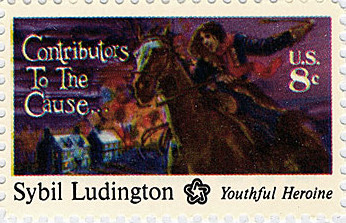
Sybil Ludington received the thanks of family and friends and even that of George Washington.  She then stepped off the pages of history.

Paul Revere’s famous ride would have likewise faded into obscurity, but for the poetry of Henry Wadsworth Longfellow.  Eighty-six years, later.

Page break

“Listen my children and you shall hear
Of the midnight ride of Paul Revere,
On the eighteenth of April, in Seventy-five;
Hardly a man is now alive
Who remembers that famous day and year.
He said to his friend, “If the British march
By land or sea from the town to-night,
Hang a lantern aloft in the belfry arch
Of the North Church tower as a signal light,–
One if by land, and two if by sea;
And I on the opposite shore will be,
Ready to ride and spread the alarm
Through every Middlesex village and farm,
For the country folk to be up and to arm.”
Then he said “Good-night!” and with muffled oar
Silently rowed to the Charlestown shore,
Just as the moon rose over the bay,
Where swinging wide at her moorings lay
The Somerset, British man-of-war;
A phantom ship, with each mast and spar
Across the moon like a prison bar,
And a huge black hulk, that was magnified
By its own reflection in the tide.
Meanwhile, his friend through alley and street
Wanders and watches, with eager ears,
Till in the silence around him he hears
The muster of men at the barrack door,
The sound of arms, and the tramp of feet,
And the measured tread of the grenadiers,
Marching down to their boats on the shore.
Then he climbed the tower of the Old North Church,
By the wooden stairs, with stealthy tread,
To the belfry chamber overhead,
And startled the pigeons from their perch
On the sombre rafters, that round him made
Masses and moving shapes of shade,–
By the trembling ladder, steep and tall,
To the highest window in the wall,
Where he paused to listen and look down
A moment on the roofs of the town
And the moonlight flowing over all.
Beneath, in the churchyard, lay the dead,
In their night encampment on the hill,
Wrapped in silence so deep and still
That he could hear, like a sentinel’s tread,
The watchful night-wind, as it went
Creeping along from tent to tent,
And seeming to whisper, “All is well!”
A moment only he feels the spell
Of the place and the hour, and the secret dread
Of the lonely belfry and the dead;
For suddenly all his thoughts are bent
On a shadowy something far away,
Where the river widens to meet the bay,–
A line of black that bends and floats
On the rising tide like a bridge of boats.
Meanwhile, impatient to mount and ride,
Booted and spurred, with a heavy stride
On the opposite shore walked Paul Revere.
Now he patted his horse’s side,
Now he gazed at the landscape far and near,
Then, impetuous, stamped the earth,
And turned and tightened his saddle girth;
But mostly he watched with eager search
The belfry tower of the Old North Church,
As it rose above the graves on the hill,
Lonely and spectral and sombre and still.
And lo! as he looks, on the belfry’s height
A glimmer, and then a gleam of light!
He springs to the saddle, the bridle he turns,
But lingers and gazes, till full on his sight
A second lamp in the belfry burns.
A hurry of hoofs in a village street,
A shape in the moonlight, a bulk in the dark,
And beneath, from the pebbles, in passing, a spark
Struck out by a steed flying fearless and fleet;
That was all! And yet, through the gloom and the light,
The fate of a nation was riding that night;
And the spark struck out by that steed, in his flight,
Kindled the land into flame with its heat.
He has left the village and mounted the steep,
And beneath him, tranquil and broad and deep,
Is the Mystic, meeting the ocean tides;
And under the alders that skirt its edge,
Now soft on the sand, now loud on the ledge,
Is heard the tramp of his steed as he rides.
It was twelve by the village clock
When he crossed the bridge into Medford town.
He heard the crowing of the cock,
And the barking of the farmer’s dog,
And felt the damp of the river fog,
That rises after the sun goes down.
It was one by the village clock,
When he galloped into Lexington.
He saw the gilded weathercock
Swim in the moonlight as he passed,
And the meeting-house windows, black and bare,
Gaze at him with a spectral glare,
As if they already stood aghast
At the bloody work they would look upon.
It was two by the village clock,
When he came to the bridge in Concord town.
He heard the bleating of the flock,
And the twitter of birds among the trees,
And felt the breath of the morning breeze
Blowing over the meadow brown.
And one was safe and asleep in his bed
Who at the bridge would be first to fall,
Who that day would be lying dead,
Pierced by a British musket ball.
You know the rest. In the books you have read
How the British Regulars fired and fled,—
How the farmers gave them ball for ball,
From behind each fence and farmyard wall,
Chasing the redcoats down the lane,
Then crossing the fields to emerge again
Under the trees at the turn of the road,
And only pausing to fire and load.
So through the night rode Paul Revere;
And so through the night went his cry of alarm
To every Middlesex village and farm,—
A cry of defiance, and not of fear,
A voice in the darkness, a knock at the door,
And a word that shall echo for evermore!
For, borne on the night-wind of the Past,
Through all our history, to the last,
In the hour of darkness and peril and need,
The people will waken and listen to hear
The hurrying hoof-beats of that steed,
And the midnight message of Paul Revere”.
ludington-statue.jpg

Founding Mother
Fatherless at age three and orphaned at twelve, Mary Ball learned a sense of independence, at an early age. Mary was wed at age 22 in a “semi-arranged” marriage by her guardian, George Eskridge. Mary’s first and only husband was Augustine “Gus” Washington, father of six borne of the union. Gus died when the eldest was only eleven and Mary thirty-five, leaving Mary to raise Eskridge’s namesake and four surviving siblings, alone. Today, little is written about Martha Ball Washington, a woman whose personal strength of character, taught her son to lead by example. Though himself childless, eleven-year-old George would grow to become a General in the cause of Liberty, first President of the United States and “Father of his Country’.

April 4, 1926  American War Dog

With the exception of a few sled dogs in Alaska, the US was the only country to take part in World War I, with virtually no service dogs in its military.

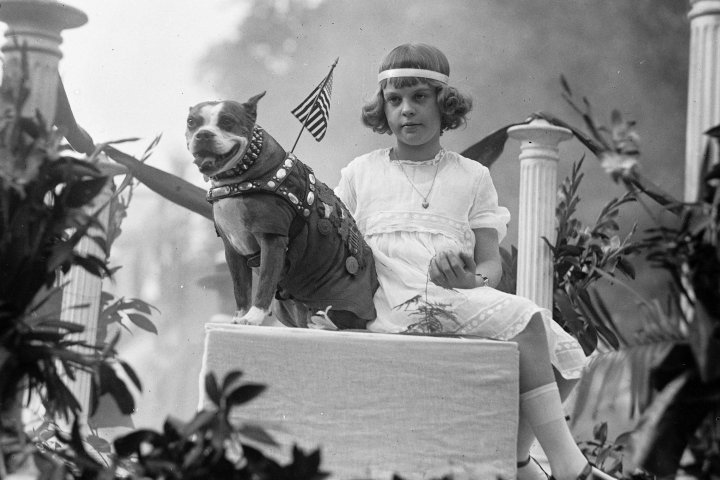
sgt_stubby_7 (1)By the last year of the Great War, the French, British and Belgians had at least 20,000 dogs on the battlefield.  Imperial Germany had 30,000.
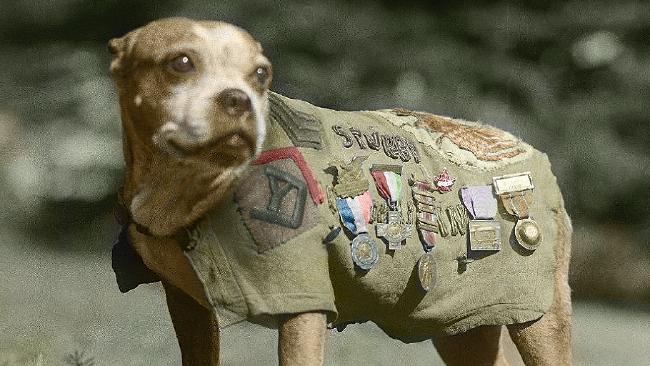
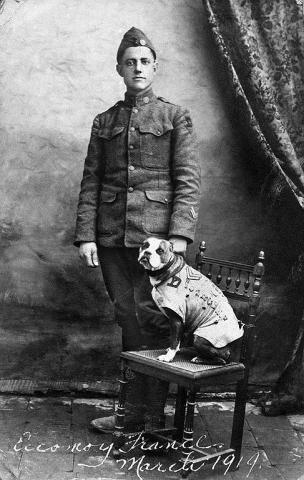
General Headquarters of the American Expeditionary Force recommended the use of dogs as sentries, messengers and draft animals in the spring of 1918. However, with the exception of a few sled dogs in Alaska, the US was the only country to take part in World War I, with virtually no service dogs in its military.

America’s first war dog, “Stubby”, got there by accident, and served 18 months ‘over there’, participating in seventeen battles on the Western Front.

He looked like a terrier of some kind, similar to a pit bull.  Nobody knows anything more about him.  He showed up as a stray at Yale Field in New Haven, Connecticut, while a group of soldiers were training. The dog hung around as the men drilled and one soldier, Corporal Robert Conroy, started taking care of him. Conroy hid Stubby on board the troop ship when the outfit shipped out in 1917.

363979bced264e59159a02578ebda717

Stubby saved his regiment from surprise \gas attacks, located and comforted the wounded, and even once caught a German spy by the seat of his pants. The Hun, who’d been prowling behind allied lines at the time, was mapping trenches for artillery bombardment.   He was found spinning in circles with a large, muscular terrier affixed to his behind.  The Bosch was easily disarmed, but it took a considerable amount of coaxing before Stubby could be persuaded to let go of that German’s rear end.

Stubby-Conroy-HistoricalStubby saw his first action at Chemin des Dames. Since the boom of artillery fire didn’t faze him, he learned to follow the men’s example of ducking when the big ones came close. It became a great game to see who could hit the dugout, first.  After a few days, the guys were watching him for a signal. Stubby was always the first to hear incoming fire.  We can only guess how many lives were spared by his early warning.
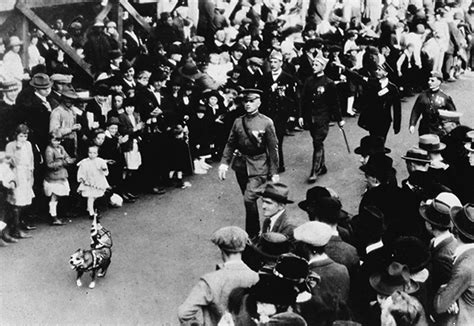
Following the Armistice, Stubby returned home as a nationally acclaimed hero, and was eventually received by presidents Harding and Coolidge. Even General John “Black Jack” Pershing, who commanded the AEF during the war, presented Stubby with a gold medal made by the Humane Society, declaring him to be a “hero of the highest caliber.”

Stubby toured the country by invitation and probably led more parades than any dog in American history.  He was promoted to honorary Sergeant by the Legion, becoming the highest ranking dog to ever serve in the Army.

download - 2019-04-04T044834.137

Old age caught up with the small warrior on April 4th, 1926, as he took ill and died in his master’s arms.

Sergeant Stubby and a few of his contemporaries were instrumental in inspiring the creation of the US K-9 Corps.  Just in time for World War ll.


A Trivial Matter
On returning home following service during WW2, only 4 of 592 Marine Corps dogs failed to adapt to civil life.

April 3, 1946 Death March

Arriving at Nagoya #7 prison camp, Tonelli was handed a piece of paper. Scribbled on it was a 58. He was prisoner number 58, the same number he had once worn on his football Jersey. “From that point on,” he said, “I knew I was going to make it”.

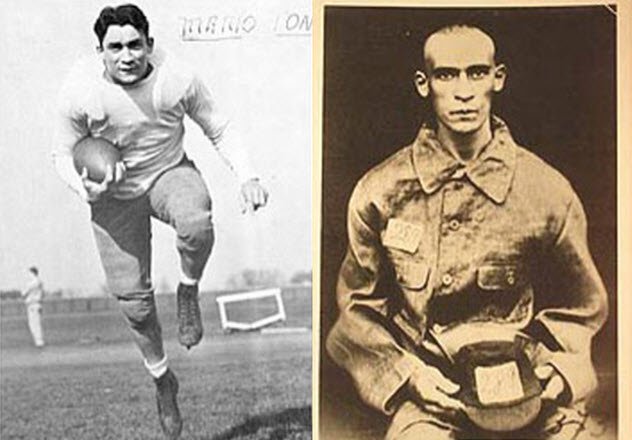
The game was November 27, 1937.  Late in the 4th quarter, Notre Dame was tied 6-6 with Southern California. The “Fighting Irish” needed a miracle. Notre Dame #58 Mario “Motts” Tonelli took the hand-off deep in Notre Dame territory and ran the ball 70 yards back before being tackled. Seconds later, the 5’11”, 195-pound fullback scored the game winning touchdown.

Tonelli (1)In some ways, Mario Tonelli himself was the miracle. Years earlier at the age of 6, he’d been burned over 80% of his body, when a trash compactor toppled over on him. Mario’s immigrant father Celi, a laborer from a northern Italian marble quarry, refused to believe the doctor who said his son would never walk again. Fixing four wheels to a door, the elder Tonelli taught his first American-born son to move about with his arms.
By 1935, Mario Tonelli was a football, basketball and track star at Chicago’s DePaul Academy.

After a year coaching at Providence College in 1939 and a year playing professional football for the Chicago Cardinals in 1940, Tonelli joined the Army in early 1941, assigned to the 200th Coast Artillery Regiment in Manila.

He’d hoped to fulfill his one years’ commitment and return to the Cardinals for the 1942 season, but it wasn’t meant to be.  The radio crackled to life at 2:30am local time on December 7, 1941. “Air raid on Pearl Harbor. This is no drill!”

pearl-harbor-4
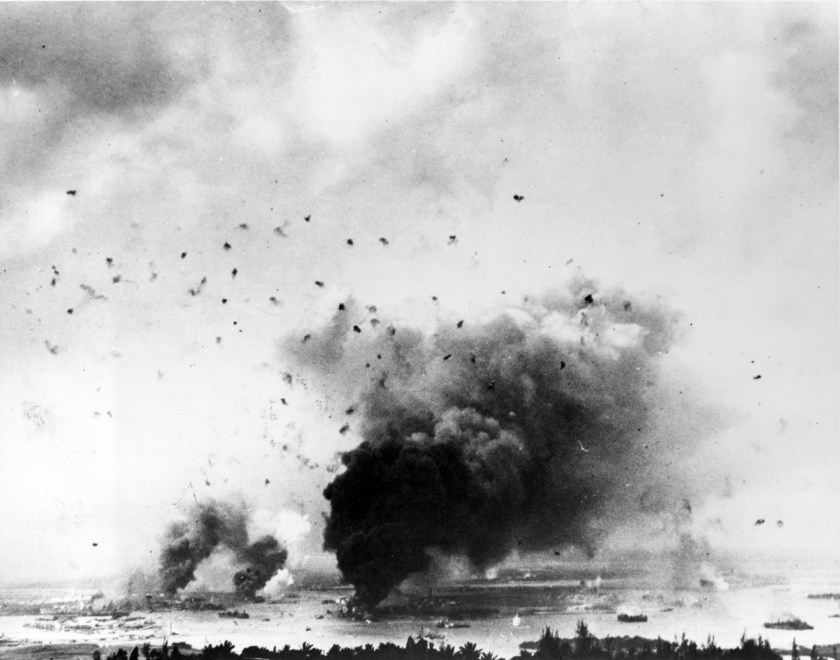
“A view of Pearl Harbor looking southwest from the hills towards the north. Taken during the Japanese raid, with anti-aircraft shell bursts overhead. Large column of smoke in lower center is from USS Arizona”. – H/T fstoppers.com

Military forces of Imperial Japan appeared unstoppable in the early months of World War Two, attacking first Thailand, then the British possessions of Malaya, Singapore, and Hong Kong as well as US military bases in Hawaii, Wake Island, Guam and the Philippines.

The United States was grotesquely unprepared to fight a World War in 1942, and dedicated itself to beating Adolf Hitler first. General Douglas MacArthur abandoned the “Alamo of the Pacific” on March 11 saying “I shall return”, leaving 90,000 American and Filipino troops without food, supplies or support with which to fight off the Japanese offensive.

bataan-death-march-route-mapOn April 9, 75,000 surrendered the Bataan peninsula, beginning a 65 mile, five-day slog into captivity through the heat of the Philippine jungle. Japanese guards were sadistic. Some would beat the marchers at random, or bayonet those too weak to walk. Japanese tanks would swerve out of the way to run over anyone who had fallen and was too slow in getting up. Some were burned alive. Already crippled from tropical disease and starving from the long siege of Luzon, thousands perished in what came to be known as the Bataan Death March.
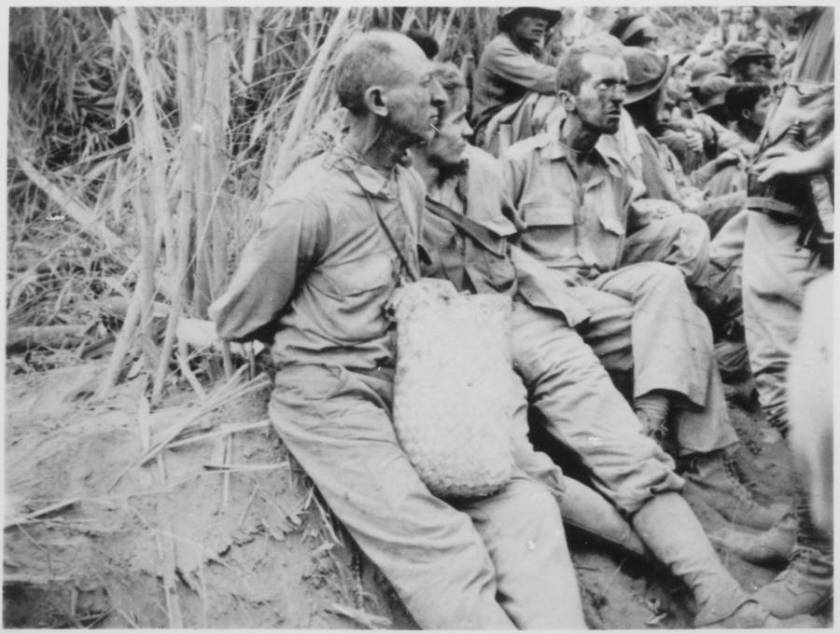
Exhausted, sunburned and aching with thirst, Tonelli still refused when a Japanese soldier demanded his Notre Dame class ring. As the guard reached for his sword, a nearby prisoner shouted “Give it to him. It’s not worth dying for”.

Minutes later, a Japanese officer appeared, speaking perfect English. “Did one of my men take something from you?” “Yes”, Tonelli replied. “My school ring”. “Here,” said the officer, pressing the ring into his hand. “Hide it somewhere. You may not get it back next time”. Tonelli was speechless. “I was educated in America”, the officer said. “At the University of Southern California. I know a little about the famous Notre Dame football team. In fact, I watched you beat USC in 1937. I know how much this ring means to you, so I wanted to get it back to you”.

prisoners-tied-up

Nearly 700 Americans and more than 10,000 Filipinos died on the Bataan death march. For the survivors, the ordeal was only beginning. For 2½ years Tonelli suffered starvation, disease and endless beatings in the squalid prison camps known as O’Donnell and Cabanatuan.  He was later transferred to Davo Penal Colony (“Dapecol”), in Panabo City.   Of an estimated 2,009 to enter Dapecol between October 1942- June 1944, only 805 survived the war.

Throughout the ordeal, Tonelli kept his ring.  Buried in a soap dish.  He’d take it out from time to time to remind himself.  Life used to be better than this. It gave him something to hope for.

Death March

The hellish 60-day journey aboard the filthy, cramped merchant vessel began in late 1944, destined for slave labor camps in mainland Japan. Tonelli was barely 100 pounds on arrival, his body ravaged by malaria and intestinal parasites. He was barely half the man who once played fullback at Notre Dame Stadium, Soldier Field and Comiskey Park.

Arriving at Nagoya #7 prison camp, Tonelli was handed a piece of paper. Scribbled on it was a 58. He was prisoner number 58, the same number he had once worn on his football Jersey. “From that point on,” he said, “I knew I was going to make it”.

mario-tonelli-ringAn American military tribunal conducted after the war held Lieutenant General Homma Masaharu, commander of the Japanese invasion forces in the Philippines, guilty of war crimes. He was executed by firing squad on April 3, 1946.

Mario Tonelli always hoped to meet the officer who’d returned his ring, but it wasn’t meant to be. He probably didn’t survive the war.  Mario “Motts” Tonelli passed away in 2003, at the age of eighty-six.  He still had that ring.


Afterward

In 1989, ROTC students at New Mexico State University held a memorial “Death March”.  Since 1992, the Army installation at the White Sands Missile Range near Las Cruces has been host to the memorial. It’s two events, really, participants competing in “heavy” and “light” division wearing full uniform with rucksack or full running gear. Marchers in both divisions compete over a full marathon course of 26.2 miles of hilly desert terrain, or a shorter 14.2 mile course.

Two weeks ago, 8,631 registered participants gathered from fifty states and a dozen nations, to commemorate the Battle of Bataan and the death march, 77 years ago.

Five actual survivors were in attendance for the opening ceremony, wrapped in blankets to ward off the pre-dawn cold.  They were Harold Bergbower, age 98.  James Bollich, age 97.  Valdemar DeHerrera, age 99.  Paul Kerchum, age 99.  Ben Skardon, age 101.

Mister Skardon actually marched in the March 17, 2019 event, covering three miles at the head of Skardon’s Brigade”.

The day began with a symbolic roll call.  Most of the names were met with silence. Twelve more than the same event, last year.

765f8607-5f56-4cbe-9a41-0fe13f1745ac-HK8A7509
“At 101 years old, Ben Skardon, center, is the oldest living Bataan Death March survivor to attend the memorial event at White Sands Missile Range. This year, he led “Ben’s Brigade” in an 3-mile march through the course on Sunday, March 17, 2019. (Photo: Kaitlin Englund/For the Sun-News)” H/T Ruidoso News
A Trivial Matter
Japanese guards made prisoners roast for hours the scorching Filipino sun, a torture known as “the sun treatment.” With little food and no water, Filipino civilians tried to throw food at the marchers. Most who did this were killed on the spot, by Japanese soldiers.


March 30, 1945 We’re All Jews Here

“We’re not doing that.  We’re all turning out”.

“First they came for the socialists, and I did not speak out—because I was not a socialist. Then they came for the trade unionists, and I did not speak out— because I was not a trade unionist. Then they came for the Jews, and I did not speak out—because I was not a Jew. Then they came for me—and there was no one left to speak for me”. – Martin Niemöller

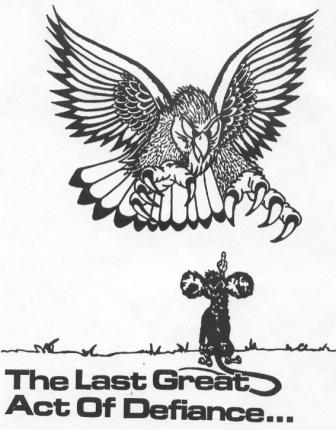
last_great_act_of_defiance1Before the age of the internet meme,  office jokes and bits of folk wisdom were passed around and copied and copied again.  There was one, “The Last great of Defiance“, which will live for all time as my favorite.  The picture speaks for itself.  I had one on the wall, for years.
This is one of those stories.

The last great effort of German arms burst out of the frozen Ardennes forest on December 16, 1944, aiming for the vital port at Antwerp.

Unternehmen Wacht am Rhein“, (“Operation Watch on the Rhine”) was a tactical surprise for the Wehrmacht, as allied forces were driven back through the densely forested regions of France, Belgium and Luxembourg. Wartime news maps showed a great inward “bulge” in the lines, and the name stuck. The Battle of the Bulge was the largest and bloodiest battle fought by American forces in World War 2, fought in the harshest winter conditions in recorded history and involving some 610,000 GIs.

malmed1Prisoners were swept up by the thousands, and faced an uncertain future.  In Malmedy, Belgium, seventy-five captured Americans were marched into an open field and machine gunned by members of the 1st SS Panzer Division (Leibstandarte Adolf Hitler), a part of 6th Panzer Army.
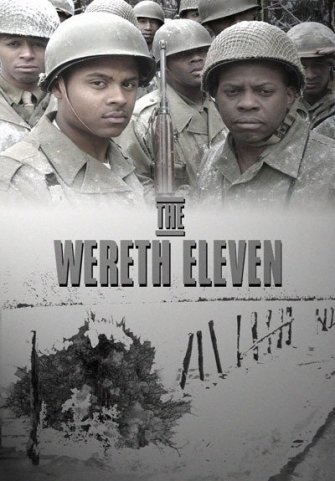
On December 16, the all-black 333rd Field Artillery Battalion of the racially segregated US Army put up an heroic defense outside the town of Wereth, Belgium, using their 155mm guns to delay the German advance. Desperately outnumbered, the 333rd was overrun the following day, groups of men scattering to escape as best they could. Eleven soldiers made their way to the home of Mathias Langer, the Mayor of Wereth.

To shelter allied troops under German occupation was to risk summary execution. Despite the obvious risk to their own lives, Matthias and his wife Maria took these men in and attempted to hide them, in their home. When German troops arrived, the eleven surrendered rather than risk the lives of their benefactors.

the-wereth-eleven-578359l
Movie poster for the 2011 film, “The Wereth Eleven”

The prisoners were marched out of sight and murdered, every one of them. The Wereth 11 were lost in the confusion of the Bulge, their bodies hidden under the snow until Spring melt. Their story was lost to history, for the next fifty years.

Nazi atrocities were not limited to Allied troops.  By some accounts, more civilians were killed during the Battle of the Bulge than the last four years.  When the fighting was over, more than 115 bodies were found in the towns of Ster and Parfondruy, alone.

For Master Sargent Roderick “Roddie” Edmonds, the war ended on December 19, swept up with hundreds of American troops and taken prisoner.  These were the lucky ones, escaping those first white-hot moments of capture to be sent to a German prisoner-of-war camp.  He was later transferred to another camp near Ziegenhain, Germany.  At 24, M/Sgt Roddie Edmonds was the senior non-commissioned officer at Stalag IX-A, responsible for 1,275 American POWs.

The Wehrmacht had harsh anti-Jew policies and kept Jewish POWs in strict segregation.  In the East, Russian Jewish POWs were sent directly to extermination camps.  The future was more uncertain for Jewish POWs, in the west.  Many were worked to death in slave labor camps.

Home_Slider_Image-1024x666

On January 27, the first day at Stalag IX-A, commandant Siegmann ordered Edmonds: All American Jews were to identify themselves, at the following day’s assembly.  The word went out to all five barracks:  “We’re not doing that.  We’re all turning out“.

The following morning, 1,275 POWs presented themselves.  Every. Single. Man.

Siegmann was perplexed.  “They can’t all be Jews!”  As senior NCO, Edmonds spoke for the group.  “We’re all Jews here“.  The Nazi commandant was apoplectic, pressing a Luger into Edmonds’ forehead.  This is your last chance.

Edmonds gave his name, rank and serial number, and then said:  ‘If you are going to shoot, you are going to have to shoot all of us because we know who you are and you’ll be tried for war crimes when we win this war.'”  Siegmann was incandescent, white with rage, but the moment had passed.  He was beaten.

The 1,275 American POWs held at Stalag IX-A were liberated this day in 1945, including some 200 Jews.

Roddie Edmonds was again recruited for the war in Korea.  He never told his family about any of it.

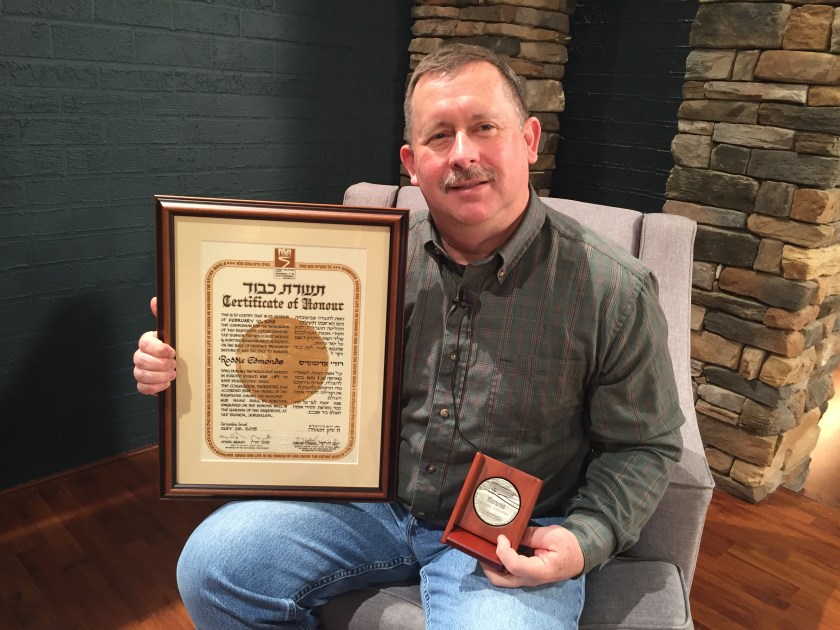
Chris Edmonds is the Pastor at Piney Grove Baptist Church in Maryville, Tennessee. Following his father’s death in 1985, Chris’ mother gave him his father’s  war diary, where he found a brief mention of this story.  Chris scoured the news for more information, around the time Richard Nixon was looking for his post-Presidential home.  As it happened, Nixon bought his posh, upper-east side home from Lester Tanner, a prominent New York Lawyer who mentioned in passing, he owed his life to Roddie Edmonds.

So it was, this story came to light.  In 2015, Edmonds was honored as “Righteous among the Nations”, the first American soldier, so honored.  It’s the highest honor bestowed by the state of Israel, on non-Jews who risked their lives to save Jews from the Nazi death machine.  President Barack Obama recognized Edmonds heroism in a 2016 speech before the Israeli embassy.  The United States Congress bestowed the Congressional Gold Medal in 2017.  As I write this, Pastor Edmonds and the Jewish veterans saved by M/Sgt Edmonds are pushing for the Knoxville, Tennessee native to receive the Medal of Honor.

Pastor Edmonds says he always looked up to his father, the man had always been, his hero.  “I just didn’t know he had a cape in his closet“.

Chris Edmonds_1455424082776_247114_ver1.0.JPG