“If you’re going to burn the flag, “don’t do it around me. I’ve been to too many veterans’ hospitals and seen too many broken bodies of guys who tried to protect it.” – Rick Monday
That Sunday was an away game for the Chicago Cubs, an afternoon matinee with a 1:00 start time at Los Angeles’ Dodger stadium. April 25, 1976 was hazy with a light breeze and a high of 70 degrees. It was a great day for a ball game.
The count was 1-0 with Dodgers second baseman Ted Sizemore, at bat. It was the bottom of the 4th and announcer Vin Scully, doing the play-by-play:
“Wait a minute, there’s an animal loose . . . two of them . . . all right . . . I’m not sure what he’s doing out there . . . it looks like he’s going to burn a flag . . . and Rick Monday runs and takes it away from him!”
Vin Scully
These particular animals had succeeded in soaking an American flag with lighter fluid, but they weren’t quite fast enough with the match.
Rick Monday was playing Center Field for the Cubs. Describing the scene, Monday said “He got down on his knees, and I could tell he wasn’t throwing holy water on it”.
Monday dashed over and grabbed the flag, to thunderous applause from the 25,167 in attendance. All but two, that is. By that time. those fools were being carted off in handcuffs.
Monday came out to bat in the top of the 5th and got a standing ovation from Dodger fans, while the message board flashed “RICK MONDAY… YOU MADE A GREAT PLAY…”
The arrested were later identified as 37-year old William Errol Thomas and his eleven year old son. Poor kid. He’d be about 56 now. I wonder how he turned out.
Thomas was convicted of trespassing and ordered to pay a $60 fine or spend three days, in jail. The man was unemployed and didn’t have anything better to do with his days, so he took the time.
Rick Monday was serving a six-year tour with the Marine Corp Reserves in fulfillment of his ROTC obligation after leaving Arizona State. The man had no use for flag burners. “If you’re going to burn the flag”, he said, “don’t do it around me. I’ve been to too many veterans’ hospitals and seen too many broken bodies of guys who tried to protect it.”
Rick Monday requested the flag after the game but it had to be held, pending police investigation. Nine days later, Dodgers General Manager Al Campanis presented Monday with that same flag, during a pregame ceremony at Wrigley Field. He’s been offered up to a million dollars for that flag but declines, all offers.
“As the cheering died, everybody in the stands started singing ‘God Bless America,’ ” Monday recalled. “I was stunned. I stood there and got chills.”
Los Angeles Times columnist, Bill Plaschke
You can see the whole episode at the link below. My favorite part has got to be that impotent little temper tantrum at the end, when the protester throws his little bottle of lighter fluid, at the outfielder’s back. Like a runt piglet, squealing at a passing stallion.
“The Ottoman Empire should be cleaned up of the Armenians and the Lebanese. We have destroyed the former by the sword, we shall destroy the latter through starvation.” – Enver Pasha
In the waning years of the 13th century, Osman Gazi led a relentless conflict against the Byzantine empire centered in Constantinople, for control of western Anatolia in modern day Turkey.
In 1453 the empire founded by Osman I captured Constantinople itself, seat of the Byzantine Empire and now known as Istanbul.
At the height of its power in 1683, the Ottoman Empire under the reign of Suleiman the Magnificent ruled over an area spanning three continents. From the shores of north Africa to the gates of Vienna, east to the modern Russian Federation state, of Georgia. Nearly 4% the landmass of the entire planet, was under Ottoman rule.
In the early 19th century, the Ottoman empire entered a period of decline. Serbia went to war for independence from the Sultan in 1804, followed closely by Greece, Crete, Bulgaria and others.
As yet one of the Great Powers of the Eurasian landmass, the Ottoman Empire was now “the Sick Man of Europe”. By mid-century, many minority populations were pushing for independence.
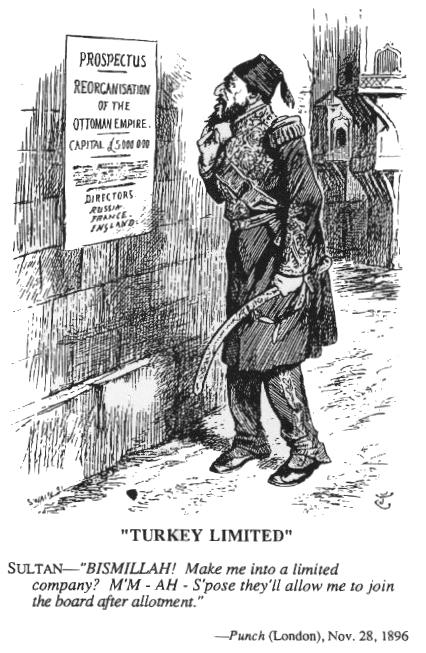
Punch cartoon dated November 28, 1896, caricatures the weakend state of the Ottomans, under Sultan Abdul Hamid II
One such were the Armenians, an ancient people living in the region for some 2,000 years. Mostly Christian, Armenians were among the earliest to adopt the new faith as their own having done so, even before Rome itself.
Mid-19th century reforms such the repeal of the “Jizya”, the tax on “unbelievers,” brought about a measure of equality. Even so, non-Muslims remained second-class citizens. Without the right to testify at trial, for all intents and purposes it was open season on Armenian Christians and other religious minorities. In some locales, such treatment rose to the level of officially sanctioned public policy. By 1860, Armenians began to push for greater rights.
Where his subjects saw the righteous quest for equal rights the Sultan saw, insurrection.
Obsessed with personal loyalty to the point of paranoia, Sultan Abdul Hamid II once told a reporter that he would give his Armenian Christian minority a “box on the ear” for their impudence. The Hamidian massacres begun in 1894 and lasting until 1897 killed between 80,000 and 300,000 Armenians, leaving in their wake, 50,000 orphaned children.
It was but a prelude of what was to come.
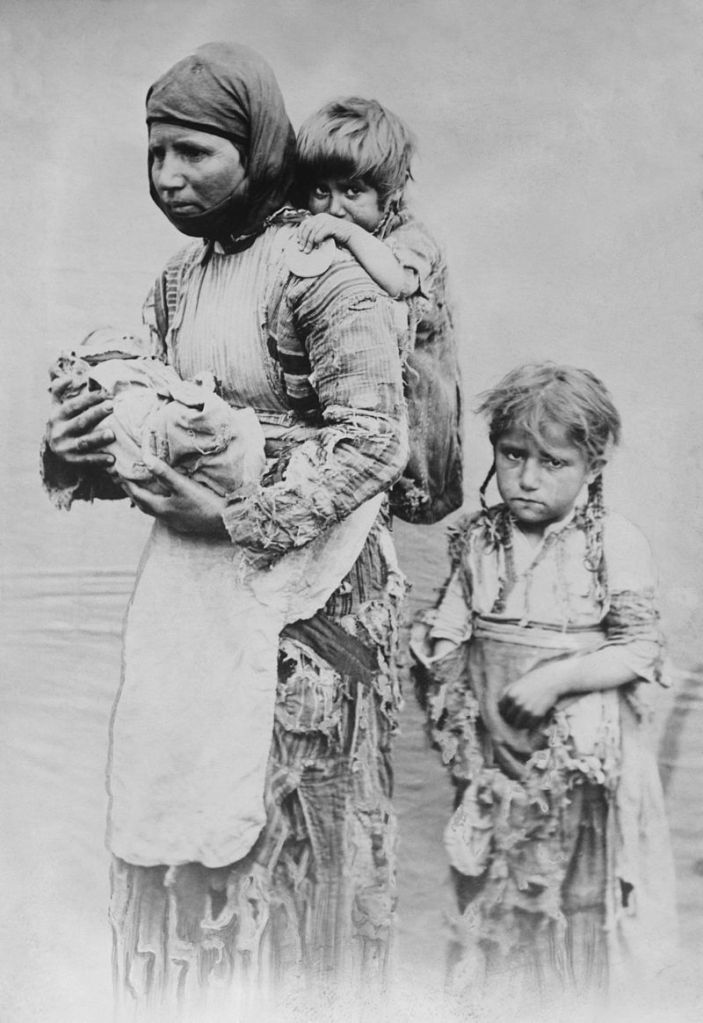
“An Armenian woman and her children who were refugees of the massacres and sought help from missionaries by walking great distances.” H/T Wikipedia
In military planning, a “decapitation strike” is an action, designed to remove the leadership of an opposing government or group. The Ottoman pogrom began with the arrest of Armenian intellectuals, a decapitation strike intended to deprive Armenians of the Empire, of leadership.
The order came down from Minister of the Interior Talaat Pasha on April 24, 1915. “Red Sunday”. By the end of the day an estimated 235 to 270 Armenian intellectuals were arrested, in Istanbul. By the end of May, their number reached 2,345. Most, were eventually murdered.
“Some of the Armenian intellectuals who were detained, deported, and killed in 1915: 1st row: Krikor Zohrab, Daniel Varoujan, Rupen Zartarian, Ardashes Harutiunian, Siamanto 2nd row: Ruben Sevak, Dikran Chökürian, Diran Kelekian, Tlgadintsi, and Erukhan” – H/T Wikipedia
The “Tehcir” Law of May 29, a term derived from an Ottoman Turkish word signifying “deportation” or “forced displacement”, authorized the forced removal within the empire, of such detainees.
“When the Turkish authorities gave the orders for these deportations, they were merely giving the death warrant to a whole race; they understood this well, and, in their conversations with me, they made no particular attempt to conceal the fact. . . . I am confident that the whole history of the human race contains no such horrible episode as this. The great massacres and persecutions of the past seem almost insignificant when compared to the sufferings of the Armenian race in 1915.“
US Ambassador Henry Morgenthau Sr.
Able bodied males were exterminated outright, or worked to death as conscripted labor. Women, children, the elderly and infirm were driven on death marches to the farthest reaches of the Syrian desert. Goaded like livestock by military “escorts”, they were deprived of food and water, subjected at all times to robbery, rape, and summary execution. By the early 1920s, as many as 1.5 million of the Ottoman Empire’s 2 million Armenian Christians, were dead.
The Turkish historian Taner Akçam has examined military and court records, parliamentary minutes, letters, and eyewitness reports to write what may be The definitive history of the whole episode entitled, A Shameful Act, The Armenian Genocide and the Question of Turkish Responsibility. In it, Akçam writes of:
“…the looting and murder in Armenian towns by Kurds and Circassians, improprieties during tax collection, criminal behavior by government officials and the refusal to accept Christians as witnesses in trial.”
Taner Akçam
The Armenian spyurk, an Aramaic cognate deriving from the Hebrew Galut, or “Diaspora”, goes back some 1,700 years. Today, the number of ethnic Armenians around the world tracing lineage back to this modern-day diaspora, numbers in the several millions.
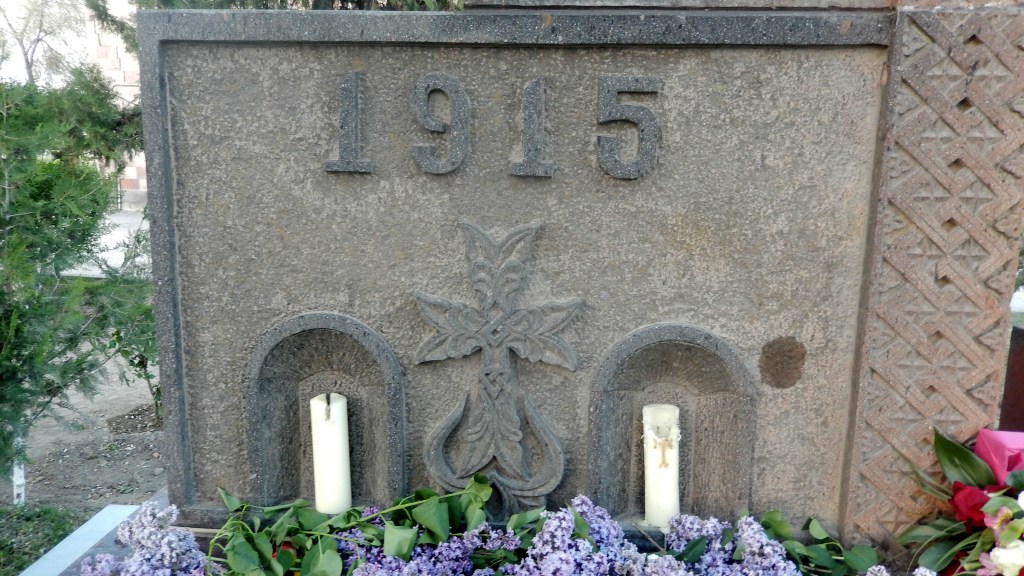
Since 1919, Armenians around the world have marked April 24 as Armenian Genocide Remembrance Day.
“Who, after all, speaks today of the annihilation of the Armenians?“
Adolf Hitler
To this day it remains illegal in Turkey, to speak of the Armenian genocide. The New York Times declined to use the term, until 2004.
In April 2019, President Donald Trump received a furious response from Turkish President Recep Tayyip Erdoğan, for this seemingly-benign statement: “Beginning in 1915, one and a half million Armenians were deported, massacred, or marched to their deaths in the final years of the Ottoman Empire. I join the Armenian community in America and around the world in mourning the loss of innocent lives and the suffering endured by so many”.
“[T]he variety of flora and fauna – rich though they are – do not approach the variety of people on the island. Pirates, fighter pilots, smugglers and cops. Shrimpers and singers. Sculptors and sword-swallowers. Bone carvers, body painters and musicians of every sort. A small fleet of commercial fisherman and more Pulitzer Prize winners per capita than any other city. – The Tennesseean
The competition is fierce come December 31 for intergalactic bragging rights: who will go home with the coveted title, “where the weird go pro”. New York drops that famous ball on New Year’s Eve and Miami drops an orange, but that stuff is all JV. Bethlehem Pennsylvania drops a 450-pound “peep”, that marshmallow children’s treat that only comes around, at Easter. Not to be outdone, Eastover North Carolina drops a 39-pound, ceramic flea (don’t ask). Mobile Alabama has a 600-pound Moon Pie (ya got an RC Cola for that?). Prairie du Chiens Wisconsin drops a live (dead) carp called “lucky”, selected by (I kid you not), a carp committee. For Eastport Maine, it’s a sardine. Others have their apples and pine cones and olives, but nothing the likes of “Sushi”, the live Drag Queen descending in a 13-foot stiletto heel.
“Weird” is no mere annual occurrence in a place where businessmen in suits ride about, on electric skateboards. Where crowds cheer dachshund parades and bed races down the main, err, drag. Where the most famous headstone in the town cemetery says: “I told you I was sick!”
From “Robert” the evil doll of Fort East Martello to the wild chickens who roam the streets, where conch fritters are considered a food group and history is literally built on salvaging shipwrecks, we’re talking about Key West Florida, where the “Weird go Pro”.
On December 5, 1937, bar owner Joe Russell faced an increase in rent. From three dollars a week to a whopping four bucks. Lucky for Joe, the former Victoria Restaurant owned by one Juan Farto (I didn’t make that up), was available. That night, everyone in the place grabbed his chair, picked up his drink, and “moved” the bar across the street.
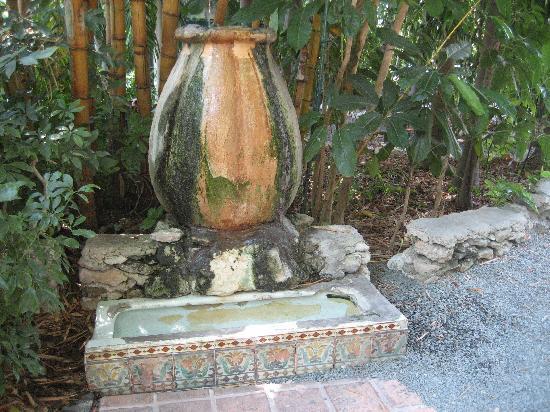
None other than Ernest Hemingway pitched in, (yeah, That Ernest Hemingway), helping himself to the urinal. “I’ve pissed enough of my money into this thing to pay for it‘ he said, bringing the object home to his wife Pauline, who converted it to a fountain. The peacocks who once roamed “Papa” Hemingway’s yard are gone now but the fountain’s still there, not far from “Sloppy Joe’s Bar” on the corner of Greene and Duval Street.
Papa Hemingway’s fountain
Ladies? You married guys out there? Can you imagine bringing such an object home to your wife? Mrs. Hemingway turned the thing into a fountain.
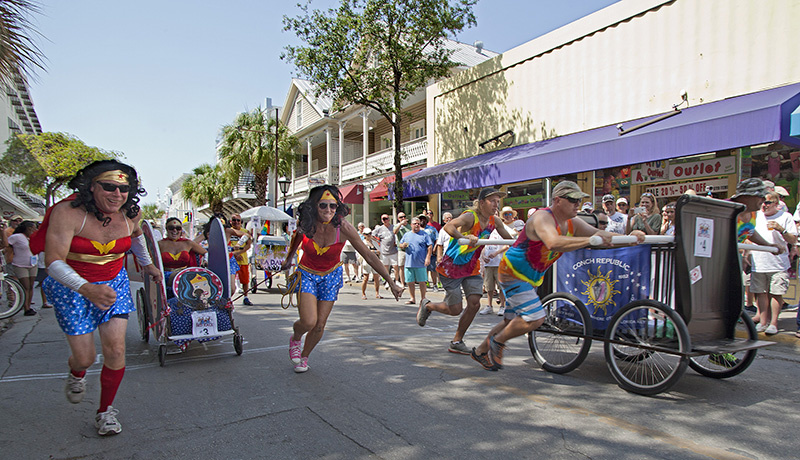
Where else but Duval Street could you watch a “bed race”, pulled by women and men in Wonder Woman outfits, or men in grass skirts.
Duval Street Bed Races, July 2015. H/t CBS, Miami
Speaking of the town cemetery. One long-suffering wife got the last word on a philandering husband, proving you should always be careful, who orders your headstone. This one says “At least I know where he’s sleeping tonight“.
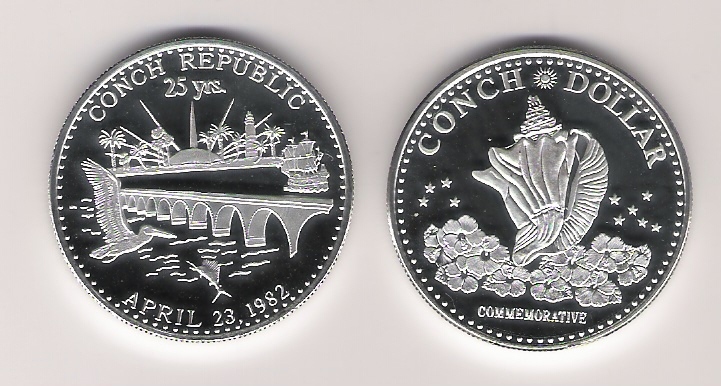
Oh. Did I tell you the place seceded? No, really. It’s the “Conch Republic”, now.
Except for the Naval Air Station at Boca Chica and Coast Guard installations in Key West, Marathon and Islamorada, most of the economic activity in the Florida Keys, comes from tourism. It’s no wonder that, when the federal government shuts down the only road into the Keys, the locals are going to get cranky.
In April 1982, the Mariel boat lift was a mere two years in the past, and very much in the public memory.
The United States had a border in those days, which the Federal government attempted to enforce.
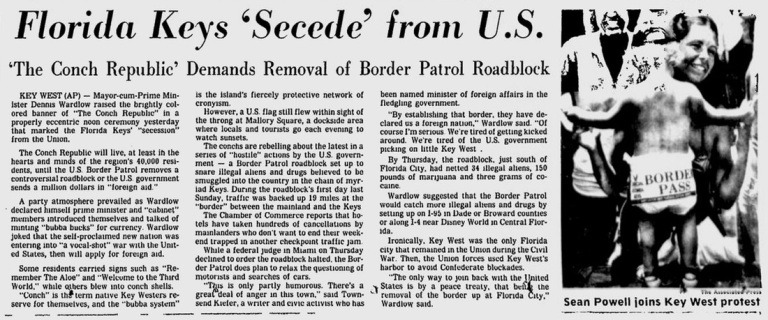
On April 18, Border Patrol set up a roadblock in front of Skeeter’s Last Chance Saloon in Florida City, shutting down US Route 1, the only road in and out of the Florida Keys. Originally intended to intercept illegals entering the country, the roadblock soon morphed into a hunt for illegal drugs, as well.
Cars waited for hours, in lines stretching 19 miles. Predictably, the attitude of Federal officials was one of towering indifference. Not so local business owners. Robert Kerstein wrote in his Key West on the Edge — Inventing the Conch Republic, “No one in Key West doubted that drugs were trafficked widely in the Keys by road and by boat. But tourism’s boosters had little tolerance for interruptions to their business.”
Dennis Wardlow, then-Mayor of Key West, contacted the chief of police, the Monroe County sheriff, his State Representative and then-Governor Bob Graham, demanding the roadblock’s removal. With none of the above having any knowledge of the barrier and lacking the authority to pull it down, Wardlow contacted INS directly. When the Border Patrol told him it was “none of his business,” the Mayor’s response may best be summed up in the words of Bugs Bunny: “Of course you know, this means war!”
Suffering a blizzard of hotel cancellations, this “attack on Key West’s sovereignty” could not stand. On April 22, Mayor Wardlow, local attorney & pilot David Horan and Old Town Trolley Tours operator Ed Swift flew to Miami seeking legal remedy. When District Court Judge C. Clyde Atkins failed to issue an injunction, the Key West delegation took to the courthouse steps.
“What are you going to do, Mr. Mayor”, asked the assembled media. Swift leaned over and whispered into the Mayor’s ear, “Tell them we are going to go home and secede!” “We are going to go home and secede!”, said Wardlow. And that’s what they did.
Over the next 24 hours, secessionist co-conspirators worked feverishly to form a new government, filling cabinet positions such as “Secretary of Underwater Affairs” and “Minister of Nutrition”.
On April 23, with federal agents on scene to monitor the proceedings, a crowd gathered before the old customs building. Mayor Wardlow and a gaggle of allies mounted the back of a flatbed truck, to read the proclamation of secession. “We serve notice on the government in Washington”, Wardlow began, “to remove the roadblock or get ready to put up a permanent border to a new foreign land. We as a people, may have suffered in the past, but we have no intention of suffering in the future at the hands of fools and bureaucrats“.
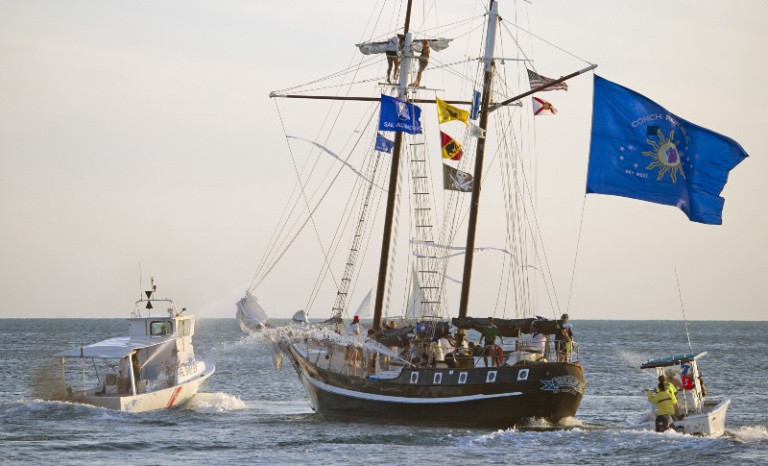
With that, Mayor Wardlow declared “war” on the United States. The “Great Battle of the Conch Republic” broke out in the harbor, when the Schooner Western Union commanded by Captain John Kraus, attacked the Coast Guard Cutter Diligence with water balloons, Conch fritters and toilet paper. Diligence fought back with water hoses, as the new “Prime Minister” broke a stale loaf of Cuban bread over the head of a man dressed in a Navy uniform.
Naval History was forever changed on this day, as the “Great Battle of the Conch Republic” raged across the waters of Key West
Pandemonium broke out as onlookers launched stale bread and conch fritters at federal agents, Navy sailors and Coast Guard personnel. One minute after declaring his “verbal shot” at the Federal government, Mayor Wardlow surrendered to a nearby Naval officer, demanding a billion dollars in “foreign aid” in compensation for “the long federal siege.”
Apparently, that’s what it takes to get the attention of a Federal government bureaucrat. The roadblock lifted. The restaurants, stores and hotels of the Keys soon filled with tourists and, once again, happiness smiled upon the land. Key West never did get its “foreign aid”, but secessionist leaders never received so much as a letter saying they couldn’t leave the Union, either.
So it is that the micro-nation of Key West celebrates its independence, every April 23. The “Conch Republic’ issues its own passports, selling T-shirts and bumper stickers with the slogan “We seceded where others failed”.
And if the Federal government ever comes back to mess with the sovereign nation of Key West, it had best be prepared to deal with the Conch Republic’s very own “Special Forces”, the motto for which is “Sanctus Merda”. “Holy Shit”.
Mine eyes have seen the glory of the sunshine and the sea Right here upon our islands, where we love to live so free But in April 1982, the peace was not to be And we went rolling on
CHORUS Glory glory Conch Republic Glory glory Conch Republic Glory glory Conch Republic From Key to shining Key
They were setting up a check point, tween the mainland and the Keys They had put a US Border, where it shouldn’t ‘oughta’ be So that’s when we seceded, and declared our sovereignty And the fun had just begun
(CHORUS)
We went forth into the harbor and a cutter we did spy And we sailed up along side her and we took her by surprise We hoisted up our battle flag, so proudly and so high And we went sailing on
(CHORUS)
The water and Conch fritters and the Cuban bread did fly Our bombers, they were raining toilet paper from the sky Our cannons they did thunder to proclaim our victory And we fought bravely on
(CHORUS)
We have faced the silly forces of misguided zealotry We have stood up to their foolishness for all the world to see And we’ve showed the other nations what America can be From Key to shining Key
“I am sick and tired of this bluffer, or Quixote, or the devil knows what.
This man can hardly serve us in New Granada without heaping ten thousand embarrassments upon us”
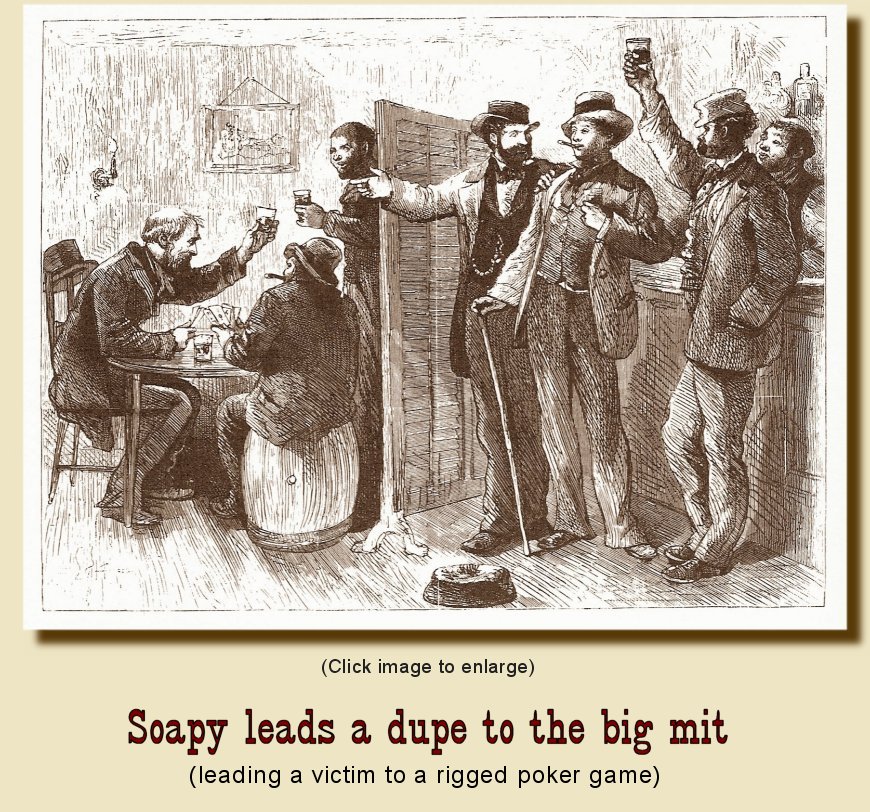
In January 1848, a carpenter and sawmill operator named James Marshall discovered gold on the American River near Coloma, California. Some 300,000 flocked to the “Golden State” over the next few years from the United States and abroad, in search of fortune. For most, the “California Gold Rush” was tedious, dirty and difficult work. For Jefferson Randolph “Soapy“ Smith and his merry band of grifters, it was easier simply to fleece the miners out of their hard won gains through rigged poker games, scam three-card Monty and a catalog of petty deceits.
Between 1869 and 1872, the German actress and amateur “banker” Adele Spitzeder became the wealthiest woman in Germany, handsomely rewarding suckers…err…investors, with cash derived from new marks. Sarah Emily Howe ran the same con throughout the 1870s and ’80s through the “Ladies Deposit Company”, of Boston.
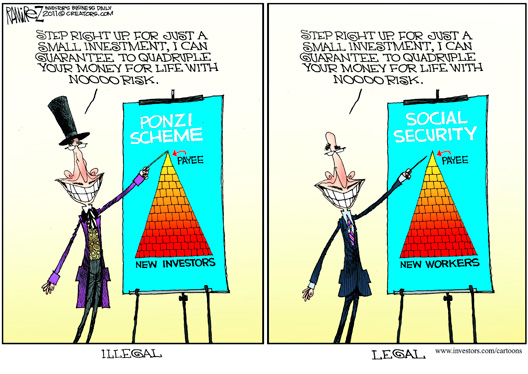
In the 1920s, Italian swindler Carlo Ponzi elevated this “rob Peter to pay Paul” scheme to such heights as to have the scam, named after himself. In the classic Ponzi scheme, early investors are paid above-average returns with the proceeds coming from new investors.
The wisely skeptical among us may question the legitimacy of consistently spectacular returns on investment but the money is real. Until it isn’t, and then heaven help the person left without a chair, when the music stops. For investors with Bernard L. Madoff Investment Securities company, the music stopped in 2008 with early losses estimated at $18 billion dollars.
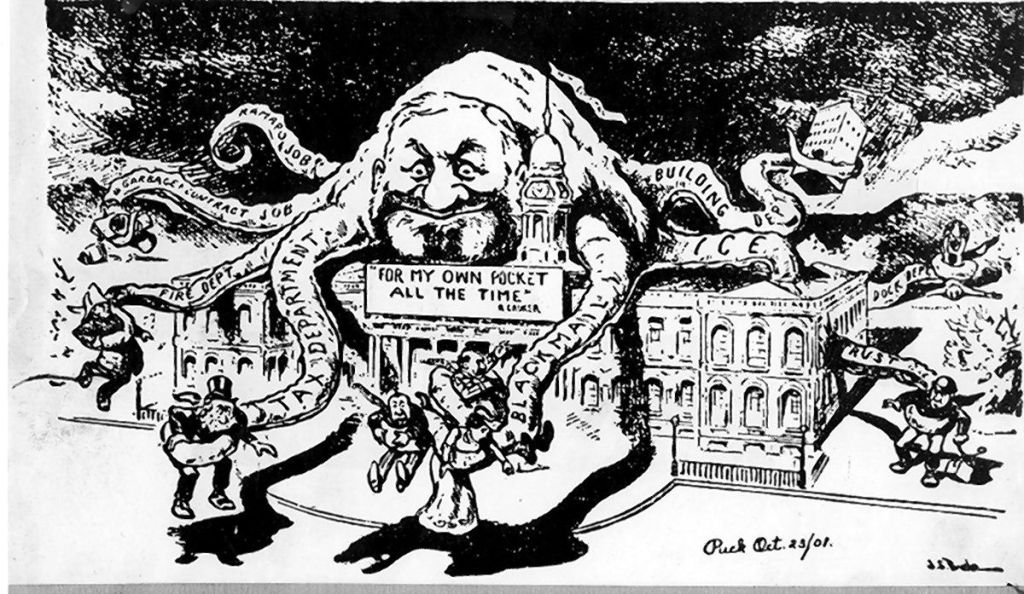
For New York’s Tammany Hall, the machinations of William Magear “Boss” Tweed elevated political corruption to such dizzying heights that the cost to taxpayers of building a single courthouse, nearly doubled that of the Alaska purchase.
Yet in all the annals of humbuggery these are as nothing, a mere spark compared with the rising of a malign sun compared with the “Cazique of Poyais”, Gregor MacGregor, the man who “sold” a continent. Or at least, part of one.
Between 1807 and 1814, a coalition of Spain, the United Kingdom and the Kingdom of Portugal went to war with the French forces of Napoleon Bonaparte for control of the Iberian peninsula.
Gregor MacGregor of the clan Gregor was a Scottish soldier and adventurer, an officer of the Peninsular war at the ripe old age of 16, the youngest age it was permitted to do so.
Having little interest in working the seven years required to become Captain, MacGregor prevailed upon the substantial dowry of his wealthy wife Maria Bowater and purchased the rank of Ensign and finally, Captain.
In 1810, a running feud with a superior officer caused MacGregor to resign his commission and receive a refund of the £1,350 he’d paid to become an officer. In 1811, actions of the 57th Foot Regiment at the Battle of Albuera earned considerable prestige for the regiment and the nickname, “Die-Hards”. MacGregor would make much of his association with his former unit even though the man had been gone by this time, for a year.
The now 23-year old MacGregor and Maria moved into a house rented by his mother in Edinburgh for a time where he adopted the title of “Colonel” and took to referring to himself as “Sir Gregor MacGregor, Bart“.
The latter is a term of nobility equivalent to a Baronet, indicating chieftainship among the clan, Gregor.
Despite parading about in extravagant finery and a badge indicating membership in an elite order of Portuguese knights, Edinburgh society failed to take notice. So it was the MacGregors moved to London, where an entirely fanciful family tree filled with Dukes and Barons, had the desired affect.
Being the kept man of a wealthy wife has its advantages but disaster struck, in 1811.
Maria Bowater MacGregor died that December. With her went the income and the support of the influential Bowater family. Most especially Maria’s father the Admiral who wasted no time in punting his now-former son in law.
For Gregor MacGregor, options were limited. Too soon to announce an engagement with any sense of decency to another heiress, a return to soldiering made sense. But not with the home team. Not after that ignominious departure, back in 1809. So…what about South America?
Since Napoleon’s 1807 invasion, Spain was beset with problems, at home. Inspired by the United States’ recent independence from Great Britain, Spanish colonies from Peru to Mexico rose up.
Venezuela was embarked on a full scale revolution at this time when General Francisco de Miranda visited London. And didn’t the man cut a dashing figure through London society, with all that military finery.
It’s unclear whether the two met at this time but, for MacGregor, this was the answer. Gregor MacGregor arrived in Venezuela in April 1812 and headed directly for Caracas. There, Miranda was delighted to entertain such an accomplished British military officer…a member of the famous “Die hards”, no less.
With Maria dead a scant six months back at home, MacGregor married the heiress of a prominent Caracas family and a cousin of the revolutionary leader Simón Bolívar, Doña Josefa Antonia Andrea Aristeguieta y Lovera, that June.
Venezuelan independence was a forlorn hope. General Miranda was captured and carted off to Spain, destined to end his days in a prison cell, in Cádiz.
Now “Colonel” MacGregor skedaddled with Josefa to the Dutch island of Curacao and on to Jamaica before returning to South America and accepting the rank of Brigadier General in service to New Granada, Venezuela’s neighbor to the west.
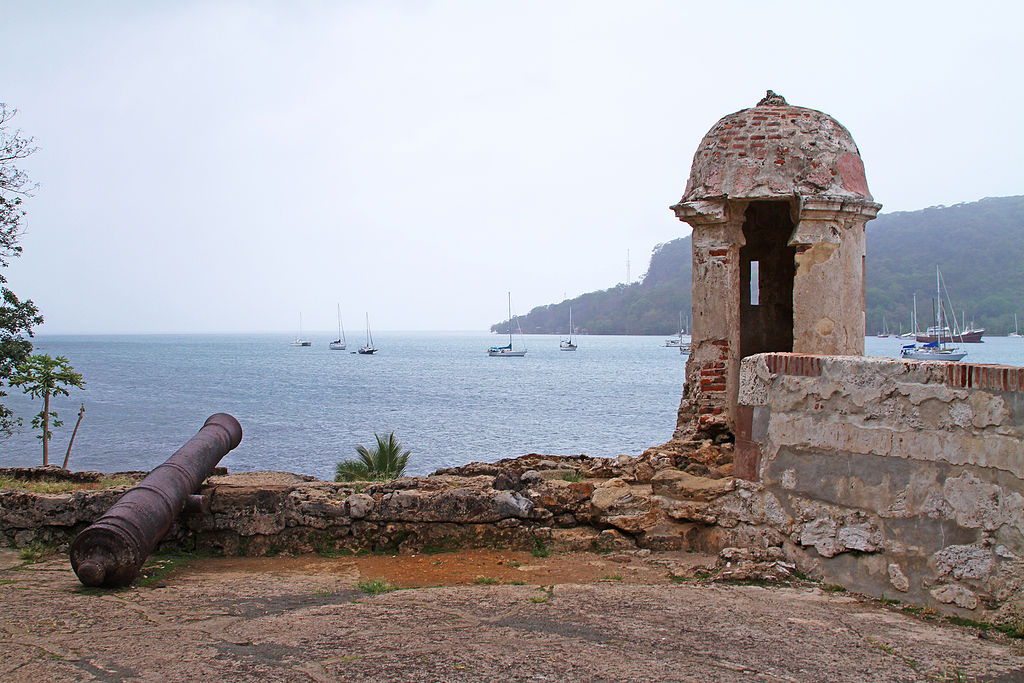
MacGregor’s South American military career is best remembered for a 34-day nation-wide retreat pursued by two Royalist armies and a hare-brained invasion of Amelia Island in Florida, resulting in the short-lived “Republic of the Floridas”. Then there was that time under fire in Porto Bello Panama, when he paddled out to his ships on a log and sailed away, abandoning his men to a miserable life, in captivity.
“Part of the fort at Porto Bello, Panama, where MacGregor abandoned his troops led by Colonel William Rafter in April 1819” – H/T Wikipedia
Even then there were those who proclaimed the “New Xenophon”, a latter-day Hannibal come forth to liberate the new Carthage. One of the more perspicacious New Granadan officials took the opposite view: “I am sick and tired of this bluffer, or Quixote, or the devil knows what” he wrote in a letter to a friend. “This man can hardly serve us in New Granada without heaping ten thousand embarrassments upon us“.
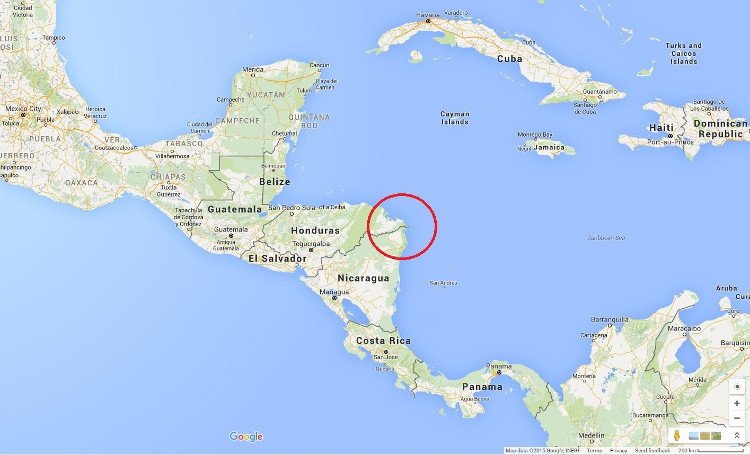
In 1820, MacGregor happened upon the Mosquito Coast (aka “Miskito), a swampy and inhospitable wilderness spanning the coasts of modern day Nicaragua, and Honduras. There, MacGregor persuaded a leader of the indigenous tribes to grant him land, to found a colony.
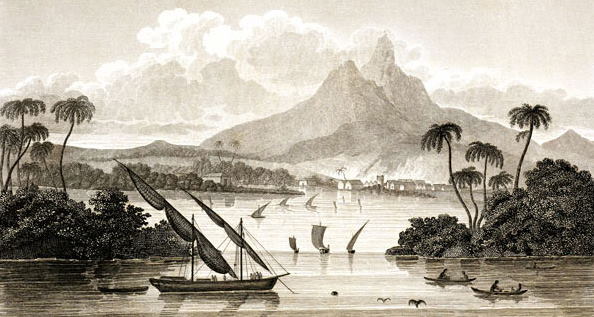
Woodcut depicting the non-existent “Black River Port”, of Poyais
Besotted with dreams of empire, MacGregor told tales back on British soil, of the independent Kingdom of “Poyais”. A land of vast wealth and welcoming natives where a man might work for a day and provide for his family, for a week. A land where he himself was “Cazique” or Royal Prince, a prestigious honor bestowed by none other than King George Frederic Augustus himself, of the Mosquito Coast.
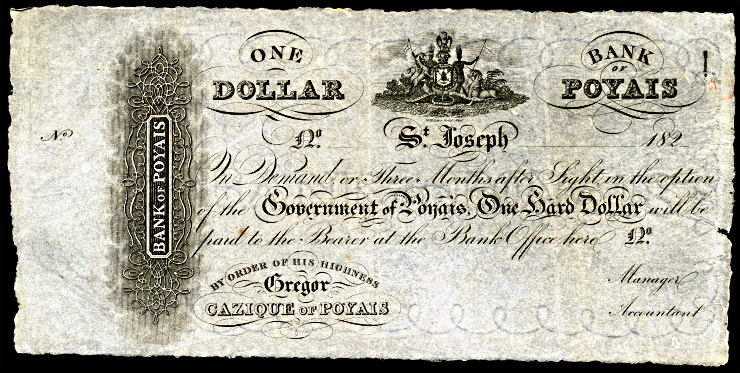
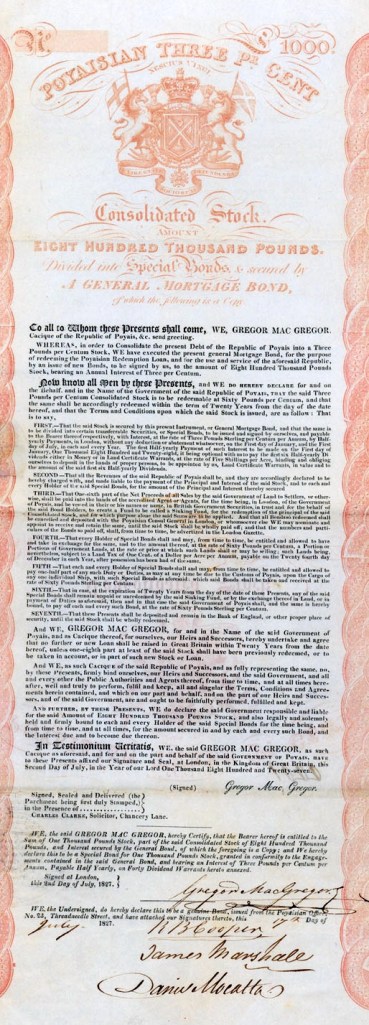
The Cazique of Poyais set about recruiting settlers and investors, raising a dizzying £200,000, a sum equivalent to nearly 12 million, today. Settlers were invited to exchange their pounds sterling for Poyais dollars, the notes conveniently printed by none other, than Gregor MacGregor.
Seventy settlers departed England in the Autumn of 1822 bound for the tropical paradise, of Poyais. Another 200 followed a few months later only to be met by desperately poor natives, the bedraggled survivors of the earlier expedition and two American hermits.
Some evacuated to Honduras while fifty returned to England arriving in October, 1823. Inexplicably, most refused to blame MacGregor for the disaster. Even so, with Poyais dominating the headlines, the Cazique wisely performed a disappearing act. Across the channel to France where he ran the very same scam, this time raising £300,000.
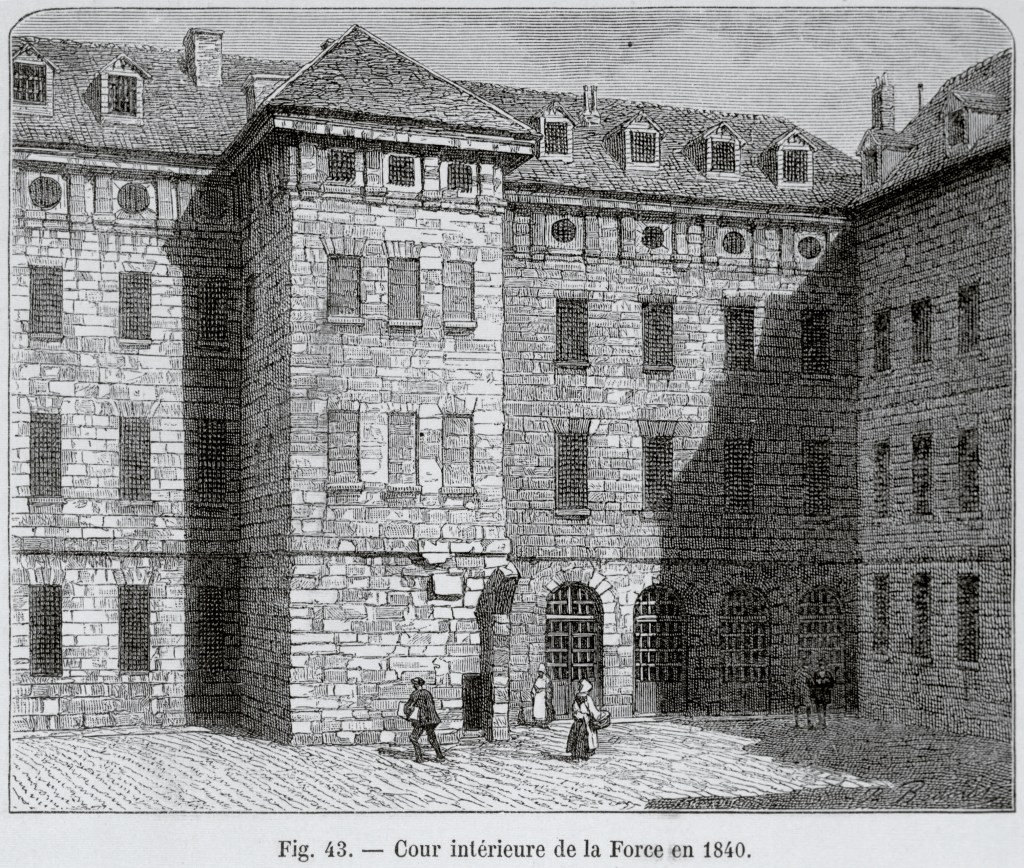
French authorities got wind of the racket, impounding the ship and trying MacGregor, for fraud. Still unrepentant, the man was acquitted while an “associate” was convicted, in his stead.
“La Force Prison in Paris, where MacGregor was detained from December 1825 to July 1826, before his trial and acquittal” H/T Wikipedia
Back in England, MacGregor was re-arrested but released in a week, without charges. He persuaded the firm of Thomas Jenkins & Company to issue a new bond in the amount of £300,000, many believing the earlier debacle to be the result of someone else’s embezzlement. There followed another bond issue, this time amounting to £800,000. It was generally regarded as a humbug by this time, not that anyone ever thought to doubt the existence of Poyais itself. It’s just that those previous bonds, had failed to generate a profit.
Gregor MacGregor continued to dine out on the same sting but, by this time, the Poyais fix had seen its best days. An attempted sale of a few land certificates in 1837 marks the final appearance of the Poyais con.
Left: Poyais stock certificate, part of an £800,000 loan package, 1827
Josefa died on this day in 1838 in Burghmuirhead near Edinburgh. MacGregor immediately departed for Venezuela where he applied for reinstatement of his former rank, complete with back pay and a pension, of course. With MacGregor’s contributions to the Venezuelan Republic having been “heroic with immense results”, the Scotsman’s petition was approved in March, 1839. He settled in Caracas and died peacefully at home in December, 1845. The Cazique of Poyais was buried with full military honors at Caracas Cathedral with Presidente Carlos Soublette leading the procession, marching behind MacGregor’s coffin followed by a phalanx of cabinet ministers and military chiefs.
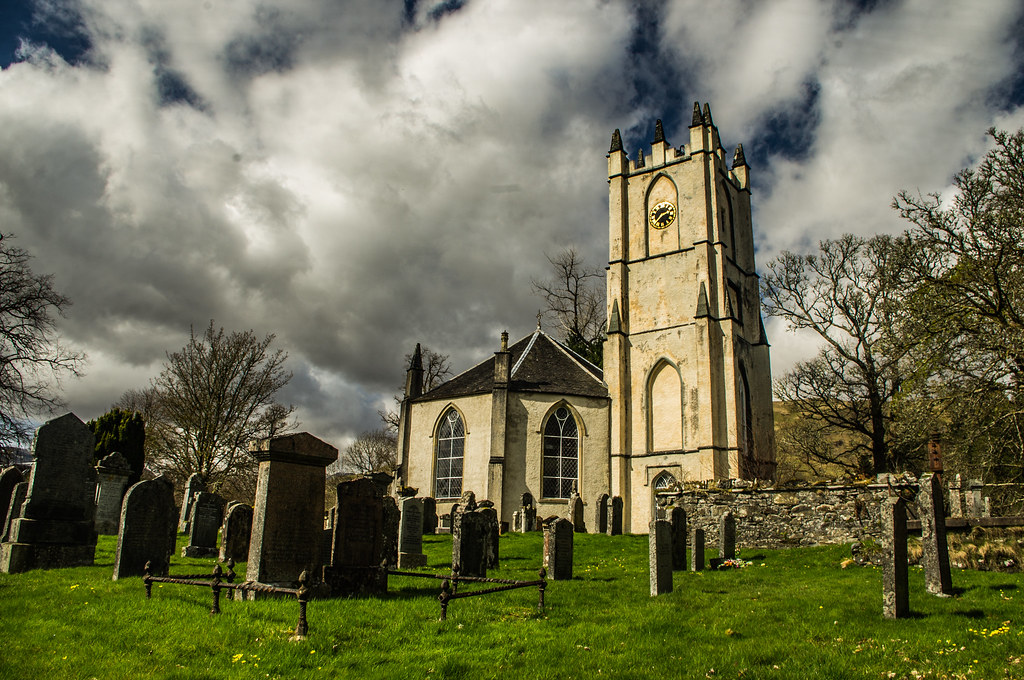
Back in Scotland, the Glenorchy Kirkyard near Loch Katrine has served as the ancestral burial ground for the Gregor clan, since 1390. There you will find an “octagonal-shaped Gothic church with its square tower and pointed stained-glass windows [set] in a peaceful graveyard on top of a knoll” according to find-a-grave.com. There is no mention of Gregor MacGregor nor the tropical paradise, he invented.
“I would not be cured if the price of the cure was that I must leave the island and give up my work I am perfectly resigned to my lot”. Saint Damien of Molokai
It’s one of the oldest diseases in recorded history, the first written reference coming down to us, from 600BC. Ancient Greeks, Chinese, Indians and Middle Eastern sources wrote about the condition as did the Roman naturalist Pliny the elder, in the first century.
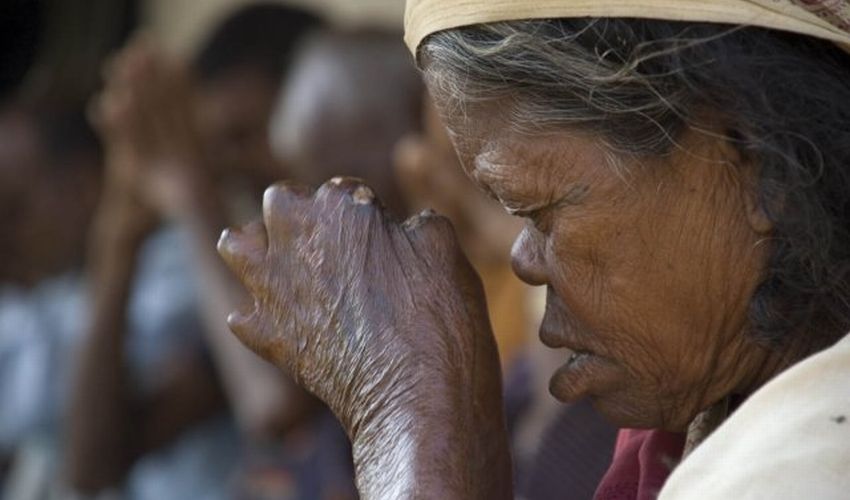
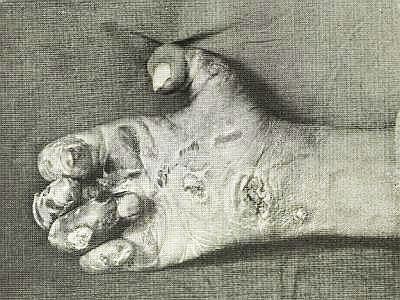
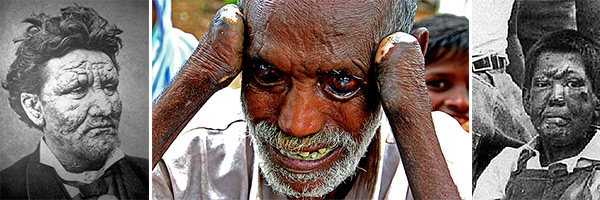
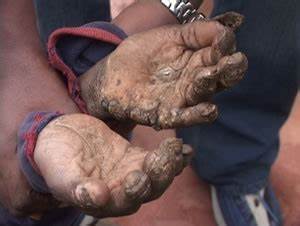
Leprosy is a chronic disease caused by the bacterium Mycobacterium leprae. Left untreated the condition produces skin ulcers, damage to peripheral nerves & upper respiratory tract, and muscular weakness. Everyday injuries go unnoticed due to numbness and lead to infection. Advanced cases result in severe disfigurement, crippling and/or the physical loss of hands, feet & facial features, and, finally, blindness.
The World Health Organization (WHO) reports a death rate among leprosy sufferers four times that of the general population.
First discovered by Norwegian physician G.H. Armauer Hansen in 1873, M. leprae is the first bacterium identified as the causative agent of disease, in humans. Today, Leprosy is curable with multidrug therapy (MDT). The world saw 208,619 new cases in 2018, 185 of which occurred, in the United States.
The horrors of the condition and resulting social stigmas, are plain for anyone to see. Today, sufferers fear loss of jobs, separation of familial and other connections and social isolation. Though not as widespread as commonly believed, victims of “Hansen’s disease” were historically sent off to quarantine in asylums and “leper colonies” from which few, ever returned.
In the 19th century, Mycobacterium leprae came to the Hawaiian islands.
According to research, long-distance explorers first came to the Hawaiian islands around the year 300. For the next 500 years, settlers arrived from French Polynesia, Tahiti, Tuamotus and the Samoan Islands. Other research indicates a shorter timeframe, settlement occurring between 1219 and 1266. Be that as it may the Hawaiian islands were first unified in 1810 to become the Kingdom of Hawai’i, under King Kamehameha the Great. Captain James Cook made the first known European contact in 1778 followed by waves of others both European, and American.
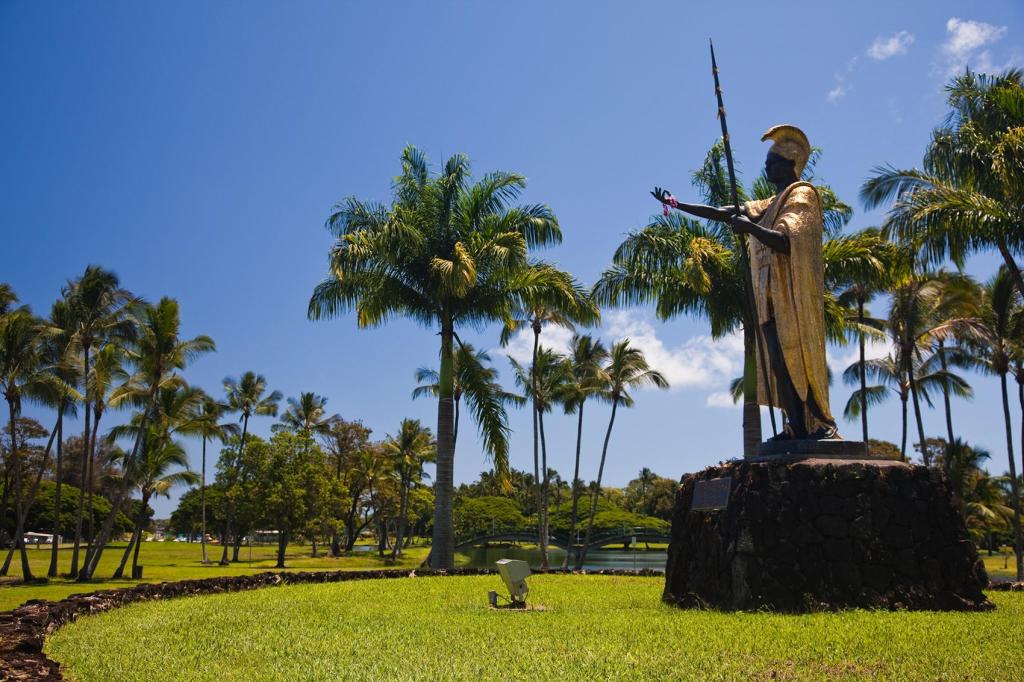
King Kamehameha statue, stands in front of Aliiolani Hale (the judiciary building), Honolulu, Oahu
According to archaeological evidence, indigenous peoples occupied the Kalaupapa peninsula on the Hawaiian island of Moloka’i, for more than 900 years. Before first contact with Europeans their numbers are estimated, between 1,000 and 2,700, . Following the arrival of Captain Cook and others, Eurasian diseases decimated native populations. By 1853 only were 140 natives were left on the Kalaupapa peninsula.
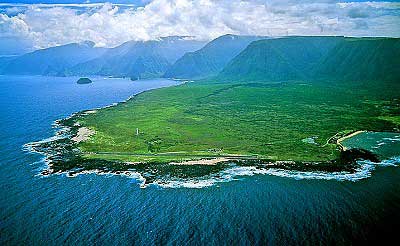
Overhead view of the Kalaupapa peninsula
Leprosy first arrived on the Hawaiian islands around 1830, believed to be carried by Chinese laborers. The disease was incurable at that time, the first effective treatment didn’t come around, until the1940s.
By 1865, sugar planters were concerned about the labor supply. The Kingdom passed a measure to remove the Kānaka Maoli, Native Hawaiian inhabitants occupying the peninsula, in preparation for a leper colony.
The first such isolation settlement was established at Kalawao on the windward side of the peninsula and then on Kalaupapa, itself.
Even after a year of family disruption brought about by government response to Covid-19 the catastrophe of such a policy, is hard to process. In native Hawaiian tradition, Aloha ʻĀina means not only “Love of the Land” but a deep sense of connection, to all living things. For the descendants of those forcibly removed from the ʻĀina as well as those “lost” to Kalaupapa the wounds remain open, to this day.
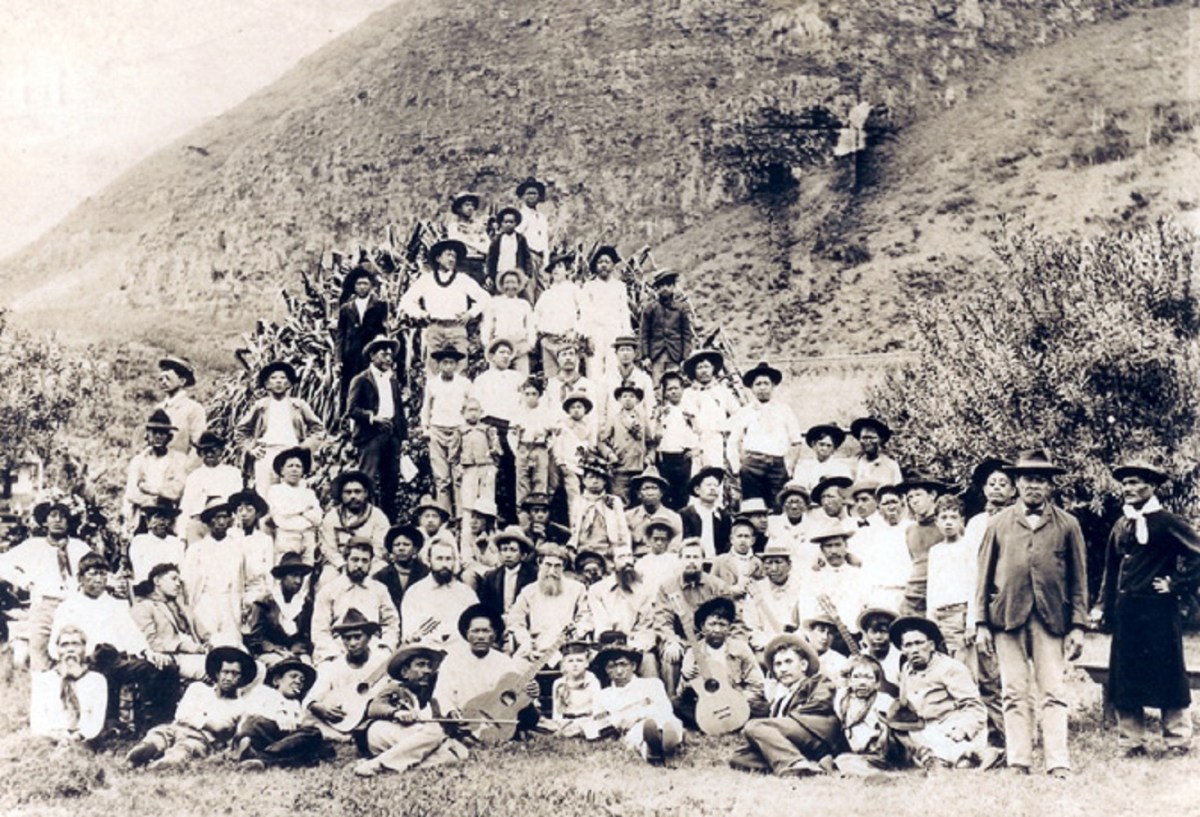
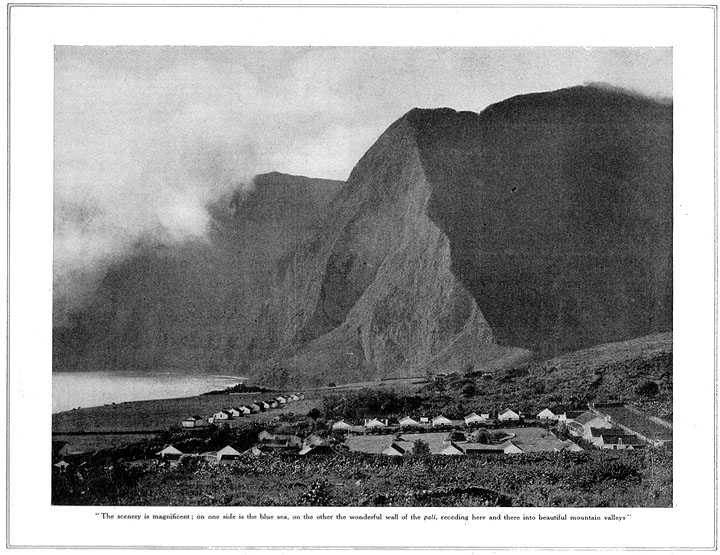
By 1890, 1,100 ‘lepers’ lived in this remote, inhospitable place, prisoners of their own deteriorating bodies and a greater culture who loathed, and feared them.
Over the years some 8,500 unfortunates would come to live in this place, the last one, in 1969.
Rudolph Wilhelm Meyer set out from his native Germany in search of the California gold rush. He made it as far as Molokaʻi. By 1866, Meyer was a father and husband to Kalama Waha, settled on the steep cliffs above Kalaupapa. As the peninsula became a leper colony, Meyer became supply agent to the colony and liaison to those few healthy individuals, willing to work there.
Mostly, those were Belgian missionary priests from the Congregation of the Sacred Hearts of Jesus and Mary, the first of whom was Father Damien, who served there from 1873 until his death, in 1889.
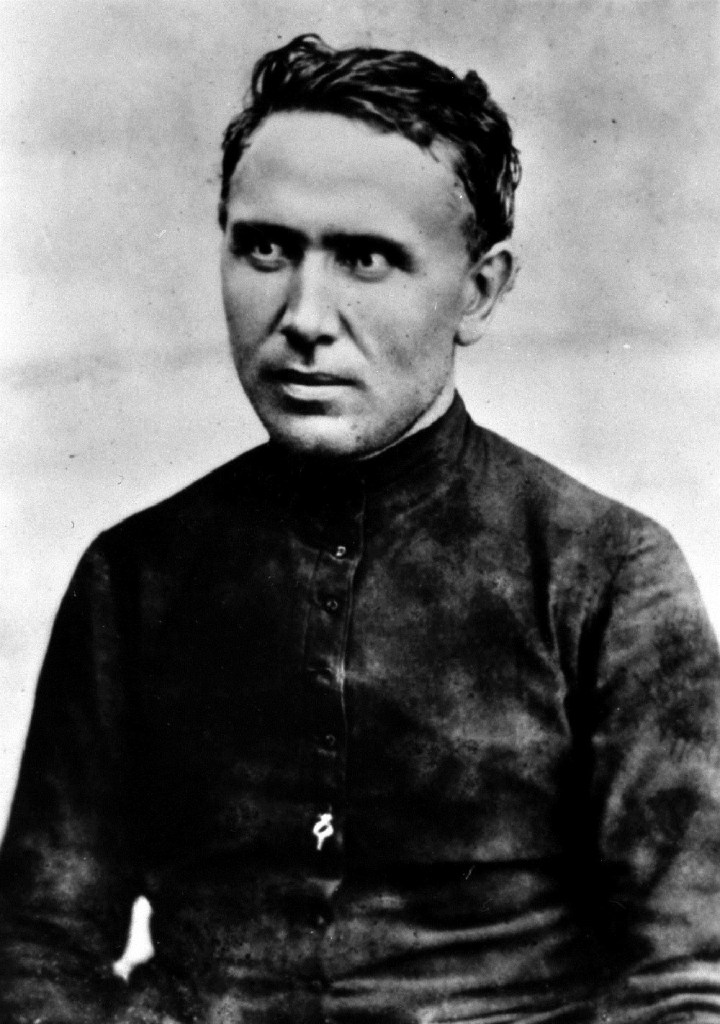
Fr. Damien in 1873 before sailing, for Hawai’i
Father Damien arrived at the isolated settlement at Kalaupapa on May 10, 1873. At that time there were 600 lepers. He spoke to the assembled unfortunates as “one who will be a father to you, and who loves you so much that he does not hesitate to become one of you; to live and die with you.”
After the Fr. Damien’s death of leprosy, commentators complained of contemporary accounts diminishing the work of native Hawaiians, some of whom served prominent roles on the island. While such are accounts are likely true enough there is no diminishing what the man did there.
For 16 years, father Damien lived and worked among the lepers of Molokaʻi. He ate with them, from the same bowls. He smoked with them, from the same pipe.
While the government had no desire to make this place a penal colony, outside support was slim to none. And this was no isolated population of yeoman farmers, these people were sickened and made weak by this most dreadful of medical conditions, many barely able to care for themselves.
Damien was not only a priest and teacher, he pitched in painting houses, organizing farms and building roads, hospitals and churches. He dressed the wounds of the stricken, built their coffins, dug graves and lived with the lepers, as equals. Six months after his arrival at Kalawao he wrote to his brother, Pamphile, in Europe: “…I make myself a leper with the lepers to gain all to Jesus Christ.”
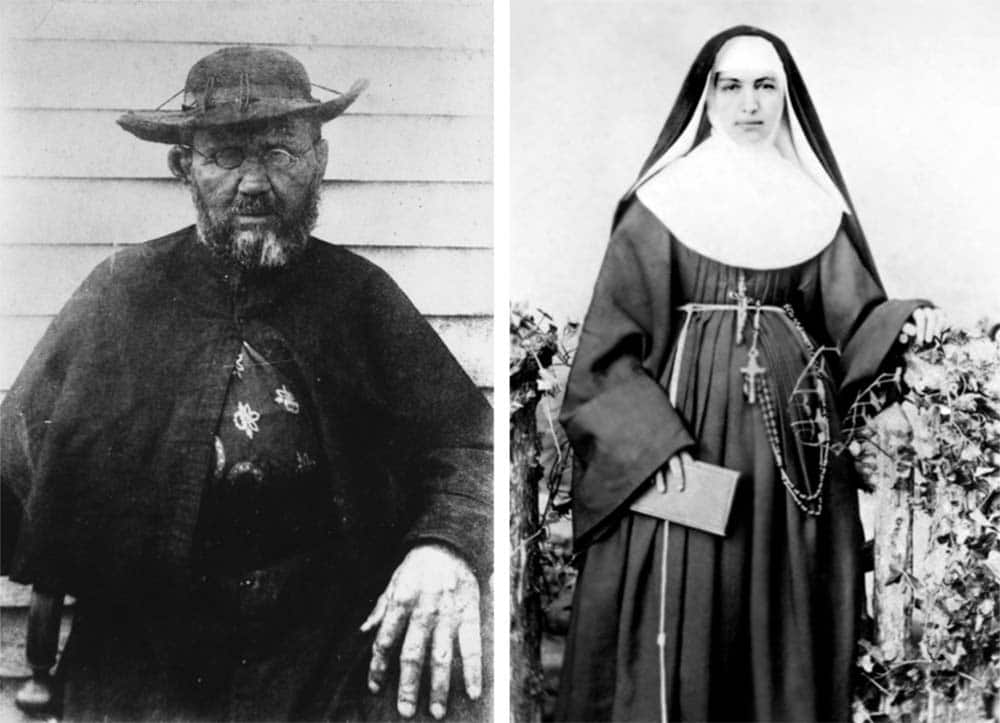
Father Damien and sister Marianne Cope have both received Roman Catholic Sainthood, for their actins on Molokaʻi
One day, it happened. In December 1884, he accidentally put his foot in scalding water. It was so hot that his skin blistered and peeled but he didn’t feel a thing. Father Damien was now himself, a leper.
Despite the illness destroying his body, Damien worked even harder in the last years of his life. He completed several building projects and improved orphanages, all while aiding his fellow lepers in their treatments and medical baths and spreading the Catholic faith. King David Kalākaua bestowed on the priest the honor of “Knight Commander of the Royal Order of Kalākaua.” When Crown Princess Lydia Liliʻuokalani arrived to present the medal she was said to be too distraught and heartbroken at the sight of those poor people, to even speak.
Princess Liliʻuokalani spoke of her experience bringing the plight of Father Damien and his flock, to the eyes of the world. European and American protestants sent money to help with the work. The Church of England sent food, medicine and supplies. It is believed that Fr. Damien never wore his medal but he went to his grave, with it by his side.
Japanese leprologist Masanao Goto arrived to treat the lepers of Molokaʻi with medical baths, moderate exercise and friction applied to parts, benumbed by disease. Goto’s treatments were popular with his patients but, in the end, there was little hope. Four volunteers arrived in the end to aid the ailing missionary including sister Marianne Cope, a woman who would one day join Father Damien, in Roman Catholic sainthood.
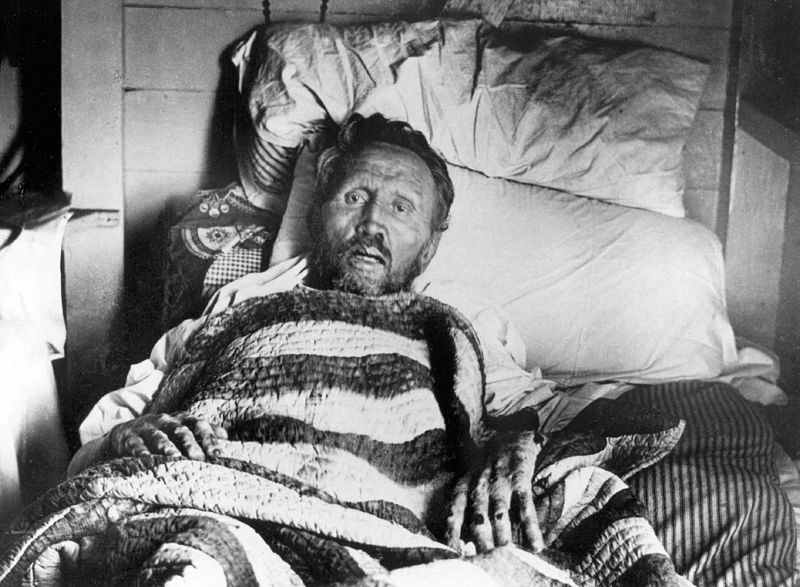
Father Damien on his deathbed, 1889
By February 1889, the end was near. With his foot in bandages and an arm in a sling, his other leg dragging uselessly behind, Damien went to his death bed on March 23. Father Damien died of leprosy at 8:00am on April 15, 1889. He was 49. The entire colony turned out the following day as the Belgian missionary was laid to rest beside the same pandamus tree under which he had slept those sixteen years earlier, on his first night in Molokaʻi.
In John 15:13, the King James Bible teaches that “Greater love hath no man than this, that a man lay down his life for his friends.” Today, I wonder how many know the name of Father Damien, of Molokaʻi . Or the faith which would bring a person to willingly submit to the literal rot, of such a hideous condition.
Let Mahatma Ghandi, himself no stranger to the horrors of leprosy, have the last word on that subject: “The political and journalistic world can boast of very few heroes who compare with Father Damien of Molokai. The Catholic Church, on the contrary, counts by the thousands those who, after the example of Fr. Damien, have devoted themselves to the victims of leprosy. It is worthwhile to look for the sources of such heroism“.
Feature image, top of page: Kalaupapa leper colony in 1905
Robert Rhett, the rabble rousing editor of the Charleston Mercury Newspaper, offered to personally eat the bodies of all those slain in the coming conflict. Never one to be outdone, former Senator James Chesnut, Jr. said “a lady’s thimble will hold all the blood that will be shed,” promising to personally drink any that might be spilled.
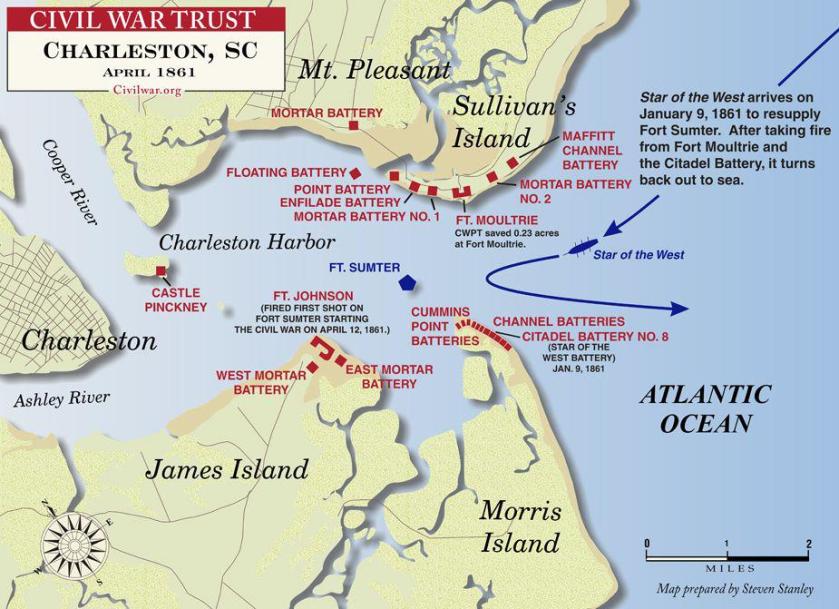
South Carolina seceded from the United States on December 20, 1860, leaving state government officials to consider themselves, a sovereign nation. Six days later, United States Army Major Robert Anderson quietly moved his small garrison from the Revolution-era Fort Moultrie on Sullivan’s Island to the yet to be completed Fort Sumter, a brick fortification at the mouth of Charleston Harbor.
President James Buchanan attempted to reinforce and resupply Anderson via the unarmed merchant vessel, “Star of the West”. Shore batteries opened up on the effort on January 9, effectively trapping Anderson and his garrison inside the only federal property in the vicinity.
For the newly founded Confederate States of America, the presence of an armed federal force at the mouth of Charleston harbor could not be tolerated. Secessionists debated whether the problem was that of South Carolina or the national government, in Mobile.
Meanwhile, the Federal government refused to recognize the Confederacy, as independent states. It was a standoff. Both sides needed the support of border states, and neither wanted to be seen as the aggressor.
Fort Sumter
Political opinion was so sharply divided at that time, that brothers literally wound up fighting against brothers. By the time the war got going, every seceding state but South Carolina sent regiments to fight for the Union and even that state, contributed troops to the Union war effort. A surprising number of northern soldiers resigned commissions and fought for the south including Barre, Massachusetts native Daniel Ruggles, Ohio Quaker Bushrod Johnson and New York native Samuel Cooper, to name a few.
Fun fact: When South Carolina seceded that December the world waited to see, who would be next. With her January 9th departure from the federal union Mississippi was the next state to actually leave, though not the next to talk about it. That honor went not to a southern state but a northern city called New York on January 7, 1861. Mayor Fernando Wood addressed the Common Council, requesting New York assert its independence as a “free city” by “disrupt[ing] the bands which bind her to a venal and corrupt master” (the federal government).
Confederate Brigadier General Pierre Gustave Toutant-Beauregard (I love that name) was placed in charge of Charleston in March and immediately began to strengthen the batteries surrounding the harbor.
Fort Sumter was designed for a garrison of 650 in service to 130 guns, most of them pointed outward, positioned to defend the harbor against threats from the sea. In April 1861 there were only 60 guns, too much for Major Anderson’s 85-man garrison, nearly half of whom were non-combatants, mostly workmen and musicians.
When Abraham Lincoln was inaugurated on March 4, the resupply of Fort Sumter became the first crisis for the new administration. Lincoln notified South Carolina Governor Francis Pickens he was sending supply ships, resulting in Beauregard’s ultimatum: the Federal garrison was to evacuate immediately, or Confederate batteries would open fire.
Major Anderson lacking the appropriate response, shore batteries opened fire at 4:30 am on April 12, 4003 guns firing in counter-clockwise rotation. Abner Doubleday, Federal 2nd in command and the man erroneously credited with the invention of baseball, later wrote “The crashing of the shot, the bursting of the shells, the falling of the walls, and the roar of the flames, made a pandemonium of the fort.”
Two years later at Gettysburg, Norman Jonathan Hall would lose over 200 men in furious fighting at a critical breach near the ”copse of trees”. One day, a brass plaque would mark the spot as the “High Water Mark” of the Confederacy. On this day, Lieutenant Hall raced through flames to rescue the colors, after a direct hit on the main flagpole knocked the flag to the ground. His eyebrows were permanently burned off of his face, but Hall and two artillerymen were able to jury-rig the pole so, once again, Old Glory flew over Fort Sumter.
The Confederate flag flies over Fort Sumter, 1861
Over 34 hours, thousands of shells were fired at Fort Sumter. Though vastly outgunned federal forces, fired back. For all that, the only casualty was a Confederate mule.
The only fatalities in the whole mess occurred after the federal surrender, on April 13. One gun misfired performing a 100-gun salute while lowering the flag, mortally wounding privates Daniel Hough and Edward Galloway.
The following day, Colonel Robert E. Lee resigned his commission in the United States Army.
The Civil War had begun but few understood the kind of demons, now unleashed. Robert Rhett, the rabble rousing editor of the Charleston Mercury Newspaper, offered to personally eat the bodies of all those slain in the coming conflict. Never one to be outdone, former Senator James Chesnut, Jr. said “a lady’s thimble will hold all the blood that will be shed,” promising to personally drink any that might be spilled.
The war between the states would lay waste to a generation and end the lives of more Americans than the Revolution, World War 1, World War 2 and the wars in Korea, Vietnam, Iraq and Afghanistan. Combined.
“All creative people want to do the unexpected” – Hedy Lamarr
According to Greek mythology, Helen was the most beautiful woman in the world. The wife of Menelaus, King of Sparta, Helen either eloped or was kidnapped, (the sources are elliptical on the point), with (or by) the Trojan prince, Paris. The Achaeans (Greeks) set sail for Troy to bring her back. The resulting war with Troy lasted ten years, culminating in the Trojan Horse episode and the eventual fall, of the city of Troy.
“Beware of Greeks bearing gifts”.
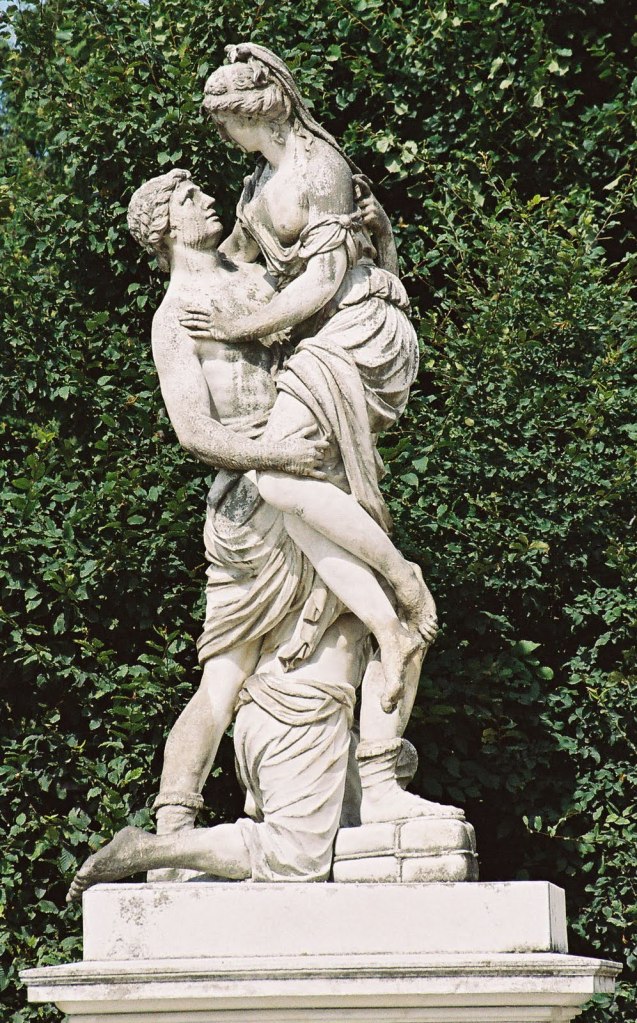
Abduction of Helen, Schönbrunn Palace, Vienna, Austria
In the 17th century, English playwright Christopher Marlowe referred to Helen of Troy as having “…the face that launched a thousand ships”.
“Was this the face that launched a thousand ships And burnt the topless towers of Illium Sweet Helen, make me immortal with a kiss…”
The Tragical History of Dr. Faustus, by Christopher Marlowe
The Austrian-born American actress and film producer Hedy Lamarr had such a face, and more. A movie star once described as “the world’s most beautiful woman”, she possessed an intellect in the very top percentile and the curiosity, of an inventor.
Hedwig Eva Maria Kiesler was born on November 9, 1914 in Vienna, Austria, the daughter of Emil Keisler and Gertrud (Lichtwitz) Kiesler. Emil, a bank director with the gift of curiosity and the mind of an engineer, would take his daughter for long walks. He would point out various machines like printing presses and streetcars and explain, their inner workings. From the age of five little Hedy could be found, taking apart and reassembling her music box and other household gadgets.
Gertrud “Trude” was a concert pianist who introduced Hedy to the arts, enrolling her daughter in ballet and piano lessons, from an early age.
Blessed or perhaps cursed with exceptional beauty, the rest of the world ignored the brilliance of her mind. That face was what mattered. At 16, Hedy was “discovered” by theater and film producer, Max Reinhardt. She was soon studying acting and appeared in her first film role in 1930, a German film called Geld auf der Straβe (“Money on the Street”).
Hedy Keisler first gained public notice in the 1932 movie “ecstasy”, a controversial film censored in some nations and banned outright in others, for sexual content.
Austrian munitions dealer Fritz Mandl became one of Hedy’s biggest fans when he saw her in the play, Sissy. The two met and, in 1933, they married.
She was miserable.
“I knew very soon that I could never be an actress while I was his wife … He was the absolute monarch in his marriage … I was like a doll. I was like a thing, some object of art which had to be guarded—and imprisoned—having no mind, no life of its own.”
Hedy Mandl
The trophy wife expected to be seen and not heard, Hedy detested her husband’s associates, many of them, Nazi party members.
Always the gracious hostess, dinner guests never suspected how much she overheard – and understood – about the German arms industry.
In 1937 she fled, to London.
She would remain a “stateless person for sixteen years, becoming a naturalized US Citizen on this day in 1953.
In London, Hedy got her first big break in the motion picture industry when she met Louis B. Mayer. It was Mayer who persuaded her to change her last name. To distance herself, from “the ecstasy lady”. Hedy chose “Lamarr” in honor of the beautiful silent film actress, Barbara La Marr. There she met and dated for a time the American business magnate, Howard Hughes. Hughes, himself an engineer and born tinkerer, was as stricken as anyone else, by her physical beauty. Unlike the sewer that is Hollywood, Hughes understood the power of the mind, behind the pretty face.
Hughes encouraged her scientific curiosity. He brought her to his aircraft factories and showed her how his aircraft were built. He introduced her to scientists and engineers who explained to her, how things work. He bought her equipment, to work with. On movie sets, Hedy could be found in her trailer, tinkering between takes.
“Improving things comes naturally to me.”
Hedy Lamarr
As a pilot and a businessman, Howard Hughes was interested in faster airplanes, to sell to the military. With an intuitive grasp of fluid dynamics and dissatisfied with the blocky appearance of Hughes’ aircraft, Lamarr bought books about birds, and fish. She studied the fastest among fish and the speediest of birds, combining aspects of the two for a new and streamlined, wing design. Hughes took a look at Lamarr’s sketches and said “Hedy, you’re a genius”.
Americans couldn’t get enough of the Austrian-born actress. On screen she radiated all the “old world” exoticism of a Dietrich or a Garbo but managed a magnetism and personal warmth unique, among the three.
Offscreen she was always exploring. Learning. Experimenting. Lamarr went on to invent a stop light upgrade and a tablet capable of transforming into a soft drink, much like Alka-Seltzer, but it took WW2 to bring about her most significant contribution.
In 1940, Hedy met the pianist and avant-garde composer, George Antheil. Every bit the polymath as Lamarr herself, the two had long conversations about – of all things – guided torpedoes. The actress had unique and personal insights into the darkness, of the Nazi war machine. Wasn’t such a guidance system susceptible to jamming, sending the projectile off-course?
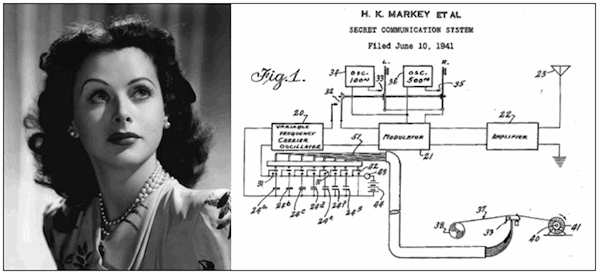
The pair set about designing a frequency-hopping system to defeat such measures. The obstacles were considerable. To create such a system, both sender and receiver needed to switch frequencies, not only at the same time, but to the same setting. Lamarr’s “Secret Communications System” was patented in 1942 under her then-married name, Hedy Keisler Markey.
While classified as “Red hot”, Hedy’s “thing” proved technically difficult to implement in the field. In 1957, the system was adapted for use in a secret naval sonobouy. An updated version was installed on Navy ships during the Cuban missile crisis but, by this time the patent had run out. Hedy Lamarr never was compensated for her invention.
Today, “spread spectrum” technologies you’re probably using at this very moment, modern wonders such as Wi-Fi, Bluetooth and GPS, are borne of the “Mother of Wi-Fi”. The Hollywood actress with a face that could launch a thousand ships and the mind, of an engineer.
On the surface of the ocean, the Battle of the Atlantic raged on with torpedo and depth charge. Under the surface, there unfolded a different story.
The Encyclopedia Britannica describes Croton oil as a “poisonous viscous liquid obtained from the seeds of a small Asiatic tree…” Highly toxic and a violent irritant, the substance was once used as a drastic purgative and counter-irritant in human and veterinary medicine, but is now considered too dangerous for medicinal use. Applied externally, Croton oil is capable of peeling your skin off. Taken internally, the stuff may be described as the atomic bomb, of laxatives.
The Nazi conquest of Europe began with the annexation of the Sudetenland in 1938, the border districts of Bohemia, Moravia, and German speaking parts of Czechoslovakia. Within two years, every major power on the European mainland was either neutral, or subject to Nazi occupation. France fell to the Nazi war machine in six weeks, in 1940. The armed forces of the island nation of Great Britain were left shattered and defenseless, stranded on the beaches of Dunkirk.
On the Scandinavian Peninsula, longstanding policies of disarmament in the wake of WW1 left the Nordic states of Denmark and Norway severely under-strength, able to offer little resistance to the Nazi invaders.
On this day in 1940, German warships entered Norwegian harbors from Narvik to Oslo, as German troops occupied Copenhagen and other Danish cities. King Christian X of Denmark surrendered almost immediately. To the northwest, Norwegian commanders loyal to former foreign minister Vidkun Quisling ordered coastal defenders to stand down, permitting the German landing to take place, unopposed. Norwegian forces refused surrender demands from the German Minister in Oslo, but the outcome was never in doubt.
Nazi Germany responded with an airborne invasion by parachute. Within weeks, Adolf Hitler could add a second and third scalp to his belt, following the invasion of Poland, six months earlier. The Kingdoms of Denmark and Norway, were out of the war.
Norway was out of the war, but not out of the fight. One Nazi officer passed an elderly woman on the street, who complained at the officer’s rudeness and knocked his hat off, with her cane. The officer apologized, and scurried away. The gray-haired old matron snickered, to herself: “Well, we’ll each have to fight this war as best we can. That’s the fourth hat I’ve knocked into the mud this morning.”
Norwegian Resistance was quick to form, as patriotic locals united against the Nazi occupier and the collaborationist policies of the Quisling government.
“Anti-Nazi graffiti on the streets of Oslo, reading “Live” above the monogram for the Norwegian king, who had fled when the Germans invaded in 1940”. (Photo: Bettmann/Getty Images)
The Norwegian secret army known as Milorg and led by General Otto Ruge, was at first loath to engage in outright sabotage, for fear of German reprisals against innocent civilians. Later in the war, Milorg commandos attacked the heavy water factory at Rjukan and sank a ferry carrying 1,300 lbs of heavy water, inflicting severe damage to the Nazi nuclear research program.
Norwegian Resistance member Sven Somme demonstrates one of the techniques by which he evaded capture in the mountains.
In the beginning, Resistance activities centered more around covert sabotage and the gathering of intelligence. One of the great but little-known dramas of WW2 unfolded across the snow covered mountains of the Scandinavian peninsula, as the civilian-turned-spy Sven Somme fled 200 miles on foot to neutral Sweden, pursued by 900 Wehrmacht soldiers and a pack of bloodhounds.
Operations of all kinds were undertaken, to stymie the Nazi war effort. Some actions seem like frat-boy pranks, such as coating condoms destined for German units, with itching powder. Hundreds of Wehrmacht soldiers (and presumably Norwegian women) showed up at Trondheim hospitals, believing they had contracted Lord-knows-what kind of plague.
Other operations demonstrate a kind of evil genius. This is where Croton oil comes in.
As dedicated as they were, Norwegian resistance fighters still had to feed themselves and their families. Many of them were subsistence fishermen, and that meant sardines. For centuries, the small fish had been a staple food item across the Norwegian countryside. It was a near-catastrophic blow to civilian and Resistance fighters alike, when the Quisling government requisitioned the entire sardine crop.
The Battle of the Atlantic was in full-swing by this time, as wolf packs of German submarines roamed the north Atlantic, preying on Allied shipping. Thousands of tons of sardines would be sent to the French port of Saint-Nazaire, to feed U-Boat crews on their long voyages at sea.
German Type X Submarine, U-864
Norwegian vengeance began with a request to the Special Operations Executive (SOE) in Great Britain, for the largest shipment of Croton oil, possible. The “atomic laxative” was smuggled into canneries across Norway, and used to replace vegetable oil in sardine tins. The plan worked nicely and no one suspected a thing, the pungent taste of the fish covering the strange flavor of the oil.
From midget submarines such as the Biber, Hai, Molch, and Seehund models to the behemoth 1,800-ton “Type X“, the Kriegsmarine employed no fewer than fifteen distinct submarine types in WW2, including the workhorse “Type VII”, of which some 700 saw service in the German war effort.
On the surface of the ocean, the Battle of the Atlantic raged on with torpedo and depth charge. Under the surface, there unfolded a different story.
Revenge, it is said, is a dish, best served cold. Excepting the participants in this tale, no one knows what it looks like when ten thousand submariners simultaneously lose control of their bowels. It could not have been a pretty sight.
Rodman was no stranger to the brutal twists and the horrors of war. Nearly half his comrades were killed, fighting in the Philippines. The survivor’s guilt. What the man saw during WW2 changed his life, forever.
Military forces of Imperial Japan appeared unstoppable during the years leading to World War 2, attacking first Thailand, then the British possessions of Malaya, Singapore and Hong Kong. The US military bases in Hawaii, Wake Island, Guam and the Philippines all fell, in quick succession.
On January 7, 1942 Japanese forces attacked the Bataan peninsula in the central Luzon region, of the Philippines. The prize was nothing short of the finest natural harbor in the Asian Pacific, Manila Bay, the Bataan Peninsula forming the lee shore and the heavily fortified island of Corregidor, the “Gibraltar of the East”, standing at the mouth. Before the Japanese invasion was to succeed, Bataan and Corregidor must be destroyed.
In early December, the Far East Air Force (FEAF) outside Luzon possessed more aircraft than the Hawaiian Department, defending Pearl Harbor. In the event of hostilities with Japan, “War Plan Orange” (WPO-3) called for superior air power, covering the strategic retreat across Manila Bay to the Bataan peninsula, buying time for US Naval assets to sail for the Philippines.
In reality, the flower of American naval power in the pacific, lay at the bottom of Pearl Harbor. Eight hours after the attack on Oahu, a devastating raid on Clark Field outside of Luzon left 102 aircraft damaged, or destroyed. Army chief of staff general George C. Marshall later remarked to a reporter: “I just don’t know how MacArthur happened to let his planes get caught on the ground.”
General Douglas MacArthur abandoned Corregidor on March 12, departing the “Alamo of the Pacific” with trademark dramatic flair: “I shall return”. Some 90,000 American and Filipino troops were on their own, left without food, supplies or support with which to fight off the onslaught of the Japanese 14th Army.
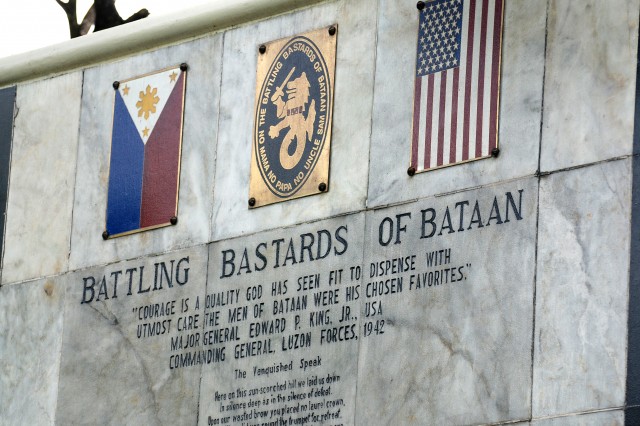
Starving, battered by wounds and decimated by all manner of tropical disease and parasite, the “Battling Bastards of Bataan” fought on until they could do no more.
War correspondent Frank Hewlett was the last reporter to leave Corregidor, before it all collapsed. It was he who coined the phrase “Angels of Bataan“, to describe the women who stayed behind to be taken into captivity, to care for the sick and wounded. Hewlett wrote this tribute to the doomed defenders of that place:
Battling Bastards of Bataan
We’re the battling bastards of Bataan; No mama, no papa, no Uncle Sam. No aunts, no uncles, no cousins, no nieces, No pills, no planes, no artillery pieces And nobody gives a damn Nobody gives a damn.
by Frank Hewlett 1942
Allied war planners turned their attention to defeating Adolf Hitler.
In the days following the attack on Pearl Harbor, the river gunboat USS Mindanao earned the distinction of taking prisoner the sole survivor of the midget submarine attacks carried out that day, Kazuo Sakamaki. Now short on fuel, Mindanao was reduced to harassing shore artillery and covering small boats evacuating soldiers, from the beaches. On April 8, 1942, Mindanao Executive Officer David Nash confided to his diary: “This has been a hectic day. It looks like the beginning of the end. The planes get nearer each day and this evening the word was received to get up steam and standby to get underway. Meanwhile Ft. Mills started shooting across our heads toward the Bataan lines. All night long our forces were obviously destroying equipment. It looks like evacuation from the Peninsula”.
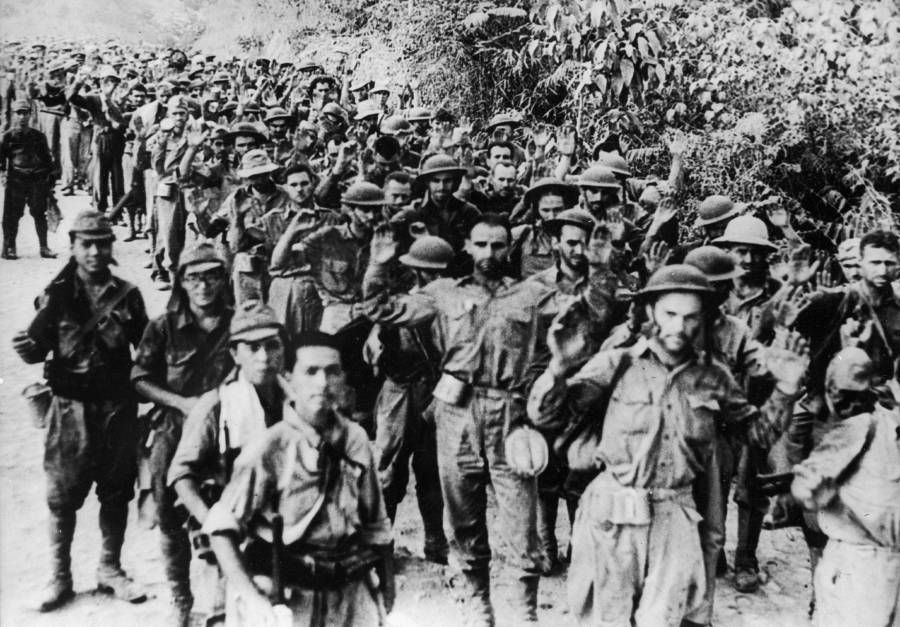
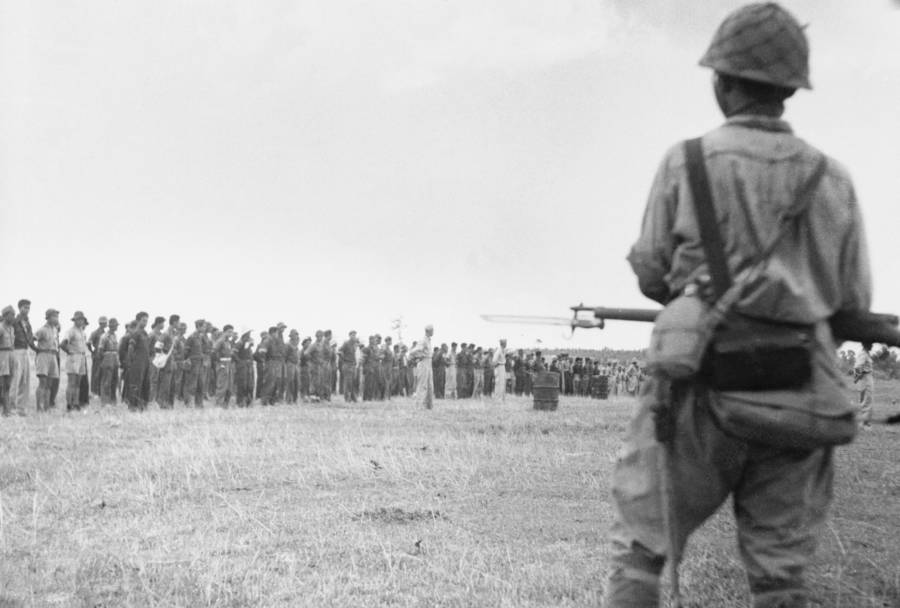
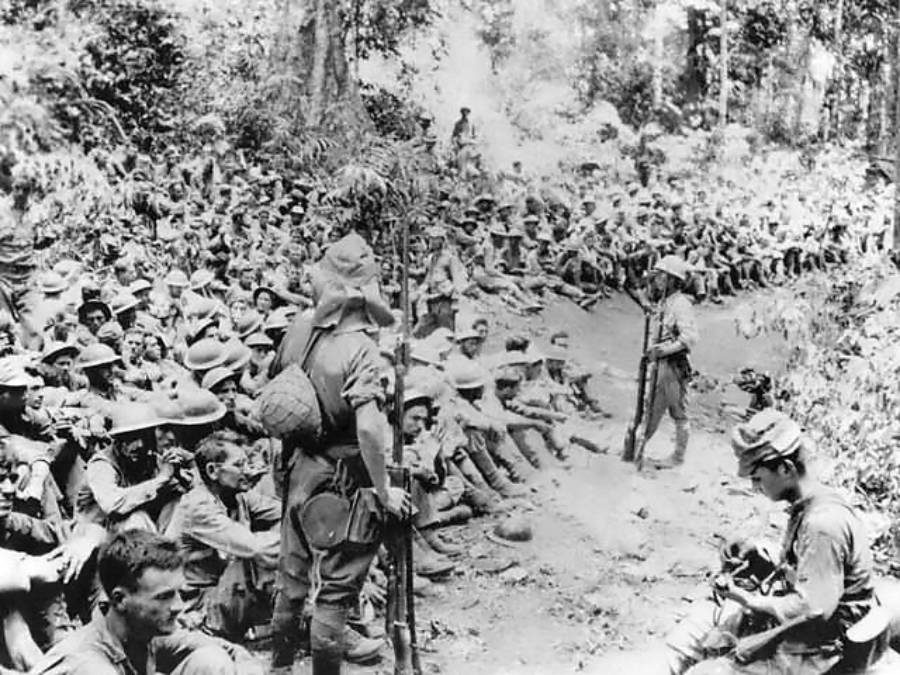
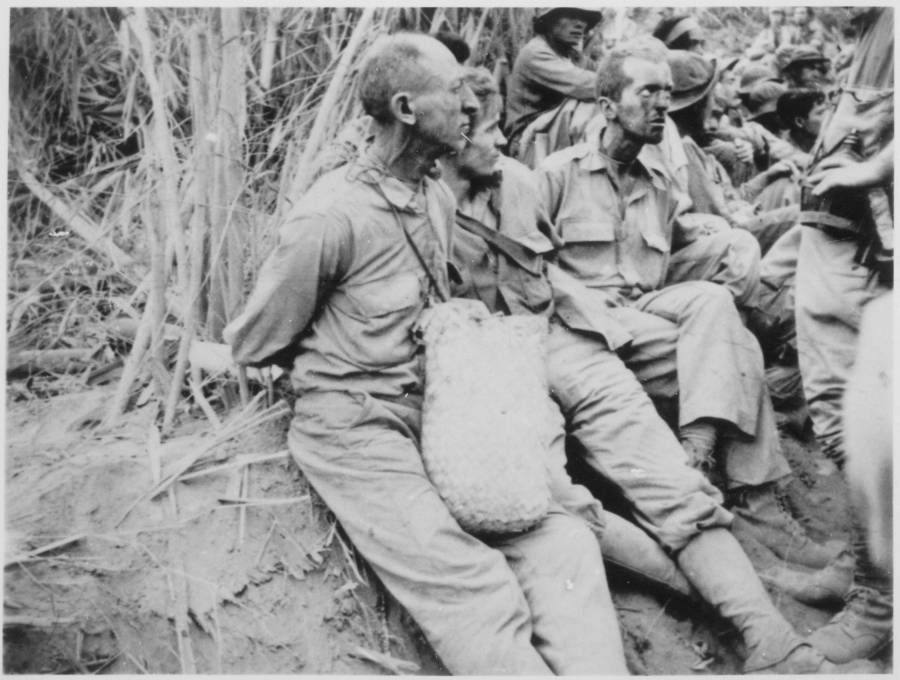
Bataan fell the following day, some 75,000 American and Filipino fighters beginning a 65-mile, five-day trek into captivity known as the Bataan Death March. Lieutenant Nash was taken prisoner, surviving a captivity many did not to pass the remainder of the war at Bilibid, Davao, Dapecol and the infamous Cabanatuan prison camps.
With a commanding position over Pacific shipping routes, holding the Philippine archipelago was critical for Japanese war strategy. Capturing the islands was important to the US by the same logic with the added reason, this was a personal point of pride for General Douglas MacArthur. Two years almost to the day from that ignominious departure, the Joint Chiefs of Staff ordered MacArthur to come up with a plan to take the place back. Luzon would come first with the invasion of Leyte in the north, slated for early 1945.
That summer, US 3rd fleet operations revealed Japanese defenses were weaker than expected. The invasion was moved forward to October. Before it was over, the Battle of Leyte would trigger the greatest naval battle, of World War 2.
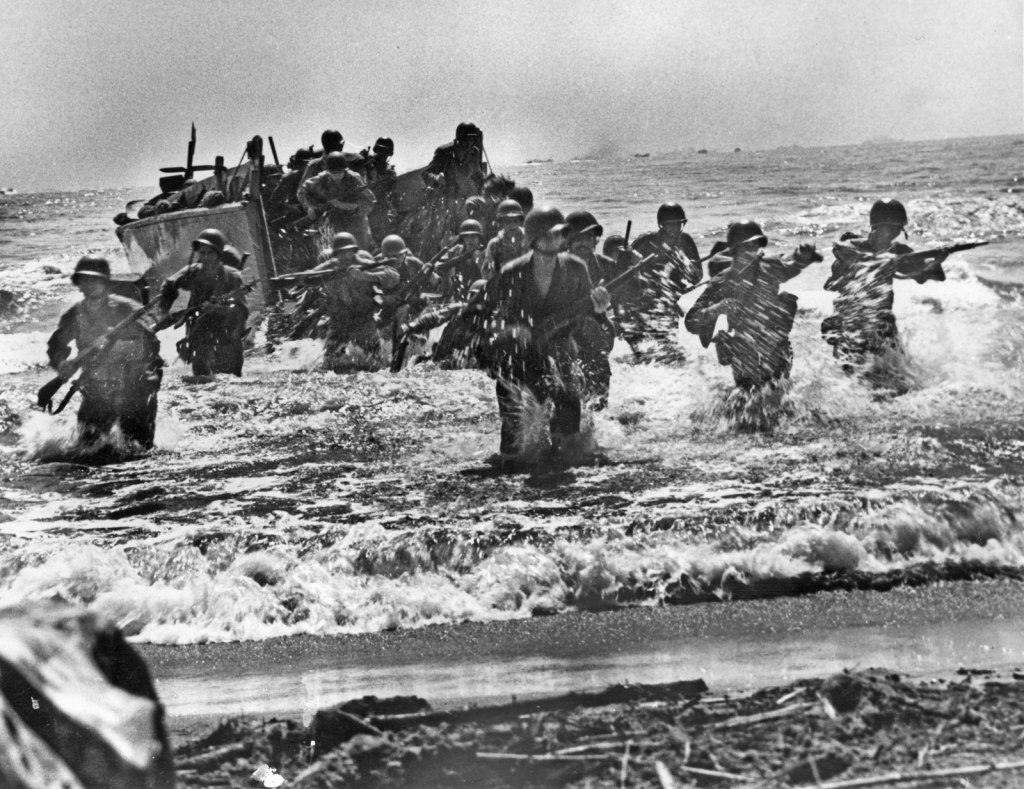
With deep-water approaches and sandy beaches, Leyte Island is tailor-made for amphibious assault. Preliminary operations for the invasion began on October 17. MacArthur made his grand entrance on the 20th announcing to the 900,000 residents of the island: “People of the Philippines, I have returned! By the grace of Almighty God, our forces stand again on Philippine soil.”
The fighting for Leyte was long and bloody involving 323,000 American troops and Filipino guerrillas. Day and night through mountains, swamps and jungles, by the time it was over some 50,000 Japanese combat troops were destroyed. Organized resistance ended on Christmas day. By the New Year there was little left, but isolated stragglers.
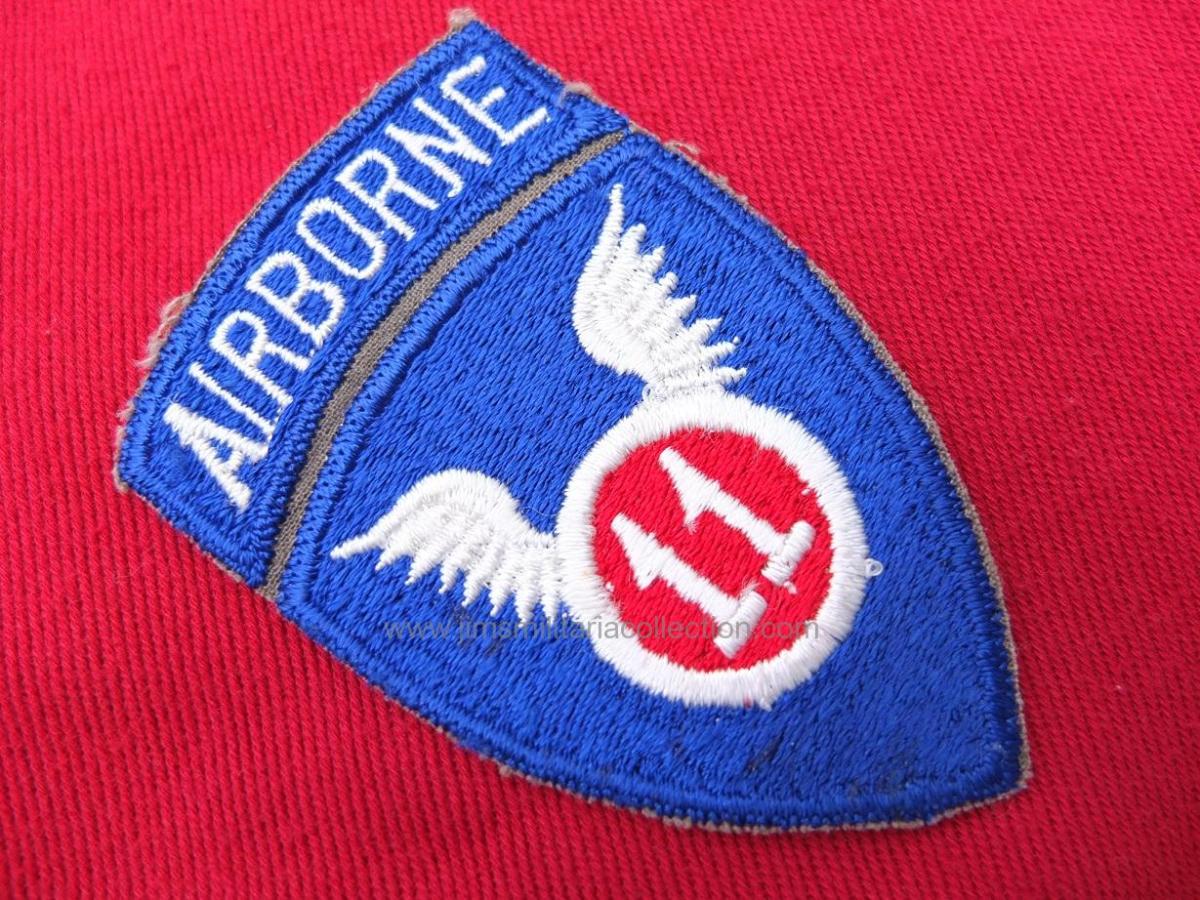
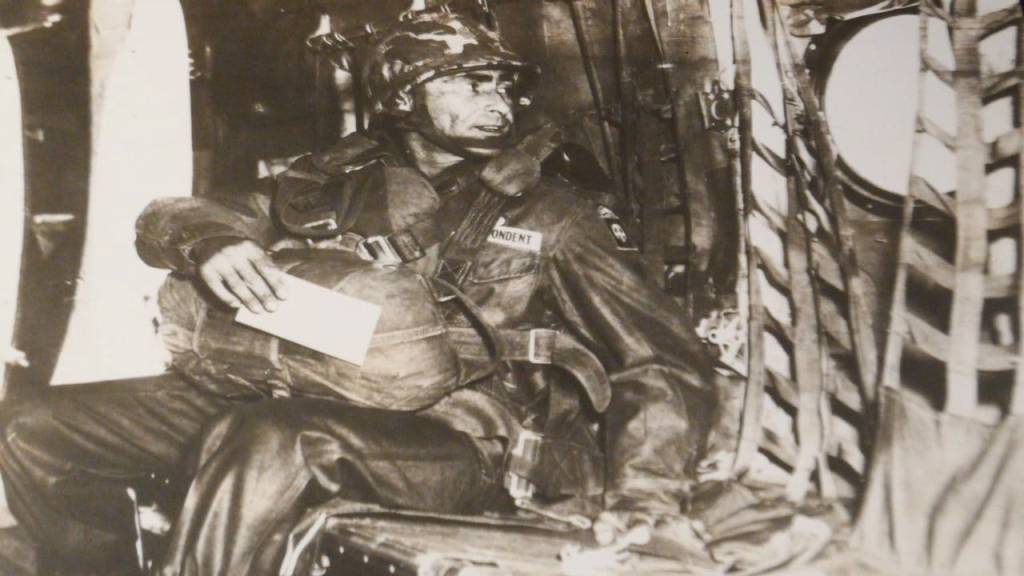
Not many can find humor in such a place as that. Private Melvin Levy was one who could. A member of the 511th Parachute Infantry Regiment of the 11th Airborne Division, that November, Levy and his comrades were fighting as infantry. He was part of the 511th‘s demolition platoon, nicknamed the “Death Squad” for its high casualty rate.
The C-47 came in low that day, but this wasn’t your normal bombing run. The plane was armed with “biscuit bombs”, crates of food and provisions intended to resupply the 511th regiment. With a comedian’s sense of timing, Levy was holding court before an enthralled group of soldiers, resting under a palm tree. Laughter filled the air as Private Levy delivered the punchline and asked his best friend Rodman, for a cigarette. Rodman took the one out of his mouth and handed it over before turning, for the pack. The biscuit bomb came in at 200 miles per hour, tearing Levy’s head from his shoulders, where he stood.
As the only other Jewish guy in the unit, Rodman presided over Levy’s funeral, the following day. He spoke a few words and placed a star of David, on Levy’s grave.
Nearly half his comrades were killed, fighting in the Philippines. Rodman himself was wounded twice and finished the war, in occupied Japan. He was no stranger to the brutal twists and the horrors of war. The survivor’s guilt. What the man saw during WW2 changed him, forever. The human wreckage wrought by the atomic bomb, the fire bombing, the results of the aerial mining of Japanese harbors literally code-named, “Operation Starvation”.
Rodman Edward Serling had opened a door, never to be closed. A door unlocked, with the key of imagination. Beyond that door is another dimension. A dimension of sound. A dimension of sight. A dimension of mind. You’re moving into a land of both shadow and substance, of things and ideas. You’ve just crossed over into, the Twilight Zone.
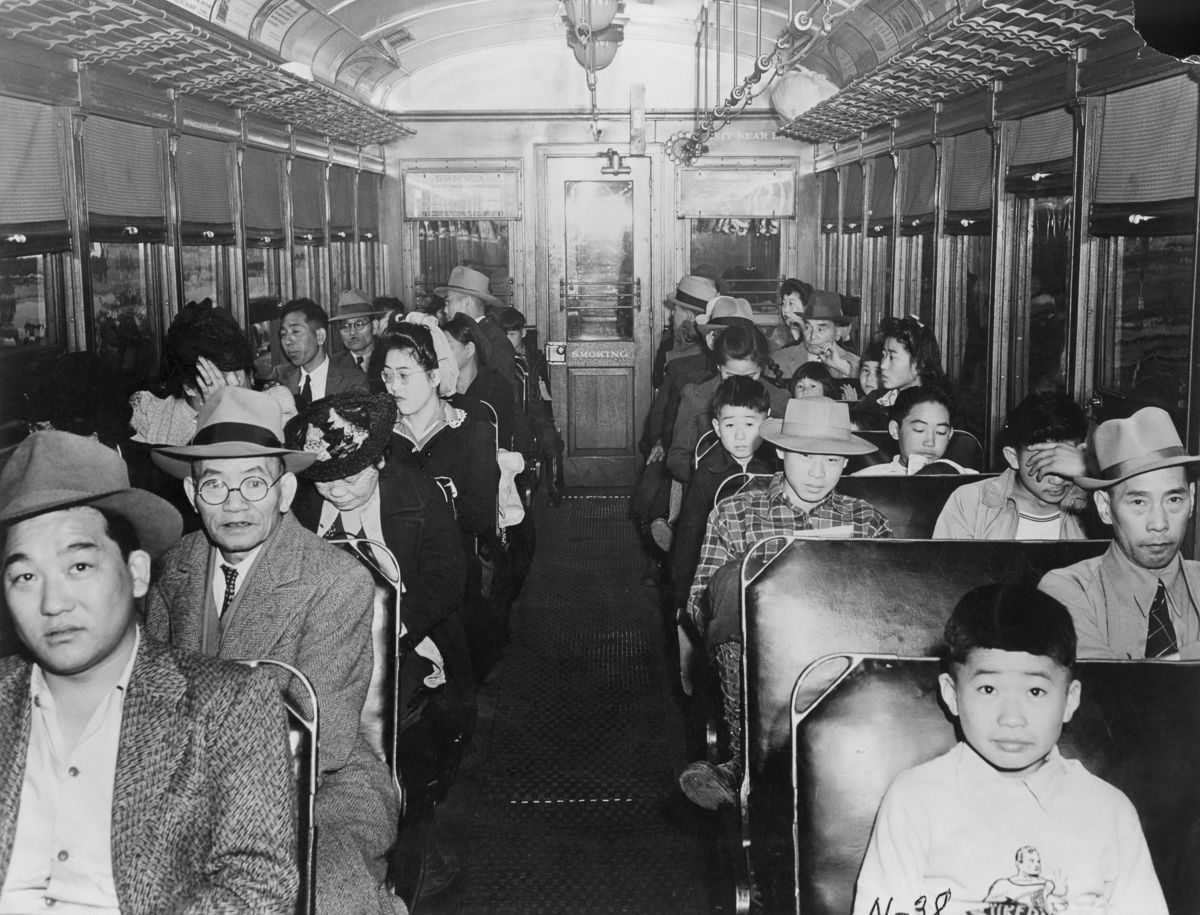
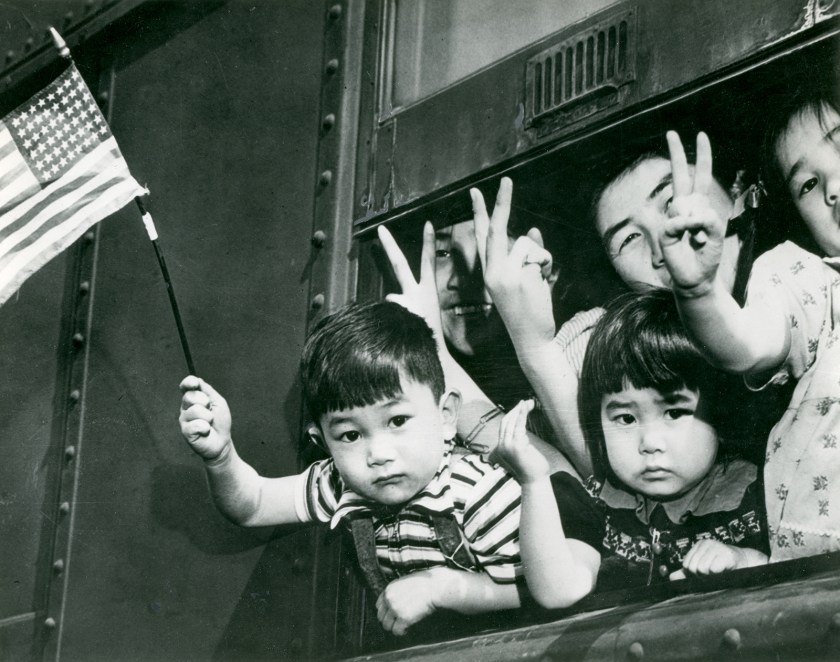
“Sometime [the train] stop[ped], you know, fifteen to twenty minutes to take fresh air-suppertime and in the desert, in middle of state. Already before we get out of train, army machine guns lined up towards us-not toward other side to protect us, but like enemy, pointed machine guns toward us”. – -Henry Sugimoto, artist
In January 1848, carpenter and sawmill operator James W. Marshall discovered gold in the foothills of the Sierra Nevada mountains, in California. Prospectors flocked to the Golden State from across the United States, and abroad. The California Gold Rush had begun.
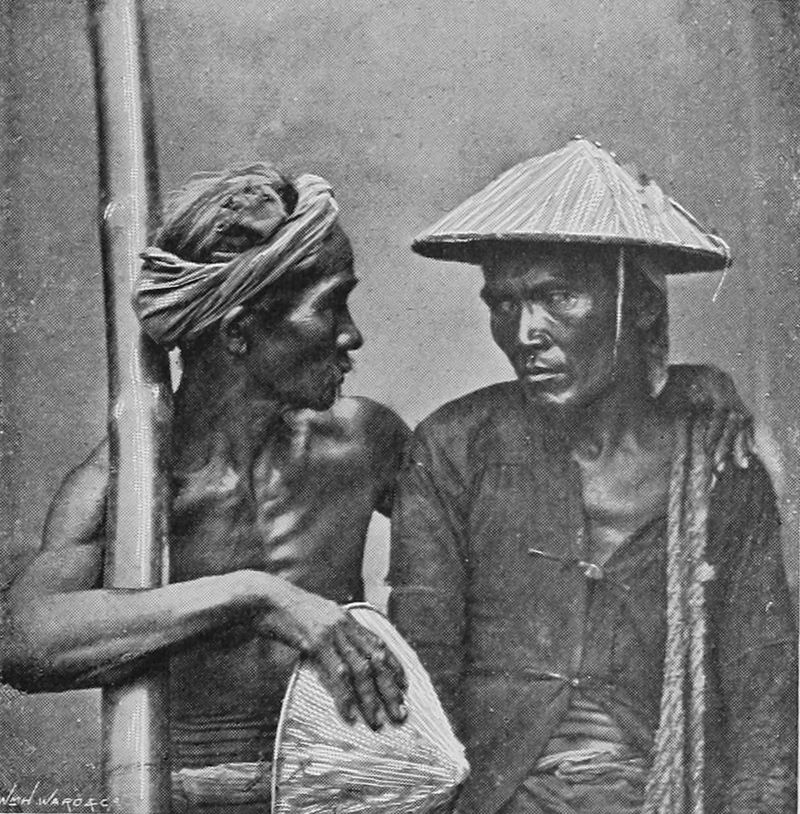
While not exactly welcoming, prospectors tolerated Chinese immigrants in the early period. Surface gold was plentiful in those days. Some even found the chopsticks and the broad conical hats of the Chinese mining camps, amusing. As competition increased, resentment began to build. Meanwhile in southern China, crop failures and rumors of the Golden Mountain, the Gam Saan, brought with it a tide of Chinese immigration. San Francisco saw a tenfold increase in 1852, alone. Now anything but amused, California lawmakers imposed a $3 per month tax on foreigners, explicitly aimed at Chinese miners.
Large labor projects like the trans-continental railroad and Canadian Pacific Railway fed the influx of Chinese “coolie” labor, eager to work for wages too small to be of interest to American laborers.
By 1870, a full 25% of the California state budget came from that single tax on Chinese miners. In 1882, President Chester A. Arthur signed the Chinese Exclusion Act, prohibiting the further immigration of Chinese laborers. It was the first and remains to this day the only law specifically targeted at one ethnic group.
Meanwhile, the “gunboat diplomacy” of President Millard Fillmore determined to open Japanese ports to trade, with the west. By force, if necessary. By 1868, internal Japanese issues and the growing pressure of western encroachment had brought about the end of the Tokugawa Shōgunate and restoration of the Meiji Emperor.
The social changes wrought by the “Meiji Restoration” combined with abrupt opening to world trade plunged the Japanese economy, into recession. Japanese emigrants had left the home islands since the 15th century, in pursuit of new opportunities. That was nothing compared with the new “Japanese diaspora” begun in 1868. 3.8 million “Nikkei” emigrated between 1868 and 1912, bound for destinations from Brazil to mainland China, the United States, Australia, Peru, Germany and others. Even Finland.
These were the Issei, first generation immigrants, ineligible for citizenship under US law. The immigrant generation kept to the ways of the land they had left behind forming kenjin-kai, social and aid organizations built around the prefecture, from which they had come. Not so, the second generation. These were the Nisei, American-born US citizens, thoroughly assimilated to the culture to which their parents had arrived.
As with the earlier wave of Chinese immigrants, west coast European Americans became alarmed at the tide of Japanese immigration. Laws were passed and treaties signed, attempting to slow their number.
Japanese immigrants in Hawaii
In 1908, an informal “Gentleman’s agreement” between the US and Japan prohibited further immigration of unskilled migrants. A loophole allowed wives to join their husbands already in the United States leading to an influx of “picture brides” – marriages arranged by friends and families and executed by proxy – many happy couples meeting for the first time, upon the arrival of the blushing bride. The immigration act of 1924 followed the example of the Chinese exclusion act of 1882, outright banning further immigration from “undesirable” Asian countries.
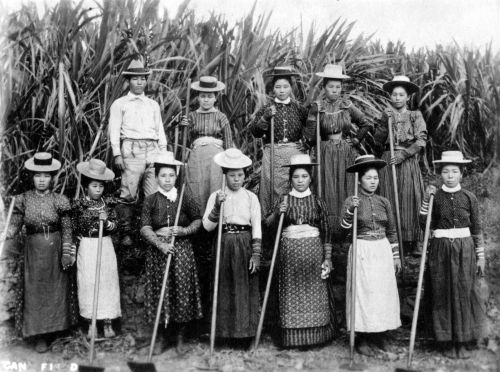
By this time 200,000 ethnic Japanese lived in Hawaii, mostly laborers looking for work on the island’s sugar plantations. A nearly equal number settled on the west coast building farms, and small businesses.
From 1937, the rapid conquests of the Asian Pacific raised fears that the Imperial Japanese military, was unstoppable. As relations soured between Japan and America, the Roosevelt administration took to surveillance of Japanese Americans, compiling lists.
Following the surprise attack on Pearl Harbor, public sentiment came down largely on the side of Japanese Americans. The Los Angeles Times characterized them as “good Americans, born and educated as such,” but that would soon change. A member of the second attack wave on December 7, “Zero” pilot Shigenori Nishikaichi downed his crippled fighter on Ni’ihau, the westernmost island of the Hawaiian archipelago. Ignorant at first of what had taken place, Ni’hauans showed the downed pilot, hospitality. By the time it was over the whole thing turned violent, pitting the pilot and a small number of Issei and Nissei, in a deadly struggle against native Hawaiians.
The “Ni’hau incident” combined with fears of 5th column activity to turn the tide, of public opinion.
General John Dewitt, a vocal proponent of what was about to happen, opined: “The fact that nothing has happened so far is more or less . . . ominous, in that I feel that in view of the fact that we have had no sporadic attempts at sabotage that there is a control being exercised and when we have it it will be on a mass basis”.
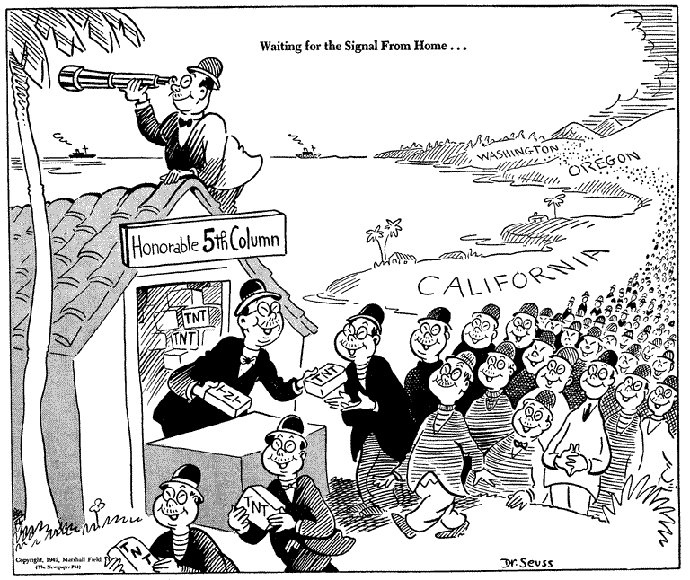
On January 2, a Joint Immigration Committee of the California legislature attacked “ethnic Japanese” citizen and non-citizen alike, as “totally unassimilable”. The presidentially appointed Roberts Committee assigned to investigate the attack on Pearl Harbor accused persons of Japanese ancestry of espionage, leading up to the attack. By February, California Attorney General and future Supreme Court Justice Earl Warren was doing everything he could to persuade the federal government, to remove all people of Japanese ancestry from the west coast.
This and other images of the period leads us today, to the place where Dr. Seuss in “cancelled”.
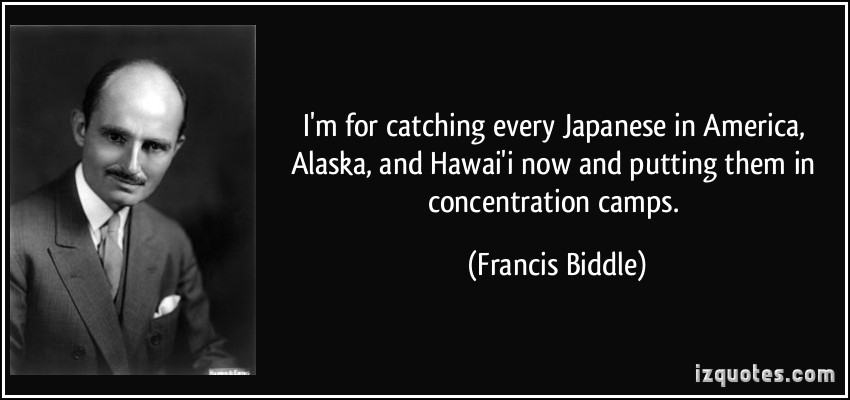
On January 14, 1942, President Roosevelt signed Proclamation 2537 requiring “enemy aliens” to procure identification and carry it with them, “at all times”. The War Department, and Department of Justice were sharply divided but, no matter. Executive order 9066 signed February 19 directed the establishment of exclusion zones.
Roosevelt Attorney General Francis Beverley Biddle
Secret Presidential commissions were appointed in early 1941 and again in 1942, to determine the liklihood of an armed uprising among Japanese Americans. Both reported no evidence of such a thing, one reporting: “the local Japanese are loyal to the United States or, at worst, hope that by remaining quiet they can avoid concentration camps or irresponsible mobs.”
That didn’t matter, either. The Senate discussed Roosevelt’s directive for an hour and the House, for thirty minutes. The President signed Public Law 77-503 on March 21 providing for enforcement, of his earlier directive.
Roosevelt’s measure made no specific reference to ethnicity. Some 11,000 ethnic Germans and 3,000 ethnic Italians were sent away to internment camps but the vast preponderance, were of Japanese descent. Throughout the west coast some 112,000 ethnic Japanese were rounded up and held in relocation camps and other confinement areas, throughout the country. Surprisingly, only a “few thousand” were detained in Hawaii itself despite a population of nearly 40% ethnic Japanese.
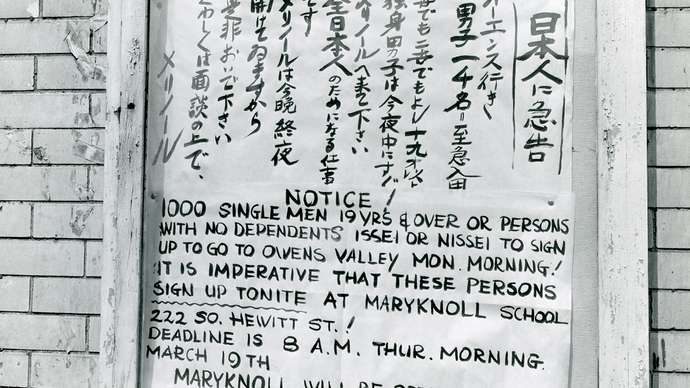
Japantown handbill: H/T Library of Congress
Below: “A moving van being loaded with the possessions of a Japanese family on Bush Street in San Francisco’s Japantown, April 7, 1942. At right are the offices of the Japanese American Citizens League (JACL), the oldest Asian American civil rights organization in the United States. Shortly after this photo was taken, the Wartime Civil Control Administration (WCCA) took over the JACL building and repurposed it as a Civil Control Station for the collection and processing of “people of Japanese descent” prior to their transport to detention camps”.
H/T Encyclopedia Britannica
Following the events at Peal harbor, Oakland California-born Fred Korematsu attempted to enlist, in the Navy. Ostensibly rejected due to stomach ulcers, Korematsu believed the real reason was his Japanese ancestry. Korematsu refused deportation orders and went into hiding. The ACLU’s northern California director Ernest Besig brought Korematsu’s case before the courts despite opposition from Roosevelt allies in the national ACLU. Korematsu lost in federal court and the US court of appeals, becoming a pariah even among fellow detainees who felt he was nothing but a troublemaker. The US Supreme Court agreed to take the case and, on December 18, 1944, upheld the lower court verdict. A 6-3 opinion penned by Justice Hugo Black opined that, though suspect, internment was justified due to national circumstances of “emergency and peril”.
“Fourteen Days to Flatten the Curve, “right?
A second decision released that same day in the case, Ex Parte Endo, unanimously declared it illegal to detain Americans, regardless of ethnicity. In effect the two rulings established that, while eviction was legal in the name of military necessity internment was not, thus paving the way to their release.
“There is but one way in which to regard the Presidential order empowering the Army to establish “military areas” from which citizens or aliens may be excluded. That is to accept the order as a necessary accompaniment of total defense”.
Washington Post, February 22, 1942
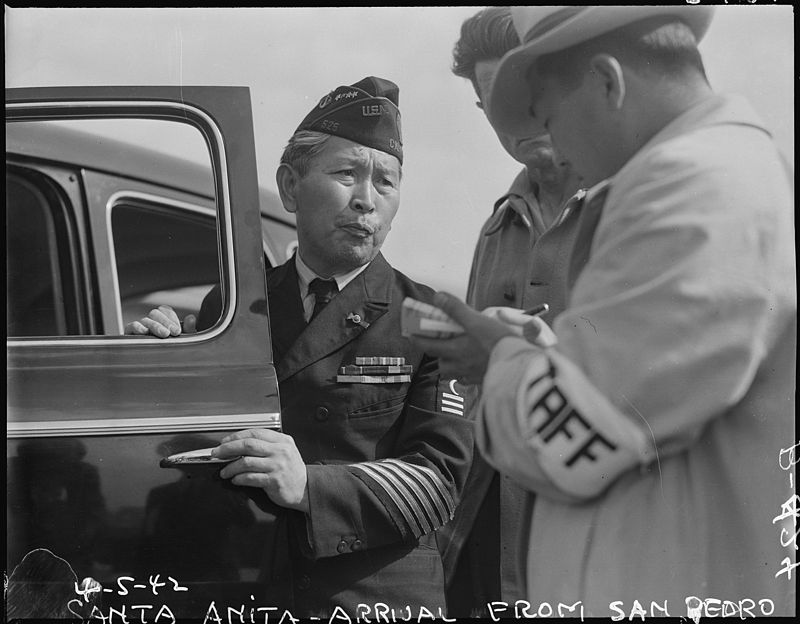
“Dressed in uniform marking his service in World War I, a U.S. Navy veteran from San Pedro enters Santa Anita Assembly Center (April 1942)”. H/T Wikipedia
The Japs in these centers in the United States have been afforded the very best of treatment, together with food and living quarters far better than many of them ever knew before, and a minimum amount of restraint. They have been as well fed as the Army and as well as or better housed. . . . The American people can go without milk and butter, but the Japs will be supplied.
Los Angeles Times, December 8, 1942
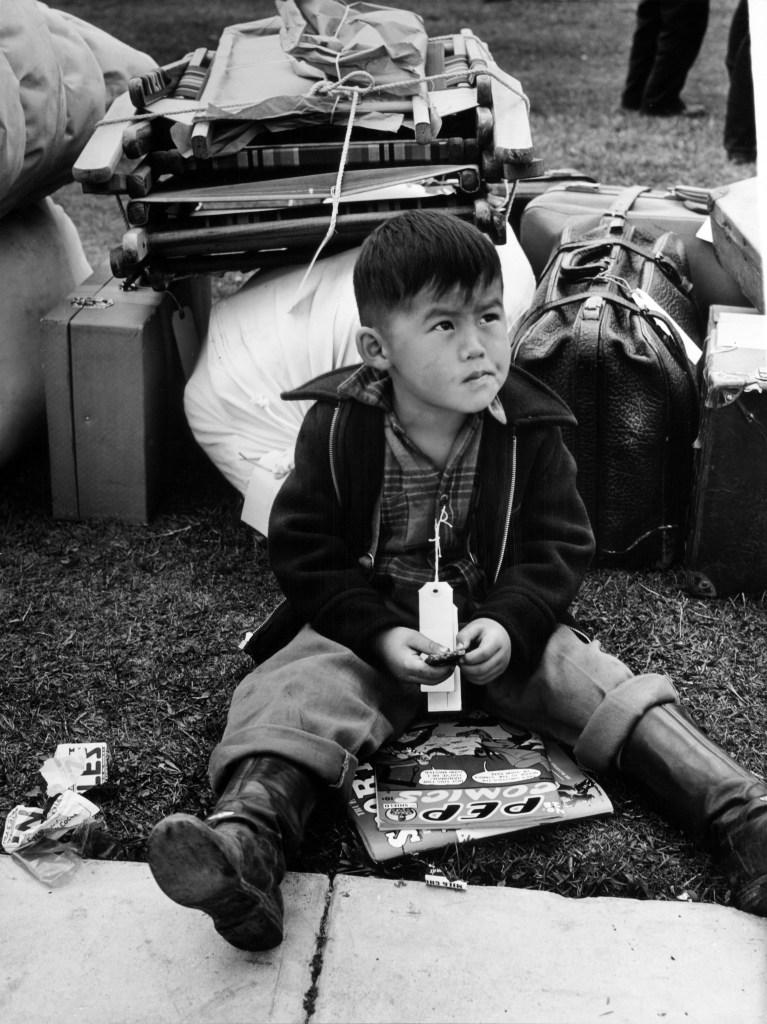
“Tagged”, and waiting for removal
Among internment camps many were eager to prove themselves, loyal Americans. Some were recruited for service in the armed forces. Many, volunteered. In April 1943 some 2,686 Japanese-Americans from Hawaii and 1,500 incarcerated in mainland camps, reported for duty at camp Shelby, in Mississippi. While many still had families in internment facilities, graduates were assigned to the segregated 442nd Regimental Combat team and sent off to fight the war, in Europe.
With something to prove every one of these guys, fought like tigers. From Naples to Rome to the south of France, to central Europe and the Po Valley, the all-Nisei 442nd infantry lived up to its own motto’ “Go for Broke”. 14,000 men served in the 442nd earning over 4,000 Purple Hearts, 4,000 Silver Stars, 4,000 Bronze Medals and 21 Medals of Honor.
With 275 Texas National Guardsmen hopelessly cut off by German forces in the Vosges Mountains of France, ‘The Lost Battalion”, the 442nd infantry was sent in to get them out. In five days of savage combat, 211 of the Texas men were rescued. The Nisei of the 442nd suffered 800 casualties. Of 185 men who entered the fray from I Company only 8 emerged, unhurt. Company K sent 186 men against the Germans 169 of whom were either killed, or wounded.
For its size and length of service the 442nd became the most highly decorated unit, in US military history.
Fun fact: Ralph Lazo was so angry at the forcible relocation of his friends he voluntarily joined them, on the train. Deported to the Manzanar concentration camp in the foot of California’s Sierra Nevada mountains, he stayed there, for two years. The only non-spouse, non-Japanese-American, so detained. Nobody ever asked the man about his ethnicity (half Mexican, half Irish). Lazo was inducted into the US Army in 1944 and served as a Staff Sergeant in the South Pacific where he earned a Bronze Star for valor, in combat.
By this time, many younger Nisei had left to pursue new lives, east of the Rockies. Seven others were shot and killed, by sentries. Older internees had little to return to with former homes and business, gone. Many were repatriated to Japan, at least some, against their will. By the end of 1945, nine of the top ten War Relocation Authority ( WRA) camps were shut down. Congress passed the Japanese-American claims Act in 1948 but, with the IRS having destroyed most of the detainees 1939-’42 tax records, only a fraction of claims were ever paid out.
By the late 1980s, powerful Japanese-American members of the United States Congress such as Bob Matsui, Norm Mineta and Spark Matsunaga spearheaded a measure, for reparations. $20,000 paid to every surviving internee. President Ronald Reagan signed the measure into law on August 10, 1988. Over 81,800 qualified, receiving a total of $1.6 Billion.





























You must be logged in to post a comment.