April 15, 1889 Damien of Moloka’i

“I would not be cured if the price of the cure was that I must leave the island and give up my work I am perfectly resigned to my lot”. Saint Damien of Molokai

It’s one of the oldest diseases in recorded history, the first written reference coming down to us, from 600BC. Ancient Greeks, Chinese, Indians and Middle Eastern sources wrote about the condition as did the Roman naturalist Pliny the elder, in the first century.

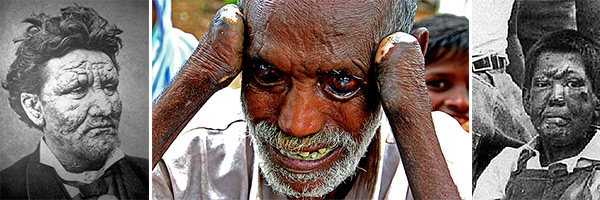
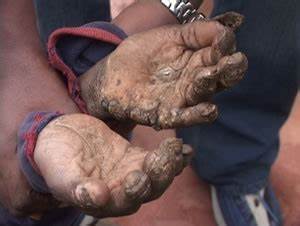
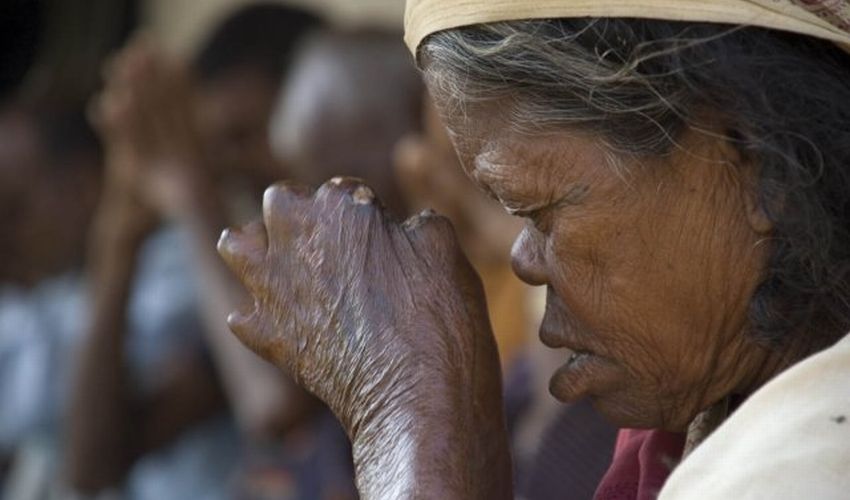
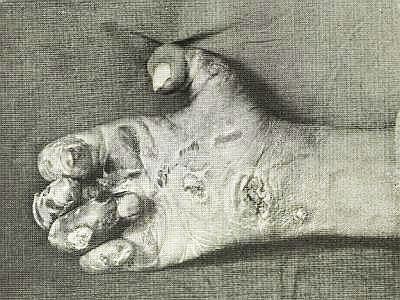
Leprosy is a chronic disease caused by the bacterium Mycobacterium leprae. Left untreated the condition produces skin ulcers, damage to peripheral nerves & upper respiratory tract, and muscular weakness. Everyday injuries go unnoticed due to numbness and lead to infection. Advanced cases result in severe disfigurement, crippling and/or the physical loss of hands, feet & facial features, and, finally, blindness.

The World Health Organization (WHO) reports a death rate among leprosy sufferers four times that of the general population.
First discovered by Norwegian physician G.H. Armauer Hansen in 1873, M. leprae is the first bacterium identified as the causative agent of disease, in humans. Today, Leprosy is curable with multidrug therapy (MDT). The world saw 208,619 new cases in 2018, 185 of which occurred, in the United States.

The horrors of the condition and resulting social stigmas, are plain for anyone to see. Today, sufferers fear loss of jobs, separation of familial and other connections and social isolation. Though not as widespread as commonly believed, victims of “Hansen’s disease” were historically sent off to quarantine in asylums and “leper colonies” from which few, ever returned.

In the 19th century, Mycobacterium leprae came to the Hawaiian islands.

According to research, long-distance explorers first came to the Hawaiian islands around the year 300. For the next 500 years, settlers arrived from French Polynesia, Tahiti, Tuamotus and the Samoan Islands. Other research indicates a shorter timeframe, settlement occurring between 1219 and 1266. Be that as it may the Hawaiian islands were first unified in 1810 to become the Kingdom of Hawai’i, under King Kamehameha the Great. Captain James Cook made the first known European contact in 1778 followed by waves of others both European, and American.
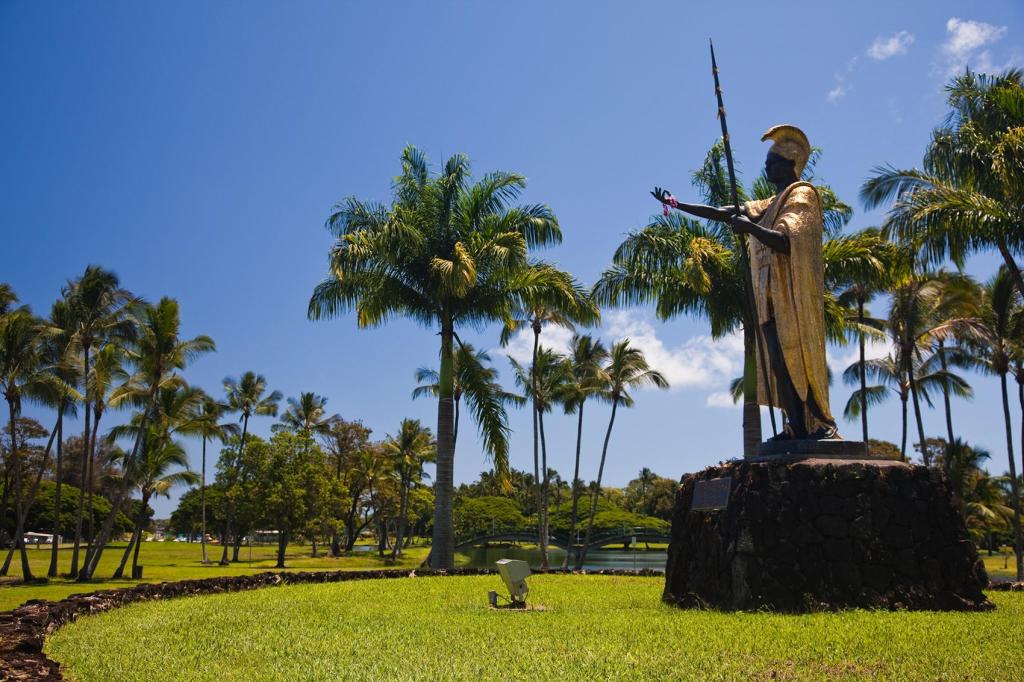
King Kamehameha statue, stands in front of Aliiolani Hale (the judiciary building), Honolulu, Oahu

According to archaeological evidence, indigenous peoples occupied the Kalaupapa peninsula on the Hawaiian island of Moloka’i, for more than 900 years. Before first contact with Europeans their numbers are estimated, between 1,000 and 2,700, . Following the arrival of Captain Cook and others, Eurasian diseases decimated native populations. By 1853 only were 140 natives were left on the Kalaupapa peninsula.
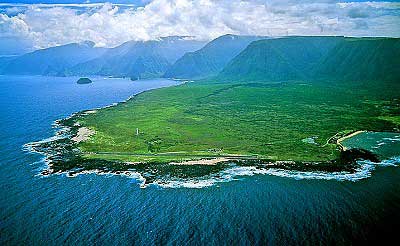
Overhead view of the Kalaupapa peninsula

Leprosy first arrived on the Hawaiian islands around 1830, believed to be carried by Chinese laborers. The disease was incurable at that time, the first effective treatment didn’t come around, until the1940s.

By 1865, sugar planters were concerned about the labor supply. The Kingdom passed a measure to remove the Kānaka Maoli, Native Hawaiian inhabitants occupying the peninsula, in preparation for a leper colony.

The first such isolation settlement was established at Kalawao on the windward side of the peninsula and then on Kalaupapa, itself.

Even after a year of family disruption brought about by government response to Covid-19 the catastrophe of such a policy, is hard to process. In native Hawaiian tradition, Aloha ʻĀina means not only “Love of the Land” but a deep sense of connection, to all living things. For the descendants of those forcibly removed from the ʻĀina as well as those “lost” to Kalaupapa the wounds remain open, to this day.

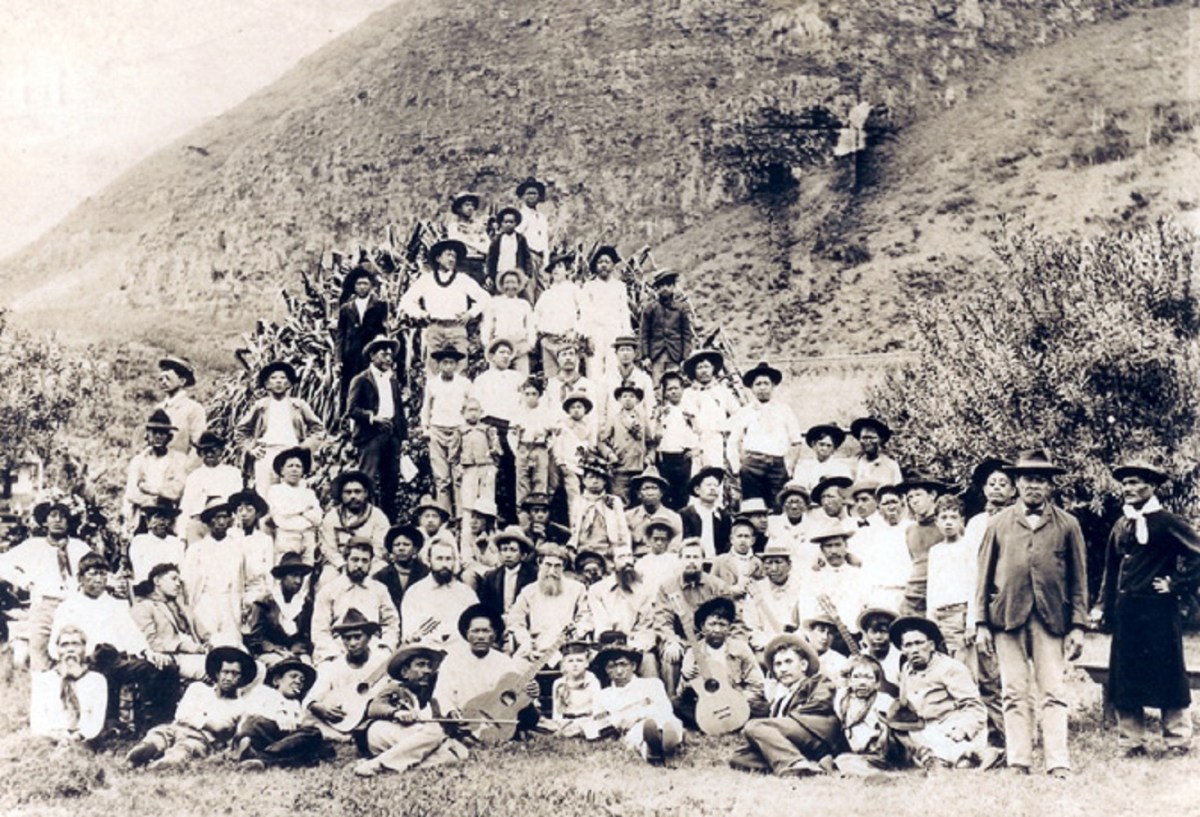
By 1890, 1,100 ‘lepers’ lived in this remote, inhospitable place, prisoners of their own deteriorating bodies and a greater culture who loathed, and feared them.

Over the years some 8,500 unfortunates would come to live in this place, the last one, in 1969.

Rudolph Wilhelm Meyer set out from his native Germany in search of the California gold rush. He made it as far as Molokaʻi. By 1866, Meyer was a father and husband to Kalama Waha, settled on the steep cliffs above Kalaupapa. As the peninsula became a leper colony, Meyer became supply agent to the colony and liaison to those few healthy individuals, willing to work there.

Mostly, those were Belgian missionary priests from the Congregation of the Sacred Hearts of Jesus and Mary, the first of whom was Father Damien, who served there from 1873 until his death, in 1889.
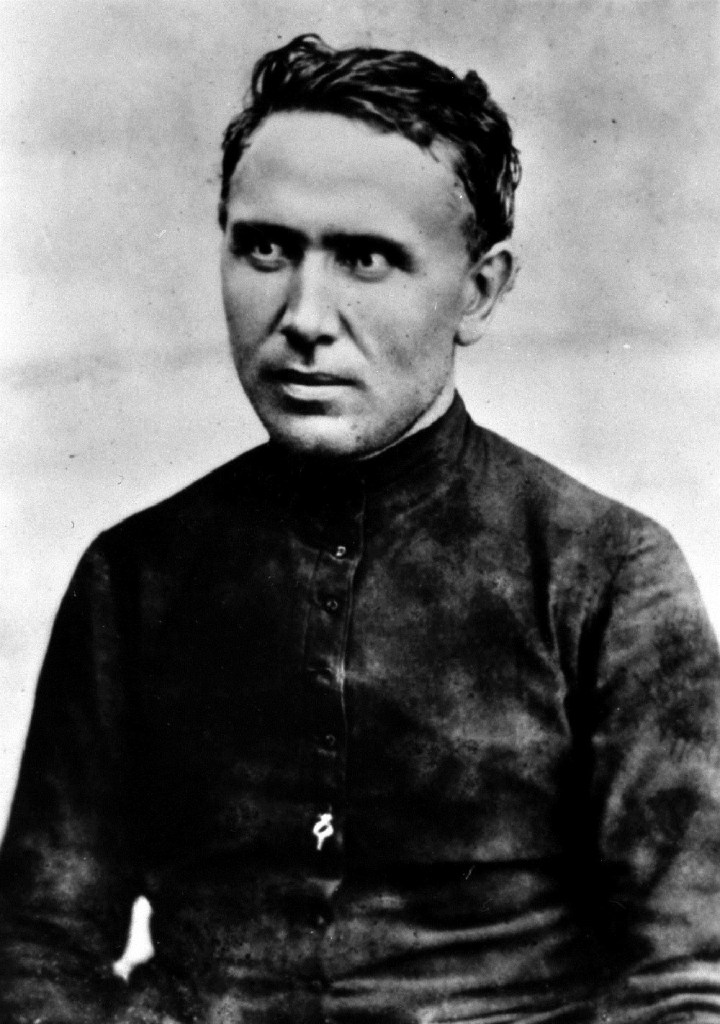
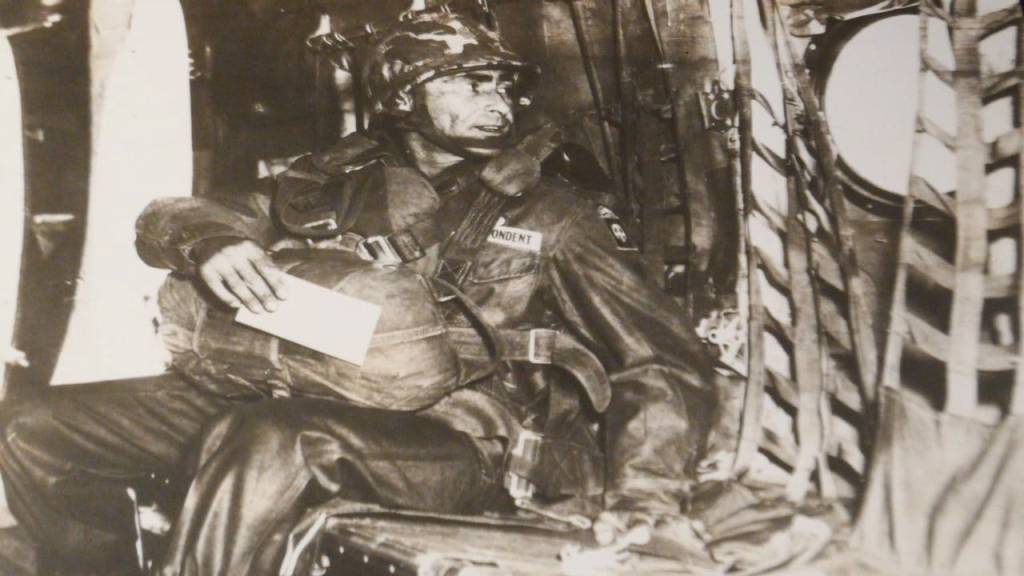
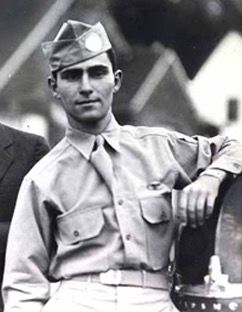
Fr. Damien in 1873 before sailing, for Hawai’i

Father Damien arrived at the isolated settlement at Kalaupapa on May 10, 1873. At that time there were 600 lepers. He spoke to the assembled unfortunates as “one who will be a father to you, and who loves you so much that he does not hesitate to become one of you; to live and die with you.”
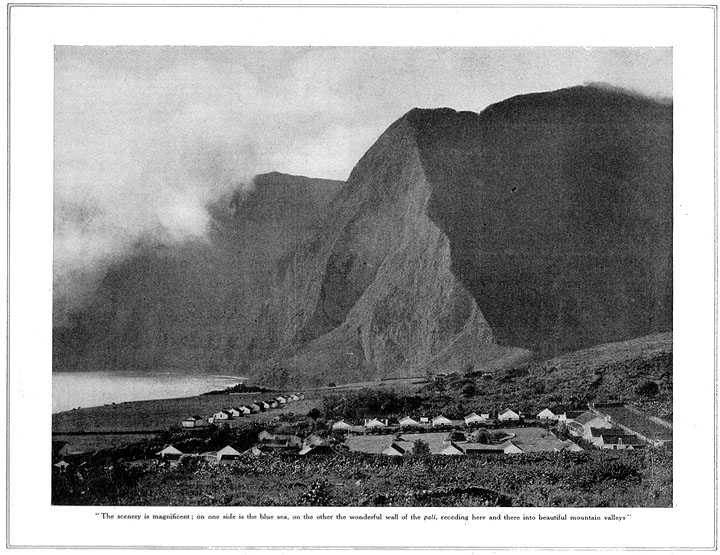
After the Fr. Damien’s death of leprosy, commentators complained of contemporary accounts diminishing the work of native Hawaiians, some of whom served prominent roles on the island. While such are accounts are likely true enough there is no diminishing what the man did there.

For 16 years, father Damien lived and worked among the lepers of Molokaʻi. He ate with them, from the same bowls. He smoked with them, from the same pipe.

While the government had no desire to make this place a penal colony, outside support was slim to none. And this was no isolated population of yeoman farmers, these people were sickened and made weak by this most dreadful of medical conditions, many barely able to care for themselves.

Damien was not only a priest and teacher, he pitched in painting houses, organizing farms and building roads, hospitals and churches. He dressed the wounds of the stricken, built their coffins, dug graves and lived with the lepers, as equals. Six months after his arrival at Kalawao he wrote to his brother, Pamphile, in Europe: “…I make myself a leper with the lepers to gain all to Jesus Christ.”
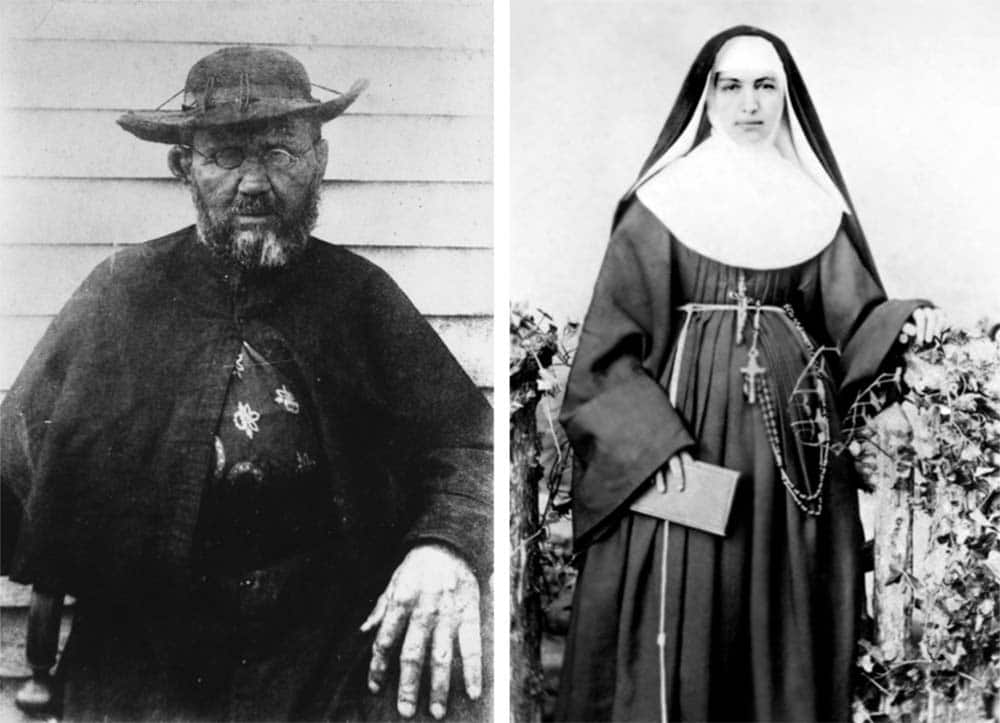
Father Damien and sister Marianne Cope have both received Roman Catholic Sainthood, for their actins on Molokaʻi

One day, it happened. In December 1884, he accidentally put his foot in scalding water. It was so hot that his skin blistered and peeled but he didn’t feel a thing. Father Damien was now himself, a leper.

Despite the illness destroying his body, Damien worked even harder in the last years of his life. He completed several building projects and improved orphanages, all while aiding his fellow lepers in their treatments and medical baths and spreading the Catholic faith. King David Kalākaua bestowed on the priest the honor of “Knight Commander of the Royal Order of Kalākaua.” When Crown Princess Lydia Liliʻuokalani arrived to present the medal she was said to be too distraught and heartbroken at the sight of those poor people, to even speak.

Princess Liliʻuokalani spoke of her experience bringing the plight of Father Damien and his flock, to the eyes of the world. European and American protestants sent money to help with the work. The Church of England sent food, medicine and supplies. It is believed that Fr. Damien never wore his medal but he went to his grave, with it by his side.

Japanese leprologist Masanao Goto arrived to treat the lepers of Molokaʻi with medical baths, moderate exercise and friction applied to parts, benumbed by disease. Goto’s treatments were popular with his patients but, in the end, there was little hope. Four volunteers arrived in the end to aid the ailing missionary including sister Marianne Cope, a woman who would one day join Father Damien, in Roman Catholic sainthood.
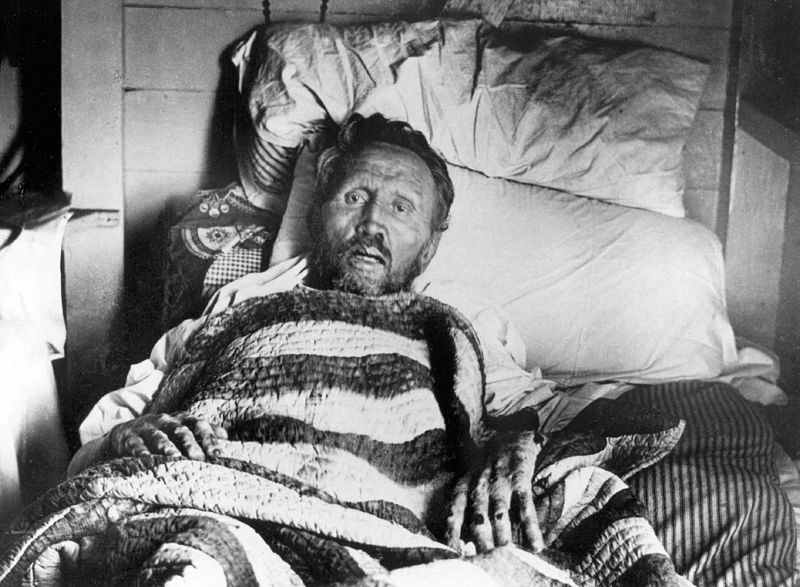
Father Damien on his deathbed, 1889

By February 1889, the end was near. With his foot in bandages and an arm in a sling, his other leg dragging uselessly behind, Damien went to his death bed on March 23. Father Damien died of leprosy at 8:00am on April 15, 1889. He was 49. The entire colony turned out the following day as the Belgian missionary was laid to rest beside the same pandamus tree under which he had slept those sixteen years earlier, on his first night in Molokaʻi.

In John 15:13, the King James Bible teaches that “Greater love hath no man than this, that a man lay down his life for his friends.” Today, I wonder how many know the name of Father Damien, of Molokaʻi . Or the faith which would bring a person to willingly submit to the literal rot, of such a hideous condition.

Let Mahatma Ghandi, himself no stranger to the horrors of leprosy, have the last word on that subject: “The political and journalistic world can boast of very few heroes who compare with Father Damien of Molokai. The Catholic Church, on the contrary, counts by the thousands those who, after the example of Fr. Damien, have devoted themselves to the victims of leprosy. It is worthwhile to look for the sources of such heroism“.

Feature image, top of page: Kalaupapa leper colony in 1905

April 12, 1861 A Lady’s Thimble

Robert Rhett, the rabble rousing editor of the Charleston Mercury Newspaper, offered to personally eat the bodies of all those slain in the coming conflict. Never one to be outdone, former Senator James Chesnut, Jr. said “a lady’s thimble will hold all the blood that will be shed,” promising to personally drink any that might be spilled.

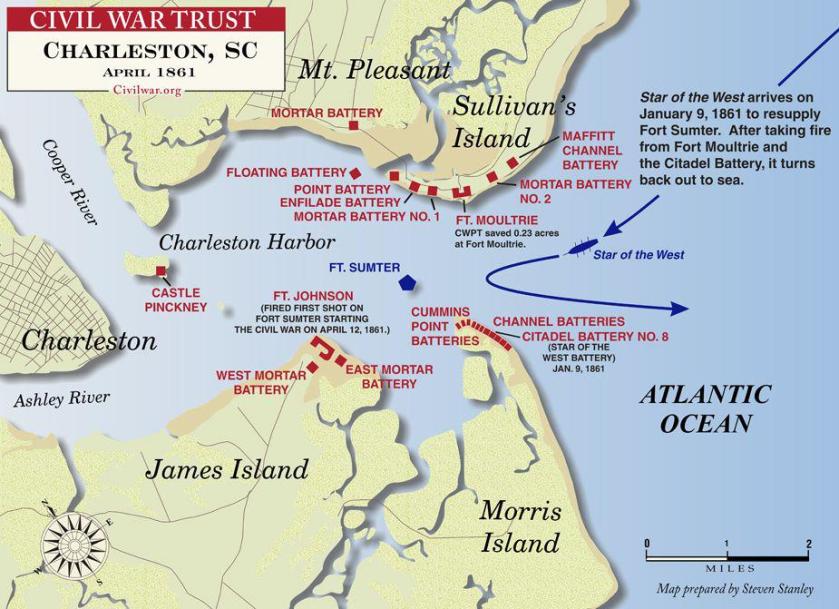
South Carolina seceded from the United States on December 20, 1860, leaving state government officials to consider themselves, a sovereign nation. Six days later, United States Army Major Robert Anderson quietly moved his small garrison from the Revolution-era Fort Moultrie on Sullivan’s Island to the yet to be completed Fort Sumter, a brick fortification at the mouth of Charleston Harbor.

Moultrie

President James Buchanan attempted to reinforce and resupply Anderson via the unarmed merchant vessel, “Star of the West”. Shore batteries opened up on the effort on January 9, effectively trapping Anderson and his garrison inside the only federal property in the vicinity.

For the newly founded Confederate States of America, the presence of an armed federal force at the mouth of Charleston harbor could not be tolerated. Secessionists debated whether the problem was that of South Carolina or the national government, in Mobile.

Meanwhile, the Federal government refused to recognize the Confederacy, as independent states.  It was a standoff. Both sides needed the support of border states, and neither wanted to be seen as the aggressor.

fort_sumter_drawing
Fort Sumter

Political opinion was so sharply divided at that time, that brothers literally wound up fighting against brothers.  By the time the war got going, every seceding state but South Carolina sent regiments to fight for the Union and even that state, contributed troops to the Union war effort.  A surprising number of northern soldiers resigned commissions and fought for the south including Barre, Massachusetts native Daniel Ruggles, Ohio Quaker Bushrod Johnson and New York native Samuel Cooper, to name a few.  

Fun fact: When South Carolina seceded that December the world waited to see, who would be next. With her January 9th departure from the federal union Mississippi was the next state to actually leave, though not the next to talk about it. That honor went not to a southern state but a northern city called New York on January 7, 1861.   Mayor Fernando Wood addressed the Common Council, requesting New York assert its independence as a “free city” by “disrupt[ing] the bands which bind her to a venal and corrupt master” (the federal government).

Confederate Brigadier General Pierre Gustave Toutant-Beauregard (I love that name) was placed in charge of Charleston in March and immediately began to strengthen the batteries surrounding the harbor.

Battle-Sumter

Fort Sumter was designed for a garrison of 650 in service to 130 guns, most of them pointed outward, positioned to defend the harbor against threats from the sea. In April 1861 there were only 60 guns, too much for Major Anderson’s 85-man garrison, nearly half of whom were non-combatants, mostly workmen and musicians.

When Abraham Lincoln was inaugurated on March 4, the resupply of Fort Sumter became the first crisis for the new administration. Lincoln notified South Carolina Governor Francis Pickens he was sending supply ships, resulting in Beauregard’s ultimatum:  the Federal garrison was to evacuate immediately, or Confederate batteries would open fire.

Major Anderson lacking the appropriate response, shore batteries opened fire at 4:30 am on April 12, 4003 guns firing in counter-clockwise rotation. Abner Doubleday, Federal 2nd in command and the man erroneously credited with the invention of baseball, later wrote “The crashing of the shot, the bursting of the shells, the falling of the walls, and the roar of the flames, made a pandemonium of the fort.”

Two years later at Gettysburg, Norman Jonathan Hall would lose over 200 men in furious fighting at a critical breach near the ”copse of trees”.  One day, a brass plaque would mark the spot as the “High Water Mark” of the Confederacy.  On this day, Lieutenant Hall raced through flames to rescue the colors, after a direct hit on the main flagpole knocked the flag to the ground.  His eyebrows were permanently burned off of his face, but Hall and two artillerymen were able to jury-rig the pole so, once again, Old Glory flew over Fort Sumter.

Fort_sumter_1861
The Confederate flag flies over Fort Sumter, 1861

Over 34 hours, thousands of shells were fired at Fort Sumter. Though vastly outgunned federal forces, fired back. For all that, the only casualty was a Confederate mule.

Fort_Sumter_storm_flag_1861

The only fatalities in the whole mess occurred after the federal surrender, on April 13. One gun misfired performing a 100-gun salute while lowering the flag, mortally wounding privates Daniel Hough and Edward Galloway.

The following day, Colonel Robert E. Lee resigned his commission in the United States Army.

Charleston, 1861

The Civil War had begun but few understood the kind of demons, now unleashed. Robert Rhett, the rabble rousing editor of the Charleston Mercury Newspaper, offered to personally eat the bodies of all those slain in the coming conflict. Never one to be outdone, former Senator James Chesnut, Jr. said “a lady’s thimble will hold all the blood that will be shed,” promising to personally drink any that might be spilled.

The war between the states would lay waste to a generation and end the lives of more Americans than the Revolution, World War 1, World War 2 and the wars in Korea, Vietnam, Iraq and Afghanistan. Combined.

April 10, 1953 Not Just a Pretty Face

“All creative people want to do the unexpected” – Hedy Lamarr

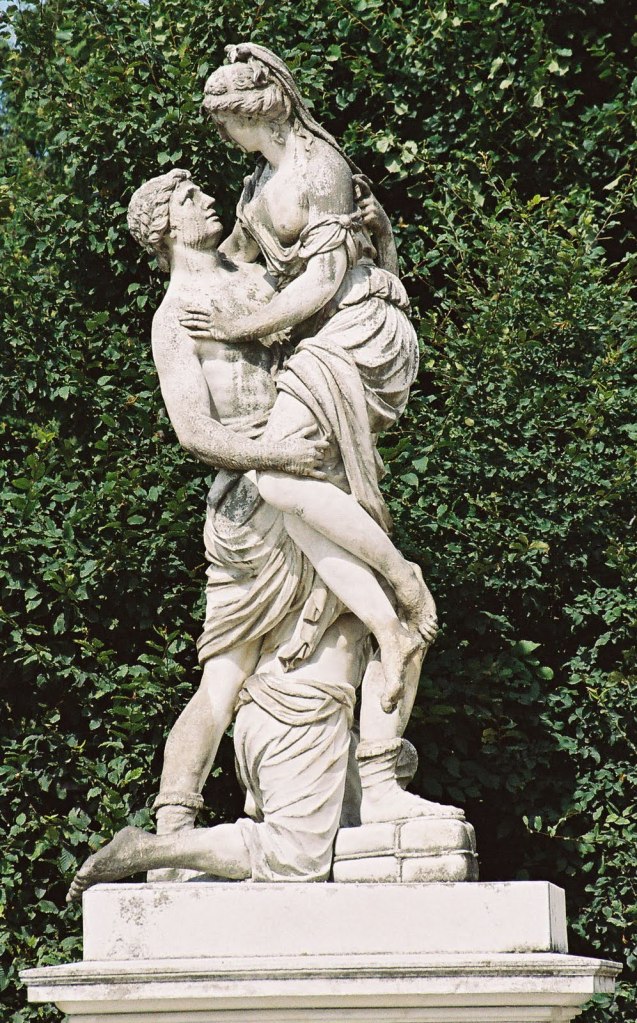
According to Greek mythology, Helen was the most beautiful woman in the world. The wife of Menelaus, King of Sparta, Helen either eloped or was kidnapped, (the sources are elliptical on the point), with (or by) the Trojan prince, Paris. The Achaeans (Greeks) set sail for Troy to bring her back. The resulting war with Troy lasted ten years, culminating in the Trojan Horse episode and the eventual fall, of the city of Troy.

“Beware of Greeks bearing gifts”.

Abduction of Helen, Schönbrunn Palace, Vienna, Austria

In the 17th century, English playwright Christopher Marlowe referred to Helen of Troy as having “…the face that launched a thousand ships”.

“Was this the face that launched a thousand ships
And burnt the topless towers of Illium
Sweet Helen, make me immortal with a kiss…”

The Tragical History of Dr. Faustus, by Christopher Marlowe

The Austrian-born American actress and film producer Hedy Lamarr had such a face, and more. A movie star once described as “the world’s most beautiful woman”, she possessed an intellect in the very top percentile and the curiosity, of an inventor.

Hedwig Eva Maria Kiesler was born on November 9, 1914 in Vienna, Austria, the daughter of Emil Keisler and Gertrud (Lichtwitz) Kiesler. Emil, a bank director with the gift of curiosity and the mind of an engineer, would take his daughter for long walks. He would point out various machines like printing presses and streetcars and explain, their inner workings. From the age of five little Hedy could be found, taking apart and reassembling her music box and other household gadgets.

Gertrud “Trude” was a concert pianist who introduced Hedy to the arts, enrolling her daughter in ballet and piano lessons, from an early age.

Blessed or perhaps cursed with exceptional beauty, the rest of the world ignored the brilliance of her mind. That face was what mattered. At 16, Hedy was “discovered” by theater and film producer, Max Reinhardt. She was soon studying acting and appeared in her first film role in 1930, a German film called Geld auf der Straβe (“Money on the Street”).

Hedy Keisler first gained public notice in the 1932 movie “ecstasy”, a controversial film censored in some nations and banned outright in others, for sexual content.

Austrian munitions dealer Fritz Mandl became one of Hedy’s biggest fans when he saw her in the play, Sissy. The two met and, in 1933, they married.

She was miserable.

“I knew very soon that I could never be an actress while I was his wife … He was the absolute monarch in his marriage … I was like a doll. I was like a thing, some object of art which had to be guarded—and imprisoned—having no mind, no life of its own.”

Hedy Mandl

The trophy wife expected to be seen and not heard, Hedy detested her husband’s associates, many of them, Nazi party members.

Always the gracious hostess, dinner guests never suspected how much she overheard – and understood – about the German arms industry.

In 1937 she fled, to London.

She would remain a “stateless person for sixteen years, becoming a naturalized US Citizen on this day in 1953.

In London, Hedy got her first big break in the motion picture industry when she met Louis B. Mayer. It was Mayer who persuaded her to change her last name. To distance herself, from “the ecstasy lady”. Hedy chose “Lamarr” in honor of the beautiful silent film actress, Barbara La Marr. There she met and dated for a time the American business magnate, Howard Hughes. Hughes, himself an engineer and born tinkerer, was as stricken as anyone else, by her physical beauty. Unlike the sewer that is Hollywood, Hughes understood the power of the mind, behind the pretty face.

Hughes encouraged her scientific curiosity. He brought her to his aircraft factories and showed her how his aircraft were built. He introduced her to scientists and engineers who explained to her, how things work. He bought her equipment, to work with. On movie sets, Hedy could be found in her trailer, tinkering between takes.

“Improving things comes naturally to me.”

Hedy Lamarr

As a pilot and a businessman, Howard Hughes was interested in faster airplanes, to sell to the military. With an intuitive grasp of fluid dynamics and dissatisfied with the blocky appearance of Hughes’ aircraft, Lamarr bought books about birds, and fish. She studied the fastest among fish and the speediest of birds, combining aspects of the two for a new and streamlined, wing design. Hughes took a look at Lamarr’s sketches and said “Hedy, you’re a genius”.

Americans couldn’t get enough of the Austrian-born actress. On screen she radiated all the “old world” exoticism of a Dietrich or a Garbo but managed a magnetism and personal warmth unique, among the three.

Offscreen she was always exploring. Learning. Experimenting. Lamarr went on to invent a stop light upgrade and a tablet capable of transforming into a soft drink, much like Alka-Seltzer, but it took WW2 to bring about her most significant contribution.

In 1940, Hedy met the pianist and avant-garde composer, George Antheil. Every bit the polymath as Lamarr herself, the two had long conversations about – of all things – guided torpedoes. The actress had unique and personal insights into the darkness, of the Nazi war machine. Wasn’t such a guidance system susceptible to jamming, sending the projectile off-course?

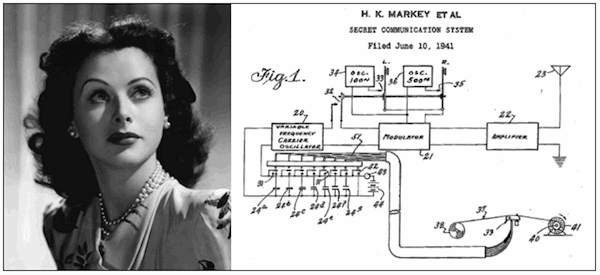
The pair set about designing a frequency-hopping system to defeat such measures. The obstacles were considerable. To create such a system, both sender and receiver needed to switch frequencies, not only at the same time, but to the same setting. Lamarr’s “Secret Communications System” was patented in 1942 under her then-married name, Hedy Keisler Markey.

While classified as “Red hot”, Hedy’s “thing” proved technically difficult to implement in the field. In 1957, the system was adapted for use in a secret naval sonobouy. An updated version was installed on Navy ships during the Cuban missile crisis but, by this time the patent had run out. Hedy Lamarr never was compensated for her invention.

Today, “spread spectrum” technologies you’re probably using at this very moment, modern wonders such as Wi-Fi, Bluetooth and GPS, are borne of the “Mother of Wi-Fi”. The Hollywood actress with a face that could launch a thousand ships and the mind, of an engineer.

April 9, 1940 A Dish Best Served Cold

On the surface of the ocean, the Battle of the Atlantic raged on with torpedo and depth charge.  Under the surface, there unfolded a different story.


The Encyclopedia Britannica describes Croton oil as a “poisonous viscous liquid obtained from the seeds of a small Asiatic tree…”  Highly toxic and a violent irritant, the substance was once used as a drastic purgative and counter-irritant in human and veterinary medicine, but is now considered too dangerous for medicinal use. Applied externally, Croton oil is capable of peeling your skin off.  Taken internally, the stuff may be described as the atomic bomb, of laxatives.

The Nazi conquest of Europe began with the annexation of the Sudetenland in 1938, the border districts of Bohemia, Moravia, and German speaking parts of Czechoslovakia. Within two years, every major power on the European mainland was either neutral, or subject to Nazi occupation.  France fell to the Nazi war machine in six weeks, in 1940.  The armed forces of the island nation of Great Britain were left shattered and defenseless, stranded on the beaches of Dunkirk.

On the Scandinavian Peninsula, longstanding policies of disarmament in the wake of WW1 left the Nordic states of Denmark and Norway severely under-strength, able to offer little resistance to the Nazi invaders.

On this day in 1940, German warships entered Norwegian harbors from Narvik to Oslo, as German troops occupied Copenhagen and other Danish cities.  King Christian X of Denmark surrendered almost immediately.  To the northwest, Norwegian commanders loyal to former foreign minister Vidkun Quisling ordered coastal defenders to stand down, permitting the German landing to take place, unopposed.  Norwegian forces refused surrender demands from the German Minister in Oslo, but the outcome was never in doubt.

Nazi Germany responded with an airborne invasion by parachute.  Within weeks, Adolf Hitler could add a second and third scalp to his belt, following the invasion of Poland, six months earlier.  The Kingdoms of Denmark and Norway, were out of the war.

Norway was out of the war, but not out of the fight.   One Nazi officer passed an elderly woman on the street, who complained at the officer’s rudeness and knocked his hat off, with her cane. The officer apologized, and scurried away.  The gray-haired old matron snickered, to herself:  “Well, we’ll each have to fight this war as best we can.  That’s the fourth hat I’ve knocked into the mud this morning.

Norwegian Resistance was quick to form, as patriotic locals united against the Nazi occupier and the collaborationist policies of the Quisling government.

“Anti-Nazi graffiti on the streets of Oslo, reading “Live” above the monogram for the Norwegian king, who had fled when the Germans invaded in 1940”. (Photo: Bettmann/Getty Images)

The Norwegian secret army known as Milorg and led by General Otto Ruge, was at first loath to engage in outright sabotage, for fear of German reprisals against innocent civilians.  Later in the war, Milorg commandos attacked the heavy water factory at Rjukan and sank a ferry carrying 1,300 lbs of heavy water, inflicting severe damage to the Nazi nuclear research program.

Sven Somme, tree
Norwegian Resistance member Sven Somme demonstrates one of the techniques by which he evaded capture in the mountains.

In the beginning, Resistance activities centered more around covert sabotage and the gathering of intelligence.  One of the great but little-known dramas of WW2 unfolded across the snow covered mountains of the Scandinavian peninsula, as the civilian-turned-spy Sven Somme fled 200 miles on foot to neutral Sweden, pursued by 900 Wehrmacht soldiers and a pack of bloodhounds.

Operations of all kinds were undertaken, to stymie the Nazi war effort. Some actions seem like frat-boy pranks, such as coating condoms destined for German units, with itching powder.  Hundreds of Wehrmacht soldiers (and presumably Norwegian women) showed up at Trondheim hospitals, believing they had contracted Lord-knows-what kind of plague.

Other operations demonstrate a kind of evil genius.  This is where Croton oil comes in.

download (61)

As dedicated as they were, Norwegian resistance fighters still had to feed themselves and their families.  Many of them were subsistence fishermen, and that meant sardines.  For centuries, the small fish had been a staple food item across the Norwegian countryside.  It was a near-catastrophic blow to civilian and Resistance fighters alike, when the Quisling government requisitioned the entire sardine crop.

The Battle of the Atlantic was in full-swing by this time, as wolf packs of German submarines roamed the north Atlantic, preying on Allied shipping.  Thousands of tons of sardines would be sent to the French port of Saint-Nazaire, to feed U-Boat crews on their long voyages at sea.

U-864
German Type X Submarine, U-864

Norwegian vengeance began with a request to the Special Operations Executive (SOE) in Great Britain, for the largest shipment of Croton oil, possible.  The “atomic laxative” was smuggled into canneries across Norway, and used to replace vegetable oil in sardine tins.  The plan worked nicely and no one suspected a thing, the pungent taste of the fish covering the strange flavor of the oil.

From midget submarines such as the BiberHaiMolch, and Seehund models to the behemoth 1,800-ton “Type X“, the Kriegsmarine employed no fewer than fifteen distinct submarine types in WW2, including the workhorse “Type VII”, of which some 700 saw service in the German war effort. 

On the surface of the ocean, the Battle of the Atlantic raged on with torpedo and depth charge.  Under the surface, there unfolded a different story.

Revenge, it is said, is a dish, best served cold. Excepting the participants in this tale, no one knows what it looks like when ten thousand submariners simultaneously lose control of their bowels. It could not have been a pretty sight.

April 8, 1942 In the Zone

Rodman was no stranger to the brutal twists and the horrors of war. Nearly half his comrades were killed, fighting in the Philippines. The survivor’s guilt. What the man saw during WW2 changed his life, forever.

Military forces of Imperial Japan appeared unstoppable during the years leading to World War 2, attacking first Thailand, then the British possessions of Malaya, Singapore and Hong Kong. The US military bases in Hawaii, Wake Island, Guam and the Philippines all fell, in quick succession.

On January 7, 1942 Japanese forces attacked the Bataan peninsula in the central Luzon region, of the Philippines. The prize was nothing short of the finest natural harbor in the Asian Pacific, Manila Bay, the Bataan Peninsula forming the lee shore and the heavily fortified island of Corregidor, the “Gibraltar of the East”, standing at the mouth.  Before the Japanese invasion was to succeed, Bataan and Corregidor must be destroyed.

In early December, the Far East Air Force (FEAF) outside Luzon possessed more aircraft than the Hawaiian Department, defending Pearl Harbor. In the event of hostilities with Japan, “War Plan Orange” (WPO-3) called for superior air power, covering the strategic retreat across Manila Bay to the Bataan peninsula, buying time for US Naval assets to sail for the Philippines. 

In reality, the flower of American naval power in the pacific, lay at the bottom of Pearl Harbor.  Eight hours after the attack on Oahu, a devastating raid on Clark Field outside of Luzon left 102 aircraft damaged, or destroyed. Army chief of staff general George C. Marshall later remarked to a reporter: “I just don’t know how MacArthur happened to let his planes get caught on the ground.”

General Douglas MacArthur abandoned Corregidor on March 12, departing the “Alamo of the Pacific” with trademark dramatic flair: “I shall return”.  Some 90,000 American and Filipino troops were on their own, left without food, supplies or support with which to fight off the onslaught of the Japanese 14th Army.

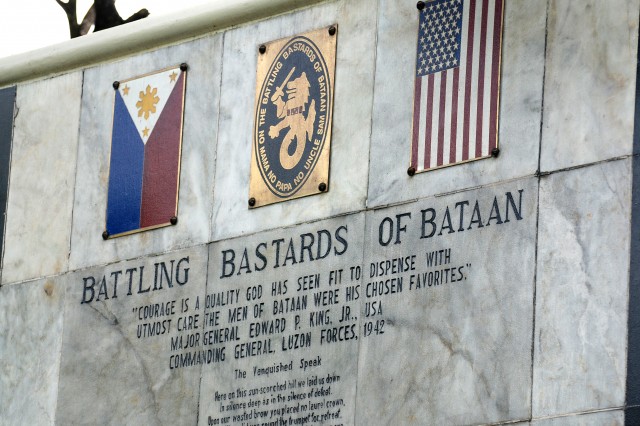
Starving, battered by wounds and decimated by all manner of tropical disease and parasite, the “Battling Bastards of Bataan” fought on until they could do no more. 

War correspondent Frank Hewlett was the last reporter to leave Corregidor, before it all collapsed. It was he who coined the phrase “Angels of Bataan“, to describe the women who stayed behind to be taken into captivity, to care for the sick and wounded. Hewlett wrote this tribute to the doomed defenders of that place:

Battling Bastards of Bataan

We’re the battling bastards of Bataan;
No mama, no papa, no Uncle Sam.
No aunts, no uncles, no cousins, no nieces,
No pills, no planes, no artillery pieces
And nobody gives a damn
Nobody gives a damn.

by Frank Hewlett 1942

Allied war planners turned their attention to defeating Adolf Hitler.

In the days following the attack on Pearl Harbor, the river gunboat USS Mindanao earned the distinction of taking prisoner the sole survivor of the midget submarine attacks carried out that day, Kazuo Sakamaki. Now short on fuel, Mindanao was reduced to harassing shore artillery and covering small boats evacuating soldiers, from the beaches. On April 8, 1942, Mindanao Executive Officer David Nash confided to his diary: “This has been a hectic day. It looks like the beginning of the end. The planes get nearer each day and this evening the word was received to get up steam and standby to get underway. Meanwhile Ft. Mills started shooting across our heads toward the Bataan lines. All night long our forces were obviously destroying equipment. It looks like evacuation from the Peninsula”.

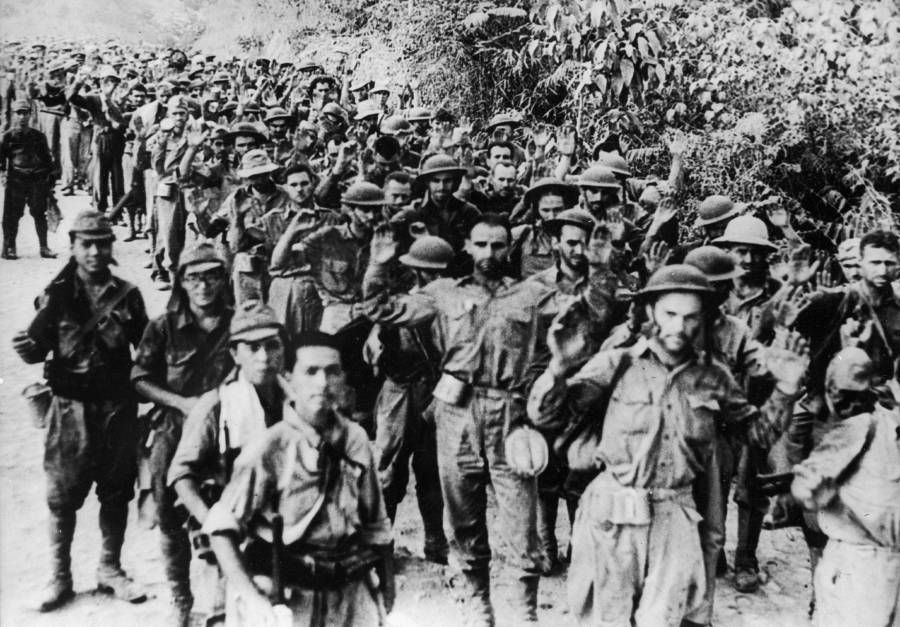
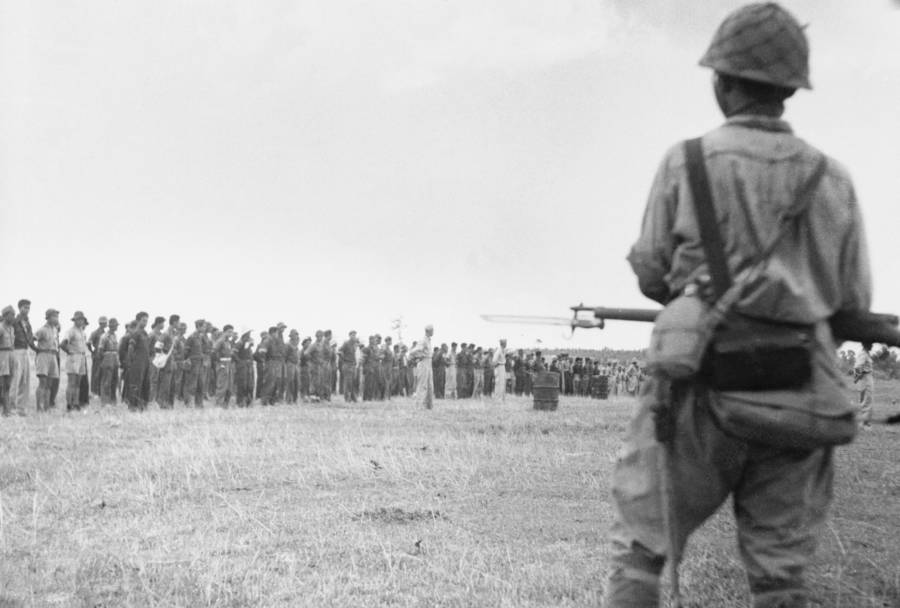
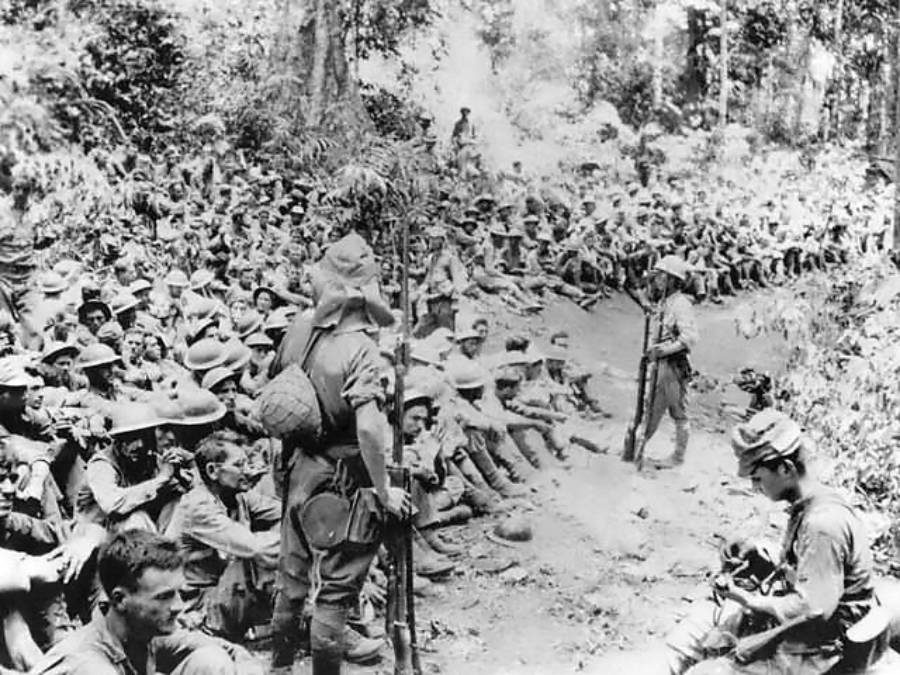
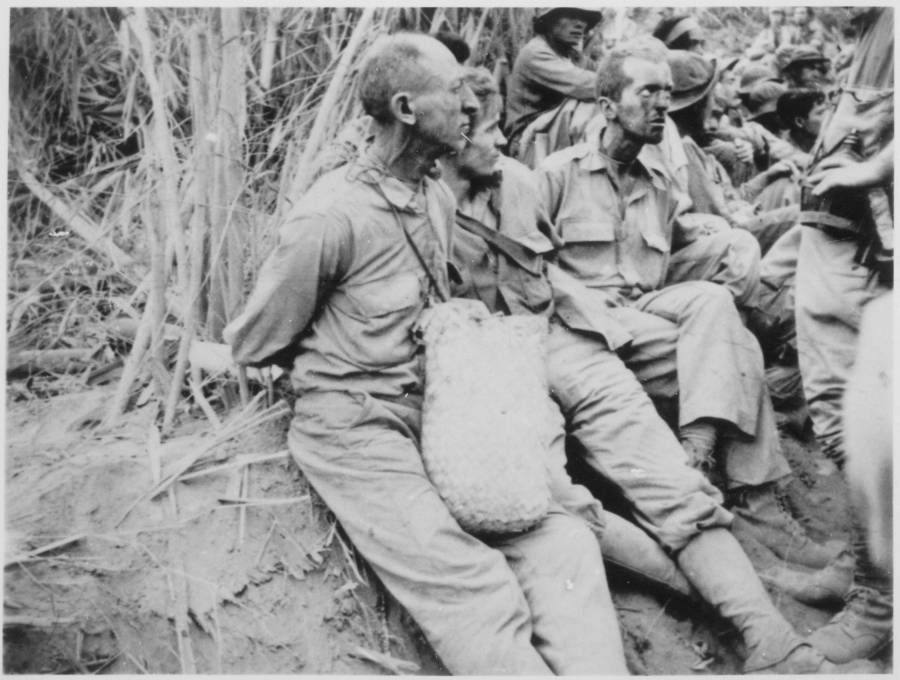
Bataan fell the following day, some 75,000 American and Filipino fighters beginning a 65-mile, five-day trek into captivity known as the Bataan Death March. Lieutenant Nash was taken prisoner, surviving a captivity many did not to pass the remainder of the war at Bilibid, Davao, Dapecol and the infamous Cabanatuan prison camps.

With a commanding position over Pacific shipping routes, holding the Philippine archipelago was critical for Japanese war strategy. Capturing the islands was important to the US by the same logic with the added reason, this was a personal point of pride for General Douglas MacArthur. Two years almost to the day from that ignominious departure, the Joint Chiefs of Staff ordered MacArthur to come up with a plan to take the place back. Luzon would come first with the invasion of Leyte in the north, slated for early 1945.

That summer, US 3rd fleet operations revealed Japanese defenses were weaker than expected. The invasion was moved forward to October. Before it was over, the Battle of Leyte would trigger the greatest naval battle, of World War 2.

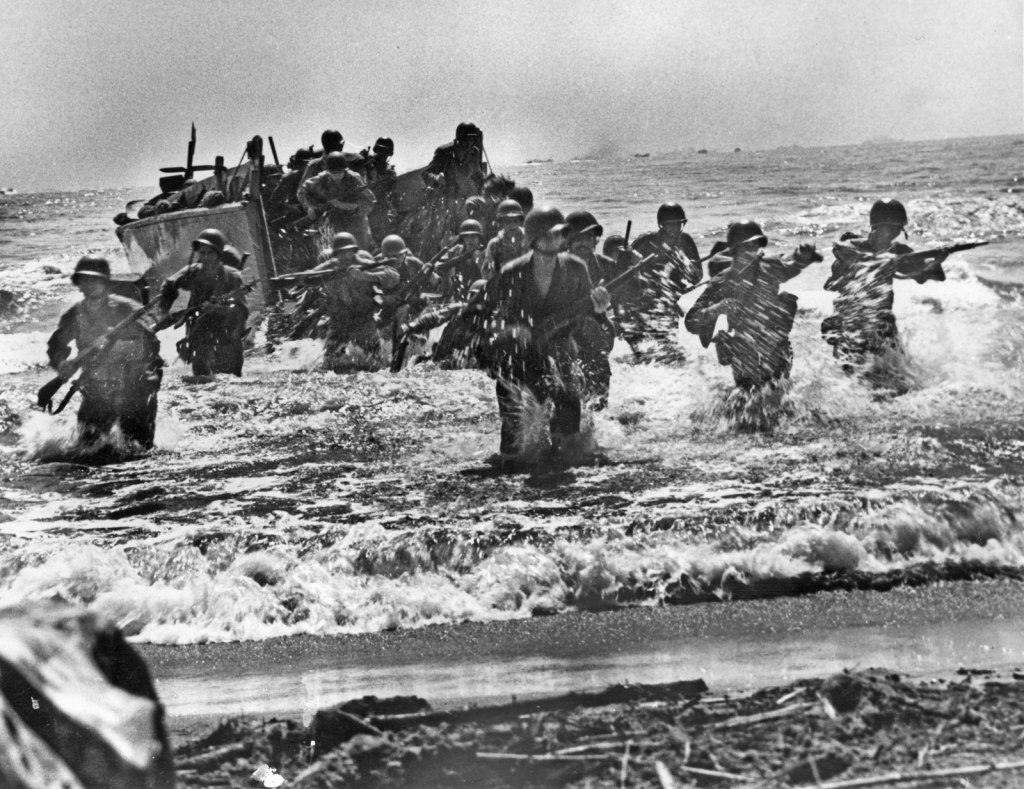
With deep-water approaches and sandy beaches, Leyte Island is tailor-made for amphibious assault. Preliminary operations for the invasion began on October 17. MacArthur made his grand entrance on the 20th announcing to the 900,000 residents of the island: “People of the Philippines, I have returned! By the grace of Almighty God, our forces stand again on Philippine soil.”

The fighting for Leyte was long and bloody involving 323,000 American troops and Filipino guerrillas. Day and night through mountains, swamps and jungles, by the time it was over some 50,000 Japanese combat troops were destroyed. Organized resistance ended on Christmas day. By the New Year there was little left, but isolated stragglers.

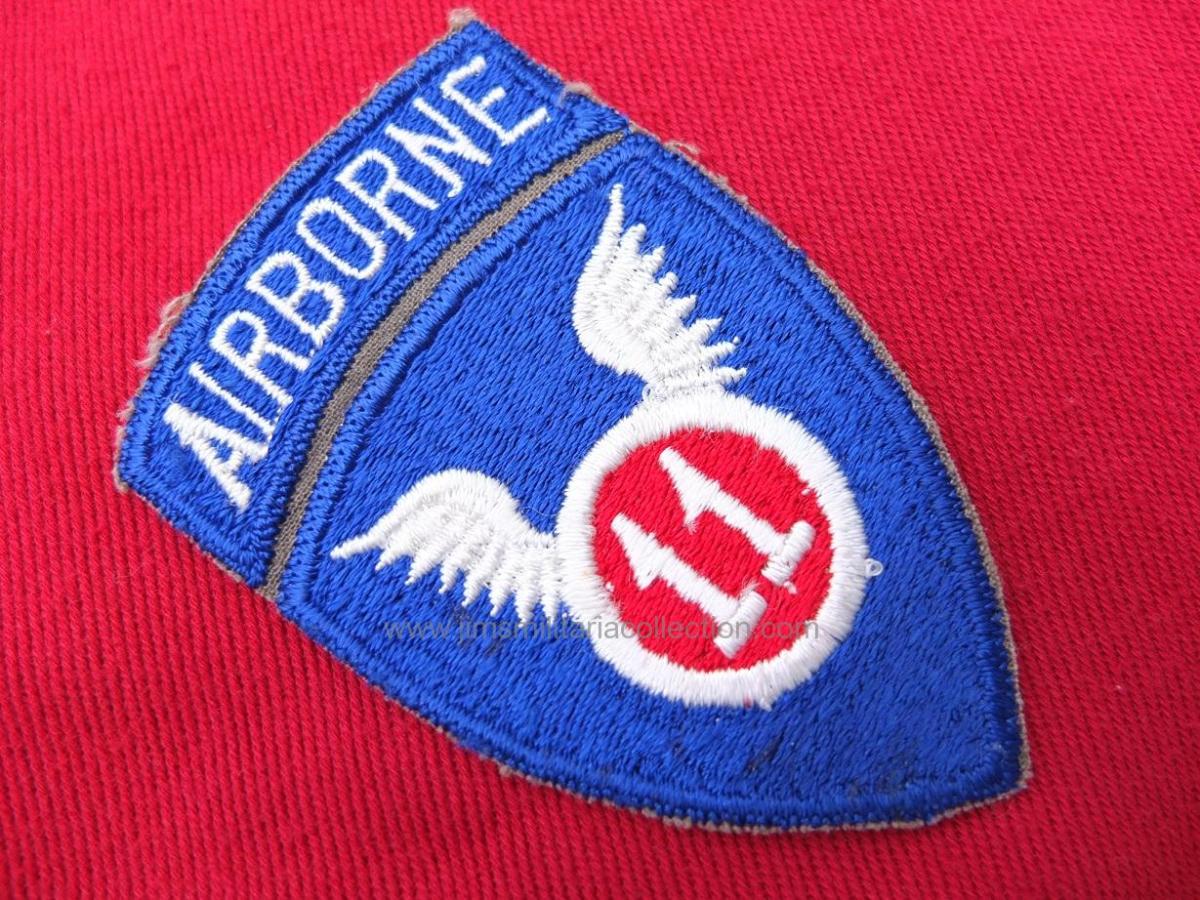
Not many can find humor in such a place as that. Private Melvin Levy was one who could. A member of the 511th Parachute Infantry Regiment of the 11th Airborne Division, that November, Levy and his comrades were fighting as infantry. He was part of the 511th‘s demolition platoon, nicknamed the “Death Squad” for its high casualty rate.

The C-47 came in low that day, but this wasn’t your normal bombing run. The plane was armed with “biscuit bombs”, crates of food and provisions intended to resupply the 511th regiment. With a comedian’s sense of timing, Levy was holding court before an enthralled group of soldiers, resting under a palm tree. Laughter filled the air as Private Levy delivered the punchline and asked his best friend Rodman, for a cigarette. Rodman took the one out of his mouth and handed it over before turning, for the pack. The biscuit bomb came in at 200 miles per hour, tearing Levy’s head from his shoulders, where he stood.

As the only other Jewish guy in the unit, Rodman presided over Levy’s funeral, the following day. He spoke a few words and placed a star of David, on Levy’s grave.

Nearly half his comrades were killed, fighting in the Philippines. Rodman himself was wounded twice and finished the war, in occupied Japan. He was no stranger to the brutal twists and the horrors of war. The survivor’s guilt. What the man saw during WW2 changed him, forever. The human wreckage wrought by the atomic bomb, the fire bombing, the results of the aerial mining of Japanese harbors literally code-named, “Operation Starvation”.

Rodman Edward Serling had opened a door, never to be closed. A door unlocked, with the key of imagination. Beyond that door is another dimension. A dimension of sound. A dimension of sight. A dimension of mind. You’re moving into a land of both shadow and substance, of things and ideas. You’ve just crossed over into, the Twilight Zone.

April 7, 1942 Relocation

“Sometime [the train] stop[ped], you know, fifteen to twenty minutes to take fresh air-suppertime and in the desert, in middle of state. Already before we get out of train, army machine guns lined up towards us-not toward other side to protect us, but like enemy, pointed machine guns toward us”. – -Henry Sugimoto, artist

In January 1848, carpenter and sawmill operator James W. Marshall discovered gold in the foothills of the Sierra Nevada mountains, in California. Prospectors flocked to the Golden State from across the United States, and abroad. The California Gold Rush had begun.

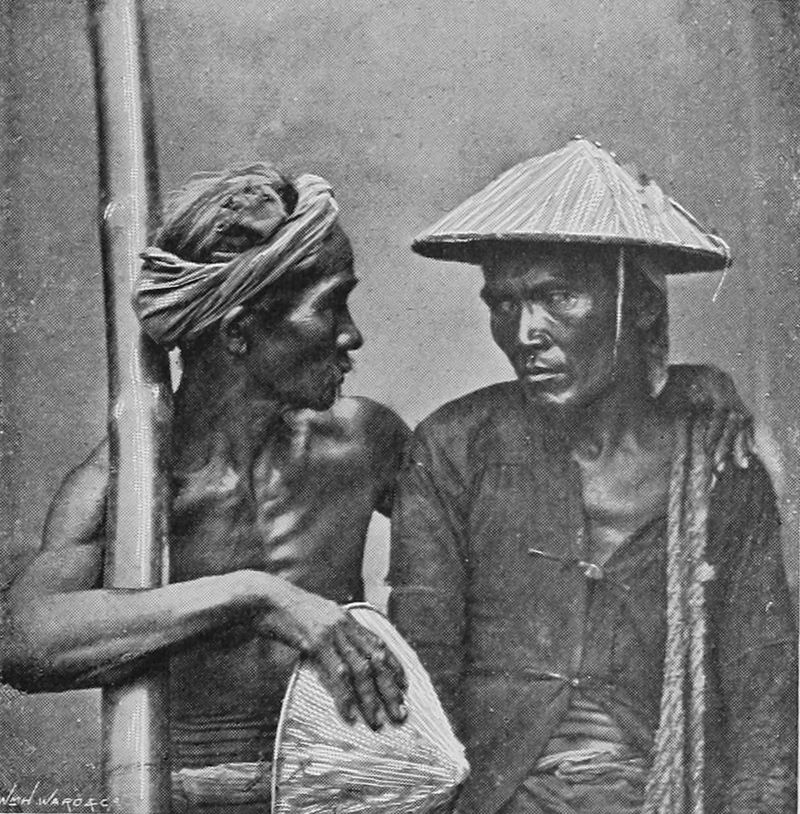
While not exactly welcoming, prospectors tolerated Chinese immigrants in the early period. Surface gold was plentiful in those days. Some even found the chopsticks and the broad conical hats of the Chinese mining camps, amusing. As competition increased, resentment began to build. Meanwhile in southern China, crop failures and rumors of the Golden Mountain, the Gam Saan, brought with it a tide of Chinese immigration. San Francisco saw a tenfold increase in 1852, alone. Now anything but amused, California lawmakers imposed a $3 per month tax on foreigners, explicitly aimed at Chinese miners.

Large labor projects like the trans-continental railroad and Canadian Pacific Railway fed the influx of Chinese “coolie” labor, eager to work for wages too small to be of interest to American laborers.

By 1870, a full 25% of the California state budget came from that single tax on Chinese miners. In 1882, President Chester A. Arthur signed the Chinese Exclusion Act, prohibiting the further immigration of Chinese laborers. It was the first and remains to this day the only law specifically targeted at one ethnic group.

Meanwhile, the “gunboat diplomacy” of President Millard Fillmore determined to open Japanese ports to trade, with the west.  By force, if necessary. By 1868, internal Japanese issues and the growing pressure of western encroachment had brought about the end of the Tokugawa Shōgunate and restoration of the Meiji Emperor. 

The social changes wrought by the “Meiji Restoration” combined with abrupt opening to world trade plunged the Japanese economy, into recession. Japanese emigrants had left the home islands since the 15th century, in pursuit of new opportunities. That was nothing compared with the new “Japanese diaspora” begun in 1868. 3.8 million “Nikkei” emigrated between 1868 and 1912, bound for destinations from Brazil to mainland China, the United States, Australia, Peru, Germany and others. Even Finland.

These were the Issei, first generation immigrants, ineligible for citizenship under US law. The immigrant generation kept to the ways of the land they had left behind forming kenjin-kai, social and aid organizations built around the prefecture, from which they had come. Not so, the second generation. These were the Nisei, American-born US citizens, thoroughly assimilated to the culture to which their parents had arrived.

As with the earlier wave of Chinese immigrants, west coast European Americans became alarmed at the tide of Japanese immigration. Laws were passed and treaties signed, attempting to slow their number.

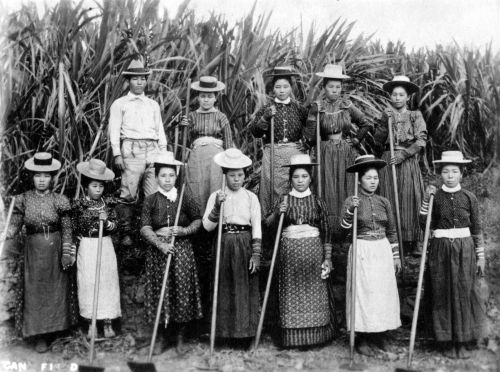
Japanese immigrants in Hawaii

In 1908, an informal “Gentleman’s agreement” between the US and Japan prohibited further immigration of unskilled migrants. A loophole allowed wives to join their husbands already in the United States leading to an influx of “picture brides” – marriages arranged by friends and families and executed by proxy – many happy couples meeting for the first time, upon the arrival of the blushing bride. The immigration act of 1924 followed the example of the Chinese exclusion act of 1882, outright banning further immigration from “undesirable” Asian countries.

By this time 200,000 ethnic Japanese lived in Hawaii, mostly laborers looking for work on the island’s sugar plantations. A nearly equal number settled on the west coast building farms, and small businesses.

From 1937, the rapid conquests of the Asian Pacific raised fears that the Imperial Japanese military, was unstoppable. As relations soured between Japan and America, the Roosevelt administration took to surveillance of Japanese Americans, compiling lists.

Following the surprise attack on Pearl Harbor, public sentiment came down largely on the side of Japanese Americans. The Los Angeles Times characterized them as “good Americans, born and educated as such,” but that would soon change. A member of the second attack wave on December 7, “Zero” pilot Shigenori Nishikaichi downed his crippled fighter on Ni’ihau, the westernmost island of the Hawaiian archipelago. Ignorant at first of what had taken place, Ni’hauans showed the downed pilot, hospitality. By the time it was over the whole thing turned violent, pitting the pilot and a small number of Issei and Nissei, in a deadly struggle against native Hawaiians.

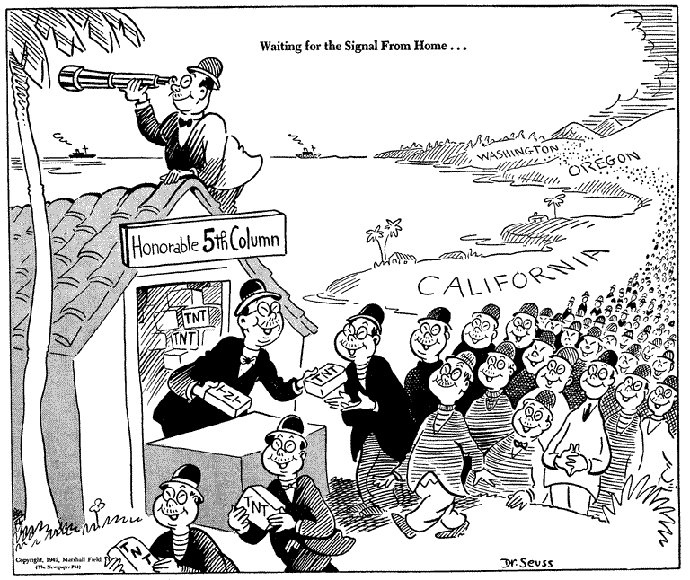
The “Ni’hau incident” combined with fears of 5th column activity to turn the tide, of public opinion.

General John Dewitt, a vocal proponent of what was about to happen, opined: “The fact that nothing has happened so far is more or less . . . ominous, in that I feel that in view of the fact that we have had no sporadic attempts at sabotage that there is a control being exercised and when we have it it will be on a mass basis”.

On January 2, a Joint Immigration Committee of the California legislature attacked “ethnic Japanese” citizen and non-citizen alike, as “totally unassimilable”. The presidentially appointed Roberts Committee assigned to investigate the attack on Pearl Harbor accused persons of Japanese ancestry of espionage, leading up to the attack. By February, California Attorney General and future Supreme Court Justice Earl Warren was doing everything he could to persuade the federal government, to remove all people of Japanese ancestry from the west coast.

This and other images of the period leads us today, to the place where Dr. Seuss in “cancelled”.

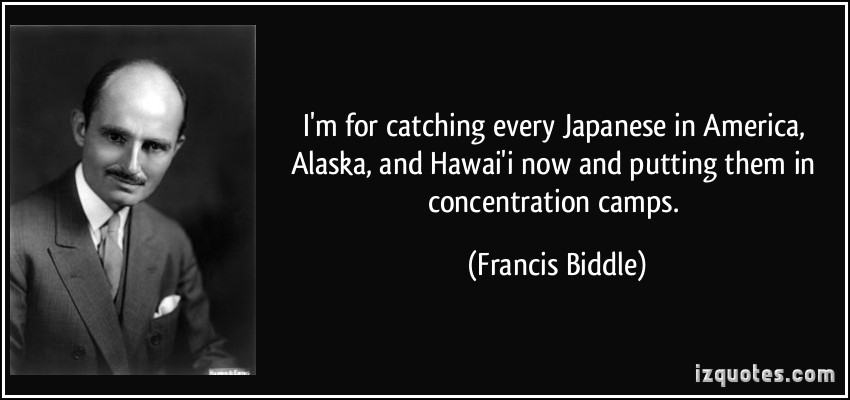
On January 14, 1942, President Roosevelt signed Proclamation 2537 requiring “enemy aliens” to procure identification and carry it with them, “at all times”. The War Department, and Department of Justice were sharply divided but, no matter. Executive order 9066 signed February 19 directed the establishment of exclusion zones.

Roosevelt Attorney General Francis Beverley Biddle

Secret Presidential commissions were appointed in early 1941 and again in 1942, to determine the liklihood of an armed uprising among Japanese Americans. Both reported no evidence of such a thing, one reporting: “the local Japanese are loyal to the United States or, at worst, hope that by remaining quiet they can avoid concentration camps or irresponsible mobs.”

That didn’t matter, either. The Senate discussed Roosevelt’s directive for an hour and the House, for thirty minutes. The President signed Public Law 77-503 on March 21 providing for enforcement, of his earlier directive.

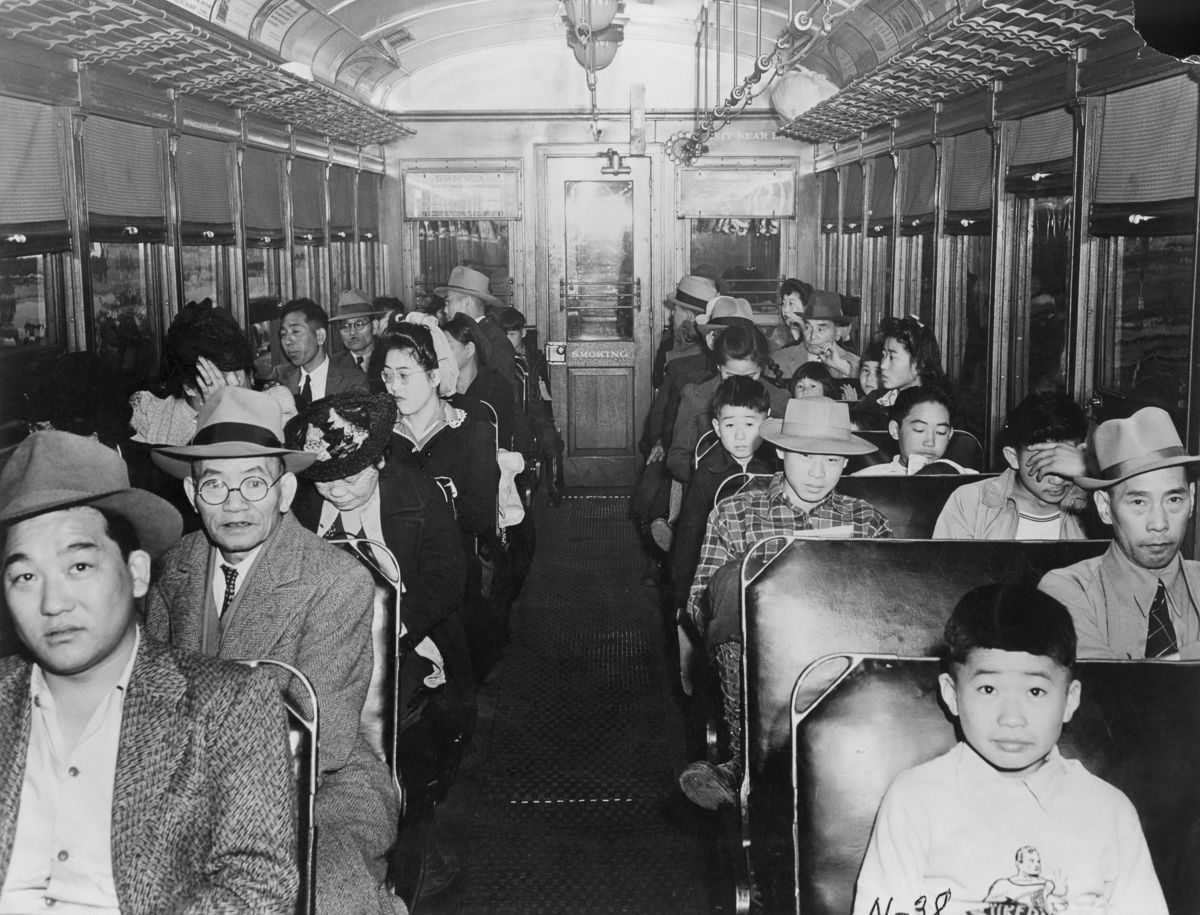
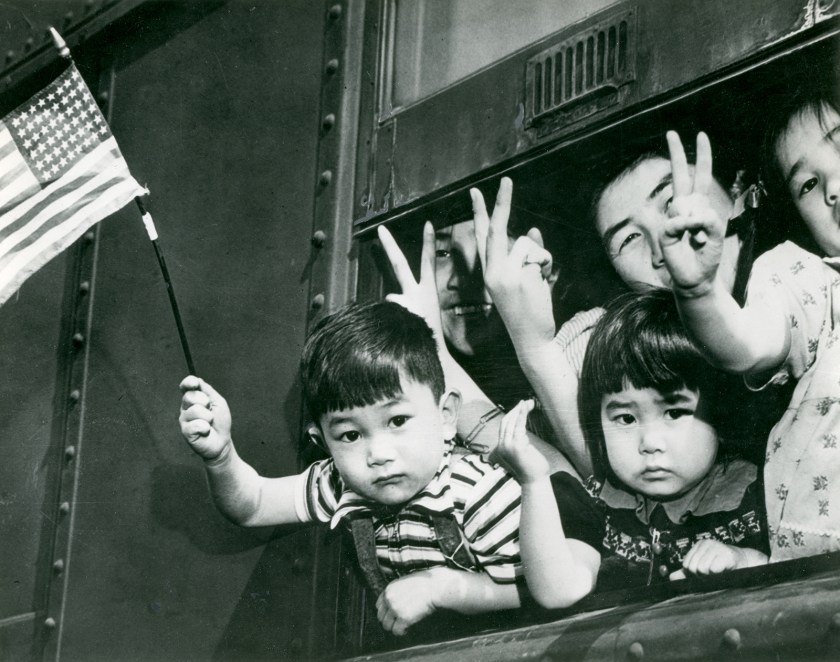
Roosevelt’s measure made no specific reference to ethnicity. Some 11,000 ethnic Germans and 3,000 ethnic Italians were sent away to internment camps but the vast preponderance, were of Japanese descent. Throughout the west coast some 112,000 ethnic Japanese were rounded up and held in relocation camps and other confinement areas, throughout the country. Surprisingly, only a “few thousand” were detained in Hawaii itself despite a population of nearly 40% ethnic Japanese.

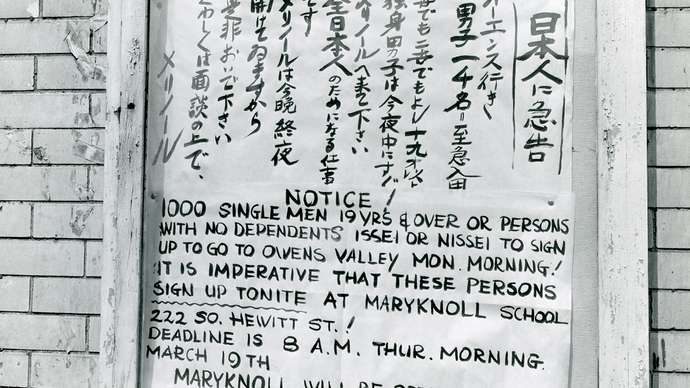
Japantown handbill: H/T Library of Congress

Below: “A moving van being loaded with the possessions of a Japanese family on Bush Street in San Francisco’s Japantown, April 7, 1942. At right are the offices of the Japanese American Citizens League (JACL), the oldest Asian American civil rights organization in the United States. Shortly after this photo was taken, the Wartime Civil Control Administration (WCCA) took over the JACL building and repurposed it as a Civil Control Station for the collection and processing of “people of Japanese descent” prior to their transport to detention camps”.

H/T Encyclopedia Britannica

Following the events at Peal harbor, Oakland California-born Fred Korematsu attempted to enlist, in the Navy. Ostensibly rejected due to stomach ulcers, Korematsu believed the real reason was his Japanese ancestry. Korematsu refused deportation orders and went into hiding. The ACLU’s northern California director Ernest Besig brought Korematsu’s case before the courts despite opposition from Roosevelt allies in the national ACLU. Korematsu lost in federal court and the US court of appeals, becoming a pariah even among fellow detainees who felt he was nothing but a troublemaker. The US Supreme Court agreed to take the case and, on December 18, 1944, upheld the lower court verdict. A 6-3 opinion penned by Justice Hugo Black opined that, though suspect, internment was justified due to national circumstances of “emergency and peril”.

“Fourteen Days to Flatten the Curve, “ right?

A second decision released that same day in the case, Ex Parte Endo, unanimously declared it illegal to detain Americans, regardless of ethnicity. In effect the two rulings established that, while eviction was legal in the name of military necessity internment was not, thus paving the way to their release.

“There is but one way in which to regard the Presidential order empowering the Army to establish “military areas” from which citizens or aliens may be excluded. That is to accept the order as a necessary accompaniment of total defense”.

Washington Post, February 22, 1942
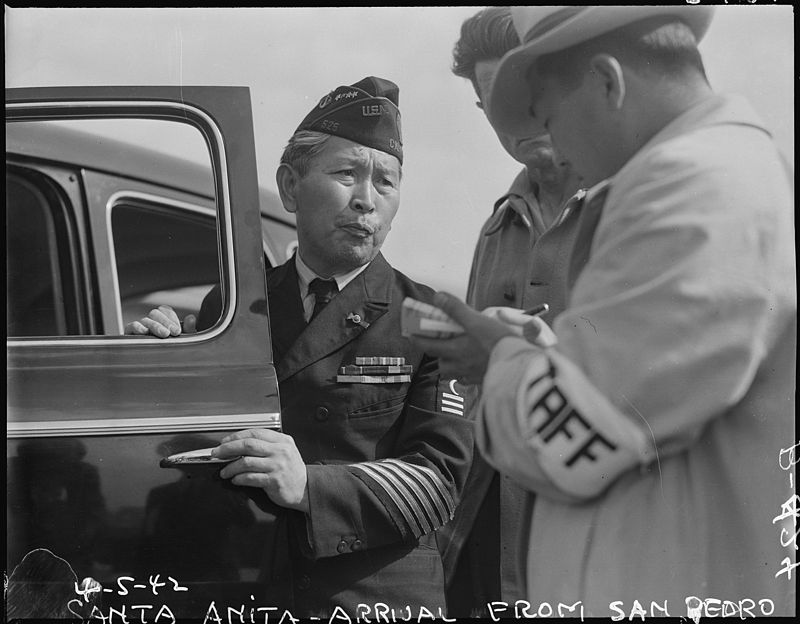
“Dressed in uniform marking his service in World War I, a U.S. Navy veteran from San Pedro enters Santa Anita Assembly Center (April 1942)”. H/T Wikipedia

The Japs in these centers in the United States have been afforded the very best of treatment, together with food and living quarters far better than many of them ever knew before, and a minimum amount of restraint. They have been as well fed as the Army and as well as or better housed. . . . The American people can go without milk and butter, but the Japs will be supplied.

Los Angeles Times, December 8, 1942
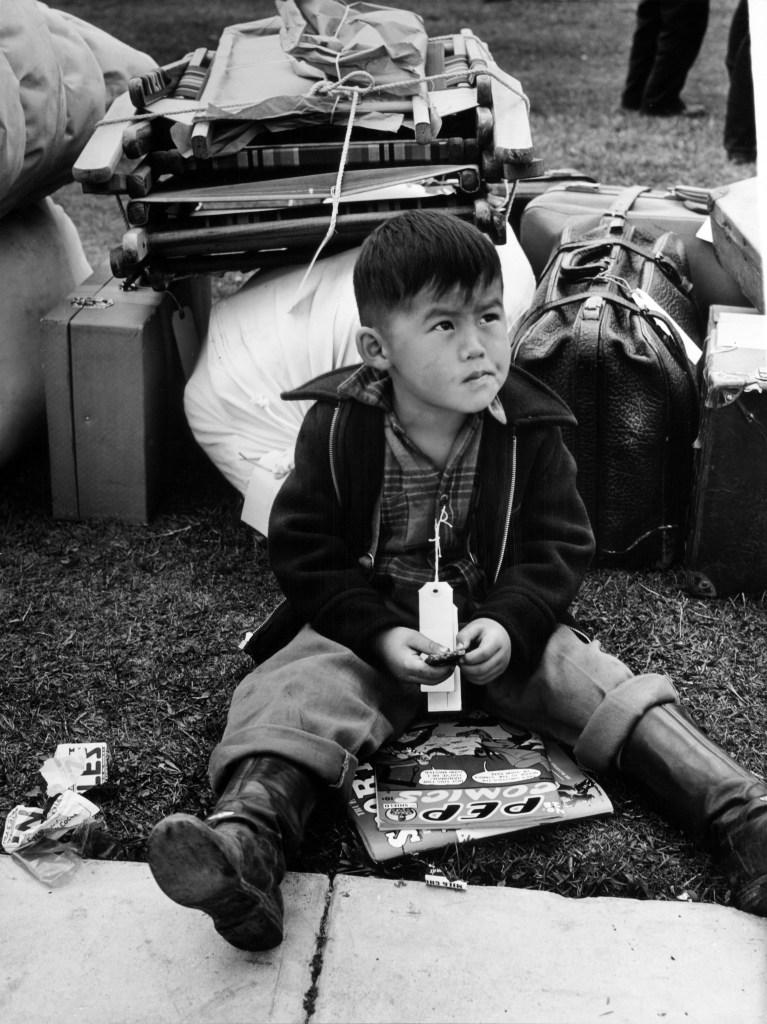
“Tagged”, and waiting for removal

Among internment camps many were eager to prove themselves, loyal Americans. Some were recruited for service in the armed forces. Many, volunteered. In April 1943 some 2,686 Japanese-Americans from Hawaii and 1,500 incarcerated in mainland camps, reported for duty at camp Shelby, in Mississippi. While many still had families in internment facilities, graduates were assigned to the segregated 442nd Regimental Combat team and sent off to fight the war, in Europe.

With something to prove every one of these guys, fought like tigers. From Naples to Rome to the south of France, to central Europe and the Po Valley, the all-Nisei 442nd infantry lived up to its own motto’ “Go for Broke”. 14,000 men served in the 442nd earning over 4,000 Purple Hearts, 4,000 Silver Stars, 4,000 Bronze Medals and 21 Medals of Honor.

With 275 Texas National Guardsmen hopelessly cut off by German forces in the Vosges Mountains of France, ‘The Lost Battalion”, the 442nd infantry was sent in to get them out. In five days of savage combat, 211 of the Texas men were rescued. The Nisei of the 442nd suffered 800 casualties. Of 185 men who entered the fray from I Company only 8 emerged, unhurt. Company K sent 186 men against the Germans 169 of whom were either killed, or wounded.
For its size and length of service the 442nd became the most highly decorated unit, in US military history.

Fun fact: Ralph Lazo was so angry at the forcible relocation of his friends he voluntarily joined them, on the train. Deported to the Manzanar concentration camp in the foot of California’s Sierra Nevada mountains, he stayed there, for two years. The only non-spouse, non-Japanese-American, so detained. Nobody ever asked the man about his ethnicity (half Mexican, half Irish). Lazo was inducted into the US Army in 1944 and served as a Staff Sergeant in the South Pacific where he earned a Bronze Star for valor, in combat.

By this time, many younger Nisei had left to pursue new lives, east of the Rockies. Seven others were shot and killed, by sentries. Older internees had little to return to with former homes and business, gone. Many were repatriated to Japan, at least some, against their will. By the end of 1945, nine of the top ten War Relocation Authority ( WRA) camps were shut down. Congress passed the Japanese-American claims Act in 1948 but, with the IRS having destroyed most of the detainees 1939-’42 tax records, only a fraction of claims were ever paid out.

By the late 1980s, powerful Japanese-American members of the United States Congress such as Bob Matsui, Norm Mineta and Spark Matsunaga spearheaded a measure, for reparations. $20,000 paid to every surviving internee. President Ronald Reagan signed the measure into law on August 10, 1988. Over 81,800 qualified, receiving a total of $1.6 Billion.

April 1, 1889 The Weird Side of Easter

“They have Easter egg hunts in Philadelphia, and if the kids don’t find the eggs, they get booed.” – Bob Uecker

According to Christian tradition, Jesus of Nazareth was crucified on Good Friday and later arose from the dead, revealing himself to his disciples before finally, ascending to heaven. The holiest day in the Christian calendar, Easter Sunday marks the resurrection as described in the New Testament.

Many of the secular symbols associated with Easter trace back to the pagan Goddess of spring and the dawn, Ēostre or Ostara, from the Old English Ēastre.

History fades into mythology in the pre-Christian past and accounts differ, but this Teutonic deity was frequently depicted with eggs symbolizing the rebirth of Spring and rabbits, symbolizing fertility.

An egg laying Easter Hare called “Osterhase” or “Oschter Haws” first arrived with the “Pennsylvania Dutch”, German immigrants who came to America in the 1700s. Children would make nests of clothing and blankets in which the creature could “lay” her colored eggs.

The eggs themselves go back before anyone thought to write it all down. Cultures as widespread as ancient Egyptians, Persians, Phoenicians and Hindus all believed the world began with an enormous egg, symbolizing the rebirth of new life. The practice of coloring eggs is believed to go back thousands of years. Except then, it was ostrich eggs.

In Mesopotamia, early orthodox Christians colored them red, in memory of Jesus’ crucifixion.

Household accounts of King Edward I “Longshanks”, King of England from 1272 to 1307, note the expenditure of eighteen pence for 450 eggs, gold-leafed and colored for Easter gifts.

The origins of confectionary bunnies is hazy. Chocolate molds may be found in Munich dating back to the 1890s, around the same time Robert Strohecker first placed a five-foot chocolate rabbit in front of his Pennsylvania drugstore, as an Easter promotion.

Overlapping as it does with pagan celebrations of Spring, some seasonal traditions are enough to make even 5-foot chocolate rabbits seem, positively normal.

In France, the Netherlands and Belgium, it is said that church bells literally depart and fly to Rome, returning Santa Claus-like on Easter morning bearing colored eggs and chocolate rabbits.

Across Scandinavia and northern Europe, April 30 – May 1 celebrates Walpurgis Night (Walpurgisnacht), a festival dedicated to the 8th century nun-turned saint Saint Walpurga, with roots in pagan era rites of fertility. Little girls dress as witches as children “trick or treat” for eggs while bonfires are lit, to chase away Judas.

In the Czech Republic, young men fashion Easter “whips” called pomlázka, with which spank the behinds of wives and girlfriends.

As bad as that sounds it seems the only pain, comes when nobody comes to milady’s door. Kind of like being left out from Valentine’s cards. More symbolic these days than real, it’s still best to do your “whipping” in the morning. To do so after noon is to invite a bucket of ice water, to be poured over your head.

In Russia, Poland and Slovenia, no Easter dinner is complete without a heart attack on a plate known as the baranek wielcanocny. A butter lamb.

The lamb is made entirely of butter, and consumed from the tail to the head. Presumably, in one day.

Believed to go back to the middle ages, today the butter lamb may be found in Milwaukee, New York and other cities with large numbers of Polish Catholics. The Broadway market in Buffalo New York sells nearly 100,000, every year.

Across the Caribbean and Bermuda, Easter kite festivals combine windblown fun with colorful symbols of the ascension, spiraling up toward the heavens. In Grenada, Easter weekend kite festival is held at the narrow isthmus, at Fort Jeudy. The location is not for the faint of heart. With that steep drop over on the leeward side, one false move and all that work will end up in the ocean.

How to make an Easter kite, with “Rasta Man Joe”

On Trinidad & Tobago, behemoth kites called “Mad Bulls” measure twelve to sixteen feet and more requiring four to ten people, to launch. Haiti runs their kite festival in January, based on prevailing winds. Competitors are allowed to put “zwill” on their kite’s tails, razor-sharp bits intended to take competitors, out of the running. Yikes.

In Finland, the Easter pulse races with the excitement, of watching the grass grow. Literally. And when that’s done, children decorate it with painted eggs and paper bunnies.

In a nation one-third of which rests above the arctic circle, may it IS that exciting to watch the grass grow. For those accustomed to a bit more stimulation, you can always try Florence, Italy, where the Scoppio del Carro, (“Explosion of the Cart”) goes back almost 400 years.

As the story goes, a young knight of the noble Pazzi family took part in the first Crusade, in 1099. Young Pazzino was the first to scale the walls of Jerusalem to raise the Christian banner for which he was awarded, with three flints from the Holy Sepulcher.

Fast forward to 1622 when Florentine officials built a cart, not quite three stories tall. Festivities begin at 10:00am when a priest rubs the flints together, to produce a flame. With the Easter candle thus lit, coals are kindled and the whole cart laden with fireworks, a team of two oxen leading the whole procession as the Holy Fire is transported to the Santa Maria del Fiore, better known as the Duomo. There, the Archbishop of Florence lights a dove-shaped rocket called a “Columbina“, signifying the Holy Spirit.

If the whole Rube Goldberg contraption actually works, the dove will “fly” down a wire to the Holy Fire and spectators will be treated to the “explosion of the cart”, one heck of a fireworks display ensuring good luck and bountiful harvests, throughout the year.

And if one rocket isn’t enough for you, (even if it is shaped like a dove), how about a War of rockets?

The Greek archipelago comprises some 1,200 to 6,000 islands, depending on how you count them. The fifth largest by landmass is Chios, said to be the birthplace of the blind bard of antiquity himself, Homer.

There on Chios in the coastal town of Vrontados you will find the Rouketopolemos. (Greek Рουκετοπόλεμος: literally “rocket war”).

There are two major parishes in Vrontanos: St. Mark’s and Panaghia Ereithiani. The two are located some 400 meters from each other, about 1,300 feet. Every year at Easter, rival congregants hold a rocket war. It used to be cannon but, on or about this day in 1889, Chios’ Ottoman overlords forbade it. So it goes, the Easter Rocket War, with gunpowder rockets launched by the tens of thousands at each other’s bell tower.

The winner is the one with the most hits, except the two sides can never agree, and so it is…NEXT year…we’ll REALLY settle some scores.

And the best part? These guys celebrate Orthodox Easter, which doesn’t come around until May 2. You still have plenty of time to get there.

Feature image, top of page: The annual Easter bunny dog chase, St Agnes, Cornwall.

March 28, 1918 White Feather

“Righteousness cannot be born until self-righteousness is dead”. – Bertrand Russell

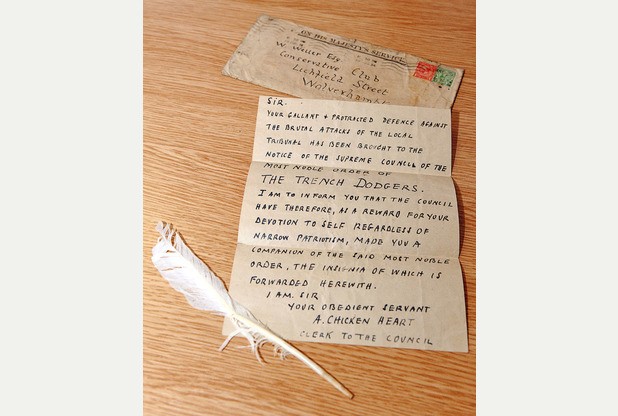
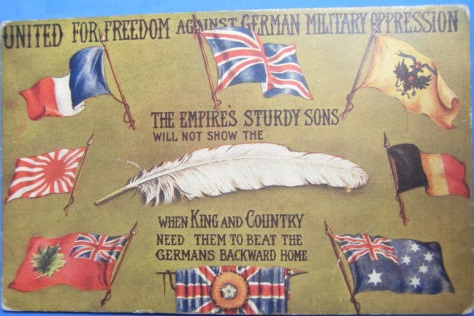
At different times and places, a white feather has carried different meanings.  For those inclined toward New-Age, the presence of a white feather is proof that Guardian Angels are near.  For the Viet Cong and NVA Regulars who were his prey, the “Lông Trắng” (“White Feather”) symbolized the deadliest menace of the American war effort in Vietnam. USMC Scout Sniper Carlos Hathcock wore one in his bush hat.  Following the Battle of Crécy in 1346, Edward of Woodstock, Prince of Wales, plucked three white ostrich feathers from the dead body of the blind King John of Bohemia. To this day, those feathers appear in the coat of arms, of the prince of Wales.

The Edward and John who faced one another over the field at Crécy, could be described in many ways.  Cowardice is not one of them.  For the men of the WW1 generation, a white feather represented precisely that.

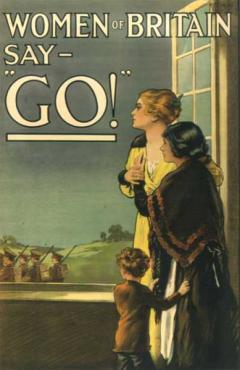
In August 1914, seventy-three year old British Admiral Charles Cooper Penrose-Fitzgerald organized a group of thirty women, to give out white feathers to men not in uniform.  The point was clear enough. To gin up enough manpower to feed the needs of a war so large as to gobble up a generation, and spit out the pieces.

white-feather-2

Lord Horatio Kitchener supported the measure, saying  “The women could play a great part in the emergency by using their influence with their husbands and sons to take their proper share in the country’s defence, and every girl who had a sweetheart should tell men that she would not walk out with him again until he had done his part in licking the Germans.”

The Guardian newspaper chimed in, breathlessly reporting on the activities of the “Order of the White Feather“, hoping that the gesture “would shame every young slacker” into enlisting.

000simkinJE9
“The White Feather: A Sketch of English Recruiting”, Collier’s Weekly (1914)

In theory, such an “award” was intended to inspire the dilatory to fulfill his duty to King and country.   In practice, such presentations were often mean-spirited, self righteous and out of line.  Sometimes, grotesquely so.

The movement spread across Great Britain and the Commonwealth nations and across Europe, encouraged by suffragettes such as Emmeline Pankhurst and her daughter Christabel, and feminist writers Mary Augusta Ward, founding President of the Women’s National Anti-Suffrage League, and British-Hungarian novelist and playwright, Emma Orczy.

Distributors of the white feather were almost exclusively female, who frequently misjudged their targets. Stories abound of men on leave, wounded, or in reserved occupations being handed the odious symbols.

Mvic

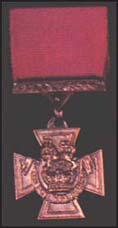
Seaman George Samson received a white feather on the same day he was awarded the British Commonwealth’s highest military award for gallantry in combat, equivalent to the American Medal of Honor:  the Victoria Cross.

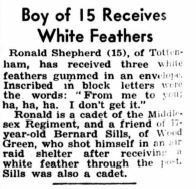
Gangs of “feather girls” took to the streets, looking for military-age men out of uniform.  Frederick Broome was  fifteen years old when “accosted by four girls who gave me three white feathers.”

The writer Compton Mackenzie, himself a serving soldier, complained that these “idiotic young women were using white feathers to get rid of boyfriends of whom they were tired“.

389px-1915_Women_of_Britain,_say_Go!

James Lovegrove was sixteen when he received his first white feather:  “On my way to work one morning a group of women surrounded me. They started shouting and yelling at me, calling me all sorts of names for not being a soldier! Do you know what they did?  They struck a white feather in my coat, meaning I was a coward. Oh, I did feel dreadful, so ashamed.” Lovegrove went straight to the recruiting office, who tried to send him home for being too young and too small: “You see, I was five foot six inches and only about eight and a half stone. This time he made me out to be about six feet tall and twelve stone, at least, that is what he wrote down. All lies of course – but I was in!”.

James Cutmore attempted to volunteer for the British Army in 1914, but was rejected for being near-sighted. By 1916, the war in Europe was consuming men at a rate unprecedented in history. Governments weren’t nearly so picky. A woman gave Cutmore a white feather as he walked home from work. Humiliated, he enlisted the following day. In the 1980s, Cutmore’s grandchild wrote “By that time, they cared nothing for [near-sightedness]. They just wanted a body to stop a shell, which Rifleman James Cutmore duly did in February 1918, dying of his wounds on March 28. My mother was nine, and never got over it. In her last years, in the 1980s, her once fine brain so crippled by dementia that she could not remember the names of her children, she could still remember his dreadful, lingering, useless death. She could still talk of his last leave, when he was so shell-shocked he could hardly speak and my grandmother ironed his uniform every day in the vain hope of killing the lice.”

figure-1

Some of these people were not to be put off. One man was confronted by an angry woman in a London park, who demanded to know why he wasn’t in uniform. “Because I’m German“, he said. She gave him a feather anyway.

Some men had no patience for such nonsense. Private Ernest Atkins was riding in a train car, when the woman seated behind him presented him with a white feather. Striking her across the face with his pay book, Atkins declared “Certainly I’ll take your feather back to the boys at Passchendaele. I’m in civvies because people think my uniform might be lousy, but if I had it on I wouldn’t be half as lousy as you.”

white-feather-3

Private Norman Demuth was discharged from the British Army after being wounded, in 1916. A woman on a bus handed Demuth a feather, saying “Here’s a gift for a brave soldier.” Demuth was cooler than I might have been, under the circumstances: “Thank you very much – I wanted one of those.” He used the feather to clean his pipe, handing the nasty thing back to her with the comment, “You know we didn’t get these in the trenches.”

Inevitably, the white feather became a problem when civilian government employees began to receive the hated symbols.  Home Secretary Reginald McKenna issued lapel badges to employees in state industries, reading “King and Country”. Proof that they too, were serving the war effort. Veterans who’d been discharged for wounds or illness were likewise issued such a badge that they not be accosted, in the street.

So it was that the laborer from St. Albans was sent to kill the greengrocer from some small village in Bavaria, each spurred on by their women, the whole sorry mess driven by politicians who would make war, from the comfort of home. The white feather campaign was briefly revived during World War 2, but never caught on to anything approaching the same degree as the first.

British infantryman Siegfried Sassoon was wounded multiple times on the Western Front, one of the great poets of the War to End All Wars. Marching off to fight the Hun for King and country, these were the boys who returned, embittered by the horrors of the trenches to speak for a broken generation, no longer able to speak for itself. And those were the lucky ones.

Let the man who earned it, have the last word:
“If I were fierce, and bald, and short of breath,
I’d live with scarlet majors at the Base,
And speed glum heroes up the line to death…And when the war is done and youth stone dead,
I’d toddle safely home and die – in bed.”

Siegfried Sassoon

March 27, 1915 Typhoid Mary

“In time of war, soldiers, however sensible, care a great deal more on some occasions about slaking their thirst than about the danger of enteric fever. Better known as typhoid, the disease is often spread by drinking contaminated water”. – Winston Churchill

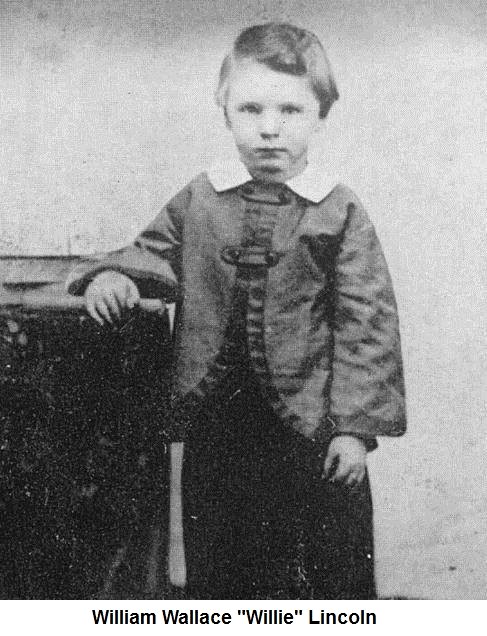
In 1841, US President William Henry Harrison died only 32 days into his only term, in office. The killer was a common culprit in Harrison’s day, one destined to end the life of Stephen A. Douglas of the famous Lincoln/Douglas debates, William “Willy” Lincoln (right), the 11-year-old son of President Abraham & First Lady Mary Todd Lincoln, and Martha Bulloch Roosevelt, mother of President Theodore Roosevelt and grandmother on her father’s side, of Eleanor Roosevelt.

Historians believe Typhoid fever to be the causative agent behind the plague which killed the great statesman Pericles and a third the population of Athens, in 430BC. Typhoid killed as many as 6,000 settlers in the English colony at Jamestown and may have been responsible for eliminating the entire colony.

In 1880, German pathologist Karl Joseph Eberth first described the bacillus involved but, throughout the 19th century, Typhoid could be counted upon to kill more combatants, than any given war in which they had come, to fight.

There’s no polite way to say this. Typhoid is spread by fecal contamination. Between humans. Today, simple acts like flushing a toilet and washing one’s hands are parts of daily routine. In an age before modern plumbing and sewage, we’re talking about a plague sufficient to make the bogey man himself, quake with terror.

Salmonella enterica enterica serovar Typhi

Even now, sciencemag.org reports some ten to thirty million cases per year and about 200,000 deaths. Today, scientists across the African continent and Asia contend with the multi-drug resistant strain H58, but now we’re ahead of the story. In a century beginning with the Napoleonic wars and ending with the gilded age, the “germ theory” of disease we know so well rose only gradually to the fore, eclipsing the “miasma” theory so familiar to contemporaries, of the Black Death.

Like the Chinese coronavirus of another century, Typhoid symptoms range from excruciating death to nothing, whatsoever. Mary Mallon was one of the latter. Born in 1869 in the north of Ireland, Mary was almost certainly infected in utero as her mother was so tainted, at the time of birth.

Mary emigrated to the United States at age fifteen and lived for a time, with an aunt and uncle. She worked as a maid at first but it didn’t take long to realize…Mary Mallon could cook. Soon she was hiring on with wealthy families, as a personal chef.

In 1906, New York banker Charles Henry Warren arranged a treat, for his family. A summer rental seemed just the thing. Warren rented the summer home of George Thompson and his wife in Oyster Bay, Long Island. Naturally, Warren went looking for a cook. Mary Mallon accepted the job.

That August, one of the Warren daughters fell ill with Typhoid fever. Mrs. Warren was soon to follow and then two maids. In total, six of eleven people in the household came down with the disease. Fearing they wouldn’t be able to rent the place, Thompson hired investigators to find the cause.

That first group found nothing and Thompson hired George Soper, a civil engineer known even then as, the “epidemic fighter”. It was Soper who first hypothesized that Mary herself, might be the cause. Mallon had left the family three weeks earlier at this point. Soper examined Mallon’s employment history from 1900 to the present, and there it was. There were seven jobs during that time in which 22 people became ill. With Typhoid. One little girl died of the disease, shortly after Mary came to work for the family.

The civil engineer turned “private eye“ went looking for Mary herself. He found found her in March 1907, working for the family of Walter Bowen.  

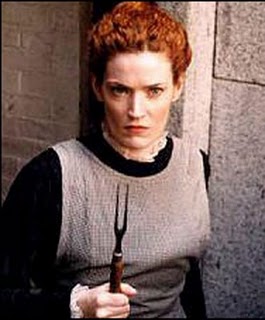
Soper explained who he was and requested samples of Mary’s blood, urine and feces.  Mallon responded as might be expected, of a cornered wildcat.  She came at him with a shriek and a carving fork and put the man to flight, for his life.

Once again Soper tracked her down and showed up, where she lived. This time he brought help in the person of one Dr. Bert Raymond Hoobler. And now there were two of them, fleeing for their lives.

Dr. Sara Josephine Baker was dispatched from the New York city health department but by now, Mallon wasn’t hearing a word of it. Next came Soper with five police officers, and an ambulance. Let the epidemic fighter describe what happened next.

“Now thoroughly convinced of her own persecution, “Mary was on the lookout and peered out, a long kitchen fork in her hand like a rapier. As she lunged at me with the fork, I stepped back, recoiled on the policeman and so confused matters that, by the time we got through the door, Mary had disappeared. ‘Disappear’ is too matter-of-fact a word; she had completely vanished”.

George Soper

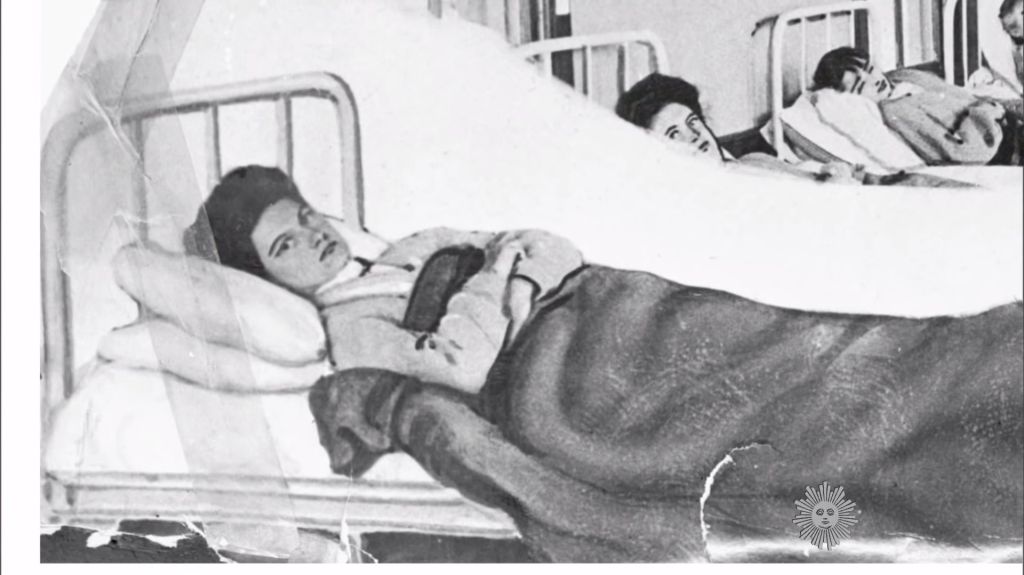
There followed a five-hour cat & mouse before they found her, hiding in a closet. It took several of them to wrestle Mary to the ground. Soper himself sat on her, all the way to the hospital. He said it was like being in a cage, with an angry lion.

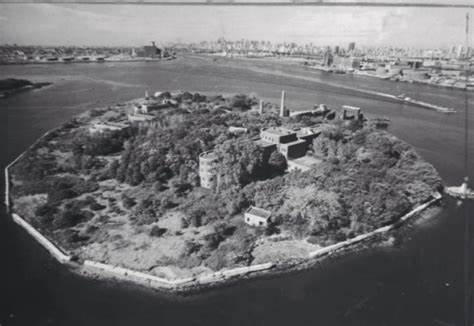
Mary was taken to Willard Parker hospital where stool samples demonstrated the presence of Typhoid. Under questioning she admitted to “almost never” washing her hands, a practice not uncommon, at that time. There followed a period of incarceration between 1907 and 1910 on North brother island on the East River, near the Bronx.

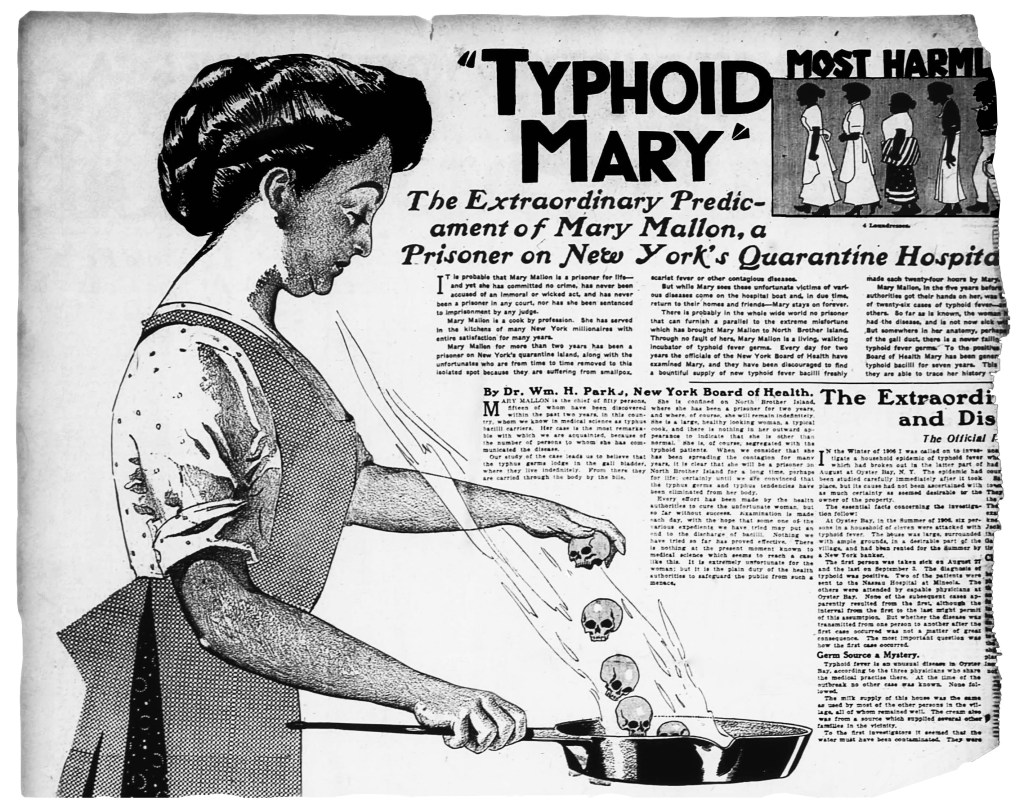
The press had a field day with the story. “Typhoid Mary” they called her.

“I never had typhoid in my life, and have always been healthy. Why should I be banished like a leper and compelled to live in solitary confinement with only a dog for a companion?”

Mary Mallon

In that time, 120 of 163 samples tested positive. Mary herself couldn’t understand why she was being treated this way. She had broken no laws. She’d been taken by force and against her will. There was a nervous breakdown. Her own samples smuggled out with the help of a friend, tested negative. The time when she sued for her freedom. And lost. The courts didn’t want anything to do with it. Soper would visit from time to time and sometimes explained the importance of handwashing. She wasn’t buying any of it. It was all she could think of. Why…Would… They…DO THIS TO ME!?

In 1910, Mary was released to the mainland with an agreement t0 “take such hygienic precautions as will protect those with whom she comes in contact, from infection.” She promised not to accept work as a cook. Now here she was, working as a laundress, earning $20 a month. Without a home of her own, and always on the brink of destitution. She used to make $50 a month, as a cook.

She broke her word. Now it was “Marie Breshof” or “Mrs. Brown,” cooking for the restaurant on Broadway, or that hotel in Southampton. There was an inn in Huntington. A sanatorium in New Jersey. The cooking gigs were always short-term and always followed by Typhoid outbreaks.

Then came the job at Sloan Hospital for Women. 20 people fell ill with Typhoid. Two died. Even the other other servants were now calling the new cook, “Typhoid Mary”.

North Brother island

This time when they came for her, she didn’t resist. On this day in 1915, Mary Mallon was returned to quarantine on North Brother Island. She had a stroke there in 1932 and spent the last six years of her life, partly paralyzed. She contracted pneumonia and died there on Armistice Day, November 11, 1938. Nine people attended her funeral.

Over her lifetime, Typhoid Mary is believed to have sickened no fewer than fifty, three of whom, died. Some put her death toll, as high as fifty. In a nation of laws the civil liberties side of her story stands to this day as an historic, unmitigated, disaster.

Mary Mallon spent her last years alone in this small house on North Brother Island in the East River, near the Bronx

The history of Mary Mallon, declared “unclean” like a leper, may give us some moral lessons on how to protect the ill and how we can be protected from illness…By the time she died New York health officials had identified more than 400 other healthy carriers of Salmonella typhi, but no one else was forcibly confined or victimized as an “unwanted ill”.

Annals of Gastroenterology, 2013

March 17, 1901 Vincent

Artists who became famous only in death read like a who’s who of painters including Monet, Gaugin, Cezanne and more but none so tragic, as Vincent van Gogh.

Herman Melville wrote more than 90 books and short stories in his 72 years. He was no stranger to some small fame but it was only after death that the man’s magnum opus Moby Dick, came to be seen as one of the finest works of literature, ever written. Edgar Allen Poe struggled as a writer. The Raven was sold for only $9 during his lifetime. Now a towering figure in the literary world his fame too, would only come after death. Shy and introverted in life, Emily Dickinson published only 8 poems during her lifetime. Her remaining body of work she hid carefully away, some 1,800 poems coming only to light, after she was gone.

Such a list could be long and includes the likes of Franz Kafka, Henry David Thoreau and Jane Austen. Artists who became famous only in death contain a who’s who of painters including Monet, Gaugin, Cezanne and more but none so tragic, as Vincent van Gogh.

Vincent Willem Van Gogh was born and died on March 30, 1852, a stillbirth. The artist with the same name was born one year later, to the day. Confusingly, the church register even assigned the infant the same number, as his dead brother. Vincent van Gogh, #29. It wasn’t unusual in those days for grieving parents to give the same name, as a child who had died. What it’s like to grow up a replacement, to visit a grave marked with your own name and birthdate minus a year, is something the rest of us can only guess at.

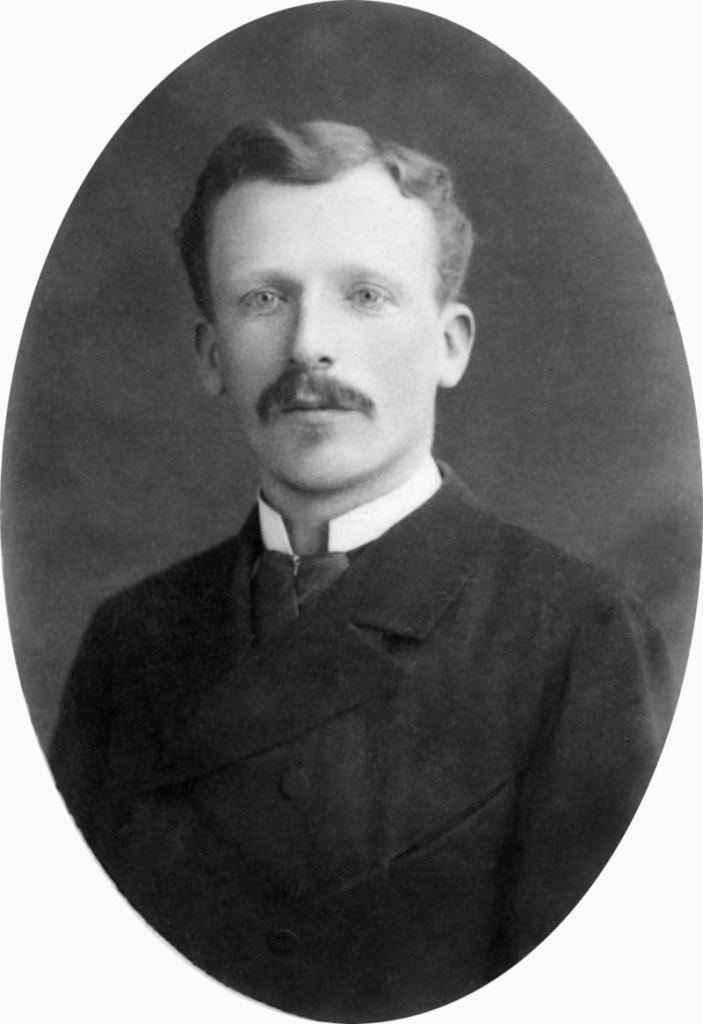
Vincent was close with his brother Theodorus, all but inseparable.

A successful Dutch art dealer, “Theo” had an important impact on the world of French and Dutch art. It is thanks to Theo van Gogh and his financial and emotional support of his older brother, that we’re able to enjoy much of the artist’s work.

Four years his junior it was Theo who encouraged his brother to paint, in the first place. Vincent could always draw but he didn’t pick up a brush, until he was 27.

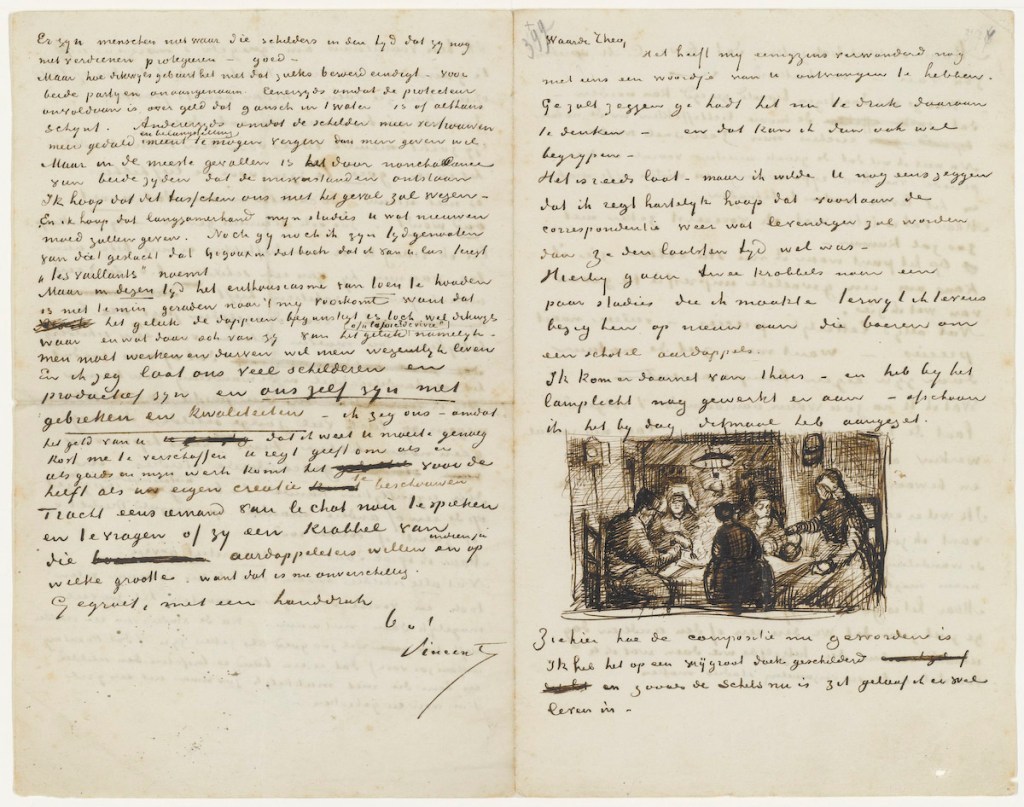
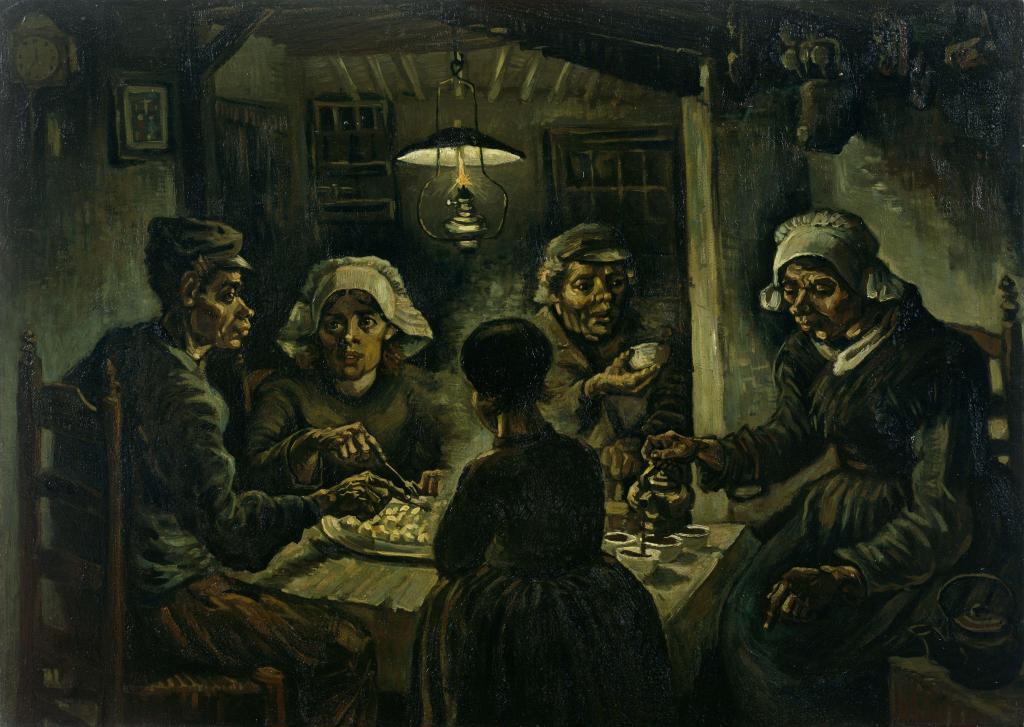
Van Gogh began to write letters in 1872, an average of one every ten days. Vincent would continue this practice for the rest of his life, some 903 in all. His sister Wil was a frequent recipient as were the artists Paul Gauguin, Anthon van Rappard and Émile Bernard, but none so much as his brother Theo. 663 of these letters are known to survive including this 1885 note describing the artist’s first masterpiece, “The Potato Eaters”. It is through these letters we know much of the life, of Vincent van Gogh.

2,300 years ago, Aristotle spoke of the confluence of Greatness, and mental illness. Even now that place where genius meets darkness, is imperfectly understood. Definitive diagnoses of historical figures are elusive and yet, history abounds with stories pointing toward mental illness in some of the great figures of the past. Michelangelo displayed signs of autism, as did Isaac Newton. The famous “scream” painting by Edvard Munch may be autobiographical of a man prone, to panic attacks. Ludwig von Beethoven suffered mood swings likely amounting to bipolar disorder as did Winston Churchill, Abraham Lincoln, and Vincent van Gogh.

Vincent tried his hand at dealing art but suffered depression during visits to London. There followed a period as Christian missionary in the south of Belgium before, feeling ill and depressed, van Gogh moved in with his parents. Theo, always the source of encouragement and support both financial and emotional convinced his brother, to take up the brush.

Vincent van Gogh had but ten years to live when he started to paint. In that time the man produced 2,100 artworks including 860 oil paintings, most of those, in the last two years of his life. First there were the dark colors of the “Dutch period” seen in peasant scenes, portraits and still life.

The Potato Eaters painted in April 1885 in Nuenen, Netherlands

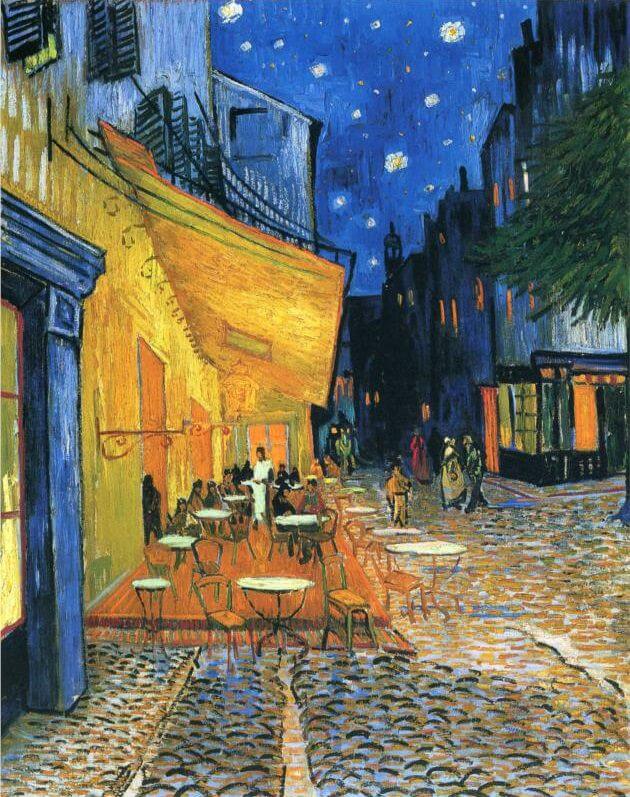
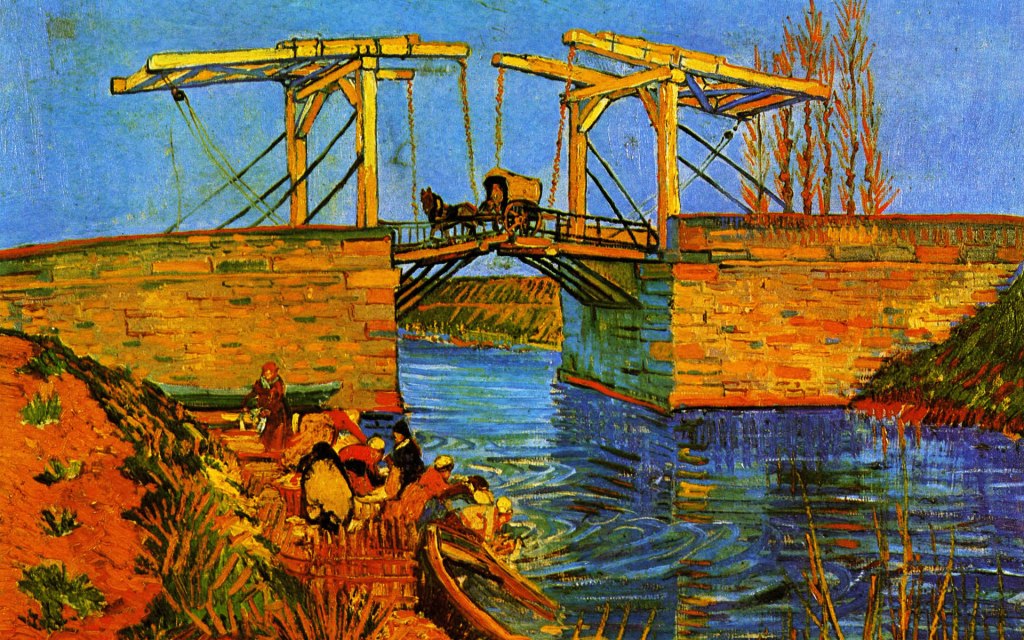
Vincent moved to Paris in 1886 where he met members of the avant-garde art world, including Émile Bernard and Paul Gauguin. These were the iconoclasts, the radicals, the unorthodox who opened a whole new vision. Here we see the burst of bright colors and bold brush strokes for which Vincent is now known.

This too was a period of depression, of mental instability and psychotic episodes. The confrontation ending Vincent’s friendship with Paul Gaugin culminated in van Gogh cutting off his own ear, with a razor.

Thus began a period of mental decline, ending in Vincent’s suicide. A period spent in and out of psychiatric hospitals, of heavy drinking, poor diet and declining health. One day, this tortured soul would be recognized as one of the finest artists who ever lived. For now he was just another madman, a failure in work, and in life.

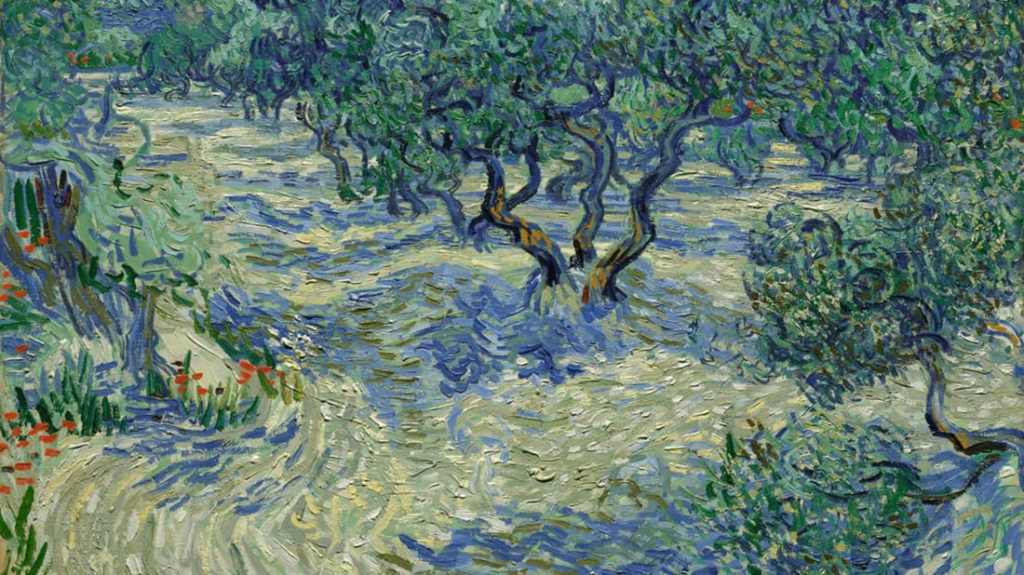
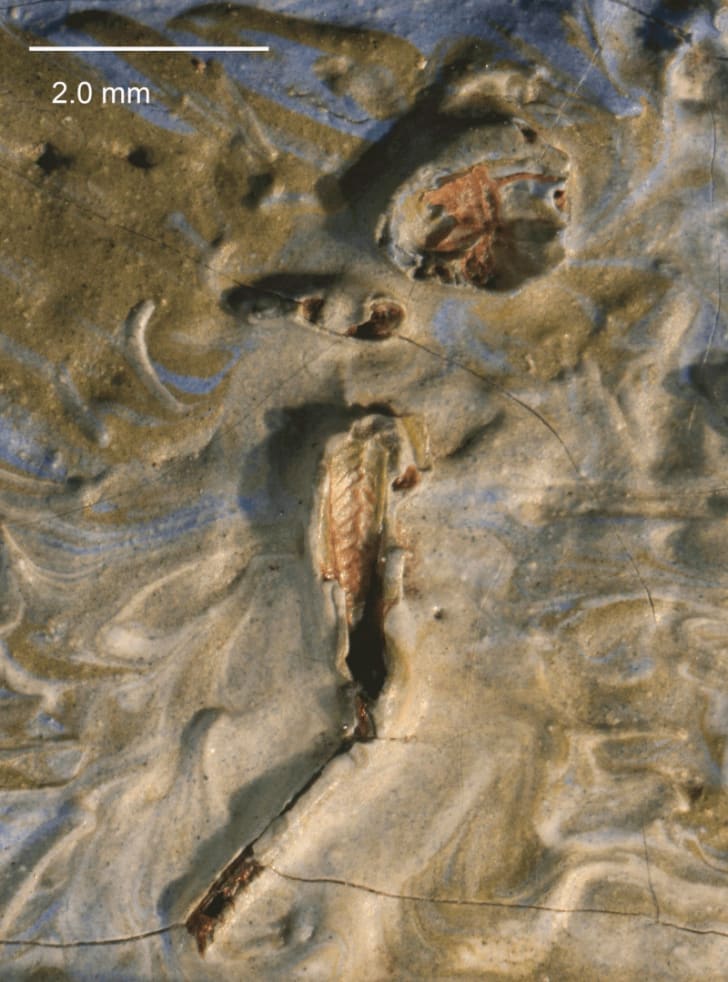
Fun Fact: Following the self-mutilation episode in which Vincent removed his own ear, van Gogh spent time in an asylum outside Saint-Rémy-de-Provence, in France. There he was fond of painting outdoors where he painted olive groves, and other pastoral scenes. If you look very closely just to the right of this 1889 portrait you will find the remains of a dead grasshopper, blown by the wind and trapped in wet paint. There no signs of struggle, indicating the insect was deceased before hitting the canvas. As for the Master he either didn’t notice, or did not care.

Olive Trees, 1889

For the man, the last two years were a downward spiral from which there would be no return. For Vincent’s art this was the most productive, the most brilliant period of a short career.

Theo alone understood his brother. His talent. His madness. For Vincent, Theo was the only person he could open up to. Vincent received a never-ending stream of letters from his brother, words of love, of encouragement, and always the painting supplies, and the money. Theo received a stream of letters in return with day-to-day news, plans for upcoming works but all the while, it wasn’t enough.

Around this time, Vincent set out on foot to visit the French naturalist Jules Breton, a walk of some 80 kilometers. Unlike van Gogh, Breton achieved considerable success, in his lifetime. Perhaps Vincent was intimidated by the high walls. The large estates. Nobody knows. After all that he turned and walked home. The man he intended to visit never knew he was there.

In Paris, Theo fell in love with one Johanna Bonger. The couple was married on April 17, 1889. Ten months later came a son, Vincent Willem van Gogh. The name was intended to honor his brother but, to Vincent, who knows? Perhaps in his madness the replacement felt that he himself, was now replaced. Theo had always been there with money, with painting materials and words of encouragement but to Vincent, he himself was nothing but a burden on a brother, now responsible for a family of three.

Visit allwallpapersfree.blogspot.com

In May of 1890, Vincent moved to a small attic room in the village of Ouvers-sur-Oisne. To be closer to Theo, and to Dr Paul Gachet, the quack homeopathic doctor Vincent himself described as “iller than I am, it seemed to me, or let’s say just as much.” On July 27, 1890, Vincent left his small apartment for the countryside. This time he carried no paints or brushes. Sick in body and mind and bereft of the Christian faith which had once bouyed his thoughts, Vincent had nothing to believe in anymore but his paintings and those, he couldn’t sell. No one knows where Vincent shot himself. The 7mm Lefaucheux à broche revolver. One bullet. In the stomach or the chest, depending on which version you happen to read. He managed to stagger back to his lodgings, lit up his pipe and lay down in his bed, to die. Gachet was called but the bullet, was too deep.

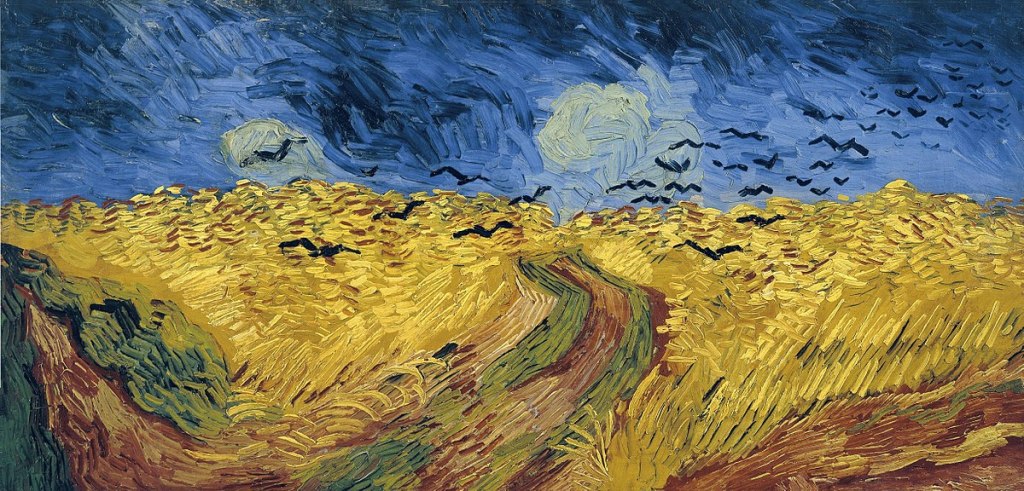
Wheatfield, with crows.

Infection began to set in as Theo was called and rushed to catch a train, to be there. Vincent van Gogh died in the arms of the brother to whom a last, unposted letter was found in his pocket. In it, Vincent describes a recently finished painting, called Wheatfield with crows. The letter said it depicted “vast fields of wheat beneath troubled skies,” adding “I did not have to go out of my way to express sadness and extreme loneliness.”

Theo van Gogh was destroyed over his brother’s death both physically, and mentally. A sharp decline ended six months later with his own death, at the age of 33. The cause of death was dementia paralytica caused by “heredity, chronic disease, overwork, sadness.” He was buried in Utrecht and later exhumed at the request of his widow to be re-interred, next to his brother

As for Johanna herself, she inherited the vast bulk of her brother-in-law’s paintings and drawings and spent the rest of her life, promoting his work.

On March 17, 1901, eleven years after his death, 71 van Gogh paintings were shown at the Bernheim-Jeune gallery, in Paris. A failure in life, Vincent’s work now hit the art world, like an electric shock. Today some of the artist’s works number among the most expensive paintings, ever sold.

Post script: Theo’s great-grandson, also called Theo van Gogh, was a Dutch film and television director, producer, actor and author. Working from a script provided by Somali-born Dutch-American activist, feminist and former politician Ayaan Hirsi Ali, van Gogh produced a ten-minute short film called Submission, concerning the plight of women in Islam. Both van Gogh and Hirsi Ali received death threats to which Theo responded “nobody kills the village idiot”. He often used that term in describing himself. On November 2, 2004, Islamist Mohammed Bouyeri shot and stabbed the director while bicycling to work, leaving a note pinned with a knife to his dead chest, containing threats against Jews, the west, and Ayaan Hirsi Ali.