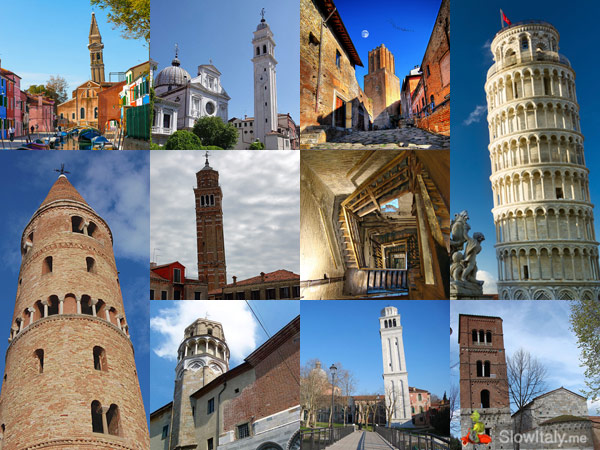
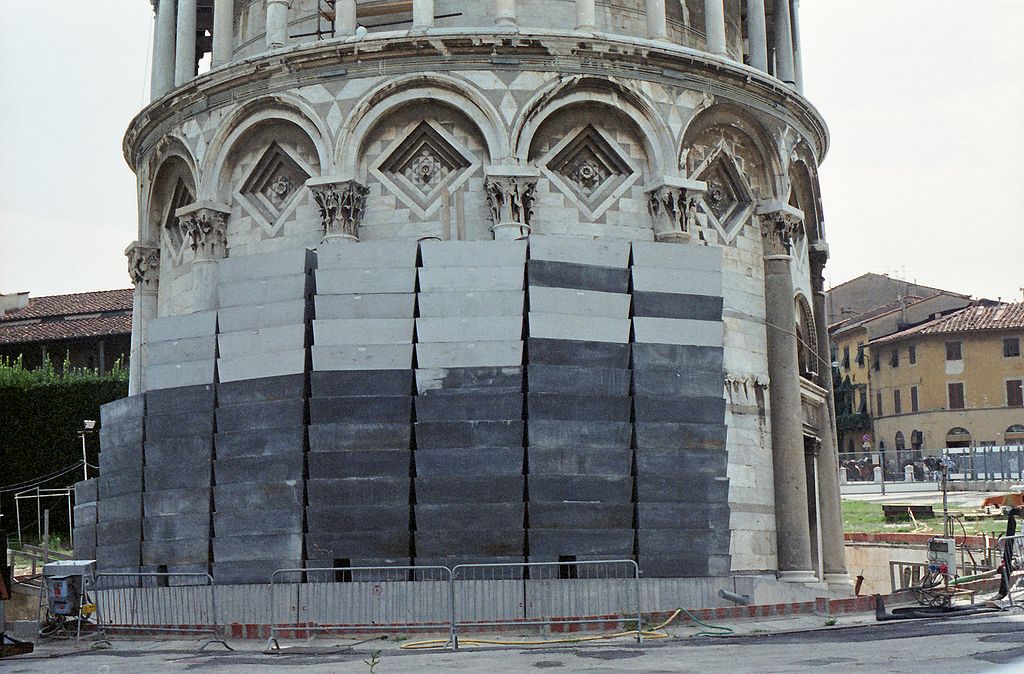
Italy has no fewer than ten towers with an other than perpendicular relationship to the ground. Three in Venice, one each in Bologna, Caorle, Burano and Rome and two others, in Pisa.
In the world of architecture, a campanile [kampəˈnēlē] is a tower, usually built beside or appended to a larger structure and most often associated with Italian architecture. Since the 19th century, such structures have served as clock or bell towers for factories, colleges and apartments. Earlier examples are mostly associated, with churches.
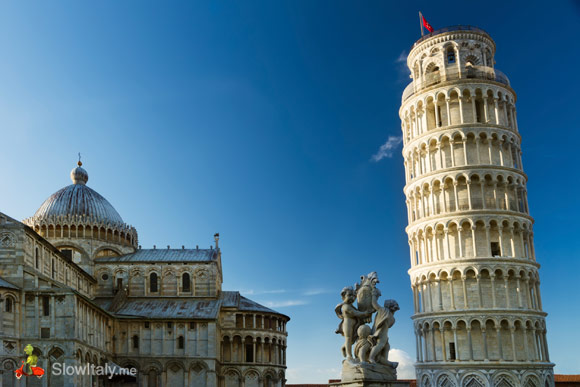
The earliest Campaniles date to the 5th and 6th centuries, such as those in Classe (c. 532–49) and Ravenna (c. 490). The most famous is the leaning tower of Pisa, construction for which began on this day, in 1173.
Standing 55.86 metres (183.27 feet) on the low side and 56.67 metres (185.93 feet) on the high side and weighing in at 16,000 tons, early planning began on January 5, 1172 when the widow Donna Berta di Bernardo bequeathed 60 Soldi for the purchase of stones, to form the foundation.
Footings were laid on August 9 of the following year, the distinctive white marble of the ground floor begun, five days later. The lean set in in 1178 with the construction of the second floor due to shallow foundations, and unstable subsoil.
Italy didn’t become a nation in the modern sense, until 1861. In the 12th century, Pisa was an independent city-state, often at war with other such polities, on the Italian peninsula. Construction halted for nearly a century while Pisa made war on Genoa, Lucca and Florence allowing the soft soil, to stabilize. Otherwise, the thing would surely have toppled.
Interior view of the leaning tower of Pisa
Construction unfolded in three major stages over 199 years. Engineers built the upper floors taller on one side than the other, to compensate, for the tilt. It’s why the thing appears curved, at certain angles. The last of seven bells representing the seven notes of the major musical scale was installed, in 1655.
Surprisingly, the Campanile in Pisa is not the only leaning tower in Italy. It isn’t even the only one, in Pisa. Italy has no fewer than ten towers with an other than perpendicular relationship, to the ground. Three are in Venice, one each in Bologna, Caorle, Burano and Rome and two others, in Pisa.
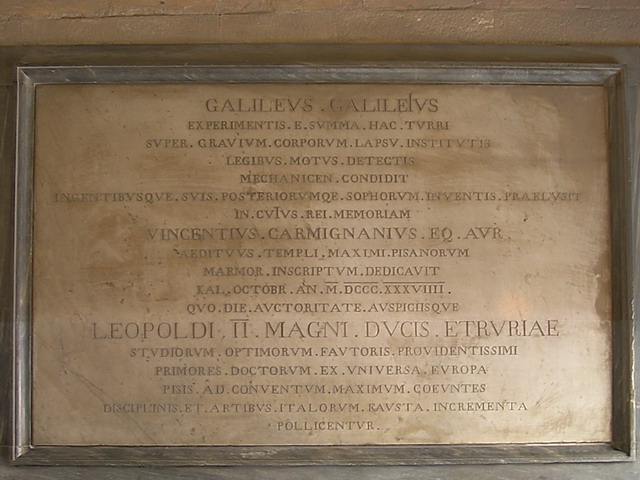
The Italian polymath Galileo Galilei was from Pisa and famously dropped two cannonballs of different sizes from the tower, to illustrate the Law of Free Fall. Galileo ended his life under house arrest for the heretical notion that the earth, revolved around the sun. The cannonball story was published long after his death, told in a biography written by Galileo’s student and personal secretary, Vincenzo Viviani. To have published such a work earlier would have significantly increased the chances, of the author’s burning at the stake.
Plaque memorializing the experiments, of Galileo
Four severe earthquakes have stricken the region since 1280 but the leaning tower, stands secure. Ironically, the soft soil which produced the lean in the first place has dampened the vibration so the tower, remains still.
The leaning tower was suspected of harboring German observers during World War 2 and US Army Sergeant Leon Weckstein was sent, to investigate. Weckstein was so impressed with the beauty of the cathedral and its campanile he refrained from calling, an artillery strike.
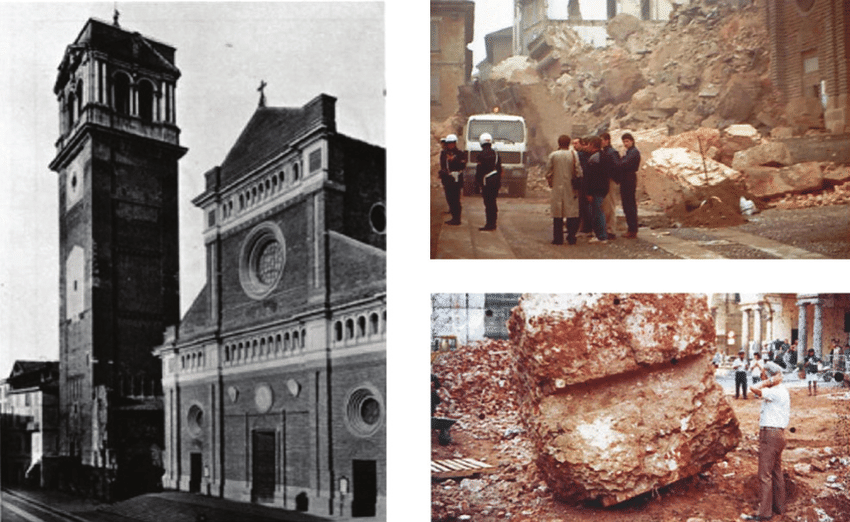
In 1989, the abrupt collapse of the civic tower in Pavia resulted in 280,000 cubic feet of brick and granite rubble leading to the closure to visitors, of the leaning tower of Pisa.
Civic tower of Pavia
Over the centuries, efforts to compensate for the lean have accomplished little. Some even made the problem, worse. More recent innovations have reduced the lean by some 17½-inches including counterweights, excavations and cables. These and the removal of bells to reduce weight have returned the tower to its 1838 position. In 2008, engineers declared the tower stable, for 200 years. In the end, the Italian government has no desire to straighten the thing, all the way. The leaning Tower of Pisa is far to great a draw, for the tourist dollar.
No sooner did the Abbey Road album hit the streets, than the “Paul Is Dead” enthusiasts were off and running. It was a funeral procession, couldn’t anybody see that? Lennon, dressed in white, symbolizes the preacher. Ringo Starr was dressed in black. He was the mourner. George Harrison was wearing blue jeans and a work shirt. Anyone could see, he was the gravedigger.
In January 1967, an automobile belonging to singer/songwriter and Beatles’ band member Paul McCartney, was involved in an accident. He wasn’t driving it at the time, but no matter.
The rumor shifted into gear and the story was told, and retold. Before long, not only had McCartney himself been involved in a violent crash. Now the story was, he’d been killed in it.
Like the child’s game of “telephone”, the story picked up details with each retelling. There had been an argument at a Beatles recording session. McCartney left in anger, and crashed his car. To spare the public from grief, the Beatles replaced him with “William Campbell”, the winner of a McCartney look-alike contest.
The February issue of “The Beatles Book” fanzine tried to put the issue to rest, but some stories die hard. A cottage industry grew up around finding “clues” to McCartney’s “death”. Hundreds were reported by fans and followers of the legend. John Lennon’s final line in the song “Strawberry Fields Forever” sounded like “I buried Paul”. (McCartney later said the words were “cranberry sauce”). When “Revolution 9” from the White Album is played backwards, some claimed to hear “turn me on, dead man”.
On this day in 1969, photographer Iain MacMillan shot the cover photo for the Beatles’ last recorded album, Abbey Road. The ten-minute photo shoot produced six images, from which McCartney himself picked the cover photo. The image shows the band crossing the street, walking away from the studio.
No sooner did the album hit the streets, than the “Paul Is Dead” enthusiasts were off and running. It was a funeral procession, anybody see that. Lennon, dressed in white, symbolizes the preacher. Ringo Starr was dressed in black. Clearly, he was the mourner. George Harrison was wearing blue jeans and a work shirt. Anyone could see, he was the gravedigger.
Then there was McCartney himself, barefoot and out of step with the other members of the band. Clearly, this was the corpse.
He later explained he’d been barefoot that day, because it was hot. No one ever satisfactorily explained, nor did anyone ask, to my knowledge, how the man got to march in his own funeral procession. No matter, the Abby Road cover put the rumor mill over the top.
On October 12, one caller to Detroit radio station WKNR-FM told DJ Russ Gibb about the rumor and its clues. Gibb and his callers then discussed the rumor on the air for the next hour. Roby Yonge did the early AM shift at the powerhouse WABC out of New York. Yonge spent a full hour discussing the rumor, before he was pulled off-air for breaking format. WABC’s signal could be heard in 38 states at that time of night, and at times, other countries. The Beatles’ press office issued a statement denying the rumor, but it had already been reported by national and international media.
The November 7, 1969, Life magazine interview with Paul and Linda McCartney finally put the story to rest. “Perhaps the rumor started because I haven’t been much in the press lately“, he said. “I have done enough press for a lifetime, and I don’t have anything to say these days. I am happy to be with my family and I will work when I work. I was switched on for ten years and I never switched off. Now I am switching off whenever I can. I would rather be a little less famous these days“.
If they had Photoshop in those days, we’d still be hearing the rumors, today.
“Consider the case of a farmer who owns a flock of chickens. He kills them and this is his business. If you interfere, you are trespassing.”
Soghomon Tehlirian 1921
Soghomon Tehlirian studied his quarry, for weeks. He even took an apartment near the man’s home at #4 Hardenbergstraße, to shadow the hated Talaat Pasha and learn his daily routine.
Then came the day. March 15, 1921. Tehlirian waited with his unsuspecting victim at a crosswalk, hurrying across only to turn and cross, once more. To look into the man’s eyes. Identity thus confirmed, the assassin wheeled on passing his victim, and raised the Luger. A single bullet in the nape of the neck.
The hated architect of the deportation and murder of so many of his people, of the extermination of 85 members of the assassin‘s own family, was dead before he hit the street. Tehlirian did not run. He waited patiently for the Polizei and surrendered, upon their arrival.
12 jurors of a Weimar Court pronounced Tehlirian not guilty of this, his second assassination. The first was that of Harutian Mgrditichian, that Judas to his own people who fed the Ottoman overlord the names and addresses, of its victims.
There was no term in 1921, for the Armenian genocide. International law was ambivalent, as to whether there was even a crime. When the Jewish/Polish law student Rafael Lemkin asked his professor why there was no law under which to prosecute Talaat, the professor replied “Consider the case of a farmer who owns a flock of chickens. He kills them and this is his business. If you interfere, you are trespassing.”
On November 26, 1935, the anti-Semitic and racist Nuremberg Laws added the Romani people as “enemies of the race-based state”, of Nazi Germany. Over the next ten years as many as three-quarters of the itinerant Indo-Aryan Roma and Sinti people, were wiped from the face of the earth. Two-thirds of all the Jews in Europe were systematically murdered by the Nazi regime along with untold numbers of smaller “undesirable” groups such as Jehova’s Witnesses, homosexuals, Germans with mental and physical disabilities and others. Six to ten percent of all the Polish gentiles in Nazi occupied Europe were destroyed along with three million Polish Jews.
“Czeslawa Kwoka. Auschwitz. 1942. Auschwitz photographer Wilhelm Brasse was deeply affected by seeing Czeslawa Kwoka beaten. “I felt as if I was being hit myself,” Brasse later said, “but I couldn’t interfere.”” Wikimedia Commons
Genocide was a crime without a name at this time. Germans called it Völkermord, (‘murder of a people’). Poles called it ludobójstwo, (‘killing of a people or nation’) and Winston Churchill, referring to the German invasion of the Soviet Union, spoke of “a crime without a name”. It was Rafael Lemkin in 1944 who coined the term ‘genocide’, from the Ancient Greek word génos (γένος, meaning “race” or “people”) and the Latin suffix caedere, meaning, “to kill”.
The term came into common usage during the Nuremberg trials but only as a descriptive. It wasn’t until the 1946 Polish Genocide trials of Arthur Greiser and Amon Leopold Goth that the term took on formal, legal meaning.
In 1996, research professor and founding Genocide Watch President Gregory Stanton presented a briefing paper to the United States Department of State, describing the “8 Stages of Genocide”. That was amended in 2012 to add two more, resulting in ten identifiable stages, of genocide:
Classification: People are divided into “them and us”. Between 1949 and 1961, Mao’s purges of China and Tibet killed an estimated 49 to 78 million souls
Symbolization: “When combined with hatred, symbols may be forced upon unwilling members of pariah groups…” On this day in 1933 the government of Iraq slaughtered over 3,000 Assyrians in the village of Sumail. To this day August 7 is known as, Assyrian Martyrs Day.
Discrimination: “Law or cultural power excludes groups from full civil rights: segregation or apartheid laws, denial of voting rights”. Josef Stalin killed 23 million between 1932 and 1939 in various purges and the politically orchestrated ‘famine’ called the Holodomor.
Dehumanization: “One group denies the humanity of the other group. Members of it are equated with animals, vermin, insects, or diseases.” The Nazi regime of Adolf Hitler was responsible for 12 million civilian deaths in the concentration camps and pogroms of 1935 through 1945.
Organization: “Genocide is always organized… Special army units or militias are often trained and armed…” Leopold II of Belgium was responsible for the death of 8,000,000 between 1886 and 1908, in the Belgian Congo.
Polarization: “Hate groups broadcast polarizing propaganda…” Hideki Tojo is credited with the death of five million civilians, during World War 2
Preparation: “Mass killing is planned. Victims are identified and separated because of their ethnic or religious identity…” The genocide carried out by Ismail Enver of Turkey killed 1,200,000 Armenians, 350,000 Greek Pontians, 480,000 Anatolian Greeks and a half-million Assyrians between 1915 and 1920.
Persecution: “Expropriation, forced displacement, ghettos, concentration camps”. Between 1975 and 1979 the agrarian utopia of the Khmer Rouge led by a revolutionary cadre of 9 intellectuals called the Ang-ka murdered between a quarter and a third of their fellow Cambodians.
Extermination: “It is ‘extermination’ to the killers because they do not believe their victims to be fully human”. The worst genocides of the 20th century killed something like 160 million souls. A closer accounting is impossible when even the counters, are killed.
Denial: “The perpetrators… deny that they committed any crimes…” Pol Pot, a self-described peaceful man who had done no wrong, died peacefully, in his sleep, in 1998.
Stanton’s ten steps may be taken in linear fashion, in any combination or all at once.
Here’s an interesting exercise. Keyword-search the term ‘country of poets and thinkers’ in the search engine, of your choice. They will all yield the same answer. Germany.
So, how does a culture known for all that, produce the Nazi Holocaust? How for that matter does the everyday Rwandan take up a machete and hack his countryman to bloody bits? How does the Cambodian farmer don the red & white scarf of the Khmer Rouge and bash in the skulls, of his neighbors? Off-duty photographs of SS officers depict not slavering monsters but smiling, everyday family members and neighbors, enjoying a pleasant outing with family, pets and friends.
The way it begins is that particular form of idiocy of which we are all guilty, every day. The classification of our fellow man not as individuals but as members, of a group.
“Apprehension seems to exist among the people of the Southern States, that by the accession of a Republican Administration, their property, and their peace, and personal security, are to be endangered.”
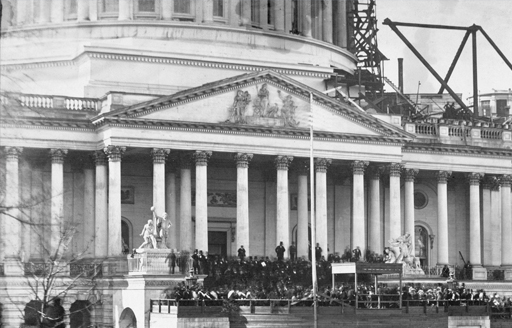
The election, was over. With a nation riven as never before the time was near, for the swearing-in. The 16th President-elect sat down in the back room of his brother-in-law’s store in Springfield Illinois, to write his acceptance speech.
“Fellow-citizens of the United States: … I appear before you to address you briefly, and to take, in your presence, the oath prescribed by the Constitution of the United States…”
It was his first inaugural. The President-elect brought with him for the task of writing the address only four works, for reference: The United States Constitution. Webster’s 1830 reply to Hayne on the matter of States’ Rights. Henry Clay’s 1850 speech on Compromise and Andrew Jackson’s proclamation, against Nullification.
“Apprehension seems to exist among the people of the Southern States, that by the accession of a Republican Administration, their property, and their peace, and personal security, are to be endangered.”
The speech was secretly printed by the Illinois State Journal and entrusted to the new president’s son Robert who proceeded to lose it for a time, causing a “minor uproar before it was found”.
“Resolved…[W]e denounce the lawless invasion by armed force of the soil of any State or Territory, no matter what pretext, as among the gravest of crimes.”
The speech was telegraphed from New York to Kearney Nebraska and taken by Pony Express to Folsom California and again telegraphed, this time to Sacramento, for publication.
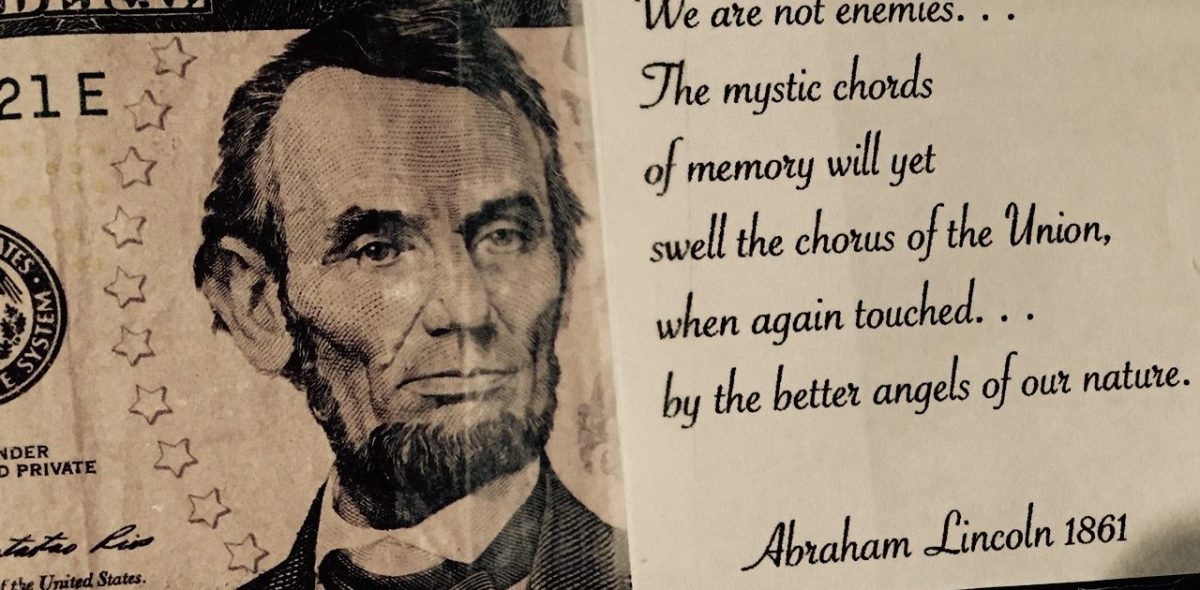
“We are not enemies, but friends. We must not be enemies. Though passion may have strained, it must not break our bonds of affection. The mystic chords of memory, stretching from every battle-field, and patriot grave, to every living heart and hearth-stone, all over this broad land, will yet swell the chorus of the Union, when again touched, as surely they will be, by the better angels of our nature”.
A. Lincoln, First Inaugural, March 4, 1861
Despite this appeal to the better angels of our nature the formerly United States were at war with themselves, within a month.
Within three years what was expected to be a brief police action at worst, had devolved into a Civil War which would kill more Americans than every war from the Revolution to the War on Terror, combined.
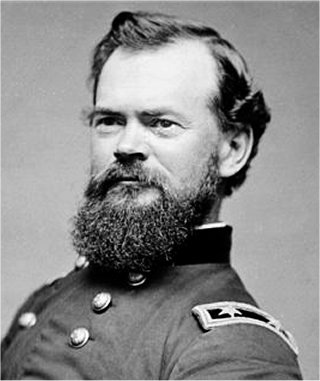
If the “better angels” of Lincoln’s 1st inaugural were to take human form one of those might resemble, General James Birdseye McPherson.
First in his class, West Point 1853, McPherson was superintending engineer constructing the defenses at Alcatraz Island at this time, in San Francisco. There he met Emily Hoffman, the daughter of a prominent Baltimore merchant who had come west, to help care for her sister’s children. The couple was soon engaged and a wedding was planned, but then came the Civil War. The wedding would have to wait.
And then there was John McAuley Palmer, a politician who was at one time a Democrat, a Free Soiler, a Republican, a Liberal Republican and a National Democrat. Whatever it takes, I guess.
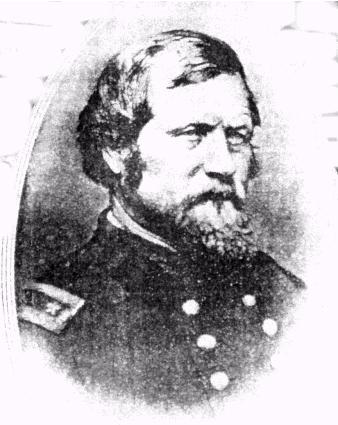
Captain Mcpherson began his Civil War service in 1861 under Major General Henry Halleck, and the Corps of Engineers. He was a lieutenant colonel and chief engineer in the amy of Brigadier General Ulysses Grant during the capture of forts Henry and Donelson in February, 1862.
Major General John Palmer
Political promotions were common enough in the military of 1861. John Palmer received his first one in 1861, entering Civil War service, as a Colonel. Palmer was promoted to Brigadier that December and went on to provide effective leadership at Chickamauga, and during the Chattanooga campaign. By the Summer of 1864 he was Major General John Palmer, commanding the 14th corps under George Henry Thomas.
McPherson’s career followed the same trajectory during this time but his were no political appointments. He became a Brigadier based on his actions at Shiloh and Major General for bravery displayed, at Corinth. In March 1864 McPherson was given command of the Army of the Tennessee replacing William Tecumseh Sherman who was now Supreme Commander, in the west.
Around this time McPherson requested time to marry his sweetheart, in Baltimore. Leave was quickly granted but then rescinded. With the upcoming campaign for Atlanta, this man was indispensable. Emily Hoffman would have to wait. Again.
A series of sharp battles began that May and concluded in September. From Dalton to Chattahoochie first against the Confederate forces of General Joe Johnston and later, General John Bell Hood. Rocky Face Ridge. Marietta. Kennesaw Mountain.
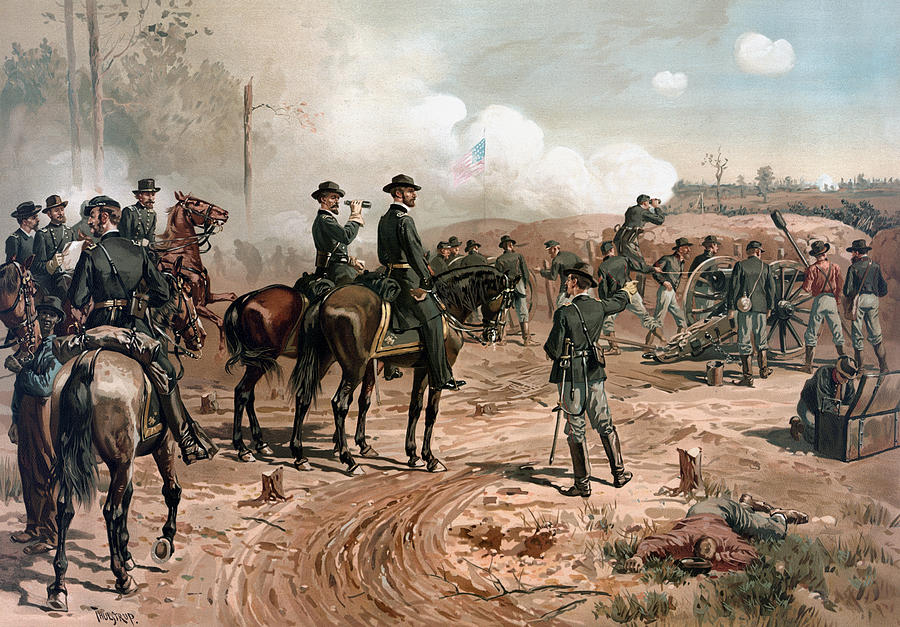
The confusingly named single-day Battle of Atlanta took place on July 22, square in the middle of the Atlanta campaign. Sherman mistakenly believed that Hood’s Confederates had gathered to retreat while McPherson rightly understood. Hood was concentrating for the attack.
General Sherman Observing The Siege of Atlanta
McPherson was personally scouting the area when a line of grey-clad skirmishers emerged from the forest calling out, “HALT”! The General raised his hand as if to tip his hat and then wheeled his horse. There was no outrunning the bullets which then tore into his back. The second-highest ranking federal officer to lose his life in the Civil War, was dead. His killers asked who they had shot and McPherson’s aid replied, “You have killed the best man in the Army”.
If the warm praise of an adversary be the measure of a man then let McPherson’s West Point classmate John Bell Hood, declare his eulogy:
General John Bell Hood
“Neither the years nor the difference of sentiment that had led us to range ourselves on opposite sides in the war had lessened my friendship; indeed the attachment formed in early youth was strengthened by my admiration and gratitude for his conduct toward our people in the vicinity of Vicksburg. His considerate and kind treatment of them stood in bright contrast to the course pursued by many Federal officers”.
On hearing what had happened General Sherman, openly wept. Emily Hoffman never recovered and spent the rest of her life, in secluded mourning.
The four months-long slugfest for Atlanta moved on to the Battle of Ezra Church and then Utoy Creek and John Palmer’s singular moment, of ignominy.
Sherman believed that only a major force was capable of taking the railroad south of Atlanta and bringing this bloodbath, to a conclusion. Major General John Schofield’s XXIII corps now situated on the extreme right of the federal position, was ideally placed to do so. Sherman placed General Palmer’s XIV Corps under Schofield’s operational control, to accomplish that objective.
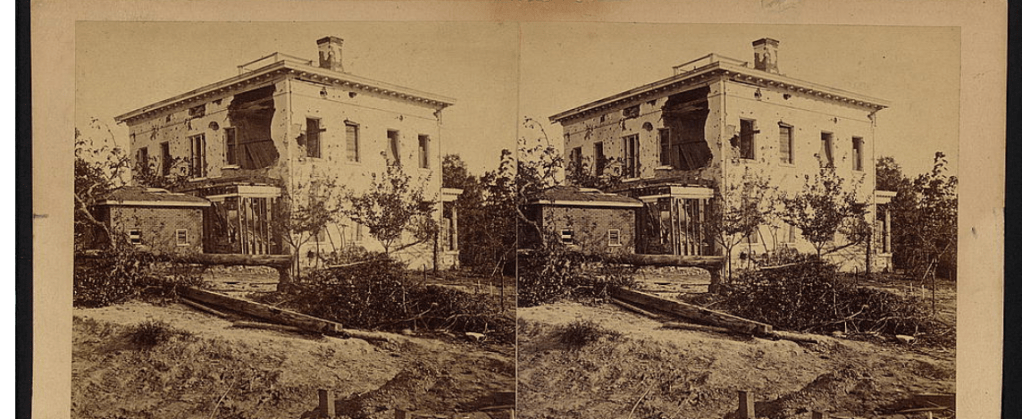
Originally mislabeled “Potter house”, this was the home of Ephraim Ponder, a wealthy slave dealer in Atlanta used by confederate sharpshooters during the battle of Atlanta and heavily damaged by Union shellfire. The house was never rebuilt and abandoned, after the war. Henry Ossian Flipper, son of Festus Flipper and one of Ponder’s former slaves went on to become the first American of African ancestry to graduate from West Point, class of 1877.
That’s when the stuff hit the fan. The temper tantrum. With men facing a determined adversary and literally dying in the field John Palmer had a hissy fit, over seniority. He would NOT place the XIV under a general who had received his two stars, after himself.
Technical niceties as date of seniority are swell subjects for discussion over cigars in garrison but not in the midst of kinetic battle, against a lethal adversary.
Sherman’s letter of August 4, decided the matter:
Major General John Schofield
“From the statements made by yourself and Gen. Schofield today, my decision is that he outranks you as a major general, being of the same date as present commission, by reason of his previous superior rank as brigadier general”.
William Tecumseh Sherman
Except, no. Sherman’s letter settled, nothing. With the Utoy Creek operation scheduled to begin the following day, August 5, Palmer rode out to Sherman’s headquarters to argue the case. Even entreaties that Palmer’s behavior might jeopardize his political career after the war, fell on deaf ears. In the end, Sherman suggested that Palmer needed to offer his resignation, to Schofield.
This he did, said resignation forwarded back to Sherman with the recommendation, that it be accepted. Palmer was sent back to Illinois to await further orders as XIV corps senior divisional commander Brig. Gen. Richard Johnson took his place and the war moved on.
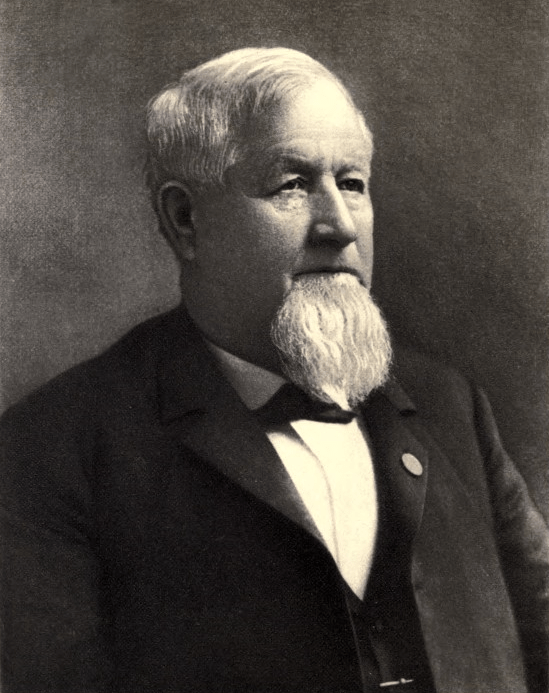
United States Senator John M. Palmer
How many ordinary soldiers were to lose their lives by this delay and the defensive advantage afforded entrenched Confederate forces, is difficult to ascertain. Ever the politician, the lesser angel that was John Palmer served out the remainder of the war as military governor of Kentucky and returned afterward to politics, serving as Illinois Governor, United States Senator and one-time Presidential candidate.
Today, top players are paid the GDP of developing nations, but that wasn’t always the case. One-hundred years ago, much of that money failed to make its way to the players. Even the best, held second jobs.
From World Cup Soccer to the Superbowl, the professional sports world has little to compare with the race for the Pinnacle Trophy. The contest for Championship, in which entire economies slow to a crawl and even casual sports fans, are caught up in the spectacle.
For professional baseball, the “Fall Classic” began in 1903, a best-of-nine “World Series” played out between the Boston Braves and the Pittsburg Pirates. Boston won, in eight.
Excepting the boycott year of 1904 when there was no series at all, most World Series have been ‘best-of-seven”. That changed in 1919, when league owners agreed to play a nine-game series, to generate more revenue and increase the popularity of the sport.
Today, top players are paid the GDP of developing nations, but that wasn’t always the case. One-hundred years ago, much of that money failed to make its way to the players. Even the best, held second jobs.
This was the world in which Chicago White Sox owner Chuck Comiskey built the most powerful organization in professional baseball, despite a miserly reputation.
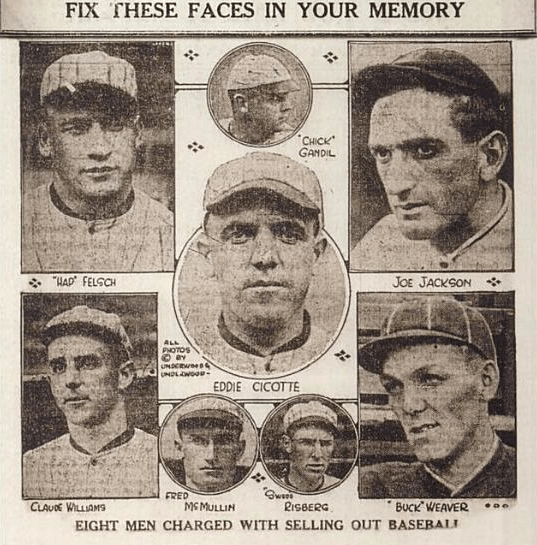
The 1919 “Black Sox” scandal began when Arnold “Chick” Gandil, White Sox first baseman with ties to the Chicago underworld, convinced his buddy and professional gambler Joseph “Sport” Sullivan, that he could throw the World Series against the Cincinnati Reds.
New York gangster Arnold Rothstein supplied the money through his right-hand man, former featherweight boxing champion, Abe Attell.
Pitchers Eddie Cicotte and Claude “Lefty” Williams were principally involved with throwing the series, along with outfielder Oscar “Hap” Felsch and shortstop Charles “Swede” Risberg. Third baseman George “Buck” Weaver attended a meeting where the fix was discussed, but decided not to participate. Weaver handed in some of his best statistics of the year during the 1919 post-season.
Star outfielder “Shoeless” Joe Jackson may have been a participant, though that involvement has been disputed. It seems that other players may have used his name in order to give themselves credibility. Utility infielder Fred McMullin was not involved in the planning, but threatened to report the others unless they cut him in, on the payoff.
The more “straight arrow” players on the club knew nothing about the fix. Second baseman Eddie Collins, catcher Ray Schalk and pitcher Red Faber had nothing to do with it, though the conspiracy received an unexpected boost, when Faber came down with the flu.
Official Program
Rumors were flying as the series started on October 2. So much money was bet on Cincinnati, that the odds were flat. Gamblers complained that nothing was left on the table. Cicotte, who had shrewdly collected his $10,000 the night before, struck leadoff hitter Morrie Rath with his second pitch, a prearranged signal that “the fix was in”.
The plot began to unravel, the first night. Attell withheld the next installment of $20,000, to bet on the following game.
Game 2 starting pitcher Lefty Williams was still willing to go through with the fix, even though he hadn’t been paid. He’d go on to lose his three games in the best-of nine series, but by game 8, he wanted out.
The wheels came off in game three. Former Tigers pitcher and Rothstein intermediary Bill “Sleepy” Burns bet everything he had on Cincinnati, knowing the outcome in advance. Except, Rookie pitcher Dickie Kerr wasn’t in on the fix. He pitched a masterful game in game three, shutting Cincinnati out 3-0, and leaving Burns, flat broke.
Cicotte became angry in game 7, thinking that gamblers were trying to renege on their deal. The knuckle baller bore down to a White Sox win and the series stood, 4-3.
Williams was back on the mound in game 8. By this time he wanted out of the deal, but gangsters threatened to hurt him and his family if he didn’t lose the game. Williams threw nothing but mediocre fastballs, allowing four hits and three runs in the first. The White Sox went on to lose that Game 10-5, ending the series with a 3 – 5 Cincinnati win.
Rumors of the fix began immediately, and dogged the team throughout the 1920 season. Chicago Herald and Examiner baseball writer Hugh Fullerton, wrote that there should never be another World Series. A grand jury was convened that September. Two players, Eddie Cicotte and Shoeless Joe Jackson, testified on September 28, both confessing to participating in the scheme. Despite a virtual tie for first place at that time, Comiskey pulled the seven players then still in the majors. Gandil was back in the minors, at the time.
“Shoeless” Joe Jackson
The reputation of professional baseball had suffered a major blow. Franchise owners appointed a man with the best “baseball name” in history, to help straighten out the mess. He was Major League Baseball’s first Commissioner, federal judge Kenesaw Mountain Landis.
The Black Sox trial began on July 18, 1921, in the Criminal Court in Cook County. Key evidence went missing before the trial, including both Cicotte’s and Jackson’s signed confessions. Both recanted and, in the end, all players were acquitted. The missing confessions reappeared several years later, in the possession of Comiskey’s lawyer. Funny how that works.
According to legend, a young boy approached Shoeless Joe Jackson one day as he came out of the courthouse. “Say it ain’t so, Joe”. There was no response.
The Commissioner was unforgiving, irrespective of the verdict. On August 3, the day of the verdict, Landis delivered the following statement:
“Regardless of the verdict of juries, no player who throws a ball game, no player who undertakes or promises to throw a ball game, no player who sits in confidence with a bunch of crooked ballplayers and gamblers, where the ways and means of throwing a game are discussed and does not promptly tell his club about it, will ever play professional baseball”.
Baseball Commissioner Kennesaw Mountain Landis
Jackson, Cicotte, Gandil, Felsch, Weaver, Williams, Risberg, and McMullin are long dead now, but every one of them remains: Banned from Baseball.
For many, the 1919 scandal paved the way to the “Curse of the Black Sox”, a World Series championship drought lasting 88 years and ending only in 2005, with a White Sox sweep of the Houston Astros. Exactly one year after the Boston Red Sox ended their own 86-year drought, the “Curse of the Bambino”.
The Philadelphia Bulletin newspaper published a poem back on opening day, of the 1919 series. They would probably have taken it back, if only they could.
“Still, it really doesn’t matter, After all, who wins the flag. Good clean sport is what we’re after, And we aim to make our brag. To each near or distant nation, Whereon shines the sporting sun. That of all our games gymnastic, Base ball is the cleanest one!”
In an age of hand-lit sputtering fuses and hand packed (to say nothing of hand-made) powder, even a millisecond difference in ignition will give one ball a head start, to be measured in feet.
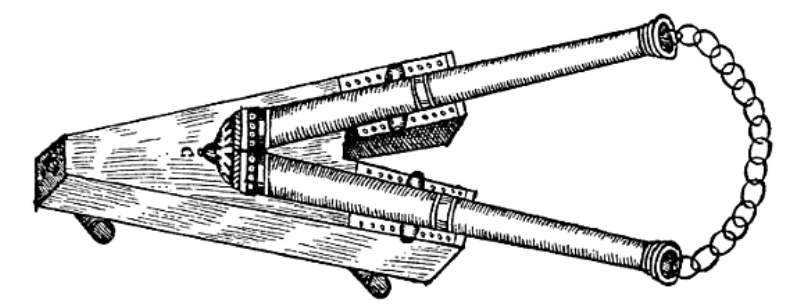
In 1642, Italian gun maker Antonio Petrini conceived a double barrel cannon with tubes joined at 45° firing solid shot joined together, by a length of chain. This was the year of the “Great Rebellion“, the English Civil War, when King and Parliament raised armies to go to war – with each other. Petrini’s idea must have looked good to King Charles I of England. Imagine, a weapon capable of slicing through the ranks of his enemies, like grass before a scythe.
The idea was to fire both barrels simultaneously, but there was the rub. Wild ideas occur to the imagination of imperfect combustion, and a chained ball swinging around to take out its own gun crew. The King himself was mute on the subject and went on to lose his head, in 1649. Petrini’s manuscript resides to this day in the tower of London. There is no documented evidence that the weapon was ever fired, save for the designer’s own description of the ‘Grandissima Ruina’ left behind, by his own splendid creation.
Two-hundred years later the former British colonies across the Atlantic, were themselves embroiled in Civil War.
In the early days of independence, the Confederate Congress enacted a measure, allowing local cities and towns to form semi-military companies for the purpose of local defense. As the very flower of young southern manhood was called up and sent to the front, these “home guard” units often comprised themselves of middle-age and older gentlemen, and others for various reasons, unable to leave home and hearth.
Augustus Longstreet Hull was born 1847 in “The Classic City” of Athens Georgia, and enlisted in the Confederate Army on September 8, 1864.
After the war, Hull worked twenty-seven years as a banker before publishing the Annals of Athens, in 1906. In it, Mr. Hull writes with not a little biting wit, of his own home town home guard unit, Athens’ own, Mitchell Thunderbolts.
“From the name one might readily infer that it was a company made up of fierce and savage men, eager for the fray and ready at all times to ravage and slaughter; yet such was not the case, for in all their eventful career no harm was done to a human being, no property was seized and not one drop of blood stained their spotless escutcheon.
Named for one of it’s own private soldiers, the Mitchell Thunderbolts were not your standard military company. These guys were “organized strictly for home defense” and absolutely refused to take orders. From anyone. They recognized no superior officer and the right to criticism was reserved and freely exercised by everyone from that “splendid old gentleman” Colonel John Billups, down to the lowliest private.
Georgia Senator Middleton Pope Barrow
General Howell Cobb sent the future United States Senator Captain Middleton Pope Barrow to Athens in 1864, to inspect the Thunderbolts. Having no intention of submitting to “inspection” by any mere stripling of a Captain, Dr. Henry Hull (Augustus’ father) “politely informed him that if he wished to inspect him, he would find him on his front porch at his home every morning at 9 o’clock“.
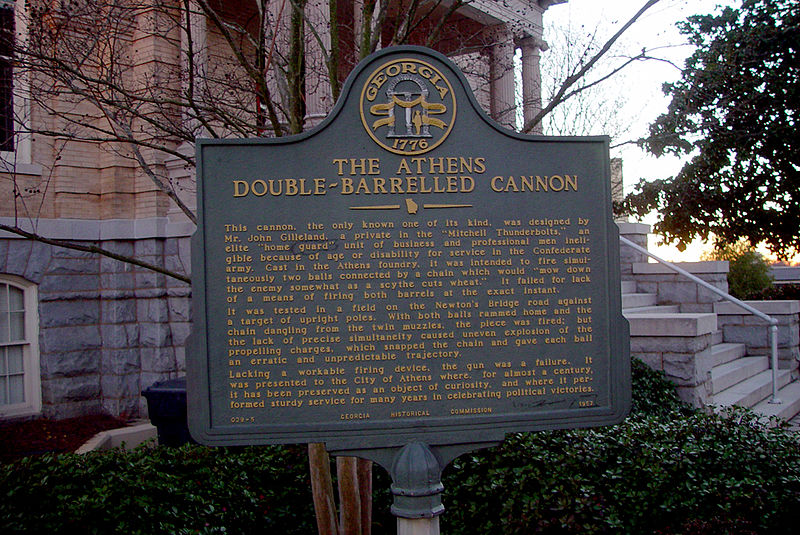
John Gilleland, 53, was a local dentist, builder and mechanic, and private soldier in good standing, of the Mitchell Thunderbolts. Gilleland must have liked Petrini’s idea because he took up a collection in 1862, and raised $350 to build the Confederate States of America’s own, double-barrel cannon.
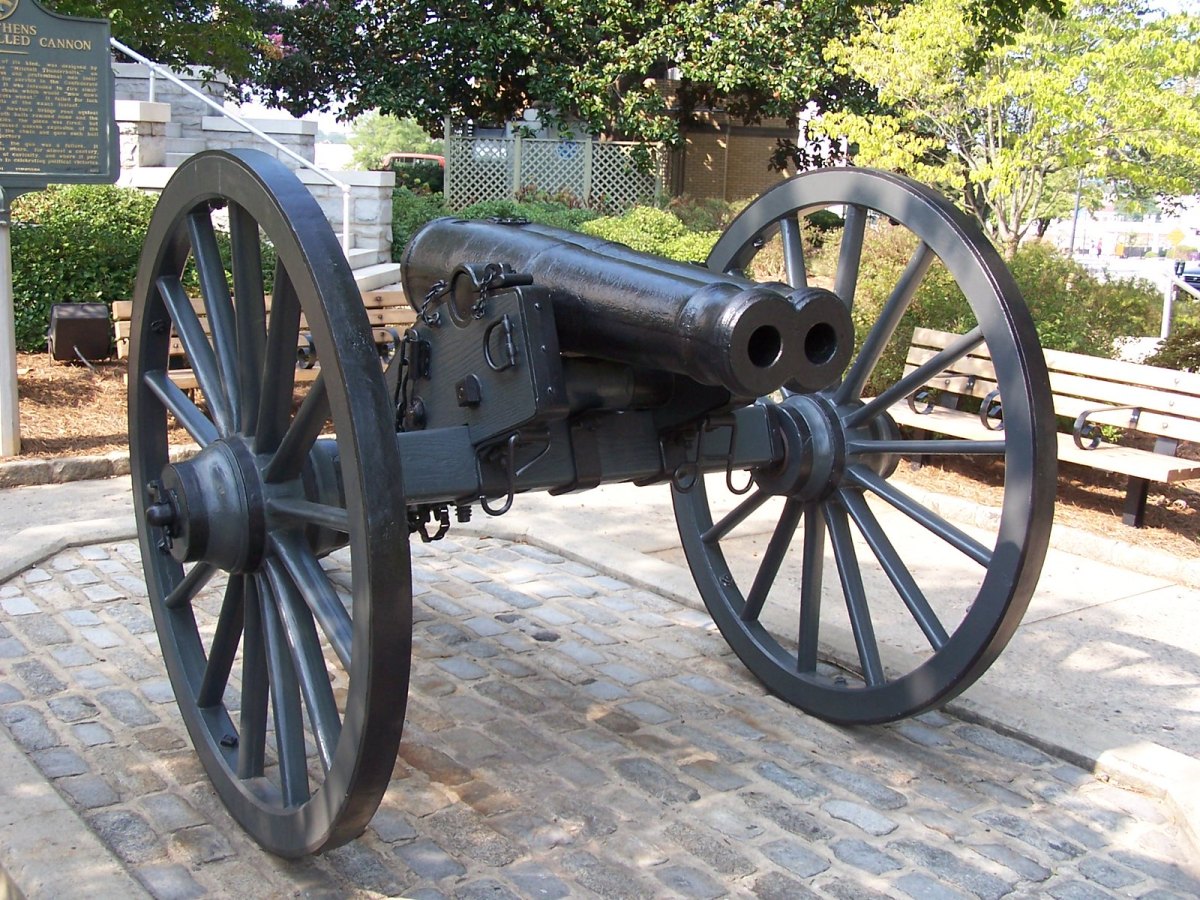
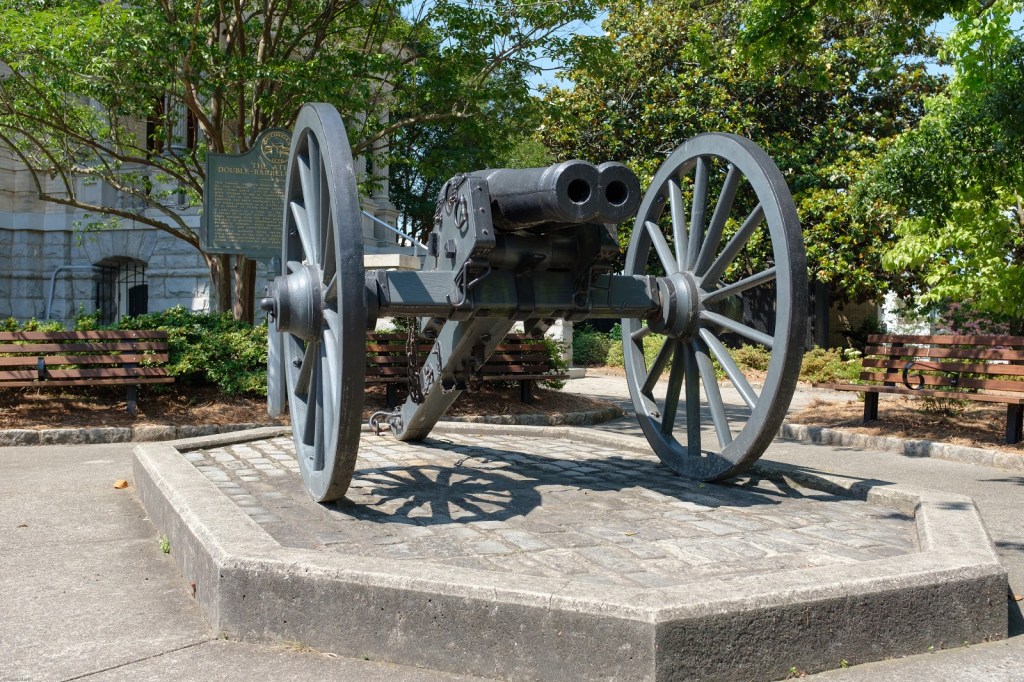
Measuring 13 inches wide by 4-feet 8½” inches and weighing in at some 1,300 pounds, this monstrosity had two barrels diverging at 3° and equipped with three touch holes, one for each barrel and a third should anyone wish to fire the two, together. It was the secret “super weapon” of the age, two cannonballs connected by a chain and designed to “mow down the enemy somewhat as a scythe cuts wheat.”
Yeah. As Mr. Petrini could have told them, the insurmountable problem remained. In an age of hand-lit sputtering fuses and hand packed (to say nothing of hand-made) powder, even a millisecond difference in ignition will give one ball a head start, to be measured in feet. How to simultaneously fire two conjoined weapons remained a problem, even for so elite an outfit, as the Mitchell Thunderbolts.
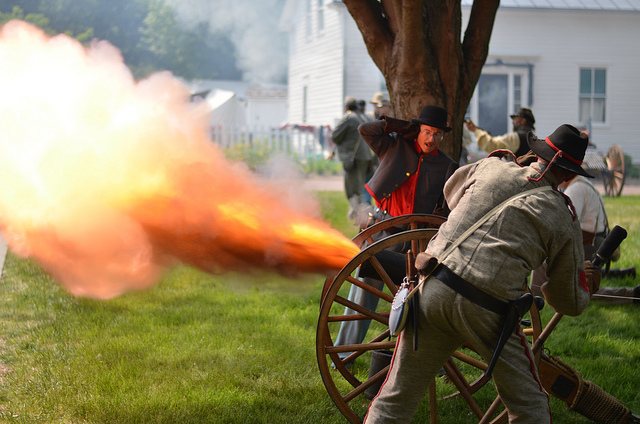
The atmosphere was festive on April 22, 1862, when a crowd gathered to watch Gilleland test the Great Yankee Killer. Aimed at two poles stuck in the ground, uneven ignition and casting imperfections sent assorted spectators scrambling for cover as two balls spun wildly off to the side where they “plowed up about an acre of ground, tore up a cornfield, mowed down saplings, and then the chain broke, the two balls going in different directions“.
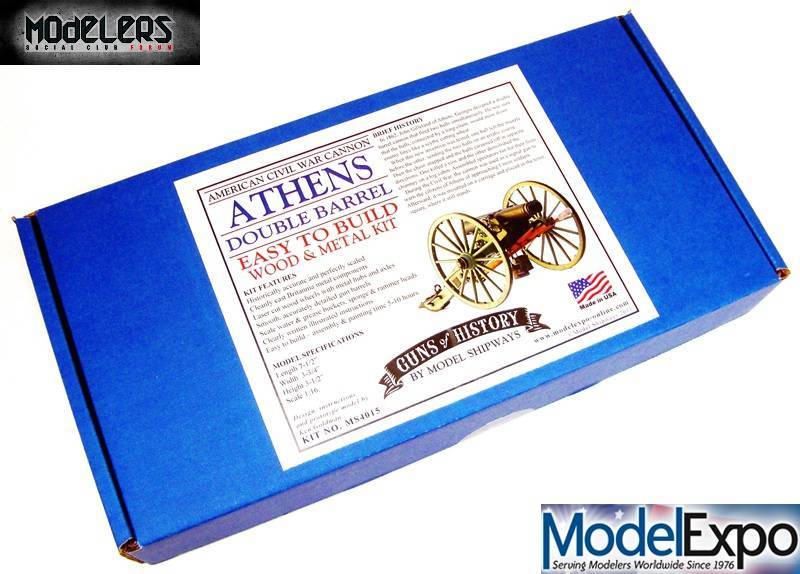
Double Barrel Cannon model, H/T ModelExpo
On the second test, two chain-connected balls shot through the air and into a stand of trees. According to one witness, the “thicket of young pines at which it was aimed looked as if a narrow cyclone or a giant mowing machine had passed through“.
On the third firing, the chain snapped right out of the barrel. One ball tore into a nearby log cabin and destroyed the chimney, while the other spun off and killed a cow who wasn’t bothering anyone.
Gilleland considered all three tests successful, even though the only ones truly safe that day, were those two target posts.
The dentist went straight to the Confederate States’ arsenal in Augusta where Colonel George Rains subjected his creation to extensive testing, before reporting the thing too unreliable for military use. Outraged, an angry inventor wrote angry letters to Georgia Governor Joseph “Joe” Brown and to the Confederate government in Richmond, but to no avail.
At last, the contraption was stuck in front of the Athens town hall and used as a signal gun, to warn citizens of approaching Yankees.
There the thing remained until August 2, 1864, when the gun was hauled out to the hills west of town to meet the Federal troops of Brigadier General George Stoneman. The double-barrel cannon was positioned on a ridge near Barber’s Creek and loaded with canister shot, along with several conventional guns. Outnumbered home guards did little real damage but the noise was horrendous, and Stoneman’s raiders withdrew to quieter pastures.
There were other skirmishes in the area, all of them minor. In the end, Athens escaped the devastation of Sherman’s march to the sea and the Confederate superweapon weapon was moved, back to town.
Gilleland’s monstrosity was sold after the war and lost, for a time. The thing was recovered and restored back in 1891, and returned to the Athens City Hall where it remains to this day, a contributing property of the Downtown Athens Historic District. Come and see it if you’re ever in Athens, right there at the corner of Hancock and College Avenue. There you will find the thing, pointing north, at all those Damned Yankees. You know. Just in case.
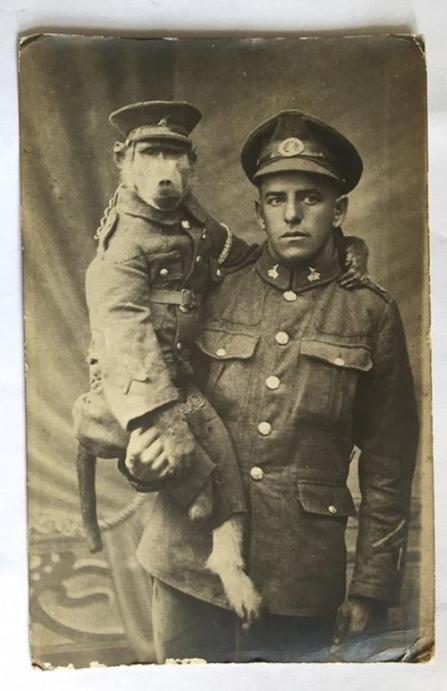
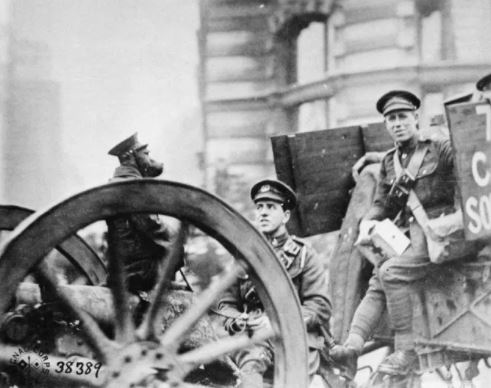
Jackie marched with his company in a special uniform and cap complete with buttons, regimental badges, and a hole for his tail.
In 1915, Albert Marr and his family lived at a farm called Cheshire just outside Pretoria, South Africa. It was there that he found a small Chacma baboon and adopted the monkey, as a pet. He called the animal, “Jackie”.
The Great War had not yet reached it second year when Marr was sworn into the 3rd (Transvaal) Regiment of the 1st South African Infantry Brigade. He was now Private Albert Marr, #4927.
Private Marr asked for permission to bring Jackie along. Mascots are good for morale in times of war, a fact about which military authorities, were well aware.
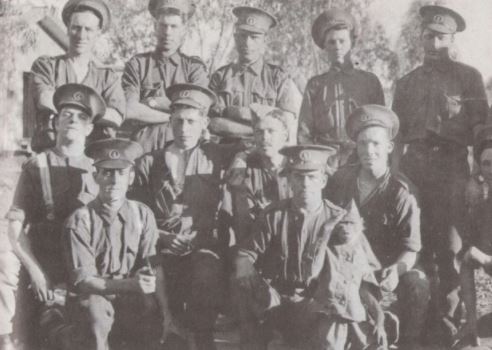
To Marr’s great surprise, permission was granted. It wasn’t long before Jackie became the official Regimental Mascot.
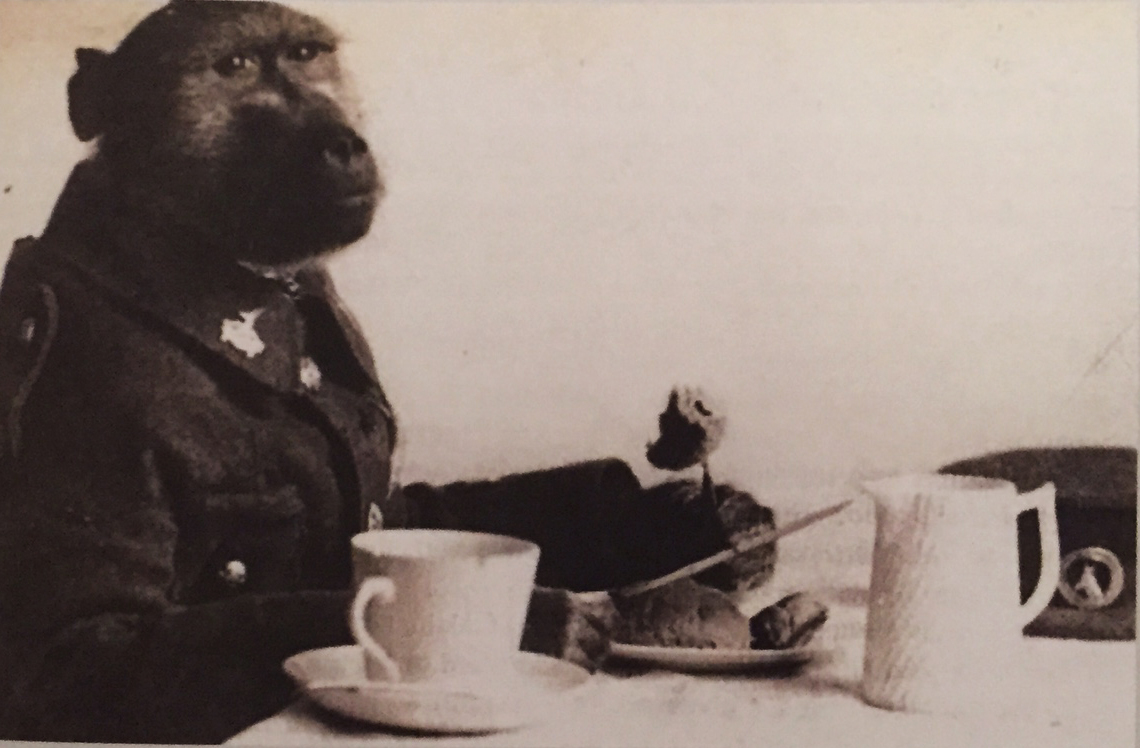
Jackie drew rations like any other soldier, eating at the mess table, using his knife and fork and washing it all down with his own drinking basin. He even knew how to use a teacup.
Jackie drilled and marched with his company in a special uniform and cap complete with buttons, regimental badges, and a hole for his tail.
He would entertain the men during quiet periods, lighting their pipes and cigarettes and saluting officers as they passed on their rounds. He learned to stand at ease when ordered, placing his feet apart and hands behind his back, regimental style.
These two inseparable buddies, Albert Marr and Jackie, first saw combat during the Senussi Campaign in North Africa. On February 26, 1916, Albert took a bullet in the shoulder at the Battle of Agagia. The monkey, beside himself with agitation, licked the wound and did everything he could to comfort the stricken man. It was this incident more than any other that marked Jackie’s transformation from pet and mascot, to a full-fledged member and comrade, of the regiment.
Jackie would accompany Albert at night, on guard duty. Marr soon learned to trust Jackie’s keen eyesight and acute hearing. The monkey was almost always first to know about enemy movements or impending attack, sounding an early warning with a series of sharp barks, or by pulling on Marr’s tunic.
The pair went through the nightmare of Delville Wood together early in the Somme campaign, when the First South African Infantry held its position despite eighty percent casualties.
The third Battle of Ypres, known as the battle of Passchendaele, began in the early morning hours of July 31, 1917. The pair experienced the sucking, nightmare mud of that place and the desperate fighting, around Kemmel Hill. The two were at Belleau Wood, a mostly American operation in which Marine Captain Lloyd Williams of the 2nd Battalion, 5th Marines, was famously informed he was surrounded, by Germans. “Retreat?” Williams snorted, “hell, we just got here.”
Through all of it, Marr and Jackie come through World War 1 mostly unscathed. That all changed in April, 1918.
Withdrawing through the West Flanders region of Belgium, the South African brigade came under heavy bombardment. Jackie was frantically building a wall of stones around himself, a shelter from the hammer blow concussion of the shells and the storm of flying metal buzzing through the air, as angry hornets. A jagged piece of shrapnel wounded Jackie’s arm and another all but tore off the animal’s leg. Even then, Jackie refused to be carried off by the stretcher-bearers, trying instead to finish his wall as he hobbled about on the bloody stump which had once been, his leg.
Lt. Colonel R. N. Woodsend of the Royal Medical Corps described the scene: “It was a pathetic sight; the little fellow, carried by his keeper, lay moaning in pain, the man crying his eyes out in sympathy, ‘You must do something for him, he saved my life in Egypt. He nursed me through dysentery’. The baboon was badly wounded, the left leg hanging with shreds of muscle, another jagged wound in the right arm. We decided to give the patient chloroform and dress his wounds…It was a simple matter to amputate the leg with scissors and I cleaned the wounds and dressed them as well as I could. He came around as quickly as he went under. The problem then was what to do with him. This was soon settled by his keeper: ‘He is on army strength’. So, duly labelled, number, name, ATS injection, nature of injuries, etc. he was taken to the road and sent by a passing ambulance to the Casualty Clearing Station”.
No one was quite sure that the chloroform used for the operation, wouldn’t kill him. When the officer commanding the regiment went to the aid station to check on him Jackie sat up in bed, and saluted.
As the “War to End All Wars” drew to a close, Jackie was promoted to the rank of Corporal and given a medal, for bravery. He may be the only monkey in history, ever to be so honored.
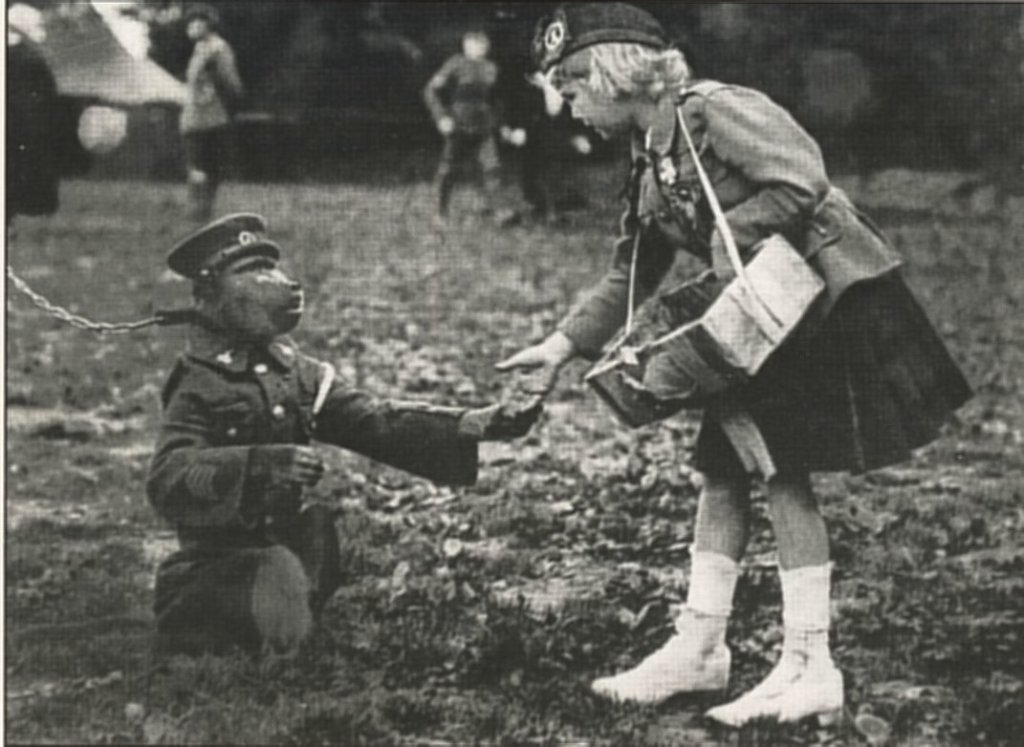
The war ended that November. Jackie and Albert were shipped to England and soon became, media celebrities. The two were hugely successful raising money for the widows and orphans fund, where members of the public could shake Jackie’s hand for half a crown. A kiss on the baboon’s cheek, would cost you five shillings.
Fundraising, in London
On his arm he wore a gold wound stripe and three blue service chevrons, one for each of his three years’ front line service.
Jackie was the center of attention on arriving home to South Africa when a parade was held, officially welcoming the Regiment home. On July 31, 1920, Jackie received the Pretoria Citizen’s Service Medal, at the Peace Parade in Church Square, Pretoria.
All thing must come to an end. The Marr family farm burned to the ground in May 1921. Jackie died in the fire. Albert Marr lived to the age of 84 and passed away, in 1973. There wasn’t a day in-between when the man didn’t miss his little battle buddy Jackie, the baboon who went to war.
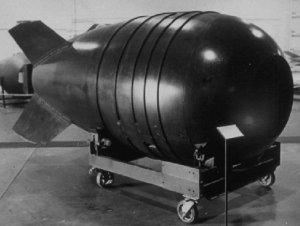
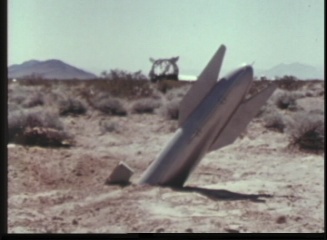
In cold war military parlance, a “Nucflash” is the accidental detonation of an atomic weapon carrying with it, the potential for nuclear war. A “Broken Arrow” refers to a similar incident, absent the potential for war.
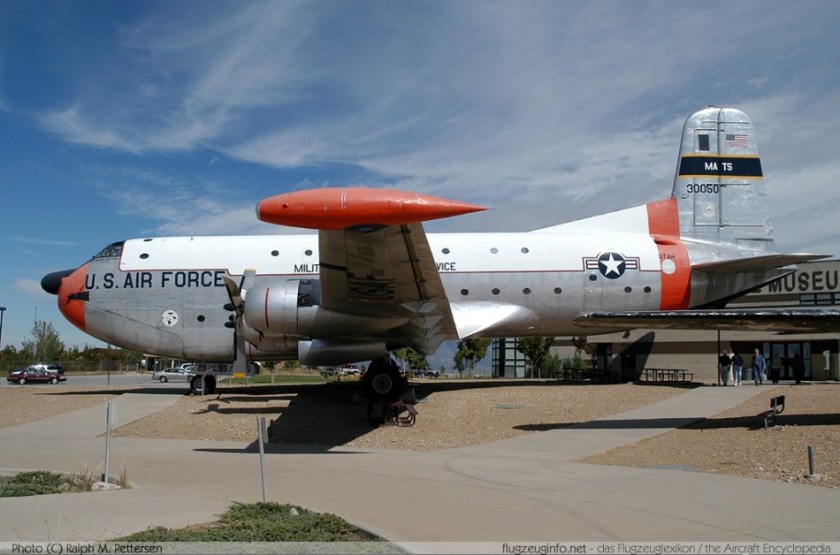
At one time, the C-124 was the world’s largest military transport aircraft. Weighing in at 175,000lbs with a wingspan of 175-feet, four 3,500 horsepower Pratt & Whitney propeller engines drive the air frame along at a stately cruising speed of 246 mph. Manufacturer Douglas Aircraft called the aircraft “Globemaster”. Airmen called the plane “Old Shaky”.
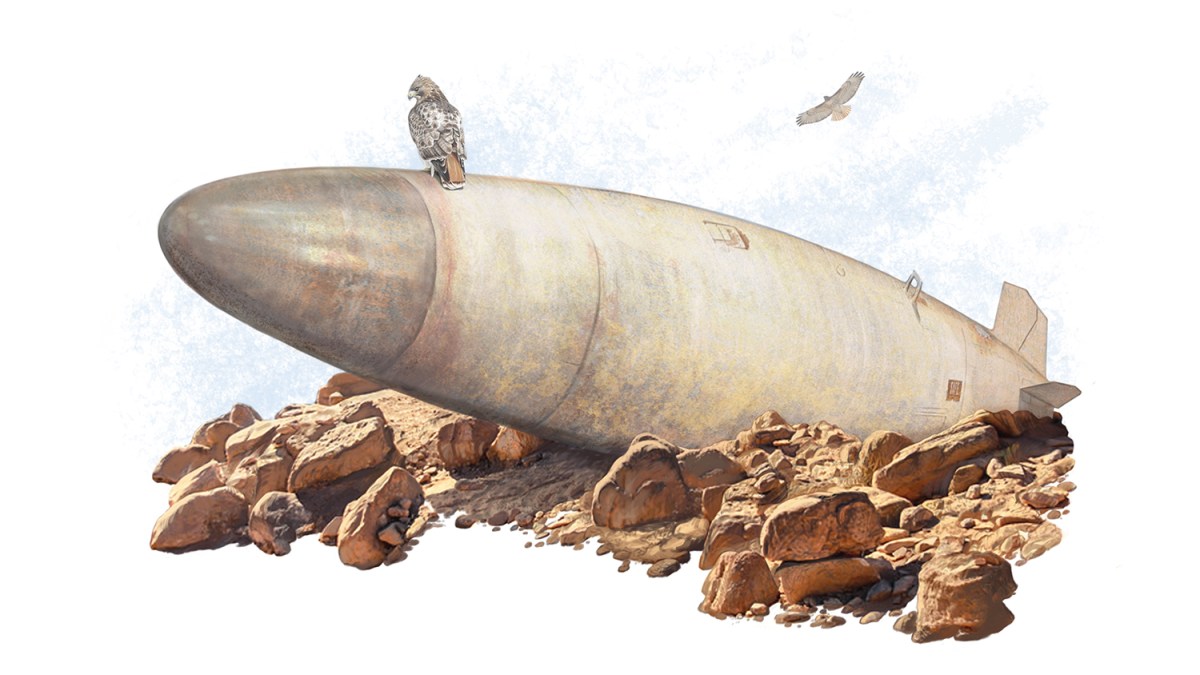
The Air Force C-124 Globemaster transport left its base in Delaware on July 28, 1957, on a routine flight to Europe. On board were a crew of seven, three nuclear bombs, and one nuclear core. The flight would routinely have taken 10-12 hours. This trip was destined to be anything but routine.
Exactly what went wrong remains a mystery, due to the sensitive nature of the cargo. Two engines had to be shut down shortly into the mission, and the aircraft turned back. The nearest suitable airfield was the Naval Air Station in Atlantic City, but that was too far. Even at maximum RPMs, the best the remaining two engines could do was slow the massive aircraft’s descent into the sea.
An emergency landing on open ocean is not an option with such a large aircraft. It would have broken up on impact with the probable loss of all hands. Descending rapidly, the crew would have jettisoned everything they could lay hands on, to reduce weight. Non-essential equipment would have gone first, then excess fuel, but it wasn’t enough. With only 2,500ft and losing altitude, there was no choice left but to jettison those atomic bombs.
At 3,000 pounds apiece, two of the three bombs were enough to do the job, and the C-124 made it safely to Atlantic City. What became of those two atomic bombs remains a mystery. Most likely, they lie at the bottom of the ocean, 100 miles off the Jersey shore.
The United States Department of Defense has a term for accidents involving nuclear weapons, warheads or components, which do not involve the immediate risk of nuclear war. Such incidents are called “Broken Arrows”.
Broken Arrows include accidental or unexplained nuclear or non-nuclear detonation of an atomic weapon, the loss of such a weapon with or without its carrying vehicle, and the release of nuclear radiation resulting in public hazard, whether actual or potential.
The US Defense Department has reported 32 Broken Arrow incidents, since 1950. To date, six nuclear weapons remain lost, and never recovered.
If you’re interested, a handy “Short History of Nuclear Folly” may be found HERE, including details of each incident along with a handy map. It all makes for some mighty comforting bedtime reading.
Gonzatti’s fellow diver Duilio Marcante conceived an idea to honor his friend. A monument to the world beneath the waves and dedicated to those who had lost their lives at sea.
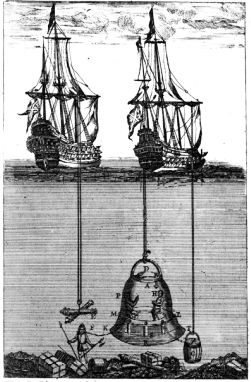
Man’s desire to enter the underwater world goes back to antiquity. Aristotle tells of Alexander the Great descending into the waters of the Mediterranean in something called a “diving bell”, as early as 332BC. The Italian polymath Leonardo da Vinci designed a similar apparatus, adding a face mask and reinforced supply hoses, to withstand the pressure of the depths.
Diving bell, 1691
The first on-demand underwater breathing valve came about in 1860s France, thanks to the work of inventors Benoît Rouquayrol, and Auguste Denayrouze. British diving engineer Henry Albert Fleuss developed the first commercially viable “rebreather” in 1878, using an air bag and rope fiber soaked in potash to “scrub” carbon dioxide from exhaled air.
The 20th century brought with it new and improved methods of pumping, and storing, compressed gas. By the 1930s every major belligerent of the coming war, had developed its own underwater breathing apparatus.
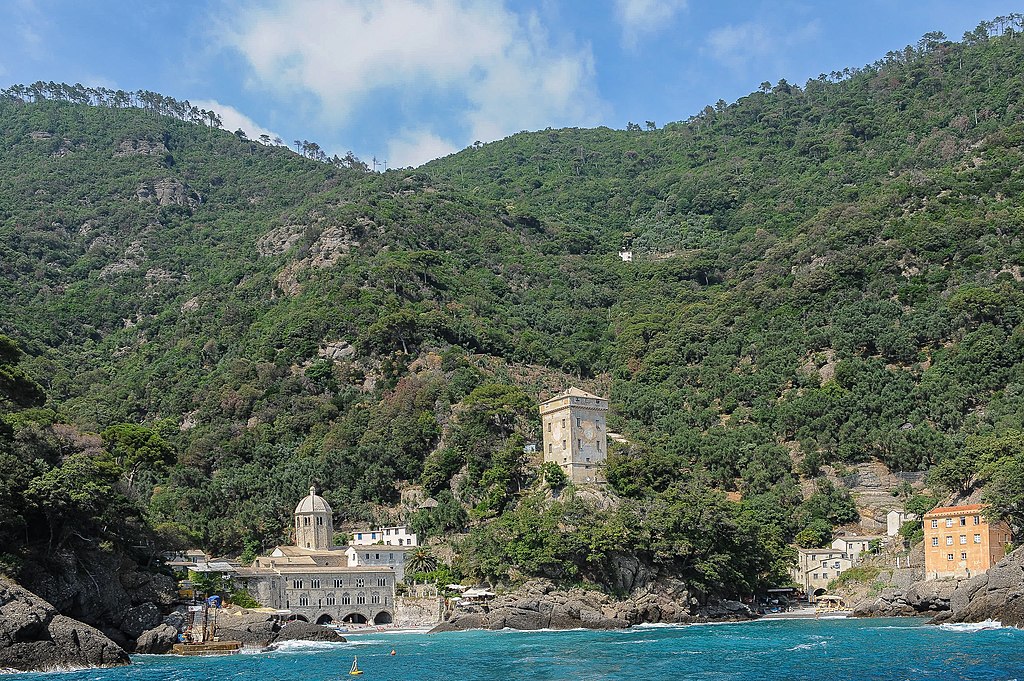
Dario Gonzatti was the first Italian to use SCUBA gear and paid for it with his life in 1947, near the village of San Fruttuoso, on the Italian Riviera.
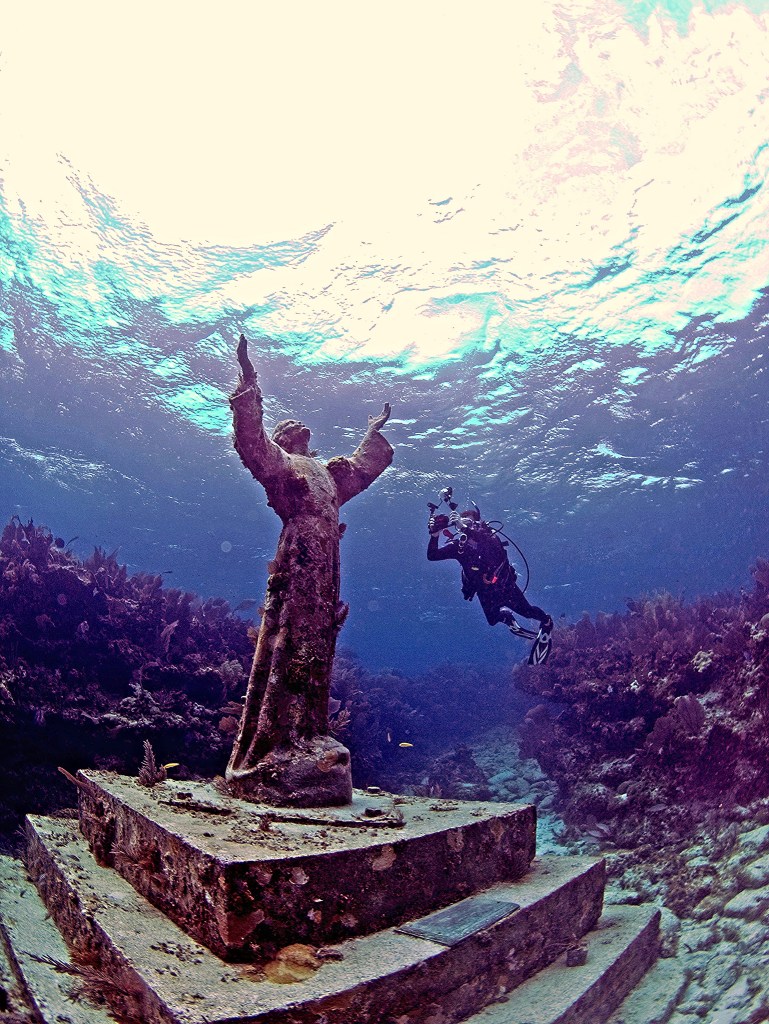
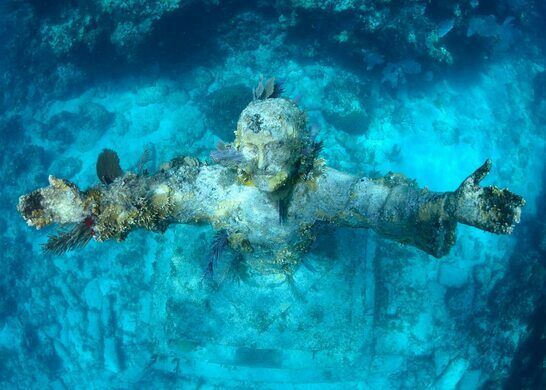
Gonzatti’s fellow diver Duilio Marcante conceived an idea to honor his friend. A monument to a world beneath the waves and dedicated to those who had lost their lives at sea. A 2½ meter tall bronze sculpture, Il Cristo degli Abissi. Christ of the Abyss.
There followed a period of collecting the metal. Cannon and other brass objects, retrieved from wrecks. Mothers and sweethearts sent coins and medals given to sailors, who never returned.
Sculptor Guido Galletti created the clay positive from which the mold was cast. A 2.5 meter (8.2 feet) likeness of Jesus Christ weighing in at 260 kg (573 pounds) without the foundation, eyes raised to the heavens and arms outstretched, in supplication. A benediction for untold numbers, lost at sea.
That first “Christ of the Abyss” was lowered in 57-feet of water on August 22, 1954, near the spot where Dario Gonzatti, lost his life.
The Cove of San Fruttuoso
Over the years, crustaceans and corrosion took their toll. A hand was broken off, by an anchor line. The statue was removed after a half-century and repaired, and re-lowered on July 17, 2004 to a newly-built foundation.
Since that first installation in 1954 two other Christ of the Abyss statues have descended into the depths, both cast from the same clay original. The first was a gift of gratitude given by the navy of Genoa, for assistance from the people of Granada in rescuing the crew of the Italian vessel MV Bianca, destroyed by fire in the port of St. George. That one was placed seven years after the original on October 22, 1961.
Italian dive equipment manufacturer Egidio Cressi donated a third to the Underwater Society of America, in 1962. This one was installed after much debate on August 25, 1965 in the John Pennekamp Coral Reef State Park near Key Largo, Florida, the first underwater park in the United States.
Located in only 25-feet of water with hands but 8 to ten feet below the surface, the site remains a popular destination for underwater selfies, from that day to this.
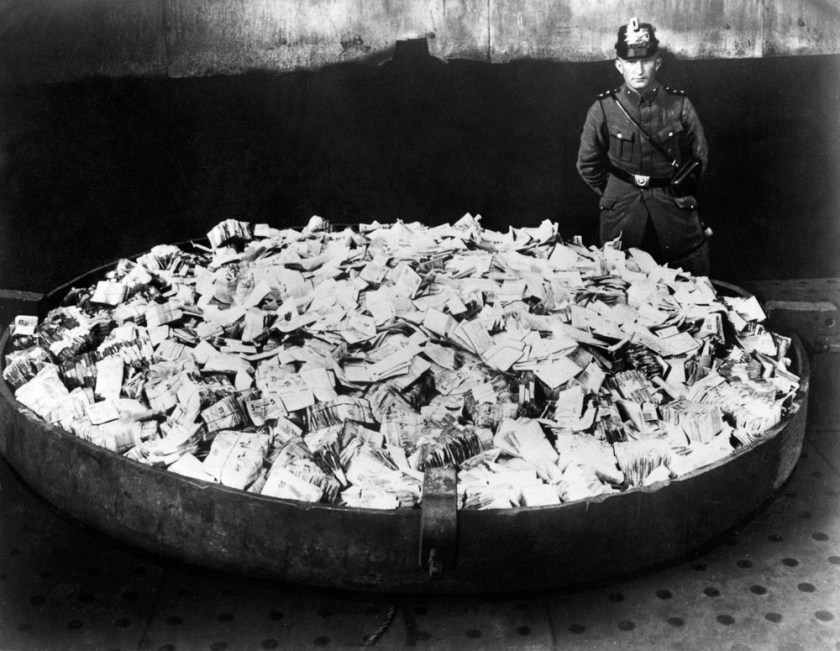
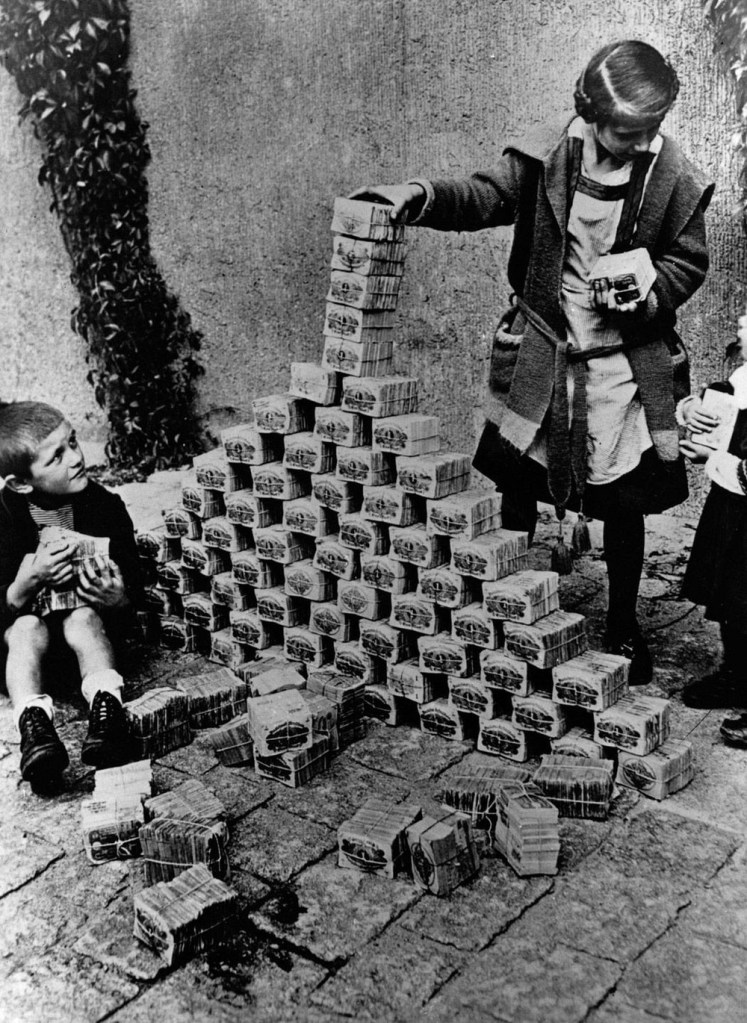
The worst hyperinflation in history peaked on July 10, 1946, when an item that cost 379 Pengö back in September, cost 1,000,000,000,000,000,000,000,000.
You’ve worked all your life. You’ve taken care of your family, paid your taxes, and paid your bills. You’ve even managed to put a few bucks aside, in hopes of a long and happy retirement. So…what if you never touched it and that “nest egg” was suddenly reduced by 10%…40%…70%.
The subject of currency devaluation is normally left to eggheads and academics. Hyperinflation is treated as an historical curiosity. But I wonder. Any economic textbook will tell you what fuels inflation. Even hyperinflation. What makes us think it couldn’t happen here?
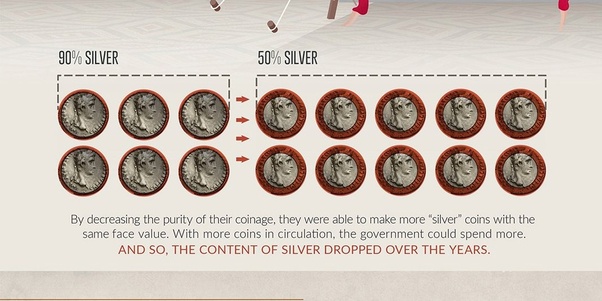
Throughout antiquity, Roman law required that coinage retain a certain silver content. Precious metal made the coins themselves objects of value, and the Roman economy remained relatively stable for 500 years. Republic morphed into Empire over the 1st century BC, leading to a conga line of Emperors minting mountains of coins in their own likenesses. Slaves worked to death in Spanish silver mines. Birds fell from the sky over vast smelting fires, yet there was never enough silver. Silver content was inexorably reduced until the currency itself collapsed, in the 3rd century reign of Diocletian. A once powerful empire and its citizens were left to barter as best they could, in a world where currency had no value.
In the waning days of the Civil War, the Confederate dollar wasn’t worth the paper it was printed on. Paper money crashed in the post-Revolution Articles of Confederation period as well, when you could buy a sheep for two silver dollars, or 150 paper “Continental” dollars. Creditors literally hid from debtors, not wanting to be repaid in worthless paper currency. For generations after our founding, a thing could be described as worthless as, not worth a Continental.
The assistance of French King Louis XIV was invaluable to Revolutionary era Americans, but French state income was only about 357 million livres at the time, with expenses of over half a billion. France descended into its own Revolution, as the government printed “assignat”, notes purportedly backed by 4 billion livres in property expropriated form the church. 912 million livres were in circulation in 1791, rising to almost 46 billion in 1796. One historian described the economic policy of the Jacobins, the leftist radicals behind the Reign of Terror: “The attitude of the Jacobins about finances can be quite simply stated as an utter exhaustion of the present at the expense of the future”.
That sounds depressingly familiar.
The Austro-Hungarian Empire was on the losing side of WW1, and was broken up after the war. Lacking the governmental structures of established states, the newly independent nation of Hungary began to experience inflation. Before the war, a US Dollar would have bought you 5 Kronen. by 1924 that number had risen, to 70,000.
Hungary replaced the Kronen with the Pengö in 1926, pegged to a rate of 12,500 to one.
Hungary became a battleground in the latter stages of WW2, between the military forces of Nazi Germany and the Union of Soviet Socialist Republics. 90% of Hungarian industrial capacity was damaged, half of it destroyed altogether. Transportation was difficult with most of the nation’s rail capacity, damaged or destroyed. What remained was either carted off to Germany or seized by the Russians, as reparations.
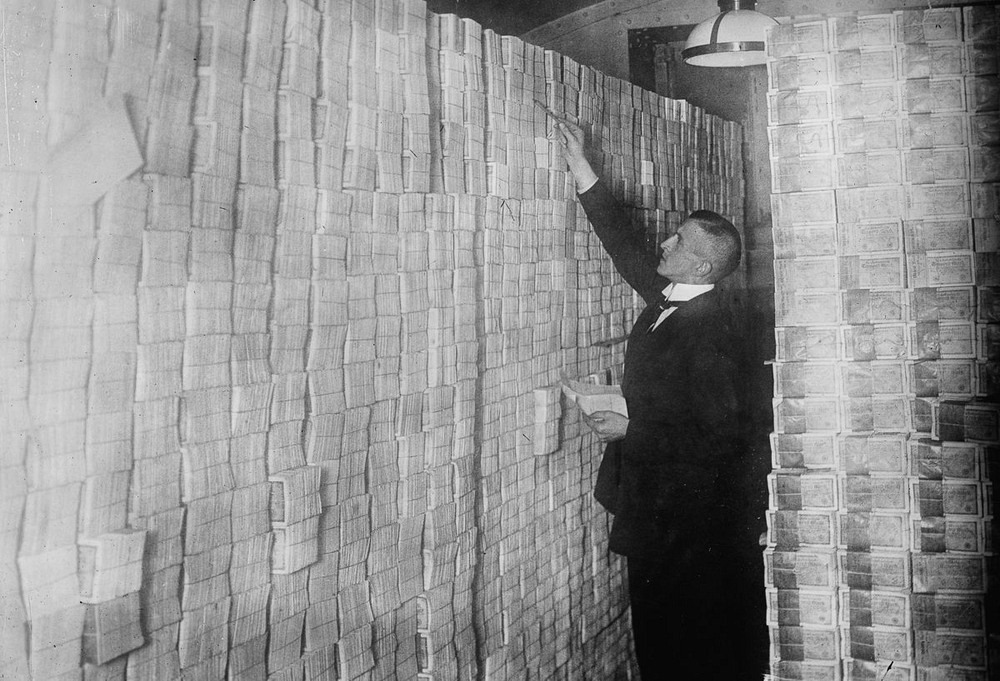
The loss of all that productive capacity led to scarcity of goods, and prices began to rise. The government responded by printing money. Total currency in circulation in July 1945 stood at 25 billion Pengö. Money supply rose to 1.65 trillion by January, 65 quadrillion and 47 septillion July. That’s a Trillion Trillion. Twenty-four zeroes.
47,000,000,000,000,000,000,000,000.00
Banks received low rate loans, so that money could be loaned to companies to rebuild. The government hired workers directly, giving out loans to others and in many cases, outright grants. The country was flooded with money, the stuff virtually grew on trees, but there was nothing to back it up.
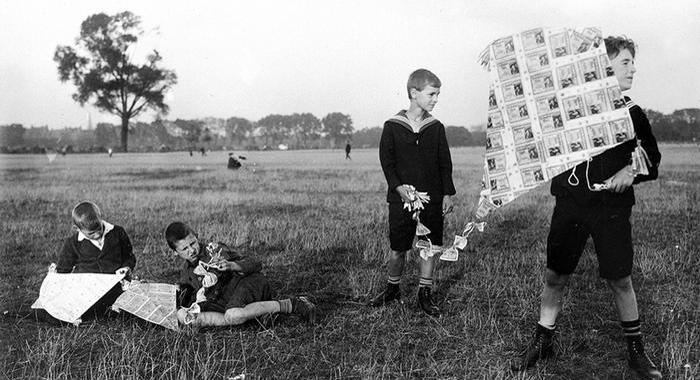
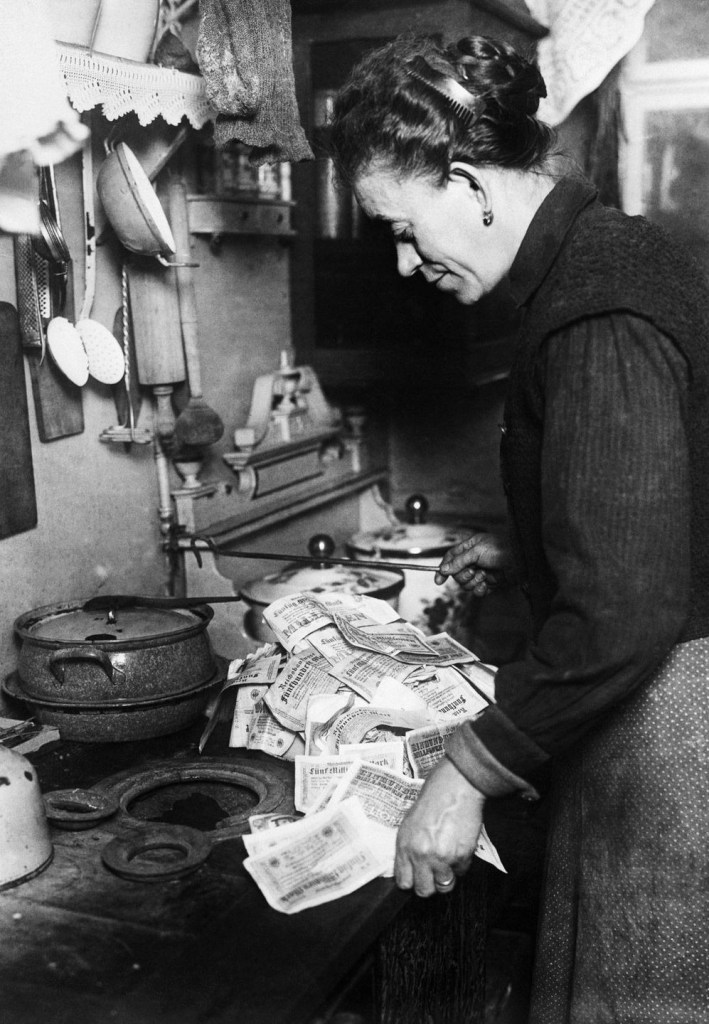
Inflation took a straight line into the stratosphere. An item that cost 379 Pengö in September 1945, cost 1,872,910 by March, 35,790,276 in April, and 862 billion in June. Inflation neared 150,000% per day as the currency became all but worthless. Massive printing of money had accomplished the cube root of zero.
The worst hyperinflation in history peaked on July 10, 1946, when that 379 Pengö item back in September, cost 1,000,000,000,000,000,000,000,000.
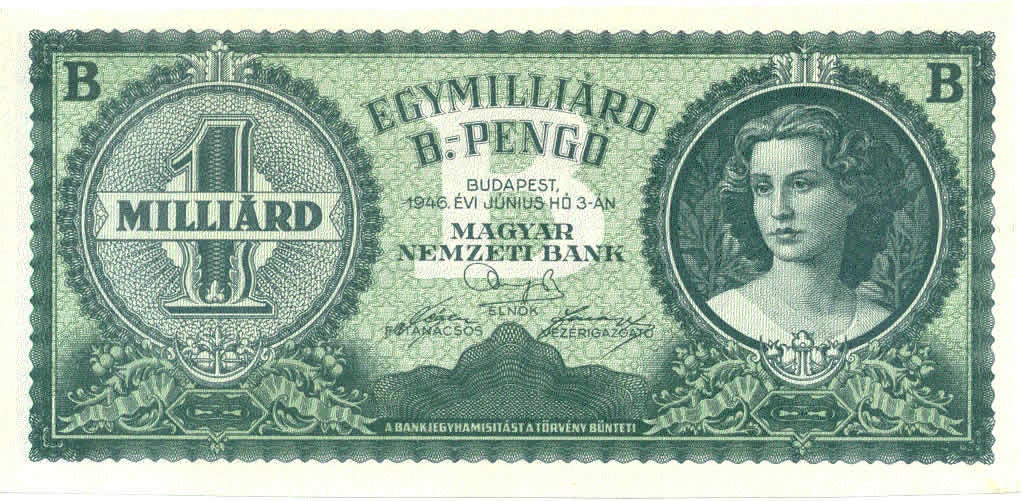
The government responded by changing the name, and the color, of the currency. The Pengö was replaced by the Milpengö (1,000,000 Pengö), which was replaced by the Bilpengö (1,000,000,000,000) and finally the (supposedly) inflation-indexed Adopengö. The spiral resulted in the largest denominated note in history: the Milliard Bilpengö. A Billion Trillion Pengö.
The thing was worth twelve cents.
One more currency replacement and all that Keynesian largesse would finally stabilize the currency, but at what price? Real wages were reduced by 80%. If you were owed money you were wiped out. The fate of the nation was sealed when communists seized power in 1949. Hungarians could now share in that old Soviet joke. “They pretend to pay us, and we pretend to work”.
The ten worst hyperinflations in history occurred during the 20th century, including Zimbabwe in 2008, Yugoslavia 1994, Germany 1923, Greece 1944, Poland 1921, Mexico 1982, Brazil 1994, Argentina 1981, and Taiwan 1949. The common denominator in all ten were government debt, and a currency with no inherent value, except the tacit agreement of a willing buyer, and a willing seller.
In 2015, Boston University economist Laurence Kotlikoff testified before the Senate Budget Committee. “The first point I want to get across” he said, “is that our nation is broke. Our nation’s broke, and it’s not broke in 75 years or 50 years or 25 years or 10 years. It’s broke today”. Kotlikoff went on to describe the “fiscal gap”, the difference between US’ projected revenue, and the obligations our government has saddled us with. “We have a $210 trillion fiscal gap at this point”, Kotlikoff said. 11.6 times GDP – the total of all goods and services produced in the United States.
US fiscal operating debt stood at 18 trillion dollars when Professor Kotlikoff testified before congress. That’s just the on-the-books stuff. We are now north of twenty-eight, seemingly hell-bent, for thirty. The printing presses are working overtime, our currency is unmoored from any objective value.
























 Historical Easter Eggs - Today in History
You must be logged in to post a comment.