Henry Ford had a “thing”, for soybeans. At the 1934 World’s Fair in Chicago, Ford invited reporters to a feast where he served soybean cheese, soybean crackers, soy bread and butter, soy milk, soy ice cream… The man was a veritable Bubba Gump, of soybeans.
The largest museum in the United States is located in the Detroit suburb of Dearborn, the Henry Ford Museum of American Innovation. The sprawling, 12-acre indoor-outdoor complex in the old Greenfield Village is home to JFK’s Presidential limo, the Rosa Parks bus and the Wright Brothers’ bicycle shop. There you will find Abraham Lincoln’s chair from Ford’s Theater, along with Thomas Edison’s laboratory and an Oscar Mayer Wienermobile. George Washington’s camp bed is there, with Igor Sikorski’s helicopter and an enormous collection of antique automobiles, locomotives and aircraft.
Sadly, one object you will not find there, is Henry Ford’s plastic car, made from soybeans.
Ford left the family farm outside of modern-day Detroit as a young man, never to return. His father William thought the boy would one day own the place but young Henry couldn’t stand farm work. He later wrote, “I never had any particular love for the farm—it was the mother on the farm I loved”.
Henry Ford went on to other things, but part of him never left the farm. In 1941, the now-wealthy business magnate wanted to combine industry, with agriculture. At least, that’s what the museum says.
George Washington Carver, at work in his library
Ford first gave the plastic car project to yacht designer Eugene Turenne Gregorie, but later turned to the Greenfield Village soybean laboratory. To the guy in charge over there, actually, a guy with some experience in tool & die making. His name was Lowell Overly.
The car was made in Dearborn with help from the scientist and botanist George Washington Carver, (yeah, That George Washington Carver), a man born to slavery who rose to such prodigious levels accomplishment, that Time magazine labeled him the “Black Leonardo”.
The soybean car, introduced to the public this day in 1941, was made from fourteen ¼-inch thick plastic panels and plexiglass windows, attached to a tubular steel frame and weighing in at 1,900 pounds, about a third lighter than comparable automobiles of the era. The finished prototype was exhibited later that year at the Dearborn Days festival, and the Michigan State Fair Grounds.
The thing was built to run on fuel derived from industrial hemp, a related strain of the Cannibis Sativa plant beloved of stoners the world over and known simply, as “weed”.
Ford claimed he’d be able to “grow automobiles from the soil”, a hedge against the metal rationing of world War Two. He dedicated 120,000 acres of soybeans to experimentation, but to no end. The total acreage devoted to “fuel” production, is unrecorded.
Another reason for a car made from soybeans, was to help American farmers. Plus, Henry Ford seems to have had a “thing”, for soybeans. At the 1934 World’s Fair in Chicago, Ford invited reporters to a feast where he served soybean cheese, soybean crackers, soy bread and butter, soy milk, soy ice cream… The man was a veritable Bubba Gump, of soybeans. Ford was probably one of the first in this country, to regularly drink soy milk.
Henry Ford’s own car was fitted with a soybean trunk and struck with an axe to show the material’s durability, though the axe was later revealed to have a rubber boot.
Henry Ford’s experiment in making cars from soybeans never got past that first prototype, and came to a halt during WW2. The project was never revived, though several states adopted license plates stamped out of soybeans, a solution farm animals found to be quite delicious.
The car itself was destroyed long ago, the ingredients for its manufacture unrecorded, but the thing lives on in the hearts of hemp enthusiasts, everywhere.
The New York Times claimed the car body and fenders were made from soy beans, wheat and corn. Some sources opine that the car was made from Bakelite or some variant of Duroplast, a plant-based auto body substance produced in the millions, for the East German Trabant.
One newspaper claimed that nothing ever came from Henry Ford’s soybean experiments, except whipped cream.
If you enjoyed this “Today in History”, please feel free to re-blog, “like” & share on social media, so that others may find and enjoy it as well. Please click the “follow” button on the right, to receive email updates on new articles. Thank you for your interest, in the history we all share.
Research suggests that we all carry Neanderthal genes and that these may have changed our immune systems, leaving us vulnerable to diseases such diabetes and cancer.
In the 17th century, the German Reformed Church teacher and hymn writer Joachim Neander liked to hike a valley outside of Düsseldorf. The beauty of nature was inspirational, clearing his mind and inspiring verses like “See how God this rolling globe/swathes with beauty as a robe…Forests, fields, and living things/each its Master’s glory sings.” The theologian contracted tuberculosis and died at the age of thirty but lived on in a way, in the valley which came to bear his name.
Nearly 200 years later, three years before Charles Darwin published the Origin of Species, workers quarrying limestone in the Neander Valley discovered an unusual skull. This was no ordinary head, elongated and nearly chinless as it was, with heavy ridges over the eyes. Heavy bones were found alongside, which fitted together, oddly.
From top, clockwise: a) Neander Valley by Friedrich Wilhelm Schreiner, oil on cardboard, 1855, b) original bones discovered the following year, and c)Artist’s conception of what he looked like, H/T Artist: Kennis & Kennis Reconstructions
The state of archaeological science had much to learn in 1856. Who knows, 22nd century historians and scientists may look back at our time, and say we had a long way to go. At the time, even to discern fossils from ordinary rock was beyond the ability of many scientists. One common method involved licking the fossil. If the thing had animal material, it would stick to your tongue.
Despite such misconceptions, scholars of the day had no shortage of theories. This was a lost Cossack, a bowlegged rider suffering from rickets, a painful condition resulting in weak and misshapen bones. To some, the life of pain resulting from such a condition made perfect sense, the bony eye ridges resulting from perpetually furrowed brow.
British geologist William King suspected something different. Something more radical. This was no aberrant human being nor even a lost ancestor. This was a member of a long lost alternate humanity. An extinct but parallel species to our own. King published a paper in 1864 hypothesizing his idea of an evolutionary dead end, naming the long lost species after the poet who had once wandered the valley in which it was discovered. He called it Homo Neanderthalensis: Neanderthal Man.
“Neanderthal sculptures, named Nana and Flint, at the Gibraltar Museum”. H/T Jaap Scheeren, New York Times
Having no context from which to draw conclusions, King fell back on the pseudo science of phrenology to describe Neanderthal man, along with preconceptions of “primitive” and “savage” races. The image of a stupid and grunting brute emerged from this analysis. King opined that “The thoughts and desires which once dwelt within it never soared beyond those of a brute.” Today we may look at such thinking as itself savage and primitive, but applying modern ideas to earlier times is a dangerous undertaking. Ideas of Eugenicssurvived well after King’s time, and into the modern era.
On this day in 1908, the brothers Amadee and Jean Bouyssonie found the most complete Neanderthal skeleton to date in a small cave near La Chapelle-aux-Saints, in France. This skeleton includes the skull, jaw, most of the vertebrae and several ribs, along with most of the long bones of his arms and legs, plus a number of smaller bones from the hands and feet.
The Old Man of La Chapelle-Aux-Saints reconstructed burial in the Musée de l’Homme de Néandertal, France
French palaeontologist Marcellin Boule studied the remains and envisioned a brutish, hairy and gorilla-like beast with opposable toes and bent spine, walking on bowed legs with bent knees. Boule’s reconstruction was influential. Decades later, scientists and popular culture viewed Neanderthal as bent and stupid brutes. Boule got it wrong that time but, to his credit, was one of the first to recognize Piltdown Man, as a paleoanthropological hoax.
Subsequent analysis of the “Old Man of La Chappelle” revealed not the bent-over beast of Boule’s imagination, but a fully erect biped, bent with advanced osteoarthritis.
What’s more, massive tooth loss and lack of mobility revealed that this specimen could neither hunt nor scavenge with ease, and would have had great difficulty in chewing his food. This and the unmolested state of the skeleton compared with animal bones found nearby suggest a man greatly cared for by his contemporaries, as well as deliberate burial of the body.
This wasn’t even an “old man” by our standards. The skeleton is currently estimated to have been that of a man between 25 and 40 years, demonstrating the Hobbesian adage that life was once indeed, “Nasty, Brutish and Short”.
Today, to call someone a “Neanderthal” is to insult him as a stupid savage. It appears that our cousin was nothing of the sort.
The hyoid bone situated at the floor of the mouth serves as a connecting-point for the tongue and other musculature, giving humans the ability to speak. A delicate structure likely to be lost in most fossilized remains, the first Neanderthal hyoid was only discovered in 1989.
An international team of researchers analysed this fossil Neanderthal bone using 3D x-ray imaging and mechanical modelling and, yes. Neanderthal could not only speak, but was capable of highly complex speech not unlike ourselves, though his voice was likely high and grating. Certainly not the base grunting commonly associated with “cave-men”.
Shorter in stature and considerably more powerful than Cro-Magnon, our direct ancestor and all but indistinguishable from ourselves, Neanderthal bodies were suited to the ice age of the early and middle Paleolithic era.
Neanderthal emerged on the Eurasian landmass between 100,000 and 200,000 years ago. Possessed of a brain only slightly smaller than Cro-Magnon, Neanderthals walked upright, formed and used simple tools and controlled fire. They even buried their own dead, at least sometimes, and some researchers theorize that they built boats and sailed the Mediterranean. Imperfectly formed tools and weapons found alongside more sophisticated specimens even suggest that he educated his children.
He might even fit in if you brought him back today, provided you dressed him right.
Despite all that, Neanderthal man is an evolutionary dead end and not our ancestor, though he did “coexist” for a time, with our Cro-Magnon forebears. It’s even possible if not probable that the two bred together and produced children, though this was likely your random hookup rather than any long-term cross-breeding.
Modern DNA analysis suggests that the two species even shared some genetic disorders, such as psoriasis, Crohn’s disease and a variety of auto-immune conditions such as Lupus.
Research even suggests that we carry Neanderthal genes, every one of us, and that these may have changed our immune systems leaving us vulnerable to diseases such diabetes and cancer.
The idea is not as strange as it sounds. Last year, Sir Richard Branson was in the news, claiming that he had looked into his family ancestry. Forty generations back, it turns out that Branson is related to Charlemagne. That’s no big deal, according to Genetecist Adam Rutherford. Speaking at the Chalke Valley History Festival, Rutherford explained that “Literally every person in Europe is directly descended from Charlemagne. Literally, not metaphorically. You have a direct lineage which leads to Charlemagne,” adding “Looking around this room, every single one of you … is directly descended between 21 and 24 generations from Edward III.” The only difference between celebrities and the rest of us it turns out, is the means to prove it.
So, maybe calling someone ‘Neanderthal’ isn’t such an insult, after all. Perhaps there’s one in there somewhere, peering back at us from our bathroom mirror.
If you enjoyed this “Today in History”, please feel free to re-blog, “like” & share on social media, so that others may find and enjoy it as well. Please click the “follow” button on the right, to receive email updates on new articles. Thank you for your interest, in the history we all share.
These guys were sending human beings 240,000 miles into space, to land on the moon and come back again, on computing “horsepower” equivalent to modern pocket calculators.
On May 25, 1961, President John F. Kennedy delivered a message before a joint session of Congress, articulating a goal of “landing a man on the moon and returning him safely to the earth” by the end of the decade.
Though he wouldn’t live to see it, Kennedy’s pledge would be realized forty-nine years ago on this day: July 20, 1969.
Today, the accomplishments of the Apollo series of spacecraft seem foreordained, the massive complexities of the undertaking, forgotten.
In the modern era, the most powerful supercomputers on earth put the Hubble Space Telescope into orbit, with “vision” literally requiring correction. With “glasses”.
These guys were sending human beings 240,000 miles into space, to land on the moon and come back again, on computing “horsepower” equivalent to modern pocket calculators.
Any one of countless calculations could have misfired, slinging three astronauts into the black void of space, there to spend eternity, in a flying tomb.
The 363′, 6,698,700-pound Saturn V launch vehicle lifted off from the John F. Kennedy Space Center on Merritt Island, Florida on July 16, carrying mission commander Neil Armstrong, Lunar module pilot Edwin “Buzz” Aldrin, and Command Module Michael Collins.
The Apollo spacecraft consisted of three components: a Command Module (CM) with a cabin for the three astronauts, a Service Module (SM) supporting the CM with propulsion, electrical power, oxygen, and water; and a Lunar Module (LM) for landing on the Moon. The vehicle was launched toward the moon by a Saturn V rocket, designed to break apart as each of a series of rocket stages were exhausted, and separated from the main craft.
The Command/Service Module passed behind the moon at 12:21 Eastern Standard Time on July 19, firing its service propulsion engine and inserting the craft into lunar orbit.
The moon as seen from the International Space Station on July 9, 2018 H/T Alexander Gerst, NASA
Aldrin and Armstrong next moved into the LM, the only component to actually land on the lunar surface, with Collins remaining to orbit the moon in the CM.
The pair landed on a flat plain called the “Sea of Tranquility” on this day in 1969 at 4:18pm EST. Half the world heard the words “Tranquility base, the eagle has landed”. Neil Armstrong stepped onto the lunar surface six hours later, with the words “That’s one small step for [a] man, one giant leap for mankind”.
These first two humans to set foot on the moon spent about 2½ hours on the surface. The pair collected nearly 50-lbs of material for transport back to earth, planting the American flag where it most likely remains, to this day.
Two days earlier, White House speechwriter William Safire had written an address, a speech to be delivered by President Richard Nixon, in case of failure. Twenty-five years earlier on the eve of the D-Day invasion, General Dwight D. Eisenhower penned a letter, taking personal responsibility for the mission’s failure. Like Eisenhower’s letter, President Nixon’s speech was never delivered. The speech was entitled, “IN EVENT OF MOON DISASTER”
“Fate has ordained that the men who went to the moon to explore in peace will stay on the moon to rest in peace. These brave men, Neil Armstrong and Edwin Aldrin, know that there is no hope for their recovery. But they also know that there is hope for mankind in their sacrifice. These two men are laying down their lives in mankind’s most noble goal: the search for truth and understanding”…
The course of events envisioned by Richard Nixon’s speech writer, never came to be. The upper part of the Lunar Module lifted off 21½ hours later, returning Armstrong and Aldrin to the Command Module. Armstrong, Aldrin and Collins returned to earth and splashed down in the Pacific Ocean on July 24. Three astronauts had made history. The United States had had the last word in the space race, with the Soviet Union.
The Apollo 17 Saturn V rocket was the last human flight to the moon
If you enjoyed this “Today in History”, please feel free to re-blog, “like” & share on social media, so that others may find and enjoy it as well. Please click the “follow” button on the right, to receive email updates on new articles. Thank you for your interest, in the history we all share.
“Now I am become death, the destroyer of worlds”. – Bhagavad Gita
“Now I am become death, the destroyer of worlds“.
The words come down to us from the Bhagavad Gita, the Hindu epic Mohandas Gandhi would describe as his “spiritual dictionary”. On this day in 1945, these were the words of “Manhattan Project” director J. Robert Oppenheimer as he witnessed “Trinity”, the world’s first nuclear detonation.
The project had begun with an August 2, 1939 letter, written by the prominent physicists Leo Szilárd and Albert Einstein to President Franklin Roosevelt, warning that Nazi Germany may be working to develop a secret “Super Weapon”. It ended with that single explosion in the Jornada del Muerto (loosely, “Journey of the Dead Man”) desert, equal to the explosive force of 15,000 – 20,000 tons of TNT.
Einstein–Szilárd letter
The Manhattan project, the program to develop the Atomic Bomb, was so secret that Vice President Harry Truman was unaware of its existence. President Roosevelt passed away on April 14, when Harry Truman was sworn in as President. He was fully briefed on the Manhattan project 10 days later, writing in his diary that night that the United States was perfecting an explosive great enough to destroy the whole world.
Nazi Germany surrendered on May 7, but the war with Japan ground on. By August, Truman faced the most difficult decision ever faced by an American President. Whether to drop an atomic bomb on a population of human beings.
The morality of the decision has been argued ever since, and will continue to be, I’m sure. In the end, it was decided that to drop the bomb would end the war faster with fewer lives lost (on both sides), compared with an invasion of the Japanese home islands.
The second nuclear detonation in history took place on August 6 over Hiroshima, Japan. “Little Boy”, as the bomb was called, was delivered by the B29 Superfortress “Enola Gay”, named after the mother of United States Army Air Forces pilot Lieutenant Colonel Paul Tibbets. 66,000 Japanese citizens were vaporized in an instant, or died within the following days from the effects of the bomb. Another 100,000 later died from injuries and the delayed effects of radiation.
Even then, the Imperial Japanese Government refused to surrender. ‘Fat Man’, a plutonium bomb carried by the B29 “Bockscar”, was dropped on Nagasaki on August 9.
The intended target was Kokura, but local weather reduced visibility. 393d Bombardment Squadron Commander Major Charles Sweeney bypassed Kokura and chose the secondary target, Nagasaki. Half of Nagasaki was destroyed in the blast, and another 70,000 people killed.
Japan surrendered unconditionally on the 14th of August, ending the most destructive war in history.
During the 1920s, the University of Göttingen was one of the world’s leading centers for theoretical physics. American-born J. Robert Oppenheimer was himself educated there, along with the likes of Enrico Fermi, Edward Teller, and the English-born Paul Dirac, regarded as “one of the most significant physicists of the 20th century”.
The academic landscape of 1920s Germany was such that the Nazi regime may very well have been first to the nuclear finish line, but for the politicization of the universities themselves, brought on by National Socialist policy.
On April 7, just 67 days after Adolf Hitler’s appointment as Chancellor, the ‘Civil Service Law’ of 1933 established the framework for the removal of ‘undesirables’ in civil service, medicine, education and the legal profession. A series of increasingly draconian anti-Jewish laws left tens of thousands of Jews including that pillar of modern theoretical physics Albert Einstein himself, no choice but to flee.
More than 133,000 German Jewish émigrés moved to the United States between 1933 and 1944, many of them highly educated and some holding Nobel prizes. In a research paper for the University of Stanford, assistant Professor of Economics Petra Moser reported a 31% increase in the number of US patents in the physical sciences, after 1933.
The Nazi nuclear weapons project began on December 17, 1938 when German physicist Otto Hahn and assistant Fritz Strassmann discovered the atomic fission of heavy elements. The first real push to develop a nuclear weapon began the following April but fizzled months later, when a number of notable physicists were drafted into the Wehrmacht.
A second such effort began on September 1, 1939, the day that Hitler invaded Poland. While the Nazi nuclear program received funding throughout the war, it never received the concentrated effort of a Manhattan project. Instead, the program was carved into three separate pieces, and personnel were always subject to the recruiting needs of the military, irrespective of education, training or skills.
This series of decisions, no doubt taken in some conference room somewhere, put Nazi Germany behind in the nuclear arms race. How different the world would be, if Little Boy and Fat Man displayed swastikas, painted on their sides.
If you enjoyed this “Today in History”, please feel free to re-blog, “like” & share on social media, so that others may find and enjoy it as well. Please click the “follow” button on the right, to receive email updates on new articles. Thank you for your interest, in the history we all share.
The “Tunguska Event” was the largest such impact event in recorded history, but far from the first. Or the last.
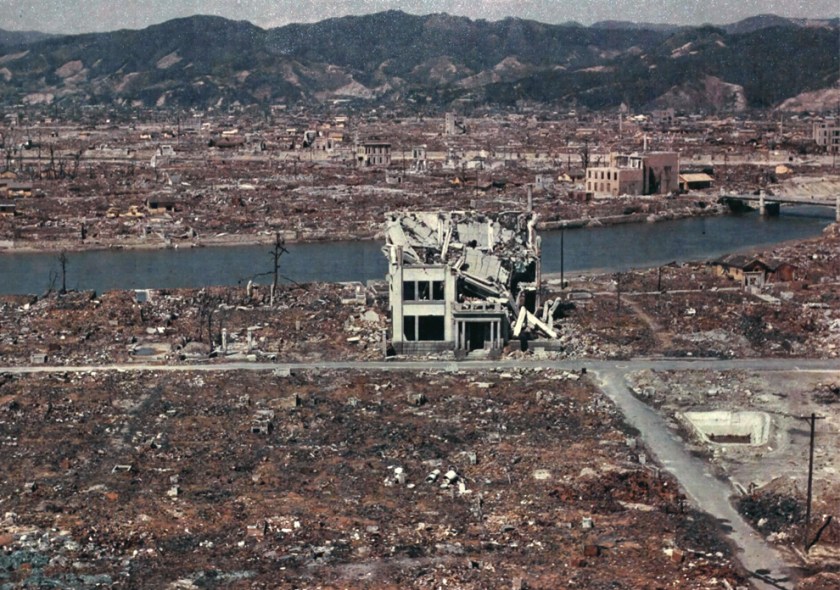
The first atomic bomb in the history of human conflict exploded in the skies over Japan on August 6, 1945. The bomb, code named “Little Boy”, reached an altitude of 1,900-ft. over the city of Hiroshima at 8:15am, Japanese Standard Time.
A “gun-triggered” fission bomb, barometric-pressure sensors initiated the explosion of four cordite charges, propelling a small “bullet” of enriched uranium the length of a fixed barrel and into a sphere of the same material. Within picoseconds (1/.000000000001 of a second), the collision of the two bodies initiated a fission reaction, releasing an energy yield roughly equivalent to 15,000 tons of TNT.
66,000 were killed by the effects of the blast, the shock wave spreading outward at a velocity greater than the speed of sound and flattening virtually everything in its path, for a distance of a mile in all directions.
Thirty-seven years earlier, the boreal forests of Siberia lit up with an explosion 1,000 times greater than the atomic bomb dropped over Hiroshima. At the time, no one had the foggiest notion that it was coming.
The Taiga occupies the high latitudes of the world’s northern regions, a vast international belt line of coniferous forests consisting mostly of pines, spruces and larches between the high tundra, and the temperate forest. An enormous community of plants and animals, this trans-continental ecosystem comprises a vast biome, second only to the world’s oceans.
The Eastern Taiga is a region in the east of Siberia, an area 1.6 times the size of the continental United States. The Stony Tunguska River wends its way along an 1,160-mile length of the region, its entire course flowing under great pebble fields with no open water.
On the morning of June 30, 1908, the Tunguska River lit up with a bluish-white light. At 7:17a local time, a column of light far too bright to look at moved across the skies above the Tunguska. Minutes later, a vast explosion knocked people off their feet, flattening buildings, crops and as many as 80 million trees over an area of 830-square miles. A vast “thump” was heard, the shock wave equivalent to an earthquake measuring 5.0 on the Richter scale. Within minutes came a second and then a third shock wave and finally a fourth, more distant this time and described by eyewitnesses as the “sun going to sleep”.
On July 13, 1908, the Krasnoyaretz newspaper reported “At 7:43 the noise akin to a strong wind was heard. Immediately afterward a horrific thump sounded, followed by an earthquake that literally shook the buildings as if they were hit by a large log or a heavy rock”.
Fluctuations in atmospheric pressure were detectable as far away as Great Britain. Night skies were set aglow from Asia to Europe for days on end, theorized to have been caused by light, passing through high-altitude ice particles.
In the United States, lookout posts from the Smithsonian Astrophysical Observatory headquartered in Cambridge, Massachusetts, to the Mount Wilson Observatory in Los Angeles recorded a several months-long decrease in atmospheric transparency, attributed to an increase in dust, suspended in the atmosphere.
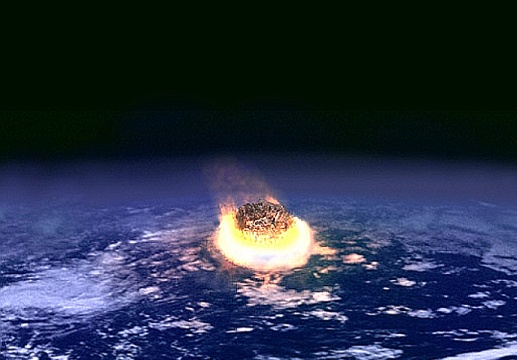
The “Tunguska Event” was the largest such impact event in recorded history, but far from the first, or the last. Mistastin Lake in northern Labrador was formed during the Eocene era of 36-million years ago, cubic Zirconium deposits suggesting an impact-zone temperature of some 4,300° Fahrenheit. Halfway to the temperature of the sun.
“A bolide – a very bright meteor of an apparent magnitude of &−14 or brighter” H/T Wikimedia
Some sixty-six million years ago, the “Chicxulub impactor” struck the Yucatan Peninsula of Mexico, unleashing a mega-tsunami of 330-ft in height from Texas to Florida. Superheated steam, ash and vapor towered over the impact zone, as colossal shock waves triggered global earthquakes and volcanic eruptions. Vast clouds of dust blotted out the sun for months on end, leading to mass extinction events the world over.
The official history of the Ming Dynasty records the Ch’ing-yang event of 1490, a meteor shower in China, in which “stones fell like rain”, killing some 10,000 people.
In 2013, a twenty-meter (66-ft) space rock estimated at 13,000-14,000 tons flashed across the skies of Chelyabinsk, Russia, breaking apart with a kinetic impact estimated at 26-times the nuclear blast over Hiroshima. The Superbolide (a bolide is “an extremely bright meteor, especially one that explodes in the atmosphere”) entered the earth’s atmosphere on February 15, burning exposed skin and damaging retinas for miles around. No fatalities were reported, though 1,500 were injured seriously enough to require medical attention.
The 450-ton Chicora Meteor collided with western Pennsylvania on June 24, 1938, in a cataclysm comparable to the Halifax Explosion of 1917. The good luck held, that time, the object making impact in a sparsely populated region. The only reported casualty, was a cow. Investigators F.W. Preston, E.P. Henderson and James R. Randolph remarked that “If it had landed on Pittsburgh there would have been few survivors”.
In 2018, the non-profit B612 Foundation dedicated to the study of near-Earth object impacts, reported that “It’s a 100 per cent certain we’ll be hit [by a devastating asteroid]”. Comfortingly, the organization’s statement concluded “we’re [just] not 100 per cent sure when.”
If you enjoyed this “Today in History”, please feel free to re-blog, “like” & share on social media, so that others may find and enjoy it as well. Please click the “follow” button on the right, to receive email updates on new articles. Thank you for your interest, in the history we all share.
Workers at the Flint Michigan plant assembled the first Corvette on this day in 1953. The first production car rolled off the assembly line two days later. 300 hand-built Corvettes came off the line that model year, all white.
For two years, General Motors designer Harley Earl labored to build an affordable American sports car, to compete with the MGs, Jaguars and Ferraris coming out of Europe. The first convertible concept model appeared in early 1953, part of the GM Motorama display at the New York Auto Show held at the Waldorf-Astoria Hotel.
Chevrolet wanted to give the new model a “non-animal” name, starting with ‘C’. Newspaper photographer Myron Scott suggested the name of a small class of warship, the “trim, fleet naval vessel that performed heroic escort and patrol duties during World War II.” They called this new model a Corvette.
Workers at the Flint Michigan plant assembled the first Corvette on this day in 1953. The first production car rolled off the assembly line two days later. 300 hand-built Corvettes came off the line that model year, all white.
To keep costs down, off-the-shelf components were used whenever possible. The body was made of fiberglass to keep tooling expenses low. The chassis and suspension came from the 1952 Chevy sedan. The car featured an increased compression-ration version of the same in-line six “Blue Flame” block used in other models, coupled with a two-speed Power glide automatic transmission. No manual transmission of the time could reliably handle an output of 150 HP and a 0-60 time of 11½ seconds.
GM moved production to St. Louis, Missouri the following year. Since 1974, the car has been manufactured in Bowling Green, Kentucky, where the Corvette has become the official sports car of the Commonwealth of Kentucky.
Sales were disappointing in the first couple years, compared with those of European competitors. GM refined the early design and added a V-8 in 1955, greatly improving the car’s performance. By 1961, the Corvette had established itself as a classic American muscle car.
The second generation (C2) introduced the “Stingray” name in 1963. Still sporting fiberglass body panels, the car was smaller and lighter than previous models with a maximum output of 360 HP. The sleek, tapered design was said to be patterned after the Mako shark caught by lead designer Bill Mitchell, on a deep sea fishing trip.
The third generation (1968–1982) featured a radically new body and interior design, and Chevy’s first use of T-top removable roof panels. The “Stingray” name was dispensed with in 1976, in 1978, the C3 became the first of 12 Corvettes to be used as Pace Cars for the Indy 500.
The radical redesign of the fourth generation Corvette was intended for the 1983 model year but, quality issues and delays from parts suppliers resulted in only 43 prototypes being built. None of them were ever sold. Only one of the 1983 prototypes survives; it’s on display at the National Corvette Museum in Bowling Green, Kentucky.
When it came to quality and styling, many felt that the C4 compared poorly with Japanese competitors like the Nissan 300ZX and Mazda RX-7. The 5th generation introduced in 1997 addressed many of these issues. The production C5 had a top speed of 181 mph, while the lower drag coefficient and new, aerodynamic styling resulted in 28 mpg on the highway.
Twenty-first century updates exposed headlights for the first time since 1962, the 7th generation becoming the first to bear the Stingray name since the 1976 model year. Air intake grills were exposed for the first time in four generations, as the all-important 0-60 times approached the four-seconds mark.
Corvette enthusiasts criticized the aggressive, angular lines of the C7, claiming the rear end looks more like a C5 Camaro. Others complained about the front end; with an air intake grill exposed for the first time in four generations.
The supercharged 6.2L V8 power plant of the 2019 Z06 develops 650 horsepower, capable of accelerating from 0-60 mph in 2.95 seconds with a top end of 207.4 mph. Ain’t nobody fussing about that.
If you enjoyed this “Today in History”, please feel free to re-blog, “like” & share on social media, so that others may find and enjoy it as well. Please click the “follow” button on the right, to receive email updates on new articles. Thank you for your interest, in the history we all share.
There is a story about Galileo, which may or may not be true. After his conviction, the astronomer is said to have muttered “Eppur si muove” — “And yet it moves”.
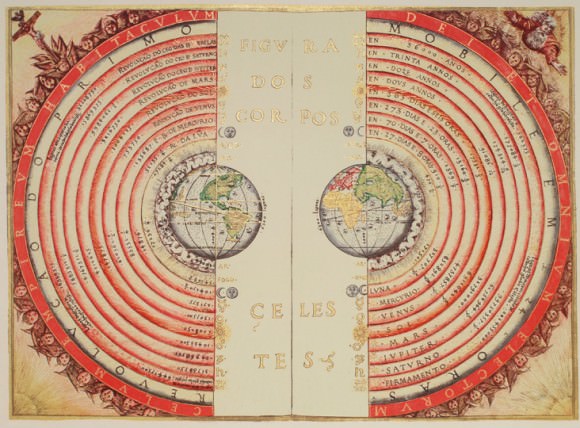
Planet Earth exists at the center of the solar system, the sun and other celestial bodies revolving around it. That was the “geocentric” model of the solar system, from the time of antiquity.
The perspective was by no means unanimous. The Greek astronomer and mathematician Aristarchus of Samos put the Sun in the center of the universe, in the third century BC. Later Greek astronomers Hipparchus and Ptolemy agreed, refining Aristarchus’ methods to arrive at a fairly accurate estimate for the distance to the moon, but theirs remained the minority view.
Earth is at the center of this model of the universe created by Bartolomeu Velho, a Portuguese cartographer, in 1568. H/T: NASA/Bibliothèque Nationale, Paris
In the 15th century, Polish mathematician and astronomer Nicolaus Copernicus parted ways with the orthodoxy of his time, describing a “heliocentric” model of the universe placing the sun at the center. The Earth and other bodies, according to this model, revolved around the sun.
Copernicus resisted publishing his ideas until the end of his life, fearing to offend the religious sensibilities of the time. Legend has it that he was presented with an advance copy of his “De revolutionibus orbium coelestium” (On the Revolutions of the Heavenly Spheres) as he awakened on his death bed from a stroke-induced coma. He took one look at his book, closed his eyes, and never opened them again.
Copernicus’ ‘heliocentric’ view of the universe.
The Italian physicist, mathematician, and astronomer Galileo Galilei came along, about a hundred years later. Galileo has been called the “Father of Modern Observational Astronomy”, his improvements to the telescope and resulting astronomical observations supporting the Copernican heliocentric view.
They also brought him to the attention of the Roman Inquisition.
Biblical references such as, “The Lord set the Earth on its Foundations; it can Never be Moved.” (Psalm 104:5) and “And the Sun Rises and Sets and Returns to its Place.” (Ecclesiastes 1:5) were taken at the time as literal and immutable fact, becoming the basis for religious objection to the heliocentric model.
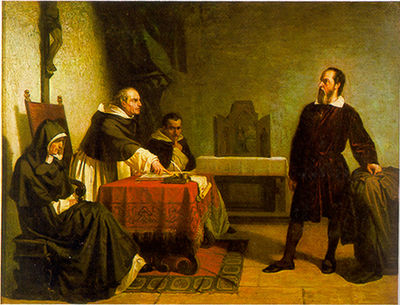
Galileo faces the Roman Inquisition
Galileo was brought before inquisitor Vincenzo Maculani for trial in 1633. The astronomer backpedaled before the Inquisition, but only to a point, testifying in his fourth deposition on this day in 1633, that “I do not hold this opinion of Copernicus, and I have not held it after being ordered by injunction to abandon it. For the rest, here I am in your hands; do as you please”.
There is a story about Galileo, which may or may not be true. After his conviction, the astronomer is said to have muttered “Eppur si muove” — “And yet it moves”.
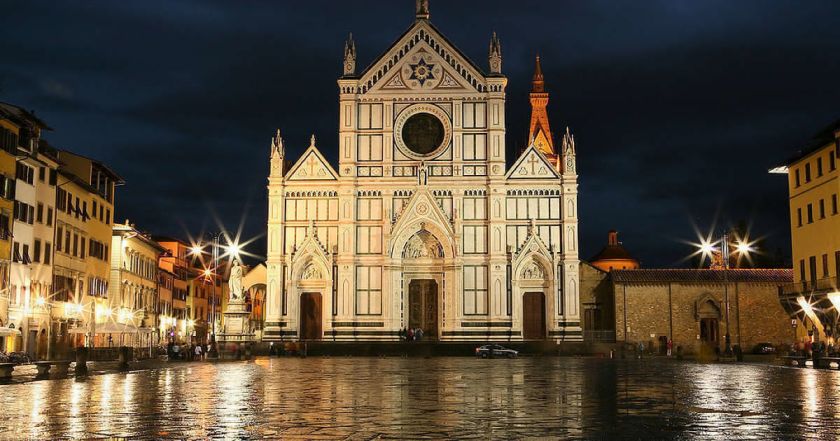
The Inquisition condemned the astronomer to “abjure, curse, & detest” his Copernican heliocentric views, returning him to house arrest at his villa in 1634, there to spend the rest of his life. Galileo Galilei, the Italian polymath who all but orchestrated the transition from late middle ages to scientific Renaissance, died on January 8, 1642, desiring to be buried in the main body of the Basilica of Santa Croce, next to the tombs of his father and ancestors. His final wishes were ignored at the time, though they would be honored some ninety-five years later, when Galileo was re-interred in the basilica, in 1737.
Basilica of Santa Croce, in Florence
Often, atmospheric conditions in these burial vaults lead to a natural mummification of the corpse. Sometimes, they look almost lifelike. When it came to the saints, believers took this to be proof of the incorruptibility of these individuals, and small body parts were taken as holy relics.
Such a custom seems ghoulish to us today, but the practice was was quite old by the 18th century. Galileo is not now and never was a Saint of the Catholic church, quite the opposite. The Inquisition had judged the man an enemy of the church, a heretic.
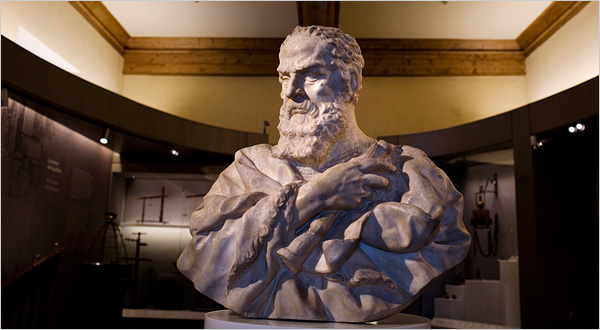
“A bust of Galileo at the Galileo Museum in Florence, Italy. The museum is displaying recovered parts of his body”. H/T New York Times
Possibly, the condition of Galileo’s body made him appear thus “incorruptible”. Be that as it may, Anton Francesco Gori removed the thumb, index and middle fingers on March 12, 1737, the digits with which Galileo wrote down his theories of the cosmos. The digits with which he adjusted his telescope.
The other two fingers and a tooth disappeared in 1905, leaving the middle finger from Galileo’s right hand on exhibit at the Museo Galileo in Florence, Italy. Locked in a glass case, the finger points upward, toward the sky.
Some 100 years later, two fingers and a tooth were purchased at auction, and have since rejoined their fellow digit at the Museo Galileo. To this day, these remain the only human body parts, in a museum otherwise devoted to scientific instrumentation.
Nearly four-hundred years after his death, Galileo’s extremity points upward, toward the glory of the cosmos. Either that, or the finger rises in eternal defiance, flipping the bird to the church which had condemned him.
If you enjoyed this “Today in History”, please feel free to re-blog, “like” & share on social media, so that others may find and enjoy it as well. Please click the “follow” button on the right, to receive email updates on new articles. Thank you for your interest, in the history we all share.
“Before man reaches the moon, mail will be delivered within hours from New York to California, to Britain, to India or Australia by guided missiles. We stand on the threshold of rocket mail.”
If we talk about RocketMail, we’re usually speaking of one of the early free webmail services, up there with Hotmail and a few others. Not to be confused with the days, when the mail was delivered on Real rockets.
Sort of.
In the early 19th century, expanding western settlement meant that a letter sent to California took one of several routes, to get there. Earlier stagecoach passages were replaced by steamship routes traveling around South America, or by overland transfer across the Isthmus of Panama or the Isthmus of Tehuantepec, in Mexico. The simmering tensions which would lead the nation to Civil War would prove such a system inadequate, as the rapid transfer of information became ever more important.
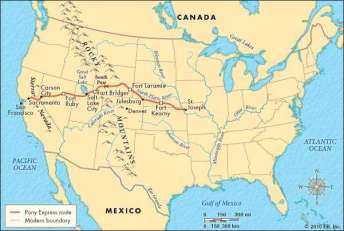
The Central Overland California & Pike’s Peak Express Company, better known as the Pony Express, was the short-lived effort to speed up the process. Between April 1860 and October ’61, continuous horse-and-rider relays carried letters the 2,000-mile distance from St. Joseph, Missouri to Sacramento, California.
Individual riders covered 75 – 100 miles at a time, on somewhere between five and ten horses. The Pony Express compressed the standard 24-day schedule for overland delivery to ten days, but the system was a financial disaster. Little more than an expensive stopgap before the first transcontinental telegraph system.
Throughout the “Reconstruction” era and on toward the turn of the century, individuals living in more remote precincts had to pick up the mail at sometimes-distant post offices, or pay private carriers.
The Post Office began experiments with Rural Free Delivery (RFD) as early as 1890, but the system was slow to catch on. Georgia Congressman Thomas Watson pushed RFD legislation through the Congress in 1893, making the practice mandatory. Implementation was slow and RFD wouldn’t be fully adopted until 1902, but elected officials were quick to implement this new way to reach out to voters.
The first mail carried through the air arrived by hot air balloon on January 7, 1785, a letter written by Loyalist William Franklin to his son William Temple Franklin, at that time serving a diplomatic role in Paris with his grandfather, the United States’ one-time and first postmaster, Benjamin Franklin.
The first (unofficial) mail delivery by aircraft took place on February 17, 1911, when Fred Wiseman flew three letters between Petaluma and Santa Rosa, California. Comprehensive airmail rules were adopted by the Universal Postal Union in 1929. Since then, airmail was often marked “Par avion”: “By airplane”.
Section 92 of the 1873 Postal Laws and Regulations book states that carriers would deliver “as frequently as the public convenience may require.” What exactly constitutes “Public Convenience” was open to interpretation but, in some cities, business districts received between three and five daily deliveries and twice a day to residential areas.
In 1950, the Postmaster General ordered residential deliveries reduced to once a day and, by the early 1990s, businesses had learned to live with the same. There was little to be improved upon, in this happy state of affairs. Unless of course you’re receiving your mail, by rocket.
The concept is older than you might think. German novelist Heinrich von Kleist (1777 – 1811) was the first to bring up the idea in 1810, calculating that a network of batteries could relay a letter from Berlin to Breslau, a distance of 180 miles, in half a day. Such a system was attempted using congreve rockets in 19th century Tonga, but proved unreliable. By 1929, American ambassador to Germany Jacob Gould Schurman was discussing the finer points of transatlantic rocket mail delivery, with a German reporter.
A 1936 experiment with rocket-powered mail delivery between New York and New Jersey ended with 50-lbs of mail, stranded on the ice of frozen Greenwood Lake.
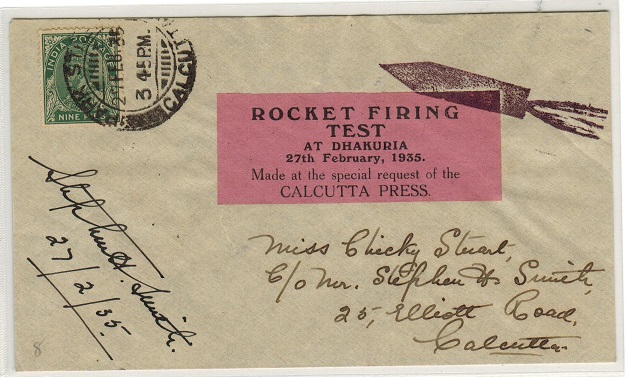
From India to the United Kingdom, the 1930s were a time for experimentation with rocket-propelled mail delivery. 1,200 letters were packed into a rocket fuselage in July 1934, and fired between Harris Island in the Hebrides and Scarp island in Scotland, a distance of some 1,600 meters (1 mile). The first rocket blew up so they gathered all the letters they could find, and packed them into a second. That one exploded, too.
As a piece of technology, the rockets’ origins are both simple and ancient. A rocket, quite simply, is a vessel, powered by stored propellant such as gunpowder, kerosene, or liquid hydrogen & oxygen. A Missile is a vehicle propelled by rockets, whose purpose it is to deliver a payload.
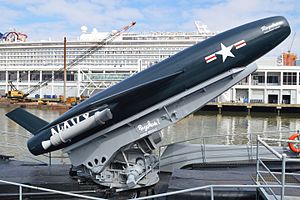
Regulus Cruise Missile
In 1959, the diesel-electric submarine USS Barbero was officially designated a branch location of the United States Post Office, for purposes of “delivering” mail to Naval Station Mayport, in Jacksonville, Florida. The nuclear warhead was removed from a Regulus Cruise missile and two Post Office-approved containers installed. 3,000 letters and postcards were inserted, addressed to President Eisenhower, Postmaster General Arthur Summerfield, and other dignitaries.
On June 8, the 13,685-pound, 32-foot cruise missile launched from the decks of the Barbero, two Aerojet-General 33,000 lbf solid-propellant boosters giving way to the turbojet engine which would guide the missile onto its target. Twenty-two minutes later the missile struck, the Regulus opened and the mail forwarded to the Jacksonville post office for sorting and routing.
Postmaster Summerfield was effusive, proclaiming the “historic significance to the peoples of the entire world”. “Before man reaches the moon”, he exclaimed, “mail will be delivered within hours from New York to California, to Britain, to India or Australia by guided missiles. We stand on the threshold of rocket mail.”
Arthur Summerfield’s golden future of missile mail, was never meant to be. Despite the postmaster’s enthusiasm, the system was Way too expensive. The Defense Department saw the first and only mail delivery by intercontinental ballistic missile in history, as more of a demonstration of the weapon system’s capabilities. In any case, aircraft were delivering airmail by this time, in less than a day.
The Regulus was superseded by the Polaris missile in 1964, the year in which Barbero ended her nuclear strategic deterrent patrols. She was struck from the Naval Registry that July, and suffered the humiliating fate of the target ship, sunk off the coast of Pearl Harbor on October 7 by the nuclear submarine USS Swordfish.
So it is that a United States mail container may be discovered at the Submarine Force Museum in Groton Connecticut, fired from a Balao-class sub, fifty-nine years ago, today.
If you enjoyed this “Today in History”, please feel free to re-blog, “like” & share on social media, so that others may find and enjoy it as well. Please click the “follow” button on the right, to receive email updates on new articles. Thank you for your interest, in the history we all share.
The first minor league game played under the lights drew 12,000 spectators, at a time when the host club was averaging only 600 per game. As the Great Depression dragged on, minor league owners were finding night games a key to staying in business. Even then, the Poobahs of Major League Baseball were slow to catch on.
In 18th century London, it was a bad idea to go out at night. Not without a lantern in one hand, and a club in the other.
The city introduced its first gas-lit street in 1807 on the Central London Pall Mall, between St. James’s Street & Trafalgar Square. Before long, hundreds of “Lamp Lighters” could be seen with their ladders, gas lights bathing the city in a soft, green glow.
The Westminster Review newspaper opined that gas lamps had done more to eliminate immorality and criminality on the streets, than any number of church sermons.
The United States followed nine years later, when the city of Baltimore lit up in 1816.
Thomas Edison patented the first carbon-thread incandescent lamp in 1879. The first baseball game played “under the lights” took place the following year near Nantasket Beach, in the ‘south shore’ town of Hull, Massachusetts.
It was September 2, 1880 when two teams, sponsored by the RH White & Co. and Jordan Marsh department stores of Boston, played a full nine innings to a 16-all tie. The era of the night game had arrived, and the lamp lighters of London, can be seen to this day.
Except, no, it didn’t work out that way. The lamp lighter part is true enough. Today, five gas engineers keep the Victorian era alive, winding and checking the mechanisms, polishing the glass and replacing the mantles of some 1,500 – 2,000 gas lamps.
Modern-day “Lamp Lighter” H/T UK Guardian
Across the pond, organized baseball would take another fifty years to give the arc light another try.
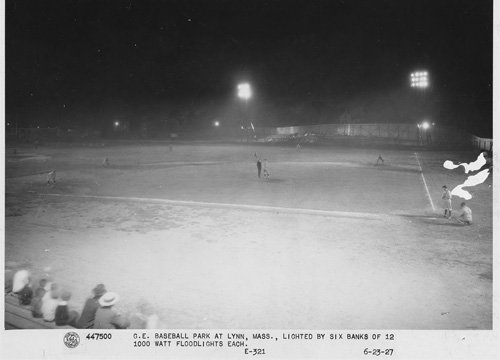
Evidence exists of other 19th-century night games, but these were little more than novelties. Holyoke Massachusetts inventor George F. Cahill, creator of the pitching machine, devised a portable lighting system in 1909. With the blessing of Garry Herrmann, President of the Cincinnati Reds, Cahill staged an exhibition game on the night of June 19, between the Elk Lodges of Cincinnati and Newport, Kentucky.
The crowd of 3,000 had little trouble following the ball and Cahill was an enthusiastic salesman for his invention, but the man was doomed to frustration and disappointment. Night-time exhibition games were regularly met with great enthusiasm, yet Organized Baseball was slow to catch on.
The Class B New England league played a night exhibition game on June 24, 1927 before a crowd of 5,000, sponsored by the General Electric Employees’ Athletic Association. The Washington Senators were in town at that time to play the Boston Red Sox. Delegations from both clubs were on-hand to watch Lynn defeat Salem in a seven-inning game, 7-2. Washington manager Bucky Harris and Boston manager Bill Carrigan, were impressed. Senator’s star outfielder Goose Goslin expressed a desire to play a night game. Claude Johnson, President of the New England League, predicted that all leagues would have night baseball within five years, including the majors.
When the Great Depression descended across the land, minor league clubs folded by the bushel. Small town owners were desperate to innovate. The first-ever night game in professional baseball was played on May 2, 1930, when Des Moines, Iowa hosted Wichita for a Western League game.
The game drew 12,000 spectators at a time when Des Moines was averaging just 600 per game. Soon, minor league owners were finding night games a key to staying in business.
Even then, the Poobahs of Major League Baseball were slow to catch on. Five years later, the Cincinnati Reds defeated the Philadelphia Phillies in the first-ever big league game played under the lights.
A crowd of 25,000 spectators waited on this day in 1935, as President Roosevelt symbolically turned on the lights from Washington DC. The Reds played a night game that year against every National League opponent and, despite a losing record of 68-85, enjoyed an increase in paid attendance of 117%.
The first night game in Major League Baseball was played on this day in 1935, when the Cincinnati Reds defeated the Philadelphia Phillies, 2-1
Thoughought the ’30s and ’40s, teams upgraded facilities to include lights and, before long, most of Major League Baseball had night games on the schedule. Wrigley Field, home of the Chicago Cubs and the second-oldest MLB stadium after Fenway Park, was the last to begin hosting night games. To this day, the Cubbies remain the only major league team to host the majority of its games, during the day.
Wrigley’s first officially recorded night game ended in a 6-4 win over the New York Mets on August 8, 1988.
If you enjoyed this “Today in History”, please feel free to re-blog, “like” & share on social media, so that others may find and enjoy it as well. Please click the “follow” button on the right, to receive email updates on new articles. Thank you for your interest, in the history we all share.
By the height of the eugenics movement, some 30 states had passed legislation, legalizing the involuntary sterilization of individuals considered “unfit” for reproduction. All told, some 60,000 individuals were forcibly sterilized in state-sanctioned procedures.
In 380BC, Plato described a system of state-controlled human breeding in his Socratic dialogue “The Republic”, introducing a “guardian class” to watch over over his ideal society.
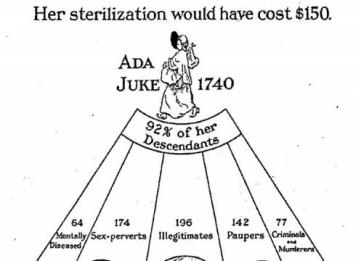
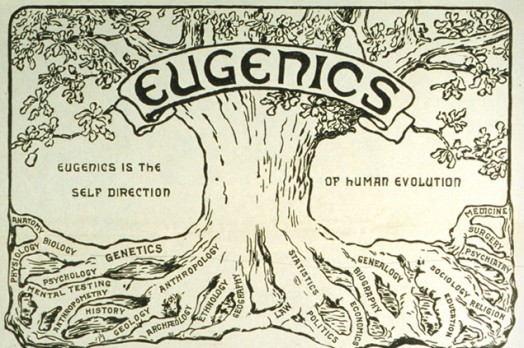
In the 19th century, Francis Galton studied the theories of his cousin Charles Darwin on the evolution of species, applying them to a system of selective breeding intended to bring “better” human beings into the world. He called it his theory of “Eugenics”.
Eugenics gained worldwide respectability in the early 20th century, when countries from Brazil to Japan adopted policies regarding the involuntary sterilization of certain mental patients.
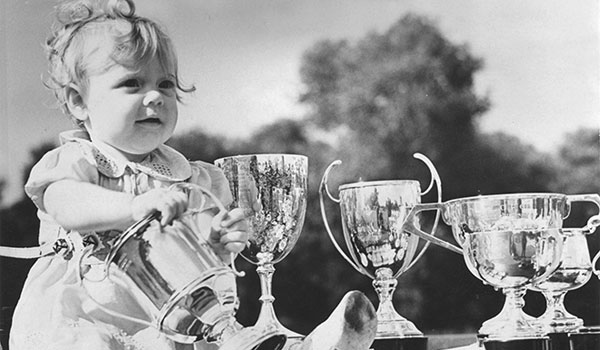
“Better Babies” competitions sprang up at state fairs across the United States, where babies were measured, weighed, and “judged”. Like livestock. By the 20s, these events had evolved into “Fitter Family” competitions.
One of the leaders of the eugenics movement was the pacifist and Stanford University professor, David Starr Jordan. After writing several books on the subject, Jordan became a founding member of the Eugenics Committee of the American Breeders Association. The higher classes of American society were being eroded by the lower class, he argued. Careful, selective breeding would be required to preserve the nation’s “upper crust”.
Margaret Samger
Margaret Higgins Sanger believed that birth control should be compulsory for “unfit” women, who “recklessly perpetuated their damaged genetic stock by irresponsibly breeding more children in an already overpopulated world.”
An early advocate for birth control, Sanger has her supporters to this day, including former Presidential candidate Hillary Rodham Clinton. “I admire Margaret Sanger enormously”, Clinton said. “Her courage, her tenacity, her vision…” Time Magazine points out that “Sanger opened the first birth-control clinic in the United States”, describing her as “An advocate for women’s reproductive rights who was also a vocal eugenics enthusiast…”
Detractors have described Sanger as a “thoroughgoing racist”, citing her own words in What Every Girl Should Know, published in 1910:“In all fish and reptiles where there is no great brain development, there is also no conscious sexual control. The lower down in the scale of human development we go the less sexual control we find. It is said that the aboriginal Australian, the lowest known species of the human family, just a step higher than the chimpanzee in brain development, has so little sexual control that police authority alone prevents him from obtaining sexual satisfaction on the streets”.
Admire or detest the woman as you choose, Sanger’s work established organizations which later evolved into the Planned Parenthood Federation of America.
Around the world, eugenics policies took the form of involuntarily terminated pregnancies, compulsory sterilization, euthanasia, and even mass extermination.
Madison Grant, the New York lawyer best known for his work in developing the discipline of wildlife management, was a leader in the eugenics movement, once receiving an approving fan letter from none other than Adolf Hitler.
Public policy and academic types conducted three international eugenics conferences to discuss the application of programs to improve human bloodlines. The first such symposium convened in London in 1912, discussing papers on “racial suicide” and similar topics. Presiding over the conference was none other than Major Leonard Darwin, the son of Charles Darwin, with Harvard president emeritus Charles William Eliot serving as vice President.
The 1912 conference was followed by two more in 1921 and 1932, both held in New York City. Colleges and universities delved into eugenics as academic discipline, with courses exploring the ethical and public policy considerations of eliminating the “degenerate” and “unfit”.
In Pennsylvania, 270 involuntary sterilizations were performed without benefit of law, between 1892 and 1931. On March 21, 1905, the Pennsylvania legislature passed “An Act for the Prevention of Idiocy”, requiring that every institution in the state entrusted with the care of “ idiots and imbecile children”, be staffed by at least one skilled surgeon, whose duty it was to perform surgical sterilization. The bill was vetoed by then-Governor Samuel Pennypacker, only to return in 1911, ’13, ’15, ’17, ’19, and again in 1921.
By the height of the eugenics movement, some 30 states had passed legislation, legalizing the involuntary sterilization of individuals considered “unfit” for reproduction. All told, some 60,000 individuals were forcibly sterilized in state-sanctioned procedures.
California forced Charlie Follett to undergo a vasectomy in 1945 at the age of 15, when Follett found himself abandoned by alcoholic parents. He was only one of some 20,000 Californians forced to undergo such a procedure.
Roadside Marker, Raleigh, NC
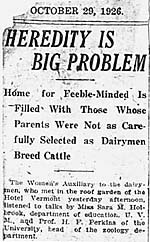
Vermont passed a sterilization law in 1931, aimed at what then-University of Vermont zoology professor Henry Perkins called the “rural degeneracy problem.” An untold number of “defectives” were forced to undergo involuntary sterilization, including Abenaki Indians and French-Canadian immigrants.
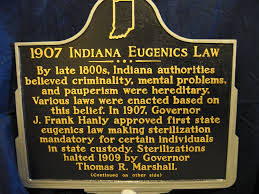
Indiana passed the first eugenic sterilization law in 1907, but the measure was legally flawed. To remedy the situation, the Eugenics Record Office (ERO), founded in 1910 by the the former Harvard University Zoology Professor Charles Benedict Davenport, Ph.D., crafted a statute, which was later adopted by the Commonwealth of Virginia as state law in 1924.
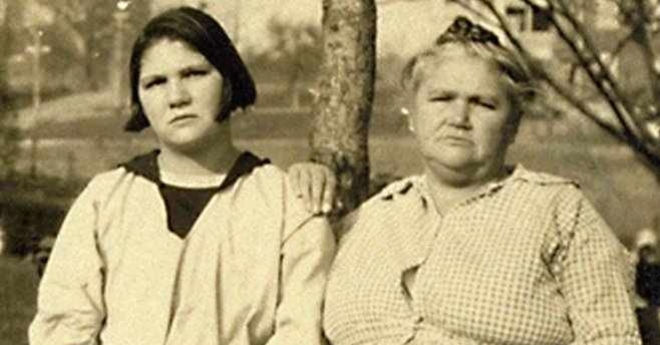
That September, Superintendent of the ‘Virginia State Colony for Epileptics and Feebleminded’ Dr. Albert Sidney Priddy, filed a petition to sterilize one Carrie Elizabeth Buck, an 18-year-old patient at the institution whom Priddy claimed to be “incorrigible”. A “genetic threat to society”. Buck’s 52-year-old mother had a record of prostitution and immorality, Priddy claimed, and the child to whom Buck gave birth in the institution only proved the point.
Carrie Elizabeth Buck was born into poverty in Charlottesville, Virginia, the first of three children born to Emma Buck. Carrie’s father Frederick Buck abandoned the family, shortly after the marriage. Emma was committed to the “Virginia State Colony for Epileptics and Feebleminded” following accusations of immorality, prostitution, and having syphilis.
Buck’s guardian brought her case to court, arguing that compulsory sterilization violated the equal protection clause of the 14th amendment. After losing in district court, the case was appealed to the Amherst County Circuit Court, the Virginia Supreme Court, and finally the United States Supreme Court.
Dr. Priddy died along the way, Dr. John Hendren Bell taking his place. SCOTUS decided the “Buck vs Bell” case on May 2, 1927, ruling in an 8–1 decision that Carrie Buck, her mother, and her perfectly normal infant daughter, were all “feeble-minded” and “promiscuous.”
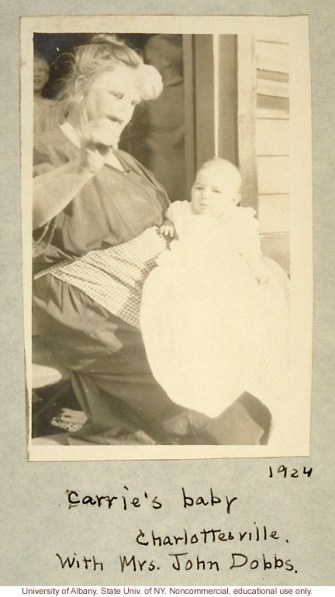
“This photograph was taken on the eve of the initial trial of Buck v Bell in Virginia. Mrs. Dobbs appear to be holding a coin believed to be used as a test for alertness or mental acuity. Vivian appears to be looking elsewhere. It may have ben on the strength of this test that Arthur Estabrook concluded that she “showed backwardness.” H/T DNA Learning Center, dnalc.org
In the majority ruling, Justice Oliver Wendell Holmes, Jr., did more than just greenlight the Virginia statute. He urged the nation as a whole to get serious about eugenics, and to prevent large numbers of “unfit” from breeding: “”It is better for all the world“, Holmes wrote, “if instead of waiting to execute degenerate offspring for crime, or to let them starve for their imbecility, society can prevent those who are manifestly unfit from continuing their kind“. In writing about Carrie Buck herself, her mother and infant daughter Vivian, Holmes delivered one of the most brutal pronouncements in all American jurisprudence: “Three generations of imbeciles are enough.”
It was later revealed that Carrie Buck had been raped by a member of the Dobbs family, the foster family who had taken her in and later had her committed. To save the family “honor”. No matter. Buck was compelled to undergo tubal ligation, later paroled from the institution to become a domestic worker with a family in Bland, Virginia. Buck’s daughter Vivian was adopted by the Dobbs family.
In a later examination of the child, ERO field worker Dr. Arthur Estabrook pronounced her “feeble minded” saying that she “showed backwardness”, supporting the “three generations” theory expressed in the SCOTUS opinion.
Vivian died from complications of measles in 1932, after only two years in school. Dr. Estabrook failed to explain in his report, how she seemed to do well for those two years, nor did doctor Estabrook reveal how she came to be listed on her school’s honor roll, in April, 1931.


 Ford left the family farm outside of modern-day Detroit as a young man, never to return. His father William thought the boy would one day own the place but young Henry couldn’t stand farm work. He later wrote, “I never had any particular love for the farm—it was the mother on the farm I loved”.
 Ford claimed he’d be able to “grow automobiles from the soil”, a hedge against the metal rationing of world War Two. He dedicated 120,000 acres of soybeans to experimentation, but to no end. The total acreage devoted to “fuel” production, is unrecorded.
 Henry Ford’s experiment in making cars from soybeans never got past that first prototype, and came to a halt during WW2. The project was never revived, though several states adopted license plates stamped out of soybeans, a solution farm animals found to be quite delicious.
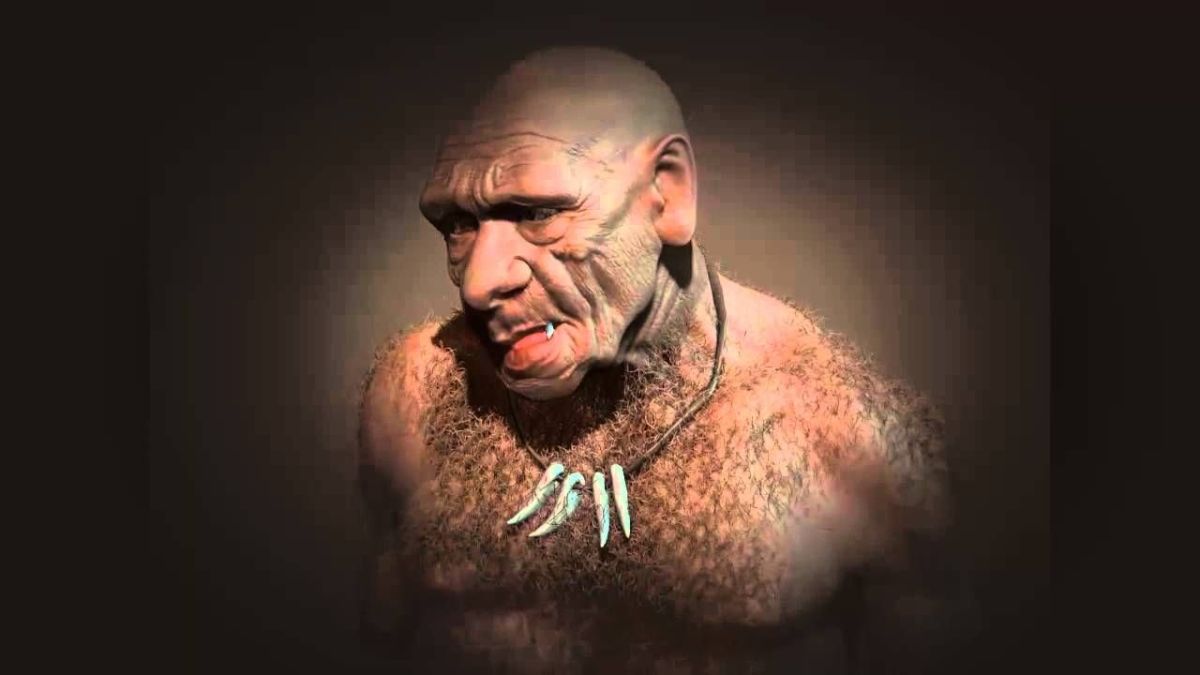


 Shorter in stature and considerably more powerful than Cro-Magnon, our direct ancestor and all but indistinguishable from ourselves, Neanderthal bodies were suited to the ice age of the early and middle Paleolithic era.


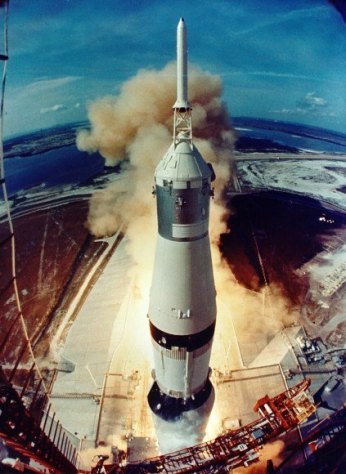 Today, the accomplishments of the Apollo series of spacecraft seem foreordained, the massive complexities of the undertaking, forgotten.
 The 363′, 6,698,700-pound Saturn V launch vehicle lifted off from the John F. Kennedy Space Center on Merritt Island, Florida on July 16, carrying mission commander Neil Armstrong, Lunar module pilot Edwin “Buzz” Aldrin, and Command Module Michael Collins.

 These first two humans to set foot on the moon spent about 2½ hours on the surface. The pair collected nearly 50-lbs of material for transport back to earth, planting the American flag where it most likely remains, to this day.




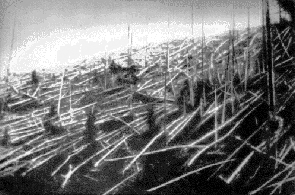 On the morning of June 30, 1908, the Tunguska River lit up with a bluish-white light. At 7:17a local time, a column of light far too bright to look at moved across the skies above the Tunguska. Minutes later, a vast explosion knocked people off their feet, flattening buildings, crops and as many as 80 million trees over an area of 830-square miles. A vast “thump” was heard, the shock wave equivalent to an earthquake measuring 5.0 on the Richter scale. Within minutes came a second and then a third shock wave and finally a fourth, more distant this time and described by eyewitnesses as the “sun going to sleep”.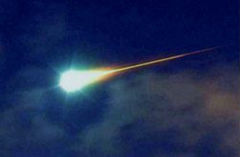


 To keep costs down, off-the-shelf components were used whenever possible. The body was made of fiberglass to keep tooling expenses low. The chassis and suspension came from the 1952 Chevy sedan. The car featured an increased compression-ration version of the same in-line six “Blue Flame” block used in other models, coupled with a two-speed Power glide automatic transmission. No manual transmission of the time could reliably handle an output of 150 HP and a 0-60 time of 11½ seconds.



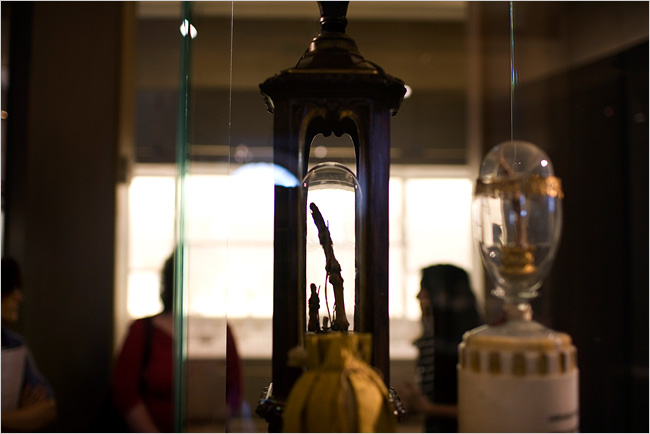 Some 100 years later, two fingers and a tooth were purchased at auction, and have since rejoined their fellow digit at the Museo Galileo. To this day, these remain the only human body parts, in a museum otherwise devoted to scientific instrumentation.

 across the Isthmus of Panama or the Isthmus of Tehuantepec, in Mexico. The simmering tensions which would lead the nation to Civil War would prove such a system inadequate, as the rapid transfer of information became ever more important.
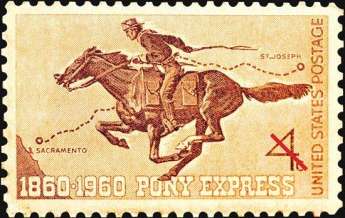 The Pony Express compressed the standard 24-day schedule for overland delivery to ten days, but the system was a financial disaster. Little more than an expensive stopgap before the first transcontinental telegraph system.
 The first mail carried through the air arrived by hot air balloon on January 7, 1785, a letter written by Loyalist William Franklin to his son William Temple Franklin, at that time serving a diplomatic role in Paris with his grandfather, the United States’ one-time and first postmaster, Benjamin Franklin.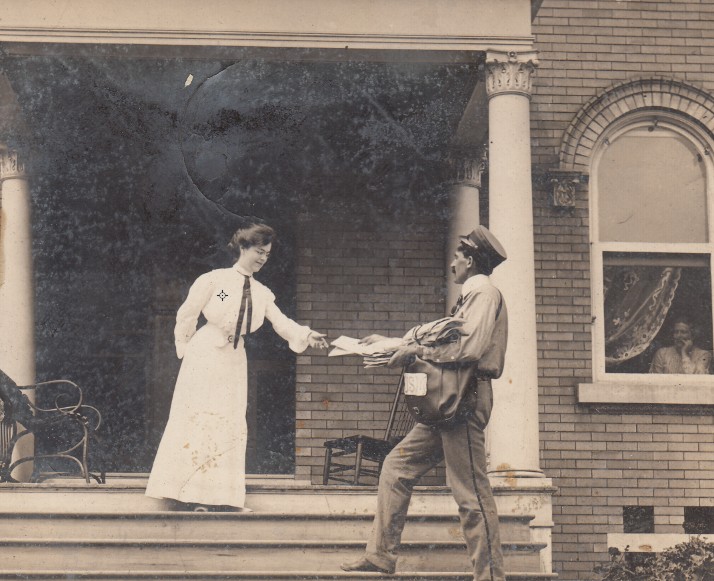


 The Regulus was superseded by the Polaris missile in 1964, the year in which Barbero ended her nuclear strategic deterrent patrols. She was struck from the Naval Registry that July, and suffered the humiliating fate of the target ship, sunk off the coast of Pearl Harbor on October 7 by the nuclear submarine USS Swordfish.

 In 18th century London, it was a bad idea to go out at night. Not without a lantern in one hand, and a club in the other.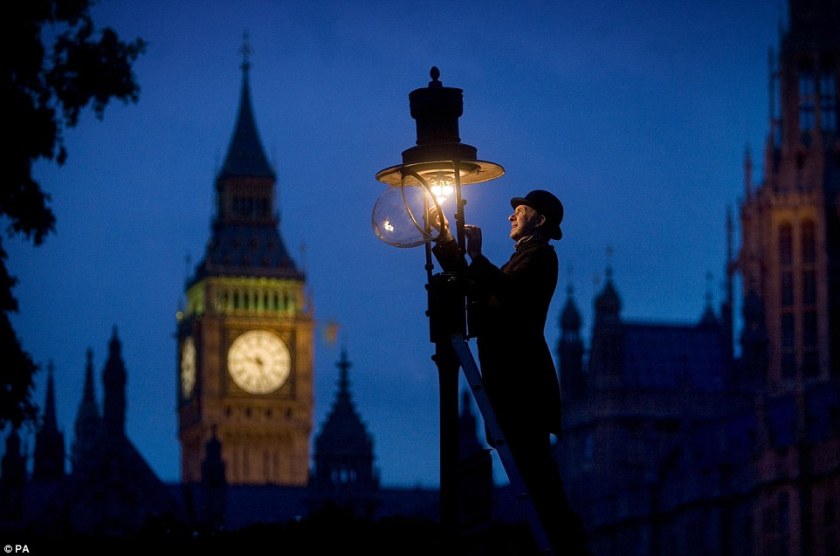
 When the Great Depression descended across the land, minor league clubs folded by the bushel. Small town owners were desperate to innovate. The first-ever night game in professional baseball was played on May 2, 1930, when Des Moines, Iowa hosted Wichita for a Western League game.

 In the 19th century, Francis Galton studied the theories of his cousin Charles Darwin on the evolution of species, applying them to a system of selective breeding intended to bring “better” human beings into the world. He called it his theory of “Eugenics”.
 “Better Babies” competitions sprang up at state fairs across the United States, where babies were measured, weighed, and “judged”. Like livestock. By the 20s, these events had evolved into “Fitter Family” competitions.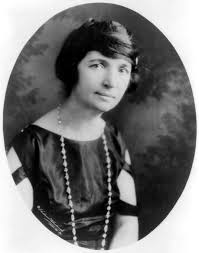
 The 1912 conference was followed by two more in 1921 and 1932, both held in New York City. Colleges and universities delved into eugenics as academic discipline, with courses exploring the ethical and public policy considerations of eliminating the “degenerate” and “unfit”.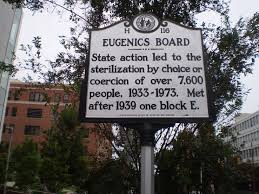

 Historical Easter Eggs - Today in History
You must be logged in to post a comment.