Much has been written of the rise of imperial Japan and the military officers, who brought the nation to war. How different the 20th century might have turned out had those guys picked up baseball, instead.
Baseball as we know it was introduced to the nation, in 1872. To this day, the game remains the most popular sport in the country for participants and spectators, alike. In 1907, Ambassador to the United States Tsuneo Matsudaira commented: “the game spread, like a fire in a dry field, in summer, all over the country, and some months afterwards, even in children in primary schools in the country far away from Tōkyō were to be seen playing with bats and balls“.
Did I neglect to mention? The nation we’re talking about, is Japan.
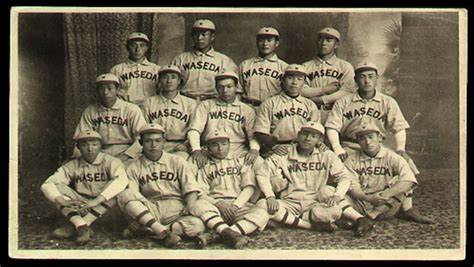
Professional baseball got off to a rocky start in 1920s Japan and continued to flounder, until 1934. That’s when media bigwig Matsutarō Shōriki pulled off a “goodwill tour” with an all-star American team.
“The [1934] party included future Hall of Famers Earl Averill, Lou Gehrig, Charlie Gehringer, Lefty Gomez, Connie Mack, Foxx and Ruth, along with several other American Leaguers (asked to accompany the tour when the National League forbade its stars from coming along). Even Moe Berg, the big league catcher who would eventually work as a United States government spy, was a member of the ball playing entourage”.
H/T baseballhall.org
Much has been written of the rise of imperial Japan and the military officers, who brought the nation to war. How different the 20th century might have turned out had those guys picked up baseball, instead.
The first Japanese professional league was formed in 1936, becoming large enough to split into two leagues in 1950, the Central and Pacific.
Today, the Kansai region of Honshu is the 2nd largest metropolis, in all Japan. That’s where you’ll find the Hanshin Tigers, those perennial underdogs of Nippon Professional Baseball and arch-rival to the Yomiuri Giants of Tokyo, widely regarded as the kings, of Japanese baseball.
As a life-long Red Sox fan, this story is beginning to sound familiar.
November 2, 1985 was a time of unbridled joy for delirious Tigers fans, following Hanshin’s 6-2 drubbing of the Seibu Lions to win the ultimate prize, the Japan series pennant, of 1985.
Now you may not know this, but the Japanese people are crazy, about Kentucky Fried Chicken. Japan is the third largest market on the planet for the Colonel’s yard bird, #3 only behind the United States and China. Not bad for a fast food outfit that opened its first Japanese franchise on July 4, 1970.
Which brings us back, to baseball.
The Boston baseball fan is well acquainted with the “Curse of the Bambino”, the 86-year World Series championship drought, second only to the “Curse of the Billy Goat” denying victory to long-suffering Cubbies fans, for 106 years.
Since 1985, Japanese mothers have scared wayward children into acting right with the curse, of Colonel Sanders.
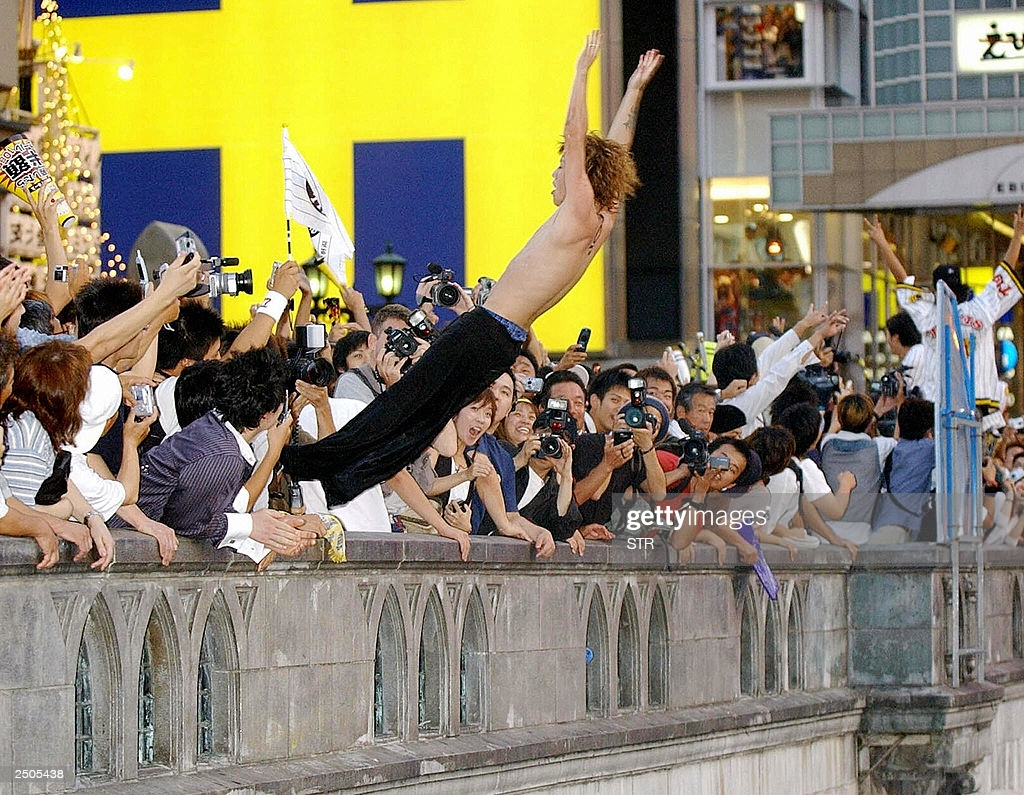
The Hanshin club emerged victorious in 1985, due in large part to the efforts of American slugger, Randy Bass. Delirious after unexpected victory in game one and superstitious as baseball fans the world over, Hanshin supporters gathered at the Ebisu Bridge over the Dōtonbori river in Osaka, to partake in one of the most bizarre spectacles, in the history of sports.
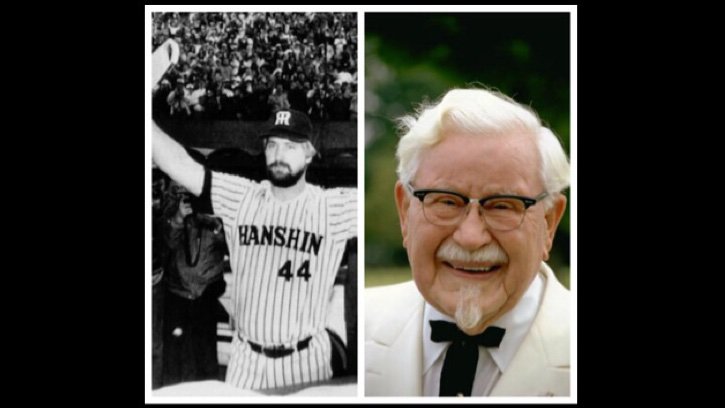
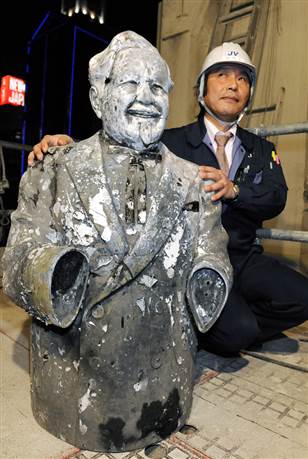
Fans would shout out the names of Tigers players and someone who resembled that player, even vaguely, would jump into the river. There being no Caucasians in attendance to represent Mr. Bass, the crowd took hold of a storefront statue of Harlan Sanders, and threw it into the River.
A young fan of the Hanshin Tigers dives into the Osaka river to celebrate the team’s first league championship win in 18 years 15 September 2003. Tigers defeated Hiroshima Carp 3-2. AFP PHOTO/JIJI PRESS (Photo credit should read STR/AFP via Getty Images)
What the hell. They were both white guys and they both wore beards, right?
Thus began the curse of Colonel Sanders, a losing streak brought on by the ghost of a man who didn’t appreciate being tossed, into a river. Brief rallies in 1992 and again in ’99 brought hope once again to the Hanshin faithful, (gosh, this story sounds Really familiar now), only to have cruel fate, block the way. Repeated efforts were made to retrieve the Colonel from the river, only to be met, with failure.
The curse, dragged on.
“Dangerous! Do not dive into this river. Osaka Regional Development Bureau and Osaka-Minami Police station” sign at the new Ebisubashi bridge H/T Wikipedia
The joy of victory smiled upon the land of Hanshin once again in 2003, when Yomiuri Giants MVP Hideki Matsui was traded to the New York Yankees, clearing the way to a Central League pennant for Hanshin. Even so, final victory remained elusive. The Japan series went to the Fukuoka Daiei Hawks that year, in 7 games.
Celebration turned to tragedy that year, when thousands of Tigers fans jumped into the river. 24-year-old Masaya Shitababa, drowned. The Osaka city council ordered construction of a new bridge over the Dōtonbori beginning in 2004, making further such jumps, next to impossible.
Divers discovered the upper part of Harlan Sanders’ statue on March 10, 2009 and the lower piece, the following day. And yet one hand and the Colonel’s eyeglasses, were nowhere to be found.
Colonel Sanders’ left hand and spectacles remain missing to this day and the KFC where it all started, is closed and gone forever. The October 26, 2021 English language edition of thehanshintigers.com blog mournfully reports: “Game 143 vs. Dragons: Lifeless Last Game, Pennant Lost”. So it is for long suffering fans of the Hanshin Tigers. The curse of Colonel Sanders, lives on.
“We know now that in the early years of the twentieth century this world was being watched closely by intelligences greater than man’s and yet as mortal as his own. We know now that as human beings busied themselves about their various concerns they were scrutinized and studied, perhaps almost as narrowly as a man with a microscope might scrutinize the transient creatures that swarm and multiply in a drop of water.” – Orson Welles
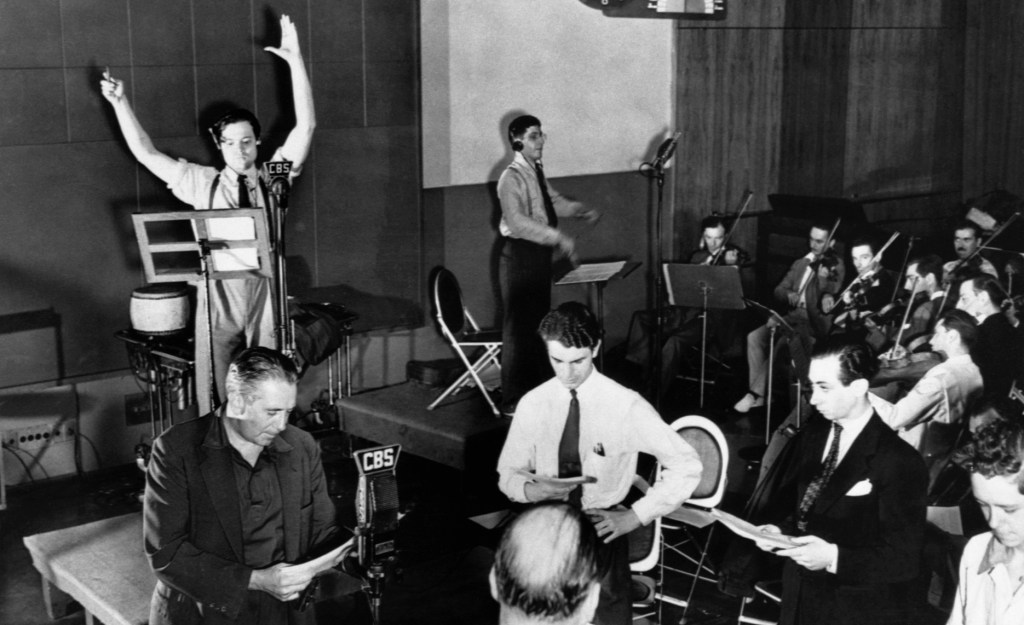
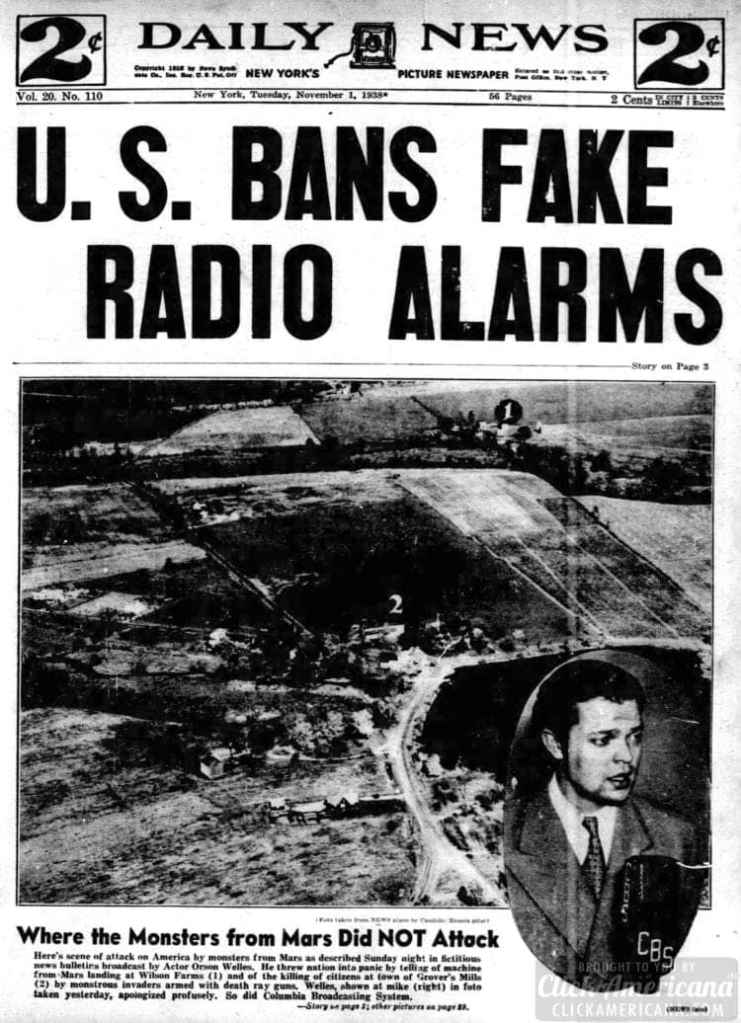
October 30, 1938 was a Sunday. The 8:00pm (eastern) broadcast of the Mercury Theater of the Air began with a weather report and then went to a dance band remote featuring “Ramon Raquello and his orchestra”. The music was periodically interrupted by live “news” flashes, beginning with strange explosions on Mars. Producer Orson Welles made his debut as the “famous” (but non-existent) Princeton Professor Dr. Richard Pierson, who dismissed speculation about life on Mars.
A short time later, another “news flash” reported a fiery crash in Grovers Mill, New Jersey. What was believed a meteorite turned out to be a rocket capsule as a tentacled, pulsating Martian unscrewed the hatch and incinerated the gathering crowd of onlookers, with a death ray.
The story is great fun, a Halloween classic telling and retelling the story of a radio broadcast leading untold thousands, perhaps hundreds of thousands to take up their families and their shotguns and flee into the night, to escape the Martian menace.
1 million Americans or more according to some news outlets, members of a generation who survived the Great Depression and went on to win World War II, actually believed Martian killing machines had blasted off and traveled across interplanetary space and attacked New Jersey, only to be destroyed themselves by microorganisms, all in the space of a sixty minute broadcast.
Umm…OK.
To be fair I wrote as much myself in this space, four years ago. Then as now the healthy skeptic might have begun, by following the money.
In 1899, the obscure Brazilian priest and inventor Father Roberto Landell de Moura successfully transmitted audio over a distance, of 7 kilometers (4.3 miles). That same year an Italian inventor called Guglielmo Marconi successfully broadcast, across the English Channel. Twenty years later, Westinghouse engineer Frank Conrad began to broadcast music, in the Pittsburg, Pennsylvania area. Conrad’s broadcasts stimulated demand for crystal sets. A year later, Westinghouse started the radio station, KDKA. Within two years, KDKA was broadcasting prize fights and Major League Baseball games. By early 1927 there were 737 stations nationwide, and growing.
In the 19th century, newspapers alone carried the journalistic heft, to go toe-to-toe with the corruption of Tammany Hall and other such political machines. Books could be written about the newspaper wars of the turn-of-the-century and the Yellow Journalism which helped goad the nation, to war. A week after the Spanish-American War broke out in 1898 William Randolph Hearst’s American Journal ran the headline “How do you like the Journal’s war?”
The “stunt journalism” of Nellie Bly and her Ten Days in a Madhouse opened the door to an era of Muckraking, journalists reporting on waste, fraud and abuse in public and private life, alike.
In depression-era America, radio was not only the cheapest form of entertainment but a source for high quality programming. By the late 1930’s radio was not only the center of household entertainment but also, a center for news and information.
It was the Golden Age of radio. By 1934 some 60 percent of American households had radio sets as did 1½ million, of the nation’s automobiles. Many theaters didn’t bother to open their doors during the Amos & Andy program and those who did shut off the projectors while the show was on and hauled out, a radio.
To the news reader of the Great War period the newspaper was equal to the entire print and electronic media of our time, in all its forms.
Such was the media landscape in the inter-war years. A new and novel form of news and entertainment gaining ground almost daily, at the expense of a centuries-old competitor. Small wonder it is then that such an industry would find threat in this upstart, called radio.
And then came October 30, 1938. The War of the Worlds.
With memories of the Great War still painfully fresh and the Nazi threat looming in Europe an excitable few did indeed, take to the streets. Most had heard the repeated warnings that this was only entertainment though, or figured it out for themselves. Others did what rational people would do and picked up the phone, in search of information.
Friends and family called each other to see if they had heard anything. New York phone switchboards experienced a geometric increase in traffic, that night. New Jersey phone traffic jumped 39 percent during the broadcast. The New York Times received 875 calls about the program. The Newark Evening News logged over a thousand. Some called CBS, to congratulate them for the show. Others complained that the program was too realistic.
Then as now Sunday night newsrooms, are all but cold and dark. With few reporters working that night and little original reporting many papers relied on the Monday morning recap from organizations, like AP. And who was this irresponsible upstart in any case when the public already had a far more trusted source, for news and information?
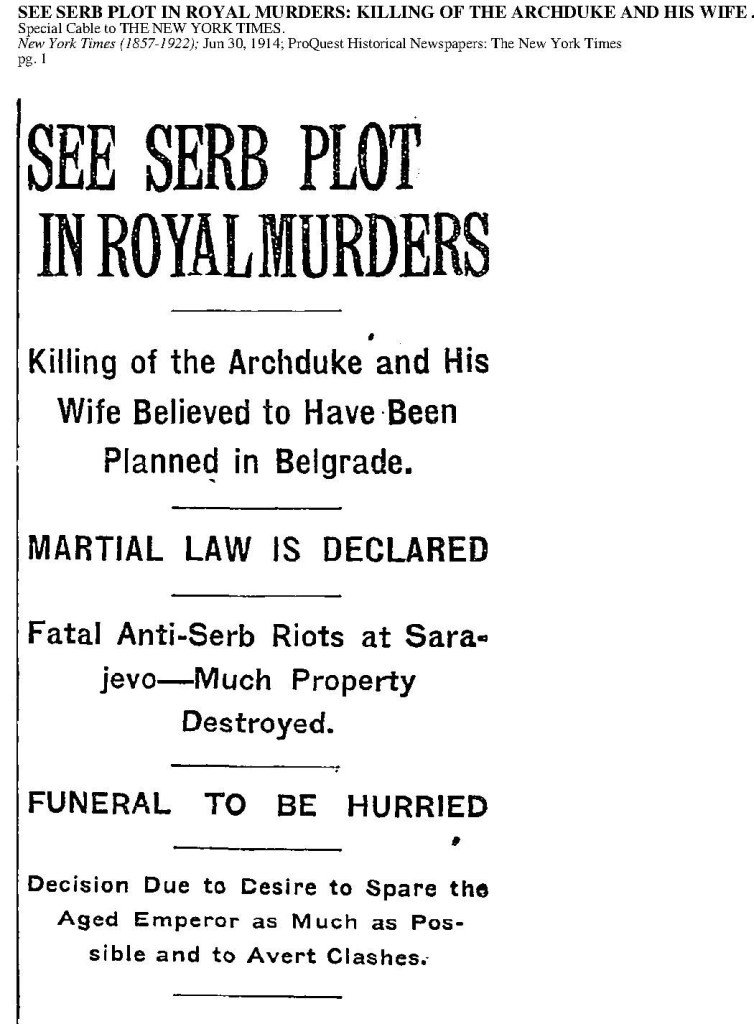
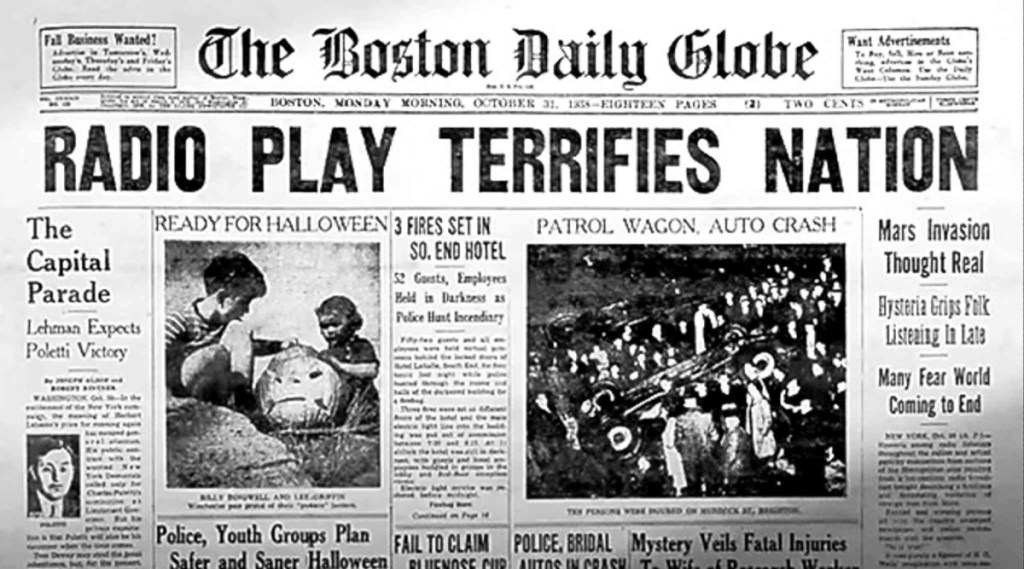
The Associated Press reported Monday morning, a man in Pittsburgh returned home to find his wife with a bottle of poison saying “I’d rather die this way“. A woman in Indianapolis ran into a church screaming “New York is destroyed… It’s the end of the world!“. The Washington Post reported the story of one Baltimore man who died of a heart attack but somehow didn’t bother to follow up, for any of the details. The New York Times piled on with the October 31 headline “Radio listeners in panic, Taking Radio drama as fact”. The Times went on to inform its readers, “In Newark, in a single block at Heddon Terrace and Hawthorne Avenue, more than 20 families rushed out of their houses with wet handkerchiefs and towels over their faces to flee from what they believed was to be a gas raid. Some began moving household furniture”.
Long on anecdote and egregiously short on details, the print media went with the narrative blaming the entire radio industry. It was the first clue, that something wasn’t right.
“For at least a couple hours or more and really into the next morning, we believed we were mass murderers, because the press which was very hostile to radio was delighted for this opportunity to piss on radio and say they were irresponsible, and so on”.
War of the Worlds producer, John Housman
Not a single one of multiple purported deaths was ever tied directly to the War of the Worlds and yet, 83 years later the panic narrative remains, alive and well. For the 75th anniversary in 2013 USA Today reported, that “The broadcast … disrupted households, interrupted religious services, created traffic jams and clogged communications systems.”
NPR’s Morning Edition reported as recently as 2005, that “”listeners panicked, thinking the story was real. Many jumped in their cars according to the broadcast, to flee from the “invasion.” ‘Radiolab’, a program produced by New York Public Radio from 2002 to the present day reported that some 12 million people listened to that original broadcast, in 1938. 1 in 12 according to Radiolab believed the story, to be true.
The Truly Terrified likely numbered in the tens of dozens and not the tens of thousands but the narrative was already being set. What better tools to apply but fear and mockery, techniques we see in common use, to this day.
The War of the Worlds broadcast was, in the end, what it described itself to be. A Halloween concoction. The equivalent of dressing up in a sheet, jumping out of a bush and saying, ‘Boo!’. Instead, the story remains one of our great and enduring media hoaxes giving proof where little is required, of Winston Churchill’s wise and timeless advice: “A lie gets halfway around the world before the truth has a chance to get its pants on“.
As for that so-called feud with Neil Young it never was anything more, than a good-natured brushback pitch. “I think “Sweet Home Alabama” is a great song” Young would later say, “I’ve actually performed it live a couple of times myself”.
If you’d like to start an argument, find yourself a pair of music enthusiasts and ask them, about the origins of rock ‘n’ roll. And then sit back because I guarantee you, hours of entertainment.
If you’d permit me a gross oversimplification, the answer may be found in the collision of black and white culture of the 1940s and 50s, an amalgamation of style and instrumentation exceeding the sum of its parts and resulting in nothing short, of cultural revolution.
Religious leaders, government officials and parents’ groups decried the new style, as the “devils music. The FBI launched a year-long obscenity investigation directed at the Jamaican sailor’s ballad “Louie Louie”, as performed by an obscure Portland Oregon outfit, called the Kingsmen. The G-Men could have saved themselves a lot of trouble and asked lead singer Jack Ely about those lyrics, but that would have made sense. As it is, the FBI’s archival website contains no fewer than 119 pages, covering the investigation.
Witnesses were interviewed and Louie Louie played forward, backward and at varying speed. In the end, the song was ruled “unintelligible at any speed”.
Rock ‘n’ roll music, was here to stay.
Before the “British invasion“ of the 1960s, rock ‘n’ roll music remained largely a product, of the American south. Artists such as Bo Diddley, Elvis Presley, Little Richard, Buddy Holly, Fats Domino and Jerry Lee Lewis all hailed, from the deep South.
Popular music changed in the 1960’s from the “Land of Cotton” to large cities like Liverpool, New York, London, Toronto, Los Angeles and San Francisco. A generation of youth the world over “turned on, tuned in and dropped out” in the words of Timothy Leary while bands like Creedence Clearwater Revival, Canned Heat and a Canadian folk rock group called The Band featuring Arkansas’s own Levon Helm preserved a Southern blues, boogie woogie and country music heritage which would come to be known, as Southern rock..
For a man tragically taken from among us at the age of 24, few have brought about the tectonic cultural shift of a man called “Skydog” by his friends, Howard Duane Allman, by the rest of us. As a session musician with established artists such as Aretha Franklin, King Curtis and Derek and the Dominoes, Rolling Stone ranked Allman #2 guitar player of all time in 2003 second only, to Jimi Hendrix.
The Allman Brothers Band established in 1968 never played so much as a single gig before cutting their first album and yet, went on to become “the best damn rock and roll band this country has produced in the past five years,” according to George Kimball of Rolling Stone. Following session work on Layla and Other Assorted Love Songs, Eric Clapton himself described Allman as the “musical brother I’d never had but wished I did.”
On October 29, 1971, a motorcycle crash on the streets of Macon Georgia ended the life of Duane Allman. A year later, bassist Berry Oakley was himself killed in a motorcycle crash only three blocks from the spot, where Allman had perished. He too, was only 24.
“You can’t help the revolution, because there’s just evolution … Every time I’m in Georgia, I eat a peach for peace”
Duane Allman
Up to this point, the Allman Brothers’ sound may be described, as blues rock. The 1972 double album “Eat a Peach” turned the corner to a more “Southern Fried” sound led by guitarist Dickey Betts’ epic, “Blue Sky“. The band led the 1970’s Southern rock phenomenon with hits like “Ramblin’ Man” and “Jessica“, both from the Brothers and Sisters album. Groups like Marshall Tucker, ZZ Top and Molly Hatchet rocketed to stardom during this period but none so much, as Lynyrd Skynyrd.
In the insanity that was the summer of 2021, the Robert E. Lee High School of Jacksonville Florida was renamed, Riverside High. Back in 1969, five Lee High school buddies, were in a band. Ronnie Van Zant (guitar), Bob Burns (drums), Gary Rossington (guitar), Allen Collins (guitar) and Larry Junstrom (bass) went through several band names from ’64 on, including The Noble Five, The One Percent, and My Backyard. In 1969, the boys took a backhanded swipe at a flat-topped gym teacher who didn’t care for all that hair. Forby Leonard Skinner was his name, the band at first calling itself Leonard Skinnerd and later morphing into, Lynyrd Skynyrd.
“It seems a physical education teacher named Leonard Skinner didn’t cotton to long hair or loud music. A run-in with him helped get the boys suspended. As a way of getting back, they named the band for Skinner, changing the vowels to avoid a lawsuit and becoming famous enough to make the story a rock legend.
Associated Press
Leonard Skinner, in later life
Skinner went on to sell real estate and even had his sign and phone number (for which he gave permission) included in the cover art for the band’s third album. Fans would call him up at all hours to ask “who’s speaking”? What followed was invariably “far out” at the response “Leonard Skinner”, but the retired PE teacher said such calls at 4:00am tended to be, anything but.
In 1972, songwriter, musician and record producer Al Kooper of Blood, Sweat and Tears saw the band on performance in Atlanta and signed them to his “Sounds of the South” label to produce their first album: “Pronounced ‘Lĕh-‘nérd ‘Skin-‘nérd” featuring the hit song “free bird“ debuted in August 1973. The band never looked back.
An opening slot on the Who’s Quadrophenia tour of late 1973 cemented the band’s popularity proceeding to the follow-up album “Second Helping”, in 1974. Much was made at the time (and since), of the so-called “feud” between Neil Young and these sons of the south but that drama may be a wee bit, overblown. Everyone concerned describes themselves as fans of the other’s work. Neil Young later described his own lyrics in “Alabama” and “Southern Man” as overly accusatory. Ronnie van Zant said the man was shooting all the ducks when he only wanted to kill, one or two. The song “Sweet Home Alabama” they claimed, started out as a joke and was, after all, just a song.
Well, I heard Mister Young sing about her Well, I heard ol’ Neil put her down Well, I hope Neil Young will remember A Southern man don’t need him around anyhow
Be that as it may, the song rocketed up the charts scoring Gold and/or Platinum certifications in Denmark, Italy, the US and the UK. Lynyrd Skynyrd was on the way to becoming one of the most popular Southern rock bands of all time, but such popularity does not come, without a cost.
There were brushes with the law and band defections much of it steeped, in drugs and alcohol. Allen Collins and Gary Rossington were involved in serious car crashes only hours apart over Labor Day weekend 1976, prompting Ronnie van Zant’s ominous warning in a song called, “That Smell”.
Angel of darkness is upon you Stuck a needle in your arm (Ya fool you) So take another toke have a blow for your nose One more drink fool would drown you (Hell yeah)
Guitarist Ed King left the band in 1975. Looking to restore the signature three-guitar front-end Lynyrd Skynyrd, went looking for a replacement. Back up singer Cassie Gaines recommended her younger brother, Steve. Steve Gaines proved to be a prodigiously talented singer, songwriter and musician. The band was headed for greatness, in 1977. The Street Survivors tour brought the band to sold-out concerts throughput Europe and all the way to Asia and a first-ever appearance for a Southern rock band, in Japan. The same group who had once opened for the Who was now playing the same venues, as headliners.
With the release of the Street Survivors album on October 17, Lynyrd Skynyrd rebranded the next leg of the tour with the ominous name, “Tour of the Survivors“. The October 19 show in Greenville South Carolina followed a three day run through their native Florida and ended with a 20 minute rendition of the now famous rock anthem, “Free Bird“. A bright future lay in wait. A future, never meant to be.
26 people boarded the Convair CV-240 chartered from South Carolina on October 20, bound for Baton Rouge and the next concert, at LSU.
“Whiskey bottles, and brand new cars, Oak tree you’re in my way / There’s too much coke and too much smoke / Look what’s going on inside you / Ooooh that smell / Can’t you smell that smell … The smell of death surrounds you.”
Lynyrd Skynyrd
Realizing the aircraft was running out of fuel, the pilots attempted to reach the airport outside McComb, Mississippi. Visibly distressed and losing altitude, pilot Walter McCreary instructed passengers, to strap in. Gary Rossington describes a sound like baseball bats on the aircraft’s aluminum skin as tree branches began to strike the fuselage.
Keyboard player Billy Powell, deeply lacerated with his nose all but torn from his face later described Van Zant being hurled from the plane, his head striking a tree as the aircraft, broke apart. Despite broken ribs, former United States Marine-turned drummer Artimus Pyle extricated himself from the wreckage and walked to a nearby home to notify the inhabitants.
Ronnie Van Zant, Steve Gaines and his sister Cassie, road manager Dean Kilpatrick, pilot McCreary and co-pilot William Gray were all killed in the crash. Everyone else on the aircraft, all 20 of them, were seriously injured.
This was to be the band’s last flight in this particular aircraft. Everyone agreed the Convair was well past its prime, unbefitting a band some have called, the best in the world. Pyle said the thing looked like it belonged to the Clampett family, referring to the Beverly hillbillies. Aerosmith had previously looked at the same aircraft and flight crew and rejected it for the 1977 American tour, despite objections from Steven Tyler and Joe Perry.
Lynyrd Skynyrd went on hiatus for over a decade after the crash but eventually, reformed. The band remains on tour to this day including original member Gary Rossington and now featuring Van Zant’s brother Johnny, as a lead singer and lead guitarist.
“I don’t like my words when I listen to it today. They are accusatory and condescending, not fully thought out, too easy to misconstrue.”
Neil Young in his 2012 book, “Alabama”
As for that so-called feud with Neil Young it never was anything more, than a good-natured brushback pitch. “I think “Sweet Home Alabama” is a great song” Young would later say, “I’ve actually performed it live a couple of times myself. My own song “Alabama” richly deserved the shot Lynyrd Skynyrd gave me with their great record. I don’t like my words when I listen to it today.” There were even plans to collaborate on Young’s upcoming song “Powderfinger” recorded on the 1979 “Rust never sleeps: album, but it wasn’t meant to be.
In later life, Leonard Skinner opened a bar in Jacksonville called “The Still” and his namesake rock group, played there. Skinner died in 2010 leaving a New York Times obituary to call him, “Arguably the most influential high school gym teacher in American popular culture“. Other music fads of the 1970s would come and go. Today, the Funk and Punk movements of the period make for good trivia questions. The disco craze is more of a punchline.
“Each day in the sacred Maya calendar has a meaning. It tells us about the relationship among all things, including the animals, the land, humans, and everything in the cosmos.” —Hermelinda Sapon Pu, K’iche’ Maya, Day Keeper
One of the sillier bits of pop culture nonsense served up to us in the recent past, may be the world coming to an end on 12/21/12, according to the Mayan calendar. The calendar itself isn’t silly, it’s actually a sophisticated mathematical construct but the end of the world part, certainly was.
The Mayans were skilled mathematicians and it shows in their calendar, the first to recognize the concept of zero, and working extensively in a base 20 number system.
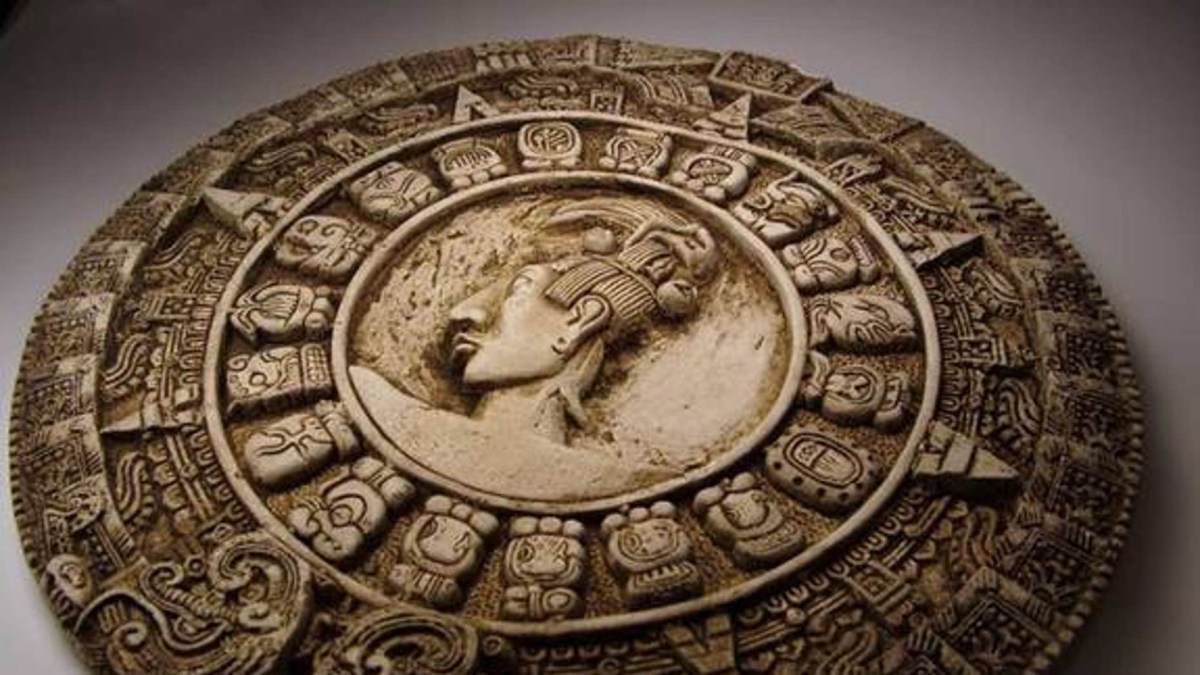
The Mayans used three separate calendars, each period represented by its own glyph. The Long Count was mainly used for historical purposes. The Maya/Mesoamerican long count, begun this day in 3114BC (corresponding to the Julian Calendar).was able to specify any date within a 2,880,000 day cycle.
The Haab was a civil calendar consisting of 18 months of 20 days, and one 5-day Uayeb, a nameless period rounding out the 365-day year.
The Tzolk’in was the “divine” calendar, used mainly for ceremonial and religious purposes. Consisting of 20 periods of 13 days, the Tzolk’in goes through a complete cycle every 260 days. The significance of this cycle is unknown, though it may be connected with the 263 day orbit of Venus. There is no year in the Haab or Tzolk’in calendars, though a Haab and Tzolk’in date may be combined to specify a particular day within a 52-year cycle.
National Geographic explains that 12/21/12 brings to a close not the end of time, but the end of the 12th Bak’tun, an almost 400-year period in the Mayan Long Count calendar. The world doesn’t end, according to this explanation, it “rolls over” to the year zero and starts over, kind of like old cars used to do, when the odometer reached 100,000 miles.
It doesn’t really roll over to “zero”, either. The base 20 numerical system means that 12/22/12 begins the next 400 year (actually 394.3 years) period to begin the 13th Bak’tun. It will reset to zero at the end of the 20th Bak’tun, about 3,000 years from now. Please let me know how that turns out.
The Mayan calendar system became extinct in most areas after the Spanish conquests of the 16th century, though it continues in use in many modern communities in highland Guatemala and in Veracruz, Oaxaca and Chiapas, Mexico.
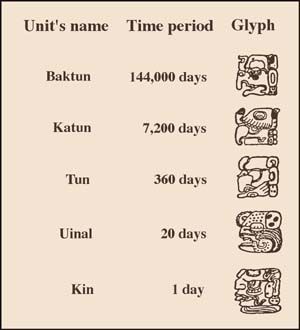
The table of Long Count units below illustrates the Mayan units of measure.
A day is a K’in, there are 20 K’ins in a Winal, and so on.
Today’s date then, according to the Mayan calendar, is Long Count Date 13.0.8.15.1, or: 13 baktun (13 X 144,000 days = 1,872,000 days) 0 katun (0 X 7,200 days = 0 days) 8 tun (8 X 360 days = 2,880 days) 15 uinal (15 X 20 days = 300 days) 1 k’in (1 X 1 day = 1 days) Tzolk’in Date: 13 Imix’ Haab Date: 19 Mol Lord of the Night
Represented graphically it all looks like this:
Hat tip to the Smithsonian National Museum of the American Indian, for that one.
History collides with legend when you peer a thousand years into the past, but one thing is certain. Shakespeare’s Macbeth bears little resemblance to the man, for whom the story is named.
Them that strut and fret their hours upon the stage are a superstitious lot full of sound and fury, signifying nothing. (Apologies to the Bard for that bit of word butchery).
In the world of theater it is high praise to present the performer with flowers, in token of appreciation for a fine performance. Be warned though, never give a performer flowers, before the play. That would bring bad luck. Never bringing a mirror on stage may be more practical than superstitious as you can never account for the reflection of set lighting, but then there’s the tradition, of the graveyard bouquet. Yeah. When a production closes, it is considered good luck to steal flowers from a graveyard and present them, to the director. Go figure. And whatever you do you are never to utter the name, Macbeth. Trust me. It’s “ the Scottish play”.
Act I. General Macbeth, Thane of Glamis, chances upon three witches who prophecy that he, Macbeth, is to be Thane of Cawdor and even more, King of Scotland.
Spurred on by his wife the ruthless and ambitious Lady Macbeth, he slips into the bedchamber of the good King Duncan and plunges the dagger, then frames the King’s bodyguards, for his murder. Now himself King in fulfillment of the witches’ prophecy, Macbeth and his Lady descend into a world of guilt and madness, duplicity and murder in the fruitless attempt to cover for his crime.
So sayeth William Shakespeare but what of the real Mac Bethad mac Findlaích?
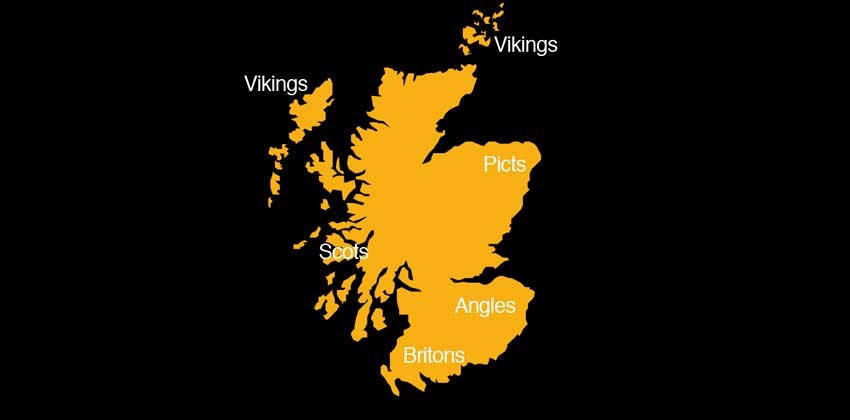
11th century Alba
History collides with legend when you peer a thousand years into the past, but some things are certain. 11th century Scotland was not the nation we know today, but a collection of warring kingdoms. Máel Coluim mac Cináeda (Malcolm II) came to power after defeating and killing his cousin King Kenneth III in 1005 at the battle of Monzievaird, near Crieff.
Malcolm was a fearsome ruler who immediately set about eliminating (read…killing), potential claimants to the throne. Information is scant but Malcolm appears to have fathered, three daughters. All three married well giving rise to yet more rivals but it was Duncan, Malcolm‘s grandson who would rise to power after his grandfather was killed in battle, in 1034.
Macbeth’s cousin murdered his father Findlaích and took for himself the title of Mormaer (Earl), when the boy was barely in his teens. Macbeth had his revenge in 1045 when found his cousin in a hall, with fifty of his warriors. Macbeth burnt the place to the ground, took the title for himself and, astonishingly, married his cousin’s widow, Gruoch.
The first Scottish Queen whose name we actually know, the real Lady Macbeth turns out to be hardly the avaricious harpy of the Bard’s portrayal but a saintly woman, best known for funding the production of illustrated manuscripts by the monks of a tiny friary, in Loch Leven.
Now himself Mormaer of Moray Macbeth proved a powerful fighter against the Vikings coming down from the north and a key ally, of King Duncan.
Duncan I ruled for five years and was indeed killed by Macbeth, but there the similarity ends. Duncan’s peaceful accession to the crown was the exception to the rule in 11th century Scotland. His death in battle was not, the killing blow delivered on August 14, 1040 at the battle of Pitgaveny, at the hands of Macbeth’s forces if not Macbeth, himself.
Victorious, Macbeth had a strong claim to the crown. According to modern descendants of clan Duncan stronger than Duncan, himself. The real lady Macbeth was the granddaughter, of Kenneth III. Macbeth was a direct relation to Malcolm himself, through his mother’s line. So it is the powerful Mormaer of Moray himself became King, ruling over Scotland, for the next seventeen years.
Scottish coronations were different at this time, than you might think. There was no physical crown, that wouldn’t come about, for another 200 years. Macbeth would have sat upon the 236-pound “Stone of Destiny” as the list of Scottish Kings, was read aloud. He was then given a sword with which to defend his kingdom and proclaimed King, by the assembled nobles.
While Shakespeare’s Macbeth was steeped in blood and treachery, the real King Macbeth seems to have been, well liked. There was blood, yes, Macbeth lived in a time of savagery when scores were settled with edged weapons but, much of his reign, was enjoyed in peace. Like the Bard’s Macbeth whose past would come back to haunt him, Duncan I’s father, Crinán, abbot of Dunkeld challenged the peace, in 1045. This was a brief but bloody struggle much smaller than the epoch-changing battle of Hastings, ten years after the death of Macbeth. When it was over Crinán lay dead along with 180 of his followers.
Macbeth was the first of the Scottish Kings to take a pilgrimage to Rome, to meet with Pope Leo IX. This demonstrates not only a sense of security against usurpers at home but the wealth, to scatter “money like seed to the poor”. For the first time a United Scotland, stood before the world.
Macbeth was the first to bring Normans into his service in 1052 indicating a new openness, to international trade.
Trouble came from the south in the form of Siward, the powerful Earl of Northumbria, a Danish chieftain who rose to power under the Viking King of England , Cnut the Great. The year was 1054, the battle taking place north of the Firth of Forth near a place called Dunsinane. When it was over 3,000 of Macbeth’s forces were dead. Siward lost 1,500 and his own son, Osbjorn.
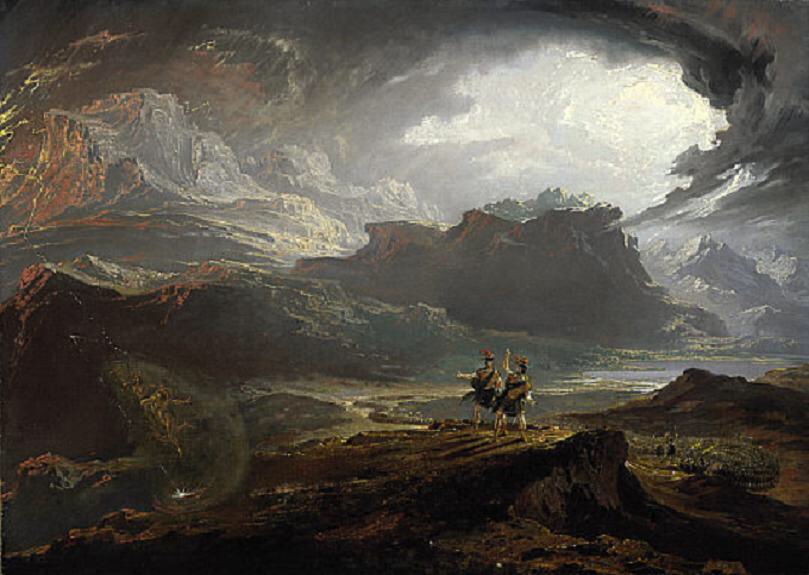
Early 19th-century depiction by John Martin of Mac Bethad (centre-right) watching Siward’s Northumbrian army approaching (right)
His Norman mercenaries now eliminated Macbeth was forced to give up, much of his southern Kingdom. Macbeth retained his kingship for now his reign came to an end a year later near Lumphanan, in Aberdeenshire. The son of the man Macbeth had killed some seventeen years earlier came for his father’s killer on August 15, 1057.
Macbeth, King of Alba, was dead. Malcolm III Canmore would rule through the Norman Conquests until he himself was ambushed and killed, in 1093.
No sooner did the Abbey Road album hit the streets, than the “Paul Is Dead” enthusiasts were off and running. It was a funeral procession, couldn’t anybody see that? Lennon, dressed in white, symbolizes the preacher. Ringo Starr was dressed in black. He was the mourner. George Harrison was wearing blue jeans and a work shirt. Anyone could see, he was the gravedigger.
In January 1967, an automobile belonging to singer/songwriter and Beatles’ band member Paul McCartney, was involved in an accident. He wasn’t driving it at the time, but no matter.
The rumor shifted into gear and the story was told, and retold. Before long, not only had McCartney himself been involved in a violent crash. Now the story was, he’d been killed in it.
Like the child’s game of “telephone”, the story picked up details with each retelling. There had been an argument at a Beatles recording session. McCartney left in anger, and crashed his car. To spare the public from grief, the Beatles replaced him with “William Campbell”, the winner of a McCartney look-alike contest.
The February issue of “The Beatles Book” fanzine tried to put the issue to rest, but some stories die hard. A cottage industry grew up around finding “clues” to McCartney’s “death”. Hundreds were reported by fans and followers of the legend. John Lennon’s final line in the song “Strawberry Fields Forever” sounded like “I buried Paul”. (McCartney later said the words were “cranberry sauce”). When “Revolution 9” from the White Album is played backwards, some claimed to hear “turn me on, dead man”.
On this day in 1969, photographer Iain MacMillan shot the cover photo for the Beatles’ last recorded album, Abbey Road. The ten-minute photo shoot produced six images, from which McCartney himself picked the cover photo. The image shows the band crossing the street, walking away from the studio.
No sooner did the album hit the streets, than the “Paul Is Dead” enthusiasts were off and running. It was a funeral procession, anybody see that. Lennon, dressed in white, symbolizes the preacher. Ringo Starr was dressed in black. Clearly, he was the mourner. George Harrison was wearing blue jeans and a work shirt. Anyone could see, he was the gravedigger.
Then there was McCartney himself, barefoot and out of step with the other members of the band. Clearly, this was the corpse.
He later explained he’d been barefoot that day, because it was hot. No one ever satisfactorily explained, nor did anyone ask, to my knowledge, how the man got to march in his own funeral procession. No matter, the Abby Road cover put the rumor mill over the top.
On October 12, one caller to Detroit radio station WKNR-FM told DJ Russ Gibb about the rumor and its clues. Gibb and his callers then discussed the rumor on the air for the next hour. Roby Yonge did the early AM shift at the powerhouse WABC out of New York. Yonge spent a full hour discussing the rumor, before he was pulled off-air for breaking format. WABC’s signal could be heard in 38 states at that time of night, and at times, other countries. The Beatles’ press office issued a statement denying the rumor, but it had already been reported by national and international media.
The November 7, 1969, Life magazine interview with Paul and Linda McCartney finally put the story to rest. “Perhaps the rumor started because I haven’t been much in the press lately“, he said. “I have done enough press for a lifetime, and I don’t have anything to say these days. I am happy to be with my family and I will work when I work. I was switched on for ten years and I never switched off. Now I am switching off whenever I can. I would rather be a little less famous these days“.
If they had Photoshop in those days, we’d still be hearing the rumors, today.
Today, top players are paid the GDP of developing nations, but that wasn’t always the case. One-hundred years ago, much of that money failed to make its way to the players. Even the best, held second jobs.
From World Cup Soccer to the Superbowl, the professional sports world has little to compare with the race for the Pinnacle Trophy. The contest for Championship, in which entire economies slow to a crawl and even casual sports fans, are caught up in the spectacle.
For professional baseball, the “Fall Classic” began in 1903, a best-of-nine “World Series” played out between the Boston Braves and the Pittsburg Pirates. Boston won, in eight.
Excepting the boycott year of 1904 when there was no series at all, most World Series have been ‘best-of-seven”. That changed in 1919, when league owners agreed to play a nine-game series, to generate more revenue and increase the popularity of the sport.
Today, top players are paid the GDP of developing nations, but that wasn’t always the case. One-hundred years ago, much of that money failed to make its way to the players. Even the best, held second jobs.
This was the world in which Chicago White Sox owner Chuck Comiskey built the most powerful organization in professional baseball, despite a miserly reputation.
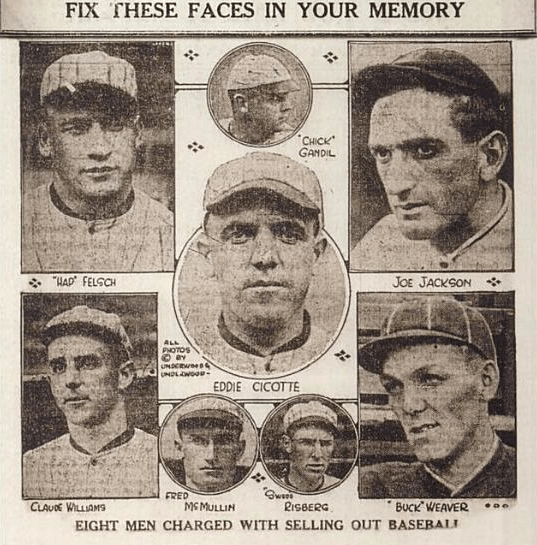
The 1919 “Black Sox” scandal began when Arnold “Chick” Gandil, White Sox first baseman with ties to the Chicago underworld, convinced his buddy and professional gambler Joseph “Sport” Sullivan, that he could throw the World Series against the Cincinnati Reds.
New York gangster Arnold Rothstein supplied the money through his right-hand man, former featherweight boxing champion, Abe Attell.
Pitchers Eddie Cicotte and Claude “Lefty” Williams were principally involved with throwing the series, along with outfielder Oscar “Hap” Felsch and shortstop Charles “Swede” Risberg. Third baseman George “Buck” Weaver attended a meeting where the fix was discussed, but decided not to participate. Weaver handed in some of his best statistics of the year during the 1919 post-season.
Star outfielder “Shoeless” Joe Jackson may have been a participant, though that involvement has been disputed. It seems that other players may have used his name in order to give themselves credibility. Utility infielder Fred McMullin was not involved in the planning, but threatened to report the others unless they cut him in, on the payoff.
The more “straight arrow” players on the club knew nothing about the fix. Second baseman Eddie Collins, catcher Ray Schalk and pitcher Red Faber had nothing to do with it, though the conspiracy received an unexpected boost, when Faber came down with the flu.
Official Program
Rumors were flying as the series started on October 2. So much money was bet on Cincinnati, that the odds were flat. Gamblers complained that nothing was left on the table. Cicotte, who had shrewdly collected his $10,000 the night before, struck leadoff hitter Morrie Rath with his second pitch, a prearranged signal that “the fix was in”.
The plot began to unravel, the first night. Attell withheld the next installment of $20,000, to bet on the following game.
Game 2 starting pitcher Lefty Williams was still willing to go through with the fix, even though he hadn’t been paid. He’d go on to lose his three games in the best-of nine series, but by game 8, he wanted out.
The wheels came off in game three. Former Tigers pitcher and Rothstein intermediary Bill “Sleepy” Burns bet everything he had on Cincinnati, knowing the outcome in advance. Except, Rookie pitcher Dickie Kerr wasn’t in on the fix. He pitched a masterful game in game three, shutting Cincinnati out 3-0, and leaving Burns, flat broke.
Cicotte became angry in game 7, thinking that gamblers were trying to renege on their deal. The knuckle baller bore down to a White Sox win and the series stood, 4-3.
Williams was back on the mound in game 8. By this time he wanted out of the deal, but gangsters threatened to hurt him and his family if he didn’t lose the game. Williams threw nothing but mediocre fastballs, allowing four hits and three runs in the first. The White Sox went on to lose that Game 10-5, ending the series with a 3 – 5 Cincinnati win.
Rumors of the fix began immediately, and dogged the team throughout the 1920 season. Chicago Herald and Examiner baseball writer Hugh Fullerton, wrote that there should never be another World Series. A grand jury was convened that September. Two players, Eddie Cicotte and Shoeless Joe Jackson, testified on September 28, both confessing to participating in the scheme. Despite a virtual tie for first place at that time, Comiskey pulled the seven players then still in the majors. Gandil was back in the minors, at the time.
“Shoeless” Joe Jackson
The reputation of professional baseball had suffered a major blow. Franchise owners appointed a man with the best “baseball name” in history, to help straighten out the mess. He was Major League Baseball’s first Commissioner, federal judge Kenesaw Mountain Landis.
The Black Sox trial began on July 18, 1921, in the Criminal Court in Cook County. Key evidence went missing before the trial, including both Cicotte’s and Jackson’s signed confessions. Both recanted and, in the end, all players were acquitted. The missing confessions reappeared several years later, in the possession of Comiskey’s lawyer. Funny how that works.
According to legend, a young boy approached Shoeless Joe Jackson one day as he came out of the courthouse. “Say it ain’t so, Joe”. There was no response.
The Commissioner was unforgiving, irrespective of the verdict. On August 3, the day of the verdict, Landis delivered the following statement:
“Regardless of the verdict of juries, no player who throws a ball game, no player who undertakes or promises to throw a ball game, no player who sits in confidence with a bunch of crooked ballplayers and gamblers, where the ways and means of throwing a game are discussed and does not promptly tell his club about it, will ever play professional baseball”.
Baseball Commissioner Kennesaw Mountain Landis
Jackson, Cicotte, Gandil, Felsch, Weaver, Williams, Risberg, and McMullin are long dead now, but every one of them remains: Banned from Baseball.
For many, the 1919 scandal paved the way to the “Curse of the Black Sox”, a World Series championship drought lasting 88 years and ending only in 2005, with a White Sox sweep of the Houston Astros. Exactly one year after the Boston Red Sox ended their own 86-year drought, the “Curse of the Bambino”.
The Philadelphia Bulletin newspaper published a poem back on opening day, of the 1919 series. They would probably have taken it back, if only they could.
“Still, it really doesn’t matter, After all, who wins the flag. Good clean sport is what we’re after, And we aim to make our brag. To each near or distant nation, Whereon shines the sporting sun. That of all our games gymnastic, Base ball is the cleanest one!”
On this day in 1963 and, for that matter, every day between April 22 and August 20, the sun never seems to set in that part of Alaska. A personal friend jokes about a family trip from Fairbanks to Florida in which he learned his kids associate warmth and cold not with the change of season, but the presence or absence of light.
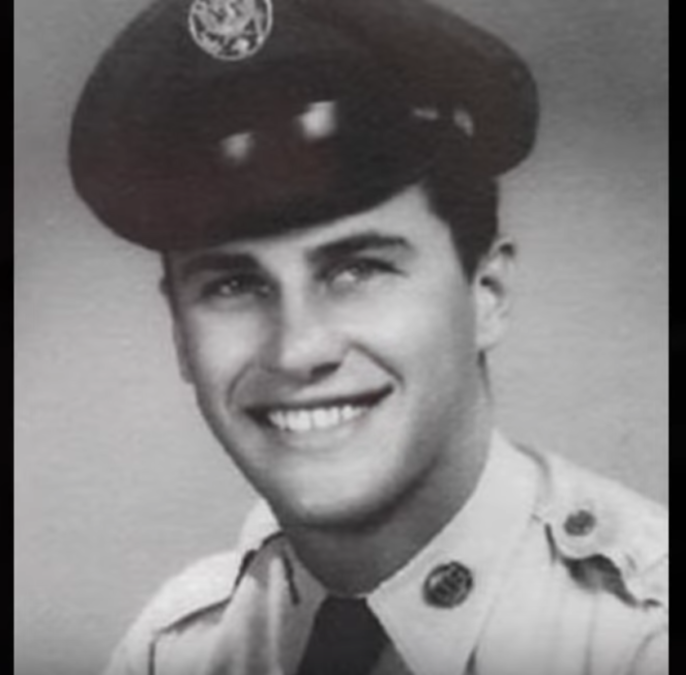
Anyone who served at Eielson Air Force Base in the early 1960s remembers Sergeant Ross. A man with a voice like a jackhammer, striding into the early morning stillness. The sleeping recruits. The voice let loose like the roar of a shotgun, fired over their heads.
For 20 years Ross served as a training instructor, ordering this man to drop and give him fifty, and that one to scrub the latrines.
And yet, here in the last frontier Sgt. Ross grew and nurtured a secret, softer side of himself, one that wasn’t so secret, at all. This was the land of the Midnight Sun, Alaska style, just outside of Fairbanks. Here the Orlando Florida-born 1st Sergeant learned to appreciate the beauty of a fresh fall of snow. The majesty of the Aurora Borealis and the magnificent mountains and tall trees.
Image of the Aurora Borealis from the official website, of Eielson Air Base
First came the art classes, to fill the quiet hours, off-duty. The large brush, wet-on-wet painting techniques that allowed Sgt. Ross to wolf down a sandwich and complete an entire canvas, all in a half-hour lunch. Painting gave the man a moment of joy and then it was…back to work.
COME ON LADIES, WE’RE NOT ON VACATION. LET’S GET THE LEAD…OUT!
On this day in 1963 and, for that matter, every day between April 22 and August 20, the sun never seems to set in that part of Alaska. A personal friend jokes about a family trip from Fairbanks to Florida in which he learned his kids associate warmth and cold not with the change of season, but the presence or absence of light.
So it was this human bullhorn of a man had an abundance of daylight in which to appreciate the beauty of Alaska and to hone and practice, his art. He produced hundreds of paintings during this period perhaps thousands and sold them, for a few extra dollars spending money.
”I developed ways of painting extremely fast. I used to go home at lunch and do a couple while I had my sandwich. I’d take them back that afternoon and sell them.”
Sgt. Robert Norman Ross
All things, must come to an end. Today, Eielson Air Base hosts the 354th Fighter Wing with a mission statement, “[T]o provide USINDOPACOM combat-ready fifth-generation airpower, advanced integration training, and strategic arctic airpower basing”.
Robert Norman Ross left the military after twenty years to pursue different interests and died too soon at the age of 52, of lymphoma. The New York times obituary said simply that the man “Was A Painter On TV.” There was no picture, nor any mention of the ugly battle that was about to break out, over his fifteen million dollar estate.
U-2 Spy Plane, Eielson AFB, Alaska
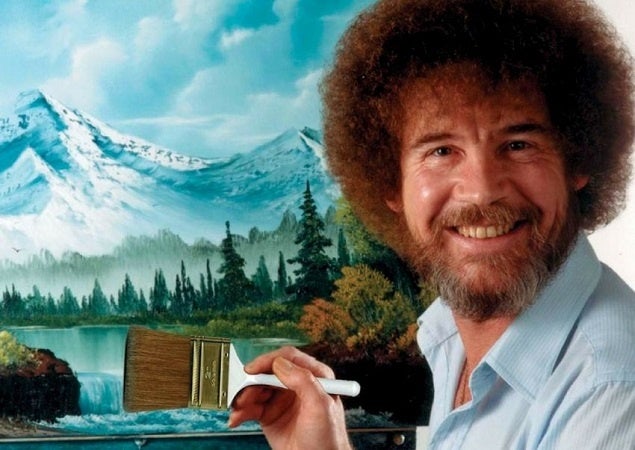
But, imagine if you will the surprise of any of those Air Force recruits from the height of the Cold War, on turning on the TV. To their favorite PBS channel to see their former drill sergeant. The man with a voice that could crack rocks sporting not the crew cut and close-shaved face of the early 1960s but a beard and an afro, the size of a basketball.
And there it was again, that oversized brush and that voice, now speaking in the soporific tones of Mr. Rogers. The cerulean reds and the burnt umbers, the tranquil almost somnolent words painting a picture, of the Joy of Painting. The happy little tree I think we’ll put…right…Here.
Hat tip to Mike Rowe and a fun podcast he calls “The Way I Heard It”, without which I would remain entirely ignorant, of this tale.
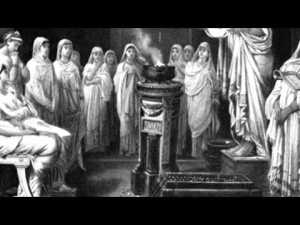
In ancient Rome, women partook of a festival, strictly forbidden to Roman men. So strict was this line of demarcation that only women were permitted even to know the name of the deity. For everyone else she was simply the “Good Goddess”. The Bona Dea.
The earliest discernible Mother’s day comes down to us from 1200-700BC, descending from the Phrygian rituals of modern day Turkey and Armenia. “Cybele” was the great Phrygian goddess of nature, mother of the Gods, of humanity, and of all the beasts of the natural world, her cult spreading throughout Eastern Greece with colonists from Asia Minor.
Much of ancient Greece looked to the Minoan Goddess Rhea, daughter of the Earth Goddess Gaia and the Sky God Uranus, mother of the Gods of Olympus. Over time the two became closely associated with the Roman Magna Mater, each developing her own cult following and worshipped through the period of the Roman Empire.
In ancient Rome, women partook of a festival, strictly forbidden to Roman men. So inflexible was this line of demarcation that only women were permitted even to know the name of the deity. For everyone else she was simply the “Good Goddess”. The Bona Dea.
In the sixteenth century, it became popular for Protestants and Catholics alike to return to their “mother church” whether that be the church in which they were baptized, the local parish church, or the nearest cathedral. Anyone who did so was said to have gone “a-mothering”. Domestic servants were given the day off and this “Mothering Sunday”, the 4th Sunday in Lent, was often the only time when whole families could get together. Children would gather wild flowers along the way, to give to their own mothers or to leave in the church. Over time the day became more secular but the tradition of gift giving continued.
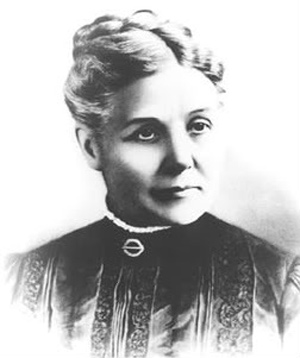
Ann Maria Reeves Jarvis
Ann Maria Reeves Jarvis was a social activist in mid-19th century western Virginia. Pregnant with her sixth child in 1858, she and other women formed “Mothers’ Day Work Clubs”, to combat the health and sanitary conditions which were leading at that time to catastrophic levels of infant mortality. Jarvis herself gave birth between eleven and thirteen times in a seventeen year period. Only four would live to adulthood.
Jarvis had no patience for the sectional differences that led the nation to Civil War, or which led her own locality to secede and form the state of West Virginia in order to rejoin the Union. Jarvis refused to support a measure to divide the Methodist church into northern and southern branches. She would help Union and Confederate soldier alike if she could. It was she alone who offered a prayer when others refused for Thornsbury Bailey Brown, the first Union soldier killed in the vicinity.
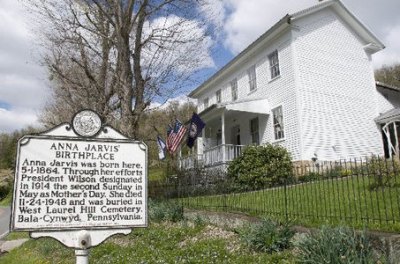
Anna Jarvis
Following Jarvis’ death in 1905, her daughter Anna conceived of Mother’s Day as a way to honor her legacy, and to pay respect for the sacrifices all mothers make on behalf of their children.
Obtaining financial backing from Philadelphia department store owner John Wanamaker, Anna Jarvis organized the first official Mother’s Day celebration at a Methodist church in Grafton, West Virginia. That same day, thousands attended the first Mother’s Day event at Wanamaker’s store in Philadelphia.
Anna Jarvis resolved that Mother’s Day be added to the national calendar, and a massive letter writing campaign ensued. On May 9, 1914, President Woodrow Wilson signed a measure declaring the second Sunday of May, to be Mother’s Day.
Anna Jarvis believed Mother’s Day to be a time of personal celebration, a time when families would gather to love and honor their mother.
In the early days she had worked with the floral industry to help raise the profile of Mother’s Day. By 1920 she had come to resent what she saw as the commercialization of the day. Greeting cards seemed a pale substitute for the hand written personal notes she envisioned. Jarvis protested a Philadelphia candy maker’s convention in 1923, deriding confectioners, florists and even charities as “profiteers”. Carnations had by this time become symbolic of Mother’s Day. Jarvis resented that they were being sold at fundraisers. She protested at a meeting of the American War Mothers in 1925 where women were selling carnations, and got herself arrested for disturbing the peace.
Soon she was launching an endless series of lawsuits against those she felt had used the name of “Mother’s Day”, in vain.
During the last years of her life, Anna Jarvis lobbied the government to take her creation off the calendar, gathering signatures door-to-door to get the holiday rescinded. The effort was obviously unsuccessful. The mother of mother’s day died childless in a sanitarium in 1948, her personal fortune squandered on legal fees.
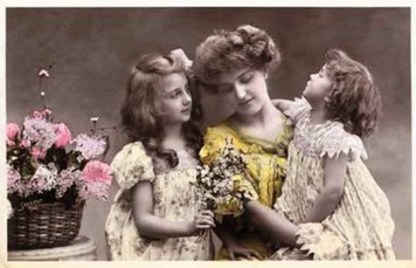
Today, some variation of Mother’s Day is observed from the Arab world to the United Kingdom. In the United States, Mother’s Day is one of the most commercially successful days of the year for flower and greeting card sales, and the biggest day of the year for long-distance phone calls. Church attendance is the third highest of the year behind only Christmas and Easter. Many churchgoers celebrate the day with carnations: colored if the mother is still living and white, if she has passed on.
“Righteousness cannot be born until self-righteousness is dead”. – Bertrand Russell
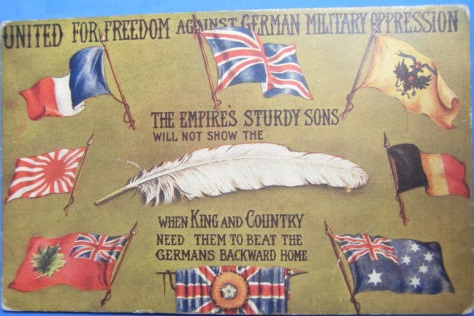
At different times and places, a white feather has carried different meanings. For those inclined toward New-Age, the presence of a white feather is proof that Guardian Angels are near. For the Viet Cong and NVA Regulars who were his prey, the “Lông Trắng” (“White Feather”) symbolized the deadliest menace of the American war effort in Vietnam. USMC Scout Sniper Carlos Hathcock wore one in his bush hat. Following the Battle of Crécy in 1346, Edward of Woodstock, Prince of Wales, plucked three white ostrich feathers from the dead body of the blind King John of Bohemia. To this day, those feathers appear in the coat of arms, of the prince of Wales.
The Edward and John who faced one another over the field at Crécy, could be described in many ways. Cowardice is not one of them. For the men of the WW1 generation, a white feather represented precisely that.
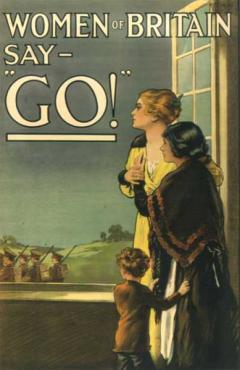
In August 1914, seventy-three year old British Admiral Charles Cooper Penrose-Fitzgerald organized a group of thirty women, to give out white feathers to men not in uniform. The point was clear enough. To gin up enough manpower to feed the needs of a war so large as to gobble up a generation, and spit out the pieces.
Lord Horatio Kitchener supported the measure, saying “The women could play a great part in the emergency by using their influence with their husbands and sons to take their proper share in the country’s defence, and every girl who had a sweetheart should tell men that she would not walk out with him again until he had done his part in licking the Germans.”
The Guardian newspaper chimed in, breathlessly reporting on the activities of the “Order of the White Feather“, hoping that the gesture “would shame every young slacker” into enlisting.
“The White Feather: A Sketch of English Recruiting”, Collier’s Weekly (1914)
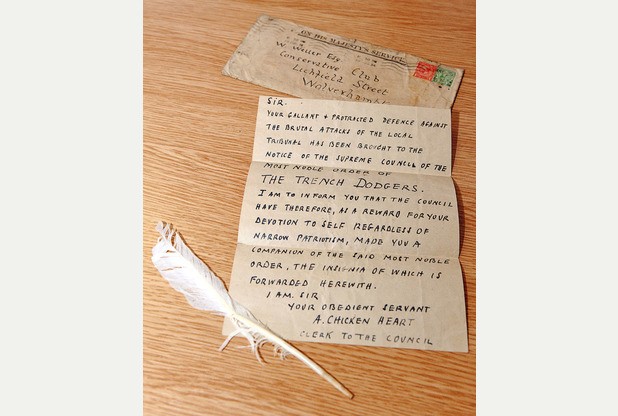
In theory, such an “award” was intended to inspire the dilatory to fulfill his duty to King and country. In practice, such presentations were often mean-spirited, self righteous and out of line. Sometimes, grotesquely so.
The movement spread across Great Britain and the Commonwealth nations and across Europe, encouraged by suffragettes such as Emmeline Pankhurst and her daughter Christabel, and feminist writers Mary Augusta Ward, founding President of the Women’s National Anti-Suffrage League, and British-Hungarian novelist and playwright, Emma Orczy.
Distributors of the white feather were almost exclusively female, who frequently misjudged their targets. Stories abound of men on leave, wounded, or in reserved occupations being handed the odious symbols.
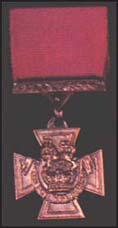
Seaman George Samson received a white feather on the same day he was awarded the British Commonwealth’s highest military award for gallantry in combat, equivalent to the American Medal of Honor: the Victoria Cross.
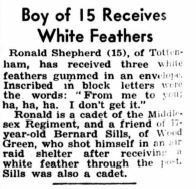
Gangs of “feather girls” took to the streets, looking for military-age men out of uniform. Frederick Broome was fifteen years old when “accosted by four girls who gave me three white feathers.”
The writer Compton Mackenzie, himself a serving soldier, complained that these “idiotic young women were using white feathers to get rid of boyfriends of whom they were tired“.
James Lovegrove was sixteen when he received his first white feather: “On my way to work one morning a group of women surrounded me. They started shouting and yelling at me, calling me all sorts of names for not being a soldier! Do you know what they did? They struck a white feather in my coat, meaning I was a coward. Oh, I did feel dreadful, so ashamed.” Lovegrove went straight to the recruiting office, who tried to send him home for being too young and too small: “You see, I was five foot six inches and only about eight and a half stone. This time he made me out to be about six feet tall and twelve stone, at least, that is what he wrote down. All lies of course – but I was in!”.
James Cutmore attempted to volunteer for the British Army in 1914, but was rejected for being near-sighted. By 1916, the war in Europe was consuming men at a rate unprecedented in history. Governments weren’t nearly so picky. A woman gave Cutmore a white feather as he walked home from work. Humiliated, he enlisted the following day. In the 1980s, Cutmore’s grandchild wrote “By that time, they cared nothing for [near-sightedness]. They just wanted a body to stop a shell, which Rifleman James Cutmore duly did in February 1918, dying of his wounds on March 28. My mother was nine, and never got over it. In her last years, in the 1980s, her once fine brain so crippled by dementia that she could not remember the names of her children, she could still remember his dreadful, lingering, useless death. She could still talk of his last leave, when he was so shell-shocked he could hardly speak and my grandmother ironed his uniform every day in the vain hope of killing the lice.”
Some of these people were not to be put off. One man was confronted by an angry woman in a London park, who demanded to know why he wasn’t in uniform. “Because I’m German“, he said. She gave him a feather anyway.
Some men had no patience for such nonsense. Private Ernest Atkins was riding in a train car, when the woman seated behind him presented him with a white feather. Striking her across the face with his pay book, Atkins declared “Certainly I’ll take your feather back to the boys at Passchendaele. I’m in civvies because people think my uniform might be lousy, but if I had it on I wouldn’t be half as lousy as you.”
Private Norman Demuth was discharged from the British Army after being wounded, in 1916. A woman on a bus handed Demuth a feather, saying “Here’s a gift for a brave soldier.” Demuth was cooler than I might have been, under the circumstances: “Thank you very much – I wanted one of those.” He used the feather to clean his pipe, handing the nasty thing back to her with the comment, “You know we didn’t get these in the trenches.”
Inevitably, the white feather became a problem when civilian government employees began to receive the hated symbols. Home Secretary Reginald McKenna issued lapel badges to employees in state industries, reading “King and Country”. Proof that they too, were serving the war effort. Veterans who’d been discharged for wounds or illness were likewise issued such a badge that they not be accosted, in the street.
So it was that the laborer from St. Albans was sent to kill the greengrocer from some small village in Bavaria, each spurred on by their women, the whole sorry mess driven by politicians who would make war, from the comfort of home. The white feather campaign was briefly revived during World War 2, but never caught on to anything approaching the same degree as the first.
British infantryman Siegfried Sassoon was wounded multiple times on the Western Front, one of the great poets of the War to End All Wars. Marching off to fight the Hun for King and country, these were the boys who returned, embittered by the horrors of the trenches to speak for a broken generation, no longer able to speak for itself. And those were the lucky ones.
Let the man who earned it, have the last word: “If I were fierce, and bald, and short of breath, I’d live with scarlet majors at the Base, And speed glum heroes up the line to death…And when the war is done and youth stone dead, I’d toddle safely home and die – in bed.”



































 Historical Easter Eggs - Today in History
You must be logged in to post a comment.