August 14, 1945 A Kiss in Times Square

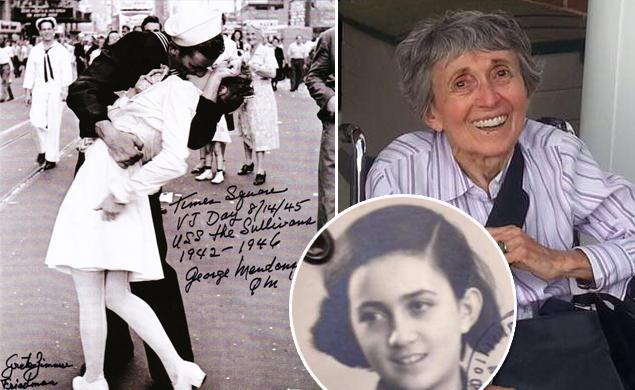
The lit message running around the Times Building read, “VJ, VJ, VJ, VJ” as George Mendonsa grabbed a stranger and kissed her. Two seconds later the moment was gone, but Alfred Eisenstaedt and his camera had been in the right place at the right time.

The most destructive war in history ended this day in 1945, with the unconditional surrender of the Empire of Japan.

It was morning on the East Coast.  President Harry Truman had not yet received the formal surrender. The White House official announcement was still hours away, but rumors had been flying since the early morning hours.

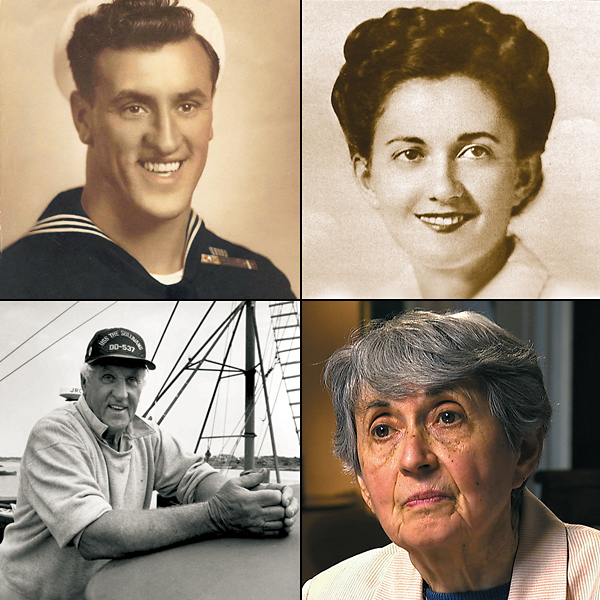
Born and raised in Austria, Greta Zimmer was 16 in 1939. Seeing the war bearing down on them, Greta’s parents sent her and her two sisters to America, not knowing if they would ever see them again. Six years later she was a dental assistant, working at the Manhattan office of Dr. J. L. Berke.

Greta’s lunch break came just after 1:00 that day.  Patients had been coming into the office all morning with rumors that the war was over. She set out for Times Square, knowing that the lit and moving type on the Times news zipper would give her the latest news.

Mendonsa, Zimmer
George Mendonsa, Greta Zimmer-Friedman

Petty Officer 1st Class George Mendonsa was on his last day of shore leave, spending the day with his new girlfriend, Rita Petry. They had heard the rumors too, but right now they were enjoying their last day together. The war could wait until tomorrow.

The couple went to a movie at Radio City Music Hall, but the film was interrupted by a theater employee who turned on the lights, announcing that the war was over. Leaving the theater, the couple joined the tide of humanity moving toward Times Square. The pair stopped at the Childs Restaurant on 7th Ave & 49th, where bartenders were pouring anything they could get hands on into waiting glasses.  Revelers were scooping them up as fast as the glasses were filled.

Mendonsa’s alcohol-powered walk/run from the restaurant left Rita trailing behind, but neither one seemed to mind. Times Square was going wild.

The sailor from the USS Sullivans had seen bloodshed. He’d been there on May 11, as kamikaze planes smashed into the USS Bunker Hill.  Explosions and fires killed 346 sailors that day.  43 of their bodies would never be found. Mendonsa had helped to pull the survivors, some of them hideously burned, out of the water. He had watched while Navy nurses tended to the injured and the dying.

When the sailor spotted Greta Zimmer, the dental assistant was dressed the same way.  To him, she must have seemed like one of those white-clad angels of mercy from those earlier months.

kiss-in-times-square-leica-2Reporters from the AP, NY Times, NY Daily News and others descended on Times Square to record the spontaneous celebration.
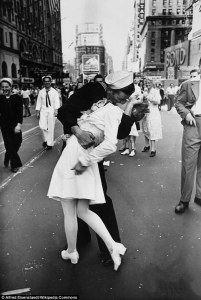
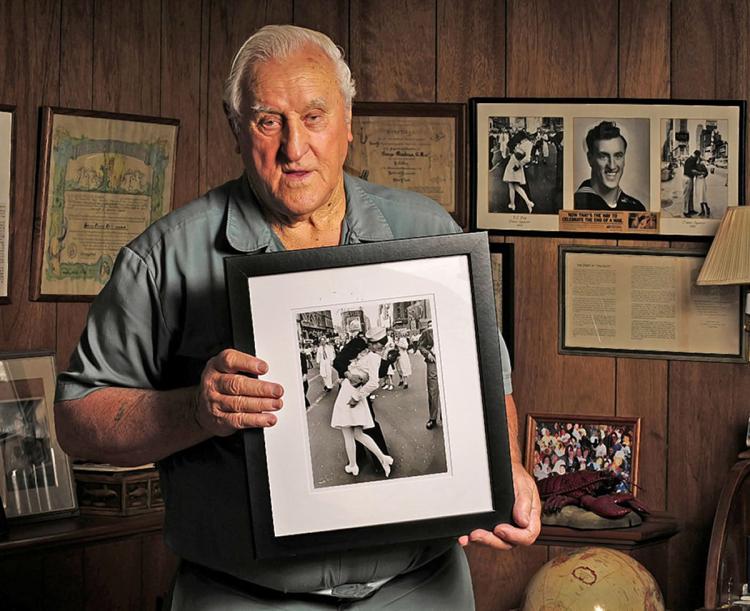
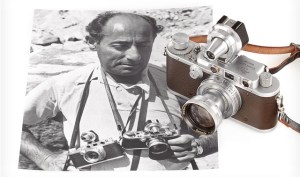
As a German Jew in the 1930s, Alfred Eisenstaedt had photographed the coming storm. He had photographed Benito Mussolini’s first meeting with Adolf Hitler in Venice in 1934. Now he and his Leica Illa rangefinder camera worked for Life Magazine, heading to Times Square in search of “The Picture”.

The lit message running around the Times Building read, “VJ, VJ, VJ, VJ” as George Mendonsa grabbed a stranger and kissed her. Two seconds later the moment was gone, but Eisenstaedt and his camera had been in the right place at the right time.Times Square Kiss

The image of the sailor kissing the nurse would become as famous as Joe Rosenthal’s photo of the flag raising at Iwo Jima, but not until years later.

The German made camera which took the iconic image recently went to auction at the Westlicht auction house in Vienna, where it was expected to sell for $30,000. The winning bid was almost $150,000.

After the war, Greta Zimmer learned that both of her parents had died in the camps. She later married and made her home in Frederick, Maryland.  Greta Zimmer Friedman never returned to Austria, and passed away last September, at the age of 92.

George Mendonsa and Rita Petry later married. George never saw the famous photograph until 1980.  At first he wasn’t sure he recognized himself.  Today, framed copies of it hang on the wall of their Rhode Island home.

MendonsaThis year, the couple celebrates their 68th wedding anniversary.  Rita says she wasn’t angry that her husband kissed another woman on their first date.  She points out that she can been seen grinning in the background of the famous picture.  She will admit, however, ‘In all these years, George has never kissed me like that.’

August 13, 3114BC  The End of the World

National Geographic explains that 12/21/12 brings to a close not the end of time, but the end of the 12th Bak’tun, an almost 400-year period in the Mayan Long Count calendar.  The world doesn’t end, according to this explanation, it just “rolls over” to the year zero and starts over, kind of like old cars used to do, when they reached 100,000 miles on the odometer.

MayanCalendarOne of the more profoundly silly bits of pop culture nonsense served up in the recent past, may be the world coming to an end on 12/21/12, according to the Mayan calendar. The calendar itself isn’t silly, it’s actually a very sophisticated mathematical construct, but the end of the world part certainly was.

According to linguist, anthropologist and Mayanist scholar Floyd Glenn Lounsbury and his “Lounsbury Correlation”, the Mayan Calendar dates back 5,131 years to August 13, 3114 BC.  This day seems as good as any, though I’m sure there can be little certainty about a date that far in the past.

The Mayans were skilled mathematicians, and it shows in their calendar.  They were the first to recognize the concept of zero, and worked extensively in a base 20 number system.

Long count glyphsThe Mayans used three separate calendars, each period represented by its own glyph. The Long Count was mainly used for historical purposes, able to specify any date within a 2,880,000 day cycle, about 7,885 solar years. The Haab was a civil calendar, consisting of 18 months of 20 days, and one 5-day Uayeb, a nameless period rounding out the 365-day year. The Tzolkin was the “divine” calendar, used mainly for ceremonial and religious purposes.  Consisting of 20 periods of 13 days, the Tzolkin goes through a complete cycle every 260 days. The significance of this cycle is unknown, though it may be connected with the 263 day orbit of Venus. There is no year in the Haab or Tzolkin calendars, though a Haab and Tzolkin date may be combined to specify a particular day within a 52-year cycle.

National Geographic explains that 12/21/12 brings to a close not the end of time, but the end of the 12th Bak’tun, an almost 400-year period in the Mayan Long Count calendar.  The world doesn’t end, according to this explanation, it “rolls over” to the year zero and starts over, kind of like old cars used to do, when the odometer reached 100,000 miles.

MayanCalendar-300x300It doesn’t really roll over to “zero”, either.  The base 20 numerical system means that 12/22/12 begins the next 400 year (actually 394.3 years) period to begin the 13th Bak’tun.  It will reset to zero at the end of the 20th Bak’tun, about 3,000 years from now.  Please let me know how that turns out.

The Mayan calendar system became extinct in most areas after the Spanish conquests of the 16th century, though it continues in use in many modern communities in highland Guatemala and in Veracruz, Oaxaca and Chiapas, Mexico.

The table of Long Count units below illustrates the Mayan units of measurement.  A day is a K’in, there are 20 K’ins in a Winal, and so on.  Today’s date, according to the Mayan calendar, is Long Count: 13.0.4.12.14, Calendar Round: 8 Ix 12 Yaxk’in, Year Bearer: 6 Ik’, Lord of Night: G2, 13 Bak’tun, 0 K’atun, 4 Tun, 12 Winal, 14 K’in, 8 Ix, G2, 12 Yaxk’in.  Got it?  Me neither.

Table of Long Count units


August 11, 1919 America’s Team

No other club in professional football history has won three consecutive championships. The Packers did it twice:  1929–1931, and 1965–1967.

The story begins with a sidewalk conversation sometime back in 1919, between Earl “Curly” Lambeau and George Whitney Calhoun. It went something like this: “Why don’t we start up a football team?” “Ok, what do we need to do”.

Curley LambeauLambeau worked for the Indian Packing Company in those days, making $250 a month as a shipping clerk. The two went to Lambeau’s employer and got a commitment for $500 for team uniforms, provided that the team use the company’s name. Today, “Green Bay Packers” is the oldest team name still in use in the NFL.

The team was founded on August 11, 1921, when Lambeau and Calhoun gathered with a group of young athletes, in the editorial room of the old Green Bay Press-Gazette building.  The team did well that first season, playing on an open field with no fences or bleachers. The money came from spectators “passing the hat”, while watching the team play to a 10-1 record.  You can imagine how that worked out.

The Packers became a professional franchise when they joined the newly formed American Professional Football Association on August 27, 1921. The league revoked their franchise at the end of the season, when the Packers were revealed to have used college players in a game. It turns out that the man who told the league about it was George Halas of the Chicago Staleys, which became “Da Bears” the following year. The incident began one of the most intense sports rivalries in history, one which rivals the Boston Red Sox and New York Yankees, and lasts to this day.

1919-team
1919 Team

In 1922, Lambeau obtained additional funding from a group of Green Bay businessmen, “The Hungry Five”, and bought the franchise back for $250, including $50 of his own money. Financial troubles continued through 1922. One game was rained out, and the insurance company wouldn’t pay off because the official amount of rain was 1/100″ short of the amount specified in the policy.

The Green Bay Football Corporation was formed to run the team in 1923, and continues to do so to this day. Other teams are owned by publicly traded corporations, such as the Atlanta Braves [Liberty Media, previously Time Warner], New York Rangers [Cablevision], and the Seattle Mariners [Nintendo of America], but the Green Bay Packers are the only franchise in American professional sports, directly owned by the public.Green Bay Uniforms

Financial troubles and micro-management persisted through the war years.  The club posted a dismal 1-10-1 record in 1958, one of the worst in league history. They hired away an assistant coach from the New York Giants that year, to be the new Head Coach.  His name was Vince Lombardi.  The first day on the job, Lombardi said “As of now, I’m in charge”.  The era of the front office running the game, was over.

The 1959 season got off to a good start, shutting out Chicago in the opener, and finishing 7-5 for their first winning record in 12 years. A 21-0 shutout of Washington on November 22 of that year, was the last Packers game to this date that didn’t sell out.

Green Bay has a population of only 105,139 according to the 2016 census, making it less than 1/10th the population of the typical NFL city. The Packers following comes from well beyond Green Bay, drawing crowds from all over Wisconsin and the Midwest. In fact, as late as 1995, the Packers played three home games a year in Milwaukee, one in pre-season, and two regular season.

SportsIllustrated_10jan1966No other club in professional football history has won three consecutive championships. The Packers did it twice:  1929–1931, and 1965–1967.
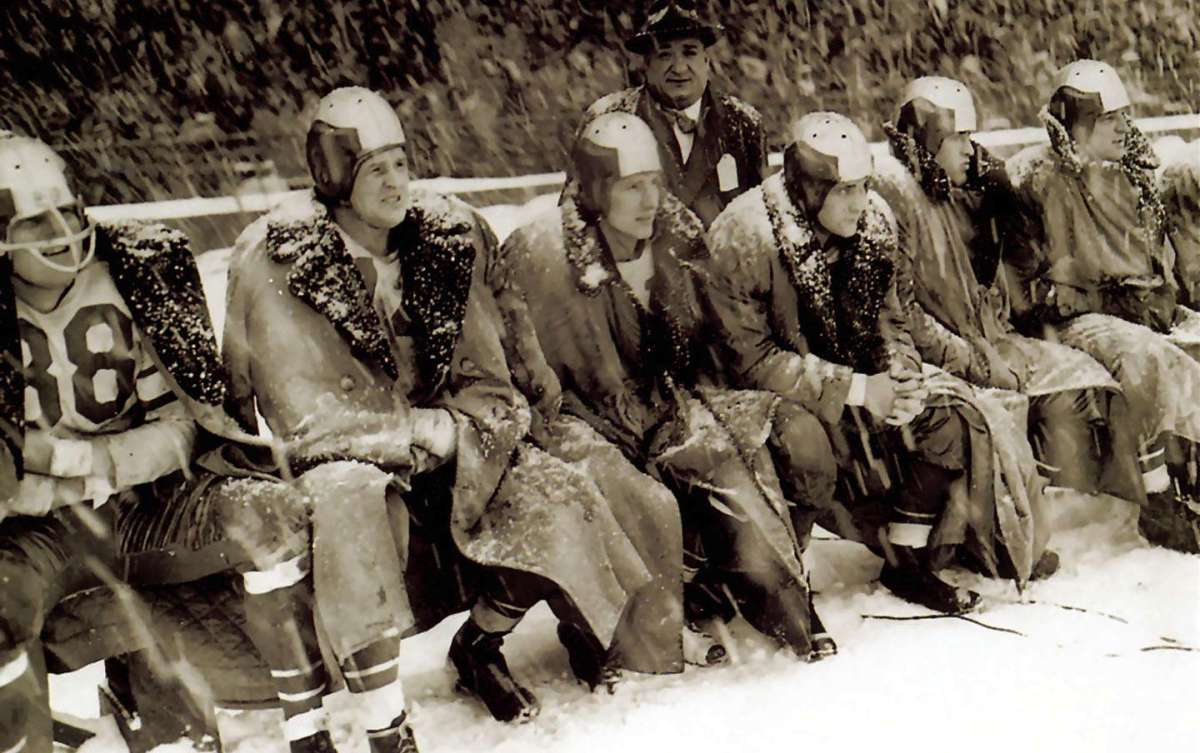
Green Bay won in 4 out of 5 Super Bowl victories, tied at 3rd with the New York Giants, behind the Pittsburgh Steelers with 6, a three-way tie at 5 each for the New England Patriots, San Francisco 49ers & Dallas Cowboys.  They’ve won 13 championships since the ‘20s, more than any team in professional football history.  Chicago comes in second with only 9.  The last three seasons have been rough on Da Bears, where rumor has it that a recent game was called due to an unknown white substance on the field.  Play was resumed after it was determined that it was only the end zone.  It was unlikely that anyone from Chicago was going to run into it again, anytime soon.

August 8, 1969 Paul is Dead

Like the child’s game of “telephone”, the story picked up details with each retelling.  There had been an argument at a Beatles recording session. McCartney left in anger, and crashed his car. To spare the public from grief, the Beatles replaced him with “William Campbell”, the winner of a McCartney look-alike contest.

In January 1967, a car belonging to singer/songwriter and Beatles’ band member Paul McCartney, was involved in an accident.  He wasn’t driving at the time, but no matter.

The story was told and retold.  Before long, not only had McCartney himself been involved in the crash.  He’d been killed in it.

Like the child’s game of “telephone”, the story picked up details with each retelling.  There had been an argument at a Beatles recording session. McCartney left in anger, and crashed his car. To spare the public from grief, the Beatles replaced him with “William Campbell”, the winner of a McCartney look-alike contest.Paul is dead

The February issue of “The Beatles Book” fanzine tried to put the issue to rest, but some stories die hard.  A cottage industry grew up around finding “clues” to McCartney’s “death”.  Hundreds were reported by fans and followers of the legend. John Lennon’s final line in the song “Strawberry Fields Forever” sounded like “I buried Paul”.  (McCartney later said the words were “cranberry sauce”).  When “Revolution 9” from the White Album is played backwards, some said they could hear “turn me on, dead man”.

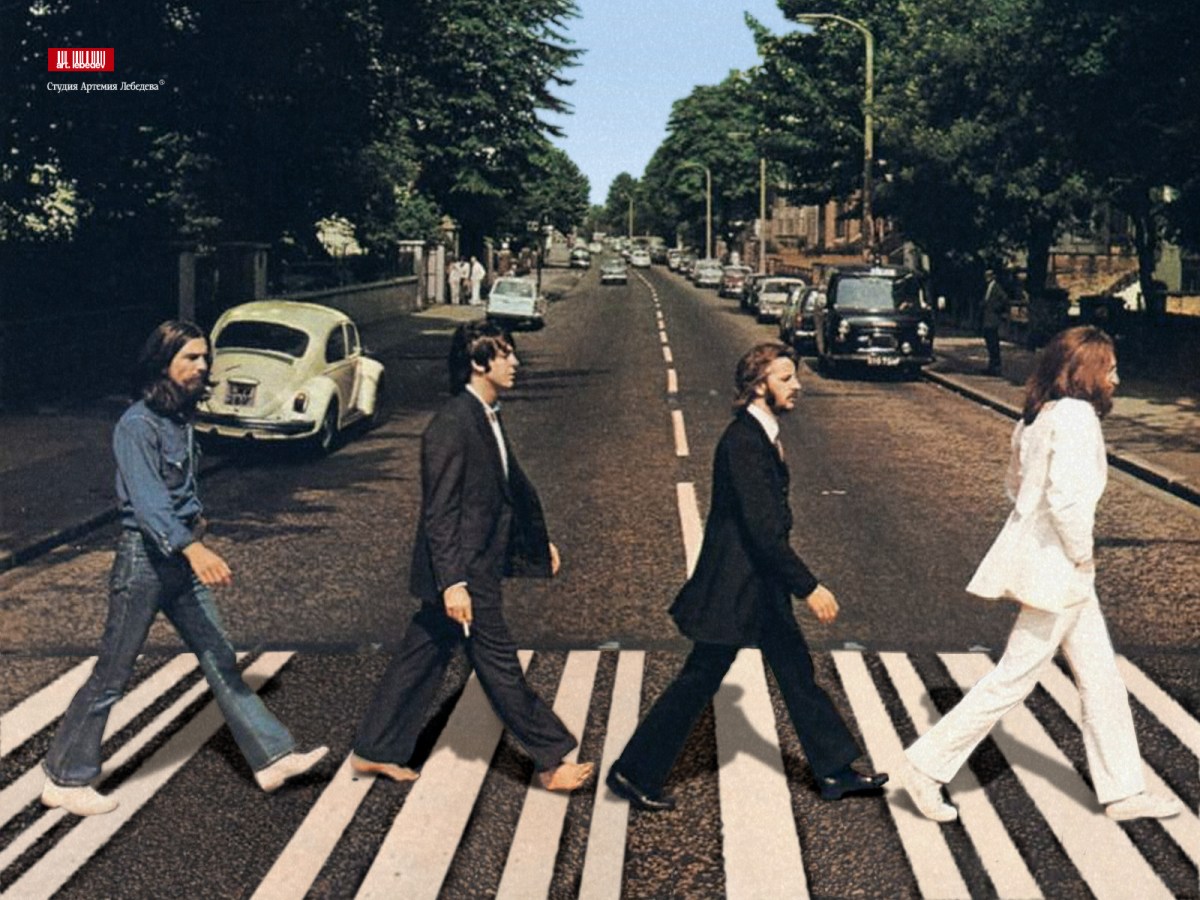
Photographer Iain MacMillan shot the cover photo for the Beatles’ last recorded album, Abbey Road, on this day in 1969. The ten-minute photo shoot produced six images, from which McCartney himself picked the cover photo. It shows the band crossing the street, walking away from the studio.

As soon as the Abby Road album hit the streets, the “Paul Is Dead” enthusiasts were off and running. It was a funeral procession, couldn’t anybody see that? Lennon, dressed in white, symbolizes the preacher. Ringo Starr was dressed in black.  He was the mourner. George Harrison was wearing blue jeans and a shirt.  Of course he was the gravedigger.Paul is dead, news

And then there was McCartney, barefoot and out of step with the other members of the band. Clearly, he symbolized the corpse. McCartney later explained that he’d been barefoot that day, because it was hot.

No one ever satisfactorily explained, nor did anyone ask, to my knowledge, how Paul McCartney got to march in his own funeral procession.  No matter, the Abby Road cover put the rumor mill over the top.

On October 12, a caller to Detroit radio station WKNR-FM told DJ Russ Gibb about the rumor and its clues. Gibb and his callers then discussed the rumor on the air for the next hour. Roby Yonge did the early AM shift at the powerhouse WABC out of New York. Yonge spent a full hour discussing the rumor, before he was pulled off-air for breaking format. WABC’s signal could be heard in 38 states at that time of night, and at times, other countries. The Beatles’ press office issued a statement denying the rumor, but it had already been reported by national and international media.

Paul is still with us-Life_magazine_nov_69The November 7, 1969, Life magazine interview with McCartney and his wife Linda finally put the story to rest. “Perhaps the rumor started because I haven’t been much in the press lately“, he said. “I have done enough press for a lifetime, and I don’t have anything to say these days. I am happy to be with my family and I will work when I work. I was switched on for ten years and I never switched off. Now I am switching off whenever I can. I would rather be a little less famous these days“.
If they’d had Photoshop in those days, we’d probably still be hearing the rumors, today.

August 6, 2011 NFL Films

Ed Sabol was inducted into the Professional Football Hall of Fame on August 6, 2011. Steve delivered a tribute to his father, explaining the company’s operating philosophy. “Tell me a fact”, he said, “and I’ll learn. Tell me a truth, and I’ll believe. But tell me a story, and it will live in my heart forever”.

Edwin Milton “Ed” Sabol came home from WWII and took a job selling topcoats. He was good at it and provided a decent living for his family, but his heart was elsewhere.  What he liked more than anything, was to watch his son Steve play high school football.

Sabol would take a motion picture camera, a wedding gift, and film the games. He found that he had a knack for it, and founded a small film production company called Blair Motion Pictures, named after his daughter, Blair.

Sabol successfully bid for the rights to film the 1962 NFL championship game between the Green Bay Packers and the New York Giants. The game was played in cold so severe that camera operators suffered frostbite, and a wind so strong that it blew the ball off the tee three times before opening kickoff.  Despite all that, Sabol’s work on the game was impressive.

nflfilm

The league’s 14 owners rejected commissioner Pete Rozelle’s proposal to buy Sabol out, instead giving him $20,000 apiece in seed money to shoot all NFL games and produce a highlight film for each team.

NFL Films production style is unmistakable: the “tight to the spiral” shot of the ball leaving the quarterback’s hand, the on-the-field close-ups and slow motion shots, all of it “mic’d up” in a way that let you hear every hit, every sound, as if you were on the field.

With the orchestral score and the stentorian tones of John Facenda’s narration, “the voice of God”: “They call it pro football. They play it under the autumn moon, in the heat of a Texas afternoon.”  NFL Films became “the greatest in-house P.R. machine in pro sports history” according to Salon.com television critic Matt Zoller Seitz. “An outfit that could make even a tedious stalemate seem as momentous as the battle for the Alamo.”

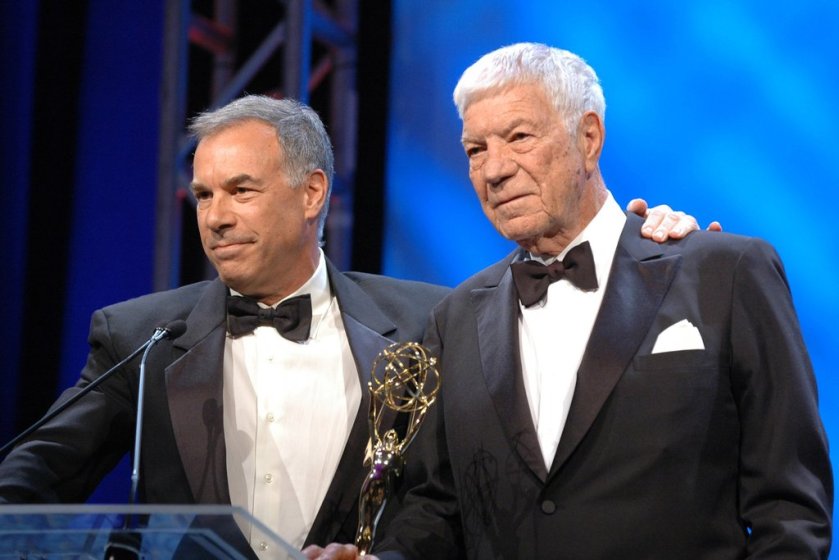
Sabols, 2004 Sports Emmys
Steve and Ed Sabol at the 2004 Sports Emmys

NFL Films won 112 Sports Emmys. While the company’s $50 million earnings are small relative to the $18 billion in revenue the NFL earns from television alone, the real value of NFL Films is how it promotes the sport. Many credit NFL Films as a key reason that the National Football League has become the most watched professional sports league in the United States.

Ed Sabol was inducted into the Professional Football Hall of Fame on August 6, 2011. Steve was suffering inoperable brain cancer at the time, a condition which would take his life the following September.   In delivering his tribute to his father, Steve Sabol explained the company’s operating philosophy. “Tell me a fact”, he said, “and I’ll learn. Tell me a truth, and I’ll believe. But tell me a story, and it will live in my heart forever”.

Sabol_Notes_Quotes

August 4, 1693 – Dom Pérignon

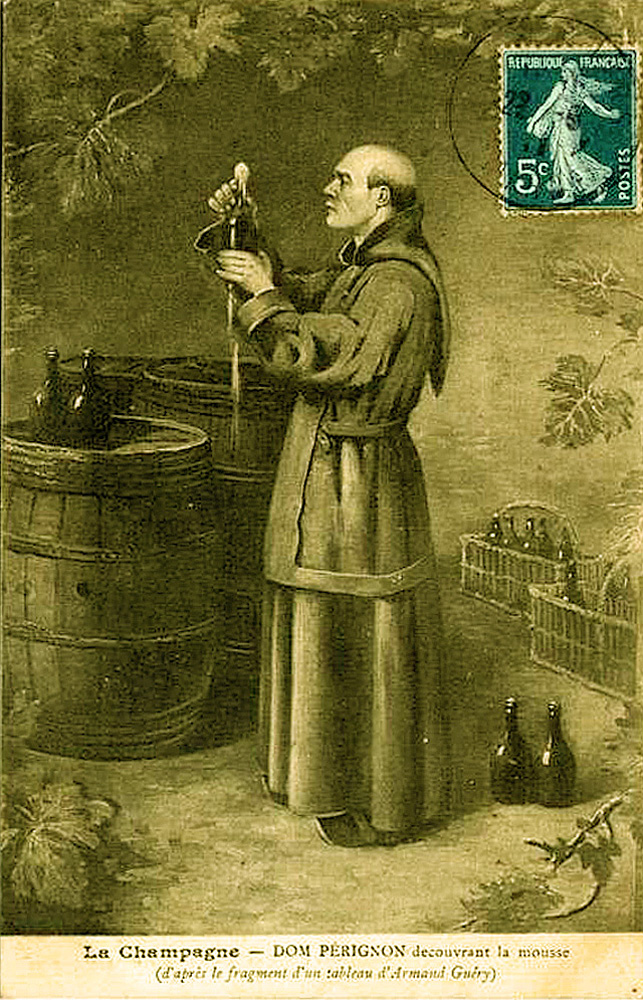
August 4, 1693 is the date traditionally ascribed to Brother (Dom) Pérignon’s invention of Champagne, when he is supposed to have said “Come quickly, I am drinking the stars!”. 

The wines of medieval and renaissance Europe tended to be almost universally red, and almost always still.  The in-bottle refermentation that gives “sparkling” wine its ‘fizz’ was a problem for winemakers.  Fermentable sugars were frequently left over when weather began to cool in the fall, particularly with the white grape varietals.  Refermentation would set in with the warm spring weather, converting bottles into literal time bombs.  Corks would pop out and wine would spoil.  Sometimes the whole batch would explode, one pressurized bottle going off in sympathetic detonation with the other.preventing-refermentation-fig1

Pierre Perignon entered the Benedictine Order when he was 19, doing his novitiate at the abbey of Saint-Vannes near Verdun, and transferring to the abbey of Hautvillers in 1668.

August 4, 1693 is the date traditionally ascribed to Brother (Dom) Pérignon’s invention of Champagne, when he is supposed to have said “Come quickly, I am drinking the stars!”.

The story seems to be an 1821 embellishment by one Dom Groussard, in an attempt to increase the prestige of the abbey.  The English scientist and physician Christopher Merret seems to have been the first to add sugars, beginning the refermentation process which resulted in the first carbonated wine.

Dom_Pérignon_découvrant_la_prise_de_mousse

Yet Dom Pérignon most certainly perfected the double fermentation process, and made important contributions to the quality of the abbey’s fine wines.  He was an early advocate of natural process, farming methods we would call “organic”, today.  He strictly avoided the addition of foreign substances, and insisted that all blending take place at the grape stage. Pérignon insisted on “blind” tasting, not wanting to know what vineyard a grape came from prior to selection.

Dom_Pérignon

Pérignon didn’t like white grapes because of their tendency to enter refermentation. He preferred the Pinot Noir, and would aggressively prune vines so that they grew no higher than three feet and produced a smaller crop. The harvest was always in the cool, damp early morning hours, and he took every precaution to avoid bruising or breaking his grapes. Over-ripe and overly large fruit was always thrown out. Pérignon did not allow grapes to be trodden, always preferring the use of multiple presses.Dom Perignon

Dom Pérignon served as the “cellarer” of the Hautvillers abbey until his death in 1715, in a time when the abbey flourished and doubled the size of its vineyards.  In a sign of honor and respect, Dom Pierre Pérignon was buried in a section of the abbey cemetery, historically reserved only for abbots.

Moët et Chandon, which began as Moët et Cie, purchased the vineyards of the Abbey of Hautvillers in 1792. To this day, Moët’s most prestigious cuvée bears the name of Dom Pérignon.

July 27, 1940 Bugs Bunny

A Utah celery grower once offered a lifetime supply of their product to everyone at the studio, if they switched Bugs over to a celery diet.  But carrots it was.  For fifty years, production had to stop as Mel Blanc, the real-life voice of Bugs Bunny, stopped to spit out the raw carrot he ate to make the sound of his character eating a carrot.

The earliest version of the Bugs Bunny cartoon character had something of his later personality, though he was smaller, with a voice sounded more like Woody Woodpecker.  He first appeared in “Porky’s Hare Hunt”, released on April 30, 1938, a little white wisecracking rabbit, entering the scene with the odd expression “Jiggers, fellers”.  Hare Hunt was the first to introduce the Elmer Fudd character, and first to use the Groucho Marx line, “Of course you realize, this means war!”

According to his 1990 “biography”, Bugs Bunny was born in Brooklyn New York on July 27, 1940, in a warren under Ebbets Field, home of the Brooklyn Dodgers.  A Utah celery grower once offered a lifetime supply of their product to everyone at the studio, if they switched Bugs over to a celery diet.  But carrots it was.  For fifty years, production had to stop as Mel Blanc, the real-life voice of Bugs Bunny, stopped to spit out the raw carrot he ate to make the sound of his character eating a carrot.

Bugs evolution“A Wild Hare”, directed by Tex Avery and released on this day in 1940, was the first recognizable Bugs Bunny cartoon.  For the first time Elmer Fudd and Bugs Bunny are cast as hunter and tormentor, the first time Mel Blanc used that trademark Flatbush accent, and the first in which Bugs uses his catchphrase, “Ehhh, What’s up, Doc?” A Wild Hare was a huge success in theaters, receiving an Academy Award nomination for Best Animated Short Film and ensuring Bugs Bunny’s future as a stock character.

AWildHareIn 1941, “Hiawatha’s Rabbit Hunt” became the second Bugs Bunny cartoon to receive an Academy Award nomination for Best Animated Short Film.  It didn’t win the award, and Bugs later made fun of the award in “What’s Cookin’ Doc?”.  In 1944 he demands a recount, claiming to be the victim of “sa-bo-TAH-gee”.
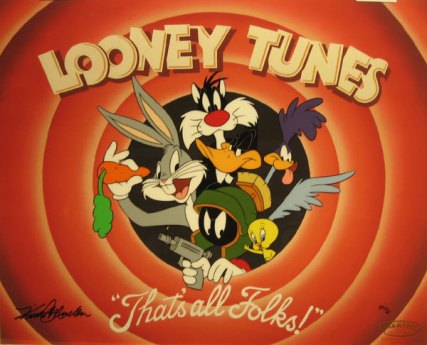
Bugs Bunny was receiving star billing by World War II, helping to make Warner Bros. the most profitable cartoon studio in America.   He appeared along with Porky Pig and Elmer Fudd in a 1942 US war bond commercial, going toe to toe with a group of Japanese soldiers in “Bunny Nips the Nips” in 1944.  The cartoon was later pulled due to the racially stereotypical manner in which it treated the Japanese.  Bugs went to “Joimany” to face off against Göring and Hitler in “Herr Meets Hare” in 1945, the first time he “musta made a wrong toin at Albaquoique”.

Bugs even showed up in rival studio Paramount Pictures’ “Jasper goes hunting”, once.  He popped out of his rabbit hole and said “What’s up Doc”, realizing his mistake only when he hears the orchestra play the wrong theme. “Hey, I’m in the wrong picture!” he says, and there he went, down the rabbit hole.Thats all folks

It was usually Porky Pig who brought Looney Tunes films to a close, with his trademark “Uh-b-dee, uh-b-dee, uh-b-dee, that’s all, folks!”, but Bugs replaced him at the end of “Hare Tonic” and “Baseball Bugs”.  He busted out of a drum, same as Porky, munching on a carrot and saying in that Brooklyn accent, “And that’s the end!”.

Bugs Bunny has appeared in more films, both short and feature length, than any other cartoon character in history.  He’s the ninth most portrayed film personality in the world.

Here ends this day’s Today in History.  Now, “shhh.  Be vewy vewy quiet, I’m hunting wabbits.  Huh-uh-uh-uh-uh-uh-uh-uh”.

July 26, 1887 Esperanto

As of July 2016, Google Translate supports 103 languages and serves over 200 million people daily.    Esperanto became number 64 on February 22, 2012.

Leyzer Leyvi Zamenhov lived in the late 19th century in the Russian town of Białystok, in what is now part of Poland.

Zamenhov was part of the Yiddish speaking majority, living side by side with Poles, Belarusians, Russians, Germans, Lipka Tatars and others.  Relations between these groups was anything but harmonious, and Zamenhov became frustrated with the many quarrels that sprang up among the groups.

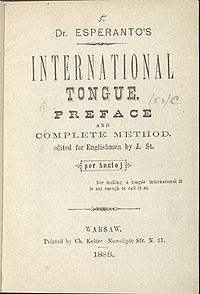
Primera_edición_de_esperantoAs the son of a German language teacher, Zamenhof was fluent in many languages, including Russian, German, French, Latin, Greek, Hebrew, Yiddish and English.  He was reasonably proficient in Italian, Spanish and Lithuanian, as well. Zamenhof came to believe that poor relations between Białystok’s many minorities stemmed from the lack of a common language, so he set out to create an “auxiliary language” – an international second language that would help people of different ethnic and linguistic backgrounds communicate with one another.
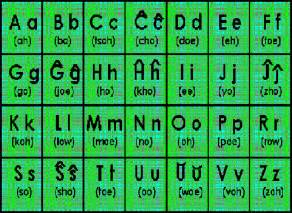
Writing under the pseudonym “Doktoro Esperanto”, Zamenhov published the “Unua Libro” describing his new language on July 26, 1887.

His goal was to create an easily learned, politically neutral language transcending nationality, fostering peace and international understanding between people with different regional and/or national languages.

Esperanto alphabetThe Esperanto alphabet includes 28 letters. There are 23 consonants, 5 cardinal vowels, and 2 semivowels which combine with vowels to form 6 diphthongs. Esperanto words are derived by stringing together prefixes, roots, and suffixes. The process is regular, so that people can create new words as they speak and still be understood.

The original core vocabulary included 900 such roots, which are combined in a regular manner so that they might be better used by international speakers.

For example, the adjective “BONA” means “GOOD”. The suffix “UL” indicates a person having a given trait, and “O” designates the ending of a noun. Therefore, the Esperanto word “BONULO” translates as “A good person”.  The title of Francis Ford Coppola’s 1972 movie “The Godfather”, translates as “La Baptopatro”.  “Esperanto” itself translates as “one who hopes”.

Some useful English words and phrases along with their Esperanto translation and the International Phonetic Alphabet transcriptions, include:

 ○ Do you speak Esperanto? Ĉu vi parolas Esperanton? [ˈtʃu vi pa.ˈro.las ˌes.pe.ˈran.ton]
 ○ Thank you. Dankon [ˈdan.kon]
 ○ You’re welcome. Ne dankinde [ˌne.dan.ˈkin.de]
 ○ One beer, please. Unu bieron, mi petas [ˈu.nu bi.ˈe.ron, mi ˈpe.tas]
 ○ Where is the toilet? Kie estas la necesejo? [ˈki.e ˈes.tas ˈla ˌne.tse.ˈse.jo]

As of July 2016, Google Translate supports 103 languages and serves over 200 million people daily.    Esperanto became number 64 on February 22, 2012.

July 17, 1914 Last to First

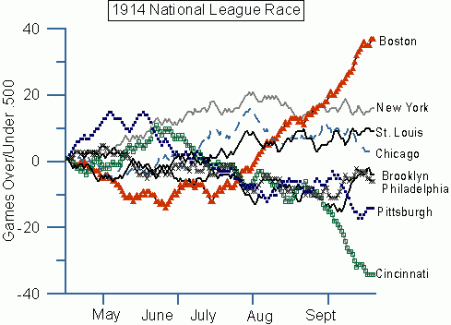
The Boston Braves were in dead last place in July 1914, with a record of 26 wins and 40 losses, 11½ games behind the first place Giants.  As with the last ten years straight, the view this year was shaping up to be one from the basement.    

Boston was a two-team town in 1914, when the American League Red Sox hired 6’2″, 200lb left handed rookie George Herman “Babe” Ruth from the Baltimore Orioles. The American League hadn’t yet adopted the designated hitter rule, they wouldn’t do that until 1973. The Red Sox started Ruth as pitcher, but it was his bat that made him one of the best. Unlike most power hitters, Babe Ruth maintained his high batting average, ending his career with a .342 lifetime average.

Four years later, Red Sox owner and theatrical producer Harry Frazee sold Ruth to the arch-rival New York Yankees, to finance the production of a Broadway musical. Thus began an 86-year World Series drought, ending only in 2004.  To this day, Boston-area mothers use the “Curse of the Bambino” to scare wayward children into acting right. But that’s a story for another day.1914nl

On the National League side, the Boston Braves were in dead last place in July 1914, with a record of 26 wins and 40 losses, 11½ games behind the first place Giants.  As with the last ten years straight, the view this year was shaping up to be one from the basement.    The Braves didn’t even have a home field advantage for the playoffs that year, they had abandoned their 43-year old home at South End Grounds that August. In post-season the Boston Braves were renting Fenway Park from their cross-town rival Red Sox.

The turnaround started on this day with a three game road trip to Redland Field, in Cincinnati, where the Braves won three consecutive games with 1-0, 6-2 and 3-2 victories over the Reds.

The Braves played 37 games through the end of the regular season, winning all but two.

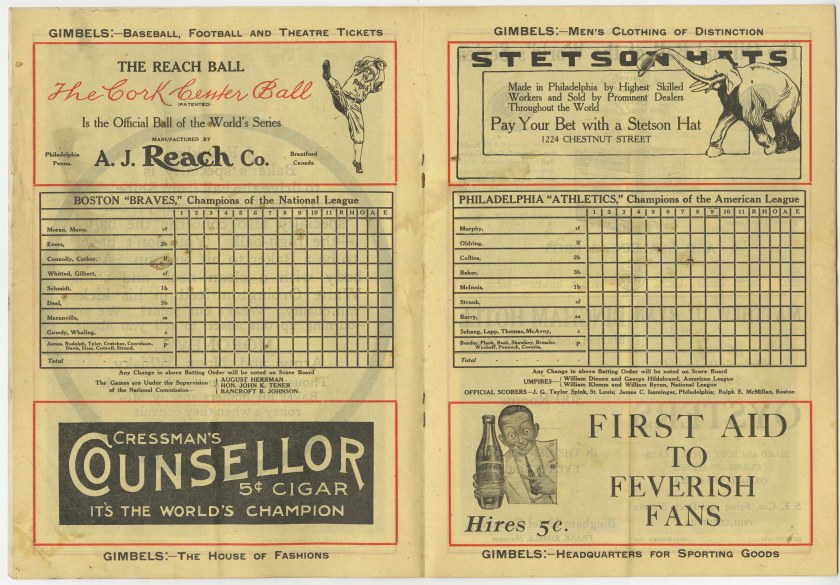
They must have been underdogs going into the World Series against the Philadelphia Athletics, who had just won their fourth American League pennant in 5 years, 8½ games ahead of second place.

1914 WS card

Game one in Philadelphia was a Boston Romp, ending with a 7-1 victory. Game two had to be a cliff hanger, going into the 9th inning with the score tied at 0. Infielder Charlie Deal found himself on second when A’s center fielder Amos Strunk lost the ball in the sun.  Deal scored the game’s only run on Les Mann’s two-out single to center field.

Game 3 in Boston was the real thriller. The score was tied at two at the end of regulation play, with the Athletics scoring two runs in the top of the 10th. Boston came back with two runs in the bottom of the inning, and won the game in the 12th when A’s second baseman Donnie Bush threw a wild ball past third, with outfielder and pinch runner Les Mann scoring the winning run from second.braves

It was two outs in the 5th inning when Braves shortstop Johnny Evers hit a two-run single to center field, putting Boston ahead 3-1 in game 4. The A’s never responded.

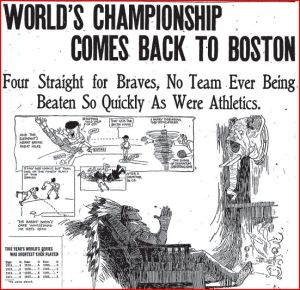
The “Miracle Braves” had emerged from dead-last to defeat the defending World Champion Philadelphia Athletics, in the first four-game sweep in World Series history.

In 2011, a descendant of shortstop Johnny Evers consigned his ancestor’s 1914 World Series ring to auction, raising an intriguing question. Today we take team-issued Championship rings for granted, but the practice is not thought to have begun, until many years later. Prior to that and dating well back to the previous century, World Series winners were rewarded with team-issued pins.

This was the second such ring known t exist, the first issued to shortstop Walter James Vincent “Rabbit” Maranville.  It may be that Evers and Maranville had the rings made for themselves, or maybe players were offered a choice of reward. Perhaps rings were offered to all players, but only at their own expense, causing most of them to pass.

Perhaps these two rings are merely the only two known to have survived.  Be that as it may, at least some players had begun to associate rings with championships, long before their first official issue, in 1922.

July 12, 1630 Ellis Island

The Ellis Island Immigration Station was officially opened on New Year’s Day, 1892.  The first immigrant to pass through it was a 15-year-old “rosy-cheeked Irish girl,” from County Cork, named Annie Moore. Three large ships were waiting to land that first day.  By year’s end nearly 450,000 had passed through the island.

In 1630, the small, 3½ acre island in upper New York Bay was little more than a mud bank, surrounded by oyster beds and barely rising above the water at high tide.  The Indians called it Kioshk, (Gull Island), after its only inhabitants.  Colonial governors of what was then “Nieuw Amsterdam” exchanged the island for “certain cargoes, or parcels of goods” on July 12. Dutch settlers called it “Little Oyster Island”.

The island was briefly known as Dyre’s, then Bucking Island during the Colonial era, and briefly known as Gibbet Island after some pirates were hanged there in the 1760s. By the time of the Revolution, a New York merchant named Samuel Ellis owned the island, on which he operated a small tavern catering to fisherman.

Ellis’ heirs sold the island to New York State in 1808, which sold it to the Federal Government the same year for $10,000. The island served as an arsenal from 1812 to 1890.  An 1834 agreement between New York and New Jersey gave Ellis Island and neighboring Bedloe’s Island to New York, even though it was on the New Jersey side of the main shipping channel.

Over the years, the ballast discharged from incoming ships and the material excavated from New York’s subway system and the excavation of Grand Central Station grew the island.  By the 1930s, Ellis Island had grown from 3½ to 27½ acres.

Statue_of_LibertyThe states turned over control of immigration to the Federal Government in 1890, and an immigration control office was opened on a Barge on the Battery at the tip of Manhattan.

405,664 immigrants, 80% of the national total, were processed through the Barge Office while the Ellis Island immigration station was under construction.

That most famous gift from the people of France, the Statue of Liberty, was dedicated on October 28, 1886 on Bedloe’s Island, though it took until 1956 to officially change the name to “Liberty Island”.

The Ellis Island Immigration Station was officially opened on New Year’s Day, 1892.  The first immigrant to pass through it was a 15-year-old “rosy-cheeked Irish girl,” from County Cork, named Annie Moore. Three large ships were waiting to land that first day.  By year’s end nearly 450,000 had passed through the island.

Ellis island’s original Georgia pine structures were completely destroyed in a fire on June 15, 1897.  The present building was opened on December 17, 1900.

An estimated 25 million passed through the Ellis Island station between 1892 and 1924.  The all-time high was April 17th, 1908, when 11,747 immigrants were processed on a single day. The Immigration Act of 1924 imposed an annual quota of 164,000, marking the end of mass legal immigration to America. Ellis Island changed from an immigrant processing station at this time, to a center for the assembly, detention, and deportation of aliens who had entered the US illegally or had violated terms of admission.

That 1834 agreement came up again in the 1990s, in a series of lawsuits between New York and New Jersey over which state “owned” Ellis Island. It went all the way to the Supreme Court, which decided in 1998 that the original 3½ acres belonged to New York, but the rest of it was now in New Jersey.

Today, Ellis Island and the old immigration processing center operates as a museum of the American immigrant experience.  I’d be more than a little interested, to know how they handle sales tax in the gift shop.