August 28, 1948 Landslide Lyndon

‘People have been saying for 40 years, ‘No one knows what really happened in that election,’ and ‘Everybody does it.’ Neither of those statements is true. I don’t think that this is the only election that was ever stolen, but there was never such brazen thievery”.

In 1944, Texas political Boss George Berham Parr and Webb County Judge Manuel “Black Coke StevensonHawk” Raymond had a favor to ask of then-Governor Coke Robert Stevenson. They wanted the Governor to appoint a Raymond relative, E. James Kazen, as Laredo district attorney.

The Governor wasn’t playing ball. The United States was at war at that time, and the commander at the local Army Air Force Base opposed the appointment, saying that half his men were down with VD. A district attorney from the local political machine, he argued, would mean lax enforcement of prostitution laws, and his high sick rate was adversely effecting the war effort.

Stevenson was persuaded, and he appointed another man to the job. George Parr would not forget the slight.

Four years later, Coke Stevenson was running for the United States Senate. Parr had a debt to repay to Stevenson’s opponent, Congressman Lyndon Baynes Johnson, who had helped him obtain a Presidential Pardon back in 1946. He had some payback to do on Stevenson’s account as well, but that would be payback of a different sort.

Landslide LyndonTexas had only a weak Republican party in 1948.  The winner of the Democrat’s three-way primary was sure to be the next Senator.

When the votes were counted on August 28, Stevenson was the top vote getter with 37.3%, edging out Johnson at #2, by 112 votes out of 988,295 cast.

Texas state law requires an absolute majority to determine a primary winner, so a runoff was held between the top two finishers.

Stevenson held the lead at the end of counting.  Five days later, Jim Wells County amended its return. 202 additional votes had been “found”, hidden away in Box #13 from the town of Alice.

200 of the 202 had voted for Johnson.  By a miraculous coincidence, each had signed their names in alphabetical order, in the same penmanship, each apparently using the same pen.

An investigation was called, and the executive committee of the Texas Democratic Party upheld Johnson’s victory, 29-to-28.   Stevenson sued.
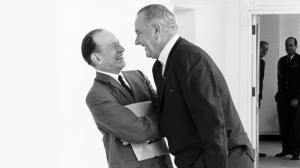
160221-updegrov-lbj-fortas-tease_xkflll
Fortas, Johnson

A Federal court ordered Johnson’s name off the ballot pending the results of an investigation, but the matter was settled in Johnson’s favor when Associate Supreme Court Justice Hugo Black voided the order on the urging of Johnson lawyer, Abe Fortas.

Purely coincidentally I’m sure, the very same Abe Fortas would himself be appointed to the Supreme Court by then-President Lyndon Johnson, in 1965.

Johnson went on to defeat the Republican candidate in the general election.  The primary ballots were “accidentally” burned some time later.

‘Means of Ascent’ author Robert A. Caro, the second volume of a projected four-volume Johnson study entitled ‘The Years of Lyndon Johnson’, told the New York Times in a 1990 interview: ‘People have been saying for 40 years, ‘No one knows what really happened in that election,’ and ‘Everybody does it.’ Neither of those statements is true. I don’t think that this is the only election that was ever stolen, but there was never such brazen thievery”.

LBJ had “won” his primary by 87 votes, August 28 forever marking the day on which he would be known as “landslide Lyndon”. Johnson easily defeated Republican Jack Porter for the Senate seat, later becoming Vice President and then President after the texas-ballot-boxassassination of John F Kennedy, a man whom many believe stole his own election from Richard Nixon in 1960, with the help of Chicago’s Daley machine and a little creative vote counting in Cook County.

Johnson never acknowledged stealing the election, but Ronnie Dugger, editor of the Texas Observer, once visited him in the White House. Then-President Johnson pulled out a photo of five “ol’ boys” from Alice, grinning back at the camera with the infamous Box 13 between them. Dugger asked LBJ if he had stolen the election. President Johnson’s only response, was to laugh.


August 3, 1913 Wheatland Hop Riot

Ralph Durst, one of the largest agricultural employers in Yuba County, California, advertised widely for hops pickers for the 1913 harvest season. He got 1,000 more than he needed, which had the effect of depressing already low wages.

Organized labor was a growing force in 1913 and strikes were often violent. English cigar maker Samuel Gompers had started the American Federation of Labor (AFL) almost 30 years earlier, and Upton Sinclair’s exposé on the Chicago Stockyards, “The Jungle”, had been in print for 7 years. Yet seasonal farm workers were difficult to organize. They were an unskilled and unsettled group, largely transient and until now, mostly passed over by Union organizers.

Ralph Durst, one of the largest agricultural employers in Yuba County, California, advertised widely for hops pickers for the 1913 harvest season. He got 1,000 more than he needed, which had the effect of depressing already low wages.

Hop Pickers

Sanitary conditions quickly became deplorable.  There was one toilet per 100 workers, which quickly filled up in the July heat. Fresh drinking water was scarce.  A Durst cousin selling watered down, ersatz lemonade out of a wagon for a nickel a glass did little to improve things.

The International Workers of the World, (IWW), established in 1905, was a radical socialist labor organization.  100 of Durst’s hop pickers were members. Two of them, Richard “Blackie” Ford and Herman Suhr, managed to rally a majority to their cause with speeches, songs and slogans.

Wheatland Hop Riot104 years ago today, 1,700 seasonal hops pickers gathered in the field of the Durst Hop Farm. They demanded an increase from their $1.00/100 lbs of hops picked, and they wanted better working conditions. Durst agreed to some changes, but Ford and Suhr stuck to their full list of demands and called a strike.

A mass meeting was called on the afternoon of August 3, as a succession of speakers addressed the crowd in English, German, Greek, Italian, Arabic, and Spanish. Most were in favor of a strike.  Tensions were high when Durst arrived just after 5pm with Marysville Sheriff George Voss, a number of deputies, and Yuba County District Attorney Edward Manwell, who was also Durst’s personal attorney.

The group was surrounded as a deputy fired a warning blast into the air from a shotgun, but the warning had the opposite effect from what was intended. The crowd attacked District Attorney Manwell and Deputy Sheriff Lee Anderson and began beating them. Gunfire erupted in what soon became a full-fledged riot. Deputy Sheriff Eugene Reardon and District Attorney Manweel were both killed, along with two pickers. A third lost an arm to a shotgun blast.

There were over 100 arrests in the aftermath of the riot, the prisoners beaten and starved to extract information on strike leaders. A field worker named Alfred Nelson was hauled from one county to another and held in secret locations while being sweated, starved, and beaten.  He was repeatedly threatened with death, unless he confessed to participation in the killings. The pressure was so severe that Nels Nelson, the picker who lost his arm in the shotgun blast, hanged himself in his cell. Another prisoner tried to do the same, and a third suffered a mental breakdown and had to be committed to an asylum.WheatlandHopField-600

Blackie Ford and Herman Suhr were found guilty of second-degree murder in the following trial, and sentenced to life in the state penitentiary. Two other strike leaders, Walter Bagan and William Beck, were acquitted.

The Wheatland Hop Riot was one of the first major agricultural labor confrontations in American history, but it was far from the last. Today, the site is registered as California Historical Landmark #1003.

August 1, 1794 Whiskey Rebellion

A federalized militia force of 12,950 was raised to put down what President Washington saw as armed insurrection, marching on Western Pennsylvania in October 1794.  It was a larger force than General Washington normally had under his command, during the late Revolution.

On ratification of the modern constitution in 1789, the founding fathers gazed out at what they had wrought.  What they saw, was debt.Constitution

The Continental government had been unable to levy taxes under the Articles of Confederation, the only major income source being foreign import duties. The government had borrowed money to meet expenses during this period, accumulating $54 million in debt.  The states themselves another $25 million.

Compounding the problem was the matter of runaway inflation, which had plagued the Articles of Confederation period. The colonies had printed paper currency to pay debts, as did the national government. Silver coinage remained stable due to the inherent value of the metal itself, but there was nothing behind this paper money. At one point, you could buy a single sheep for $2 “hard currency”, or $150 in paper “Continental Dollars”. To this day, you might hear the expression “worthless as a continental”.

The first Secretary of the Treasury, Alexander Hamilton, reported in his Report on Public Credit, urging Congress to consolidate state and national debt into a single debt to be funded by the federal government. Hamilton felt that existing duties were as high as they could be without depressing imports, so he recommended the first excise tax on a domestically manufactured product – whiskey.  The more meddlesome of Hamilton’s contemporaries were enthusiastically in favor of a “sin tax”, just as they are today.  The “Whiskey Act” became law on March 3, 1791.

The whiskey tax was immediately unpopular, particularly in the west where it was, for all intents and purposes, an income tax.  At a flat rate of 7¢ per gallon, the tax weighed more heavily on the western frontiers, where whiskey was sold for 50¢ a gallon.  About half what it sold for in the more established regions of the east.

Furthermore, coinage wasn’t easy to come by on the frontiers.  In many areas the medium for exchange was whiskey itself.  The stuff was popular, it’s value was relatively stable, and it was easier to transport than the grain from which it was distilled.

Folks on the western fringes of the new nation already felt the federal government was doing too little to secure them against the predation of Indians.  This whiskey tax was the final straw.

Whiskey_Insurrection
Illustration of the Whiskey Rebellion from “Our First Century”, R.M. Devens 1882

Petitions were signed against the new law and there were hearings, none of which settled the matter satisfactorily. Events reached a boiling point in May 1794, when federal district attorney William Rawle issued subpoenas for more than 60 Western Pennsylvania distillers who had not paid their excise tax. All 60 were expected to appear in excise court in Philadelphia, an expensive, disruptive trip that these poor farmers were loathe to undertake.

The war of words became a shooting war as US Marshal David Lenox was delivering these writs in Allegheny County, south of Pittsburgh, on July 15.

Braddocks FieldMore shooting incidents occurred in the days that followed.  Objections to the whiskey tax gave way to a long list of economic grievances, as over 7,000 gathered in Braddock’s Field on August 1. They talked of secession and carried their own flag, each of its six stripes representing one of 6 Pennsylvania or eastern Ohio counties.

At last they marched on Pittsburg, burning the barns of Major Abraham Kirkpatrick, who had previously led soldiers against them.

A federalized militia force of 12,950 was raised to put down what President Washington saw as armed insurrection, marching on Western Pennsylvania in October 1794.  It was a larger force than General Washington normally had under his command during the late Revolution.

Washington himself rode out to check on the progress of his army, the first and only time in history that a sitting American President led an army in the field.

whiskey-rebellion-300x214The whiskey rebellion collapsed in the face of what was then an overwhelming army, with 10 of their leaders brought to Philadelphia to stand trial. Two were sentenced to hang for their role in the rebellion, but President Washington pardoned them both.  The whiskey rebellion was over.

All internal taxes were repealed in 1800, when President Thomas Jefferson returned US fiscal policy to a reliance on trade tariffs.  With the Napoleonic wars ongoing in Europe, business was good.  National debt was reduced from $83 million to $43 million, despite $11 million spent on the Louisiana Purchase.

President Andrew Jackson paid off the national debt in its entirety, in 1835.  The first and only President in United States history, ever to do so.  Since that time, the Federal government has saddled the American taxpayer with approximately $301 million in additional debt.  Per day.

July 22, 1937 Packing the Court

Article III, Section 1 of the United States Constitution creates the highest court in the land. The relevant clause states that “The judicial power of the United States, shall be vested in one Supreme Court, and in such inferior courts as the Congress may from time to time ordain and establish”. Nowhere does the document specify the number of justices.

Article III, Section 1 of the United States Constitution creates the highest court in the land. The relevant clause states that “The judicial power of the United States, shall be vested in one Supreme Court, and in such inferior courts as the Congress may from time to time ordain and establish”. Nowhere does the document specify the number of justices.Constitution

The United States was in the midst of the “Great Depression” when President Franklin Delano Roosevelt came to office in 1932. He had promised a “New Deal” for America, immediately beginning a series of sweeping legislative reforms designed to counter the devastating effects of the Depression. His initiatives faced many challenges in the courts, with the Supreme Court striking down as unconstitutional several New Deal provisions in his first term.

The Supreme Court was divided along ideological lines in 1937, as it is today. “Judicial Court Packing Scheme,1Realist” or “Liberal” legal scholars and judges argued that the constitution was a “living document”, allowing for judicial flexibility and legislative experimentation. Supreme Court justice Oliver Wendell Holmes, Jr., a leading proponent of the Realist philosophy, said of Missouri v. Holland that the “case before us must be considered in the light of our whole experience and not merely in that of what was said a hundred years ago”.
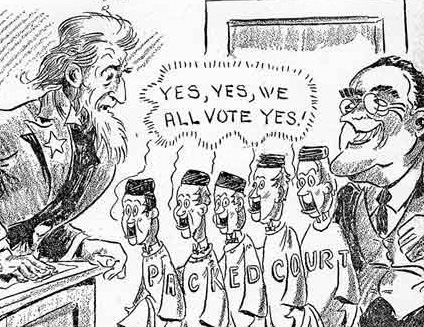
“Judicial Formalists”, today we call them “Conservatives” or “Originalists”, seek to discover the original meaning or intent of the constitution. Formalist legal scholars and judges argue that the judiciary is not supposed to create, amend or repeal law; that is for the legislative branch. The role of the court is to interpret and uphold law, or strike them down in light of the original intent of the framers, and the ratifiers, of the constitution.

In 1937, SCOTUS was divided along ideological lines, with three Liberals, four Conservatives, and two swing votes.

President Woodrow Wilson’s Attorney General, James Clark McReynolds, made a proposal in 1914 that: “(When) any judge of a federal court below the Supreme Court fails to avail himself of the privilege of retiring now granted by law (at age 70), that the President be required, with the advice and consent of the Senate, to appoint another judge, who would preside over the affairs of the court and have precedence over the older one. This will insure at all times the presence of a judge sufficiently active to discharge promptly and adequately the duties of the court”.

Court Packing SchemeTo Roosevelt, that was the answer. The age 70 provision allowed him 6 more handpicked justices, effectively ending Supreme Court opposition to his policies.

Roosevelt’s “Judiciary Reorganization Bill of 1937” immediately came under sharp criticism from legislators, bar associations, and the public. The Senate Judiciary Committee began hearings on the bill on March 10, 1937, reporting it “adversely” by a committee vote of 10 to 8. The full senate took up the matter on July 2, with the Roosevelt administration suffering a disastrous setback when Senate Majority Leader Joseph T. Robinson, a powerful supporter of the legislation, died of a heart attack.

The full Senate voted on July 22, 1937, to send the bill back to the Judiciary Committee, where provisions for additional justices were stripped from the bill. A modified version passed in August, but Roosevelt’s “court packing” scheme was dead.

In the end, the President had the last word. After an unprecedented four terms, Roosevelt would eventually appoint eight of nine justices to the Court.

July 14, 1789 Storming the Bastille

Paris was “intoxicated with liberty and enthusiasm,” when the crowd converged on the Bastille on the morning of July 14, 1789. It was guarded by 82 invalides (veteran soldiers no longer fit for service in the field) and 32 Swiss grenadiers.
The attackers – vainqueurs de la Bastille – numbered 954.

In most of medieval France, the major constituent parts of French society were the “Three Estates”:  the Clergy, the Nobility and the Commons.

France was in a state of economic crisis in the late 18th century. The Nobility refused to accede to the tax demands of King Louis XVI. The Commoners reconstituted themselves into a “National Assembly” in June 1789, demanding an audience with the King for the purpose of drawing up a Constitution.

The National Assembly converged on the Estates General on June 20, only to find the door locked. What followed was either hysterical or duplicitous, because the King and his family were still mourning the death of the Dauphin; the heir apparent.  It was customary at that time to hold political matters, until the King came out of mourning.

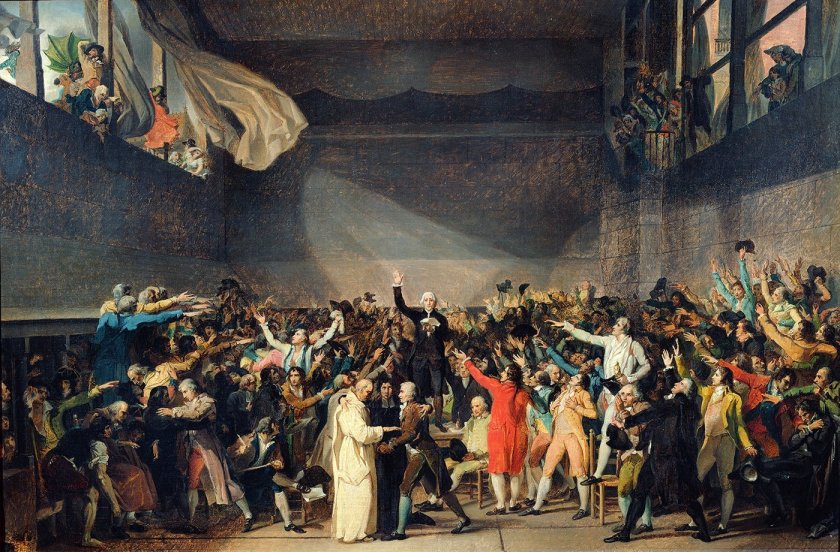
Tennis Court Oath
Tennis Court Oath

Be that as it may, the entire National Assembly, all 577 members, converged on an indoor tennis court. All but one put their names to a solemn oath, the famous “The Tennis Court Oath”, swearing “not to separate, and to reassemble wherever circumstances require, until the constitution of the kingdom is established”.

The oath itself was a revolutionary act, asserting that political authority came from the people and their representatives, not from the monarchy. The National Assembly had declared themselves to be supreme in the exercise of state power, making it increasingly difficult for the monarchy to operate based on “Divine Right of Kings”.

Riots followed as the left and reformist factions moved from anarchy to a coherent movement against the monarchy and the French right.

Built in 1309, the fortress and medieval prison of the Bastille had long been a focal point of the insurrection, representing royal authority in the center of the city. Donatien Alphonse François, better known as the Marquis de Sade, was one of the few remaining prisoners in the Bastille by this time. He was transferred to an insane asylum after attempting to incite a crowd outside his window, yelling: “They are massacring the prisoners; you must come and free them.”

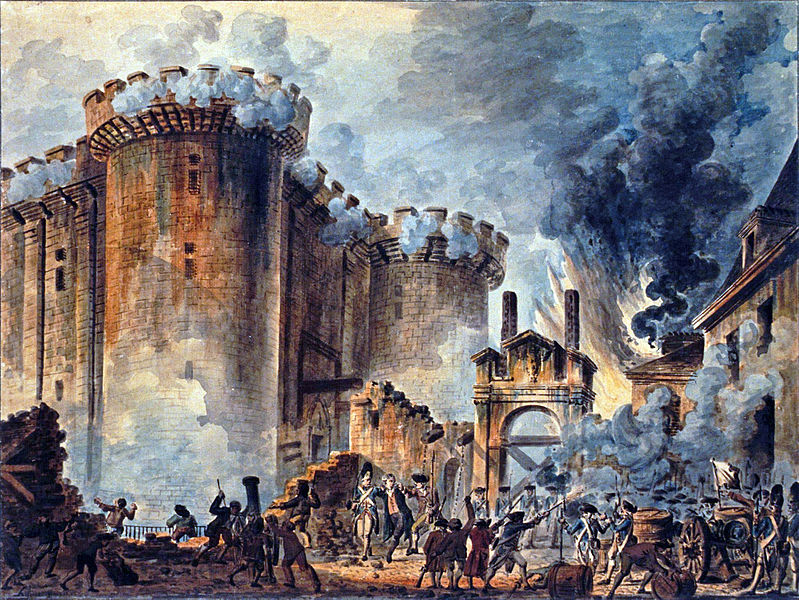
Prise_de_la_Bastille

Paris was “intoxicated with liberty and enthusiasm,” when French revolutionaries converged on the Bastille on the morning of July 14, 1789. The fortress was guarded by 82 “invalides”, veteran soldiers no longer fit for service in the field, and 32 Swiss grenadiers under the command of Governor Bernard-René de Launay, the son of the previous governor, actually born in the Bastille.

The attackers – vainqueurs de la Bastille – numbered 954. Negotiations dragged on until the crowd lost patience, crowding into the outer courtyard and cutting the chain that held the drawbridge. Firing broke out as the bridge slammed down, crushing one unlucky vainqueur, while a nearby force of Royal Army troops did nothing to intervene. 98 attackers and one defender died in the fighting.  The mob murdered another 7, after their surrender.

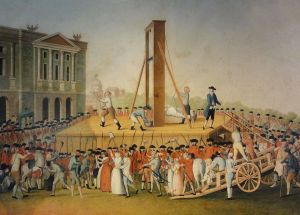
The successful insurrection at Paris raced across all of France, as the “Great Fear” spread across the countryside. The absolute monarchy which had ruled for centuries was over within three years, when Louis himself lost his head to the guillotine in 1793. 16,594 went to the guillotine under “the Reign of Terror”, led by the “Committee of Safety” under the direction of Parisian lawyer Maximilian Robespierre. Among them was Queen Marie Antoinette, who never did say “let them eat cake”.  Her last words were pardon me, sir, I meant not to do it, on stepping on her executioner’s toes.

Exécution_de_Marie_Antoinette_le_16_octobre_1793
Execution of Marie Antoinette

As many as 40,000 were summarily executed or died in prison awaiting trials before the hysteria died down.  Robespierre himself lost his head in 1794.

The Napoleonic Wars which followed resulted in a Corsican artillery corporal-turned Emperor, fighting (and winning), more battles than Hannibal, Caesar, Alexander the great, and Frederick the Great, combined.

The saddest part of the whole sad story, may be the son of Louis and Antoinette, Louis-Charles, Duke of Normandy. He was King Louis XVII in name only, thrown into a stone prison cell at the age of 8. He would die there, at the age of 10. Miserable, sick and alone.  It all seems pointless. The Bourbon Dynasty was back in power, within twenty years.

July 12, 1630 Ellis Island

The Ellis Island Immigration Station was officially opened on New Year’s Day, 1892.  The first immigrant to pass through it was a 15-year-old “rosy-cheeked Irish girl,” from County Cork, named Annie Moore. Three large ships were waiting to land that first day.  By year’s end nearly 450,000 had passed through the island.

In 1630, the small, 3½ acre island in upper New York Bay was little more than a mud bank, surrounded by oyster beds and barely rising above the water at high tide.  The Indians called it Kioshk, (Gull Island), after its only inhabitants.  Colonial governors of what was then “Nieuw Amsterdam” exchanged the island for “certain cargoes, or parcels of goods” on July 12. Dutch settlers called it “Little Oyster Island”.

The island was briefly known as Dyre’s, then Bucking Island during the Colonial era, and briefly known as Gibbet Island after some pirates were hanged there in the 1760s. By the time of the Revolution, a New York merchant named Samuel Ellis owned the island, on which he operated a small tavern catering to fisherman.

Ellis’ heirs sold the island to New York State in 1808, which sold it to the Federal Government the same year for $10,000. The island served as an arsenal from 1812 to 1890.  An 1834 agreement between New York and New Jersey gave Ellis Island and neighboring Bedloe’s Island to New York, even though it was on the New Jersey side of the main shipping channel.

Over the years, the ballast discharged from incoming ships and the material excavated from New York’s subway system and the excavation of Grand Central Station grew the island.  By the 1930s, Ellis Island had grown from 3½ to 27½ acres.

Statue_of_LibertyThe states turned over control of immigration to the Federal Government in 1890, and an immigration control office was opened on a Barge on the Battery at the tip of Manhattan.

405,664 immigrants, 80% of the national total, were processed through the Barge Office while the Ellis Island immigration station was under construction.

That most famous gift from the people of France, the Statue of Liberty, was dedicated on October 28, 1886 on Bedloe’s Island, though it took until 1956 to officially change the name to “Liberty Island”.

The Ellis Island Immigration Station was officially opened on New Year’s Day, 1892.  The first immigrant to pass through it was a 15-year-old “rosy-cheeked Irish girl,” from County Cork, named Annie Moore. Three large ships were waiting to land that first day.  By year’s end nearly 450,000 had passed through the island.

Ellis island’s original Georgia pine structures were completely destroyed in a fire on June 15, 1897.  The present building was opened on December 17, 1900.

An estimated 25 million passed through the Ellis Island station between 1892 and 1924.  The all-time high was April 17th, 1908, when 11,747 immigrants were processed on a single day. The Immigration Act of 1924 imposed an annual quota of 164,000, marking the end of mass legal immigration to America. Ellis Island changed from an immigrant processing station at this time, to a center for the assembly, detention, and deportation of aliens who had entered the US illegally or had violated terms of admission.

That 1834 agreement came up again in the 1990s, in a series of lawsuits between New York and New Jersey over which state “owned” Ellis Island. It went all the way to the Supreme Court, which decided in 1998 that the original 3½ acres belonged to New York, but the rest of it was now in New Jersey.

Today, Ellis Island and the old immigration processing center operates as a museum of the American immigrant experience.  I’d be more than a little interested, to know how they handle sales tax in the gift shop.

July 11, 1804 Weehawken

What would it be like to turn on CNN or Fox News, to learn that Barack Obama’s Secretary of the Treasury Jacob Lew was party to a duel, and that he was near death after being shot by the Vice President of the United States, Mike Pence.

What would it be like to turn on CNN or Fox News, to learn that Barack Obama’s Secretary of the Treasury Jacob Lew was party to a duel, and that he was near death after being shot by the Vice President of the United States, Mike Pence.

Weehawken today
Weehawken, New Jersey

The year was 1804.  President Thomas Jefferson’s Vice President, Aaron Burr, had a long standing personal problem with one of the Founding Fathers. Alexander Hamilton had been Secretary of the Treasury under George Washington:  the first Secretary of the Treasury, the only signer of the US Constitution from the state of New York.

The animosity between the two began in 1791, when Burr defeated Hamilton’s father-in-law Philip Schuyler in a US Senate election. Hostilities escalated when the Electoral College deadlocked over the 1800 Presidential election, moving the selection of President and Vice President to the House of Representatives. Hamilton exerted his influence on behalf of Jefferson, who was elected on the 36th ballot, making Burr his VP.Duel

Burr knew that Jefferson wouldn’t keep him on as VP for the 1804 election, and so he ran for Governor of New York. He blamed Hamilton for his defeat, and challenged the man to a duel over comments made during the election.

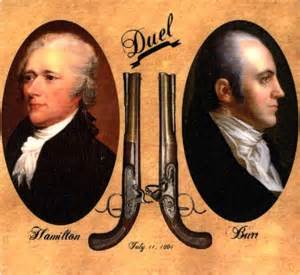
Dueling was illegal in both New York and New Jersey by this time, though enforcement was far more aggressive in New York. The pair rowed across the Hudson River from Manhattan to Weehawken, New Jersey in the early morning hours of July 11, 1804, dueling pistols tucked safely in a leather bag.

Both men’s “seconds” stood with their backs to the duelists, enabling both to later state under oath that they didn’t see either the weapons or the duel itself. “Plausible deniability” was preserved, but it’s hard to have a first-hand account when the only witnesses deliberately turned their backs. Accounts vary, but it seems that Hamilton fired first, apparently “throwing away his shot” as he had once advised his son Philip to do when the younger man was in this position.

Hamilton-Burr-duel

This account is supported by a letter that Hamilton wrote the night before the duel, stating that he was “strongly opposed to the practice of dueling” for both religious and practical reasons. The letter went on, “I have resolved, if our interview is conducted in the usual manner, and it pleases God to give me the opportunity, to reserve and throw away my first fire, and I have thoughts even of reserving my second fire”.

Burr had no such reservations. He fired with intent to kill, the shot hitting Hamilton in the lower abdomen. The wound was clearly fatal, even to Hamilton himself, who said “This is a mortal wound, doctor”.

The man whose likeness appears on the $10 bill died the next day. Among his last words were “Pendleton knows,” (Judge Nathaniel Pendleton, his second), “that I did not intend to fire at him”.

Hamilton Bill

July 8, 1776 The Liberty Bell 

The Philadelphia Public Ledger reported the last clear note ever sounded by the Liberty Bell, on George Washington’s birthday, 1846 .

Philadelphia’s city bell originally hung from a tree near the Pennsylvania State House, now known as Independence Hall. The date is uncertain, but it probably dates back to the city’s founding in 1682. The bell would ring to alert citizens of civic events and proclamations, and to the occasional civic danger.

The “Liberty Bell” was ordered from the London bell foundry of Lester and Pack (today the Whitechapel Bell Foundry) in 1752, arriving in August of that year. Weighing in at 2,080 lbs, it has written upon it a passage from the Book of Leviticus, the third book of the Hebrew Bible; the third of five books of the Torah. “Proclaim LIBERTY throughout all the land unto all the inhabitants thereof”.

Mounted to a stand to test the sound, the first strike of the clapper cracked the bell’s rim. Authorities tried to return it, but the ship’s master couldn’t take it on board, so the bell was re-cast by two local founders, John Pass and John Stow. It was broken into pieces, melted down and re-cast, with the addition of 10% copper to make the metal less brittle.

The_Bell's_First_Note_by_JLG_Ferris
The Bell’s First Note, by Jean Leon Gerome Ferris

Pass and Snow bragged that the bell’s lettering was clearer on this second casting than the original. The newly re-cast bell was ready in March 1753, when City officials scheduled a public celebration to test the sound. There was free food and drink all around, but the crowd gasped and started to laugh when the bell was struck. It didn’t break this time…it sounded like two coal scuttles being banged together.

Pass and Stow hastily took it away, again breaking the bell into pieces, and again melting it down to be recast.

The whole performance was repeated in June 1753.  This time most thought the sound to be satisfactory, and the bell was hung in the steeple of the State House. One who did not like the sound was Isaac Norris, speaker of the Pennsylvania Provincial Assembly. He ordered a second bell in 1754, though he was unsuccessful in his efforts to return the original for credit to the Lester and Pack foundry.

The new bell was attached to the tower clock, while the old one was, by vote of the Assembly, devoted “to such Uses as this House may hereafter appoint.” One such use of the old bell occurred on July 8, 1776, to announce the public reading of the Declaration of Independence.

Bells are easily melted down for ammunition, so the bell was taken down and hidden before the British occupation of Philadelphia in 1777. The distinctive large crack began to develop some time in the early 19th century, about the time when abolitionist societies began calling it “The Liberty Bell”. Some say it cracked while ringing after the death of Chief Justice John Marshall in 1835.

Libbell1908
The Liberty Bell is paraded through the streets of Philadelphia, 1908, in a recreation of its 1777 journey to Allentown

The Philadelphia Public Ledger reported the last clear note ever sounded by the Liberty Bell, in its February 26, 1846 edition:

“The old Independence Bell rang its last clear note on Monday last in honor of the birthday of Washington and now hangs in the great city steeple irreparably cracked and dumb. It had been cracked before but was set in order of that day by having the edges of the fracture filed so as not to vibrate against each other … It gave out clear notes and loud, and appeared to be in excellent condition until noon, when it received a sort of compound fracture in a zig-zag direction through one of its sides which put it completely out of tune and left it a mere wreck of what it was.”

Benjamin_Harrison
“#23”, Benjamin Harrison

The bell would periodically travel to expositions and celebrations, but souvenir hunters would break off pieces from its rim, and additional cracking would develop after several of these trips. The bell’s travels were sharply curtailed after it came back from Chicago with a new crack in 1893, and discontinued altogether in 1915.

Former President Benjamin Harrison may have had the last word as the Liberty bell passed through Indianapolis in 1893. “This old bell was made in England”, he said, “but it had to be re-cast in America before it was attuned to proclaim the right of self-government and the equal rights of men.”

July 4, 1826 Founding Fathers

The letters between Adams and Jefferson together constitute one of the most comprehensive historical and philosophical assessments ever written about the American founding.

Thomas Jefferson met John Adams at the 1775 Continental Congress in Philadelphia, the two forming a close personal friendship which would last for most of their lives.   They were two of the committee of five assigned to write the Declaration of Independence, and worked closely together throughout the era of our founding.

The friendship between the two men came to an end during the Presidential election of 1800.  Mudslinging on both sides rose to levels never before seen in a national election, an election in which both sides firmly believed the election of the other, would destroy the young nation.HamJeff

Jefferson defeated one term incumbent Adams and went on to serve two terms as President.

On Jefferson’s retirement in 1809, one of the signers of the Declaration of Independence, Dr. Benjamin Rush, took it upon himself to patch up the broken friendship between the two founding fathers. Dr. Rush worked on his personal diplomatic mission for two years.  In 1811, he finally succeeded.

There followed a series of letters between Adams and Jefferson, which together constitute one of the most comprehensive historical and philosophical assessments ever written about the American founding.

Their correspondence touched on a variety of topics, from the birth of this self-governing Republic, to then-current political issues, to matters of philosophy and religion and issues of aging. Both men understood that they were writing not only to one another, but to generations yet unborn.Letters

Each went to great lengths to explain the philosophical underpinnings of his views.  Adams the Federalist, the firm believer in strong, centralized government.  Jefferson was the Democratic-Republican, advocating for smaller federal government and more autonomy for the states.

In 1826, Jefferson and Adams were the last of the founding fathers.  In an ending no fiction writer would even dare to contemplate, both men died on this day in 1826, fifty years to the day from the birth of the Republic they had helped to create.

Adams was 90. His final words as he lay on his deathbed were “Thomas Jefferson still survives”.  Adams had no way of knowing that Jefferson had died five hours earlier, at Monticello.  He was 82.

Daniel Webster spoke of the pair a month later, at Faneuil Hall, in Boston. “No two men now live” he said”, (or) any two men have ever lived, in one age, who (have) given a more lasting direction to the current of human thought. No age will come, in which the American Revolution will appear less than it is, one of the greatest events in human history. No age will come, in which it will cease to be seen and felt, on either continent, that a mighty step, a great advance, not only in American affairs, but in human affairs, was made on the 4th of July, 1776″.

July 2, 1776 Founding Document

Resolved, that these United Colonies are, and of right ought to be, free and independent States, that they are absolved from all allegiance to the British Crown, and that all political connection between them and the State of Great Britain is, and ought to be, totally dissolved.

Richard Henry Lee’s resolution was taken almost verbatim from instructions from the Virginia Convention and its President, Edmund Pendleton.  As presented to the second Continental Congress on June 7, 1776, Lee’s resolution read:

“Resolved, that these United Colonies are, and of right ought to be, free and independent States, that they are absolved from all allegiance to the British Crown, and that all political connection between them and the State of Great Britain is, and ought to be, totally dissolved. That it is expedient forthwith to take the most effectual measures for forming foreign Alliances. That a plan of confederation be prepared and transmitted to the respective Colonies for their consideration and approbation”.

Several colonies were not yet ready to declare independence at that time.

Committeof 5Representatives agreed to delay the vote until July 1, appointing a “Committee of Five” to draft a declaration of independence from Great Britain. Members of the committee included John Adams of Massachusetts, Benjamin Franklin of Pennsylvania, Roger Sherman of Connecticut, Robert Livingston of New York and Thomas Jefferson of Virginia. The committee selected Jefferson to write the document, the draft presented to Congress for review on June 28.

Debate resumed on July 1, 1776, with most of the delegates favoring Lee’s resolution.Declaration of Independence

The final vote was taken on July 2, when delegates from 12 of the 13 colonies voted in favor. Delegates from New York abstained, having had no clear instructions from their constituents.

The Pennsylvania Evening Post reported on July 2nd that “This day the Continental Congress declared the United Colonies Free and Independent States”.

The Pennsylvania Gazette followed suit on the third with “Yesterday, the CONTINENTAL CONGRESS declared the UNITED COLONIES FREE and INDEPENDENT STATES”.

John Adams thought that July 2 would go down as the country’s Independence Day.

This day has been mostly forgotten in favor of July 4, when the final edits of Jefferson’s Declaration were adopted, the final document engrossed (handwritten onto parchment), and sent off to the printer.

The 56 signers were never together at the same time.  Many of the signatures we see on the Declaration of Independence, would not be affixed to the document until August 2, possibly even later.

Happy Independence Day.

declaration-of-independence