Fun fact: Bill Murray was bitten not once but twice, by the groundhog used on the set.
Here on sunny Cape Cod, there is a joke about the four seasons. We have “Almost Winter”, “Winter”, “Still Winter” and “Bridge Construction”.
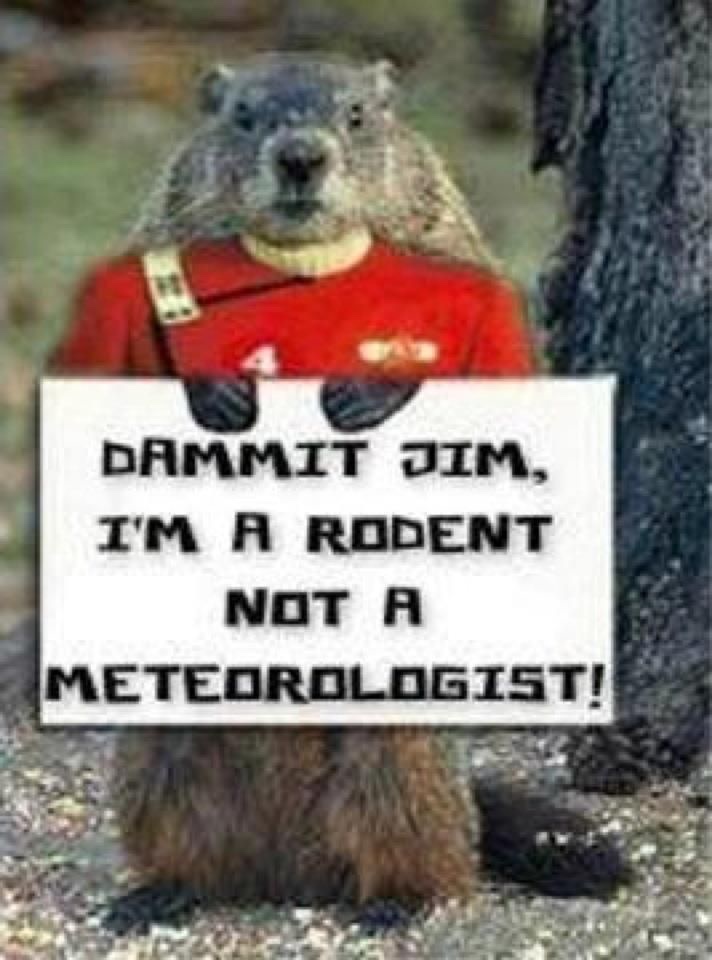
Midway between Winter Solstice and Spring Equinox and well before the first crocus of spring has peered out across the frozen tundra, there is a moment of insanity which helps those of us living in northern climes get through to that brief, blessed moment of warmth when the mosquitoes once again have their way with us.
The ancient Romans observed their mid-season festival on February 5, the pagan Irish on February 1. For Christians, it was February 2, Candlemas day, a Christian holiday celebrating the ritual purification of Mary. For reasons not entirely clear, early Christians believed that there would be six more weeks of winter if the sun came out on Candlemas Day.
Clergy would bless and distribute candles needed for winter, their length representing how long and cold the winter was expected to be. Germans expanded on the idea by selecting an animal, a hedgehog, as a means of predicting weather. Once a suitable number of Germans had come to America, they switched over to a more local rodent: Marmota monax. The common Groundhog.

Groundhogs hibernate for the winter, an ability held in great envy by some people I know. During that time, their heart rate drops from 80 beats per minute to 5, and they live off their stored body fat. Another ability some of us would appreciate, very much.
The male couldn’t care less about the weather. He comes out of his burrow in February, in search of a date. If uninterrupted, he will fulfill his groundhog mission of love and return to earth, not coming out for good until sometime in March.
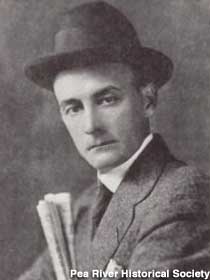
But then there is the amorous woodchuck’s worst nightmare in a top hat. The groundhog hunter.
In 1887, a group of Pennsylvania groundhog hunters took to calling themselves the Punxsutawney Groundhog Club. One of them, a newspaper editor, declared on February 2, 1887: you could search far and wide but their groundhog “Phil” was the only True weather forecasting rodent.
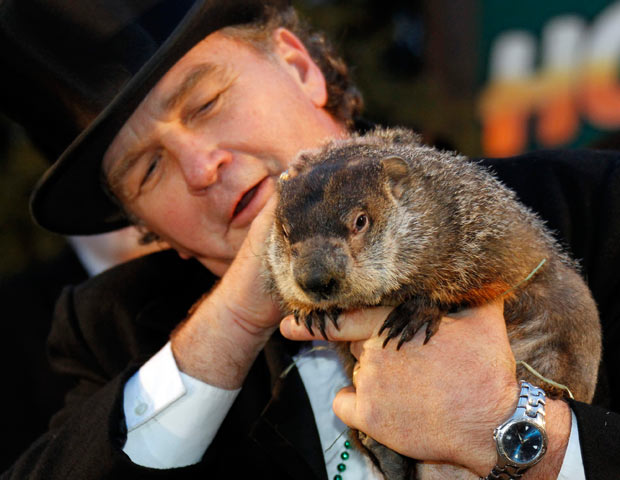
There are those who would dispute the Gobbler’s Knob crowd and their claims to Punxsutawney Phil’s weather forecasting prowess. Alabama has “Birmingham Bill”, and Canada has Shubenacadie Sam. New York can’t seem to decide between Staten Island Chuck and New York City’s very own official groundhog, “Pothole Pete”. North Carolinians look to “Queen Charlotte” and “Sir Walter Wally”, while Georgia folks can take their choice between “Gus” the Groundhog and “General Beauregard Lee”.
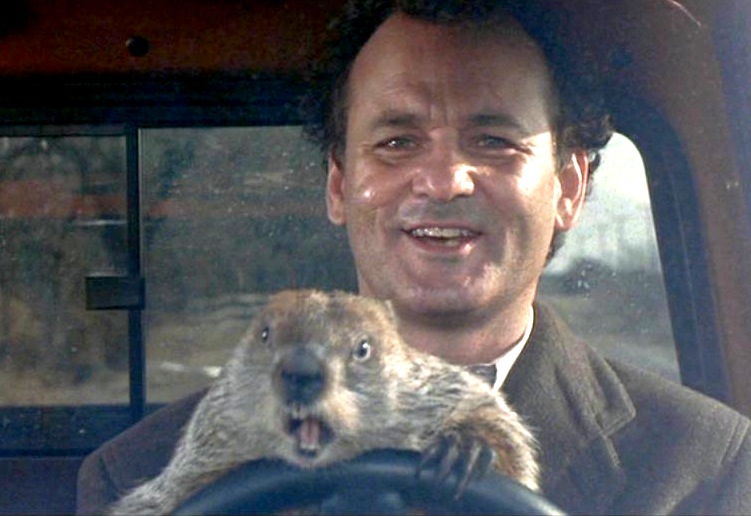
Since the eponymously named Bill Murray film from 1993, nothing seems to rise to the appropriate level of insanity, more than Groundhog Day drinking games. For the seasoned Groundhog enthusiast, “beer breakfasts” welcome the end of winter, across the fruited plain. If you’re in the Quaker state, you can attend the Groundhog day “Hawaiian Shirt Beer Breakfast”, at Philadelphia’s own Grey Lodge Public House. If you’re in Des Moines, stop by the The High Life Lounge, where free Miller High Life beers will be served from 6am, to eleven. And for the late sleeper, there is the annual screening of the Bill Murray Masterpiece, at the Alamo Drafthouse Cinema Beer Dinner.
Fun fact: Bill Murray was bitten not once but twice, by the groundhog used on the set.
It appears that there is no word for groundhog in Arabic. Accounts of this day in the Arab press translate the word as جرذ الأرض. “Ground Rat”. I was pretty excited to learn that, thank you Al Jazeera.
If anyone was to bend down and ask Mr. Ground Rat his considered opinion on the matter, he would probably cast a pox on all their houses. Starting with the guy in the top hat. It’s been a long winter, and Mr. Ground Rat’s dressed up for a date. He has other things on his mind.
For sixty years people either talked to each other or turned, and looked away. It all depended on which side you were on.
In the biblical story of Genesis, Cain was born to Adam and Eve, followed by his brother Abel. The first to be born slew his own brother, the first human to die, and Cain was cast out to wander in the land of nod, east of Eden.
According to legend, the evil King Amulius ordered the twin sons of Rhea Silvia and the war god Mars drowned in the Tyber River. Instead, the boys washed ashore to be suckled by a she-wolf. Romulus and Remus went on found a town on the site of their salvation, the traditional date being April 21, 753BC. Romulus later murdered his brother after some petty quarrel, making himself sole ruler of the settlement. He modestly called the place “Rome”, after himself.
Two thousand years later, two brothers come into this story. The enmity between Adolf and Rudolf Dassler never rose to fratricide but it came close, a detestation for one another to endure, beyond the grave. And you may be wearing one of their products right this moment, as you read this.
Oh. Did I tell you, the brothers were both Nazis?
The Bavarian town of Herzogenaurach is located in the Middle Franconia region of West Germany, about 14 miles from Nuremberg. In the early 20th century, the local textile economy collapsed in the face of more industrialized competitors. Many turned to shoe-making. By 1922, the small town of 3,500 boasted some 122 cobblers. Christoph Dassler was one such, specializing in felt slippers.
Herzogenaurach
Adolf “Adi” Dassler was the third son and youngest of four children born to Christoph and Paulina Dassler. An avid sportsman and athlete, Adi engaged in a variety of sporting events including track & field, futbol, skiing and ice hockey. Usually with close friend Fritz Zehlein, the son of a local blacksmith.
Adolf Dassler
The “Great War” descended over Germany in 1914, and the elder Dassler boys were conscripted into the army. Not yet thirteen, Adi was apprenticed to a baker, but turned to his father instead to learn the intricate stitching of the cobbler. Adi was particularly interested in sports, and how the proper shoe could improve athletic performance.
Adi himself was drafted into the army in 1918, five months before his 18th birthday.
Adi returned to what he knew after the war, repairing shoes while starting a business of his own. The German economy lay in ruins. Dassler was forced to scavenge war materials, to form his designs. Leather from bread pouches. Canvas from uniforms. And always the need to improvise, jury rigging available machinery in the absence of electricity.
Rudolf Dassler trained to become a police officer, but left to join his brother’s company, forming the Dassler Brothers Sports Shoe company, in 1924. Dassler Brothers may have been the first to use metal spikes, fashioned by Adi’s old buddy, Fritz Zehlein.
The following year, the company was making leather Fußballschuhe with nailed studs and track shoes with hand-made spikes.
Former Olympian and coach of the German Olympic track & field team Josef Waitzer took an interest in the work, becoming a friend and consultant. Dassler brothers shoes were used in international competitions as early as the 1928 games in Amsterdam and the Los Angeles games, of 1932.
With the rise of Adolf Hitler and the Nazi party in 1933, it was hard not to see the economic self-interest, in politics. The Dassler brothers – Adi, Rudi and Fritz all joined the party on May 1.
Jesse Owens
For the family business, the big break came in 1936 when American Olympian Jesse Owens agreed to compete in Dassler Brothers shoes. This American athlete of African ancestry went on to win four gold medals, a humiliating defeat for Hitler’s Aryan “master race”, but the sporting world soon beat a path to Adi’s door.
Compared with his brothers, Rudi seems to have been the more ardent Nazi. Adi confined himself to coaching Hitler Youth teams, while Rudi was off at rallies and political meetings. Politics formed much of what led to their parting ways.
Germany once again found itself at war and Adi switched over to producing army boots. Christoph and Paulina lived with their two grown sons and their wives, and five grandchildren. Käthe (Martz) Dassler, Adi’s wife, had frequent run-ins with her mother and father-in-law, and seems to have had a relationship of mutual detestation with Rudi’s wife, Friedl.
Family fault lines were already irreparable in 1943 when Adi and Käthe climbed into a bomb shelter. Rudi and his family were already there when Adi quipped, “The dirty bastards are back again”. He was referring to the Allied war planes overhead. Rudi was convinced the comment was directed at himself and Friedl.
Rudolf blamed his brother and his “Nazi friends” when he was called up to fight the Russians, in the east. Adi himself was drafted but dismissed when his civilian services, were deemed indispensable to the war effort.
Rudolf Dassler
Stationed in Tuschin that April, Rudi wrote to his brother: “I will not hesitate to seek the closure of the factory so that you be forced to take up an occupation that will allow you to play the leader and, as a first-class sportsman, to carry a gun.”
The Soviet Red Army overran Tuschin on January 19, 1945, decimating Dassler’s unit. Rudi fled to Herzogenaurach where a doctor certified him as militarily “incapable”, due to a frozen foot.
Allied “de-nazification” efforts after the war led to a blizzard of recriminations between the two brothers, and the end of the Dassler Brothers Shoe Factory.
The two men now hated each other.
Adi Dassler formed a new company which would come to be known, as Adidas. Rudi attempted to copy the idea but the name “Ruda”, just didn’t have the same ring. He settled on “Puma”.
Evolution of the Adidas logo
Herzogenaurach became a two-factory town, the sight of a German Hatfield & McCoy, blood feud. The rivalry extended to the two soccer clubs in town, ASV Herzogenaurach and 1FC Herzogenaurach. There were Adidas stores, and Puma stores. Adidas restaurants, and Puma restaurants. And don’t even think about being served if you had the wrong shoes on your feet.
For sixty years people either talked to each other or turned, and looked away. It all depended on which side you were on. The town became so saturated with the hate these two brothers felt for each other, the place came to be known as “The Town of Bent Necks“.
Puma logo, over the ages
The Dassler brothers never reconciled. They are buried in the same cemetery, as far away from each other as it is possible to be. The families are now out of the business, and so is the antagonism which held out for all those years. So remember that familiar cat or those famous three stripes, next time you lace up. You just might be wearing, a piece of history.
In 1954 Roger Bannister became the first human being to break the four-minute mile. Today, the Jamaican sprinter Usain Bolt is the fastest man who ever lived. It would come as a rude shock to both of those guys, that they are literally slower than cold molasses. In January.
The fastest man alive today is the Jamaican sprinter, Usain Bolt. He may be the fastest man who ever lived. The average male aged 20 to 40 in reasonably good shape is capable of speeds, between 10 and 15 miles per hour. At the 2009 World Track and Field Championships, Bolt ran 100 meters from a standing start at an average 23.35 mph and the 20 meters between the 60 & 80 marks, at an average 27.79 mph.
On May 6, 1954, Roger Bannister became the first human to run a sub-four minute mile with an official time of 3 minutes, 59.4 seconds.
It would come as a rude shock to both of those guys that they are literally slower than cold molasses. In January.
Usain Bolt
In 1919, the Purity Distilling Company operated an enormous iron storage tank, in the North End of Boston. Six stories high and ninety feet wide, the tank held 2.32 million gallons of molasses, awaiting transformation to sweeteners, drinking liquor and alcohol based munitions.
It was cold that month but on January 15 the temperature reached a balmy 46°, up from the bitter low of 2° of the day before.
If you were there that morning you would have heard sounds, not unlike the grumbling of some great, upset stomach. At 12:30 came a rumble, a sound like a distant train. Then came the staccato chatter of the machine gun, as iron rivets popped and the sides of the great tower split apart.
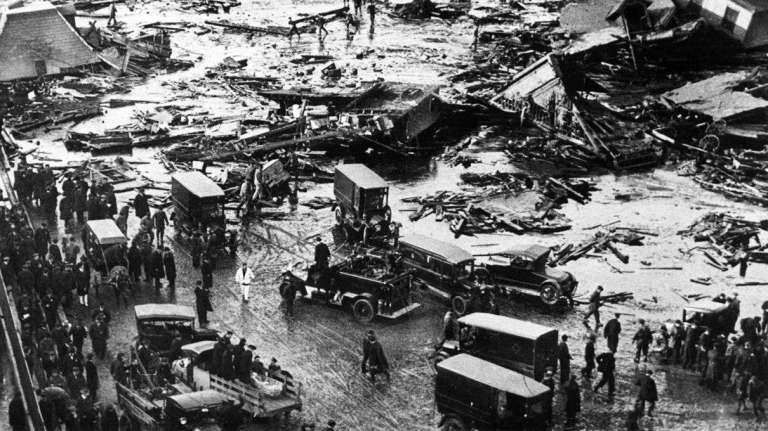
The collapse hurled a wall of molasses 40-feet high down the street at 35 miles per hour, smashing the elevated train tracks on Atlantic Ave and hurling entire buildings from foundations. Horses, wagons and dogs were caught up with broken buildings and scores of people struggling in the brown deluge, speeding across the North End. Twenty municipal workers eating lunch in a nearby city building were swept away, parts of the building hurled some fifty yards. Part of the tank wall fell on a nearby fire house, crushing the building and burying three firemen, alive.
The men playing cards at the firehouse looked out the windows and saw a dark wall that didn’t belong there. Whatever it was, the wall was coming right at them.
The power of the deluge may be seen in the elevated rail, twisted and deformed as by the temper tantrum, of some titanic child.
In the 17th century, Sir Isaac Newton described the physical properties of fluids. Water, a “Newtonian” fluid, retains a constant viscosity (flow) between 32° and 212°, Fahrenheit. We all know what it is to swim in water. You can propel yourself through the stuff but a “non-Newtonian” fluid such as ketchup or molasses, behaves differently. Non Newtonian fluids change viscosity and “shear” in response to pressure. You can’t propel yourself through a non-Newtonian fluid. The stuff will swallow you, whole. Not even Michael Phelps would be able to swim out of a sea of that gunk.
“Firefighters tried to wash the molasses away with freshwater, but would later find that briny seawater was the only way to “cut” the hardened substance”. H/T Historycollection.com
The Boston Post reported “Molasses, waist deep, covered the street and swirled and bubbled about the wreckage … Here and there struggled a form—whether it was animal or human being was impossible to tell. Only an upheaval, a thrashing about in the sticky mass, showed where any life was … Horses died like so many flies on sticky fly-paper. The more they struggled, the deeper in the mess they were ensnared. Human beings—men and women—suffered likewise”.
In 1983, a Smithsonian Magazine article described the experience of one child: “Anthony di Stasio, walking homeward with his sisters from the Michelangelo School, was picked up by the wave and carried, tumbling on its crest, almost as though he were surfing. Then he grounded and the molasses rolled him like a pebble as the wave diminished. He heard his mother call his name and couldn’t answer, his throat was so clogged with the smothering goo. He passed out, then opened his eyes to find three of his four sisters staring at him”.
All told, the molasses flood of 1919 killed 21 people and injured another 150. 116 cadets from the Massachusetts Nautical School, now Mass Maritime Academy, were the first to arrive on-scene. They were soon followed by Boston Police, Red Cross, Army and Navy personnel. Some Red Cross nurses literally dove into the mess to rescue victims while doctors and surgeons set up a makeshift hospital and worked around the clock.
Four days later the search was called off, for additional victims. The cleanup has been estimated at 87,000 man-hours.
The rupture resulted from a combination of factors. Construction was so poor, locals knew they could come down and collect household molasses from drippings down the outside of the thing which was leaking so badly the company painted it brown, to hide the leaks.
This was only the 4th time the tank was filled to capacity and rising temperatures helped build up gas pressure, inside the structure. Subsequent analysis determined the thickness and quality of the iron itself was insufficient, to contain 14,000 tons of molasses.
With temperatures so cold, the rapid spread of all that molasses made no sense. Everyone knows what it is to turn over a jar of the stuff…and wait. Now, cold molasses had all but exploded. In January, no less. There must be something else. There HAD to be. Dark rumors spread outward like ripples, on a pond. Newspapers speculated. There must be some insidious cause, a bomb perhaps, planted by Italian anarchists. Or the work of German saboteurs.
The newspapermen of the age would have learned more if they’d cracked a physics textbook. In fluid dynamics, a “gravity current” describes the horizontal flow in a gravitational field, of a dense fluid into a fluid of lesser density. Like, say, a wall of molasses, into the surrounding air. The air around us is after all, a fluid. Think about the way cold air rushes through an open doorway into a warm room, even when there is no wind.
Harvard lecturer and aerospace engineer Nicole Sharp explains that, as a non-Newtonian fluid, the flood would have advanced with terrifying rapidity behaving much the same as a mudslide, avalanche or lava flow. Sharp’s calculations confirm the initial flow could have indeed traveled as fast, as 35 miles per hour.
Today, the site of the Great Molasses Flood is occupied by a recreational complex called Langone Park featuring a Little League ball field, a playground, and bocce courts. Boston Duck Tours regularly visit the place in amphibious vehicles, designed for land and water. Especially the dark brown one. The one with the name “Molly Molasses”, painted on the side.
Mr. Columbus seems not to have been impressed with his mermaids, describing these particular creatures as “not half as beautiful as they are painted.”
Pax Romana”. The “Roman Peace”. A period between the 1st and 2nd century AD when the force of Roman arms subdued nearly all, who would stand against them.
Unsurprisingly, the conquered peoples described the period, somewhat differently. Sometime around 84AD Calgacus of the Caledonian Confederacy in Northern Scotland said, “They make a desert and call it peace”.
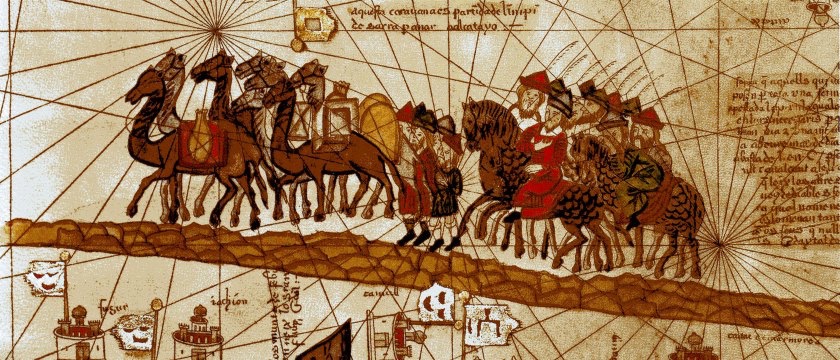
The conquests of Genghis Khan and his successors accomplished much the same during the 13th and 14th century. The “Pax Mongolica” effectively connected Europe with Asia, a time when one could travel the “Silk Road” from Britain in the west to China in the east. Great caravans carrying Chinese silks and spices came to the west via transcontinental trade routes. It was said of the era that “a maiden bearing a nugget of gold on her head could wander safely throughout the realm.”
Never mind the pyramids of skulls, over there.
Over time the “Black Death” and Mongol fracturing along political lines brought the Pax Mongolica to an end. Muslim domination of Middle Eastern trade routes made overland travel to China and India increasingly difficult in the 15th century. After Constantinople fell to the Ottoman Turks in 1453, such travel became next to impossible. Europe began to look for a water route to the East.
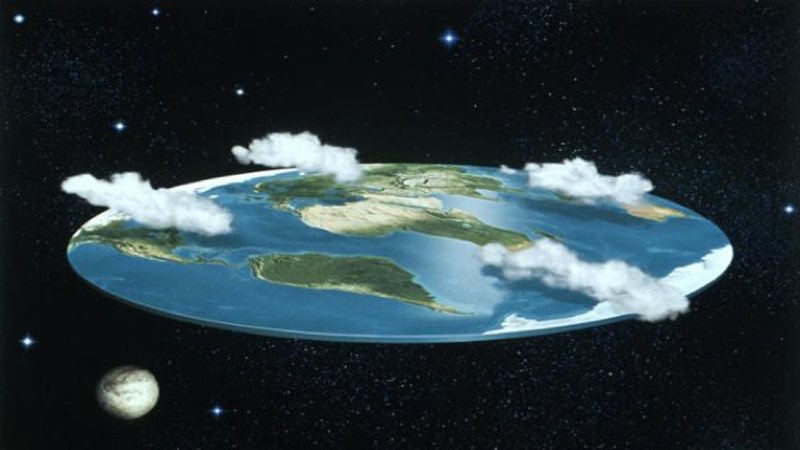
It’s popular to believe that 15th century Europeans thought the world was flat, but that’s a myth. Otherwise, cats would have pushed everything over the edge by now.
The fact that the world is round was understood for over a thousand years, though 15th century mapmakers often got places and distances wrong. In 1474, Paolo dal Pozzo Toscanelli detailed a scheme for sailing westward to China, India and the Spice Islands. He believed that Japan, which he called “Cipangu”, was larger than it is, and farther to the east of “Cathay” (China). Toscanelli vastly overestimated the size of the Eurasian landmass while the Americas were left out, altogether.
This is the map that Christopher Columbus took with him, in 1492.
Columbus had taken his idea of a westward trade route to the Portuguese King, to Genoa and to Venice, before he came to Ferdinand and Isabella in 1486. At that time the Spanish monarchs had a Reconquista to tend to, but by 1492, they were ready. The Nina, Pinta and the Santa Maria sailed that August.
By the new year the expedition had been at sea for six months. Sailing off the coast of Hispaniola on January 9, what we now call the Dominican Republic, Columbus spotted three “mermaids”.
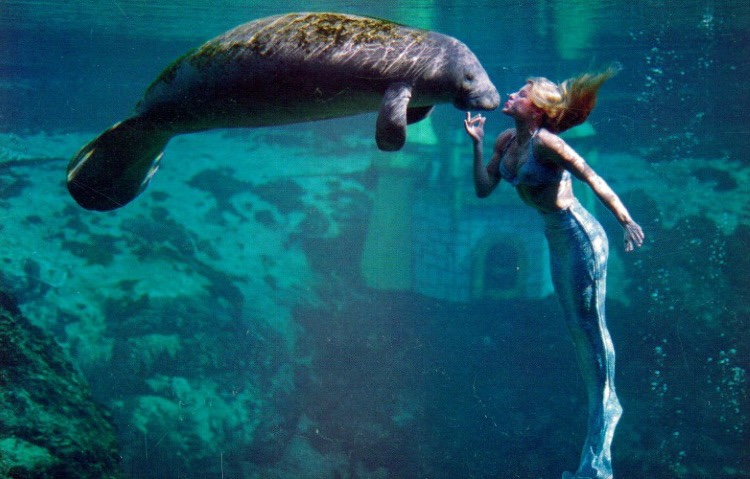
They were almost certainly Manatee, part of the order “Sirenia”. “Sirens” are the beautiful sisters, half birdlike creatures who live by the sea, according to ancient Greek mythology. These girls, according to myth, sang a song so beautiful that sailors fell into hypnosis, dashing ships on the rocks in vain efforts to reach them.
Columbus seems not to have been impressed, describing these particular mermaids as “not half as beautiful as they are painted.”
Small wonder. These marine herbivores measure 10 to 13-feet from nose to tail and weigh in at 800 to 1,200 lbs.
Not everyone was quite so dismissive. A hundred years later, the English explorer John Smith reported seeing a mermaid, probably a Manatee. The creature was “by no means unattractive” Smith wrote, but I’m not so sure. Maybe Mr. Smith just needed to get out a little more.
Lippincott’s monthly magazine, waxed rhapsodic: “This animal, homely as a steamroller, is the embodiment of salvation. Peace, plenty and contentment lie before us, and a new life with new experiences, new opportunities, new vigour, new romance, folded in that golden future, when the meadows and the bayous of our southern lands shall swarm with herds of hippopotami”.
Only hours from now, families will gather far and near around, the Christmas table. There will be moist and savory stuffing, and green bean casserole. Creamy mashed potatoes and orange cranberry sauce. And there, the centerpiece of the feast. Slow-roasted and steaming in that silver tray the golden brown, delicious, roast hippopotamus.
Wait…Umm…What?
Water Hyacinth
On this day in 1884, the World Cotton Centennial and World’s Fair was beginning its second week, in New Orleans. Among the many wonders on display was the never-before seen Eichornia crassipes, a gift of the Japanese delegation. The Water Hyacinth.
Visitors marveled at this beautiful aquatic herb, its yellow spots accentuating the petals of delicate purple and blue flowers floating across tranquil ponds on a mat of thick, dark green leaves.
The seeds of Eichornia crassipes are spread by wind, flood, birds and humans and remain viable, for 30 years. Beautiful as it is to look at, the Water Hyacinth is an “alpha plant”, an aquatic equivalent to the Japanese invasive perennial Kudzu, the “vine that ate the south”. Impenetrable floating mats choke out native habitats and species while thick roots impede the passage of vessels, large and small. The stuff is toxic if ingested by humans and most animals, and costs a fortune to remove.
This plant native from the Amazon basin quickly broke the bounds of the 1884 World’s Fair, spreading across the bayous and waterways of Louisiana, and beyond.
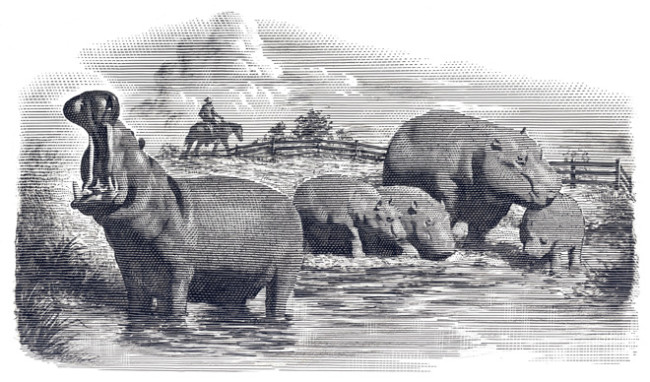
During the first decade of the 20th century, an exploding American population could barely keep up with its own need for food, especially, meat. The problem reached crisis proportions in 1910, with over grazing and a severe cattle shortage. Americans were seriously discussing the idea, of eating dogs.

Enter Louisiana member of the House of Representatives, New Iberia’s own Robert Foligny Broussard, with a solution to both problems. Lake Bacon.
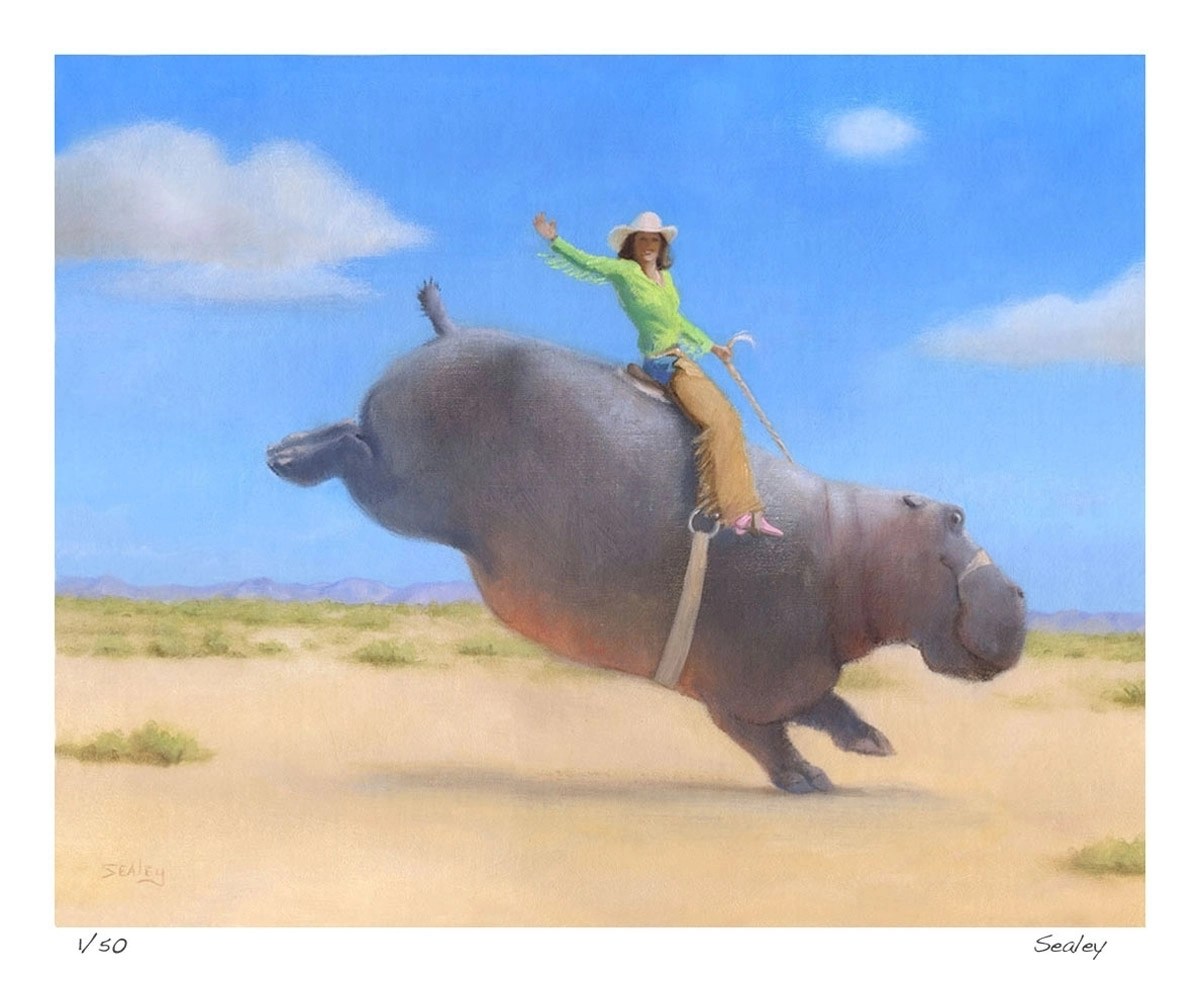
The attorney from Louisiana’s 3rd Congressional district proposed the “American Hippo” bill, H.R. 23621, in 1910, with enthusiastic support from Theodore Roosevelt and the New York Times. One Agricultural official estimated that a free-range hippo herd could produce up to a million tons of meat, per year.
Lippincott’s monthly magazine, waxed rhapsodic: “This animal, homely as a steamroller, is the embodiment of salvation. Peace, plenty and contentment lie before us, and a new life with new experiences, new opportunities, new vigour, new romance, folded in that golden future, when the meadows and the bayous of our southern lands shall swarm with herds of hippopotami”.
With a name deriving from the Greek term “River Horse”, the common hippopotamus is the third largest land animal living today. Despite a physical resemblance to hogs and other even-toed ungulates, Hippopotamidae’s closest living relatives are cetaceans such as whales, dolphins and porpoises.
All well and good. The problem is, those things are dangerous.
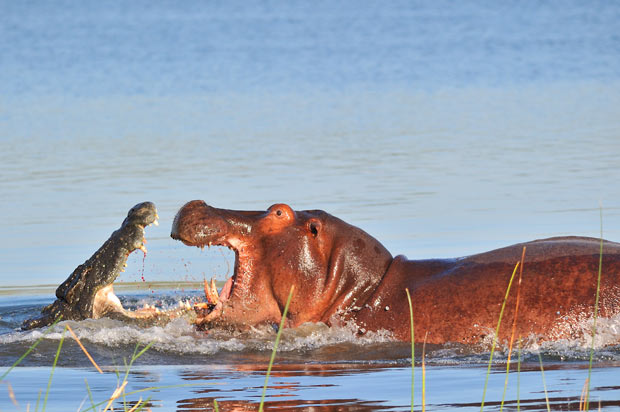
The adult bull hippopotamus is extremely aggressive, unpredictable and highly territorial. And heaven help anyone caught between a cow, and her young. Hippos can gallop at short sprints of 19 mph, only slightly less than Jamaican Sprinter Usain Bolt, “the fastest man who ever lived”.
To search the “10 most dangerous animals in Africa” is to learn that hippos are #1, responsible for more human fatalities than any other large animal, in Africa.
Be that at it as it may, the animal is a voracious herbivore, spending daylight hours at the bottom of rivers & lakes, happily munching on vegetation.
Back to Broussard’s bill, what could be better than taking care of two problems at once? Otherwise unproductive swamps and bayous from Florida to Louisiana would become home to great hordes of free-range hippos. The meat crisis would be averted. America would become a nation of hippo ranchers.
As Broussard’s bill wended its way through Congress, the measure picked up steam with the enthusiastic support of two men, mortal enemies who’d spent ten years in the African bush, trying to kill each other. No, really.
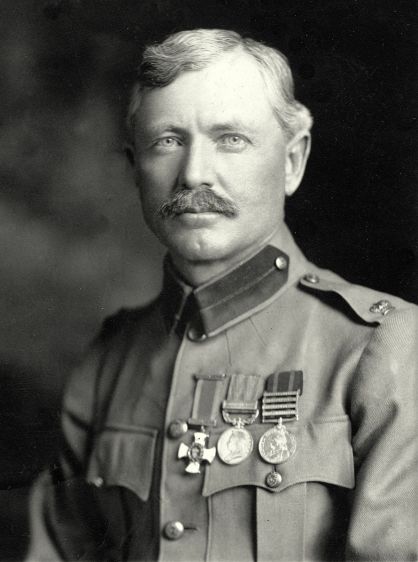
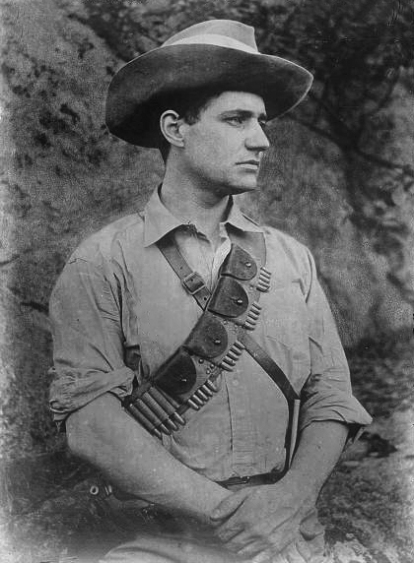
Frederick Russell Burnham had argued for four years for the introduction of African wildlife into the American food stream. A freelance scout and American adventurer, Burnham was known for his service to the British South Africa company, and to the British army in colonial Africa. The “King of Scouts’, commanding officers described Burnham as “half jackrabbit and half wolf”. A “man totally without fear.” One writer described Burnham’s life as “an endless chain of impossible achievements”, another “a man whose senses and abilities approached that of a wild predator”. He was the inspiration for the Indiana Jones character and for the Boy Scouts. Forget the Dos Equis guy. Frederick Burnham really was the “most interesting man in the world“.
Frederick Russell BurnhamFritz Joubert Duquesne
Fritz Duquesne? Well that’s another matter. Frederick “Fritz” Joubert Duquesne was a Boer of French Huguenot ancestry, descended from Dutch settlers to South Africa. A smooth talking guerrilla fighter, the self-styled “Black Panther” once described himself as every bit the wild African animal, as any creature of the veld. An incandescent tower of hate for all things British, Duquesne was a liar, a chameleon, a man of 1,000 aliases who once spent seven months feigning paralysis, just so he could fool his jailers long enough to cut through his prison bars.
Destined to become a German spy it is he who lends his name to the infamous Duquesne Spy Ring. Frederick Burnham described this, his mortal adversary, thus: “He was one of the craftiest men I ever met. He had something of a genius of the Apache for avoiding a combat except in his own terms; yet he would be the last man I should choose to meet in a dark room for a finish fight armed only with knives“.
During the 2nd Boer war, the pair had sworn to kill each other. In 1910, these two men became partners in a mission to bring hippos, to America’s dinner table.
Biologically, there is little reason to believe that Hippo ranching couldn’t have worked along the Gulf coast. Colombian officials estimate that, within a few years, the hippo descendants of drug kingpin Pablo Escobar’s exotic animal menagerie will number 100 or more individuals.
Broussard’s measure went down to defeat by a single vote but never entirely went away. Always the political calculator, Representative and later-Senator Broussard died with the bill on his legislative agenda, waiting for the right moment to reintroduce the thing.
Over time, the solution to the meat question became a matter of doubling down on what was already happening, as factory farms and confinement operations took the place of free ranges and massive use of antibiotics replaced the idea of balanced biological systems.
We may or may not have “traded up”. Today, we contend with ever more antibiotic-resistant strains of “Superbugs”. Louisiana spends $2 million per year on herbicidal control of the water hyacinth. The effluent of factory farms from Montana to Pennsylvania works its way into the nation’s rivers and streams, washing out to the Mississippi Delta to a biological dead zone, the size of New Jersey.
Gulf of Mexico dead zone, image credit NOAA
That golden future of Lippincott’s hippo herds roam only in the meadows and bayous of the imagination. Who knows, it may be for the best. I don’t know if any of us could’ve seen each other across the table, anyway. Not when the hippopotamus came out of the oven.
It was hardly coincidental that the thing was installed outside of Fleming’s General Store, but hey. This was a guy who let guinea hens loose inside his store and offered a discount, to anyone who could catch one. Roscoe Fleming had style.
Few machines have changed the course of history, like Eli Whitney’s cotton gin.
The long, hot summers of the southeastern United States have always been ideal for growing cotton, but there was a time when the stuff was extremely expensive to produce. Cotton comes out wet from the boll, the protective capsule requiring about ten man hours just to remove the seeds to produce a pound of cotton.
By comparison, a cotton gin can process about a thousand pounds a day, at comparatively little expense.
In 1792, the year that Whitney invented his machine, the southeastern United States exported 138,000 pounds a year to Europe and to the northern states. Two years later, that number had risen to 1,600,000 pounds. By the time of the Civil War, Britain alone was importing ¾ of the 800 million pounds it consumed every, from the American south.
Enterprise, Alabama got its start when John Henry Carmichael first settled there, in 1881. Within a few years the Alabama Midland Railway came to Enterprise. By the turn of the century the place was a major cotton growing hub.
Anthonomus grandis, the Boll Weevil, is a small beetle, about the size of the nail on your little finger. Indigenous to Mexico, the beetle crossed the Rio Grande near Brownsville, sometime around 1892. The insect spread rapidly, producing eight to ten generations in a single growing season and preying mainly on the young cotton boll.
weevil in a ball of cotton
The insect is capable of destroying entire cotton crops and did just that in 1915, the year the insect reached Enterprise and most of Coffee County. Facing economic ruin, local farmers were forced to diversify their crops, just to recoup the losses caused by this wretched insect.
Within two years, Enterprise became one of the leading peanut producers in the nation. Not only had farmers been able to stave of disaster, but they were already becoming prosperous as a result of the thriving new crop base.
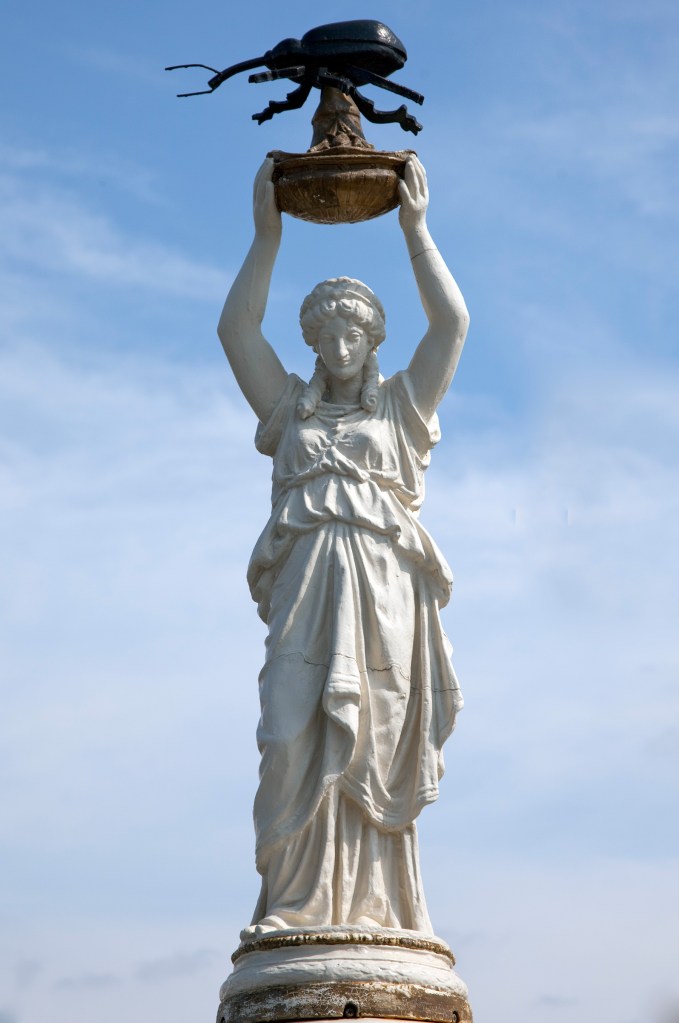
Town fathers decided to build a monument, their “herald of prosperity”, to the boll weevil. The bug that had almost ruined them.
Roscoe Owen “Bon” Fleming
The idea was the brainstorm of one Roscoe Owen “Bon” Fleming, a man roadsideamerica.com describes as a “businessman, city councilman, and rogue promoter of the town of Enterprise”.
It was hardly coincidental that the thing was installed outside of Fleming’s General Store, but hey. This was a guy who let guinea hens loose inside his store and offered a discount, to anyone who could catch one. Roscoe Fleming had style.
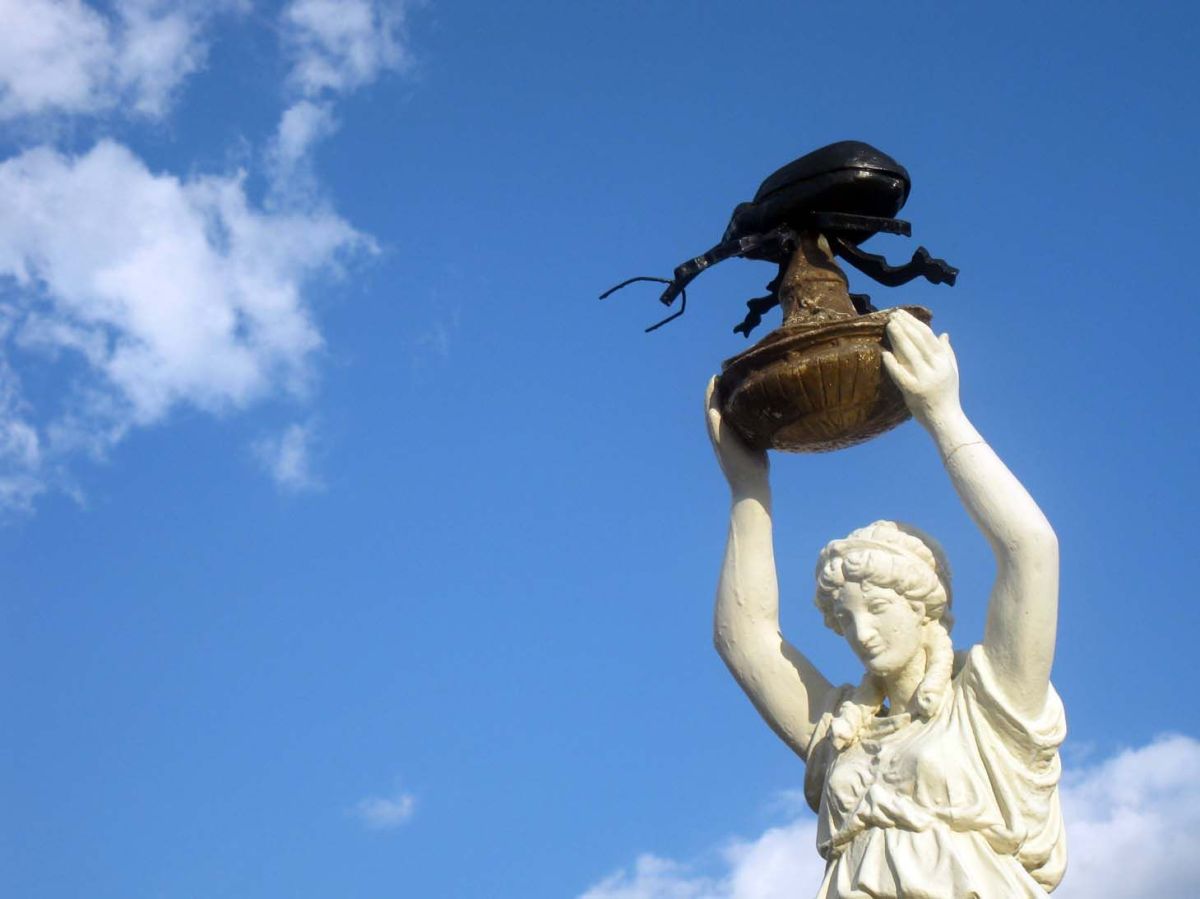
Designed in Italy (or maybe not), the monument depicts a female figure in a flowing gown, arms stretched high over her head and holding in her hands, a trophy. Maybe the whole thing came from the Bama Iron Works 90 miles down the road, who knows. There’s nothing like a good story.
George Washington Carver
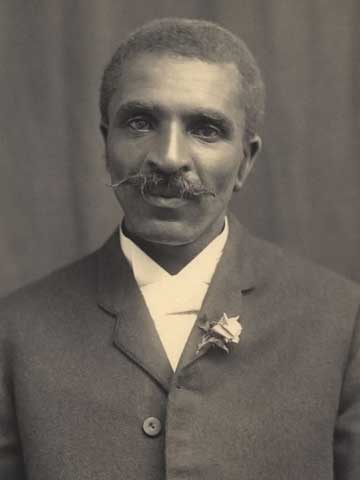
Critics railed against the $1,800 cost of the project, half of which came out of Fleming’s own pocket. The punditry also took aim at the subject of the monument. Why would you have a statue of a boll weevil in segregated Alabama when you could honor George Washington Carver, the African American agronomist who championed the peanut, in the first place?
Bon Fleming was not insensitive to such criticism and invited Carver to be the principal speaker, at the unveiling. It wasn’t meant to be. Rain washed out the tracks into town and Carver never made it.
So it is, a monument to a bug was dedicated on December 11, 1919 at the intersection of College and Main Street, in the heart of the business district, of Enterprise Alabama.
Now, you can’t have a boll weevil monument without a boll weevil, right? Thirty years later one Luther Baker added a bug to the top of the trophy. A big one, about the size of a Bassett hound. At the base of the memorial appears this inscription:
“In profound appreciation of the Boll Weevil and what it has done as the herald of prosperity this monument was erected by the citizens of Enterprise, Coffee County, Alabama.”
The original has been vandalized so many times it was moved it to a protected facility and a replica, put in its place. So it is you can drive down the Main Street of Enterprise Alabama, and there you will find a monument…to a bug.
Before the age of King George III, readers scoffed at the notion of a venomous, egg-laying mammal with the bill of a duck, the tail of a beaver and the webbed feet, of an otter. Until one was discovered, in 1799.
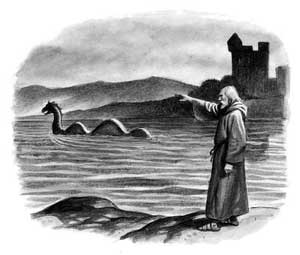
As the story goes, the Irish priest Columba was traveling the Scottish Highlands, teaching Christianity to the Picts. He was walking along the shores of Loch Ness one day, when he came upon some local villagers burying one of their own. The poor unfortunate had swum out to retrieve a boat adrift from its moorings, when he was bitten by a water creature of some sort. The priest sent one of his followers swimming across the loch to get the boat. The monster rose from the depths once again and was just about to eat the man, when Columba commanded the beast to depart.
There’s no telling how it actually happened. The story was written down 100 years, after the fact. The events described took place on August 22nd, 565, meaning that we’ve been talking about the Loch Ness monster for about 1,500 years. At a minimum.
Loch Ness is formed by a 60 mile, active tectonic fault, where the hills are still rising at a rate of a millimeter, per year. It’s made up of 3 lochs; Loch Lochy, Loch Oich and Loch Ness with Loch Ness being by far, the largest. There is more water in Loch Ness than all the other lakes in England, Scotland and Wales, combined. It is 22½ miles long and varies from a mile to 1½ miles wide, with a depth of 754-feet and a bottom “as flat as a bowling green”.
Loch Ness never freezes. There is a thermocline at 100-feet, below which the water remains a uniform 44° Fahrenheit. As the surface water cools in winter, it is replaced by warmer water rising up from below, causing the loch to steam on cold days. The heat energy generated has been compared to burning 2 million tons of coal. With the steam rising off the water and the occasional seismic tremor, Loch Ness can be a very eerie place.
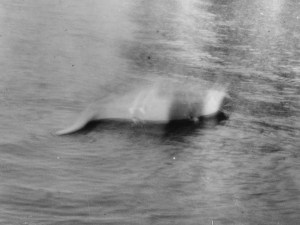
Loch Ness ‘Monster’ as photographed, by Hugh Gray
The first photographic “evidence” of the Loch Ness monster was taken on the 12th of November 1933, by Hugh Gray. Some said the picture showed an otter, while others believed it was “some kind of giant marine worm”. The UK Daily Mail sent a team to look for evidence, headed by the famous big game hunter Marmaduke Wetherell. There was great media excitement when Wetherell discovered enormous footprints along the shore in December. Researchers from the Natural History Museum examined the tracks, which they determined to have come from a dried hippo’s foot; probably one of the umbrella stands popular at the time. That was the end of that.
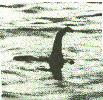
Surgeon’s Photo
A British surgeon, Colonel Robert Wilson, took what might be the most famous picture of “Nessie” the following year. He didn’t want his name associated with it, so it became “The Surgeon’s Photo”, showing what appears to be a head and neck rising above the waters of the loch.
In one of history’s more interesting death bed confessions, Christian Spurling claimed in 1994 at the age of 93, that the surgeon’s photo had been a hoax. According to Spurling, his step-father Marmaduke Wetherell, was smarting over his hippo-foot humiliation. Spurling remembers Wetherell saying “We’ll give them their monster”, and asking his stepson to build a credible model of a marine creature. And so he did, the photo was taken, and Dr. Wilson became the respectable front man for the hoax.
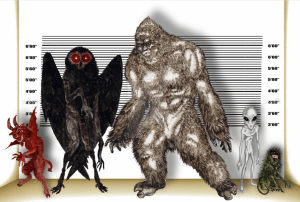
An entire study called “Cryptozoology” (literally, the study of hidden animals) has sprung up around Nessie and other beasts whose existence is never quite proven, and never completely debunked. There is Big Foot, who seems to have made it to stardom with his own series of beef jerky commercials. You have the Chupacabra, the Yeti, Ogopogo, Vermont’s own Lake Champlain monster, “Champ”, and more.
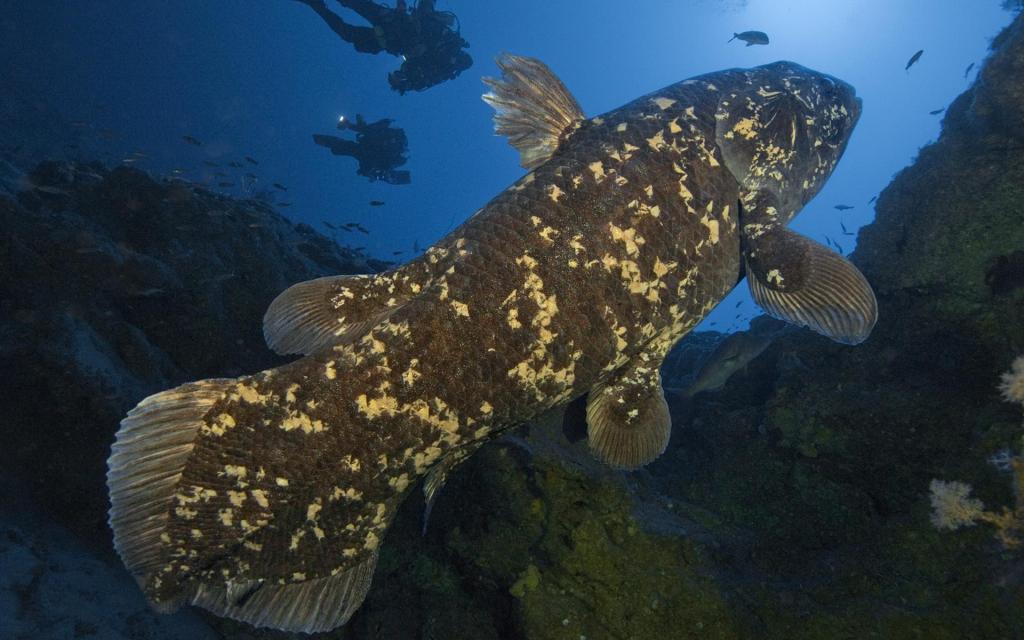
And yet, some of these critters have proven to be, very real. The terrifying ‘Kraken’ of sailor’s lore was likely a colossal squid, now known to gain lengths up to 46-feet. Before the age of King George III, readers scoffed at the notion of a venomous, egg-laying mammal with the bill of a duck, the tail of a beaver and the webbed feet, of an otter. Until one was discovered, in 1799. Today we know that little guy, as the duck-billed platypus. The Coelacanth was ‘known’ to be extinct since the late cretaceous, until one of them popped up in a fisherman’s net, in 1938.
Hundreds of images have been taken over the years, purporting to demonstrate that these critters do exist. Some were transparent hoaxes, for others there is less certainty. In the end, people will believe what they want to believe. The existence of these mythical creatures may never be proven, short of one of them washing up on shore somewhere. Even then, someone will take to social media, to argue otherwise.
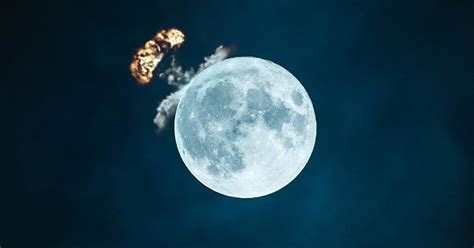
Out of the mess of the Space race emerged an idea destined to go down in the Hare-Brain Hall of fame, if there is ever to be such a place. A show of force sufficient to boost domestic morale while showing the Russkies, we mean Business. It was the top-secret “Project A119”, also known as A Study of Lunar Research Flights. We were going to detonate a nuclear weapon. On the moon.
As World War II drew to a close in 1945, there arose a different sort of conflict, a contest of wills, between the two remaining Great Powers of the world. The “Cold War” pitted the free market economy and constitutional republicanism of the United States against the top-down, authoritarian governing and economic models of the Soviet Union. The stakes could not have been higher, as each side sought to demonstrate its own technological and military superiority and, by implication, the dominance of its own economic and political system.
American nuclear preeminence lasted but four short years, coming to an end with the first successful Soviet atomic weapon test code named “First Lightning”, carried out on August 29, 1949. Mutual fear and distrust fueled the Soviet-American “arms race”, a buildup of nuclear stockpiles beyond any rational purpose. A generation grew up under the shadow of nuclear annihilation. A single mistake, misunderstanding or one fool in the wrong place at the wrong time, initiating a sequence and bringing about the extinction of life on this planet.
The arms race acquired the dimensions of a Space Raceon July 29, 1956, when the United States announced its intention to launch an artificial satellite, into earth orbit. Two days later, the Soviet Union announced that it aimed to do the same.
The early Space Race period was a time of serial humiliation for the American side, as the Soviet Union launched the first Inter-Continental Ballistic Missile (ICBM) on August 21, 1957, and the first artificial satellite “Sputnik 1” on October 4.
The first living creature to enter space was the dog “Laika“, launched aboard the spacecraft Sputnik 2 on November 3 and labeled by the more smartass specimens among the American commentariat, as “Muttnik”.
Soviet propaganda proclaimed “the first traveler in the cosmos”, replete with heroic images printed on posters, stamps and matchbook covers. The American news media could do little but focus on the politics of the launch, as animal lovers the world over questioned the ethics of sending a dog to certain death, in space.
On the American side, the giant Vanguard rocket was scheduled to launch a grapefruit-sized test satellite into earth orbit that September, but the program was plagued by one delay after another. The December 6launch was a comprehensive disaster, the rocket lifting all of four-feet from the pad before crashing to the ground in a sheet of flame, the satellite rolling free where it continued to beep, only feet from the burning wreck.
The second Vanguard launch was nearly as bad, exploding in flames only seconds after launch. Chortling Soviet leaders were beside themselves with joy, stamping the twin disasters as “Kaputnik”, and “Flopnik”.
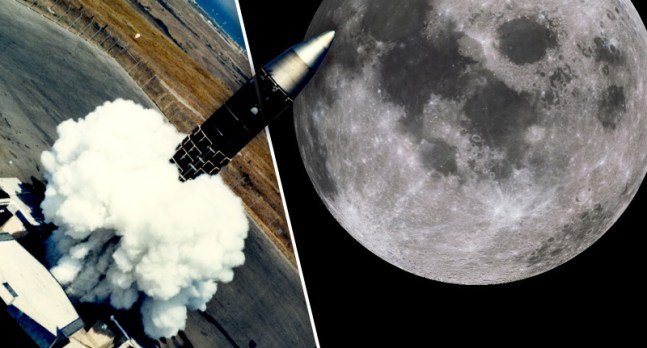
Out of this mess emerged an idea destined to go down in the Hare-Brain Hall of fame, if there is ever to be such a place. A show of force sufficient to boost domestic morale, while showing the Russkies, we mean business. It was the top-secret “Project A119”, also known as A Study of Lunar Research Flights.
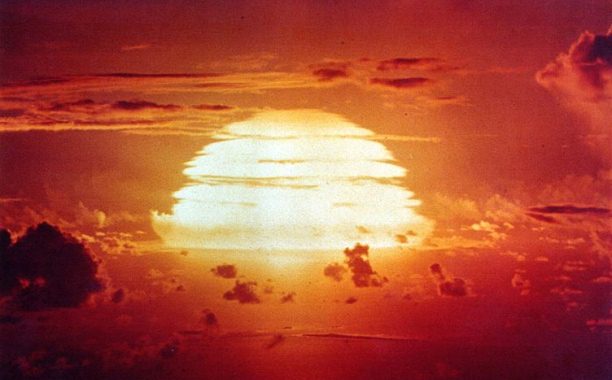
We were going to detonate a nuclear weapon. On the moon.
In 1957, newspapers reported a rumor. The Soviet Union planned a nuclear test explosion on the moon, timed to coincide with the lunar eclipse of November 7. A celebration of the anniversary of the Glorious October Revolution.
Edward Teller himself, the ‘Father of the H-Bomb” is said to have proposed such an idea as early as February, to test the effects of the explosion in a vacuum, and conditions of zero gravity.
Today, we take for granted the massively complex mathematics, involved in hitting an object like the moon. In 1957 there was a very real possibility of missing the thing and boomerang effect, returning the bomb from whence it came.
While the information is still classified, the project was revealed in 2000 by former NASA executive Leonard Reiffel, who said he was asked to “fast track” the program in 1958, by senior Air Force officials. A young Carl Sagan was all for the idea, believing at the time that living microbes may inhabit the moon, and a nuclear explosion may help in detecting such organisms.
Reiffel commented in a Guardian newspaper interview: “It was clear the main aim of the proposed detonation was a PR exercise and a show of one-upmanship. The Air Force wanted a mushroom cloud so large it would be visible on earth. The US was lagging behind in the space race.” The now-retired NASA executive went on to explain that “The explosion would obviously be best on the dark side of the moon and the theory was that if the bomb exploded on the edge of the moon, the mushroom cloud would be illuminated by the sun.”
The Air Force canceled the A119 program in 1959, apparently out of concern that a ‘militarization of space’ would create public backlash, and that nuclear fallout may hamper future research and even colonization efforts, on the moon.
Previously secret reports revealed in 2010 that Soviet leaders had indeed contemplated such a project, part of a multi-part program code named “E”. Project E-1 involved reaching the moon, while E-2 and E-3 focused on sending a probe around the far side of the celestial body. The final stage, project E-4, involved a nuclear strike on the moon as a “display of force”.
Construction plans for the aforementioned Hare-Brain Hall of Fame have yet to be announced but, it already appears the place may need another wing.
“We know now that in the early years of the twentieth century this world was being watched closely by intelligences greater than man’s and yet as mortal as his own. We know now that as human beings busied themselves about their various concerns they were scrutinized and studied, perhaps almost as narrowly as a man with a microscope might scrutinize the transient creatures that swarm and multiply in a drop of water.” – Orson Welles
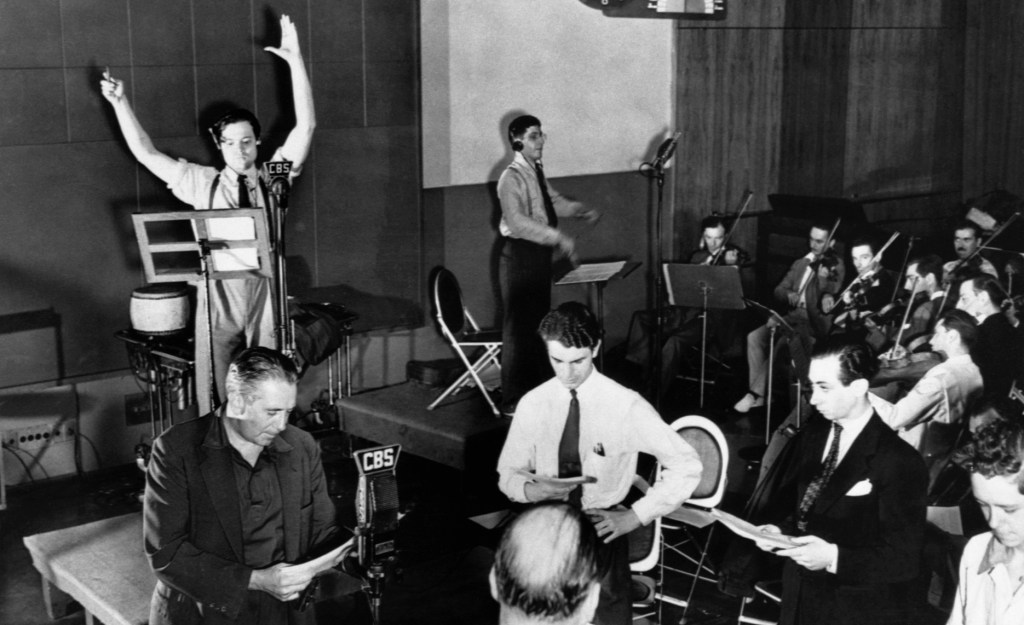
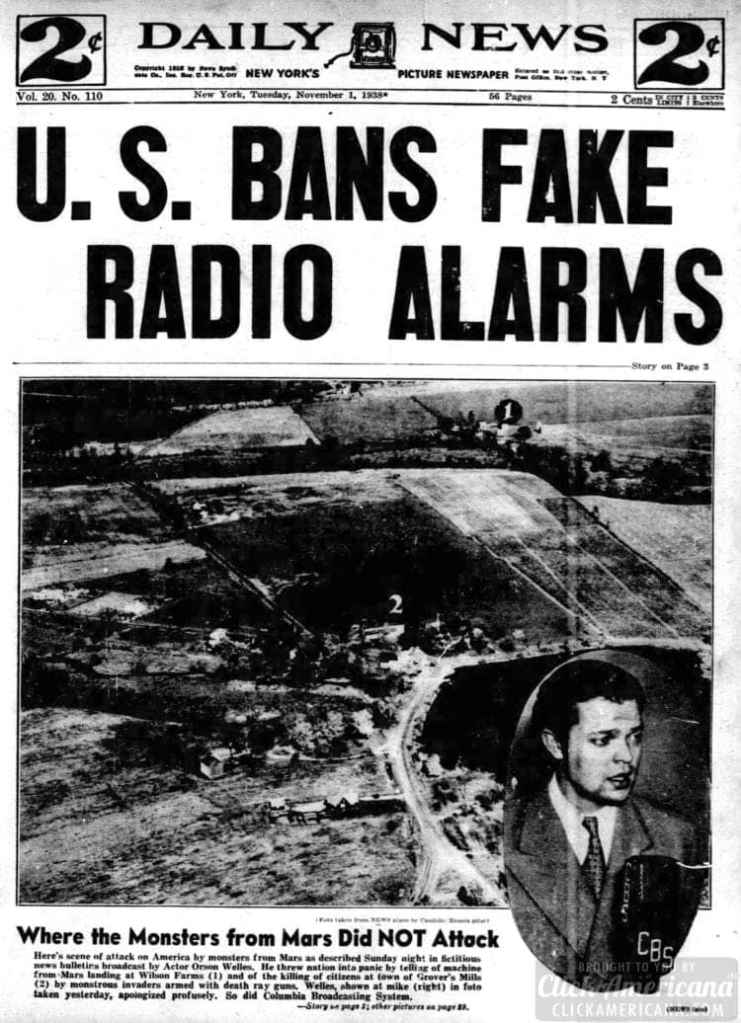
October 30, 1938 was a Sunday. The 8:00pm (eastern) broadcast of the Mercury Theater of the Air began with a weather report and then went to a dance band remote featuring “Ramon Raquello and his orchestra”. The music was periodically interrupted by live “news” flashes, beginning with strange explosions on Mars. Producer Orson Welles made his debut as the “famous” (but non-existent) Princeton Professor Dr. Richard Pierson, who dismissed speculation about life on Mars.
A short time later, another “news flash” reported a fiery crash in Grovers Mill, New Jersey. What was believed a meteorite turned out to be a rocket capsule as a tentacled, pulsating Martian unscrewed the hatch and incinerated the gathering crowd of onlookers, with a death ray.
The story is great fun, a Halloween classic telling and retelling the story of a radio broadcast leading untold thousands, perhaps hundreds of thousands to take up their families and their shotguns and flee into the night, to escape the Martian menace.
1 million Americans or more according to some news outlets, members of a generation who survived the Great Depression and went on to win World War II, actually believed Martian killing machines had blasted off and traveled across interplanetary space and attacked New Jersey, only to be destroyed themselves by microorganisms, all in the space of a sixty minute broadcast.
Umm…OK.
To be fair I wrote as much myself in this space, four years ago. Then as now the healthy skeptic might have begun, by following the money.
In 1899, the obscure Brazilian priest and inventor Father Roberto Landell de Moura successfully transmitted audio over a distance, of 7 kilometers (4.3 miles). That same year an Italian inventor called Guglielmo Marconi successfully broadcast, across the English Channel. Twenty years later, Westinghouse engineer Frank Conrad began to broadcast music, in the Pittsburg, Pennsylvania area. Conrad’s broadcasts stimulated demand for crystal sets. A year later, Westinghouse started the radio station, KDKA. Within two years, KDKA was broadcasting prize fights and Major League Baseball games. By early 1927 there were 737 stations nationwide, and growing.
In the 19th century, newspapers alone carried the journalistic heft, to go toe-to-toe with the corruption of Tammany Hall and other such political machines. Books could be written about the newspaper wars of the turn-of-the-century and the Yellow Journalism which helped goad the nation, to war. A week after the Spanish-American War broke out in 1898 William Randolph Hearst’s American Journal ran the headline “How do you like the Journal’s war?”
The “stunt journalism” of Nellie Bly and her Ten Days in a Madhouse opened the door to an era of Muckraking, journalists reporting on waste, fraud and abuse in public and private life, alike.
In depression-era America, radio was not only the cheapest form of entertainment but a source for high quality programming. By the late 1930’s radio was not only the center of household entertainment but also, a center for news and information.
It was the Golden Age of radio. By 1934 some 60 percent of American households had radio sets as did 1½ million, of the nation’s automobiles. Many theaters didn’t bother to open their doors during the Amos & Andy program and those who did shut off the projectors while the show was on and hauled out, a radio.
To the news reader of the Great War period the newspaper was equal to the entire print and electronic media of our time, in all its forms.
Such was the media landscape in the inter-war years. A new and novel form of news and entertainment gaining ground almost daily, at the expense of a centuries-old competitor. Small wonder it is then that such an industry would find threat in this upstart, called radio.
And then came October 30, 1938. The War of the Worlds.
With memories of the Great War still painfully fresh and the Nazi threat looming in Europe an excitable few did indeed, take to the streets. Most had heard the repeated warnings that this was only entertainment though, or figured it out for themselves. Others did what rational people would do and picked up the phone, in search of information.
Friends and family called each other to see if they had heard anything. New York phone switchboards experienced a geometric increase in traffic, that night. New Jersey phone traffic jumped 39 percent during the broadcast. The New York Times received 875 calls about the program. The Newark Evening News logged over a thousand. Some called CBS, to congratulate them for the show. Others complained that the program was too realistic.
Then as now Sunday night newsrooms, are all but cold and dark. With few reporters working that night and little original reporting many papers relied on the Monday morning recap from organizations, like AP. And who was this irresponsible upstart in any case when the public already had a far more trusted source, for news and information?
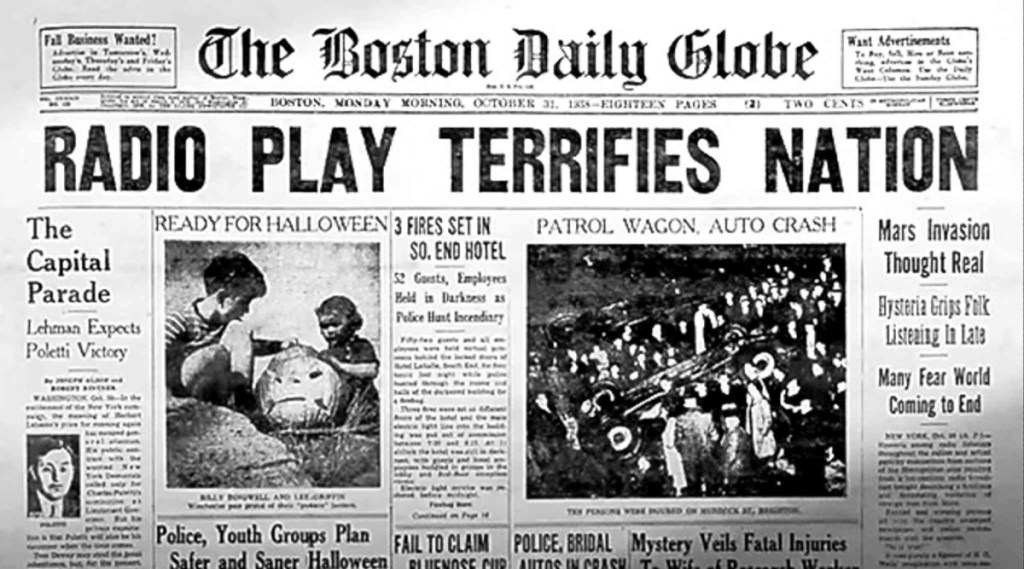
The Associated Press reported Monday morning, a man in Pittsburgh returned home to find his wife with a bottle of poison saying “I’d rather die this way“. A woman in Indianapolis ran into a church screaming “New York is destroyed… It’s the end of the world!“. The Washington Post reported the story of one Baltimore man who died of a heart attack but somehow didn’t bother to follow up, for any of the details. The New York Times piled on with the October 31 headline “Radio listeners in panic, Taking Radio drama as fact”. The Times went on to inform its readers, “In Newark, in a single block at Heddon Terrace and Hawthorne Avenue, more than 20 families rushed out of their houses with wet handkerchiefs and towels over their faces to flee from what they believed was to be a gas raid. Some began moving household furniture”.
Long on anecdote and egregiously short on details, the print media went with the narrative blaming the entire radio industry. It was the first clue, that something wasn’t right.
“For at least a couple hours or more and really into the next morning, we believed we were mass murderers, because the press which was very hostile to radio was delighted for this opportunity to piss on radio and say they were irresponsible, and so on”.
War of the Worlds producer, John Housman
Not a single one of multiple purported deaths was ever tied directly to the War of the Worlds and yet, 83 years later the panic narrative remains, alive and well. For the 75th anniversary in 2013 USA Today reported, that “The broadcast … disrupted households, interrupted religious services, created traffic jams and clogged communications systems.”
NPR’s Morning Edition reported as recently as 2005, that “”listeners panicked, thinking the story was real. Many jumped in their cars according to the broadcast, to flee from the “invasion.” ‘Radiolab’, a program produced by New York Public Radio from 2002 to the present day reported that some 12 million people listened to that original broadcast, in 1938. 1 in 12 according to Radiolab believed the story, to be true.
The Truly Terrified likely numbered in the tens of dozens and not the tens of thousands but the narrative was already being set. What better tools to apply but fear and mockery, techniques we see in common use, to this day.
The War of the Worlds broadcast was, in the end, what it described itself to be. A Halloween concoction. The equivalent of dressing up in a sheet, jumping out of a bush and saying, ‘Boo!’. Instead, the story remains one of our great and enduring media hoaxes giving proof where little is required, of Winston Churchill’s wise and timeless advice: “A lie gets halfway around the world before the truth has a chance to get its pants on“.
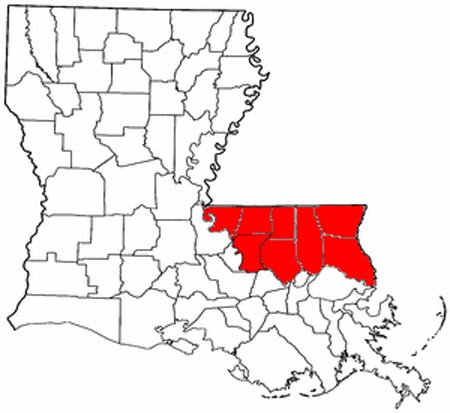
To this day, eight parishes in East Louisiana (“Counties” to the rest of us), are called the “Florida Parishes”.
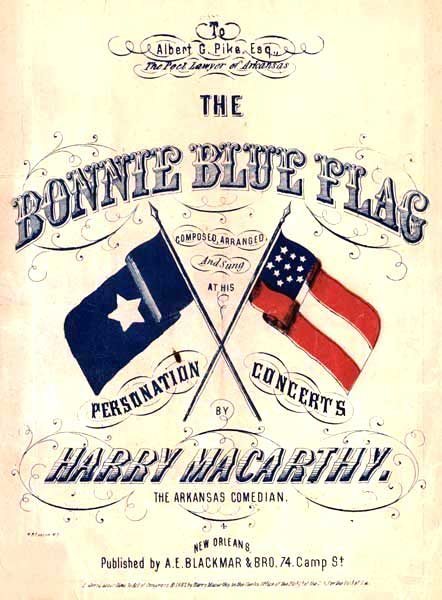
This is a story of Independence, of Revolution. Of overthrowing a Spanish-speaking government and creating an Independent Republic in the American South. About a banner bearing a symbol recognizable to this day, depicting a single, five-pointed white star on a blue field. The Bonnie Blue Flag of the original, Lone Star Republic.
The Republic of West Florida.
Wait…What?
Spanish colonization of the Americas began when the Crown of Castille, Ferdinand and Isabella, sent an Italian explorer this way in 1492.
Motivated by the promotion of trade and of the Catholic faith throughout indigenous populations, the Spanish Empire expanded across South and Central America and much of North America including the Caribbean, Florida and a strip running through modern day Mexico to the Pacific Southwest.
The French first came to America in 1524, colonizing vast expanses from Quebec to Green Bay in the north, Baton Rouge to Biloxi in the south. They sought wealth, territory and a route to the Pacific Ocean. What they got was endless conflict.
Following the French and Indian War in 1762, Louis XV signed the secret Treaty of Fountainebleu with King Carlos III, ceding “la Louisiane” to Spain.
The Treaty of Paris was signed the following year, ending the Seven Years War in Europe. There lies the crux of the problem. French colonists poured into Louisiana, wanting no part of the Brits. They wouldn’t learn until 1764 they had placed themselves under Spanish rule.
Rebellion was immediate and ongoing. Colonists expelled their first Spanish governor Alejandro O’Reilly (I love that name) in the Rebellion of 1768, and had to be put down by force.
The American colonies were soon convulsed in Revolution, after which both East and West Florida reverted to Spanish control. European Colonial Powers would have their turn ten years later, with the French Revolution and the rise of the Napoleonic Empire. Spain would cede much of the Louisiana Territory back to France during this period, but not all of it.
President Jefferson purchased 828,000 square miles from the French in 1803, doubling the size of the United States, but the exact borders remained, unclear.
Spain claimed title to what they called “West Florida, a territory bounded by the Perdido River in the east, the modern border of Florida and Alabama, south of the 31st parallel, and running west to the Mississippi River.
What followed may be the shortest Revolution in history. Revolutionary War veteran Philemon Thomas led fifty “Americanos” through the early morning darkness of September 23, 1810, through the open gate of Fort San Carlos in Baton Rouge, while another 25 men on horseback rode through a hole in the fort’s wall. Soldados fired their muskets, and Thomas’ men responded with a single volley, killing or wounding five Spaniards.
That was about it. Surviving soldados fled, as the flag of the new Republic was unfurled over the fort: a dark blue field with a single white star. The whole thing was over, in about a minute.
Americanos had revolted back in 1804 without success. This time they would make it stick. Sort of.
The constitution of the Republic of West Florida was patterned on that of the United States, with government divided into three branches, Executive, Legislative and Judiciary.
The first and only Governor was Fulwar Skipwith, whose inaugural address seemed to make room for Union with the United States. “[T] he blood which flows in our veins”, he said, “like the tributary streams which form and sustain the father of rivers, encircling our delightful country, will return if not impeded, to the heart of our parent country”.
Skipwith’s overtures seemed to have been met with a yawn by the Madison administration, soon the new Republic was launching a raid, unsuccessfully, against the Spanish garrison at Mobile.
The Republic soon became accustomed to its newfound independence, a state of affairs President James Madison had no intention of recognizing.
President Madison proclaimed the territory annexed on October 27, 1810, and made part of the Territory of Orleans. William Claiborne, military governor of the Orleans Territory, was sent to take possession.
Florida Parishes of East Louisiana
Governor Skipwith proclaimed himself ready to “die in defense of the Lone Star flag,” though his stance softened considerably when military forces entered the capital of St. Francisville on December 6 and Baton Rouge, four days later.
Florida itself, along with the eastern expanses of West Florida, reverted to United States control with the Onís-Adams Treaty of 1819.
To this day, eight parishes in East Louisiana (“Counties” to the rest of us), are called the “Florida Parishes”.
The taking stood on questionable legal grounds, but it was complete on December 10, when the legislature voted to accept annexation and dissolve the Republic. Twenty-Six years later to the day, the Republic of Texas adopted the “Burnet” or “Bonnie Blue” Flag, all but indistinguishable from that of the original Lone Star Republic.
You must be logged in to post a comment.