November 21, 1942 The Alcan Highway

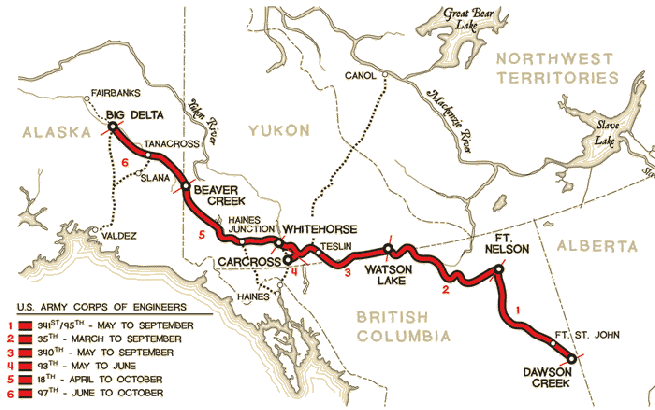
Construction began in March as trains moved hundreds of pieces of construction equipment to Dawson Creek, the last stop on the Northern Alberta Railway. At the other end, 10,670 American troops arrived in Alaska that spring, to begin what their officers called “the biggest and hardest job since the Panama Canal.”

In-between lay over 1,500 miles of unmapped, inhospitable wilderness.

Discussions of a road to Alaska began as early as 1865, when Western Union contemplated plans to install a telegraph wire from the United States to Siberia. The idea picked up steam with the proliferation of automobiles in the 1920s, but it was a hard sell for Canadian authorities. Such a road would necessarily pass through their territory, but the Canadian government felt the project would have little impact, benefiting no more than a few thousand people in the Yukon.

In the days following the attack on Pearl Harbor, Guam and Wake Island fell to Imperial Japanese forces , making it clear that parts of the Pacific coast were vulnerable.

Priorities were changing for both the United States and Canada.
alcan-highway

The Alaska Territory was particularly exposed.  Situated only 750 miles from the nearest Japanese base, the Aleutian Island chain had only 12 medium bombers, 20 pursuit planes, and fewer than 22,000 troops in the entire territory, an area four times the size of Texas. Colonel Simon Bolivar Buckner Jr., the officer in charge of the Alaska Defense Command, made the point succinctly. “If the Japanese come here, I can’t defend Alaska. I don’t have the resources.”
Alcan Lake

The US Army approved construction of the Alaska Highway in February, the project receiving the blessing of Congress and President Roosevelt within the week. Canada agreed to allow the project, provided that the US pay the full cost, and the roadway and other facilities be turned over to Canadian authorities at the end of the war.

Alcan_constructionConstruction began in March as trains moved hundreds of pieces of construction equipment to Dawson Creek, the last stop on the Northern Alberta Railway. At the other end, 10,670 American troops arrived in Alaska that spring, to begin what their officers called “the biggest and hardest job since the Panama Canal.”

In-between lay over 1,500 miles of unmapped, inhospitable wilderness.

Alcan BridgeThe project had a new sense of urgency in June, when Japanese forces landed on Kiska and Attu Islands, in the Aleutian chain. Adding to that urgency was that there is no more than an eight month construction window, before the return of the deadly Alaskan winter.

Construction began at both ends and the middle at once, with nothing but the most rudimentary engineering sketches. A route through the Rockies had not even been identified yet.

Radios didn’t work across the Rockies and there was only erratic mail and passenger service on the Yukon Southern airline, a run that locals called the “Yukon Seldom”. It was faster for construction battalions at Dawson Creek, Delta Junction and Whitehorse to talk to each other through military officials in Washington, DC.

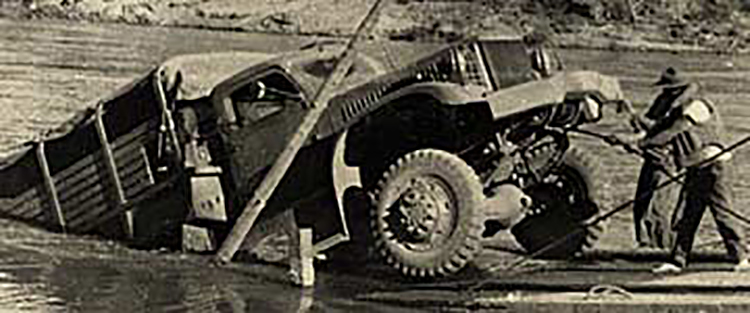
Moving men to their assigned locations was one thing, moving 11,000 pieces of construction equipment, to say nothing of the supplies needed by man and machine, was another.

Tent pegs were useless in the permafrost, while the body heat of sleeping soldiers meant they woke up in mud. Partially thawed lakes meant that supply planes could use neither pontoon nor ski, as Black flies swarmed the troops by day, and bears raided camps at night, looking for food.

Alcan TerrainEngines had to run around the clock, as it was impossible to restart them in the cold. Engineers waded up to their chests building pontoons across freezing lakes, battling mosquitoes in the mud and the moss laden arctic bog. Ground that had been frozen for thousands of years was scraped bare and exposed to sunlight, creating a deadly layer of muddy quicksand in which bulldozers sank in what seemed like stable roadbed.

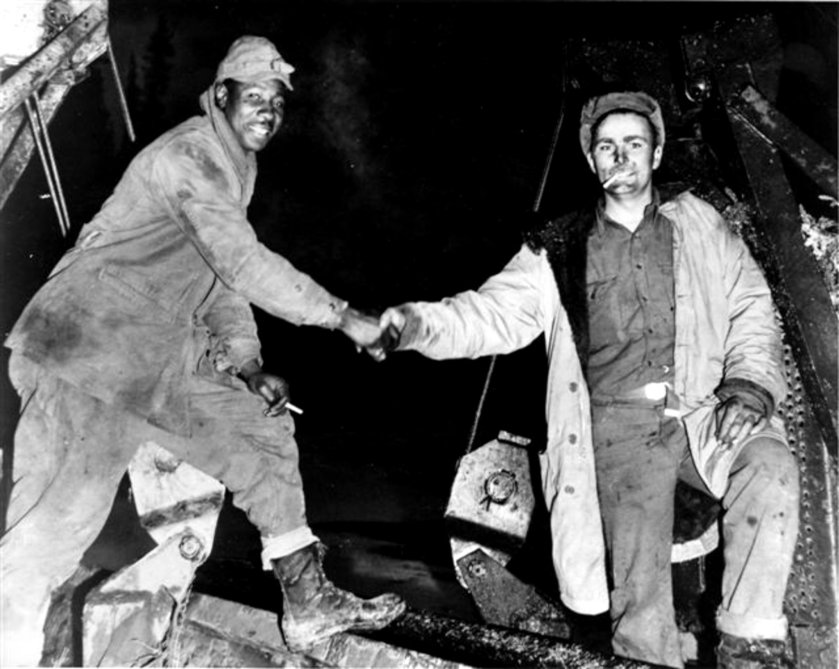
On October 25, Refines Sims Jr. of Philadelphia, with the all-black 97th Engineers was driving a bulldozer 20 miles east of the Alaska-Yukon line, when the trees in front of him toppled to the ground. He slammed his machine into reverse as a second bulldozer came into view, driven by Kennedy, Texas Private Alfred Jalufka. North had met south, and the two men jumped off their machines, grinning. Their triumphant handshake was photographed by a fellow soldier and published in newspapers across the country, becoming an unintended first step toward desegregating the US military.
Sims, Jalufka

They celebrated the route’s completion at Soldier’s Summit on November 21, 1942, though the “highway” remained unusable by most vehicles, until 1943.

NPR ran an interview about this story back in the eighties, in which an Inupiaq elder was recounting his memories. He had grown up in a world as it existed for hundreds of years, without so much as an idea of internal combustion. He spoke of the day that he first heard the sound of an engine, and went out to see a giant bulldozer making its way over the permafrost. The bulldozer was being driven by a black operator, probably one of the 97th Engineers Battalion soldiers. I thought the old man’s comment was a classic. “It turned out”, he said, “that the first white person I ever saw, was a black man”.

November 17, 1558 Strange Beauty Secrets

Cleopatra bathed in the milk of donkeys, as did the 12th century Queen Isabeau of France, who followed it up by rubbing her skin with crocodile glands and the brains of boars. Mary, Queen of Scots, bathed in wine. Strange beauty rituals weren’t limited to women, either. Novelist George Sands used to soak himself in cow’s milk (3 quarts) and honey (3 pounds).

Popular ideas of what is beautiful have changed with time and place, but strange beauty secrets are as old as history itself.

In ancient Greece, blond hair was perceived as beautiful, probably because it was unusual. Women would lighten their hair using a mixture of ashes, olive oil & water, and sometimes arsenic.

Cleopatra bathed in the milk of donkeys, as did the 12th century Queen Isabeau of France, who followed it up by rubbing her skin with crocodile glands and the brains of boars.

During the Heian period in Japan, 794 to 1185AD, a woman’s beauty was judged by the length of her hair. The ideal was considered to be about two feet below her waist.

blood-countess-elizabeth-bathory
“Blood Countess Erzsébet Báthory

The Hungarian “Blood Countess” Erzsébet Báthory, who lived from August 7, 1560 – August 21, 1614, may have been the most prolific female serial killer in history, bathing in the blood of as many as 650 virgins, to keep herself looking young. Her four cohorts were convicted of killing 80, while Erzsébet herself was neither tried nor convicted due to her rank. She was simply thrown in jail on her arrest in December, 1610, and left there to die, four years later.

On a considerably less macabre note, Mary, Queen of Scots, bathed in wine. Strange beauty rituals weren’t limited to women, either. Novelist George Sands used to soak himself in cow’s milk (3 quarts) and honey (3 pounds).

elizabeth 1
Queen Elizabeth, I

Elizabeth I, daughter of Anne Boleyn and Henry VIII, was crowned this day, November 17, 1588. As queen, Elizabeth followed a path taken by women for thousands of years, sporting the high forehead and daubing her face with a powder makeup called ceruse. High lead content made the practice deadly enough, but they would top it off with a rouge containing mercury, leading to an untold number of birth defects and miscarriages. It’s all but certain that the combination of lead and mercury led to her complete loss of hair. Little wonder that she was the “Virgin Queen”.

The quest for the perfect, porcelain complexion would last well into the 19th century, for which some women ate clay. Marie Antoinette and other ladies of the French Court obsessed over flawless, alabaster skin, until the end of the 18th century. They would fake it with thick layers of white powder, made from white lead, or talcum powder, or pulverized bone, whatever they could get hold of. Combined with wax, whale blubber, or vegetable oil, it had a nice, greasy consistency that stayed where they put it.

boat hairThis was a time of big hair, when hair was piled high on top of the head, powdered, and augmented with the hair of servants and pets. The do was often adorned with fabric, ribbons or fruit, sometimes holding props like birdcages complete with stuffed birds, and even miniature frigates, under sail.

It wasn’t just women’s hair, either. Fashionable European men of the 18th century wore wigs made of both animal and human hair, a practice which spread across the pond into North America. The wealthy wore longer wigs, often powdered and curled, while those who couldn’t afford them wore shorter versions, often styled into a braided ponytail.

George Edward Pickett, he of the famous charge at Gettysburg, was acclaimed for his oiled and perfumed locks. Same with the “Boy General”, the youngest Civil War General in the Union Army: George Armstrong Custer, who would anoint his hair with cinnamon oil.

pickett6q
George Pickett

Well into the 20th century, women chose between slicking their hair down with a greasy brilliantine, or spraying it with shellac dissolved in an admixture of water and alcohol.

Weird beauty tips are easy to find on-line, and I have to believe that each has its adherents. Some say that Preparation H under the eyes reduces puffiness (I hear it works), hot pepper sauce applied to the roots of your hair will help it grow, (the jury’s out on this one). Some believe that urine works as an astringent to clear up acne, (it doesn’t), and rubbing your face with a potato dries up oily skin (that one’s false as well).

Today, we look on past practices as bizarre, but maybe we shouldn’t. If those people from the past were to peer into their own future, they’d see spray tanning, teeth bleaching, and Brazilian bikini wax. They’d see people injecting the neurotoxic output of Clostridium Botulinum into their faces, and sticking metal objects through all manner of body parts.

You have to wonder what our own future will bring. Not even Nostradamus foretold tattooed grandmothers.

November 15, 1963 Louie Louie

For two years, FBI investigators interviewed witnesses. They listened to the song at varying speeds, backward and forward, but the relentless search for bawdy material came up empty. In the end, the song was ruled “unintelligible at any speed”.

In 1955, Richard Berry wrote a song about a Jamaican sailor returning to his island to see his lady love. It’s a ballad, a conversation in the first person singular, with a bartender. The bartender’s name is Louie.

The song was covered in Latin and R&B styles in the fifties, but was never more than a regional hit on the west coast.

Louie3“Mainstream” white artists of the fifties and sixties often covered songs written by black artists. On April 6, 1963, an obscure rock & roll group out of Portland, Oregon covered the song, renting a recording studio for $50. They were The Kingsmen.

Lead singer Jack Ely showed the band how he wanted it played. Berry’s easy 1-2-3-4, 1-2, 1-2-3-4 ballad would be changed to a raucous 1-2-3, 1-2, 1-2-3 beat.

The guitar work could only be described as anarchic, the lyrics unintelligible.  The Kingsmen recorded the song in a single take. It was released by a small label in May and re-released by Wand Records in October, 1963. Sales of the single increased through the 15th of November, the song entering the Billboard Top 100 chart on December 7.

Rock & Roll music is so mainstream now, that it’s hard to remember how subversive and decadent it was considered to be.

Louie Louie’s impenetrable lyrics led to all kinds of speculation about what was being said.  More than a few imaginations ran wild. Fabricated lyrics ranging from mildly raunchy to pornographic were written out on slips of paper and exchanged between teenagers, spurring interest in the song and driving record sales through the roof.

Concerned parents contacted government authorities to see what could be done. One parent, a Sarasota, Florida junior high school teacher, wrote to Attorney General Bobby Kennedy. “Who do you turn to when your teen age daughter buys and brings home pornographic or obscene materials being sold along with objects directed and aimed at the teenage market in every City, Village and Record shop in this Nation?” The letter ends with a plea, complete with four punctuation marks: “How can we stamp out this menace????
louierfk1

The FBI took up the investigation in 1964 under the ITOM statute, a federal law regulating the Interstate Transportation of Obscene Material. There are 119 pages in the FBI’s archival website, covering the case.

For two years, FBI investigators interviewed witnesses. They listened to the song at varying speeds, backward and forward, but the relentless search for bawdy material came up empty.  In the end, the song was ruled “unintelligible at any speed”.

Louie4Strangely, the feds never interviewed Kingsmen lead singer Jack Ely, who probably could have saved them a lot of time.

The song has been covered by numerous artists over the years, including Paul Revere & the Raiders, Otis Redding, Motorhead, Black Flag and Young MC.  The best version ever, has got to be the Delta Tau Chi fraternity version from John Landis’ 1978 movie, Animal House.

“OK, let’s give it to ’em.  Right now”.

November 14, 1902 Teddy Bear

In 1972, the weekly journal of the British veterinary profession, the Veterinary Record, ran an article in their April 1st edition. It described the diseases common to “Brunus Edwardii”, a species “commonly kept in homes in the United Kingdom and other countries in Europe and North America”. The article reported that “Pet ownership surveys have shown that 63.8% of households are inhabited by one or more of these animals, and there is a statistically significant relationship between their population and the number of children in a household”.

Theodore Roosevelt was in Mississippi in November 1902, helping local authorities settle a border dispute with Louisiana. There was some downtime on the 14th, when Governor Andrew Longino invited Roosevelt and some other dignitaries on a bear hunt.

holtcollier
Holt Collier

The hunt was a high profile affair, attended by a number of reporters, and led by a former slave and Confederate Cavalryman, the famous bear tracker Holt Collier:  a man who had killed more bears than Davy Crockett and Daniel Boone, combined. Yes, I meant to say that. He was a black man who fought, in uniform and by his own choice, for the Confederate States of America. Real history is so much more interesting than the political or pop culture varieties.

Late in the afternoon, Collier and his tracking dogs cornered a large female black bear. Roosevelt hadn’t “bagged” one yet, and Collier bugled for the President to join him. He would have ordinarily shot the bear when it killed one of his dogs, but Collier wanted the president to get this one. He busted the bear over the head with his rifle, hard enough to bend the barrel, and tied it to a willow tree.

TR-teddy_earRoosevelt declined to shoot the animal, calling it “unsportsmanlike” to shoot a bound and wounded animal. Instead, he ordered the bear put down, putting an end to its pain.

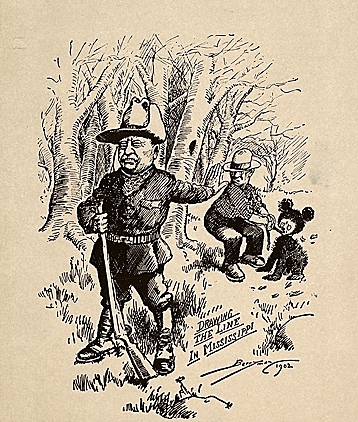
The Washington Post ran an editorial cartoon, “Drawing the Line in Mississippi”, by Clifford K. Berryman, depicting both the state line dispute and the hunting incident. Berryman first drew the animal as a large, fierce killer, but later redrew the bear, making it into a cute, cuddly cub.

Morris Michtom owned a small novelty and candy store in Brooklyn, New York. Michtom’s wife Rose had been making toy bears for sale in their store, when Michtom sent one of them to Roosevelt, asking permission to call it “Teddy’s Bear”. Roosevelt detested that nickname, but he said yes. Michtom’s bear became so popular that he went on to start what would become the Ideal Toy Company.

In 1972, the weekly journal of the British veterinary profession, the Veterinary Record, ran an article in their April 1st edition. It described the diseases common to “Brunus Edwardii”, a species “commonly kept in homes in the United Kingdom and other countries in Europe and North America”. The article reported that “Pet ownership surveys have shown that 63.8% of households are inhabited by one or more of these animals, and there is a statistically significant relationship between their population and the number of children in a household”.

Brunus Edwardii

It went on to describe some of them medical afflictions, common to this creature.  The article was overwhelmingly popular, except for the usual curmudgeonly contingent, who seem to experience life as a need to complain, in search of a target.

One such was A. Noel Smith, a zany funster if there ever was one, who sniffed, “I have been practising veterinary medicine for the past 12 years or more “across the pond” and my Veterinary Records arrive a month or more late. However, I still open them with interest and read what is going on “at home”. April 1st’s edition thoroughly soured my interest. How three members holding sets of impressive degrees can waste their time writing such garbage in a journal that is the official publication of the B.V.A. is beyond my comprehension, as is your effrontery to publish it under “Clinical Papers”.

I’ll bet he’d be a hoot to have a beer with.

For the record,”Brunus Edwardii”, is latin for Edward Brown. The internet dictionary etymologyonline.com explains the origins of “Brown” as, among others, Dutch, for  “Bruin”.

Edward Bruin. Edward Bear.  Author A.A. Milne’s proper name, for Winnie-the-Pooh.

November 12, 1970 Exploding Whale

No one knew what to do with an 8-ton dead whale, washed up on the beach, but there happened to be an ex-military guy around who had explosives training.  He tried to tell them that 20 sticks of dynamite would do it, if they were placed correctly. No one seemed to want his advice.  Someone had decided to use a half-ton of the stuff, and that’s what they were going to do. It was a bad idea.

It was November 12, 1970, when a 45 foot, 8 ton, dead sperm whale washed up on the beaches near Florence, Oregon.  State beaches came under the jurisdiction of the Department of Transportation at that time, and they came down to have a look.

images (9)Officials discussed the matter with the Navy (it wasn’t every day that they had to remove 16,000 lbs of rotting whale meat) and someone came up with a bright idea.  They would remove the carcass the same way they’d remove a huge boulder.  They’d blow it up.

They figured the gulls and the crabs would take care of things if they got the pieces small enough.  The trick was to use enough dynamite.

No one could know it at the time, but the incident had already reached its high water mark.  From there, it would all be downhill.

By sheer coincidence, there happened to be an ex-military guy around, Walter Umenhofer, who had explosives training.  He tried to tell them that 20 sticks of dynamite would do it, if they were placed correctly, but no one seemed to want his advice.

Someone had decided to use a half a ton of the stuff, and that’s what they were going to do.

That might have been the worst idea, since Rudolph Hess flew that plane to Scotland.

Crowds lined the beach the day of the explosion, and TV cameras were rolling.  No one had ever seen a whale explode.

Olds 88The detonation tore through the whale, like a bullet passes through a pane of glass.  Thousands of chunks of dead whale, large and small, soared through the air, landing on nearby buildings, houses and streets.

Umenhofer was among the crowd that day, and had a great slab of blubber come down from the sky and destroy his brand new Olds 88.  He had just bought the car from a dealer who was running a “Whale of a Sale” deal.  You can’t make this stuff up.

It turns out that exploding whales aren’t even that unusual.  Iceland, Australia and South African authorities routinely blow up whale carcasses to avoid hazards to navigation, though they are usually towed out to sea, first.

There have even been spontaneously exploding whales, when gasses built to a point of ripeness that can no longer be contained.  It happened on Salt Spring Island, British Columbia, where the locals reported that blubber “hung in the trees for weeks”.

A whale washed ashore in Denmark sometime in 1991, when someone decided that a careful poke here and a prod there would release the highly pressurized gasses of decomposition. That one didn’t exactly work out as planned, either.

Denmark_exploding_whale.img_assist_custom
Exploding whale, 1991

Another spontaneous whale explosion occurred on January 26, 2004, in Tainan City, Taiwan.  That time, they had managed to get the thing onto a truck, and were hauling it through town went off.  It must have been a memorable experience for passing pedestrians, traffic and nearby shop keepers.

Forty-seven years ago today, the folks from Florence learned an important lesson about what to do with dead whales.  Nine years later, 41 dead sperm whales washed ashore on nearby beaches.  This time, they were burned and buried where they lay.

October 29,  1921  Bill Mauldin’s Army

A talented artist, Bill Mauldin’s medium was the cartoon.  Through them, he told the story of the common soldier, usually at a rate of six per week.

Bill Mauldin's Army 5Born on October 29, 1921 in New Mexico and brought up in Arizona, William Henry “Bill” Mauldin was part of what Tom Brokaw called, the “Greatest Generation”.
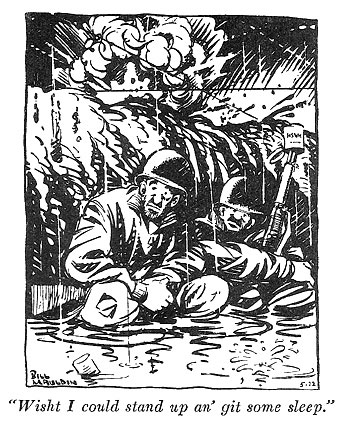
Mauldin enlisted in the 45th Infantry Division when the United States entered WWII.  He was a talented artist, trained at the Chicago Academy of Fine Arts, and volunteered to work for the unit’s newspaper, as a cartoonist.

As a sergeant of the 45th Division’s press corps and later for Stars & Stripes, Mauldin was part of the invasion of Sicily and the later Italian campaign.  He was given his own jeep and allowed to go wherever he pleased, which was usually out in front.  His medium was the cartoon.  He told the story of the common soldier, usually at the rate of six per week.

Bill Mauldin's Army 2Mauldin developed two cartoon infantrymen, calling them “Willie and Joe”.  He told the story of the war through their eyes.  He became extremely popular within the enlisted ranks, while his humor tended to poke fun at the “spit & polish” of the officer corps.  He even lampooned General George Patton one time, for insisting that his men to be clean shaven all the time.  Even in combat.

Patton summoned the cartoonist to his office, threatening to “throw his ass in jail” for “spreading dissent”, until Dwight Eisenhower told Patton to leave him alone.  According to the Supreme Allied Commander, Mauldin’s cartoons gave the soldiers an outlet for their frustrations.

Bill Mauldin's Army 3Mauldin later told an interviewer, “I always admired Patton. Oh, sure, the stupid bastard was crazy. He was insane. He thought he was living in the Dark Ages. Soldiers were peasants to him. I didn’t like that attitude, but I certainly respected his theories and the techniques he used to get his men out of their foxholes”.

His was no rear echelon assignment.  Mauldin’s fellow soldier-cartoonist, Gregor Duncan, was killed in Anzio in May 1944.  Mauldin himself was wounded in a German mortar attack near Monte Cassino.  By the end of the war, he had received the Army’s Legion of Merit for his drawings.

Mauldin tried to revive Willy & Joe after the war, but found they didn’t assimilate well into civilian life.

“Peanuts” cartoonist Charles M. Schulz was himself a veteran of World War II. Schulz paid tribute to Rosie the Riveter and Ernie Pyle in his strip, but more than any other, he paid tribute to Willy & Joe. Snoopy visited with Willie & Joe no fewer than 17 times over the years.  Always on Veterans Day.

Bill Mauldin passed away on January 22, 2003, from a bathtub scalding exacerbated by complications of Alzheimer’s disease.

PeanutsBill Mauldin drew Willie & Joe for last time in 1998, for inclusion in Schulz’ Veteran’s Day Peanuts strip.  Schulz had long described Mauldin as his hero. He signed that final strip Schulz, as always, and added “and my Hero“.  Bill Mauldin’s signature, appears underneath.

Bill Mauldin's Army 6


October 28, 1945  The Last Rebel

South Carolina seceded in December 1860, and the world waited to see who’d follow.  New York City became the next to call for secession on January 6, when Mayor Fernando Wood addressed the city’s governing body. 

By the early 1830s, cotton exceeded the value of all other American exports, combined. As secession loomed over the nation, a Chicago Daily Times editorial warned that if the South left “in one single blow, our foreign commerce must be reduced to less than one half of what it is now”.

South Carolina seceded in December 1860, and the world waited to see who’d follow.  New York City became the next to call for secession on January 6, when Mayor Fernando Wood addressed the city’s governing body.  “When Disunion has become a fixed and certain fact”, he said, “why may not New York disrupt the bands which bind her to a venal and corrupt master…and destroyed the Confederacy of which she was the proud Empire City?”

townline4In New York city and “upstate” alike, economic ties with the south ran deep.  40¢ of every dollar paid for southern cotton stayed in New York, in the form of insurance, shipping, warehouse fees and profits.

30 minutes’ east of Buffalo, the village of Lancaster contemplated staying with the Union.  500 miles from the nearest Confederate state, George Huber remembered the time.  “When war was declared, Lancaster seethed with the news, and many were the nights we stayed up as late as 12 o’clock to talk things out.  I was twelve years old at the time, but I remember the stern faces of the elders and the storm of passionate and angry discussion. Soon the town split into two factions, it was a very tense situation…Often the excitement ran so high that if a man in either group had made the slightest sign, neighbors would have been at each other’s throats and fists would have taken the place of words.”

town line courthouse“Town Line”, a hamlet on the village’s eastern boundary, put it to a vote.  In the fall of 1861, residents gathered in the old schoolhouse-turned blacksmith’s shop.  By a margin of 85 to 40, Town Line, New York voted to secede from the Union.

At first there was angry talk of arresting “Copperheads” for sedition, but “seceders” soon became quiet, as casualty reports came back from the front.  Most became afraid to meet in public, amidst angry talk of lynching.  A half-dozen or so more ardent secessionists went south to fight for the Confederacy.  Others quietly moved north, to Canada.   Outside of Lancaster, no one seemed to notice.  Taxes continued to be paid. No federal force ever arrived to enforce the loyalty of the small village.

Town Line MarkerA rumor went around in 1864, that a large Confederate army was building in Canada, poised to invade from the north.

Town Line became a dangerous place for the few southern sympathizers left.  Most of those remaining moved to Canada and, once again, Lancaster became the quiet little village in upstate New York, that nobody ever heard of.

Impatient to get on with it, Dade County “symbolically” seceded both from Georgia and from the Union, back in 1860.  Officially, Dade County seceded with Georgia in 1861, and rejoined with the rest of the state in 1870.  The deal was sealed on July 4, 1945, when a telegram from President Harry S. Truman was read at a celebration marking Dade County’s “rejoining” the Union.

The “Confederate Gibraltar”, Vicksburg Mississippi, fell on July 4, 1863.  The city wouldn’t celebrate another Independence Day, for 80 years.

By October 1945, there was legally only one remaining part of the Confederate States of America. The hamlet of Town Line, New York.

greensboro-daily-news-newspaper-0125-1946-town-line-rejoins-unionEven Georgians couldn’t help themselves from commenting. 97-year-old Confederate General T.W. Dowling said: “We been rather pleased with the results since we rejoined the Union. Town Line ought to give the United States another try“. Judge A.L. Townsend of Trenton Georgia commented “Town Line ought to give the United States a good second chance“.

A courier express note arrived on October 7, 1945.  “There are few controversies that are not susceptible to a peace time resolution” read the note, “if examined in an atmosphere of tranquility and calm rather than strife and turmoil. I would suggest the possibility of roast veal as a vehicle of peace.  Why don’t you run down the fattest calf in Erie County, barbecue it and serve it with fixins in the old blacksmith shop where the ruckus started? Who can tell? The dissidents might decide to resume citizenship.”  The note was signed “Very Sincerely Yours, Harry Truman”.

last-of-the-rebels-1Fireman’s Hall became the site of the barbecue, “The old blacksmith shop where the ruckus started” being too small for the assembled crowd.  On October 28, 1945, residents adopted a resolution suspending its 1861 ordinance of secession, by a vote of 90-23. The Stars and Bars of the Lost Cause was lowered for the last time, outside the old blacksmith shop.

Alabama member of the United States House of Representatives, John Jackson Sparkman, may have had the last word on the sunject.  “As one reconstructed rebel to another, let me say that I find much comfort in the fact that you good people so far up in Yankee land have held out during the years. However, I suppose we grow soft as we grow older.”

October 27, 1871 The Original Lone Star Republic

The taking stood on questionable legal grounds, but it was complete on December 10, when the legislature voted to accept annexation and dissolve the Republic. Twenty-Six years later to the day, the Republic of Texas adopted the “Burnet” or “Bonnie Blue” Flag, all but indistinguishable from that of the original Lone Star Republic.

Bonnie Blue Flag hatThis is a story of Independence, of Revolution. Of overthrowing a Spanish-speaking government, and creating an Independent Republic in the American South. Its banner was a single, five-pointed white star on a blue field.  It was the original Lone Star Republic. The Republic of West Florida.

Wait. What?

Spanish colonization of the Americas began when the Crown of Castille, Ferdinand and Isabella, sent an Italian explorer this way in 1492.

Motivated by the promotion of trade and of the Catholic faith throughout indigenous populations, the Spanish Empire expanded across South and Central America and much of North America, including the Caribbean, Florida, and a strip running through modern day Mexico to the Pacific Southwest.

imageThe French first came to America in 1524, colonizing vast expanses from Quebec to Green Bay in the north, Baton Rouge to Biloxi in the south. They sought wealth, territory and a route to the Pacific Ocean. What they got was endless conflict.

Following the French and Indian War in 1762, Louis XV signed the secret Treaty of Fountainebleu with King Carlos III, ceding “la Louisiane” to Spain.

The Treaty of Paris was signed the following year, ending the Seven Years War in Europe. There lies the crux of the problem. French colonists poured into Louisiana, wanting no part of British rule. They wouldn’t learn until 1764 that the place was under Spanish rule.

Rebellion was immediate and ongoing. Colonists expelled their first Spanish governor Alejandro O’Reilly (I love that name) in the Rebellion of 1768, and had to be put down by force.

The American colonies were soon convulsed in Revolution, after which both East and West Florida reverted to Spanish control. European Colonial Powers would have their turn ten years later, with the French Revolution and the rise of the Napoleonic Empire. Spain would cede much of the Louisiana Territory back to France during this period, but not all of it.

spnflaPresident Jefferson bought 828,000 square miles from the French in 1803, doubling the size of the United States, but the exact borders were unclear.

Spain claimed title to what they called “West Florida, a territory bounded by the Perdido River in the east, the modern border of Florida and Alabama, south of the 31st parallel, and running west to the Mississippi River.

What followed may have been the shortest Revolution in history. Revolutionary War veteran Philemon Thomas led fifty “Americanos” through the early morning darkness of September 23, 1810. They passed through the open gate of Fort San Carlos in Baton Rouge, while another 25 men on horseback rode through a hole in the fort’s wall. Soldados fired their muskets, and Thomas’ men responded with a single volley, killing or wounding five Spaniards.

Bonnie Blue FlagThat was about it. Surviving soldados fled, as the flag of the new Republic was unfurled over the fort: a dark blue field with a single white star. The whole thing had taken about a minute.

Americanos had revolted back in 1804 without success. This time they would make it stick. Sort of.

The constitution of the Republic of West Florida was patterned on that of the United States, with government divided into three branches, Executive, Legislative and Judiciary.

The first and only Governor was Fulwar Skipwith, whose inaugural address seemed to make room for Union with the United States. “[T] he blood which flows in our veins”, he said, “like the tributary streams which form and sustain the father of rivers, encircling our delightful country, will return if not impeded, to the heart of our parent country”.

Skipwith’s overtures seemed to have been met with a yawn by the Madison administration, soon the new Republic was launching a raid, unsuccessfully, against the Spanish garrison at Mobile.

The Republic was becoming quite accustomed to its newfound independence, a state of affairs which President James Madison had no intention of recognizing.

President Madison proclaimed the territory annexed on October 27, 1810, and made part of the Territory of Orleans. William Claiborne, military governor of the Orleans Territory, was sent to take possession.

FloridaParishes
Florida Parishes of East Louisiana

Governor Skipwith proclaimed himself ready to “die in defense of the Lone Star flag,” though his stance softened considerably when military forces entered the capital of St. Francisville on December 6, and Baton Rouge four days later.

Florida itself, along with the eastern expanses of West Florida, reverted to United States control with the Onís-Adams Treaty of 1819.

To this day, eight parishes in East Louisiana (“Counties” to the rest of us), are called the “Florida Parishes”.

The taking stood on questionable legal grounds, but it was complete on December 10, when the legislature voted to accept annexation and dissolve the Republic. Twenty-Six years later to the day, the Republic of Texas adopted the “Burnet” or “Bonnie Blue” Flag, all but indistinguishable from that of the original Lone Star Republic.

Bonnie Blue, Stars and Stripes

October 19, 1864, St. Albans Raid

The $1 million the Confederate government sunk into their Canadian office, probably did them more harm than good.  Those resources could have been put to better use.

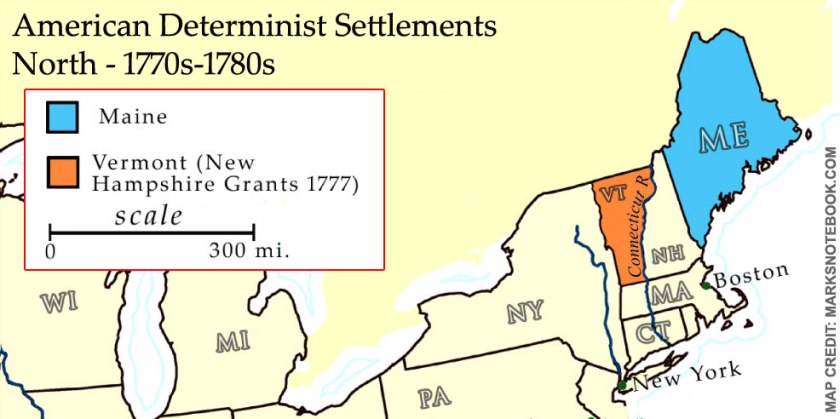
In the late 18th century, lands granted by the governor of New Hampshire led the colonial province into conflict with the neighboring province of New York.  Conflict escalated over jurisdiction and appeals were made to the King, as the New York Supreme Court invalidated these “New Hampshire grants”.  Infuriated residents including Ethan Allen and his “Green Mountain Boys” rose up in anger.  Two natives of Westminster Vermont, then part of the New Hampshire land grants, were killed on March 13, 1775, by British Colonial officials.  Today, the event is remembered as the “Westminster Massacre”.

American_Determinist_Settlements_North_1770
The New Hampshire Grants region petitioned Congress for entry into the American union as a state independent of New York in 1776″ – H/T, https://en.wikipedia.org/wiki/New_Hampshire_Grants

The battles at Lexington and Concord broke out a month later, ushering in a Revolution and eclipsing events to the north.  New York consented to admitting the “Republic of Vermont” into the union in 1790, ceding all claims on the New Hampshire land grants in exchange for a payment of $30,000.  Vermont was admitted as the 14th state on March 4, 1791, the first state so admitted following the adoption of the federal Constitution.

Organized in 1785, St. Albans forms the county seat of Franklin County, Vermont.  15 miles from the Canadian border and situated on the eastern shore of Lake Champlain, it’s not the kind of place you’d expect, for a Civil War story.

screen shot 2014-05-22 at 5.14.39 pm
St. Albans Vermont, 1864

The Confederate States of America maintained government operations in Canada, from the earliest days of the Civil War.  Toronto was a logical relay point for communications with Great Britain, from whom the Confederate government sought unsuccessfully to gain support.

Secondly, Canada provided a safe haven for prisoners of war, escaped from Union camps.

Former member of Congress and prominent Ohio “Peace Democrat” Clement Vallandigham fled the United States to Canada in 1863, proposing to detach the states of Illinois, Indiana and Ohio from the Union, in exchange for sufficient numbers of Confederate troops to enforce the separation.  Vallandigham’s five-state “Northwestern Confederacy” would include Kentucky and Missouri, breaking the Union into three pieces.  Surely that would compel Washington to sue for peace.

ThomasHinesin1884fromHeadleyIn April 1864, President Jefferson Davis dispatched former Secretary of the Interior Jacob Thompson, ex-Alabama Senator Clement Clay, and veteran Confederate spy Captain Thomas Henry Hines to Toronto, with the mission of raising hell in the North.
This was no small undertaking. A sizeable minority of Peace Democrats calling themselves “Copperheads” were already in vehement opposition to the war.  So much so that General Ambrose Burnside declared in his General Order No. 38, that “The habit of declaring sympathy for the enemy will not be allowed in this” (Ohio) “department. Persons committing such offenses will be at once arrested with a view of being tried. . .or sent beyond our lines into the lines of their friends. It must be understood that treason, expressed or implied, will not be tolerated in this department“.

Hines and fellow Confederates worked closely with Copperhead organizations such as the Knights of the Golden Circle, the Order of the American Knights, and the Sons of Liberty, to foment uprisings in the upper Midwest.

In the late Spring and early Summer of 1864, residents of Maine may have noted an influx of “artists”, sketching the coastline.  No fewer than fifty in number, these nature lovers were in fact Confederate topographers, sent to map the Maine coastline.

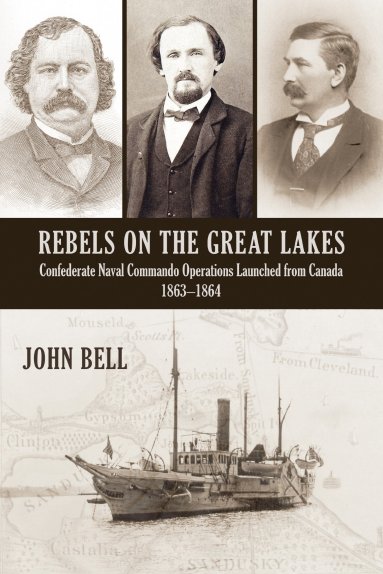
Rebels on the great LakesThe Confederate invasion of Maine never materialized, thanks in large measure to counter-espionage efforts by Union agents.
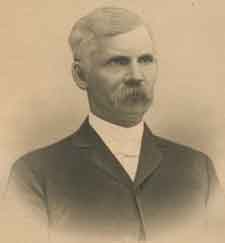
J.Q. Howard, the U.S. Consul in St. John, New Brunswick, informed Governor Samuel Cony in July, of a Confederate party preparing to land on the Maine coast.

The invasion failed to materialize, but three men declaring themselves to be Confederates were captured on Main Street in Calais, preparing to rob a bank.

Disenchanted Rebel Francis Jones confessed to taking part in the Maine plot, revealing information leading to the capture of several Confederate weapons caches in the North, along with operatives in Maine, Massachusetts, New York, Pennsylvania, Maryland, Illinois, Kentucky, Tennessee and Ohio.

Captain Hines planned an early June uprising in the Northwest, timed to coincide with a raid planned by General John Hunt Morgan.  Another uprising was planned for August 29, timed with the 1864 Democratic Convention in Chicago.   It seems the conspirators’ actions didn’t quite live up to the heat of their rhetoric, and both operations fizzled.  A lot of these guys were more talk than action, yet Captain Hines continued to send enthusiastic predictions of success, back to his handlers in Richmond.

The Toronto operation tried political methods as well, supporting Democrat James Robinson’s campaign for governor of Illinois.  If elected they believed, Robinson would turn over the state’s militia and arsenal to the Sons of Liberty.  They would never know.  Robinson lost the election.

Bennett_H._Young_cropped
Bennett Henderson Young

All this cost money, and lots of it.  In October 1864, the Toronto operation came to St. Albans, to make a withdrawal.

Today, St. Albans is a quiet town of 6,918.  In 1864 the town was quite wealthy, home to manufacturing and repair facilities for railroad locomotives.  Located on a busy rail line, St. Albans was also home to four banks.

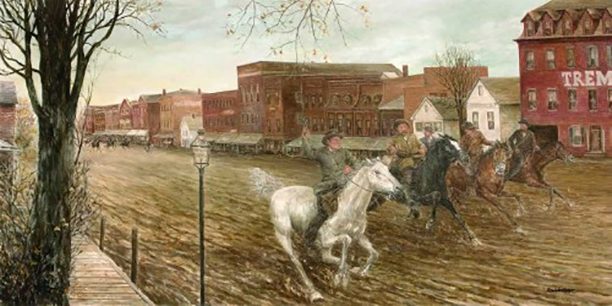
Nicholasville, Kentucky native Bennett Henderson Young was a member of the Confederate 8th Kentucky Cavalry, captured during Morgan’s 1863 raid into Ohio.  By January, Young had escaped captivity and fled to Canada. On October 10, Bennett crossed the Canadian border with two others, taking a room at the Tremont House, in St. Albans.  The trio said they had come for a “sporting vacation”.

In the following days, small groups filtered into St. Albans, quietly taking rooms across the town.  There were 21 of them, former POWs and cavalrymen all, hand selected by Young for their daring and resourcefulness.

featured-image-4

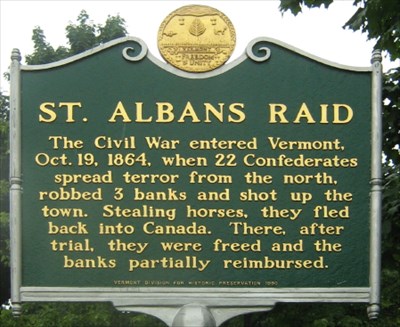
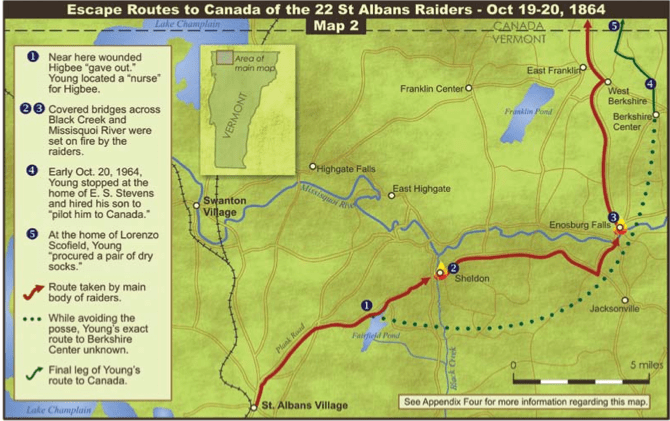
On October 19 the group split up.  Announcing themselves to be Confederate soldiers, groups of them simultaneously robbed three of St. Albans’ four banks, while eight or nine held the townspeople at gunpoint, on the village green.  One resident was killed before it was over and another wounded. Young ordered his troops to burn the town, but the bottles of “Greek Fire” they carried for the purpose, failed to ignite.  Only one barn was burned down and the group got away with a total of $208,000, and all the horses they could find. It was the northernmost Confederate action of the Civil War.

StAlbansRaid, memoriaizedThe group was arrested on returning to Canada and held in Montreal.  The Lincoln administration sought extradition, but the Canadian court decided otherwise, ruling that the raiders were under military orders at the time, and neutral Canada could not extradite them to America.  The $88,000 found with the raiders, was returned to Vermont.
The $1 million the Confederate government sunk into their Canadian office, probably did them more harm than good.  Those resources could have been put to better use, but we have the advantage of hindsight.  Neither Captain Hines nor Jefferson Davis could know how their story would turn out.  In the end, they both fell victim to that greatest of human weaknesses, of believing what they wanted to believe.

st_albans_raiders_1

October 17, 1814  London Beer Flood

Nine people lost their lives altogether, including one man who died of alcohol poisoning, apparently leading a heroic one-man effort to drink the entire flood.

On April 1, 1785, the Times of London reported:  “There is a cask now building at Messrs. Meux & Co.’s brewery…the size of which exceeds all credibility, being designed to hold 20,000 barrels of porter; the whole expense attending the same will be upwards of £10,000”.

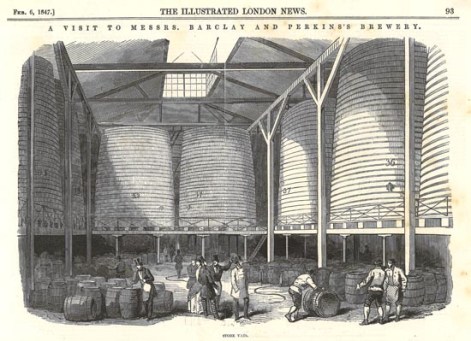
05-the-great-vats-barclay-perkins-1847-550The Meux’s Brewery Co Ltd, established in 1764, was a London brewery owned by Sir Henry Meux. What the Times article was describing was a 22′ high monstrosity, held together by 29 iron hoops.
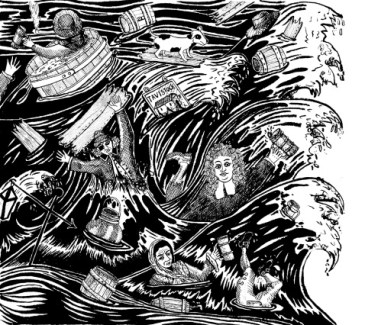
When completed, this would be one of several such vats, each designed to hold 3,500 barrels of brown porter ale.

The brewery was located in the crowded slum of St. Giles, where many homes contained several people to the room.

the-rookery-1800

On October 17, 1814, storehouse clerk George Crick noticed one of those 700-pound iron hoops had slipped off a cask.   This happened two or three times a year, and Crick thought little of it, writing a note to another employee, to fix the problem.

It was a bad decision.

The explosive release of all that hot, fermenting liquid could be heard five miles away, causing a chain reaction as the other vats went down like exploding dominoes.

londonbeerflood323,000 imperial gallons of beer smashed through the brewery’s 25′ high brick walls, gushing into the streets, homes and businesses of St. Giles. The torrent smashed two houses and the nearby Tavistock Arms pub on Great Russell Street, where a 14-year-old barmaid named Eleanor Cooper was buried under the rubble.
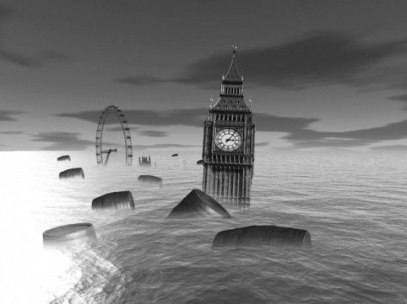
One brewery worker was able to save his brother from drowning in the flood, but others weren’t so lucky.

Mary Mulvey and her 3-year-old son Thomas were drowned, while Hannah Banfield and Sarah Bates, ages 4 and 3, were swept away in the flood.  Both died of their injuries.  Nine people lost their lives altogether, including one man who died of alcohol poisoning, apparently leading a heroic one-man effort to drink the entire flood.

As the torrent subsided, hundreds of people came outside carrying pots, pans, and kettles – whatever they had on hand to scoop up some of it.  Some just bent low and lapped at the dirty, warm beer as it washed through the streets.  Meanwhile, several injured were taken to the nearby Middlesex Hospital, where a near-riot broke out as other patients demanded to know why they weren’t getting some of it, too.

london-beer-floodIn the days that followed, the crushing poverty of the slum led some to exhibit the corpses of their family members, charging a fee for anyone who wanted to come in and see.  In one house, too many people crowded in and the floor collapsed, plunging them all into a cellar full of beer.

The stink lasted for months, as the Meux Brewery Company was taken to court over the accident.  Judge and jury ruled that the flood was an ‘Act of God’ and the deaths were just a ‘casualty’, leaving no one responsible.  Meux & Co. survived, though the financial loss was made worse by the fact that they had already paid tax on the beer. The company successfully applied to Parliament for a refund, and continued to brew beer on the same site.

The brewery was closed in 1921 and demolished the following year.  Since 2012, a local tavern called the “Holborn Whippet” marks the event with its own vat of porter, brewed specially for this day. Cheers.