
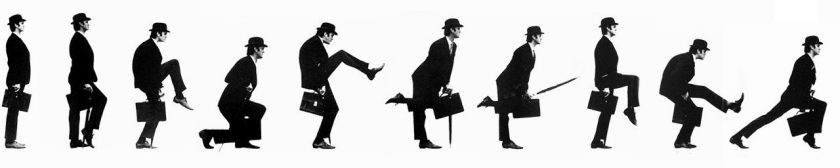
Graham Chapman was trained and educated to be a physician, but that career trajectory was never meant to be. John Cleese was writing for TV personality David Frost and actor/comedian Marty Feldman in 1969, when he recruited Chapman as a writing partner and “sounding board”. BBC offered the pair a show of their own in 1969, when Cleese reached out to former How To Irritate People writing partner Michael Palin, to join the team. Palin invited his own writing partner Terry Jones and colleague Eric Idle over from rival ITV, who in turn wanted American-born Terry Gilliam for his animations.
The British comedy troupe which formed on this day forty-nine years ago was amused at the idea of a haughty Lord Montgomery, patterned after Field Marshal Bernard Law Montgomery, 1st Viscount Montgomery of Alamein, KG, GCB, DSO, PC, DL, etc., etc., etc. “Python” seemed just slippery enough to make the whole thing work.

The Pythons considered several names for the new program, including “Owl Stretching Time”, “The Toad Elevating Moment”, “Vaseline Review” and “A Horse, a Spoon and a Bucket”. “Flying Circus” had come up as well. The name stuck when BBC revealed that it had already printed flyers, and weren’t about to go back to the printer.
The show was a collaborative process, beginning with the first broadcast on October 5, 1969. With no writers of their own, the six would divide into groups and write their own material. Whether any given sketch would make it into the program, was always a democratic process.
Different Python factions were responsible for different elements of the team’s humor. The work of the Oxford educated Terry Jones and Michael Palin was more visual, and a little more off the wall. The Spanish Inquisition bursting into the suburban apartment is a prime example, while the Cambridge educated John Cleese and Graham Chapman were more confrontational – “This is abuse. I came here for an argument”. Cleese described Eric Idle’s work: “anything that got utterly involved with words and disappeared up any personal orifice was Eric’s”. The Man who Spoke in Anagrams. Terry Gilliam was the guy behind the animation.
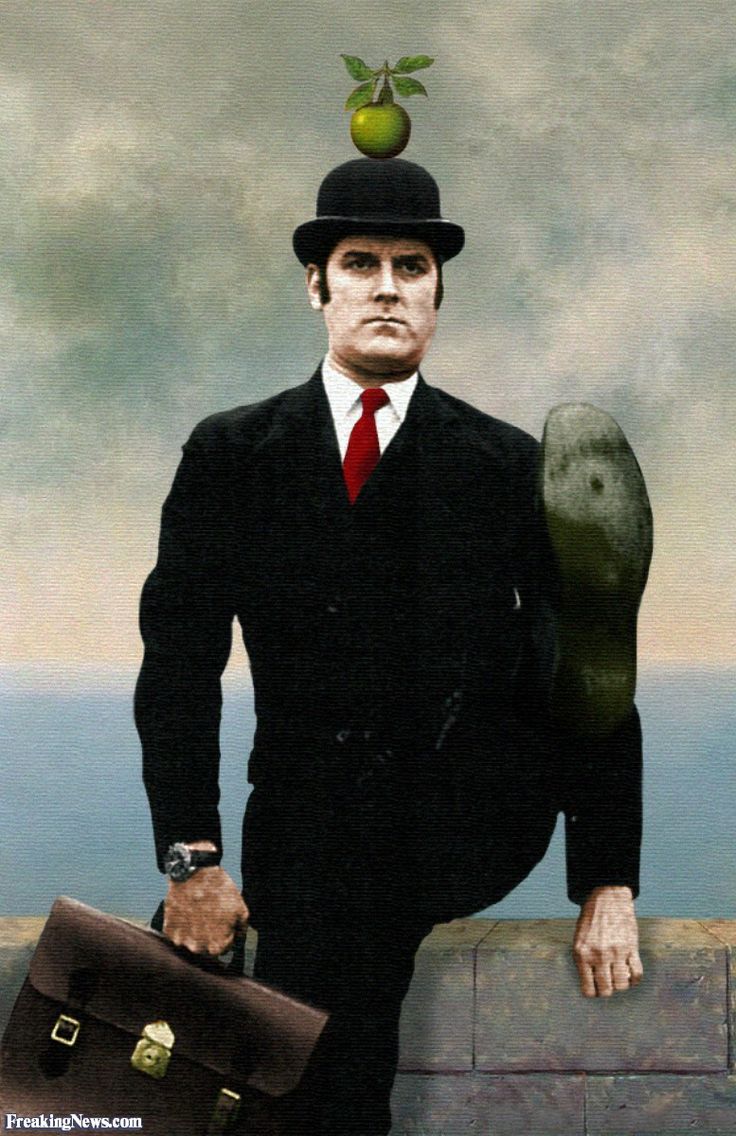
The Flying Circus broke new ground with techniques like the “cold open”. With no titles, credits, or opening theme, Michael Palin would crawl across the tundra a la Robinson Crusoe, looking into the camera and saying “It’s“… And off they went. The cold open sometimes lasted until the middle of the show. Occasionally, the Pythons fooled viewers by rolling closing credits halfway through, usually continuing the gag by fading to the BBC logo while Cleese parodied the tones of a BBC announcer. On one occasion, closing credits ran directly after the opening titles.
I personally learned to never leave a Python film during closing credits, finding my reward for sticking around at the end of the Life of Brian was to learn who wiped the moose’s noses. As I recall, it was John J. Llama.
The “Iron Lady”, Prime Minister Margaret Thatcher herself, appears to have been a fan, doing a more than passable version of the Dead Parrot sketch at a Conservative Party Conference in 1990.
The Pythons shared a dislike for “capping” bits with punchlines, and experimented with ending sketches by cutting abruptly to another scene, or breaking the rules altogether by addressing the camera directly. The knight in armor, played by Terry Gilliam, would wander onto the set and whack people over the head with a rubber chicken. Chapman’s “Colonel” character would walk into sketches and order them stopped because things were becoming “far too silly.”
Gilliam’s animations were a favorite technique, when a 16 ton weight would drop from the sky, or else it was Cupid’s foot – yes, that’s Cupid’s foot – cut from a reproduction of the Renaissance masterpiece “Venus, Cupid, Folly, and Time” by Il Bronzino.

John Cleese left the Flying Circus at the end of the third season. He had considered doing so at the end of the second, feeling that he had little original material to offer the show. He found Chapman difficult to work with, who was at this time a full tilt alcoholic. Cleese could be difficult himself. Eric Idle once said of John Cleese. “He’s so funny because he never wanted to be liked. That gives him a certain fascinating, arrogant freedom”.

The group reunited in 1974 to do the Holy Grail, filmed on location in Scotland on a budget of £229,000. The money was raised in part by investments from musical figures like Pink Floyd, Jethro Tull and Led Zeppelin backer Tony Stratton-Smith.
Investors in the film wanted to cut the famous Black Knight scene, (“None shall pass”), but were eventually persuaded to keep it in the film. Good thing, the scene became second only to the Holy Hand Grenade of Antioch and the Killer Rabbit. “What’s he going to do, nibble my bum?”

Graham Chapman is best remembered as King Arthur in the Holy Grail, and Brian Cohen in the Life of Brian. Chapman died of spinal and throat cancer on the 20th anniversary of their first broadcast. John Cleese delivered a uniquely Pythonesque eulogy, which sounded a lot like the Dead Parrot sketch. “”Graham Chapman, co-author of the Parrot sketch, is no more,” he began. “He has ceased to be, bereft of life, he rests in peace, he has kicked the bucket, hopped the twig, bit the dust, snuffed it, breathed his last, and gone to meet the Great Head of Light Entertainment in the sky…”
I don’t believe he’d have had it any other way. Silly bunt.


 Following liberation, French women were beaten and humiliated in the streets, their heads shaved, for being “collaborators” with their German occupiers.
 Sixty-five years later, Jan Gregor of the East German state of Brandenburg, can still remember the day his mother told him that she’d been “made pregnant by force”. He was five, at the time.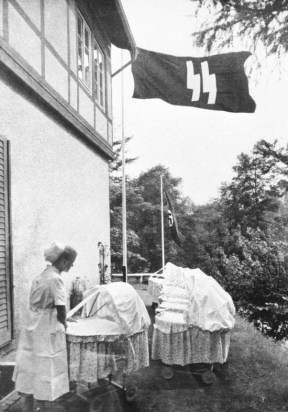

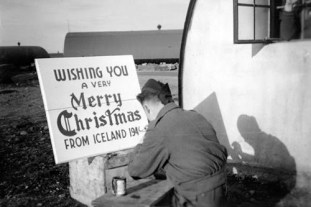 Icelandic public opinion was sharply divided at the invasion and subsequent occupation. Some described this as the “blessað stríðið”, the “Lovely War”, and celebrated the building of roads, hospitals, harbors, airfields and bridges as a boon to the local economy. Many resented the occupation, which in some years equaled 50% of the native male population.


 Mark Kurlansky, author of “Cod: A Biography of the Fish That Changed the World”, laments the 1990s collapse of the Cod fishery, saying the species finds itself “at the wrong end of a 1,000-year fishing spree.”









 The United States still had a border in those days, which the Federal government attempted to enforce.
 Suffering a blizzard of hotel cancellations, this “attack on Key West’s sovereignty” could not stand. On April 22, Mayor Wardlow, local attorney & pilot David Horan and Old Town Trolley Tours operator Ed Swift flew to Miami seeking legal remedy. When District Court Judge C. Clyde Atkins failed to issue an injunction, the Key West delegation took to the courthouse steps.
 On April 23, with federal agents on scene to monitor the proceedings, a crowd gathered before the old customs building. Mayor Wardlow and a gaggle of allies mounted the back of a flatbed truck, to read the proclamation of secession. “We serve notice on the government in Washington”, he started, “to remove the roadblock or get ready to put up a permanent border to a new foreign land. We as a people, may have suffered in the past, but we have no intention of suffering in the future at the hands of fools and bureaucrats“.
 So it is that the micro-nation of Key West celebrates its independence, every April 23. The “Conch Republic’ issues its own passports, selling T-shirts and bumper stickers with the slogan “We seceded where others failed”.


 Many of the secular symbols associated with Easter trace back to the pagan goddess of spring and the dawn, Ēostre or Ostara, from the Old English Ēastre. History fades into mythology in the pre-Christian usage and accounts differ, but this Teutonic deity was frequently depicted with eggs symbolizing the rebirth of Spring. And rabbits.
 The story involves no less a figure than Napoleon Bonaparte. In July 1807, Napoleon had just signed the Treaty of Tilsit, ending the war between the French Empire and Imperial Russia. Looking to celebrate, Napoleon suggested a rabbit hunt, and ordered his Chief of Staff Alexandre Berthier to make it happen.
 The hunt was supposed to start when all those cages opened up but, instead of scattering, a swarm of rabbits thought it was dinner time and pelted straight across the field.
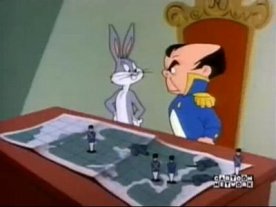 Napoleon retreated to his carriage, but still the attack continued. Historian David Chandler picks up the story. “With a finer understanding of Napoleonic strategy than most of his generals, the rabbit horde divided into two wings and poured around the flanks of the party and headed for the imperial coach.” The tide of bunnies continued. Some even got into the carriage. The assault finally ebbed away, only as the Royal Conveyance, drove out of sight.
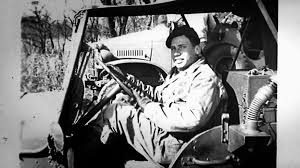
 The boy had a talent for music. He was taught by another kid from Williamsburg, named Buddy Rich. By 14 he was good enough to be playing drums for money.
 At one point, Kaminsky’s unit gathered along a River. The Americans were so close they could hear German soldiers singing a beer hall song, from the other side. Kaminsky grabbed a bullhorn and serenaded the Germans back, crooning out an old tune that Al Jolson used to perform, in black face: “Toot Toot Tootsie, Goodbye”. After he was done, polite applause could be heard, drifting across the river. I can’t imagine many Allied soldiers ever tried singing to their Nazi adversaries, during World War II. The ones who actually pulled it off, must number precisely, one.
 Brooks started doing stand-up, when the regular comedian at one of the clubs was too sick to perform. By ’49 he was “Tummler”, the master entertainer at Grossinger’s, one of the most famous resorts in the Borscht Belt.


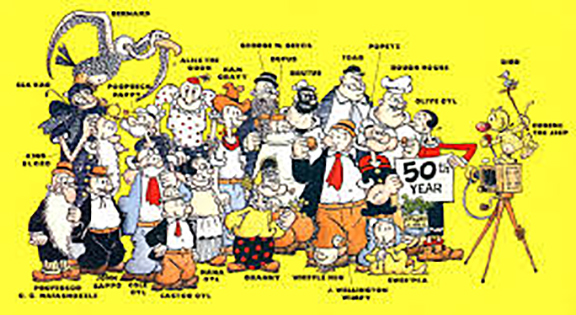
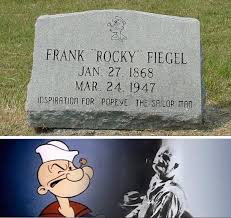 The strip was around for ten years or so, when Olive & co. decided to recruit a sailor to get them to the casino on Dice Island. Approaching a rough looking character on the docks, “Popeye’s” first line was “Ja think I was a cowboy? He was supposed to be an extra, but he became so popular he soon developed into the center of the strip.
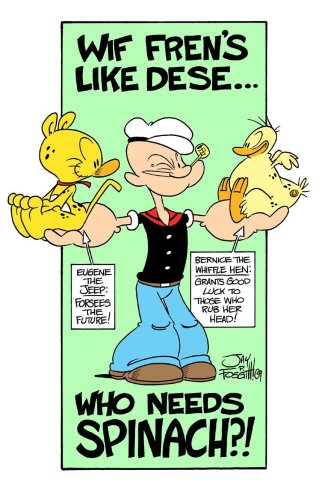 Before spinach, Popeye gained his superhuman strength patting the head of a magical “whiffle hen” named “Bernice”.
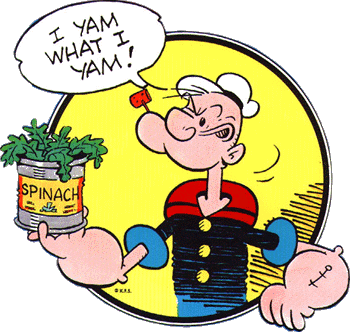 Popeye’s pet “Eugene the Jeep” first appeared in a 1936 strip called “Wha’s a Jeep?”. Eugene was sort of magical dog who could go anywhere. Five years later, military contractors worked to develop the iconic off-road vehicle of WWII. Like Popeye’s pet Eugene, the General Purpose GP (“Jeep”) could go anywhere. Eventually, the name stuck.


You must be logged in to post a comment.