May 10, 1940 Children of the Situation

It is often said that, when governments make war, it’s the everyday John and the Nigel, the Fritz and the Pierre down the street, who must do the fighting, the bleeding and the dying.  It might well be added, that it is left to the mice, to pick up the pieces.

Little is written in times of war, about the Innocents. The proverbial mice trying to go about their business, amidst the combat of elephants. What then is to be made of the innocent who exists, only as the result of that war?

Throughout history and across cultures, having a child by a member of a hostile force is looked upon as a grave betrayal of social values.  Often, such parents (usually women) are shunned by neighbors and even family.  “War children” are ostracized and bullied, or worse.

0816794dc6f218e5e56c1b3a489b439f--rare-photos-old-photosFollowing liberation, French women were beaten and humiliated in the streets, their heads shaved, for being “collaborators” with their German occupiers.

On the Eastern Front of WW2, combat between Nazi Germany and the Soviet Union had long taken on shades of a race war, Slav against Teuton, in a paroxysm of mutual extermination that is horrifying, even by the hellish standards of that war.  Soviet soldiers committed prodigious numbers of rapes on German and Austrian women, and even Soviet women released from work camps.  Historian Geoffrey Roberts writes that 70,000–100,000 such rapes took place in Vienna, alone.

800px-US_Army_Germany_occupation_zones_1945
Post-WW2 Occupation Zones

Propaganda banners and posters appeared all over the Soviet-occupation zone and later East Germany, proclaiming the heroism of those who had smashed the Nazi war machine and paved the way to Soviet-German friendship.  The plight of tens of thousands of the mostly fatherless “Russian children”,  was taboo.

s-l640Sixty-five years later, Jan Gregor of the East German state of Brandenburg, can still remember the day his mother told him that she’d been “made pregnant by force”.  He was five, at the time.

An estimated 100,000 “Amerasian” children were born to Asian mothers and US servicemen during WWII, the Korean War, and war in Vietnam.

37,000 or more children were fathered by American soldiers and German & Austrian women in the 10 years following the German surrender.  Food and sex became principle units of  currency in a growing black market.  Cigarettes were widely referred to as “frau bait.”

Locals disapproved of such relations, not only because Americans had recently been their enemies, but also because such children often became “wards of the state” in local economies severely impoverished by war.

The situation for children fathered by black GIs called Negermischlinge (“Negro half-breeds”) was particularly difficult, in what was then a nearly-racially homogeneous society.  Even in cases where the father wanted to marry the mother of his child, Army policy prohibited interracial marriages, until 1948.  Some were eventually adopted by African-American couples and families in the United States.  The plight of black German-speaking children trying to get by in post-war America, is a tale that is yet to be told.
Bundesarchiv_Bild_146-1973-010-11,_Schwester_in_einem_Lebensbornheim
Lebensborn Birth House

Military forces of Nazi Germany invaded the Scandinavian Kingdoms of Denmark and Norway on April 9, 1940.  Denmark fell in a day and Norwegian armed resistance ceased within two months, when civil rule passed to the Reichskommissariat Norwegen (Reich Commissariat of Norway).

The neutral Scandinavian countries remained under Wehrmacht occupation, for the following five years.

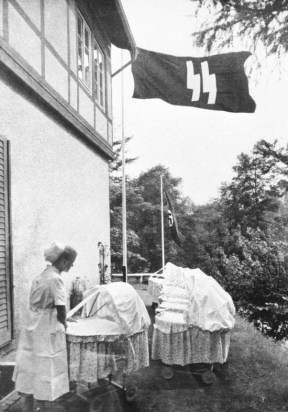
Sometimes, relationships formed between German occupying forces and native women.  The racially obsessed Nazi regime was happy to encourage such relations, particularly in Norway, where local women were considered to be of pure, “Aryan” stock.

“Lebensborn”, the SS-initiated, state-supported association whose goal it was to raise the birth rate of the “Master Race” began on December 12, 1935.  The first such Birth House outside of German soil opened in Norway, within a year of the invasion.

Some such relationships were consensual.  Many were anything but.  Some 10,000 to 12,000 children were born of Norwegian women and German fathers, the most famous being Anni-Frid Synni Lyngstad of ABBA, who was forced to flee Norway after the war for fear of reprisals.

For nearly a thousand years, the administration of Iceland was all but indistinguishable from that of Denmark and Norway.  An Act of Union established Iceland as a fully sovereign state in 1918, an independent country in a Personal Union through a common monarch, with the Kingdom of Denmark.

iceland-location-map

Alarmed at the possibility of a German military presence in Iceland, British authorities invited the neutral nation to join the war as “as a belligerent and an ally,” following the collapse of Denmark. The invitation was rejected, and the UK invaded Iceland on May 10, an initial force of 746 British Royal Marines disembarking at the Icelandic capital of Reykjavík.

The British invasion of Iceland never resembled the “shooting war” in Europe.  The government complained that its neutrality had been “flagrantly violated” and demanded compensation, but principle opposition took the form of hordes of civilians, crowding in to see what was going on.  Many locals learned they had been invaded, only on seeing a single British aircraft – at that time the only airplane in Iceland.
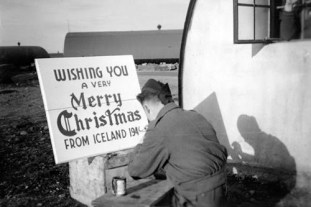
Wife's grandfatherIcelandic public opinion was sharply divided at the invasion and subsequent occupation.  Some described this as the “blessað stríðið”, the “Lovely War”, and celebrated the building of roads, hospitals, harbors, airfields and bridges as a boon to the local economy.  Many resented the occupation, which in some years equaled 50% of the native male population.

Sexual relationships between foreign troops and local women were severely frowned upon, such women often subjected to what might indelicately be described as “slut-shaming”.  In 1941, the Icelandic Minister of the Judiciary investigated “The Situation”.  Upset that foreign troops were “taking away” women from friends and family. Police investigated over 500 women for sexual relations with soldiers.  Most were determined to be consensual.  Two facilities opened to house such women in 1942, but closed within a year.

Two-hundred fifty-five ástandsbörn (“Children of the Situation”) were born of such relationships.  332 Icelandic women married foreign soldiers.

52818947753c5a2c9430272.00130840
WWII landing craft – Mjóifjorður, Iceland

It is often said that, when governments make war, it’s the everyday John and the Nigel, the Fritz and the Pierre down the street, who must do the fighting, the bleeding and the dying.  It might well be added, that it is left to the mice, to pick up the pieces.

If you enjoyed this “Today in History”, please feel free to re-blog, “like” & share on social media, so that others may find and enjoy it as well. Please click the “follow” button on the right, to receive email updates on new articles.  Thank you for your interest, in the history we all share.

May 1, B.C.62 Ladies Night

Scandal broke out on this day in 62BC, when the aforementioned meathead, the politician Publius Clodius Pulcher, dressed as a woman and sneaked into the festival for the Bona Dea, bent on seducing Caesar’s wife, Pompeia.

images (50)
To this day, we know her only as Feminea Dea (“The Women’s Goddess”)

The etymology website etymonline.com defines “pulchritude” as (n.) – “beauty,” c. 1400, from Latin pulchritudo “beauty, excellence, attractiveness”.

The word has fallen out of everyday usage, and the website indicates origin unknown.  Possibly, the term comes down to us from an individual, who may have been the greatest maniac if not the dumbest man, in Roman antiquity.  Either that, or a man so bull-headedly determined to get what he wanted, that he deserves to be remembered as one of the great Meatheads, of history.

In ancient Rome, women partook of a festival, strictly forbidden to Roman men.  So stringent was this line of demarcation that only women were permitted even to know the name of the deity, to whom the festival was dedicated.  For everyone else she was simply the “Good Goddess”. The Bona Dea.

The first of two annual festivals of the Bona Dea was held during the winter, at the Aventine Temple. The second rite took place every May, hosted by the wife of the current Pontifex Maximus and attended by an elite group of Roman matrons, female attendants and vestal virgins.

images (51)
Publius Clodius Pulcher

Eighteen years before the end of the Republic, the Pontifex Maximus was Julius Caesar. Scandal broke out on this day in 62BC, when the aforementioned meathead, the politician Publius Clodius Pulcher, dressed as a woman and sneaked into the festival for the Bona Dea, bent on seducing Caesar’s wife, Pompeia.

I’m not even sure how that was supposed to work but, of all the women in Rome, this guy set his sights on the wife of Julius Caesar.

Apparently, ol’ Pulcher was insufficiently pulchritudinous. He was found out and thrown out.  Thus vitiated, the rites of the Bona Dea were rendered null and void, necessitating repetition by the Vestals.  Meanwhile, the desecration of such rites carried a sentence of death.  The legal wrangling went on for two years.

download (50)
Pompeia, Granddaughter of Sulla, 2nd Wife of Caesar

In the end, Clodius was acquitted, a fact which Cicero put down to fixed juries and back-room dealings.  Pulcher’s populist politics would one day transform Clodius into “One of the most innovative urban politicians in Western history”.  His transvestite dalliance with the Bona Dea provided arch-rival Cicero with verbal ammunition, for years.

The verdict of the ages was quite unfair to Pompeia.  Nothing more substantial than gossip and rumor ever implicated her in the Bona Dea scandal.

Her husband, one of the most ambitious politicians of the era, divorced her anyway, claiming that “Caesar’s wife must be above suspicion”.

If you enjoyed this “Today in History”, please feel free to re-blog, “like” & share on social media, so that others may find and enjoy it as well. Please click the “follow” button on the right, to receive email updates on new articles.  Thank you for your interest, in the history we all share.

April 28, 1933 Sacred Cod

So important was the Cod to the regional economy, that a carved likeness of the fish hung in the Massachusetts State House, fifty years or more before the Revolution.

The American Revolution was barely 15 years in the rear-view mirror, when the new State House opened in the Beacon Hill neighborhood of Boston.  The building has expanded a couple of times since then, and remains the home of Massachusetts’ state government, to this day.

download (71)

On January 11, 1798, a procession of legislators and other dignitaries worked its way from the old statehouse at the intersection of Washington and State Streets to the new one on Beacon Hill, a symbolic transfer of the seat of government.  The procession carried with it, a bundle.  Measuring 4’11” and wrapped in an American flag, it was a life-size wooden carving.  Of a fish.

For the former Massachusetts colony, the Codfish had once been a key to survival.  Now, this “Sacred Cod” was destined for a new home in the legislative chamber of the House of Representatives.

download (72)Mark Kurlansky, author of “Cod: A Biography of the Fish That Changed the World”, laments the 1990s collapse of the Cod fishery, saying the species finds itself “at the wrong end of a 1,000-year fishing spree.”

Records exist from as early as AD985, of Eirik the Red, Leif Eirikson’s father, preserving Codfish by hanging them in the cold winter air.  Medieval Spaniards of the Basque region improved on the process, by the use of salt.  By A.D. 1,000, Basque traders were supplying a vast international market, in Codfish.

By 1550, Cod accounted for half the fish consumed in all Europe.  When the Puritans set sail for the new world it was to Cape Cod, to pursue the wealth of the New England fishery.

download (100)

Without Codfish, Plymouth Rock would likely have remained just another boulder. William Bradford, first signer of the Mayflower Compact in 1620 and 5-term governor of the Plymouth Colony (he called it “Plimoth”), reported that, but for the Cod fishery, there was talk of going to Manhattan or even Guiana:  “[T]he major part inclined to go to Plymouth, chiefly for the hope of present profit to be made by the fish that was found in that country“.

There are tales of sailors scooping Codfish out of the water, in baskets.  So important was the Cod to the regional economy, that a carved likeness of the creature hung in the old State House, fifty years or more before the Revolution.

01_11.1_1798-c1f3d5a8
Massachusetts’ old Statehouse

The old State House burned in 1747, leaving nothing but the brick exterior you see today, not far from Faneuil Hall.  It took a year to rebuild the place, including a brand new wooden Codfish.  This one lasted until the British occupation of Boston, disappearing sometime between April 1775 and March 1776.

The fish which accompanied that procession in 1798 was the third, and so far the last such carving to hang in the Massachusetts State House, where it’s remains to this day.  Sort of.

With the country plunged into the Great Depression, someone looked up in Massachusetts’ legislative chamber, and spied – to his dismay – nothing but bare wires.  The Commonwealth had suffered “The Great Cod-napping”, of 1933.

Newspapers went wild with speculation about what happened to The Sacred Cod.

Suspects were questioned and police chased down one lead after another, but they all turned out to be red herring (sorry, I couldn’t help myself).  State police dredged the Charles River, (Love that dirty water).  Lawmakers refused D’Bait (pardon), preferring instead to discuss what they would do with the Cod-napper(s), if and when the evildoers were apprehended.

Soon, an anonymous tip revealed the culprits to be college pranksters, three editors of the Harvard Lampoon newspaper pretending to be tourists.  It was a two-part plan, the trio entering the building with wire cutters and a flower box, as other Lampoon members created a diversion by kidnapping an editor from the arch-rival newspaper, the Harvard Crimson.  The caper worked, flawlessly.  Everyone was busy looking for the missing victim, as two snips from a wire cutter brought down the Sacred Cod.

04_26_1933-da89b1f1

Two days later, it was April 28.  A tip led University Police to a car with no license plate, cruising up the West Roxbury Parkway. After a 20-minute low speed chase, (I wonder if it was a white Bronco), the sedan pulled over.  Two men Carp’d the Diem (or something like that), and handed over the Sacred Cod, before driving away.

The Sacred Cod  resumed its rightful place, and once again, there was happiness upon the Land.  The Cod was stolen one more time in 1968, this time by UMASS students protesting some thing or other, but the fish never made it out of the State House.

Holy-Mackerel
The “Holy Mackerel” of the Massachusetts State Senate

Years later, future Speaker of the House Tip O’Neill faced the Cod in the direction of the majority party.  It will come as no surprise to anyone familiar with Bay State politics, that the thing has faced Left, from that day to this.  For Massachusetts’ minuscule Republican delegation, hope springs eternal that the Sacred Cod will one day, face Right.

Not to be outdone, the State Senate has its own fish, hanging in the legislative chambers.  There in the chandelier, above the round table where sits the Massachusetts upper house, is the copper likeness of the “Holy Mackerel”.  No kidding.  I wouldn’t fool around about a thing like that.

Legend has it that, when you see those highway signs saying X miles to Boston, they’re really giving you the distance to the Holy Mackerel.

A tip of my hat to my friend and Representative to the Great & General Court David T. Vieira, without whom I’d have remained entirely ignorant of this fishy tale.

FOT2DE
Beacon Hill, seat of Massachusetts state government, where the author addresses an empty chamber.  Maybe The Sacred Cod™ was listening.
If you enjoyed this “Today in History”, please feel free to re-blog, “like” & share on social media, so that others may find and enjoy it as well. Please click the “follow” button on the right, to receive email updates on new articles.  Thank you for your interest, in the history we all share.

April 25, 1898 Newsies

As late as 1900, fully 18% of the American workforce was under the age of sixteen.

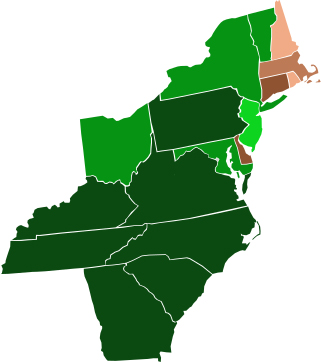
United_States_presidential_election_results,_1796-1820
US presidential election results from 1796 to 1820 gives a good idea of partisan press circulation, where Green shaded states usually voted for the Democratic-Republican Party, while brown shaded states supported the Federalist Party

During the early colonial period, American newspapers were “wretched little” sheets in the words of America’s “1st newsboy”, Benjamin Franklin.  Scarcely more than sidelines to keep presses occupied.

Newspapers were distributed by mail in the early years, thanks to generous subsidies from the Postal Act of 1792. In 1800, the United States could boast somewhere between 150 – 200 newspapers.  Thirty-five years later, some 1,200 were competing for readership.

350px-Great-Moon-Hoax-1835-New-York-Sun-lithograph-298px
Lithograph from the “Great Moon Hoax” of 1835

Today we hear a lot about “fake news”, but that’s nothing new.  In 1835, the New York Sun published a six-part series, about civilization on the moon.   The “Great Moon Hoax”, ostensibly reprinted from the Edinburgh Courant, was falsely attributed to the work of Sir John Herschel, one of the best known astronomers of his time.

Whatever it took, to sell newspapers.

Two years earlier, Sun publisher Benjamin Day ran a Help-Wanted advertisement, looking for adults to help expand circulation. “To the unemployed — A number of steady men can find employment by vending this paper. A liberal discount is allowed to those who buy and sell again“. To Day’s surprise, his ad didn’t produce adult applicants as expected.  Instead, the notice attracted children.

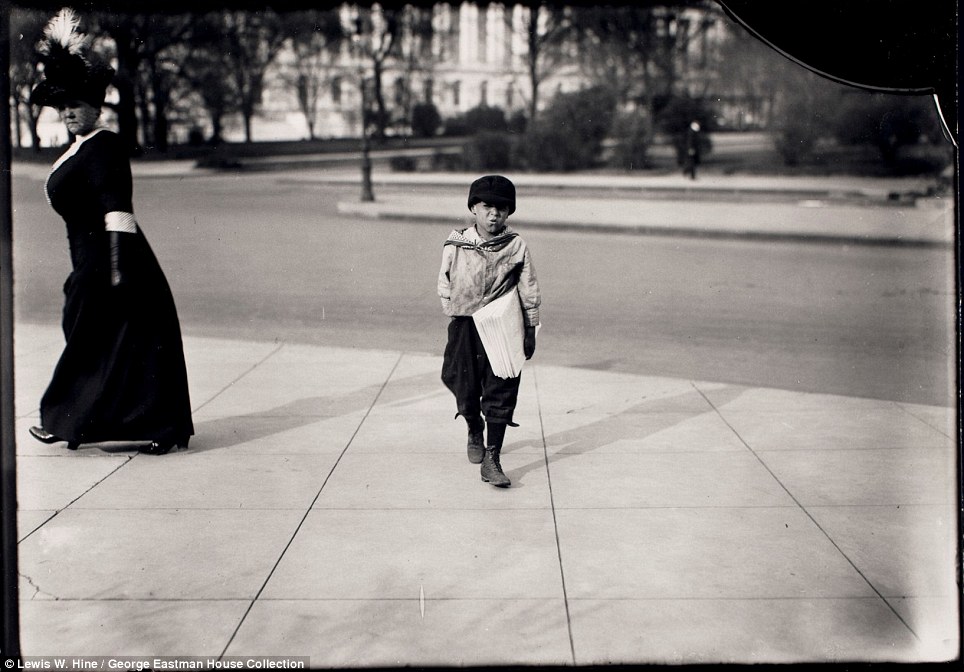
Today, kids make up a minimal part of the American workforce, but that wasn’t always so. Child labor played an integral part in the agricultural and handicraft economy, working on family farms or hiring out to other farmers.  Boys customarily apprenticed to the trades, at 10 – 14. As late as 1900, fully 18% of the American workforce was under the age of sixteen.

download (82)
Brooklyn newsboy, ca. 1910 Photo by Lewis Hine (Library of Congress)

Benjamin Day’s first newspaper “hawker” was Bernard Flaherty, a ten-year-old Irish immigrant. The kid was good at it too, crying out lurid headlines, to passers-by: “Double Distilled Villainy!” “Cursed Effects of Drunkenness!” “Awful Occurrence!” “Infamous Affair!” “Extra! Extra! Read all about it!”

download (92)

Hordes of street urchins swarmed the tenements and alleyways of American cities. During the 1870s, homeless children were estimated at 20,000 – 30,000 in New York alone, as much as 12% of school-age children in the city.

For thousands, newspapers were all that stood in the way of an empty belly.

800px-Riischildren
Homeless children sleeping in Mulberry Street district of New York, circa 1890

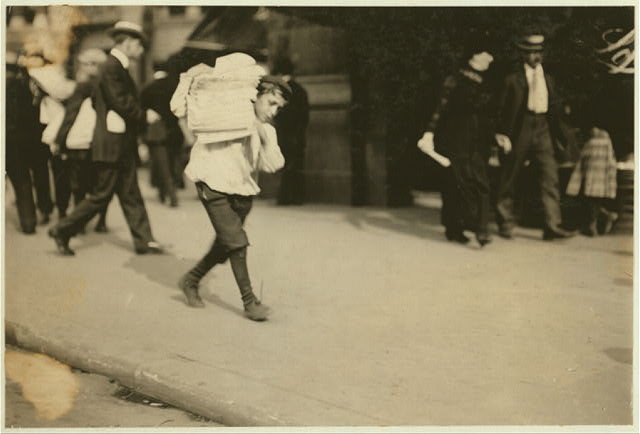
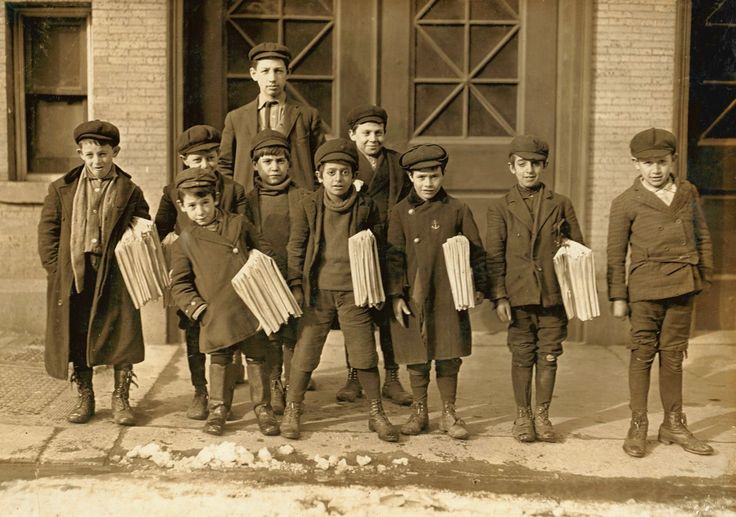
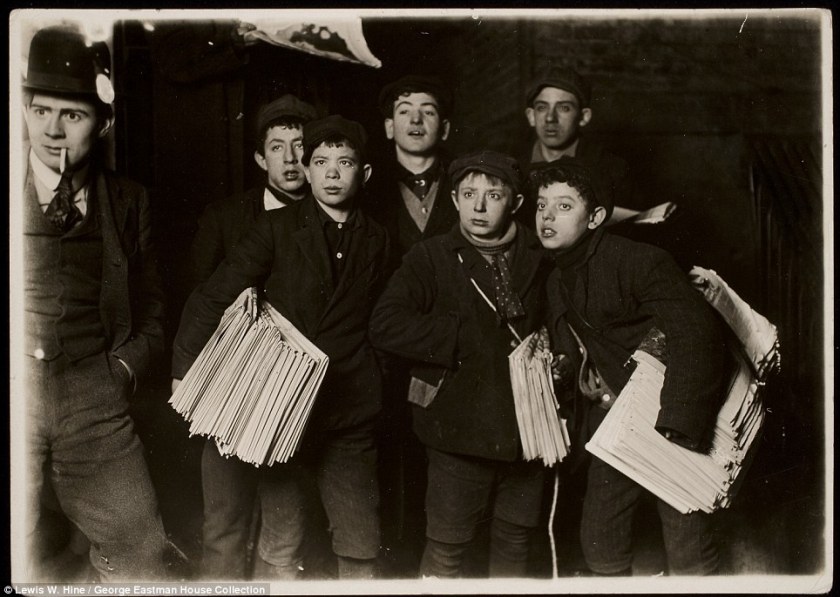
Adults had no interest in the minuscule income, and left the newsboys (and girls) to their own devices.  “Newsies” bought papers at discounted prices and peddled them on the street.    Others worked saloons and houses of prostitution.  They weren’t allowed to return any left unsold, and worked well into the night to sell every paper.

article-2467498-18D8276800000578-777_964x699

For that, newsies earned about 30¢ a day.  Enough for a bite to eat, to afford enough papers to do it again the following day, and maybe a 5¢ bed in the newsboy’s home.

article-2467498-18D8273A00000578-282_964x688

Competition was ferocious among hundreds of papers, and business practices were lamentable.  In 1886, the Brooklyn Times tried a new idea. The city was expanding rapidly, swallowing up previously independent townships along the Long Island shore. The Times charged Western District newsboys a penny a paper, while Eastern District kids paid 1 1/5¢.

The plan was expected to “push sales vigorously in new directions.” It took about a hot minute for newsies to get wise, and hundreds of them descended on the Times’ offices with sticks and rocks. On March 29, several police officers and a driver’s bullwhip were needed to get the wagons out of the South 8th Street distribution offices. One of the trucks was overturned, later that day.

article-2467498-18D8272400000578-972_964x686

That time, the newsboy strike lasted a couple of days, enforced by roving gangs of street kids and “backed by a number of roughs”. In the end, the Times agreed to lower its price to a penny apiece, in all districts. Other such strikes would not be ended so quickly, or so easily.

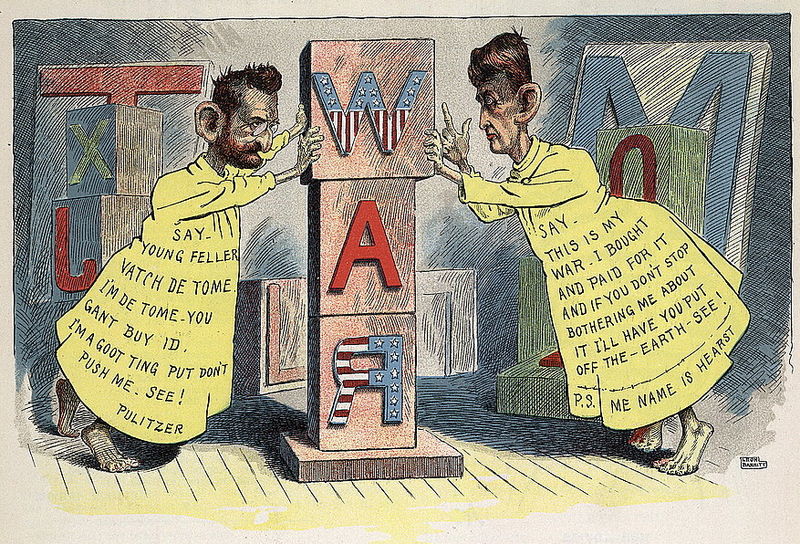
In those days, the Caribbean island of Cuba was ruled from Spain. After decades spent in the struggle for independence, many saw parallels between the “Cuba Libre” movement, and America’s own Revolution of the previous century.  In 1897-’98, few wanted war with Spain over Cuban interests more than Assistant Naval Secretary Theodore Roosevelt, and New York publishers Joseph Pulitzer & William Randolph Hearst.

800px-PulitzerHearstWarYellowKids

This was the height of the Yellow Journalism period, and newspapers clamored for war. Hearst illustrator Frederic Remington was sent to Cuba, to document “atrocities”.  On finding none, Remington wired: “There will be no war. I wish to return”.  Hearst wired back: “Please remain. You furnish the pictures, and I’ll furnish the war.” President McKinley urged calm, but agreed to send the armored cruiser USS Maine, to protect US “interests”.

The explosion that sank the Maine on February 15 killing 268 Americans was almost certainly accidental, but that wouldn’t be known for decades. Events quickly spun out of control and, on April 21, 1898, the US blockaded the Caribbean island. Spain gave notice two days later, that it would declare war if US forces invaded its territory. Congress declared on April 25 that a state of war had existed between Spain and the United States, since the 21st.

article-2467498-18D8275900000578-427_964x657

Several days later, newsboys were shouting the headline:  “How do you like the Journal’s war?”

The Spanish-American War was over in 3 months, 3 weeks and 2 days, but circulation was great while it lasted. Publishers cashed in, raising the cost of newsboy bundles from 50¢ to 60¢ – the increase temporarily offset by higher sales. Publishers reverted to 50¢ per 100 after the war, with the notable exceptions of Joseph Pulitzer’s New York World, and William Randolph Hearst’s New York Journal.

February_23rd_1908_Boys_Selling_Newspapers_on_Brooklyn_Bridge
Brooklyn newsboys, 1908

Newsies struck the two in 1899, refusing to sell their papers. 5,000 newsboys blocked the Brooklyn Bridge, bringing traffic to a standstill. Competing papers such as the New York Tribune couldn’t get enough of the likes of strike “President” Dave Simmons, the boy “prize-fighter”, Barney “Peanuts”, “Crutch” Morris, and others.  The charismatic, one-eyed strike leader “Kid Blink”, was a favorite: “Friens and feller workers. This is a time which tries de hearts of men. Dis is de time when we’se got to stick together like glue…. We know wot we wants and we’ll git it even if we is blind”.

Neither Hearst nor Pulitzer ever dropped their price, but they did agree to take back unsold papers.

800px-Child_Labor_in_United_States_1910_working_night_shift
Some worked well after midnight, to sell every paper

Long before modern notions of child welfare, street kids had precious few to look out for them, beyond themselves.  “Dutch” Johnson, Brooklyn’s “Racetrack Newsie”, caught cold, in 1905.  The illness soon turned more serious, and he was found unconscious on a pile of catalogs.  Brought to Bellevue Hospital by the East River,  the 16-year-old was informed that it was pneumonia.  This was before the age of antibiotics.  There was no chance.

“It goes”, Dutch said, in a voice barely audible.  “Only I ain’t got no money and I’d like to be put away decent”.

tumblr_ne0yqmwDCl1u0ndouo1_500 (1)
H/T http://newsieshistory.tumblr.com for this image

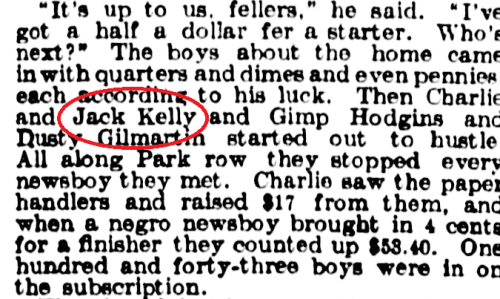
Bookmaker “Con” Shannon offered to take up a collection for the burial.  He could have easily produced hundreds from bookies and gamblers.   Dutch’s diminutive successor “Boston”, spoke up.  “Naw”, he said “we’re on de job and nobody else”.  So it was that “Gimpy”, “Dusty”, and the other urchins of Sheepshead Bay pitched in with their pennies, their nickels and their dimes.  $53.40 bought the plot in Linden Hill Cemetery, with its small stone marker.  Not a plain black wagon and a nameless grave in some Potter’s Field.


If you enjoyed this “Today in History”, please feel free to re-blog, “like” & share on social media, so that others may find and enjoy it as well. Please click the “follow” button on the right, to receive email updates on new articles.  Thank you for your interest, in the history we all share.

April 23, 1982 Conch Republic

The United States still had a border in those days, which the Federal government attempted to enforce.

Except for the Naval Air Station at Boca Chica and Coast Guard installations in Key West, Marathon and Islamorada, most of the economic activity in the Florida Keys, comes from tourism. It’s no wonder that, when the federal government shuts down the only road into the Keys, the locals are going to get cranky.

In April 1982, the Mariel boatlift was a mere two years in the past, and very much in the public memory.

download (74)The United States still had a border in those days, which the Federal government attempted to enforce.

On April 18, Border Patrol set up a roadblock in front of Skeeter’s Last Chance Saloon in Florida City, shutting down US Route 1, the only road in and out of the Florida Keys.  Originally intended to intercept illegals entering the country, the roadblock soon morphed into a hunt for illegal drugs, as well.

Cars waited for hours, in lines stretching 19 miles. Predictably, the attitude of Federal officials was one of towering indifference. Not so local business owners. Robert Kerstein wrote in his Key West on the Edge — Inventing the Conch Republic, “No one in Key West doubted that drugs were trafficked widely in the Keys by road and by boat. But tourism’s boosters had little tolerance for interruptions to their business.”

Dennis Wardlow, then-Mayor of Key West, contacted the chief of police, the Monroe County sheriff, his State Representative and then-Governor Bob Graham, demanding the roadblock’s removal. With none of the above having any knowledge of the barrier and lacking the authority to pull it down, Wardlow contacted INS directly. When the Border Patrol told him it was “none of his business,” the Mayor’s response could best be summed up in the words of Bugs Bunny: “Of course you know, this means war!

Conch Republic PassportsSuffering a blizzard of hotel cancellations, this “attack on Key West’s sovereignty” could not stand. On April 22, Mayor Wardlow, local attorney & pilot David Horan and Old Town Trolley Tours operator Ed Swift flew to Miami seeking legal remedy. When District Court Judge C. Clyde Atkins failed to issue an injunction, the Key West delegation took to the courthouse steps.

“What are you going to do, Mr. Mayor”, asked the assembled media. Swift leaned over and whispered into the Mayor’s ear, “Tell them we are going to go home and secede!” “We are going to go home and secede!”, said Wardlow, and that’s what they did.

Conch Republic Secession

Over the next 24 hours, secessionist co-conspirators worked feverishly to form a new government, filling cabinet positions such as “Secretary of Underwater Affairs” and “Minister of Nutrition”.

logo-navy2On April 23, with federal agents on scene to monitor the proceedings, a crowd gathered before the old customs building. Mayor Wardlow and a gaggle of allies mounted the back of a flatbed truck, to read the proclamation of secession. “We serve notice on the government in Washington”, he started, “to remove the roadblock or get ready to put up a permanent border to a new foreign land. We as a people, may have suffered in the past, but we have no intention of suffering in the future at the hands of fools and bureaucrats“.

With that, Mayor Wardlow declared “war” on the United States.  The “Great Battle of the Conch Republic” broke out in the harbor, when the Schooner Western Union commanded by Captain John Kraus, attacked the Coast Guard Cutter Diligence with water balloons, Conch fritters and toilet paper.  Diligence fought back with water hoses, as the new “Prime Minister” broke a stale loaf of Cuban bread over the head of a man dressed in a Navy uniform.

download (73)
Naval History was forever changed on this day, as the “Great Battle of the Conch Republic” raged across the waters of Key West

Pandemonium broke out as others launched stale bread and conch fritters at federal agents, Navy sailors and Coast Guard personnel. One minute after declaring his “verbal shot” at the Federal government, Mayor Wardlow surrendered to a nearby Naval officer, demanding a billion dollars in “foreign aid” in compensation for “the long federal siege.”

Apparently, that’s what it takes to get the attention of a Federal government bureaucrat. The roadblock lifted.  The restaurants, stores and hotels of the Keys soon filled with tourists and, once again, there was happiness upon the land.  Key West never got its “foreign aid”, but “secesh” leaders never received so much as a letter, saying they couldn’t leave the Union, either.

ConchRepublicSpecialForcesSo it is that the micro-nation of Key West celebrates its independence, every April 23. The “Conch Republic’ issues its own passports, selling T-shirts and bumper stickers with the slogan “We seceded where others failed”.

And if the Federal government ever comes back to mess with the sovereign nation of Key West, it had better be prepared to deal with the Conch Republic’s very own “Special Forces”, the motto for which is “Sanctus Merda”.  “Holy Shit”.

Tip of the hat to

“Conch Republic Military Forces, The Official Site of the Conch Republic Military”

Linked Here

for the “Conch Battle Hymn of the Republic”.  Lyrics by First Sea Lord, Admiral Finbar Gittelman, October 14, 2012 © Finbar Gittelman

Mine eyes have seen the glory of the sunshine and the sea
Right here upon our islands, where we love to live so free 
But in April 1982, the peace was not to be 
And we went rolling on

CHORUS
Glory glory Conch Republic 
From Key to shining Key

They were setting up a check point, tween the mainland and the Keys 
They had put a US Border, where it shouldn’t ‘oughta’ be 
So that’s when we seceded, and declared our sovereignty 
And the fun had just begun

(CHORUS)

We went forth into the harbor and a cutter we did spy 
And we sailed up along side her and we took her by surprise 
We hoisted up our battle flag, so proudly and so high 
And we went sailing on

(CHORUS)

The water and Conch fritters and the Cuban bread did fly 
Our bombers, they were raining toilet paper from the sky 
Our cannons they did thunder to proclaim our victory 
And we fought bravely on

(CHORUS)

We have faced the silly forces of misguided zealotry 
We have stood up to their foolishness for all the world to see 
And we’ve showed the other nations what America can be From
Key to shining Key

(CHORUS)


If you enjoyed this “Today in History”, please feel free to re-blog, “like” & share on social media, so that others may find and enjoy it as well. Please click the “follow” button on the right, to receive email updates on new articles.  Thank you for your interest, in the history we all share.

April 9, 1940 “Evacuation Day”

Norway was out of the war, but not necessarily out of the fight.   A Nazi officer passed an old woman on the street, who complained at his rudeness and knocked his hat off, with her cane. The officer apologized and scurried off.  The gray-haired old matron snickered, to herself:  “Well, we’ll each have to fight this war as best we can.  That’s the fourth hat I’ve knocked into the mud this morning.”

The Encyclopedia Britannica describes Croton oil as a “poisonous viscous liquid obtained from the seeds of a small Asiatic tree…”  Highly toxic and a violent irritant, the substance was once used as a drastic purgative and counter-irritant in human and veterinary medicine, but is now considered too dangerous for medicinal use. Applied externally, Croton oil is capable of peeling your skin off.  Taken internally, the stuff may be regarded as the atomic bomb, of laxatives.

The Nazi conquest of Europe began with the annexation of the Sudetenland in 1938, the border districts of Bohemia, Moravia, and German speaking parts of Czechoslovakia. Within two years, every major power on the European mainland was either neutral, or subject to Nazi occupation.  France fell to the Nazi war machine in six weeks, in 1940.  The armed forces of the island nation of Great Britain were left shattered and defenseless, stranded on the beaches of Dunkirk.

On the Scandinavian Peninsula, longstanding policies of disarmament in the wake of WW1, left the Nordic states of Denmark and Norway severely under-strength, able to offer little resistance to the Nazi invaders.

On this day in 1940, German warships entered Norwegian harbors from Narvik to Oslo, as German troops occupied Copenhagen and other Danish cities.  King Christian X of Denmark surrendered almost immediately.  To the northwest, Norwegian commanders loyal to former foreign minister Vidkun Quisling ordered coastal defenders to stand down, permitting the German landing to take place, unopposed.  Norwegian forces refused surrender demands from the German Minister in Oslo, but the outcome was never in doubt.

Nazi Germany responded with an airborne invasion by parachute.  Within weeks, Adolf Hitler could add a second and third scalp to his belt, following the invasion of Poland, six months earlier.  The Kingdoms of Denmark and Norway, were out of the war.

Norway was out of the war, but not necessarily out of the fight.   A Nazi officer passed an old woman on the street, who complained at his rudeness and knocked his hat off, with her cane. The officer apologized and scurried off.  The gray-haired old matron snickered, to herself:  “Well, we’ll each have to fight this war as best we can.  That’s the fourth hat I’ve knocked into the mud this morning.

A Norwegian Resistance was quick to form, as patriotic locals united against the Nazi occupier and the collaborationist policies of the Quisling government.

The Norwegian secret army, known as Milorg and led by General Otto Ruge, was at first loath to engage in outright sabotage, for fear of German reprisals against innocent civilians.  Later in the war, Milorg commandos attacked the heavy water factory at Rjukan and sank a ferry carrying 1,300 lbs of heavy water, inflicting severe damage to the Nazi nuclear research program.

Sven Somme, tree
Norwegian Resistance member Sven Somme demonstrates one of the techniques by which he evaded capture in the mountains.

In the beginning, Resistance activities centered more around covert sabotage and the gathering of intelligence.  One of the great but still-unknown dramas of WW2 unfolded across the snow covered mountains of the Scandinavian peninsula, as the civilian-turned-spy Sven Somme fled 200 miles on foot to neutral Sweden, pursued by 900 Wehrmacht soldiers and a pack of bloodhounds.

Operations of all kinds were undertaken, to stymie the Nazi war effort. Some actions seem like frat-boy pranks, such as coating condoms destined for German units, with itching powder.  Hundreds of Wehrmacht soldiers (and presumably Norwegian women) showed up at Trondheim hospitals, believing they had contracted God-knows-what kind of plague.

Other operations demonstrate a kind of evil genius.  This is where Croton oil comes in.

download (61)
“Croton oil (Crotonis oleum) is an oil prepared from the seeds of Croton tiglium, a tree belonging to the order Euphorbiales and family Euphorbiaceae, and native or cultivated in India and the Malay Archipelago. Small doses taken internally cause diarrhea. Externally, the oil can cause irritation and swelling. Croton oil is used in some chemical peels, due to its caustic exfoliating effects it has on the skin”. H/T, Wikipedia

Norwegian resistance fighters, as dedicated as they were, still had to feed themselves and their families.  Many of these guys were subsistence fishermen, and that meant sardines.  For centuries, the small fish had been a staple food item across the Norwegian countryside.  It was a near-catastrophic blow to civilian and Resistance fighters alike, when the Quisling government requisitioned the entire sardine crop.

The Battle of the Atlantic was in full-swing by this time, as wolf packs of German submarines roamed the north Atlantic, preying on Allied shipping.  Thousands of tons of sardines would be sent to the French port of Saint-Nazaire, to feed U-Boat crews on their long voyages at sea.

U-864
German Type X Submarine, U-864

Norwegian vengeance began with a request to the Special Operations Executive (SOE) in Great Britain, for the largest shipment of Croton oil, possible.  The “atomic laxative” was smuggled into canneries across Norway, and used to replace vegetable oil in sardine tins.  The plan worked nicely and no one suspected a thing, the pungent taste of the fish covering the strange flavor of Croton oil.

From midget submarines such as the Biber, Hai, Molch, and Seehund models to the behemoth 1,800-ton “Type X“, the Kriegsmarine employed no fewer than fifteen distinct submarine types in WW2, including the workhorse “Type VII”, of which some 700 saw service in the German war effort.  In the North Atlantic, the battle raged on with torpedo and depth charge.  Under the surface, there unfolded a different story.

Except for the participants in this tale, no one knows what it looks like, when ten thousand submariners simultaneously lose control of their bowels. It could not have been a pretty sight.

Feature image, top of page:  “Anti-Nazi graffiti on the streets of Oslo, reading “Live” above the monogram for the Norwegian king, who had fled when the Germans invaded in 1940”. (Photo: Bettmann/Getty Images)


If you enjoyed this “Today in History”, please feel free to re-blog, “like” & share on social media, so that others may find and enjoy it as well. Please click the “follow” button on the right, to receive email updates on new articles.  Thank you for your interest, in the history we all share.

April 1, 2018 The Easter Bunny

So it is that Emperor Napoleon Bonaparte, a General who fought and won more battles than Hannibal Barca, Alexander the Great, Julius Caesar and Frederick the Great, combined, was defeated and driven out of town…by bunnies.

In Christian tradition, Jesus of Nazareth was crucified on Good Friday, arising from the dead two days later to reveal himself to his disciples, before finally ascending to heaven.

So where did the Easter Bunny come from?

download (35)Many of the secular symbols associated with Easter trace back to the pagan goddess of spring and the dawn, Ēostre or Ostara, from the Old English Ēastre. History fades into mythology in the pre-Christian usage and accounts differ, but this Teutonic deity was frequently depicted with eggs symbolizing the rebirth of Spring.  And rabbits.

It’s small wonder that the latter symbolized fertility.  A female Hare, called a “Jill” has a 42-day gestation period, and is capable of conceiving while still pregnant.  Kriss Kringle and an egg laying Easter Hare called “Osterhase” or “Oschter Haws” came to America in the 1700s, with German immigrants who settled in Pennsylvania. Children would make nests of clothing and blankets, in which the creature could lay its colored eggs. This is the origin of the Easter basket.

Hares and rabbits are different species of the same family, like sheep and goats. Until the 18th century, rabbits were called Coneys, after the Latin “cuniculus”. The word has all but disappeared from American English vernacular, its only use today relates to Coney Island, in New York.

It was around that time that the diminutive, fuzzier “bunny” came to replace the Easter Hare.

History gives us a tale about rabbits having nothing whatever to do with Easter, but it’s way too good not to tell it here.  I swear it’s not an April Fool.

download (34)The story involves no less a figure than Napoleon Bonaparte.  In July 1807, Napoleon had just signed the Treaty of Tilsit, ending the war between the French Empire and Imperial Russia. Looking to celebrate, Napoleon suggested a rabbit hunt, and ordered his Chief of Staff Alexandre Berthier to make it happen.

Berthier put together an outdoor luncheon, inviting the highest brass from the French military. Meanwhile, Napoleon’s men ranged far and wide, collecting rabbits for the hunt. As many as 3,000 of them.

Napoleon arrived at one side of a grassy field with his beaters and gun bearers, with all those caged rabbits lined up on the other side. Rabbits and Hares are predictably shy and retiring creatures, but Berthier’s soldiers had found it easier to purloin domesticated rabbits instead of flushing out the wild variety, and these things were hungry.

download (33)The hunt was supposed to start when all those cages opened up but, instead of scattering, a swarm of rabbits thought it was dinner time and pelted straight across the field.
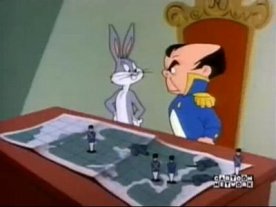
The most powerful man in the world thought it was funny at first, until all those rabbits started coming up his legs. Coachmen cracked bullwhips and men grabbed sticks.  There was shooting and shouting and pandemonium, everywhere.  Still, the bunny horde came on.

Baron Paul Thiébault was there, let him tell the story. “The intrepid rabbits turned to the Emperor’s flank, attacked him frantically in the rear, refused to quit their hold, piled themselves up between his legs till they made him stagger, and forced the conqueror of conquerors, fairly exhausted, to retreat and leave them in possession of the field”.

Napolean_Bunny_Part_StillNapoleon retreated to his carriage, but still the attack continued. Historian David Chandler picks up the story. “With a finer understanding of Napoleonic strategy than most of his generals, the rabbit horde divided into two wings and poured around the flanks of the party and headed for the imperial coach.” The tide of bunnies continued.  Some even got into the carriage.  The assault finally ebbed away, only as the Royal Conveyance, drove out of sight.
So it is that Emperor Napoleon Bonaparte, a General who fought and won more battles than Hannibal Barca, Alexander the Great, Julius Caesar and Frederick the Great, combined, was defeated and driven out of town…by bunnies.


If you enjoyed this “Today in History”, please feel free to re-blog, “like” & share on social media, so that others may find and enjoy it as well. Please click the “follow” button on the right, to receive email updates on new articles.  Thank you for your interest, in the history we all share.

March 31, 2016 A Talent for Music

The 1104th worked to find and defuse explosives, though on several occasions, the unit had to drop its tools and fight as Infantry.

James and Kate Kaminski’s little bundle of joy came into the world on June 26th 1926, in Brooklyn.

The Kaminskis named this, their fourth son, Melvin James. The elder James died of tuberculosis at 34, when the boy was only two. A small Jewish kid growing up in a tough Brooklyn neighborhood, Kaminsky learned the value of being able to crack a joke. “Growing up in Williamsburg”, he said, “I learned to clothe it in comedy to spare myself problems—like a punch in the face”.

download (41)The boy had a talent for music. He was taught by another kid from Williamsburg, named Buddy Rich.  By 14 he was good enough to be playing drums for money.

Melvin attended a year at Brooklyn College before being drafted into the Army, in WWII. After attending Army Specialized Training at VMI, Corporal Kaminsky joined the 1104th Combat Engineers Battalion of the 78th Infantry Division, in the European theater.  There, he served through the end of the war.

He and his unit worked to find and defuse explosives, though on several occasions, the 1104th had to drop its tools and fight as Infantry.

download (40)At one point, Kaminsky’s unit gathered along a River. The Americans were so close they could hear German soldiers singing a beer hall song, from the other side. Kaminsky grabbed a bullhorn and serenaded the Germans back, crooning out an old tune that Al Jolson used to perform, in black face:  “Toot Toot Tootsie, Goodbye”.  After he was done, polite applause could be heard, drifting across the river.  I can’t imagine many Allied soldiers ever tried singing to their Nazi adversaries, during World War II.  The ones who actually pulled it off, must number precisely, one.

Kaminski went into show business after the war, playing drums and piano in the Borscht Belt resorts and nightclubs of the Catskills. It was around this time that he took his professional name, adopting his mother’s maiden name of Brookman and calling himself “Mel Brooks”.

images (45)Brooks started doing stand-up, when the regular comedian at one of the clubs was too sick to perform. By ’49 he was “Tummler”, the master entertainer at Grossinger’s, one of the most famous resorts in the Borscht Belt.

Soon he was making $50 a week writing for his buddy Sid Caesar and his NBC program “The Admiral Broadway Review”.

In 1968, Mel Brooks wrote and produced the satirical comedy film “The Producers”, about a theatrical producer and an accountant who set out to fleece their investors. The scheme was to create a play so awful that it was sure to flop on Broadway, then to abscond to Brazil with investors’ money.  The problems started, when the show turned out to be a hit. The fictional play is a musical, called “Springtime for Hitler”.  Even before the time when taking offense became an industry, I don’t know many guys beside Mel Brooks who could have gotten away with that one.

There isn’t one of us who doesn’t know his work. Three of his movies made the American Film Institute’s top 100 list of comedy films.  From the 2,000 year old man with “over forty-two thousand children, and not one comes to visit me” to Blazing Saddles’ “Candygram for Mongo” (“Mongo likes candy”).

download (46)

“As long as the world is turning and spinning”, Brooks says, “we’re gonna be dizzy and we’re gonna make mistakes”.

images (42)

Brooks has risen to the top of his chosen profession, winning the coveted “EGOT”, an acronym for the entertainment industry’s four major awards, the Emmy, Grammy, Oscar and Tony. Only eleven others have ever risen to this level: Richard Rodgers, Helen Hayes, Rita Moreno, John Gielgud, Audrey Hepburn, Marvin Hamlisch, Jonathan Tunick, Mike Nichols, Whoopi Goldberg, Scott Rudin, and Robert Lopez.  As of this date, Brooks only needs another Oscar to be the first “Double EGOT”, in history.

Two years ago, March 31, 2016, the Averhill Park K-12 School District in upstate New York kicked off a three-day production of “Young Frankenstein”.  Let me know if you can think of another 90-year-old guy, who remains that current.  I can’t think of one.

“Well, just being stupid and politically incorrect doesn’t work. You can be politically incorrect if you’re smart”.

melbrooks1-2x

If you enjoyed this “Today in History”, please feel free to re-blog, “like” & share on social media, so that others may find and enjoy it as well. Please click the “follow” button on the right, to receive email updates on new articles.  Thank you for your interest, in the history we all share.

March 26, 1937  I Yam What I Yam

Cartoonist E.C. Segar (rhymes with cigar) passed away back in 1938, but his characters live on.  Over the weekend of January 16-18, 2004, the Empire State Building was lit up spinach green, a tribute to the 75th anniversary of Segar’s favorite character. 

Eighty-nine years ago, Popeye the Sailor appeared for the first time in Elzie Segar’s “Thimble Theater”, a newspaper comic strip revolving around the lives of Olive Oyl and her extended family, including her brother Castor and then-boyfriend Harold Hamgravy.

download (29)The strip was around for ten years or so, when Olive & co. decided to recruit a sailor to get them to the casino on Dice Island.  Approaching a rough looking character on the docks, “Popeye’s” first line was “Ja think I was a cowboy? He was supposed to be an extra, but he became so popular he soon developed into the center of the strip.
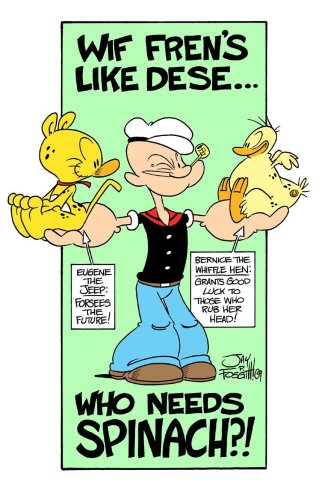
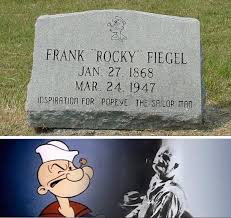
Like Olive, who was patterned after the real-life Dora Paskel, the one eyed, fighting, pipe smoking sailor was based on a real man:  Chester, Illinois boxer Frank ‘Rocky’ Fiegal.  The boxer didn’t mind being associated with a cartoon character.  When Fiegal died in 1947, his gravestone was inscribed with the words “inspiration for Popeye.”

popeye__eugene_and_bernice_by_fourpanelheroBefore spinach, Popeye gained his superhuman strength patting the head of a magical “whiffle hen” named “Bernice”.
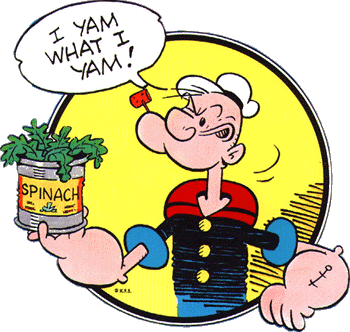
Back in 1870, a misplaced decimal point in a scientific journal led readers to believe that spinach had ten times the iron than it actually does.  Some ideas die hard.  Sixty years later, the grandchildren and great-grandchildren of those people still believed it to be true.

Bluto beat our sailor up in 1932 and tossed him into a spinach field, with predictable results.  Following that episode, spinach sales increased by 33%.  At one point, children voted spinach their third favorite food, behind turkey and ice cream.

To the everlasting joy of depression-era spinach producers, Popeye found extra muscle in the leafy vegetable, ever since.  On March 26, 1937, Crystal City, Texas spinach producers unveiled a statue of Popeye, the first time in history that a statue had been erected in honor of a cartoon character.

What-is-SpinachPopeye’s pet “Eugene the Jeep” first appeared in a 1936 strip called “Wha’s a Jeep?”.  Eugene was sort of magical dog who could go anywhere.  Five years later, military contractors worked to develop the iconic off-road vehicle of WWII.  Like Popeye’s pet Eugene, the General Purpose GP (“Jeep”) could go anywhere.  Eventually, the name stuck.
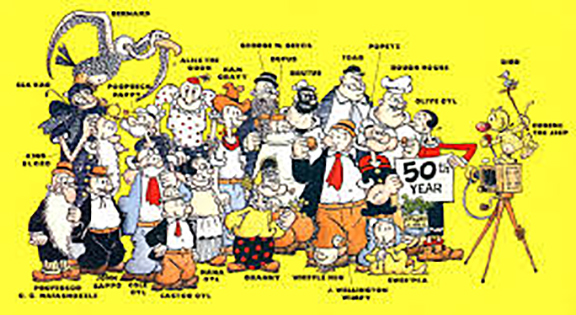
Jeep isn’t the only word we get from the Popeye cartoon franchise.  The inveterate moocher J. Wellington Wimpy, who would gladly pay you Tuesday for a hamburger today, gave us the word “wimp” and the burger chain that goes with it.  The comic strip introduced a character called “Dufus”.  To this day, a Dufus (Doofus) in the American vernacular is a “silly fool, a dimwit, or a stupid person”,

Just about every cartoon character who ever was, appears in the 1988 “Who framed Roger Rabbit”, except for Popeye.  Disney didn’t forget him, the problem was that they couldn’t get legal permission to use the character, from Paramount Pictures.

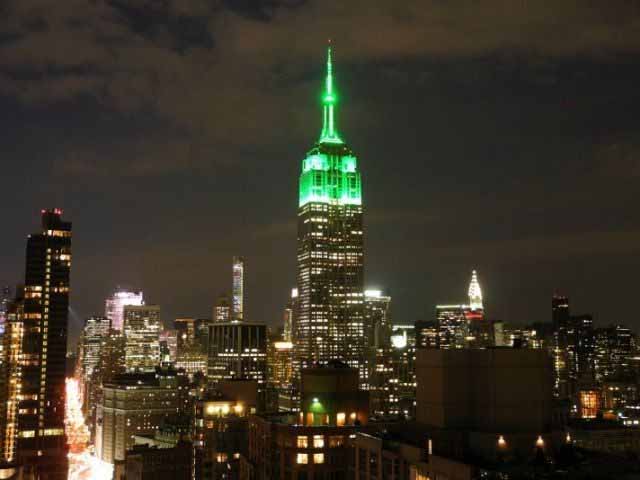
Cartoonist E.C. Segar (rhymes with cigar) passed away back in 1938, but his characters live on.  Over the weekend of January 16-18, 2004, the Empire State Building was lit up spinach green, a tribute to the 75th anniversary of Segar’s favorite character.   Weight Watchers put out a series of spinach recipes. There was even a ceremonial “official adoption” of the orphan sea waif Swee’ Pea, during National Adoption Month (November).

EmpireStateBldg.Green_
“Later that year (2004), the Empire State Building was lit in spinach green to celebrate Popeye’s 75th, and Weight Watchers put out a series of spinach recipes. There was even a ceremonial “official adoption” of the orphan sea waif Swee’ Pea during National Adoption Month (November)”. H/T The Coronado Times

On December 8, 2009, Google featured the character to honor the birth of his creator, Elzie Crisler Segar. Google’s famous Doodle appeared along with the mouseover text, “E.C. Segar’s Birthday.”

If you enjoyed this “Today in History”, please feel free to re-blog, “like” & share on social media, so that others may find and enjoy it as well. Please click the “follow” button on the right, to receive email updates on new articles.  Thank you for your interest, in the history we all share.

March 22, 2228 Final Frontier

Kirk was killed in 2329 on the Enterprise (B), after the ship was eaten by a Nexus energy ribbon on its maiden voyage. Only he didn’t die, because Jean-Luc Picard found him alive in the timeless Nexus, negotiating hotel deals for Priceline.com. Or something like that.

On this day in the year 2228, a boy was born to George and Winona Kirk. He would go on to become the youngest captain in Starfleet history but, before he could boldly go where no man has gone before, he had to have a name.

The former WWII fighter pilot and veteran of 89 combat missions Gene Roddenberry had 16 suggestions for a name, among them “Hannibal”, “Timber”, “Flagg”, and “Raintree”.  The television screenwriter and producer decided on James T. Kirk, based on a journal entry from the 18th century British explorer, Captain James Cook, who wrote “ambition leads me … farther than any other man has been before me“.

Kirk_surrounded_by_Tribbles-970x545

Kirk was killed in 2329 on the Enterprise (B), after the ship was eaten by a Nexus energy ribbon on its maiden voyage. Only he didn’t die, because Jean-Luc Picard found him alive in the timeless Nexus, negotiating hotel deals for Priceline.com. Or something like that.

In his 1968 book “Making of Star Trek“, Roddenberry writes that James Kirk was born in a small town in Iowa. Full time “Trekkie” and part time Riverside, Iowa Councilman Steve Miller thought “Why not Riverside”. In 1985, Miller moved that Riverside declare itself the Future Birthplace of James T. Kirk. The motion passed unanimously. Miller poked a stick into the ground behind the barber shop, (good thing he owned the property), declaring that this was the place.  An engraved monument was erected, and so it was.  Riverside, population 963, became the “Future Birthplace of Captain James T. Kirk.  A bench was added later, along with a Shuttlecraft-shaped donation box.

jk6Riverside’s official slogan was changed from “Where the best begins” to “Where the Trek begins,” the annual “River Fest” summer festival, became “Trek Fest”.

Star Trek fans, ever-jealous protectors of series trivia, sometimes wonder why the March 22, 2228 date on the Riverside monument differs from the March 22, 2233 date usually cited as Kirk’s future birthday. The 2233 date didn’t come around until eight years after the monument, with the publication The Star Trek Chronology: The History of the Future. 2228 or 2233 you can take your pick, but both agree on March 22, which happens to be William Shatner’s birthday.

download (24)In case you ever wondered what the “T” stands for – its “Tiberius”.

The Space Foundation of Colorado Springs bills itself as “the world’s premier organization to inspire, educate, connect, and advocate on behalf of the global space community“.  A 2010 survey conducted by the organization found that James Tiberius Kirk was voted the 6th “most inspirational space hero of all time“, tied with Russian Cosmonaut Yuri Gagarin.  Tied for 6th place, with the first human in space.  A guy who went there, and came back.  A guy who…you know…actually…exists.

If you enjoyed this “Today in History”, please feel free to re-blog, “like” & share on social media, so that others may find and enjoy it as well. Please click the “follow” button on the right, to receive email updates on new articles.  Thank you for your interest, in the history we all share.