

In 380BC, Plato described a system of state-controlled human breeding in the Socratic dialogue “The Republic”, introducing a “guardian class” to watch over over his ideal society.
In the 19th century, the British statistician Francis Galton studied the theories of his cousin Charles Darwin on the evolution of species, applying them to a system of selective breeding intended to bring “better” human beings into the world. He called this his theory of “Eugenics”.
Eugenics gained worldwide respectability in the early 20th century, when countries from Brazil to Japan adopted policies regarding the involuntary sterilization of certain mental patients.

In the United States, 30 states passed legislation at the height of the movement, legalizing the involuntary sterilization of individuals considered “unfit” for reproduction. All told, some 60,000 individuals were forcibly sterilized in state-sanctioned procedures.
The race to perfect worldwide “genetic hygiene” reached its zenith with the “sterilization law” enacted in Nazi Germany on July 14, 1933. The German measure borrowed heavily from the statutes of American educator and Eugenics Record Office (ERO) Director Harry H. Laughlin, taking such measures a step further by allowing compulsory sterilization of any citizen displaying one of a long list of supposed genetic disorders, not just those confined to institutions.
In the wake of World War II, West German authorities were loath to apply such strict congenital examination. Pathologist Franz Büchner would go on to propagate his theories of Teratology, stating that healthy nutrition and behavior of expecting mothers was more important for the health of the child, than genetic considerations. The idea would prove to be a disastrous oversight.
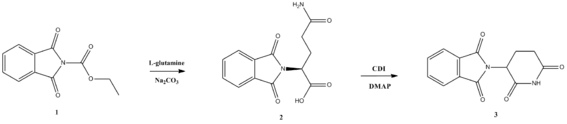
The German company Chemie Grünenthal (now Grünenthal GmbH) was established to address the urgent need for antibiotics. and other pharmaceuticals. In 1953, company scientists developed a two-step procedure for synthesizing a new molecule. The compound underwent rodent testing and further revision, the new drug “Thalidomide” introduced in 1956, as a sedative.

Researchers at Chemie Grünenthal found the drug an effective remedy for vomiting and nausea, an important remedy for morning sickness in expectant mothers. It was a “wonder drug”, a cure for ailments from insomnia to coughs and colds, claiming to cure “anxiety…gastritis, and tension”.
Despite documented cases of fetal alcohol syndrome, scientists believed no drug could pass the placental barrier, passing from mother to unborn child. Within three years, the new compound was licensed to 14 pharmaceutical companies under 37 different trade names and sold in 46 countries.
Thalidomide acceptance was far from universal. Regulatory authorities in East Germany refused approval. In the United States, the U.S. Food and Drug Administration (FDA) denied widespread marketing and distribution though large quantities were released, for testing. Approximately 875 people were involved in such trials, including a number of pregnant women.

The drug first arrived in Canada on this day in 1961. Several variants entered the Canadian market, the most common sold under the name, Talimol. Within two months, pharmaceutical companies were warning physicians of the risk of birth defects. Canadian authorities banned all variants within a year, instructing physicians to destroy stockpiles.
The first birth defects began to appear around 1958, peripheral nerve palsies or Phocomelia, a malformation or entire absence of arms and/or legs, hands & feet. Some cases showed malformation of eyes, ears and internal organs, others born with no anus and no genitals and doomed to die. Some five to seven thousand children were born with such birth defects in West Germany alone, four-in-ten of whom, survived. Worldwide, some 10,000 “Thalidomide babies” were born with such defects, half of whom survived infancy. An estimated 123,000 others miscarried, or were stillborn.
“Today, fewer than 3,000 are still alive. In Britain, it’s about 470. Among the nearly 50 countries affected are Japan (approximately 300 survivors), Canada and Sweden (both more than 100), and Australia (45). Spain’s government only recently acknowledged the drug was ever distributed there. No-one knows how many Spanish survivors there are. It could be hundreds”. H/T BBC
Despite such egregious side effects, Thalidomide remains in use today, albeit under conditions of strict birth control. Thalidomide is in fact a “wonder drug” for the treatment of certain skin conditions related to leprosy, and is useful for treatments relating to HIV, Crohn’s Disease and certain cancers.


Sadly, Brazilian strictures are not so severe, leading to the birth of a whole new generation of “thalidomiders”, as adult survivors call themselves. Research has uncovered circumstantial evidence connecting Thalidomide’s origins to Dr. Otto Ambros, the “Devil’s Chemist”, alleging Dr. Ambros helped develop the nerve agent sarin, while experimenting on thalidomide as an antidote on concentration camp inmates.
Eight years ago, German survivors’ marked the fifty-year mark, in the Thalidomide debacle. Spokesman Gernot Stracke quipped:
“On 26 November – 50 years on – we, the German survivors, will march, waddle, limp or roll in wheelchairs from the Brandenburg Gate to the Federal Chancellery in Berlin. To celebrate that we are still alive, and to remember those who never lived”.
Feature image, top of page: Survivors tell tales of frequent falls leading to scores of stitches as the armless and legless attempt navigation with contraptions like the British prosthesis, on the left. Right, young German girl uses crude boxing glove-like prostheses, in place of hands. H/T Life Magazine.













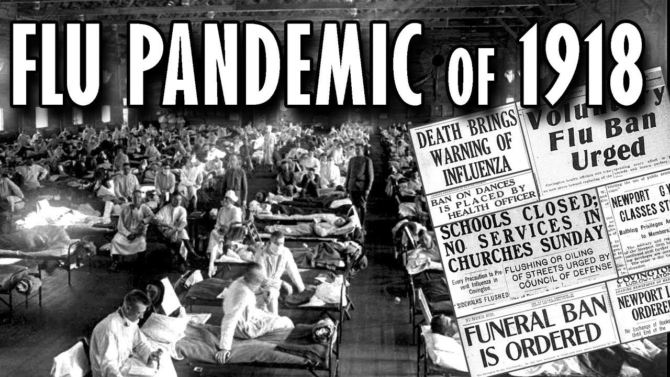
 When the “Great War” broke out in 1914, US Armed Forces were small compared with the mobilized forces of the European powers. The Selective Service Act, enacted May 18, 1917, authorized the federal government to raise an army for the United States’ entry into WWI. Two months after the American declaration of war against Imperial Germany, a mere 14,000 American soldiers had arrived “over there”. Eleven months later, that number stood at well over a million.
 On the morning of March 11, 1918, most of the recruits at Fort Riley, Kansas, were turning out for breakfast. Private Albert Gitchell reported to the hospital, complaining of cold-like symptoms of sore throat, fever and headache. By noon, more than 100 more had reported sick with similar symptoms.
 Over the next two years, this strain of flu infected one in every four people in the United States, killing an estimated 675,000 Americans. Eight million died in Spain alone, following an initial outbreak in May. Forever after, the pandemic would be known as the Spanish Flu.


 On December 21, 1898, Marie and Pierre Curie discovered the 88th element of the Periodic Table. This new and radioactive element was Radium, one of the ‘alkaline earth metals’.
 Serious physicians had early success killing cancer cells, driving a quack medicine craze where charlatans sold radium creams, salts and suppositories claiming to to cure everything from impotence to acne to insanity, rickets, tooth decay, and warts.


 Reports of illness among other women came flooding in. US Radium took to assassinating the character of these women, claiming that their symptoms resulted from syphilis.


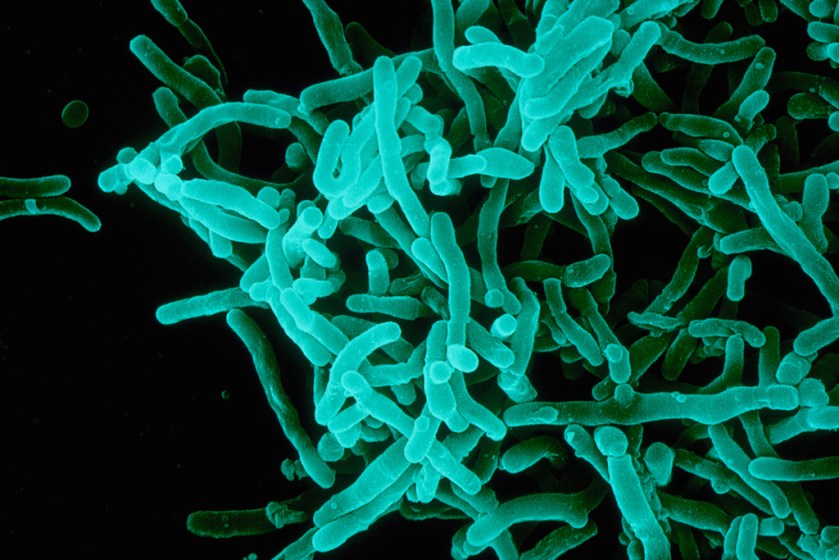
 Dr. Curtis Welch practiced medicine in Nome, Alaska, in 1925. Several children became ill with what he first diagnosed as tonsillitis. More came down with sore throats, early sufferers beginning to die as Welch observed the pseudomembrane of diphtheria. Dr. Welch had ordered fresh antitoxin the year before, but the shipment hadn’t arrived by the time the ports froze over. By January, all the serum in Nome was expired.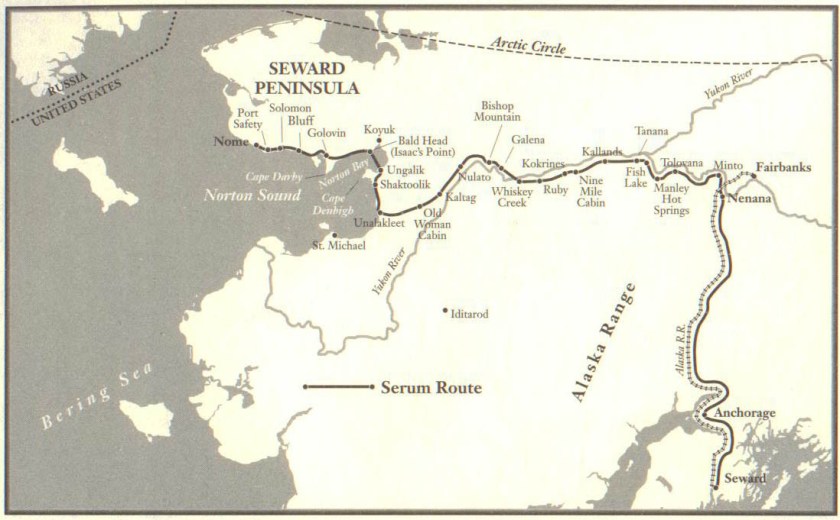


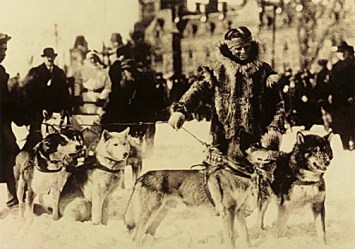 20 mushers and 150 dogs or more had covered 674 miles in 5 days, 7½ hours, a distance that normally took the mail relay 2-3 weeks. Not a single serum ampule was broken.


 “The once tight fabric covering the wings and fuselage was weak from all the rough landings as well as the wind and rain. Dirt and oil caked the engine and prop. Wires for the rudders and elevators hung from the sides of the fuselage.” Even in such disrepair, the pilots and mechanics thought one of the planes could be ready to go Nome in just three days, a flight they thought would take no more than 6-hours”.





 The younger Williams died of Leukemia two years later, despite a bone marrow donation from his sister. John-Henry joined his father, in 2004.

 The terrain was considered unsuitable for such an attack. The tactical surprise was complete, British and American forces separated and driven back, their positions forming an inward “bulge” on wartime battle maps.
 Historian Stephen Ambrose wrote “Band of Brothers” nearly fifty years later, a non-fiction account later broadcast as an HBO mini-series, of the same name. The story refers to a black nurse named Anna. There is a brief appearance and then she is gone. No one knew who Anna was, or even if she was real.
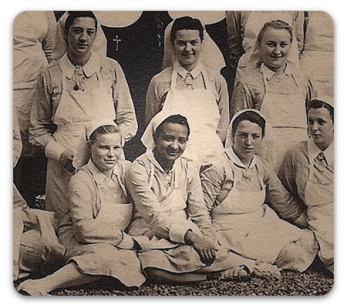 Augusta Chiwy came back to Belgium when she was nine, one of the luckier of thousands born to European fathers, and African mothers. Back to the doctor’s home in Bastogne, a small town of 9,000 where Augusta was loved and cared for by her father and his sister, whom the girl knew as “aunt Caroline”.

 Augusta Chiwy was in a neighboring building at the time. The explosion blew the petite nurse through a wall but, unhurt, she picked herself up and went back to work. There were grisly injuries and many died due to inadequate medical facilities, but many lived, their families reunited thanks to the tireless work of Dr. Jack Prior, and nurse Augusta Chiwy.
 Augusta Chiwy suffered symptoms of post-traumatic stress disorder, a condition poorly understood at that time. She would go long periods without speaking, becoming quiet and withdrawn even years later. She married a Belgian soldier in 1959 and the couple had two children. It would be twenty years, before she resumed her nursing career. She almost never spoke of her experience in Bastogne.
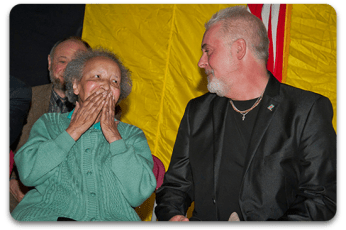 Albert II of Belgium. Six months later she received the U.S. Army’s Civilian Award for Humanitarian Service. And on March 21, 2014, Augusta was recognized by her hometown as a Bastogne Citizen of Honor”.







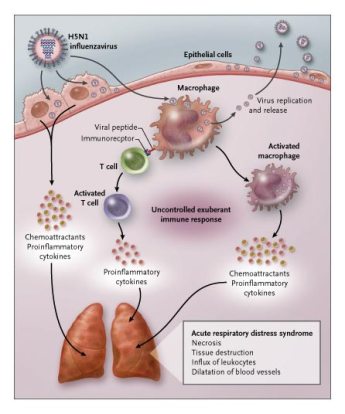
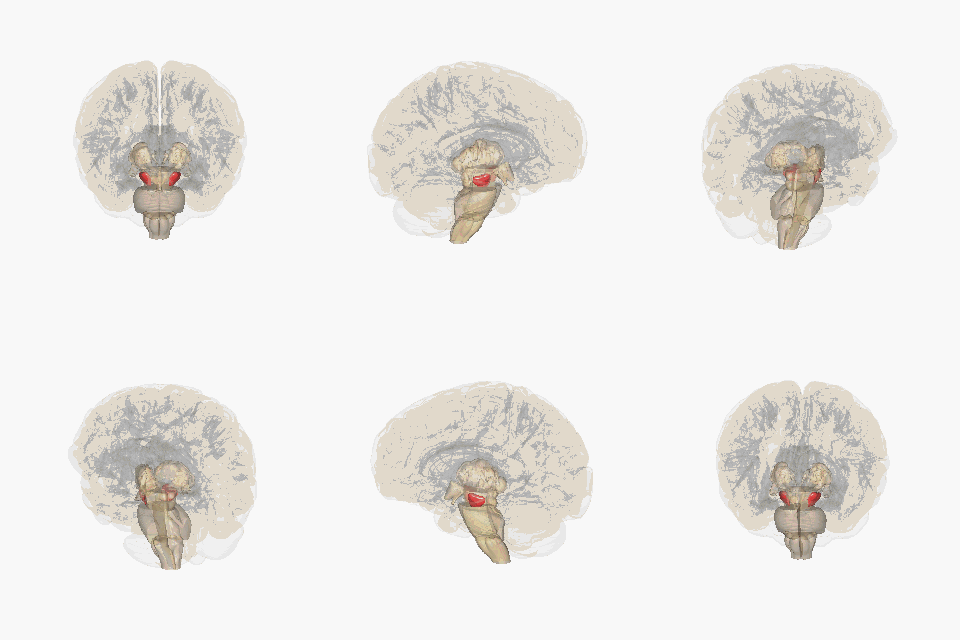
 The worldwide Encephalitis Lethargica epidemic afflicted some five million people between 1915 and 1924. One-third of sufferers died in the acute phase of the disease, a higher mortality rate than the Spanish flu of 1918-’19. Many of those who survived never returned to their pre-existing state of “aliveness”, and lived the rest of their lives institutionalized, as described above.
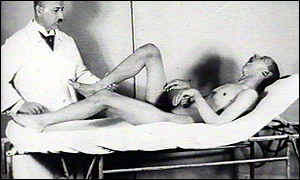 Individual cases continue to pop up, but have never assumed the pandemic proportions of 1915-’24. Further study is needed but, perversely, such study is only possible given more cases of the disease. For now, Encephalitis Lethargica must remain one of the great medical mysteries of the twentieth century. An epidemiological conundrum, locked away in a nightmare closet of forgotten memory.
 Historical Easter Eggs - Today in History
You must be logged in to post a comment.