

In 1922, a bank teller named Grace Fryer began to feel soreness in her jaw. She was 23 at the time and too young to have her teeth falling out, yet that’s what was happening. Her doctor was able to identify the problem, but he couldn’t explain it. Grace Fryer’s jawbones were so honeycombed with holes, they looked like moth eaten fabric.
On December 21, 1898, Marie and Pierre Curie discovered the 88th element of the Periodic Table. This new and radioactive element was Radium, one of the ‘alkaline earth metals’. Curie’s work would make her the first female recipient of a Nobel Prize in 1906, and the only person of either sex to ever win two Nobels, in 1911.
There have been strange fads over the years, from goldfish swallowing to pole sitting, but none stranger than the radium craze of 1904. Newspapers waxed rhapsodic about cities of the future, streets aglow in the light of radium lamps as smiling restaurant patrons enjoyed luminescent cocktails. Serious doctors had early successes killing cancer cells, while quacks and charlatans sold radium creams, drinks and suppositories to cure everything from acne to warts.
An unseen benefit of the craze, at least for a time, was that demand for radium was vastly greater than actual production. Prices skyrocketed to $84,500 per gram by 1915, equivalent to $1.9 million today. Authorities warned consumers to be on the lookout for fake radium, while the business in fake radium products soared.
When WWI began, it didn’t take long to recognize the advantages of glow in the dark instruments. A number of companies stepped up to fill the need, perhaps none larger than US Radium and their glow-in-the-dark paint, “Undark”.
Hundreds of women worked in their factories, hand painting the stuff on watches, gun sights and other instruments. Radioactivity levels were so small as to be harmless to users of these objects, but not so to the people who made them.

The harmful effects of radiation were relatively well understood by 1917, though the information was kept from factory workers. Camel hair brushes tended to splay out with use, supervisors encouraged the women to sharpen their brushes using their lips and tongues. The stuff was odorless and tasteless, some couldn’t resist the fun of painting nails and even teeth with the luminous paint. The only side effects of all that radium, they were told, would be rosy cheeks.
The active ingredient in Undark was a million times more active than Uranium, and company owners and scientists knew it. Company labs were equipped with lead screens, masks and tongs, while literally everything on the factory floor, glowed.
In 1925, doctors began to suspect that Grace Fryer’s condition may be related to her previous employment in US Radium’s Orange, New Jersey factory. By that time she was seriously ill, yet Columbia University “Specialist” Frederick Flynn and a “Colleague” pronounced her to be in “fine health”. It was only later that the two were revealed to be company executives.
These US Radium guys must have been genuine, mustache twirling, villains. In the early 20s, company officials hired physiologist and Harvard Professor Cecil Drinker to report on working conditions. Drinker’s report detailed catastrophically dangerous working conditions, with virtually every factory employee suffering blood or bone conditions.
The report filed with the New Jersey Department of Labor omitted all of it, describing conditions in glowing terms (pun not intended), claiming that “every girl is in perfect condition”.
Reports of illness among other women came flooding in. In a tactic that may sound familiar today, US Radium took to assassinating the character of these women, claiming that their symptoms resulted from syphilis.
 Attorney Raymond Berry filed suit on Fryer’s behalf in 1927, the lawsuit joined by four other dial painters seeking $250,000 apiece in damages. Soon, the newspapers were calling them “radium girls”. The health of all five plaintiffs was deteriorating rapidly, while one stratagem after another was used to delay proceedings. By their first courtroom appearance in January 1928, none could raise their arm to take the oath. Grace Fryer was altogether toothless by this time, unable to walk, requiring a back brace even to sit up.
Another dial painter, Amelia Maggia, had had to have her jaw removed in the last months of her life. Her cause of death was ruled as syphilis, but her dentist wasn’t buying it. Dr. Joseph Knef placed the jaw on a piece of dental film, the resulting image showing “absurd” levels of radiation.
The radium girls were far too sick to attend the next hearing in April, when the judge ordered a continuation to September, an accommodation to several company witnesses “summering” in Europe.
Walter Lippmann of the New York World called it a “damnable travesty of justice”. “There is no possible excuse for such a delay”, Lippmann wrote. “The women are dying. If ever a case called for prompt adjudication, it is the case of five crippled women who are fighting for a few miserable dollars to ease their last days on earth. This is a heartless proceeding. It is unmanly, unjust and cruel. This is a case which calls not for fine-spun litigation but for simple, quick, direct justice.”
Delay was a deliberate and sleazy tactic, and it worked. Plaintiffs accepted a settlement of $10,000 apiece, plus legal fees and a $600 annual annuity. The deal was mediated by Judge William Clarke, himself a US Radium stockholder. None of them lived long enough to cash more than one or two annuity checks.
Marie Curie herself was dead by 1934, poisoned by radiation. With a half-life of 1,600 years, her lab notebooks remain too hot to handle, to this day.
Radium was synthesized for the first time two years later, on February 4, 1936. Presumably, factory workers using the stuff were no longer encouraged to sharpen their brushes, by licking them.


 Edward Donald “Eddie” Slovik was paroled in 1942, his criminal record making him 4F. “Registrant not acceptable for military service”. He took a job at the Montella Plumbing and Heating company in Dearborn, Michigan, where he met bookkeeper Antoinette Wisniewski, the woman who would later become his wife.
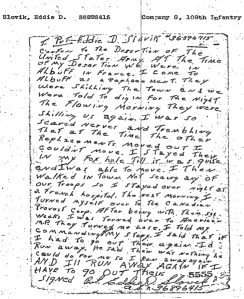 of my desertion we were in Albuff [Elbeuf] in France. I came to Albuff as a replacement. They were shelling the town and we were told to dig in for the night. The following morning they were shelling us again. I was so scared, nerves and trembling, that at the time the other replacements moved out, I couldn’t move. I stayed there in my fox hole till it was quiet and I was able to move. I then walked into town. Not seeing any of our troops, so I stayed over night at a French hospital. The next morning I turned myself over to the Canadian Provost Corp. After being with them six weeks I was turned over to American M.P. They turned me loose. I told my commanding officer my story. I said that if I had to go out there again I’d run away. He said there was nothing he could do for me so I ran away again AND I’LL RUN AWAY AGAIN IF I HAVE TO GO OUT THERE. — Signed Pvt. Eddie D. Slovik A.S.N. 36896415”.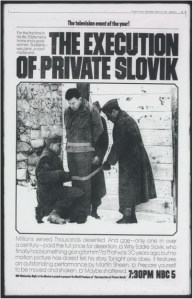
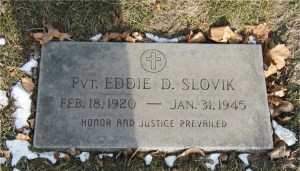 In 1987, President Ronald Reagan ordered the repatriation of Slovik’s remains. He was re-interred at Detroit’s Woodmere Cemetery next to Antoinette, who had gone to her final rest eight years earlier.
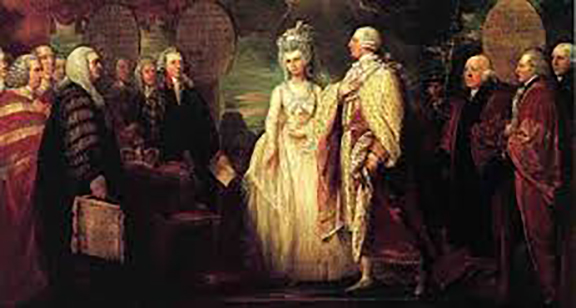
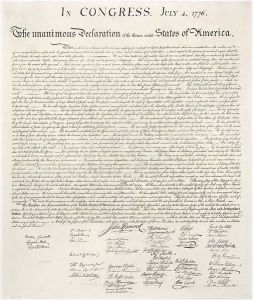 be self-evident, that all men are created equal, that they are endowed by their Creator with certain unalienable Rights, that among these are Life, Liberty and the pursuit of Happiness”.

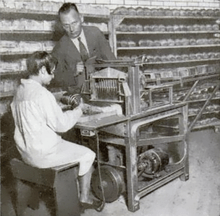 The project almost ended in a fire in 1917, when the prototype was destroyed along with the blueprints. Rohwedder soldiered on, by 1927 he had scraped up enough financing to rebuild his bread slicer.
 Article 1, Section 8 of the Constitution includes the “Commerce Clause”, permitting the Congress “To regulate Commerce with foreign Nations, and among the several States, and with the Indian Tribes”. That’s it. The Federal District Court sided with the farmer, but the Federal government appealed to the US Supreme Court, arguing that, by withholding his surplus from the interstate wheat market, Filburne was effecting that market, and therefore fell under federal government jurisdiction under the commerce clause.
 government had a billion bushels of wheat stockpiled at the time, about two years’ supply, and the amount of steel saved by not making bread slicers has got to be marginal, at best.

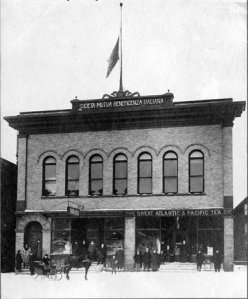 families gathered on Christmas Eve at the “Societa Mutua Beneficenza Italiana”, the Italian Hall in Calumet, Michigan, for a Christmas party sponsored by the Ladies Auxiliary of the WFM.
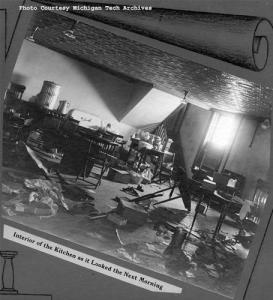 Miners Charles Moyer publicly accused members of the pro management “Citizens Alliance” of responsibility for the disaster. He was subsequently assaulted by members of the Alliance, who shot and kidnapped him, placing him on a train with instructions to leave Michigan and never return. Moyer would later receive medical attention in Chicago, holding a press conference where he displayed his gunshot wound before returning to Michigan and resuming his work with the WFM.
 1st amendment right to free speech. It’s a paraphrasing of Justice Oliver Wendell Holmes, Jr.’s opinion in the 1919 SCOTUS decision, Schenck v. United States, a case which turned, in part, on the Italian Hall disaster of seven years earlier.


You must be logged in to post a comment.