September 24, 1789 SCOTUS

Over time, SCOTUS has proven itself to be as imperfect as any other institution. There have only been 112 justices in the history of the court. Some of them have been magnificent human beings, and some of them cranks.

Article III of the Constitution establishes the Supreme Court of the United States (SCOTUS), and “such inferior Courts as the Congress may from time to time ordain and establish”.

There’s no mention of the number of justices. The first Congress passed the Federal Judiciary Act on September 24, 1789, creating a six-justice Supreme Court.

Twelve years later, the presidency of John Adams was coming to an end. As a Federalist, Adams wanted nothing more than to stymie the incoming administration of Democratic-Republican Thomas Jefferson. Toward that end, Adams appointed the infamous “midnight judges” in the last hours of his administration: 16 Federalist Circuit Court judges and 42 Federalist Justices of the Peace.

350px-Plaque_of_Marbury_v._Madison_at_SCOTUS_BuildingThe incoming Jefferson administration sought to block the appointments. Jefferson ordered then-Secretary of State James Madison to hold those commissions as yet undelivered, thus invalidating the appointments. One of the appointees, William Marbury, took the matter to Court.

The case advanced all the way to the Supreme Court, which ruled in Marbury v. Madison that the provision of the Judiciary Act enabling Marbury to bring his claim, was unconstitutional. Marbury had lost his case, but the principle of judicial review, the idea that the court could preside, Godlike, over laws passed by their co-equal branch of government, has been the law of the land, ever since.

In the early days of the Great Depression, Federal agricultural officials conceived the hare brained idea that artificially introducing scarcity would increase prices, and therefore wages, in the agricultural sector. Six million hogs were destroyed in 1933. Not harvested, just destroyed and thrown away. 470,000 cattle were shot in Nebraska alone. Vast quantities of milk were poured down sewers, all at a time of national depression when malnutrition was widespread.

chapter-23-the-new-deal-22-638

With the Agricultural Adjustment Act of 1938, Washington began to impose production quotas on the nation’s farmers. Ohio farmer Roscoe Filburne was ordered to grow 223 bushels of wheat in the 1941 season. Filburne grew 462.

Article 1, Section 8 of the Constitution permits Congress “To regulate Commerce with foreign Nations, and among the several States, and with the Indian Tribes”. On this flimsy basis, the Federal Government took Roscoe Filburne to court.

The farmer argued that the “surplus” stayed on his farm, feeding his family and his chickens. Lower Courts sided with Filburne. The government appealed all the way to the Supreme Court, arguing that, by withholding his surplus, Filburne was effecting interstate market conditions, thereby putting him under federal government jurisdiction.

Supreme_Court_cartoonIntimidated by the Roosevelt administration’s aggressive and illegal “court packing scheme“, SCOTUS ruled against the farmer. Ever since, what you don’t do can be held against you in a court of law. Get it? Neither do I.

Over time, SCOTUS has proven itself to be as imperfect as any other institution. There have only been 17 Chief Justices and 101 Associate Justices in the entire history of the court. Five Chiefs having previously sat as Associate Justices, there are only 113 in all.

Some of them have been magnificent human beings, and some of them cranks. There have been instances of diminished capacity ranging from confusion to outright insanity. One justice spent part of his term in a debtor’s prison.  Another killed a man. There have been open racists and anti-Semites.

There is no official portrait of the 1924 court because Justice James C. McReynolds wouldn’t stand next to Louis Brandeis, the court’s first Jewish Justice. One Justice was known to chase flight attendants around his quarters, while another spent his time in chambers watching soap operas.

There’s the former Klan lawyer turned Justice who took a single phrase, “separation of church and state”, from a private letter of Thomas Jefferson, and turned the constitutional freedom OF religion into an entirely made up freedom FROM religion.

The Supreme Court reinforced chattel slavery with the Dred Scott decision.  The Korematsu ruling gave us the forced incarceration of Americans of Japanese descent. Buck v. Bell gave American women the gift of forced sterilization, and Stenberg v. Carhartt enshrined the constitutional “right” to the hideous and detestable “procedure” known as partial birth abortion. From “Separate but Equal” to the “rights” of terrorists, SCOTUS’ rulings are final, inviolate, and sometimes imbecilic.

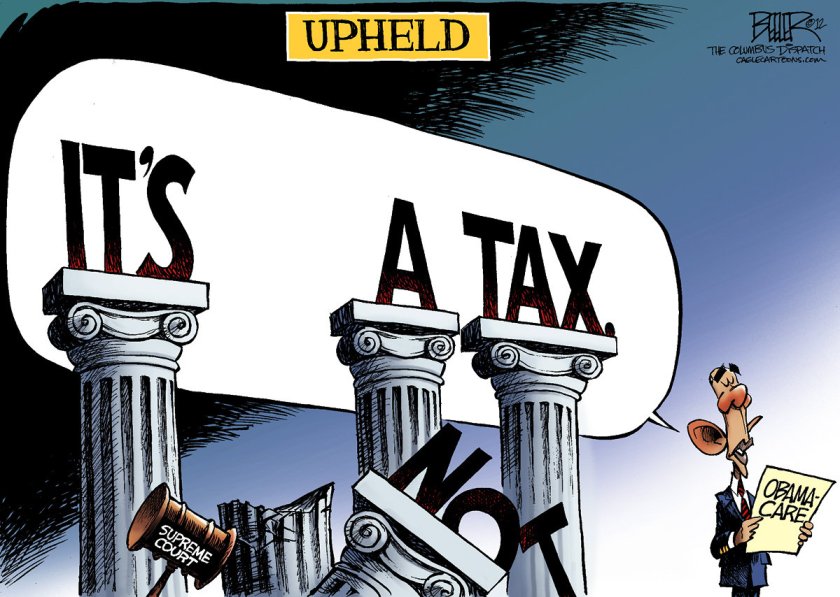
Chief Justice John Roberts, who once said “remember that it’s my job to call balls and strikes, and not to pitch or bat,” invented a whole new definition of taxation, enshrining the “Affordable Care Act” as the law of the land.

ConstitutionThe framers gave us a Constitutional Republic with co-equal branches of government, with power diffused and limited by a comprehensive set of checks and balances.

They gave us two distinct means to amend that Constitution, should circumstances require it.

Traditionally, Congress proposes amendments, submitting them to the states for ratification. The problem is that many believe Congress itself to be part of the problem, and a broken institution is unlikely to fix itself.

Article V gives us a way to amend the constitution, if we would take it. Instead of Congress proposing amendments, an Article V convention of state legislatures would propose amendments, to take effect only if ratified by a super majority of states. We could start with an amendment permitting 2/3rds of the People’s representatives in Congress, to overturn a SCOTUS decision. Then we could term limit these people.

Unless, that is, you believe it’s fine for the Federal Government to prohibit a farmer from growing wheat for his own use, that one man in a black robe can force you to buy a product you don’t want and call it a “tax”, or you believe that “established by the state” means by the state or federal government, at the sole discretion of the man who says, “I’m from the Government. I’m here to help”.
SCOTUS

July 30 1945 USS Indianapolis

“This is Captain McVay’s dog tag from when he was a cadet at the Naval Academy. As you can see, it has his thumbprint on the back. I carry this as a reminder of my mission in the memory of a man who ended his own life in 1968. I carry this dog tag to remind me that only in the United States can one person make a difference no matter what the age. I carry this dog tag to remind me of the privilege and responsibility that I have to carry forward the torch of honor passed to me by the men of the USS Indianapolis”.

The heavy cruiser USS Indianapolis set out on its secret mission on July 16, 1945, under the command of Captain Charles Butler McVay, III.  She was delivering “Little Boy” to the Pacific island of Tinian, the atomic bomb which would later be dropped on Hiroshima.

USS_Indianapolis_at_Mare_IslandIndianapolis made her delivery on July 26, arriving at Guam two days later and then heading for Leyte to take part in the planned invasion of Japan. She was expected to arrive on the 31st.
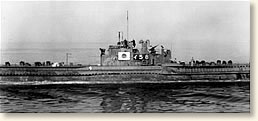
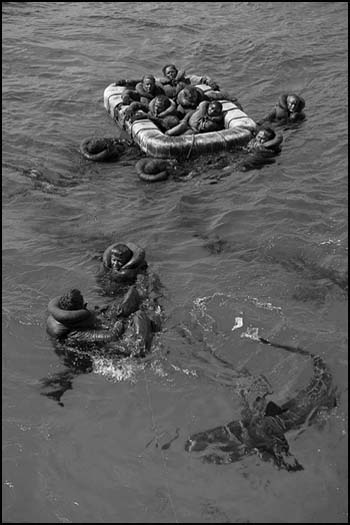
Japanese submarine I-58, Captain Mochitsura Hashimoto commanding, fired a spread of six torpedoes at the cruiser, two striking Indianapolis’ starboard bow at fourteen minutes past midnight on Monday, July 30. The damage was massive. Within 12 minutes she had rolled over, gone straight up by the stern, and sunk beneath the waves.

About 300 of Indianapolis’ 1,196-member crew were killed outright, leaving almost 900 treading water. Many had no life jackets and there were few life boats.  There had been too little time.Indianapolis Sub

For four days they treaded water, alone in open ocean, hoping for the rescue that did not come.   Shark attacks began on the first day, and didn’t let up for the entire time they were in the water. Kapok life vests became waterlogged and sank after 48 hours, becoming worse than useless.

Exhaustion, hypothermia, and severe sunburn took their toll as the days went by. Some went insane and began to attack shipmates.  Others found the thirst so unbearable that they drank seawater, setting off a biological chain reaction which killed them in a matter of hours.

Some simply swam away, following some hallucination that only they could see. Through it all, random individuals would suddenly rise up screaming from the ocean, and then disappear from sight, as the sharks claimed another victim.

indianapolis_2
Caribbean Reef sharks circling the sailors in reenactment scene after USS Indianapolis had been sunk by Japanese submarine. As seen on OCEAN OF FEAR: WORST SHARK ATTACK EVER.

At Naval Command, there was confusion about where Indianapolis was to report when it arrived.  When the cruiser failed to arrive on the 31st, there was no report of the non-arrival.  Perhaps worst, a message which could have clarified Indianapolis’ expected arrival on Monday came through garbled, and there was no request to repeat it.

As it was, only the barest of chances led to Indianapolis’ survivors being located at all.   Lieutenant Wilbur Gwinn, pilot of a Ventura scout-bomber, had lost the weight from a navigational antenna wire.  Belly-crawling through the fuselage to fix the thrashing antenna, Gwinn noticed an oil slick.  Back in the cockpit, he dropped down to have a better look.  Only then did he spot men floating in open ocean.

Lieutenant R. Adrian Marks and his PBY Catalina amphibious patrol aircraft were the first on the scene.  Horrified to see sharks actually attacking the men below, Marks landed his flying boat at sea.   The last Indianapolis survivor was plucked from the ocean Friday afternoon, half dead after almost five days in the water.  Of the 900 or so who survived the sinking, only 317 remained alive at the end of the ordeal.

The Navy had committed multiple errors, from denying McVay’s requested escort to informing him that his route was safe, even when the surface operations officer knew at least two Japanese submarines operated within the area.  No Matter.  A capital ship had been lost and someone was going to pay.  A hastily convened court of inquiry was held in Guam on August 13, leading to Captain McVay’s court-martial.

No less a figure than Fleet Admiral Chester Nimitz (CINCPAC) and Admiral Raymond Spruance, for whom the Indianapolis had served as 5th Fleet flagship, opposed the court-martial, believing McVay to be guilty of an error in judgement at worst, not gross negligence. Naval authorities in Washington saw things differently, particularly Navy Secretary James Forrestal and Chief of Naval Operations Admiral Ernest King.

Captain McVay’s orders were to “zigzag” at discretion, a naval maneuver most effective at avoiding torpedoes already in the water.   No Navy directives in effect at that time or since have so much as recommended, let alone ordered, zigzagging at night or in poor visibility.

Prosecutors flew I-58 commander Hashimoto in to testify at the court-martial, but he swore that zigzagging would have made no difference.  The Japanese Commander even became part of a later effort to exonerate McVay, but to no avail. Charles Butler McVay III was convicted of “hazarding his ship by failing to zigzag”, his career ruined.

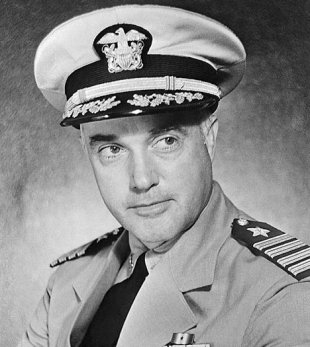
Captain Charles Butler McVay, III

McVay had wide support among Indianapolis’ survivors, but opinion was by no means unanimous. Many family members held him personally responsible for the death of loved ones.  Birthdays, anniversaries and holidays would come and go.  There was almost always hate mail from some family member. One Christmas missive read “Merry Christmas! Our family’s holiday would be a lot merrier if you hadn’t killed my son”.

As the years went by, McVay began to question himself.  In time, he came to feel the weight of the Indianapolis’ dead, a soul crushing burden from which there was no escape.  On November 6, 1968, Charles McVay took a seat on his front porch in Litchfield Connecticut, took out his Navy revolver, and killed himself.  He was cremated, his ashes scattered at sea.

The ULTRA code-breaking system which revealed I-58’s presence on Indianapolis’ course, would not be declassified until the early 90s.

Afterward:

Hunter Alan Scott was 11 and living in Pensacola when he saw the movie “Jaws”, in 1996. He was fascinated by the movie’s brief mention of Indianapolis’ shark attacks.  The next year, he created his 8th grade “National History Day” project on USS Indianapolis’ sinking.

The boy interviewed nearly 150 survivors and reviewed 800 documents.  The more he read, the more he became convinced that Captain McVay was innocent of the charges for which he’d been convicted.

Scott’s National History Day project went up to the state finals, only to be rejected because he used the wrong type of notebook to organize the material.

He couldn’t let it end there. Scott began to attend Indianapolis survivors’ reunions, at their invitation, and helped to gain a commitment in 1997 from then-Representative Joe Scarborough that he would introduce a bill in Congress to exonerate McVay the following year.

Senator Bob Smith of New Hampshire joined Scarborough in a joint resolution of Congress.  Hunter Scott and several Indianapolis survivors were invited to testify before Senator John Warner and the Senate Armed Services committee on September 14, 1999.

Holding a dog tag in his hand, Scott testified “This is Captain McVay’s dog tag from when he was a cadet at the Naval Academy. As you can see, it has his thumbprint on the back. I carry this as a reminder of my mission in the memory of a man who ended his own life in 1968. I carry this dog tag to remind me that only in the United States can one person make a difference no matter what the age. I carry this dog tag to remind me of the privilege and responsibility that I have to carry forward the torch of honor passed to me by the men of the USS Indianapolis”.

The United States Congress passed a resolution in 2000, signed into law by President Bill Clinton on October 30, exonerating Charles Butler McVay, III of the charges which had led to his court martial, humiliation and suicide.

The record cannot not be expunged – Congress has rules against even considering bills which alter military records.  Yet Captain McVay had been exonerated, something that the Indianapolis survivors had tried for years to accomplish, without success.  Until the intervention of a 12-year-old boy.

The last word on the whole episode belongs to Captain Hashimoto, who wrote the Senate Armed Services Committee in 1999 on behalf of Captain McVay.  “Our peoples have forgiven each other for that terrible war and its consequences“, wrote the former submarine commander, now a Shinto Priest.  “Perhaps it is time your peoples forgave Captain McVay for the humiliation of his unjust conviction“.

July 22, 1937 Packing the Court

Article III, Section 1 of the United States Constitution creates the highest court in the land. The relevant clause states that “The judicial power of the United States, shall be vested in one Supreme Court, and in such inferior courts as the Congress may from time to time ordain and establish”. Nowhere does the document specify the number of justices.

Article III, Section 1 of the United States Constitution creates the highest court in the land. The relevant clause states that “The judicial power of the United States, shall be vested in one Supreme Court, and in such inferior courts as the Congress may from time to time ordain and establish”. Nowhere does the document specify the number of justices.Constitution

The United States was in the midst of the “Great Depression” when President Franklin Delano Roosevelt came to office in 1932. He had promised a “New Deal” for America, immediately beginning a series of sweeping legislative reforms designed to counter the devastating effects of the Depression. His initiatives faced many challenges in the courts, with the Supreme Court striking down as unconstitutional several New Deal provisions in his first term.

The Supreme Court was divided along ideological lines in 1937, as it is today. “Judicial Court Packing Scheme,1Realist” or “Liberal” legal scholars and judges argued that the constitution was a “living document”, allowing for judicial flexibility and legislative experimentation. Supreme Court justice Oliver Wendell Holmes, Jr., a leading proponent of the Realist philosophy, said of Missouri v. Holland that the “case before us must be considered in the light of our whole experience and not merely in that of what was said a hundred years ago”.
“Judicial Formalists”, today we call them “Conservatives” or “Originalists”, seek to discover the original meaning or intent of the constitution. Formalist legal scholars and judges argue that the judiciary is not supposed to create, amend or repeal law; that is for the legislative branch. The role of the court is to interpret and uphold law, or strike them down in light of the original intent of the framers, and the ratifiers, of the constitution.

In 1937, SCOTUS was divided along ideological lines, with three Liberals, four Conservatives, and two swing votes.

President Woodrow Wilson’s Attorney General, James Clark McReynolds, made a proposal in 1914 that: “(When) any judge of a federal court below the Supreme Court fails to avail himself of the privilege of retiring now granted by law (at age 70), that the President be required, with the advice and consent of the Senate, to appoint another judge, who would preside over the affairs of the court and have precedence over the older one. This will insure at all times the presence of a judge sufficiently active to discharge promptly and adequately the duties of the court”.

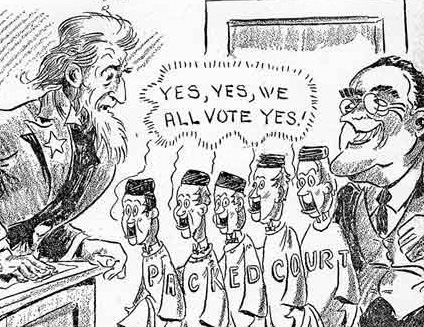
Court Packing SchemeTo Roosevelt, that was the answer. The age 70 provision allowed him 6 more handpicked justices, effectively ending Supreme Court opposition to his policies.
Roosevelt’s “Judiciary Reorganization Bill of 1937” immediately came under sharp criticism from legislators, bar associations, and the public. The Senate Judiciary Committee began hearings on the bill on March 10, 1937, reporting it “adversely” by a committee vote of 10 to 8. The full senate took up the matter on July 2, with the Roosevelt administration suffering a disastrous setback when Senate Majority Leader Joseph T. Robinson, a powerful supporter of the legislation, died of a heart attack.

The full Senate voted on July 22, 1937, to send the bill back to the Judiciary Committee, where provisions for additional justices were stripped from the bill. A modified version passed in August, but Roosevelt’s “court packing” scheme was dead.

In the end, the President had the last word. After an unprecedented four terms, Roosevelt would eventually appoint eight of nine justices to the Court.

July 21, 1925 Monkey Trial

H.L. Mencken, writing for the Baltimore Sun, mocked the prosecution and the jury as “unanimously hot for Genesis.” He called the town’s inhabitants “yokels” and “morons”, Bryan was a “buffoon” and his speeches “theologic bilge”.  It was Mencken who dubbed the proceedings, “Monkey Trial”.  The defense, on the other hand, was “eloquent” and “magnificent”.  Or so he claimed.  No media bias there.

State of Tennessee v. John Thomas Scopes, better known as the “Scopes Monkey Trial”, began when State Representative John W. Butler passed the “Butler Act”, prohibiting teaching of the theory of evolution in Tennessee public schools, colleges and universities.

The ACLU immediately announced its intention to sue, offering to defend anyone accused of violating the act. Local businessman George Rappleyea arranged a meeting with the county superintendent of schools and local attorney Sue Kerr Hicks, a man who may have been the inspiration for Shel Silverstein’s “A Boy Named Sue,” which everyone knows from the Johnny Cash song of 1969.

Read your bibleThe three met at Robinson’s Drug Store, and agreed that their little town of Dayton, Tennessee could use the publicity. The trio summoned 24-year-old High School football coach and part time substitute teacher John T. Scopes, asking him to plead guilty to teaching the theory of evolution. Scopes replied that he could not recall if he had taught evolution, but he would be more than happy to be the defendant if anyone could prove that he had.
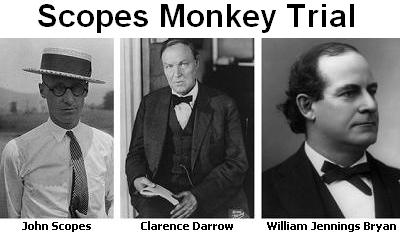
Scopes was charged on May 5, barely two months after the law’s enactment, with teaching evolution from “Civic Biology”, a textbook describing the theory of evolution, race and eugenics. The Prosecution brought in William Jennings Bryan to try the case and the defense hired Clarence Darrow. Two of the heaviest of jurisprudential heavy hitters of the day, were now lined up in the “Trial of the Century”.

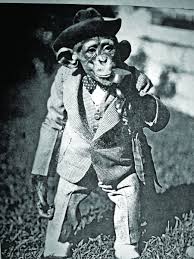
Bryan complained that evolution taught children that humans were no more than one of 35,000 mammals. He rejected the idea that humans were descended from apes. “Not even from American monkeys, but from old world monkeys”. The ACLU wanted to oppose the Butler Act on grounds that it violated teacher’s individual rights and academic freedom, but it was Darrow who shaped the case, taking the position that the theistic and the evolutionary view were not mutually exclusive. Chimpanzee

What had begun as a publicity stunt soon became an overwhelming media event. 200 newspaper reporters from all over the country were in Dayton, along with two from London. Twenty-two telegraphers sent out 165,000 words a day over thousands of miles of telegraph wires, hung specifically for the purpose.

Trained chimpanzees performed on the courthouse lawn.  Chicago’s WGN radio personality Quin Ryan broadcast the nation’s first on-the-scene coverage of a criminal trial. A specially constructed airstrip was prepared, from which two movie cameramen had their newsreel footage flown out, daily.

H.L. Mencken, writing for the Baltimore Sun, mocked the prosecution and the jury as “unanimously hot for Genesis.” He called the town’s inhabitants “yokels” and “morons”. Bryan was a “buffoon” and his speeches “theologic bilge”.  It was Mencken who dubbed the proceedings, “Monkey Trial”.  The defense, on the other hand, was “eloquent” and “magnificent”.  Or so he claimed.  No media bias there.

Scopes TrialAfter eight days of trial, it took the jury only nine minutes to deliberate, finding Scopes guilty on July 21. He was ordered to pay a $100 fine, equivalent to about $1,300 today. The conviction was overturned by the Tennessee Supreme Court, on the basis that state law required fines over $50 to be decided by jury, and not by the judge presiding.

American creationists believe to this day, that media reports turned public opinion against the creationist view. Evolution vs Creation debates can be reasonably expected to continue.  Neither view seems supportable, by much more than the faith of its adherents.

April 10, 1869 SCOTUS

There have been fewer justices in Supreme Court history than you might think. The recent passing of Antonin Scalia made way for only number 113

ConstitutionThe Stuart King James had judges riding into the countryside once a year to hear cases, saving many of his subjects the arduous journey to London.  The custom carried “across the pond” and, from the earliest days of the American colonies, judges could be found “riding the circuit”.

Article III of the United States Constitution establishes the judiciary as a coequal branch of the federal government, “vested in one supreme Court, and in such inferior Courts as the Congress may from time to time ordain and establish”. That’s about it.

Congress passed the Federal Judiciary Act in 1789, creating a six justice Supreme Court, and signed into law by President George Washington on September 24.  Principally written by Senator Oliver Ellsworth of Connecticut, the act established the office of Attorney General, and largely laid out the Federal court system, as it exists today.

United States Circuit courts were established in each federal judicial district, exercising jurisdiction over both original (first instance) matters and appeals, until the creation of the Federal Court of Appeals, in 1912.

Judicial Districts map
2017 Judicial Districts map

Supreme Court justices were not exempt from Circuit court duty, each justice “riding the circuit” to hear cases in his own district, in addition to his caseload, back at the capital.

Smaller districts may occupy a single federal courthouse, while larger districts stretch across thousands of miles.  This duty became increasingly onerous, until finally abolished by the Judiciary Act of 1891. Yet, the vestiges of this system remain. Today, each justice hears certain provisional appeals from specific circuits, which he or she may decide unilaterally, or refer “en banc” to the entire Court.

Increasing caseloads led Congress to increase the number of judicial districts to seven in 1807, and nine in 1837, finally raising that to ten during the Civil War.  With each new district, came another justice.

In one of the political skirmishes leading to President Andrew Johnson’s impeachment in 1868, Congress passed the Judicial Circuits Act in 1866, shrinking the number of justices to seven, thus preventing Johnson from appointing any new justices.

Congress raised the number to nine circuits with nine justices on April 10, 1869.  Today there are eleven federal judicial districts, while the number of justices remain at nine.

Supreme_Court_cartoonIn 1937, President Franklin Delano Roosevelt sought to increase the number of justices to 15. Then as now, the court was sharply divided along ideological lines, consisting of a four member conservative majority called the “four horsemen”, three liberals dubbed the “three musketeers” and two “swing votes”.

The conservative bloc became a roadblock to President Roosevelt’s New Deal programs, preferring the federal government take a hands off approach to the economy.

Buoyed by his landslide reelection in 1936, Roosevelt proposed to provide retirement at full pay for all justices over 70.  Any justice refusing retirement would be provided with an “assistant” with full voting rights, providing Roosevelt with an overwhelming liberal majority.

Not even vice president John Nance Garner would go along with Roosevelt’s aggressive and illegal “court packing scheme”, nor would a democrat-controlled congress. Yet Roosevelt’s effort had the desired result, as former swing vote Owen Roberts became a reliable vote for the liberal minority. By the time of his death 1945, Roosevelt had appointed every justice on the court, except Roberts himself.

supremecourtThere have been fewer justices in Supreme Court history than you might think.  The recent passing of Antonin Scalia made way for only number 113.

A proponent of “Judicial Originalism”, justice Scalia and his conservative allies on the court seek to decide on the constitutionality of the laws before them, based on what the framers of the constitution intended when they actually wrote the thing. In contrast, the liberal majority believes in a “living constitution”, a form of jurisprudence whose supporters believe the Constitution is a document which adapts to the times.  Detractors believe that amounts to law-making from the bench, a job more properly left the legislature.

With the ideological makeup of the Supreme Court hanging in the balance, President Obama and his allies pulled out all the stops to get his nominee confirmed and seated before the end of his presidency. The Republican controlled Senate invoked the “Biden Rule”, as described in the former Vice President’s 1992 speech on the Senate floor:  “It would be our pragmatic conclusion that once the political season is underway, and it is, action on a Supreme Court nomination must be put off until after the election campaign is over.”

Barack Obama himself tried to block the confirmation of Samuel Alito in 2006, saying Filibuster“There are some who believe that the president, having won the election, should have complete authority to appoint his nominee, that once you get beyond intellect and personal character, there should be no further question as to whether the judge should be confirmed. I disagree with this view”. The filibuster was joined by Senators Kennedy, Leahy, Durbin, Salazar, and Baucus.

In 2007, now-Senate minority leader Chuck Schumer said “We should not confirm any Bush nominee to the Supreme Court, except in extraordinary circumstances”. That was 19 months before the next presidential inauguration.

The resulting conflict is great fodder for the bicker fest that passes for our national politics, from the legacy media and the talking heads of the punditocracy, to the endless and meaningless cage matches over the rhetorical anthills of Facebook.

CapitolSenator Schumer once said, “We have three branches of government. We have a house, we have a senate, we have a president.” He got that wrong, but he was part right.  We have three co-equal branches in our government, each having specific responsibilities as laid out in the Constitution.

The “advice and consent” clause contained in Article II grants the President authority to appoint judges to the Supreme Court, “by and with the Advice and Consent of the Senate.”  The Senate, for its part, will do what the Senate will do.

Later today, Justice David Kennedy will administer the oath of office to his former law clerk, judge Neil Gorsuch.  The 113th justice of the United States Supreme Court, and the first in history to serve alongside the justice for whom he once clerked.

March 25, 1911 Triangle Shirtwaist Fire

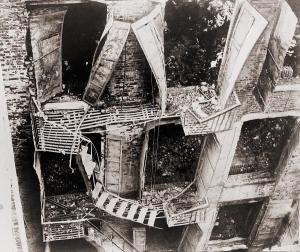
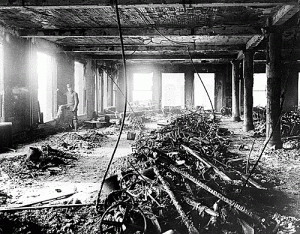
The fire started in a wicker scrap bin on the 8th floor, and spread quickly. A bookkeeper warned coworkers on the 10th by telephone, but there was no way to contact anyone on the 9th.

As the late 19th century gave way to the 20th, the increasing number of women in the workforce was driving a change in women’s fashion.  Gone were the confinements of Victorian era bodices.  The “shirtwaist” blouses of the Edwardian era were patterned on men’s shirts only looser, ranging from plain, “ready to wear” simplicity to the elaborate detail and stitching that transformed the plain shirtwaist to haute mode.

A September 16, 1906 article in the Pittsburgh Press said, “A very fashionable woman with a half a hundred waists boasts that there are no two alike.”  Shirtwaist blouses were sold around the country, but most were made in Philadelphia and New York City.

Triangle_Shirtwaist_FactoryAt the turn of the century there were over 450 textile factories in Manhattan alone, employing something like 40,000 garment workers.  Many of them were young, immigrant women of Jewish and Italian ethnicity, working nine hours a day on weekdays and seven on Saturdays.  Wages were typically low:  $7 to $12 per week, equivalent to $3.20 to $5.50 per hour, in 2016.
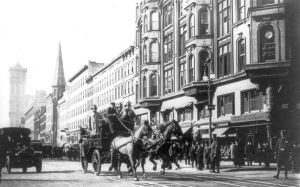
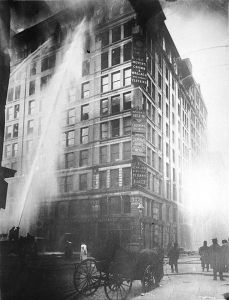
The Triangle Shirtwaist factory was located in the Asch Building in the Greenwich Village area of New York City, now known as the Brown Building and part of New York University.  In 1911, the factory occupied the 8th – 10th floors, employing some 500 people.

The fire started in a wicker scrap bin on the 8th floor, and spread quickly. A bookkeeper warned coworkers on the 10th by telephone, but there was no way to contact anyone on the 9th floor.  Survivor Yetta Lubitz said the first warning came about the same time as the flames themselves.TriangleFireengine_crop

Every one of the fatalities that day, came from the 200 working on this one floor.  The Washington Place stairwell was locked to prevent thefts & unauthorized breaks, and the foreman had fled with the keys.  The Greene Street stairwell was packed solid in three minutes.  The only survivors were those who fled to the roof.

Terrified employees crowded onto a rickety fire escape, collapsing it under the weight and dropping 20 people some 100′ to their death.  Fire companies were quick to arrive, but ladders only reached up to the 6th or 7th floors. A life net was unfurled, but ripped away when three women jumped for it, simultaneously.  For the most part, fire companies could only look on helplessly, along with the crowd gathered on the street.  62 people, some already on fire, jumped or fell to the street below.  As on 9/11, at least one couple stepped off together, holding hands as they fell.Triangle_Shirtwaist_Factory_fire_March_25_1911

With one exit on fire and the other locked, elevator operators Joseph Zito and Gaspar Mortillalo did everything they could to save lives.  Mortillalo made three trips before being forced to give up when the rails of his elevator buckled under the heat.  Desperate to get out, some victims pried open the other elevator door, hoping to slide down greasy cables, or just to jump into the shaft and hope for the best.  The weight and impact of their bodies warped Zito’s elevator car, making another rescue attempt impossible.

Reporter William Gunn Shepard learned a sound that day, that many of us remember from those first hours of 9/11.  Before the media censored itself.  “I learned a new sound that day, a sound more horrible than description can picture — the thud of a speeding living body on a stone sidewalk”.triangle-shirtwaist-factory-fire-escape-everett

Louis Waldman, later to become a Socialist state assemblyman, described the scene:  “Horrified and helpless, the crowds — I among them — looked up at the burning building, saw girl after girl appear at the reddened windows, pause for a terrified moment, and then leap to the pavement below, to land as mangled, bloody pulp”.

146 died that day, 123 women and 23 men.

The company’s owners, Max Blanck and Isaac Harris, survived by fleeing to the roof when the fire began. The pair had four suspicious factory fires between 1902 and 1910, but arson was not suspected in this case.Triangle-Shirtwaist-Fire1

Blanck and Harris were indicted on charges of 1st and 2nd degree manslaughter, but the jury acquitted them both. Their attorney convinced the jury that witnesses may have been “coached”, since their stories didn’t change on cross examination.

They lost a subsequent civil suit in 1913 in which plaintiffs won compensation amounting to $75 per dead victim. The insurance company paid $60,000 more than the reported losses, for a profit of $336 per corpse.

The fire led to 64 new laws regulating the health and safety of New York’s factory workers, and helped spur the growth of the International Ladies’ Garment Workers’ Union (ILGWU).  In 1913, Blanck was once again arrested for locking a factory door during working hours. He was fined $20.

The Triangle Shirtwaist conflagration led to the largest loss of life by fire, in New York history.  The second largest would be the “Happy Land” night club fire in the Bronx.  79 years later, to the day.

triangle shirtwaist factory

March 21, 1905 Eugenics

Some 30 states had passed legislation by the height of the eugenics movement, legalizing the involuntary sterilization of individuals considered “unfit” for reproduction. All told, some 60,000 individuals were forcibly sterilized in state-sanctioned procedures.

In 380BC, Plato described a system of state-controlled human breeding in his Socratic dialogue “The Republic”, intended to create a “guardian class” over his ideal society.

In the 19th century, Francis Galton studied the theories of his cousin Charles Darwin on the evolution of species, applying them to a system of selective breeding intended to bring better human beings into the world.  He called it his theory of “Eugenics”.

Eugenics gained worldwide respectability in the early 20th century, when countries from Brazil to Japan adopted policies regarding the involuntary sterilization of certain mental patients.

“Better Babies” competitions sprang up at state fairs across the United States, where babies were measured, weighed, and “judged”, like livestock.  By the 20s, these events evolved into “Fitter Family” competitions.Better babies Certificate

One of the leaders of the eugenics movement was the pacifist and Stanford University professor, David Starr Jordan.  After writing several books on the subject, Jordan became a founding member of the Eugenics Committee of the American Breeders Association.  The upper class of America was being eroded by the lower class, he said.  Careful, selective breeding would be required to preserve the nation’s “upper crust”.

MargaretSanger
Margaret Sanger

Margaret Higgins Sanger believed that birth control should be compulsory for “unfit” women who “recklessly perpetuated their damaged genetic stock by irresponsibly breeding more children in an already overpopulated world.”

An early advocate for birth control, Sanger has her supporters to this day, including former Presidential candidate Hillary Rodham Clinton. “I admire Margaret Sanger enormously”, Clinton said.  “Her courage, her tenacity, her vision…”  Time Magazine points out that “Sanger opened the first birth-control clinic in the United States”, describing her as “An advocate for women’s reproductive rights who was also a vocal eugenics enthusiast…”

Detractors have described Sanger as a “thoroughgoing racist”, citing her own words in What Every Girl Should Know, published in 1910:  “In all fish and reptiles where there is no great brain development, there is also no conscious sexual control. The lower down in the scale of human development we go the less sexual control we find. It is said that the aboriginal Australian, the lowest known species of the human family, just a step higher than the chimpanzee in brain development, has so little sexual control that police authority alone prevents him from obtaining sexual satisfaction on the streets”.

Admire or detest the woman as you prefer, Sanger’s work established organizations that later evolved into the Planned Parenthood Federation of America.

Around the world, eugenics policies took the form of involuntarily terminated pregnancies, compulsory sterilization, euthanasia, and even mass extermination.

Madison Grant, the New York lawyer known for his work in developing the discipline of wildlife management, was a leader in the eugenics movement, once receiving an approving fan letter from none other than Adolf Hitler.Eugenics Propaganda

Public policy and academic types conducted three international eugenics conferences to advance their ideas.  The first such conference was held in Great Britain in 1912, followed by two more in 1921 and again in 1932, both in New York City.  Colleges and universities offered eugenics as an academic discipline, delving into the ethical and public policy considerations of eliminating the “degenerate” and “unfit”.

In Pennsylvania, 270 involuntary sterilizations were performed without benefit of law, between 1892 and 1931.  On March 21, 1905, the Pennsylvania legislature passed “An Act for the Prevention of Idiocy”, requiring that every institution in the state entrusted with the care of “ idiots and imbecile children”, be staffed by at least one skilled surgeon, whose duty it was to perform surgical sterilization.  The bill was vetoed by then-Governor Samuel Pennypacker, only to return in 1911, 1913, 1915, 1917, 1919, and in 1921.

By the height of the movement, some 30 states had passed eugenics legislation, legalizing the involuntary sterilization of individuals considered “unfit” for reproduction. All told, some 60,000 individuals were forcibly sterilized in state-sanctioned procedures.

California forced Charlie Follett to undergo a vasectomy in 1945 at the age of 15, when Follett found himself abandoned by alcoholic parents.   He was only one of some 20,000 Californians forced to undergo such a procedure.

Vermont passed a sterilization law in 1931, aimed at what then-University of Vermont zoology professor Henry Perkins called the “rural degeneracy problem.”  An untold number of “defectives” were forced to undergo involuntary sterilization, including Abenakis and French-Canadian immigrants.VA-Eugenic-Sterilization-Law-Upheld

Indiana passed the first eugenic sterilization law in 1907, but it was legally flawed.  To remedy the situation, the Eugenics Record Office (ERO) of the Carnegie Institution of Washington’s Station for Experimental Evolution crafted a eugenics statute, adopted by the Commonwealth of Virginia as a state statute in 1924.

That September, Superintendent of the ‘Virginia State Colony for Epileptics and Feebleminded’ Dr. Albert Sidney Priddy, filed a petition to sterilize Carrie Buck, an 18-year-old patient at his institution whom he claimed to be “incorrigible”.  A “genetic threat to society”.  Buck’s 52 year old mother had a record of prostitution and immorality, Priddy claimed, and the child to whom Buck gave birth in the institution further proved the point.

Buck’s guardian brought her case to court, arguing that the law violated the equal protection clause of the 14th amendment.  After losing in district court, the case was appealed to the Amherst County Circuit Court, the Virginia Supreme Court, and finally the United States Supreme Court.Carrie-Buck-and-Emma-Buck-1924

Dr. Priddy died along the way, Dr. John Hendren Bell taking his place.  SCOTUS decided the “Buck vs Bell” case on May 2, 1927, ruling in an 8–1 decision that Buck, her mother, and daughter Vivian, were all “feeble-minded” and “promiscuous.”

In the majority ruling, Justice Oliver Wendell Holmes, Jr., wrote:  “”It is better for all the world, if instead of waiting to execute degenerate offspring for crime, or to let them starve for their imbecility, society can prevent those who are manifestly unfit from continuing their kind…. Three generations of imbeciles are enough.”

It was later revealed that Carrie Buck had been raped by a member of the Dobbs family, the foster family who had taken her in and later had her committed.  To save their family “honor”.  No matter.  Buck was compelled to undergo tubal ligation, and later paroled to become a domestic worker with a family in Bland, Virginia.  Buck’s daughter Vivian, was adopted by this same Dobbs family.

HolmesQuoteBuckvBelIn a later examination of Vivian, ERO field worker Dr. Arthur Estabrook pronounced her “feeble minded” saying that she “showed backwardness”, supporting the “three generations” theory expressed in the SCOTUS opinion.

The child died from complications of measles in 1932, after only two years in school.  Dr. Estabrook failed to explain in his report, how she seemed to do well for those two years, nor did he explain how she came to be listed on her school’s honor roll, in April 1931.

March 4, 1789 Founding Documents

On September 25, the first Congress adopted 12 amendments, sending them to the states for ratification. The states got rid of the first two, and so the Congress’ original 3rd amendment became 1st, of what we now call the “Bill of Rights”.

Early discussions of the American experiment in self-government began 20 years before the Revolution, with the Albany Congress of 1754, and Benjamin Franklin’s proposed Albany Plan of Union. The 2nd Continental Congress appointed a drafting committee to write our first constitution in 1776, the work beginning on July 12. The finished document was sent to the states for ratification on November 15 of the following year.

articles-of-confederation_grandeTwelve of the original thirteen states ratified these “Articles of Confederation” by February, 1779. Maryland would hold out for another two years, over land claims west of the Ohio River. In 1781, seven months before Cornwallis’ surrender at Yorktown, the 2nd Continental Congress formally ratified the Articles of Confederation. The young nation’s first governing document.

The Articles of Confederation provided for a loose confederation of sovereign states. At the center stood a congress, a unicameral legislature, and that’s about it. There was no Executive, there was no Judiciary.

In theory, Congress had the authority to govern foreign affairs, conduct war, and to regulate currency. In practice, these powers were limited because Congress had no authority to enforce the requests it made on the states, either for money or for troops.

The Union would probably have broken up if the Articles of Confederation were not amended or replaced. Twelve delegates from five states met at Mann’s Tavern in Annapolis Maryland in September 1786, to discuss the issue. The decision of the Annapolis Convention was unanimous. Representatives from all the states were invited to send delegates to a new constitutional convention in Philadelphia, the following May.

The United States had won its independence from England four years earlier, when 55 state delegates convened in Philadelphia to compose a new constitution.

Delegates from 12 of the 13 colonies, (only Rhode Island abstained) met on May 25, 1787 atconstitutional_convention_1787 Philadelphia’s Pennsylvania State House. The building is now known as Independence Hall, the same place where the Declaration of Independence and the Articles of Confederation were drafted.

The assembly immediately discarded the idea of amending the Articles, instead crafting a brilliant Federal system of checks and balances over three months of debate. The Federal Republic crafted by the framers delegates specific, limited powers to the Federal Government, with authority outside those specific powers devolving to the states.

Even at the convention, there was concern about the larger, more populous states governing at the expense of the smaller states. The “Connecticut Compromise” solved the problem, creating a bicameral legislature with proportional representation in the lower house (House of Representatives) and equal representation of the states in the upper house (Senate).

signingThe Constitution was signed by 38 of the 41 delegates on September 17, 1787. As dictated by Article VII, the document would not become binding until it was ratified by nine of the 13 states.

Five states: Delaware, Pennsylvania, New Jersey, Georgia, and Connecticut ratified the document in quick succession. Some states objected to the new document, especially Massachusetts, which wanted more protection for basic political rights such as freedom of speech, religion, and the press. They wanted it specified that powers undelegated to the Federal government, were reserved to the states. A compromise was reached in February, 1788 whereby Massachusetts and other states would ratify the document, with the assurance that such amendments would be immediately proposed.

The Constitution was ratified in Massachusetts by a two vote margin, followed by Maryland and South Carolina. New Hampshire became the ninth state to ratify on June 21. The new Constitutional Government would take effect on March 4, 1789.

On September 25, the first Congress adopted 12 amendments, sending them to the states for ratification. The states got rid of the first two, and so the Congress’ original 3rd amendment became 1st, of what we now call the “Bill of Rights”. Today, the United States Constitution is the oldest written national constitution in operation in the world.

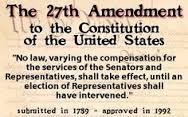
It’s interesting to note the priorities of that first Congress, as expressed in their original 1st and 2nd amendments. The ones that were thrown out. The first had to do with proportional representation, and would have led us to a 6,000 member House of Representatives, instead of the 435 we currently have. The second most important thing in the world, judging by the priorities of that first Congress, was that any future Congress could not change their own salaries. Any such change could affect only future Congresses.27th-amendment

That original 2nd amendment, reading that “No law, varying the compensation for the services of the Senators and Representatives, shall take effect, until an election of Representatives shall have intervened”, took effect in 1992 as the 27th amendment, following a ratification period stretching out to 202 years, 7 months, and 12 days. We must not be too hasty about these things.

February 22, 2005 Little Pink House

For newly divorced paramedic Susette Kelo, the house overlooking the Fort Trumbull waterfront was the home of her dreams

In 1775, Connecticut Governor Jonathan Trumbull proposed a fortification at the port of New London, situated on the Thames River and overlooking Long Island Sound. The fort was completed two years later and named for Governor Trumbull. During the Revolution, Fort Trumbull was attacked and occupied by British forces, for a time commanded by the turncoat American General, Benedict Arnold.

By the early 20th century, the Fort Trumbull neighborhood consisted of 90 or so single and multi-family working class homes, situated on a peninsula along the fringes of a mostly industrialized city center.

In 1996, chemists working at Pfizer Corporation’s research facility in England were studying compound UK-92, 480 or “Sildenafil Citrate”, synthesized for the treatment of hypertension and heart disease resulting from a restriction in blood supply to heart tissues. Study subjects were expected to return unused medication at the end of the trial. Women showed no objection in doing so but a significant number of male subjects refused to give it back. It didn’t take long to figure out what was happening.  The chemical compound which would one day bear the name “Viagra”, was going to be put to a very different use.

little-pink-houseFor newly divorced paramedic Susette Kelo, the house overlooking the Fort Trumbull waterfront was the home of her dreams. Long abandoned and overgrown with vines, the little Victorian cottage needed a lot of work, but where else would she ever find a waterfront view at this asking price?  It was 1997, about the same time that Connecticut and New London politicians resurrected the long-dormant New London Development Corporation (NLDC), charging it with developing a plan to revitalize the New London waterfront.

Susette Kelo sanded her floors on hands and knees, as Pfizer Corporation was looking at a cataract of business based on their newest chemical compound. The company was recruited to become the principal tenant in a “World Class” multi-use waterfront campus, including high-income housing, hotels, shopping and restaurants, all centered around a 750,000 sq. ft. corporate research facility.  Connecticut College professor and NLDC President Dr. Claire Gaudiani liked to talk about her “hip” new development project.  Fort Trumbull residents were convinced that stood for “High Income People”. With an average income of $22,500, that didn’t include themselves.

Most property owners agreed to sell, though not exactly “voluntarily”.  There was considerable cap_nfs_keloharassment of the reluctant ones, including late-night phone calls, waste dumped on property, and tenants locked out of apartments during cold winter weather.

Seven homeowners holding fifteen properties refused to sell, at any price. Wilhelmina Dery was in her eighties. She was born in her house and she wanted to die there. The Cristofaro family had lost another New London home in the ’70s, taken by eminent domain during yet another “urban renewal” program. They didn’t want to lose this one, too.

Susette Kelo came home from work the day before Thanksgiving 2000, to find an eviction notice taped to her door.

Letters were written to editors and rallies held, as NLDC and state officials literally began to bulldoze homes. Holdout property owners were left trying to prevent property damage from flying demolition debris.

KELO BULLOCK

Facing a prolonged legal battle which none of the homeowners could afford, the group got a boost when the Libertarian law firm Institute for Justice took their case pro bono. There was cause for hope. Retired homeowner Vera Coking had faced a similar fight against Now-President Donald Trump in 1993, when the developer and Atlantic City New Jersey authorities attempted to get her house condemned to build a limo lot.

Eminent domain exists for a purpose, but the most extreme care should be taken in its use. Plaintiffs argued that this was not a “public use”, but rather a private corporation using the power of government to take their homes for economic development, a violation of both the takings clause of the 5th amendment and the due process clause of the 14th.

Vera Coking won her case against Trump, the casino later failing and closing its doors. New Londonkelo-decision District Court, with Susette Kelo lead plaintiff, “split the baby”, ruling that 11 out of 15 takings were illegal and unconstitutional. At that point it wasn’t good enough for the seven homeowners. They had been through too much.  All of them would stay, or they would all go.

Connecticut’s highest court reversed the decision, throwing out the baby AND the bathwater in a 3-4 decision. The United States Supreme Court agreed to hear the case, argued before the seven justices then in attendance on February 22, 2005.

SCOTUS ruled in favor of New London in a 5-4 decision, Justices Stevens, Kennedy, Souter, Ginsburg and Breyer concurring. Seeing the decision as a reverse Robin Hood scheme that would steal from the poor to give to the rich, Sandra Day O’Connor wrote “Any property may now be taken for the benefit of another private party, but the fallout from this decision will not be random. The beneficiaries are likely to be those citizens with disproportionate influence and power in the political process, including large corporations and development firms”.  Clarence Thomas took an originalist view, stating that the majority opinion had confused “Public Use” with “Public Purpose”. “Something has gone seriously awry with this Court’s interpretation of the Constitution”, Thomas wrote. “Though citizens are safe from the government in their homes, the homes themselves are not”.  Antonin Scalia concurred, seeing any tax advantage to the municipality as secondary to the taking itself.

kelo-2014In the end, most of the homes were destroyed or relocated. State and city governments spent $78 million and bulldozed 70 acres.  The 3,169 new jobs and the $1.2 million in new tax revenue anticipated from the waterfront project, never materialized.  Pfizer backed out of the project and moved away, taking 1,500 existing jobs with them.  Just about the time when existing tax breaks were set to expire, raising the company’s tax bill by 400%.

The now-closed redevelopment area became a dumping ground for debris left by Hurricane Irene in 2011.  Its only residents were feral cats.

In reaction to the Kelo v. City of New London decision, a group of New Hampshire residents proposed a hotel to be built on the site of Justice David Souter’s home in Weare, New Hampshire.  Calling it the “Lost Liberty Motel”, an on-line petition was created to quantify the public benefit of the taking, generating at least 1,418 signatories committing to stay there at least a week. Supporters claimed to be serious, but the measure was defeated three to one in a ballot referendum. The two candidates for Selectman backing the measure, were both defeated.

To this day, New Hampshire license plates bear the slogan “Live Free or Die”.  Those in Connecticut say “Constitution State”.  In neither case is it at all clear, why.

February 4, 1936 Undark

Newspapers waxed rhapsodic about cities of the future, streets aglow in the light of radium lamps as smiling restaurant patrons enjoyed luminescent cocktails

In 1922, a bank teller named Grace Fryer began to feel soreness in her jaw. She was 23 at the time and too young to have her teeth falling out, yet that’s what was happening. Her doctor was able to identify the problem, but he couldn’t explain it. Grace Fryer’s jawbones were so honeycombed with holes, they looked like moth eaten fabric.

On December 21, 1898, Marie and Pierre Curie discovered the 88th element of the Periodic Table. This new and radioactive element was Radium, one of the ‘alkaline earth metals’. Curie’s work would make her the first female recipient of a Nobel Prize in 1906, and the only person of either sex to ever win two Nobels, in 1911.

There have been strange fads over the years, from goldfish swallowing to pole sitting, but none stranger than the radium craze of 1904. Newspapers waxed rhapsodic about cities of the future, streets aglow in the light of radium lamps as smiling restaurant patrons enjoyed luminescent cocktails. Serious doctors had early successes killing cancer cells, while quacks and charlatans sold radium creams, drinks and suppositories to cure everything from acne to warts.undark_ad_large

An unseen benefit of the craze, at least for a time, was that demand for radium was vastly greater than actual production. Prices skyrocketed to $84,500 per gram by 1915, equivalent to $1.9 million today. Authorities warned consumers to be on the lookout for fake radium, while the business in fake radium products soared.

When WWI began, it didn’t take long to recognize the advantages of glow in the dark instruments. A number of companies stepped up to fill the need, perhaps none larger than US Radium and their glow-in-the-dark paint, “Undark”.

Hundreds of women worked in their factories, hand painting the stuff on watches, gun sights and other instruments. Radioactivity levels were so small as to be harmless to users of these objects, but not so to the people who made them.

gracefryer
Grace Fryer

The harmful effects of radiation were relatively well understood by 1917, though the information was kept from factory workers. Camel hair brushes tended to splay out with use, supervisors encouraged the women to sharpen their brushes using their lips and tongues. The stuff was odorless and tasteless, some couldn’t resist the fun of painting nails and even teeth with the luminous paint. The only side effects of all that radium, they were told, would be rosy cheeks.

The active ingredient in Undark was a million times more active than Uranium, and company owners and scientists knew it. Company labs were equipped with lead screens, masks and tongs, while literally everything on the factory floor, glowed.

In 1925, doctors began to suspect that Grace Fryer’s condition mayradium-girls be related to her previous employment in US Radium’s Orange, New Jersey factory. By that time she was seriously ill, yet Columbia University “Specialist” Frederick Flynn and a “Colleague” pronounced her to be in “fine health”. It was only later that the two were revealed to be company executives.

These US Radium guys must have been genuine, mustache twirling, villains. In the early 20s, company officials hired physiologist and Harvard Professor Cecil Drinker to report on working conditions. Drinker’s report detailed catastrophically dangerous working conditions, with virtually every factory employee suffering blood or bone conditions.

The report filed with the New Jersey Department of Labor omitted all of it, describing conditions in glowing terms (pun not intended), claiming that “every girl is in perfect condition”.

Reports of illness among other women came flooding in. In a tactic that may sound familiar today, US Radium took to assassinating the character of these women, claiming that their symptoms resulted from syphilis.

phossyjawAttorney Raymond Berry filed suit on Fryer’s behalf in 1927, the lawsuit joined by four other dial painters seeking $250,000 apiece in damages. Soon, the newspapers were calling them “radium girls”. The health of all five plaintiffs was deteriorating rapidly, while one stratagem after another was used to delay proceedings. By their first courtroom appearance in January 1928, none could raise their arm to take the oath. Grace Fryer was altogether toothless by this time, unable to walk, requiring a back brace even to sit up.
Another dial painter, Amelia Maggia, had had to have her jaw removed in the last months of her life. Her cause of death was ruled as syphilis, but her dentist wasn’t buying it. Dr. Joseph Knef placed the jaw on a piece of dental film, the resulting image showing “absurd” levels of radiation.

The radium girls were far too sick to attend the next hearing in April, when the judge ordered a continuation to September, an accommodation to several company witnesses “summering” in Europe.

Walter Lippmann of the New York World called it a “damnable travesty of justice”. “There is no possible excuse for such a delay”, Lippmann wrote. “The women are dying. If ever a case called for prompt adjudication, it is the case of five crippled women who are fighting for a few miserable dollars to ease their last days on earth. This is a heartless proceeding. It is unmanly, unjust and cruel. This is a case which calls not for fine-spun litigation but for simple, quick, direct justice.”waterbury-mother

Delay was a deliberate and sleazy tactic, and it worked. Plaintiffs accepted a settlement of $10,000 apiece, plus legal fees and a $600 annual annuity. The deal was mediated by Judge William Clarke, himself a US Radium stockholder. None of them lived long enough to cash more than one or two annuity checks.

Marie Curie herself was dead by 1934, poisoned by radiation. With a half-life of 1,600 years, her lab notebooks remain too hot to handle, to this day.

Radium was synthesized for the first time two years later, on February 4, 1936.  Presumably, factory workers using the stuff were no longer encouraged to sharpen their brushes, by licking them.