May 26, 1940 Dunkirk

The Nazi conquest of Europe began with the Sudetenland in 1938. Within two years, every major power on the European mainland was either neutral, or under Nazi occupation. The island nation of Great Britain alone escaped occupation, but its armed forces were shattered and defenseless in the face of the German war machine.

The Nazi conquest of Europe began with the Sudetenland in 1938, the border districts of Bohemia, Moravia, and German speaking parts of Czechoslovakia. Within two years, every major power on the European mainland was either neutral, or under Nazi occupation.

The island nation of Great Britain alone escaped occupation, but its armed forces were shattered and defenseless in the face of the German war machine.

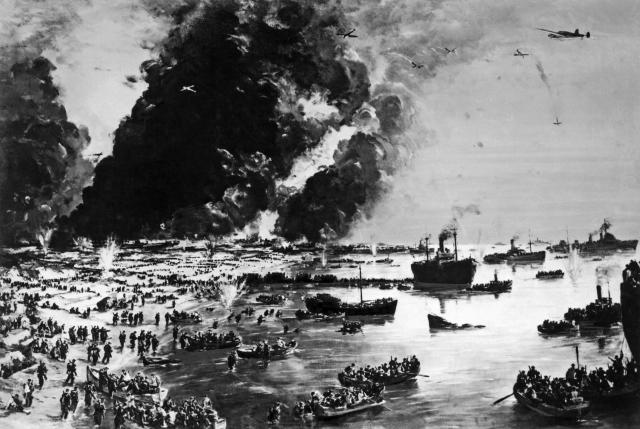
Dunkirk4In May of 1940 the British Expeditionary Force and what remained of French forces occupied a sliver of land along the English Channel. Field Marshall Gerd von Rundstedt called a halt of the German armored advance on May 24, while Hermann Göring urged Hitler to stop the ground assault, let the Luftwaffe finish the destruction of Allied forces. On the other side of the channel, Admiralty officials combed every boatyard they could find for boats to ferry their people off of the beach.

Hitler ordered his Panzer groups to resume their advance on May 26, while a National Day of Prayer was declared at Westminster Abbey. That night Winston Churchill ordered “Operation Dynamo”. One of the most miraculous evacuations in military history had begun from the beaches of Dunkirk.

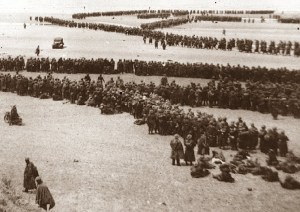
The battered remnants of the French 1st Army fought a desperate delaying action against the advancing Germans. They were 40,000 men against seven full divisions, 3 of them armored. They held out until May 31 when, having run out of food and ammunition, the last 35,000 finally surrendered. Meanwhile, a hastily assembled fleet of 933 vessels large and small began to withdraw the broken army from the beaches.Dunkirk6
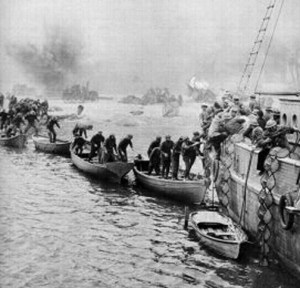
Larger ships were boarded from piers, while thousands waded into the surf and waited in shoulder deep water for smaller vessels. They came from everywhere: merchant marine boats, fishing boats, pleasure craft, lifeboats and tugs. The smallest among them was the 14’7″ fishing boat “Tamzine”, now in the Imperial War Museum.

A thousand copies of navigational charts helped organize shipping in and out of Dunkirk, as buoys were laid around Goodwin Sands to prevent strandings. Abandoned vehicles were driven into the water at low tide, weighted down with sand bags and connected by wooden planks, forming makeshift jetties.

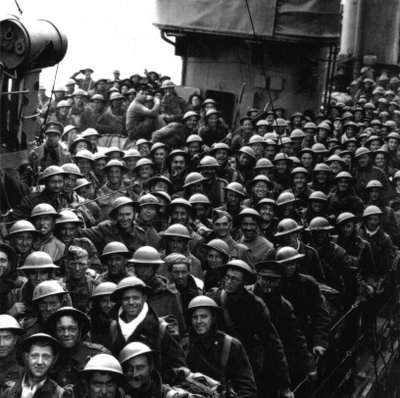
7,669 were evacuated on May 27, the first full day of the evacuation. By day 9 a total of 338,226 soldiers had been rescued from the beach.  The “Miracle of Dunkirk” would remain the largest such waterborne evacuation in history, until September 11, 2001.

It all came to an end on June 4. Most of the light equipment and virtually all the heavy stuff had to be left behind, just to get what remained of the allied armies out alive. But now, with the United States still the better part of a year away from entering the war, the allies had a fighting force that would live to fight on. Winston Churchill delivered a speech that night to the House of Commons, calling the events in France “a colossal military disaster”. “[T]he whole root and core and brain of the British Army”, he said, had been stranded at Dunkirk and seemed about to perish or be captured. In his “We shall fight on the beaches” speech of June 4, Churchill hailed the rescue as a “miracle of deliverance”.dunkirk2
On the home front, thousands of volunteers signed up for a “stay behind” mission in the weeks that followed. With German invasion all but imminent, their mission was to go underground and to disrupt and destabilize the invaders in any way they could. They were to be the British Resistance, a guerrilla force reportedly vetted by a senior Police Chief so secret, that he was to be assassinated in case of invasion to prevent membership in the units from being revealed.

Participants of these auxiliaries were not allowed to tell their families, what they were doing or where they were. Bob Millard, who passed in 2014 at the age of 91, said that they were given 3 weeks’ rations, and that many were issued suicide pills in case of capture. Even Josephine, his wife of 67 years, didn’t know a thing about it until the auxiliaries’ reunion in 1994. “You just didn’t talk about it, really”, he said. “As far as my family were aware I was still in the Home Guard. It was all very hush hush. After the war, it was water under the bridge”.dunkirk troops, 1940
The word “Cenotaph” literally translates as “Empty Tomb”, in Greek. Every year since 1919 and always taking place on the Sunday closest to the 11th day of the 11th month, the Cenotaph at Whitehall is the site of a remembrance service, commemorating British and Commonwealth servicemen and women who died in 20th century conflicts. Since WWII, the march on the Cenotaph includes members of the Home Guard and the “Bevin Boys”, the 18-25 year old males conscripted to serve in England’s coal mines. In 2013, the last surviving auxiliers joined their colleagues, proudly marching past the Cenotaph for the very first time.

Historians from the Coleshill Auxiliary Research Team (CART) had been trying to do this for years.

CART founder Tom Sykes said: “After over 70 years of silence, the veterans of the Auxiliary Units and Special Duties Section, now more than ever, deserve to get the official recognition that has for so long been lacking. ‘They were, in this country’s hour of need, willing to give up everything, families, friends and ultimately their lives in order to give us a fighting chance of surviving”.

May 13, 1916 Lafayette Escadrille

The Lafayette Escadrille is often confused with the much larger Lafayette Flying Corps, and the movie “Flyboys” adds to the confusion.

Sous-Lieutenant_Norman_Prince_summer1916
Norman Prince

Knowing that his father would not approve, Norman Prince of Beverly Massachusetts concealed his flight training.  Using the name George Manor,  Norman earned his wings in 1911 in the Quincy, Massachusetts neighborhood of Squantum.  A fluent French speaker with a family estate in Pau, France, Norman sailed in January 1915, to join the French war effort.

The earliest vestiges of the American Hospital of Paris and what would become the American Ambulance Field Service can be found five years earlier, in 1906. Long before the American entry in 1917, individual sympathies brought Americans into the war to fight for Britain and France. They traveled to Europe to fight in the war against the Axis Powers, joining the Foreign Legion, the Flying Corps or, like Ernest Hemingway, the Ambulance Service.

Lafayette_Escadrille_Pin
Squadron Insignia pin

After 1915, American pilots volunteered for multiple “Escadrille” – flight squadrons of the French Air Service, the Aéronautique Militaire.

The March 7, 1918 Harvard Alumni Bulletin, would give Norman Prince full credit for persuading the French government to form all-American flying squadrons, though he would not live to see the article.

Sergeant Norman Prince caught a landing wheel on a telegraph wire after a bombing run on October 12, 1916, sustaining massive injuries when his plane flipped over and crashed.  He was promoted to sous (2nd) lieutenant on his death bed and awarded the Legion of Honor.  He died three days later, at the age of 29.

LtCol_William_Thaw_with_lion_cub_mascots_of_Lafayette_Escradrille_c1916
Lt. Col. William Thaw II with_lion cub mascots Whiskey and Soda

William Thaw II of Pittsburgh was the first pilot to fly up New York’s East River under all four bridges, the first American engaged in aerial combat in the war.

Thaw pooled his money with three other pilots to purchase a male lion cub, the first of two such mascots kept by the Escadrille.  He bought the lion from a Brazilian dentist for 500 francs and bought a dog ticket, walking the lion onto the train on a leash.  Explanations that this was an “African dog” were less than persuasive, and the pair was thrown off the train.  “Whiskey” would have to ride to his new home in a cage, stuck in cargo.

Captain_Georges_Thenault_and_Fram_1917
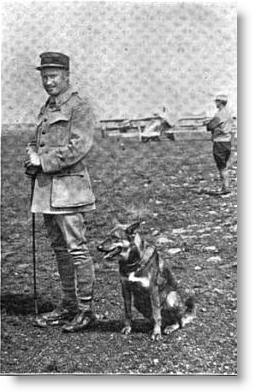
French Lieutenant Colonel Georges Thenault & Fram, 1917

French Lieutenant Colonel Georges Thenault owned a “splendid police dog” named Fram who was the best of friends with Whiskey, though he learned to keep to himself at dinner time.

A female lion, “Soda”, was purchased sometime later.  The lions were destined to spend their adult years in a Paris zoo, but both remembered from whence they had come.  Both animals recognized William Thaw on a later visit to the zoo, rolling onto their backs in expectation of a good belly rub.

Originally authorized on March 21, 1916 as the Escadrille Américaine (Escadrille N.124), American pilots wore French uniforms and flew French aircraft.  Nevertheless, Germany was dismayed at the existence of such a unit, and complained that the neutral United States appeared to be aligning with France.

Lafayette EscadrilleEscadrille N.124 changed its name in December 1916, adopting that of a French hero of the American Revolution.  Marie-Joseph Paul Yves Roch Gilbert du Motier, Marquis de Lafayette. Five French officers commanded a core group of 38 American volunteers, supported by all-French mechanics and ground crew.  Rounding out the Escadrille were the unit mascots, the African lions Whiskey and Soda.
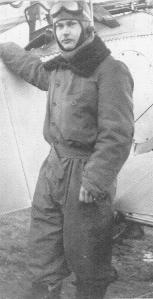
This early in aviation history, flying duty was hazardous to say the least.  Planes were flimsy and plagued with mechanical difficulties. Machine guns jammed and other parts failed when they were needed most.  There were countless wounds in addition to fatal injuries. At least one man actually asked to be sent back to the trenches, where he felt safer.

Kiffin Rockwell "In American Escadrille "movie" picture May 1916"
Kiffin Rockwell

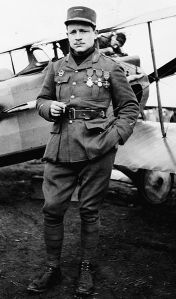
The first major action of the Escadrille Américaine took place at the Battle of Verdun on May 13, 1916. Kiffin Rockwell of Newport Tennessee became the first American to shoot down an enemy aircraft on May 18, later losing his own life when he was shot down by the gunner in a German Albatross observation plane on September 23. French born American citizen Raoul Lufbery became the squadron’s first Ace with 5 confirmed kills, and went on to be the highest scoring flying ace in the unit with 17 confirmed victories. He was killed on May 19, 1918, when his Nieuport 28 flipped over while he attempted to clear a jam in his machine gun.

The unit sustained its first fatality on June 24, 1916, when Victor Chapman was attacked by German flying ace Leutnant Kurt Wintgens, north of Douaumont.  Chapman was carrying oranges at the time, intended for his buddy Clyde Balsley, who was in hospital recuperating from an earlier incident.

Edmond_Charles_Clinton_Genet_circa_1915-1917
Edmond Genet

Ossining, New York native Edmond Genet was a bit of a celebrity among American expats, as the second-great grandson of Edmond-Charles Genêt, of the Founding-era Citizen Genêt Affair.  Genet sailed for France at the end of January 1915, joining the French Foreign Legion, and finally the Lafayette Escadrille on January 22, 1917.

Genet had left while on leave from the US Navy, and was therefore classified as a deserter. The decision weighed heavily on him.  Edmond Genet was shot down and killed by anti-aircraft artillery on April 17, eleven days after the American declaration of war, officially making him the first American fatality in the War to end all Wars.  The war department sent his family a letter after his death, stating that his service was considered in all respects, honorable.

38 American pilots passed through the Lafayette Escadrille, “the Valiant 38”, eleven of whom were either killed in action or died later as the result of wounds received.  The unit flew for the French Air Service until the US’ entry into the war, when it passed into the 103rd Aero Squadron, American Expeditionary Force.

Raoul Lufbery
Raoul Lufbery

The Lafayette Escadrille is often confused with the much larger Lafayette Flying Corps, and the movie “Flyboys” adds to the confusion.  The Flying Corps was different from the Escadrille, the former coming about as the result of widespread interest in the exploits of the latter.  American volunteers were assigned individually or in groups of two or three to fly in various French Aviation units, but, prior to US entry into the war.  The Lafayette Escadrille was the only one to serve as a single organization.

All told, 267 American volunteers applied to serve in the Lafayette Flying Corps, credited with downing 199 German planes at the cost of 19 wounded, 15 captured, 11 dead of illness or accident, and 51 killed in action.

Escadrille_Lafayette_in_July_1917
Lafayette Escadrille, July 1917. Standing (left to right) Soubiron, Doolittle, Campbell, Persons, Bridgman, Dugan, MacMonagle, Lowell, Willis, Jones, Peterson and de Maison-Rouge. Seated (left to right) Hill, Masson with “Soda,” Thaw, Thénault, Lufbery with “Whiskey,” Johnson, Bigelow and Rockwell. Georges Thenault’s dog “Fram” sits in the foreground.

March 16, 1914 The Caillaux Affair

Most of France was riveted by the Caillaux affair in July 1914, ignorant of the European crisis barreling down on them like the four horsemen of the apocalypse.

We heard a lot this past election year, about “Left” and “Right”, “Liberal” and “Conservative”.

The terms have been with us a long time, originating in the early days of the French Revolution. In those days, National Assembly members supportive of the Monarchy sat on the President’s right.  Those favoring the Revolution, on the left. The right side of the seating arrangement began to thin out and disappeared altogether during the “Reign of Terror”, but re-formed with the restoration of the Monarchy, in 1814-1815. By this time, it wasn’t just the “Party of Order” on the right and the “Party of Movement” on the left. Now the terms began to describe nuances in political philosophy, as well.

200 years later, differences between the French left and right of the period, would be recognizable to American political observers of today.

Joseph Caillaux
Joseph Cailloux

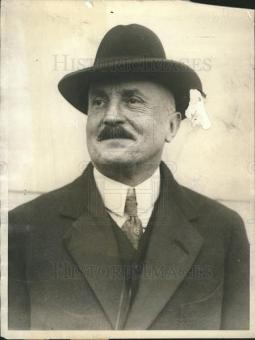
Joseph Cailloux (rhymes with “bayou”) was a left wing politician, appointed prime minister of France in 1911. The man was indiscreet in his love life, even for a French politician. Back in 1907, Cailloux had paraded about with a succession of mistresses, finally carrying on with one Henriette Raynouard, while both were married to someone else. They were both divorced by 1911 and that October, Henriette Raynouard became the second Mrs Cailloux.

The right considered Cailloux to be far too accommodating with Germany, with whom many felt war to be all but inevitable. While serving under the administration of President Raymond Poincare in 1913, Cailloux became a vocal opponent of a bill to increase the length of mandatory military service from two years to three, intended to offset the French population disadvantage between France’ 40 million and Germany’s 70 million.

Gaston Calmette
Gaston Calmette

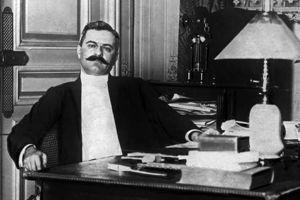
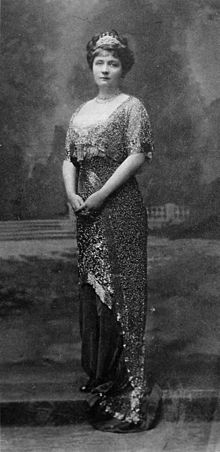
Gaston Calmette, editor of the leading Conservative newspaper Le Figaro, threatened to publicize love letters between the former Prime Minister and his second wife, written while both were still married for the first time. Henriette Cailloux was not amused.

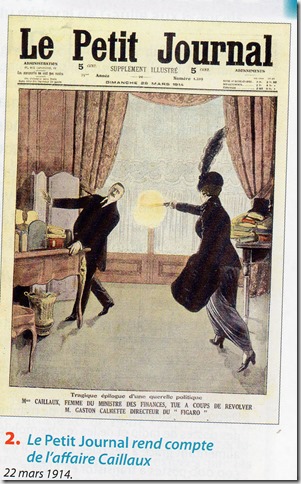
On March 16, 1914, Madame Cailloux took a taxi to the offices of Le Figaro. After being shown into Calmette’s office, the pair spoke only briefly, before Henriette withdrew the Browning .32 automatic, and fired six rounds at the editor. Two missed, but four were more than enough to do the job. Gaston Calmette was dead within six hours.

Henriette_Caillaux
Henriette Cailloux

German Chancellor Otto von Bismarck once said the next great European war would start with “some damn fool thing in the Balkans”.  Though no one realized it at the time, Bismarck got his damn fool thing on June 28, when a Serbian Nationalist assassinated the heir apparent to the Austro-Hungarian throne.

The July Crisis of 1914 was a series of diplomatic maneuverings, culminating in the ultimatum from Austria-Hungary to the Kingdom of Serbia. Vienna, with tacit support from Berlin, made plans to punish Serbia for her role in the assassination, while Russia mobilized armies in support of her Slavic ally.

Meanwhile, England and France looked the other way.  In Great Britain, officialdom was focused on yet another home rule crisis concerning Ireland, while all of France was distracted by the “Trial of the Century”.

Think of the OJ trial, only in this case the killer was a former First Lady. This one had everything: Left vs.affairecaillaux_thumb Right, the fall of the powerful, and all the salacious details anyone could ask for. Most of France was riveted by the Caillaux affair in July 1914, ignorant of the European crisis barreling down on them like the four horsemen of the apocalypse. Madame Caillaux’s trial for the murder of Gaston Calmette began on July 20.
She was acquitted on July 28, the jury ruling the murder to be a “crime passionnel”.  A crime of passion. That same day, Austria-Hungary declared war on Serbia.

In the days that followed, the Czar would begin the mobilization of men and machines that would place Imperial Russia on a war footing. Imperial Germany invaded Belgium, in pursuit of the one-two punch strategy by which they sought first to defeat France, before turning to face the “Russian Steamroller”. England declared war in support of a 75 year old commitment to protect Belgian neutrality, a treaty obligation that German diplomats had dismissed as a “scrap of paper”.

Eleven million military service members and seven million civilians who were alive in July of 1914, would not live to see November 11, 1918.

February 21, 1431 Joan of Arc

History has repeatedly demonstrated the truth of Taylor Owen’s comment on the subject of leadership: “An army of donkeys led by a lion is better than an army of lions led by a donkey.” So it was in the days after Jeanne’s arrival at Orléans

The Hundred Years’ War began as a succession dispute over the French throne, with an alliance of Burgundians and English on one side, against a coalition of Royalists led by the Armagnacs on the other.

Europe was not far removed from the latest outbreak of the Black Death at this time, as the scorched earth tactics employed by the English army laid waste to the countryside and devastated the French economy.

Charles, Dauphin and heir apparent to the French throne was up against a wall, when a teenage peasant girl approached him in 1429.

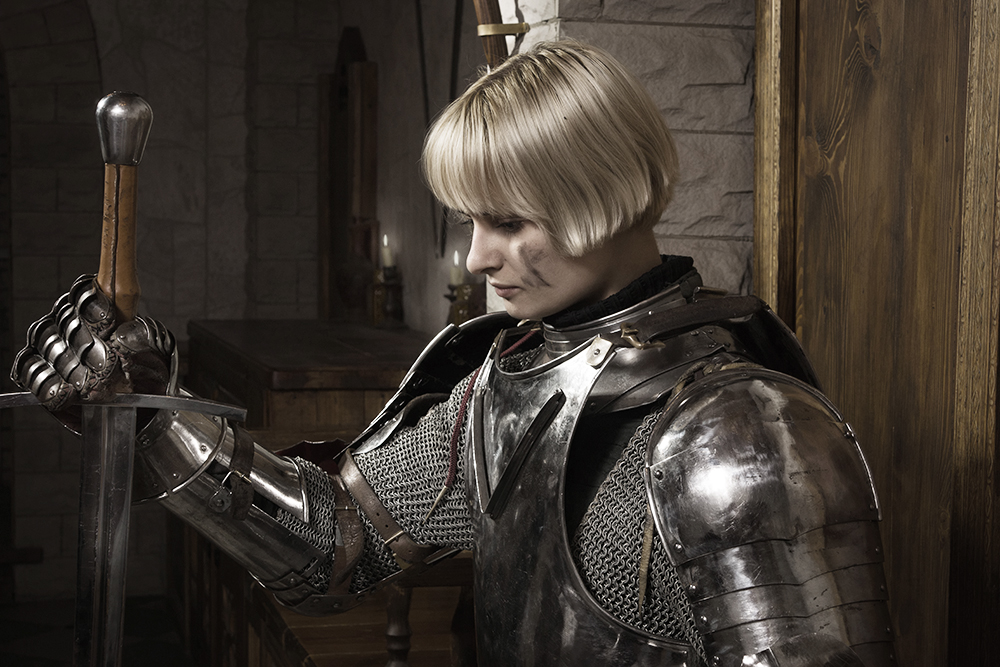
joan_of_arcFor the 14-year-old boy-king, even listening to her was an act of desperation, borne of years of humiliating defeats at the hands of the English army. Yet this illiterate peasant girl had made some uncanny predictions concerning battlefield successes.  Now she claimed to have had visions from God and the Saints, commanding her to help him gain the throne. Her name was Jeanne d’Arc.
The siege of Orléans was six months old at this time, when the Dauphin decided it couldn’t hurt to let her take part. She dressed herself in borrowed armor and set out, arriving on the 29th of April, 1429.

History has repeatedly demonstrated the truth of Taylor Owen’s comment on the subject of leadership: “An army of donkeys led by a lion is better than an army of lions led by a donkey.” So it was in the days after Jeanne’s arrival at Orléans.

Though repeatedly excluded from war councils, Jeanne managed to insert herself anyway, putting the French back on the offensive and handing them one victory after another.

Nine days after her arrival, Orléans turned into an unexpected victory for the French, despite Jeanne’s being shot through the neck and left shoulder by an English longbow, while holding a ladder at the siege of Tourelles.  The Dauphin granted her co-command of the army with Duke John II of Alençon. The French army enjoyed a string of successes, recovering Jargeau on June 12, Meung-sur-Loire on the 15th, and Beaugency two days later, leading to a humiliating English defeat at the battle at Patay on the 18th.

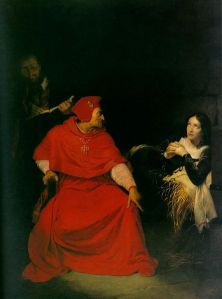
Several more Armagnac victories followed.  On July 17, 1429, Charles was consecrated King Charles VII of France, fifth King of the House of Valois, with Jeanne at his side.  Despite her loyalty, Charles’ support began to waver.  Court favorite Georges de La Trémoille had convinced the king that she was becoming too powerful.  An archer pulled Jeanne from her horse during the siege of joan_of_arc_interrogationCompiègne in May, 1430, and her allies failed to come to her aid.  Left outside the town’s gates when they closed, she was captured and taken to the castle of Bouvreuil.
Some 70 charges were made against her by the pro-English Bishop of Beauvais, Pierre Cauchon, including witchcraft, heresy, and dressing like a man.

Representatives of the judge were dispatched  to Jeanne’s home village of Domremy, to ascertain the prisoner’s virginity, character, habits and associations.  Nicolas Bailly, the man responsible for collecting testimony, reported that he “had found nothing concerning Joan that he would not have liked to find about his own sister”. This Bishop Cauchon must have been some piece of work.  The report so angered the man, that he called Bailly “a traitor and a bad man” and refused to pay him for his work.

Jean Le Maistre, whose presence as Vice-Inquisitor for Rouen was required by canon law, objected to the proceedings and refused to appear, until the English threatened his life.

Interrogation of the prisoner began on February 21, 1431. The outcome was never in doubt. Transcripts were falsified and witnesses intimidated.  Even then, trial records reveal this illiterate peasant girl to be brighter than all her inquisitors, combined.

One example from her third interrogation, was the Question: “Do you know whether or not you are in God’s grace?”. The question was a trap.  Church doctrine stated that no one could be certain of being in God’s grace, yet a “no” answer would have been held against her.  “If I am not”, she said, “may God put me there; and if I am, may God so keep me. I should be the saddest creature in the world if I knew I were not in His grace.”

After fifteen such interrogations her inquisitors still had nothing on her, save for the wearing of soldier’s garb, and her visions. Yet, the outcome of her “trial” was already determined.  She was found guilty of heresy, and sentenced to be burned at the stake.  On May 24, Jeanne was taken to a scaffold.  Threatened that she would be immediately burned alive if she didn’t disavow her visions and abjure the wearing of soldier’s clothing, Jeanne agreed to sign such an abjuration, but recanted four days later.

jean-darc-executionThe death sentence was carried out on May 30, 1431, in the old marketplace at Rouen. She was 19.  After she died, the coals were raked back to expose her charred body.  No one would be able to claim she’d escaped alive. Her body was then burned twice more, so no one could collect the relics.  Her ashes were then cast into a river.

Guillaume Manchon, one of the court scribes, later recalled: “And she was then dressed in male clothing, and was complaining that she could not give it up, fearing lest in the night her guards would inflict some act of [sexual] outrage upon her; and she had complained once or twice to the Bishop of Beauvais, the Vice-Inquisitor, and Master Nicholas Loiseleur that one of the aforesaid guards had tried to rape her.”

Her executioner, Geoffroy Therage, later said that he “Greatly feared to be damned”.

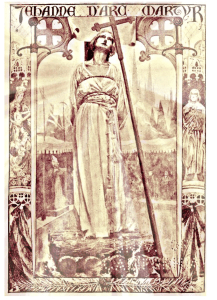
An inquisitorial court authorized by Pope Calixtus III re-examined the evidence, 25 years later. The court exonerated her of all charges, pronouncing her innocent on July 7, 1456, and later declaring her a martyr.

A National Heroine to the French, Joan of Arc was canonized a saint of the Roman Catholic Church, in 1920.  It was small consolation for this child who had been set up for a fall by her enemies, and abandoned to be incinerated alive, by her friends.