August 25, 1830  Night at the Opera

In 1914, Imperial Germany took a straight line through neutral Belgium into France, believing that Great Britain would never honor a “scrap of paper” signed back in 1839. 

In 1830, what is now Belgium was part of the United Kingdom of the Netherlands, a fusion of territories brought about in the wake of the Napoleonic Wars, formerly belonging to the Dutch Republic, Austrian Netherlands, and Prince-Bishopric of Liège. It was a Constitutional Monarchy,  ruled by the first King of the Netherlands, King William I.

The “Southern Provinces” of King William’s polity were almost all Catholic, and mostly French speaking, in contradistinction to the Dutch speaking, mostly Protestant north.  Many southern liberals of the time thought King William a despot and tyrant, and high levels of industrial unemployment made for widespread unrest among the working classes.la muette

La Muette de Portici (The Mute Girl of Portici) is an opera in five acts by Daniel Auber.  Generally recognized as the earliest of the French Grand Opera, it was first performed at the Paris Opéra on February 29 1828.   During an August 25, 1830 performance, a riot broke out during one particularly patriotic duet, Amour sacré de la patrie, (Sacred love of Fatherland).  Soon it was spilling out onto the street, a full-scale riot spreading across Brussels and igniting other riots as shops were looted, factories occupied and machinery destroyed.

King William committed troops to the southern provinces in an effort to restore order, while radicals asserted control of rioting factions and began talk of secession.  Dutch military units experienced massive desertion of recruits from the southern provinces, and had to pull out.

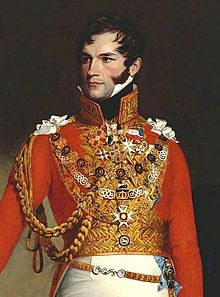
The States-General in Brussels voted in favor of secession and declared independence, assembling a National Congress while King William appealed to the Great Powers for help. The resulting 1830 London Conference of major European powers came to recognize Belgian independence, and Leopold I was installed as “King of the Belgians”.Leopold_I_of_Belgium

King William made one more attempt to reconquer Belgium militarily, in 1831.  France intervened with troops of its own and the “Ten Days’ Campaign” ended in failure.  The European powers signed the “Treaty of London” in 1839, recognizing and guaranteeing Belgium’s independence and neutrality.

The German Composer Wilhelm Richard Wagner remarked on the events decades later, saying that “[S]eldom has an artistic product stood in closer connection with a world-event”.

In August 1914, Imperial Germany’s plan in the event of war could be likened to one guy against two in a bar fight, (Germany vs France & Russia).  The plan was to take out the nearer one first (France), before turning to face the second.  Imperial Germany took a straight line through neutral Belgium into France, believing that Great Britain would never honor that “scrap of paper” signed back in 1839.

In this German calculations were grievously mistaken.  A regional squabble had begun that June, with an assassination in the Balkans.  That miscalculation would plunge the world into two world wars.

August 17, 1917  Black Swallow of Death

French President Charles de Gaulle came to New York City in 1960, surprising media and dignitaries alike when all he wanted to do was to visit with a black elevator operator at the Rockefeller Center.

Eugene James Bullard was born October 9, 1894 in Columbus Georgia, the seventh of 10 children born to William Octave Bullard and an indigenous Creek named Josephine “Yokalee” Thomas.  Bullard’s father had come from Martinique, where his people could trace their lineage back to the Haitian Revolution.

Eugene wanted to leave behind the racial discrimination of his day.  The near-lynching of his father became the catalyst in 1902, when the boy was eight.  He ran away from home, spending the next four years doing odd jobs to survive  The elder Bullard had always told him “in France a man is accepted as a man regardless of the color of his skin”.   In 1906, the boy stowed away on a German ship to Aberdeen.

Bullard worked a number of odd jobs to support himself.  By age 16 he was becoming well known as a boxer, and moved to Paris at the first opportunity.

WWI broke out in August of 1914.  By the end of the year the French nation had suffered over a half million casualties.Ace-Website-Banner-1

Bullard enlisted in the French Foreign Legion, an American serving as one of 54 different nationalities serving in the Moroccan Division, Third Marching Regiment.

The Regiment was sent to the Somme front in 1915, where 300,000 Frenchmen were lost by the end of November. One unit of 500 men began the disastrous Champagne offensive of September.    At the end of the battle, 31 responded to the first evening’s roll call.

What remained of Bullard’s unit was disbanded to form the 170th Infantry, and sent to Verdun.  He thought he had arrived in hell, saying, “I thought I had seen fighting in other battles but no one has ever seen anything like Verdun – not ever before or ever since.”

Erich von Falkenhayn had designed his battle plan for Verdun to “bleed France white”, calling Verdun Operation Gericht.  Operation Execution Place.  Over 250,000 died in the 10 months long battle, more than 100,000 were missing and 300,000 gassed or wounded.

Bullard had been wounded four times before.  On March 5th 1916, he received the wounds that took him out of the ground war.  He was 8 months in hospital when the opportunity arose to join the French Flying Corps.  A white American buddy bet him $2,000 that he couldn’t get into aviation and become a pilot, and he took the challenge.  Bullard earned his wings on May 5, 1917, and received his $2,000 soon thereafter.

Bullard and JimmyBullard was assigned to the 93d Spad Squadron on August 17, 1917, flying Spad V11s and Nieuports with a mascot, a pet Rhesus Monkey he called “Jimmy”.  He said, “I was treated with respect and friendship – even by those from America.  Then I knew at last that there are good and bad white men just as there are good and bad black men.”

The first black combat pilot and the only one to serve in the Great War, Bullard painted a bleeding red heart pierced by a knife on the side of his Spad biplane. Below the heart were the words “Tout le Sang qui coule est rouge!” The phrase roughly translates as “All Blood Runs Red”.

Bullard is credited with two kills while flying for the 93rd, though one of the Germans crashed behind enemy lines so it remained unconfirmed.  He tried to join the American squadron when the US entered the war, but the whites only policy of the time prevented him from doing so.

Bullard married in 1923.  The marriage ended in divorce, with Bullard gaining custody of their two surviving daughters (a son had died of pneumonia in infancy).   He became a drummer at the jazz club, “Le Grand Duc”, later buying his own club and calling it “L’Escadrille”.  Bullard made several famous friends during this time, including Josephine Baker, Louis Armstrong, Langston Hughes and the French flying ace Charles Nungesser.

He volunteered with the 51st Infantry when WWII broke out, becoming wounded and escaping to the United States in 1940.Bullard, medals

Bullard spent his last days in obscurity. His daughters had married by the 1950s, and he lived alone in a New York apartment, decorated with pictures of his famous friends and a framed case containing his fifteen French war medals.  He worked as an elevator operator at the Rockefeller Center, where nobody knew anything about his service.

The French government requested his presence in 1954, when he and two white Frenchmen were accorded the honor of relighting the Eternal Flame at the Tomb of the Unknown French Soldier at l’Arc de Triomphe.

France honored Bullard once again in 1959, naming him a Knight of the Légion d’honneur in a lavish ceremony in New York City. Dave Garraway interviewed him on the Today Show, but he remained alone and unknown in his native country.quote-tout-le-sang-qui-coule-rouge-all-blood-is-red-eugene-bullard-71-83-05

French President Charles de Gaulle came to New York City in 1960, surprising media and dignitaries alike when all he wanted to do was to visit the black elevator operator who worked at the Rockefeller Center.

Eugene James “Jacques” Bullard died on October 12, 1961.  He was buried with the tri-color of France draping his coffin, laid to rest with full honors by the Federation of French War Officers at Flushing Cemetery in New York.

The first black fighter pilot, the “Black Swallow of Death”, was honored by the country he had loved and served during two world wars.  On August 23, 1994, 77 years after Bullard’s American flight physical, the USAF posthumously awarded Eugene Bullard a commission as a Lieutenant.


August 4, 1693 – Dom Pérignon

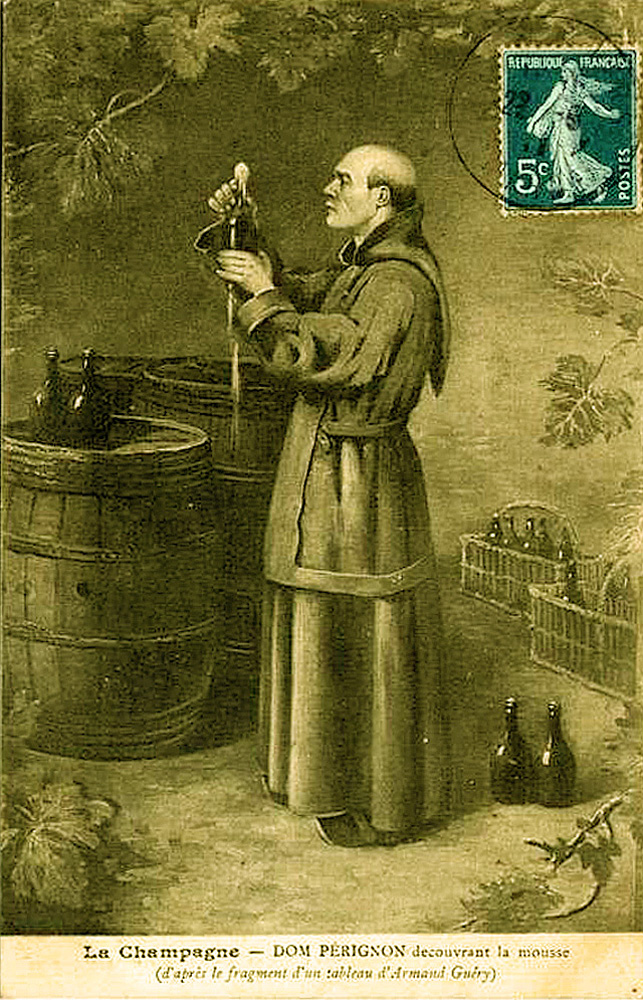
August 4, 1693 is the date traditionally ascribed to Brother (Dom) Pérignon’s invention of Champagne, when he is supposed to have said “Come quickly, I am drinking the stars!”. 

The wines of medieval and renaissance Europe tended to be almost universally red, and almost always still.  The in-bottle refermentation that gives “sparkling” wine its ‘fizz’ was a problem for winemakers.  Fermentable sugars were frequently left over when weather began to cool in the fall, particularly with the white grape varietals.  Refermentation would set in with the warm spring weather, converting bottles into literal time bombs.  Corks would pop out and wine would spoil.  Sometimes the whole batch would explode, one pressurized bottle going off in sympathetic detonation with the other.preventing-refermentation-fig1

Pierre Perignon entered the Benedictine Order when he was 19, doing his novitiate at the abbey of Saint-Vannes near Verdun, and transferring to the abbey of Hautvillers in 1668.

August 4, 1693 is the date traditionally ascribed to Brother (Dom) Pérignon’s invention of Champagne, when he is supposed to have said “Come quickly, I am drinking the stars!”.

The story seems to be an 1821 embellishment by one Dom Groussard, in an attempt to increase the prestige of the abbey.  The English scientist and physician Christopher Merret seems to have been the first to add sugars, beginning the refermentation process which resulted in the first carbonated wine.

Dom_Pérignon_découvrant_la_prise_de_mousse

Yet Dom Pérignon most certainly perfected the double fermentation process, and made important contributions to the quality of the abbey’s fine wines.  He was an early advocate of natural process, farming methods we would call “organic”, today.  He strictly avoided the addition of foreign substances, and insisted that all blending take place at the grape stage. Pérignon insisted on “blind” tasting, not wanting to know what vineyard a grape came from prior to selection.

Dom_Pérignon

Pérignon didn’t like white grapes because of their tendency to enter refermentation. He preferred the Pinot Noir, and would aggressively prune vines so that they grew no higher than three feet and produced a smaller crop. The harvest was always in the cool, damp early morning hours, and he took every precaution to avoid bruising or breaking his grapes. Over-ripe and overly large fruit was always thrown out. Pérignon did not allow grapes to be trodden, always preferring the use of multiple presses.Dom Perignon

Dom Pérignon served as the “cellarer” of the Hautvillers abbey until his death in 1715, in a time when the abbey flourished and doubled the size of its vineyards.  In a sign of honor and respect, Dom Pierre Pérignon was buried in a section of the abbey cemetery, historically reserved only for abbots.

Moët et Chandon, which began as Moët et Cie, purchased the vineyards of the Abbey of Hautvillers in 1792. To this day, Moët’s most prestigious cuvée bears the name of Dom Pérignon.

July 14, 1789 Storming the Bastille

Paris was “intoxicated with liberty and enthusiasm,” when the crowd converged on the Bastille on the morning of July 14, 1789. It was guarded by 82 invalides (veteran soldiers no longer fit for service in the field) and 32 Swiss grenadiers.
The attackers – vainqueurs de la Bastille – numbered 954.

In most of medieval France, the major constituent parts of French society were the “Three Estates”:  the Clergy, the Nobility and the Commons.

France was in a state of economic crisis in the late 18th century. The Nobility refused to accede to the tax demands of King Louis XVI. The Commoners reconstituted themselves into a “National Assembly” in June 1789, demanding an audience with the King for the purpose of drawing up a Constitution.

The National Assembly converged on the Estates General on June 20, only to find the door locked. What followed was either hysterical or duplicitous, because the King and his family were still mourning the death of the Dauphin; the heir apparent.  It was customary at that time to hold political matters, until the King came out of mourning.

Tennis Court Oath
Tennis Court Oath

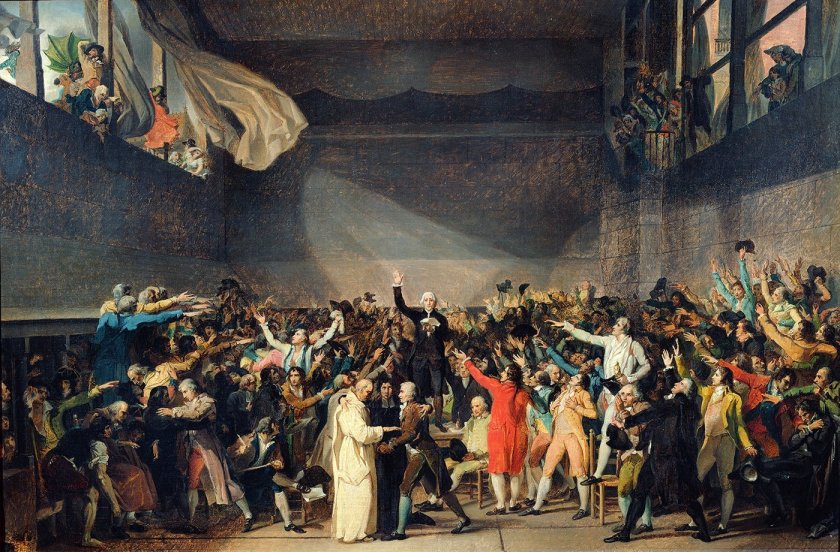
Be that as it may, the entire National Assembly, all 577 members, converged on an indoor tennis court. All but one put their names to a solemn oath, the famous “The Tennis Court Oath”, swearing “not to separate, and to reassemble wherever circumstances require, until the constitution of the kingdom is established”.

The oath itself was a revolutionary act, asserting that political authority came from the people and their representatives, not from the monarchy. The National Assembly had declared themselves to be supreme in the exercise of state power, making it increasingly difficult for the monarchy to operate based on “Divine Right of Kings”.

Riots followed as the left and reformist factions moved from anarchy to a coherent movement against the monarchy and the French right.

Built in 1309, the fortress and medieval prison of the Bastille had long been a focal point of the insurrection, representing royal authority in the center of the city. Donatien Alphonse François, better known as the Marquis de Sade, was one of the few remaining prisoners in the Bastille by this time. He was transferred to an insane asylum after attempting to incite a crowd outside his window, yelling: “They are massacring the prisoners; you must come and free them.”

Prise_de_la_Bastille

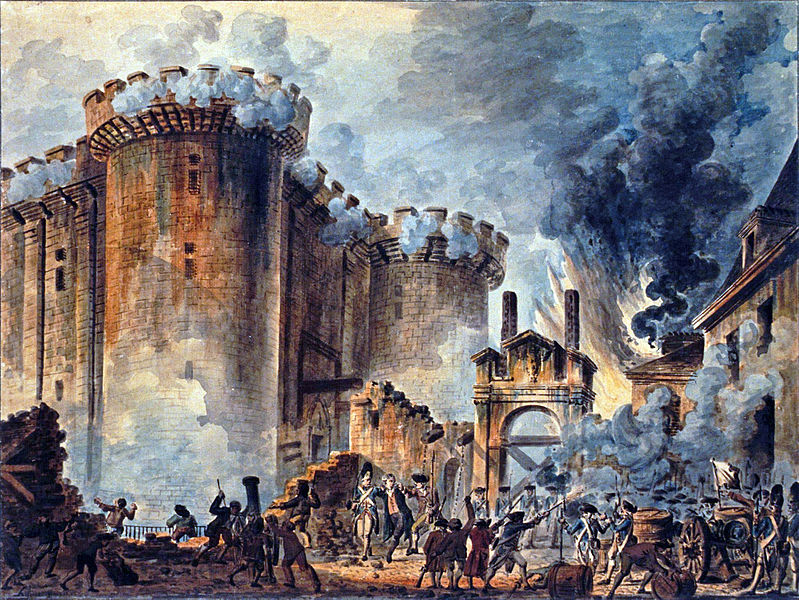
Paris was “intoxicated with liberty and enthusiasm,” when French revolutionaries converged on the Bastille on the morning of July 14, 1789. The fortress was guarded by 82 “invalides”, veteran soldiers no longer fit for service in the field, and 32 Swiss grenadiers under the command of Governor Bernard-René de Launay, the son of the previous governor, actually born in the Bastille.

The attackers – vainqueurs de la Bastille – numbered 954. Negotiations dragged on until the crowd lost patience, crowding into the outer courtyard and cutting the chain that held the drawbridge. Firing broke out as the bridge slammed down, crushing one unlucky vainqueur, while a nearby force of Royal Army troops did nothing to intervene. 98 attackers and one defender died in the fighting.  The mob murdered another 7, after their surrender.

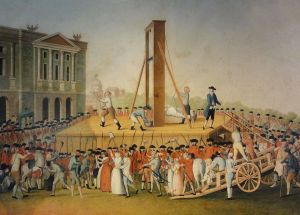
The successful insurrection at Paris raced across all of France, as the “Great Fear” spread across the countryside. The absolute monarchy which had ruled for centuries was over within three years, when Louis himself lost his head to the guillotine in 1793. 16,594 went to the guillotine under “the Reign of Terror”, led by the “Committee of Safety” under the direction of Parisian lawyer Maximilian Robespierre. Among them was Queen Marie Antoinette, who never did say “let them eat cake”.  Her last words were pardon me, sir, I meant not to do it, on stepping on her executioner’s toes.

Exécution_de_Marie_Antoinette_le_16_octobre_1793
Execution of Marie Antoinette

As many as 40,000 were summarily executed or died in prison awaiting trials before the hysteria died down.  Robespierre himself lost his head in 1794.

The Napoleonic Wars which followed resulted in a Corsican artillery corporal-turned Emperor, fighting (and winning), more battles than Hannibal, Caesar, Alexander the great, and Frederick the Great, combined.

The saddest part of the whole sad story, may be the son of Louis and Antoinette, Louis-Charles, Duke of Normandy. He was King Louis XVII in name only, thrown into a stone prison cell at the age of 8. He would die there, at the age of 10. Miserable, sick and alone.  It all seems pointless. The Bourbon Dynasty was back in power, within twenty years.

July 7, 1798 XYZ

In the UK, the ruling class appeared to enjoy the chaos.  A British political cartoon of the time depicted the United States, represented by a woman being groped by five Frenchmen while John Bull, the fictional personification of all England, laughs from a nearby hilltop.

Imagine that you’ve always considered yourself to be somewhere in the political center, maybe a little to the left.  Now imagine that, in the space of two years, your country’s politics have shifted so radically that you find yourself on the “reactionary right”. So much so, that you are subject to execution by your government.  And all that time, your politics haven’t changed.

Our strongest ally in the American Revolution lost its collective mind in 1792, when France descended into its own revolution.    17,000 Frenchmen were officially tried and executed during the 1793-94 “Reign of Terror”, including King Louis XVI himself and his queen, Marie Antoinette.  Untold thousands died in prison or without benefit of trial.  The monarchical powers of Europe were quick to intervene and for the 32nd time since the Norman invasion of 1066, England and France found themselves at war.

Exécution_de_Marie_Antoinette_le_16_octobre_1793
Execution of Marie Antoinette

Both sides in the European conflict seized neutral ships which were trading with their adversary.  The “Treaty of Amity, Commerce, and Navigation” between Great Britain and its former colonies, better known as the “Jay Treaty”, all but destroyed relations with the French Republic.  France retaliated by stepping up attacks on American merchant shipping, seizing 316 vessels in one 11-month period, alone.

France had been the colonies’ strongest ally during the American Revolution, now the Jay treaty infuriated the French, who believed the agreement violated earlier arrangements between the two nations.  Making matters worse, America repudiated its war debt in 1794, arguing that it owed money to “L’ancien Régime”, not to the “First Republic” which had overthrown it and executed its King.

In 1796, France formally broke diplomatic relations with the United States, rejecting the credentials of President Washington’s Ambassador, Charles Cotesworth Pinckney.

The following year, President John Adams dispatched a delegation of two.  They were future Chief Justice of the Supreme Court John Marshall, and future Massachusetts Governor Elbridge Gerry, the man who later became the 5th Vice President, lending his name to the term “Gerrymander”.  Their instructions were to join with Pinckney in negotiating a treaty with France, with terms similar to those of the Jay treaty with Great Britain.

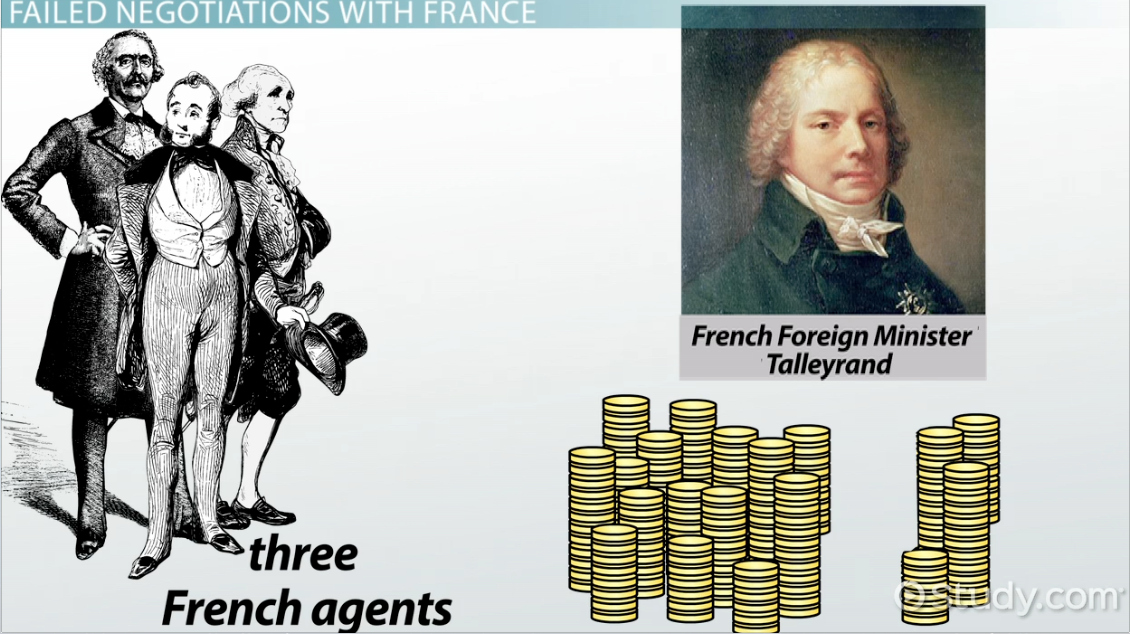
The American commission arrived in Paris in October 1797, requesting a meeting with the French Foreign Minister, Charles Maurice de Talleyrand.  Talleyrand, unkindly disposed toward the Adams administration to begin with, demanded a bribe for himself and substantial ‘loan’ to the French Republic, before so much as meeting with the American delegation.  The practice was not uncommon in European diplomacy of the time.  The Americans were appalled.

Believing that the Adams administration sought war by exaggerating the French position, Jeffersonian allies in Congress joined with more warlike Federalists in demanding the release of the commissioner’s communications. It was these dispatches, released in redacted form, which gave the name “X-Y-Z Affair” to the diplomatic and military crisis to follow.

Nicholas Hubbard, an English banker, was identified in the transcripts, only as “W”.  W introduced “X” (Baron Jean-Conrad Hottinguer) as a “man of honor”, who wished an informal meeting with Pinckney.  Pinckney agreed and Hottinguer reiterated Talleyrand’s demands, specifying the payment of a large loan to the French government, and a £50,000 bribe to Talleyrand himself.  Met with flat refusal by the American commission, X then introduced Pierre Bellamy (“Y”) to the Americans.  Lucien Hauteval (“Z”), Talleyrand’s personal emissary, was then sent to negotiate with Elbridge Gerry.  X, Y and Z, each in their turn, reiterated the Foreign Minister’s demand for a loan, and a bribe.

American politics were sharply divided over the European war.  President Adams and his Federalists, always the believers in strong, central government, took the side of the Monarchists.  Thomas Jefferson and his “Democratic-Republicans” found more in common with the ‘liberté, égalité and fraternité’ espoused by French revolutionaries.

In the UK, the ruling class appeared to enjoy the chaos.  A British political cartoon of the time depicted the United States, represented by a woman being groped by five Frenchmen while John Bull, the fictional personification of all England, laughs from a nearby hilltop.

John Bull cartoon

At this point, the United States had little means of defending itself.  The government had disbanded the Navy along with the Marine Corps at the end of the Revolution, selling the last warship in 1785 and retaining only a handful of “revenue cutters” doing customs enforcement.  The Naval Act of 1794 established a standing Navy for the first time in US history.  In October 1797, Congress authorized the construction of six frigates.  One of them, USS Constitution, saw its first combat in the Quasi-War with France, and remains in service to this day, the oldest commissioned ship in the United States Navy.

Quasi War

Adams’ commission left without entering formal negotiations, their failure leading to a political firestorm in the United States.  Congress rescinded all existing treaties with France on July 7, 1798, authorizing American privateers to attack French shipping. The undeclared “Quasi-War” with France, had begun.

Four days later, President John Adams signed “An Act for Establishing and Organizing a Marine Corps,” permanently establishing the United States Marine Corps as an independent service branch, in order to defend the American merchant fleet.

For the United States, military involvement proved decisive.  Before military intervention, the conflict with France resulted in 28 Americans killed, 42 wounded, and over 2,000 merchant ships captured.  Following intervention, the US suffered 54 killed and 43 wounded, with only a single ship lost, and that one was later recaptured.

The undeclared naval war with our former ally was settled with the Treaty of Mortefontaine, also known as the Convention of 1800, and ratified the following year.

June 18, 1815 Waterloo

It was common practice of the age to “spike” enemy cannon, driving a nail into the touchhole to disable the weapon. But for a handful of nails, the outcome of the battle might have been different. Possibly, even the history of the world.

The Napoleonic Wars began in 1799, pitting Emperor Napoleon Bonaparte and his Grand Armée against a succession of international coalitions. The first five such coalitions formed to oppose him would go down to defeat.

The empire of Czar Alexander I had long traded with Napoleon’s British adversary. Napoleon invaded Russia in 1812 intending to cut off that trade, but he made the same mistake that Adolf Hitler would make, 130 years later. He failed to account for Russia’s greatest military asset. General Winter.

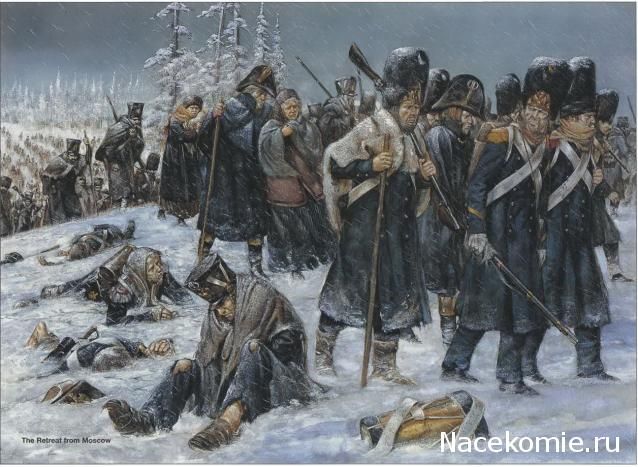
For months Napoleon’s army pressed ever deeper into Russian territory, as Cossack cavalry burned out villages and fields to deny food or shelter to the advancing French army. Napoleon entered Moscow itself in September, with the Russian winter right around the corner. He expected capitulation.  Instead, he got more scorched earth.

Grand Armee Retreat from MoscowFinally there was no choice for the Grand Armée, but to turn about and go home. Starving and exhausted with no winter clothing, stragglers were frozen in place or picked off by villagers or pursuing Cossacks. From Moscow to the frontiers you could follow their retreat, by the bodies they left in the snow. 685,000 had crossed the Neman River on June 24. By mid-December there were fewer than 70,000 known survivors.

The War of the 6th Coalition ended in 1814 with Bonaparte’s defeat and exile to the Mediterranean island of Elba, and the restoration to the throne of the Bourbon King, Louis VXIII. That would last 111 days, until Napoleon reappeared at the head of another army.

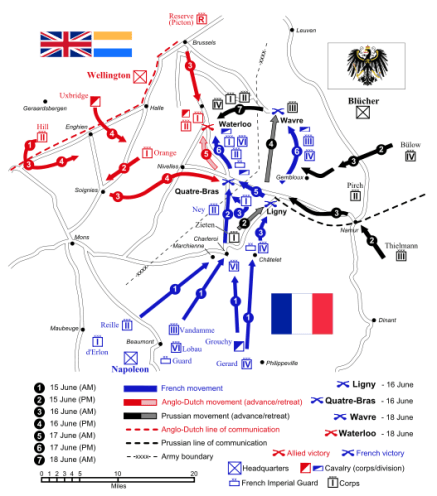
Waterloo_Campaign_mapThe Congress of Vienna declared Napoleon an outlaw on March 13, 1815.  Austria, Prussia, Russia and the UK bound themselves to put 150,000 men apiece into the field to end his rule.

Napoleon struck first, taking 124,000 men of l’Armee du Nord on a pre-emptive strike against the Allies in Belgium. Intending to attack Coalition armies before they combined, he struck and defeated the Prussian forces of Gebhard von Blücher near the town of Ligny.

Napoleon then turned his attention to the coalition forces under the Lord Arthur Wellesley, Duke of Wellington, who fell back to a carefully selected position on a long east-west ridge at Mont St Jean, a few miles south of the village of Waterloo.

It rained all day and night that Saturday. Napoleon waited for the ground to dry on the morning of June 18, launching his first attack before noon while Wellington’s Prussian allies were still five hours away. The 80 guns of Napoleon’s grande batterie opened fire at 11:50, while Wellington’s reserves sheltered out of sight on the reverse slope of the Mont St. Jean ridge.

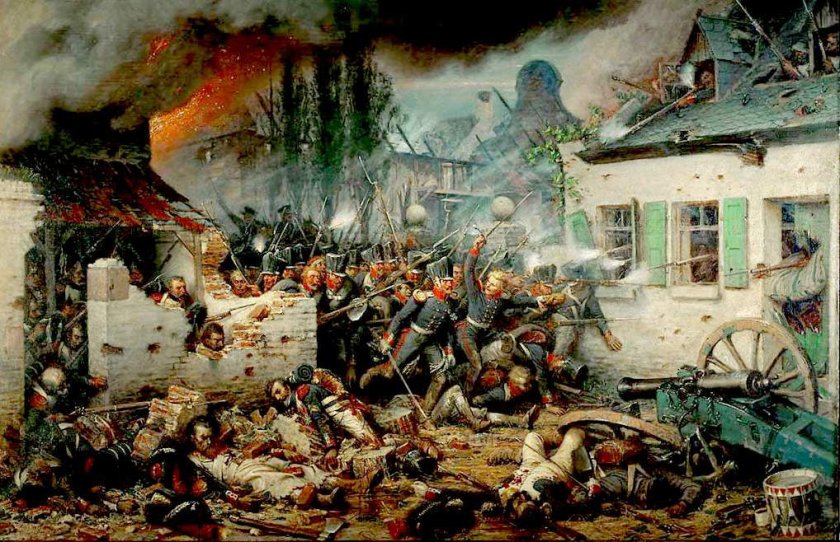
Fighting was furious around Wellington’s forward bastions, the walled stone buildings of the Château Hougomont on Wellington’s right, and La Haie Sainte on his left.  Eight times, French infantry swarmed over the orchards and outbuildings of the stone farmhouses, only to be beat back.

Waterloo, Chateau Battle

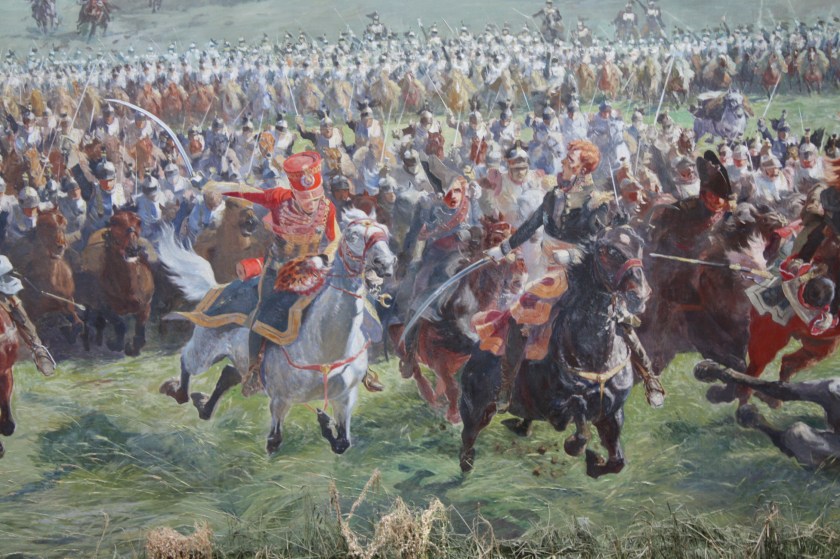
Most of the French reserves were committed by 4:00pm, when Marshall Ney ordered the massed cavalry assault. 9,000 horsemen in 67 squadrons charged up the hill as Wellington’s artillery responded with canister and shot, turning their cannon into giant shotguns tearing holes in the French ranks.

It was common practice of the age to “spike” enemy cannon, driving a nail into the touchhole to disable the weapon. But for a handful of nails, the outcome of the battle might have been different. Possibly, even the history of the world.  Eleven times French cavalry gained the hill and surrounded those guns. Eleven times the gunners retreated into defensive infantry squares, bristling with bayonets. Eleven times French cavalry withdrew only to form up, and do it all over again.Waterloo_Cavalry

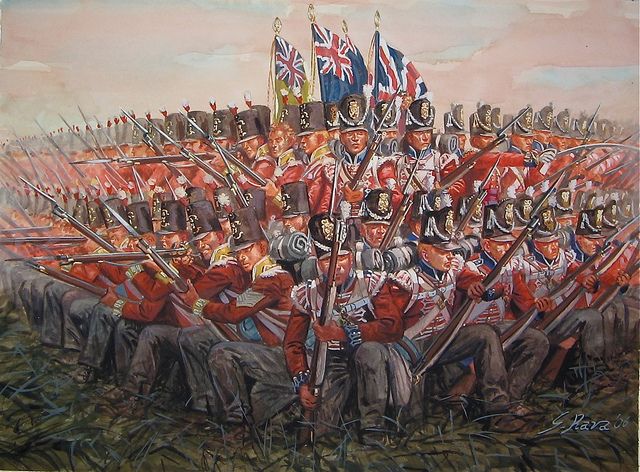
Newly arrived Prussians were pouring in from the right at 7:30 when Napoleon committed his 3,000-man Imperial Guard. These were Napoleon’s elite soldiers, almost seven feet tall in their high bearskin hats. Never before defeated in battle, they came up the hill intending to roll up Wellington’s center, away from their Prussian allies. 1,500 British Foot Guards were lying down to shelter from French artillery. As the French lines neared the top of the ridge, the English stood up, appearing to rise from the ground and firing point blank into the French line.

The furious counter assault which followed caused the Imperial Guard to waver and then fall back.  Retreat broke into a route, someone shouting “La Garde recule. Sauve qui peut!” (“The Guard retreats. Save yourself if you can!”), as the Allied army rushed forward and threw themselves on the retreating French.Infantry Square

There is a story, possibly apocryphal, concerning Henry Paget, 2nd Earl of Uxbridge. One of the last cannonballs fired that day hit Uxbridge just above the knee, all but severing the leg. Lord Uxbridge was close to Wellington at the time, exclaiming “By God, sir, I’ve lost my leg!”. Wellington replied “By God, sir, so you have!” There’s another version in which Wellington says “By God, sir, you’ve lost your leg!”. Looking down, Uxbridge replied “By God, sir, so I have!”

According to Wellington, the battle was “the nearest-run thing you ever saw in your life.” The French defeat was complete. Bonaparte was once again captured and exiled, this time to a speck in the North Atlantic called Saint Helena.  He died there in 1821.

Estimates of the total killed and wounded in the Napoleonic wars range from 3.5 to 6 million, at a time when the entire world population was about 980 million. Until Waterloo, Napoleon Bonaparte participated in, and won, more battles than Julius Caesar, Hannibal, Frederick the Great, and Alexander the Great.  Combined.

June 13, 1777 Marquis de Lafayette

The two men bonded almost immediately, forming a relationship that closely resembled that of father and son. The fatherless young French officer, and the father of his country who went to his grave, childless.

There are a handful of men who were indispensable to the American Revolution, men without whom the war effort would have been doomed to fail.

One, of course is George Washington, who became commander in chief before he had an army.  Before he even had a country. Knowing full well that the penalty for high treason against the British Crown was death, Washington took command of an army with enough powder for an average 9 rounds per man, in a contest against the most powerful military of its time.

Another indispensable man has to be Benjamin Franklin, whose diplomatic skills and unassuming charm all but single-handedly turned France into an indispensable ally.

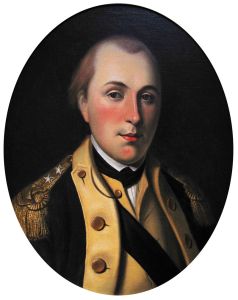
Marquis_de_Lafayette_2A third would arguably be Marie-Joseph Paul Yves Roch Gilbert du Motier, better known as the Marquis de Lafayette.

Lafayette was all of nineteen when he landed on North Island South Carolina on June 13, 1777.

The French King had forbidden his coming to America, fearing his capture by British agents. Lafayette wanted none of it. His own father, also the Marquis de Lafayette, was killed fighting the British when the boy was only two. The man was determined to take part in this contest, even if he had to defy his King to do so. Lafayette disguised himself on departure, and purchased the entire ship’s cargo, rather than landing in Barbados and thus exposing himself to capture.

Franklin had written to Washington asking him to take on Lafayette, in hopes that it would secure an increase in French aid to the American war effort. The two men bonded almost immediately, forming a relationship that closely resembled that of father and son. The fatherless young French officer, and the father of his country who went to his grave, childless.

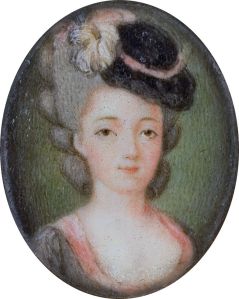
Lafeyettes wife Marie_Adrienne_Francoise
Marie Adrienne Francoise, wife of Lafayette

Lafayette wrote home to his wife Marie Adrienne in 1778, from Valley Forge. “In the place he occupies, he is surrounded by flatterers and secret enemies. He finds in me a trustworthy friend in whom he can confide and who will always tell him the truth. Not a day goes by without his talking to me at length or writing long letters to me. And he is willing to consult me on most interesting points.”

Lafayette served without pay, spending the equivalent of $200,000 of his own money for the salaries and uniforms of staff, aides and junior officers. He participated in several Revolutionary War battles, being shot in the leg at Brandywine, going on to serve at Barren Hill, Monmouth Courthouse, Rhode Island, and the final siege at Yorktown. All the while, Lafayette periodically returned to France to work with Franklin in securing thousands of additional troops and several warships to aid in the war effort.

Adrienne gave birth to their first child on one such visit, a boy they named Georges Washington Lafayette.

It was a small force under Lafayette that took a position on Malvern Hill in 1781, hemming in much larger British forces under Lord Cornwallis at the Yorktown peninsula.

Lafayette_sabre
Lafayette’s sabre as general of the Garde nationale. On display at the Musée de l’Armée, Paris.

The trap was sprung that September with the arrival of the main French and American armies under Marshal Jean-Baptiste Donatien de Vimeur, comte de Rochambeau & General George Washington, and the French fleet’s arrival in the Chesapeake under Lieutenant Général des Armées Navales François-Joseph Paul, comte de Grasse.

Cornwallis surrendered on October 19, 1781, after which Lafayette returned to France.

The Marquis played an important role in his own country’s revolution, becoming a Commander of the French National Guard. When the Bastille was stormed by an angry mob in 1789, Lafayette was handed the key.

Lafayette sent the key to the Bastille to George Washington, as a “token of victory by Liberty over Despotism”. Today that key hangs in the main hallway at Washington’s mansion at Mount Vernon.

There came a time when the French Revolution morphed into the Reign of Terror, and began to eat its young.  The Marquis de Lafayette was captured by Austria in 1792 and imprisoned under verminous conditions, while his wife was taken into custody by the French Republic.

Lafayette_Prison_reunionSecretary of State Thomas Jefferson found a loophole that allowed Lafayette to be paid, with interest, for his services in the late Revolution. An act was rushed through Congress and signed by President Washington, the resulting funds allowing both Lafayettes some of the few privileges permitted them, during their five years’ captivity.

Georges Washington Lafayette was smuggled to America out of France in 1795, while his father was held prisoner.   Adrienne was released after four, and persuaded Emperor Francis to permit her and her two daughters to join her husband in prison. After a brutal year in solitary confinement, Lafeyette’s cell door opened on October 15, 1795.  He must have been astonished to see his wife and daughters walk in. The four would spend his last year in captivity, together.

Adrienne died on Christmas day, 1807.  She had slipped into delirium the night before, her final words spoken to her husband:  “Je suis toute à vous“.  I am all yours.

Lafayette remained staunchly opposed to both the Napoleonic regime and the restoration of the Bourbon dynasty, feeling that both had come to power by undemocratic means.

Lafayette-portrait
1824 portrait by Scheffer, hangs in the U.S. House of Representatives

In 1824, President James Monroe and Congress invited Lafayette to visit the United States, for the nation’s upcoming 50th birthday. Crowds of cheering citizens greeted the French Marquis and his son Georges Washington on their return to Boston, Philadelphia and New York.

Harlow Giles Unger wrote in his 2003 book Lafayette, “It was a mystical experience they would relate to their heirs through generations to come. Lafayette had materialized from a distant age, the last leader and hero at the nation’s defining moment. They knew they and the world would never see his kind again.”

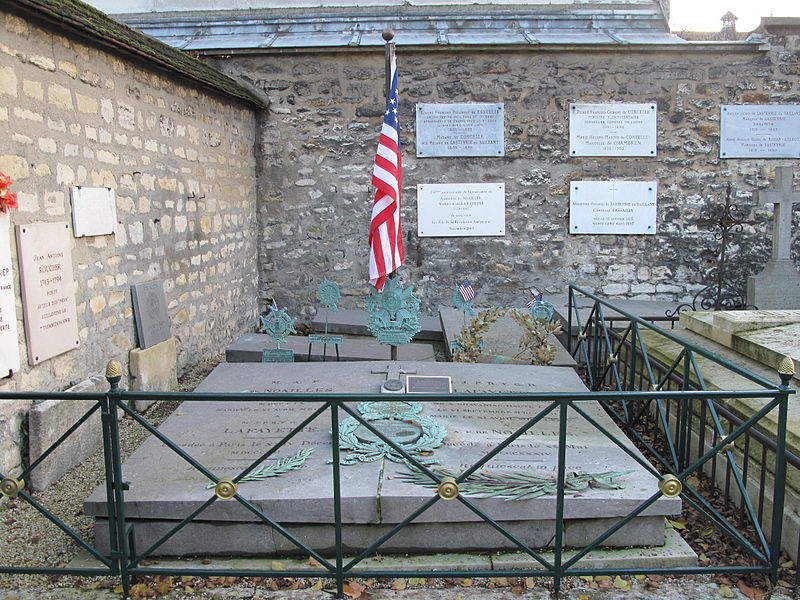
Marie-Joseph Paul Yves Roch Gilbert du Motier died in Paris on May 20, 1834, and was buried next to his wife at the Picpus Cemetery.  He was seventy-six.  President Andrew Jackson ordered that he be accorded the same funeral honors which President John Adams had bestowed on George Washington himself, in 1799. John Quincy Adams delivered a three-hour eulogy in Congress, saying “The name of Lafayette shall stand enrolled upon the annals of our race high on the list of the pure and disinterested benefactors of mankind.”

Lafayette-grave
Lafayette Burial Place, Picpus Cemetery, Paris

In obedience to his one of his last wishes, several feet of earth were dug up from Bunker Hill, and shipped to France.  The man had always wanted to be buried under American soil.

June 10, 1944 Oradour-sur-Glane

The women and children were locked in a village church while the German soldiers looted the town. The men were taken to a nearby barn, where the machine guns had already been set up.

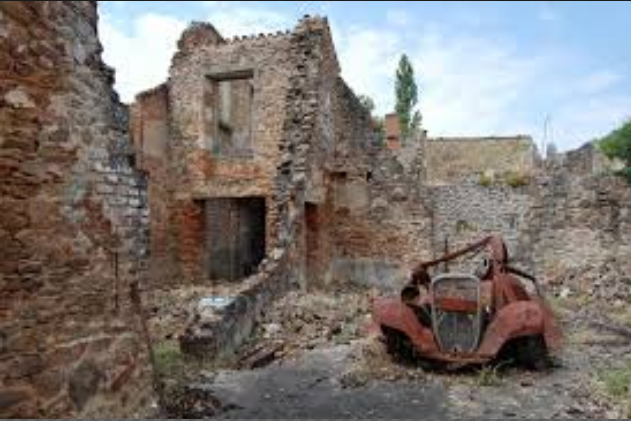
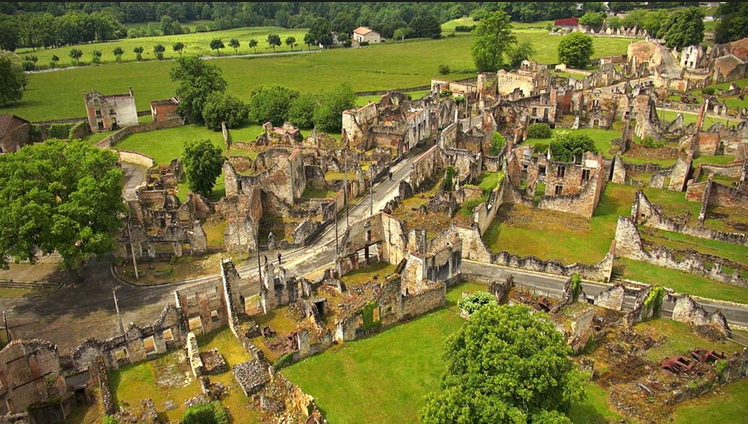
Oradour-sur-Glane-StreetsIt was D+4 in the invasion of Normandy, and the 2nd SS Panzer Division (“Das Reich”) had been ordered to stop the Allied advance. They were passing through the Limousin region in west central France, when SS-Sturmbannführer Adolf Diekmann received word that Waffen-SS officer Helmut Kämpfe was being held by French Resistance forces in the village of Oradour-sur-Vayres.

Diekmann’s battalion sealed off the nearby village of Oradour-sur-Glane, unaware that they had confused it with the other village. Everyone in the town was ordered to assemble in the village square to have their identity papers examined. The entire population of the village was there, plus another 6 unfortunates who were riding their bicycles in the wrong place, at the wrong time.

Oradour-sur-Glane.jpg 1

The women and children were locked in a village church while German soldiers looted the town. The men were taken to a nearby barn, where machine guns had already been set up.

The Germans aimed for the legs when they opened fire, intending to inflict as much pain as possible. Five escaped in the confusion before the SS lit the barn on fire. 190 men were burned alive.

Nazi soldiers then lit an incendiary device in the church, and gunned down 247 women and 205 children as they tried to get out.

642 inhabitants of Oradour-sur-Glane, age one week to 90 years, were murdered in a few hours, the village razed to the ground. After the war, French President Charles de Gaulle ordered that the village remain as is; a memorial to the cruelty of collective punishment, and the savagery committed by the Waffen-SS in countless places: the French towns of Tulle, Ascq, Maillé, Robert-Espagne, and Clermont-en-Argonne; the Polish villages Michniów, Wanaty and Krasowo-Częstki, Warsaw; the Soviet village of Kortelisy; the Lithuanian village of Pirčiupiai; the Czechoslovakian villages of Ležáky and Lidice; the Greek towns of Kalavryta and Distomo; the Dutch town of Putten; the Yugoslavian towns of Kragujevac and Kraljevo, and the village of Dražgoše, in what is now Slovenia; the Norwegian village of Telavåg; the Italian villages of Sant’Anna di Stazzema and Marzabotto. And on, and on, and on.

French President Jacques Chirac dedicated a memorial museum in 1999, the “Centre de la mémoire d’Oradour”. The village stands today as the Nazis left it, 73 years ago today. It may be the most forlorn place on earth.

The story was featured in the 1974 British television series “The World at War”, narrated by Sir Laurence Olivier. The first and final episodes of the program began with these words: “Down this road, on a summer day in 1944. . . The soldiers came. Nobody lives here now. They stayed only a few hours. When they had gone, the community which had lived for a thousand years. . . was dead. This is Oradour-sur-Glane, in France. The day the soldiers came, the people were gathered together. The men were taken to garages and barns, the women and children were led down this road . . . and they were driven. . . into this church. Here, they heard the firing as their men were shot. Then. . . they were killed too. A few weeks later, many of those who had done the killing were themselves dead, in battle. They never rebuilt Oradour. Its ruins are a memorial. Its martyrdom stands for thousands upon thousands of other martyrdoms in Poland, in Russia, in Burma, in China, in a World at War”.

Oradour-sur-Glane

June 5, 1899 – The Dreyfus Affair

The Dreyfus affair has been called “a modern and universal symbol of injustice”.

Europe was embarked on yet another of its depressingly regular paroxysms of anti-Semitism in the late 19th century, when Alfred Dreyfus was arrested for espionage.

alfred dreyfus
Alfred Dreyfus

A French Captain of Jewish-Alsatian background, the “evidence” against him was almost non-existent, limited to an on-the-spot handwriting analysis of a tissue paper missive written to the German Embassy. “Expert” testimony came from Alphonse Bertillon, inventor of the modern ‘mug shot’ and an enthusiastic proponent of anthropometry in law enforcement, the collection of body measurements and proportions for purposes of identification, later phased out by the use of fingerprints. Though no handwriting expert, Bertillon opined that Dreyfus’ handwriting was similar to that of the sample, explaining the differences with a cockamamie theory he called “autoforgery”.

Chief Inspector Lieutenant-Colonel Charles Armand Auguste Ferdinand Mercier du Paty de Clam, himself no handwriting expert, agreed with Bertillon. With no file and only the flimsiest of evidence, de Clam summoned Dreyfus for interrogation on October 13, 1894. Dreyfus maintained his innocence during the interrogation, with his inquisitor going so far as to slide a revolver across the table, silently suggesting that Dreyfus kill himself. Du Paty arrested Dreyfus two days later, informing the captain that he would be brought before a Court Martial.Dreyfus-Affair

Despite the paucity of evidence, the young artillery officer was convicted of handing over State Secrets in November 1894.  The insignia was torn from his uniform and his sword broken, and then he was paraded before a crowd that shouted, “Death to Judas, death to the Jew.”  Dreyfus was sentenced to life, and sent to the penal colony at Devil’s Island in French Guiana, where he spent almost five years.

A simple miscarriage of justice elevated to a national scandal two years later, when evidence came to light identifying French Army major Ferdinand Walsin Esterhazy as the real culprit. Esterhazy was brought to trial in 1896, but high ranking military officials suppressed evidence, and he was acquitted on the second day of trial. The military dug in, accusing Dreyfus of additional crimes based on false documents. Indignation at the obvious frame-up began to spread.

i-accuseMost of the political and military establishment lined up against Dreyfus, but the public outcry became furious after writer Émile Zola published his vehement open letter “J’accuse” (I accuse) in the Paris press in January 1898.

Zola himself was tried and convicted for libel, and fled to England.

Liberal and academic activists put pressure on the government to reopen the case. On June 5 1899, Alfred Dreyfus learned of the Supreme Court decision to revisit the judgment of 1894, and to return him to France for a new trial.french-prison-ile-st-joseph-in-french-guiana-devils-island--29946

What followed nearly tore the country apart.  “Dreyfusards” such as Anatole France, Henri Poincaré and future Prime Minister Georges Clemenceau were pitted against anti-Dreyfusards such as Edouard Drumont, publisher of the anti-Semitic newspaper La Libre Parole.  To his supporters, the “Dreyfus affair” was a grotesque miscarriage of justice.  A clear and obvious frame-up.  To his detractors, Dreyfus came to symbolize the supposed disloyalty of French Jews, the attempt to reopen the case an attack on the nation and an attempt to weaken the army in order to place it under parliamentary control.

The new trial was a circus. The political and military establishments stonewalled. One of Dreyfus’ two attorneys was shot in the back on the way to court. The judge dismissed Esterhazy’s testimony, even though the man had confessed to the crime by that time. The new trial resulted in another conviction, this time with a ten-year sentence. Dreyfus would probably not have survived another 10 years in the Guiana penal colony. This time, he was pardoned and set free.

Alfred Dreyfus was finally exonerated of all charges in 1906, and reinstated as a Major in the French Army, where he served with honor for the duration of World War I, honorably ending his service at the rank of Lieutenant-Colonel.

The Dreyfus affair has been called “a modern and universal symbol of injustice”.  The divisions and animosities left in the world of French politics, would remain for years.  The French army would not publicly declare the man’s innocence, until 1995.

June 1, 1918 Belleau Wood

White crosses and Stars of David stand silent witness over the graves of fallen servicemen at the American cemetery, 2,289 of them. 250 mark the final resting place of the unknown.  The names of another 1,060, missing for all time, appear on the wall of a memorial chapel. Visitors there may also stop at the nearby German cemetery, where 8,625 are buried.

After three years, the Great War could be likened to two evenly matched and exhausted fighters, each holding the other by the throat while attempting to beat the other to death.

Swaths of the European countryside were literally torn to pieces.  Every economy on the continent tottered on the edge of destruction, or close to it.  The Austro-Hungarian and Ottoman Empire were on the edge of extinction.  The Russian Empire was dying.WW1

No fewer than 1.7 million Russian troops lay dead at the dawn of 1917, and food shortages plagued the countryside.  The Czar was forced to abdicate by February, as the largest belligerent of the war descended into civil war.  By March, Imperial Russia was all but out of the war.

The United States entered WW1 relatively late, the first 14,000 Americans arriving ‘over there’ in June 1917.  General John ‘Black Jack’ Pershing wanted his troops to be well trained and equipped before entering combat, and refused to disperse them, piecemeal.  Desperately wanting the Americans to fill in gaps in his own lines, British Field Marshal Douglas Haig called Pershing ‘Obstinate and Stupid.  Ridiculous’.  French Marshall Ferdinand Foch was apoplectic, but Pershing refused to allow his people to be used as cannon fodder.

The first small-scale American action occurred that October, near the trenches of Nancy.  Meanwhile, a mighty force was building at the French harbors of Bordeaux, La Pallice, Saint Nazaire and Brest.  Passenger liners, seized German vessels and borrowed Allied ships poured out of New York, New Jersey, and Newport News, as American engineers built 82 new ship berths, nearly 1,000 miles of railroad track and 100,000 miles of telephone and telegraph lines across the french countryside.

By May 1918, those initial 14,000 had grown to over a million, ‘over there’.

It was imperative at this stage for the German war effort, to throw a knockout punch before the Americans entered in force.  With close to 50 divisions freed up from duty in the east following the Russian surrender, Spring of 1918 was time for the ‘King’s Battle’.  The Kaiserschlacht.

Operation Michael, the first of four German offensives, exploded against the British 3rd and 5th Armies at 4:40am on March 21.  In the space of five hours, 1,100,000 shells were fired into an area 150 miles square.  This “Storm of Steel” was followed by storm troopers:  fast, elite German infantry armed with flame throwers and small arms, following a moving curtain of fire known as the ‘Feuerwalze’.  Rupprecht, Crown Prince of Bavaria, was succinct. “We chop a hole. The rest follows.”belleau-wood

At first, Michael was so successful that German troops outran their own supply lines.  The German advance began to falter as exhausted forces faced waves of fresh British and Australian troops.  By April 5 the western front was returned to stalemate, at the cost of 255,000 British, British Empire and French troops.  239,000 were lost to the German side.

Operation Georgette‘, the Battle of Lys, opened after preliminary bombardment on April 9.  The main attack all but destroyed the Portuguese Expeditionary Corps, the British 2nd Division and elements of the British 40th Division.  In issuing his “Order of the Day” on April 11, Field Marshal Sir Douglas Haig stated, “With our backs to the wall and believing in the justice of our cause, each one of us must fight on to the end.”

Technically a German victory insofar as they held the ground when the shooting stopped, Georgette too was a pyrrhic victory.  Killed, wounded and missing stood at roughly 220,000, split evenly between both sides.
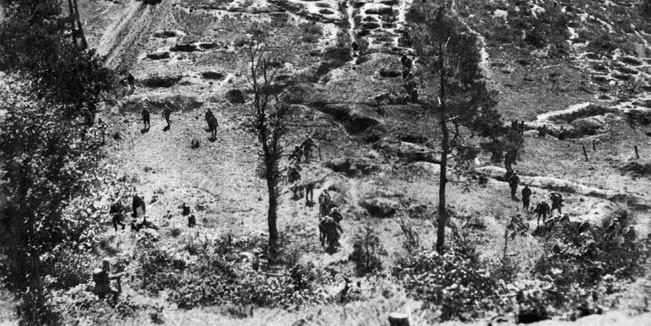
M-Belleau-12-HT-Jun08-1

Operation Blücher–Yorck, known to history as the Third Battle of the Aisne, began with a German attack on May 27, toward Rheims.  The sector was nominally held by six British divisions, badly depleted and basically ‘resting’, following the mauling suffered in earlier fighting.  Making matters worse, French General Denis Auguste Duchêne was openly contemptuous of Marshall Philippe Petain’s order to maintain defense in depth, insubordinately massing his troops in forward trenches.

Marines-battle-of-belleau-woodThe results of the Feuerwalze were devastating, if not predictable.  Allied lines were smashed as German armies poured through, taking 19 kilometers in three days and reaching the Marne River, 50 miles from Paris.  On May 31, a dogged defense by the US 3rd Infantry Division turned the German advance at Château-Thierry, and toward Belleau Wood.

This and the following week’s fighting earned for the 3rd I.D. the nickname “The Rock of the Marne”.  To this day, the unit out of Ft. Stewart, Georgia, is known as the “Marne Division”.

On June 1, German Forces penetrated French lines to the left the US Reserve.  The US Army 23rd Infantry Regiment, the 1st Battalion, 5th Marines, and an element of the Marine Corps 6th Machine Gun Battalion conducted a forced march overnight, covering over 6 miles to plug the gap and oppose the German line.Scott_Belleau_Wood
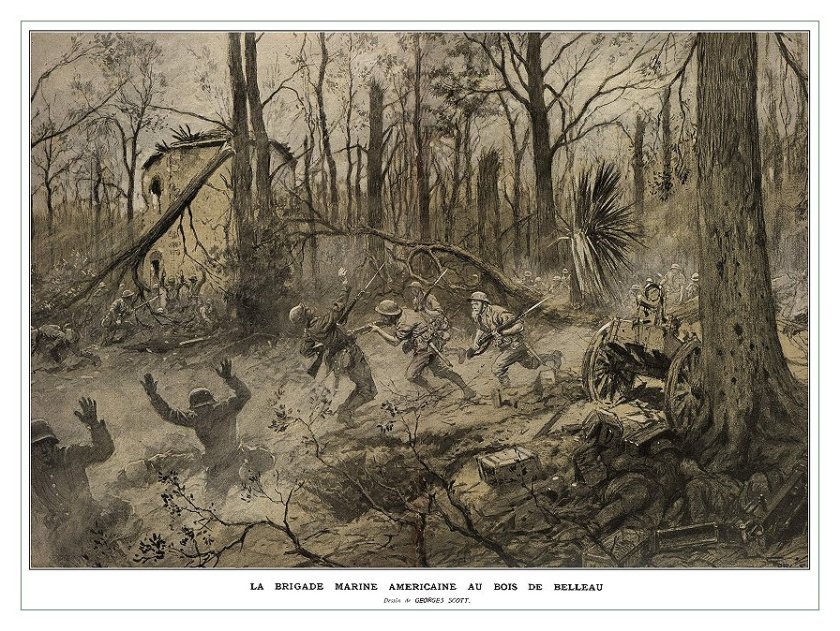
Arriving to find French forces retreating, Marines were urged to turn back.  2nd Battalion, 5th Marines Captain Lloyd Williams’ response would go down in Marine Corps History.  “Retreat? Hell, we just got here”.  Belleau Wood was one of the bloodiest battles US forces would fight in WW1.  Six times over the following days, 5th & 6th Battalion Marines attacked the better part of five German divisions in Belleau Wood.  The once-beautiful hunting preserve was reduced to a jungle of shattered timber.

An overwhelmingly superior German force threw everything they had at these two brigades of Marines, a few hundred soldiers and a handful of Navy corpsmen:  mustard gas, interlocking and mutually supporting fields of machine gun fire.  Fighting became hand to hand with rifle, bayonet and even fists. And still they came.Teufel Hunden
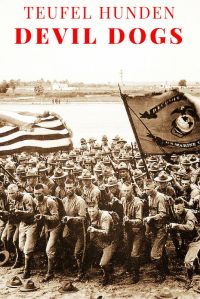
At Belleau Wood, Marines first heard the name “Höllenhunde” (“hellhound”), and the appellation that goes down in Marine Corps lore, to this day.  “Teufelshunde”. “Devil Dogs.”  In one attack on June 11, only 1 of the 10 Marine officers and 16 out of 250 enlisted men survived, or came out unscathed.

On June 26, Major Maurice Shearer was able to report, “Woods now U.S. Marine Corps entirely,”  Belleau Wood was the first major engagement for American forces in WW1.  They came out of it with nothing to prove.

On June 30, the French 6th Army Commanding General Jean Degoutte officially renamed Belleau Wood as “Bois de la Brigade de Marine” – Wood of the Marine Brigade.

A German private, one of only 30 men left out of 120, may have had the understatement of the war, when he wrote “We have Americans opposite us who are terribly reckless fellows.”