October 16, 1793 Let them eat Cake

Marie-Antoinette’s hair was cut off on October 16, 1793. She was driven through Paris in an ox cart, taken to the Place de la Révolution, and decapitated. She accidentally stepped on the executioner’s foot on mounting the scaffold.  Her last words were “Pardon me sir, I meant not to do it”.

Alliances came and went throughout 18th century Europe, and treaties were often sealed by arranged marriages. One such alliance took place in 1770 when Francis I, Holy Roman Emperor and his wife Maria Theresa, the formidable Queen of Hungary and Bohemia, married their daughter Maria Antonia to Louis-Auguste, the son of Louis XV, King of France.

The happy couple had yet to meet when the marriage was performed by proxy, the bride remaining in Vienna while the groom stayed in Paris. At 12 she was now the Dauphine, Marie Antoinette, wife of the 14-year-old Dauphin, future King of France.
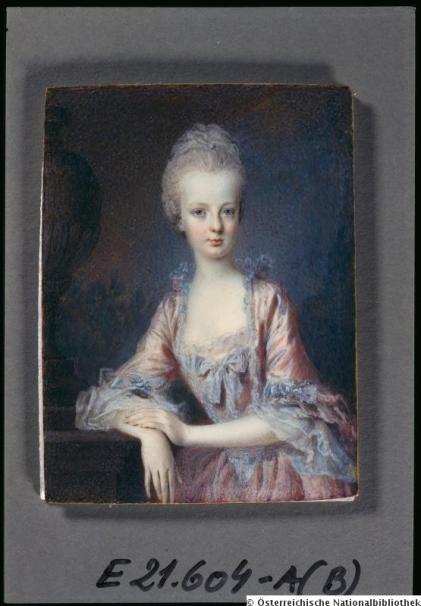
Marie_Antoinette_girlThere was a second, ceremonial wedding held in May, after which came the ritual bedding. This wasn’t the couple quietly retiring to their own private space.  This was the bizarre spectacle of a room full of courtiers, peering down at the proceedings, to make sure the marriage was consummated.

It was not, and that failure did damage to both of their reputations.

The people liked their new Dauphine at first, but the Royal Court was another story. They had promoted several Saxon Princesses for the match, and called Marie Antoinette “The Austrian Woman”.  She would be called far worse.

The stories you read about 18th century Court intrigue make you wonder how anyone lived like that. Antoinette was naive of the shark tank into which she’d been thrown. Relations were especially difficult with the King’s mistress, the Comtesse du Barry, and Antoinette was somehow expected to work them out. The King’s daughters, on the other hand, didn’t care for du Barry’s unsavory relations with their father. Antoinette couldn’t win. The sisters complained of feeling “betrayed” one time, when Antoinette commented to the King’s mistress “There are a lot of people at Versailles today”.

Court intrigues were accompanied by reports to Antoinette’s mother in Vienna, the Empress responding with her own stream of criticism. The Dauphin was more interested in lock making and hunting, she wrote, because Antoinette had failed to “inspire passion” in her husband. The Empress even went so far as to tell her daughter that she was no longer pretty. She had lost her grace. Antoinette came to fear her own mother more than she loved her.

Marie_Antoinette_by_Joseph_DucreuxLouis-Auguste was crowned Louis XVI, King of France, on June 11, 1775. Antoinette remained by his side, though she was never crowned Queen, instead remaining Louis’ “Queen Consort”.

With her marriage as yet unconsummated, Antoinette’s position became precarious when her sister in law gave birth to a son and possible heir to the throne. Antoinette spent her time gambling and shopping, while wild rumors and printed pamphlets described her supposedly bizarre sexual romps.

France had serious debt problems in the 1770s, the result of endless foreign wars, but Antoinette received more than her share of the blame. As first lady to the French court, Antoinette was expected to be a fashion trendsetter. Her shopping was in keeping with the role, but rumors wildly inflated her spending habits. Her lady-in-waiting protested that her habits were modest, visiting village workshops in a simple dress and straw hat. Nevertheless, Antoinette was rumored to have plastered the walls of Versailles with gold and diamonds.

The difficult winter of 1788-89 produced bread shortages and rising prices as the King withdrew from public life. The marriage had produced children by this time, but the legend of the licentious spendthrift and empty headed foreign queen took root in French mythology, as government debt overwhelmed the economy.

French politics boiled over in June 1789, leading to the storming of the Bastille on July 14. Much of the French nobility fled as the newly formed National Constituent Assembly conscripted men to serve in the Garde Nationale, while the French Constitution of 1791 weakened the King’s authority.

Bastille

Food shortages magnified the unrest. In October, the King and Queen were placed under house arrest in the Tuileries Palace. In June they attempted to flee the escalating violence, but were caught and returned within days. Radical Jacobins exploited the escape attempt as a betrayal, and pushed to have the monarchy abolished altogether.
marie-antoniette-french-historyUnrest turned to barbarity as Antoinette’s friend and supporter, the Princesse de Lamballe, was taken by the Paris Commune for interrogation. She was murdered at La Force prison, her head fixed on a pike and marched through the city.

Louis XVI was charged with undermining the First Republic in December 1792, found guilty and executed by guillotine on January 21, 1793. He was 38.

Marie-Antoinette became prisoner #280, her health deteriorating in the following months. She suffered from tuberculosis by this time and was frequently bleeding, possibly from uterine cancer.

Antoinette was taken from her cell on October 14, subjected to a sham trial whose outcome was never in doubt. She was accused of molesting her own son, a charge so outrageous that even the market women who had stormed the palace demanding her entrails in 1789, spoke in her support. “If I have not replied”, she said, “it is because nature itself refuses to respond to such a charge laid against a mother.”

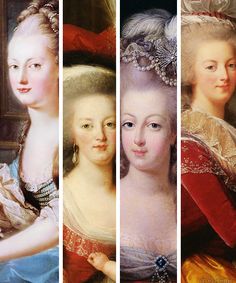
marie-antoinette over the yearsMarie-Antoinette’s hair was cut off on October 16, 1793. She was driven through Paris in an ox cart, taken to the Place de la Révolution, and decapitated. She accidentally stepped on the executioner’s foot on mounting the scaffold.  Her last words were “Pardon me sir, I meant not to do it”.

“Let them eat cake” is often attributed to Marie Antoinette, but there’s no evidence that she ever said it. The phrase appears in the autobiography of Jean-Jacques Rousseau, “Les Confessions”, attributed to a “Grande Princesse” whom the book declines to name. Considering the lifetime of cheap and mean-spirited gossip to which Marie Antoinette was subjected, it’s easy to believe that this was more of the same.

October 9, 768 Holy Roman Empire

The French Enlightenment philosopher Voltaire remarked that “This agglomeration which was called and still calls itself the Holy Roman Empire was neither Holy, nor Roman, nor an Empire”.

In Medieval Europe, most of the government powers that mattered were exercised by a chief officer to the King, the “Mayor of the Palace”.  This Maior Domus, or “Majordomo” was created during the Merovingian Dynasty to manage the household of the Frankish King.  By the 7th century, the position had evolved into the power behind the throne of an all but ceremonial monarch.

In 751, the Mayor of the Palace forced King Childeric III off the throne and into a monastery.  He was the younger son of Charles “The Hammer” Martel and his wife Rotrude, destined to become sire to the founding father of the European Middle Ages.  He was Pepin III, “The Short”.

The Hammer
Charles “The Hammer” Martel who Saved Europe from an Invasion by the Ummayad Caliphate in 732 at the Battle of Tours

Pepin’s first act as King was to intercede with King Aistulf of the Lombards, on behalf of Pope Stephen II. Pepin wrested several cities away from the Lombards, forming a belt of central Italian territory which would later become the basis for the Papal States.  In the first crowning of a civil ruler by a Pope, Stephen anointed Pepin “Patricius Romanorum” (Patrician of the Romans) in 754, naming his sons Charlemagne and Carloman as his heirs.  This was the first vestige of a multi-ethnic union of European territories which would last until the age of Napoleon – the Holy Roman Empire.

Pepin died on campaign at age 54, his sons crowned co-rulers of the Franks on October 9, 768. Three years later, Carloman’s unexpected and unexplained death left Charlemagne undisputed ruler of the Frankish kingdom.

images (3)Charlemagne led an incursion into Muslim Spain, continuing his father’s policy toward the Church when he cleared the Lombards out of Northern Italy.  He Christianized the Saxon tribes to his east, sometimes under pain of death.
Pope Leo III was attacked by Italian enemies in the streets of Rome, who attempted unsuccessfully to cut out his tongue.  For the third time in a half-century, a Pope reached out to the Frankish Kingdom for help.

Pope Leo crowned Charlemagne “Emperor” on Christmas day in the year 800, in the old St. Peter’s Basilica. The honor may have been mostly diplomatic, as the seat of what remained of the Roman Empire remained in Constantinople.  Nevertheless, this alliance between a Pope and the leader of a confederation of Germanic tribes, was nothing short of a tectonic shift in western political power.

By the time of his death in 814, Charlemagne was “Pater Europae”, the Father of Europe.  German and French monarchies alike have traced their roots to his empire, ever since.

The title fell into disuse with the end of the Carolingian dynasty, until Pope John XII once again came under attack by Italian enemies of the Papacy.  The crowning of Otto I began an unbroken line of succession, extending out eight centuries. Charlemagne had been the first to bear the title of Emperor.  Otto I is regarded as the founder of the Holy Roman Empire, the date of his coronation in 962, as its founding.

Holy Roman Empire, 972-1000

Henry III deposed three Popes in 1046, personally selecting four out of the next five, after which a period of tension between the Empire and the Papacy lead to reforms within the church.

Simony (the selling of clerical posts) and other corrupt practices were restricted, ending lay influence in Papal selection.  After 1059, the selection of Popes was exclusively the work of a College of Cardinals.

The Papacy became increasingly politicized in the following years.  Pope Gregory decreed the right of investiture in high church offices to be exclusive to religious authorities.  Great wealth and power was invested in these offices, and secular authorities weren’t about to relinquish that much power.

Schism and excommunication followed.  Urban II, the Pope who preached the first crusade in 1095, couldn’t so much as enter Rome for years after his election in 1088.  The “anti-pope” Clement III ruled over the holy city at that time, with support from Henry IV.

The Kingdom had no permanent capital, Kings traveled between multiple residences to discharge their duties.  It was an elective monarchy, though most Kings had sons elected during their lifetime, enabling them to keep the crown within the family.  Many of the dynastic families throughout history have their origins in the Holy Roman Empire.  The Hohenstaufen, Habsburg and Hohenzollern among the Germanic Kings, the French Dynasties of the Capetian, Valois and Bourbon, as well as the Iberian dynasties of the Castilla, Aragonia and Pamplona y Navarre.HRE 1500

The French Enlightenment philosopher Voltaire remarked that “This agglomeration which was called and still calls itself the Holy Roman Empire was neither Holy, nor Roman, nor an Empire”.

The Holy Roman Empire became bogged down in struggles of succession in the 18th century. There was the War of Spanish Succession. The War of Polish Succession. The Wars of Austrian Succession and of German Dualism. The Holy Roman Empire peaked in 1050, becoming increasingly anachronistic by the period of the French Revolution. The last Holy Roman Emperor was Franz II, Emperor of Austria and Germany, who abdicated and dissolved the Empire in 1806, following the disastrous defeat of the 3rd Coalition by Emperor Napoleon Bonaparte at Austerlitz, in 1804.

Napoleon sarcastically commented that the German states were always “becoming, not being”. Ironically, the policies of “the little corporal” directly resulted in a rise of German nationalism, clearing the way to a united German state in 1870.  The polity which emerged would humble the French state in two World Wars.

September 17, 1940 Battle of Britain

Prime Minister Winston Churchill captured the spirit of the period, as only he could. “Never in the field of human conflict was so much owed by so many to so few”. – Winston Churchill

When the allies invaded Europe in 1944, they had to land on the beach in order to get a foothold. At that point, they controlled none of the European continent. The Nazi war machine had been so successful, that a map of Europe at that time could have been drawn in only two colors. One for the occasional neutral nation, the other for Nazi controlled or occupied territory.

dunkirk2
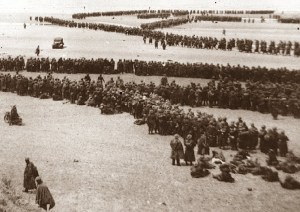
Allied evacuation of Dunkirk, May 1940

Your eyes would have to cross the English Channel on that map to find a third color, that of Great Britain, which in June of 1940 stood defiant and alone in the face of the Nazi war machine.

Rooftop Observer

In his “Finest Hour” speech of June 18, Prime Minister Winston Churchill said “What General Weygand has called the Battle of France is over. I expect that the Battle of Britain is about to begin“.

In Germany, street decorations were being prepared for the victory parades which were sure to come, as Hitler considered plans for his surprise attack on his ally to the East, the Soviet Union. After Great Britain and her allies had been hurled from the beaches of Dunkirk, Hitler seemed to feel he had little to do but “mop up”.

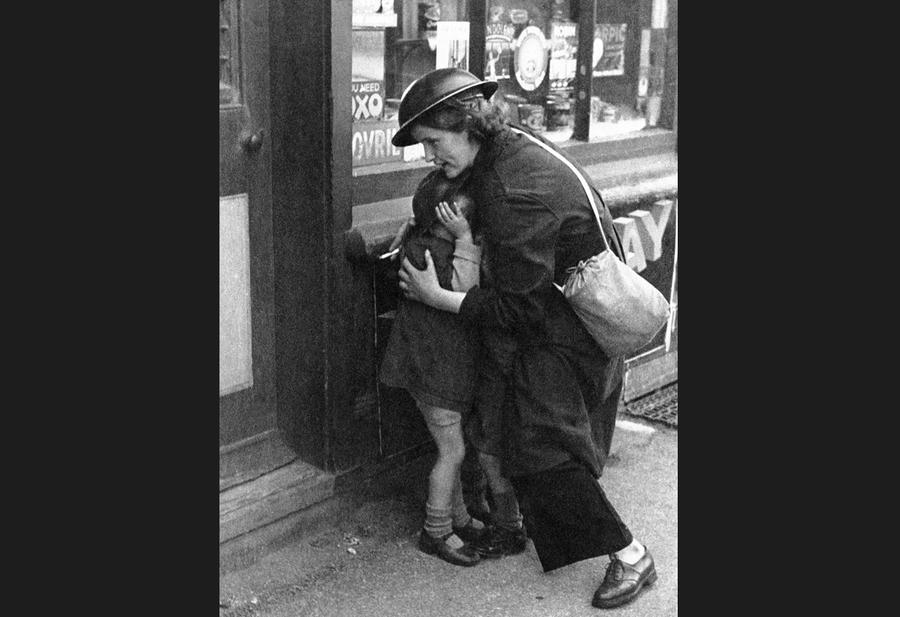
Battle of britain, children evacuatedGermany needed air supremacy before “Operation Sea Lion”, the amphibious invasion of England, could begin. Luftwaffe commander Hermann Göring said he would have it in four days.

Military planners of the 1930s believed that “The Bomber will always get through”, and Luftwaffe strategy was based on that assumption. Air Chief Marshal Sir H.C.T. “Stuffy” Dowding, leader of RAF Fighter Command, had other ideas. Dangerously low on aircraft and the pilots to fly them, the “Dowding System” employed a complex network of detection, command, and control to run the battle. The RAF hadn’t the faintest prayer of defending their entire coast, but Dowding’s system allowed them to dispatch individual squadrons to intercept each German air raid.

Battle of Britain, cleaning up
THE BATTLE OF BRITAIN 1940 (HU 104718) Workmen carry part of the bullet-riddled fuselage of a Dornier Do 17, alongside the wreckage of other crashed German aircraft at a scrapyard in Britain, August 1940. Copyright: © IWM. Original Source: http://www.iwm.org.uk/collections/item/object/205227877

The “Channel battles” beginning on July 10 were followed by a month of Luftwaffe attacks on English air fields. Losses were catastrophic for the RAF, but worse for the Luftwaffe. On only one day during this period, September 1, did the Germans succeed in destroying more aircraft than they lost.

German tactics changed on September 7. For almost two months, Luftwaffe attacks concentrated on cities and towns.

battleofbritain2

The Imperial War Museum online library (http://www.iwm.org.uk/collections/search?query=battle+of+britain&items_per_page=10) overflows with images of every day English life, set against a backdrop of catastrophic destruction. Children climbing over piles of rubble on their way to school. A milk man on his rounds, picking his way through shattered streets.  Adults browsing through stacks of library books, the ceilings open to the sky, great beams and rubble littering the aisles between the stacks.

23,002 English civilians died in the raids.  Another 32,138 were injured.

Battle of Britain, score
BATTLE OF BRITAIN (HU 810) A newspaper seller in the street watching a dog-fight during the Battle of Britain. Copyright: © IWM. Original Source: http://www.iwm.org.uk/collections/item/object/205226579

Interestingly, the most successful RAF squadrons to fight in the Battle of Britain weren’t British at all, but Polish.

battle of britain, kidsCzechoslovakia fell to the Nazis on the Ides of March, 1939, Czech armed forces having been ordered to offer no resistance. Some 4,000 Czech soldiers and airmen managed to get out, most escaping to neighboring Poland.

Tales of Polish courage in the face of the Nazi invasion of September 1 are magnificent bordering on reckless, replete with images of Polish horse cavalry riding out to meet German tanks. Little Poland never had a chance, particularly when the Soviet Union piled on two weeks later. Poland capitulated in a month, but the German victory was more costly than expected. Much more.  It’s estimated that the Wehrmacht expended twice as much ammunition defeating Poland as they did France the following Spring.  A country with a third larger population.

Battle of Britain, where from

The combined fighting forces of the two nations wound up in France in accordance with the Franco-Polish Military Alliance of 1921, thence to Great Britain following the French capitulation of June, 1940.

Battle of Britain, MilkmanBritish military authorities were slow to recognize the flying skills of the Polskie Siły Powietrzne (Polish Air Forces), the first fighter squadrons only seeing action in the third phase of the Battle of Britain. Despite the late start, Polish flying skills proved superior to those of less-experienced Commonwealth pilots. The 303rd Polish fighter squadron became the most successful RAF fighter unit of the period, its most prolific flying ace being Czech Sergeant Josef František.  He was killed in action in the last phase of the Battle of Britain, the day after his 26th birthday.

145 Polish aircrew served with the RAF during this period, making up the largest non-British contribution to the Battle of Britain.  The smallest is a two-way tie at one each, between Barbados and Jamaica.

Polish_airforce_memorial,_St_Clements
Polish Air Force memorial, St Clement Danes, London

In the end, Great Britain could not be defeated. German resources greatly outnumbered those of the English, but the ratio was reversed when it came to losses. The two nations were at a stalemate and none but a Pyrrhic victory was possible for either. Hitler indefinitely postponed Operation Sea Lion on September 17. By the end of October, the air raids had come to an end.

In the end, the Battle of Britain remains a story we remain free to tell, in English.  Prime Minister Winston Churchill captured the spirit of the period, as only he could.

“Never in the field of human conflict was so much owed by so many to so few”.


September 1 (est.), 911 A Different Normandy Story

Rollo was called “The Walker”, because the man was so huge that no horse could carry him.

The warlike men who sailed their longboats out of the north tormented the coastal UK and northwestern Europe, ever since their first appearance at Lindisfarne Monastery in 793.

These “Norsemen” (“Normans”), attacked Paris early in 911. By July they were holding Rollothe nearby town of Chartres under siege. Normans had burned the place to the ground back in 858 and would probably have done so again, but for their defeat at the battle of Chartres on July 20.
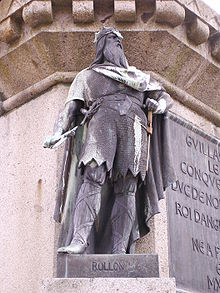
Even in defeat, these people presented a formidable threat. The Frankish King approached them with a solution.

King Charles III, known as “Charles the Simple” after his plain, straightforward ways, proposed to give the Normans the region from the English Channel to the river Seine. It would be the Duchy of Normandy, some of the finest farmlands in northwest Europe, and it would be theirs in exchange for an oath of loyalty to Charles.

Rollo the WalkerThe deal made sense for the King, because he had already bankrupted his treasury paying these people tribute. And what better way to deal with future Viking raids down the channel, than to make them the Vikings’ own problem?
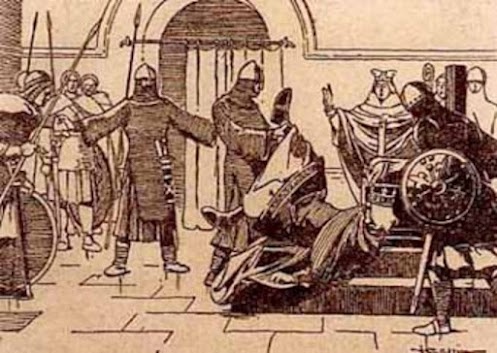
And so the Treaty of Saint-Clair-sur-Epte was concluded on this day in 911, when the Viking Chieftain Rollo pledged feudal allegiance to the King of Western Francia. Rollo was called “The Walker”, because the man was so huge that no horse could carry him. He must have been some scary character with a two-handed battle axe.

At some point in the proceedings, The Walker was expected to stoop down and kiss the king’s foot, in token of obeisance. Rollo recognized Treaty of Saint-Clair-sur-Eptethe symbolic importance of the gesture, but wasn’t about to submit to such degradation himself. The chieftain motioned to one of his lieutenants, a man almost as huge as himself, to kiss the king’s foot. The man shrugged, reached down and lifted King Charles off the ground by his ankle. He kissed the foot, and tossed the King of the Franks aside.  Like a sack of potatoes

In that moment, the personal dignity of the King of France, ceased to exist. The Duchy of Normandy, was born.

August 5, 1305 William Wallace

The Mel Gibson film “Braveheart” has it mostly right as they depict Wallace’s betrayal by Scottish Nobles. Wallace had evaded capture until August 5, 1305, when a Scottish knight loyal to Edward, John de Menteith, turned him over to English soldiers at Robroyston, near Glasgow.

Following the death of King Alexander in 1286, there were several weak claimants to the Scottish throne. Thousands of nobles met in the great feudal court held at the castle Berwick upon Tweed, for the purpose of selecting their new King.  In the end, the nobles selected John Balliol.

John was a weak king, known as “Toom Tabard”.  Empty Coat. Factions quickly coalesced around rival claimants.  Scotland was descending into civil war when nobles called on English King Edward I “Longshanks”, to arbitrate.

Edward could have entered this story as a benevolent and wise ruler, or he could have been a tyrant. He chose the latter course, passing into history as “The Hammer of the Scots”. Edward summoned King John to stand before the English Court as a common plaintiff.  Thousands of Scottish nobles were arrested as John was forced to abdicate.

william-wallace-1-728

It’s uncertain where William Wallace came from, but later events indicate that he had military training. Specifically, he was an archer. He must have been an imposing physical specimen, as the first class long bow of the era had a draw weight of 170lbs.

Rebellion arose across Scotland as Wallace assassinated William de Heselrig, the English High Sheriff of Lanark, in May 1297. He became involved with raids happening all over Scotland, joining forces with Andrew Moray on September 11, 1297 to defeat a vastly superior English army at Stirling Bridge.

After the battle, Moray and Wallace assumed the title of “Guardians of the Kingdom of Scotland”, though Moray would soon die of injuries suffered at Stirling Bridge. They were sworn to restore the reign of King John Balliol, and Wallace was knighted as he led a large scale raid into northern England in November of 1297.

Edward ordered a second invasion of Scotland in April, 1298.  Wallace was defeated at the battle Falkirk later that year. He managed to escape capture, resigning as Guardian of Scotland and traveling to the French court of King Philip IV to plead the case for assistance in the Scottish struggle for independence.

melThe Mel Gibson film “Braveheart” has it mostly right as it depicts Wallace’s betrayal by Scottish Nobles. Wallace had evaded capture until August 5, 1305, when a Scottish knight loyal to Edward, John de Menteith, turned him over to English soldiers at Robroyston, near Glasgow.
Wallace was transported to London and tried for treason and “atrocities against civilians in war.” He was crowned with a garland of oak, suggesting that he was “king of outlaws”. Responding to the treason charge, Wallace said “I could not be a traitor to Edward, for I was never his subject.” Wallace was found guilty on August 23, stripped naked, and dragged through the city by a horse to the Elms at Smithfield.

This is where the Braveheart film gets it wrong. I’m not going to dwell on the brutality which passes for medieval “justice”.  Suffice it to say that the film’s portrayal of Wallace’s execution could have been a Disney production, compared with what was dealt him. When it was over, Wallace’s head sat atop a pike on London Bridge, dipped in tar, next to the heads of the brothers John and Simon Fraser.

Scotland never did gain independence from England, though the subject has never entirely been put to rest. Last June, the Scottish electorate voted to remain in the European Union, even should the rest of the UK vote to “Brexit”. William Wallace was looking down on the proceedings with great interest.  I’m sure.

July 14, 1789 Storming the Bastille

Paris was “intoxicated with liberty and enthusiasm,” when the crowd converged on the Bastille on the morning of July 14, 1789. It was guarded by 82 invalides (veteran soldiers no longer fit for service in the field) and 32 Swiss grenadiers.
The attackers – vainqueurs de la Bastille – numbered 954.

In most of medieval France, the major constituent parts of French society were the “Three Estates”:  the Clergy, the Nobility and the Commons.

France was in a state of economic crisis in the late 18th century. The Nobility refused to accede to the tax demands of King Louis XVI. The Commoners reconstituted themselves into a “National Assembly” in June 1789, demanding an audience with the King for the purpose of drawing up a Constitution.

The National Assembly converged on the Estates General on June 20, only to find the door locked. What followed was either hysterical or duplicitous, because the King and his family were still mourning the death of the Dauphin; the heir apparent.  It was customary at that time to hold political matters, until the King came out of mourning.

Tennis Court Oath
Tennis Court Oath

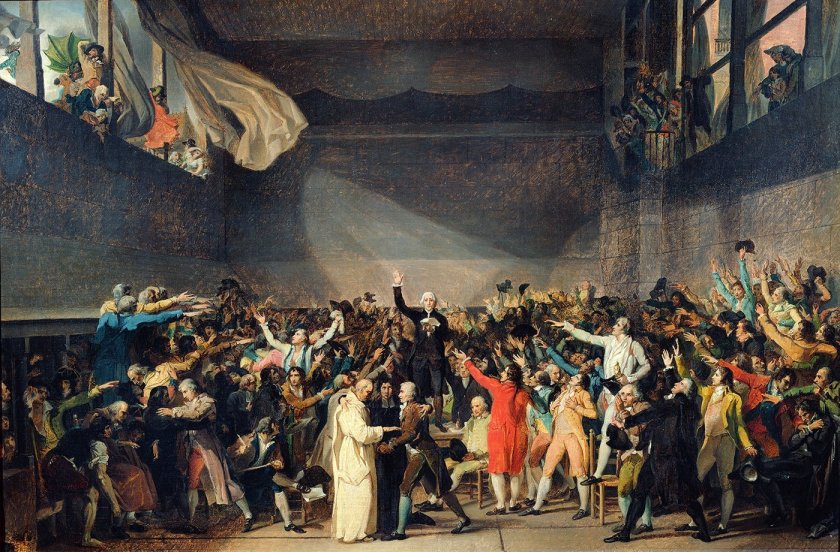
Be that as it may, the entire National Assembly, all 577 members, converged on an indoor tennis court. All but one put their names to a solemn oath, the famous “The Tennis Court Oath”, swearing “not to separate, and to reassemble wherever circumstances require, until the constitution of the kingdom is established”.

The oath itself was a revolutionary act, asserting that political authority came from the people and their representatives, not from the monarchy. The National Assembly had declared themselves to be supreme in the exercise of state power, making it increasingly difficult for the monarchy to operate based on “Divine Right of Kings”.

Riots followed as the left and reformist factions moved from anarchy to a coherent movement against the monarchy and the French right.

Built in 1309, the fortress and medieval prison of the Bastille had long been a focal point of the insurrection, representing royal authority in the center of the city. Donatien Alphonse François, better known as the Marquis de Sade, was one of the few remaining prisoners in the Bastille by this time. He was transferred to an insane asylum after attempting to incite a crowd outside his window, yelling: “They are massacring the prisoners; you must come and free them.”

Prise_de_la_Bastille

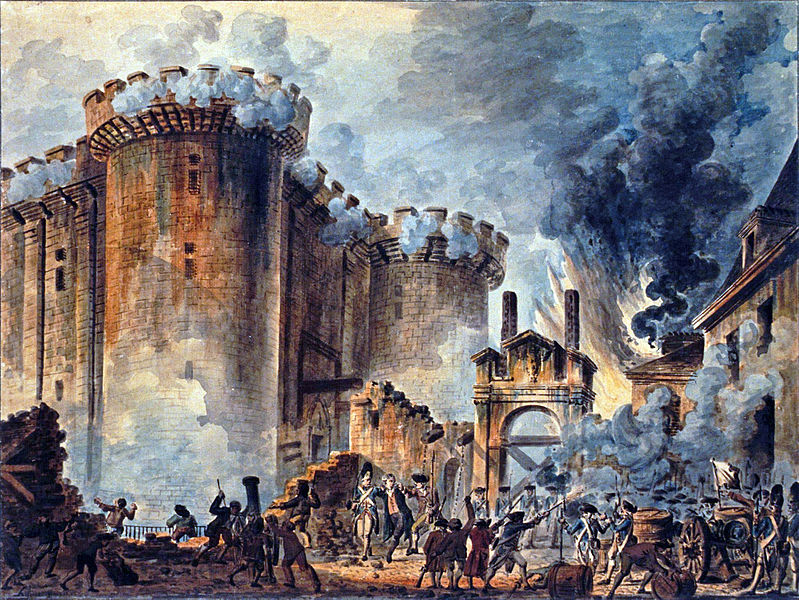
Paris was “intoxicated with liberty and enthusiasm,” when French revolutionaries converged on the Bastille on the morning of July 14, 1789. The fortress was guarded by 82 “invalides”, veteran soldiers no longer fit for service in the field, and 32 Swiss grenadiers under the command of Governor Bernard-René de Launay, the son of the previous governor, actually born in the Bastille.

The attackers – vainqueurs de la Bastille – numbered 954. Negotiations dragged on until the crowd lost patience, crowding into the outer courtyard and cutting the chain that held the drawbridge. Firing broke out as the bridge slammed down, crushing one unlucky vainqueur, while a nearby force of Royal Army troops did nothing to intervene. 98 attackers and one defender died in the fighting.  The mob murdered another 7, after their surrender.

The successful insurrection at Paris raced across all of France, as the “Great Fear” spread across the countryside. The absolute monarchy which had ruled for centuries was over within three years, when Louis himself lost his head to the guillotine in 1793. 16,594 went to the guillotine under “the Reign of Terror”, led by the “Committee of Safety” under the direction of Parisian lawyer Maximilian Robespierre. Among them was Queen Marie Antoinette, who never did say “let them eat cake”.  Her last words were pardon me, sir, I meant not to do it, on stepping on her executioner’s toes.

Exécution_de_Marie_Antoinette_le_16_octobre_1793
Execution of Marie Antoinette

As many as 40,000 were summarily executed or died in prison awaiting trials before the hysteria died down.  Robespierre himself lost his head in 1794.

The Napoleonic Wars which followed resulted in a Corsican artillery corporal-turned Emperor, fighting (and winning), more battles than Hannibal, Caesar, Alexander the great, and Frederick the Great, combined.

The saddest part of the whole sad story, may be the son of Louis and Antoinette, Louis-Charles, Duke of Normandy. He was King Louis XVII in name only, thrown into a stone prison cell at the age of 8. He would die there, at the age of 10. Miserable, sick and alone.  It all seems pointless. The Bourbon Dynasty was back in power, within twenty years.

July 10, 1946 Ruined

Paper money crashed in the post-Revolutionary Articles of Confederation period, when you could buy a sheep for two silver dollars, or 150 paper “Continental” dollars. Creditors hid from debtors, not wanting to be repaid in worthless paper currency. For generations after our founding, a thing could be described as worthless, as “not worth a Continental”.

You’ve worked all your life.  You’ve supported your family, paid your taxes, and paid your bills. You’ve even managed to put a few bucks aside, in hopes of a long and happy retirement.  “Inflation” is such a bloodless term.  What if you hadn’t touched that “nest egg”, and its purchasing power was suddenly diminished…by 10%…40%…70%.

Throughout Roman antiquity, coinage retained a high silver content as a matter of law.  Precious metal made the coins themselves objects of value and, for 500 years, the Roman economy remained relatively stable. Republic morphed into Empire over the 1st century BC, leading to a conga line of Emperors minting mountains of coins in their own likenesses. Slaves were worked to death in Spanish silver mines, to satisfy an endless need for the metal. Birds fell from the sky over vast smelting fires, yet there was never enough silver.  Silver content was inexorably reduced, until the currency itself became worthless.  Roman currency collapsed in the 3rd century reign of Diocletian. An Empire and its citizens were left to barter as best they could, in a world where money no longer had any value.

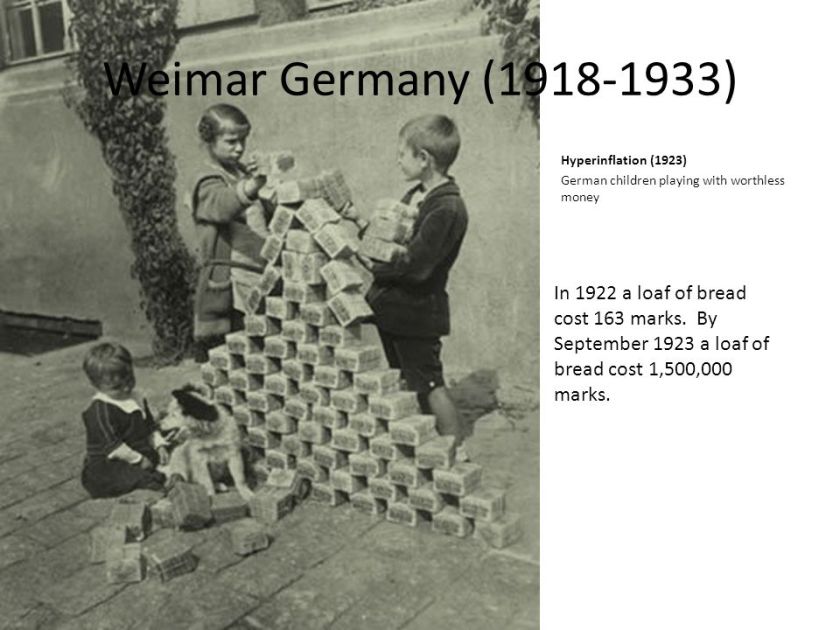
Weimar+Germany+(1918-1933)+Hyperinflation+(1923)+German+children+playing+with+worthless+money
German children playing with worthless currency, 1923.

In the waning days of the Civil War, the Confederate dollar wasn’t worth the paper it was printed on. Paper money crashed in the post-Revolutionary Articles of Confederation period as well, when you could buy a sheep for two silver dollars, or 150 paper “Continentals”. Creditors hid from debtors, not wanting to be repaid in worthless paper currency. Generations after our founding, the worthlessness of a thing could be described as “not worth a Continental”.

The assistance of French King Louis XVI was invaluable to Revolutionary era Americans, but French state income was only about 357 million livres at the time, with expenses of over half-billion. France descended into its own Revolution, as the government printed “assignat”, notes purportedly backed by 4 billion livres in property expropriated from the church. 912 million livres in circulation in 1791 rose to almost 46 billion in 1796, of a note whose purchasing power had diminished by 99%.

The money in their pockets was literally, not worth the paper it was printed on.  One historian described the economic policy of the Jacobins, the leftist radicals behind the reign of terror, as:  “[A]n utter exhaustion of the present at the expense of the future”.

In each of these historic cases, nothing defined and established the value a currency, except what a willing buyer and a willing seller agreed it was worth.  There was no “there”, there.  It all sounds depressingly familiar.

The Austro-Hungarian Empire was on the losing side of WW1, and broken up after the war.  Lacking the governmental structures of established states, the newly independent nation of Hungary began to experience inflation.  Before the war, a US Dollar would have bought you 5 Kronen.  In 1924, it was 70,000.

10Hungary replaced the Kronen with the Pengö in 1926, pegged to a rate of 12,500 to one.
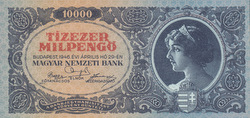
Hungary became a battleground in the latter stages of WW2, between the military forces of Nazi Germany and the USSR. 90% of Hungarian industrial capacity was damaged, half of it destroyed altogether.  Transportation became difficult, with most of the nation’s rail capacity damaged or destroyed.  What remained was either carted off to Germany, or seized by the Soviets, as reparations.

1000

The loss of all that productive capacity led to scarcity of goods, and prices began to rise.  The government responded by printing money.  Total currency in circulation in July 1945 stood at 25 billion Pengö.  Money supply rose to 1.65 trillion by January, 65 quadrillion in April and 47 septillion in July.  That’s a Trillion Trillion.  Twenty-four zeroes.

Banks received low rate loans, so that money could be loaned to companies to rebuild. The government hired workers directly, giving out loans to others and in many cases, outright grants.  The country was flooded with money, the stuff virtually grew on trees, but there was nothing to back it up.10000

Inflation took a straight line into the stratosphere.  The item that cost you 379 Pengö in September 1945, cost 1,872,910 by March, 35,790,276 in April, and 862 billion in June.  Inflation neared 150,000% per day, as the currency became all but worthless.  Massive printing of money had accomplished the cube root of zero.  The worst hyperinflation in history peaked on July 10, 1946, when that 379 Pengö item from September, cost you 1,000,000,000,000,000,000,000,000.

The government responded by changing the name, and the color, of the currency.  The Pengö was replaced by the Milpengö (1,000,000 Pengö), which was replaced by the Bilpengö (1,000,000,000,000 Pengö), and finally by the (supposedly) inflation-indexed Adopengö.  This spiral resulted in the largest denomination common currency note ever printed, the Milliard Bilpengö.  A Billion Trillion Pengö.

The thing was worth twelve cents.

100000One more currency replacement and all that Keynesian largesse would finally stabilize the currency, but at what cost?  Real wages were reduced by 80% and creditors wiped out.  The fate of the nation was sealed when communists seized power in 1949.  Hungarians could now share in that old Soviet joke: “They pretend to pay us, and we pretend to work”.

The ten worst hyperinflations in history occurred during the 20th century, including Zimbabwe in 2008, Yugoslavia 1994, Germany 1923, Greece 1944, Poland 1921, Mexico 1982, Brazil 1994, Argentina 1981, and Taiwan 1949.  The common denominator in all ten were massive amounts of government debt, and a currency with no intrinsic worth.

Hungary-Milliard-Bilpengo
A Billion Trillion Pengö. The largest denomination common currency note ever printed. It was worth about twelve cents.

In 2015, Boston University economist Laurence Kotlikoff testified before the Senate Budget Committee.  “The first point I want to get across” he said, “is that our nation is broke.  Our nation’s broke, and it’s not broke in 75 years or 50 years or 25 years or 10 years. It’s broke today”.

Kotlikoff went on to describe the “fiscal gap”, the difference between US’ projected revenue, and the obligations with which our government has saddled the taxpayer.  “We have a $210 trillion fiscal gap at this point”, Kotlikoff testified.  11.6 times GDP, the total of all goods and services produced in the United States.

On top of that, the United States owes something close to twenty trillion dollars, in fiscal operating debt, and our currency is unmoored from anything of inherent value.   We spend a lot of time, talking about politics.  Perhaps we should be talking about math, instead.

June 18, 1815 Waterloo

It was common practice of the age to “spike” enemy cannon, driving a nail into the touchhole to disable the weapon. But for a handful of nails, the outcome of the battle might have been different. Possibly, even the history of the world.

The Napoleonic Wars began in 1799, pitting Emperor Napoleon Bonaparte and his Grand Armée against a succession of international coalitions. The first five such coalitions formed to oppose him would go down to defeat.

The empire of Czar Alexander I had long traded with Napoleon’s British adversary. Napoleon invaded Russia in 1812 intending to cut off that trade, but he made the same mistake that Adolf Hitler would make, 130 years later. He failed to account for Russia’s greatest military asset. General Winter.

For months Napoleon’s army pressed ever deeper into Russian territory, as Cossack cavalry burned out villages and fields to deny food or shelter to the advancing French army. Napoleon entered Moscow itself in September, with the Russian winter right around the corner. He expected capitulation.  Instead, he got more scorched earth.

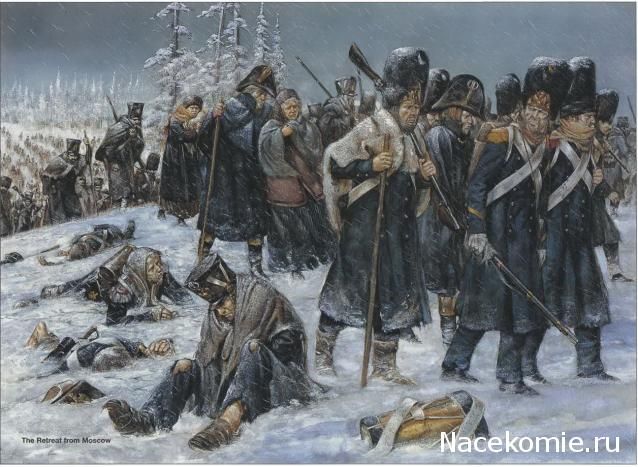
Grand Armee Retreat from MoscowFinally there was no choice for the Grand Armée, but to turn about and go home. Starving and exhausted with no winter clothing, stragglers were frozen in place or picked off by villagers or pursuing Cossacks. From Moscow to the frontiers you could follow their retreat, by the bodies they left in the snow. 685,000 had crossed the Neman River on June 24. By mid-December there were fewer than 70,000 known survivors.
The War of the 6th Coalition ended in 1814 with Bonaparte’s defeat and exile to the Mediterranean island of Elba, and the restoration to the throne of the Bourbon King, Louis VXIII. That would last 111 days, until Napoleon reappeared at the head of another army.

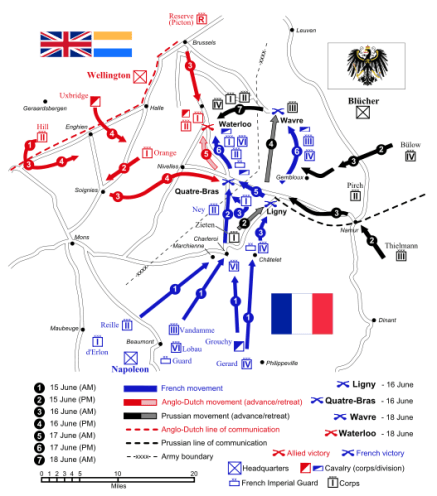
Waterloo_Campaign_mapThe Congress of Vienna declared Napoleon an outlaw on March 13, 1815.  Austria, Prussia, Russia and the UK bound themselves to put 150,000 men apiece into the field to end his rule.

Napoleon struck first, taking 124,000 men of l’Armee du Nord on a pre-emptive strike against the Allies in Belgium. Intending to attack Coalition armies before they combined, he struck and defeated the Prussian forces of Gebhard von Blücher near the town of Ligny.

Napoleon then turned his attention to the coalition forces under the Lord Arthur Wellesley, Duke of Wellington, who fell back to a carefully selected position on a long east-west ridge at Mont St Jean, a few miles south of the village of Waterloo.

It rained all day and night that Saturday. Napoleon waited for the ground to dry on the morning of June 18, launching his first attack before noon while Wellington’s Prussian allies were still five hours away. The 80 guns of Napoleon’s grande batterie opened fire at 11:50, while Wellington’s reserves sheltered out of sight on the reverse slope of the Mont St. Jean ridge.

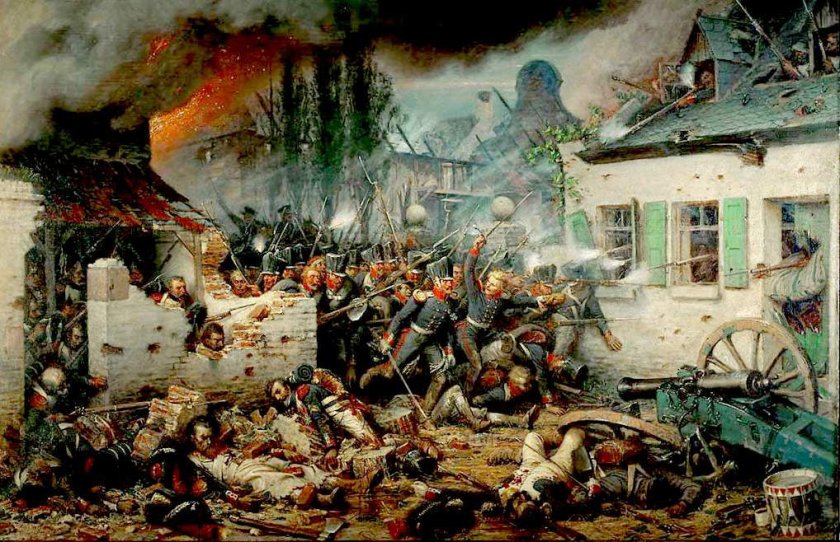
Fighting was furious around Wellington’s forward bastions, the walled stone buildings of the Château Hougomont on Wellington’s right, and La Haie Sainte on his left.  Eight times, French infantry swarmed over the orchards and outbuildings of the stone farmhouses, only to be beat back.

Waterloo, Chateau Battle

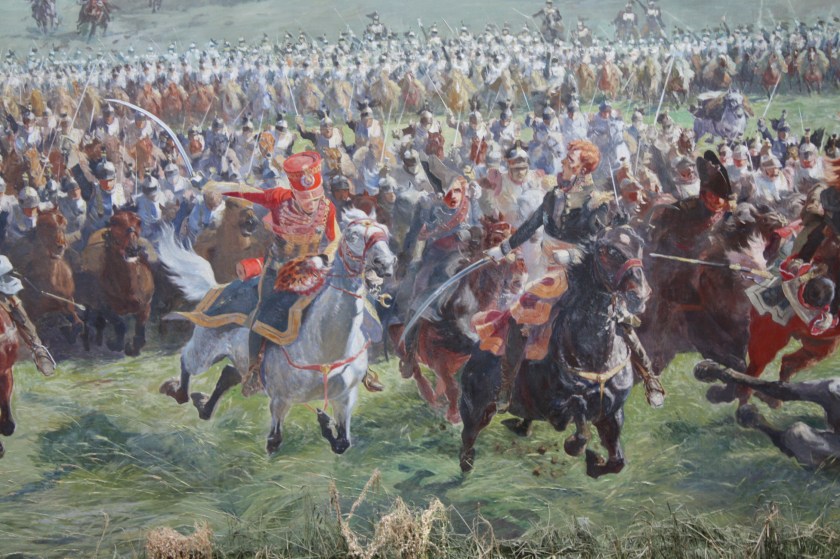
Most of the French reserves were committed by 4:00pm, when Marshall Ney ordered the massed cavalry assault. 9,000 horsemen in 67 squadrons charged up the hill as Wellington’s artillery responded with canister and shot, turning their cannon into giant shotguns tearing holes in the French ranks.

It was common practice of the age to “spike” enemy cannon, driving a nail into the touchhole to disable the weapon. But for a handful of nails, the outcome of the battle might have been different. Possibly, even the history of the world.  Eleven times French cavalry gained the hill and surrounded those guns. Eleven times the gunners retreated into defensive infantry squares, bristling with bayonets. Eleven times French cavalry withdrew only to form up, and do it all over again.Waterloo_Cavalry

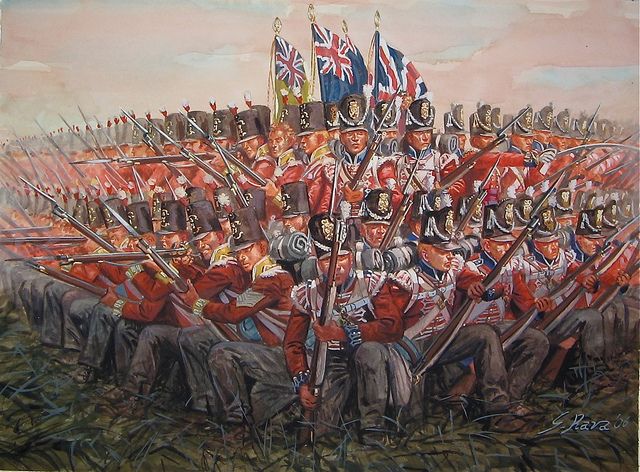
Newly arrived Prussians were pouring in from the right at 7:30 when Napoleon committed his 3,000-man Imperial Guard. These were Napoleon’s elite soldiers, almost seven feet tall in their high bearskin hats. Never before defeated in battle, they came up the hill intending to roll up Wellington’s center, away from their Prussian allies. 1,500 British Foot Guards were lying down to shelter from French artillery. As the French lines neared the top of the ridge, the English stood up, appearing to rise from the ground and firing point blank into the French line.

The furious counter assault which followed caused the Imperial Guard to waver and then fall back.  Retreat broke into a route, someone shouting “La Garde recule. Sauve qui peut!” (“The Guard retreats. Save yourself if you can!”), as the Allied army rushed forward and threw themselves on the retreating French.Infantry Square

There is a story, possibly apocryphal, concerning Henry Paget, 2nd Earl of Uxbridge. One of the last cannonballs fired that day hit Uxbridge just above the knee, all but severing the leg. Lord Uxbridge was close to Wellington at the time, exclaiming “By God, sir, I’ve lost my leg!”. Wellington replied “By God, sir, so you have!” There’s another version in which Wellington says “By God, sir, you’ve lost your leg!”. Looking down, Uxbridge replied “By God, sir, so I have!”

According to Wellington, the battle was “the nearest-run thing you ever saw in your life.” The French defeat was complete. Bonaparte was once again captured and exiled, this time to a speck in the North Atlantic called Saint Helena.  He died there in 1821.

Estimates of the total killed and wounded in the Napoleonic wars range from 3.5 to 6 million, at a time when the entire world population was about 980 million. Until Waterloo, Napoleon Bonaparte participated in, and won, more battles than Julius Caesar, Hannibal, Frederick the Great, and Alexander the Great.  Combined.

June 5, 1899 – The Dreyfus Affair

The Dreyfus affair has been called “a modern and universal symbol of injustice”.

Europe was embarked on yet another of its depressingly regular paroxysms of anti-Semitism in the late 19th century, when Alfred Dreyfus was arrested for espionage.

alfred dreyfus
Alfred Dreyfus

A French Captain of Jewish-Alsatian background, the “evidence” against him was almost non-existent, limited to an on-the-spot handwriting analysis of a tissue paper missive written to the German Embassy. “Expert” testimony came from Alphonse Bertillon, inventor of the modern ‘mug shot’ and an enthusiastic proponent of anthropometry in law enforcement, the collection of body measurements and proportions for purposes of identification, later phased out by the use of fingerprints. Though no handwriting expert, Bertillon opined that Dreyfus’ handwriting was similar to that of the sample, explaining the differences with a cockamamie theory he called “autoforgery”.

Chief Inspector Lieutenant-Colonel Charles Armand Auguste Ferdinand Mercier du Paty de Clam, himself no handwriting expert, agreed with Bertillon. With no file and only the flimsiest of evidence, de Clam summoned Dreyfus for interrogation on October 13, 1894. Dreyfus maintained his innocence during the interrogation, with his inquisitor going so far as to slide a revolver across the table, silently suggesting that Dreyfus kill himself. Du Paty arrested Dreyfus two days later, informing the captain that he would be brought before a Court Martial.Dreyfus-Affair

Despite the paucity of evidence, the young artillery officer was convicted of handing over State Secrets in November 1894.  The insignia was torn from his uniform and his sword broken, and then he was paraded before a crowd that shouted, “Death to Judas, death to the Jew.”  Dreyfus was sentenced to life, and sent to the penal colony at Devil’s Island in French Guiana, where he spent almost five years.

A simple miscarriage of justice elevated to a national scandal two years later, when evidence came to light identifying French Army major Ferdinand Walsin Esterhazy as the real culprit. Esterhazy was brought to trial in 1896, but high ranking military officials suppressed evidence, and he was acquitted on the second day of trial. The military dug in, accusing Dreyfus of additional crimes based on false documents. Indignation at the obvious frame-up began to spread.

i-accuseMost of the political and military establishment lined up against Dreyfus, but the public outcry became furious after writer Émile Zola published his vehement open letter “J’accuse” (I accuse) in the Paris press in January 1898.

Zola himself was tried and convicted for libel, and fled to England.

Liberal and academic activists put pressure on the government to reopen the case. On June 5 1899, Alfred Dreyfus learned of the Supreme Court decision to revisit the judgment of 1894, and to return him to France for a new trial.french-prison-ile-st-joseph-in-french-guiana-devils-island--29946

What followed nearly tore the country apart.  “Dreyfusards” such as Anatole France, Henri Poincaré and future Prime Minister Georges Clemenceau were pitted against anti-Dreyfusards such as Edouard Drumont, publisher of the anti-Semitic newspaper La Libre Parole.  To his supporters, the “Dreyfus affair” was a grotesque miscarriage of justice.  A clear and obvious frame-up.  To his detractors, Dreyfus came to symbolize the supposed disloyalty of French Jews, the attempt to reopen the case an attack on the nation and an attempt to weaken the army in order to place it under parliamentary control.

The new trial was a circus. The political and military establishments stonewalled. One of Dreyfus’ two attorneys was shot in the back on the way to court. The judge dismissed Esterhazy’s testimony, even though the man had confessed to the crime by that time. The new trial resulted in another conviction, this time with a ten-year sentence. Dreyfus would probably not have survived another 10 years in the Guiana penal colony. This time, he was pardoned and set free.

Alfred Dreyfus was finally exonerated of all charges in 1906, and reinstated as a Major in the French Army, where he served with honor for the duration of World War I, honorably ending his service at the rank of Lieutenant-Colonel.

The Dreyfus affair has been called “a modern and universal symbol of injustice”.  The divisions and animosities left in the world of French politics, would remain for years.  The French army would not publicly declare the man’s innocence, until 1995.

May 26, 1940 Dunkirk

The Nazi conquest of Europe began with the Sudetenland in 1938. Within two years, every major power on the European mainland was either neutral, or under Nazi occupation. The island nation of Great Britain alone escaped occupation, but its armed forces were shattered and defenseless in the face of the German war machine.

The Nazi conquest of Europe began with the Sudetenland in 1938, the border districts of Bohemia, Moravia, and German speaking parts of Czechoslovakia. Within two years, every major power on the European mainland was either neutral, or under Nazi occupation.

The island nation of Great Britain alone escaped occupation, but its armed forces were shattered and defenseless in the face of the German war machine.

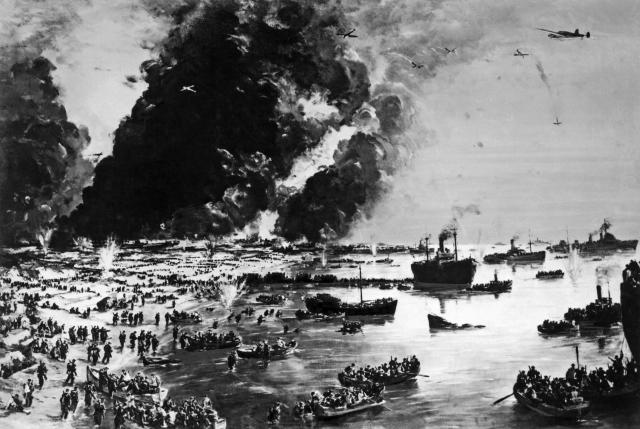
Dunkirk4In May of 1940 the British Expeditionary Force and what remained of French forces occupied a sliver of land along the English Channel. Field Marshall Gerd von Rundstedt called a halt of the German armored advance on May 24, while Hermann Göring urged Hitler to stop the ground assault, let the Luftwaffe finish the destruction of Allied forces. On the other side of the channel, Admiralty officials combed every boatyard they could find for boats to ferry their people off of the beach.
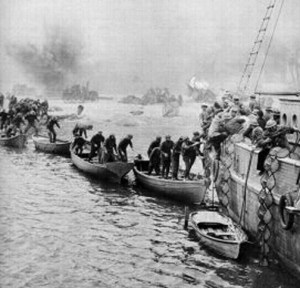
Hitler ordered his Panzer groups to resume their advance on May 26, while a National Day of Prayer was declared at Westminster Abbey. That night Winston Churchill ordered “Operation Dynamo”. One of the most miraculous evacuations in military history had begun from the beaches of Dunkirk.

The battered remnants of the French 1st Army fought a desperate delaying action against the advancing Germans. They were 40,000 men against seven full divisions, 3 of them armored. They held out until May 31 when, having run out of food and ammunition, the last 35,000 finally surrendered. Meanwhile, a hastily assembled fleet of 933 vessels large and small began to withdraw the broken army from the beaches.Dunkirk6

Larger ships were boarded from piers, while thousands waded into the surf and waited in shoulder deep water for smaller vessels. They came from everywhere: merchant marine boats, fishing boats, pleasure craft, lifeboats and tugs. The smallest among them was the 14’7″ fishing boat “Tamzine”, now in the Imperial War Museum.

A thousand copies of navigational charts helped organize shipping in and out of Dunkirk, as buoys were laid around Goodwin Sands to prevent strandings. Abandoned vehicles were driven into the water at low tide, weighted down with sand bags and connected by wooden planks, forming makeshift jetties.

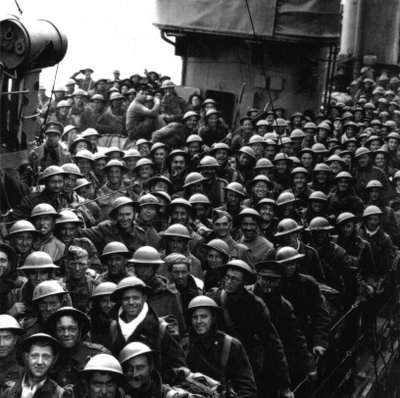
7,669 were evacuated on May 27, the first full day of the evacuation. By day 9 a total of 338,226 soldiers had been rescued from the beach.  The “Miracle of Dunkirk” would remain the largest such waterborne evacuation in history, until September 11, 2001.

It all came to an end on June 4. Most of the light equipment and virtually all the heavy stuff had to be left behind, just to get what remained of the allied armies out alive. But now, with the United States still the better part of a year away from entering the war, the allies had a fighting force that would live to fight on. Winston Churchill delivered a speech that night to the House of Commons, calling the events in France “a colossal military disaster”. “[T]he whole root and core and brain of the British Army”, he said, had been stranded at Dunkirk and seemed about to perish or be captured. In his “We shall fight on the beaches” speech of June 4, Churchill hailed the rescue as a “miracle of deliverance”.dunkirk2

On the home front, thousands of volunteers signed up for a “stay behind” mission in the weeks that followed. With German invasion all but imminent, their mission was to go underground and to disrupt and destabilize the invaders in any way they could. They were to be the British Resistance, a guerrilla force reportedly vetted by a senior Police Chief so secret, that he was to be assassinated in case of invasion to prevent membership in the units from being revealed.

Participants of these auxiliaries were not allowed to tell their families, what they were doing or where they were. Bob Millard, who passed in 2014 at the age of 91, said that they were given 3 weeks’ rations, and that many were issued suicide pills in case of capture. Even Josephine, his wife of 67 years, didn’t know a thing about it until the auxiliaries’ reunion in 1994. “You just didn’t talk about it, really”, he said. “As far as my family were aware I was still in the Home Guard. It was all very hush hush. After the war, it was water under the bridge”.dunkirk troops, 1940

The word “Cenotaph” literally translates as “Empty Tomb”, in Greek. Every year since 1919 and always taking place on the Sunday closest to the 11th day of the 11th month, the Cenotaph at Whitehall is the site of a remembrance service, commemorating British and Commonwealth servicemen and women who died in 20th century conflicts. Since WWII, the march on the Cenotaph includes members of the Home Guard and the “Bevin Boys”, the 18-25 year old males conscripted to serve in England’s coal mines. In 2013, the last surviving auxiliers joined their colleagues, proudly marching past the Cenotaph for the very first time.

Historians from the Coleshill Auxiliary Research Team (CART) had been trying to do this for years.

CART founder Tom Sykes said: “After over 70 years of silence, the veterans of the Auxiliary Units and Special Duties Section, now more than ever, deserve to get the official recognition that has for so long been lacking. ‘They were, in this country’s hour of need, willing to give up everything, families, friends and ultimately their lives in order to give us a fighting chance of surviving”.