
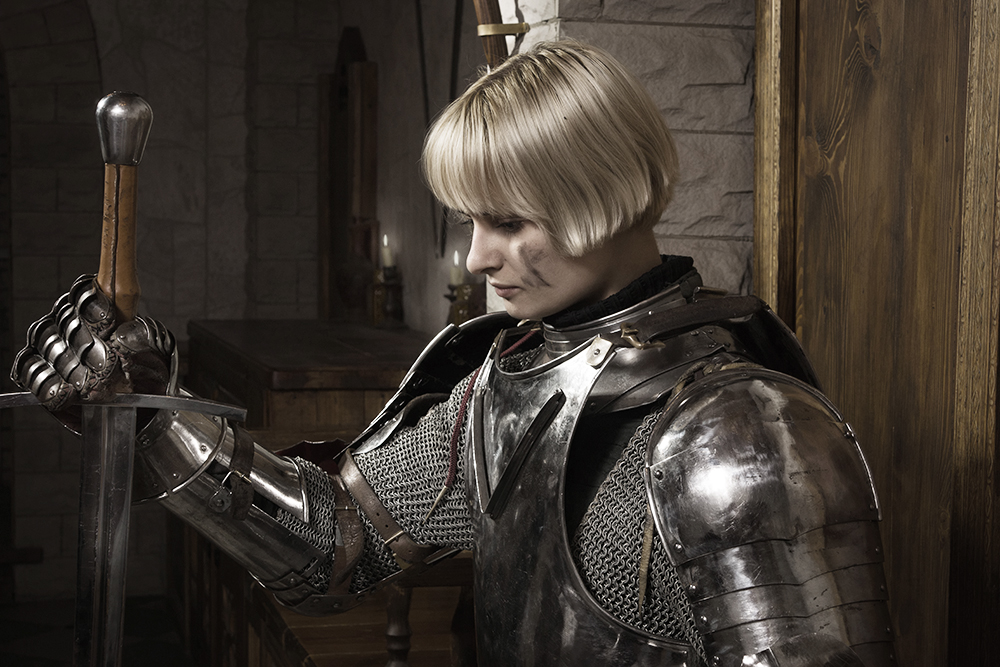
The Hundred Years’ War began as a succession dispute over the French throne, with an alliance of Burgundians and English on one side, against a coalition of Royalists led by the Armagnacs on the other.
Europe was not far removed from the latest outbreak of the Black Death at this time, as the scorched earth tactics employed by the English army laid waste to the countryside and devastated the French economy.
Charles, Dauphin and heir apparent to the French throne was up against a wall, when a teenage peasant girl approached him in 1429.
 For the 14-year-old boy-king, even listening to her was an act of desperation, borne of years of humiliating defeats at the hands of the English army. Yet this illiterate peasant girl had made some uncanny predictions concerning battlefield successes. Now she claimed to have had visions from God and the Saints, commanding her to help him gain the throne. Her name was Jeanne d’Arc.
The siege of Orléans was six months old at this time, when the Dauphin decided it couldn’t hurt to let her take part. She dressed herself in borrowed armor and set out, arriving on the 29th of April, 1429.
History has repeatedly demonstrated the truth of Taylor Owen’s comment on the subject of leadership: “An army of donkeys led by a lion is better than an army of lions led by a donkey.” So it was in the days after Jeanne’s arrival at Orléans.
Though repeatedly excluded from war councils, Jeanne managed to insert herself anyway, putting the French back on the offensive and handing them one victory after another.
Nine days after her arrival, Orléans turned into an unexpected victory for the French, despite Jeanne’s being shot through the neck and left shoulder by an English longbow, while holding a ladder at the siege of Tourelles. The Dauphin granted her co-command of the army with Duke John II of Alençon. The French army enjoyed a string of successes, recovering Jargeau on June 12, Meung-sur-Loire on the 15th, and Beaugency two days later, leading to a humiliating English defeat at the battle at Patay on the 18th.
Several more Armagnac victories followed. On July 17, 1429, Charles was consecrated King Charles VII of France, fifth King of the House of Valois, with Jeanne at his side. Despite her loyalty, Charles’ support began to waver. Court favorite Georges de La Trémoille had convinced the king that she was becoming too powerful. An archer pulled Jeanne from her horse during the siege of 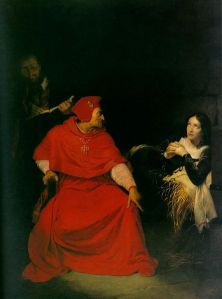 Compiègne in May, 1430, and her allies failed to come to her aid. Left outside the town’s gates when they closed, she was captured and taken to the castle of Bouvreuil.
Some 70 charges were made against her by the pro-English Bishop of Beauvais, Pierre Cauchon, including witchcraft, heresy, and dressing like a man.
Representatives of the judge were dispatched to Jeanne’s home village of Domremy, to ascertain the prisoner’s virginity, character, habits and associations. Nicolas Bailly, the man responsible for collecting testimony, reported that he “had found nothing concerning Joan that he would not have liked to find about his own sister”. This Bishop Cauchon must have been some piece of work. The report so angered the man, that he called Bailly “a traitor and a bad man” and refused to pay him for his work.
Jean Le Maistre, whose presence as Vice-Inquisitor for Rouen was required by canon law, objected to the proceedings and refused to appear, until the English threatened his life.
Interrogation of the prisoner began on February 21, 1431. The outcome was never in doubt. Transcripts were falsified and witnesses intimidated. Even then, trial records reveal this illiterate peasant girl to be brighter than all her inquisitors, combined.
One example from her third interrogation, was the Question: “Do you know whether or not you are in God’s grace?”. The question was a trap. Church doctrine stated that no one could be certain of being in God’s grace, yet a “no” answer would have been held against her. “If I am not”, she said, “may God put me there; and if I am, may God so keep me. I should be the saddest creature in the world if I knew I were not in His grace.”
After fifteen such interrogations her inquisitors still had nothing on her, save for the wearing of soldier’s garb, and her visions. Yet, the outcome of her “trial” was already determined. She was found guilty of heresy, and sentenced to be burned at the stake. On May 24, Jeanne was taken to a scaffold. Threatened that she would be immediately burned alive if she didn’t disavow her visions and abjure the wearing of soldier’s clothing, Jeanne agreed to sign such an abjuration, but recanted four days later.
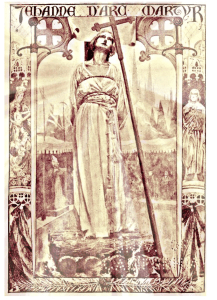 The death sentence was carried out on May 30, 1431, in the old marketplace at Rouen. She was 19. After she died, the coals were raked back to expose her charred body. No one would be able to claim she’d escaped alive. Her body was then burned twice more, so no one could collect the relics. Her ashes were then cast into a river.
Guillaume Manchon, one of the court scribes, later recalled: “And she was then dressed in male clothing, and was complaining that she could not give it up, fearing lest in the night her guards would inflict some act of [sexual] outrage upon her; and she had complained once or twice to the Bishop of Beauvais, the Vice-Inquisitor, and Master Nicholas Loiseleur that one of the aforesaid guards had tried to rape her.”
Her executioner, Geoffroy Therage, later said that he “Greatly feared to be damned”.
An inquisitorial court authorized by Pope Calixtus III re-examined the evidence, 25 years later. The court exonerated her of all charges, pronouncing her innocent on July 7, 1456, and later declaring her a martyr.
A National Heroine to the French, Joan of Arc was canonized a saint of the Roman Catholic Church, in 1920. It was small consolation for this child who had been set up for a fall by her enemies, and abandoned to be incinerated alive, by her friends.

 into Western Europe at the Battle of Tours, in 732.


 Ironically, Henry himself may have been the problem, when it came to the inability to produce a male heir. Researchers revealed in 2011 that Henry’s blood group may have been “Kell positive”, a rare condition which would have initiated an auto-immune response in the mother’s body, targeting the body of the baby inside of her. It’s unlikely that first pregnancies would have been effected, but the mother’s antibodies would have attacked second and subsequent Kell-positive babies as foreign objects.

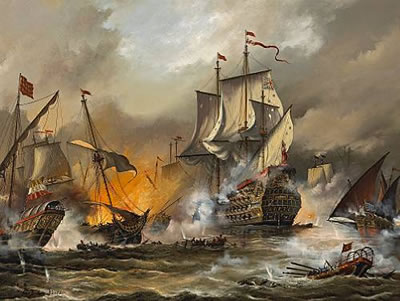
 In all the annals of warfare, there may be nothing more ironic, than the time a naval force was defeated by men mounted on horseback.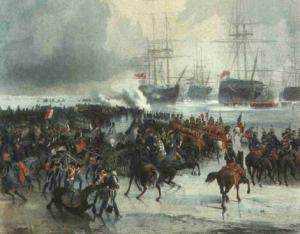
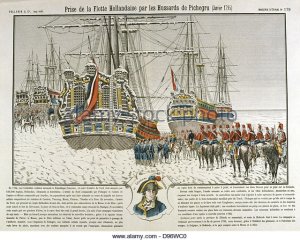 At least one source will tell you that this event never occurred, or at least it’s an embellished version, as retold by the hussars themselves. I guess you can take your pick. A number of 19th century authors have portrayed the episode as unvarnished history, as have a number of paintings and sketches.

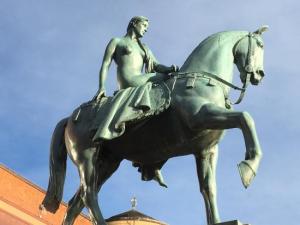 repeal the tax on one condition; that she ride a horse through the streets of town, dressed only in her birthday suit and her long hair. Lady Godiva took him at his word. She issued a proclamation that all townspeople stay indoors and shut their windows, and then she took her famous naked ride through town.
 On December 31, 1695, King William III decreed a 2 shilling tax on each house in the land. Not wanting to miss an opportunity to “stick-it-to-the-rich”, there was an extra tax on every window over ten, a tax that would last for another 156 years.


 Back in 2013, EU politicians were discussing a way of taxing livestock flatulence, as a means of curbing “Global Warming”. At that time there was an Australian ice breaker, making its way to Antarctica to free the Chinese ice breaker, that got stuck in the ice trying to free the Russian ship full of environmentalists. They were there to view the effects of “Global Warming”, before they got stuck in the ice.

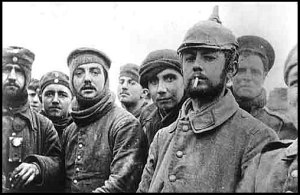 Captain Bruce Bairnsfather later wrote: “I wouldn’t have missed that unique and weird Christmas Day for anything. … I spotted a German officer, some sort of lieutenant I should think, and being a bit of a collector, I intimated to him that I had taken a fancy to some of his buttons. … I brought out my wire clippers and, with a few deft snips, removed a couple of his buttons and put them in my pocket. I then gave him two of mine in exchange. … The last I saw was one of my machine gunners, who was a bit of an amateur hairdresser in civil life, cutting the unnaturally long hair of a docile Boche, who was patiently kneeling on the ground whilst the automatic clippers crept up the back of his neck.”
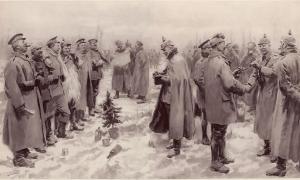 December 24-25, 1914, lasting in some sectors until New Year’s Day.


 For two days, a desperate defense of the nearby villages of Noville and Foy held back the 2nd Panzerdivision, as 11,000 men and 800 officers of the 101st joined a combined force of 11,000 converging on Bastogne. By the 21st, Bastogne’s field hospital was overrun, they were surrounded by forces outnumbering them 2½ to one. Poorly supplied for the cold winter conditions with air supply made all but impossible by weather conditions, the citizens of Bastogne gave their blankets to the American soldiers, along with white linens which they used for camouflage.
 later, ending the German encirclement.
 entire siege tending to the wounded, along with Dr. Jack Prior. Once, she even ran through enemy fire to collect the wounded from the field. On Christmas eve, she was blown off her feet and through a wall. She got up and went back to it, despite the direct hit that killed 30 American wounded, along with the only other nurse at the Rue Neufchatel aid station, Renée Lemaire.
  Bastogne. Chiwy married after the war, and rarely talked about her experience in Bastogne. It took King a full 18 months to coax the story out of her. The result was the 2015 Emmy award winning historical documentary, “Searching for Augusta, The Forgotten Angel of Bastogne”.

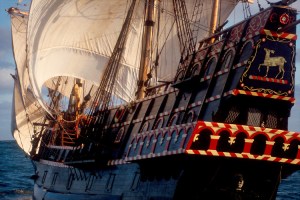
 offloaded his captives, each with a gift appropriate to his rank, and a letter of safe conduct.


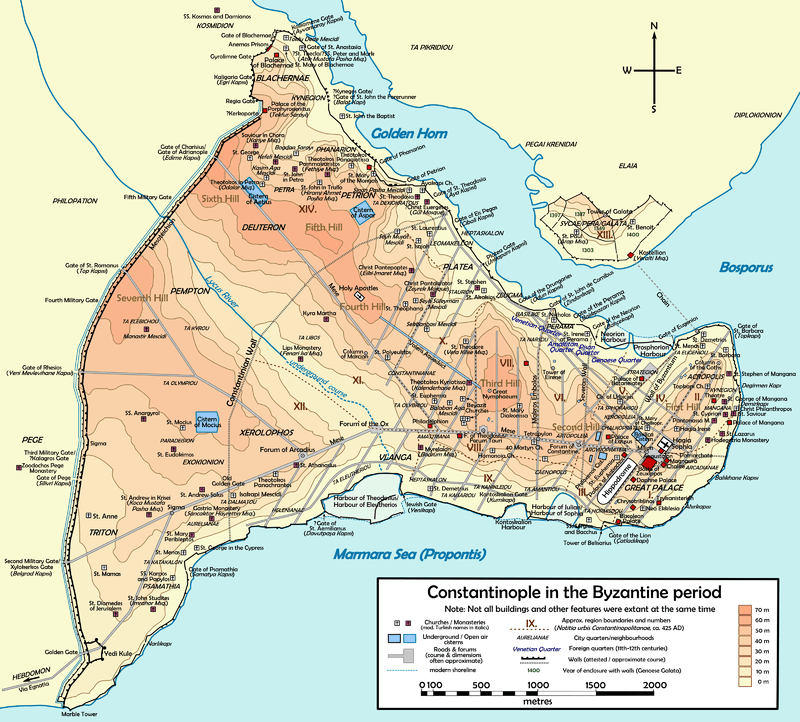

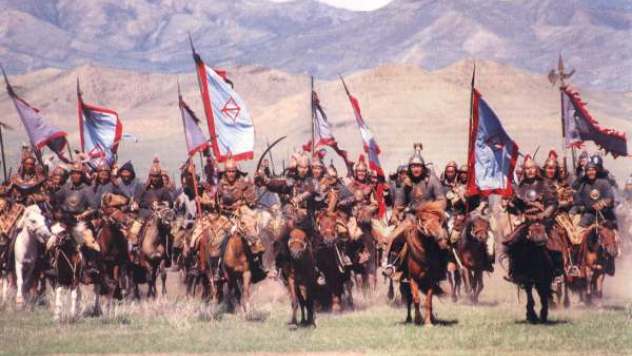
 The Steppes have long been a genetic crossroad, the physical features of its inhabitants as diverse as any in the world. The word “Rus”, from which we get Russia, was the name given to Viking invaders from earlier centuries. History does not record what Genghis himself looked like, though he’s often depicted with Asian features. There is evidence suggesting he had red hair and green eyes. Think of that beautiful young Afghan girl, the one with those killer eyes on that National Geographic cover, a few years back.
 Hungary, to parts of Austria, to Eastern Persia. Plans were being laid for the invasion of Germany, Austria and Italy in December, 1241, when news arrived informing them of the death of the Great Khan. Ögedei and Batu wanted to continue, but the Law of Yassa required that all Princes of the Blood return to Karakorum and the Kurultai, the meeting of Mongol Chieftains.
 Historical Easter Eggs - Today in History
You must be logged in to post a comment.