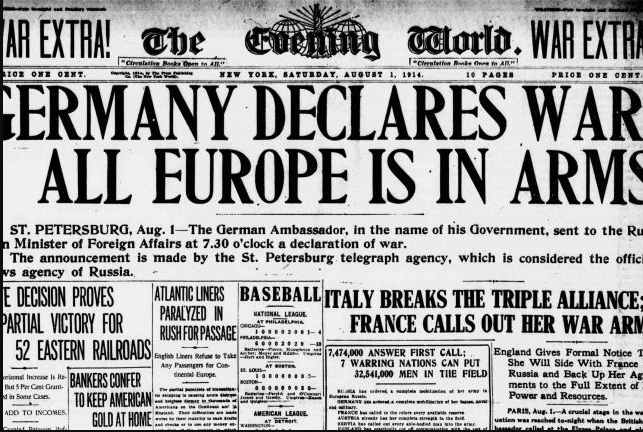
This time there would be no “Phoney War”, no “Sitzkreig”, as some wags were wont to call the early days of WWII. Few could imagine a cataclysm to rock a century and beyond, a war in which many single day’s fighting would produce casualties equal to that of every war of the preceding 100 years, combined. Fewer still understood on this date, one-hundred eight years ago, today. The four horsemen of the Apocalypse, had arrived.
In 1869, Germany had yet to come into its own as an independent nation. Forty-five years later she was one of the Great Powers, of Europe.
Alarmed by the aggressive growth of her historic adversary, the French government had by that time increased compulsory military service from two years to three, in an effort to offset the German’s military of a much larger population.
Joseph Caillaux was a left wing politician, once Prime Minister of France and, by 1913, a cabinet minister under the more conservative administration of French President Raymond Poincare.
Never too discreet with his personal conduct, Caillaux paraded through public life with a succession of women, who were not Mrs Caillaux. One of them was Henriette Raynouard. By 1911, Madame Raynouard had become the second Mrs Caillaux.
A relative pacifist, many on the French right considered Caillaux to be too “soft” on Germany. One of them was Gaston Calmette, editor of the leading right-wing newspaper Le Figaro, who regularly excoriated the politician.
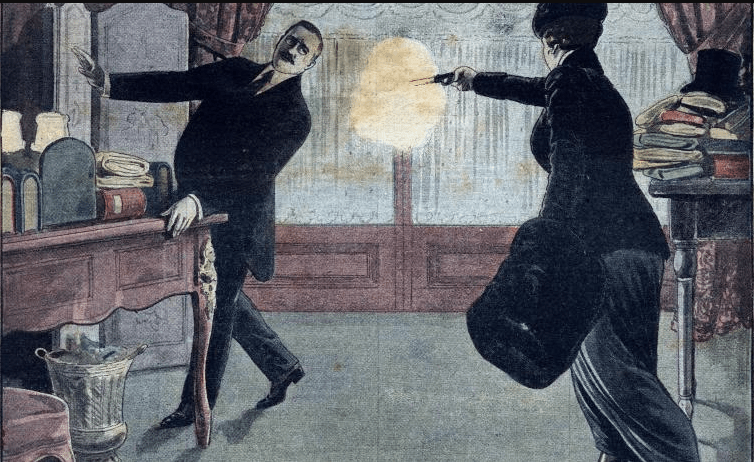
On March 16, 1914, Madame Caillaux took a taxi to the offices of Le Figaro. She waited for a full hour to see the paper’s editor, before walking into his office and shooting him at his desk. Four out of six rounds hit their mark. Gaston Calmette was dead before the night was through.
It was the crime of the century. This one had everything: Left vs. Right, the fall of the powerful, and all the salacious details anyone could ever ask for. It was the OJ trial, version 1.0, and the French public was transfixed.
The British public was similarly distracted, by the latest in a series of Irish Home Rule crises.
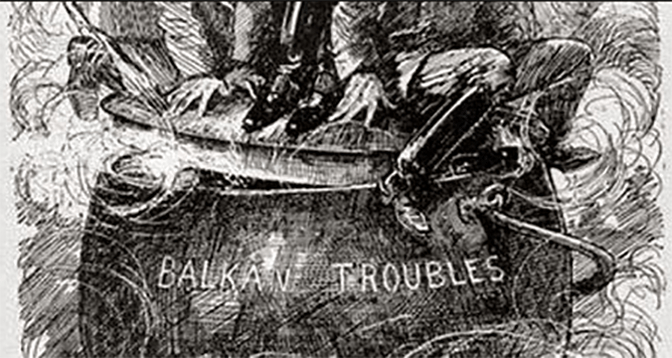
The Austro-Hungarian Empire, a sprawling amalgamation of 17 nations, 20 Parliamentary groups and 27 political parties, desperately needed to bring the Balkan peninsula into line following the June 28 assassination of the heir apparent to the dual monarchy. That individual Serbians were complicit in the assassination is beyond doubt but so many government records of the era have disappeared that, it’s impossible to determine official Serbian complicity. Nevertheless, Serbia had to be brought to heel.
Having given Austria his personal assurance of support in the event of war with Serbia, even if Russia entered in support of her Slavic ally, Kaiser Wilhelm of Germany left on a summer cruise in the Norwegian fjords. The Kaiser’s being out of touch for those critical days that July has been called the most expensive maritime disaster, in naval history.
The Austro-Hungarian Empire delivered a deliberately unacceptable ultimatum to Serbia on the 23rd, little more that a bald pretext for war. Czar Nicholas wired Vienna as late as the 27th proposing an international conference concerning Serbia, but to no avail. Austria responded that same day. It was too late for such a proposal.
The Austro-Hungarian Empire declared war on Serbia the following day, the day on which Madame Caillaux was acquitted of the murder of Gaston Calmette, on the grounds of being a “crime of passion”.
As expected, Russia mobilized in support of Serbia. For Germany’s part, nothing was to be feared more than a two-front war with the “Russian Steamroller” to the east, and the French Republic to the west. Germany invaded neutral Belgium in pursuit of the one-two punch strategy by which she sought first to defeat France, before turning to face the far larger Russian adversary.
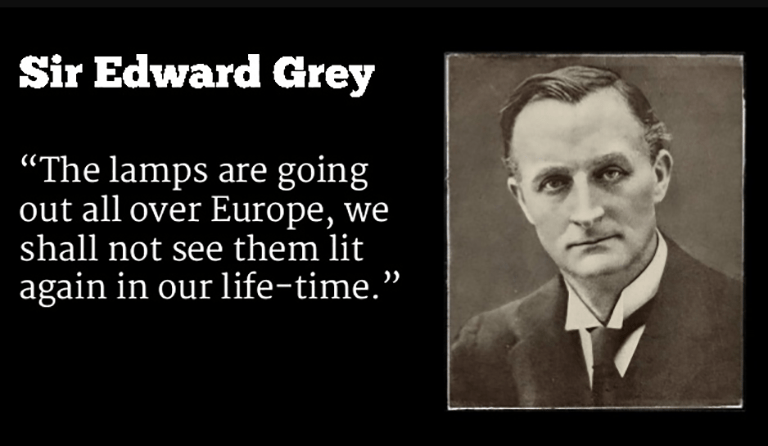
On August 3, 1914, British Foreign Secretary Sir Edward Grey announced before Parliament his government’s intention to defend Belgian neutrality, a treaty obligation German diplomats had dismissed as a “scrap of paper”.
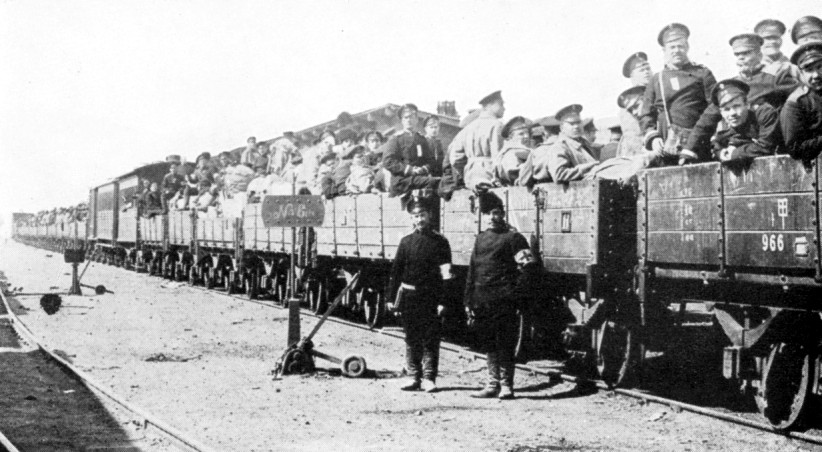
Pre-planned timetables took over – France alone would have 3,781,000 military men under orders before the middle of August, arriving at the western front on 7,000 trains arriving as often as every eight minutes.
This time there would be no “Phoney War”, no “Sitzkreig”, as some wags were wont to call the early days of WWII. Few could imagine a cataclysm to rock a century and beyond, a war in which many single day’s fighting would produce casualties equal to that of every war of the preceding 100 years, combined. Fewer still understood on this date, one-hundred eight years ago, today. The four horsemen of the Apocalypse, had arrived.
With the life of the carrier at stake, tales of incredible courage became commonplace.
The Super Carrier USS Forrestal departed Norfolk in June 1967 with a crew of 552 officers and 4,988 enlisted men. Sailing around the horn of Africa, she stopped briefly at Leyte Pier in the Philippines before sailing on to “Yankee Station” in the South China Sea, arriving on July 25.
Before the cruise, damage control firefighting teams were shown training films of Navy ordnance tests, demonstrating how a 1000-pound bomb could be directly exposed to a jet fuel fire for a full 10 minutes. Tests were conducted using the new Mark 83 bomb featuring a thicker, heat resistant wall compared with older munitions, and “H6” explosive, designed to burn off at high temperatures. Think of an enormous sparkler.
Along with Mark 83s, ordnance resupply had included sixteen AN-M65A1 “Fat Boy” bombs, Korean war era surplus intended to be used on the second bombing runs scheduled for the 29th. These were thinner skinned than the newer ordnance, armed with 10+ year-old “Composition B” explosive. Already far more sensitive to heat and shock than the newer ordnance, composition B becomes more volatile as the explosive ages. The stuff becomes more powerful as well, as much as 50%, by weight.
These older bombs were way past their “sell-by” date, having spent the better part of the last ten years in the heat and humidity of Subic Bay depots. Ordnance officers wanted nothing to do with the Fat Boys with their rusting shells leaking paraffin, and rotted packaging. Some had production date stamps as early as 1953.
Some handlers feared the old bombs might spontaneously detonate from the shock of a catapult takeoff.
In 1967, the carrier bombing campaign was the longest and most intense such effort in US Naval history. Over the preceding four days, Forrestal had already launched 150 sorties against targets in North Vietnam. Combat operations were outpacing production, using Mark 35s faster than they could be replaced.
When Forrestal met the ammunition ship Diamond Head on the 28th, the choice was to take on the Fat Boys, or cancel the second wave of attacks scheduled for the following day.
In addition to the bombs, ground attack aircraft were armed with 5″ “Zuni” unguided rockets, carried four at a time in under-wing rocket packs. Known for electrical malfunctions and accidental firing, standard Naval procedure required electrical pigtails to be connected, at the catapult.
Ordnance officers found this slowed the launch rate and deviated from standard procedure, connecting pigtails while aircraft were still, “in the pack”. The table was now set for disaster.
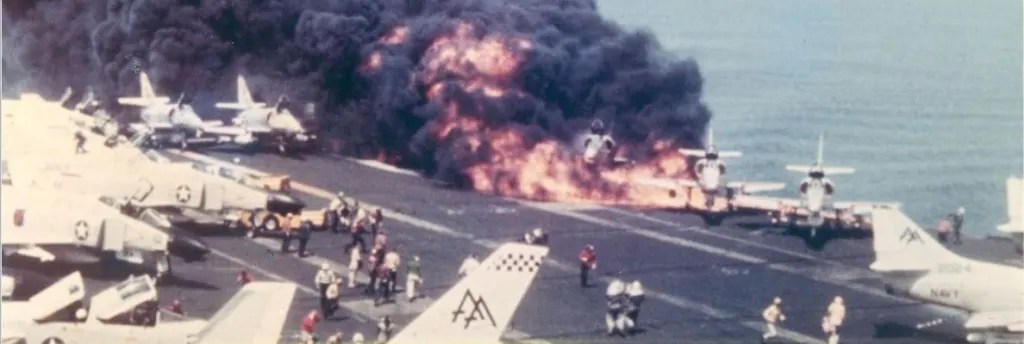
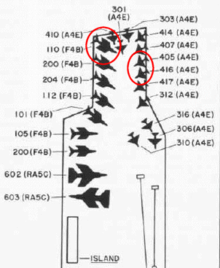
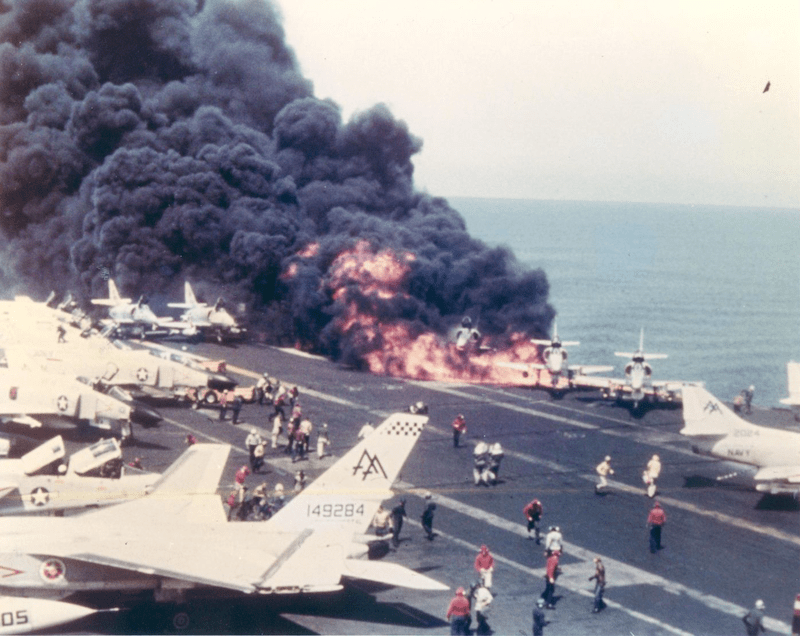
At 10:50-am local time, preparations were underway for the second strike of the day. Twenty-seven aircraft were on deck, fully loaded with fuel, ammunition, bombs and rockets. An electrical malfunction fired a Zuni rocket 100-feet across the flight deck, severing the arm of one crew member and piercing the 400-gallon external fuel tank of an A-4E Skyhawk, awaiting launch.
The rocket’s safety mechanism prevented the weapon from exploding, but the A-4’s torn fuel tank was spewing flaming jet fuel onto the deck. Other fuel tanks soon overheated and exploded, adding to the conflagration.
During World War 2, virtually every American carrier crewmember was a trained firefighter. Over time, this began to change. By 1967, the United States Navy had adopted the Japanese method at Midway, relying instead on specialized and highly trained damage control and fire fighting teams.
Damage Control Team #8 came into action immediately, as Chief Gerald Farrier spotted one of the Fat Boy bombs turning cherry red in the flames. Farrier was working without benefit of protective clothing. There had been no time to suit up. Farrier held his PKP fire extinguisher on the 1000-lb bomb, hoping to keep it cool enough to prevent the thing from cooking off as the rest of his team brought the conflagration under control.
Firefighters were confident that their ten-minute window would hold as they fought the flames, but composition B explosives proved as unstable as the ordnance people had feared. Farrier “simply disappeared” in the first of a dozen or more explosions, in the first few minutes of the fire. By the third such explosion, Damage Control Team #8 had all but ceased to exist.
Margins of survival were now become, split-second. Future United States Senator John McCain managed to scramble out of his cockpit and down the fuel probe. Lieutenant Commander Fred White scrambled out of his own aircraft only a split-second later, but he was killed in that first explosion.
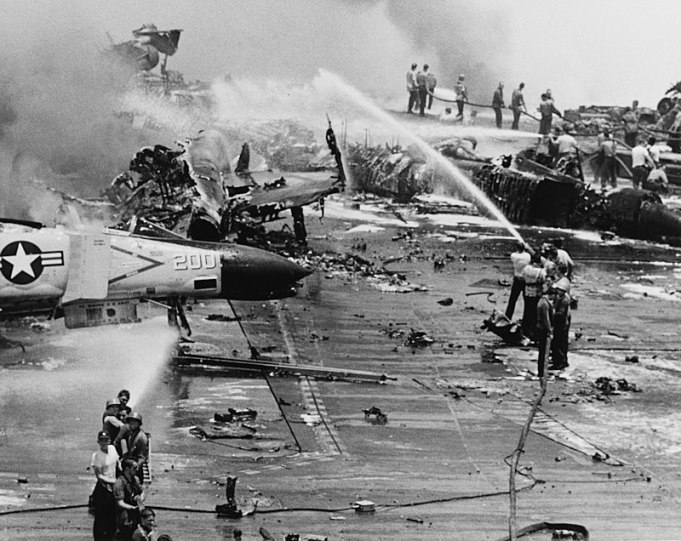
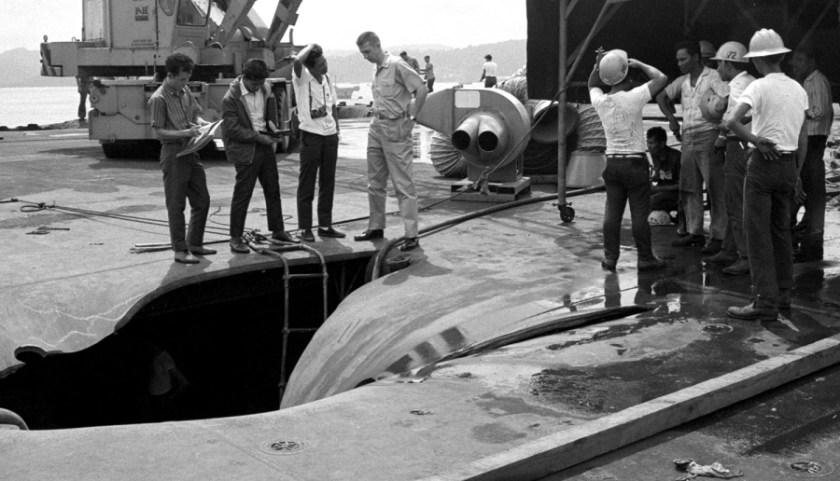
The port quarter of the Forrestal ceased to exist in the violence of the explosions, office furniture thrown to the floor as much as five decks below. Huge holes were torn into the flight deck while a cataract of flaming jet fuel, some 40,000 US gallons of the stuff, poured through ventilation ducts and into living quarters below.
Ninety-one crew members were killed below decks, by explosion or fire.
With trained firefighters now dead or incapacitated, sailors and marines fought heroically to bring the fire under control, though that sometimes made matters worse. Without training or knowledge of fire fighting, hose teams sprayed seawater, some washing away retardant foam being used to smother the flames.
With the life of the carrier at stake, tales of incredible courage became commonplace. Medical officers worked for hours in the most dangerous conditions imaginable. Explosive ordnance demolition officer LT(JG) Robert Cates “noticed that there was a 500-pound bomb and a 750-pound bomb in the middle of the flight deck… that were still smoking. They hadn’t detonated or anything; they were just setting there smoking. So I went up and defused them and had them jettisoned.” Sailors volunteered to be lowered through the flight decks into flaming and smoked-filled compartments, to defuse live bombs.
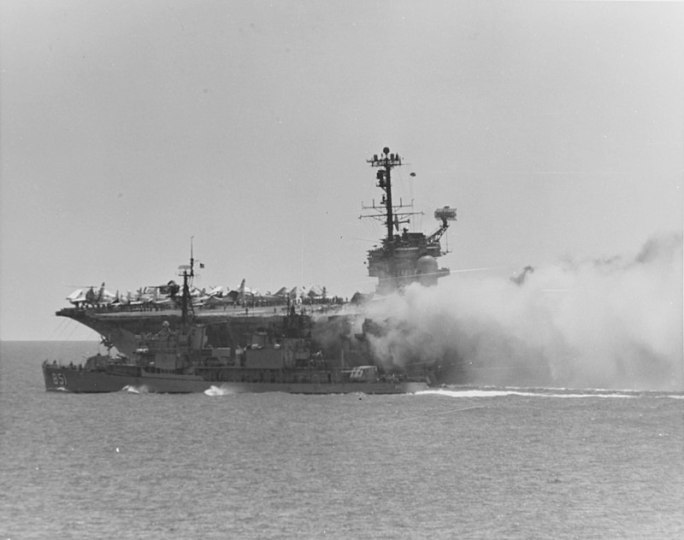
The destroyer USS George K. MacKenzie plucked men out of the water as the destroyer USS Rupertus maneuvered alongside for 90 minutes, directing on-board fire hoses at burning flight and hangar decks.
Throughout the afternoon, crew members rolled 250-pound and 500-pound bombs across the decks, and over the side. The major fire on the flight deck was brought under control within four hours but fires burning below decks would not be declared out until 4:00am, the following day.
Panel 24E of the Vietnam Memorial records the names of 134 crewmen who died in the conflagration. Another 161 were seriously injured. 26 aircraft were destroyed and another 40, damaged. Damage to the Forrestal itself exceeded $72 million, equivalent to over $415 million today.
Gary Childs of Paxton Massachusetts, my uncle, was one among hundreds of sailors and marines who fought to bring the fire under control. He was below decks when the fire broke out, leaving moments before his quarters were engulfed in flames. Only by that slimmest of margins did he and any number of sailors aboard the USS Forrestal on this day in 1967, escape being #135.
“The Zone Rouge is a 42,000-acre territory that, nearly a century after the conflict, has no human residents and only allows limited access”. – National Geographic
In an alternate history, the June 1914 assassination of the heir-apparent to the Habsburg Empire may have led to nothing more than a regional squabble. Little more than a policing action, in the Balkans. As it was, mutual distrust and entangling alliances drew the Great Powers of Europe into the vortex. On August 3, the “War to End Wars” exploded across the European continent.
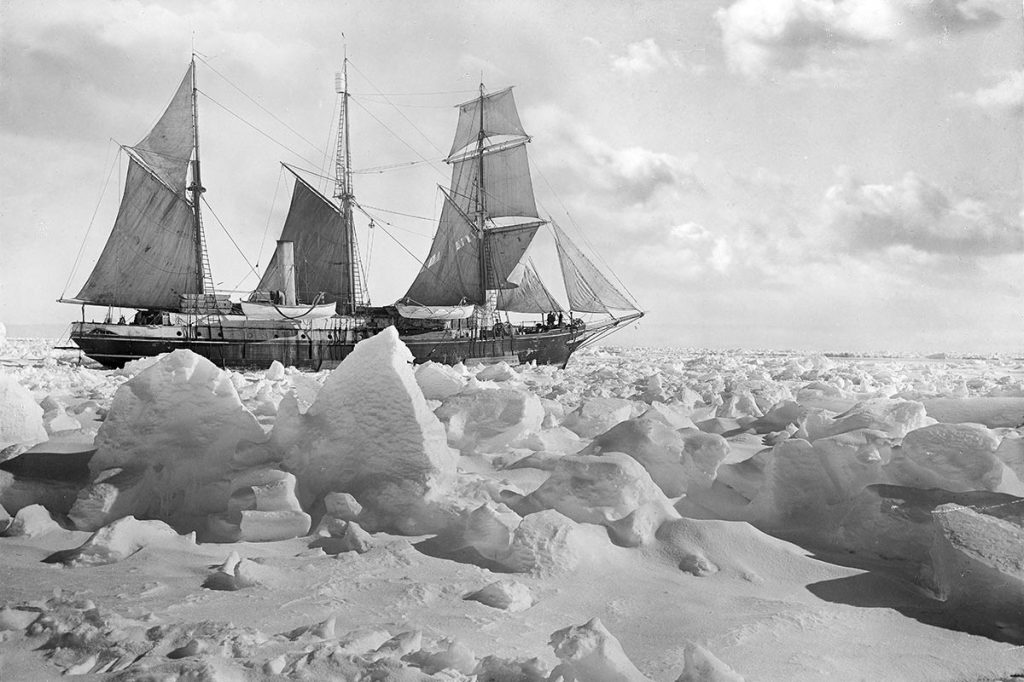
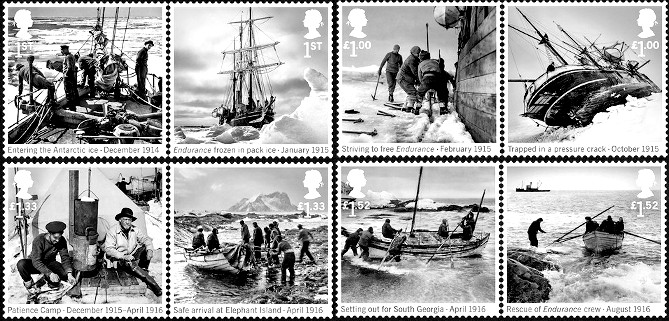
The early 20th century has been called the “Heroic Age of Antarctic Exploration”, and for good reason. As the diplomatic wrangling, mobilizations and counter-mobilizations of the “period preparatory to war” advanced through July, 1914, Sir Ernest Shackleton made the final arrangements for his third expedition into the Antarctic. Despite the outbreak of war, 1st Lord of the Admiralty Winston Churchill ordered Shackleton to proceed. The “Endurance” expedition” departed British waters on August 8.
The German invasion of France ground to a halt that September. The first entrenchments were being dug as Shackleton himself remained in England, departing on September 27 to meet up with the Endurance expedition in Buenos Aires.
Endurance was destined to be stuck in the ice, stranding the men of the Shackleton Expedition floating on pack ice, in open ocean.
As the unofficial Christmas Truce descended over the trenches of Europe, Shackleton’s expedition slowly picked their way through the ice floes of the Weddell Sea.
The disaster of WWI became “Total War” with the zeppelin raids of January, as Endurance met with disaster of her own. The ship was frozen fast, with no hope of escape. As the nine-month battle unfolded across the Gallipoli Peninsula, Shackleton’s men abandoned ship’s routine and converted to winter station. Finally, camps were set up across the drifting ice. On November 21, the wreck of the Endurance slipped below the surface.
In December 1915, Allies began preparations for a summer offensive along the upper reaches of the river Somme. In February, Erich von Falkenhayn began an offensive in Verdun designed to “bleed France white”. The Shackleton party was at this time camped on an ice pack, adrift in open ocean.
The ice began to break up that April, forcing Shackleton and his party into three small lifeboats. Five brutal days would come and go in those open boats, the last of 457 days spent at sea before finally reaching the desolate shores of Elephant Island.
The whaling station at South Georgia Island some 720 miles distant, was the nearest outpost of civilization. The only hope for survival. Shackleton and a party of five set out on April 24 in a 20-foot lifeboat. They shouldn’t have made it, but somehow did. In hurricane-force winds, the cliffs of South Georgia Island came into view four weeks later.
Scaling those terrible cliffs alone was a survival epic, worthy of its own story. Somehow, not a man was lost. They must have been a sight, with thick ice encrusting long, filthy beards, saltwater-soaked sealskin clothing rotting from their bodies. The first people they came across were children, who ran in fright at the sight of them. At last, on May 20, 1916, the Shackleton expedition was saved.
Like a latter-day Robinson Crusoe emerged from the frozen wastes of the Antarctic, Shackleton asked for news on the war. How it had all ended. The response came back as if every word of it, was a hammer blow.
“The war isn’t over. Millions are dead. Europe is mad. The world is mad”.
Preparatory bombardment for the Somme offensive began that June, 1,500 guns firing 1.7 million shells into a twelve-mile front. 27 shells for every foot of the front. Allies went “over the top” on July 1, the single worst day in British military history. 19,240 British soldiers were killed in that single day, along with 1,590 French. German losses numbered 10,000–12,000. By July 19, 1916, the Somme offensive was just getting started. The battle would last another 122 days.
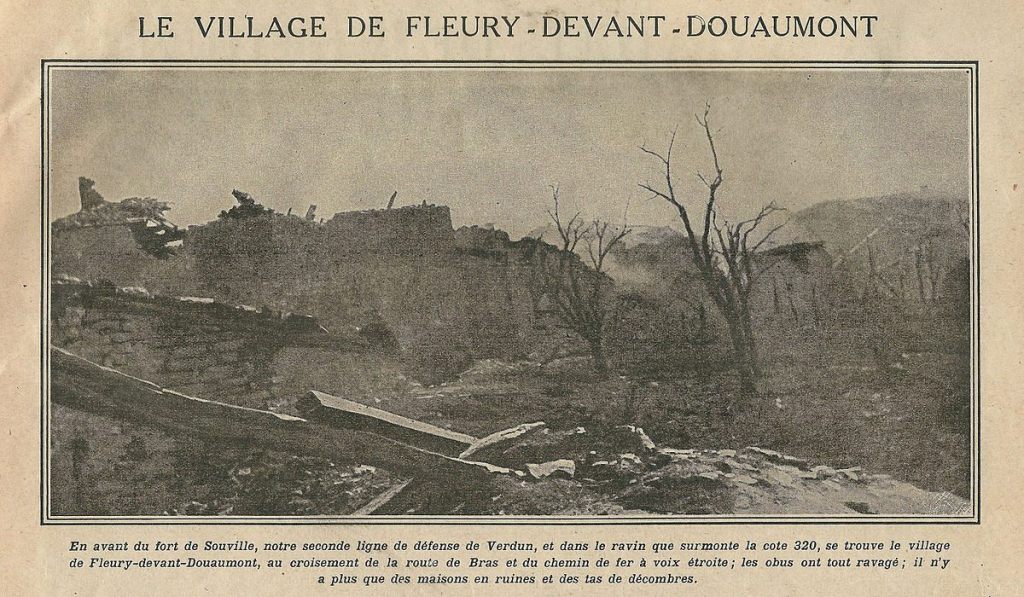
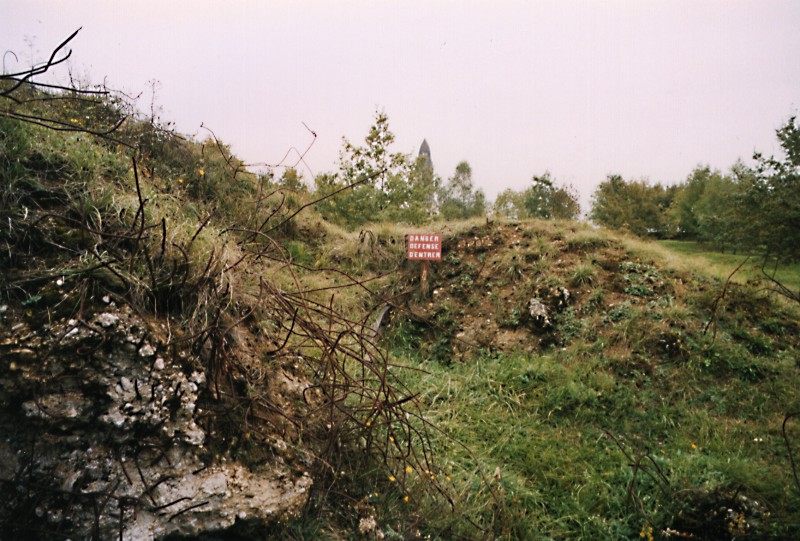
Former battlefield at Dououmont. The sign reads “Danger Access Forbidden”
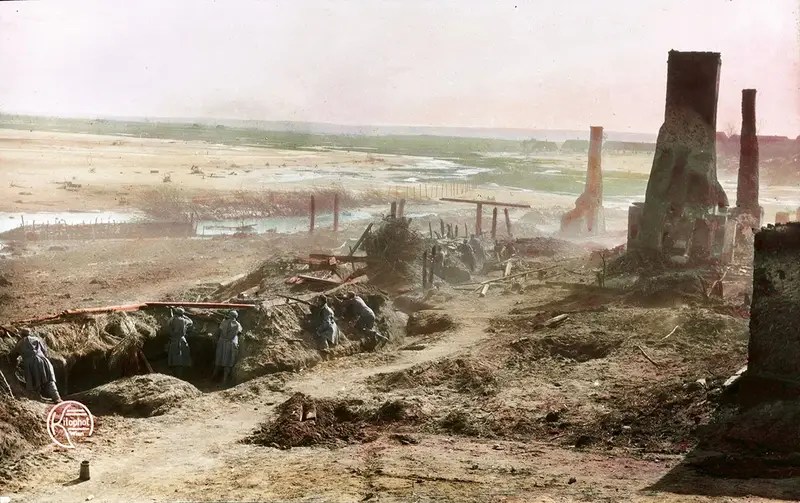
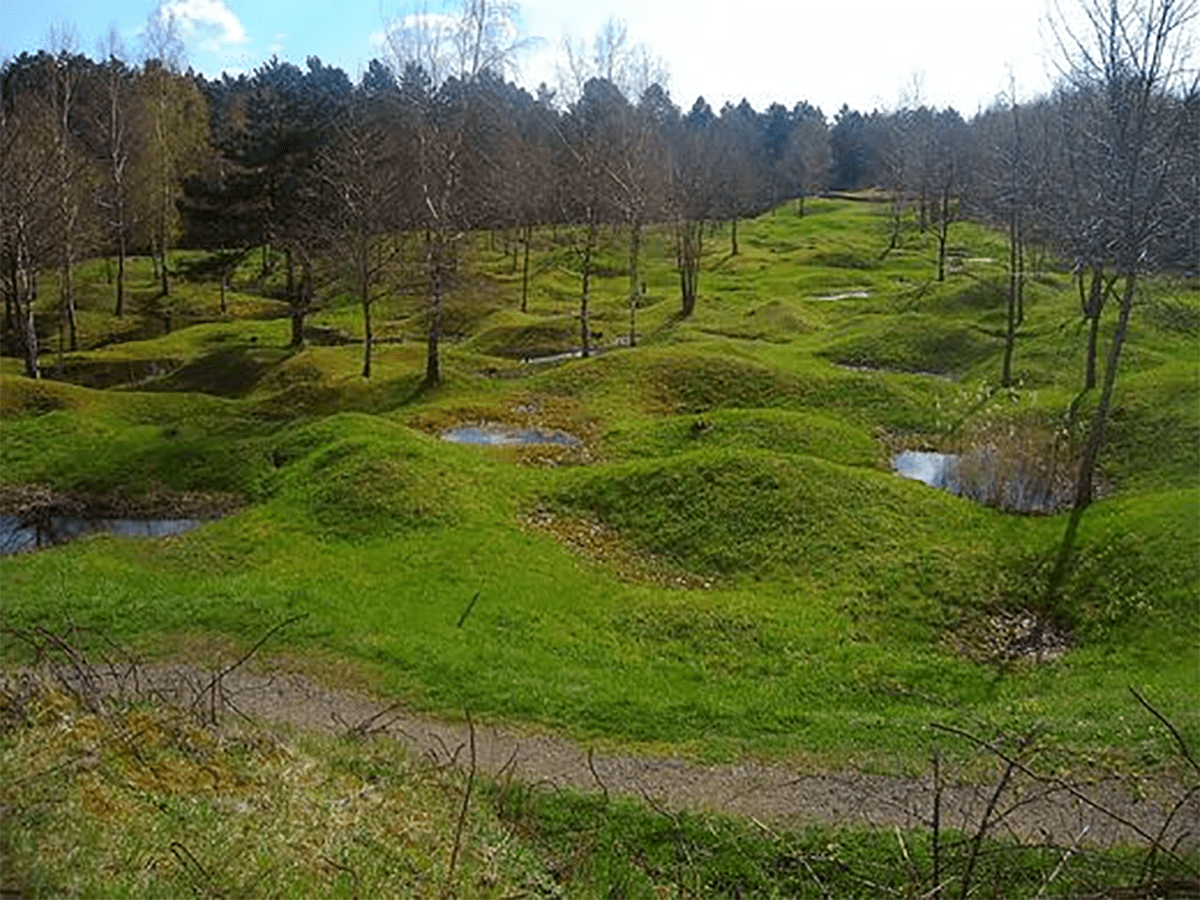
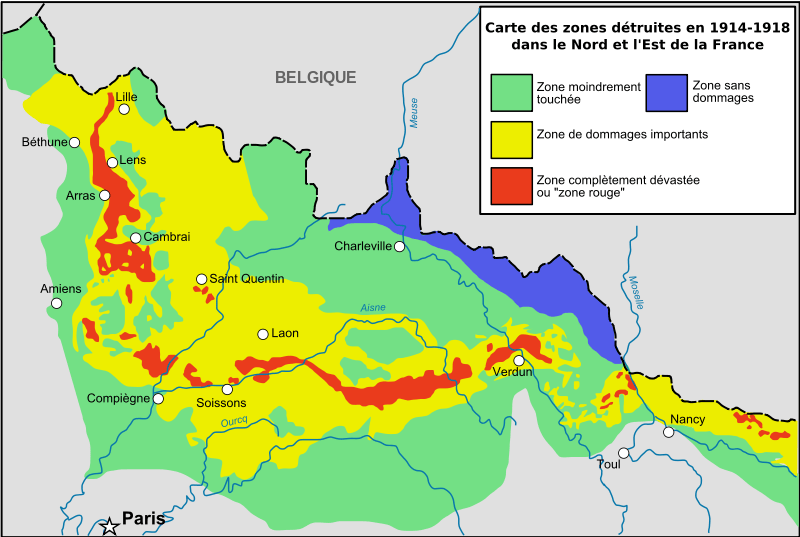
The toll exacted by the 1st World War was cataclysmic in human, economic and environmental terms. After the war, hundreds of square miles along the north of France were identified, thusly:
“Completely devastated. Damage to properties: 100%. Damage to Agriculture: 100%. Impossible to clean. Human life impossible”.
Vast quantities of human and animal remains permeate this “Zone Rouge”, an area saturated with unexploded shells and munitions of all sizes and types: gas, high explosive, anti-personnel. There are hand grenades and bombs, small arms and rusted ammunition, by the truckload.
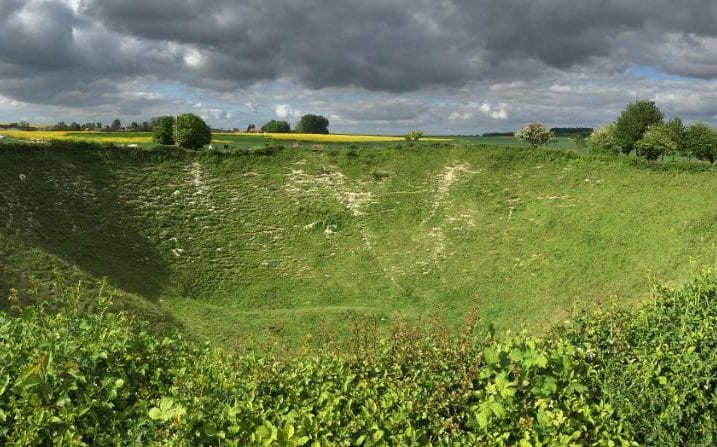
Lochnagar bomb crater in the Somme Photo Credit Telegraph Newspaper: HENRY SAMUEL
Lead, mercury, chlorine, arsenic and other toxins permeate the soil. In two areas near Ypres and Woëvre, arsenic constitutes up to 17% of some soil samples. The Red Zone is smaller today than it once was but, to this day, 99% of all plants still die in some of these places.
During World War 1 the two sides fired an estimated ton of explosives at each other, for every square meter of the western Front. As many as one in three shells failed to explode. The Ypres salient alone was believed to contain as many as 300 million unexploded shells at the war’s end. 87 years after the cessation of hostilities, one “Red Zone” survey uncovered up to 150 shells per 5,000 square meters in the top six inches of soil, alone.
By means of comparison, an American football field covers 5,351.215 square meters.
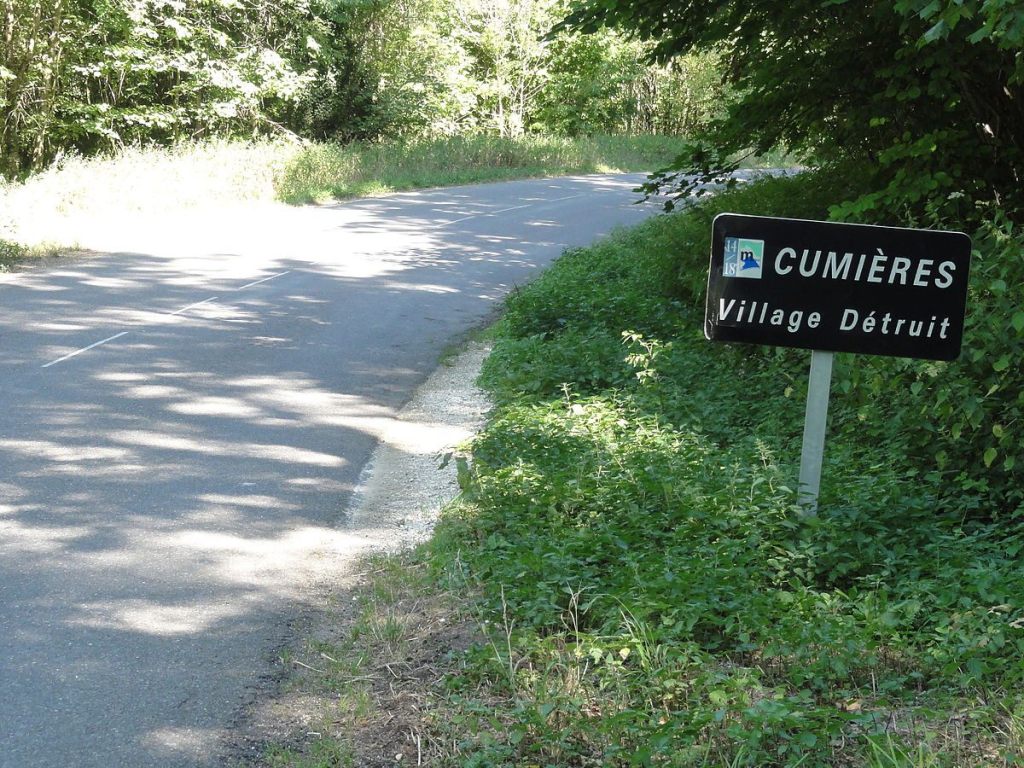
Signs like this dot the landscape in parts of France and Belgium: “Village Destroyed”
100 years after WW1, more than 20 members of Belgian Explosive Ordnance Disposal (DOVO) were killed in 1998, alone.
In June 2016, head of the bomb disposal unit at Amiens Michel Colling, said: “Since the start of the year we’ve been called out 300 times to dispose of 25 tons of bombs. As soon as you start turning the earth up”, Colling said, “you find them. At this rate, we have another 500 years to clear the area, so the work is far from over.”
The rotor blades from farmers’ tractors sometimes set them off. In June 2016, farmer Claude Samain plowed up a Lee-Enfield rifle. Last held in all probability by a British infantryman, the rifle was now seeing the sun for the first time, in 100 years. He placed it on a pile rusted old shells and ironworks. As a farm kid of the 1930s, Claude remembered turning up bodies in his fields. ‘We find shells every time we turn the earth over for potatoes or sugar beet.” he explained.
French farmers call the stuff, récolte de fer. Iron harvest.
That part about Claud Samain comes from a Mirror story published July 1, 2016 and written, by Andy Lines. “As Claude, 76, passed me the gun” Lines writes, “he smiled: “You Brits are so respectful of what happened here on the Somme. “Three coachloads of children arrive every single day to learn what happened 100 years ago – you never see any French children.””
Nor I would guess, any American children, and that’s a damned shame.
To this day the spill at Church Rock remains the US’ worst nuclear disaster, and best kept secret.
They call themselves Diné, (din neh) meaning literally, “the people”. Originally a hunter/gatherer culture, the Diné are believed to have migrated from northwestern Canada and eastern Alaska long before there were such place names, around the year 1400. Mostly hunters and gatherers at this time, they lived in a region known as Dinétah, occupying parts of the modern American states of Utah, Colorado, Arizona and New Mexico.
Over time, the Diné adopted the farming methods of the Pueblo peoples, mainly the “three sisters” of corn, squash and beans. They acquired livestock, sheep and goats mostly, the animals becoming not only food sources but also symbols of wealth, and status. Tewa-speaking pueblo groups called them Navahu, meaning large areas of cultivated land. Spanish settlers knew them as, Navajo.
In the 21st century, many Navajos live a traditional lifestyle including language, religious practices a social structure based on kinship, and locality of residence. Despite the legacy of bitterness resulting from 19th century conflicts between first nations and relative newcomers to the North American continent, Navajos have volunteered for military service in numbers disproportionate to their population.
Shiprock (Navajo: Tsé Bitʼaʼí, “rock with wings” ), located in traditional Dinétah territory (northwestern New Mexico). – H/T Wikipedia
During World War 1 some 10,000 “Indians” including Navajo served the United States armed services both as volunteers, and conscripts. Navajo “code talkers” served a pivotal role during World War 2, building on the work of the Choctaw during the “Great War” and producing secret communications based on native languages, indecipherable to the adversary.
The number four is sacred to the Navajo people. The four cardinal directions of north, south, east and west. The four seasons. The four original clans and the creation story, of four worlds. Four mountains mark the land given to the people of Navajo lore, by the creator. The four day-parts of dawn, day, dusk and night. Four colors correspond to each of four mountains marking the land: the color white for shell, the blue of turquoise, the shimmering black of obsidian and the color yellow, representing but one shade of the multi-colored abalone.
A yellow that most assuredly DOES NOT symbolize, Uranium.
In August 1939, a letter written by physicist Leó Szilárd and signed by Albert Einstein warned President Franklin Roosevelt that Nazi Germany was working to develop a war-winning super weapon. A bomb, capable of obliterating entire cities in a single blast. The American-led effort to produce such a weapon began in 1942, the US Army component of the team at first headquartered in Manhattan. So began the ultra-secret “Manhattan Project” culminating in the Trinity test blast of July 16, 1945 and that famous line from the “father of the atomic bomb” J. Robert Oppenheimer, quoting from the Bhagavad Gita:
“Now I am become death, the destroyer of worlds“.
First used during WW1 to harden the steel hulls of ocean-going vessels, vanadium is often bound with oxygen and other substances in a lemon yellow, radioactive mineral called carnotite. One of the substances contained in this “yellow dirt”, is Uranium.
First identified by German chemist Martin Klaproth in 1789, Uranium is 40 times as common as silver but only rarely found, in concentration. The ancient Romans used the stuff in its natural oxide form as early as the year 79, to add a yellow hue to ceramic glazes.
credit: Getty Images
The Navajo were no strangers to the yellow rocks of the Dinetah, possessed as it is of one of the highest concentrations of such minerals, on the planet. Fed by the need to defeat Nazi Germany, the 1942 “discovery” of yellow dirt on Navajo lands set off a feeding frenzy from which the people, have yet to recover.
Such concentrations were well suited to the work of men and wheelbarrows and Navajo men went to work, as miners. That the stuff was dangerous in high concentrations was well known to mining corporations, military and government officials alike, but no matter. There was a war going on.
The squared-off contours of blasted rock it turned out, made for very fine building material. The by-products of Uranium mines could be used in a cement nearly the equal of concrete, so these unstable, mildly radioactive minerals were concentrated not only in the lives of Navajo miners but also in their homes, in which they built masonry additions. The ovens in which they cooked their bread were often built, using yellow rocks. The clothing of Navajo children playing outside were stained by yellow dust.
Even among those not in daily contact with dangerous minerals many lacked running water, on the reservation. Water resources themselves were often contaminated.
“Susan Black, who lost her son Sylvester Stanley to Navajo neuropathy, drank from the open pits during her pregnancy while sheep herding. The grazing territory had been so parched at times they drank from puddles in depressions of the sandstone less than a mile from the mine where uranium residue was everywhere”. Hat tip TeenVogue, and Gail Fisher
World War 2 gave way to the “cold war” but the need for uranium, seemed without end. Sickness and death occurred among the Navajo in numbers disproportionate, to their population. Cancers of the liver, kidney, stomach and lungs. A mélange of symptoms affecting mostly (but not entirely) children received a name, hitherto unheard of: “Navajo Neuropathy“.
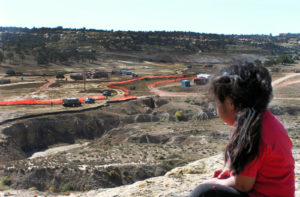
“William McCray, 4, overlooks a clean up operation of radium and uranium contaminated soils near his home on Oct. 9, 2009. Uranium mining from the mid-1900s left over 500 unregulated mines scattered once mining stopped in 1986. Photo by Teddy Nez” – H/T indiearizona.com
Helen Nez is but one person, among many. For most of her adult life she drank from a spring located on Navajo lands, in northeastern Arizona. Uranium levels were at least five times greater than safe drinking water standards, but who knew? The stuff has no odor. It has no taste. Helen Nez gave birth, ten times. Four of her children died, as toddlers. Three died as young adults, their bellies bloated, their eyes, turned gray. The last three are all adults now. All of them have serious health problems.
There is barely a parent alive who doesn’t dread the death of their child. Helen Nez lost seven. Thanks to Helen Nez herself and northcountrypublicradio.org for this image
Four generations of Navajo have come and gone since that first discovery, in 1942. Activist types have come, and they went home. Mining company commitments to restore the land to its original form, failed to materialize. Elected officials conducted hearings. Congressmen with familiar names like Waxman and Udall showed seemingly genuine concern, but little came of it. Bureaucratic Washington offered bland and infuriatingly meaningless responses to pointed questions. The EPA even refused assistance to one family whose hilltop home was the victim of “natural” radiation. Until their “hill” was demonstrated to be a pile of mine waste.
By 1977, the discarded by-products of Uranium mines formed piles large enough climb and enjoy the view, but I wouldn’t recommend it. That was the year United Nuclear Corporation took a different approach. A pond.
Mining and crushing up to 4,000 tons of ore daily leaves a prodigious amount of waste. “Yellowcake” is extracted leaving a sandy sludge, called tailings. These may contain up to 85% of the radioactivity, of the original ore. Another byproduct of the acid leach solvent extraction process is called “liquor”, a witches brew containing Thorium-230, Radium-222, Lead-210 and other isotopes.
A 20-foot breach in the Church Rock tailings dam opened around 5:30 on the morning of July 16, 1979 H/T Wikipedia
At 5:30am on July 16, 1979, the dam holding back the Church Rock tailings pond, gave way . A thousand tons of Uranium mill waste and 93 million gallons of acidic, radioactive tailings solution gushed through an ever-widening breach in the dam, down the pipeline arroyo and into the Puerco River, a tributary to the Little Colorado River.
A little perspective on what 93 million gallons looks like.
Was there anyone alive on March 28, 1979, who didn’t hear about Three Mile Island? The New York-Washington media corridor went wall to wall with coverage as they tend to do, with stories that effect them personally.
And yet, the Church Rock nuclear release four months later far exceeded that of Three Mile Island. Ever hear of Church Rock? Don’t feel bad if the answer is no. The “News” just wasn’t that into it. The Navajo Nation requested a disaster declaration from New Mexico Governor Bruce King, in order to facilitate federal assistance with the cleanup. For reasons which remain unclear, the governor refused such a declaration.
Between 1944 and 1986 some 521 mines extracted 30 million tons of Uranium ore from Navajo lands. Most of that was sold to the United States Atomic Energy Commission, until 1966, the only customer.
To this day the spill at Church Rock remains the US’ worst nuclear disaster, and best kept secret.
In 1990, the Radiation Exposure Compensation Act (RECA) was passed into law establishing an administrative framework for compensating victims of radiation, whether from atmospheric nuclear testing or employment in uranium mining. As of April 20 2018, 34,372 claims have been approved with total compensation amounting to $2,243,205,380. On June 7, 2022, the president signed into law the RECA Extension Act of 2022. This law extends the termination of the RECA Trust Fund and the filing deadline for all claims for two years from its date of enactment.
Thus far, several Navajo have received the maximum compensation allowed under the act, of $100,000. Even so. It’s difficult to understand how something like this remains to torment so few, for so many years. All that really matters is results. Everything else is excuses.
Afterward
“The 2020-2029 Ten-Year Plan continues the effort of the previous Five-Year Plans and identifies the next steps in addressing the human health and environmental risks associated with the legacy of uranium mining on the Navajo Nation. The Ten-Year Plan was developed in cooperation with multiple federal partner agencies including Bureau of Indian Affairs, Department of Energy, Nuclear Regulatory Commission, Navajo Area Indian Health Service, and the Agency for Toxic Substances and Disease Registry to incorporate goals and milestones for achieving assessment and cleanup actions”.
EPA.gov
Special hat tip to LA Times journalist Judy Pasternak for her disturbing and important new book, Yellow Dirt. Much of the material in this essay is based on her work.
Warm and dry in our rooms we can only wonder what went through the minds, of those lowering the lifeboats. Among them was Thomas Millar who must have wondered why. He had wanted to give little Tommy and Ruddock, a better life. He was about to leave his sons, orphans.
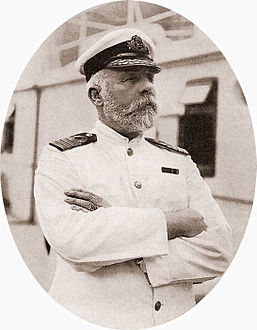
Captain Edward Smith
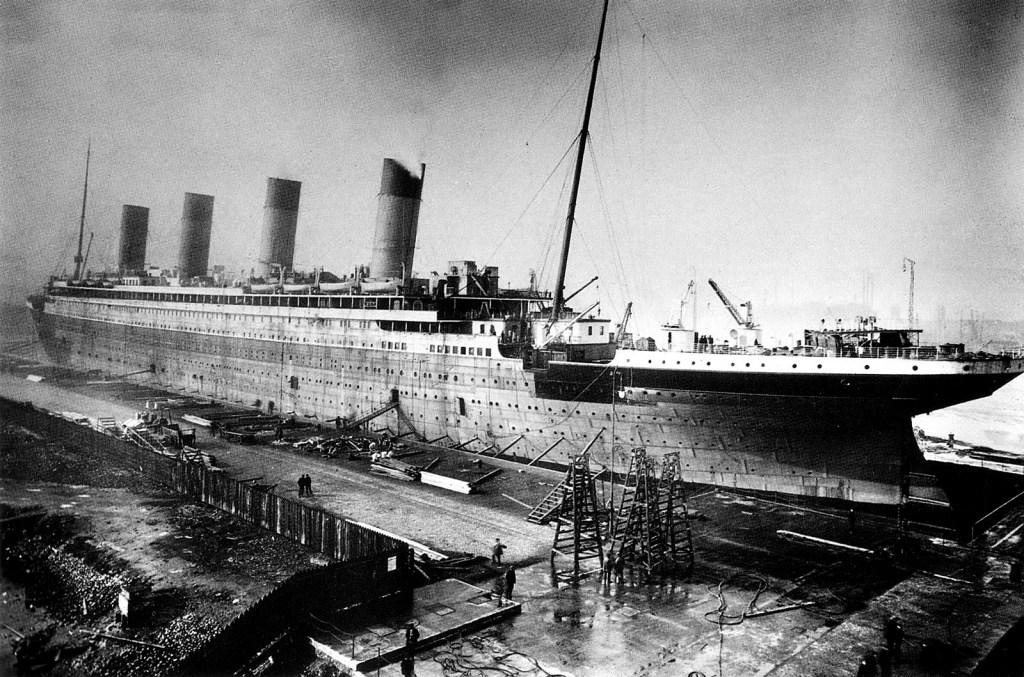
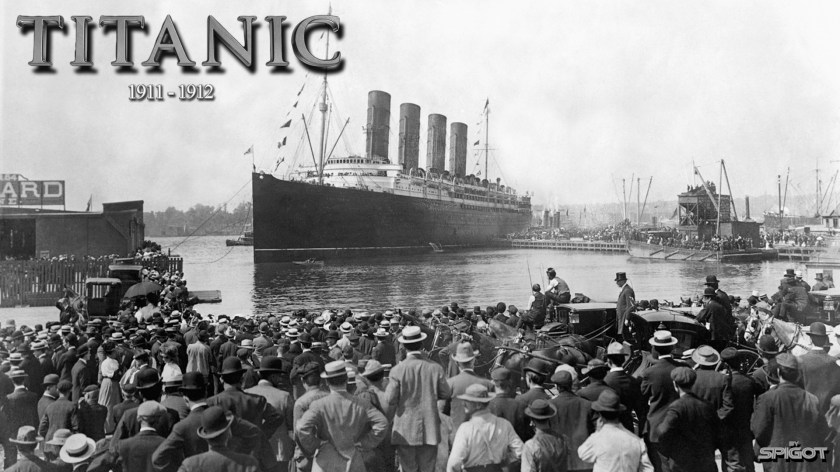
The great ship left the port of Southampton, England on April 10, 1912, narrowly averting an accident only minutes into her maiden voyage.
The largest liner in the world at this time, the bow wave of the RMS Titanic lifted the liners SS City of New York and Oceanic at their moorings. Dropping into the trough, New York’s mooring cables snapped with a sound like a rifle shot as the vessel swung about, stern-first. The crew of the tugboat Vulcan struggled frantically to bring New York under tow as Titanic’s Captain Edward Smith ordered starboard engines hard astern. Collision was averted, by a scant four feet.
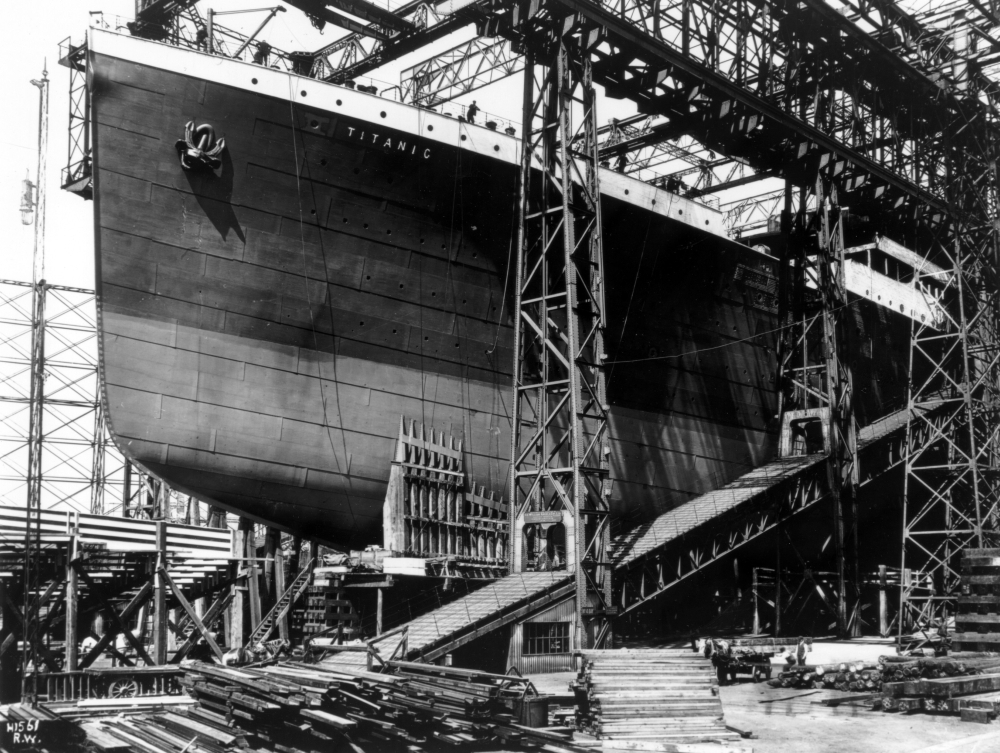
The idea for this largest of all luxury liners came about in 1907, construction beginning on March 31, 1909 at the Harland and Wolff shipyards of Belfast, Ireland.
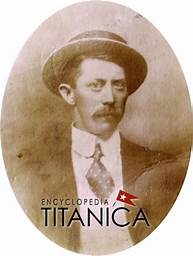
Thomas Millar
In its prime Harland and Wolff was the largest shipyard in the world with some 40,000 workmen tramping to work across the cobblestone paved streets, of Belfast.
Thomas Millar was one of those workers. The son of a sailor Millar grew up in the shadow of the great vessels of northern Ireland and all but destined, for the shipbuilding industry. First came the apprenticeship with Harland & Wolff and later work at Vickers of Barrow, Workman, Clark & Co. of Belfast before returning to work, at Harland & Wolff.
Along the way, “Tommy” married Jane “Jennie” Ruddock, the marriage producing two sons, Thomas born February 9, 1901 and William Ruddock born March 5, 1907.
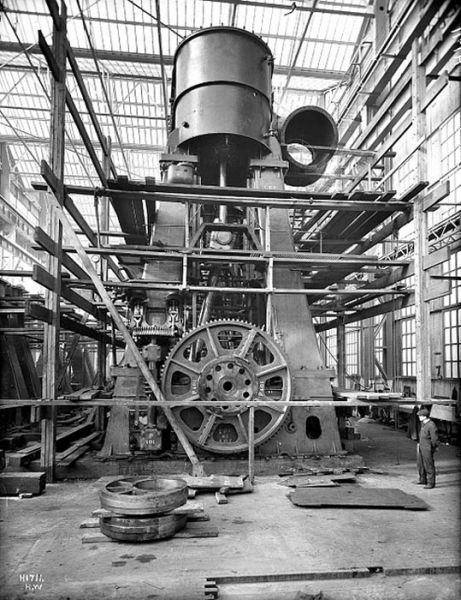
Millar took pride in his work, assigned to help build the great engines of RMS Titanic and proud to take some small part in the technological wonder, of the age. At night Millar would tell the boys about his work, wanting to instill in them the same pride he felt, in seeing the great liner take form.
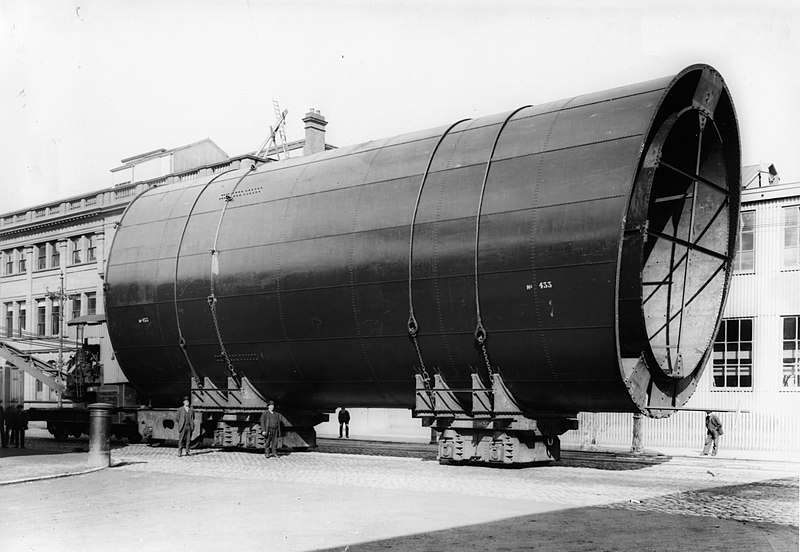
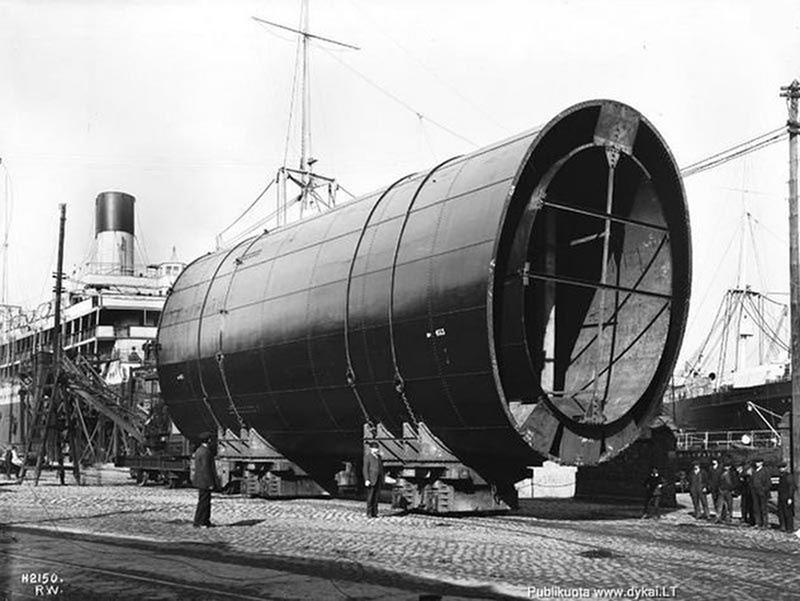
One of Britannic’s funnels, in transit to the ship
Disaster struck the family in January 1912 when Jennie died suddenly, of tuberculosis. With work now nearing completion on Titanic, the grieving father thought about a fresh start. He would improve his lot and that of his small family. So it was he left the dockyards to work, for the White Star Line. He would get himself settled and, when the time was right, he would reunite with his boys to pursue their new life. In America.
Thomas accepted work as assistant deck engineer for the White Star Line responsible for the upkeep of cranes, davits and the like. As things turned out he was assigned to the maiden voyage of the vessel he had helped to build. RMS Titanic.
With 16 transverse bulkheads Titanic could survive the breach, of as many as four. Shipbuilder Magazine dubbed the vessel “unsinkable”. The name was never officially sanctioned by her builders, but no matter. From that day, to this the name lives on, in the public imagination.
At last came the day. Time to leave. The work would be constant, and Thomas knew this was no place for children. He left the boys with his aunt Mary bidding the two, goodbye. “Be good to your aunt” he told the boys, “and try not to fight with your cousins”. He reached in his pocket and pulled out two new pennies. “Don’t spend these” he told his sons, “until we’re together again”.
Later that day the boys stood on the shores of Belfast Loch watching the liner, steam away. So tightly did each grip his penny the date imprinted into the palm of his small hand. 1912.
The story from here, is familiar. On Sunday April 14, Titanic was 400 miles off the coast of Newfoundland. Conditions were clear, calm and cold, just a few degrees above freezing. There had been warnings of drifting ice from other ships in the area, but no ice was believed to pose a danger, to such a ship as Titanic. Captain Smith said it himself, that he “[couldn’t] imagine any condition which would cause a ship to founder. Modern shipbuilding has gone beyond that.”
Lookout Frederick Fleet alerted the bridge. Iceberg dead ahead at 11:40pm. First Officer William Murdoch ordered the engines in reverse, veering the ship to port. Lookouts were relieved, thinking that collision was averted. Below the surface, the starboard side ground into the iceberg, opening a gash the length of a football field.
The ship was built to survive flooding in four watertight compartments. The iceberg had opened five. As Titanic began to lower at the bow, it soon became clear. The great ship was doomed.
Those aboard were poorly prepared for such an emergency. The vessel was built for 64 wooden lifeboats but only carried, 16. Based as they were on ship size and not the number of passengers and crew, regulations required enough for 990. Titanic carried enough for 1,178.
There was room for over half of those on board, provided that each boat was filled to capacity. And yet, many boats were launched only half-full. Confused and still sleepy in the midnight air many refused the small boats, reluctant to leave the “safety” of the 40,000-ton ship. In other cases so strictly did some adhere to the “women and children first” directive, that evacuation included women and children, only. The first lifeboat in the water, rated at 65 passengers, launched with only 28 aboard. Lifeboat #1 rated for 60, contained 12.
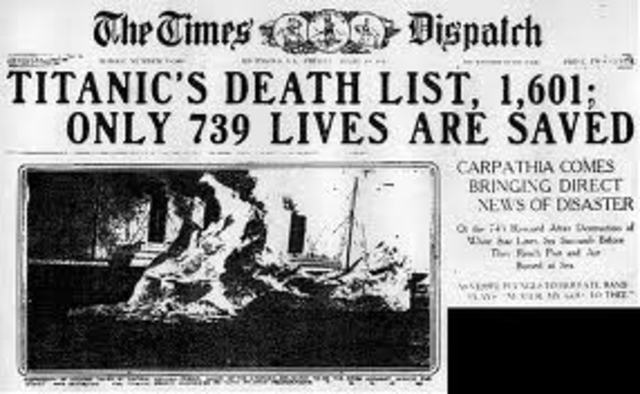
Only 20 miles away the crewmen of the SS Californian saw distress rockets but dismissed them, as fireworks. Titanic’s wireless operator pleaded for help but the dits and dahs fell on deaf ears. Californian’s wireless operator, had gone to bed. 57 miles away the steamship Carpathia turned and dashed to the rescue but, too late.
In the hour and ½ it took to lower the lifeboats Titanic’s enormous propellers were visible above the water. Warm and dry in our rooms we can only wonder what went through the minds, of those lowering the lifeboats. Thomas Millawas one of those. Did he wonder in those last hours of his life…why? He had left to seek a better life for little Tommy and Ruddock. He was about to leave them orphans.
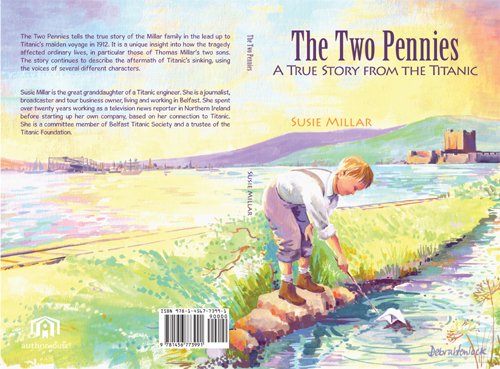
1,496 died that night of 2,223 passengers and crew. Mostly from hypothermia. Thomas Millar’s body if it was ever recovered, was never identified. Tommy and Ruddock never did spend those pennies. The coins remain treasured family heirlooms from that day to this. You can still see those two pennies if you like, on the streets of Belfast. There Thomas’ Great-Granddaughter Susie Millar directs “the original & ONLY Titanic themed tour in Belfast guided by the direct descendant of a crew member”.http://www.titanictours-belfast.co.uk/
“It was soldiers saving soldiers. Soldiers putting out fires on other soldiers; soldiers dragging soldiers out of fires; resuscitating; giving soldiers CPR; putting tourniquets on limbs that had been severed; putting out fires on their bodies, sometimes with their own hands. Anything they could do to care for their buddies that were more seriously injured they were doing. They can’t do that without knowing how. They responded the way they would in combat”.
March 23, 1994 was a good day for a jump.. The skies were clear with moderate winds of 5 -7 MPH, temperatures a comfortable mid-sixties.
H/T History.army.mil
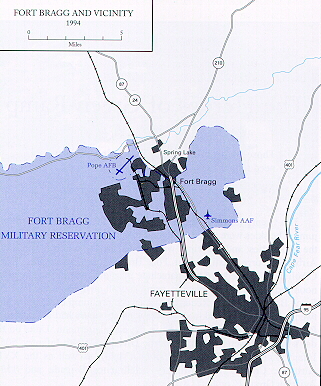
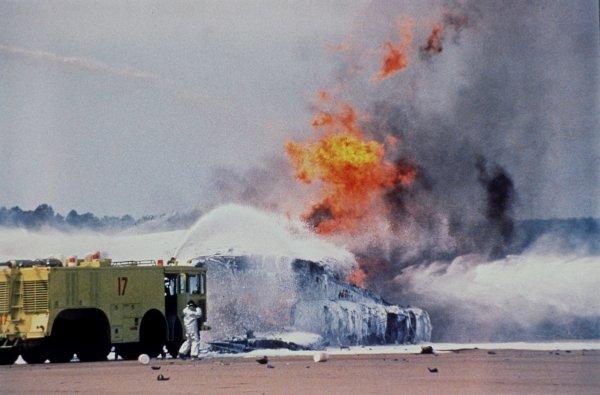
Some 500 paratroopers of the 82nd Airborne Division were assembled around the parking area known as “Green Ramp”, part of a joint exercise between Fort Bragg North Carolina, and nearby Pope Air Force base.
There were two parachute drops scheduled that day. The sky above was filled with aircraft, General Dynamics F-16 Fighting Falcons, Fairchild Republic A-10 Thunderbolts and C-130 aircraft, conducting training.
On the ground, paratroops of the First Brigade, 504th Infantry Regiment, and 505th Infantry Regiment prepared to board Lockheed C-130 Hercules and Lockheed C-141 Starlifter aircraft parked on Green Ramp, or practiced jumps from one of several concrete tail mock-ups or just waited, resting in a large personnel shed called the “PAX”, or surrounding lawns.
An F-16D Fighting Falcon was conducting a simulated flame-out on final approach to the runway, with two pilots at the stick. 300-feet above tree level, the giant four-engine turboprop military transport known as the C-130E Hercules, was making the same approach.
The Fighter’s nose struck the tail of the transport, severing the C-130E’s right elevator. F-16 pilots applied full after burner trying to recover the aircraft, as its frame began to disintegrate. The transport was able to recover, veering off to circle the air field and assess the damage. Meanwhile both F-16 pilots ejected with the fighter still on afterburner, hurtling toward Green Ramp.
H/T Fayettville Observer
The shattered wreckage of the F-16 hit the ground between two parked C-130s before striking the right wing of the C-141B Starlifter, puncturing 55,000 gallon fuel tanks. A great fireball of flaming wreckage some 75-feet in diameter ricocheted across the tarmac, hurtling toward 82nd Airborne personnel staging for that second jump.
“S. Sgt. Daniel E. Price of the 2d Battalion, 505th Infantry, sacrificed his life to save a female soldier he had never met before. Spc. Estella Wingfield, an information systems operator with Headquarters and Headquarters Detachment, 525th Military Intelligence Brigade, remembered:
He looked me in the eye, grabbed me by the shirt, threw me several feet in the air and jumped on top of me…. An instant later, I heard the blast, felt the extreme heat from the explosion and the debris falling on us…. After the explosion and the rounds stopped going off, he whispered in my ear, “Crawl out from underneath me.”” I did and took off running.
History.army.mil
Captain Gerald K. Bebber, Chaplain to the 525th Military Intelligence Brigade chaplain, remembers he:
“heard the high pitched screech of a jet fighter airplane at open throttle from beyond the pack shed [sic] suddenly give way to a deep reverberating thud and massive explosion. I recognized the sound from my experience in battle in Desert Storm. As soon as I could think this, a great roaring rush of fire entered my sight above and to the left of the pack shed. It was at tree-top level, slanting down as it gushed into the mockup area at terrific speed…. The flame came though the tops of the trees that stood in a small open area beside the pack shed. In the torrent of flame I saw pieces of wreckage and machinery hurling along. As the torrent rushed in I could hear cries of alarm, curses, and someone yelling “run” from the mock-ups. The fire blast crackled as it blasted in, and at its sides it curled outward as it went forward. I was standing perhaps thirty feet beside the edge of the blast, and could see eddies of the flame curling out toward me. I turned and ran from the flame, to just beyond the right end of the pack shed, where . . . I no longer felt the intense heat, so I stopped. To my left, out on the aircraft ramp, now in my line of sight I could see a parked C-141 engulfed in flames. It was the left one of a pair of C-141s parked there”.
H/T Fayetville Observer
Jump master Captain James B. Rich was conducting a pre-jump briefing by one of those concrete mock-ups, and remembers the “overwhelming understanding that there was no way in hell I could outrun the oncoming debris…” Captain Rich “felt fully exposed” as flaming chunks of white hot metal, rained down. It was like “heavy pipes clanging against each other, mixed with a handful of steel marbles thrown against a road sign“.
2d Battalion S. Sgt. Michael T. Kelley remembered nuclear event training and hit the ground as the fireball rolled over him. When he got up he was on fire. Sergeant Kelley dropped and rolled as a would-be rescuer jumped on his body, to put out the flames. A second beat back the fire with “a wrap of some kind” while a third came up with water. When the flames went out, Sgt. Kelly had severe burns over 70 per cent of his body, including the lower one-third of his face.
Sgt. Gregory Cowper of the 2d Battalion, 505th Infantry, began to roll when the fire caught up with him. “Ammunition was going off”, he said, “I couldn’t tell where it was. I looked to my left and there was a man on fire. I looked to my right and there was a man on fire.”
Rank held no distinction that day, Privates to Captains age eighteen to forty, pulling one another from the flames and shielding the wounded, with their bodies. Twenty three were killed outright, another eighty severely injured. One badly burned soldier survived nine agonizing months before succumbing, to his wounds.
82d Airborne commander Major General William M. Steele, remembered:
“It was soldiers saving soldiers. Soldiers putting out fires on other soldiers; soldiers dragging soldiers out of fires; resuscitating; giving soldiers CPR; putting tourniquets on limbs that had been severed; putting out fires on their bodies, sometimes with their own hands. Anything they could do to care for their buddies that were more seriously injured they were doing. They can’t do that without knowing how. They responded the way they would in combat”.
The Green Ramp disaster of March 23, 1994 was the greatest single-day loss of life suffered by the 82nd Airborne division, since the Battle of the Bulge.
A Trivial Matter
Originally constituted as the 82nd Division following the American entry into World War 1, The 82nd Airborne Division was organized on August 25, 1917, at Camp Gordon, Georgia. The “AA” on the arm patch stands for “All American”. Now based out of Fort Bragg North Carolina, the All Americans have participated in virtually every American conflict, of the last 100 years.
“The god Prometheus stole fire from heaven to give to the human race, which originally consisted only of men. To punish humanity, the other gods created the first woman, the beautiful Pandora. As a gift, Zeus gave her a box, which she was told never to open. However, as soon as he was out of sight she took off the lid, and out swarmed all the troubles of the world, never to be recaptured. Only Hope was left in the box, stuck under the lid. Anything that looks ordinary but may produce unpredictable harmful results can thus be called a Pandora’s box”. – Merriam-Webster.com
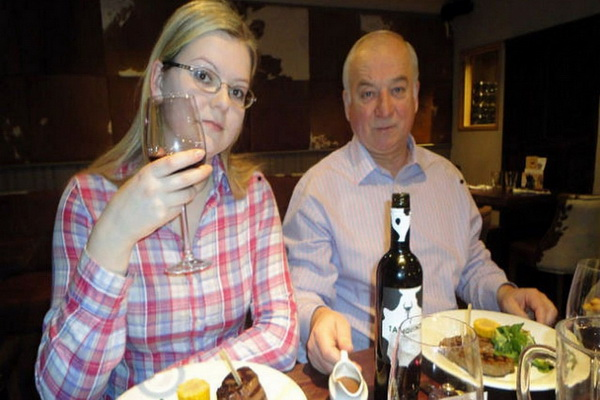
On March 4, 2018, a father and daughter enjoyed a meal at the Zizzi restaurant in the cathedral city of Salisbury, ninety miles southwest of London. Two hours before sunset, the two took ill. A passing doctor and nurse found the couple unresponsive, on a park bench.
Sergei and Yulia Skripal
Sergei Skripal, age 66, and his daughter Yulia (33) were slipping in and out of consciousness, foaming at the mouth with eyes wide open, but entirely white. The Skripals were weeks in intensive care before regaining consciousness. In a May 23 interview with CBS News, Yulia said “I don’t want to describe the details, but the clinical treatment was invasive, painful and depressing.”
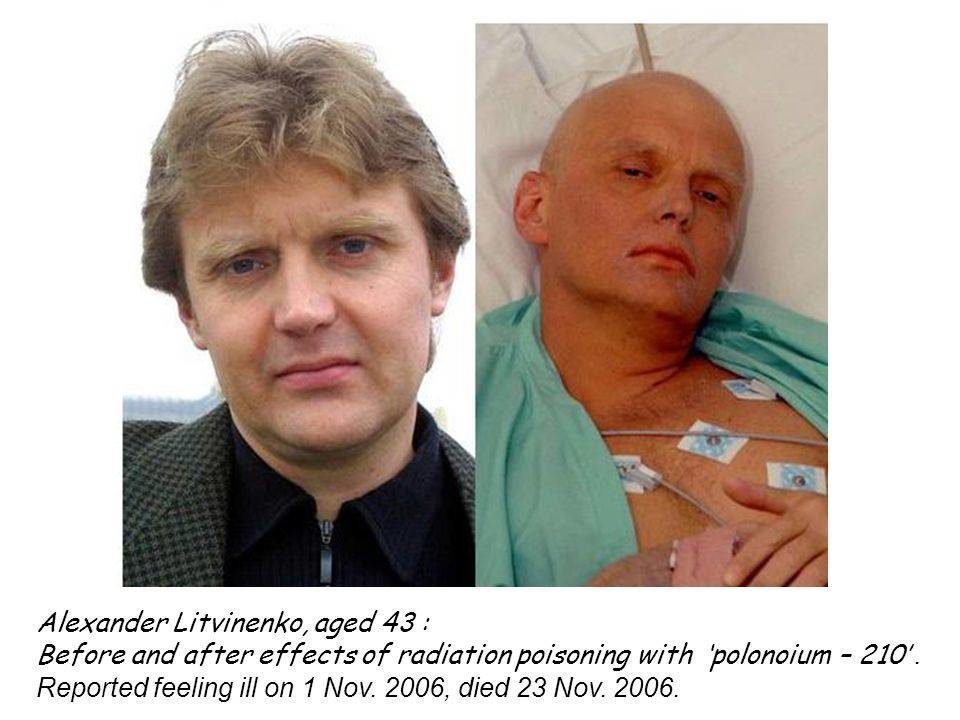
Like the Russian State Security operative turned defector Alexander Litvinenko before them, Sergei Skripal knew his former boss had a very long reach. In 2006, Litvinenko took ill on the streets of England, poisoned by the radioactive element Pollonium-210, slipped into his tea. Skripal it turns out was a former Russian military officer and double agent for British intelligence. Twelve years earlier Litvinenko suffered a long and terrible death. Skripal and his daughter recovered. The former spy is rumored to be living in New Zealand, under an assumed name.
British Prime Minister Theresa May expelled 23 Russian “diplomats” following the 2018 incident. While Vladimir Putin’s government vehemently denies the charge, the Skripal matter has been classified as an attempted assassination using the military grade nerve agent, Novichok.
The terrifying history of nerve agents began in 1936, when the German biochemist Dr. Gerhard Schrader was working on pesticides. Dr. Schrader first experienced problems with his eyesight, and soon had difficulty breathing. Symptoms included involuntary muscular spasms. Within days the scientist’s arm was fully paralyzed.
Dr. Schrader had discovered a class of chemical compounds known as organo-phosphates.
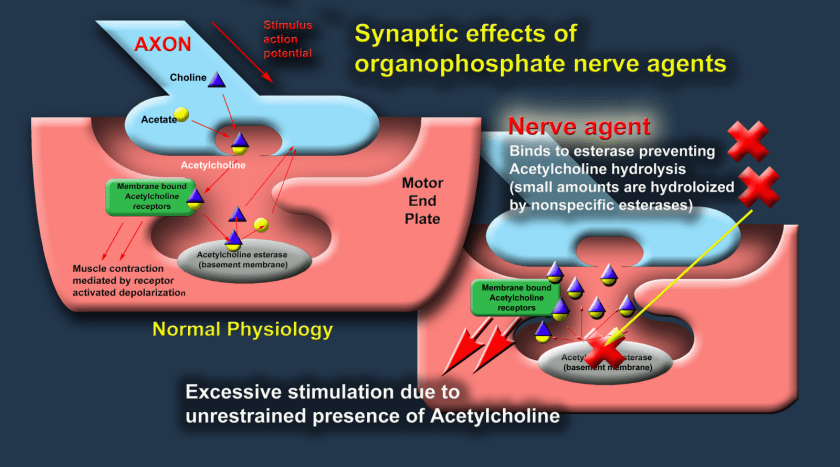
Organo-phosphates are a class of organic chemical which block nerve signals to bodily organs. Nerve agents are generally clear to a golden amber in color, tasteless liquids which may be evaporated, into a gas. The Sarin gas used in the 1995 Aum Shinrikio attack on the Tokyo subway was odorless as was the VX used to assassinate the brother of Kim Jong-un, in 2017.
Symptoms of nerve agent poisoning begin with constriction of pupils and convulsions, leading to involuntary urination and defecation. Death follows within minutes caused by asphyxiation, or cardiac arrest.
In the 1950s, British chemist Dr. Ranajit Ghosh discovered the “V”series of organophosphate, sold as a pesticide in 1954 under the trade name Amiton. The stuff was soon judged too dangerous for safe use and taken off the market. British Armed Forces took control of the compound at Porton Downs and traded it to the United States in 1958, for information on thermo-nuclear weapons.
In 1961, the American military went into full-scale production of VX gas as a chemical weapon of war. The Soviet military developed an analog called VR in 1963 later developed into the Novichok group, including the most toxic molecules ever developed.
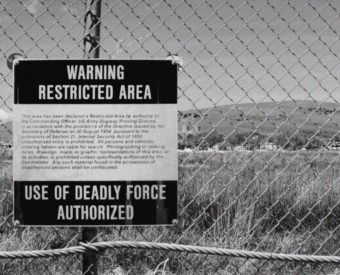
Dugway Proving Ground
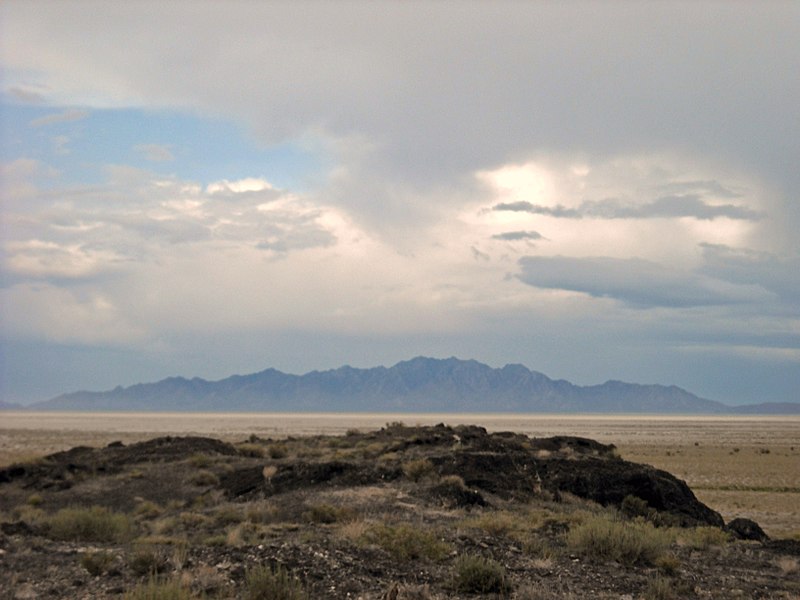
The Dugway Proving Ground near Salt lake City Utah was established in 1941 and used for hundreds if not thousands of open-air tests of nuclear, biological and chemical (NBC) compounds.
A 1994 the US GAO (General Accounting Office) reported:
“From 1951 through 1969, hundreds, perhaps thousands of open-air tests using bacteria and viruses that cause disease in human, animals, and plants were conducted at Dugway … It is unknown how many people in the surrounding vicinity were also exposed to potentially harmful agents used in open-air tests at Dugway”.
Skull Valley is a geologic formation bordering the Great Salt Lake Desert near Dugway, in the south of Utah. On March 17, 1968, the manager of a Skull Valley livestock company phoned the department of ecology and epidemiology at Dugway to report the unexplained death of 3,000 sheep.
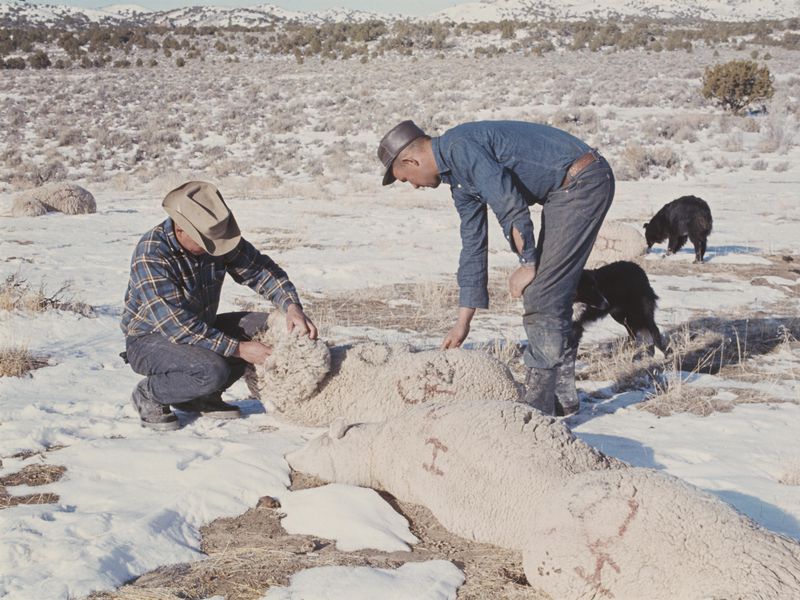
The Dugway safety office compiled a count of 3,843 dead animals. Exact cause of death was at first difficult to determine, since “no other animals of any type, including cows, horses, dogs, rabbits, or birds, appeared to have suffered any ill effects, a circumstance that was hard to explain if VX had in fact caused the sheep deaths.”
View of two farmers checking the corpses of dead sheep on a farm ranch near the Dugway Proving Ground in Utah. (Rolls Press/Popperfoto/Getty Images) H/T Smithsonian.com
Necropsies revealed the presence of VX nerve agent, as did grass and snow samples taken, some three weeks after the incident. Total sheep fatalities were counted at 6,000-6,400 including those humanely euthanized. With even a suspicion of VX nerve agent, the animals had no market value whatsoever either for meat, or for wool.
A report which remained classified for thirty years blamed a faulty nozzle left open as the test aircraft, gained altitude.
Public backlash was vehement against the US Army Chemical Corps, and nearly lead to its disbanding. President Richard Nixon ordered a halt to open air testing of “NBC” agents, in 1969.
Few nations possess stockpiles of nerve agents, a hellish weapon of war which may, with a mere puff of wind, turn on those who would use it. The use of such an agent would almost certainly lead to nuclear retaliation should any nation so attacked, possess the capability.
Today on the morning news we hear of “scum” and “insects” who must be “purged” from the Russian nation. These are the pronouncements of the dictator Vladimir Putin, words we haven’t heard since the days of the Third Reich or the terrible monstrosity of Stalin’s USSR, words directed this time at Putin’s own countrymen, objectors to the war of aggression being carried out even now, against their neighbors in Ukraine.
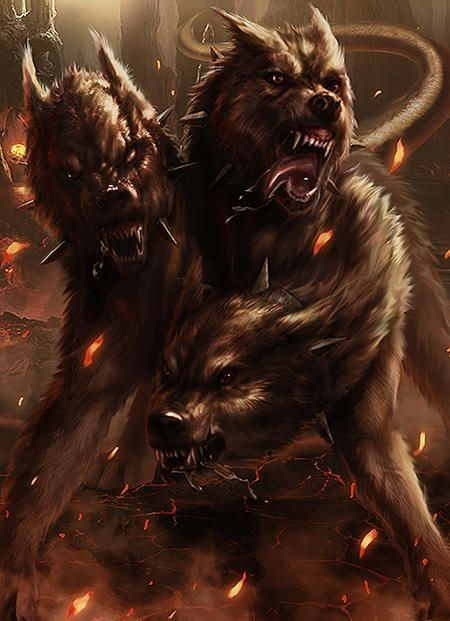
The nations of the world release statements but stand at bay, fearful of the horrors as yet locked away in the darkness, of Pandora’s box. Like the hideous three-headed dog Cerberus standing guard at the gates of hell we shrink in horror at that terrible and yet benign sounding term, NBC. We hold a wolf by the ears, desperately afraid to hang on yet unable, to let go.
On Friday, the Durham investigation filed indictments alleging that Clinton campaign operatives fabricated evidence of Trump campaign and later Presidential “collusion”, with Russia. If true this is a scandal orders of magnitude greater than Watergate and yet the legacy media, are silent. Five news cycles have come and gone since that announcement. The sum total of coverage by CBS, ABC and NBC amounts to the cube root, of zero.
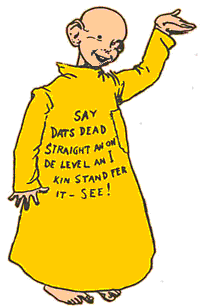
Mickey Dugan was born on February 17, 1895, on the wrong side of the tracks. A wise-cracking street urchin with a “sunny disposition”, Mickey was the kind of street kid you’d find in New York’s turn-of-the-century slums, maybe hawking newspapers. “Extra, Extra, read all about it!”
With his head shaved as if recently ridden of lice, Mickey was one of thousands of homeless street urchins roaming the back lots and tenements of the city, not as much an individual as an archetype. Mickey Dugan was a cartoon character, the child of artist and “Buster Brown” creator, Richard Outcault.
Outcault’s “Hogan’s Alley” strip, one of the first regular Sunday newspaper cartoons in the country, became colorized in May of 1895. For the first time, Mickey Dugan’s oversized, hand-me-down nightshirt was depicted in yellow. Soon, the character was simply known as “the Yellow kid”.
Outcault worked for Joseph Pulitzer in those days, owner of the New York World Newspaper. Archrival William Randolph Hearst hired the cartoonist away to work for Pulitzer’s cross-town competitor Journal American, but the pair soon received a lesson, in the law. There was no copyright protection on the Yellow kid. Before long, the character was simultaneously appearing in competing newspaper strips where he would remain, for over a year.
We hear a lot today about “fake news” but the sorry state of journalism, is hardly new. Circulation wars were white hot at the turn of the last century. Competing newspapers used anything possible to get an edge. Real-life street urchins hawked lurid headlines, heavy on scandal-mongering and light on verifiable fact. Whatever it took, to increase circulation.
The Yellow Kid character was gone by 1898 but he lived on in a way, in the style of newspaper reporting which came to be called “yellow journalism”.
After two wars for independence from Spain, the Caribbean island of Cuba found its economy increasingly intertwined with that of the United States. From the Spanish perspective, Cuba was more of a province than a colony. They were not about to relinquish a foot of territory. When the Cuban Rebellion of 1895 broke out, Spanish colonial administrator don Valeriano Weyler’s brutal repressions killed thousands in Cuban concentration camps.
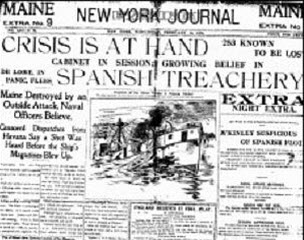
In America, some saw parallels between the “Cuba Libre” movement, and the United States’ own revolution of a hundred-odd years earlier. Fearing the economic repercussions of a drawn out conflict, shipping and other business interests put pressure on President McKinley to intervene. Meanwhile, the yellow papers kept the issue front page, whipping up popular fury with tales of the noble Cuban revolutionary and the barbaric Spaniard. There were even tales of American women publicly strip searched, by Spanish authorities.
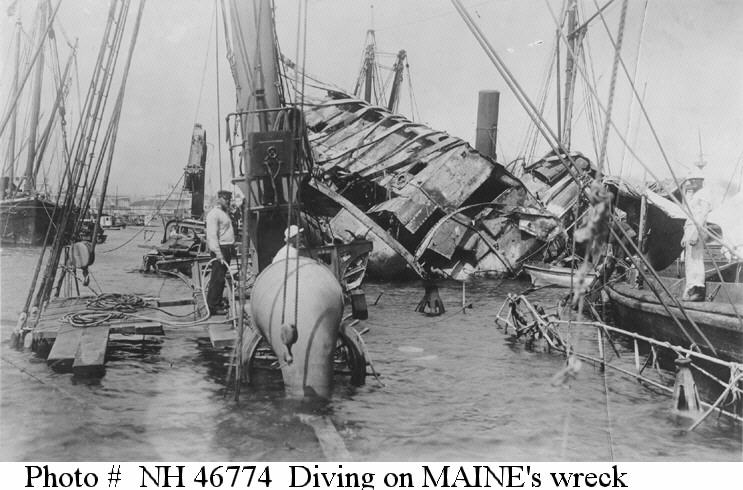
The armored cruiser USS Maine left Key West headed for Cuba in January 1898, to protect US interests and to emphasize the need for a quick resolution to the conflict. Anchored in Havana Harbor on February 15, a massive explosion of unknown origin rocked the Maine, sinking the cruiser within minutes and killing 268 of the 355 Americans on board.
The McKinley administration urged calm. Conditions in Cuba were bad enough, without front page headlines like “Spanish Murderers” and “Remember the Maine”, accompanied by sensationalized accounts of Spanish brutality. War became all but inevitable when US Navy findings were released that March, stating that the sinking had resulted from an external explosion.
“Spanish Misrule,” Puck, 1890s, by Louis Dalrymple
The Spanish-American War began the following month, leading to the Philippine-American war.
There is a story that illustrator Frederic Remington said there was no war brewing in Cuba. Hearst is supposed to have replied. “You furnish the pictures and I’ll furnish the war.” The story may be apocryphal. Newspapers then couldn’t tell us what to think any more than today, but the media most certainly controlled what the public was thinking ABOUT.
For two years, Hearst and Pulitzer had clamored for war with Spain. Both were happy to take credit, when war came. Beside that, the war was good for circulation. A week after the Spanish-American War began that April, Hearst’s American Journal ran the headline “How do you like the Journal’s war?” Front page. Above the fold.
It’s been said you should never pick a fight with a guy who buys ink by the barrel. I disagree. I have broken that dictum myself and recommend the practice to anyone so inclined. For all the Wizard of Oz antics of the print and electronic media, there remains only the one man behind the curtain. Ask Jeffrey Zucker how that turns out.
President Reagan once said of the Soviet Union, “doveryai no proveryai” (trust, but verify). He might have said the same of an information industry whose business model it is, to rent an audience to a sponsor.
In 1976, a team of American naval investigators concluded that the explosion aboard the USS Maine was likely caused by a fire which ignited ammunition stockpiles and not by Spanish mine or act of sabotage.
What to say to the families of the 20,603 dead, wounded and missing from the Spanish-American war? The media of the day were and remain to this day, a tower of indifference.
“We saw terrible things: cremated adults shrunk to the size of small children, pieces of arms and legs, dead people, whole families burnt to death, burning people ran to and fro, burnt coaches filled with civilian refugees, dead rescuers and soldiers, many were calling and looking for their children and families, and fire everywhere, everywhere fire, and all the time the hot wind of the firestorm threw people back into the burning houses they were trying to escape from”. Eyewitness to the firebombing at Dresden
The most destructive war in history entered its final, apocalyptic phase in January 1945, with another four months of hard fighting yet remaining before Allied forces could declare victory in Europe. In the west, the “Battle of the Bulge” was ended, the last great effort of German arms spent and driven back beyond original lines. In the east, the once mighty German military contracted in on itself, in the face of a massive Soviet advance.
Dozens of German divisions hurried east to meet the threat. Allied intelligence believed the war could be over in April if the major cities to the east, were destroyed. Dresden. Leipzig. Chemnitz. Letting these places stand to serve as bases for retreating German forces, could drag the war out until November.
German military equipment lies broken in Czechoslovakia, 1945
Sir Charles Portal, British Chief of the Air Staff, put the problem succinctly: “We should use available effort in one big attack on Berlin and attacks on Dresden, Leipzig, and Chemnitz, or any other cities where a severe blitz will not only cause confusion in the evacuation from the East, but will also hamper the movement of troops from the West.”
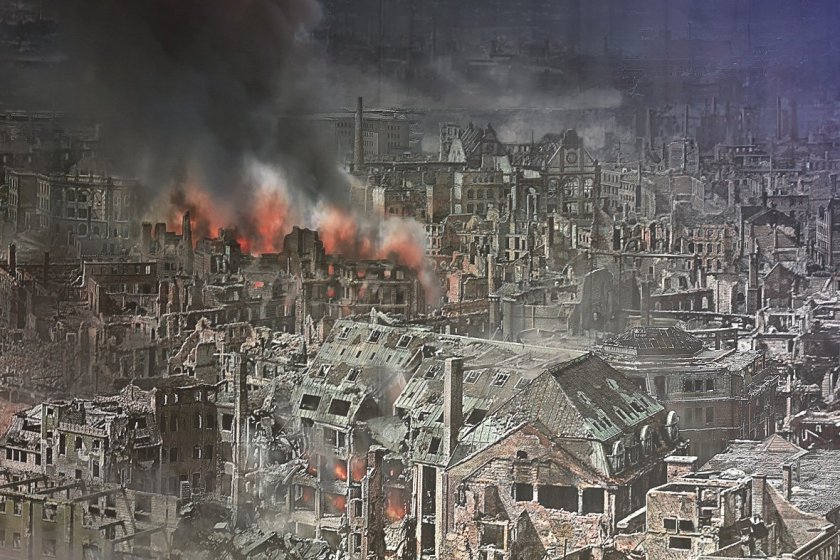
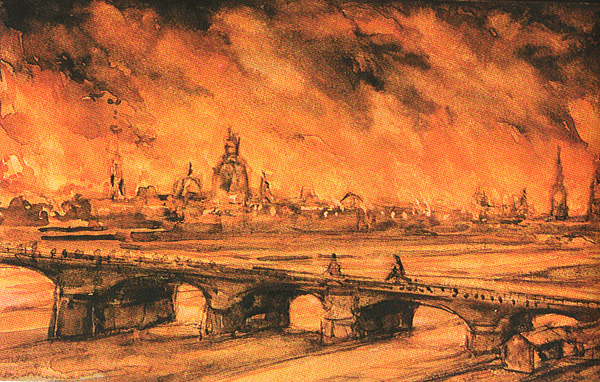
With its baroque and rococo city center, the capital city of Dresden was long described as the “Jewel Box” of the Free State of Saxony, family seat to the Polish monarchs and royal residence to the Electors and Kings of Saxony. Dresden was the seventh-largest city in Germany in 1945, home to 127 medium-to-large sized factories supplying the German war machine, and the largest built-up area in the “thousand-year Reich”, yet to be bombed.
Long described as “Florence on the Elbe” Dresden was considered one of the world’s most beautiful cities, a treasure of art and architecture.
For Victor Klemperer, the 13th of February, 1945, was the most terrifying and depressing experience of a lifetime. Once home to well over 6,000 Jews, Dresden now contained a mere forty-one. Klemperer’s marriage to an “Aryan” wife had thus far protected him from the “final solution”, despite the yellow Juden star he was forced to wear on his coat.
Now, the man witnessed notices for final “deportation” being delivered even to those last few. There wasn’t one who received such a notice who didn’t understand what it meant. Terrified that he might be next the process was interrupted by the coming firestorm. Three nights later Klemperer removed the yellow star, an act punishable by death at the time.
Three hundred miles away, bad weather hampered operations for the United States Army Air Force (USAAF). The first wave in the fire bombing of Dresden would be a Royal Air Force (RAF) operation.
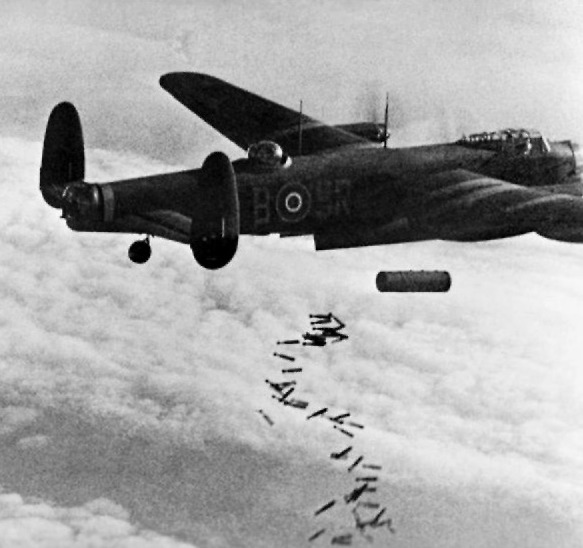
The first group of Lancaster bombers arrived in the skies over Dresden two hours before midnight, February 13. These were the pathfinders, their job to find the place and drop magnesium parachute flares, to light up the target. Then came the marker planes, Mosquito bombers whose job it was to drop 1,000-pound target indicators whose red glare provided something to aim at. Then came the first wave, 254 Lancaster bombers dropping 500 tons of high explosives ranging from 500-pounders to massive, 4,000-pound “blockbusters”. Next came the incendiaries. The “fire bombs”. 200,000 of them.
For those caught on the ground like scared rabbits in oncoming headlights, the horrors had only begun.
The second wave came in the small hours of February 14, just as rescue operations were getting underway. By now thousands of fires were burning, with smoke rising 15,000 feet into the air. You could see it from the air, from five hundred miles.
Then came another 529 Lancasters, dropping another 1,800 tons of bombs.
Lancaster bomber
The USAAF arrived over the target on the afternoon of February 14, the 317 B-17 “Flying Fortresses” of the “Mighty 8th” delivering another 771 tons of bombs.
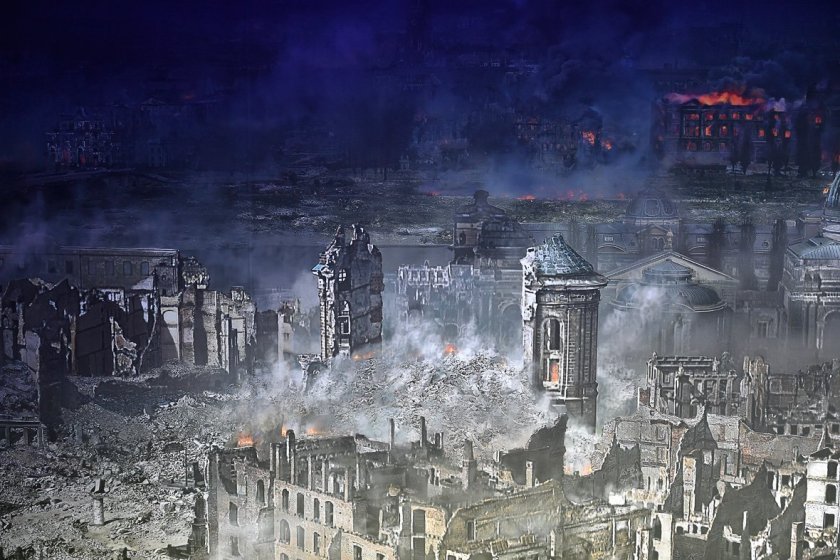
Fires enveloped the city by the tens of thousands growing into a great, howling firestorm. A shrieking, seemingly living demon beast from the blackest pits of hell, devouring all in its path.
A firestorm of this size develops its own weather, fire tornadoes reaching into the sky as pyrocumulonimbus clouds hurl lightning bolts back to earth, starting new fires. Gale force winds scream into the vortex from all points of the compass, powerful enough to hurl grown adults opening doors in an effort to flee, off their feet and into the flames.
Lothar Metzger brings us one of the few eyewitness accounts of the fire bombing of Dresden, as seen from the ground:
“It is not possible to describe! Explosion after explosion. It was beyond belief, worse than the blackest nightmare. So many people were horribly burnt and injured. It became more and more difficult to breathe. It was dark and all of us tried to leave this cellar with inconceivable panic. Dead and dying people were trampled upon, luggage was left or snatched up out of our hands by rescuers. The basket with our twins covered with wet cloths was snatched up out of my mother’s hands and we were pushed upstairs by the people behind us. We saw the burning street, the falling ruins and the terrible firestorm. My mother covered us with wet blankets and coats she found in a water tub.
We saw terrible things: cremated adults shrunk to the size of small children, pieces of arms and legs, dead people, whole families burnt to death, burning people ran to and fro, burnt coaches filled with civilian refugees, dead rescuers and soldiers, many were calling and looking for their children and families, and fire everywhere, everywhere fire, and all the time the hot wind of the firestorm threw people back into the burning houses they were trying to escape from.
I cannot forget these terrible details. I can never forget them”.
He was ten years old at the time.
For Victor Klemperer, the fire bombing of Dresden was a last minute reprieve. On the 19th he joined a refugee column fleeing the inferno, for American held territory. He would survive the attack, and live to see the end of the war.
Official death tolls from the burned out city are estimated at 18,500 to 25,000. The real number will never be known. At this point in the war refugees and military forces were streaming through the area by the tens of thousands. Estimates run as high as 200,000. That number if accurate, is more than death tolls resulting from the atomic bombings of Hiroshima and Nagasaki, combined.
By 6:30pm, the fleet had formed a line some thirty miles long proceeding north at 20 knots, equivalent to 23MPH over the ground. It was full dark at this latitude with the Haar or “sea fog”, closing in. The fleet was effectively deaf and blind, and traveling fast. The table was set, for disaster.
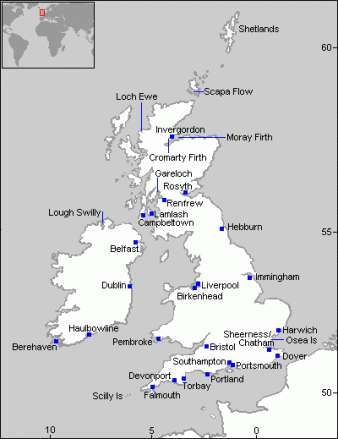
Operation E.C.1 was a planned exercise for the British Grand Fleet, scheduled for February 1, 1918 out of the naval anchorage at Scapa Flow in the North Sea Orkney Islands.
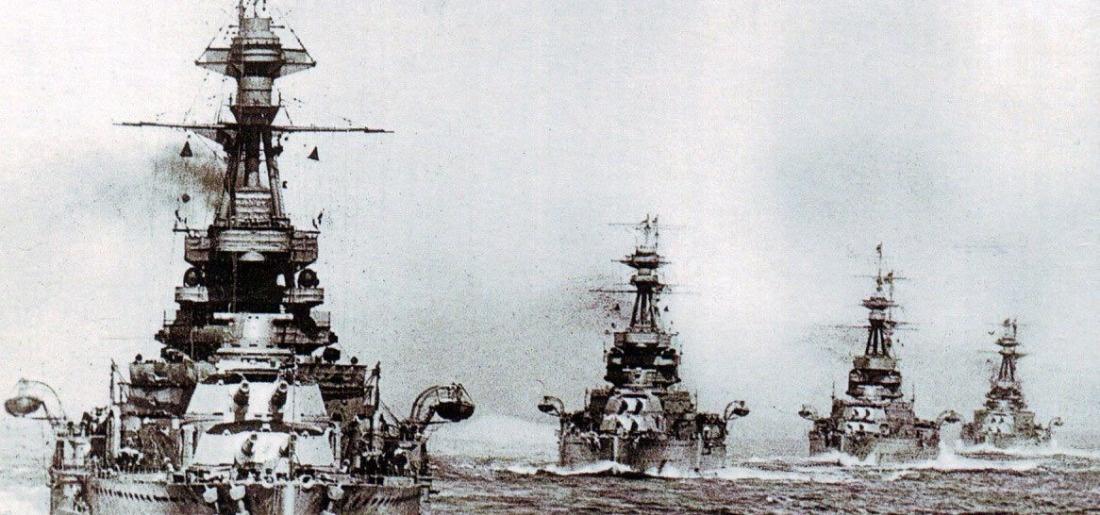
Forty vessels of the British Royal Navy departed Rosyth in the Scottish fjord at the Firth of Forth on January 31, bound for Scapa flow. They were the 5th Battle squadron with destroyer escort, the 2nd Battlecruiser squadron and their destroyers, two cruisers and two flotillas of K-class submarines, each led by a light cruiser.
By 6:30pm, the fleet had formed a line some thirty miles long proceeding north at 20 knots, equivalent to 23MPH over the ground. It was full dark at this latitude with the Haar or “sea fog”, closing in. The fleet was effectively deaf and blind, and traveling fast.
While only an exercise, strict radio silence was observed, lest there be any Germans in the vicinity. Each vessel displayed a faint blue stern light, travelling 400-yards ahead of the next-in-line. Black-out shields restricted the lights’ visibility to one compass point left or right of the boats’ center line. The table was set for disaster.
Though large for WW1-vintage submarines at over 300-feet, K-class subs were low to the water and slow, compared with the much larger surface vessels. Compounding the problem, the unfortunately nicknamed”Kalamity Klass” was powered by steam, meaning that stacks had to be folded and closed, before the thing was ready to dive. Only eighteen K-class submarines were ever built, only one of which ever caused damage to a German U-boat, and that was a ramming attack.
Seems the K-class was more dangerous to its own people, than anyone else.
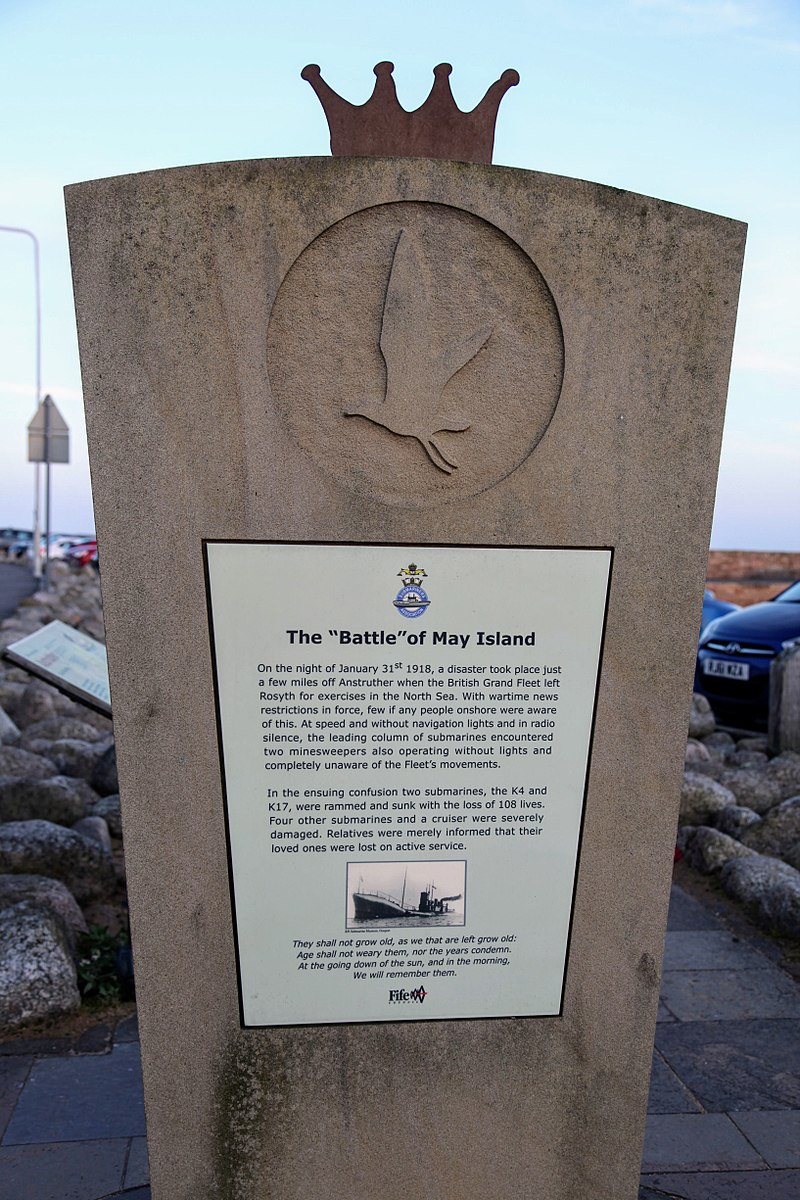
A half-hour into the cruise, the flagship HMS Courageous passed a tiny speck on the map called May Island and picked up speed. A pair of lights appeared in the darkness as the 13th Submarine Flotilla passed, possibly a pair of mine sweeping trawlers. The flotilla turned hard to port to avoid collision when the helm of the third-in-line K-14 jammed, and veered out of line. Both K-14 and the boat behind her, K-12 turned on their navigation lights as K-22, the next submarine in line, lost sight of the flotilla and collided with K-14, severing the bow and killing two men. Two stricken submarines now struggled to pull themselves apart while an entire fleet sped through the darkness, unaware of what was about to happen.
The destroyer HMS Ithuriel received a coded signal and turned to lend aid, doubling back and followed by the remainder of the 13th submarine flotilla and thus putting themselves on collision course with the outgoing 12th flotilla.
Unaware of the mess lying in her path, 12th flotilla escort HMS Fearless was traveling way too fast to change the outcome. Fearless went “hard astern” on sighting K-17 but too late, her bow knifing through the smaller vessel, sinking the sub within minutes with the loss of 47 men. Meanwhile, outgoing submarine K-4 heard the siren and came to a stop but not the trailing K-3 which hit her sister sub broadside, nearly cutting the vessel in half.
HMS Fearless
K-4 sank in minutes, with the loss of 55 men.
The number of near misses that night, can never be known. 104 men were dead before it was over, with the total loss of two K-class submarines. Four more sustained severe damage along with the Scout Cruiser, HMS Fearless.
A hastily arranged Board of inquiry began on February 5 and sat for five days, resulting in several courts martial for negligence. Those would be adjudicated, “unproved”.
The whole disaster and subsequent inquiry was kept quiet to avoid embarrassment, and to deprive the propaganda bonanza, to the Germans. Full details were released only in 1994, long after the participants in this story had passed on.
On January 31, 2002, a memorial cairn was erected in memory of the slain. As it had been eighty four years before there wasn’t a German, in sight. The “Battle of May Island” was no battle at all. Just the black and forlorn humor, of men at war.





 Gary Childs of Paxton Massachusetts, my uncle, was one among hundreds of sailors and marines who fought to bring the fire under control. He was below decks when the fire broke out, leaving moments before his quarters were engulfed in flames. Only by that slimmest of margins did he and any number of sailors aboard the USS Forrestal on this day in 1967, escape being #135.






















 Historical Easter Eggs - Today in History
You must be logged in to post a comment.