April 27, 1865 Sultana

Sultana was the worst maritime disaster in United States history, though its memory was mostly swept away in the tide of events that April.  The United States Customs Service records an official count of 1,800 killed, though the true number will never be known.  Titanic went down in the North Atlantic 47 years later, taking 1,512 with her.

In April 1865, the Civil War was all but ended.  General Robert E. Lee surrendered to General Ulysses S. Grant on the 9th.  President Abraham Lincoln was assassinated five days later, and John Wilkes Booth run to ground and killed on the 26th.  Thousands of former POWs were being released from Confederate camps in Alabama and Georgia, and held in regional parole camps.

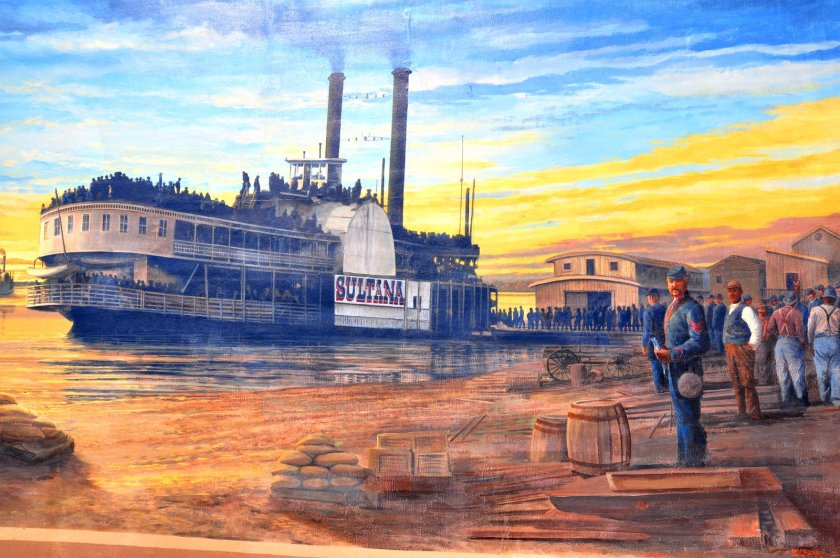
The sidewheel steamboat Sultana left New Orleans with about 100 passengers and a few head of livestock, pulling into Vicksburg Mississippi on the 21st to repair a damaged boiler and to pick up a promised load of passengers.

The mechanic wanted to cut a bulging seam out of the boiler and install a new plate, easily three day’s work.  Captain J. Cass Mason declined, for fear of losing his passengers.  He wanted the seam hammered back into place and covered with a patch, and he wanted it done in a day.
download (88)

The passengers Mason was so afraid of losing were former prisoners of the Confederacy, and Confederate parolees, returning to their homes in Kentucky and Tennessee.

The Federal government was paying $5 each to anyone bringing enlisted guys home, and $10 apiece for officers.  Lieutenant Colonel Reuben Hatch, chief quartermaster at Vicksburg and one of the sleazier characters in this story, had approached Captain Mason with a deal.  Hatch would guarantee a minimum of 1,400 passengers, and they’d both walk away with a pocketful of cash.

As it was, there were other riverboats in the vicinity.  Mason didn’t have time to worry about boiler repairs.

The decks creaked and sagged, as beams were installed to shore up the load.  Sultana backed away from the dock on April 24, with 2,427 passengers.  More than six times her legal limit of 376.
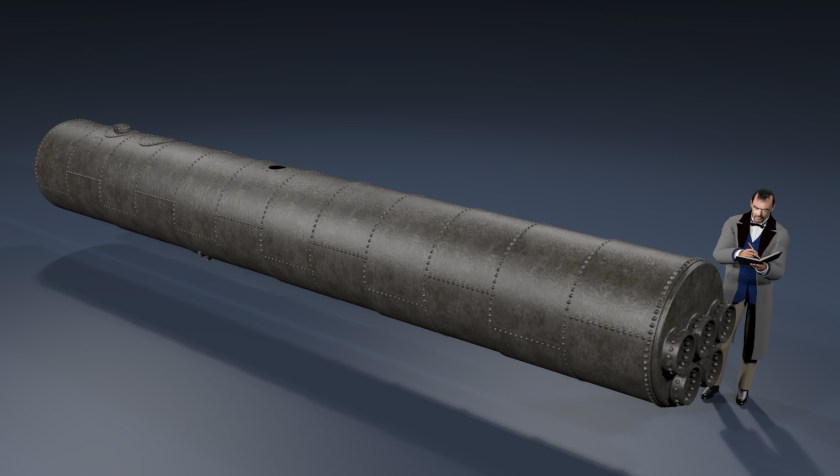
BoilerBlue
This animation gives a sense of the size, of Sultana’s boilers

Sultana spent two days traveling upstream, fighting one of the heaviest spring floods in the history of the Mississippi River.  She arrived at Memphis on the evening of the 26th, unloading 120 tons of sugar from her holds.  Already massively top heavy, the riverboat now lurched from side to side with every turn.
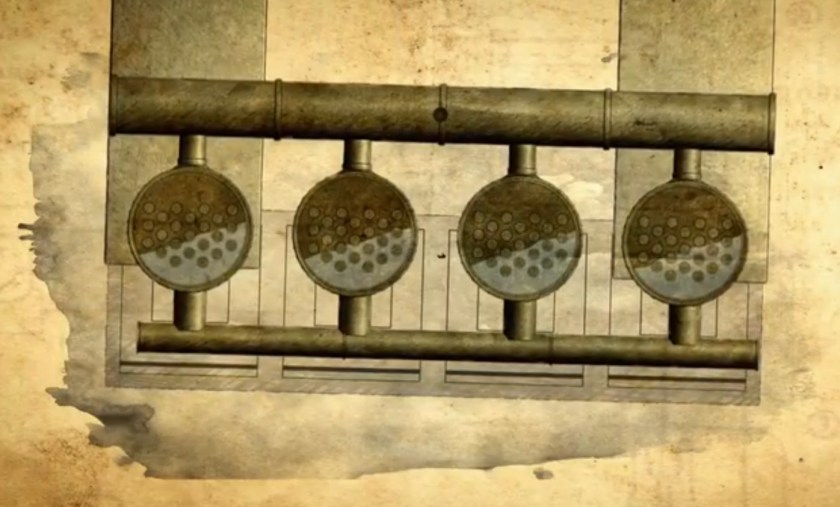
Sultana (1)
SS Sultana was equipped with four such boilers, mounted from side-to-side.  Massively top heavy, water would run from left to right as she lurched from side to side, water then flashing to steam and creating enormous surges in pressure

The crew must have exceeded allowable steam pressure, pushing all that load against the current.  Pressure varied wildly inside Sultana’s four giant boilers, as water sloshed from one to the next with every turn, boiling water flashing to superheated steam and back to water.

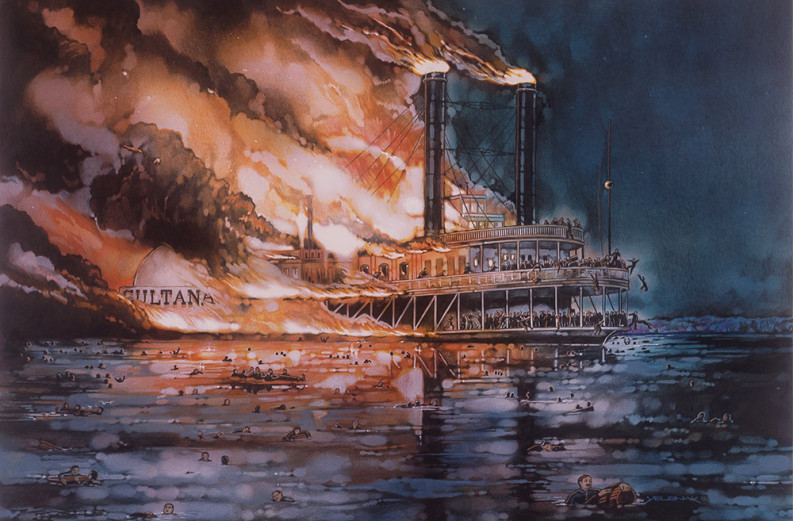
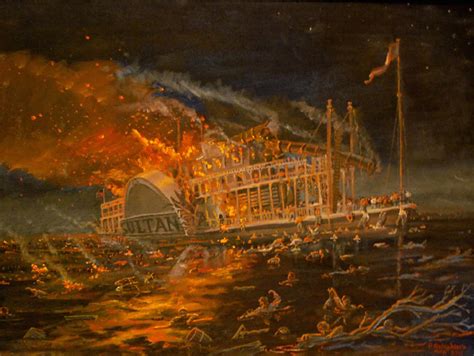
The temporary boiler patch exploded at 2:00am on April 27, detonating two more boilers a split second later.  The force of the explosion hurled hundreds into the icy black water.  The top decks soon gave way, as hundreds tumbled into the gaping maw of the fire boxes below.
download (90)

Within moments, the entire riverboat was ablaze.  Those who weren’t incinerated outright now had to take their chances in the swift moving waters of the river.  Already weakened by terms in captivity, they died by the hundreds of drowning or hypothermia.

The drifting and burnt out hulk of the Sultana sank to the bottom, seven hours later.  The steamers Silver Spray, Jenny Lind, and Pocohontas joined the rescue effort, along with the navy tinclad Essex and the sidewheel gunboat USS Tyler.  700 were plucked from the water and taken to Memphis hospitals, of whom 200 later died of burns or exposure.  Bodies would continue to wash ashore, for months.

Sultana was the worst maritime disaster in United States history, though its memory was mostly swept away in the tide of events that April.  The United States Customs Service records an official count of 1,800 killed, though the true number will never be known.  Titanic went down in the North Atlantic 47 years later, taking 1,512 with her.
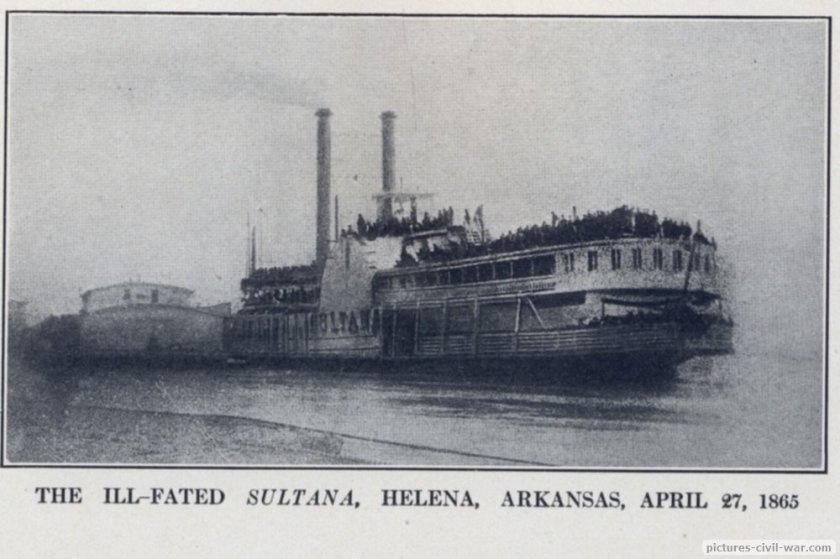
download (91)

Despite the enormity of the disaster, no one was ever held accountable.  One Union officer, Captain Frederick Speed, was found guilty of grossly overcrowding the riverboat.  It was he who sent 2,100 prisoners from their parole camp into Vicksburg, but his conviction was later overturned.  It seems that higher ranking officials may have tried to make him into a scapegoat, since he never so much as laid eyes on Sultana herself.

Captain Williams, the officer who actually put all those people onboard, was a West Point graduate and regular army officer.  The army didn’t seem to want to go after one of its own.  Captain Mason and all of his officers were killed in the disaster.  Reuben Hatch, the guy who concocted the whole scheme in the first place, resigned shortly after the disaster, thereby putting himself outside the reach of a military tribunal.
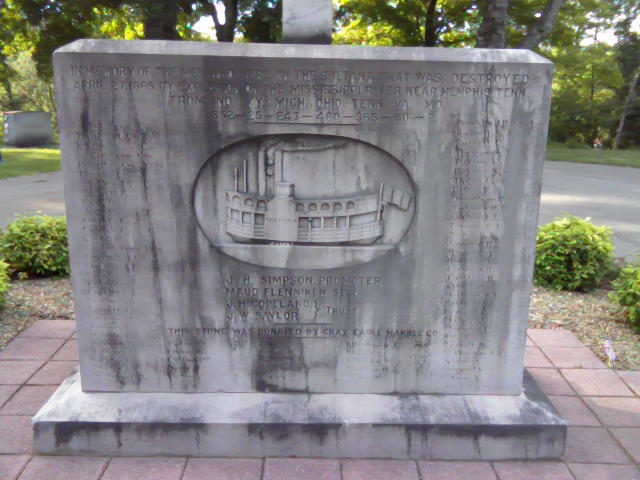
Sultana Memorial at the Mount Olive Baptist Church Cemetery in Knoxville, Tennessee in 2010
Sultana Memorial at the Mount Olive Baptist Church Cemetery in Knoxville, Tennessee, 2010

The last survivor of the Sultana disaster, Private Charles M. Eldridge of the 3rd (Confederate) Tennessee Cavalry, died at his home at the age of 96 on September 8, 1941. Three months before the Imperial Japanese attack on Pearl Harbor.

If you enjoyed this “Today in History”, please feel free to re-blog, “like” & share on social media, so that others may find and enjoy it as well. Please click the “follow” button on the right, to receive email updates on new articles.  Thank you for your interest, in the history we all share.

April 16, 1866 Pleasant Paths

“Let no neglect, no ravages of time, testify to the present or to the coming generations that we have forgotten as a people the cost of a free and undivided republic.”

On April 16, 1866, the American Civil War was barely a year in the past.  An unknown widow brought her children to the Hiller Cemetery, near Carbondale, Illinois.  She and the children placed flowers on an unmarked grave, as several veterans watched from the steps of the nearby Crab Orchard Christian Church.

The group was struck by her simple gesture.  When the family left, the men gathered up wild flowers and so decorated the graves of their fallen comrades, as she and the kids had done. Word of the gesture soon spread, and it was agreed that a more formal act of Memorial should be carried out. A community wide event took place at Carbondale’s Woodlawn Cemetery on April 29, 1866.

212 veterans took part in that first ceremony, among them Major General John A. Logan, invited to give the keynote address.

decoration-day

Two years later, General Logan was Commander-in-Chief of the Grand Army of the Republic, in Washington DC. In March of that year, General Logan’s wife Mary visited several battlefields of the late war, in Virginia. While there, Mary Logan noticed a number of small flags, wilting flowers and other decorations, marking Confederate graves at the Blandford Cemetery, near Petersburg.

On her return, Mary expressed the opinion that the North should so decorate the graves of its fallen. Perhaps reminded of that earlier occasion near Carbondale, General Logan issued General Order No. 11, setting aside a date in May as an annual date “for the purpose of strewing flowers, or otherwise decorating the graves of Comrades who died in the defense of their country.”

Some two dozen communities claim the honor of having held that first Memorial Day, though it wouldn’t be called that until much later. For now, it was “Decoration Day”. The first large-scale observance was held that year at Arlington National Cemetery, across the Potomac River from Washington, D.C.

download (53)

The veranda of the Arlington mansion, once the home of General Robert E. Lee, was draped in mourning. A number of officials attended the event, including General Ulysses S. Grant and his wife, Julia. There were speeches and hymns, and then children from the Soldiers’ and Sailors’ Orphan Home joined with members of the GAR, in laying flowers on the graves of Union and Confederate alike.

General Logan’s order instructed all posts to decorate the graves of the fallen “with the choicest flowers of springtime”. “We should guard their graves with sacred vigilance“, he wrote, “Let pleasant paths invite the coming and going of reverent visitors and fond mourners. Let no neglect, no ravages of time, testify to the present or to the coming generations that we have forgotten as a people the cost of a free and undivided republic.”

So may it always be.

download (52)

If you enjoyed this “Today in History”, please feel free to re-blog, “like” & share on social media, so that others may find and enjoy it as well. Please click the “follow” button on the right, to receive email updates on new articles.  Thank you for your interest, in the history we all share.

A Love of History

If you are so inclined, there’s nothing like a visit to the place where history happened, to make the story come alive.

“Today in History” will be suspended for a time, following the passing of the man for whom I am namesake: Lieutenant Colonel (retired), Richard B. “Rick” Long, Sr.

I have a few new articles tee’d up to post automatically. If you’re interested, please sign up on the right, to receive email notifications when they come out.

Thank you for your interest.

Rick Long, Jr.

Long Family "Blue/Gray Ramble", Gettysburg, 2012
The Patriarch explains the story of John Burns, the civilian old timer who came out to help fight back the invasion of his town. He fought with the Union forces on the second day and then, having been “nicked” three times by three bullets, he quietly went back to his farm to await the end of the battle. Long Family “Blue/Gray Ramble”, Gettysburg,
76818_709826510429_895191284_n
Walking with the Rebel side of the family. Long Family “Blue/Gray Ramble”, 32nd North Carolina, Culp’s Hill
29598118_10100599595014189_3563648717366943004_n
Long Family “Blue/Gray Ramble, Petersburg Campaign
29572295_10100599591885459_2784692964927955618_n
Long Family “Blue/Gray Ramble, Spotsylvania


Featured image, top:  Rick Long, Sr., remembering the 17th PA Cavalry Regiment at Gettysburg, with which our ancestor served as Blacksmith.

Photography by my son and Rick Sr.’s grandson Daniel Christopher Long, an apple who didn’t fall far from the tree.

March 24, 1921 Coughing up Bullets

Twenty-one-year-old Peter Knapp spotted the Confederate sharpshooter, behind the iron plate. He raised his rifle, aimed at the peephole, and fired.

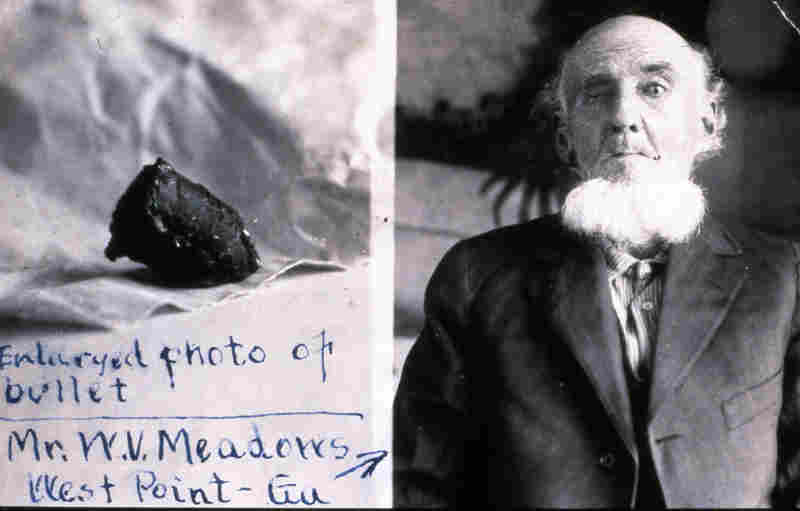
Willis Meadows grasped his throat, as he began to choke. The one-eyed 78-year old couldn’t breathe, as spasms became more violent. Whatever was in there wouldn’t come out. He thought his time had come. That’s when the bullet flew out of his mouth, clattering across the wooden table and onto the kitchen floor. It was March 24, 1921.

meadowsandknapp1Fifty-nine years earlier, nineteen-year-old Willis V. Meadows signed up with his brothers and his cousins, enlisting in Company G of the 37th Alabama Volunteer Infantry.
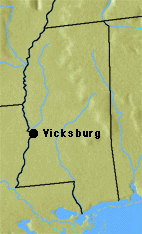
Meadows was assigned to the western front along the Mississippi River. By the following summer, Company G had joined in defending Vicksburg Mississippi, laid siege by the Union army of Major General Ulysses S Grant.

On July 1, Meadows was positioned just outside of town, firing at the oncoming Yankees through a peephole in an iron boiler plate. Three blue-clad soldiers approached from the east, members of Company H of the Fifth Iowa Volunteer Infantry, with orders to take out enemy snipers.

Twenty-one-year-old Peter Knapp spotted the Confederate sharpshooter, behind the iron plate. He raised his rifle, aimed at the peephole, and fired. It was a perfect shot, the one-ounce slug clearing the small hole and striking the sniper in the right eye.

vi_msWillis fell over apparently dead, blood streaming out of his eye with the bullet lodged near his brain.  The battle moved on. Vicksburg Mississippi fell to the Union army on July 4, 1863. The “Confederate Gibraltar” wouldn’t celebrate another Independence Day, for 80 years.

Meanwhile, Meadows was found and brought to Union physicians. Surgeons probed for the bullet but were unable to find it, and didn’t feel it was safe to operate. Instead, he was put on a POW ship and brought to a Federal hospital. Meadows was later paroled and brought to a Confederate hospital, there to spend the remainder of the war as a patient and sometime nurse’s aide.

Peter Knapp was captured that November at Missionary Ridge, part of the Chattanooga campaign, and spent the rest of the war in a number of Confederate prisons, including the Hell of Andersonville.

Both went back to civil life after the war. Meadows returned to his farm in Lanett, Alabama, just east of the Georgia state line. He would later marry, but the marriage produced no children. Knapp farmed for a time in Michigan before marrying, later moving to Kelso, in Washington state.

downloadWillis Meadows and Peter Knapp might have walked off the page of their time and on to obscurity, but for a circumstance even more unlikely, than a man holding a bullet in his head for fifty-eight years.

Following Meadows’ coughing episode in 1921, “Coughs Up Bullet” was a newspaper story, all over the country. “Ripley’s Believe It or Not” ran the story eleven years later, published around the world in 42 countries and 17 languages. Even Robert Ripley missed the best part.

Peter Knapp read the story, and realized that that had to have been his bullet. He contacted Meadows a few months later, and the two compared notes.  Sure enough.  The two had met again.

When politicians make war, it is the young men and sometimes the young women, who do the fighting, and the bleeding, and the dying. Now these two old men, former mortal enemies who had tried their level best to kill one another, became friends. The two old warriors spent the rest of their days, exchanging photographs and wishing each other good health.

The Central Point Oregon newspaper editor who heard the story in 1950, had the final word.  “Can you beat that for a story?” he asked.  “How small this little old world is, after all.”

Afterward

article-2129086-12920C7E000005DC-788_306x483It’s remarkable enough that Peter Knapp survived the brutality of the notorious Andersonville prison camp, an institution described as the “Auschwitz of the Civil War”. The Union POW camp at Elmira New York might be described as the Andersonville of the North. My own thrice-Great Grandfather went to his final rest there, along with his brother.
A passage from Knapp’s journal written in January 1862 expresses the man’s patriotism: ‘May God give wisdom and strength to our rulers that they counsel wisely, so that this government, which has been the wonder of the world, may triumph over its many enemies, crush treason to the earth never to rise again and proving to the world that republican governments are capable of withstanding any storm which may gather on their political horizon.’
Following his death in 1924 at the age of 81, Peter Knapp’s remains were cremated and, for whatever reason, never claimed by his family. The ‘cremains’ of his wife Georgianna joined those of her husband in 1930, and there they sat, unclaimed.
download (28)In 2012, Alice Knapp was researching the genealogical records of her deceased husband Steve, when she came upon the story of his ancestor. Stunned to learn that he had never been buried, Ms. Knapp called the Portland crematorium. ‘Yeah, he’s here’. Alice Knapp got the death certificate in Washington. I “called back and said, ‘By the way, is his wife there?’ and they said, ‘Yeah.’ The shock was that he was not ever buried. That was the surprise to me.”
So it was that Peter Knapp of the 5th Iowa Infantry was laid to rest with his wife at the Willamette National Cemetery in Oregon, with full military honors provided by the Oregon National Guard.
A folded American flag was presented to representatives of the Knapp family, ‘on behalf of a grateful nation’.  One-hundred and forty-seven years, after the Civil War.

March 8, 1863  The Gray Ghost

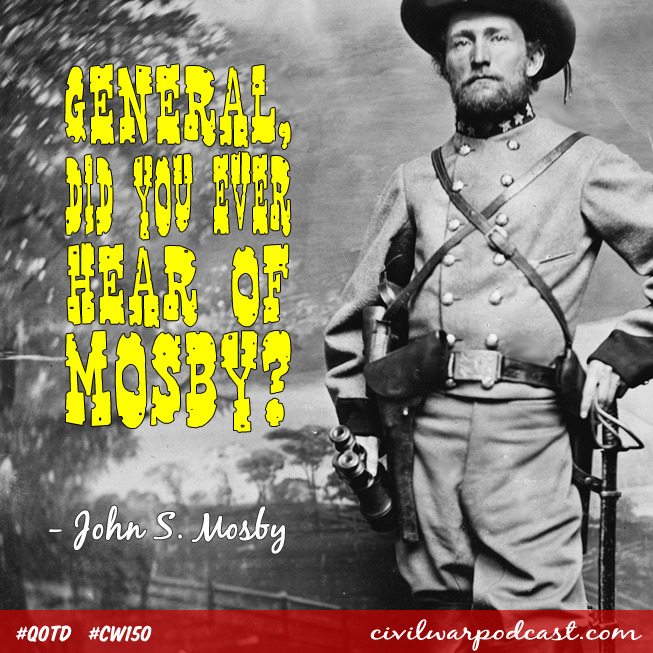
Late on the night of March 8, 1863, a light rain was falling when Mosby’s Rangers formed up for a raid on Fairfax Virginia, known at that time as Fairfax Courthouse. 

Like fellow Virginian Robert E. Lee, the Howardsville lawyer John Singleton Mosby opposed the destruction of the Union but, when secession came, he stayed with his state.  Small and frail as a boy, Mosby was often the target of much larger bullies.  Years later in his memoirs, he’d write that he never won a fight.  It seems that John Singleton Mosby never backed down from one, either.

Mosby participated in the 1st Battle of Manassas (1st Bull Run) as a member of the Virginia Volunteers Mounted Rifles, later joining James Ewell Brown “J.E.B.” Stuart as a Cavalry Scout.  A gifted horseman and natural tactician, information gathered by Mosby aided Stuart in his humiliating ride around McLellan’s Army of the Potomac in June, 1862.

tumblr_mxvjev4IY21t8ultdo1_1280

The following year, Stuart authorized Mosby to form and take command of the 43rd Battalion of Virginia Cavalry, a regiment-sized unit operating out of north central Virginia.  These “Partisan Rangers”, 1,900 of whom served between January 1863 and April ’65, were under the command of Stuart and Lee and subject to their authority, but were not a traditional army unit.  Mosby’s Rangers shared in the spoils of war but had no camp duties, and lived scattered among civilian populations.

Known for lightning raids of the Virginia countryside, Mosby’s 43rd Cavalry would be called together to strike specific targets, dispersing afterward and making themselves next to impossible to run aground.  So successful were they that, to this day, parts of Virginia’s Piedmont region are known as “Mosby’s Confederacy”.

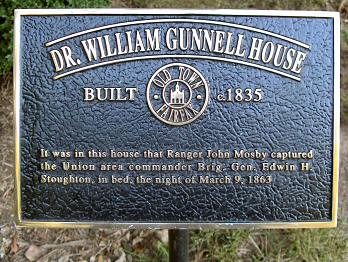
Late on the night of March 8, 1863, a light rain was falling when Mosby’s Rangers formed up for a raid on Fairfax Virginia, known at the time as Fairfax Courthouse.  Deep in the midst of several thousand Federal soldiers and only fifteen miles from the White House, Union Brigadier General Edwin H. Stoughton was sleeping in his headquarters.  Some sources indicate that he was “sleeping it off”.  The “Gray Ghost” entered the Union General’s quarters in the small hours of March 9, his rangers quickly overpowering a handful of sleepy guards.

mar8map

Entering the bed chamber as others went to the stables and gathered horses, Mosby lifted the General’s nightshirt and slapped his bare backside with a sword. General Stoughton sputtered awake, demanding “What is the meaning of this!?” “General, did you ever hear of Mosby“, came the question.

Mosby himself later recalled, “There was no time for ceremony, so I drew up the bedclothes, pulled up the general’s shirt, and gave him a spank on his bare back, and told him to get up”.  Stoughton replied, “Yes, have you caught him?” “I AM Mosby,” said the Gray Ghost, “and I have caught You. Stuart’s cavalry has possession of the Courthouse; be quick and dress.

mosby73

As prisoners came to the realization that they’d been captured by such a puny force, many melted into the woods, and escaped.  In the end, Mosby and his 29 rangers had captured a Union General, two Captains, 30 enlisted men and 58 horses, without firing a shot.  On hearing the story the next day, President Lincoln lamented:  “I can make another Brigadier in 5 minutes, but I can’t replace those horses”.

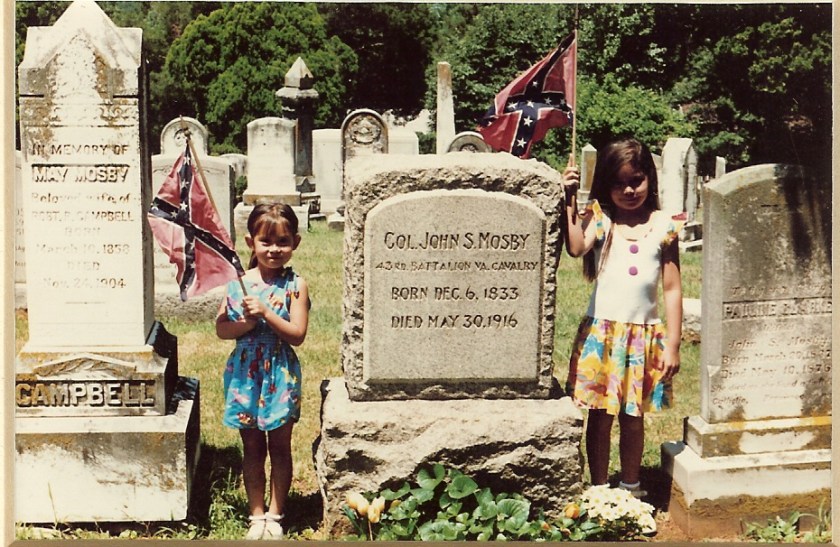
Mosby_Monument

If you enjoyed this “Today in History”, please feel free to re-blog, “like” & share on social media, so that others may find and enjoy it as well. Please click the “follow” button on the right, to receive email updates on new articles.  Thank you for your interest, in the history we all share.

March 6, 1857 Dred Scott

Dred Scott had lost at virtually every turn, only to win his freedom at the hands of the family which had once held him enslaved.

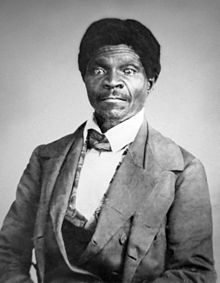
Dred Scott, his full name may have been “Etheldred”, was born into slavery in Southampton County, Virginia, sometime in the late 1790s.  In 1818, Scott belonged to Peter Blow, who moved his family and six slaves to Alabama, to attempt a life of farming. The farm near Huntsville was unsuccessful and the Blow family gave up the effort, moving to St. Louis Missouri in 1830, to run a boarding house. Around this time, Dred Scott was sold to Dr. John Emerson, a surgeon serving in the United States Army.

Dred_&_Harriet_Scott_Quarters
Dred & Harriet Scott’s restored quarters, at Ft. Snelling

As an army officer, Dr. Emerson moved about frequently, bringing Scott with him. In 1837, Emerson moved to Fort Snelling in the free territory of Wisconsin, now Minnesota. There, Scott met and married Harriet Robinson, a slave belonging to fellow army doctor and Justice of the Peace, Lawrence Taliaferro. Taliaferro, who presided over the ceremony, transferred Harriet to Emerson, who continued to regard the couple as his slaves. Emerson moved away later that year, leaving the Scotts behind to be leased by other officers.

The following year, Dr. Emerson married Eliza Irene Sanford, and sent for the Scotts to rejoin him in Fort Jesup, in Louisiana. Harriett gave birth to a daughter while on a steamboat on the Mississippi, between the free state of Illinois and the Iowa district of the Wisconsin Territory.

images (25)Dr. Emerson died in 1842, leaving his estate to his wife Eliza, who continued to lease the Scotts out as hired slaves.
Four years later, Scott attempted to buy his freedom for the sum of $300, equivalent to about $8,000 today. Mrs. Emerson declined the offer and Scott took legal recourse. By this time, Dred and Harriett Scott had two daughters, who were approaching an age where their value would be greatly increased, should they be sold as slaves. Wanting to keep his family together, Scott sued.

Ironically, Dred Scott’s suit in state court, Scott v. Emerson, was financially backed by three now-adult Blow children, who had since become abolitionists. The legal position stood on solid ground, based on the doctrine “Once free, always free”. The Scott family had resided in free states and territories for two years, and their eldest daughter was born on the Mississippi River, between a free state and a free territory.

The verdict went against Scott but the judge ordered a retrial, which was held in January, 1850. This time, the jury ruled in favor of Dred Scott’s freedom. Emerson appealed and the Missouri supreme court struck down the lower court ruling, along with 28 years of Missouri precedent.

By 1853, Eliza Emerson had remarried and moved to Massachusetts, transferring ownership of the Scott family to her brother, John Sanford. Scott sued in federal district court, on the legal basis that the federal courts held “diversity jurisdiction”, since Sanford lived in one state (New York), and Scott in another (Missouri). Dred Scott lost once again and appealed to the United States Supreme Court, a clerical misspelling erroneously recording the case as Dred Scott v. Sandford.

On March 6, 1857, Chief Justice Roger B. Taney delivered the 7-2 majority opinion, enunciating one of the stupidest decisions, in the history of American jurisprudence:
“[Americans of African ancestry] had for more than a century before been regarded as beings of an inferior order, and altogether unfit to associate with the white race, either in social or political relations; and so far inferior, that they had no rights which the white man was bound to respect; and that the negro might justly and lawfully be reduced to slavery for his benefit. He was bought and sold, and treated as an ordinary article of merchandise and traffic, whenever a profit could be made by it”.

download (18)
Frederick Douglass

The highest court in the land had ruled that slaves were private property and not citizens, with no right to legal recourse. Furthermore, the United States Congress had erred in attempting to regulate slavery in the territories, and had no right to revoke the property rights of a slave owner, based on his place of residence.

The response to the SCOTUS opinion was immediate, and vehement. Rather than settle the issue of slavery, the decision inflamed public opinion, dividing an already fractured country, further. Frederick Douglass assailed Chief Justice Taney’s opinion, noting that:

“We are now told, in tones of lofty exultation, that the day is lost all lost and that we might as well give up the struggle. The highest authority has spoken. The voice of the Supreme Court has gone out over the troubled waves of the National Conscience, saying peace, be still . . . The Supreme Court of the United States is not the only power in this world. It is very great, but the Supreme Court of the Almighty is greater”.

220px-Dred_Scott_photograph_(circa_1857)
Dred Scott, photograph circa 1857

The Supreme Court had spoken, but the Dred Scott story was far from over.  Eliza Irene Emerson’s new husband was Calvin C. Chaffee, a member of the United States Congress, and an abolitionist.

Following the Dred Scott decision, the Chaffees deeded the Scott family over to Henry Taylor Blow, now a member of the United States House of Representatives from Missouri’s 2nd Congressional district, who manumitted the family on May 26. Dred Scott had lost at virtually every turn, only to win his freedom at the hands of the family which had once held him enslaved.

For Harriett and the two Scott daughters, it was the best of all possible outcomes.  For Scott himself, freedom was short-lived.  Dred Scott died of tuberculosis, the following year.

Nationally, the Dred Scott decision had the effect of hardening enmities already nearing white-hot, increasing animosities within and between pro- and anti-slavery factions in North and South, alike. Politically, the Democratic party was broken into factions and severely weakened,  while the fledgling Republican party was strengthened, as the nation was inexorably drawn to Civil War.

Slaves Issues Plague the Democratic Party

The issue of Black citizenship was settled in 1868, via Section 1 of the 14th Amendment, which states: “All persons born or naturalized in the United States, and subject to the jurisdiction thereof, are citizens of the United States and of the State wherein they reside …”

Dred Scott is buried in the Calvary Cemetery in St. Louis, Missouri. The marker next to his headstone reads: “In Memory Of A Simple Man Who Wanted To Be Free.”

112973396-H

If you enjoyed this “Today in History”, please feel free to re-blog, “like” & share on social media, so that others may find and enjoy it as well. Please click the “follow” button on the right, to receive email updates on new articles.  Thank you for your interest, in the history we all share.

February 17, 1864  My life Preserver

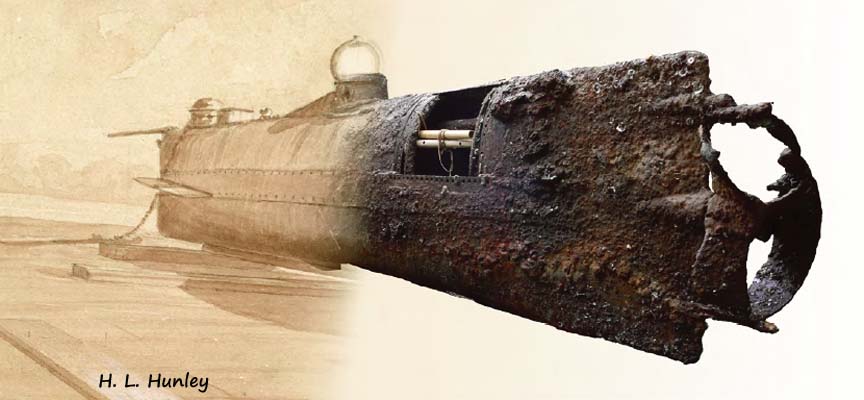
Author and adventurer Clive Cussler found the sub in 1995, buried in silt under 32′ of water. 

1200px-Scott-anaconda
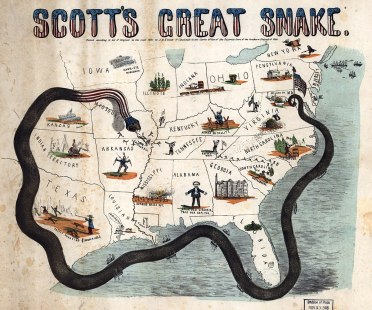
Civil War-era cartoon depicts Winfield Scott’s “Great Snake”

In the 1850s, the economy of the southern United States was mostly agrarian.  When civil war broke out in 1861, the Confederate states depended to a greater degree on imported manufactured goods, compared with the more industrialized states to the north.  For the Union, there was strategic advantage in cutting off this flow of manufactured goods.  So it was the “Anaconda Plan” was initiated, to choke off traffic to southern ports and harbors.

Few in the Confederacy understood the need to keep southern ports open, as well as the planter, legislator, and southern patriot Horace Lawson Hunley.

In 1861, Hunley joined forces with James McClintock and Baxter Watson to design and build a secret Super Weapon for the Confederacy.  A submarine.  The trio completed construction on its first effort, the Pioneer, that same year in New Orleans.  The team went on to build two more submarines in Mobile, Alabama:  the American Diver, and the last and most successful creation, the “Fishboat“, later renamed HL Hunley.

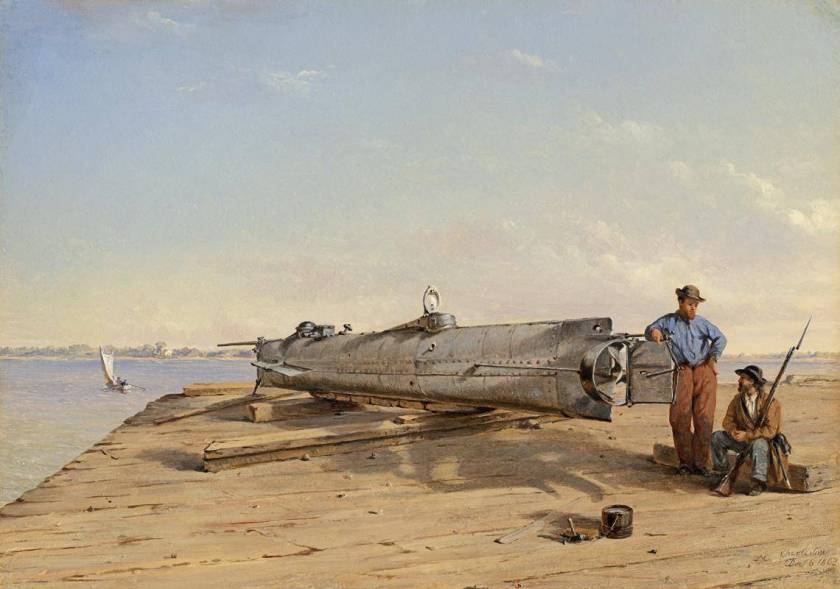
Conrad_Wise_Chapman_-_Submarine_Torpedo_Boat_H.L._Hunley,_Dec._6,_1863
An oil painting by Conrad Wise Chapman, “Submarine Torpedo Boat H.L. Hunley, Dec. 6, 1863”

After a short sea trial in Mobile, the Hunley was put on a train and shipped up to Charleston, South Carolina, to help break the blockade.  Arriving on August 12, 1863, she was 40′ long by 4′ wide, displacing about 7½ tons.  She was designed for a crew of 8, with 7 operating a hand crank and the 8th steering the boat.

A test run on August 29 ended in disaster, when Skipper John A. Payne accidentally stepped on the lever controlling the diving planes, with the hatches open.  Payne and two others escaped, but the other five crew members went to the bottom.

confederatesA second crew tested the submarine on October 15, this one including Horace Hunley himself.  The submarine conducted a mock attack but failed to surface afterward, this time drowning all 8 crew members.
Despite those two disastrous test runs, there was no shortage of volunteers.  Once again, the Hunley was fished up from the bottom.

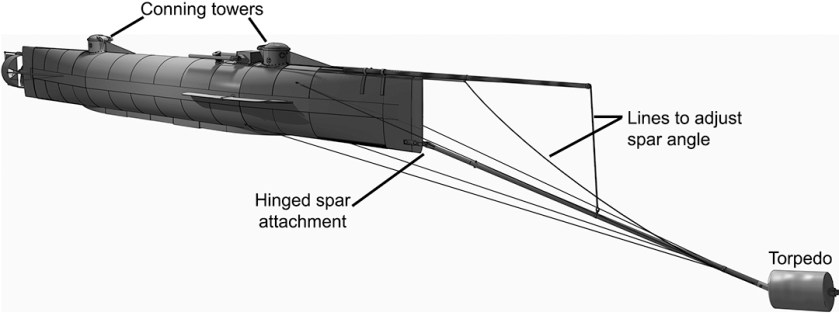
The original plan was to tow a floating mine called a “torpedo”, with a contact fuse.  They would dive beneath their victim and surface on the other side, pulling the torpedo into the side of the target.

images (21)Tide and current conditions in Charleston proved very different from those in Mobile.  On several test runs, the torpedo floated out ahead of the sub.  That wouldn’t do, so a spar was fashioned and mounted to the bow.  At the end of the spar was a 137lb waterproof cask of powder, attached to a harpoon-like device with which Hunley would ram its target.

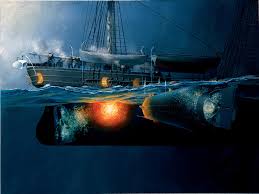
Hunley made her first live attack run four miles outside of Charleston Harbor, on the night of February 17, 1864. Lieutenant George Dixon and a crew of seven attacked USS Housatonic, a 1,240 ton steam powered sloop of war, embedding the spar torpedo into Housatonic’s hull.  It must have been a sight to see.  The torpedo ignited a 4,000 lb store of black powder in the hull of the ship, exploding with a deafening roar and a towering column of flame that lit up the night.

Housatonic was gone in three minutes, killing five sailors.  What happened next, is a mystery.  The first successful attack sub in history, vanished.  The Hunley crew would not be seen again, for 136 years.

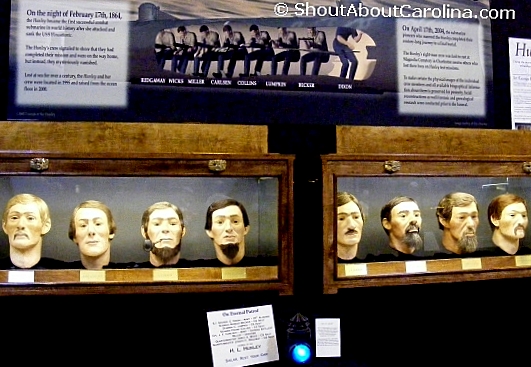
hunley-submarine-crew-facial-reconstruction
Forensic facial reconstructions techniques bring back the faces of the last crew of HL Hunley

Author and adventurer Clive Cussler found the sub in 1995, buried in silt under 32′ of water.  A painstaking, five year effort was launched to bring Hunley to the surface, and on August 8, 2000, HL Hunley returned to the light of day.  The sub was moved to the Warren Lasch Conservation Center in the Charleston Navy Yard, and submerged in 55,000 gallons of chilled, fresh water, where scientists and historians worked on unlocking its secrets.

images (20)

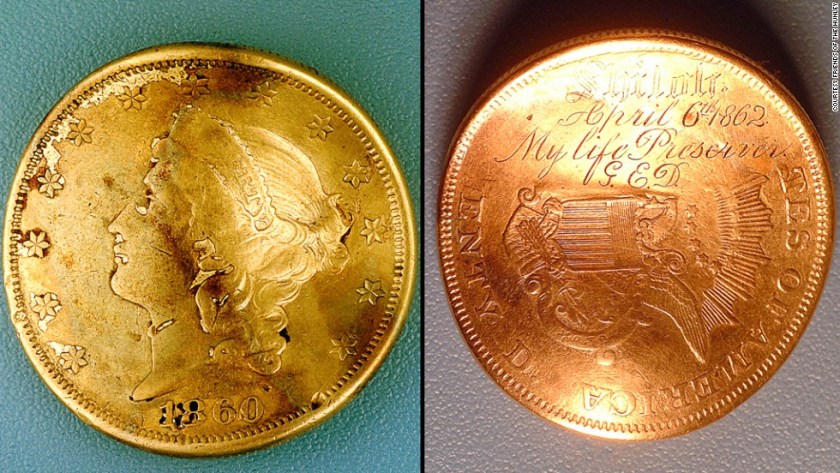
There was an old rumor that Lt. Dixon left a girlfriend in Mobile, Alabama, a woman named Queenie Bennett.  She had given him a $20 gold piece, a good luck charm and token of her affection.  Dixon was shot in the hip at Shiloh, the story goes, a wound that should have killed him.  If the bullet hadn’t struck the gold piece in his pocket.

No one knew if the story was true, until excavation started inside the sub.  Senior Archaeologist Maria Jacobsen found the coin, next to the remains of George E. Dixon.  “Some people may think this is a stroke of luck,” she said, “but perhaps it’s something else. They tell me that Lt. Dixon was a lady’s man, perhaps he winked at us yesterday to remind us that he still is”.

140214143335-07-hl-hunley-coin-horizontal-large-galleryOn the coin, clearly showing signs of having been struck by a bullet, are inscribed these words:

Shiloh

April 6, 1862

My life Preserver

G.E.D.


If you enjoyed this “Today in History”, please feel free to re-blog, “like” & share on social media, so that others may find and enjoy it as well. Please click the “follow” button on the right, to receive email updates on new articles.  Thank you for your interest, in the history we all share.

January 21, 1824 Stonewall

Today we remember Stonewall Jackson as a brilliant military tactician and Confederate commander, second only to Robert E. Lee.  Who knew that the man was also a civil rights leader.  Real history is so much more interesting than the political and pop culture varieties.

Cheers rang out in the streets of Washington DC, as General Irvin McDowell’s Army of the Potomac marched out to meet the Confederate Army of the Shenandoah, led by Brigadier General Pierre Gustave Toutant-Beauregard.  The first major battle of the Civil War was joined on July 21, in what Confederates called the Battle of 1st Manassas, and the Federals called 1st Bull Run.

First Manassas July 21, 1861 SquareOn that July morning, no one had any idea of the years-long bloodbath that lay ahead.  35,000 Federal troops, 90-day recruits all, had arrived to crush a trifling force of rebels.  Then on to Richmond, the Confederate capitol, and the end of the uprising.

The atmosphere was festive, like a football game.  The upper crust of Washington society had turned out in their carriages.  There was wine and picnic baskets, society ladies and their beaus, congressmen and their families, all arrived to watch the show.

Green and inexperienced as they were, the fighting was at times confused, and could have gone either way.  The tide of the battle turned at 4pm, with the capture of Artillery Captain James Ricketts’ guns. An hour later the Union position began to disintegrate.  Soon, a disorderly retreat turned into a rout, a blue-clad stampede back to Washington, on roads clogged with panicked civilians, attempting to flee in their carriages.

The battle could have ended differently, when Colonel William Tecumseh Sherman struck the right flank of the Confederate defenders near Henry House Hill, collapsing the Rebel line and sending it into disorderly retreat.  The Virginia Brigade of General Thomas Jonathan Jackson came up at this point, taking a defensive position on Henry House Hill.  Brigadier General Barnard Bee exhorted his troops to reform, shouting “There is Jackson standing like a stone wall. Rally behind the Virginians.”

35aknky
Confederate General and VMI Professor Thomas Jonathan Jackson wore a blue uniform, at the Battle of 1st Manassas.  Note the 1st (of three) Confederate national flags, the “Stars and Bars”.

Some will tell you that Bee’s comment was meant to be pejorative, as in “Look at Jackson standing there like a stone wall!”  We’ll never know. General Bee was shot in the abdomen and died the next day.  The legend of “Stonewall Jackson”, was here to stay.

Born in Clarksburg Virginia on January 21, 1824, the boy lost his father at age two and his mother, five years later.  Largely self-educated, the future Civil War General went to live with an uncle.  As a boy, Jackson made a deal with one of his uncle’s slaves, to teach the man to read.  It was illegal at this time, to teach blacks to read, but Jackson was as good as his word, receiving pine knots in exchange for lessons.

Jackson16
Stonewall Jackson pictured astride his favorite mount, “Little Sorrel”

Thomas Jonathan Jackson was a devoutly religious man, said to fear only God.  “My religious belief teaches me” he said, “to feel as safe in battle as in bed.”

Jackson was educated at the United States Military Academy at West Point New York, graduating in 1846 and serving in the Mexican-American war.  Returning to civil life in 1851, Jackson moved to Lexington Virginia, where he worked as a professor of natural and experimental philosophy (Physics), and instructor of artillery at the Virginia Military Institute.

Though himself an owner of African slaves from a family of slave owners, Thomas Jackson was well regarded among the free and enslaved blacks of Lexington.  This may sound paradoxical to the modern reader, but the players in this story were products of their time.  Not ours.

sjchurJackson believed that slavery existed because the Creator willed it.  His mission was to save their souls, by teaching them the Old Testament, the Ten Commandments, the Lord’s Prayer and the Apostle’s Creed.

So it was that Jackson and his wife established the Lexington Presbyterian Church Sunday School. There, contrary to state law. the pair taught African-American children to read and write, continuing to do so until Jackson went to war, in 1861.  The next time he would visit was to be buried there, in 1863.

Jackson’s military career reads like a timeline of his era.  The Great Train Raid of 1861.  Falling Waters. Bull Run (Manassas), 1st and 2nd. The Romney Expedition.  The Valley Campaign. The Seven Days’ Battles. The Northern Virginia Campaign. The Maryland Campaign, Harpers Ferry, Antietam and Fredericksburg.  And the last.  Chancellorsville.  The Virginia town where the story of Stonewall Jackson comes to an end.

Returning to camp on May 2, 1863, Jackson and his staff were mistaken in the rain and darkness for a Union cavalry force.   A nervous sentry from the 18th North Carolina shouted, “Halt, who goes there?”, and fired before things sorted out.  Frantic shouts from Jackson’s party trying to identify themselves were met by Major John Barry, who shouted, “It’s a damned Yankee trick! Fire!”  Several of Jackson’s men were killed on the spot, along with a number of horses.  Jackson himself was shot twice in the left arm, and once in the right hand.

Robert E. Lee wrote to the General, on learning of his injuries:  “Could I have directed events, I would have chosen for the good of the country to be disabled in your stead.”

There was no saving Jackson’s arm.  The limb was amputated by Dr. Hunter McGuire, the following day  Jackson was moved to the office building at the Chandler plantation in Guinea Station.  General Lee complained, “He has lost his left arm, but I have lost my right arm.”

dsc00823

By that time, Jackson was already developing a tightness in his chest, an early sign of pneumonia.

Before antibiotics, doctors could predict the hour of death, of pneumonia patients.  On May 10, eight days after being shot, Jackson was breathing his last.  “It is the Lord’s Day; my wish is fulfilled. I have always desired to die on Sunday.”

Dr. McGuire wrote the following account of Stonewall Jackson’s last words:  “A few moments before he died he cried out in his delirium, ‘Order A.P. Hill to prepare for action! Pass the infantry to the front rapidly! Tell Major Hawks —’ then stopped, leaving the sentence unfinished. Presently a smile of ineffable sweetness spread itself over his pale face, and he said quietly, and with an expression, as if of relief, ‘Let us cross over the river, and rest under the shade of the trees.’

CW-334 Last Tribute of Respect
“Last Tribute of Respect”, by Mort Künstler

In 1906, Reverend LL Downing raised money to install a memorial window in the 5th Avenue Presbyterian Church of Roanoke, dedicated to Stonewall Jackson.  And to Reverend Dowling’s own parents, who as slave children had been educated in Jackson’s Sunday school.  It may be the only “black” church in the country, with a stain-glass window dedicated to a Confederate General.

manassas085b

CBS Sunday Morning did an interesting segment on the church and its window, amidst the current hysteria involving Confederate monuments.  Their article and the video, are linked here.

Today we remember Stonewall Jackson as a brilliant military tactician and Confederate commander, second only to Robert E. Lee.  Who knew that the man was also a civil rights leader.  Real history is so much more interesting than the political and pop culture varieties.

Feature Image, top, by 20th century artist and illustrator, N. C. Wyeth

January 13, 1997 Buffalo Soldier

After the war, the town of Sommocolonia erected a Memorial, to nine brave soldiers who gave their lives, that their brothers might live.  Eight Italians, and one American.

In September 1867, Private John Randall of Troop G, United States 10th Cavalry Regiment, was assigned to escort two civilians on a hunting trip. The hunters became the hunted when a band of 70 Cheyenne warriors swept down on the trio. The two civilians were killed in the initial attack and Randall’s horse shot out from under him.

download (3)
Private John Randall

Cornered in a washout under some railroad tracks, Randall single handedly held off the attack with his revolver, despite a gunshot wound to his shoulder and no fewer than 11 lance wounds.

By the time help arrived, 13 Cheyenne warriors lay dead.  Private Randall was still standing. Word spread among the Cheyenne about a new kind of soldier, “who had fought like a cornered buffalo; who like a buffalo had suffered wound after wound, yet had not died; and who like a buffalo had a thick and shaggy mane of hair.”

167090-049-69103B80On July 28, 1866, the Army Reorganization Act authorized the formation of 30 new units, including two cavalry and four infantry regiments “which shall be composed of colored men.”

The 10th US Cavalry, formed on September 21, 1866 at Fort Leavenworth, Kansas, was the first unit of “Negro Cavalry”.  The 10th would soon be joined by the 9th, 24th and 25th Cavalry, all-black units which would come to be known as “Buffalo Soldiers”.

While several all-black regiments were formed during the Civil War, including the 54th Massachusetts Volunteer Infantry depicted in the movie “Glory”, these were the first peacetime all-black regiments in the regular Army.

ww1buffsoldThe original units fought in the American Indian Wars, the Spanish-American War, the Philippine-American War, the Border War and two World Wars, amassing 22 Medals of Honor by the end of WW1.

The old met the new during WWII, when 1st Sergeant Mark Matthews, veteran of the Pancho Villa Expedition, WW1, WW2 and the Battle of Saipan, was sent to train with the Tuskeegee Airmen.

In the end, Matthews would prove too old to fly.  A member of the Buffalo Soldiers Drum & Bugle Corps, Matthews would play taps at Arlington National Cemetery, always from the woods. Blacks of the era were not allowed at “white” funerals.

220px-MarkMatthews
Mark Matthews

Matthews retired shortly before the Buffalo Soldiers were disbanded, part of President Truman’s effort to integrate United States’ armed forces.

In December 1944, the segregated 366th Regiment of the 92nd Infantry Division (colored), the Buffalo Soldiers, were fighting in the vicinity of Sommocolonia, in northern Italy.

On Christmas day, German soldiers began to infiltrate the town, disguised as civilians.  A heavy artillery barrage began in the early morning hours of the 26th, followed by an overwhelming attack of enemy ground forces.  Vastly outnumbered, American infantry were forced to conduct a fighting retreat.

1st Lieutenant John R. Fox, forward observer for the 598th Field Artillery Battalion, volunteered to stay behind with a small Italian force, to help slow the enemy advance.

From the second floor of a house, Lieutenant Fox directed American defensive fire by radio, adjusting each salvo closer to his own position.  Warned that his final adjustment would bring artillery fire down on his head, the soldier who received the message was stunned at the response. 1st Lt. John Fox’ last known words, were “Fire it.”

John-Robert-Fox-1
1st Lieutenant John Robert Fox deliberately called down American artillery on his own position

When American forces retook the town, Lieutenant Fox’ body was found with those of about 100 German soldiers.

Sandra Fox of Boston, his only daughter, was two-years old when her father went to war.

The King James Bible translates John 15:13, as “Greater love hath no man than this, that a man lay down his life for his friends”.  After the war, the town of Sommocolonia erected a Memorial, to nine brave soldiers who gave their lives, that their brothers might live.  Eight Italians, and one American.

Sommocolonia_Memorial
Sommocolonia Memorial

In a January 13, 1997 ceremony at the White House, President Bill Clinton awarded the Medal of Honor, posthumously, to the family of 1st Lt. John Robert Fox.

1st Sergeant Mark Matthews died of pneumonia on September 6, 2005, at the age of 111.  The last of the Buffalo Soldiers was buried with honors, at Arlington National Cemetery, section 69, grave #4215.

The rank of General of the Armies is equivalent to that of a six-star general, the highest possible operational rank in the United States Armed Forces.  The rank has been held only twice in all American history, once awarded posthumously to George Washington, and once to an active-duty officer, John J. Pershing.

Memorial Day celebration in Washington, D.C.
1st Sgt. Mark Matthews, the last of the Buffalo Soldiers

Then-1st Lieutenant Pershing served with the Buffalo Soldiers from October 1895 to May 1897 plus another six months in Cuba, and came to respect soldiers of African ancestry as “real soldiers” in every way.

As West Point instructor beginning in 1897, Pershing was looked down upon and insulted by white cadets and officers, aggrieved over Pershing’s strict and unyielding disciplinary policies.  The press sanitized the favorite insult to “Black Jack”. The name they called the man, was uglier still.

During WW1, General Pershing bowed to the segregationist policies of President Woodrow Wilson and Secretary of War Newton Baker.

It seems that John Joseph Pershing understood what the northeast academic and the Ohio politician had yet to learn, a principle that the Reverend Martin Luther King Jr. would spell out, some fifty years later

“We must learn to live together as brothers, or perish together as fools”. 

If you enjoyed this “Today in History”, please feel free to re-blog, “like” & share on social media, so that others may find and enjoy it too. Please click the “follow” button on the right, to receive email updates on new articles.  Thank you for your interest, in the history we all share.

December 30, 1863 The Confederate States of…Bermuda

“The opportunities for Bermudians to profit from blockade running were boundless… The Civil War proved to be the road to riches.”

When South Carolina seceded from the Union in December 1860, it was the first of 11 states to do so. War broke out in April, and the Confederacy desperately needed ships for its fledgling Navy. It needed manufactured goods as well, goods which were no longer available from the industrialized North. The answer, in both cases, was Great Britain. While remaining officially neutral, England soon became primary ship builders and trade partners for the Confederacy.

For the British military, Bermuda had already demonstrated its value. Bermuda based privateers captured 298 American ships during the war of 1812. The place served as a base for amphibious operations as well, such as the 1815 sack of Washington, DC. British Commander Sir Alexander Milne said “If Bermuda were in the hands of any other nation, the base of our operations would be removed to the two extremes, Halifax and Jamaica, and the loss of this island as a Naval Establishment would be a National misfortune”.

slide_18President Abraham Lincoln issued a proclamation soon after taking office, threatening to blockade southern coastlines. It wasn’t long before the “Anaconda Plan” went into effect, a naval blockade extending 3,500 miles along the Atlantic coastline and Gulf of Mexico, up into the lower Mississippi River.

Running the blockade was no small or occasional enterprise. The number of attempts to run the Federal stranglehold have been estimated at 2,500 to 2,800, of which about 2/3rds succeeded. Over the course of the war, the Union Navy captured over 1,100 blockade runners. Another 355 vessels were destroyed or run aground.

runnerbritanniawilmCotton would ship out of Mobile, Charleston, Wilmington and other ports, while weapons and other manufactured goods would come back in. Sometimes, these goods would make the whole trans-Atlantic voyage.  Often, they would stop at neutral ports in Cuba or the Bahamas.

North Carolina and Virginia had long-established trade relations with Bermuda, 600 nautical miles to the east.

The most successful blockade runners were the fast, paddle wheeled steamers, though surprisingly little is known of the ships themselves. They were usually built in secrecy, and operated at night. One notable exception is the “Nola”, a 236-foot paddle steamer which ran aground on December 30, 1863, en route from London to North Carolina. Nola ran aground, attempting to escape threatening weather. She was wrecked near Western Blue Cut on Bermuda’s reefs, and remains a popular dive destination to this day.

shipwreck-in-bermuda
The blockade runner “Nola” was known at various times as Montana, Gloria, and Paramount.

President Lincoln appointed Massachusetts native Charles Maxwell Allen Consul to Bermuda in 1861, where he remained until his death in 1888. There were times when it was a great job, I’m sure, but not in the early days. “There are a great many Southern people here”, Allen wrote in 1862, “14 came in the steamer ‘Bermuda’. They & their friends are down on me & have threatened to whip me”. People were getting rich running the blockade.  Allen estimated that one blockade runner alone, which sank after three voyages, generated a profit of more than £173,000.

Bermuda-National-Trust-Museum
Bermuda National Trust Museum

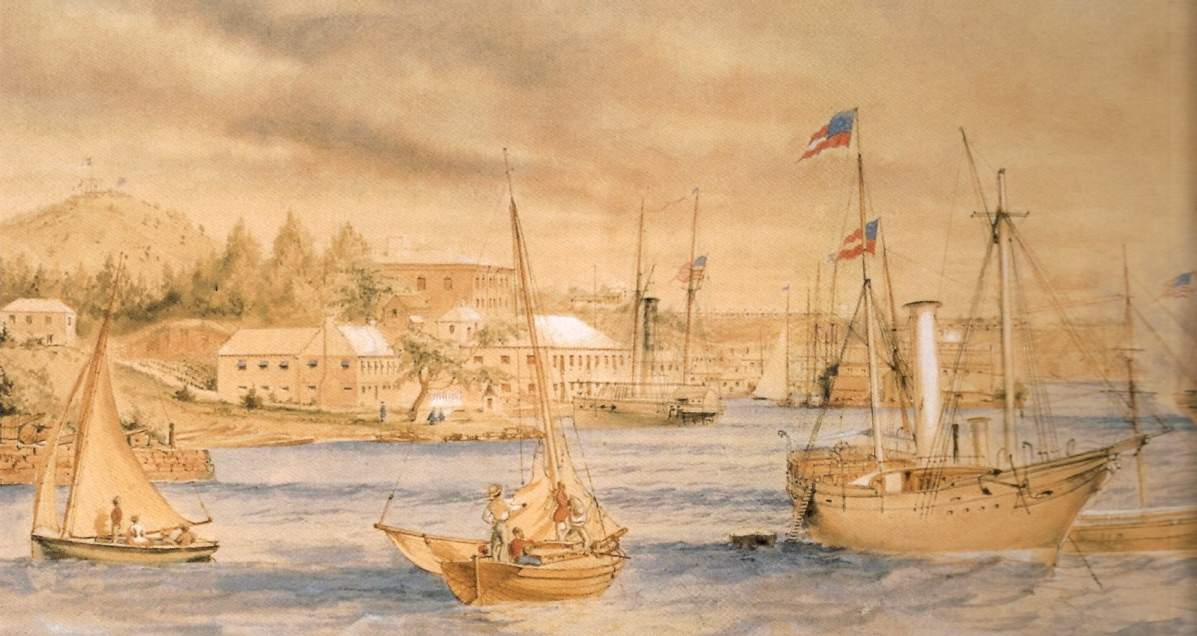
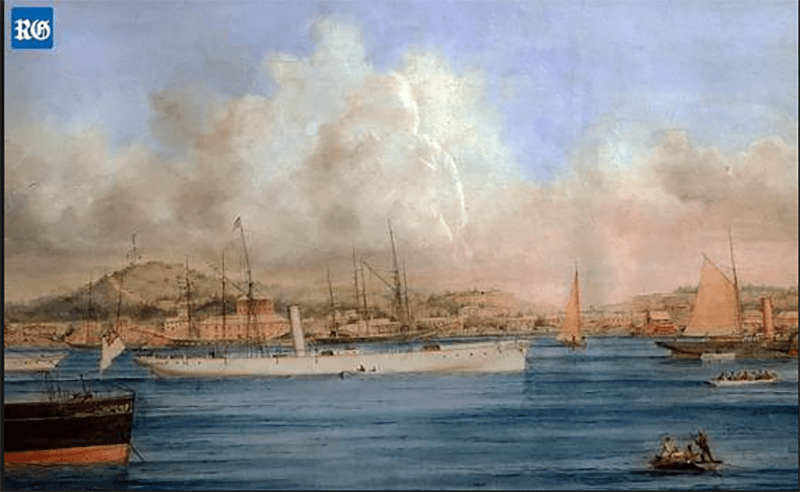
Today, the capital of Bermuda is Hamilton, moved across the island in 1815 from the old port of St. George, leaving the former capital in a kind of time warp, where you can walk down streets that look like they did 150 years ago. Portraits of Robert E. Lee and Confederate battle flags can still be found on the walls of the old port, beside paintings showing the harbor filled with blockade runners, lying quietly at anchor.

Once the office of Confederate Commercial Agent John Tory Bourne and Confederate Shipping Agent Major Norman Walker, today the Bermuda National Trust Museum tells the story of the island’s history, including Bermuda’s role in the American Civil War. The museum’s guide book explains: “The opportunities for Bermudians to profit from blockade running were boundless. Ships needed coal and provisions. Crews required lodging, food and entertainment between runs. Cargoes had to be unloaded, stored and reloaded, while crews and cargoes had to be ferried to ships lying at anchor. Bermudian pilots guided the ships through the reefs; those with skills as mates, carpenters, firemen and ordinary seamen signed on as crew. The Civil War proved to be the road to riches.

Sheryl and I traveled to Bermuda a while back, and visited the old port at St. George. At some point we learned about the maritime history of the island, as well. Making a living at sea in the 19th century was a dangerous business, so much so that one in ten of the married women living in Bermuda at that time, were widows.

It occurred to me that all those Confederate officers and enlisted men were spending a lot of time in Bermuda.  The possibility that followed soon morphed into a probability and then a certainty. At this point I can only wonder how many English citizens there are, residents of Bermuda and loyal subjects of the Queen, who can trace their paternity back to the Confederate States of America.

Bonnie Blue
‘The ‘Bonnie Blue’ flies over bonnie St George’s’ H/T Royal Gazette