

In 1607, approximately 100 English colonists settled along the James River in Tidewater-area Virginia. They called their little settlement “Jamestown, the first permanent English settlement in the New World. One of the colonists, John Smith, was exploring the Chickahominy River that December, when he and two others were captured by Powhatan warriors. The Powhatan Confederacy of the Tsenacommacah comprised roughly 30 Algonquin speaking tribes, led by Paramount Chief Wahunsonacock.
 Smith’s two companions were killed. John Smith himself was transported to the principle village of Werowocomoco, and brought before the Chief of the Powhatan. His head was forced onto a large stone as a warrior raised a club to bash out his brains. Pocahontas, the favorite daughter of Wahunsonacock, rushed in and placed her head on top of his, stopping the execution.
Whether it actually happened this way has been debated for centuries. One theory describes the event as an elaborate adoption ceremony, though Smith himself wouldn’t have known it at the time. Afterward, Powhatan told Smith he would “forever esteem him as his son Nantaquoud”.
The year of Pocahontas’ birth is uncertain. In the Spring of 1608, Smith described her as “a child of tenne years old”. At the time, Powhatans were commonly given multiple names, some secret and known only a select few. Names would change for important occasions, different names carrying different meanings depending on context.
 Pocahontas was a pet name, variously translated as “playful one” “my favorite daughter” or “little wanton”. Early in life, she bore the secret name “Matoaka” meaning, “Bright Stream Between the Hills”. Later she was known as “Amonute” which, to the best of my knowledge, has never been translated.
The “Starving Time”, the winter of 1609-1610, killed all but 60 of the 204 settlers then in Jamestown. Survivors were about to abandon the place when the Baron De La Warr, also known as Delaware, arrived in June with new supplies and new settlers. The settlement was rebuilt. One of the new arrivals, John Rolfe, became the first tobacco planter in the area.
Pocahontas was a frequent visitor at this time. English Captain Samuel Argall took her hostage in the spring of 1613, hoping it would help him negotiate a permanent peace with her father.
Pocahontas was treated as a guest rather than a prisoner and encouraged to learn English customs. She converted to Christianity and was baptized, Lady Rebecca. Powhatan eventually agreed to terms for her release, but by then she’d fallen in love with John Rolfe. The two were married on April 5, 1614, with the blessing of Chief Powhatan and the governor of Virginia.
The marriage ensured peace between the Jamestown settlers and the Powhatan Confederacy for several years. Pocahontas gave birth to Thomas, the couple’s first child, in 1615. The couple sailed to England the following year, where she proved popular with English gentry. The couple was preparing to sail back to Virginia in March 1617 when Pocahontas sickened and died, of unknown causes. She was twenty-one years old.
Some historians believe Pocahontas suffered from an upper respiratory condition, possibly pneumonia. Others believe she died from dysentery. The favorite daughter of Paramount Chieftain Powhatan of the Attanoughkomouck is buried at the parish church of St. George in Gravesend, in England.
John Rolfe returned to Virginia and died in an Indian attack, in 1622. Following his education in England, Thomas Rolfe returned to Virginia to become a prominent citizen. Some of the socially prominent and wealthy destined to become America’s own gentry, the “First Families of Virginia”, trace their lineage through Thomas Rolfe to Pocahontas.
 Later descendants of the “Indian Princess” include Glenn Strange, the actor who played Frankenstein in three Universal films during the 1940s and the character Sam Noonan, the popular bartender in the CBS series, “Gunsmoke”. Astronomer Percival Lowell is a direct descendant of Pocahontas, as are Las Vegas performer Wayne Newton and former First Lady Edith Wilson, whom some describe as the first female President of the United States. But that must be a story for another day.
At a recent event honoring Native American code talkers, President Donald Trump revived his pet nickname for Massachusetts Senator Elizabeth Warren, who has claimed Native American ancestry but has thus far, embarrassingly proven but 1/1,024th.
Predictably, Washington Post editorial writers were incensed: “Trump’s repeated reference to “Pocahontas” is racist first of all because it’s intended as a pejorative. Trump does not like Warren. It’s also racist because it seizes on a stereotypical Native American name to refer to an entire race — like calling an Asian man “Jackie Chan” or a black man “Frederick Douglass” (one of the president’s favorites). Worse yet, Trump is mushing together his tribes: At an event to honor Navajo heroes, he used the name of a Powhatan woman to disparage a senator who claimed Cherokee ancestry“.
Matoaka, also known as Amonute, daughter of the Paramount Chieftain Powhatan of the Attanoughkomouck who called her “Pocahontas” would be surprised I imagine, to learn that the Washington Post regards her name as a racial slur.


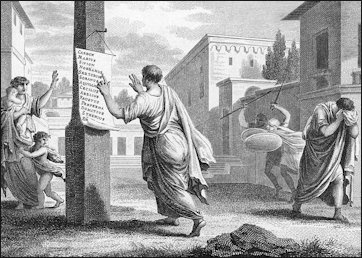
 For 38 days, the young Caesar joined in games and exercises, with these bloodthirsty killers. As if he were their leader, instead of their prisoner. All the while, he promised these pirates. He would come back to crucify them all, and he said it with a smile.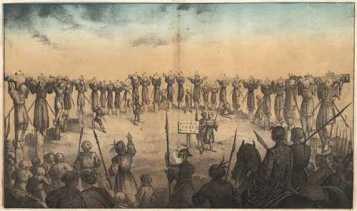
 He seems to have been a ladies’ man, fathering a son with none other than Queen Cleopatra of Egypt. One story has him being handed a note while speaking at the Senate. Caesar’s arch rival Cato (the younger) demanded to know the contents of the letter, loudly accusing him of complicity in the “Catiline Conspiracy” to overthrow the government. At last Caesar relented, reading out loud what turned out to be a love letter – a graphic one – written to him by Cato’s own half-sister Servilia Caepionis.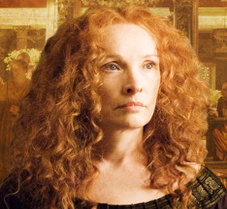
 Shortly before his assassination in BC 44, Caesar was named dictator perpetuo rei publicae constituendae, (English: “dictator in perpetuity”). It was the first time such a title had ever been made permanent. Nothing was more repugnant to traditional Roman sensibilities, than the idea of a dictator for life. Caesar’s days were numbered.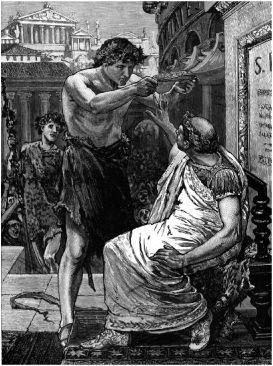
 The Roman calendar tracked the phases of the moon (or tried to), and didn’t count the days from first to last. Instead, Romans counted backward from three fixed points: the Nones (5th or 7th, depending on the length of the month), the Ides (13th or 15th), and the Kalends (1st of the following month).
 Here’s where the story becomes Really interesting. Like the apocryphal warning to “Beware the Ides of March”, Caesar’s last words, “Et tu Brute” were first introduced by William Shakespeare, 1,643 years after the fact. No eyewitness account of the assassination survives today, though a more contemporary source recorded the Greek words “Kai su, teknon?” as Brutus plunged the dagger in. “And you, my child?”


 Be that as it may, three things are certain. First, The fire burned for six days, utterly destroying three of the 14 districts of Rome and severely damaging seven others. Second, Nero used the excuse of the fire to go after Christians, having many of them arrested and executed. Third, the Domus Aurea (“Golden Palace”) and surrounding “Pleasure Gardens” emperor Nero built on the ruins, would be the death of him.

 Within forty years, most of the grounds were filled with earth and built over, replaced by the Baths of Titus and the Temple of Venus and Rome. Vespasian drained the lake and built the Flavian Amphitheatre.
 The Arch of Constantine, the last and largest of the Triumphal Arches of Rome and dedicated in AD315, was carefully positioned to align with Sol Invictus, so that the Colossus formed the dominant backdrop when approaching the Colosseum via the main arch.


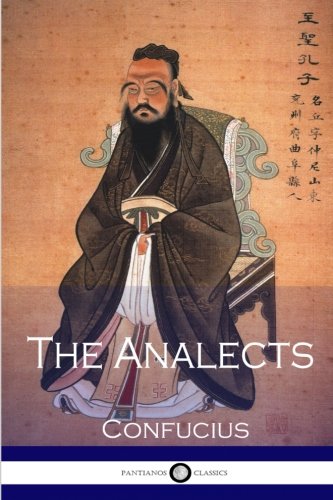 In it, a follower called Yen Yüan asked the Master about perfect virtue.
 In medieval Japanese, mi-zaru, kika-zaru, and iwa-zaru translate as “don’t see, don’t hear, and don’t speak”, –zaru being an archaic negative verb conjugation and pronounced similarly to “saru”, the word for monkey.
 The first known depiction of the “Three Mystic Apes” appears over the doors of the Tōshō-gū shrine in Nikkō, Japan, carved sometime in the 17th century.
 Mohandas Karamchand Gandhi was a Hindu lawyer, a member of the merchant caste from coastal Gujarat, in western India. Today he is known by the honorific “Mahatma”, from Gandhithe Sanskrit meaning “high-souled”, or “venerable”.


 Look up the Highest Paid Athlete of All Time and you’ll be rewarded with the knowledge that Michael Jordan amassed career earnings of $1.85 Billion, according to Forbes Magazine. Steve Forbes and Michael Jordan alike may be surprised to know. Spanish driver Gaius Appuleius Diocles amassed an astonishing 35,863,120 sesterces, equivalent to $15 Billion, today. Not bad for a man whose name suggests he probably began as a slave, freed by a guy named Gaius Appuleius.
 The age of Constantine saw enormous expansion of the city which bore his name, including enlargement of the Hippodrome to an impressive 1,476-feet long by 427-feet wide with a seating capacity of 100,000. By way of comparison, the Empire State Building is 1,454-feet from sidewalk to the very tip of the spire. Mercedes Benz Stadium in Atlanta, home of Super Bowl LIII, has a rated capacity of 71,000 spectators.
 A raised median called a spina ran down the center, adorned with stone statuary and obelisks. Ganging up to drive opposing handlers into the stone median or the stands, whipping opponents and even hauling them out of their chariots was not only permitted, but encouraged.
 Modern sport has seen its share of fan passion rising to violence, but the worst “futbol hooligan” pales into docility, compared with the crowd come to watch the chariot races. Imagine the worst fan violence of the modern era combined with aspects of street gangs and political organizations, each faction holding positions on the issues of the day and attempting to sway public policy by shouting slogans, between races.
 With spine thus restored, Justinian formulated a plan. The popular eunuch Narses was sent with a bag of gold, into the lion’s den. Small and slight of build, unarmed but for those coins, Narses entered the Hippodrome and went directly to the Blue section. On this day in 562 Hypatius was in the very act of coronation when the eunuch spoke. Narses reminded the Blues that Hypatius was a Green while Justinian himself, supported their team.
 Thus ends one of the great “backfires” in political history. Senator Hypatius was put to the sword and those who had supported the pretender, sent into exile. Justinian I would rule another 33 years, rebuilding Constantinople, muzzling the Senatorial Class which had caused him such grief and reconquering lost territories, in Italy.

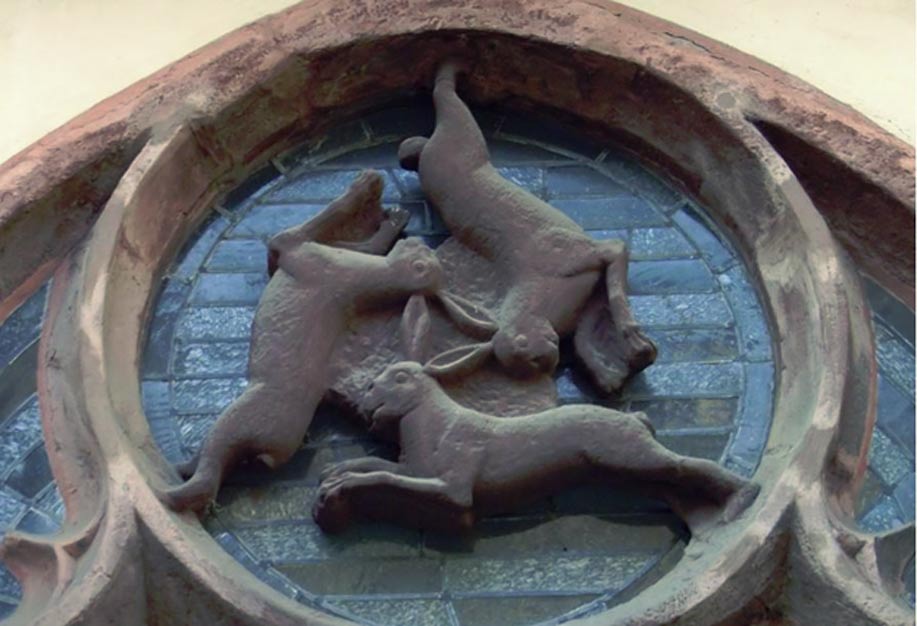



 The story involves no less a figure than Napoleon Bonaparte. In July 1807, Napoleon had just signed the Treaty of Tilsit, ending the war between the French Empire and Imperial Russia. As a means of celebration, Napoleon suggested a rabbit hunt, and ordered Chief of Staff Alexandre Berthier, to make it happen.


 Chariots go back to the earliest days of the Roman Republic, coming down from the ancient Greeks, by way of the Etruscan empire. The mythical abduction of the Sabine women was carried out, while the Sabine men watched a chariot race. While Romans never used them as weapons of war, chariots were used in triumphal processions, pulled by teams of horses, dogs, tigers and even ostriches.
 Modern sport has seen its share of fan passion rising to violence, but the worst “soccer hooligan” fades to docility, compared with the crowd come to watch the chariot races. In the year 69, Emperor Vitellius had commoners put to death for talking trash about the Blue faction. Ten years later, a fan threw himself on the funeral pyre, of his favorite driver. The week-long outbreak of violence known as the Nika Riots of 532 cost the lives of some 30,000 spectators. It all started, over a chariot race.


 Historical Easter Eggs - Today in History
You must be logged in to post a comment.