May 6, 1937 Hindenburg

The famous film shows ground crew running for their lives, and then turning and running back to the flames. It’s natural enough to have run, but there’s something the film doesn’t show.

Hindenburg left Frankfurt airfield on its last flight at 7:16pm, May 3, 1937, carrying 97 passengers and crew. Crossing over Cologne, Beachy Head and Newfoundland, the airship arrived over Boston at noon on the 6th.  By 3:00pm it was over the skyscrapers of Manhattan, arriving at the Naval Air Station in Lakehurst, NJ at 4:15.

Foul weather had caused a half-day’s delay, but the landing was eventually cleared.  The final S turn approach executed at 7:21pm. The ship was at the mooring mast, 180′ from the ground with forward landing ropes deployed, when flames first erupted near the top tail fin.

Eyewitness accounts differ as to the origin of the fire.  The leading theory is that, with the metal frameworkHindenburg grounded through the landing line, the ship’s fabric covering became charged in the electrically charged atmosphere, sending a spark to the air frame and igniting a hydrogen leak.  Seven million cubic feet of hydrogen ignited almost simultaneously.  It was over in less than 40 seconds.

The largest dirigible ever built, an airship the size of Titanic, burst into flames as the hull collapsed and plummeted to the ground.  Passengers and crew jumped for their lives and scrambled to safety, along with ground crews who had moments earlier been positioned to receive the ship.

The famous film shows ground crew running for their lives, and then turning and running back to the flames. It’s natural enough to have run, but there’s something the film doesn’t show.  That was Chief Petty Officer Frederick “Bull” Tobin, the airship veteran in charge of the landing party, bellowing at his sailors above the roar of the flames.  “Navy men, Stand fast!  We’ve got to get those people out of there!” Tobin had survived the crash of the USS Shenandoah on September 4, 1923.  He wasn’t about to abandon his post, even if it cost him his life. Tobin’s Navy men obeyed.  That’s what you see when they turn and run back to the flames.

The Hindenburg disaster is sometimes compared with that of the Titanic, but there’s a common misconception that the former disaster was the more deadly of the two. In fact, 64% of the passengers and crew aboard the airship survived the fiery crash, despite having only seconds to react.   In contrast, officers on board the Titanic had 2½ hours to evacuate, yet most of the lifeboats were launched from level decks with empty seats. Only 32% of Titanic passengers and crew survived the sinking.  It’s estimated that an additional 500 lives could have been saved, had there been a more orderly, competent, evacuation of the ship.

As it was, 35 passengers and crew lost their lives on this day in 1937, and one civilian ground crew.  Without doubt the number would have been higher, if not for the actions of Bull Tobin and is Navy men.

Hindenberg CrashWhere a person was inside the airship, had a lot to do with their chances of survival.  Mr and Mrs Hermann Doehner and their three children (Irene, 16, Walter, 10, and Werner, 8) were in the dining room, watching the landing.  Mr. Doehner left before the fire broke out.  Mrs. Doehner and the two boys were able to jump out, but Irene went looking for her father.  Both died in the crash.

For all the film of the Hindenburg disaster, there is no footage showing the moment of ignition. Investigators theorized a loose cable creating a spark or static charge from the electrically charged atmosphere.  Some believed the wreck to be the result of sabotage, but that theory is largely debunked.

Four score years after the disaster, the reigning hypothesis begins with the static electricity theory, the fire fed and magnified by the incendiary iron oxide/aluminum impregnated cellulose “dope” with which the highly flammable hydrogen envelope was painted.

The 35 year era of the dirigible was filled with accidents before Hindenburg, but none had dampened public enthusiasm for lighter-than-air travel. The British R-101 accident killed 48, the crash of the USS Akron 73. The LZ-4, LZ-5, Deutschland, Deutschland II, Italia, Schwaben, R-38, R-101, Shenandoah, Macon, and there were others.  All had crashed, disappeared into the darkness, or over the ocean.  Hindenburg alone was caught on film, the fiery crash recorded for all to see.  The age of the dirigible, had come to an end.

May 1, 1863  Flags of the Confederacy

I find it infinitely preferable that we learn from our history, rather than hide from it.

Last week, New Orleans authorities took to the dead of night, to remove monuments to the history of their own city.   The recent fuss about the “Confederate Flag” has faded away, sort of, not so the political atmosphere that gave it birth.   For all that, it seems worth pointing out:  the “Stars and Bars” with which we’ve all become so familiar, never was the flag of the Confederate States of America.  It wasn’t even the real Stars & Bars.

Battle_of_Sullivans_Island
Battle of Sullivan’s Island, 1776

On June 28, 1776, British General Sir Henry Clinton ordered the ship Thunder to attack the Continental fortification on Sullivan’s Island, in Charleston Harbor. The fighting was furious and lasted 16 hours and more. At one point, a British shell tore the flagstaff away. In full view and under constant fire, Sergeant William Jasper of the 2nd South Carolina retrieved the fallen flag of his regiment and fixed it to an artilleryman’s sponge pole. There he stood on the parapet, holding the flag under fire until a new pole could be installed.

Jasper’s heroism had rallied his forces to fight on.  Governor John Rutledge gave him his personal sword, in recognition of his bravery.  The battle was a humiliating defeat for a British fleet that hadn’t been beaten in 100 years. It was four years before they’d take another run at Charleston.

SC secession flag
SC Secession Flag

The Liberty Flag or Moultrie flag became a standard for South Carolina militia. A palmetto was added in 1861, a reference to the palm trunks laid over the sand walls of Fort Moultrie, which had helped withstand that British bombardment of 85 years earlier. A variant of this flag appeared at South Carolina’s secession conventions, as did militia and state flags in all the state secession conventions.

Bonnie Blue Flag
Bonnie Blue Flag

When Mississippi seceded in January 1861, a blue flag with a single white star was flown from the capitol dome. This, the first and unofficial flag of the Confederacy, came to be called the “Bonnie Blue Flag”, closely patterned after the flag flown over the short-lived Republic of West Florida in 1810, and adopted by the Congress of the Republic of Texas on December 10, 1836.


The first national flag of the Confederate States of America, the real Stars and Bars, was similar in design to the United States flag. A blue field containing seven, nine, eleven and finally thirteen stars, depending on the period, appeared in the “canton”, or upper left corner. Three stripes of equal height ran from hoist to fly end, alternating red to white and back to red.

Stars and bars
Stars and Bars

Regiments of the era carried flags to help commanders observe and assess the progress of battle. At a distance, the Stars and Bars and the Stars and Stripes were hard to tell apart, particularly in still conditions, or when smoke clouded the view.

The similarity between the two national flags led to confusion at the first battle of Manassas, also known as the first battle of Bull Run. After the battle, Confederate General Pierre Gustave Toutant Beauregard wrote that he was “resolved then to have [our flag] changed if possible, or to adopt for my command a ‘Battle flag’, which would be entirely different from any State or Federal flag”.

The star studded diagonal stripes of the St. Andrew’s Cross is what resulted, becoming Beauregard’s battle flag, as well as that of the Army of Tennessee, the Army of Northern Virginia, and the ensign of the Confederate Navy.

Most submissions for the second national flag incorporated the battle flag into the design. The winning design adopted on May 1, 1863, was called the “Stainless Banner”, placing the Saint Andrews Cross in the canton, the rest of the flag pure white. Visibility remained an issue with this design as with the first; as it was often misinterpreted as a flag of surrender.

stainless-banner-david-andrews
Stainless Banner

The third national flag, also known as the “Blood Stained Banner”, was adopted March 4, 1865. This last design retained the white background with the same canton as before, but now there was a vertical red stripe on the fly end.

The Confederate battle flag enjoyed renewed popularity during the first half of the 20th century. Several WWII military units with Southern nicknames, made the flag their unofficial emblem. The USS Columbia flew a Confederate Navy Ensign throughout combat in the South Pacific. A Confederate battle flag was raised over Shuri Castle after the Battle of Okinawa, by a Marine from Company A of the 1st Battalion, 5th Marines; the self-styled “Rebel Company”. It was visible for miles and was taken down after three days on the orders of General Simon Bolivar Buckner, Jr., son of Confederate general Simon Bolivar Buckner. “Americans from all over are involved in this battle”, said Buckner, replacing it with the US flag.

Blood stained banner
Blood Stained Banner

According to Civil War historian and native Southerner Shelby Foote, the flag traditionally represented the South’s resistance to Northern political dominance.

The symbol became highly controversial during the Civil Rights era, and disagreement continues over its symbolism. Supporters of the flag view it as a symbol of southern heritage and the independence of the distinct cultural tradition of the American South. Civil rights groups associate it with a history of racial discrimination and the institution of slavery.

Now, we have the current government in New Orleans, taking to the dark of night, to remove Confederate memorials from the streets of that city.

In writing these history essays, I hope to learn something new about a subject which interests me.  I enjoy the responses of those who feel the same way. There’s plenty of time for politics and I don’t intend that this blog be the place for it.  Except to say:  I find it infinitely preferable that we learn from our history, rather than hiding from it.

April 27, 1944 Exercise Tiger

Estimates of Americans killed in the D-Day rehearsal range from 639 to 946, nearly five times the number killed on the actual Utah Beach landing.

The largest amphibious attack in history began on June 6, 1944, on the northern coast of France.  British and Canadian forces came ashore at beaches code named Gold, Juno and Sword.  Americans faced light opposition at Utah Beach, while heavy resistance at Omaha Beach resulted in over 2,000 American casualties.

By end of day, some 156,000 Allied troops had successfully stormed the beaches of Normandy.  Within a week that number had risen to 326,000 troops, over 50,000 vehicles and more than 100,000 tons of equipment.

The success of “Operation Overlord” resulted from lessons learned from the largest amphibious training exercise of the war, the six phases of “Operation Fabius”, itself following the unmitigated disaster of a training exercise that killed more Americans, than the actual landing at Utah beach.

Slapton_Sands
Slapton Sands

Slapton is a village and civil parish in the River Meadows of Devon County, where the southwest coast of England meets the English Channel.  Archaeological evidence suggests human habitation from at least the bronze age.  The “Domesday Book”, the recorded manuscript of the “Great Survey” of England and Wales completed in 1086 by order of William the Conqueror, names the place as “Sladone”, with a population of 200.

In late 1943, 750 families, some 3,000 locals, were evacuated with their livestock to make way for “Operation Tiger”, a D-Day landing rehearsal scheduled for the following spring.   Some had never so much as left their village.Channel map

Thousands of US military personnel were moved into the region during the winter of 1943-44. The area was mined and bounded with barbed wire, and patrolled by sentries.  Secrecy was so tight, that even those in surrounding villages, had no idea of what was happening.

Exercise Tiger was scheduled to begin on April 22, covering all aspects of the “Force U” landing on Utah beach, culminating in a live-fire beach landing at Slapton Sands at first light, on April 27.

220px-D-Day_rehearsal_cph.3c32795
Slapton Sands Landing

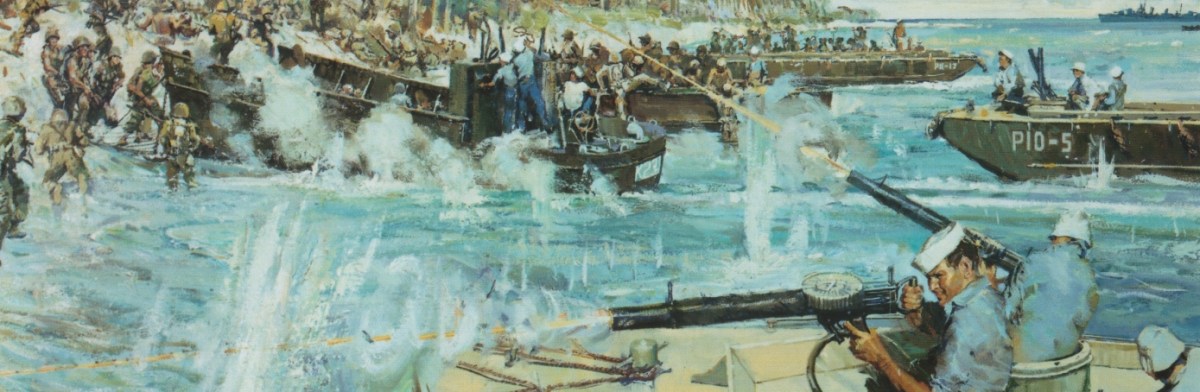
Nine large tank landing ships (LSTs) shoved off with 30,000 troops on the evening of the 26th, simulating the overnight channel crossing. Live ammunition was used in the exercise, to harden troops off to the sights, sounds and smells of actual battle. Naval bombardment was to commence 50 minutes before H-Hour, however delays and scheduling confusion resulted in landing forces coming under direct naval bombardment. An unknown number were killed in this “friendly fire” incident. Fleet rumors put the number as high as 450.

Two Royal Navy Corvettes, HMS Azalea and Scimitar, were to guard the exercise from German “Schnellboots” (“S-Boots” – the allies called the “E-Boats”), the fast attack craft based across the channel, at Cherbourg.

German_S-Boat_S_204
German Fast Attack Boats known as ‘Schnell-Boots” or, “Fast Boats”

Scimitar withdrew for repairs following a collision with an LST on the 27th. In the earlymorning darkness of the following day, the single corvette was leading 8 LSTs carrying vehicles and combat engineers of the 1st Engineer Special Brigade through Lyme Bay, when the convoy was spotted by a nine vessel E-Boat patrol.

8 landing craft in single-file didn’t have a chance against fast-attack craft capable of 55mph.  LST-531 was torpedoed and sunk in minutes, killing 424 Army and Navy personnel. LST-507 suffered the same fate, with the loss of 202. LST-289 made it to shore in flames, with the loss of 123. LST-511 was damaged in yet another friendly fire incident.

Unable to wear their lifebelts correctly due to the large backpacks they wore, many men placed them around their waists. That only turned them upside down in the water and that’s how they died, with nothing but legs visible above the waves. Dale Rodman, who survived the sinking of LST-507, said “The worst memory I have is setting off in the lifeboat away from the sinking ship and watching bodies float by.”

Survivors were sworn to secrecy due to official embarrassment, and the possibility of revealing the real invasion, scheduled for June.  Ten officers with high level clearance were killed in the incident, but no one knew that for sure until their bodies were recovered.  The D-Day invasion was nearly called off.  Any of them could have been captured alive, revealing pending invasion plans to German interrogators.  Particularly under torture.

There’s a surprising amount of confusion about the final death toll.  Estimates range from 639 to 946, nearly five times the number killed in the actual Utah Beach landing.  Some or all of the personnel from that damaged LST may have been aboard the other 8 on the 28th, but log books went down along with everything else.  Many of the remains, have never been found.

Even that number would surely have been higher, had not Captain John Doyle disobeyed orders and turned his LST-515 around, plucking 134 men from the frigid water.

Sherman_Tank_Operation_TigerToday the Exercise Tiger disaster is largely forgotten.  Some have charged official cover-up, though information from SHAEF press releases appeared in the August edition of Stars & Stripes.  At least three books contain the information.  It seems more likely that the immediate need for secrecy and subsequent D-Day invasion swallowed the Tiger disaster, whole.  History has a way of doing that.

Some of Slapton’s residents came home to rebuild their lives after the war, but many never returned.  In the early 1970s, Devon resident and civilian Ken Small discovered an artifact of the Tiger exercise, while beachcombing on Slapton Sands.

With little or no help from either the American or British governments, Small purchased rights to a submerged Sherman tank from the 70th Tank Battalion, from the United States Government.  The tank was raised in 1984 with the help of local residents and dive shops, and now stands as a memorial to Exercise Tiger, not far from a monument remembering those villagers who never came home.Slaptonmemorial

A plaque was erected at Arlington National Cemetery in 1995, inscribed with the words “Exercise Tiger Memorial”.  A 5,000-pound LST stern anchor bears silent witness to Exercise Tiger in Mexico, Missouri, as does an M4 Sherman tank at Fort Rodman Park in New Bedford, Massachusetts.

In 2012, a granite memorial was erected at Utah Beach, engraved with the words in French and English: “In memory of the 946 American servicemen who died in the night of 27 April 1944 off the coast of Slapton Sands (G.B.) during exercise Tiger the rehearsals for the D-Day landing on Utah Beach”.

SONY DSC


April 23, 1982, Conch Republic

The Mayor’s response could best be summed up in the words of Bugs Bunny: “Of course you know, this means war!”

Except for the Naval Air Station at Boca Chica and Coast Guard installations in Key West, Marathon and Islamorada, most if not all economic activity in the Florida Keys comes from tourism. It’s no wonder then, that when the federal government shuts down the only road into town, the locals are going to get cranky.

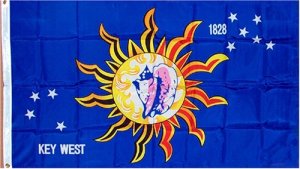
On April 18, 1982, the Mariel boatlift was a mere two years in the past, and very much in the public memory. The United States still had a border in those days, or at least a federal government that tried to enforce it. Border Patrol set up a roadblock in front of Skeeter’s Last Chance Saloon in Florida City, blocking Rt.1, the only road into the Keys. Originally intended to intercept illegals entering the country, the roadblock soon morphed into a hunt for illegal drugs, as well.Conch Republic Flag

Cars waited for hours, in lines that stretched for 19 miles. Predictably, the attitude of federal officials was one of towering indifference, but not so local business owners. Robert Kerstein wrote in his Key West on the Edge — Inventing the Conch Republic, “No one in Key West doubted that drugs were trafficked widely in the Keys by road and by boat. But tourism’s boosters had little tolerance for interruptions to their business.”

Dennis Wardlow, then-mayor of Key West, contacted the chief of police, the Monroe County sheriff, and his State Rep, as well as Governor Bob Graham, demanding the roadblock’s removal. With none of the above having any knowledge of the barrier and lacking the authority to pull it down, Wardlow contacted INS directly. When the Border Patrol told him it was “none of his business,” the Mayor’s response could best be summed up in the words of Bugs Bunny: “Of course you know, this means war!”Key West Review Feb 2014 011

Suffering a blizzard of hotel cancellations, this “attack on Key West’s sovereignty” could not stand. On April 22, Mayor Wardlow, local attorney & pilot David Horan and Old Town Trolley Tours operator Ed Swift flew to Miami seeking legal relief. When District Court Judge C. Clyde Atkins failed to issue an injunction, the Key West delegation took to the courthouse steps.

“What are you going to do, Mr. Mayor”, asked the assembled media. Swift leaned over and whispered into the Mayor’s ear, “Tell them we are going to go home and secede” “We are going to go home and secede!”, said Wardlow, and that’s what they did.

Over the next 24 hours, a group of secessionist co-conspirators worked feverishly to form the new government, filling cabinet positions such as “Secretary of Underwater Affairs” and “Minister of Nutrition”.

Old Customs Building, Key West

On April 23, with federal agents on scene to monitor the proceedings, a crowd gathered before the old customs building. Mayor Wardlow and a gaggle of allies mounted the back of a flatbed truck to read the proclamation of secession. “We serve notice on the government in Washington”, it read, “to remove the roadblock or get ready to put up a permanent border to a new foreign land. We as a people, may have suffered in the past, but we have no intention of suffering in the future at the hands of fools and bureaucrats”.

Battle of the Conch Republic
“Great Battle of the Conch Republic”

With that, Mayor Wardlow declared “war” on the United States.  The “Great Battle of the Conch Republic” broke out in the harbor, when the Schooner Western Union commanded by Captain John Kraus, attacked the Coast Guard Cutter Diligence with water balloons, Conch fritters and toilet paper.  Diligence fought back with water hoses, as the new “Prime Minister” broke a loaf of stale Cuban bread over the head of a man dressed in a Navy uniform. Others launched stale bread and conch fritters at federal agents, Navy sailors and Coast Guard personnel in attendance.

Conch Republic PassportsOne minute after declaring his “verbal shot” at the feds, Wardlow “surrendered” to a nearby naval officer, demanding a billion dollars in “foreign aid” in compensation for “the long federal siege.”

Apparently, that’s what it takes to get the attention of a federal bureaucrat. The roadblock lifted, and soon the restaurants, stores and hotels of the Keys were once again filled with smiling tourists. Key West never got their “foreign aid”, but they never received so much as a letter saying they couldn’t secede, either.

So it is that Key West celebrates its independence this day, April 23. The “Conch Republic’ issues its own passports, and sells t-shirts and bumper stickers with the slogan “We seceded where others failed”. And if the federal government ever comes back to mess with the micro-nation, they’d better be prepared to deal with the Conch Republic’s very own “Special Forces”, whose motto is “Sanctus Merda”.  “Holy Shit”.


Tip of the hat to

“Conch Republic Military Forces

The Official Site of the Conch Republic Military”

Linked Here

for the “Conch Battle Hymn of the Republic”

words by First Sea Lord, Admiral Finbar Gittelman • October 14, 2012 © Finbar Gittelman

Mine eyes have seen the glory of the sunshine and the sea
Right here upon our islands, where we love to live so free
But in April 1982, the peace was not to be
And we went rolling on

CHORUS
Glory glory Conch Republic
From Key to shining Key

They were setting up a check point, tween the mainland and the Keys
They had put a US Border, where it shouldn’t ‘oughta’ be
So that’s when we seceded, and declared our sovereignty
And the fun had just begun

(CHORUS)

We went forth into the harbor and a cutter we did spy
And we sailed up along side her and we took her by surprise
We hoisted up our battle flag, so proudly and so high
And we went sailing on

(CHORUS)

The water and Conch fritters and the Cuban bread did fly
Our bombers, they were raining toilet paper from the sky
Our cannons they did thunder to proclaim our victory
And we fought bravely on

(CHORUS)

We have faced the silly forces of misguided zealotry
We have stood up to their foolishness for all the world to see
And we’ve showed the other nations what America can be From
Key to shining Key

(CHORUS)


April 19, 1775  Shot Heard ‘Round the World

Taking positions across the village green to block the soldiers’ line of march, 80 “minutemen” turned and faced 700 of the most powerful military, on the planet.

The column of British soldiers moved out from Boston late on the 18th, their mission to confiscate the American arsenal at Concord and to capture the Patriot leaders Sam Adams and John Hancock, known to be hiding in Lexington.

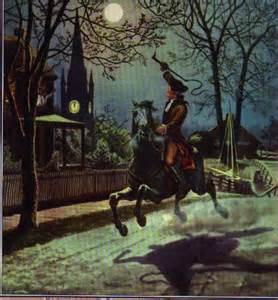
Midnight RideBoston Patriots had been preparing for such an event.  Sexton Robert John Newman and Captain John Pulling carried two lanterns to the steeple of the Old North church, signaling that the Regulars were crossing the Charles River to Cambridge. Dr. Joseph Warren ordered Paul Revere and Samuel Dawes to ride out and warn surrounding villages and towns, the two soon joined by a third rider, Samuel Prescott. It was Prescott alone who would make it as far as Concord, though hundreds of riders would fan out across the countryside before the night was through.
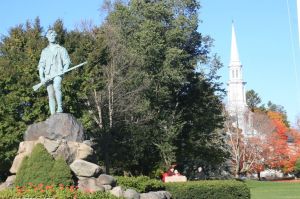
The column entered Lexington at sunrise on April 19, bayonets gleaming in the early morning light.  Armed with a sorry assortment of weapons, colonial militia poured out of Buckman Tavern, and fanned out across the town square.   Some weapons were hand made by village gunsmiths and blacksmiths, some decades old, but all were in good working order.   Taking positions across the village green to block the soldiers’ line of march, 80 “minutemen” turned and faced 700 of the most powerful military, on the planet.Lexington Green

Words were exchanged and no one knows who fired the first shot.  When it was over, eight Lexington men lay dead or dying, another ten wounded. One British soldier was wounded.

Vastly outnumbered, the militia soon gave way, as word spread and militia gathered from Concord to Cambridge.   The King’s Regulars never did find the weapons for which they had come, nor did they find Adams or Hancock.  There had been too much warning for that.

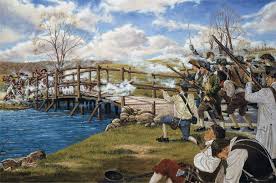
Regulars would clash with colonial subjects two more times that day, first at Concord Bridge and then in a running fight at a point in the road called “The Bloody Angle”.  Finally, hearing that militia was coming from as far away as Worcester, the column turned to the east and began their return march to Boston.

Concord BridgeSome British soldiers marched 35 miles over those two days, their final retreat coming under increasing attack from militia members firing from behind stone walls, buildings and trees. One taking up such a firing position was Samuel Whittemore of Menotomy Village, now Arlington Massachusetts. At 80 he was the oldest known combatant of the Revolution.

Whittemore took his position by the road, armed with his ancient musket, two dueling pistols and the old French cutlass captured years earlier from a French officer whom he explained had “died suddenly”.

three-men-from-action-header

Waiting until the last possible moment, Whittemore rose and fired his musket at the oncoming Redcoats, one shot, one kill. Several charged him from only feet away as he drew his pistols.  Two more shots, one dead and one mortally wounded. He had barely drawn his sword when they were on him, a .69 caliber ball fired almost point blank tearing part of his face off, as the butt of a rifle smashed into his head. Whittemore tried to fend off the bayonet strokes with his sword but he didn’t have a chance.  He was run through thirteen times before he lay still, one for each colony.

The people who came out of their homes to clean up the mess afterward found Whittemore, up on one knee and trying to reload his old musket.

Doctor Nathaniel Tufts treated the old man’s wounds as best he could, but felt that there was nothing anyone could do. Sam Whittemore was taken home to die in the company of his loved ones, which he did. Eighteen years later, at the age of ninety-eight.samuel_whittemore

April 18, 1943 Terrible Resolve

Painfully aware of the overwhelming productive capacity of the American economy, Yamamoto sought to neuter the US High Seas fleet in the Pacific, while simultaneously striking at the oil and rubber rich resources of Southeast Asia

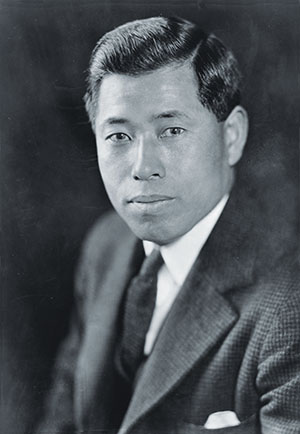
Captian Isoroku YamamotoIsoroku Takano was born in Niigata, the son of a middle-ranked samurai of the Nagaoka Domain. His first name “Isoroku”, translating as “56”, refers to his father’s age at the birth of his son. At this time, it was common practice that samurai families without sons would “adopt” suitable young men, in order to carry on the family name, rank, and the income that came with it. The young man so adopted would carry the family name.  So it was that Isoroku Takano became Isoroku Yamamoto in 1916, at the age of 32.
After graduating from the Imperial Japanese Naval Academy, Yamamoto went on to serve in the Russo-Japanese war of 1904, later returning to the Navy Staff College and emerging as Lieutenant Commander in 1916. He attended Harvard University from 1919-1921, learning fluent English. A later tour of duty in the US enabled him to travel extensively, and to study American customs and business practices.

Like most of the Japanese Navy establishment, Yamamoto promoted a strong Naval policy, at odds with the far more aggressive Army establishment. For those officers, particularly those of the Kwantung army, the Navy existed only to ferry invasion forces about the globe.

Yamamoto opposed the invasion of Manchuria in 1931 and the 1937 land war with

uss_panay
Panay

China. As Deputy Navy Minister, it was Yamamoto who apologized to Ambassador Joseph Grew, following the “accidental” bombing of the USS Panay in 1937. Even when he was the target of assassination threats by pro-war militarists, Yamamoto still opposed the attack on Pearl Harbor, which he believed would “awaken a sleeping giant and fill him with a terrible resolve”.

Yamamoto received a steady stream of hate mail and death threats in 1938, as a growing number of army and navy officers spoke publicly against him. Irritated with Yamamoto’s immovable opposition to the tripartite pact with Nazi Germany and Fascist Italy, army hardliners dispatched military police to “guard” him. In one of the last acts of his short-lived administration, Navy Minister Mitsumasa Yonai reassigned Yamamoto to sea as Commander-in-Chief of the Combined Fleet, making it harder for assassins to get at him.

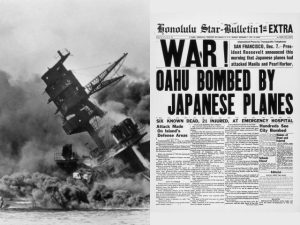
USS-Arizona-Sinking-Pearl-Harbor-Newspaper-December-7-1941-AP-Getty-640x480Many believed that Yamamoto’s career was finished when his old adversary Hideki Tōjō ascended to the Prime Ministership in 1941. Yet there was none better to run the combined fleet. When the pro-war faction took control of the Japanese government, he bowed to the will of his superiors. It was Isoroku Yamamoto who was tasked with planning the attack on Pearl Harbor.
Nothing worked against the Japanese war effort as much as time and resources. Painfully aware of the overwhelming productive capacity of the American economy, Yamamoto sought to emasculate the US High Seas fleet in the Pacific, while simultaneously striking at the oil and rubber rich resources of Southeast Asia. To accomplish this first objective, he planned to attack the anchorage at Pearl Harbor, followed by an offensive naval victory which would bring the Americans to the bargaining table. It’s not clear if he believed all that, or merely hoped that it might work out.

Yamamoto got his decisive naval engagement six months after Pearl Harbor, near Midway Island. Intended to be the second surprise that finished the carriers which had escaped destruction on December 7, American code breakers turned the tables. This time it was Japanese commanders who would be surprised.

Battle-Of-Midway-Turns-Tide-Of-Pacific-War-2American carrier based Torpedo bombers were slaughtered in their attack, with 36 out of 42 shot down.  Yet Japanese defenses had been caught off-guard, their carriers busy rearming and refueling planes when American dive-bombers arrived.
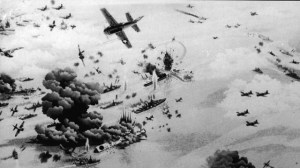
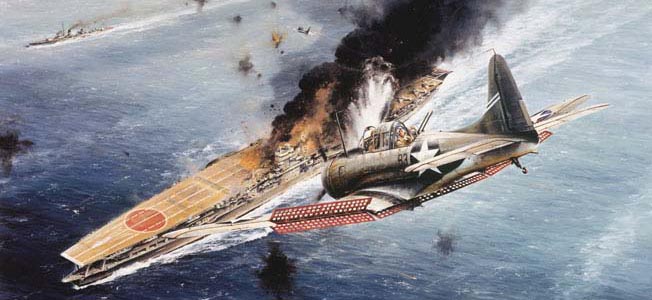
midway-copyMidway was a disaster for the Imperial Japanese navy. The carriers Akagi, Kaga, Soryu and Hiryu, the entire strength of the task force, went to the bottom. The Japanese also lost the heavy cruiser Mikuma, along with 344 aircraft and 5,000 sailors. Much has been made of the loss of Japanese aircrews at Midway, but two-thirds of them survived. The greater long term disaster, may have been the loss of all those trained aircraft mechanics and ground crew who went down with their carriers.
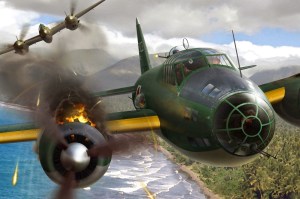
The Guadalcanal campaign, fought between August 1942 and February ’43, was the first major allied offensive of the Pacific war and, like Midway, a decisive victory for the allies.

Needing to boost morale after the string of defeats, Yamamoto planned an inspection 2013-Yamamoto-10.1tour throughout the South Pacific. US naval intelligence intercepted and decoded his schedule.  The order for “Operation Vengeance” went down the chain of command from President Roosevelt to Secretary of the Navy Frank Knox to Naval Operations Admiral Ernest King to Admiral Chester Nimitz at Pearl Harbor. Sixteen Lockheed P-38 Lightnings, the only fighters capable of the ranges involved, were dispatched from Guadalcanal on April 17 with the order: “Get Yamamoto”.

Yamamoto’s two Mitsubishi G4M bombers with six Mitsubishi A6M Zeroes in escort were Yamamoto Wreckintercepted over Rabaul on April 18, 1943. Knowing only that his target was “an important high value officer”, 1st Lieutenant Rex Barber opened up on the first Japanese transport until smoke billowed from its left engine. Yamamoto’s body was found in the wreckage the following day with a .50 caliber bullet wound in his shoulder, another in his head. He was dead before he hit the ground.

Isoroku Yamamoto had the unenviable task of planning the attack on Pearl Harbor, but he was an unwilling participant in his own history. “In the first six to twelve months of a war with the United States and Great Britain”, he had said, “I will run wild and win victory upon victory. But then, if the war continues after that, I have no expectation of success”.Yamamoto

April 17, 1961 Bay of Pigs

“Trials” were carried out across the country, some in sports stadia in front of thousands of spectators. Hundreds of supporters of the former regime were executed as a result. When Castro didn’t like the outcome, he would personally order a retrial.

Cuban strongman Fulgencio Batista seized power March 1952, proclaiming himself president and labeling his governing system “disciplined democracy”. While Batista had some popular support when he canceled presidential elections, many Cubans came to see the administration as a one-man dictatorship.  Opponents of the regime formed several anti-Batista groups, taking to armed rebellion to oust the government. The best known of these groups was the “26th of July Movement”, founded by the lawyer Fidel Castro and operated out of base camps in the Sierra Maestra mountains.

Batista’s repressive tactics led to widespread disapproval by the late ’50s, culminating in his resignation on December 31, 1958.  By February 1959, Fidel Castro had installed himself as Prime Minister.

bay-of-pigs_timelineCastro proclaimed his administration to be an example of “direct democracy”, and dismissed the need for elections.  The Cuban people could assemble demonstrations and express their democratic will to him personally, he said.  Who needs elections?
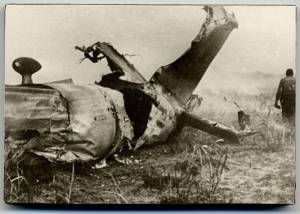
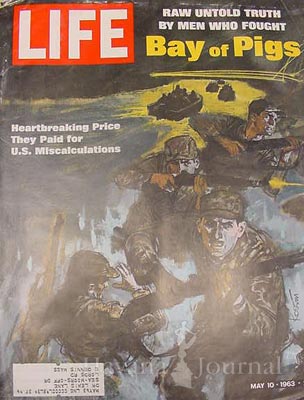
“Trials” were carried out across the country, some in sports stadia in front of thousands of spectators.  Hundreds of supporters of the former regime were executed as a result.  When Castro didn’t like the outcome, he would personally order a retrial.

American influence had once been widespread on the island, but that went away as the Castro regime adopted an increasingly leftist posture. “Until Castro”, said Earl Smith, former American Ambassador to Cuba, “the U.S. was so overwhelmingly influential in Cuba that the American ambassador was the second most important man, sometimes even more important than the Cuban president.”

Castro nationalized US controlled oil refineries run by Esso and Standard Oil as well as Anglo-Dutch Shell, when US authorities objected to their being required to process oil purchased from the Soviet Union.  Tit-for-tat retaliations resulted in the expropriation of American owned banks and sugar refineries, by October 1960 the Castro regime had “nationalized” a total of 166 such businesses, including Coca Cola and Sears & Roebuck.Bay_of_Pigs_1

Secretary of State Christian Herter publicly stated that Castro was “following faithfully the Bolshevik pattern” by instituting a single-party political system, taking control of trade unions, suppressing civil liberties, and sharply limiting both freedom of speech and freedom of the press. Castro fired back, criticizing the way black people and the working classes were treated in New York City, attacking US media as “controlled by big business” and claiming that the American poor were living “in the bowels of the imperialist monster”.

A “secret” operation was conceived and initiated under the Eisenhower administration, and approved by the incoming Kennedy administration.  Beginning on April 15, 8 B-29 CIA bombers attacked Cuban military aircraft on the ground at several locations. A B-26 bearing Cuban markings and perforated with bullet-holes later landed at Miami International Airport, the pilots claiming to be defecting Cubans. The story began to unravel, when reporters noted that the plane’s machine guns hadn’t been fired.  Furthermore, the Cubans didn’t operate that type of plane. Fidel Castro said that not even Hollywood would have tried such a feeble story.

The invasion began on the 16th, when 1,400 Cuban exiles landed on Cuba’s “Playa Girón”, or “Bay of Pigs”.  Snagged on razor sharp coral that reconnaissance had identified as seaweed, landing forces were pinned down as government forces responded in the early morning hours of April 17. The landing achieved a beachhead, but things quickly started to go wrong.  A freighter containing food, fuel, medical equipment, and ten days’ ammunition, was sunk. The Cuban Air Force had taken a beating two days earlier, but “Brigade 2506” wasn’t supplied with fighter aircraft at all.  Wanting to preserve “plausible deniability”, President Kennedy refused to allow US fighters to go into combat, leaving the remnants of the Cuban Air Force unopposed.  Landing forces were bombed and strafed, at will.

bay-of-pigsKennedy was finally persuaded to authorize unmarked US fighter jets from the aircraft carrier Essex to provide escort cover for the invasion’s B-26 bombers, most of which were flown by CIA personnel in support of the ground invasion. Fighters missed their rendezvous by an hour, due to a misunderstanding about time zones.  Unescorted bombers are easy targets, and two of them were shot down with four Americans killed. Fighting ended on April 20, 1961 in what had become an unmitigated fiasco.

The Bay of Pigs invasion was probably doomed from the start. Castro was popular at that time, and the project had not exactly been a secret. The New York Times had run a story a month earlier, predicting a US invasion of Cuba in the coming weeks.  Another story ran on April 7, headlined “Anti-Castro Units Trained to Fight at Florida Bases,” reporting that invasion plans were in their final stages. When Kennedy saw the paper, he said that Castro didn’t need spies, all he had to do was read the news.

April 13, 1861, Sumter

Thousands of shells were fired at Fort Sumter over 34 hours. Federal forces fired back, though vastly outgunned. For all that, the only casualty was one Confederate mule.

South Carolina seceded from the Union on December 20, 1860, after which the state government considered itself to be that of a sovereign nation. Six days later, US Army Major Robert Anderson quietly moved his small command from the Revolution-era Fort Moultrie on Sullivan’s Island to the as-yet to be completed Fort Sumter, a brick fortification at the mouth of Charleston Harbor.

MoultriePresident James Buchanan attempted to reinforce and resupply Anderson, via the unarmed merchant vessel “Star of the West”. Shore batteries opened up on the effort on January 9, 1861, effectively trapping Anderson and his garrison inside the only federal property in the vicinity.

The newly founded Confederate States of America couldn’t tolerate the presence of an armed federal force at the mouth of Charleston harbor, while secessionists debated whether this was South Carolina’s problem, or that of the national government, in Mobile.

Meanwhile, the Federal government refused to recognize the Confederacy, as an independent state.  Neither side wanted to be seen as the aggressor, both needing the support of the border states.

fort_sumter_drawing

Political opinion was so sharply divided at that time, that brothers literally wound up fighting against brothers.  By the time the war got going, every seceding state but South Carolina sent regiments to fight for the Union.  Even that state contributed troops.  A surprising number of northern soldiers resigned commissions and fought for the south, including Barre, Massachusetts native Daniel Ruggles, Ohio Quaker Bushrod Johnson and New York native Samuel Cooper, to name a few.  But I’m getting ahead of the story.

Confederate Brigadier General Pierre Gustave Toutant-Beauregard (I love that name) was placed in charge of Charleston in March, and immediately began to strengthen the batteries surrounding the harbor.

Fort Sumter was designed for a garrison of 650 in the service of 130 guns, most of them pointed outward, positioned to defend the harbor against threats from the sea. In April 1861 there were only 60 guns, too much for Major Anderson’s 85-man garrison, almost half of whom were non-combatants:  workmen or musicians.Battle-Sumter

When Abraham Lincoln was inaugurated on March 4, the resupply of Fort Sumter became the first crisis for the new administration. Lincoln notified South Carolina Governor Francis Pickens that he was sending supply ships, resulting in Beauregard’s ultimatum:  the Federal garrison was to evacuate immediately, or Confederate batteries would open fire.

Major Anderson’s response lacking acceptable specificity, shore batteries opened fire at 4:30 am on April 12th, 4003 guns firing in counter-clockwise rotation. Abner Doubleday, Federal 2nd in command and the man erroneously credited with the invention of baseball, later wrote “The crashing of the shot, the bursting of the shells, the falling of the walls, and the roar of the flames, made a pandemonium of the fort.”

Two years later at Gettysburg, Norman Jonathan Hall would lose over 200 men from his brigade, in furious fighting at a critical breach in Union lines, near the”copse of trees”.  One day, a brass plaque would mark the spot of the “High Water Mark” of the Confederacy.  On this day, Lieutenant Hall raced through flames to rescue the colors, after a direct hit on the main flagpole knocked the flag to the ground.  His eyebrows were permanently burned off of his face, but Hall and two artillerymen were able to jury-rig the pole, so that once again, Old Glory flew over Fort Sumter.

Fort_sumter_1861
The Confederate flag flies over Fort Sumter, 1861

Thousands of shells were fired at Fort Sumter over 34 hours. Federal forces fired back, though vastly outgunned. For all that, the only casualty was one Confederate mule.

The only fatalities in the whole mess, occurred after the Union surrender on April 13. Firing a 100-gun salute while lowering the flag, one cannon misfired, mortally wounding privates Daniel Hough and Edward Galloway.

The following day, Colonel Robert E. Lee resigned his commission in the United States Army.

The Civil War had begun, but there didn’t seem to be a single individual who understood what kind of demons had just been unleashed. Robert Rhett, the rabble rousing editor of theFort_Sumter_storm_flag_1861 Charleston Mercury Newspaper, offered to personally eat the bodies of all the slain in the coming conflict. Not wanting to be outdone, former Senator James Chesnut, Jr. said “a lady’s thimble will hold all the blood that will be shed,” promising to personally drink any that might be spilled.
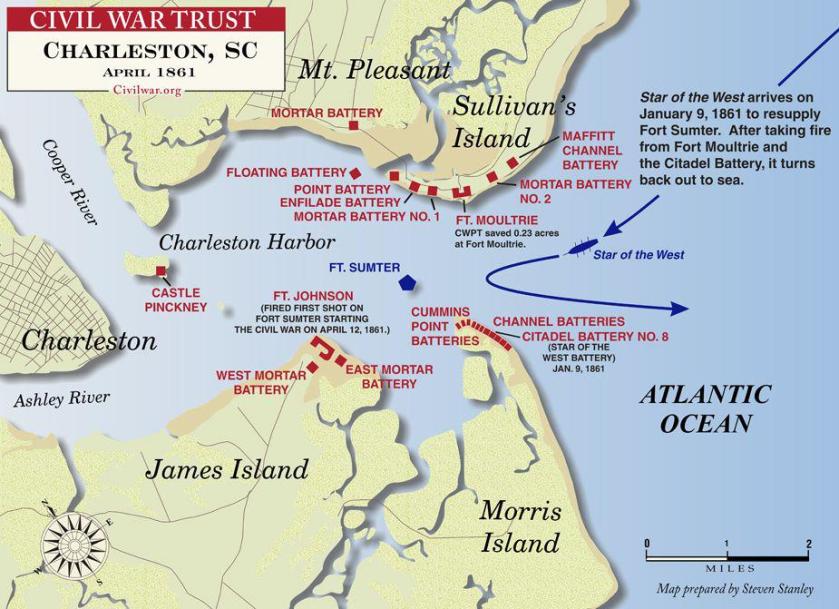
The war between the states would end the lives of more Americans than the Revolution, WWI, WWII, and the wars in Korea, Vietnam, Iraq and Afghanistan, combined.

Charleston, 1861


April 11, 1970  Houston, We’ve had a Problem

For four days and nights, the three-man crew lived aboard the cramped, freezing Aquarius, a landing module intended to support a crew of 2 for only 1½ days

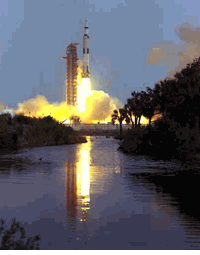
Apollo 13 liftoffJack Swigert was supposed to be the backup pilot for the Command Module, (CM), officially joining the Apollo 13 mission only 48 hours earlier, when prime crew member Ken Mattingly was exposed to German measles. Jim Lovell was the world’s most traveled astronaut, a veteran of two Gemini missions and Apollo 8. By launch day, April 11, 1970, Lovell had racked up 572 space flight hours. For Fred Haise, former backup crew member on Apollo 8 and 11, this would be his first spaceflight.
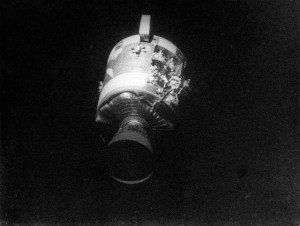
The seventh manned mission in the Apollo space program was intended to be the third moon landing, launching at 13:13 central standard time, from the Kennedy Space Center in Florida.

The Apollo spacecraft comprised two separate vessels, separated by an airtight hatch. The crew lived in the Command/Service module, called “Odyssey”.  The Landing Module (LM) “Aquarius”, would perform the actual moon landing.

Apollo 13 Schematic

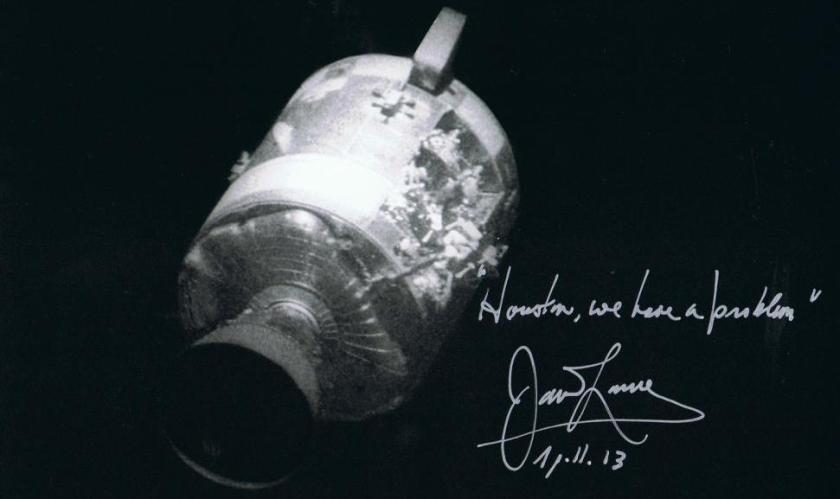
56 hours into the mission and 5½ hours from the Moon’s sphere of gravitational influence, Apollo crew members had just finished a live TV broadcast.  Haise was powering the LM down while Lovell stowed the TV camera.  Mission Control asked Swigert to activate stirring fans in the SM hydrogen and oxygen tank. Two minutes later, the astronauts heard a “loud bang”.

Spacecraft manufacturing and testing had both missed an exposed wire in an oxygen tank.  When Swigert flipped the switch for that routine procedure, a spark set the oxygen tank on fire. Alarm lights lit up all over Odyssey and in Mission Control.  The spacecraft shuddered as one oxygen tank tore itself apart and damaged another.  Power began to fluctuate.  Attitude control thrusters fired, and communications temporarily went dark. The crew could not have known it at the time, but the entire Sector 4 panel had just blown off.apollo-13-damage

The movie takes creative license with Commander James Lovell saying “Houston, we have a problem”.  On board the real Apollo 13 it was Jack Swigert who spoke, saying “Houston, we’ve had a problem”.

205,000 miles into deep space with life support systems shutting down, the Lunar Module became the only means of survival. There was no telling if the explosion had damaged Odyssey’s heat shields, but it didn’t matter. For now, the challenge was to remain, alive.  Haise and Lovell frantically worked to boot up Aquarius, while Swigert shut down systems aboard Odyssey, in order to preserve power for splashdown.

Apollo_13-insigniaThis situation had been suggested during an earlier training simulation, but had been considered unlikely. As it happened, the accident would have been fatal without access to the Lunar Module.

For four days and nights, the three-man crew lived aboard the cramped, freezing Aquarius, a landing module intended to support a crew of 2 for only 1½ days. Heat fell close to freezing and food became inedible, as mission control teams, spacecraft manufacturers and the crew itself worked around the clock to jury rig life support, navigational and propulsion systems.  This “lifeboat” would have to do what it was never intended to do.

Atmospheric re-entry alone, presented almost insurmountable challenges. The earth’s atmosphere is a dense fluid medium. If you reenter at too steep an angle, you may as well be jumping off a high bridge. As it is, the human frame can withstand deceleration forces no higher than 12 Gs, equivalent to 12 individuals identical to yourself, piled on top of you.  Even at that, you’re only going to survive a few minutes, at best.

Apollo_13_Prime_Crew
Left to right: Commander, James A. Lovell Jr., Command Module pilot, John L. Swigert Jr., Lunar Module pilot, Fred W. Haise Jr.

We all know what it is to skip a stone off the surface of a pond.  If you hit the atmosphere at too shallow an angle, the result is identical. There is no coming down a second time. You get one bounce and then nothing but the black void of space.

For four days, most of the country and much of the world held its breath, waiting for the latest update from newspaper and television news.  With communications down, TV commentators used models and illustrations, to describe the unfolding drama.  Onboard Odyssey, power was so low that voice-only transmissions became difficult. Visual communications with Mission Control were as impossible, as the idea that the stranded astronauts could walk home.

As Odyssey neared earth, engineers and crew jury-rigged a means of jettisoning the spent Service Module, to create enough separation for safe re-entry.Apollo_13_timeline

One last problem to be solved, was the crew’s final transfer from Lunar Module back to Command Module, prior to re-entry.  With the “reaction control system” dead, University of Toronto engineers had only slide rules and six hours, in which to devise a way to “blow” the LM, by pressurizing the tunnel connecting it with the CM.  Too much pressure might damage the hatch and its seal, too little wouldn’t provide enough separation between the two bodies.  The result of either failure, would have been identical to that of the “shooting stars”, you see at night.

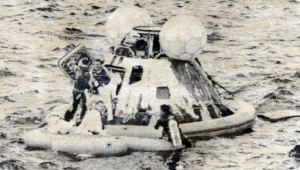
Apollo 13 after it came back to Earth.

By this time the Command Module had been in “cold soak” for days.  No one even knew for certain, if the thing would come back to life.

Crashing into the atmosphere at over 24,000mph, the capsule had 14 minutes in which to come to a full stop, splashing down in the waters of the Pacific Ocean. External temperatures on the CM reached 2,691° F, as the kinetic energy of re-entry was converted to heat.

The Apollo 13 mission ended safely with splashdown southeast of American Samoa on April 17, 1970, at 18:07:41 local time.  Exhausted and hungry, the entire crew had lost weight.  Haise had developed a kidney infection.  Total duration was 142 hours, 54 minutes and 41 seconds.

apollo-13-problem

April 8, 1740, War of Jenkin’s Ear

In the smoke and confusion, the Spanish never did figure out how puny the forces were who opposed them

A series of escalating trade disputes had already taken place between British and Spanish forces, when the Spanish patrol boat La Isabela drew alongside the British brig Rebecca in 1731. After boarding, Commander Juan de León Fandiño accused the British commander of smuggling.  The discussion became heated, when Fandiño drew his sword and cut the left ear off of Captain Robert Jenkins.  “Go, and tell your King that I will do the same”, he said, “if he dares to do the same.”jenkins-ear-1

Seven years later, Jenkins was ordered to testify before Parliament where, according to some accounts, he produced the severed ear in a pickling jar, as part of his presentation. This and other incidents of “Spanish Depredations upon the British Subjects” were considered insults to the honor of the British nation and a provocation to war.

A squadron of three 70-gun British third-rates was patrolling off the coast of Cornwall on April 8, 1740, when a mast was sighted to the north.  What at first appeared to be a French vessel was revealed to be the 70 gun ship-of-the-line Princesa, when she struck her French colors and hoist the Spanish flag.  Outnumbered 3-to-1, Princesa put up a good fight, but the issue was never in doubt.  She was brought into Portsmouth for repairs, entering British service as HMS Princess in 1742.  What had once been described as “the finest ship in the Spanish Navy”, would serve Her Britannic Majesty for another 42 years.Princesa

For the future Georgia colony, the War of Jenkins Ear was an existential threat.  Spain had laid claim to Florida, when Ponce de Leon first mapped the territory in 1513.  The territory which later became North & South Carolina joined the British Colonies to the north in 1663, leaving the areas in-between in dispute.  James Oglethorpe founded the 13th colony of Georgia as a buffer to Spanish incursion, two years after Mr. Jenkins lost his ear. Battle of Bloody Marsh (Model)

By 1736, Oglethorpe established Fort Frederica on the barrier island of St. Simon, off the Savannah coast.  The Spanish landing force of 4,500 to 5,000 men arrived on St. Simon’s Island in July of 1742, opposed by only 950 British Rangers, Colonial Militia and Indian Allies.

Oglethorpe’s forces attacked a Spanish reconnaissance in force at the Battle of Gully Hole Creek in the early morning hours of July 7, followed by the ambush of a much larger force that afternoon, in what would be known as the Battle of Bloody Marsh.  In the smoke and confusion, the Spanish never did figure out how puny the forces were who opposed them.  These two victories were as big a boost to British morale as they were a blow to that of their adversary.  The last major Spanish offensive into Georgia ended with a complete withdrawal, a week later.

GullyHoleCreekSign

The conflict which began in 1739 ended in 1748, though major operations ceased in 1742 when the War of Jenkins Ear was subsumed by the greater War of Austrian Succession, involving most of the major powers of Europe at that time. Peace arrived with the Treaty of Aix-la-Chapelle in 1748.