August 24, 1814 Washington is Burning

The only bright spot for the American side that day, came when Commodore Joshua Barney lead 520 seamen in a downhill charge, against a vastly superior British force. Barney took a bullet to the thigh and was captured by the British, who paroled him on the spot. Rear Admiral Sir George Cockburn was impressed with the American sailor’s show of courage, saying “They have given us the only fighting we have had.”

In the early years of the nineteenth century, Napoleon Bonaparte and his Grande Armée kept his Britannic Majesty’s armed forces pretty well occupied.  In the former American colonies, the first two years of the War of 1812 were little more than a series of skirmishes.

washingtonsack1The Corsican’s defeat at Waterloo and subsequent exile to Elba freed up some of the most elite, battle hardened troops in the world.
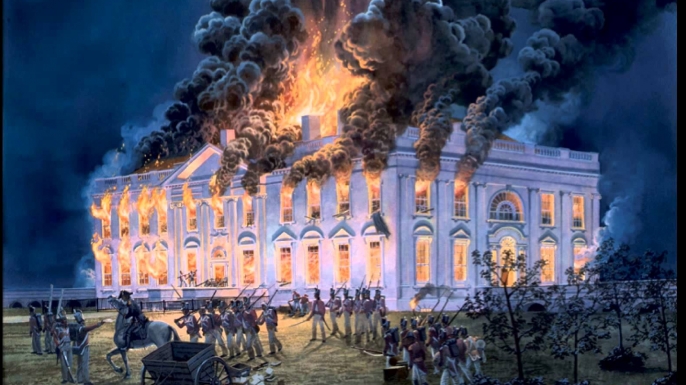
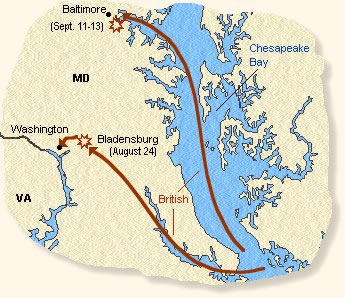
On the morning of August 24, 1814, 4,370 of them were moving up the Chesapeake, toward Baltimore.

They were met by an inexperienced and poorly equipped militia force of some 6,000 American forces at Bladensburg, Maryland, whose comprehensive defeat and humiliating rout went into the history books as the “Bladensburg Races”.  President James Madison and most of the federal government were present at the battle, and nearly captured. American militia members fled through the streets of Washington, while every politician from President Madison down to Freshman Members of Congress skedaddled across the countrysides of Maryland and Virginia.

The only bright spot for the American side that day, occurred when Commodore Joshua Barney lead 520 seamen in a downhill charge against vastly superior British forces. Barney took a bullet to the thigh and was captured by the British.  Rear Admiral Sir George Cockburn was so impressed with the American sailor’s show of courage that he paroled the man on the spot, saying “They have given us the only fighting we have had.”

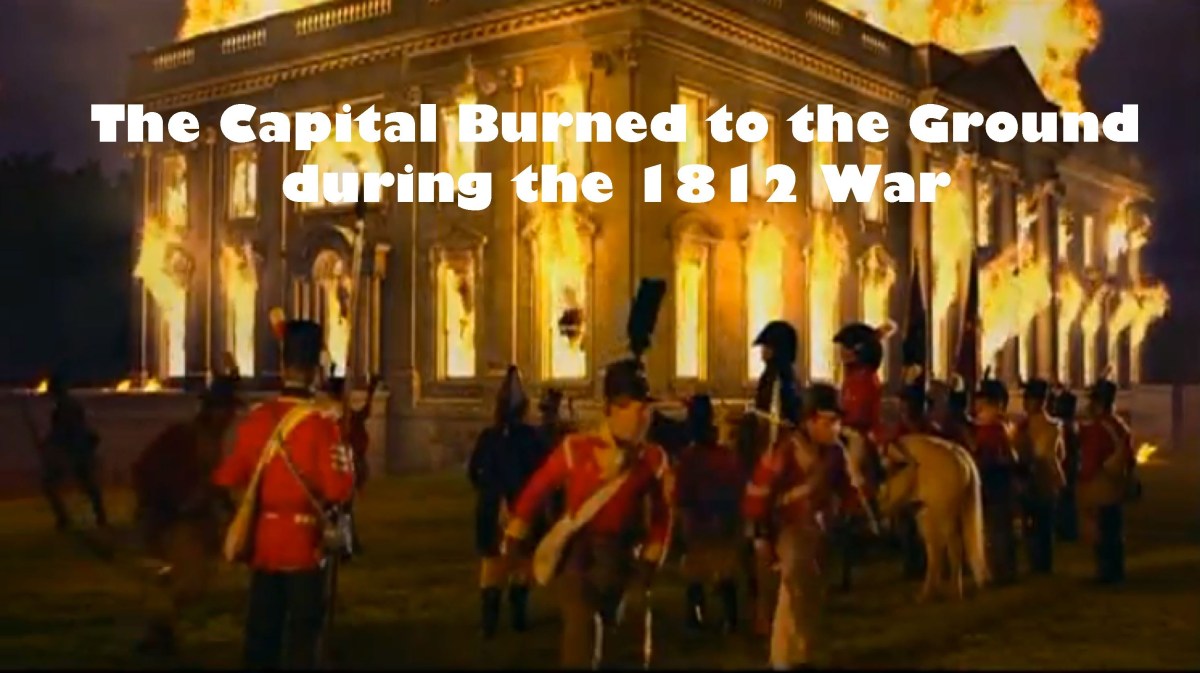
The British sent an advance guard of soldiers to Capitol Hill under flag of truce, intending to discuss terms of surrender. The column was attacked by the occupants of a single house at the corner of Maryland & Constitution Ave., the only resistance the redcoats would see in the city. The house was burned, and the British raised the Union Jack over Washington DC.  Then they commenced to burn every government building they could find.

Dolley-Madison-directing-rescue-of-George-Washington-portrait-631

The Senate and House of Representatives buildings were the first to burn, along with the Library of Congress and Supreme Court, which at that time were located inside.  The Treasury building was next, though British hopes were disappointed to find there was no money inside.

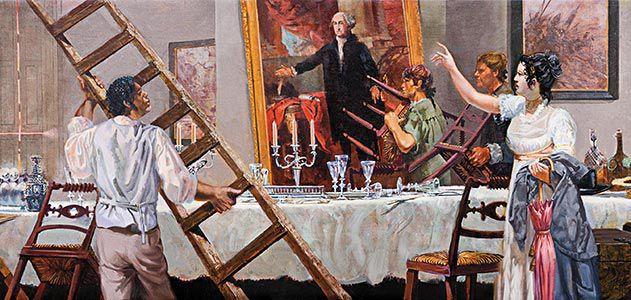
First Lady Dolley Madison barely had time to gather up some precious objects, ordering White House staff to remove the portrait of George Washington before the “President’s House”, as the White House was then called, was overrun. The table was set for President Madison and a party of 40 at the time, the wine still cooling on a sideboard when the British set the White House of it’s day, on fire.  All night they added fuel to the flames, just to keep it going.

British burn the White House

Portraits of King George III and his wife Queen Charlotte Sophia were discovered in one public building, and taken down before that building too, was burned.  The two portraits made their way halfway across the Atlantic to Bermuda, where they hang in the Parliament building, to this day.

The Washington Navy Yard was torched the following day, along with departments of State, War and Navy.  Admiral Cockburn entered the building of the National Intelligencer newspaper intending to burn that down, too, but several women persuaded him not to.  Instead, Cockburn ordered his troops to tear the building down brick by brick.  He ordered all the “C” typeset destroyed, too, “so that the rascals can have no further means of abusing my name.”

The largest loss of life in the whole episode occurred on the afternoon of the 25th, whenWashington burning General Ross sent two hundred men to secure a fort on Greenleaf’s Point. The fort had already been destroyed by American forces, but 150 barrels of gunpowder remained. The powder ignited while the British were trying to drop it into a well, killing at least a dozen and injuring many others.

A heavy thunderstorm came up that same day, putting out many of the fires and spawning a small tornado that damaged British ships causing them to withdraw. Thomas Jefferson later sold his personal library of more than 6,000 volumes to the government, restocking the Library of Congress with his own personal collection.

The episode has been called “The greatest disgrace ever dealt to American arms”…”The most humiliating episode in American history.”  It was the only time before or since, that an enemy force has occupied our nation’s capital.

August 21, 1863 Lawrence Massacre

Quantrill’s band went through the town, systematically shooting most of the male population. The shooting, the looting and the burning went on for four hours.  Between 160 and 190 of the men and boys of Lawrence, ages 14 to 90, were murdered.  Most of them had had no means of defending themselves.

Lawrence, 1863
Lawrence, Kansas, 1863

300 to 400 riders converged outside the city of Lawrence, Kansas in the early morning hours of August 21, 1863.

They were a loose collection of independent bushwacker groups, pro-slavery and nominally Confederate, though they were part of no command and control structure.

This was a civilian group operating outside of the Confederate chain of command, more of a gang of criminal outlaws than a military operation.  There was Cole Younger and Frank James, Jesse’s older brother. There was William T. “Bloody Bill” Anderson, whose men were known for tying the scalps of slain Unionists to the saddles and bridles of their horses. Leading the group was a 27 year old former schoolteacher from Ohio:  William Clarke Quantrill.Lawrence Kansas

Lawrence, Kansas was mostly asleep as several columns of riders descended on the town. It was 5:00am and pitch dark, as most of the city of 3,000 awoke to the sound of pounding hooves.

Doors were smashed in amid the sounds of gunshots and screams. Quantrill’s band went through the town, systematically shooting most of the male population. The shooting, the looting and the burning went on for four hours.  Between 160 and 190 of the men and boys of Lawrence, ages 14 to 90, were murdered.  Most of them had had no means of defending themselves.

Quantrill's Raid Stone (N.H. Street)
Quantrill’s Raid Memorial Stone on New Hampshire Street

Intending to deprive Confederate sympathizers from their base of support, General Thomas Ewing authorized General Order No. 11 four days later, ordering that most of four counties along the Kansas-Missouri border be depopulated. Tens of thousands of civilians were forced out of their homes as Union troops came through, burning buildings, torching fields and shooting livestock.

The area was so thoroughly devastated that it would forever be known as the “Burnt District”.

Burnt_district_monumentQuantrill fled to Texas after the raid on Lawrence, and was later killed in a Union ambush near Taylorsville, Kentucky. His band broke up into several smaller groups, with some joining the Confederate army.

Others such as Frank and Jesse James and the Younger brothers, went on to apply the hit and run tactics they had learned from Quantrill’s band to a career of bank and train robberies.

Quantrill himself said that the raid was retribution for the 1861 “Jayhawker” raid of Colonel Charles “Doc” Jennison and Senator James H. Lane, that left 9 dead in Osceola, Missouri and acres of so-called “Jennison Monuments”, the two story brick chimneys that were all that remained of the burned out homes of Union and Confederate sympathizers alike.

Others blamed the raid on the collapse of a makeshift jail in Kansas City that killed several female relatives of the raiders. It seems more likely that it was just one more in a series of homicidal raids carried out by both sides:  such raids usually resulting in the death of innocents.

Newspaper articles appeared in Canada in August 1907 that Quantrill was still alive, living on Vancouver Island under the name of John Sharp. It was probably an unfortunate fib on Mr. Sharp’s part.  Two men traveled to Canada for the express purpose of beating Mr. Sharp to death, which they did as soon as they could locate him. The crime has never been solved.

August 20, 1938 Lucky Man

Lou Gehrig collapsed in 1939 spring training, going into an abrupt decline early in the season. Sports reporter James Kahn wrote: “I think there is something wrong with him. Physically wrong, I mean.  I don’t know what it is, but I am satisfied that it goes far beyond his ball-playing”.

The Lane Tech High school baseball team was at home on June 26, 1920.  10,000 spectators had assembled to watch the game at Cubs Park, now Wrigley Field.  New York’s Commerce High was ahead 8–6 in the top of the 9th, when a left handed batter hit a grand slam out of the park.  No 17-year-old had ever hit a baseball out of a major league park before, and I don’t believe it’s happened, since. It was the first time the country heard the name Lou Gehrig.

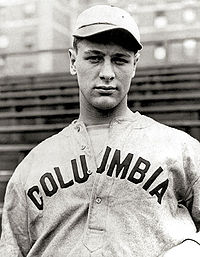
GehrigCUGehrig was pitching for Columbia University against Williams College on April 18, 1923, the day that Babe Ruth hit the first home run out of the brand new Yankee Stadium. Though Columbia would lose the game, Gehrig struck out seventeen batters to set a team record. The loss didn’t matter to Paul Krichell, the Yankee scout who had been following Gehrig. Krichell didn’t care about the arm either, as much as he did that powerful left-handed bat. He had seen Gehrig hit some of the longest home runs ever seen on several Eastern campuses, including a 450′ home run at Columbia’s South Field that cleared the stands, landing at 116th Street and Broadway.
NY Giants manager John McGraw persuaded a young Gehrig to play pro ball under a false name, Henry Lewis, despite the fact that it could jeopardize his collegiate sports eligibility. He played only a dozen games for the Hartford Senators before being found out, and suspended for a time from college ball. This period, and a couple of brief stints in the minor leagues in the ’23 and ’24 seasons, were the only times Gehrig didn’t play for a New York team.

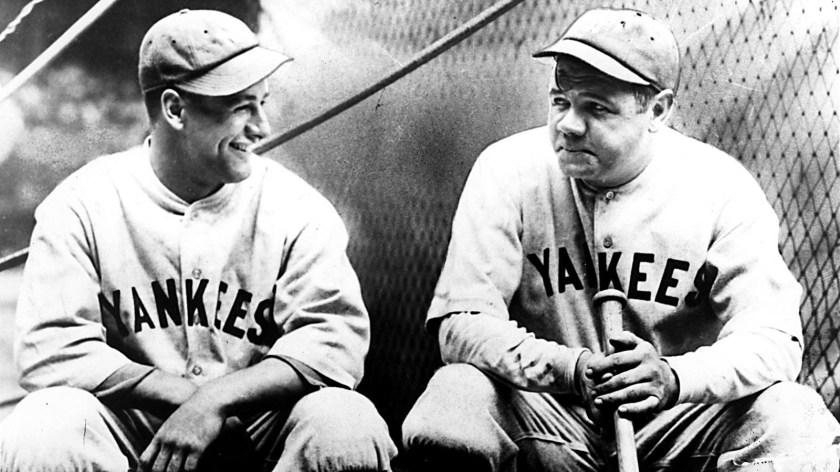
Gehrig started as a pinch hitter with the NY Yankees on June 15, 1923. He came into his own in the ‘26 season, in 1927 he batted fourth on “Murderers’ Row”; the first six hitters in the Yankee’s batting order: Earle Combs, Mark Koenig, Babe Ruth, Lou Gehrig, Bob Meusel and Tony Lazzeri.

Murderers--Row

He had one of the greatest seasons of any batter in history that year, hitting .373, with 218 hits: 52 doubles, 18 triples, 47 home runs, a then-record 175 RBIs, with a .765 slugging percentage. Gehrig’s bat helped the 1927 Yankees to a 110–44 record, the American League pennant, and a four game World Series sweep of the Pittsburgh Pirates.

Gehrig was the “Iron Horse”, playing in more consecutive games than any player in history. It was an “unbreakable” record, standing for 56 years, until surpassed in 1995 by Cal Ripken, Jr. Gehrig hit his 23rd and last major league grand slam on August 20 1938, a record that would stand until fellow Yankee Alex Rodriquez tied it in 2012.

Ruth, Gehrig

Lou Gehrig collapsed in 1939 spring training, going into an abrupt decline early in the season. Sports reporter James Kahn wrote: “I think there is something wrong with him. Physically wrong, I mean.  I don’t know what it is, but I am satisfied that it goes far beyond his ball-playing”.

The team was in Detroit on May 2 when Gehrig told manager Joe McCarthy “I’m benching myself, Joe”.  It’s “for the good of the team”.  McCarthy put Babe Dahlgren in at first and the Yankees won 22-2, but that was it.  The Iron Horse’s streak of 2,130 consecutive games, had come to an end.

Yankees Tigers Gehrig Ends StreakGehrig left the team in June, arriving at the Mayo Clinic on the 13th. The diagnosis of Amyotrophic Lateral Sclerosis (ALS) was confirmed six days later, on June 19.  It was his 36th birthday.  It was a cruel prognosis: rapidly increasing paralysis, difficulty in swallowing and speaking, and a life expectancy of fewer than three years.
Gehrig briefly rejoined the Yankees in Washington, D.C. He was greeted by a group of Boy Scouts at Union Station, happily waving and wishing him luck. Gehrig waved back, but he leaned forward to a reporter. “They’re wishing me luck”, he said, “and I’m dying.”

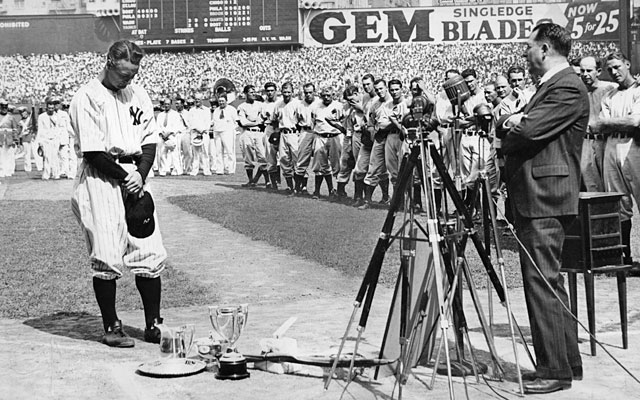
The Iron Horse appeared at Yankee Stadium on “Lou Gehrig Appreciation Day”, July 4, 1939.  Gehrig was awarded a series of trophies and other tokens of affection by the New York sports media, fellow players and groundskeepers.  He would place each one on the ground, already too weak to hold them up.   Addressing his fans, Lou Gehrig then described himself as “The Luckiest Man on the Face of the Earth”.

Lou Gehrig Appreciation Day

Henry Louis Gehrig died on June 2, 1941, at the age 37.

I drove by Yankee Stadium a while back, and thought of Lou Gehrig. It was right after the Boston Marathon bombing. The sign out front said “United we Stand”. With it was a giant Red Sox logo. That night, thousands of Yankees fans interrupted a game with the Arizona Diamondbacks, to belt out Neil Diamond’s Sweet Caroline, a staple of Red Sox home games since 1997.

I’ve always been a Boston guy myself, I think I’m required by Massachusetts state law to hate the Yankees. But seriously, what a Class Act.

August 18, 1587 Lost Colony of Roanoke

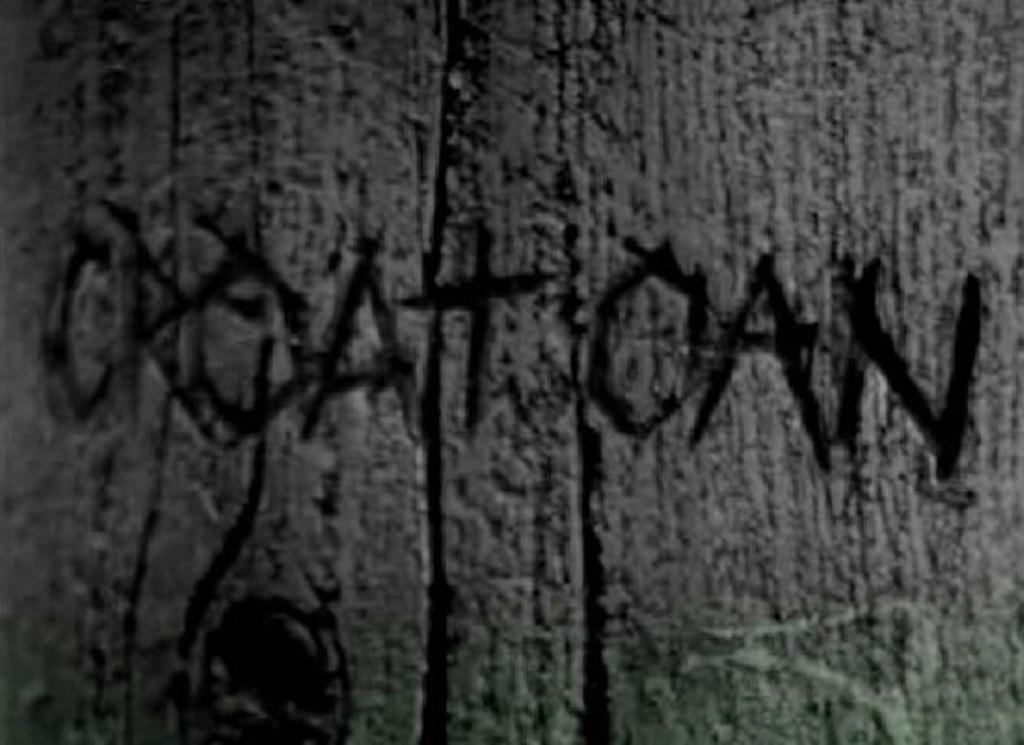
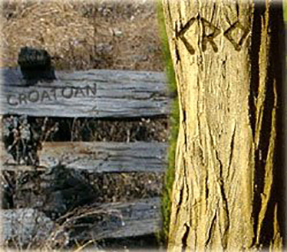
John White returned on August 18, 1590, three years to the day from the birth of his granddaughter. He found the place deserted, only the word “CROATOAN” carved into a fence post, and the letters “CRO” on a nearby tree.

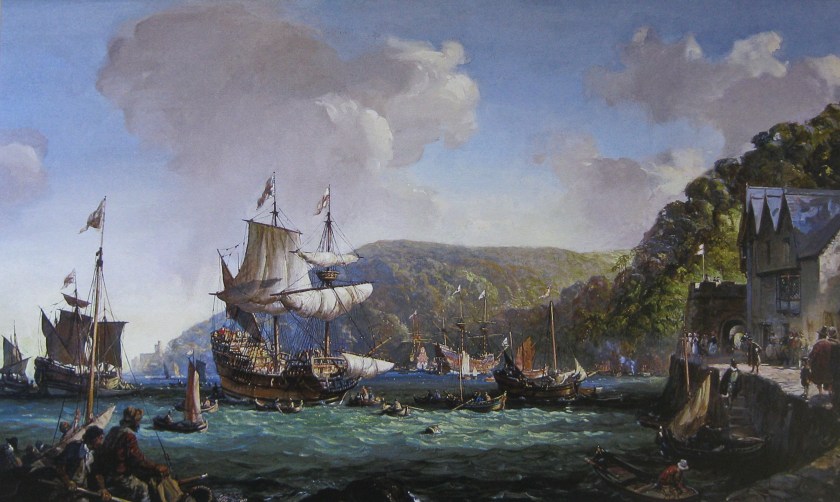
The 16th century was drawing to a close when Queen Elizabeth set out to establish a permanent English settlement in the New World. The charter went to Walter Raleigh, who sent explorers Philip Amadas and Arthur Barlowe to scout out locations for a settlement.

The pair landed on Roanoke Island on July 4, 1584, establishing friendly relations with local natives, the Secotans and Croatans. They returned a year later with glowing reports of what is now the Outer Banks of North Carolina. Two Native Croatans, Manteo and Wanchese, accompanied the pair back to England. All of London was abuzz with the wonders of the New World.

Sir Walter Raleigh (?)
Explorer Sir Walter Raleigh

Queen Elizabeth was so pleased that she knighted Raleigh.  The new land was called “Virginia” in honor of the Virgin Queen.

Raleigh sent a party of 100 soldiers, miners and scientists to Roanoke Island, under the leadership of Captain Ralph Lane. The attempt was doomed from the start. They arrived too late in the season for planting, and Lane alienated the neighboring tribe when he murdered their chief, Wingina. By 1586 they had had enough, and left the island.

Ironically, their supply ship arrived about a week later. Finding the island deserted, that ship left 15 men behind to “hold the fort” before they too, departed.

The now knighted “Sir” Walter Raleigh was not deterred. He recruited 90 men, 17 women and 9 children for a more permanent “Cittie of Raleigh”, appointing John White governor. Among the colonists were White’s pregnant daughter, Eleanor, her husband Ananias Dare, and the Croatans Wanchese and Manteo.

Wanchese, Manteo
Wanchese, Manteo

The caravan stopped at Roanoke Island in July, 1587, to check on the 15 men left behind a year earlier.  Raleigh believed that the Chesapeake afforded better opportunities for his new settlement, but his Portuguese pilot Simon Fernandes had other ideas.

Fernandes was a Privateer, impatient to resume his hunt for Spanish shipping.  He ordered the colonists ashore on Roanoke Island. It could not have lifted the spirits of the small group to learn that the 15 left there by the earlier expedition, had disappeared.

Eleanor Dare gave birth to a daughter on August 18, 1587, and called her Virginia.  The first English child born to the new world.

Fernandez departed for England ten days later, taking along an anxious John White, who wanted to return to England for supplies. It was the last time Governor White would see his family.

croatoan(2)White found himself trapped in England by the invasion of the Spanish Armada, and the Anglo-Spanish war.  It would be three years before he could return to Roanoke. He arrived on August 18, 1590, three years to the day from the birth of his granddaughter. He found the place deserted, only the word “CROATOAN” carved into a fence post.  The letters “CRO” were carved into a nearby tree.
croatoan(1)White had hopes of finding his family at Croatoan, the home of Chief Manteo’s people to the south, on modern day Hatteras Island.
A hurricane came up before he could explore further, his ships so damaged that he had return to England. Despite several attempts, he was never able to raise the resources to return.

What happened to the lost colonists of Roanoke, remains a mystery. They may have died of disease or starvation, or they may have been killed by hostile natives.

Perhaps they went to live with Chief Manteo’s people, after all. One of the wilder legends has Virginia Dare, now a young woman, transformed into a snow white doe by the evil medicine man, Chico, but that’s a story for another day.  The fate of the first English child born on American soil may never be known.

white-deerSeventeen years later, another group of colonists would apply the lessons learned in Roanoke, founding their own colony a few miles up the coast at a place called Jamestown.

A personal anecdote involves a conversation I had with a woman in High Point, North Carolina, a few years back. She described herself as having Croatan ancestry, her family going back many generations on the outer banks of North Carolina. She described her Great Grandmother, a full blooded Croatan. The woman looked like it, too, except for her crystal blue eyes. She used to smile at the idea of the lost colony of Roanoke. “They’re not lost”, she would say. “They are us”.

August 15, 1620 Pilgrims

There is a common misconception that the Pilgrims settled in Plymouth in pursuit of religious freedom, but that’s not the way it happened.  They had found their religious liberty in Holland.  What they sought in the New World, was a return to religious discipline.

In 16th century Tudor England, there was widespread belief that authority over the Church belonged with the monarchy, and not with Rome.  England broke with the Catholic Church over the Pope’s refusal to grant Henry VIII a divorce from Catherine of Aragon, the youngest surviving child of Ferdinand and Isabella, in 1533.

Strict conformity with the English, (Anglican) church, was enforced throughout the 16th and 17th centuries, when separatist groups were suppressed. The Puritans were one such group, though they maintained ties with the Anglican. Other separatist groups had irreconcilable differences with the Church of England, believing that worship should be organized independently of the trappings, traditions and organization of the central church.

Tobias Matthew was elected Anglican Archbishop in 1606, and promptly began a campaign to purge the archdiocese of nonconforming influences. Separatists and those wishing to return to the Catholic faith alike were confronted, fined, and imprisoned.  Many “recusants” were driven from the country.

William Bradford, the future 5-time Governor of the Plymouth Colony and signer of the Mayflower Compact, said of this period “[A]fter these things they could not long continue in any peaceable condition, but were hunted & persecuted on every side, so as their former afflictions were but as flea-bitings in comparison of these which now came upon them. For some were taken & clapt up in prison, others had their houses besett & watcht night and day, & hardly escaped their hands; and ye most were faine to flie & leave their howses & habitations, and the means of their livelehood“.

So it was that the group which came to be known as the Pilgrims left England not for the New World, but for Amsterdam, and later the city of Leiden, in the Netherlands.   There they stayed for 13 years.Pilgrims Voyage

By 1617, Bradford was writing of his concern that the younger members of the group were being “drawn away by evil examples into extravagance and dangerous courses“. He wrote positive terms of the “great hope for the propagating and advancing the gospell of the kingdom of Christ in those remote parts of the world.”

They considered moving to Virginia, near the existing settlement of Jamestown, but dismissed the idea out of fear that the political atmosphere might be too much like the one they left in England.

Mayflower and Speedwell in Dartmouth

A land grant was obtained to the north of the existing Virginia territory, to be called New England. The 60-ton Speedwell departed Delfshaven with the Leiden colonists in July 1620, meeting with Mayflower at Southampton, Hampshire. The two vessels set out on August 15, but soon had to turn back as the Speedwell took on water. Speedwell was abandoned after the second failed attempt, Mayflower setting out alone on September 16, 1620, with 121 on board.

pilgrims65 days at sea brought them up on the outer reaches of Cape Cod in mid-November, near the present site of Provincetown Harbor.   There they stayed long enough to draw up the first written framework of government established in the United States, signing the Mayflower Compact off the shores of Provincetown on November 11, 1620.
A month in that place convinced them of its unsuitability.  By mid-December they had crossed Cape Cod Bay and fetched up at Plymouth Harbor.

More than half of these settlers died that first winter, of malnutrition and exposure.

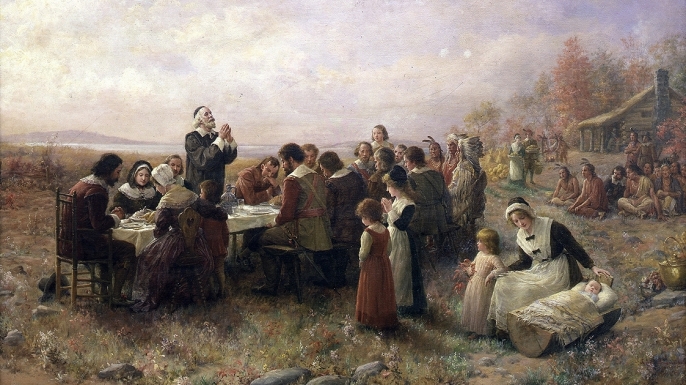
Tisquantum, (Squanto), the English-speaking Pawtuxet, would mediate between the settlers and the native tribes, including Massasoit, chief of the Pokanoket.  Squanto taught them how to plant corn, as well as where to fish and how to hunt beaver.  The harvest feast of 1621, shared between the Pilgrims and the Pokanokets, is now considered the basis for our own Thanksgiving holiday, but that is a story for another day.Pilgrims Thanksgiving

Bradford and the other Plymouth settlers referred to themselves as “Old Comers.”  A manuscript was later discovered, in which Bradford called the settlers who left Holland “Saints” and “Pilgrimes.” 200 years after the colony’s founding, Daniel Webster referred to “Pilgrim Fathers” in a bicentennial address.  The name stuck.

There is a common misconception that the Pilgrims settled in Plymouth in pursuit of religious freedom, but that’s not the way it happened.  They had found their religious liberty in Holland.  What they sought in the New World, was a return to religious discipline.

August 14, 1945 A Kiss in Times Square

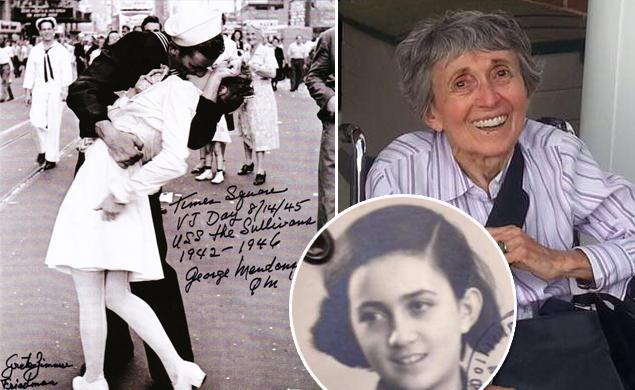
The lit message running around the Times Building read, “VJ, VJ, VJ, VJ” as George Mendonsa grabbed a stranger and kissed her. Two seconds later the moment was gone, but Alfred Eisenstaedt and his camera had been in the right place at the right time.

The most destructive war in history ended this day in 1945, with the unconditional surrender of the Empire of Japan.

It was morning on the East Coast.  President Harry Truman had not yet received the formal surrender. The White House official announcement was still hours away, but rumors had been flying since the early morning hours.

Born and raised in Austria, Greta Zimmer was 16 in 1939. Seeing the war bearing down on them, Greta’s parents sent her and her two sisters to America, not knowing if they would ever see them again. Six years later she was a dental assistant, working at the Manhattan office of Dr. J. L. Berke.

Greta’s lunch break came just after 1:00 that day.  Patients had been coming into the office all morning with rumors that the war was over. She set out for Times Square, knowing that the lit and moving type on the Times news zipper would give her the latest news.

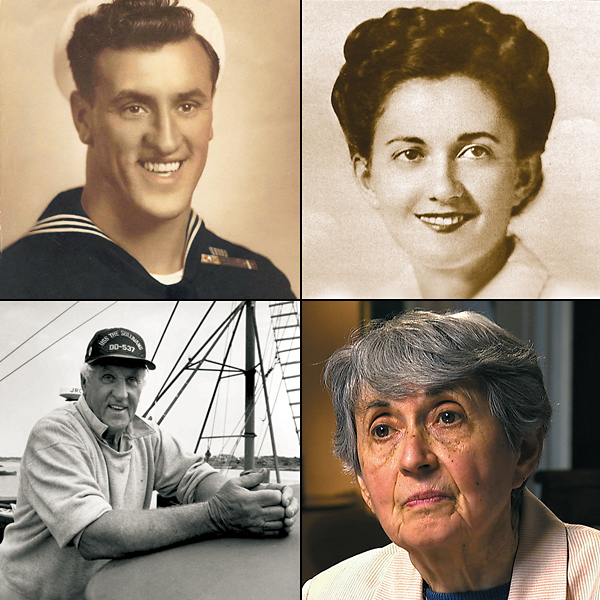
Mendonsa, Zimmer
George Mendonsa, Greta Zimmer-Friedman

Petty Officer 1st Class George Mendonsa was on his last day of shore leave, spending the day with his new girlfriend, Rita Petry. They had heard the rumors too, but right now they were enjoying their last day together. The war could wait until tomorrow.

The couple went to a movie at Radio City Music Hall, but the film was interrupted by a theater employee who turned on the lights, announcing that the war was over. Leaving the theater, the couple joined the tide of humanity moving toward Times Square. The pair stopped at the Childs Restaurant on 7th Ave & 49th, where bartenders were pouring anything they could get hands on into waiting glasses.  Revelers were scooping them up as fast as the glasses were filled.

Mendonsa’s alcohol-powered walk/run from the restaurant left Rita trailing behind, but neither one seemed to mind. Times Square was going wild.

The sailor from the USS Sullivans had seen bloodshed. He’d been there on May 11, as kamikaze planes smashed into the USS Bunker Hill.  Explosions and fires killed 346 sailors that day.  43 of their bodies would never be found. Mendonsa had helped to pull the survivors, some of them hideously burned, out of the water. He had watched while Navy nurses tended to the injured and the dying.

When the sailor spotted Greta Zimmer, the dental assistant was dressed the same way.  To him, she must have seemed like one of those white-clad angels of mercy from those earlier months.

kiss-in-times-square-leica-2Reporters from the AP, NY Times, NY Daily News and others descended on Times Square to record the spontaneous celebration.
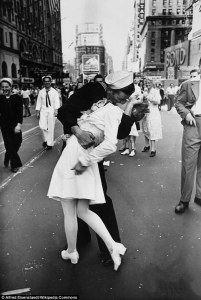
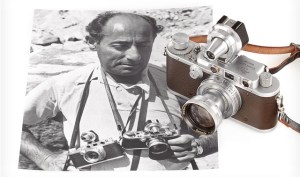
As a German Jew in the 1930s, Alfred Eisenstaedt had photographed the coming storm. He had photographed Benito Mussolini’s first meeting with Adolf Hitler in Venice in 1934. Now he and his Leica Illa rangefinder camera worked for Life Magazine, heading to Times Square in search of “The Picture”.

The lit message running around the Times Building read, “VJ, VJ, VJ, VJ” as George Mendonsa grabbed a stranger and kissed her. Two seconds later the moment was gone, but Eisenstaedt and his camera had been in the right place at the right time.Times Square Kiss

The image of the sailor kissing the nurse would become as famous as Joe Rosenthal’s photo of the flag raising at Iwo Jima, but not until years later.

The German made camera which took the iconic image recently went to auction at the Westlicht auction house in Vienna, where it was expected to sell for $30,000. The winning bid was almost $150,000.

After the war, Greta Zimmer learned that both of her parents had died in the camps. She later married and made her home in Frederick, Maryland.  Greta Zimmer Friedman never returned to Austria, and passed away last September, at the age of 92.

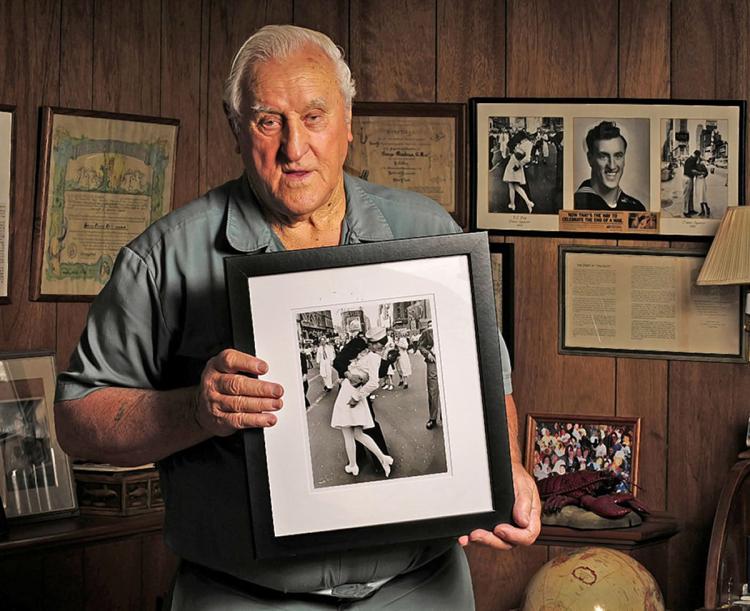
George Mendonsa and Rita Petry later married. George never saw the famous photograph until 1980.  At first he wasn’t sure he recognized himself.  Today, framed copies of it hang on the wall of their Rhode Island home.

MendonsaThis year, the couple celebrates their 68th wedding anniversary.  Rita says she wasn’t angry that her husband kissed another woman on their first date.  She points out that she can been seen grinning in the background of the famous picture.  She will admit, however, ‘In all these years, George has never kissed me like that.’

August 12, 1944 Operation Aphrodite

Kennedy and Willy remained aboard as BQ-8 completed its first remote controlled turn at 2,000′, near the North Sea coast. They removed the safety pin arming the explosive, Kennedy sending the code “Spade Flush”, to signal the task was complete. They were his last words.

The Normandy landings were two months in the past in August 1944, with yet another 9 months of hard fighting to go before the defeat of Nazi Germany.

Allied strategic bombing was having little effect on German submarine pens and rocket launch sites. Operations “Aphrodite” and “Anvil” were supposed to help. The idea was to load old Boeing B-17 Flying Fortresses and B-24 Liberator bombers with tons of explosives, fly it via radio control, and crash it directly onto a target.

The drone was to fly at 2,000′ with the controlling aircraft directing the flying bomb onto its target from 20,000′. The converted bombers required a minimum of two crew to take off and operate.  The plan was to have them bail out over the English Channel, a waiting boat picking up the two pilots while control of the drone passed to the operating aircraft.Kennedy, Aphrodite

On August 12, 1944, Lt. Joseph Patrick “Joe” Kennedy, Jr. and Lieutenant Wilford John Willy stepped into a converted B-24 Liberator, designated BQ-8. It was the seventh Aphrodite mission, and Willy had “pulled rank” on Kennedy’s usual co-pilot, Ensign James Simpson, in order to be on the mission.

Two Lockheed Ventura mother planes with radio control sets took off from RAF Fersfield at 6:00pm, followed by the BQ-8 aircraft, loaded with 21,170 lbs of Torpex, a British high explosive 50% more powerful than TNT.  Two P-38 Lightning fighters followed, as mission escort. A sixth aircraft followed the formation, a de Havilland Mosquito, come to film the operation. In an unlikely historical coincidence, the Mosquito was piloted by Colonel Elliott Roosevelt, USAAF, son of President Franklin Delano Roosevelt.

The target was the Fortress of Mimoyecques and its V-3 cannons, in the north of France.

Operation-Aphrodite-Drones-versus-V2-Rockets-4Kennedy and Willy remained aboard as BQ-8 completed its first remote controlled turn at 2,000′, near the North Sea coast. They removed the safety pin arming the explosive, Kennedy sending the code “Spade Flush”, to signal the task was complete. They were his last words. The aircraft exploded two minutes later, a shower of wreckage coming to earth near the village of Blythburgh in Suffolk, England.  A series of small fires were started and 59 buildings were damaged, but there were no casualties on the ground. The bodies of Kennedy and Willy were never recovered.

There would be fourteen such missions in total.  Only one caused damage to the intended target, and that may have been accidental. In the end, the program killed more American airmen than it did Nazis.  More damage was done to the British countryside, than to German interests.

Operation-Aphrodite-Drones-versus-V2-Rockets-5When Joseph Kennedy Jr. was born, his grandfather John F. Fitzgerald, then Mayor of Boston, said, “This child is the future President of the nation”.  He had been a delegate to the Democrat’s National Convention in 1940, and planned to run for Massachusetts’ 11th congressional district in 1946.
Kennedy could have gone home, he had already completed the 25-mission requirement, to do so.  Clearly, Joseph Kennedy Jr. had the resume, and he had the pedigree.  He showed every indication of following the path which would later lead his brother to the Presidency.  Joe Senior had already begun to lay the campaign groundwork when his son was killed.

‘What if’ histories are always tricky, but in this particular alternate universe, it seems safe to say.  A future President of the United States was killed over the Blyth Estuary.  73 years ago, today.

August 7, 1782 Purple Heart

For the first time in history, recognition for meritorious service in time of war, was available to the common soldier. George Washington personally bestowed the Badge of Merit on only three non-commissioned officers, though evidence suggests that other such awards were bestowed by subordinate officers.

Prior to the the American Revolution, European armies honored only high-ranking officers who had achieved victory in battle. There was no such honor for the common soldier.

To George Washington, the “road to glory in a patriot army and a free country is…open to all”.  General Washington’s general orders of August 7, 1782, began: “The General ever desirous to cherish virtuous ambition in his soldiers, as well as to foster and encourage every species of Military merit, directs that whenever any singularly meritorious action is performed, the author of it shall be permitted to wear on his facings over the left breast, the figure of a heart in purple cloth…”

For the first time in history, recognition for meritorious service in time of war, was available to the common soldier. George Washington personally bestowed the Badge of Merit on only three non-commissioned officers, though evidence suggests that other such awards were bestowed by subordinate officers.

The Badge of Merit fell into disuse after the Revolution, though the award was never formally abolished.

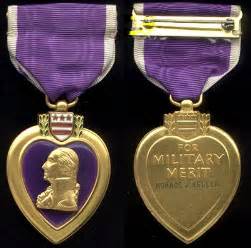
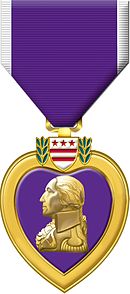
PurpleheartIn 1927, Army Chief of Staff General Charles Summerall directed that a bill be drafted and submitted to Congress, “To revive the Badge of Military Merit”.  This badge of merit came to be known as the Purple Heart. General Douglas MacArthur, Summerall’s successor, began work on a new design for the medal in 1931. Elizabeth Will, heraldic specialist with the Quartermaster General’s office, created the design we see today.
A War Department circular dated February 22, 1932 authorized the award to soldiers who had been awarded the Meritorious Service Citation Certificate, Army Wound Ribbon, or were authorized to wear Wound Chevrons on or later than April 6, 1917, the day the United States entered WWI.

At that time, the Purple Heart was awarded not only for wounds received in action against enemy forces, but also for “meritorious performance of duty”.

The first Purple Heart was awarded to Douglas MacArthur himself.

President Franklin Delano Roosevelt’s Executive Order 9277 of December 3, 1942, discontinued the award for meritorious service, and broadened service-related injury eligibility requirements to include all armed services personnel.

Following the defeat of Nazi Germany in WWII, Military planners put their minds to the invasion of Imperial Japan. Knowing nothing of the atomic bombs which would put a quick end to the war that August, authorities ordered 500,000 purple hearts. To this day, American military forces have yet to use them all up. As of 2003, 120,000 of these Purple Heart medals, remained in inventory.

On November 22, 1944, Time Magazine reported the first Purple Heart awarded to an animal.  “Chips“, a German Shepherd/Collie/Husky mix, also received the Distinguished Service Cross and Silver Star, for single “handedly” wiping out an Italian machine-gun nest, during the Allied invasion of Sicily.

Lex Purple Heart
Military Working Dog “Lex” with his (honorary) Purple Heart

William Thomas, Commander of the Order of the Purple Heart at that time, complained that giving such medals to a dog “insulted” the men who received them.

History is silent on the matter of precisely which purple recipient was thus insulted.

Accounts differ as to whether Chips was actually stripped of his medals.  Apparently, Army Adjutant General James Ulio ruled that Chips could keep them, but no more such awards would be given to dogs.  To this day, Chips remains the only “official” canine recipient of a Purple Heart.

lucca1
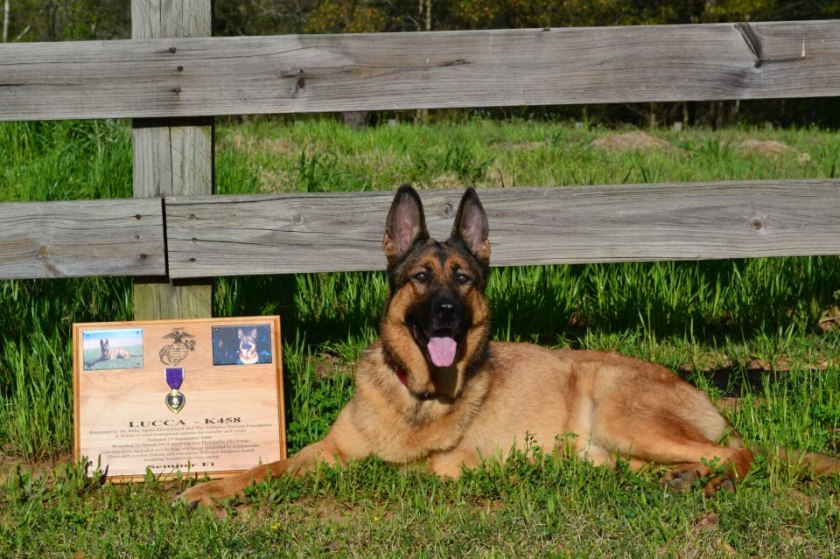
Lucca and his (honorary) Purple Heart

Lucca, a German Shepherd–Belgian Malinois mix who lost a leg to an IED in Afghanistan, received an “honorary” Purple Heart, donated by a guy who already had two.  German Shepherd “Lex” was injured in Iraq, in an incident which killed his handler, Marine Corporal Dustin J. Lee.   He too was given a medal donated by a Purple Heart recipient. Somehow, neither of those guys appear to have been insulted by the award.

August 3, 1913 Wheatland Hop Riot

Ralph Durst, one of the largest agricultural employers in Yuba County, California, advertised widely for hops pickers for the 1913 harvest season. He got 1,000 more than he needed, which had the effect of depressing already low wages.

Organized labor was a growing force in 1913 and strikes were often violent. English cigar maker Samuel Gompers had started the American Federation of Labor (AFL) almost 30 years earlier, and Upton Sinclair’s exposé on the Chicago Stockyards, “The Jungle”, had been in print for 7 years. Yet seasonal farm workers were difficult to organize. They were an unskilled and unsettled group, largely transient and until now, mostly passed over by Union organizers.

Ralph Durst, one of the largest agricultural employers in Yuba County, California, advertised widely for hops pickers for the 1913 harvest season. He got 1,000 more than he needed, which had the effect of depressing already low wages.

Hop Pickers

Sanitary conditions quickly became deplorable.  There was one toilet per 100 workers, which quickly filled up in the July heat. Fresh drinking water was scarce.  A Durst cousin selling watered down, ersatz lemonade out of a wagon for a nickel a glass did little to improve things.

The International Workers of the World, (IWW), established in 1905, was a radical socialist labor organization.  100 of Durst’s hop pickers were members. Two of them, Richard “Blackie” Ford and Herman Suhr, managed to rally a majority to their cause with speeches, songs and slogans.

Wheatland Hop Riot104 years ago today, 1,700 seasonal hops pickers gathered in the field of the Durst Hop Farm. They demanded an increase from their $1.00/100 lbs of hops picked, and they wanted better working conditions. Durst agreed to some changes, but Ford and Suhr stuck to their full list of demands and called a strike.

A mass meeting was called on the afternoon of August 3, as a succession of speakers addressed the crowd in English, German, Greek, Italian, Arabic, and Spanish. Most were in favor of a strike.  Tensions were high when Durst arrived just after 5pm with Marysville Sheriff George Voss, a number of deputies, and Yuba County District Attorney Edward Manwell, who was also Durst’s personal attorney.

The group was surrounded as a deputy fired a warning blast into the air from a shotgun, but the warning had the opposite effect from what was intended. The crowd attacked District Attorney Manwell and Deputy Sheriff Lee Anderson and began beating them. Gunfire erupted in what soon became a full-fledged riot. Deputy Sheriff Eugene Reardon and District Attorney Manweel were both killed, along with two pickers. A third lost an arm to a shotgun blast.

There were over 100 arrests in the aftermath of the riot, the prisoners beaten and starved to extract information on strike leaders. A field worker named Alfred Nelson was hauled from one county to another and held in secret locations while being sweated, starved, and beaten.  He was repeatedly threatened with death, unless he confessed to participation in the killings. The pressure was so severe that Nels Nelson, the picker who lost his arm in the shotgun blast, hanged himself in his cell. Another prisoner tried to do the same, and a third suffered a mental breakdown and had to be committed to an asylum.WheatlandHopField-600

Blackie Ford and Herman Suhr were found guilty of second-degree murder in the following trial, and sentenced to life in the state penitentiary. Two other strike leaders, Walter Bagan and William Beck, were acquitted.

The Wheatland Hop Riot was one of the first major agricultural labor confrontations in American history, but it was far from the last. Today, the site is registered as California Historical Landmark #1003.

August 1, 1794 Whiskey Rebellion

A federalized militia force of 12,950 was raised to put down what President Washington saw as armed insurrection, marching on Western Pennsylvania in October 1794.  It was a larger force than General Washington normally had under his command, during the late Revolution.

On ratification of the modern constitution in 1789, the founding fathers gazed out at what they had wrought.  What they saw, was debt.Constitution

The Continental government had been unable to levy taxes under the Articles of Confederation, the only major income source being foreign import duties. The government had borrowed money to meet expenses during this period, accumulating $54 million in debt.  The states themselves another $25 million.

Compounding the problem was the matter of runaway inflation, which had plagued the Articles of Confederation period. The colonies had printed paper currency to pay debts, as did the national government. Silver coinage remained stable due to the inherent value of the metal itself, but there was nothing behind this paper money. At one point, you could buy a single sheep for $2 “hard currency”, or $150 in paper “Continental Dollars”. To this day, you might hear the expression “worthless as a continental”.

The first Secretary of the Treasury, Alexander Hamilton, reported in his Report on Public Credit, urging Congress to consolidate state and national debt into a single debt to be funded by the federal government. Hamilton felt that existing duties were as high as they could be without depressing imports, so he recommended the first excise tax on a domestically manufactured product – whiskey.  The more meddlesome of Hamilton’s contemporaries were enthusiastically in favor of a “sin tax”, just as they are today.  The “Whiskey Act” became law on March 3, 1791.

The whiskey tax was immediately unpopular, particularly in the west where it was, for all intents and purposes, an income tax.  At a flat rate of 7¢ per gallon, the tax weighed more heavily on the western frontiers, where whiskey was sold for 50¢ a gallon.  About half what it sold for in the more established regions of the east.

Furthermore, coinage wasn’t easy to come by on the frontiers.  In many areas the medium for exchange was whiskey itself.  The stuff was popular, it’s value was relatively stable, and it was easier to transport than the grain from which it was distilled.

Folks on the western fringes of the new nation already felt the federal government was doing too little to secure them against the predation of Indians.  This whiskey tax was the final straw.

Whiskey_Insurrection
Illustration of the Whiskey Rebellion from “Our First Century”, R.M. Devens 1882

Petitions were signed against the new law and there were hearings, none of which settled the matter satisfactorily. Events reached a boiling point in May 1794, when federal district attorney William Rawle issued subpoenas for more than 60 Western Pennsylvania distillers who had not paid their excise tax. All 60 were expected to appear in excise court in Philadelphia, an expensive, disruptive trip that these poor farmers were loathe to undertake.

The war of words became a shooting war as US Marshal David Lenox was delivering these writs in Allegheny County, south of Pittsburgh, on July 15.

Braddocks FieldMore shooting incidents occurred in the days that followed.  Objections to the whiskey tax gave way to a long list of economic grievances, as over 7,000 gathered in Braddock’s Field on August 1. They talked of secession and carried their own flag, each of its six stripes representing one of 6 Pennsylvania or eastern Ohio counties.

At last they marched on Pittsburg, burning the barns of Major Abraham Kirkpatrick, who had previously led soldiers against them.

A federalized militia force of 12,950 was raised to put down what President Washington saw as armed insurrection, marching on Western Pennsylvania in October 1794.  It was a larger force than General Washington normally had under his command during the late Revolution.

Washington himself rode out to check on the progress of his army, the first and only time in history that a sitting American President led an army in the field.

whiskey-rebellion-300x214The whiskey rebellion collapsed in the face of what was then an overwhelming army, with 10 of their leaders brought to Philadelphia to stand trial. Two were sentenced to hang for their role in the rebellion, but President Washington pardoned them both.  The whiskey rebellion was over.

All internal taxes were repealed in 1800, when President Thomas Jefferson returned US fiscal policy to a reliance on trade tariffs.  With the Napoleonic wars ongoing in Europe, business was good.  National debt was reduced from $83 million to $43 million, despite $11 million spent on the Louisiana Purchase.

President Andrew Jackson paid off the national debt in its entirety, in 1835.  The first and only President in United States history, ever to do so.  Since that time, the Federal government has saddled the American taxpayer with approximately $301 million in additional debt.  Per day.