Interestingly, though the Japanese government held considerable animosity for that of the United States, the people of Japan seemed a different story. Ambassador Grew was flooded with expressions of sympathy from Japanese citizens, who apologized for their government and expressed affection for the United States.
USS Panay was a flat bottomed river craft, built in Shanghai as part of the Asiatic fleet and charged with protecting American lives and property on the Yangtze River, near Nanking.
Japanese forces invaded China in the summer of 1937, advancing on Nanking as American citizens evacuated the city. The last of them boarded Panay on December 11: five officers, 54 enlisted men, four US embassy staff, and 10 civilians.
Japanese air forces received word the morning of December 12, 1937, that Chinese forces were being evacuated on several large steamers and a number of junks, about 12 miles north of the city.
Anchored a short way upstream along with several Chinese oil tankers, Panay came under bombing and strafing attack that morning, sinking mid-river with three men killed. 43 sailors and five civilians were wounded. Two newsreel cameramen were on board at the time, and captured part of the attack.
The American ambassador to Japan at the time was Joseph C. Grew, a man who was more than old enough to remember how the sinking of the Maine in Havana Harbor brought the US into war with Spain, in 1898. Grew hoped to avoid a similar outcome following the Panay sinking, though Japanese authorities were less than helpful.
US cryptographers uncovered information shortly after the attack, indicating that aircraft were operating under orders. The Japanese government continued to insist that the attack had been accidental.
The matter was officially settled four months later, with an official apology and an indemnity of $2,214,007.36 paid to the US government.
The “accidental attack” narrative appears to be a safe story which both sides pretended to accept, but it seems a little hard to believe. HMS Ladybird had been fired on that same morning by Japanese shore batteries, and the attack was followed a month later by the “Allison incident”, in which the American consul in Nanking, John M. Allison, was struck in the face by a Japanese soldier.
Added to the fact that American property was being looted by Japanese forces, it seems clear that relations between the two governments at that time, were toxic.
Interestingly, though the Japanese government held considerable animosity for that of the United States, the people of Japan seemed a different story. Ambassador Grew was flooded with expressions of sympathy from Japanese citizens, who apologized for their government and expressed affection for the United States.
Letters came from citizens of all ages and walks of life, from doctors and professors to school children. The wives of high ranking Japanese officials apologized to Grew’s wife without the knowledge of their husbands, while ten Japanese men describing themselves as retired US Navy sailors living in Yokohama, sent a check for $87.19.
A typical letter read: “Dear Friend! This is a short letter, but we want to tell you how sorry we are for the mistake our airplane made. We want you to forgive us I am little and do not understand very well, but I know they did not mean it. I feel so sorry for those who were hurt and killed. I am studying here at St. Margarets school which was built by many American friends. I am studying English. But I am only thirteen and cannot write very well. All my school-mates are sorry like myself and wish you to forgive our country. To-morrow is X-Mas, May it be merry, I hope the time will come when everybody can be friends. I wish you a Happy New Year. Good-bye.”
The two governments never did patch things up. What’s been called the “Rape of Nanking”, began the day after the Panay incident. On December 13, Japanese forces smashed into the city of 600,000, murdering fully half of the inhabitants. Newsreel footage may be found of live prisoners being used for bayonet practice, being mowed down by machine guns, or doused with accelerant and burnt alive.
The US placed an embargo on September 1940, prohibiting exports of steel, scrap iron, and aviation fuel, in retaliation for the Japanese occupation of northern French Indochina: modern day Laos, Cambodia and Vietnam.
Japan occupied southern Indochina by the summer of 1941, as the US, Great Britain, and the Netherlands retaliated by freezing Japanese assets.
Throughout that summer and fall, Japan tried to negotiate a settlement to lift the embargo on terms which allowed them to keep newly captured territory, while at the same time preparing for war.
General Hideki Tojo, future Prime Minister, secretly set November 29 as the last day on which Japan would accept settlement without war.
Air and naval forces of the Imperial Japanese government attacked the US naval anchorage at Pearl Harbor, about a week later.
ICYMI – “In profound appreciation of the Boll Weevil and what it has done as the herald of prosperity this monument was erected by the citizens of Enterprise, Coffee County, Alabama.”
Few machines have changed the course of history, like Eli Whitney’s cotton gin.
The long, hot summers of the southeastern United States have always been ideal for growing cotton, but there was a time when the stuff was extremely expensive to produce. Cotton comes out wet from the boll, the protective capsule requiring about ten man hours just to remove the seeds to produce a pound of cotton.
By comparison, a cotton gin can process about a thousand pounds a day, at comparatively little expense.
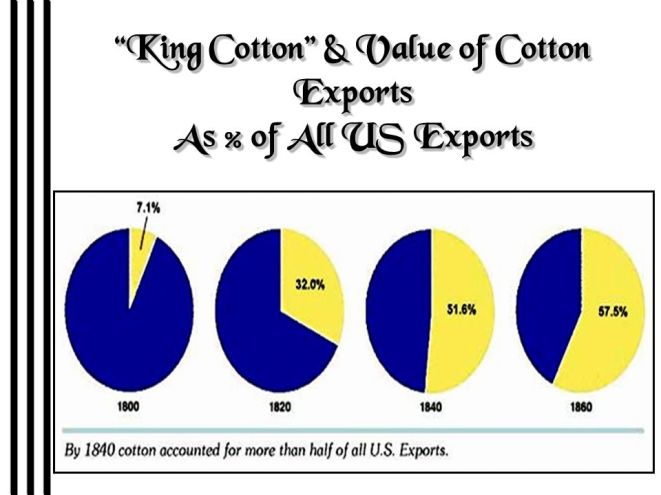
In 1792, the year that Whitney invented his machine, the southeastern United States exported 138,000 pounds a year to Europe and to the northern states. Two years later, that number had risen to 1,600,000 pounds. By the time of the Civil War, Britain alone was importing ¾ of the 800 million pounds it used each year, from the American south.
Enterprise, Alabama got its start when John Henry Carmichael first settled there in 1881. Within a few years the Alabama Midland Railway came to Enterprise. By the turn of the century the place was a major cotton growing hub.
Anthonomus grandis, the Boll Weevil, is a small beetle, about the size of the nail on your little finger. Indigenous to Mexico, the beetle crossed the Rio Grande near Brownsville, sometime around 1892. The insect spread rapidly, producing eight to ten generations in a single growing season and preying mainly on the young cotton boll.
The insect is capable of destroying entire cotton crops, which it did in 1915, the year the insect reached Enterprise and most of Coffee County. Facing economic ruin, local farmers were forced to diversify their crops, just to recoup some of the losses caused by that one wretched beetle.
Within two years, Enterprise became one of the leading peanut producers in the country. Not only had farmers been able to stave of disaster, but they were already becoming prosperous as a result of the thriving new crop base.
Town fathers decided to build a monument, their “herald of prosperity”, to the boll weevil. The bug that had almost ruined them.
Designed in Italy at a cost of $1,800, the monument depicts a female figure in a flowing gown, arms stretched high over her head, and holding in her hands a trophy.
The monument was dedicated on December 11, 1919 at the intersection of College and Main Street, in the heart of Enterprise’ business district.
You can’t have a Boll Weevil monument without a Boll Weevil. Thirty years later, Luther Baker added a big bug on top of the trophy. At the base of the monument appears this inscription: “In profound appreciation of the Boll Weevil and what it has done as the herald of prosperity this monument was erected by the citizens of Enterprise, Coffee County, Alabama.”
The original has been vandalized so many times that it was moved it to a protected facility, and a replica put in its place. So it is that you can drive down the Main Street of Enterprise Alabama today, in the footsteps of my own brother Dave, and there you will find a statue of…a bug.
Roosevelt probably learned that he was riding in Al Capone’s limo after he got in, on the way to Capitol Hill. He didn’t seem to be bothered, the President’s only comment was “I hope Mr. Capone won’t mind.”
On Sunday morning, December 7th, 1941, the armed forces of Imperial Japan attacked the US Navy’s Pacific anchorage at Pearl Harbor.
The President of the United States, Franklin Delano Roosevelt, was notified almost immediately. It had been an act of war, a deliberate attack on one sovereign nation by another. Roosevelt intended to ask Congress for a declaration of war.
Presidential Limo “Sunshine Special”, used in both the FDR and Truman administrations
Work began almost immediately on what we now know as Roosevelt’s “Day of Infamy” speech, to be delivered to a joint session of Congress the following day.
There was no knowing if the attack on Pearl Harbor had been an isolated event, or whether there would be a continuation of such attacks, sabotage on facilities, or even assassination attempts.
The Willamette University football team, in Honolulu at this time to play the “Shrine Bowl”, took up a defensive cordon around the Punahou school.
Roosevelt’s speech was scheduled for noon on the 8th, and the Secret Service knew they had a problem. Roosevelt was fond of his 1939 Lincoln V12 Convertible. Roosevelt called it the “Sunshine Special,” but the car was anything but secure. Armored Presidential cars would not come into regular use for another 20 years, after the assassination of President Kennedy.
Federal regulations of the time restricted the purchase of any vehicle costing $750 or higher, $10,455 in today’s dollars, and that wasn’t going to get them an armored limo. They probably couldn’t have gotten one that quickly anyway, even if there had been no restriction on spending.
In 1928, Al Capone purchased a Cadillac 341A Town Sedan with 3,000 pounds of armor and inch-thick bulletproof windows. It was green and black, matching the Chicago police cars of the era, and equipped with a siren and flashing lights hidden behind the grill.
Advanced syphilis had reduced Al Capone to a neurological wreck by this time. By the time of FDR’s speech, Capone had been released from Alcatraz, and resided in Palm Island, Florida. His limo had been sitting in a Treasury Department parking lot, ever since being seized in his IRS tax evasion suit from years earlier.
Mechanics cleaned and checked Capone’s Caddy well into the night of December 7th, making sure that it would safely get the Commander in Chief the few short blocks to Capitol Hill. It apparently did, because Roosevelt continued to use it until his old car could be fitted with the same features. To this day, Presidential limousines have flashing police lights hidden behind their grilles.
Roosevelt probably learned that he was riding in Al Capone’s limo after he got in, on the way to Capitol Hill. He didn’t seem to be bothered, the President’s only comment was “I hope Mr. Capone won’t mind.”
Afterward
The internet can be a wonderful thing, if you don’t mind taking your water from a fire hose. The reader of history quickly finds that some tales are true as written, some are not, and some stories are so good you want them to be true.
Napoleon once asked, ‘What is history, but a fable agreed upon?” Winston Churchill said “History will be kind to me, for I intend to write it”.
You can find on-line sources if you like, to tell you this story is a myth. Others will tell you it’s perfectly true. CBS News reports: “After the attack on Pearl Harbor, President Roosevelt made use of a heavily armored Cadillac that was originally owned by gangster Al Capone until the Sunshine Special could be modified with armor plating, bulletproof glass, and sub-machine gun storage“.
As a piece of history, you may take this one as you like. I confess, I am one who wants it to be true.
If you enjoyed this “Today in History”, please feel free to re-blog, “like” & share on social media, so that others may find and enjoy the same. Please click the “follow” button on the right, to receive email updates on new articles. Thank you for your interest, in the history we all share.
In 1944 and ’45 with the country at war, Army and Navy both entered that final game of the season,with perfect records. Army finished both of those seasons, undefeated.
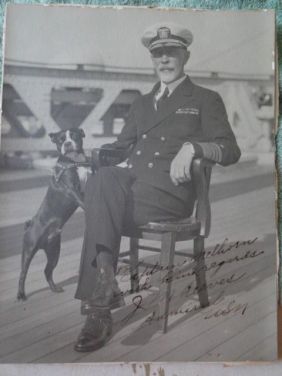
Admiral Joseph Mason “Bull” Reeves
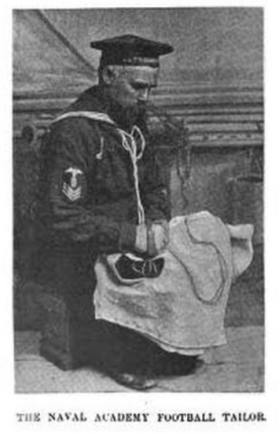
Sometime during the 1893 football season, a navy doctor told Midshipman Joseph Reeves that another kick to the head could result in “instant insanity”, even death.
Reeves commissioned an Annapolis-area shoemaker to build him a leather covering, thus making himself the father of the modern football helmet. Years later, this man of the battleship era became an ardent supporter of naval air power. Today, Admiral “Bull” Reeves is widely known as the “Father of Carrier Aviation”.
The naval academy’s football program is one of the oldest in the country, dating back to 1879.
The Army got into the game in November 1890, when Navy challenged Army cadets in what was then a relatively new sport.
The naval academy introduced a canvas jersey in 1879, believed to be the first college football uniform, in history. Photo by Caspar W. Whitney – Whitney, Caspar W. (May 21, 1892). “The Athletic Development at West Point and Annapolis”. Harper’s Weekly XXXVI (1848): 496., Public Domain, https://commons.wikimedia.org/w/index.php?curid=51990735
That first Army-Navy game was played on November 29, when the Midshipmen humiliated the Army cadets at West Point, 24-0.
The Black Knights had their revenge the following year, defeating Navy at Annapolis, 32-16.
The two teams met some 30 times between 1890 and 1930, when the game became an annual event.
More than inter-service “bragging rights” are at stake. Only 17 schools can boast Heisman Trophy winners. Army and Navy, combine for five.
West Point and Annapolis fielded some of the best teams in college football, during the first half of the 20th century. In 1944 and ’45 with the country at war, Army and Navy both entered that final game of the season,with perfect records. Army finished both seasons, undefeated.
Today, size and weight restrictions combine with a five-year military service commitment, while dreams of NFL careers draw some of the best football talent in college ball away from the service academies. Since 1963, only four seasons have seen both teams enter the Army-Navy game with winning records. Yet, the game remains a college football institution, receiving radio coverage every year since the late ’20s, and broadcast on national television, since 1945.
The first instant replay in American football history, made its debut during the 1963 Army–Navy game.
Arguably, the Army-Navy game may be the purest such event, in all of college sports. These are the kids who play for the love of the game, knowing that their next years are unlikely to lead to careers in sports, business, or academia. These young men have given the next few years of their lives, to the United Sates military.
Roger Staubach
Five-year post-graduation military service commitments preclude the NFL career aspirations of most Army-Navy game veterans, but not all. Notable exceptions include Dallas Cowboys Quarterback Roger Staubach (Navy, 1965), New York Giants Wide Receiver and Return Specialist Phil McConkey (Navy, 1979), and (then) LA Raiders Running back Napoleon McCallum (Navy, 1985).
President Dwight Eisenhower earned the distinction of being the only future President in history to play the Army-Navy game in 1912, alongside future General of the Army, Chairman of the Joint Chiefs of Staff and teammate, Omar Bradley.
Most games are played in a neutral city, almost always on the east coast. Most often in Philadelphia. The Army-Navy game has appeared west of the Mississippi only twice, first for the national dedication of Chicago’s Soldier Field, in 1926. The second was in 1983, when the Department of Defense earned Wisconsin Democratic Senator William Proxmire’s not-so-coveted “Golden Fleece” award, for spending $100,000 to transport cadets, midshipmen and mascots, to play in Pasadena, California’s Rose Bowl.
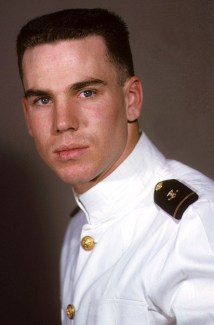
Oh, for the days when the government pretended to look out for our money.
With capacities of only 38,000 and 34,000 respectively, Army’s Michie Stadium and Navy’s Navy–Marine Corps Memorial Stadium are far too small, to hold the assembled crowd. Out of 117 games, only six have been played on either campus. Two of those (1942-’43), were due to WWII travel restrictions.
In 1963, the Army-Navy game was canceled in observation of a 30-day period of mourning, following the assassination of president John Fitzgerald Kennedy. Knowing her now-deceased husband to be a big fan, First Lady Jacqueline Kennedy requested that the game go on, and so it was, quarterback Roger Staubach leading his #2 nationally ranked team in a 34-14 Navy romp.
For most seniors, the “First Classmen” of either academy, the Army-Navy game carries special meaning. Some may go on to play in a bowl game, but for most, this is the last regular season football game, each will ever play. In times of war, they and others like themselves will be among the first to go, in defense of the country. Some will not return home, alive.
The game is particularly emotional for this reason. Despite intense rivalry, it would be hard to find a duel in all of sports, where the two sides hold the other in higher respect and esteem.
The game is steeped in tradition. As their opposites cheer them on, each side takes the field in a spectacle of precision drill, unmatched in any venue outside of the military. After the game, both teams assemble to sing the almae matres (‘On Brave Old Army Team’ and ‘Anchors Aweigh’) of each institution, to the assembled students and fans.
Navy marches on the field, 1950
The first such serenade is always performed for those of the losing academy, hence the coveted position of “singing second”, signifying the victor of this, the oldest sports rivalry in service academy history.
Respect and tradition is all well and good, but such rivalries do not come without a share of debauchery. During junior year, selected “Middies” and Cadets attend courses with the opposite military academy. On game day, each is restored in a “prisoner exchange”, returning from their semester in “enemy territory”.
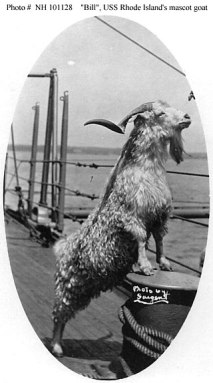
“Bill the goat”, mascot of BB-17 USS Rhode Island, circa 1913
Goats have a long history with all things maritime, having gone to sea since the age of sail and eating all manner of garbage and other undesirable food, in exchange for which, usually “she”, provided companionship, milk and butter. Sir Joseph Bank’s nanny goat was the first creature two-legged or four, to circumnavigate the planet, twice.
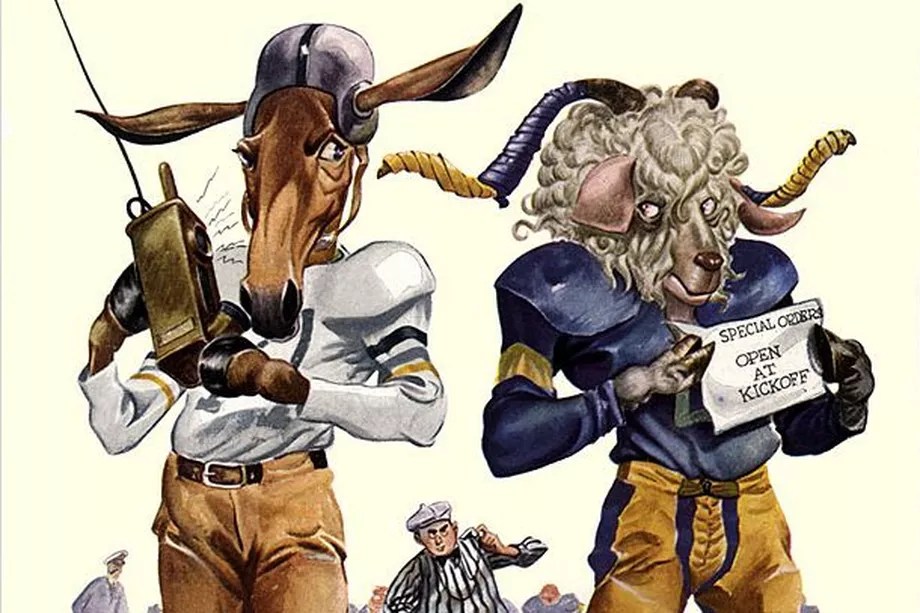
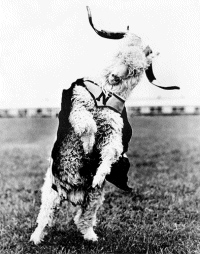
Navy had multiple mascots during the early years, including a gorilla, two cats, a bulldog, and a carrier pigeon. Legend has it that a beloved goat once died aboard a Navy cruise, and two ensigns cavorted about wearing the skin during half-time, before making their way to the taxidermist.
Navy won that game, and a live goat named “El Cid” (The Chief) appeared at the fourth Army-Navy game, in 1893. Navy won that game too, its third victory of those first four games. Small wonder that Billy goats have been the Navy mascot, since 1904.
The 2016 matchup was attended by “Bill” the Goat #XXXVI and his backup, Bill #XXXVII.
Small wonder too, why Army cadets will go to any length, to kidnap that goat. The first such kidnapping of the modern era, took place in 1953.
On November 5, 1995, US Military Academy cadets staged a pre-dawn raid at the Naval Academy Dairy Farm in Gambrills, Maryland, kidnapping Bill the Goat #s XXVI, XXVII and XXIX. The Pentagon was notified, and the goats were returned under a joint Army/Navy policy, stipulating that the “kidnapping of cadets, midshipmen or mascots will not be tolerated”.
Cadets pulled off the caper in 2002, disguised in Grateful Dead T-shirts. “Operation Good Shepherd” launched in 2007, to kidnap Bill #XXXII, XXXIII, and XXXIV. The whole thing was posted, on You Tube.
It’s been said that only the Army, would mount a military operation to kidnap a goat, and only the Navy would involve the Pentagon, to get him back.
The Philadelphia Quartermaster Depot decided in 1899, that Army needed a mascot in response to the Navy’s goat. Mules have a long history with the United Sates Army, going back to George Washington, the “Father of the American Mule“. The question was self-answering. Little is known of the “official” Army mules prior to 1936, when former pack mule “Mr. Jackson” (named for Thomas Jonathan “Stonewall” Jackson), arrived from Front Royal, Virginia.
Mr. Jackson served twelve years, the first of seventeen “official” Army mules. Only one, “Buckshot”, was a female. Currently, the “Mule Corps” consists of “Ranger III”, the son of a Percheron mare standing at 16.2 hands (66″) high, his only slightly shorter half-brother “Stryker”, and “Paladin”, a half-thoroughbred, standing a full two hands shorter than either of his counterparts
Always the last regular-season game in Division I-A football, the next four Army-Navy games are scheduled in Philadelphia. The game site will then move to Metlife Stadium in East Rutherford New Jersey, to mark the twenty-year anniversary of the Islamist terror attacks on the World Trade Center. The 2022 game moves back to Philadelphia, marking the 91st time Army and Navy have played there.
To date, Navy leads Army in the series 60-50-7, with Army’s Black Knights ending Navy’s 14-game winning streak in 2016. The 2017 edition is scheduled for Saturday, December 9, at Philadelphia’s Lincoln Financial Field.
This son and grandson of Army veterans going back to the Revolution and beyond, is compelled to say, ‘Beat Navy’.
Meeting of the Mascots, 1939
If you enjoyed this “Today in History”, please feel free to re-blog, “like” & share on social media, so that others may find and enjoy the same. Please click the “follow” button on the right, to receive email updates on new articles.
Thank you for your interest, in the history we all share.
ICYMI – A former President and son of a Founding Father, John Quincy Adams, argued the case, in a trial beginning on George Washington’s birthday, 1841.
By 1839, the international slave trade was illegal in most countries, though the “peculiar institution” itself, was not. In April of that year, five or six hundred Africans were illegally purchased by a Portuguese slave trader, and shipped to Havana aboard the brig Tecora.
Fifty-three members of the Mende tribe, of the modern-day country of Sierra Leone, were sold to Joseph Ruiz and Pedro Montez, who planned to use them on their Cuban sugar plantation. The Mendians were given Spanish names and designated “black ladinos,” fraudulently documenting them to have always lived as slaves, in Cuba. In June, Ruiz and Montez placed the Africans on board the schooner la Amistad, (“Friendship”), and set sail down the Cuban coast to Puerto del Principe.
On the fourth night at sea, Joseph Cinqué, also known as Sengbe Pieh, led a number of captives in breaking free of their chains and seizing control of the ship. They killed two of their captors, losing two of their own in the struggle, while two others escaped in a boat. The cabin boy, who really was a black ladino, was spared and used as translator.
The Mendians forced the two remaining crew to return them to Africa, which they pretended to do by day. But they were betrayed, the two slavers would steer the ship north by night, when the position of the sun couldn’t be seen. Amistad was apprehended off Long Island by a U.S. Coastal Survey brig and taken to New London, Connecticut, where the Africans were put in prison. Connecticut was still a slave state at that time.
The Spanish Ambassador demanded that Ruiz’ and Montez’ “property” be returned and the matter settled under Spanish law. President Martin van Buren agreed, but the matter had already fallen under the jurisdiction of the courts.
The district court trial which followed in Hartford determined that the Mendians’ papers were forged, and they should be returned to Africa. The cabin boy was ruled to be a slave and ordered returned to the Cubans, however he fled to New York with the help of abolitionists. He would live out the rest of his life as a free man.
Fearing the loss of pro-slavery political support, President van Buren ordered government lawyers to appeal the case up to the United States Supreme Court. The government case depended on the anti-piracy provision of a treaty then in effect between Spain and the United States,
A print of Joseph Cinqué appeared in The New York Sun newspaper, August 31, 1839
A former President and son of a Founding Father, John Quincy Adams, argued the case, in a trial beginning on George Washington’s birthday, 1841.
In United States v. Schooner Amistad, SCOTUS upheld the decision of the lower court 8-1, ruling that the Africans had been detained illegally, ordering them returned to their home. John Tyler, a pro slavery Whig, was President by this time. Tyler refused to provide a ship or fund the repatriation, so abolitionists and missionaries did so, returning 35 surviving Mendians to Africa on November 25, 1841.
In arguing the case, President Adams took the position that no man, woman, or child in the United States could ever be sure of the “blessing of freedom”, if the President could hand over free men on the demand of a foreign government.
152 years later, Bill Clinton, Eric Holder and Janet Reno kidnapped six-year-old Elian Gonzalez at gunpoint, sending him back to Cuba over the body of the mother who died bringing him to freedom.
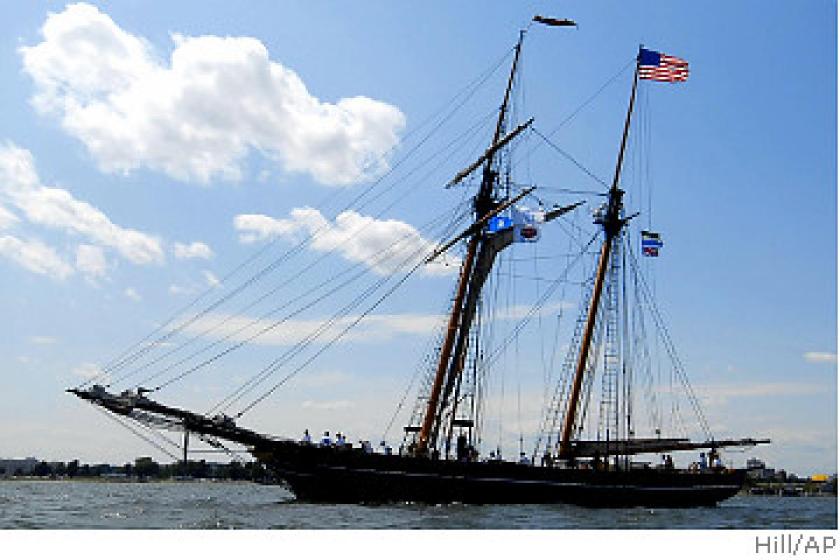
In 2007, a near-replica of the Amistad left its home port in Connecticut, on a 16-month, 14,000-mile voyage to Nova Scotia, Britain and Africa.
The Chicago Times described Lincoln’s remarks as “silly, flat and dish-watery utterances”, but it all came out in the end. Lincoln’s address went into history as one of the finest pieces of English language prose since Henry V’s St. Crispin’s Day speech, at Agincourt. The names of the haters at the Chicago Times, are all but forgotten.
154 years ago today, Abraham Lincoln boarded a train in Washington. He’d been asked to make “a few dedicatory remarks” on the following day, dedicating the new National Cemetery at Gettysburg where, even now, workmen labored to re-inter the dead from the carnage of July.
Lincoln was the President of a country torn by Civil War, a war so terrible that, before it was over, would kill more Americans than all the wars from the Declaration of Independence to the Global War on Terror, combined.
Lincoln had been feeling poorly the day of the train ride, telling his secretary, John Hay, that he was feeling weak. He would feel worse over the course of that day, and Hay noted that Lincoln’s face was ‘a ghastly color’ the day of the address. No one knew it at the time, but Lincoln was in the early stages of smallpox.
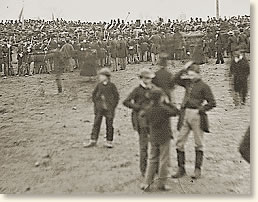
“A rare photo of the ceremonies. A group of boys stand at the fringe of a crowd. In the distance, several men wearing sashes can be seen standing on the speakers’ platform. Analysis of an enlargement of this photo reveals the image of Lincoln sitting to the left of these men”. Tip of the hat to http://www.eyewitnesstohistory.com, for this image
His was not the keynote address. That would be a 13,607 word, two-hour oration delivered by Boston politician Edward Everett.
After Everett’s speech, photographers thought they had all the time in the world to prepare and set their glass plates. They did not, and no photograph exists of Lincoln delivering the Gettysburg address.
The 16th President of the United States stepped to the rostrum and delivered 271 words, in ten sentences. In just over two minutes, Lincoln captured an entire vision of where the country was at that moment in time, where it had been, and where it was going.
Lincoln himself thought his speech a flop, but Everett later wrote to him, saying “I wish that I could flatter myself that I had come as near to the central idea of the occasion in two hours as you did in two minutes.”
There were haters then, as now, as always prepared to fire their little spitballs. The Chicago Times described Lincoln’s remarks as “silly, flat and dish-watery utterances”, but it all came out in the end. Lincoln’s address went into history as one of the finest pieces of English language prose since Henry V’s St. Crispin’s Day speech, at Agincourt. The names of the haters at the Chicago Times, are all but forgotten.
Oddly, we do not know the precise form in which the President delivered his address. Lincoln wrote his own speeches, lining out words and writing into margins as he developed his thought process. That working copy is lost.
“The only known image of Abraham Lincoln at Gettysburg was uncovered in 1952 at the National Archives. It was taken by photographer Mathew Brady. (Library of Congress)” H/T Smithsonian.com, for this image
There are five known copies of the Gettysburg address, written in Lincoln’s own hand, each varying slightly in wording and punctuation. He wrote two after the address, giving them to his two personal secretaries, John Hay and John Nicolay. He sent one to Edward Everett early in 1864, and another to George Bancroft, the former Secretary of the Navy turned historian. Lincoln wrote a fifth copy, known as the Bliss copy, for Colonel Alexander Bliss, in February, upon learning that the Bancroft version was unsuitable for publication, due to its having been written on both sides of the same page.
Lincoln signed, dated and titled the Bliss copy. This is the version inscribed on the South wall of the Lincoln Memorial.
One of my stranger childhood notions, was the idea that sounds never went away, they just diminished as they spread outward, like ripples on a pond. If that was true (thought my nine-year-old self), could we not somehow capture and listen to the Gettysburg address, as it was actually delivered?
It’s a funny thing how some ideas, even the goofy ones, never completely die away.
For the terminal history geek, the full text of all five copies may be discovered atwww.abrahamlincolnonline.org
Governor de Graaff ordered an 11-gun return salute fired from the guns of Fort Oranje, making Sint Eustatius the first nation in history to acknowledge the independence of the United States.
Sint Eustatius, known to locals as “Statia”, is a Caribbean island of 8.1 sq. miles in the northern Leeward Islands. Formerly part of the Netherlands Antilles, the island lies southeast of the Virgin Islands, immediately to the northwest of Saint Kitts.
The island had close ties with North America throughout the 18th century, becoming wealthy from the trade in a variety of goods. Sugar, molasses, gin, rum and cotton were only a few of the goods shipped from, or through, Sint Eustatius. Colonial ports from Maine to Virginia shipped products to the island in return, including barrel staves, beans, flour, cod, horses, lumber and tobacco.
At its peak, the island was handling over 3,000 ships per year, making St. Eustatius the “Golden Rock” of the Caribbean.
Sint Eustatius was a Dutch Colony, and should have remained neutral during the American Revolution. The government in Holland warned Governor Johannes de Graaff to stay away from the rebels fighting for independence, but the Governor would have none of it. The trade in powder, ammunition and arms continued throughout the revolutionary period, with covert support smuggled from Spain, France and dissident interests in Holland. For a time, Sint Eustatius was the only link between Europe and the fledgling American colonies.
On the 16th of November, 1776, the Brig Andrew Doria sailed into Sint Eustatius’ principle anchorage in Oranje Bay. Flying the Continental Colors of the fledgling United States and commanded by Captain Isaiah Robinson, the Brig was there to obtain munitions and military supplies. Andrew Doria also carried a precious cargo, a copy of the Declaration of Independence.
It was the Americans’ second attempt to send the Declaration to their Dutch associates, the first having been captured on the way to Holland. Seemingly wrapped in papers containing some obscure espionage code, British investigators labored in vain to unlock this strange new cipher. They could have spared themselves the effort: they were personal notes in Yiddish, greetings to some of the Jewish merchants of Holland.
It was traditional in those days, that vessels approaching a foreign harbor would fire a gun salute upon entering. Captain Robinson fired a 13 gun volley on entering the bay, representing the 13 American colonies. The commander at Fort Oranje, overlooking the anchorage, wasn’t sure how to respond.
Tradition dictated the firing of a salute in return, typically two guns fewer than that fired by the incoming vessel. Such an act carried meaning. The firing of a return salute was the overt recognition that a sovereign state had entered the harbor. Such a salute amounted to formal recognition of the independence of the 13 American colonies.
Governor de Graaff ordered an 11-gun return salute fired from the guns of Fort Oranje, making Sint Eustatius the first nation in history to acknowledge the independence of the United States.
Playing the role of the tattle-tale younger sibling, nearby Saint Kitts immediately dispatched a vessel to England to inform the British government of the event. The British were furious, of course. The trade between St. Eustatius and the American Colonies became the principal cause of the fourth Anglo-Dutch war, begun on December 12, 1780.
Admiral George Bridges Rodney forced the surrender of Sint Eustatius in February of the following year, saying that “This rock, of only six miles in length and three in breadth, has done England more harm than all the arms of her most potent enemies, and alone supported the infamous rebellion. When I leave the island of St. Eustatius, it will be as barren a rock as the day it erupted from the sea. Instead of one of the greatest emporiums on earth, it will be a mere desert and known only by report.”
Rodney pretty much had his way. The census of 1790 shows 8,124 on the Dutch island nation. In 1950, the population stood at 790. It would take 150 years from Rodney’s departure, before tourism even began to restore the economic well-being of the tiny island.
Today, Sint Eustatius celebrates the 16th of November as “Statia America Day”, in recognition of that first salute.
An official coat of arms was designed by Walter Hellebrand, and adopted on this day in 2004. On the left is a Golden Rock, in memory of the trade which made the island rich. On the right is Fort Oranje, Sint Eustatius’ most important landmark. The angel fish of St. Eustatius is at the bottom, symbolizing the island’s future. Below that is the Latin motto, “SUPERBA ET CONFIDENS”. Proud and Confident.
Historians differ on the location of the first recruiting station. Some will tell you that it was the “Conestoga Waggon” tavern in Philadelphia. Tradition holds it to have been the “Tun Tavern”, a name coming from the Olde English “Tun”, meaning a barrel or a keg of beer.
The Navy had been in existence for less than a month and the Battles of Lexington and Concord a mere seven months in the past, when the Continental Marines were formed by an act of the 2nd Continental Congress, convened on November 10, 1775.
“Resolved, That two Battalions of Marines be raised, consisting of one Colonel, two Lieutenant Colonels, two Majors, and other officers as usual in other regiments; and that they consist of an equal number of privates with other battalions; that particular care be taken, that no persons be appointed to office, or inlisted into said Battalion, but such are good seamen, or so acquainted with maritime affairs as to be able to serve to advantage by sea when required: that they be inlisted and commissioned to serve for and during the present war between Great Britain and the colonies, unless dismissed by order of Congress: that they be distinguished by the names of the first and second battalion of American Marines, and that they be considered as part of the number which the continental Army before Boston is ordered to consist of.”
“The First Recruits” by Col Charles Waterhouse, USMCR (Ret)
Historians differ on the location of the first recruiting station. Some will tell you that it was the “Conestoga Waggon” tavern in Philadelphia. Tradition holds it to have been the “Tun Tavern”, a name coming from the Olde English “Tun”, meaning a barrel or a keg of beer.
Continental Marines served a number of important functions during the Revolution, including ship-board security, amphibious assault and ship-to-ship combat. Then as now, Marines were riflemen first. During naval engagements they could be found in the masts and rigging, their sharpshooters’ skills taking out opposing helmsmen, gunners and ship’s officers.
No less a figure than Admiral David G. Farragut wrote in 1862, “A ship without Marines is like a garment without buttons.”
The first Marine landing on a hostile shore took place in March 1776, when a Marine force under the former Quaker, Captain Samuel Nicholas, captured New Province Island in the Bahamas. Nicholas was the first commissioned officer in the Continental Marines, and is now remembered as the first commandant of the Marine Corps.
The Continental Congress disbanded the Marines in 1783, following their help in winning American independence. Increasing conflict and the coming “quasi-war” with revolutionary France would soon bring them back.
President John Adams signed a bill establishing the United States Marine Corps as a permanent military force under Navy jurisdiction on July 11, 1798.
The most famous action of the early period occurred during the Tripolitan War of 1801–’05, against the Barbary states of Tripoli, Algiers, Tunis, and the independent Sultanate of Morocco. US Army Lieutenant William Eaton and United States Marine Corps 1st Lieutenant Presley O’Bannon led eight Marines and 500 mercenaries on a 600-mile forced march through the desert, against a much larger force defending the city of Derna, in Libya. Ottoman viceroy Prince Hamet awarded a Mameluke sword to O’Bannon on December 8, 1805, in a gesture of respect for the Marines’ conduct. That curved, cross-hilted scimitar became the model for swords worn by Marine officers to this day, the victory at Derna memorialized in a line from the Marine Corps Hymn “From the halls of Montezuma, to the shores of Tripoli”.
Since then, the Marine Corps has participated in virtually every conflict ever fought by the United States. They’re usually the first ones in. To date, United States Marines have executed over 300 landings on foreign shores.
The USMC has 182,000 active duty members as of 2016, with 38,500 in reserve. They are separated into three divisions, headquartered at Camp Lejeune, North Carolina, Camp Pendleton in California; and Okinawa, Japan. Each division maintains one or more expeditionary units, prepared for major operations anywhere in the world on two weeks’ notice.
The original Tun Tavern burned down in 1781, shortly before the end of the Revolution. Today, the site is part of Interstate 95, where it passes Penn’s landing. You can still visit the Tun Tavern styled restaurant at the National Marine Corps Museum in Quantico, where a beer and a bread pudding is always part of the lunch menu.
Happy 241st birthday, United States Marine Corps. Thank you.
Semper Fidelis.
Camp Lejeune celebrated the 233rd Marine Corps birthday with its annual Joint Daytime Ceremony at Liversedge Field, Friday. Pageant Marines wore period uniforms representing major conflicts. Attendees were reminded that throughout history, Marines continue to distinguish themselves on battlefields and foreign shores, in both war and peace.
On April 18, 2015, Richard Cole and David Thatcher fulfilled their original bargain, as the last two surviving members of the Doolittle raid. Staff Sergeant Thatcher passed in June of last year, at the age of 94. As I write this, Lieutenant Colonel Richard Cole age 102, Jimmy Doolittle’s co-pilot, is the only man in the world who has earned the right to open that bottle.
On November 9, 2013, there occurred a gathering of four, a tribute to fallen heroes. These four are themselves heroes, and worthy of tribute. It was to be their last such gathering.
This story begins on April 18, 1942, when a flight of 16 Mitchell B25 medium bombers took off from the deck of the carrier USS Hornet. It was a retaliatory raid on Japan, planned and led by Lieutenant Colonel James “Jimmy” Doolittle of the U.S. Army Air Forces. It was payback for the sneak attack on Pearl Harbor, seven months earlier. A demonstration that the Japanese home islands were not immune from attack.
Launching such large aircraft from the decks of a carrier had never been attempted, and there were no means of bringing them back. This was to be a one-way mission, into enemy occupied territory.
Fearing a breach in operational security, the mission was forced to launch 200 miles before the intended departure spot. The range now made fighter escort impossible, and left the bombers themselves with the slimmest margin of error.
Japanese Premier Hideki Tojo was inspecting military bases at the time of the raid. One B-25 came so close that he could see the pilot, though the American bomber never fired a shot.
After dropping their bombs, all but one aircraft was able to continue west into Japanese occupied China. That one landed in Vladivostok, where the pilot and crew were interned for a year by our Soviet “allies”.
A quarter of a million Chinese were murdered by Japanese soldiers, as they hunted for Doolittle’s raiders. Eight of them were captured, three were executed and one died in captivity, but most of the 80 who began the mission survived the war.
There was little serious damage done to the Japanese home islands, but the raid had a decisive effect. Japan withdrew its powerful aircraft carrier force to protect the home islands. Admiral Isoroku Yamamoto attacked Midway, thinking it to have been the jump-off point for the raid. Described by military historian John Keegan as “the most stunning and decisive blow in the history of naval warfare”, the battle of Midway would be a major strategic defeat for Imperial Japan.
The Doolittle raiders have held a reunion every year, from the late 40’s, until 2013. In 1959, the city of Tucson presented them with 80 silver goblets, each engraved with the name of one of their number. They are on display at the National Museum of the Air Force, in Dayton Ohio.
With those goblets is a fine bottle of vintage Cognac, 1896, the year Jimmy Doolittle was born. There’s been a bargain among the Doolittle raid survivors that, one day, the last two of their number would open that bottle, and toast their comrades.
In 2013 they changed their bargain, just a bit. Jimmy Doolittle himself passed away in 1993. Twenty years later, 76 goblets had been turned over, each signifying a man who had passed on. The last four were Lieutenant Colonel Richard E. Cole, co-pilot of crew No. 1; Lieutenant Colonel Robert L. Hite, co-pilot of crew No. 16; Lieutenant Colonel Edward J. Saylor, engineer-gunner of crew No. 15; and Staff Sergeant David J. Thatcher, engineer-gunner of crew No. 7. These four agreed that they would gather one last time. It would be they who would finally open that bottle.
Robert Hite, 93, was too frail to travel, so his son stood in for him. So it was that a 117 year-old bottle of cognac was cracked open on this date in 2013, and enjoyed in the company of heroes. If there is a more magnificent act of tribute, I cannot at this moment think of what it might be.
On April 18, 2015, Richard Cole and David Thatcher fulfilled their original bargain, as the last two surviving members of the Doolittle raid. Staff Sergeant Thatcher passed in June of last year, at the age of 94. As I write this, Lieutenant Colonel Richard Cole age 102, Jimmy Doolittle’s co-pilot, is the only man in the world who has earned the right to open that bottle.
The men who built the Tacoma Narrows Bridge used to suck lemons on the job site, to keep from becoming seasick. It was probably one of these “boomers” who first noticed how the bridge rippled in the wind. Someone called it “Galloping Gertie”, and the name stuck.
The name “Galloping Gertie” was first used to describe a 900′ bridge over the Ohio River in Wheeling, West Virginia. Built in 1849, it was the longest suspension bridge in the world at the time, until collapsing in a windstorm in May, 1854.
Ninety years later, the 5,939′ bridge over Puget Sound earned the same name.
The Tacoma Narrows Bridge had been designed by one of the most respected bridge engineers of its time. Federal and state experts all approved the plans, when construction began in 1937. When finished, it was the third longest suspension bridge in the world.
The deck’s vertical wave motions, or “bounce”, were noted as early as May 1940, as workmen finished the bridge’s floor system. As with the 790’ John Hancock Tower in Boston, the bridge would literally twist in the wind. The solution was similar in both cases. Engineers installed hydraulic buffers, pistons called “Tuned Mass Dampers,” to act as shock absorbers. The tactic worked for the John Hancock building, which, mercifully, no longer ejects 4’x11’, 500lb glass panels onto the street below.
The tactic made little to no improvement on the bridge.
The men who built it used to suck lemons on the job site, to keep from becoming seasick. It was probably one of these “boomers” who first noticed how the bridge rippled in the wind. Someone called it “Galloping Gertie”, and the name stuck.
Carol Peacock, a student at nearby Fife High School, sat down to do her homework on the evening of November 6, 1940. She was taking a journalism class. Her assignment was to write an essay beginning with, “Just suppose . . .” She called her essay, “Tacoma Narrows Bridge Collapses.” Nostradamus could not have called it better. The bridge came down the next day.
Leonard Coatsworth, a Tacoma News Tribune editor, entered the span some time before 11:00am on November 7, the last person to drive onto the bridge. “Just as I drove past the towers”, he said, “the bridge began to sway violently from side to side. Before I realized it, the tilt became so violent that I lost control of the car…I jammed on the brakes and got out, only to be thrown onto my face against the curb…Around me I could hear concrete cracking…The car itself began to slide from side to side of the roadway. On hands and knees most of the time, I crawled 500 yards or more to the towers…Toward the last, I risked rising to my feet and running a few yards at a time…Safely back at the toll plaza, I saw the bridge in its final collapse and saw my car plunge into the Narrows.”
The bridge was bucking so violently that at times, one sidewalk rose as high as 28’ above its opposite.
Frederick Bert Farquharson was a professor of civil engineering at the University of Washington. He’d been retained to help fix the bridge, and was on the span on the morning of the 7th. Professor Farquharson noticed “Tubby”, a black Cocker Spaniel, cowering in the back of Coatsworth’s abandoned car. He tried to rescue the terrified dog, but all he got was a bite on the hand. Driven by the desire to record the engineering science and delayed by the failed rescue attempt, Professor Farquharson was the last to leave the span. Tubby went down with the bridge, the only life lost in the incident.
The bridge remains at the bottom of Puget Sound to this day, one of the largest artificial reefs, in the world.
Photographer Howard Clifford and reporter Bert Brintnall covered the story for the Tacoma News Tribune. The pair had noticed a billboard ad that morning, for the Pacific National Bank. “As secure as the Narrows Bridge,” it read. They returned fewer than two hours after the collapse, wanting to photograph the billboard for their story. Workmen had already covered the sign with white paper.


 Japanese forces invaded China in the summer of 1937, advancing on Nanking as American citizens evacuated the city. The last of them boarded Panay on December 11: five officers, 54 enlisted men, four US embassy staff, and 10 civilians.
 The matter was officially settled four months later, with an official apology and an indemnity of $2,214,007.36 paid to the US government.


 Anthonomus grandis, the Boll Weevil, is a small beetle, about the size of the nail on your little finger. Indigenous to Mexico, the beetle crossed the Rio Grande near Brownsville, sometime around 1892. The insect spread rapidly, producing eight to ten generations in a single growing season and preying mainly on the young cotton boll.
 Designed in Italy at a cost of $1,800, the monument depicts a female figure in a flowing gown, arms stretched high over her head, and holding in her hands a trophy.


 In 1928, Al Capone purchased a Cadillac 341A Town Sedan with 3,000 pounds of armor and inch-thick bulletproof windows. It was green and black, matching the Chicago police cars of the era, and equipped with a siren and flashing lights hidden behind the grill.
 The internet can be a wonderful thing, if you don’t mind taking your water from a fire hose. The reader of history quickly finds that some tales are true as written, some are not, and some stories are so good you want them to be true.
 Oh, for the days when the government pretended to look out for our money.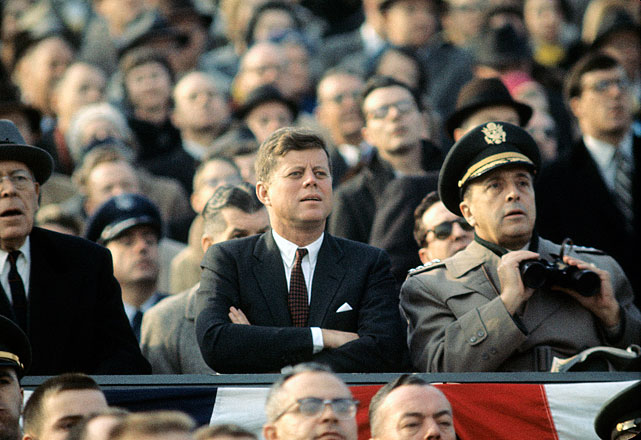
 The game is particularly emotional for this reason. Despite intense rivalry, it would be hard to find a duel in all of sports, where the two sides hold the other in higher respect and esteem.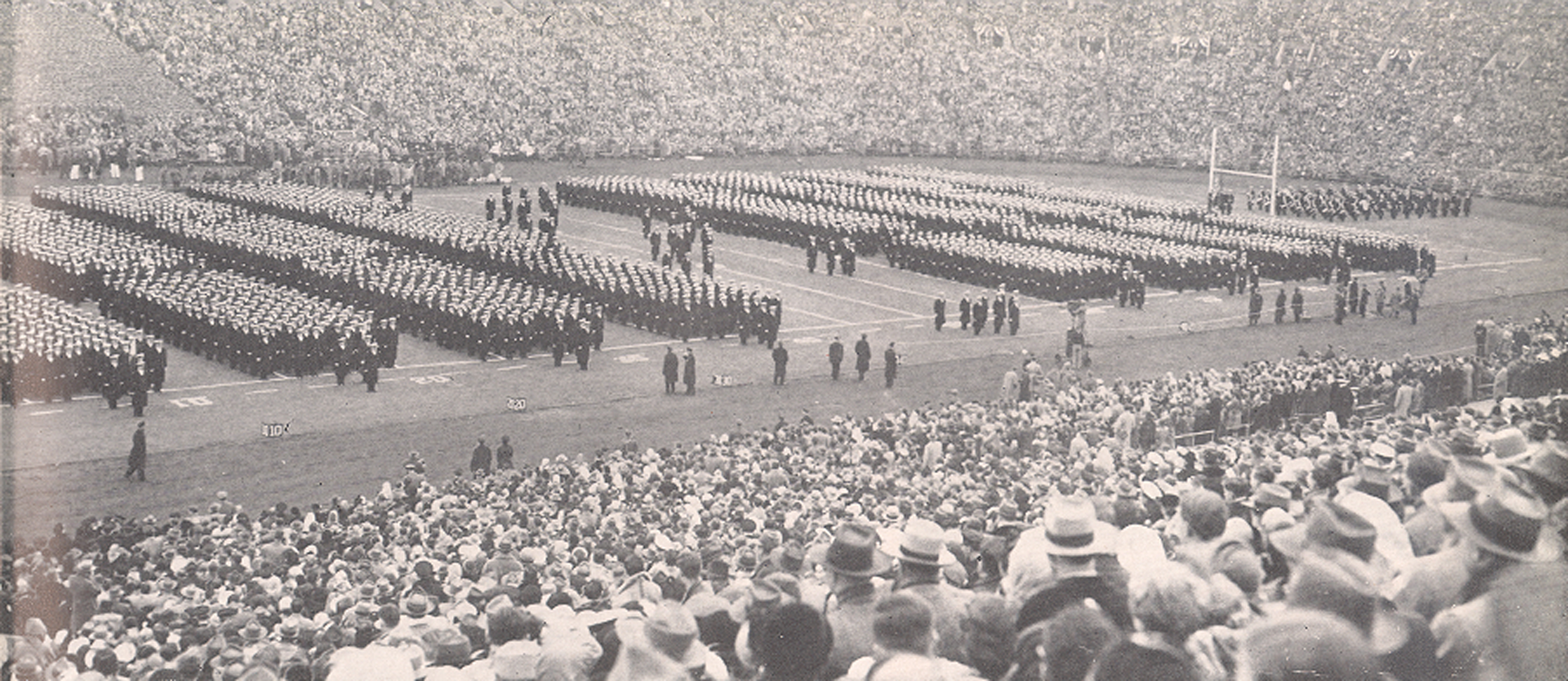
 The Philadelphia Quartermaster Depot decided in 1899, that Army needed a mascot in response to the Navy’s goat. Mules have a long history with the United Sates Army, going back to George Washington, the “
 Always the last regular-season game in Division I-A football, the next four Army-Navy games are scheduled in Philadelphia. The game site will then move to Metlife Stadium in East Rutherford New Jersey, to mark the twenty-year anniversary of the Islamist terror attacks on the World Trade Center. The 2022 game moves back to Philadelphia, marking the 91st time Army and Navy have played there.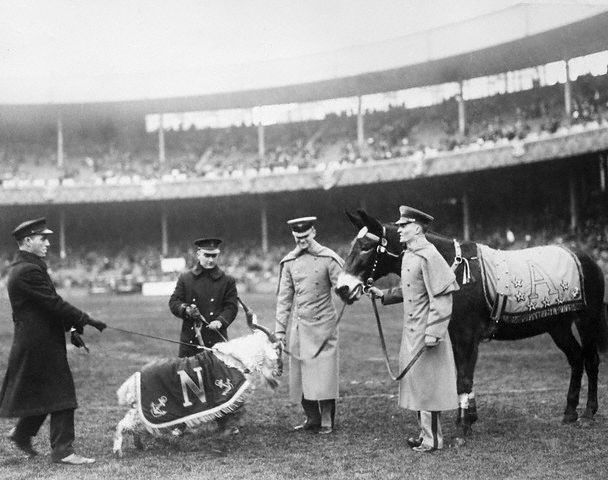


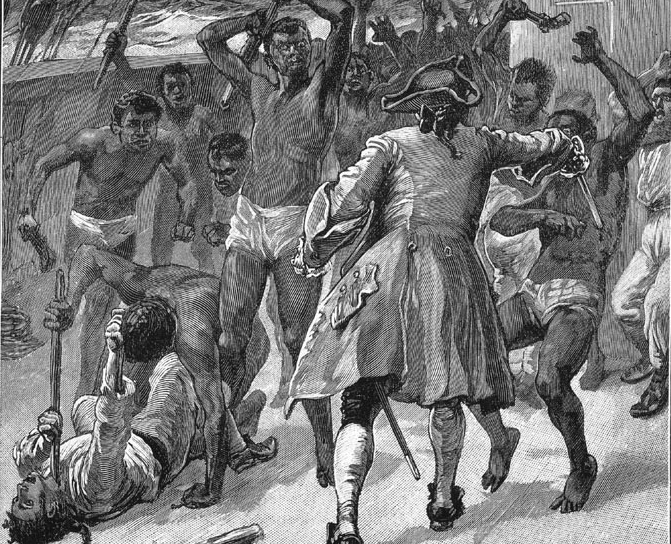
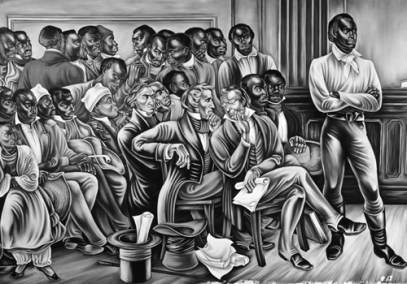 The district court trial which followed in Hartford determined that the Mendians’ papers were forged, and they should be returned to Africa. The cabin boy was ruled to be a slave and ordered returned to the Cubans, however he fled to New York with the help of abolitionists. He would live out the rest of his life as a free man.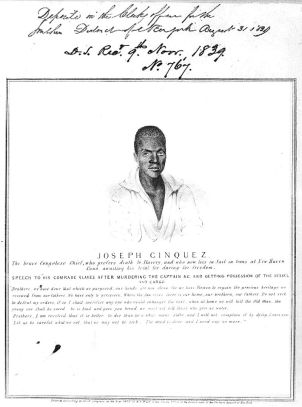



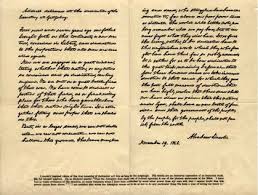 Lincoln signed, dated and titled the Bliss copy. This is the version inscribed on the South wall of the Lincoln Memorial.

 Sint Eustatius, known to locals as “Statia”, is a Caribbean island of 8.1 sq. miles in the northern Leeward Islands. Formerly part of the Netherlands Antilles, the island lies southeast of the Virgin Islands, immediately to the northwest of Saint Kitts.
 On the 16th of November, 1776, the Brig Andrew Doria sailed into Sint Eustatius’ principle anchorage in Oranje Bay. Flying the Continental Colors of the fledgling United States and commanded by Captain Isaiah Robinson, the Brig was there to obtain munitions and military supplies. Andrew Doria also carried a precious cargo, a copy of the Declaration of Independence.
 Tradition dictated the firing of a salute in return, typically two guns fewer than that fired by the incoming vessel. Such an act carried meaning. The firing of a return salute was the overt recognition that a sovereign state had entered the harbor. Such a salute amounted to formal recognition of the independence of the 13 American colonies.
 Rodney pretty much had his way. The census of 1790 shows 8,124 on the Dutch island nation. In 1950, the population stood at 790. It would take 150 years from Rodney’s departure, before tourism even began to restore the economic well-being of the tiny island.


 President John Adams signed a bill establishing the United States Marine Corps as a permanent military force under Navy jurisdiction on July 11, 1798.
 Since then, the Marine Corps has participated in virtually every conflict ever fought by the United States. They’re usually the first ones in. To date, United States Marines have executed over 300 landings on foreign shores.



 The men who built it used to suck lemons on the job site, to keep from becoming seasick. It was probably one of these “boomers” who first noticed how the bridge rippled in the wind. Someone called it “Galloping Gertie”, and the name stuck.
 The bridge was bucking so violently that at times, one sidewalk rose as high as 28’ above its opposite.
 Historical Easter Eggs - Today in History
You must be logged in to post a comment.