January 27, 1945 Cabanatuan

The Japanese atrocity at Palawan sparked a series of raids at Santo Tomas Internment Camp, Bilibid Prison, Los Baños and others.  The first such behind-enemy-lines rescue, was Cabanatuan.

Today, Cabanatuan calls itself the “Tricycle Capital of the Philippines”, with about 30,000 motorized “auto rickshaws”.  Seventy-three years ago, the place was home to one of the worst POW camps of WWII.

15918-cabanatuan-city-locator-map

1942 was a dreadful year for the allied war effort in the Pacific.  The Battle of Bataan alone resulted in 72,000 prisoners being taken by the Japanese, marched off to POW camps designed for ten to twenty-five thousand.

pows-cabanatuan20,000 died from sickness or hunger, or were murdered by Japanese guards on the 60 mile “death march” from Bataan, into captivity at Cabanatuan prison and others.

Cabanatuan held 8,000 prisoners at its peak, though the number dropped considerably as the able-bodied were shipped out to work in Japanese slave labor camps.

Cabanatuan-prisoncamp-report_555Two rice rations per day, fewer than 800 calories, were supplemented by the occasional animal or insect caught and killed inside camp walls, or by the rare food items smuggled in by civilian visitors.

2,400 died in the first eight months at Cabanatuan, animated skeletons brought to “hospital wards”, nothing more than 2’x6′ patches of floor, where prisoners waited to die.

A Master Sergeant Gaston saw one of these wards in July 1942, saying: “The men in the ward were practically nothing but skin and bones and they had open ulcers on their hips, on their knees and on their shoulders…maggots were eating on the open wounds. There were blow flies…by the millions…men were unable to get off the floor to go to the latrine and their bowels moved as they lay there”.

The war was going badly for the Japanese by October 1944, as Imperial Japanese High Command ordered able bodied POWs removed to Japan.  1,600 were taken from Cabanatuan, leaving 500 weak and disabled prisoners.  The guards abandoned camp shortly after, though Japanese soldiers continued to pass through.  POWs were able to steal food from abandoned Japanese quarters; some even captured two water buffalo called “Carabao”, which were killed and eaten.  Many feared a trick and never dared to leave the camp.  Most were too sick and weak to leave in any case, though the extra rations would help them through what was to come.

Palawan_Massacre_POW_Burial_Site_1945On December 14, some fifty to sixty soldiers of the Japanese 14th Area Army in Palawan doused 150 prisoners with gasoline and set them on fire, machine gunning or clubbing any who tried to escape the flames.   Some thirty to forty managed to escape the killing zone, only to be hunted down and murdered, one by one.  Eleven managed to escape the slaughter, and lived to tell the tale.  139 were burned, clubbed or machine gunned to death.
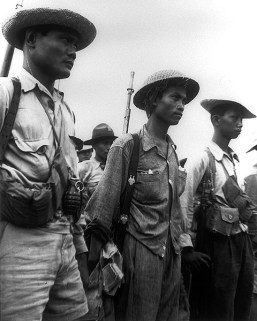
The atrocity at Palawan sparked a series of raids at Santo Tomas Internment Camp, Bilibid Prison, Los Baños and others.  The first such behind-enemy-lines rescue, was Cabanatuan.

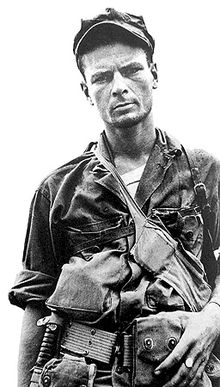
Lieutenant Colonel Henry Mucci of the United States Army’s elite 6th Ranger Battalion selected Captain Robert Prince to plan the rescue. “We couldn’t rehearse this”, Prince said. “Anything of this nature, you’d ordinarily want to practice it over and over for weeks in advance. Get more information, build models, and discuss all of the contingencies. Work out all of the kinks. We didn’t have time for any of that. It was now, or not”.

220px-Robert_Prince
6th Ranger Battalion Capt. Robert Prince

On the evening of January 27, 1945, a 14-man advance team formed from the 6th Ranger Battalion and a special reconnaissance group called the “Alamo Scouts”, separated into two groups and began the 30-mile march behind enemy lines to liberate Cabanatuan.

The main force of 121 Rangers moved out the following day, meeting up with 200 Filipino guerrillas, serving as guides and helping in the rescue.

Other guerrillas assisted along the way, muzzling dogs and corralling chickens so that Japanese occupiers would hear nothing of their approach.  Japanese soldiers once again occupied the camp, with 1,000 more camped across the Cabo River outside the prison.  As many as 7,000 more were deployed, just a few miles away.

On the night of the 30th, a P-61 Black Widow piloted by Captain Kenneth Schrieber and 1st Lt. Bonnie Rucks staged a ruse.  For 45 minutes, the pair conducted a series of aerial acrobatics, cutting and restarting engines with loud backfires while seeming to struggle to maintain altitude. Thousands of Japanese soldiers watched the show, as Rangers belly crawled into positions around the camp.

Pajota's_Guerrillas
Filipino Guerilla fighters of Captain Juan Pajota

Guard towers and pillboxes were wiped out in the first fifteen seconds of the assault.  Filipino guerrillas blew the bridge and ambushed the large force across the river while one, trained to use a bazooka only hours earlier, took out four Japanese tanks.

In the camp, all was pandemonium as some prisoners came out and others hid, suspecting some trick to bring them out in the open.  They were so emaciated that Rangers carried them out two at a time.

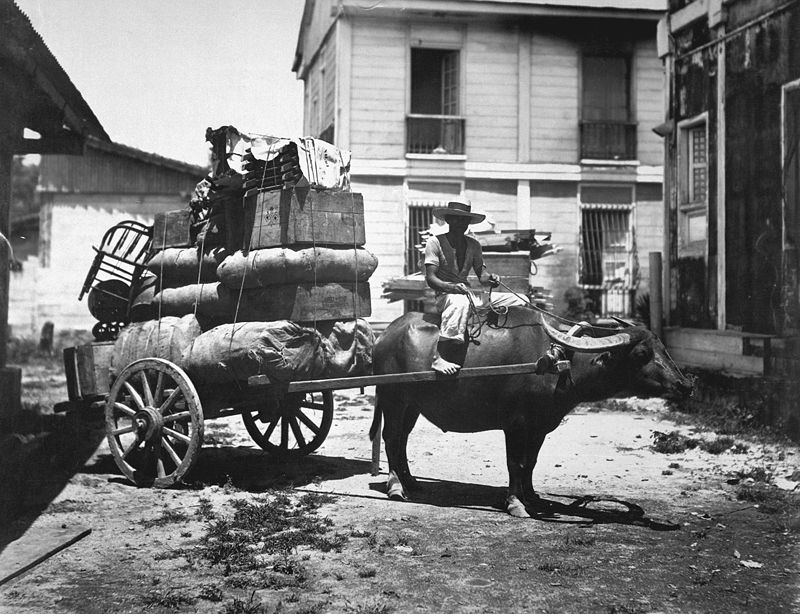
The raid was over in 35 minutes, POWs brought to pre-arranged meet-up places with dozens of carabao carts.   A long trek yet remained, one POW said “I made the Death March from Bataan, so I can certainly make this one!”  Over three days, up to 106 carts joined the procession, their plodding 2 MPH progress covered by strafing American aircraft.

Two American Rangers were killed in the raid, another 4 Americans and 21 Filipinos wounded, compared with 500-1,000 Japanese killed and four tanks put out of action.  One prisoner died in the arms of a Ranger, before leaving the gate.  Another died of illness on the long trip back.  464 American soldiers were liberated, along with 22 British and 3 Dutch soldiers, 28 American civilians, 2 Norwegians and one civilian each of British, Canadian and Filipino nationalities.

800px-Carabao_Cart
Carabao cart, similar to the ones used after the raid on Cabanatuan

Edwin Rose was a civilian, a purser on a ship plying the Singapore – Hong Kong run, when the war broke out.  He was caught in Manila and spent 929 days in captivity.  One of the longest-held POWs of the war in the Pacific. Rose awoke the night of the raid, and “heard all the shooting”.  He “knew the Americans had arrived” but he rolled over and went back to sleep, thinking they were there to stay. On awakening the following morning, Rose found he had “Cabanatuan all my own.”

POWs_celebrateHe dressed and shaved, put on his best clothes, and walked out of camp.  Passing guerrillas found him and passed him to a tank destroyer.  Give the man points for style.  A few days later, Edwin Rose strolled into 6th army headquarters, a cane tucked under his arm.

The Cabanatuan raid of January 30, 1945 liberated over 500 allied prisoners, the Americans among them representing virtually every state in the Union. Begging pardon for any mistakes in rank and/or spelling, the following represents those from my home state of Massachusetts:

  • Lieutenant Commander Robert Strong, Jr., Arlington
  • Captain John Dugan, Milton
  • 2nd Lieutenant John Temple, Pittsfield
  • Sergeant Richard Neault, Adams
  • Sergeant Stanislaus Malor, Salem
  • Private, 1st Class Joseph Thibeault, Lawrence
  • Private Edward Searkey, Lynn
  • USN C/QM Martin Seliga, Fitchburg
  • USN 1/C PO J.E.A. Morin, Danvers
  • USN AC MM Carl Silverman, Wareham

I hope I didn’t leave anyone out.  These guys have earned the right to be remembered.

If you enjoyed this “Today in History”, please feel free to re-blog, “like” & share on social media, so that others may find and enjoy it too. Please click the “follow” button on the right, to receive email updates on new articles.  Thank you for your interest, in the history we all share.

January 26, 1945 Underage, and Under Weight

After the war, Audi Murphy was asked how he could have grabbed that machine gun, and taken on an entire company of German infantry.  “They were killing my friends”, he replied.

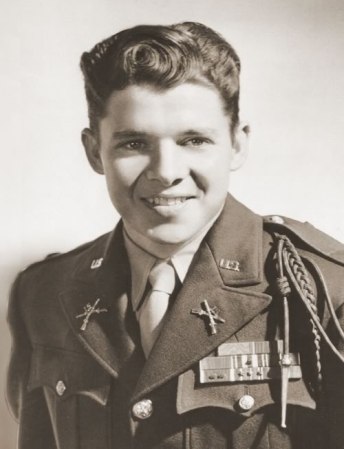
In the days following the Japanese sneak attack on Pearl Harbor, hundreds of thousands of Americans rushed to enlist in the United States’ armed services.  One of these was the son of a Hunt County Texas sharecropper family,  Audie Leon Murphy.

He went to the Marine Corps, Navy and the Army, and all turned him down, for being underweight and under age.  Murphy changed his diet to “fatten” up, and appeared at a Dallas recruiting station six months later, armed with a sworn affidavit from his sister, inflating his age by a year. It was 10 days past his 17th birthday when Audi Murphy, all 5’5½” and 112 lbs of him, enlisted in the United States Army.

f50b348dd608662fdfc1b4b1203ddf06Murphy’s company commander thought he wasn’t big enough for infantry service, and attempted to transfer him to cook and bakers’ school. Murphy refused.  He wanted to be a combat soldier.

Joining the 3rd Infantry Division of George S. Patton’s 7th Army, Murphy participated in amphibious landings in Sicily in July, fighting in nearly every aspect of the Italian campaign.

From Palermo to Messina and on to Naples, Anzio and Rome, the Germans were driven out of the Italian peninsula in savage and near continuous fighting that killed a member of my own family.

By mid-December, the 3rd ID suffered 683 dead, 170 missing, and 2,412 wounded. Now Sergeant Murphy was there for most of it, excepting two periods when he was down with malaria.

Two months after the “Overlord” landings in Normandy, elements of the 7th Army landed in southern France in an operation called “Dragoon”. By mid-September, only three of Company B’s original roster remained, the rest either killed or removed due to wounds or illness. It was around this time when Audi Murphy received his first Purple Heart.  A mortar blast resulted in a heel wound that wasn’t very serious, but a far more dangerous hip wound followed from a sniper, that December.  Murphy repaid the sniper, with a bullet between the German’s eyes.

Reduction of Colmar Pocket - January 20, 1945-February 9, 1944He was still in the hospital when his unit moved into the Vosges Mountains, in Eastern France.

The “Colmar Pocket” was an 850 square mile area held by German troops: Murphy described it as “a huge and dangerous bridgehead thrusting west of the Rhine like an iron fist. Fed with men and materiel from across the river, it is a constant threat to our right flank; and potentially it is a perfect springboard from which the enemy could start a powerful counterattack.”

Rejoining his unit in January, now Lieutenant Murphy became Company Commander, being the only officer remaining in the Company. Disease, wounds and casualties had reduced company B’s fighting strength by this time from an original 235, to 18.

What remained of the unit was awaiting reinforcements on January 26, 1945, as a combined force of German infantry and armor assembled itself outside of town. “I see the Germans lining up for an attack”, said Murphy. “Six tanks rumble to the outskirts of Holtzwihr, split into groups of threes, and fan out toward either side of the clearing. Then wave after wave of white dots, barely discernible against the background of snow, start across the field. They are enemy infantrymen”.

Let Lt. Murphy’s Medal of Honor Citation describe what happened next:

Audie-murphy-tank-scene-world-war-II-2“Second Lieutenant Audie L. Murphy, 01692509, 15th Infantry, Army of the United States, on 26 January 1945, near Holtzwihr, France, commanded Company B, which was attacked by six tanks and waves of infantry. Lieutenant Murphy ordered his men to withdraw to a prepared position in a woods while he remained forward at his command post and continued to give fire directions to the artillery by telephone. Behind him to his right one of our tank destroyers received a direct hit and began to burn. Its crew withdrew to the woods. Lieutenant Murphy continued to direct artillery fire which killed large numbers of the advancing enemy infantry. With the enemy tanks abreast of his position, Lieutenant Murphy climbed on the burning tank destroyer which was in danger of blowing up any instant and employed its .50 caliber machine gun against the enemy. He was alone and exposed to the German fire from three sides, but his deadly fire killed dozens of Germans and caused their infantry attack to waver. The enemy tanks, losing infantry support, began to fall back. For an hour the Germans tried every available weapon to eliminate Lieutenant Murphy, but he continued to hold his position and wiped out a squad which was trying to creep up unnoticed on his right flank. Germans reached as close as 10 yards only to be mowed down by his fire. He received a leg wound but ignored it and continued the single-handed fight until his ammunition was exhausted. He then made his way to his company, refused medical attention, and organized the company in a counterattack which forced the Germans to withdraw. His directing of artillery fire wiped out many of the enemy; he personally killed or wounded about 50. Lieutenant Murphy’s indomitable courage and his refusal to give an inch of ground saved his company from possible encirclement and destruction and enabled it to hold the woods which had been the enemy’s objective”.
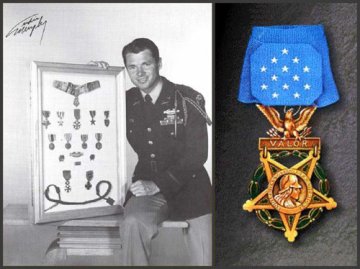
After the war, Audi Murphy was asked how he could have grabbed that machine gun, and taken on an entire company of German infantry.  “They were killing my friends”, he replied.

MurphyMOHThe man who had once been judged too small to fight was one of the most decorated American combat soldiers of WW2, having received every military combat award for valor the United States Army has to give, plus additional awards for heroism, from France and from Belgium.
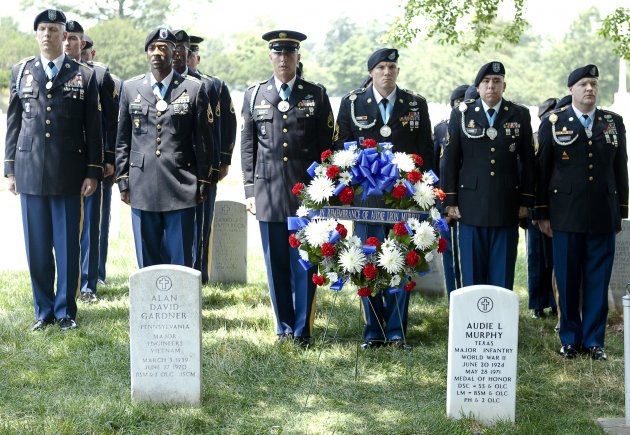
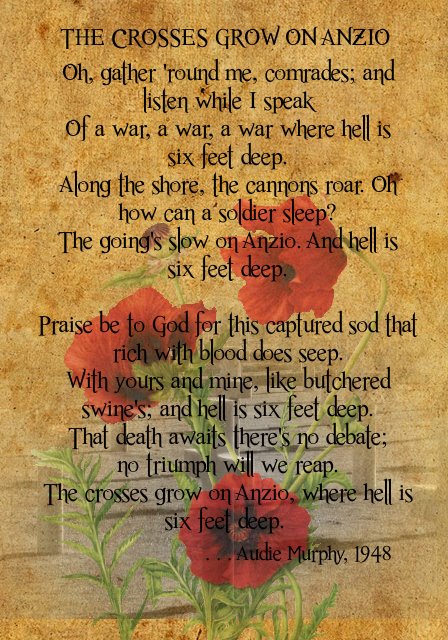
Audi Murphy returned to civil life and a 21-year career in Hollywood, starring in 40 feature films and a television series.  The transition was difficult  There were frequent bouts of depression and insomnia, and an addiction to sedatives.  He turned to poetry and songwriting for a creative outlet, but images of German war orphans could bring him to tears of guilt.  He slept with a loaded gun under his pillow, and there were episodes which professional colleagues and family members, found alarming.

In Murphy’s Day it was called “Battle Fatigue”, or “Shell Shock”.  He was candid about his own difficulties, and called on government to give increased consideration to the emotional toll inflicted on those whom it sent into combat.

Audi Murphy was killed in a plane crash near Catawba, Virginia, and buried with full military honors, in Arlington National Cemetery.  He was 45.

Audie Murphy Gravesite

Nine years later, the American Psychiatric Association recognized Post-Traumatic Stress Disorder (PTSD) in the 3rd edition of its Diagnostic and Statistical Manual of Mental Disorders.

Data from the National Vital Statistics System, a collaboration of the National Center for Health Statistics of the Department of Health and Human Services, reveals a suicide rate among veteran populations approximately twice that of comparable civilian populations.

I wonder about that term. “Disorder”.  The word makes it sound like there’s something wrong with these guys.

When a soldier experiences an event, so traumatic that the very memory of it causes pain, I don’t understand how that can be characterized as a “disorder”. To me it seems like the properly functioning conscience of a good man, recoiling in horror at what he’s seen in service to his country.

cc5083d1b7c62b153cd42c8f568de8f7

January 24, 1776 A Noble Train of Artillery

It must have been a sight when that noble train of artillery entered Cambridge on this day in 1776. By March, Henry Knox’ cannon would be manhandled to the top of Dorchester Heights, resulting in the British evacuation of Boston and a peculiar Massachusetts institution which exists to this day, known as “Evacuation Day”: March 17.

The American Revolution began with the “Shot Heard Round the World” on the morning of April 19, 1775. Within days of the Battles at Lexington and Concord and the subsequent British withdrawal to Boston, over 20,000 men poured into Cambridge from all over New England. Abandoned Tory homes and the empty Christ Church became temporary barracks and field hospitals.  Even Harvard College shut down, its buildings becoming quarters for at least 1,600 Patriots.

127472-004-69EA7B31The Continental Congress appointed George Washington General of this “Army” on June 15, two days before the British assault on Farmer Breed’s hill. An action which took its name from that of a neighboring farmer, going into history as the Battle of Bunker Hill.
Shortly after his arrival in July, General Washington discovered that his army had enough gunpowder for nine rounds per man, and then they’d be done.

At the time, Boston was a virtual island, connected to the mainland by a narrow strip of land.  British forces were effectively penned up in Boston, by a force too weak to do anything about it.

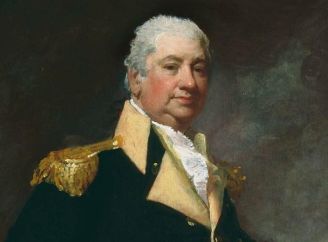
henry-knox-large-57c4b9525f9b5855e5f5e9c7
Henry Knox

The stalemate dragged on for months, when a 25-year-old bookseller came to General Washington with a plan. His name was Henry Knox. His plan was a 300-mile, round trip slog into a New England winter, to retrieve the guns of Fort Ticonderoga.

Washington’s advisors derided the idea as hopeless, but the General approved. Henry Knox set out with a column of men on December 1.

Located on the New York banks of Lake Champlain, Fort Ticonderoga was captured by a small force led by Ethan Allen and Colonel Benedict Arnold, in May of that year. In it were brass and iron cannon, howitzers, and mortars, 59 pieces in all. Arriving on December 5, Knox and his men set about disassembling the artillery, making it ready for transport. A flotilla of flat bottom boats was scavenged from all over the countryside, the guns loaded and rowed the length of Lake George, arriving barely before the water began to freeze over.

colonel-knox-bringing-the-cannons-from-fort-ticonderoga (2)Local farmers were enlisted to help and by December 17, Knox was able to report to General Washington “I have had made forty two exceedingly strong sleds & have provided eighty yoke of oxen to drag them as far as Springfield where I shall get fresh cattle to carry them to camp. . . . I hope in 16 or 17 days to be able to present your Excellency a noble train of artillery.”
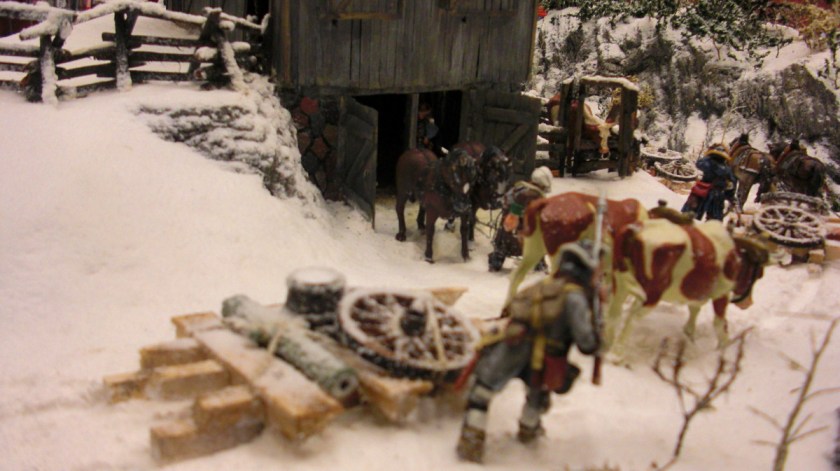
Bare ground prevented the sleds from moving until Christmas morning, when a heavy snow fell and the column set out for Albany. Two attempts to cross the Hudson River on January 5 each resulted in cannon being lost to the river, but finally Knox was able to write “Went on the ice about 8 o’clock in the morning & proceeded so carefully that before night we got over 23 sleds & were so lucky as to get the Cannon out of the River, owing to the assistance the good people of the City of Albany gave.”

CIMG5933

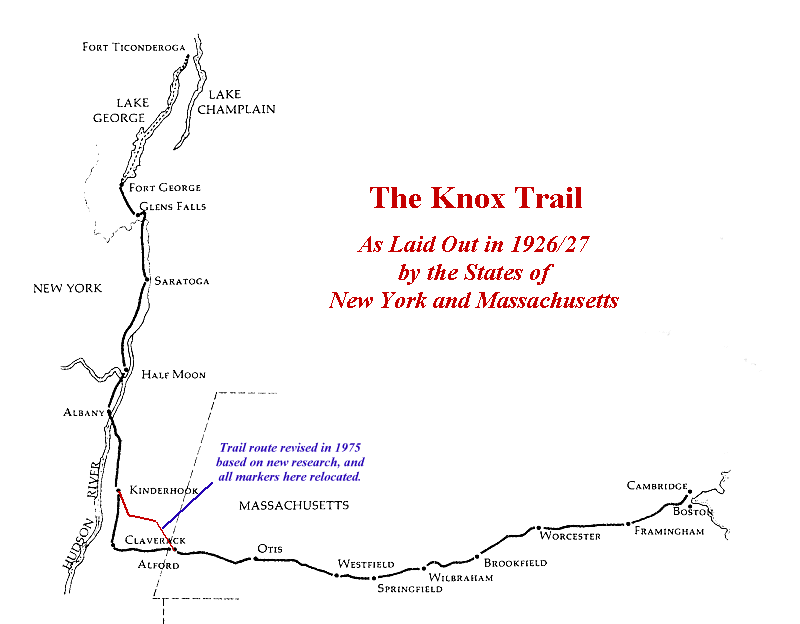
Continuing east, Knox and his men crossed into Massachusetts, over the Berkshires, and on to Springfield. With 80 fresh yoke of oxen, the 5,400lb sleds moved along much of what are modern-day Routes 9 and 20, passing through Brookfield, Spencer, Leicester, Worcester, Shrewsbury, Northborough, Marlborough, Southborough, Framingham, Wayland, Weston, Waltham, and Watertown.

knoxtrailmap

It must have been a sight when that noble train of artillery entered Cambridge on this day in 1776. By March, Henry Knox’ cannon would be manhandled to the top of Dorchester Heights, resulting in the British evacuation of Boston and a peculiar Massachusetts institution which exists to this day, known as “Evacuation Day”: March 17.

It is doubtful whether Washington possessed sufficient powder or shot for a sustained campaign, but British forces occupying Boston didn’t know that. The mere presence of those guns moved British General Howe to weigh anchor and sail for Nova Scotia, but that must be a story for another day.

January 23, 1828 A Victim to Maternal Love

In 1929, Washington journalist Margaret Husted wrote about her in the Washington Star. Descendants came forward and, piece by piece, the story of the first person buried at Arlington came to light.

The first military burial at Arlington National Cemetery was that of Private William Henry Christman, 67th Pennsylvania Infantry, interred on May 13, 1864. Two more joined him that day, the trickle soon turning into a flood. By the end of the war between the states, that number was 17,000 and rising.

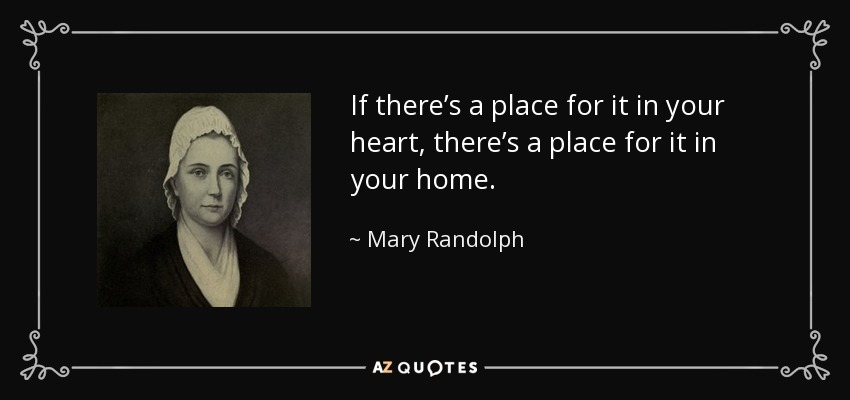
ARHO282_Mary-Randolph-PortrThe first military burial, but not the first.  When Private Christman went to his rest in our nation’s most hallowed ground, his grave joined that of Mary Randolph, buried some thirty-six years earlier.
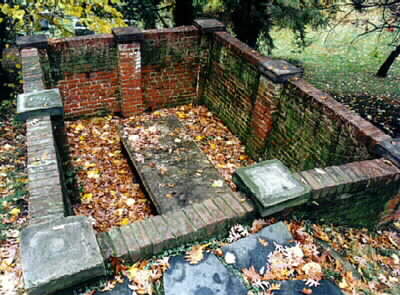
In 1929, cemetery workers were doing renovations on the Custis Mansion, at the top of the hill.  They couldn’t help being aware of a solitary grave, 100′ to the north, but knew little of its occupant.

Marked with the name Mary Randolph, the stone was inscribed with these words:

“In the memory of Mrs. Mary Randolph,

Her intrinsic worth needs no eulogium.

The deceased was born

The 9th of August, 1762

at Amphill near Richmond, Virginia

And died the 23rd of January 1828

In Washington City a victim to maternal love and duty.”

Little else was known about Mary Randolph.

In 1929, journalist Margaret Husted wrote about her in the Washington Star newspaper.  Descendants came forward and, piece by piece, the story of the first person buried at Arlington, came to light.

mrandolpMary Randolph, Pocahontas’ direct descendant and cousin to Thomas Jefferson,  was the cousin of George Washington Parke Custis, adopted step-grandson of George Washington, and the godmother of Custis’ daughter, Mary Anna Randolph Custis, wife of Robert E. Lee.

The last line of the inscription, “a victim to maternal love and duty” refers to her youngest surviving son, Midshipman Burwell Starke Randolph, who suffered a fall from a high mast in 1817, while serving in the Navy.  Both of his legs were broken and never healed properly.  When Mary passed away in 1828, Randolph remarked that his mother had sacrificed her own life in care of his.

american-housewife-randolphMary Randolph is best known as the author of America’s first regional cookbook, “The Virginia Housewife”. The Virginia Culinary Thymes writes that “It is interesting to note that all the cookery at that time was done in kitchens that had changed little over the centuries. In Virginia, the kitchen was typically a separate building for reasons of safety, summer heat and the smells from the kitchen. The heart of the kitchen was a large fireplace where meat was roasted and cauldrons of water and broth simmered most of the day. Swinging cranes and various devices made to control temperature and the cooking processes were used. The Dutch oven and the chafing dish were found in most kitchens. The brick oven used for baking was located next to the fireplace. A salamander was used to move baked products around in the oven and it could also be heated and held over food for browning“.

fdsdfsdfsdfs 116Mrs. Randolph was an early advocate of the now-common use of herbs, spices and wines in cooking. Her recipe for apple fritters calls for slices of apple marinated in a combination of brandy, white wine, sugar, cinnamon, and lemon rind.

She was well known as a Virginia cook and hostess, so much so that, during an 1800 slave insurrection near Richmond, the leader “General Gabriel” said that he would spare her life, if she would become his cook.

I believe that General Gabriel might have been onto something.

If you enjoyed this “Today in History”, please feel free to re-blog, “like” & share on social media, so that others may find and enjoy it too. Please click the “follow” button on the right, to receive email updates on new articles.  Thank you for your interest, in the history we all share.

January 18, 1943 Greatest Thing since Sliced Bread

The United States had been in World War II for two years in 1943, when Claude Wickard, head of the War Foods Administration as well as Secretary of Agriculture, had the hare brained idea of banning sliced bread.

The first automatic bread slicer was invented by Otto Frederick Rohwedder of Davenport, Iowa, in 1912. The idea was not at all popular among bakers, who feared that pre-sliced bread would go stale faster, leading to spoiled inventory and customer complaints.

A fire almost ended the project in 1917, when the prototype was destroyed along with the blueprints. Rohwedder soldiered on.  By 1927, he had scraped up enough financing to rebuild his bread slicer.

51f7f26521dd5.image

Frank Bench, a personal friend of the inventor, was the first to install the machine. The first pre-sliced loaf was sold in July of the following year. Customers loved the convenience and Bench’s bread sales shot through the roof.

Sliced bread became a national hit when the Continental Baking Company, then owner of the “Wonder Bread” brand, began using a modified version of Rowhedder’s machine in 1930. Sliced bread was here to stay. Sort of.

1101410721_400The United States had been in World War II for two years in 1943, when Claude Wickard, head of the War Foods Administration as well as Secretary of Agriculture, had the hare brained idea of banning sliced bread.

Mr. Wickard was no stranger to hare brained ideas; it is he who lends his name to the landmark Supreme Court case, Wickard v. Filburne.

Talk about hare brained ideas. The Agricultural Adjustment Act of 1938 limited the area that farmers could devote to wheat production, in an effort to stabilize the price of wheat on the national market.

An Ohio farmer named Roscoe Filburne was producing more than his allotment. The federal government ordered him to destroy the surplus and pay a fine, even though his “surplus” was being consumed on the farm by the Filburne family and their chickens.

download (6)Article 1, Section 8 of the Constitution includes the “Commerce Clause”, permitting the Congress “To regulate Commerce with foreign Nations, and among the several States, and with the Indian Tribes”.  That’s it and, not surprisingly, the Federal District Court sided with the farmer.

The Federal government appealed to the United States Supreme Court, arguing that, by withholding his surplus from the interstate wheat market, Filburne was effecting that market, thereby falling under federal government jurisdiction under the Commerce Clause.

USArooseveltF3The Supreme Court, apparently afraid of President Roosevelt and his aggressive and illegal “court packing” scheme, ruled against the farmer. Ever since, what you don’t do can be argued in a court of law to effect interstate conditions, putting what you didn’t do under the jurisdiction of the federal government.

Get it? Neither do I, but I digress.

Back to Mr. Wickard, who enacted his ban against sliced bread and put it into effect on January 18, 1943.

The push-back, as you might guess, was immediate and vehement. One woman wrote to the New York Times: “I should like to let you know how important sliced bread is to the morale and saneness of a household. My husband and four children are all in a rush during and after breakfast. Without ready-sliced bread I must do the slicing for toast—two pieces for each one—that’s ten. For their lunches I must cut by hand at least twenty slices, for two sandwiches apiece. Afterward I make my own toast. Twenty-two slices of bread to be cut in a hurry!

slicedbreadban-january18.1943The stated reasons for the ban never did make sense. At various times, Wickard claimed that it was to conserve wax paper, wheat and steel, but one reason was goofier than the one before.

According to the War Production Board, most bakeries had plenty of wax paper supplies on hand, even if they didn’t buy any. Furthermore, the federal government had a billion bushels of wheat stockpiled at the time, about two years’ supply, and the amount of steel saved by not making bread slicers has got to be marginal, at best.

The ban was rescinded on March 8, 1943.  Pre-sliced bread was once again available to the federal government and its grateful subjects. There’s no telling who first used the expression, “The greatest thing since sliced bread”.  A reasonable guess may be made, as to why.

153069796

January 16, 2003 Columbia

Flight Director Jon Harpold stated the problem, succinctly. “If it has been damaged it’s probably better not to know. I think the crew would rather not know. Don’t you think it would be better for them to have a happy successful flight and die unexpectedly during entry than to stay on orbit, knowing that there was nothing to be done, until the air ran out?”

Discussions of a reusable Space Transportation System (STS) began as early as the 1960s, as a way to cut down on the cost of space travel. The final design was a reusable, winged “spaceplane”, with disposable external tank and reusable solid fuel rocket boosters.

The ‘Space Truck’ program was approved in 1972, the prime contract awarded to North American Aviation (later Rockwell International), with the first orbiter completed in 1976.

Early Approach and Landing Tests were conducted with the first prototype, dubbed “Enterprise”, in 1977. A total of 16 tests, all within the confines of the atmosphere, were conducted from February to October of that year, the lessons learned applied to the first spaceworthy vehicle in NASA’s orbital fleet.

columbia_sts1STS-1, the first mission of the “Space Shuttle” program launched aboard “Columbia” from the Kennedy Space Center on Merritt Island, Florida. It was April 12, 1981, the 20th anniversary of the first human spaceflight, aboard the Russian Vostok 1. This was the first and, to-date only, manned maiden test flight of a new spacecraft system, in the US space program.

This first flight of Columbia would be commanded by Gemini and Apollo veteran John Young, and piloted by Robert Crippen. It was the first of 135 missions in the Space Shuttle program, the first of only two to take off with its external hydrogen fuel tank painted white. From STS-3 on, the external tank would be left unpainted to save weight.

There were initially four fully functional orbiters in the STS program: Columbia was joined after her first five missions by “Challenger”, “Discovery”, and finally “Atlantis”. A fifth orbiter, “Endeavor”, was built in 1991 to replace Challenger, which broke apart 73 seconds after lift-off on January 28, 1986, killing all seven of its crew.

All told, Columbia flew 28 missions with 160 crew members, traveling 125,204,911 miles in 4,808 orbits around the planet.

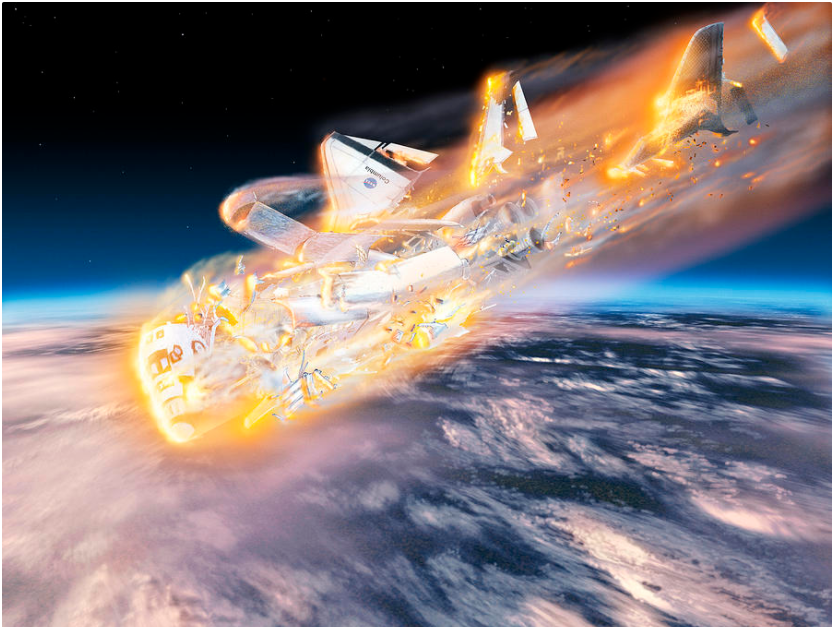
Columbia-Space-Shuttle-DisasterSTS-107 launched from the Kennedy Space Center aboard the Space Shuttle Columbia on January 16, 2003.  Eighty seconds after launch, a piece of insulating foam the size of a briefcase broke away from the external fuel tank, striking the leading edge of Columbia’s left wing and leaving a hole in the carbon composite tiles.

These carbon tiles are all that stands between the orbiter and the searing heat of re-entry.  On the ground, mission management teams discussed the problem, without being certain of its extent.  Even if there was major damage, little could be done about it.  So, what to tell the crew?

Flight Director Jon Harpold stated the problem, succinctly. “If it has been damaged it’s probably better not to know. I think the crew would rather not know. Don’t you think it would be better for them to have a happy successful flight and die unexpectedly during entry than to stay on orbit, knowing that there was nothing to be done, until the air ran out?”

So it was that Columbia’s 300 days, 17 hours, forty minutes and 22 seconds in space came to an end on the morning of February 1, 2003.

231,000 feet over the California coast and traveling 23 times the speed of sound, external temperatures surrounding the craft rose to 3,000°F when hot gases penetrated the interior of the left wing.  Abnormal readings began to show up at Mission Control, first temperature readings, and then tire pressures.

article-2271525-1747F562000005DC-689_634x334

The first debris began falling to the ground near Lubbock, Texas, at 8:58am. “Capcom”, the spacecraft communicator, called to discuss the tire pressure readings. At 8:59:32 a.m., Commander Husband called back from Columbia: “Roger,” he said, followed by another word.  It was cut off in mid-sentence.

After sixteen days in space, the ST-107 crew — Rick Husband, commander; Michael Anderson, payload commander; David Brown, mission specialist; Kalpana Chawla, mission specialist; Laurel Clark, mission specialist; William McCool, pilot; and Ilan Ramon, payload specialist from the Israeli Space Agency, probably survived the initial breakup, losing consciousness in the seconds following.

QkRd6

Vehicle debris and crew remains were found in over 2,000 locations across Arkansas, Texas and Louisiana. The only survivors of the disaster was a canister full of worms, brought into space for study.

Petr-Ginz-drawing-lPayload Specialist Colonel Ilan Ramon, born Ilan Wolferman, was an Israeli fighter pilot, the first Israeli astronaut to join the NASA space program.

Colonel Ramon’s mother survived the Nazi death camp at Auschwitz.  His grandfather and several family members, did not.  In their memory, Ramon carried a copy of “Moon Landscape”, a drawing by 14-year-old holocaust victim Petr Ginz, depicting what he thought earth might look like, from the moon.

Today, there are close to 84,000 pieces of Columbia and assorted debris, stored in the Vehicle Assembly Building at the Kennedy Space Center. To the best of my knowledge, that drawing by a boy who never made it out of Auschwitz, was never found.

article-2271525-1746D34A000005DC-544_634x370
Left to right: David Brown, Rick Husband, Laurel Clark, Kalpana Chawla, Michael Anderson, William McCool and Ilan Ramon

Feature Image credit, top:  Space Shuttle Columbia Disaster, Chris Butler

January 13, 1997 Buffalo Soldier

After the war, the town of Sommocolonia erected a Memorial, to nine brave soldiers who gave their lives, that their brothers might live.  Eight Italians, and one American.

In September 1867, Private John Randall of Troop G, United States 10th Cavalry Regiment, was assigned to escort two civilians on a hunting trip. The hunters became the hunted when a band of 70 Cheyenne warriors swept down on the trio. The two civilians were killed in the initial attack and Randall’s horse shot out from under him.

download (3)
Private John Randall

Cornered in a washout under some railroad tracks, Randall single handedly held off the attack with his revolver, despite a gunshot wound to his shoulder and no fewer than 11 lance wounds.

By the time help arrived, 13 Cheyenne warriors lay dead.  Private Randall was still standing. Word spread among the Cheyenne about a new kind of soldier, “who had fought like a cornered buffalo; who like a buffalo had suffered wound after wound, yet had not died; and who like a buffalo had a thick and shaggy mane of hair.”

167090-049-69103B80On July 28, 1866, the Army Reorganization Act authorized the formation of 30 new units, including two cavalry and four infantry regiments “which shall be composed of colored men.”

The 10th US Cavalry, formed on September 21, 1866 at Fort Leavenworth, Kansas, was the first unit of “Negro Cavalry”.  The 10th would soon be joined by the 9th, 24th and 25th Cavalry, all-black units which would come to be known as “Buffalo Soldiers”.

While several all-black regiments were formed during the Civil War, including the 54th Massachusetts Volunteer Infantry depicted in the movie “Glory”, these were the first peacetime all-black regiments in the regular Army.

ww1buffsoldThe original units fought in the American Indian Wars, the Spanish-American War, the Philippine-American War, the Border War and two World Wars, amassing 22 Medals of Honor by the end of WW1.

The old met the new during WWII, when 1st Sergeant Mark Matthews, veteran of the Pancho Villa Expedition, WW1, WW2 and the Battle of Saipan, was sent to train with the Tuskeegee Airmen.

In the end, Matthews would prove too old to fly.  A member of the Buffalo Soldiers Drum & Bugle Corps, Matthews would play taps at Arlington National Cemetery, always from the woods. Blacks of the era were not allowed at “white” funerals.

220px-MarkMatthews
Mark Matthews

Matthews retired shortly before the Buffalo Soldiers were disbanded, part of President Truman’s effort to integrate United States’ armed forces.

In December 1944, the segregated 366th Regiment of the 92nd Infantry Division (colored), the Buffalo Soldiers, were fighting in the vicinity of Sommocolonia, in northern Italy.

On Christmas day, German soldiers began to infiltrate the town, disguised as civilians.  A heavy artillery barrage began in the early morning hours of the 26th, followed by an overwhelming attack of enemy ground forces.  Vastly outnumbered, American infantry were forced to conduct a fighting retreat.

1st Lieutenant John R. Fox, forward observer for the 598th Field Artillery Battalion, volunteered to stay behind with a small Italian force, to help slow the enemy advance.

From the second floor of a house, Lieutenant Fox directed American defensive fire by radio, adjusting each salvo closer to his own position.  Warned that his final adjustment would bring artillery fire down on his head, the soldier who received the message was stunned at the response. 1st Lt. John Fox’ last known words, were “Fire it.”

John-Robert-Fox-1
1st Lieutenant John Robert Fox deliberately called down American artillery on his own position

When American forces retook the town, Lieutenant Fox’ body was found with those of about 100 German soldiers.

Sandra Fox of Boston, his only daughter, was two-years old when her father went to war.

The King James Bible translates John 15:13, as “Greater love hath no man than this, that a man lay down his life for his friends”.  After the war, the town of Sommocolonia erected a Memorial, to nine brave soldiers who gave their lives, that their brothers might live.  Eight Italians, and one American.

Sommocolonia_Memorial
Sommocolonia Memorial

In a January 13, 1997 ceremony at the White House, President Bill Clinton awarded the Medal of Honor, posthumously, to the family of 1st Lt. John Robert Fox.

1st Sergeant Mark Matthews died of pneumonia on September 6, 2005, at the age of 111.  The last of the Buffalo Soldiers was buried with honors, at Arlington National Cemetery, section 69, grave #4215.

The rank of General of the Armies is equivalent to that of a six-star general, the highest possible operational rank in the United States Armed Forces.  The rank has been held only twice in all American history, once awarded posthumously to George Washington, and once to an active-duty officer, John J. Pershing.

Memorial Day celebration in Washington, D.C.
1st Sgt. Mark Matthews, the last of the Buffalo Soldiers

Then-1st Lieutenant Pershing served with the Buffalo Soldiers from October 1895 to May 1897 plus another six months in Cuba, and came to respect soldiers of African ancestry as “real soldiers” in every way.

As West Point instructor beginning in 1897, Pershing was looked down upon and insulted by white cadets and officers, aggrieved over Pershing’s strict and unyielding disciplinary policies.  The press sanitized the favorite insult to “Black Jack”. The name they called the man, was uglier still.

During WW1, General Pershing bowed to the segregationist policies of President Woodrow Wilson and Secretary of War Newton Baker.

It seems that John Joseph Pershing understood what the northeast academic and the Ohio politician had yet to learn, a principle that the Reverend Martin Luther King Jr. would spell out, some fifty years later

“We must learn to live together as brothers, or perish together as fools”. 

If you enjoyed this “Today in History”, please feel free to re-blog, “like” & share on social media, so that others may find and enjoy it too. Please click the “follow” button on the right, to receive email updates on new articles.  Thank you for your interest, in the history we all share.

January 8, 1945 The Sub that Bagged a Train

So ended the only ground combat operation of WW2, on the soil of the Japanese homeland. And so it is, that an American submarine came to count a Medal of Honor and a Japanese locomotive, among its battle honors.

In the early phase of WW2, the traditional role of the American submarine service was to search, identify and report enemy activity to surface ships. Customary tactics emphasized stealth over offense, preferring to submerge and lie in wait over the surface attack.

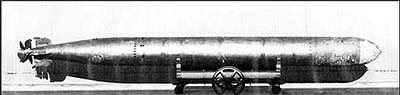
Small wonder. The Mark XIV torpedo, the primary anti-ship submarine-launched torpedo of WW2, was literally a scandal. Not only was torpedo production woefully inadequate to the needs of the war in the Pacific, but stingy pre-war budgets had precluded live-fire testing of the thing.

mk14torpedoAmong the Mark-XIV’s more pronounced deficiencies was a tendency to run about 10-ft. too deep, causing it to miss with depressing regularity. The magnetic exploder often caused premature firing of the warhead, and the contact exploder frequently failed altogether. There must be no worse sound to a submariner, than the metallic ‘clink’ of a dud torpedo bouncing off an enemy hull.
Worse still, these things tended to ‘run circular’, meaning that they’d return to strike the firing vessel.

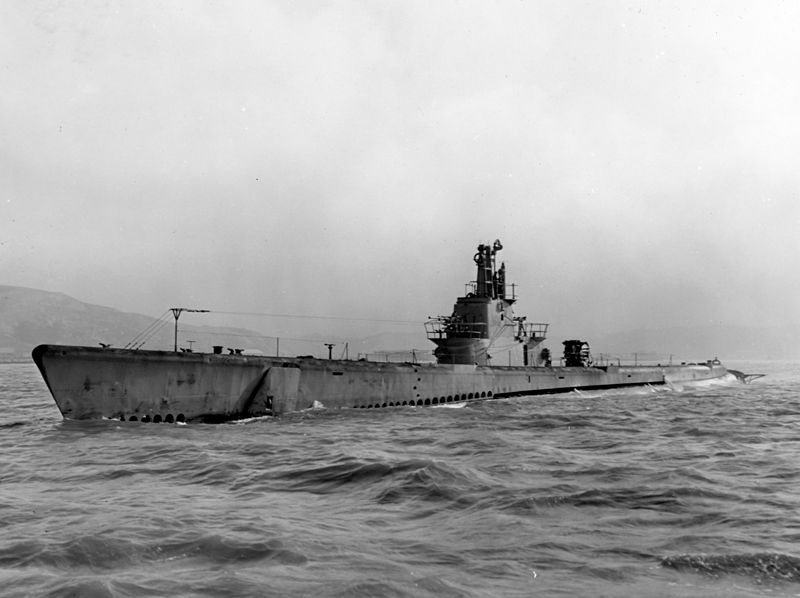
USS_Barb_(SS-220)_underway_in_May_1945
USS Barb (SS-220) underway in May, 1945

On July 24, 1943, Lawrence “Dan” Daspit commanding USS Tinosa (SS-283) attacked the 19,000-ton whale factory ship Tonan Maru III. Tinosa fired fifteen torpedoes with two stopping dead in the water and the other thirteen striking their target. Not one of them exploded. Thinking that he had a bad production run, Daspit kept his last torpedo for later inspection. Nothing out of the ordinary, was found.

Commander Eugene “Lucky” Fluckey didn’t subscribe to the conventional wisdom. WW2 vintage submarines were designed for speed on the surface, and USS Barb (SS-220) was capable of 21 knots.  Equivalent to 24mph on land. Under Commander Fluckey, Barb was for all intents and purposes, a fast-attack surface craft.

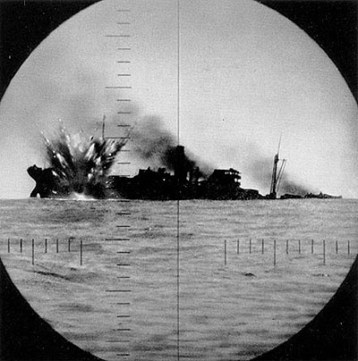
BarbperiscopeSam Moses, writing for historynet’s “Hell and High Water,” writes, “In five war patrols between May 1944 and August 1945, the 1,500-ton Barb sank twenty-nine ships and destroyed numerous factories using shore bombardment and rockets launched from the foredeck”.

In January 1945, the Barb, USS Picuda (SS-382), and the USS Queenfish (SS-393) were ordered to the China Sea, blocking the Formosa Strait to Japanese shipping.

On the 8th, the small “wolf pack” encountered eight large Japanese merchant ships, escorted by four patrol boats. In a two-hour running night battle, Barb sank merchant cargo ships Anyo Maru and Tatsuyo Maru in explosions so violent that Barb was forced to go deep, even then suffering light damage to her decks. She also sank merchant tanker Sanyo Maru and damaged the army cargo ship Meiho Maru.

The merchant tanker Hiroshima Maru ran aground in the confusion.  SS-220 returned the following day, to finish the job.

barbfastexitpaintingTwo weeks later, USS Barb spotted a 30-ship convoy, anchored in three parallel lines in Namkwan Harbor, on the China coast. Slipping past the Japanese escort guarding the harbor entrance under cover of darkness, the American submarine crept to within 3,000 yards.
Fluckey gave the order and Barb fired her six bow torpedoes at the tightly packed convoy. Swinging around, she fired her four stern torpedoes, just as the first salvo slammed home. Four ships were mortally wounded and another three heavily damaged, as a Japanese frigate opened fire.

It took a full hour to extract herself from the uncharted, heavily mined and rock-obstructed shallows of Namkwan Harbor. Torpedoes meant for the American sub struck Chinese junks instead. A Japanese aircraft appeared overhead, just as Barb slipped out into deeper water. No wonder they called him “Lucky Fluckey”.

The episode earned Commander Fluckey the Medal of Honor in March, 1945.

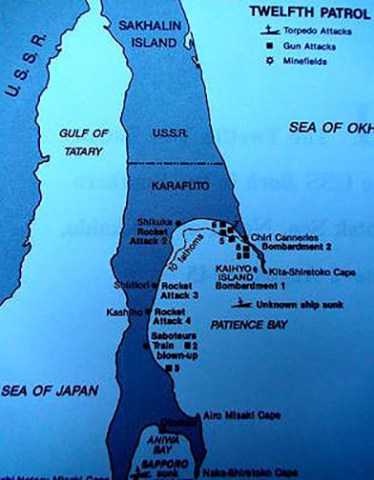
BarbOkhoskOn completion of her 11th patrol, USS Barb underwent overhaul and alterations, including the installation of 5″ rocket launchers, setting out on her 12th and final patrol in early June.
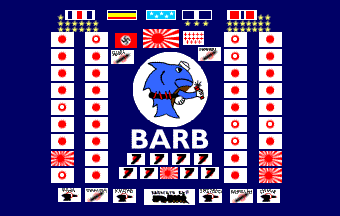
For the first time in the history of submarine warfare, rocket attacks were successfully employed against shore targets, including facilities in Shari, Hokkaido; Shikuka, Kashiho; and Shiritoru. Barb also attacked Kaihyo To with her regular armaments, destroying 60% of the town.

By mid July 1945, USS Barb had racked up one of the most successful records in the submarine service, sinking the third-highest gross tonnage of enemy shipping of the entire war, and the highest in Japanese shipping, according to the Japanese’ own records..

In poring over a coastal map of Karafuto, the Japanese end of Sakhalin island, the answer as to what to do next, soon came clear. The American sub was going to take out the supply line to enemy merchant shipping, and use a Japanese train, to do it.

Steel plates were bent and welded into crude tools, and a team of eight volunteers was selected. There was so much excitement among the crew over the idea, that even the Japanese POW on board wanted to go ashore, promising he wouldn’t try to escape.

On the night of July 22-23, Fluckey maneuvered the sub into shallow water within 950 feet of land, and put two rubber rafts ashore.

main-qimg-7d0915017cc1ad3409a1a960f4379e17Working so close to a Japanese guard tower that they could almost hear the snoring of the sentry, the eight-man team dug into the space between two ties and buried the 55-pound scuttling charge. They then dug into the space between the next two ties, and placed the battery.

At one point the team had to dive for the bushes, as a night train came through.

At last the work was done and, for the first time that night, the group disobeyed a direct order.  The other seven had been ordered to back off as Electricians Mate 3rd Class Billy Hatfield wired the switch and activated the bomb. That way only one man would die if things went wrong, but these guys weren’t going anywhere. Seven men looked on as Hatfield made the final connections, each wanting to see that this last step was done right.

Barb had worked her way to within 600′ of shore and the shore party was barely halfway back, when the second train came through. A thunderous explosion tore through the stillness, as night turned to day.  Pieces of the locomotive were thrown 200 feet in the air as twelve freight cars, two passenger cars, and a mail car derailed and piled together.

There was no further need for stealth.  With barely 6′ of water under her keel, Fluckey took up a megaphone, bellowing “Paddle like the devil!”  Five minutes later the shore party was on board.  As “The Galloping Ghost of the China Coast” slipped away, every crew member not absolutely necessary to the operation of the boat was on-deck, to witness the spectacle they had wrought.

So closes a little-known chapter of the war in the Pacific.  The only ground combat of WW2, carried out on the Japanese home islands. So it is, that an American submarine came to count a Medal of Honor and a Japanese locomotive, among its battle honors.

USS_Barb_crew_1945_i03570
Members of the USS Barb demolition squad pose with her battle flag at the conclusion of her 12th war patrol, Pearl Harbor, August 1945. Chief Gunners Mate Paul G. Saunders, USN, Electricians Mate 3rd Class Billy R. Hatfield, USNR, Signalman 2nd Class Francis N. Sevei, USNR, Ships Cook 1st Class Lawrence W. Newland, USN, Torpedomans Mate 3rd Class Edward W. Klingesmith, USNR, Motor Machinists Mate 2nd Class James E. Richard, USN, Motor Machinists Mate 1st Class John Markuson, USN; and Lieutenant William M. Walker, USNR.

In addition to Commander Fluckey’s Medal of Honor, the crew of USS Barb earned a Presidential Unit Citation, a Navy Unit Commendation, the Asiatic-Pacific Campaign Medal with eight battle stars, the World War II Victory Medal, and the National Defense Service Medal.  Of all those awards, the one of which later-Rear Admiral Fluckey was most proud, was the one he didn’t get.  In five successful combat patrols under Commander Eugene Fluckey, not one crew member of the USS Barb ever received so much as a purple heart.


If you enjoyed this “Today in History”, please feel free to re-blog, “like” & share on social media, so that others may find and enjoy it too. Please click the “follow” button on the right, to receive email updates on new articles.  Thank you for your interest, in the history we all share.

January 3, 1870 Mr. Roebling’s Bridge

To aid in the work, Emily Roebling took a crash course in bridge engineering. For 11 years she studied higher mathematics, catenary curves, materials strength, and the intricacies of cable construction, all while acting as the pivot point on the largest bridge construction project in the world, and nursemaid to a desperately sick husband.

At the time it was built, the span across the East river linking Brooklyn with Manhattan was the longest suspension bridge in the world.

In 1869, civil engineer John Roebling had already invested two years in site work.   With the ferry coming in, he should have paid more attention to his surroundings.  Focused on what he was doing on the pier, the engineer’s toes were crushed as the boat docked, so badly that several had to be amputated.

brooklyn-bridge-caisson-granger“Lockjaw” is such a sterile term, it doesn’t begin to describe the condition known as Tetanus. In the early stages, the anaerobic bacterium Clostridium Tetani produces tetanospasmin, a neurotoxin producing mild spasms in the jaw muscles. As the disease progresses, sudden and involuntary contractions effect most skeletal muscle groups, becoming so powerful that bones are fractured and the muscles tear themselves apart. These were the last days of John Roebling, the bridge engineer who would not live to see his most famous work.
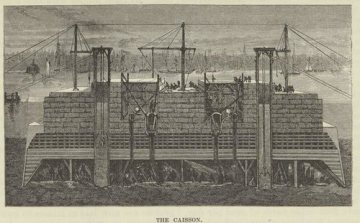
Roebling was the first casualty of the project.  He would not be the last.

Brooklyn Bridge Caisson ConstructionRoebling’s 32-year-old son Washington took over the project, beginning construction on January 3, 1870.
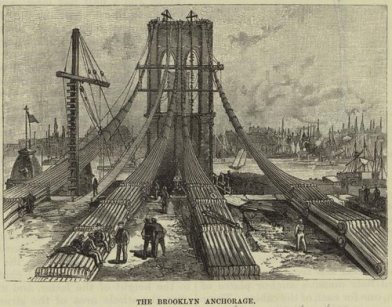
Enormous yellow pine boxes called “caissons” were built on the Brooklyn and New York sides of the river, descending at the rate of 6-in. per week in search of bedrock. Like giant diving bells, the New York side ended up at 78′ below mean high tide, the Brooklyn side 44′. Pressurized air was pumped into these boxes, keeping water and mud at bay, as workers excavated the bottom. In 1872, these “sandhogs” began to experience a strange illness that came to be called “caisson disease”.

Civil War era submarine designer Julius Hermann Kroehl may have recognized what was happening, but Kroehl was five years in his grave by this time, victim of the same “fever”. Today we call it “the bends”. Pop the top off a soda bottle and you’ll see the principle at work. Without sufficient decompression time, dissolved gasses come out of solution and the blood turns to foam. Bubbles form in or migrate to any part of the body, resulting in symptoms ranging from joint pain and skin rashes, to paralysis and death.  The younger Roebling was badly injured as a result of the bends in 1872, leaving him partially paralyzed and bedridden, incapable of supervising construction on-site.

brooklyn-anchorageRoebling conducted the entire project looking out his apartment window, designing and redesigning details while his wife, Emily Warren Roebling, became the critical connection between her husband and the job site.
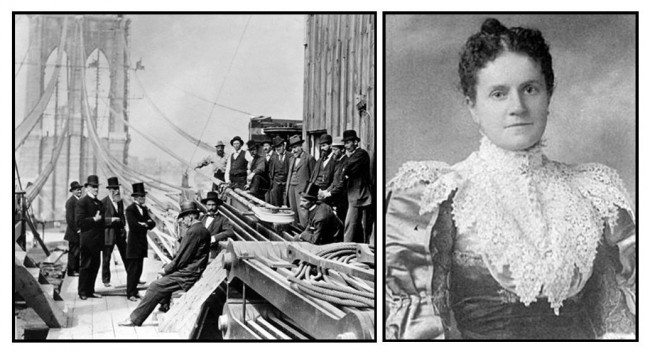
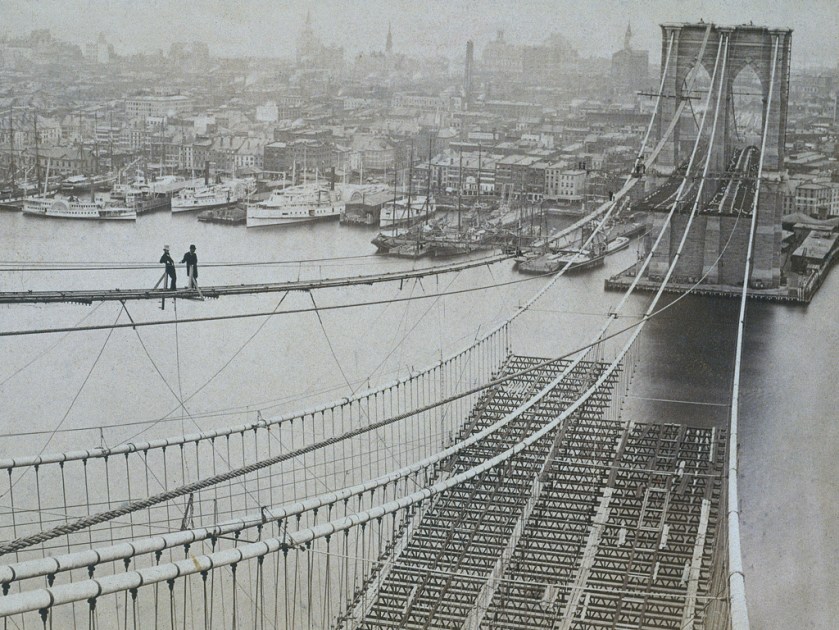
To aid in the work, Emily Roebling took a crash course in bridge engineering. For 11 years she studied higher mathematics, catenary curves, materials strength, and the intricacies of cable construction, all while acting as the pivot point on the largest bridge construction project in the world, and nursemaid to a desperately sick husband.

Emily-Warren-Roebling-e1389630968571
Emily Warren Roebling, the “first woman field engineer”.

Historian David McCullough wrote in his book, The Great Bridge: The Epic Story of the Building of the Brooklyn Bridge: “By and by it was common gossip that hers was the great mind behind the great work and that this, the most monumental engineering triumph of the age, was actually the doing of a woman, which as a general proposition was taken in some quarters to be both preposterous and calamitous. In truth, she had by then a thorough grasp of the engineering involved”.

Unlikely as it sounds, fires broke out at the bottom of the river on several occasions, started by workmen’s candles, fed by the oakum used for caulking, and turbocharged by all that pressurized air. On at least one occasion, the caisson had to be filled with millions of gallons of water, before the fire went out for good.

Brooklyn bridge builders

A footbridge connected the two sides in 1877, and soon the wires began to be strung. Wooden “buggies” carried men back and forth along wires suspended hundreds of feet above the water, as individual wires were woven into the four great cables that support the bridge. The work was exacting, with each wire bound together to precise specifications. Rumors about corruption and sleaze surrounded the project when J. Lloyd Haigh, the wire contractor, was discovered to be supplying inferior material. It was way too late to do anything about it, and 150 extra wires were bundled into each cable to compensate. The tactic worked.  Haigh’s shoddy wire remains there, to this day.

Construction was completed in 1883, the bridge opening for use on May 24. The first person to cross was Emily Roebling. Six days later, a rumor started that the bridge was about to collapse.  At least 12 people were killed in the resulting stampede. A year later, a publicity stunt by P. T. Barnum helped to put people’s minds at ease when Jumbo, the circus’ prize elephant, led a parade of 20 other elephants across the bridge.

Brooklyn Bridge

For a long time the span was called the “New York and Brooklyn Bridge” or the “East River Bridge”, officially becoming the “Brooklyn Bridge” only in 1915. At least 27 were killed in its construction; 3 from the bends, several from cable stringing accidents and others crushed under granite blocks or killed in high falls.

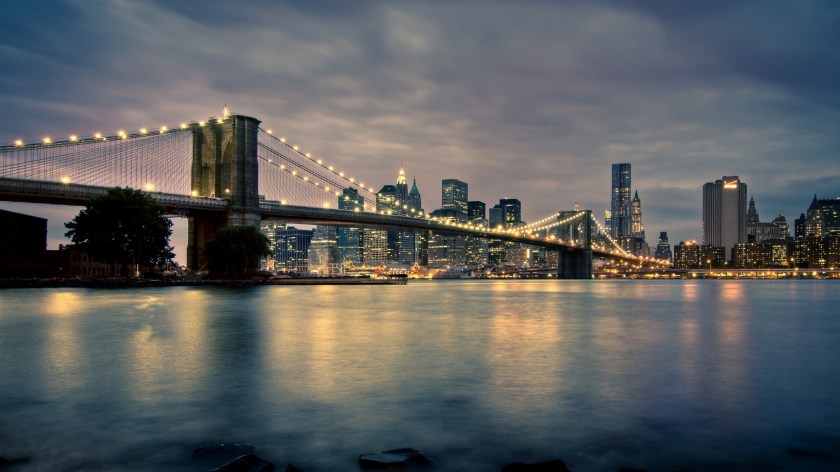
Even today, popular culture abounds with stories of suckers “buying” the Brooklyn Bridge. It was the longest bridge in the world for its time, and would remain so until 1903. Roebling had designed his project to be six times the strength required for the job. Even with the defective cables installed, the bridge is four times as strong as it needs to be. Many of the Brooklyn Bridge’s contemporary structures have long since gone.  Johann Augustus Röbling’s bridge carries 145,000 cars, every day.


December 31, 1903 Happy New Year

In 1907, Times owner Adolph Ochs wanted a bigger spectacle to draw attention to the newly renamed Times Square. He asked the newspaper’s chief electrician, Walter F. Painer for an idea. Painer suggested a time ball.

From the 7th century BC, the Roman calendar attempted to follow the cycles of the moon. The method frequently fell out of phase with the change of seasons, requiring the random addition of days. The Pontifices, the Roman body charged with overseeing the calendar, made matters worse. They were known to add days to extend political terms, and to interfere with elections. Military campaigns were won or lost due to confusion over dates. By the time of Julius Caesar, things needed to change.

julius-caesar-11-638

Caesar hired the Alexandrian astronomer Sosigenes to help straighten things out. The astronomer calculated that a proper year was 365¼ days, which more accurately tracked the solar, and not the lunar year. “Do like the Egyptians”, he might have said, the new “Julian” calendar went into effect in 46BC. Caesar decreed that 67 days be added that year, moving the New Year’s start from March to January 1. The first new year of the new calendar was January 1, 45BC.

Caesar synchronized his calendar with the sun by adding a day to every February, and changed the name of the seventh month from Quintilis to Julius, to honor himself. Rank hath its privileges.

Not to be outdone, Caesar’s successor changed the 8th month from Sextilis to Augustus. 2,062 years later, we still have July and August.

Julian_to_Gregorian_Date_ChangeSosigenes was close with his 365¼ day long year, but not quite there. The correct value of a solar year is 365.242199 days.  By the year 1000, that 11-minute error had added seven days. To fix the problem, Pope Gregory XIII commissioned Jesuit astronomer Christopher Clavius to come up with yet another calendar. The Gregorian calendar was implemented in 1582, omitting ten days and adding a day on every fourth February.

Most of the non-Catholic world took 170 years to adopt the Gregorian calendar. Britain and its American colonies “lost” 11 days synchronizing with it in 1752.  The last holdout, Greece, would formally adopt the Gregorian calendar in 1923. Since then, we’ve all gathered to celebrate New Year’s Day on the 1st of January.

For years, New Years’ eve celebrations were held at Trinity Church, where revelers would gather to “ring in the new”. The New York Times newspaper moved into “Longacre Square” just after the turn of the 20th century.   Times owner Adolph Ochs held his first fireworks celebration on December 31, 1903, with almost 200,000 people attending the event.  Four years later, Ochs wanted a bigger spectacle to draw attention to the newly renamed Times Square. He asked the newspaper’s chief electrician, Walter Painer, for an idea. Painer suggested a time ball.

Time Ball
Flamsteed house royal observatory time ball, Greenwich, England

A time ball is a marine time signaling device, a large painted ball which is dropped at a predetermined rate, enabling mariners to synchronize shipboard marine chronometers for purposes of navigation. The first one was built in 1829 in Portsmouth, England, by Robert Wauchope, a Captain in the Royal Navy.

Time balls were obsolete technology by the 20th century, but it fit the Times’ purposes, nicely.  A young immigrant metalworker named Jacob Starr designed a 5′ wide, 700-lb iron and wooden ball, decorated with 100 25-watt incandescent bulbs.  For most of the twentieth century the company he founded, sign maker Artkraft Strauss, was responsible for lowering the ball.

download (1)That first ball was hoist up a flagpole by five men on December 31, 1907. Once it hit the roof of the building, the ball completed an electric circuit, lighting up a sign and touching off a fireworks display.

The newspaper no longer occupies the building at 1 Times Square, but the tradition continues.  One of seven versions of the Times Square ball has marked the coming of the new year ever since, with the exceptions of 1942 and ’43, due to the wartime need to dim out the lights.

The version used the last few years is 12′ wide, weighing in at 11,875lbs; a great sphere of 2,688 Waterford Crystal triangles, illuminated by 32,256 Philips LED bulbs and producing more than 16 million colors.  It used to be that the ball only came out for New Year.  The last few years, you can see the thing, any time you like.

only-sailors-truly-understand-the-strange-tradition-of-the-new-years-eve-ball-drop

In most English-speaking countries, the singing of “Auld Lang Syne”, is the traditional end to the New Year’s celebration.  Written by the Scottish poet Robert Burns in 1788, the tune comes from an old pentatonic Scots folk melody. The original verse, phonetically spelled as a Scots-speaker would pronounce it, sounds like this:

“Shid ald akwentans bee firgot, an nivir brocht ti mynd?

Shid ald akwentans bee firgot, an ald lang syn?”

CHORUS

“Fir ald lang syn, ma jo, fir ald lang syn,

wil tak a cup o kyndnes yet, fir ald lang syn.

An sheerly yil bee yur pynt-staup! an sheerly al bee myn!

An will tak a cup o kyndnes yet, fir ald lang syn”.

CHORUS

“We twa hay rin aboot the braes, an pood the gowans fyn;

Bit weev wandert monae a weery fet, sin ald lang syn”.

CHORUS

“We twa hay pedilt in the burn, fray mornin sun til dyn;

But seas between us bred hay roard sin ald lang syn”.

CHORUS

“An thers a han, my trustee feer! an gees a han o thyn!

And we’ll tak a richt gude-willie-waucht, fir ald lang syn”.