October 27, 1962 Archipov

Anyone alive on or after this day in 1962, probably owes their life to one man. I wonder how many remember his name.

Come join me for a moment, in a thought experiment.  A theater of the mind.

Imagine. Two nuclear superpowers, diametrically opposed, armed to the teeth and each deeply distrustful of the other. We’re talking here, about October 1962. The Cuban Missile Crisis. Now imagine at the height of the standoff, a misunderstanding leads some fool to push the button. The nuclear first strike is met with counterattack and response in a series of ever-escalating retaliatory launches.

You’ve seen enough of human nature. Counterattacks are all but inevitable, right? Like some nightmare shootout at the OK corral, only this one is fought with kiloton-sized weapons. Cities the world over evaporate in fireballs. Survivors are left to deal with a shattered, toxic countryside and nuclear winter, without end.

Are we talking about an extinction event? Possibly. Terrible as it is, it’s not so hard to imagine, is it?

In 1947, members of the Science and Security Board of the Bulletin of Atomic Scientists envisioned a “Doomsday Clock”. A symbolic clock face, dramatizing the threat of global nuclear catastrophe.  Initially set at seven minutes to midnight, the “time” has varied from seventeen minutes to two.

The Cuban Missile Crisis of October 1962 didn’t make it onto the doomsday clock. Those 13 days went by far too quickly to be properly assessed. And yet, the events of 62 years ago brought us closer to extinction than at any time before or since.

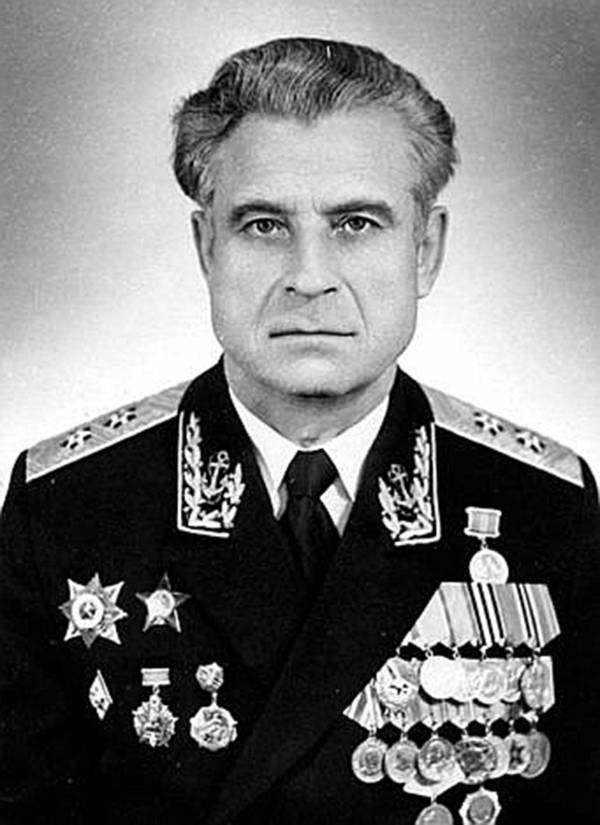
On this day in 1962, an unsuspecting world stood seconds away from the abyss. The fact that we’re here to talk about it came down to one man, Vasili Arkhipov. Many among us have never heard his name. Chances are very good that we can thank him for our lives.

As WW2 gave way to the nuclear age, Cold War military planners adopted a policy of “Deterrence”. “Mutually Assured Destruction” (MAD). Soviet nuclear facilities proliferated across the “Eastern Bloc”, while US nuclear weapons dispersed across the NATO alliance. By 1961 some 500 US nuclear warheads were installed in Europe, from West Germany to Turkey, Italy to Great Britain.

Judging President Kennedy weak and ineffective, communist leaders made their move in 1962, signing a secret arms agreement in July. Medium-range ballistic missiles with a range of 2,000 miles were headed to the Caribbean basin.

By mid- October, US reconnaissance aircraft revealed Soviet ballistic nuclear missile sites under construction Cuba. 90 miles from American shores. President John F. Kennedy warned of the “gravest consequences”, ordering a blockade of the island nation. Relations turned to ice as Soviet military vessels joined the standoff.

Tensions dialed up to 11 on October 27, when USAF Major Rudolph Anderson’s U-2 reconnaissance aircraft was shot down over the village of Veguitas. His body still stapped into his ejection seat.

Wreckage of Major Rudolf Anderson Jr.’s U2 at the Museo del Aire, Havana, Cuba H/T theaviationgeekclub.com

The US Navy practiced a submarine attack protocol at that time, called “hunt to exhaustion”. Anatoly Andreev described what it was like to be on the receiving end:

“For the last four days, they didn’t even let us come up to the periscope depth … My head is bursting from the stuffy air. … Today three sailors fainted from overheating again … The regeneration of air works poorly, the carbon dioxide content [is] rising, and the electric power reserves are dropping. Those who are free from their shifts, are sitting immobile, staring at one spot. … Temperature in the sections is above 50 [122ºF].”

I’m not sure I could think straight under conditions like that.

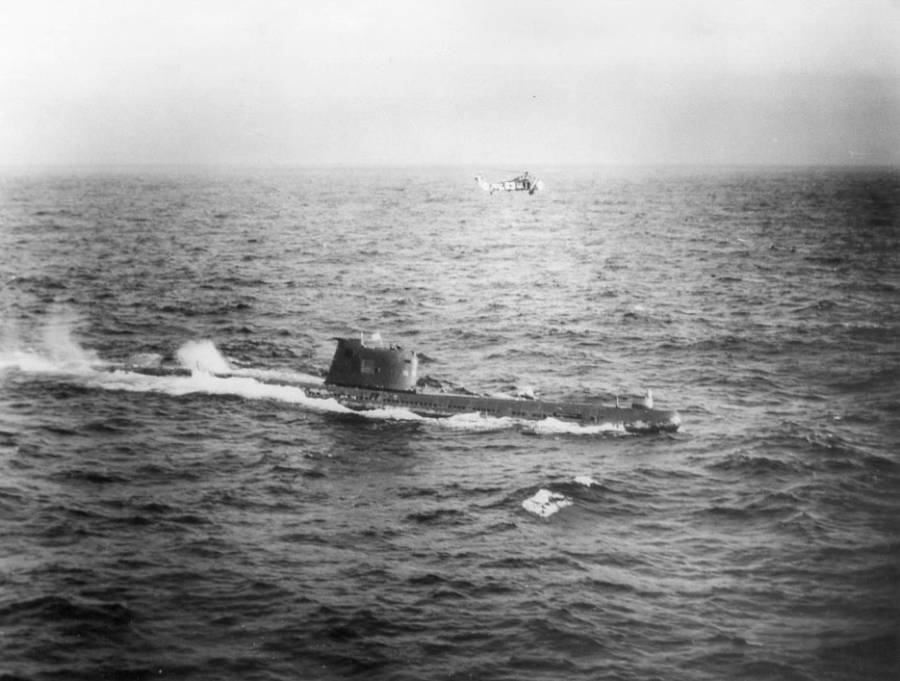
On the 27th, US Navy destroyers began to drop depth charges. This was not a lethal attack, intending only to bring the sub to the surface. Deep under the water, captain and crew had no way of knowing that. B-59 had not been in contact with Moscow for several days. Now depth charges were exploding to the left and right. Captain Valentin Savitsky made his decision. Convinced that war had begun, the time had come for the “special weapon”. “We’re gonna blast them now!,” he reportedly said. “We will die, but we will sink them all – we will not become the shame of the fleet.” Political officer Ivan Maslennikov concurred. Send it.

On most nuclear-armed Soviet submarines, two signatures were all that was needed. With Chief of (submarine fleet) Staff officer Vasili Archipov on board, the decision required approval by all three senior officers. To Archipov, this didn’t feel like a “real” attack. What if they’re only trying to get us to the surface?

Archipov said no.

Perhaps it was his role in averting disaster aboard the nuclear-powered submarine K-19, the year before. Maybe it was his calm, unflappable demeanor when Captain Savitsky had clearly “lost his temper”. Somehow, Archipov was able to keep his head together under unimaginable circumstances and convince the other two. B-59 came to the surface to learn that, no. World War III had not begun after all.

The submarine went quietly on its way. Kruschev announced the withdrawal of Soviet missiles the following day. The Cuban Missile Crisis was over.

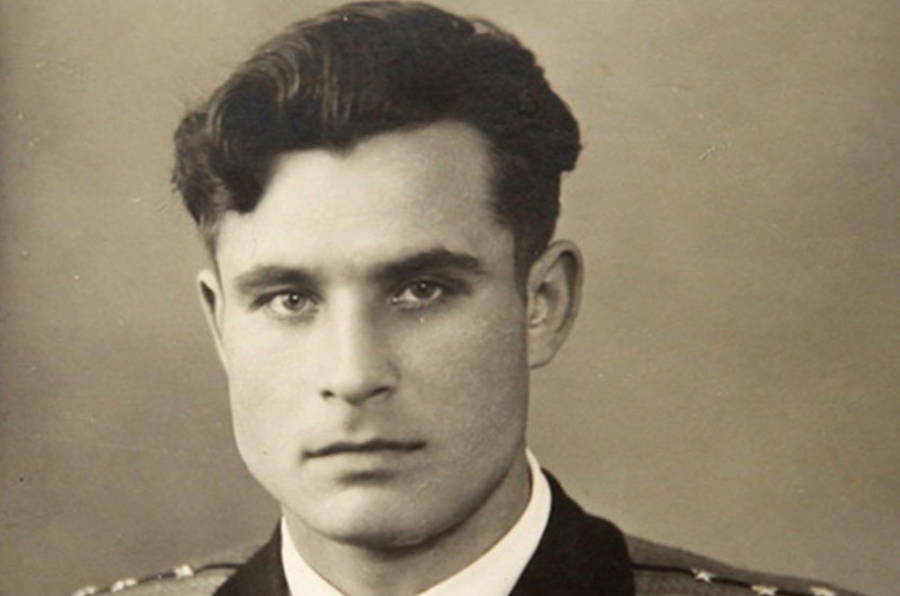
Vasily Aleksandrovich Arkhipov

These events wouldn’t come to light for another 40 years.

B-59 crewmembers were criticized on returning to the Soviet Union. One admiral told them “It would have been better if you’d gone down with your ship.”

Vasily Aleksandrovich Arkhipov retired from the submarine service in 1988 and died, ten years later. Cause of death was kidney cancer, likely the result of radiation exposure sustained during the K-19 incident, back in 1961.
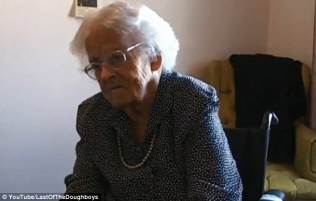
Lieutenant Vadim Orlov was an intelligence officer back in 1962, onboard the B-59. In 2002, then Commander Orlov (retired) gave Archipov full credit for averting nuclear war. Former U.S. Defense Secretary Robert McNamara said in 2002 “We came very, very close, closer than we knew at the time.” Historian Arthur Schlesinger Jr. was an advisor to President Kennedy. “This was not only the most dangerous moment of the Cold War”, he said. “It was the most dangerous moment in human history.”

September 22, 1776 Nathan Hale

The Connecticut schoolteacher was young and untried when he placed is confidence in the wrong place. It would prove to be a fatal mistake.

The nine Hale brothers of Coventry, Connecticut supported the Patriot side from the earliest days of the American Revolution. Five of them participated in the battles at Lexington and Concord. Nathan was the youngest and destined to be the most famous of them all. He was still at home at this time, finishing out the term of a teaching contract in New London, Connecticut.

Nathan Hale’s unit participated in the siege of Boston. Hale himself joined General George Washington’s army in the spring of 1776, as the army moved to Long Island to block the British move on the strategically important port city of New York.

On June 29, General Howe appeared off Staten Island with a fleet of 45 ships. By the end of the week, he’d assembled an overwhelming fleet of 130.

There was an attempt at peaceful negotiation on July 13, when General Howe sent a letter to General Washington under flag of truce. The letter was addressed “George Washington, Esq.”, intentionally omitting Washington’s rank. Washington declined to receive the letter, responding that there was no one present by that address. Howe tried the letter again on the 16th, this time addressing “George Washington, Esq., etc., etc.”. Again, Howe’s letter was refused.

The following day, General Howe sent Captain Nisbet Balfour in person to ask if Washington would meet with Howe’s adjutant, Colonel James Patterson. Considerations of honor having thus been settled, a meeting was scheduled for July 20.

Patterson told Washington that General Howe had come with powers to grant pardons.  Washington refused, saying “Those who have committed no fault want no pardon”.

Patriot forces were comprehensively defeated at the Battle of Brooklyn, fought on August 27, 1776. With the Royal Navy in command on the water, Howe’s army dug in for a siege, confident that the adversary was trapped and waiting to be destroyed at their convenience.

On the night of August 29-30, Washington withdrew his army to the ferry landing and across the East River, to Manhattan.

With horse’s hooves and wagon wheels muffled, oarlocks stuffed with rags, the Patriot army withdrew even as a rearguard tended fires, convincing the redcoats in their trenches that the Americans were still there.

The surprise was comprehensive for the British side, on waking on the morning of the 30th.  The Patriot army had vanished.

The Battle of Long Island would almost certainly have ended in disaster for the Patriot cause but for that silent evacuation over the night of August 29-30, one of the great military feats of the American revolution.

Following evacuation, the Patriot army found itself isolated on Manhattan island, virtually surrounded.  Only the thoroughly disagreeable current conditions of the Throg’s Neck-Hell’s Gate segment of the East River prevented Admiral Sir Richard Howe (William’s brother) from enveloping Washington’s position, altogether.

Expecting a British assault in September, General Washington became increasingly desperate for information on British movements.

Nathan Hale Capture

Washington asked for volunteers for a dangerous mission, to go behind enemy lines as a spy.  Up stepped a volunteer.  His name was Nathan Hale.

Hale set out on his mission on September 10, disguised as a Dutch schoolmaster. He was successful for about a week but appears to have been something less than “street smart”.  The young and untrained Patriot turned spy, bestowed his trust where it did not belong.

Major Robert Rogers was an old British hand, a leader of Rangers during the earlier French and Indian War. Rogers must have suspected that this Connecticut schoolteacher was more than he pretended to be, intimating that he himself was a spy in the Patriot cause.

Hale took Rogers into his confidence, believing the two to be playing for the same side.  Consider Tiffany, a British loyalist and Barkhamsted Connecticut shopkeeper was himself a sergeant of the French and Indian War. Tiffany recorded what happened next in his journal:

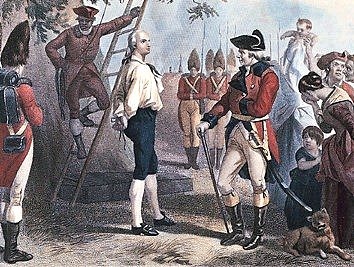
The time being come, Captain Hale repaired to the place agreed on, where he met his pretended friend” (Rogers), “with three or four men of the same stamp, and after being refreshed, began [a]…conversation. But in the height of their conversation, a company of soldiers surrounded the house, and by orders from the commander, seized Captain Hale in an instant. But denying his name, and the business he came upon, he was ordered to New York. But before he was carried far, several persons knew him and called him by name; upon this he was hanged as a spy, some say, without being brought before a court martial.”

“Stay behind spy” Hercules Mulligan had better success, reporting on British goings-on from the 1776 capture of New York to their withdrawal seven years later.  But that must be a story for another day.

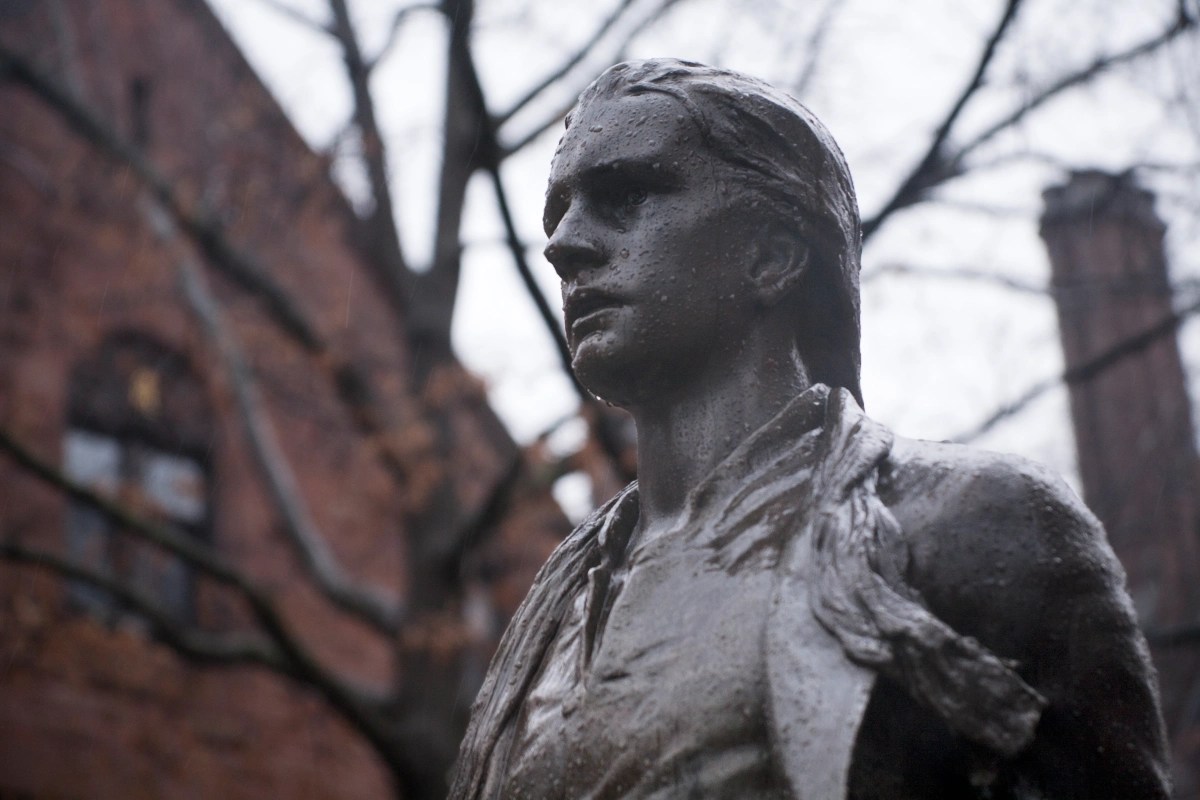
Nathan Hale was hanged on this day in 1776, described by CIA.gov as “The first American executed for spying for his country”.

There is no official account of Nathan Hale’s final words. However, an eyewitness statement from British Captain John Montresor exists. He was present at the hanging.

Montresor spoke with American Captain William Hull the following day under flag of truce.  The captain gave Hull the following account: “‘On the morning of his execution,’ said Montresor, ‘my station was near the fatal spot, and I requested the Provost Marshal to permit the prisoner to sit in my marquee, while he was making the necessary preparations. Captain Hale entered: he was calm, and bore himself with gentle dignity, in the consciousness of rectitude and high intentions. He asked for writing materials, which I furnished him: he wrote two letters, one to his mother and one to a brother officer.’ He was shortly after summoned to the gallows. But a few persons were around him, yet his characteristic dying words were remembered. He said, ‘I only regret, that I have but one life to lose for my country‘.

Nathan Hale was barely three months past his 21st birthday on the day he died.

September 21, 1780 André

He asked not that his life be spared, but only that he be executed by firing squad. A death considered worthy of a gentleman of the age and not hanging, an end reserved for thieves and scoundrels.

In an age before radio or television, John André was an interesting man to be around. A gifted storyteller with a great sense of humor he could draw, paint and cut silhouettes. He was an excellent writer, he could sing, and he could write verse.  John André was a British Major at the time of the American Revolution, who took part in his army’s occupations of Philadelphia and New York.

John André was a spy.

A favorite of colonial era loyalist society, Major André dated Peggy Shippen for a time, the daughter of a prominent Philadelphia loyalist. Shippen went on to marry Benedict Arnold in 1779, forming a link between the spy and an important general in the cause of American independence.

Hat tip artist Dale Watson for this image of Peggy Shippen

The relationship nearly changed the outcome of the American revolution.

Arnold was the Commandant of West Point at the time, the future location of one of our great military academies. A prominence overlooking the Hudson River, West Point was a fortified position offering decisive military advantage to the side holding the position. The British capture of West Point would have split the colonies in half.

The author (left) on a 2022 “history ramble” weekend with family members. It doesn’t take a military strategist to understand the importance of West Point’s commanding position over the Hudson River.

The Sloop of War HMS Vulture sailed up the Hudson River on September 20, 1780, Major André meeting with General Arnold on the river’s banks the following day. Dressed in civilian clothes, John André struck a bargain with the patriot general. Arnold would receive £20,000, over a million dollars today, in exchange for which he would give up West Point.

Tasked with returning the signed papers to British lines, Major André was stopped by three Patriot Militiamen two days later. They were John Paulding, David Williams and Isaac Van Wart. One of the three wore a Hessian overcoat, making André believe they might be loyalists. “Gentlemen”, he said, “I hope you belong to our party”. “What party”, came the reply, and André said “The lower (British) party”. “We do”, they said, to which André replied that he was a British officer and must not be detained. That was as far as he got.

You need not be a military strategist to recognize the importance of the commanding heights at West Point. The discovery of those papers brought Benedict Arnold’s treachery to light. Arnold immediately fled on hearing of André’s arrest, even as George Washington was headed to his place for a meeting over breakfast.

John André was tried and sentenced to death as a spy. He asked if he could write a letter to General Washington.  In it he asked not that his life be spared, but that he be executed by firing squad, a death more worthy of a gentleman than hanging, an execution at that time commonly reserved for criminals.

General Washington believed that Arnold’s crimes to be far more egregious than those of John André. Furthermore, he was impressed with the man’s courage.  Washington wrote to General Sir Henry Clinton asking for an exchange of prisoners.

Having received no reply, Washington wrote in his General Order of October 2 “That Major André General to the British Army ought to be considered as a spy from the Enemy and that agreeable to the law and usage of nations it is their opinion he ought to suffer death. The Commander in Chief directs the execution of the above sentence in the usual way this afternoon at five o’clock precisely.”

John André was executed by hanging in Tappan, New York. He was 31.

A vintage postcard illustration depicting the execution of Major John Andre, hung as a spy for aiding and abetting General Benedict Arnold during the American Revolutionary War in Trenton, New Jersey on 2nd October 1780, published in New York, circa 1903. Andre’s body was later disinterred from American soil and buried in Westminster Abbey, London. (Photo by Paul Popper/Popperfoto via Getty Images)

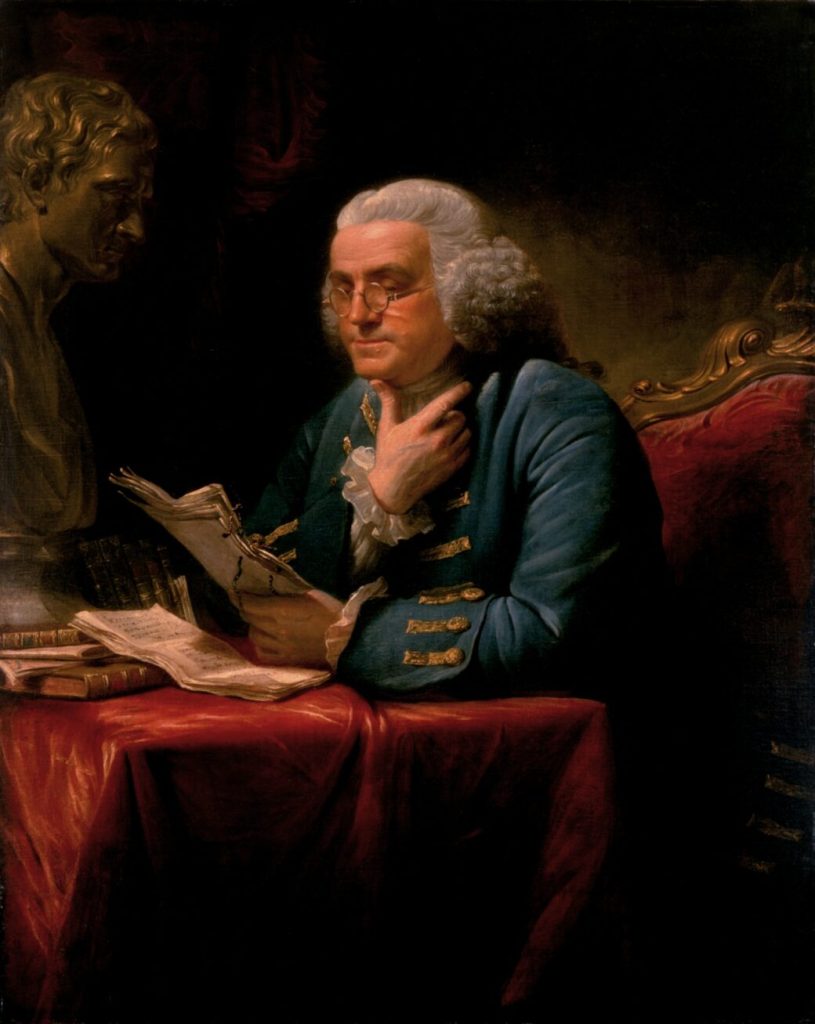
John André lived for a time in Benjamin Franklin’s house back in 1777-’78, during the British occupation of Philadelphia. As he was packing to leave, Geneva-born American patriot and portrait artist Pierre-Eugène Du Simitiere came to say goodbye. The officer was always known as a gentleman. Simitiere was shocked to find André stoop to looting the home of such a prominent patriot. For a man known for extravagant courtesy, this was way out of character. André was packing books, musical instruments and scientific apparatus, even an oil portrait of Franklin, offering not so much as a response to Simitiere’s protests.

Nearly two hundred years later, the descendants of Major-General Lord Charles Grey returned the painting to the United States, explaining that André had probably looted Franklin’s home under direct orders from the General himself. A Gentleman always, it would explain the man’s inability to defend his own actions.

Today that oil portrait of Benjamin Franklin hangs in the White House.

Benedict Arnold went on to lead British forces against his former comrades. As the story goes, Arnold once asked one of his officers what the Americans might do should he (Arnold) be captured. The officer replied: “They will cut off the leg which was wounded when you were fighting so gloriously for the cause of liberty, and bury it with the honors of war, and hang the rest of your body on a gibbet.”

The story refers to a grievous injury the turncoat general received at the Battle of Saratoga, heroically leading patriot infantry against a position remembered as Breymann redoubt. It was the second time a bullet had shattered the general’s leg in service to the Revolution. Arnold walked with a pronounced limp for the rest of his life.

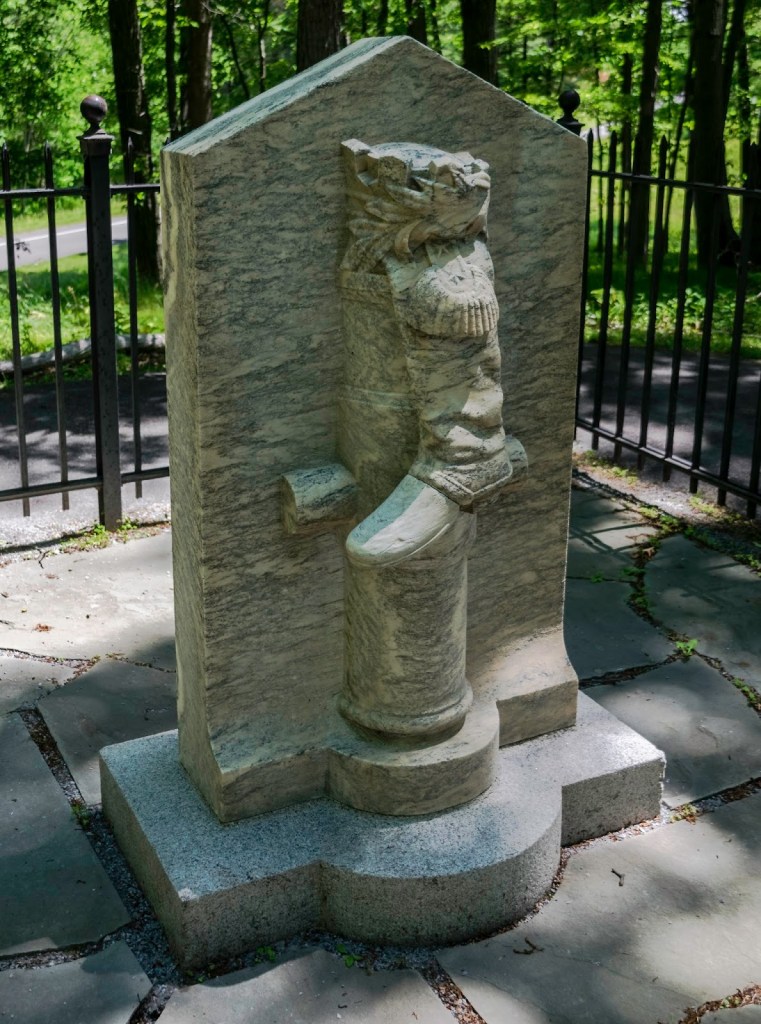
On the grounds near the battlefield at Saratoga there stands the statue of a cannon’s barrel, and a leg. An officer’s boot, really, dedicated to a Hero of the Revolution. The cannon’s barrel is pointed down as a sign of dishonor. The monument declines to give this hero a name.

It is one of the most forlorn places I have ever seen.

May 17, 1947  The Last Voyage of the USS Oklahoma

The only US warship ever named after the 46th state, she was destroyed in an enemy sneak attack before she knew she was at war.

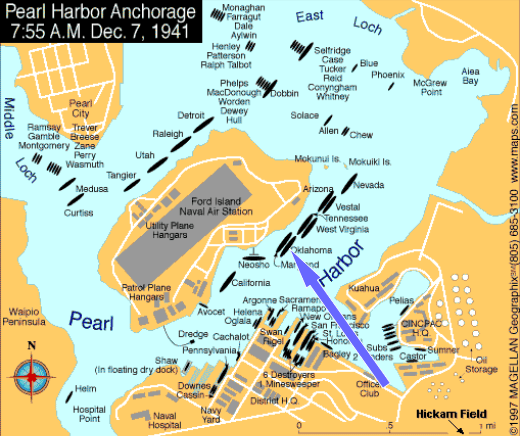
It was literally out of the blue when the first wave of enemy aircraft arrived at 7:48 local time, December 7, 1941.  353 Imperial Japanese warplanes approached in two waves out of the southeast, fighters, bombers, and torpedo planes, across Hickam Field and over the waters of Pearl Harbor.  Tied in place and immobile, the eight vessels moored at “Battleship Row” were easy targets.

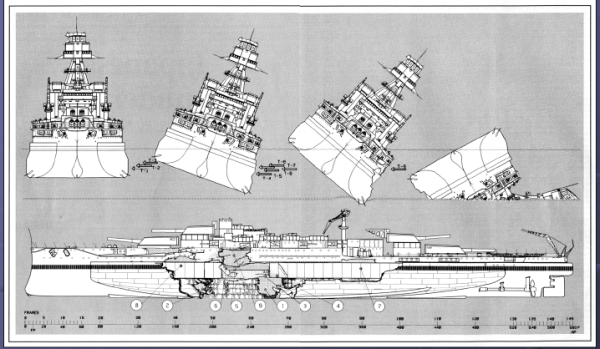
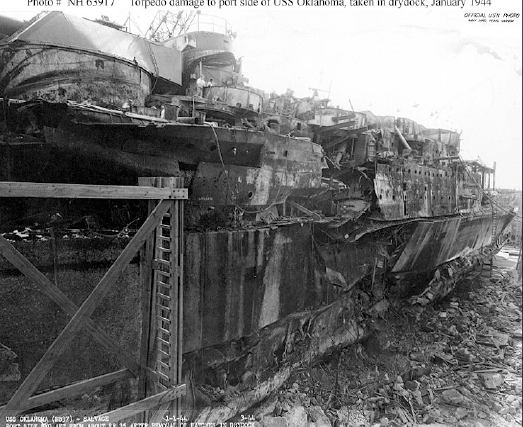
In the center of the Japanese flight path, sailors and Marines aboard the USS Oklahoma fought back furiously.  She didn’t have a chance.  Holes as wide as 40′ were torn into the hull in the first ten minutes of the fight.  Eight torpedoes smashed into her port side, each striking higher on the hull as the Battleship began to roll

Hat Tip John F. DeVirgilio for this graphic

Bilge inspection plates had been removed for a scheduled inspection the following day, making counter-flooding to prevent capsize, impossible.   Oklahoma rolled over and died as the ninth torpedo slammed home.  Hundreds scrambled out across the rolling hull, jumped overboard into the oil covered, flaming waters of the harbor, or crawled out over mooring lines in the attempt to reach USS Maryland in the next berth.

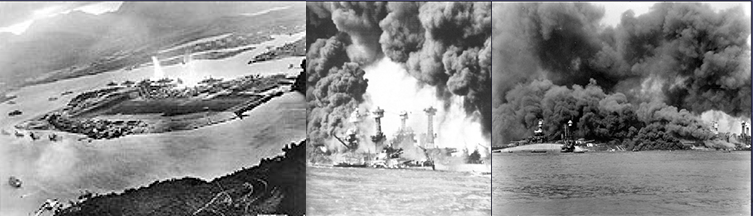
The damage was catastrophic.  Once the pride of the Pacific fleet, all eight battleships were damaged, and four of them sunk.  Nine cruisers, destroyers, and other ships were damaged, and another two sunk. 347 aircraft were damaged, most caught while still on the ground.  159 of those were destroyed altogether.  2,403 were dead or destined to die from the attack, another 1,178 wounded.

Nine Japanese torpedoes struck Oklahoma’s port side during the first ten minutes of the attack.

Frantic around the clock rescue efforts began almost immediately to get at 461 sailors and Marines trapped inside.  Tapping could be heard as holes were drilled to get to those trapped inside. 

Only 32 were delivered from certain death. 14 Marines and 415 sailors lost their lives onboard Oklahoma, either immediately or in the days and weeks to come.  Bulkhead markings later revealed that at least some of the doomed lived on in that pitch black, upside-down hell, waiting for rescue that would come too late.  The last survivor drew the last such mark on Christmas Eve, 17 days after the attack.


Of sixteen ships lost or damaged, thirteen would be repaired and returned to service.  USS Arizona remains on the bottom, a monument to the event and to the 1,102-honored dead who remain entombed within her hull.  The USS Utah defied salvage efforts. She, too, is a War Grave, 64 honored dead remaining within her hull, lying at the bottom not far from the Arizona.  Repairs were prioritized, and USS Oklahoma was beyond repair.  She, and her dead, would have to wait.

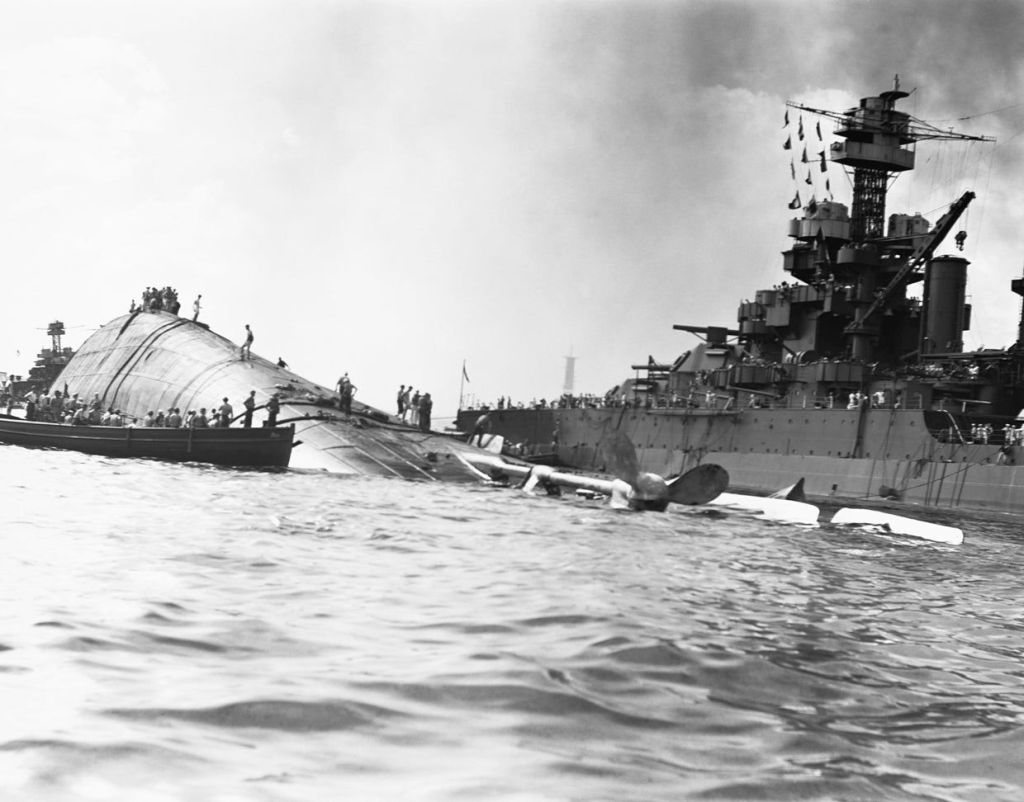
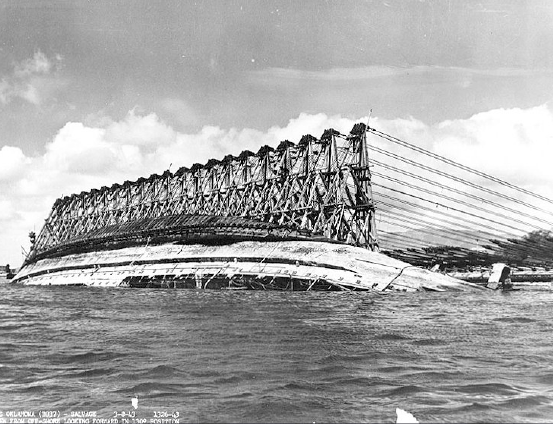
The extraordinarily difficult salvage at last began in March of 1943.  21 giant A-frames were fixed to the hull, 3″ cables connecting compound pulleys to 21 electric motors, each capable of pulling 429 tons.  Two pull configurations were used over 74 days, first the configuration below, then direct connections once the hull had achieved 70°. 

That May, the decks of USS Oklahoma once again saw the light of day.

At last fully righted, the ship was now 10 feet below water.  Massive temporary wood and concrete structures called “cofferdams” closed the gaping wounds left by torpedoes, so the hull could be pumped out and re-floated.  A problem even larger than those torpedo holes were the gaps between hull plates, caused by the initial capsize and righting operations.  Divers stuffed kapok in the gaps as water was pumped out.

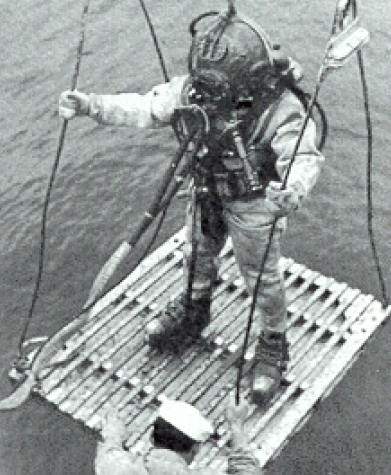
Individual divers spent 2-3 years on the Oklahoma salvage job.  Underwater arc welding and hydraulic jet techniques were developed during this period and remain in use to this day.  1,848 dives were performed for a total of 10,279 man hours under pressure.  For all that, no military and only one civilian diver lost his life, that, when his air hose became severed.

Salvage workers entered the pressurized hull through airlocks wearing masks and protective suits.   Bodies were in advanced stages of decomposition by this time, and the oil and chemical-soaked interior was toxic to life.  Most victims were impossible to identify.

Twenty 10,000 gallon per minute pumps operated for 11 hours straight.  On November 3, 1943, the ‘Mighty Okie’ broke from the bottom and once again floated on her own.

Oklahoma entered dry dock the following month, a total loss to the American war effort.  She was stripped of guns and superstructure and sold for scrap on December 5, 1946, to the Moore Drydock Company of Oakland, California.

The battered hulk left Pearl Harbor for the last time in May 1947, headed for a scrapyard in San Francisco bay.  She never made it.  Taken under tow by the ocean-going tugs Hercules and Monarch, the three vessels entered a storm some 540 miles east of Hawaii. 

On May 17, disaster struck.  Piercing the darkness, Hercules’ spotlight revealed that the former battleship was listing heavily.  Naval base at Pearl Harbor instructed them to turn around when these two giant tugs ground to a halt and found themselves moving… backward.  Despite her massive engines, Hercules was being dragged astern, hurtling past Monarch, herself swamped at the stern and being dragged backward at 17mph.

Fortunately for both tugs, skippers Kelly Sprague of Hercules and George Anderson of Monarch had loosened the cable drums connecting 1,400-foot tow lines to Oklahoma.  Monarch’s line played out and detached.  With Oklahoma forever sunk beneath the waves and Hercules’ tow line pointing straight down, Hercules detached with a crash at the last possible moment, the 409-ton tug bobbing to the surface like the float on a child’s fishing line.

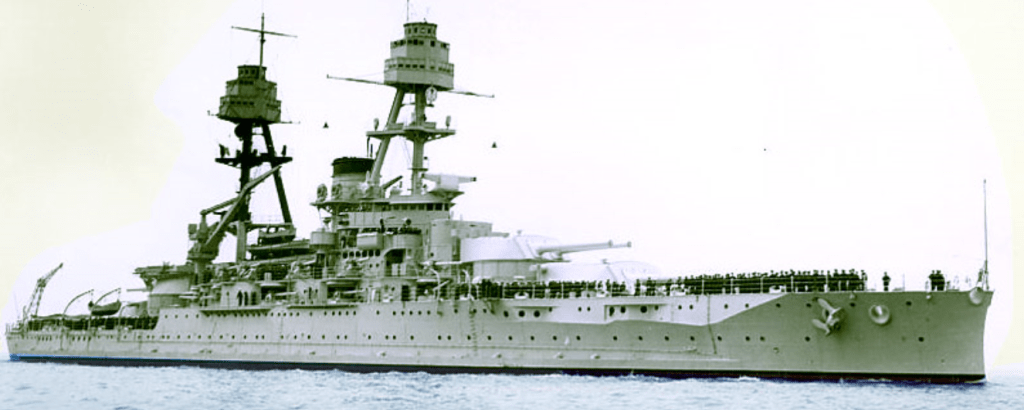
Ordered in March 1911 and launched three years later, the 583’ Nevada-class battleship USS Oklahoma was designed to fight at the most extreme ranges expected by gunnery experts. Commanded by Charles B. McVay, Jr., father of the ill-fated skipper of the USS Indianapolis Charles Butler McVay III, Oklahoma’s role in the Great War was limited, due to a shortage of oil in major theaters of operation. Notable among her exploits of WW1 were the memorable fist fights crew members got into with Sinn Féin members in Berehaven, County Cork, and casualties sustained during the 1918-19 flu pandemic.

Oklahoma was up-armored in a 1927 – ’29 refit.  Additional anti-torpedo armor bulges were added, briefly making her the widest battleship in the United States fleet. Oklahoma was dispatched to Europe in 1936 to evacuate American civilians during the Spanish civil war.

The only US warship ever named after the 46th state, she was destroyed in an enemy sneak attack before she knew she was at war.

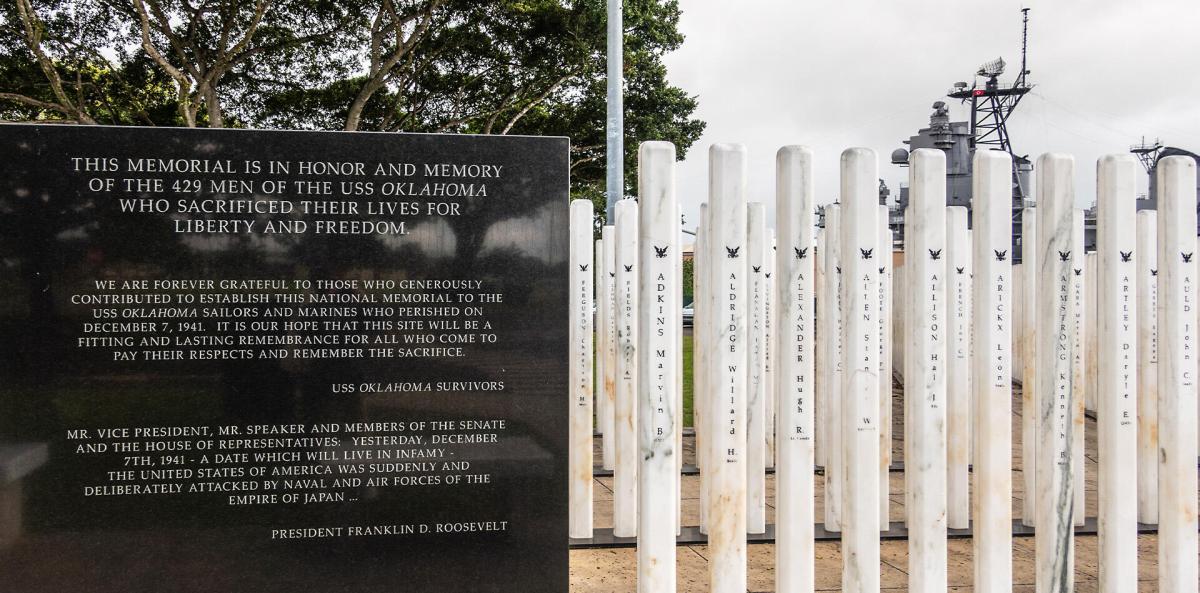
Of the 429 killed, 394 were buried as unknown persons.  Since 2015, advances in forensic science and dna technology have led to the identification of 346.  Many warships sunk during World War 2 have since been found. The final resting place of the USS Oklahoma remains, a mystery.

February 1, 1901 The Last Doughboy

The people the author sought were over 101. One was 113. The search could not have been easy, beginning with the phone call to next of kin. There is no delicate way to ask the question. “Is he still with us?” Most times, the answer was “no”.

In 2003, author Richard Rubin set out to interview the last surviving veterans of the Great War, the “War to End All Wars”.  World War One.

The people the author sought were all over 101. One was 113. It could not have been easy, beginning with the phone call to next of kin. There is no delicate way to ask the question. “Is he still with us?” Most times the answer was “no”.

Sometimes it was “yes”, and Rubin would ask for an interview. The memories his subjects sought to bring back were 80 years old and more.  Some spoke haltingly, and with difficulty.  Others were fountains of information, as clear and lucid as if the memories of which they spoke were made only  yesterday.

Rubin writes “Quite a few of them told me that they were telling me things that they hadn’t talked about in 50, 60, 70 years. I asked a few of them why not, and the surprising response often was that nobody had asked.”

Anthony Pierro of Swampscott, Massachusetts, served in Battery E of the 320th Field Artillery and fought in several of the major battles of 1918, including Oise-Aisne, St. Mihiel, and Meuse-Argonne.

Pierro recalled his time in Bordeaux as the best time of the war. “The girls used to say, ‘upstairs, two dollars.’” Pierro’s nephew Rick interrupted the interview. “But you didn’t go upstairs.”  Although possibly unexpected, Uncle Anthony’s response was a classic.  “I didn’t have the two dollars”.

Reuben Law of Carson City, Nevada remembered a troop convoy broken up by a German U-Boat while his own transport was swept up in the murderous Flu pandemic of 1918.

The people Rubin spoke with weren’t all men. 107-year-old Hildegarde Schan of Plymouth, Massachusetts spoke of caring for the wounded.

Howard Ramsey helped start an American burial ground in France, 150 miles north of Paris. Today, the 130½ acres of the Meuse-Argonne American Cemetery serves as the final resting place for the largest number of US military dead in Europe.

“So I remember one night”, Ramsey said, “It was cold, and we had no blankets, or nothing like that. We had to sleep, we slept in the cemetery, because we could sleep between the two graves, and keep the wind off of us, see?”

Arthur Fiala of Kewaunee, Wisconsin remembered traveling across France in a boxcar marked “40-8″. Room enough for 40 men, or eight horses.

Arthur Fiala

There was J. Laurence Moffitt of Orleans, Massachusetts. Today, we see the “Yankee Division” only on highway signs. At 106, this man was the last surviving member of his outfit, with a memory so clear he could recall every number from every fighting unit of the 26th Division.

George Briant was caught in an open field with his battery, as German planes dropped bombs from the sky.  Briant felt as if he was hit by every one of them, spending several months in the hospital. When it was through, he begged to go back to the front.  

On the last night of the war, November 10, 1918, Briant came upon the bodies of several men who had just been shelled.

“Such fine, handsome, healthy young men”, he said, “to be killed on the last night of the war.  I cried for their parents. I mean it’s a terrible, terrible thing to lose anyone you love in a war, but imagine knowing precisely when that war ends, and then knowing that your loved one died just hours before that moment.

Rubin interviewed dozens of men and a handful of women, a tiny and ever diminishing living repository for memory of the War to End All Wars. Their stories are told in their own words and linked HERE, if you care to learn more.  I highly recommend it.  The words of these women and men are far more powerful than anything I can offer.

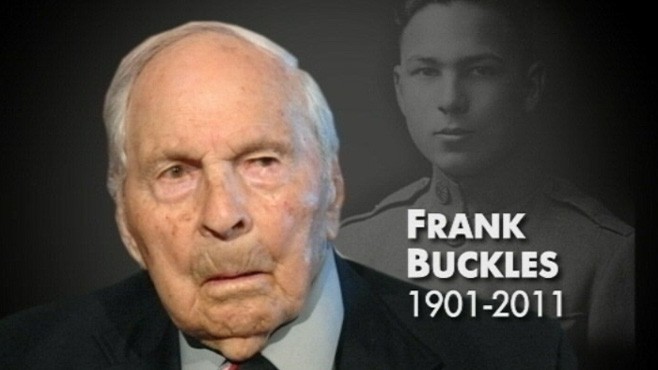
Frank Woodruff Buckles, born Wood Buckles, is one. Born on February 1, 1901, Buckles enlisted with the First Fort Riley Casualty Detachment at the age of sixteen, training for trench casualty retrieval and ambulance operations.

Frank Woodruff Buckles, S/N 15577

Buckles’ unit set sail from Hoboken New jersey in December 1917 aboard HMS Carpathia, a vessel made famous by the Titanic rescue, five years earlier.

Frank never saw combat but he did see a lot of Germans, with a Prisoner-of War escort company.  Returning home in January 1920 aboard USS Pocahontas, Buckles was paid $143.90, including a $60 bonus.

Buckles was a civilian in 1940, working for the White Star Lines and WR Grace shipping companies. His work took him to the Philippines, where he remained after the outbreak of WWII. He was helping to resupply U.S. troops when captured by Japanese forces in January 1942, imprisoned for thirty-nine months as a civilian prisoner in the Santo Tomas and Los Baños prison camps. 

He was rescued by the 11th Airborne Division on February 23, 1945. The day he was scheduled to be executed.

Buckles married Audrey Mayo of Pleasanton, California in 1946, and returned from whence he had come.  Back to the land, back to the Gap View Farm near Charles Town, West Virginia in January 1954, to farm the land his ancestors worked back in 1732.

Audrey Mayo Buckles lived to ninety-eight and passed away on June 7, 1999.  Frank continued to work the farm until 106, and still drove his tractor.  For the last four years of his life he lived with his daughter Susannah near Charles Town, West Virginia.

Once asked his secret to a long life, Buckles responded, “When you start to die, don’t”.

On December 3, 2009, Frank Buckles became the oldest person ever to testify before the United States Congress, where he campaigned for a memorial to honor the 4.7 million Americans who served in World War 1.

“We still do not have a national memorial in Washington, D.C. to honor the Americans who sacrificed with their lives during World War I. On this eve of Veterans Day, I call upon the American people and the world to help me in asking our elected officials to pass the law for a memorial to World War I in our nation’s capital. These are difficult times, and we are not asking for anything elaborate. What is fitting and right is a memorial that can take its place among those commemorating the other great conflicts of the past century. On this 92nd anniversary of the armistice, it is time to move forward with honor, gratitude, and resolve”.

The United States came late to the Great War, not fully trained, equipped or mobilized until well into the last year.  Even so, fully 204,000 Americans were wounded in those last few months.  116,516 never came home from a war in which, for all intents and purposes, the US fought for a bare five months.

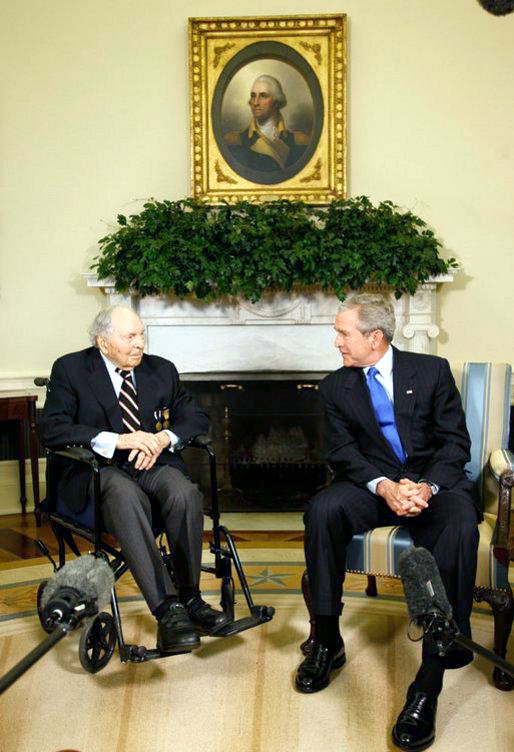
Frank Woodruff Buckles passed away on February 27, 2011 at the age of 110, and went to his rest in Arlington National Cemetery.  The last of the Doughboys, the only remaining American veteran of WWI, the last living memory of the war to end all wars, was gone.

The United States House of Representatives and Senate proposed concurrent resolutions for Buckles to lie in state, in the Capitol rotunda. For reasons still unclear, the plan was blocked by Speaker John Boehner and Senate Majority Leader Harry Reid.  Neither Boehner nor Reid would elaborate, proposing instead a ceremony in the Amphitheater at Arlington National Cemetery.  The President of the United States personally attended the funeral.

Washington Post reporter Reporter Paul Duggan described the occasion:

“The hallowed ritual at grave No. 34-581 was not a farewell to one man alone. A reverent crowd of the powerful and the ordinary—President Obama and Vice President Biden, laborers and store clerks, heads bowed—came to salute Buckles’s deceased generation, the vanished millions of soldiers and sailors he came to symbolize in the end”.

Frank Woodruff Buckles, the last living American veteran of WW1 was survived by the British Women’s Royal Air Force (WRAF) servicewoman Florence Beatrice (Patterson) Green who died on February 4, 2012, at the age of 110.

Afterward

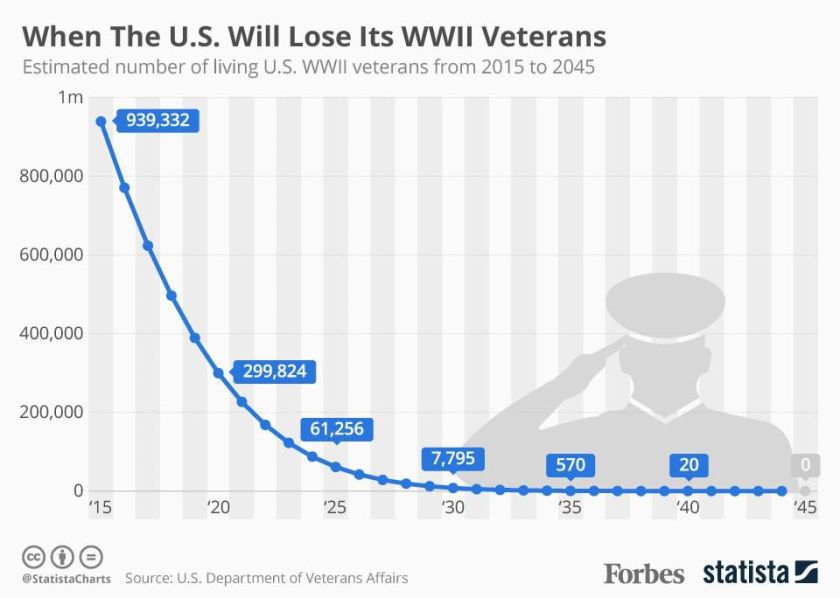
Sixteen million Americans joined with allies the world over to defeat the Axis Powers of World War 2.  They were the children of Frank Buckles’ and Florence Green’s generation, sent to complete what their parents had begun.  According to the Department of Veterans Affairs some 66,000 remained alive in 2024.

If actuarial projections are any indication, the Frank Buckles of his generation, the last living veteran of WW2, can be expected to pass from among us sometime around 2044.

That such an event should pass from living memory is a loss beyond measure.

December 2, 1859 John Brown

To some, the man was a hero.  To others he was a kook. The devil incarnate.


Following the war for independence, American politics split between those supporting a strong federal government and those favoring greater self-determination for the states. In the South, climate conditions led to dependence on agriculture, the rural economy of the southern states producing cotton, rice, sugar, indigo and tobacco. Colder states to the north tended to develop manufacturing economies, urban centers growing up in service to hubs of transportation and the production of manufactured goods.

During the first half of the 19th century, 90% of federal government revenue came from tariffs on foreign manufactured goods. Most of this revenue was collected in the South, with the region’s greater dependence on imported goods.  Much of federal spending was directed toward the North, toward the construction of roads, canals and other infrastructure.

The debate over economic issues and rights of self-determination, so-called ‘state’s rights’, grew and sharpened in 1828 with the threatened secession of South Carolina and the “nullification crisis” of 1832-33. South Carolina declared such tariffs unconstitutional and therefore null and void within the state. A Cartoon from the era says it all – Northern domestic manufacturers getting fat at the expense of impoverishing the South under protective tariffs.

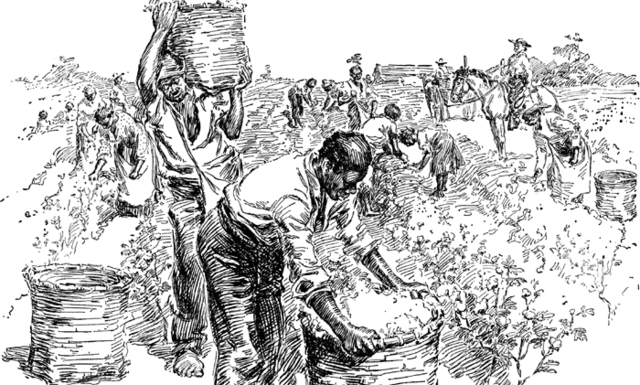
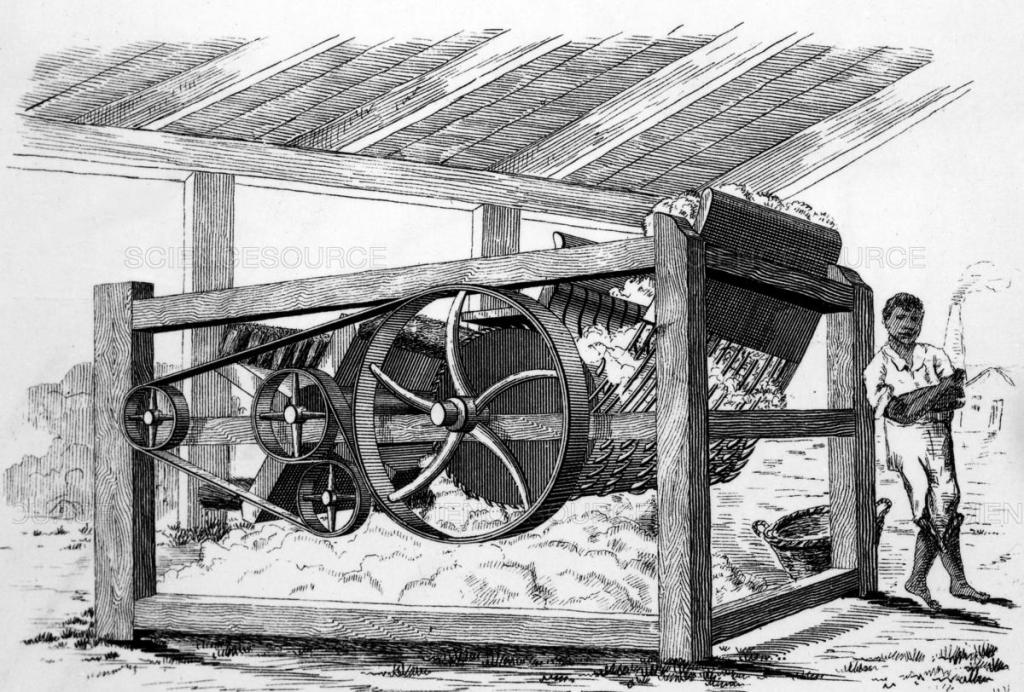
Chattel slavery came to the Americas well before the colonial era, from Canada to Mexico to Brazil and around the world. Moral objections to what was clearly a repugnant practice could be found throughout, but economic forces had as much to do with ending the practice as any other. The “peculiar institution” died out first in the colder regions of the US and may have done so in warmer climes as well, but for Eli Whitney’s invention of a cotton engine (‘gin’) in 1792.

Removing cotton seeds by hand requires ten man-hours to remove the seeds from a single pound of cotton. By comparison, a cotton gin can process about a thousand pounds a day at comparatively little expense.

The year of Whitney’s invention, the South exported 138,000 pounds a year to Europe and the northern colonies. Sixty years later, Britain alone was importing 600 million pounds a year of the stuff, from the American south. Cotton was King, and with good reason.  The crop is easily grown, is more easily transportable and can be stored indefinitely, compared with food crops.  The southern economy turned overwhelmingly to this one crop and with it, the need for cheap, plentiful labor.

By then the issue of slavery was so joined and intertwined with ideas of self-determination, as to be indistinguishable.

The Cotton Gin

The short-lived “Wilmot Proviso” of 1846 sought to ban slavery in new territories, after which the Compromise of 1850 attempted to strike a balance.  The Kansas Nebraska Act of 1854 created the territories of Kansas and Nebraska, basically repealing the Missouri Compromise and allowing settlers to determine their own way through popular sovereignty.

John_Brown
John Brown

This attempt to democratize the issue instead had the effect of drawing up battle lines.  Pro-slavery forces established a territorial capital in Lecompton, while “antis” set up an alternative government in Topeka.

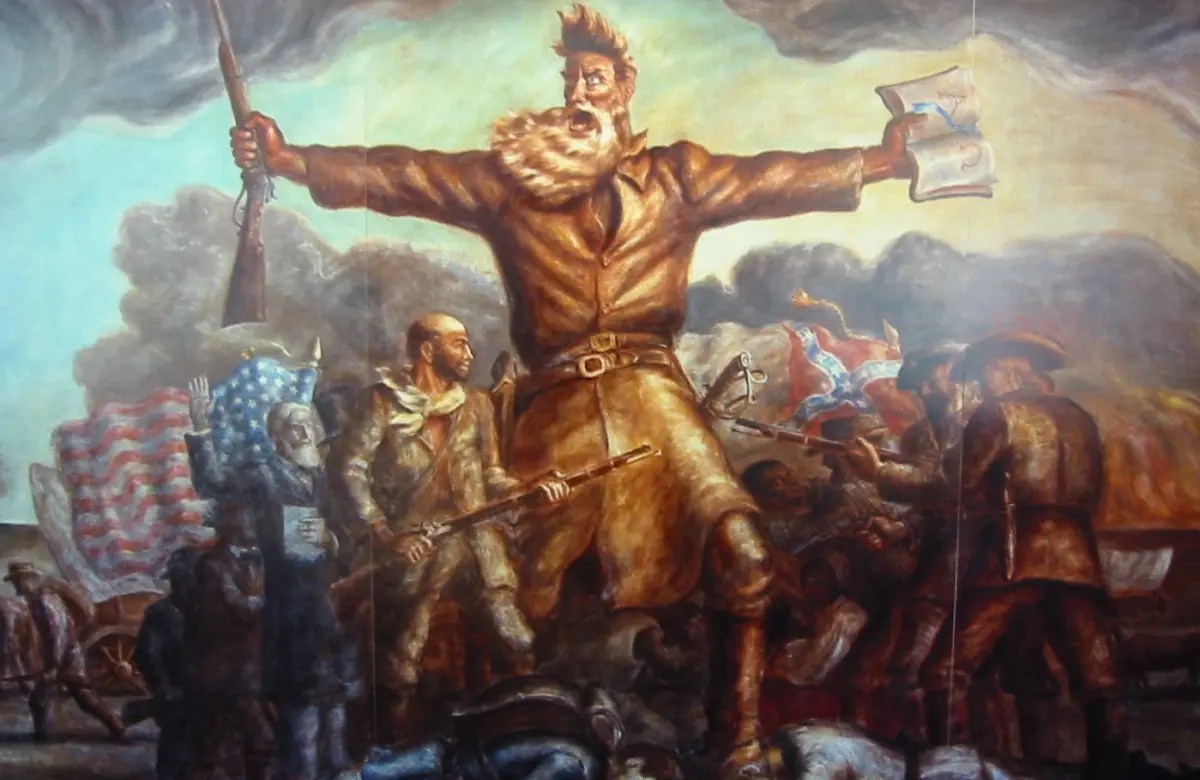
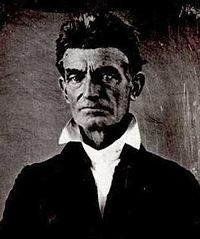
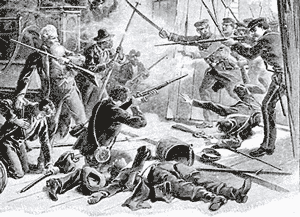
John Brown Sr. came to the Kansas Territory as a result of violence, sparked by the expansion of slavery into the Kansas-Nebraska territories between 1854 and 1861, a period known as “Bleeding Kansas”.  To some, the man was a hero.  To others he was a kook. The devil incarnate.  A radical abolitionist and unwavering opponent of the “peculiar institution” of slavery, John Brown believed that armed confrontation was the only way to bring it to an end.

BleedingKansasFight

In Washington DC, a United states Senator was beaten nearly to death on the floor of the Senate, by a member of the House of Representatives. The following day Brown and four of his sons: Frederick, Owen, Salmon, and Oliver, along with Thomas Weiner and James Townsley, set out on a “secret expedition”.

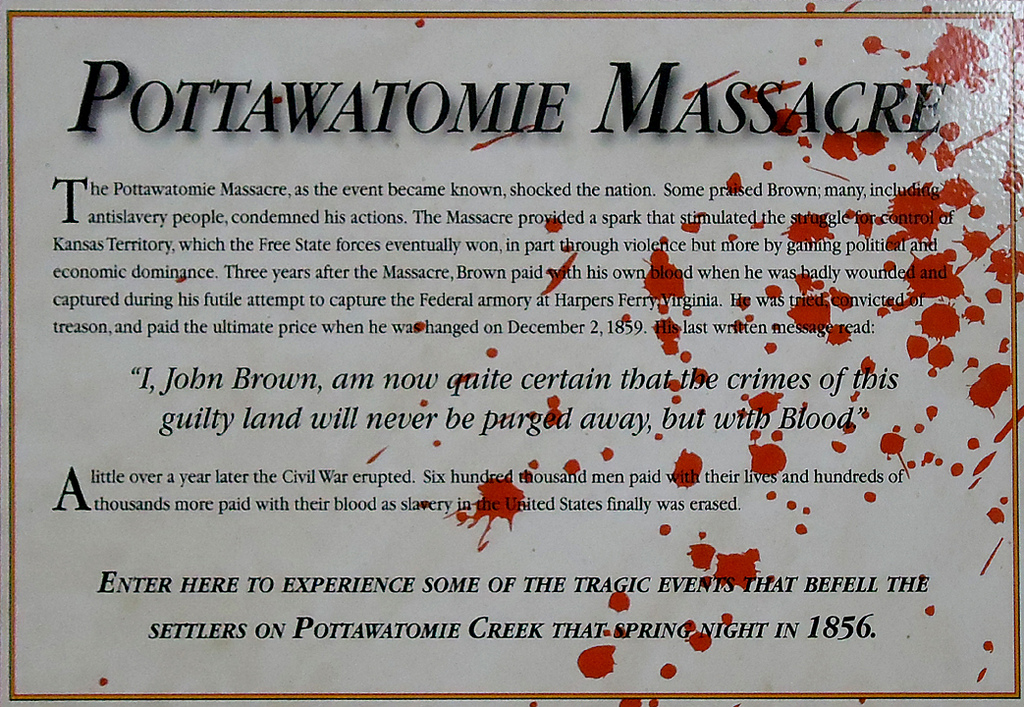
The group camped between two deep ravines off the road that night, remaining in hiding until sometime after dark on the 24th. Late that night, they stopped at the house of James P. Doyle, ordering him and his two adult sons, William and Drury, to go with them as prisoners. Doyle’s wife pleaded for the life of her 16 year old son John, whom the Brown party left behind. The other three, all former slave catchers, were led into the darkness.  Owen Brown and one of his brothers murdered the brothers with broadswords. John Brown, Sr. fired the coup de grace into James Doyle’s head to ensure that he was dead.

The group went on to the house of Allen Wilkinson, where he too was brought out into the darkness and murdered with broadswords. Sometime after midnight, the group forced their way into the cabin of James Harris. His two house guests were spared after interrogation, but Wilkinson was led to the banks of Pottawatomie Creek where he too was slaughtered.

There had been 8 killings to date in the Kansas Territory; Brown and his party had just murdered five in a single night. The massacre lit a powder keg of violence in the days that followed.  Twenty-nine people died on both sides in the next three months alone.

Harper's Ferry

Brown would go on to participate in the Battle of Black Jack and the Battle of Osawatomie in the Kansas Territory.  Brown lead a group to the armory in Harper’s Ferry Virginia in a hare brained scheme to capture the weapons contained there and trigger a slave revolt. The raid was ended by a US Army force under Colonel Robert E. Lee, and a young Army lieutenant named James Ewell Brown (JEB) Stuart.

Brown supporters blamed the 1856 massacre on everything from defending the honor of the Brown family women, to self defense, to a response to threats of violence from pro slavery forces. Free Stater and future Kansas Governor Charles Robinson may have had the last word when he said, “Had all men been killed in Kansas who indulged in such threats, there would have been none left to bury the dead.”

John Brown was hanged on December 2, 1859.

The 80-year-old nation forged inexorably onward, toward a Civil War that would kill more Americans than every conflict from the American Revolution to the War on Terror, combined.

November 25, 1841 Amistad

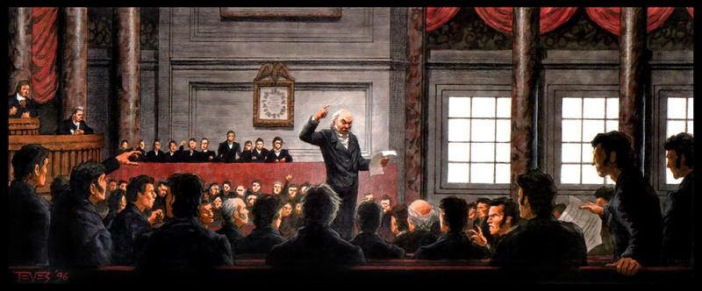
In arguing the case before the Supreme Court former President John Quincy Adams took the position that no man, woman, or child in the United States could ever be sure of the “blessing of freedom”, if the President could hand over free men on the demand of a foreign government.

The international slave trade was illegal in most countries by 1839 while the “peculiar institution” of slavery remained legal. In April of that year, a Portuguese slave trader illegally purchased some 500 Africans and shipped them to Havana aboard the slave ship Teçora.

Conditions were so horrific aboard Teçora that fully one-third of its “cargo”, presumably healthy individuals, died on the journey. Once in Cuba, sugar cane producers Joseph Ruiz and Pedro Montez purchased 49 members of the Mende people, 49 adults and four children, for use on the plantation.

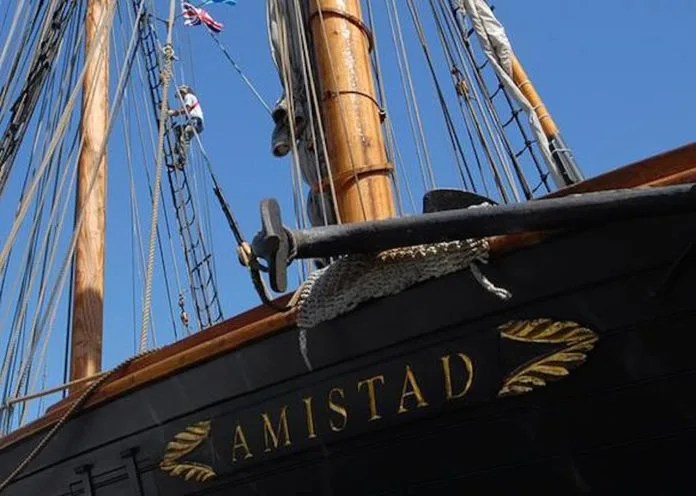
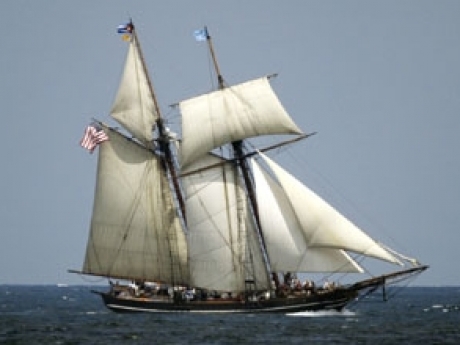
The Mendians were given Spanish names and designated “black ladinos,” fraudulently documenting the 53 to have always lived as slaves in Cuba. In June of 1841 Ruiz and Montez placed the Africans on board the schooner la Amistad, (“Friendship”), and set sail down the Cuban coast to Puerto del Principe.

jul-02-amistad
Replica of the slave ship, Amistad

Africans had been chained onboard Teçora but chains were judged unnecessary for the short coastal trip aboard Amistad.  On the second day at sea, two Mendians were whipped for an unauthorized trip to the water cask.  One of them asked where they were being taken.  The ship’s cook responded, they were to be killed and eaten.

The cook’s mocking response would cost him his life.

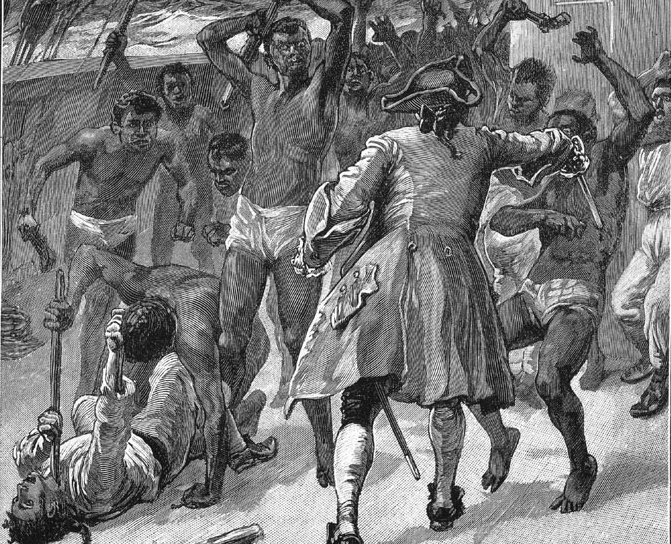
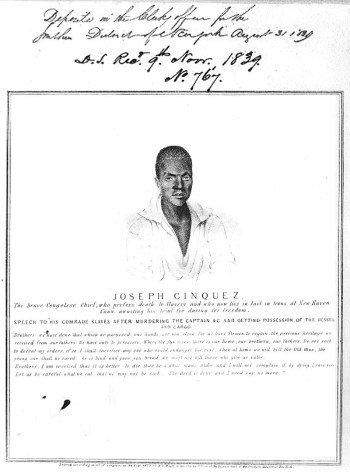
That night, captives armed with cane knives seized control of the ship. Their leader was Sengbe Pieh, also known as Joseph Cinqué. Africans killed the ship’s Captain and the cook losing two of their own in the struggle.  Montez was seriously injured while Ruiz and a cabin boy named Antonio, were captured and bound.  The rest of the crew escaped in a boat.

The mulatto cabin boy who really was a black ladino, would be used as translator.

Revolt-Aboard-Ship

Mendians forced the two to return them to their homeland, but the Africans were betrayed.  By day the two would steer east, toward the African coast.  By night when the position of the sun could not be determined, the pair would turn north.  Toward the United States.

After 60 days at sea, Amistad came aground off Montauk on Long Island Sound. Several Africans came ashore for water when Amistad was apprehended by the US Coastal Survey brig Washington, under the command of Thomas Gedney and Richard Meade.  Meanwhile on shore, Henry Green and Pelatiah Fordham (the two having nothing to do with the Washington) captured the Africans who had come ashore.

Joseph_Cinque
This print depicting Joseph Cinqué appeared in The New York Sun newspaper, August 31, 1839

Amistad was piloted to New London Connecticut, still a slave state at that time.  The Mendians were placed under the custody of United States marshals.

Both the slave trade and slavery itself were legal at this time according to Spanish law while the former was illegal in the United States.   The Spanish Ambassador demanded the return of Ruiz’ and Montez’ “property”, asserting the matter should be settled under Spanish law.  American President Martin van Buren agreed, but, by that time, the matter had fallen under court jurisdiction.

Gedney and Meade of the Washington sued under salvage laws for a portion of the Amistad’s cargo, as did Green and Fordham.  Ruiz and Montez sued separately.  The district court trial in Hartford determined the Mendians’ papers to be forged.  These were now former slaves  entitled to be returned to Africa.

Antonio was ruled to have been a slave all along and ordered returned to Cuba.  He fled to New York with the help of white abolitionists and lived out the rest of his days as a free man.

Fearing the loss of pro-slavery political support, President van Buren ordered government lawyers to appeal the case up to the United States Supreme Court.  The government’s case depended on the anti-piracy provision of a treaty then in effect between the United States, and Spain.

A former President, son of a Founding Father and eloquent opponent of ‘peculiar institution’ John Quincy Adams argued the case in a trial beginning on George Washington’s birthday, 1841.

img_3917.jpg

In United States v. Schooner Amistad, the Supreme Court upheld the decision of the lower court 8-1, ruling that the Africans had been detained illegally  and ordering them returned to their homeland.

Pro slavery Whig John Tyler was President by this time, refusing to provide a ship or to fund the repatriation.  Abolitionists and Christian missionaries stepped in, 34 surviving Mendians departing for Sierra Leone on November 25, 1841 aboard the ship, Gentleman.

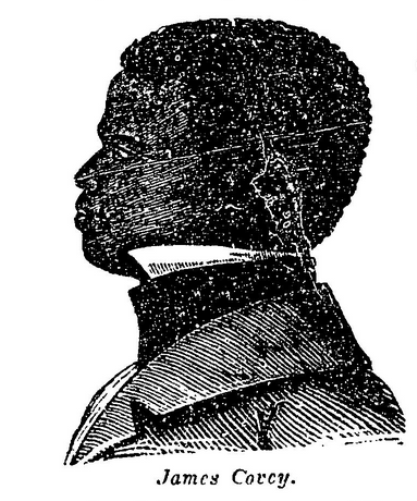
The Amistad story has been told in books and in movies and is familiar to many. One name perhaps not so familiar is that of James Benjamin Covey. James Covey was born Kaweli sometime around 1825, in what is now the the border region between of Sierra Leone, Guinea and Liberia. Kidnapped in 1833 and taken aboard the Segundo Socorro, Kaweli was an illegal slave when the vessel was seized by the Royal Navy.

Kaweli went to school for five years in Bathurst, Sierra Leone, where he took the name of James Benjamin Covey. Joining the Royal Navy, Covey participated in the capture of several illegal slave ships.

Hired on as live interpreter, James Covey was to play a crucial role in the Medians’ trial before the Supreme Court. He would also accompany the 34 on their return to the African continent.

James Covey, aka Kaweli, was going home.

‘They all have Mendi names and their names all mean something… They speak of rivers which I know. They sailed from Lomboko… two or three speak different language from the others, the Timone language… They all agree on where they sailed from. I have no doubt they are Africans.’ – James Benjamin Covey

Gentleman landed in Sierra Leone in January 1842, where some of the Africans helped establish a Christian mission.  Most including Joseph Cinque himself returned to homelands in the African interior. One survivor, a little girl when it all started by the name of Margru, returned to the United States where she studied at Ohio’s integrated Oberlin College, returning to Sierra Leone as the Christian missionary Sara Margru Kinson.

In arguing the case, President Adams took the position that no man, woman or child in the United States could ever be sure of the “blessing of freedom” if the President could hand over free men on the demand of a foreign government.

A century and a half later later President Bill Clinton, Deputy Attorney General Eric Holder and AG Janet Reno orchestrated the kidnap of six-year-old Elián González at gunpoint, returning him to Cuba over the body of the mother who had drowned bringing her boy to freedom.

November 14, 1975 Wreck of the Edmund Fitzgerald

The largest fresh water system on the planet, the Great Lakes of North America are estimated to hold no fewer than 6,000 shipwrecks with the loss of some 30,000 lives. Lake Superior alone forms the watery grave for some 350 wrecks, fewer than half of which have ever been found.

As early as 1888, the largest cargo on the Great Lakes shipping routes was Iron Ore. Great quantities of the stuff were brought up from mines in Minnesota and Michigan to be processed in iron works in Toledo, Ohio, Detroit, Michigan and other ports. A great fleet of freighters known as “lakers” provide the transportation.

In 2019, iron ore remained the third highest value metal mined in the US behind only gold and copper. Most of it is mined in the upper Midwest.

In the life insurance business, revenues are earned by assessing and properly pricing risk, and reinvesting those revenues into tangible assets. Small wonder then that the Northwestern Mutual Life Insurance Company would be invested in iron ore.

In 1954, construction began on the St Lawrence Seaway, a system of locks, channels and canals linking Montreal Quebec to the Great Lakes, as far inland as Duluth Minnesota. Three years later, Northwestern Mutual commissioned the construction of the largest freighter of its time, designed to be “within a foot of the maximum length allowed” by the system of locks.

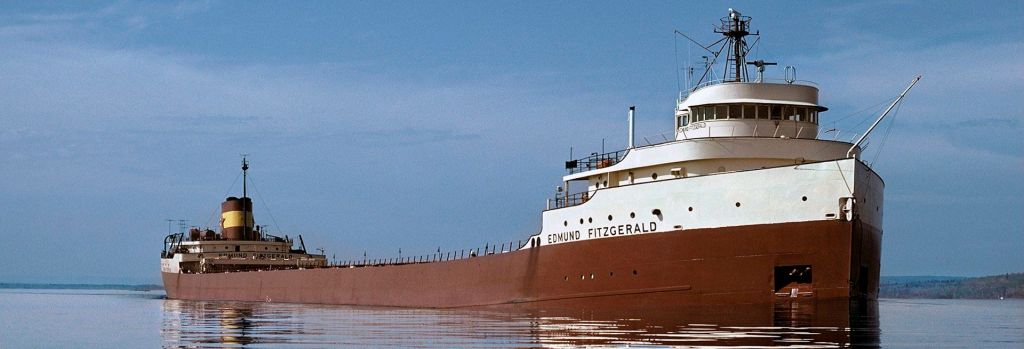
Measuring 729 feet long and weighing over 13,600 tons without cargo, she was the ‘Queen of the Great Lakes’. On June 8, 1958, the vessel was christened SS Edmund Fitzgerald, after the firm’s president.

A favorite of Great Lakes boating enthusiasts “the Big Fitz”, “the Mighty Fitz”, set out on her maiden voyage on September 24, 1958. For 17 years she plied the Great Lakes carrying taconite pellets, a form of iron ore.

According to NASA, major hurricanes form ‘the greatest storm on earth’, expending energy equivalent to 10,000 nuclear bombs over the life of the storm.

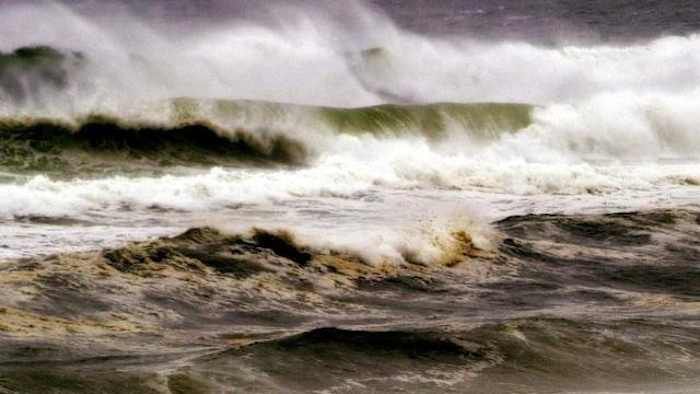
Every year around this time, violent weather systems rise up mid-continent when frigid air masses from the north collide with warmer fronts coming up from the Gulf of Mexico, resulting in inland weather systems equivalent to low-level hurricanes. These ‘mid-latitude cyclones’ are capable of producing sustained winds of 84 miles per hour and mountainous seas. To Great Lakes sailors, these late-season gales howling across the largest freshwater system on the planet, are the ‘Witch of November’.

‘The wind in the wires made a tattle-tale sound
When the wave broke over the railing
And every man knew, as the captain did too
‘Twas the witch of November come stealin’’

The National Weather Service published an advisory on November 9, 1975, even as the Fitz was loading iron ore.  With 26,116 tons in her holds and Captain Ernest McSorley in command, she set out at 2:30 that afternoon.  McSorley was at the end of a long and successful career as a mariner. This was to be his last voyage.

The 647-ft freighter Arthur M. Anderson departed shortly after the Fitz, with Captain Jesse B. Cooper at the helm. 

The storm gathered strength throughout that night and the following day. Throughout it all, the two vessels remained in radio contact, Anderson trailing by 10-15 miles. 

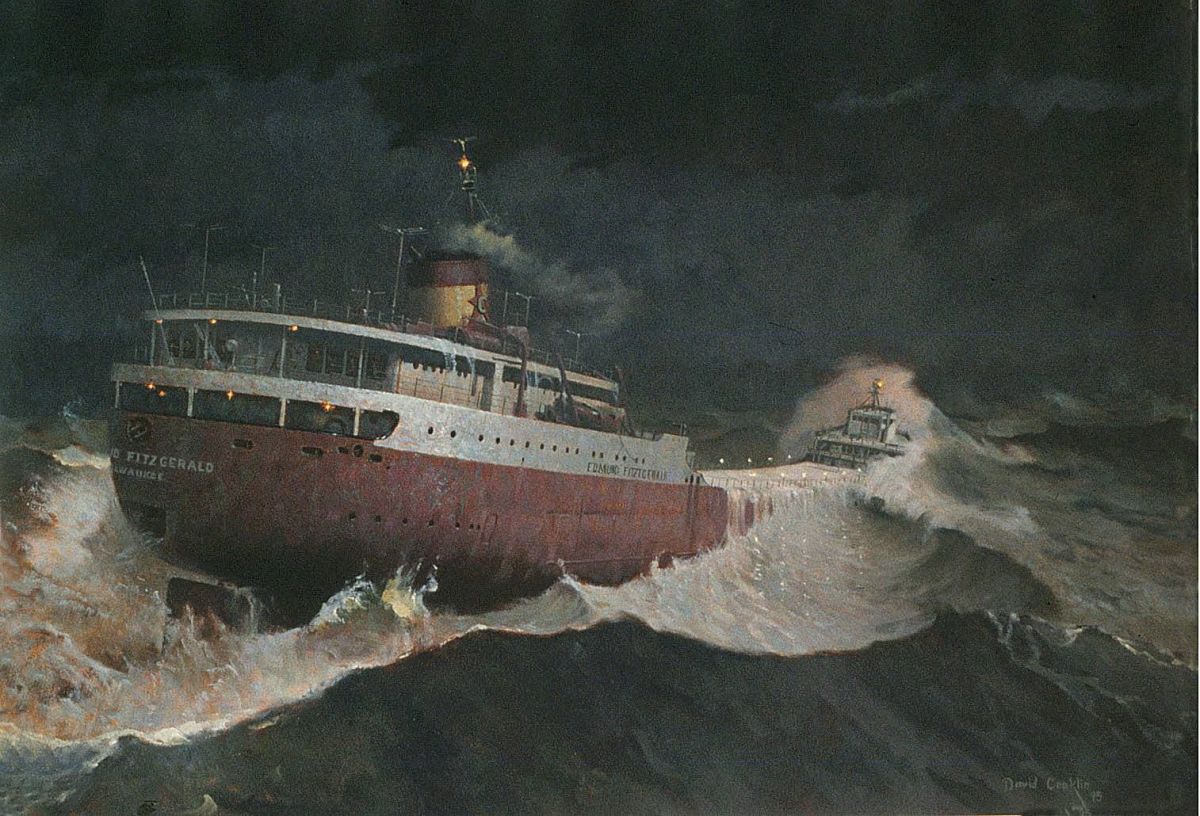
With howling winds and towering seas, Captain Cooper inquired at 7:10pm on the 10th, about Fitzgerald and her crew.   McSorley replied, “We are holding our own”. Ten minutes later, the Mighty Fitz disappeared.

Does anyone know where the love of God goes, when the winds turn the minutes to hours…

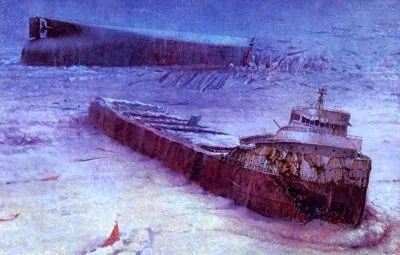
The search dragged on for four days, finding nothing more than debris and a few empty lifeboats.  The wreck was discovered on November 14 by a US Navy Lockheed P-3 Orion turboprop aircraft using the same equipment submarines use to identify magnetic anomalies. 

Edmund Fitzgerald lay 530 feet below the surface of the lake, 17 miles from the safety of Whitefish Bay.

In a musty old hall in Detroit they prayed
In the maritime sailors’ cathedral
The church bell chimed ’til it rang twenty-nine times
For each man on the Edmund Fitzgerald

Thirty years later, a computer simulation run by the National Oceanic and Atmospheric Administration and the National Weather Service estimated that wind gusts ran as high as 86 mph that night with waves up to 46 feet high.

The Edmund Fitzgerald was the largest vessel ever claimed by the Great Lakes, but not the greatest loss of life.  That dubious honor goes to the SS Eastland which rolled over while tied to a pier in 1915, killing 844.

Today, the death of the 29 who served aboard the decks of that the greatest of all the lakers may be as unknown as any of the other 30,000 lost souls, save for the loved ones left behind and a few maritime historians. And a Canadian singer/songwriter, named Gordon Lightfoot.

The legend lives on from the Chippewa on down
Of the big lake they call Gitche Gumee
Superior, they said, never gives up her dead
When the gales of November come early

September 11, 2001  An American Story

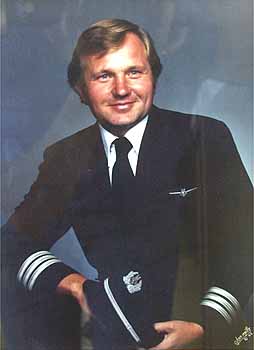
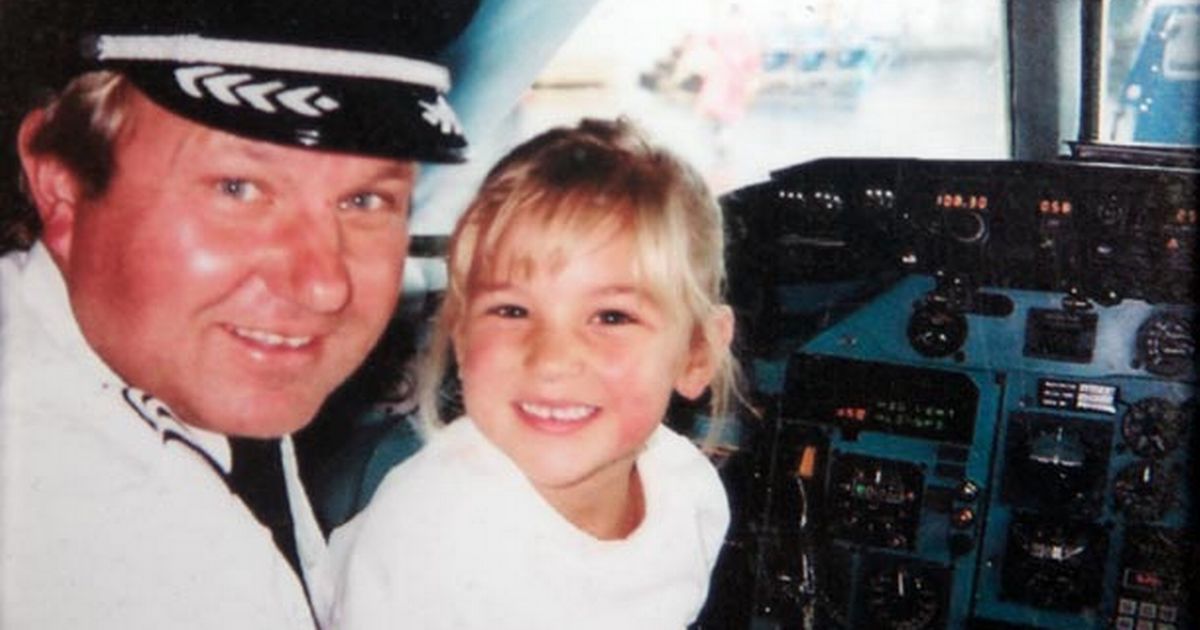
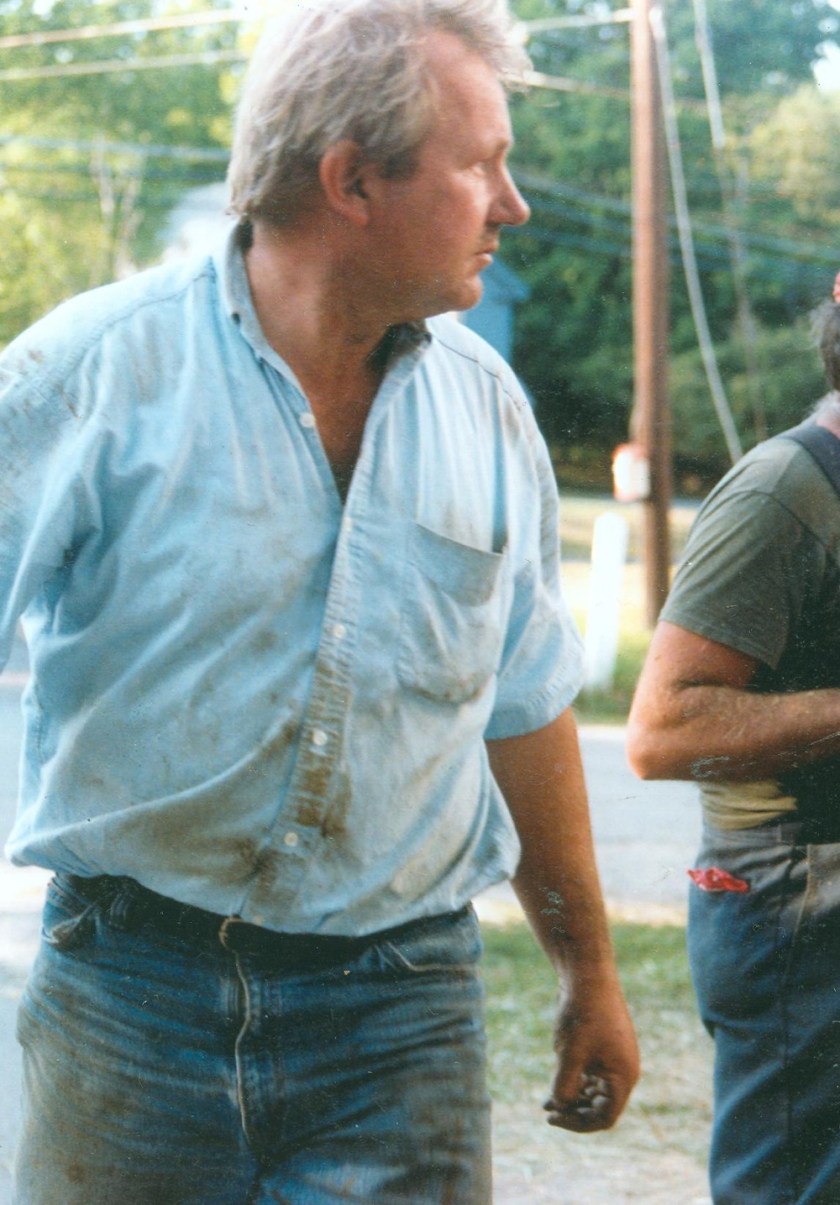
Twelve days a month, John Ogonowski would leave the farm in his Captain’s uniform, flying jumbo jets out of Logan Airport.  He’d always return to the land that he loved.

A great wave of immigrants came to the United States around the turn of the 20th century, 20 million Europeans or more making the long journey to become Americans.

Among them was the Ogonowski family, emigrating from Poland to make their home in Massachusetts’ Merrimack Valley, along the New Hampshire line.

The earliest members of the family received invaluable assistance from Yankee farmers, well acclimated to growing conditions in the harsh New England climate. Four generations later, the Ogonowski family still tilled the soil of their 150 acre “White Gate Farm” in Dracut, Massachusetts.

Ogonowski 2

Graduating from UMass Lowell in 1972 with a degree in nuclear engineering, John Ogonowski joined the United States Air Force.  During the war in Vietnam, the farmer-turned-pilot would ferry equipment from Charleston, South Carolina to Southeast Asia, sometimes returning with the bodies of the fallen aboard his C-141 transport aircraft.

Ogonowski left the Air Force with the rank of Captain, becoming a commercial pilot and joining American Airlines in 1978. There he met Margaret, a flight attendant, “Peggy” to her friends. The two would later marry and raise three daughters.

Twelve days a month, Ogonowski would leave the farm in his Captain’s uniform, flying jumbo jets out of Logan Airport.  He’d always return to the land he loved.

Family farming is not what it used to be, as suburban development and subdivisions creep into what used to be open spaces. “When you plant a building on a field” he would say, “it’s the last crop that will ever grow there”.

Ogonowski helped to create the Dracut Land Trust in 1998, working to conserve the town’s agricultural heritage. He worked to bring more people into farming.  The bumper sticker on his truck read “There is no farming without farmers”.

Ogonowski 1

That was the year the farm Service Agency in Westford came looking for open agricultural land, for Southeast Asian immigrants from Lowell.

It was a natural fit. Ogonowski felt a connection to these people, based on his time in Vietnam. He would help them, here putting up a shed, there getting a greenhouse in order or putting up irrigation. He would help these immigrants, just as those Yankee farmers of long ago had helped his twice-great grandfather.

Ogonowski 3

Cambodian farmers learned to grow their native vegetables in an unfamiliar climate. They would lease small plots, growing water spinach, lemon grass, pigweed, Asian basil, and Asian squash. There was taro and Laotian mint, coconut amaranth, pickling spices, pea tendrils and more. It was the food they grew up with. They would sell it into nearby immigrant communities and to the restaurants of Boston.

The program was a success.  Ogonowski told The Boston Globe in 1999, “These guys are putting more care and attention into their one acre than most Yankee farmers put into their entire 100 acres.”

mrkimcilantro

So it was that, with the fall harvest of 2001, Cambodian immigrants found themselves among the pumpkins and the hay of a New England farm, putting on a special lunch spread for visiting agricultural officials from Washington, DC.  It was September 11.

By now you know that John Ogonowski was flying that day, Senior Captain on American Airlines flight 11. He was perhaps the first to die, murdered in his cockpit by Islamist terrorist Mohammed Atta and his accomplices.

It’s a new perspective on a now-familiar story, to think of the shock and grief of those refugees from the killing fields of Pol Pot, on hearing the news that their friend and mentor had been hijacked and flown into the World Trade Tower.

Ogonowski farm

The White Gate Farm closed for a week, but the Ogonowski family was determined that John’s dream would not die.  Peg said it best:  “This is what he was all about. He flew airplanes, he loved flying, and that provided all the money, but this is what he lived for. He was a very lucky man, he had both a vocation and an avocation and he loved them both.”

John Ogonowski had been working with the Land Trust to raise $760,000 to purchase a 34 acre farm in Dracut, previously slated to be developed into a golf course with housing.  Federal funds were raised with help from two members of Congress.  The “Captain John Ogonowski Memorial Preservation Farmland” project was dedicated in 2003, a living memorial to Captain John Ogonowski.  The pilot, the American Patriot, and the farmer.

June 7, 1866 The Fenian Raids on Canada

The US chapter of Fenian Brotherhood was founded in 1858, based on the idea that Ireland should be free of English rule to become an independent, self-governing Republic. The Brotherhood traced its lineage back to 1758. By 1866, many of the membership were battle hardened veterans of the Civil War, ended only a year before.

The idea was to bring pressure on Britain to withdraw from Ireland. The attacks were directed toward British army forts, customs posts, and other targets in Canada. Fenians invaded Canada no fewer than five times between 1866 and 1871.

Irish Canadian Catholics were divided by the raids, with many feeling torn between loyalty to their new home and sympathy for the Fenians’ objectives. Canadian-Irish Protestants and French Catholics were generally loyal to the crown. Many took up arms against the raiders.

In April 1866 some 700 Fenians headed north to Campobello Island, New Brunswick, intending to seize the island. The war party became discouraged and dispersed after a show of force by the British Navy at Passamaquoddy Bay, but they would be back.

Next, a group of 1,000 to 1,300 Fenians sabotaged the US Navy side-wheeler gunboat USS Michigan, slipping across the Canadian border at the Niagara River on June 1. A Fenian ambush west of Ft. Erie led to the Battle of Ridgeway, in which 13 Canadian Militia were killed. 94 were wounded or incapacitated by disease.

Fenian Independence

Further fighting took place the following day, in which the Canadian Militia’s inexperience led to battlefield confusion. A number were taken prisoner. Realizing that they couldn’t hold their position, the Fenians released their prisoners and withdrew to Buffalo on the 3rd, but again, they would return

This seems to have been the high water mark of the Fenian uprising. President Andrew Johnson began to crack down, dispatching Generals Ulysses Grant and George Meade to Buffalo to assess the situation. Their orders on the 7th of June were to arrest anyone who even looked like a Fenian.

The Fenian “army of liberation” may have had little effect on Irish Independence, but it served to fire up Canadian Nationalism.  Canada was more properly called “British North America” in those days.   It seems that the Fenian raids tipped many of the more reluctant votes toward the security of nationhood, particularly in the Maritime provinces.   Some historians will tell you that Ridgeway is “the battle that made Canada.”  The Canadian Confederation was formed in 1867, uniting Nova Scotia, New Brunswick, Ontario and Quebec into one Dominion of Canada.

Fenian 2

There would be several more Fenian raids over the years that followed, from Pigeon Hill and Mississquoi County in modern day Quebec, to the 1870 Pembina raid in the Dakota territory. 

US authorities ultimately arrested the men and confiscated their arms, but many felt that the government had turned a blind eye to the invasions, seeing them as payback for British assistance to the Confederacy during the late Civil War.

The Fenian Brotherhood was a nation within a nation, organized for the purpose of winning Irish independence by force. A member of the British House of Commons rightly called them “a new Irish nation on the other side of the Atlantic, recast in the mould of Democracy, watching for an opportunity to strike a blow at the heart of the British Empire.”

Fenian 1

In modern times, scores of self-styled ‘Militia’ have adopted the use of military style drill in this country, from the far-left Los Macheteros and Black Panthers, to Posse Comitatus and the far-right militia units of the nineties.  And yet I believe it is accurate to say,  the Fenian Brotherhood remains the only organization in United States history, to have publicly armed and drilled on this scale.

“We are the Fenian Brotherhood, skilled in the arts of war,

And we’re going to fight for Ireland, the land we adore,

Many battles we have won, along with the boys in blue,

And we’ll go and capture Canada, for we’ve nothing else to do”.

Fenian soldier’s song