"Tell me a factand I'll learn. Tell me a truth, and I'll believe. But tell me a story, and it will live in my heart forever." – Steve Sabol, NFL Films
Author: Cape Cod Curmudgeon
I'm not an academic "Historian". I'm a father, a son and a grandfather. A history geek and sometimes curmudgeon who still likes to learn new things. I make every effort to get my facts straight but I'm as good at being wrong as the next guy. I offer these stories hoping you'll enjoy them as much as I do. This is the history we all share. I'm glad you're here.
Rick Long, the “Cape Cod Curmudgeon”
The hated Tea Act actually reduced the price of tea, but colonists saw the measure as an effort to buy popular support for taxes already in force.
During the time of Henry VIII, military outlays as a percentage of British central government expenses averaged 29.4%. During the 18th century that number skyrocketed to 74.6%, and never dropped below 55 percent.
The Seven Years’ War alone, fought on a global scale from 1756 – 1763 saw England borrow the unprecedented sum of £58 million, doubling the national debt and straining the British economy.
For the American colonies, the conflict took the form of the French and Indian Wars. In the view of the British government, the colonists themselves were the beneficiaries of much of that expense, for which the government expected reimbursement.
In the Americas, a never-ending succession of English wars meant until this time that colonists were left alone to run their own affairs.
Several measures were taken to collect revenues. Colonists bristled at the heavy handed taxation policies of the 1760s. The Sugar Act, the Currency Act: in one 12-month period Parliament passed the Stamp Act, Quartering Act, and the Declaratory Act, and deputized Royal Navy Sea Officers to enforce customs laws in colonial ports.
The merchants and traders of Boston cited the “late war” and related expenses, concluding the Boston Non-Importation Agreement of August 1, 1768. That agreement prohibited the importation of a long list of goods, ending with the statement ”That we will not, from and after the 1st of January 1769, import into this province any tea, paper, glass, or painters colours, until the act imposing duties on those articles shall be repealed”.
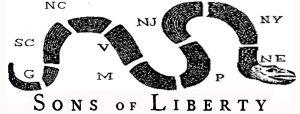
The ‘Boston Massacre’ of 1770 was a direct result of the tensions between colonists and the “Regulars” sent to enforce the will of the Crown. Two years later, Sons of Liberty looted and burned the HMS Gaspee in Narragansett Bay, RI.
The Tea Act, passed by Parliament on May 10, 1773, was less a revenue measure than it was an effort to prop up the British East India Company, by that time burdened with debt and holding eighteen million pounds of unsold tea. The measure actually reduced the price of tea, but Colonists saw this as an effort to buy popular support for taxes already in force, and refused the cargo. In Philadelphia and New York, tea ships were turned away and sent back to Britain while in Charleston, the cargo was left to rot on the docks.
British law required a tea ship to offload and pay customs duty within 20 days, or the cargo was forfeit. The Dartmouth arrived in Boston at the end of November with a cargo of tea, followed by the tea ships Eleanor and Beaver. Sam Adams called for a meeting at Faneuil Hall on the 29th, which then moved to Old South Meeting House to accommodate the crowd. 25 men were assigned to watch Dartmouth, making sure it didn’t unload.
7,000 gathered at Old South Meeting House on December 16th, 1773, the last day of Dartmouth’s deadline. Royal Governor Hutchinson held his ground, refusing Dartmouth permission to leave. Adams concluded that “This meeting can do nothing further to save the country.”
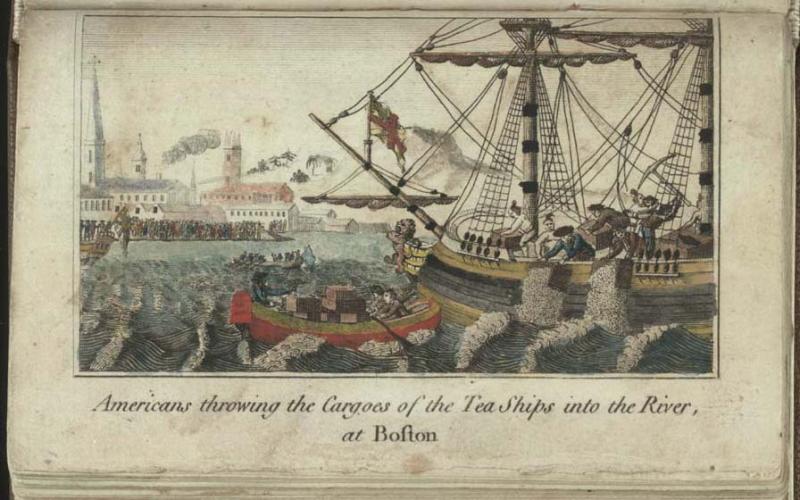
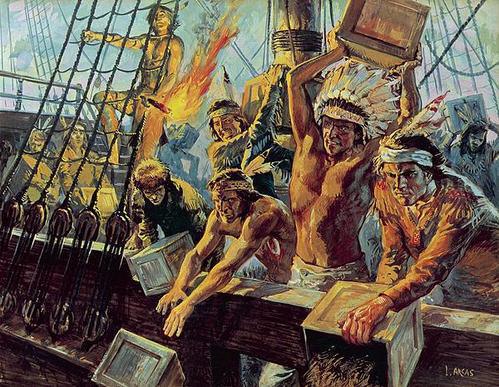
That night, somewhere between 30 and 130 Sons of Liberty, some dressed as Mohawk Indians, boarded the three ships in Boston Harbor. There they threw 342 chests of tea, 90,000 pounds in all, into Boston Harbor. £9,000 worth of tea was destroyed, worth about $1.5 million in today’s dollars.
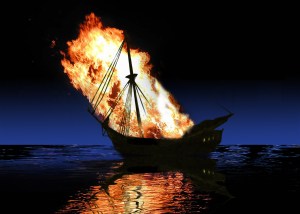
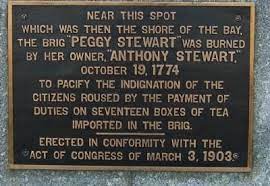
In the following months, other protesters staged their own “Tea Parties”, destroying imported British tea in New York, Philadelphia, Charleston, and Greenwich, NJ. There was even a second Boston Tea Party on March 7, 1774, when 60 Sons of Liberty, again dressed as Mohawks, boarded the “Fortune”. This time they dumped 3,000 pounds of the stuff into the harbor. That October in Annapolis Maryland, the owner of the Peggy Stewart was compelled to burn his own vessel to the water line. It was better than facing the angry mob.
For decades to come, the December 16 incident in Boston Harbor was blithely referred to as “the destruction of the tea.” The earliest newspaper reference to “tea party” wouldn’t come around until 1826.
John Crane of Braintree is one of the few original tea partiers ever identified, and the only man injured in the event. An original member of the Massachusetts Society of the Cincinnati and early member of the Sons of Liberty, Crane was struck on the head by a tea crate and thought to be dead. His body was carried away and hidden under a pile of shavings at a Boston cabinet maker’s shop. It must have been some sight to see when John Crane “rose from the dead”, the morning after.
Great Britain responded with the “Intolerable Acts” of 1774, including the occupation of Boston by British troops. Minutemen clashed with “Lobster backs” just a few months later – on April 19, 1775. No one alive today knows who fired that first shot at Lexington Green. History would record that sound as “The shot heard ’round the world”.
Possessed of all the physical prowess of youth, the individual assassin was well-read and highly intelligent, expertly trained in combat tactics, the art of disguise, the ways of silent infiltration and the skills of the expert horseman.
For the Islamic world, the 11th century was a time of political instability. The Fatimid Caliphate, established in 909 and headquartered in Cairo, found itself in sharp decline by the year 1090.
Within 100 years, the Fatimids would disappear altogether, eclipsed by the Abbasid Caliphate of An-Nasir Salah ad-Din Yusuf ibn Ayyub, better known to anyone familiar with the story of Richard Lionheart, as Saladin.
To the east lay the Great Seljuk Empire, the Turko-Persian, Sunni Muslim state established in 1037 and stretching from the former Sassanid domains of modern-day Iran and Iraq, to the Hindu Kush. An “appanage” or “family federation” state, the Seljuk empire was itself in flux after a series of succession contests and destined to disappear in 1194.
Into the gap there arose the “Old Man of the Mountain”, Hassan-i Sabbah, and a fanatically loyal, secret sect of Nizari Ismaili followers, called Assassins.
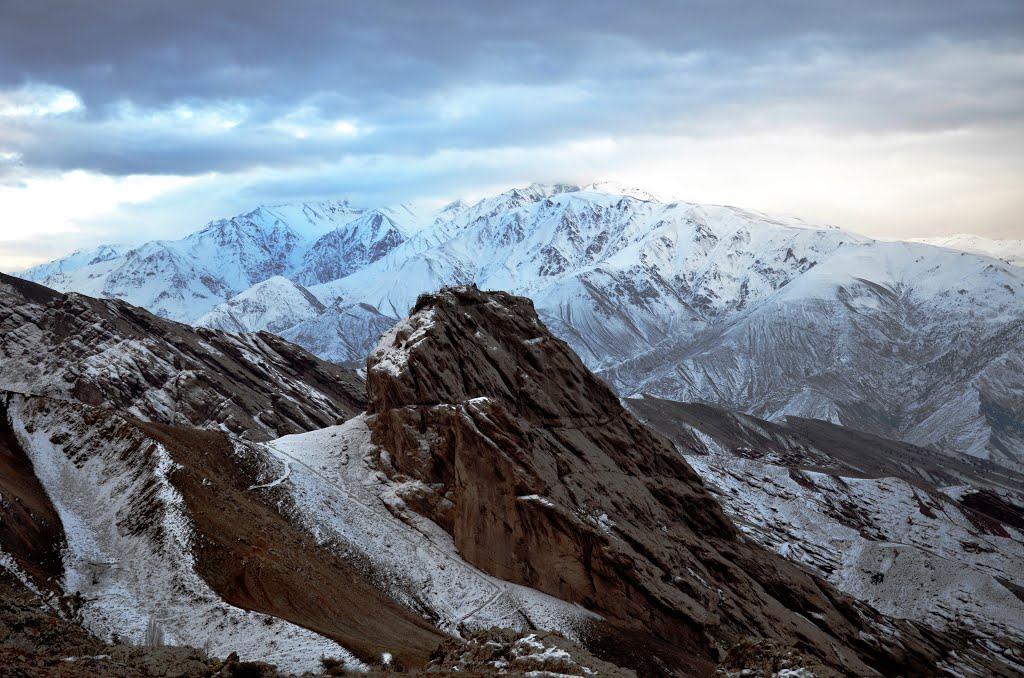
Alamut Castle in modern day Iran
The name derives from the Arabic “Hashashin”, meaning “those faithful to the foundation”. Marco Polo related a tale that the old man got such fervent loyalty from his young followers by drugging and leading them to a “paradise” of earthly delights, to which only he could bring them back. The story is most likely apocryphal. There is little evidence that hashish was ever used by the sect.
More likely that Sabbah’s followers believed him to be divine, personally selected by Allah. The man didn’t need to drug his “Fida’i” (self-sacrificing agents), he was infallible. His every whim would be obeyed as the literal Word of God.
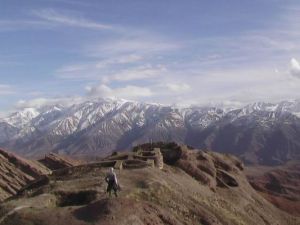
The mountain fortification of Alamut in northern Persia was all but impervious to defeat by military means, but not to the two-years long campaign of stealth and pretend friendship practiced by Sabbah and his followers. Alamut fell in a virtually bloodless takeover in 1090, becoming the headquarters of the Nizari Ismaili state.
Alamut Fortress, Nortwest Iran
Why Sabbah would have founded such an order is unclear, if not in pursuit of his own personal and political goals. By the time of the first Crusade (1095-1099) the Nizari Isma’ili leader found himself pitted against Muslim and Christian rivals, alike.
Western, Arabic, Syriac and Persian sources alike depicted the Assassins as trained killers, equally adept with dagger, arrow and poison alike.
Sabbah would order the elimination of his rivals, often up close. From religious figures to politicians and generals, assassinations were preferably carried out in broad daylight, lest everyone absorb the intended message.
The assassin could carry out the hit or insert himself and wait for years, for the opportunity to strike. Either way, he fully expected to die in carrying out his charge, a fact which troubled him not at all, knowing that he would awake, in paradise.
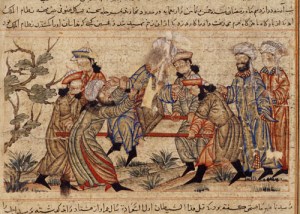
Assassination of the Seljuk Vizier Nizam al-Mulk
While the “Fida’in” occupied the lowest rank of the order, great care was devoted to their education and training. Possessed of all the physical prowess of youth, the individual assassin was intelligent and well-read, highly trained in combat tactics, the art of disguise and the skills of the expert horseman. All the necessary traits for anyone who would penetrate enemy territory, insinuate himself into their ranks, and murder the victim who had learned to trust him.
Sometimes, a credible threat of assassination was as effective as murder itself. When the new Seljuk Sultan Ahmad Sanjar rebuffed Hashashin diplomatic overtures in 1097, the sultan awoke one morning to find a dagger struck fast in the ground, next to his bed. A messenger arrived sometime later from the old man of the mountain. “Did I not wish the sultan well” he asked, “that the dagger which was struck in the hard ground would have been planted on your soft breast?” The technique worked nicely. For the rest of his days, Sanjar was happy to allow the Hashashin to collect tolls from travelers. The Sultan even provided them with a pension, collected from the inhabitants of the lands they occupied.
The great Saladin himself awoke one morning, to find a note resting on his chest, along with a poisoned cake. The message was clear. Sultan of all Egypt and Syria though he was, Saladin made an alliance with the rebel sect. There were no more attempts on his life.
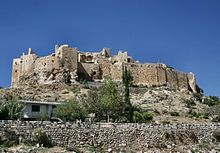
Assassin stronghold at Masyaf, in Northern Syria
Over the course of 200 years, the assassins occupied scores of mountain redoubts, while Alamut remained its principle quarters.
It’s impossible to know how many of the hundreds of political assassinations of this period were attributable to the followers of Hassan-i Sabbah. Without a doubt, their fearsome reputation ascribed more political murder to the sect than it was actually responsible for.
The Fida’in of Hassan-i Sabbah were some of the most feared killers of the middle ages. Scary as they were, there came a time when the order of the assassins tangled with someone far scarier than themselves.
In 1250, the grand master dispatched his killers to Karakorum in order to murder the Great Khan of the “Golden Horde” and great grandson of Genghis Kahn himself, Möngke. That turned out to be a bad idea.
The Nestorian Christian ally of the Mongol Empire Kitbuqa Noyan, was ordered to destroy several Hashashin fortresses in 1253. In 1255. Möngke’s brother Hulagu rode out at the head of the largest Mongol army ever assembled and no fewer than 1,000 Chinese engineer squads. Their orders were to treat those who submitted with kindness, and to utterly destroy those who did not.
That he did. Rukn al-Dīn Khurshāh, fifth and final Imam who ruled at Alamut, submitted after four days of preliminary bombardment. On December 15, 1256, Mongol forces under the command of Hulagu Khan entered the Hashshashin stronghold at Alamut Castle.
Alamut was destroyed, the defeated hashashin leader paraded before subordinate fortresses, each of which was destroyed in its turn.
Some Hashashin continued to exist in small, fractured groups, though their power was at an end. Destroyed by the power of the Mongol horde, 767 years ago today.
Nobody fired. No one so much as moved as one man stepped over that wall and into the no-man’s land between two watching armies.
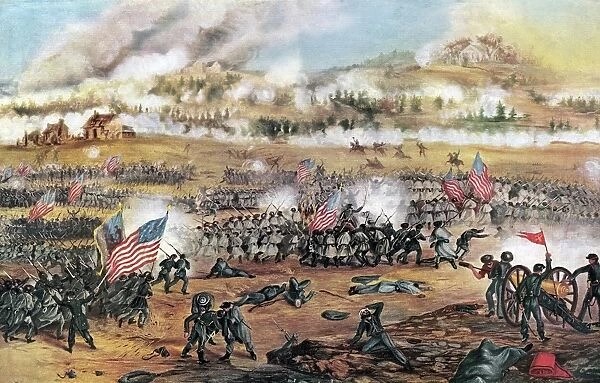
It was the greatest clash of the Civil War, and it should have been a sure victory. Overwhelmingly superior federal forces easily taking the lightly defended city of Fredericksburg and marching on, to the Confederate capital of Richmond.
It was never meant to be.
Departing November 15, 120,000 federal troops under Union General Ambrose Burnside hurried the 35-miles from Warrenton to Falmouth Virginia, the first arriving on the north bank of the Rappahannock two days later. Across the river stood the port city of Fredericksburg, defended by a paltry confederate force numbering barely a few hundred.
Back in Washington, bureaucratic wrangling conspired with wretched weather to delay the only means of crossing the Rappahannock. Portable bridge pontoons only now beginning the journey south.
“A TRAIN OF PONTOONS LIKE THOSE USED BY BURNSIDE TO SPAN THE RAPPAHANNOCK RIVER. THE TARDY ARRIVAL OF THE PONTOONS UPSET BURNSIDE’S PLANS FOR AN EASY CROSSING AND ULTIMATELY DOOMED HIS CAMPAIGN TO FAILURE”. Hat tip NPShistory.com
And so they waited, any chance of surprise squandered as Robert E. Lee hurried some 70,000 of own troops to the scene. First to arrive was General James Longstreet’s wing moving east from Culpeper, taking up positions along a prominence known as Marye’s heights. Meanwhile, General Thomas J. “Stonewall” Jackson’s men hurried in from the Shenandoah Valley, forming up a defensive line four miles outside of town.
By the time those bridges arrived, heavy snows slowed military operations for at least another week. Longstreet’s and Stonewall Jackson’s men had more than enough time to prepare.
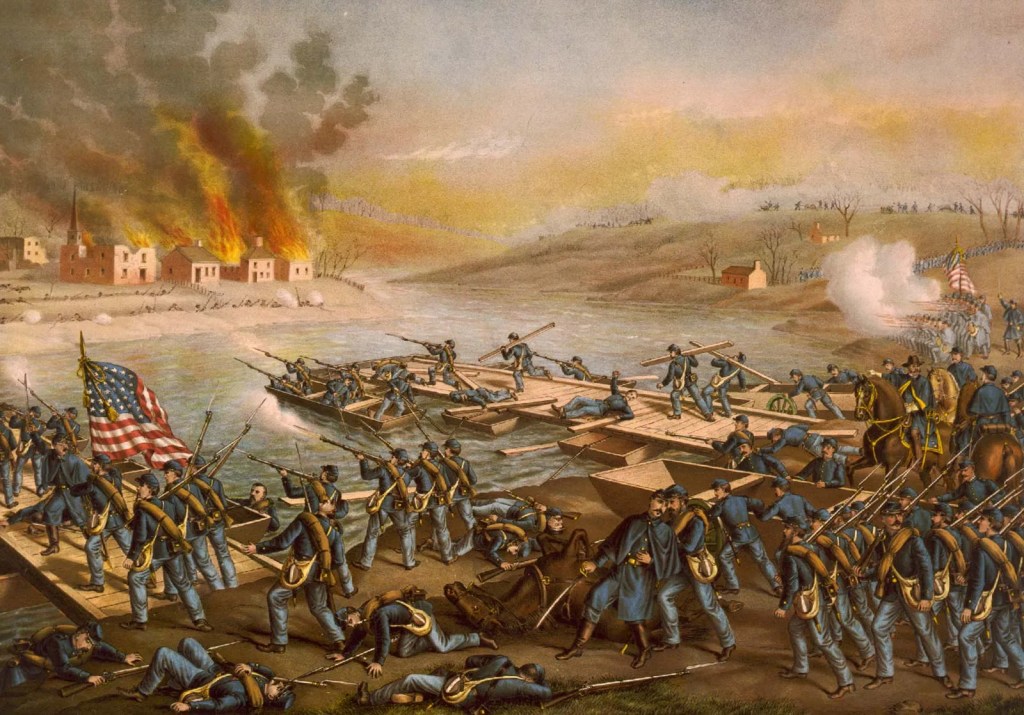
Hat tip Britannica
Burnside’s crossing finally began on the morning of December 11, as engineer battalions constructed bridges in the face of determined Confederate fire. Several groups of soldiers had to row across the river, the battle moving through the streets and buildings in the first urban combat of the Civil War.
On the morning of the 13th, Robert E. Lee’s forces occupied a seven mile long curving line, with the five divisions of Longstreet’s Corps on the left along Marye’s Heights, west of town.
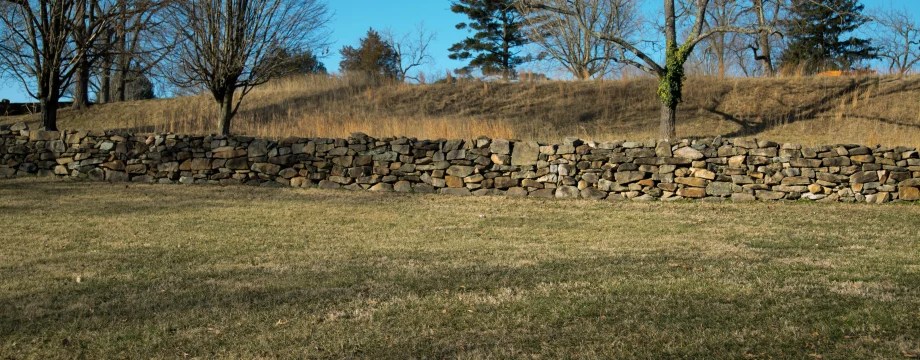
The stone wall at Marye’s Heights. Hat tip theamericanwarrior.com
Fighting began on both ends of the Confederate position, more or less simultaneously. The federals had some early successes against Stonewall Jackson’s dug-in positions on the right, but requested reinforcements never arrived. By the end of the day, the old farmer’s expression “slaughter pen”, had taken on a whole new meaning.
In contrast to the swampy approaches on the Confederate right, 5,000 soldiers under James Longstreet looked out from behind the stone wall on Marye’s Heights to an open plain, crossed from left to right by a mill run 5-feet deep and 15-feet wide, filled with 3-feet of freezing water.
Confederate artillery commander Edward Porter Alexander looked out on that ground and remarked “a chicken could not live on that field when we open on it”. He was right. For six hours, the Union army threw one attack after another against the rebels behind the wall. Fourteen assaults in all. As the sun went down on the evening of December 13, the ground before Marye’s Heights was carpeted with the mangled, dead and dying bodies of Union soldiers.
The Army of the Potomac suffered more than 13,000 casualties, approximately two-thirds of them in front of that wall. Lee’s army, by comparison, suffered around 4,500 losses. Watching the great Confederate victory unfold from his hilltop command post, Robert E. Lee said “It is well that war is so terrible, or we should grow too fond of it.”
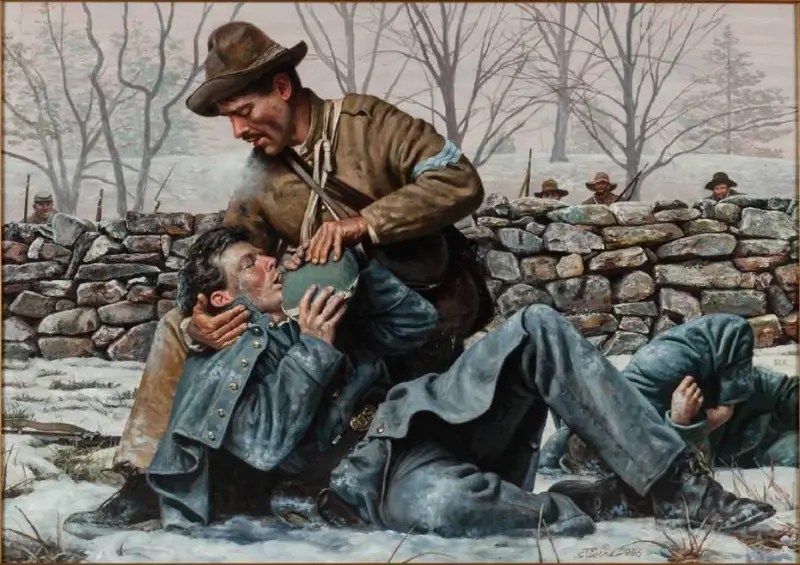
Hat tip Grainger Art
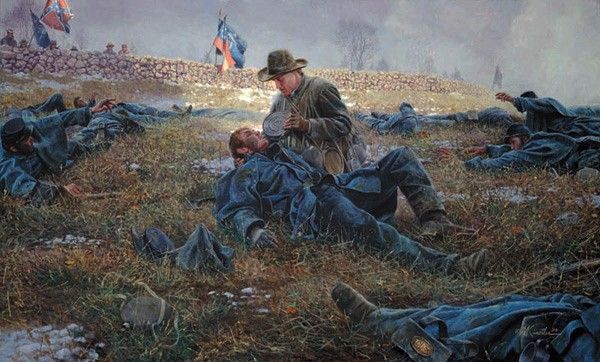
Union ambulance corps had all they could do to remove their wounded from the plains, but dared not enter within the Confederate’s range of fire. So it is all through the night of December 13-14, the moans of mangled and dying Union soldiers could be heard all along that wall.
Perhaps some Confederate soldiers reveled in all that carnage, but not all. As the moans could be heard throughout that night here was hardly a man among them, who didn’t understand. That could be me out there.
Sergeant Richard Kirkland, Company G, Second South Carolina Infantry, could not sit and listen. Kirkland couldn’t stand to hear “those poor people crying for water”, so he left his position and made his way to General Joseph Kershaw’s headquarters, and asked to be allowed to help.
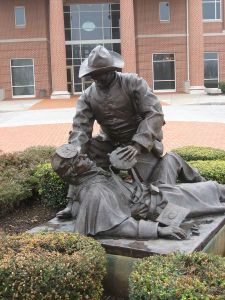
On the morning of December 14, 1862, Richard Kirkland took as many canteens as he could carry and stepped into the no man’s land between two watching armies. No one fired. No one even moved as one man worked his way alone from one wounded man to the next, straightening out a shattered leg here, there spreading out an overcoat and always with a quiet word of encouragement, and a drink of water.
Kirkland was out there for no less than 1½ hours. Alone in no man’s land, he never returned to the safety of that wall until he had helped every fallen soldier, friend or foe, on that part of the battlefield.
General Kershaw later gave this account: “Unharmed he reached the nearest sufferer. He knelt beside him, tenderly raised the drooping head, rested it gently upon his own noble breast, and poured the precious life-giving fluid down the fever scorched throat. This done, he laid him tenderly down, placed his knapsack under his head, straightened out his broken limb, spread his overcoat over him, replaced his empty canteen with a full one, and turned to another sufferer.”
Moment of Mercy, by Felix de Weldon. 1965, Fredericksburg, VA. Photo credit Claire H. New York
Sergeant Kirkland lost his life the following year, leading an infantry charge at a place called Chickamauga.
How many lives were spared by one man’s courage and compassion this day in 1862, is impossible to know. One man who stepped out onto no man’s land between two watching armies, to give a moment’s comfort to a fallen adversary.
For that, Richard Rowland Kirkland will forever remain, the Angel of Marye’s Heights.
World War II was cut short on this day in 1942, by as much as a year. Untold lives spared by the actions of two courageous sailors. And a 16-year-old ship’s cook.
Similar to the Base Exchange system serving American military personnel, the British Navy, Army and Air Force Institutes (NAAFI) is the UK-government organization operating clubs, bars, shops and supermarkets in service to British armed forces, as well as naval canteen services (NCS) onboard Royal Navy ships.
NAAFI personnel serving on such vessels are assigned to duty stations and wear uniforms, while technically remaining civilians.
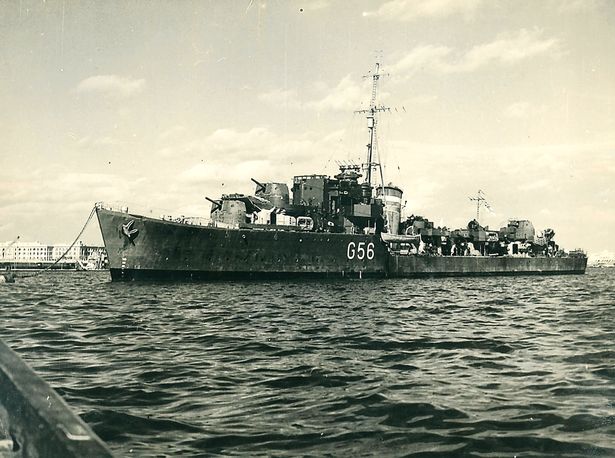
Tommy Brown was fifteen that day, lying about his age and enlisting in the NAAFI. He was assigned as canteen assistant to the “P-class” destroyer, HMS Petard.
HMS Petard
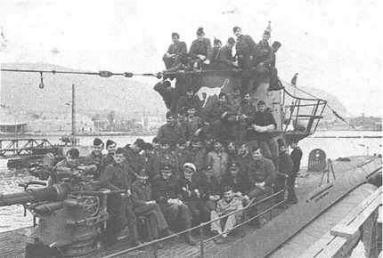
On October 30, 1942, Petard joined three other destroyers and a squadron of Vickers Wellesley light bombers off the coast of Port Said Egypt, in a 16-hour hunt for the German “Unterseeboot”, U–559.
Hours of depth charge attacks were finally rewarded when the crippled U-559 came to the surface, the 4-inch guns of HMS Petard permanently ending the career of the German submarine.
U-559
The crew abandoned ship, but not before opening the boat’s seacocks. Water was pouring into the submarine, even as Lieutenant Francis Anthony Blair Fasson and Able Seaman Colin Grazier dived into the water and swam to the stricken sub, with junior canteen assistant Tommy Brown close behind.
With U-559 sinking fast, Fasson and Grazier made their way into the captain’s cabin. Finding a set of keys, Fasson opened a drawer and discovered a number of documents, including two sets of code books.
With one hand on the conning ladder and the other clutching those documents, Brown made three trips up and down through the hatch, to Petard’s whaler.
U-185 sinking, after American depth charging
In the final moments, the ship’s cook called for his shipmates to get out of the boat. Brown himself was dragged under, but managed to kick free and come to the surface. Colin Grazier and Francis Fasson went down with the German sub.
The episode brought Tommy Brown to the attention of the authorities, ending his posting aboard Petard when his true age was revealed. Even so he was never discharged from the NAAFI, and later returned to sea on board the light cruiser, HMS Belfast.
In 1945, now-Leading Seaman Tommy Brown was home on shore leave, when fire broke out at the family home in South Shields. He died while trying to rescue his 4-year-old sister Maureen, and was buried with full military honors in Tynemouth cemetery.
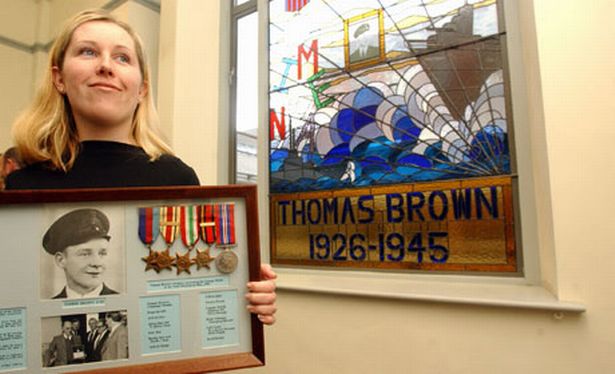
Fasson and Grazier were awarded the George Cross, the second-highest award in the United Kingdom system of honors. Since he was a civilian due to his NAAFI employment, Brown was awarded the George Medal.
For German U-boat commanders, the period between the fall of France and the American entry into WW2 was known as “Die Glückliche Zeit” – “The Happy Time” – in the North Sea and North Atlantic. From July through October 1940 alone, 282 Allied ships were sunk on the approaches to Ireland, for a combined loss of 1.5 million tons of merchant shipping.
Tommy Brown’s Mediterranean episode took place in 1942, in the midst of the “Second Happy Time”, a period known among German submarine commanders as the “American shooting season”. U-boats inflicted massive damage during this period, sinking 609 ships totaling 3.1 million tons with the loss of thousands of lives, against a cost of only 22 U-boats.
USMM.org reports that the United States Merchant Marine service suffered a higher percentage of fatalities at 3.9%, than any American service branch in WW2.
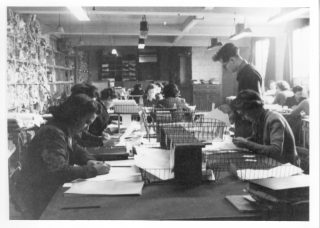
Early versions of the German “Enigma” code were broken as early as 1932, thanks to cryptanalysts of the Polish Cipher Bureau, and French spy Hans Thilo Schmidt. French and British military intelligence were read into Polish decryption techniques in 1939, these methods later improved upon by the British code breakers of Bletchley Park.
Vast numbers of messages were intercepted and decoded from Wehrmacht and Luftwaffe sources through the Allied intelligence project “Ultra”, shortening the war by at least a year, and possibly two.
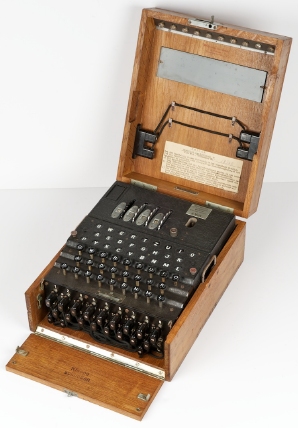
The Kriegsmarine was a different story. Fanatically jealous of security, Admiral Karl Dönitz introduced a third-generation enigma machine (M4) into the submarine service around May 1941, a system so secret that even the Wehrmacht and the Luftwaffe, were ignorant of its existence.
The system requires identical cipher machines at both ends of the transmission and took a while to put into place, with German subs being spread around the world.
All M4 machines were distributed by early 1942. On February 2, German submarine communications went dark. For code breakers at Bletchley Park, the blackout was sudden and complete. For a period of nine months, Allies had not the slightest idea of what the German submarine service was up to. The result was catastrophic.
U-559 documents were rushed back to England, arriving at Bletchley Park on November 24, allowing cryptanalysts to attack the “Triton” key used within the U-boat service. It would not be long, before the U-boats themselves were under attack.
The M4 code was broken by December 13, when the first of a steady stream of intercepts arrived at the Admiralty Operational Intelligence Office, giving the positions of 12 U-boats.
The UK Guardian newspaper wrote: “The naval historian Ralph Erskine thinks that, without the (M4) breakthrough, the Normandy invasion would have been delayed by at least a year, and that between 500,000 and 750,000 tons of allied shipping were saved in December 1942 and January 1943 alone”.
Tommy Brown never knew what was in those documents. The entire enterprise remained top secret, until decades after his death.
Winston Churchill later described the actions of the crew of HMS Petard as “crucial to the outcome of the war”. Untold numbers of lives that could have been lost. But for the actions of two courageous sailors. And a sixteen-year-old ship’s cook.
“Tommy’s grand niece Sharon Carley stands next to commemorative stained glass window of late war hero“. Hat Tip mirror.co.uk
“We had no reason to believe the Japanese would attack us,” Executive Officer Lieutenant Arthur Anders later explained. “The United States was a neutral nation.”
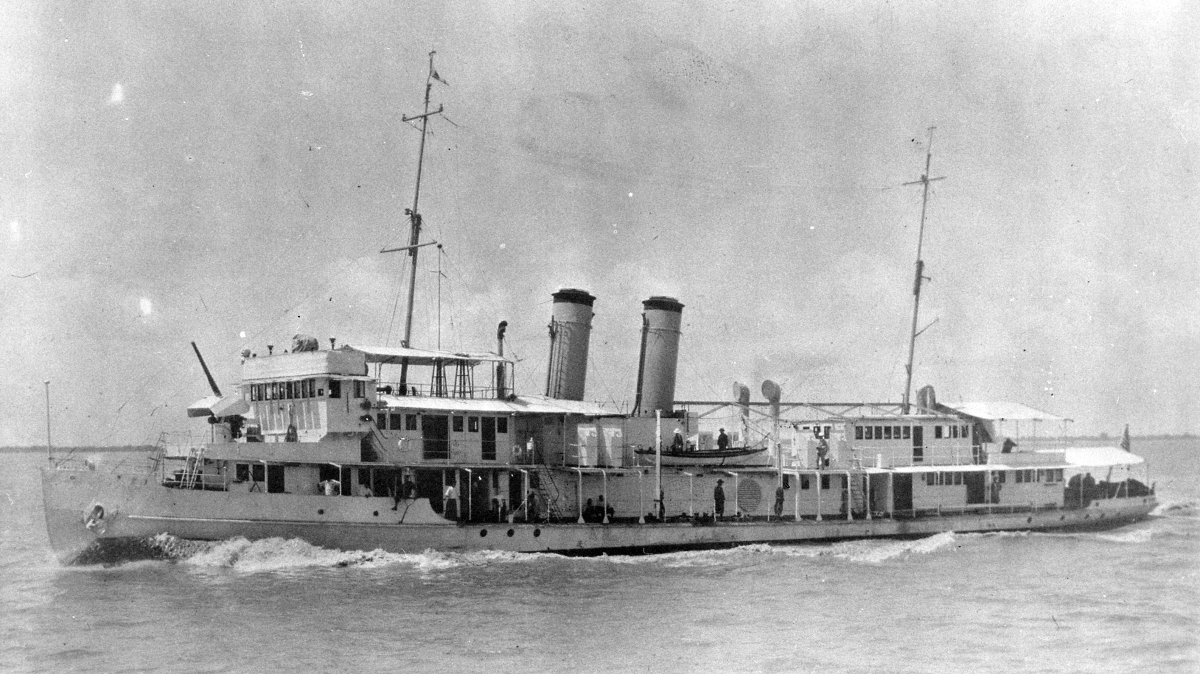
USS Panay was a flat bottomed river craft built in Shanghai, part of the Asiatic fleet and charged with protecting American lives and property on the Yangtze River near Nanking.
Japanese forces invaded China in the summer of 1937, advancing on Nanking as American citizens evacuated the city. The last of them boarded Panay on December 11: five officers, 54 enlisted men, four US embassy staff, and 10 civilians.
Japanese air forces received word the morning of December 12, 1937, that Chinese forces were about 12 miles north of the city, evacuating on several large steamers and a number of junks.
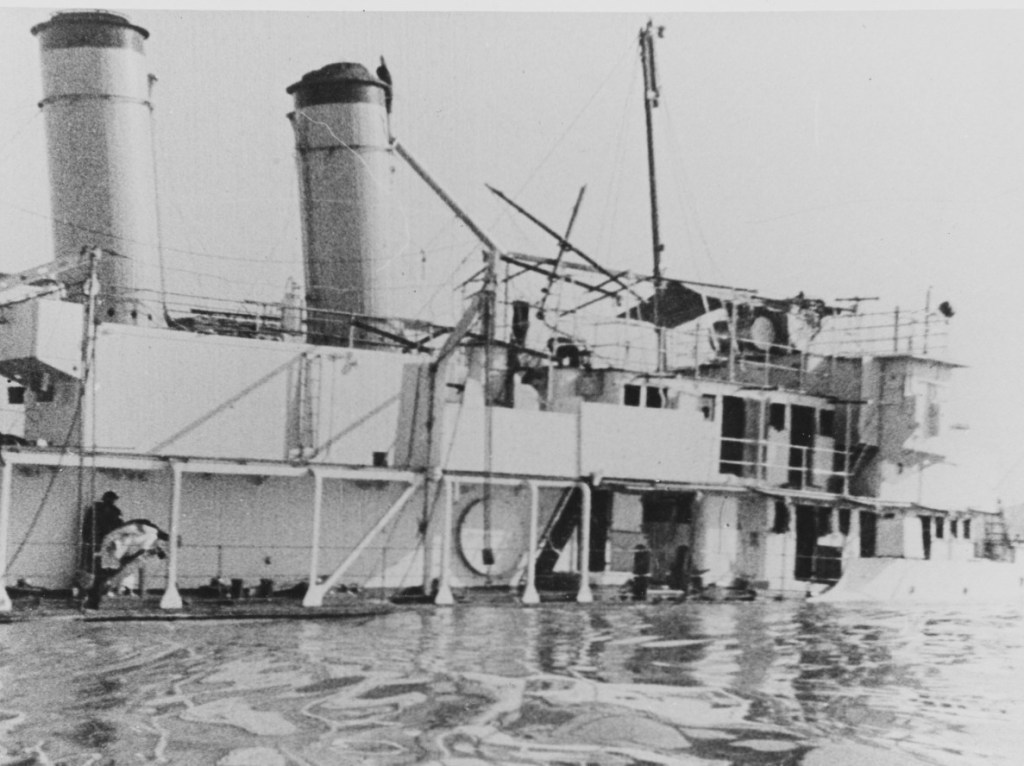
Anchored a short way upstream along with several Chinese oil tankers, Panay came under bombing and strafing attack that morning, sinking mid-river with three men killed. 43 sailors and five civilians were wounded. Two newsreel cameramen were on board at the time of the attack, and were able to film part of it.
“View of Panay with her main deck awash, as she sinks into the Yangtze River between Nanking and Wuhu, China, after being bombed by Japanese planes on 12 December 1937. Note tangled wreckage of foremast and seaman on deck, to left (NH 50807)”. – Hat Tip history.navy.mil
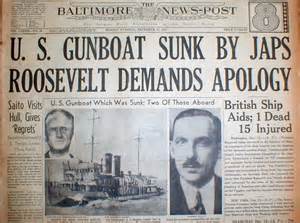
The American ambassador to Japan at the time was Joseph C. Grew, a man who was more than old enough to remember how the sinking of the Maine in Havana Harbor brought the US into war with Spain in 1898. While Japanese authorities were less than helpful, Ambassador Grew hoped to avoid a similar outcome following the Panay sinking.
The Japanese government continued to insist that the attack had been accidental, even as US cryptographers uncovered information indicating that aircraft were operating under orders.
Hat tip Historica.fandom.com
The matter was officially settled four months later, with an official apology and an indemnity of $2,214,007.36 paid to the US government. The “accidental attack” narrative seems to have been a safe story both sides pretended to believe, but the story strains credulity. HMS Ladybird was fired on that same morning by Japanese shore batteries, the attack followed a month later by the “Allison incident”, in which the American consul in Nanking, John M. Allison, was struck in the face by a Japanese soldier.
Adding in the fact that American property had been looted by Japanese forces, it seems clear that relations between the two governments had become toxic.
Interestingly, though the Japanese government held considerable animosity for that of the United States, the people of Japan seemed a different story. Ambassador Grew was flooded with expressions of sympathy from Japanese citizens, apologizing for their government and expressing affection for the United States.
Letters came from citizens of all ages and walks of life, from doctors and professors to school children. The wives of high ranking Japanese officials apologized to Ambassador Grew’s wife without their own husbands’ knowledge, while ten Japanese men describing themselves as retired US Navy sailors living in Yokohama, sent a check for $87.19.
One typical letter read: “Dear Friend! This is a short letter, but we want to tell you how sorry we are for the mistake our airplane made. We want you to forgive us I am little and do not understand very well, but I know they did not mean it. I feel so sorry for those who were hurt and killed. I am studying here at St. Margarets school which was built by many American friends. I am studying English. But I am only thirteen and cannot write very well. All my school-mates are sorry like myself and wish you to forgive our country. To-morrow is X-Mas, May it be merry, I hope the time will come when everybody can be friends. I wish you a Happy New Year. Good-bye.”
The two governments never did patch things up. The US placed an embargo in September 1940 prohibiting exports of steel, scrap iron, and aviation fuel to Japan, in retaliation for the Japanese occupation of northern French Indochina: modern day Laos, Cambodia and Vietnam.
Japan occupied southern Indochina by the summer of 1941 as the US, Great Britain and the Netherlands retaliated by freezing Japanese assets.
Throughout that summer and fall, Japan tried to negotiate a settlement to lift the embargo on terms which would allow them to keep newly captured territory, while at the same time preparing for war. Future Prime Minister and General Hideki Tojo secretly set November 29 as the last day on which Japan would accept a peaceful settlement.
Air and naval forces of the Imperial Japanese government attacked the US naval anchorage at Pearl Harbor one week later.
Perhaps a wolf once approached some some long-dead campfire in hopes of a morsel. Maybe someone took in a sick or injured puppy. Wolf packs could have shadowed human hunting parties, the two groups learning to work together for their mutual advantage. The story is lost to the mists of time, but one thing is certain. The bond that exists between our kind and canis familiaris will be with us, until the end of days.
Is there a creature alive capable of the loyalty and fidelity of a dog? Take, for example, Miguel Guzmán of Cordoba Argentina, who died in 2006. The following day Capitán, the family German Shepherd, vanished. Mrs. Guzmán and the couple’s son searched and searched until the dog arrived at the cemetery, forty-five minutes away.
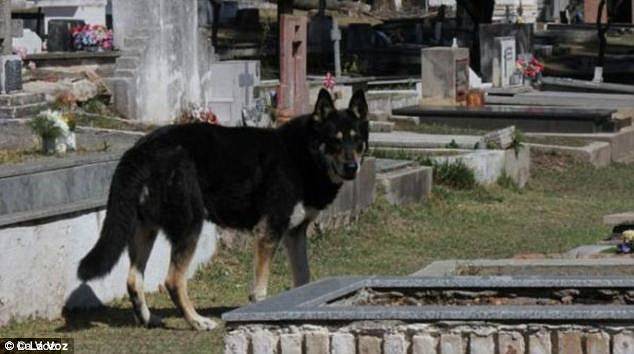
No one knows how he got there. The family claims they didn’t bring him. Cemetery director Hector Baccega remembers when he first saw the dog: ‘He turned up here one day, all on his own, and started wandering all around the cemetery until he eventually found the tomb of his master”.
Capitan. H/T Guardian, for this image
Capitán was brought home but he was back, the following day. Baccega describes what has since become, routine: “During the day he sometimes has a walk around the cemetery, but always rushes back to the grave. And every day, at six o’clock sharp, he lies down on top of the grave [and] stays there all night”.
Capitán lived to fifteen or sixteen, old for a large breed, and died in February 2018, in the cemetery in which he had lived. He was crippled and mostly blind by that time when he went to join his human “Dad”. Who knows, I certainly don’t. Maybe they really are together again.
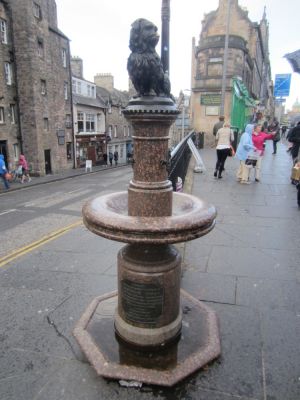
“Greyfriar’s Bobby” was a Skye Terrier in 19th-century Edinburgh, who waited 14 years by the grave of his owner, police nightwatchman, John Gray. He died there in 1872 and was buried in the Greyfriars Kirkyard, not far from where his master lay.
Artist William Brodie created a life-sized likeness atop the Greyfriars Bobby Fountain in Edinburgh. Paid for by local aristocrat Baroness Burdett-Coutts, the memorial was dedicated November 15, 1873.
Hachikō, an Akita known to Japanese children as chūken Hachikō (“faithful dog Hachikō”), liked to tag along with his owner Hidesaburō Ueno, a professor of agriculture at Tokyo University. Ueno would commute to work, and every evening, Hachikō would wait at the Shibuya Station for the professor’s return.
In May 1925, a cerebral hemorrhage took him away while delivering a lecture. Hidesaburō Ueno was never coming home. Every day for the next nine years, nine months and fifteen days, the golden colored Akita appeared at Shibuya Station, precisely on time for that evening train.
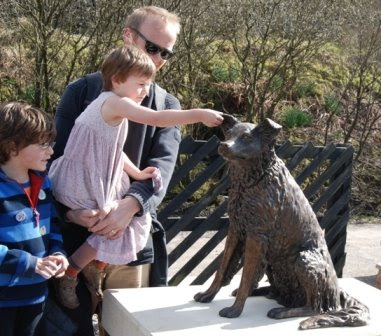
Ruswarp was a fourteen-year old Border Collie who went hiking with Graham Nuttall on January 20, 1990 in the Welsh Mountains near Llandrindod. On April 7, a hiker discovered Nuttall’s body near a mountain stream. For eleven weeks the dog had been standing guard.
Ruswarp was so weak that he had to be carried off the mountain and died shortly thereafter. Today there’s a small monument in his memory on a platform near the Garsdale railway station.
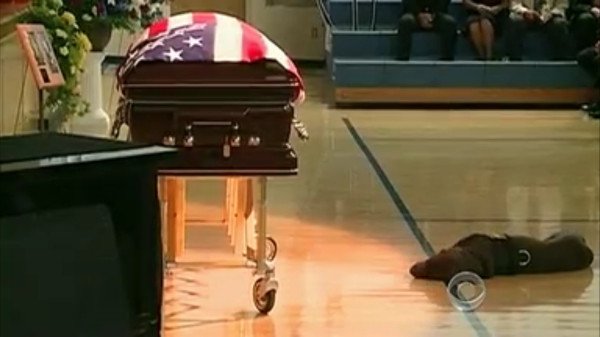
In the early morning hours of August 6, 2011, 30 American military service members including 22 US Navy SEALs were killed along with eight Afghans, SEAL Team 6 handler John “Jet Li” Douangdara and his Military Working Dog (MWD) “Bart”. The Chinook helicopter in which they were riding was shot down by a rocket-propelled grenade in the Kunar Province, of Afghanistan.
To anyone around at that time, the images of “Hawkeye”, together for the last time with slain Navy SEAL Jon Tumilson, are hard to forget.
In 1936, a sheep handler whose name is lost to history tended his flock in the fields near Fort Benton, Montana. With him always was his four-legged partner and sheepdog, “Shep”.
The man fell ill and was taken to a local hospital. For over a week, Shep waited at the hospital for his master to return. On the 11th day, the man died, his casket taken to the local train station and placed in the cargo hold to be returned home for burial.
Shep was there throughout and watched the train chug away. He’d return to that hospital door where a kindly nun would feed him a scrap, but every time he heard that train whistle, there was a sheepdog waiting at the station.
In those days, there were four trains a day. For nearly six years, Shep returned to the station, every time he heard that whistle. He even dug a den for himself, near the track.
Passengers took the Havre to Great Falls rail line just to see the dog. Shep received so much fan mail, the Great Northern Railroad assigned a secretary to write responses.
In time, the dog wasn’t quite so fast as he used to be, his hearing not so good. On January 12, 1942, “Forever Faithful” Shep was struck and killed on the tracks, waiting for a man who could never return.
There are enough stories like this to fill a book. I keep a sign at my home to remind me. It’s on the wall in the kitchen. “Lord, make me half the man my dog thinks I am“.
Begun on November 1, 1955, the American war in Southeast Asia lasted 19 years, 5 months and a day. On March 29, 1973, two months after signing the Paris Peace accords, the last US combat troops left South Vietnam as Hanoi freed the remaining POWs held in North Vietnam.
It was the longest war in American history, until Afghanistan.
Jan Scruggs served in that war. Two tours, returning home with a Purple Heart and three army commendation medals as well as a medal for valor. Theirs was an unpopular war. Like many he found readjustment to civilian life, difficult.
In 1979 he and Becky, his wife of five years, went to see a movie. The Deer Hunter. The film seemed to bring it all back. The RPG that had left him so grievously wounded. The accidental explosion of those mortar rounds that had killed his buddies. Twelve of them.
That night passed without sleep, a waking nightmare of flashbacks and alcohol. By dawn he’d envisioned a memorial. With names on it. Maybe an obelisk. On the Mall, in Washington DC. Becky feared he was losing his mind.
Scruggs was working for the department of labor at the time when he took a week off, to pursue the project.
The idea received little support. The project was impractical it was said, and besides, the project would distract veterans organizations from more important work. Undaunted, Scruggs left his job to pursue the project, full time.
It was tough going. Becky was now the sole breadwinner. In two months the project raised a scant $144.50.
Always a sign of the contemptible times in which we live, the CBS Evening News ridiculed the project. Late night “comedians” joined in the mockery and yet, that CBS report attracted the attention of powerful allies. Thousands of dollars came in from not-so-powerful contributors, mostly in $5 and $10 denominations.
Chuck Hagel, then deputy administrator for the United States Department of Veterans Affairs, took interest. Likewise John Wheeler, a fellow Vietnam vet – turned attorney who’d spearheaded the effort to erect the Southeast Asia Memorial on the military academy, at West Point.
$8 million came in over the next two years and then came the competition. The actual design. There were 1,422 submissions, so many that selections were carried out in an aircraft hangar.
Much to her surprise, the winner was 1st-generation American of Chinese ancestry Maya Lin, then an undergraduate studying architecture, at Yale University.
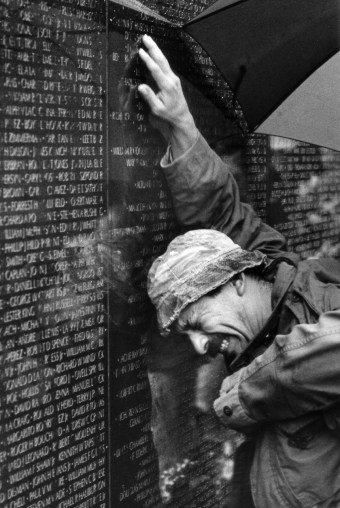
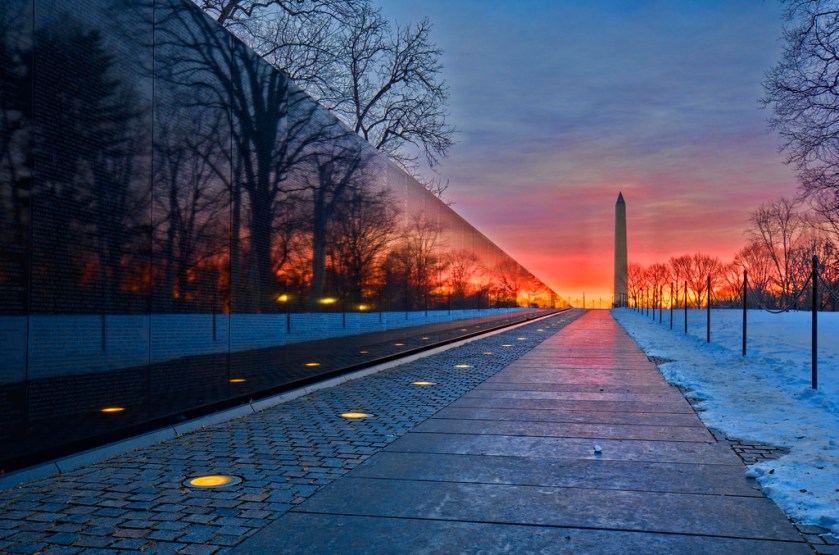
“The Wall” was dedicated on this day. November 13, 1982.
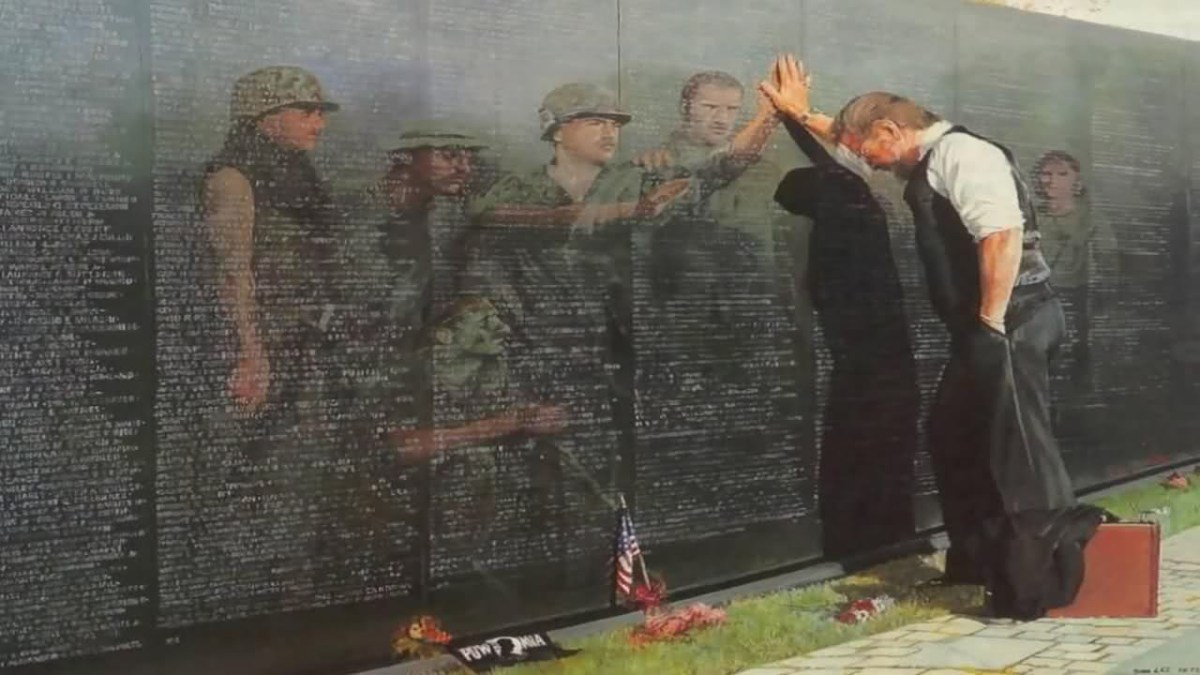
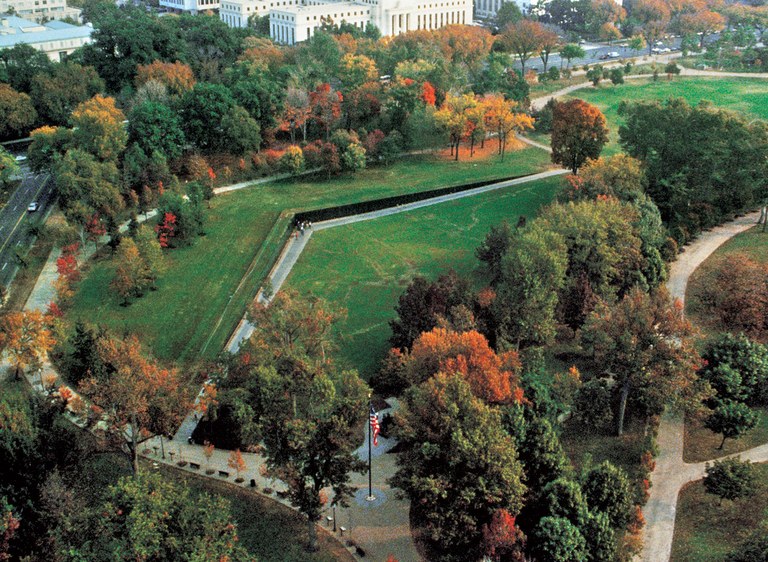
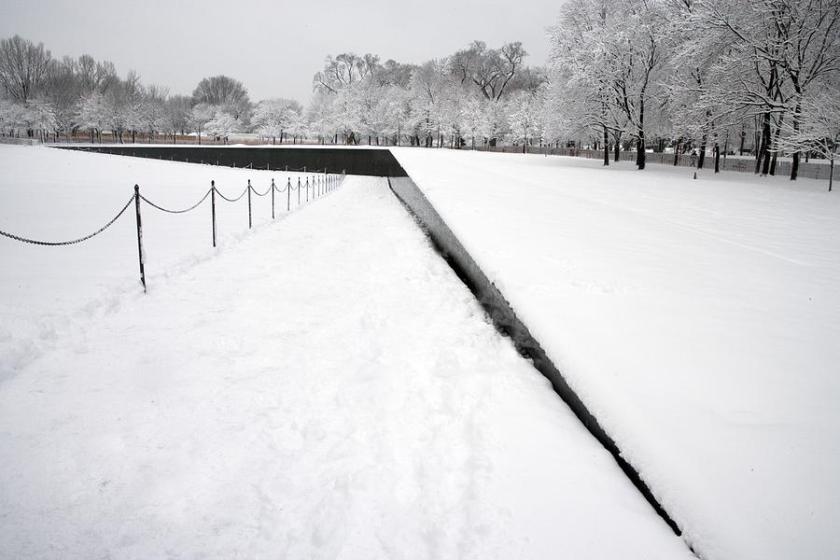
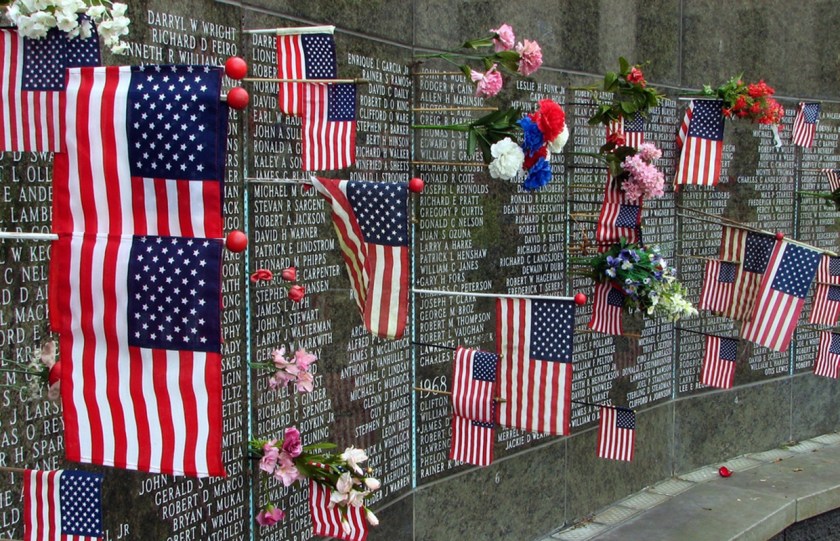
Lin’s design takes the form of a black granite wall, 493½-feet long and 10-feet, 3-inches high at its peak, laid out in a great wedge of stone seeming to rise from the earth and return to it. The name of every person lost in the war in Vietnam sandblasted onto stone, appearing in the order in which they were killed.
Go to the highest point on the memorial, panel 1E, the very first name is that of Air Force Tech Sgt. Richard B. Fitzgibbon, Jr. of Stoneham, Massachusetts, killed on June 8, 1956. Some distance to his right you will find the name of Marine Corps Lance Cpl. Richard B. Fitzgibbon III, killed on Sept. 7, 1965. The Fitzgibbons are one of three Father/Son pairs so memorialized.
The names begin at the center and move outward, the east wing ending on May 25, 1968. The same day continues at the far end of the west wing, moving back toward the center at panel 1W. The last name on the wall, the last person killed in the war, meets the first. The circle is closed.
There you will find the name of Kelton Rena Turner of Los Angeles, an 18-year old Marine, killed in action on May 15, 1975 during the “Mayaguez incident”, two weeks after the evacuation of Saigon.
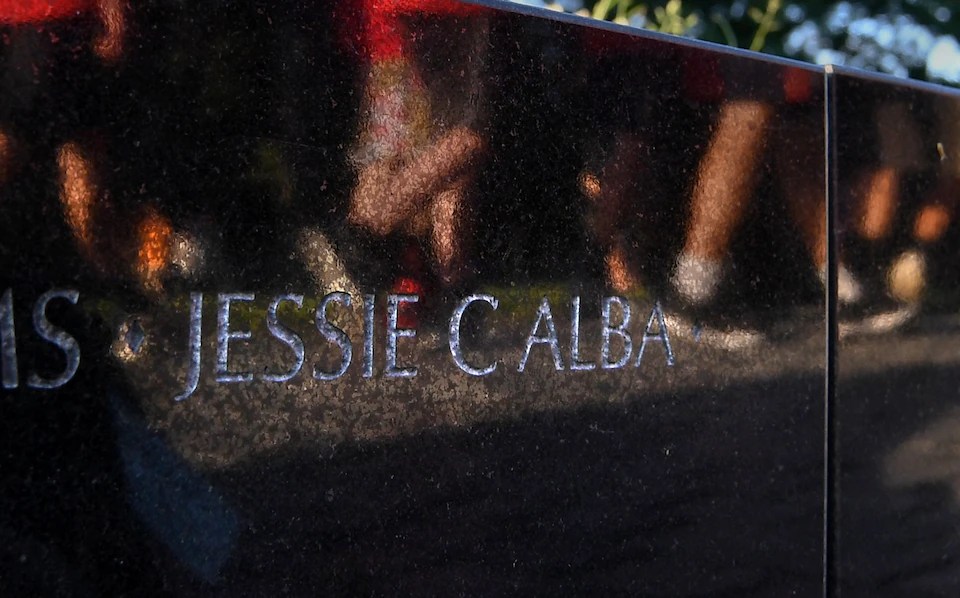
Approach from the east and the first name you will encounter is that of Sergeant Jessie C. Alba of Port Lavaca, Tex., who served in the 101st Airborne Division and was killed near Hue in a mortar attack. Sgt. Alba was engage to be married on the day he was killed. Mary Ann Lopez later wrote in an on-line tribute, “Even now after so many years past, I still think of him and what our lives, could of been.”
Those who go to war are never the only ones to serve and to sacrifice, on behalf of the rest of us.
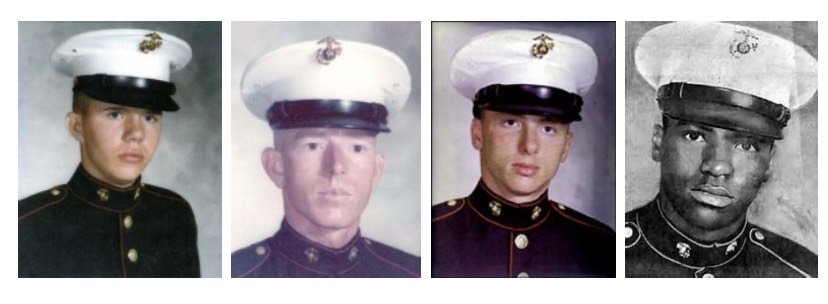
Most sources list Gary L. Hall, Joseph N. Hargrove and Danny G. Marshall as the last to die in Vietnam, though their fate remains, unknown. These were United States Marines, an M-60 machine gun squad, mistakenly left behind while covering the evacuation of their comrades, from the beaches of Koh Tang Island. Their names appear along with Turner’s on panel 1W, lines 130-131.
There were 57,939 names inscribed on the Memorial when it opened in 1982. 39,996 died at age 22 or younger. 8,283 were 19 years old. The 18-year-olds are the largest age group, with 33,103. Twelve of them were 17. Five were 16. There is one name on panel 23W, line 096, that of PFC Dan Bullock, United States Marine Corps. He was 15 years old on June 7, 1969. The day he died.
Left to right: PFC Gary Hall, KIA age 19, LCPL Joseph Hargrove, KIA on his 24th birthday, Pvt Danny Marshall, KIA age 19, PFC Dan Bullock, KIA age 15
Eight names belong to women, killed while nursing the wounded. 997 soldiers were killed on their first day in Vietnam. 1,448 died on their last. There are 31 pairs of brothers on the Wall. 62 parents left to endure the loss of two sons.
As of Memorial Day 2015, there are 58,307, as the names of military personnel who succumbed to wounds sustained during the war, were added to the wall.
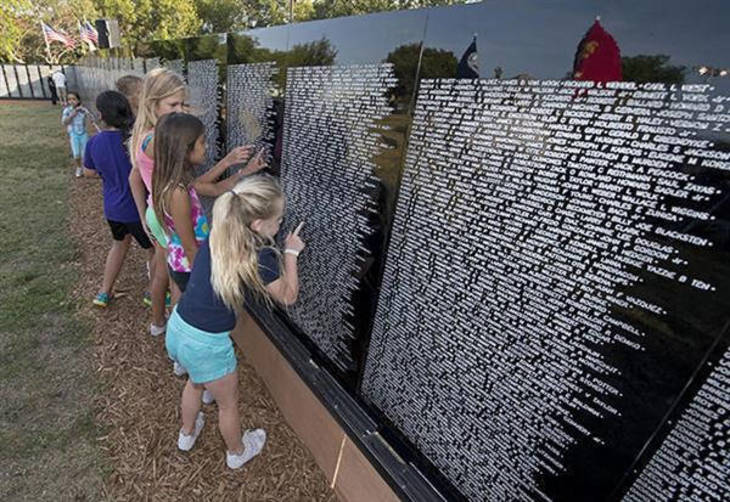
Over the years, the Wall has inspired a number of tributes, including a traveling 3/5ths scale model of the original and countless smaller ones, bringing the grandeur of Lin’s design to untold numbers without the means or the opportunity, to travel to the nation’s capital.
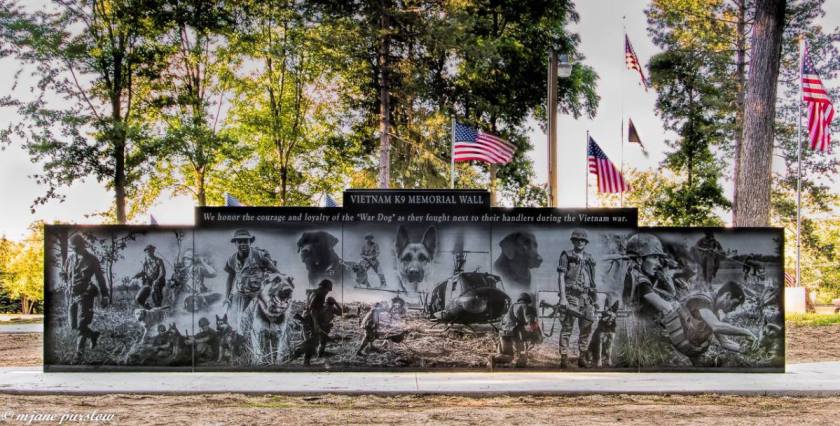
In South Lyons Michigan, the black marble Michigan War Dog Memorial pays tribute to the names and tattoo numbers of 4,234 “War Dogs” who served in Southeast Asia, the vast majority of whom were left behind as “surplus equipment”.
There is even a Vietnam Veterans Dog Tag Memorial, at the Harold Washington Library, in Chicago.
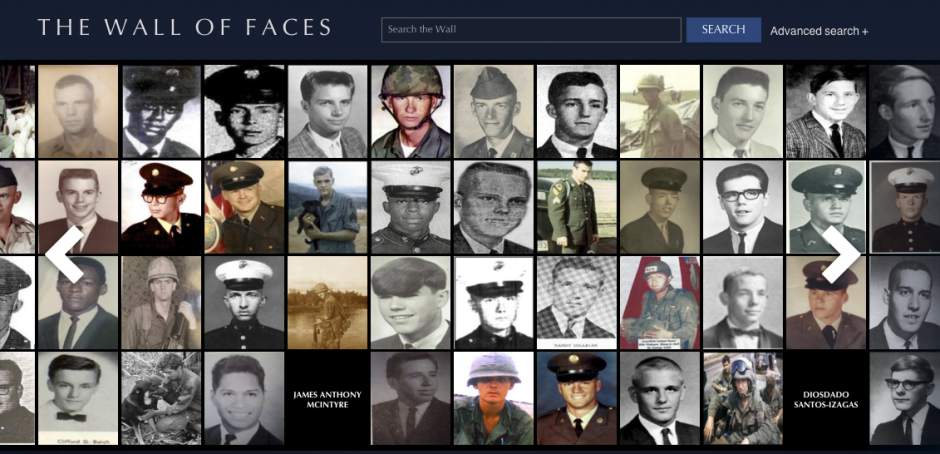
Ten years ago, the Vietnam Veterans Memorial Fund, www.vvmf.org began work on a virtual “Wall of Faces”, where each name is remembered with a face, and a story to go with it. In 2017, the organization was still looking for 6,000+ photographs. As I write this there remain only 200, yet to be discovered.
Check it out. Pass it around. You might be able to help.
I was nine years old in May 1968, the single deadliest month of that war with 2,415 killed. All these decades later later I still recall the way so many disgraced themselves, in the way they treated those returning home from that place.
Even today as veterans of the war in Vietnam know the appreciation that is their due, the scars run deep for the recognition too often denied, those many years ago.
Now in the modern era we trust and expect our countrymen will remember. Any issue taken with US war policy, needs to brought up with the politicians who craft that policy. Not a member of the Armed Services, doing what his nation called on him to do.
The military went out of its way during World War 2 to provide the traditional Thanksgiving meal for soldiers and Marines at home, as well as overseas. Thousands of turkeys with all the trimmings fanned out in a worldwide effort to make sure every uniformed member of the armed services had a holiday meal.
In the English tradition, days of Thanksgiving first came about during the Reformation, in the time of King Henry VIII.
Historian Michael Gannon writes about the “real first Thanksgiving” in America taking place in 1565, when Pedro Menéndez de Avilés landed in modern-day Florida. Avilés “had the Indians fed and then dined himself,” likely on a diet of salt-pork stew and garbanzo beans. Yumm.
According to the Library of Congress, the English colony of Popham in present-day Maine held a “harvest feast and prayer meeting” with the Abenaki people in 1607, nearly two decades before the “first Thanksgiving” we all learned about in 5th grade.
In 1619, thirty eight settlers departed Bristol, England on board the ship Margaret bound for Virginia, under the leadership of Captain John Woodliffe. London Company proprietors instructed these settlers that “the day of our ships arrival . . . shall be yearly and perpetually kept as a day of Thanksgiving.” So it was the December 4 landing at Berkeley Hundred became a day of prayer and Thanksgiving, nearly a year before the “pilgrims” landed on the outer reaches of Cape Cod.
Surprisingly little comes down to us from that “first Thanksgiving”, of 1621. Governor William Bradford’s Of Plymouth Plantation and Mourt’s Relations by Edward Winslow provide only hints of a harvest feast, sometime between September and November of 1621.
“Waterfowl” were surely on the menu and, the Wampanoag being a coastal peoplE. Shellfish were likely included along with dried fish and maybe a seal, or a boiled eagle.
The 1st Continental Congress proclaimed a national day of thanksgiving in 1777, a time of national thanksgiving and celebration following the Patriot victory, at Saratoga.
“…It is therefore recommended to the legislative or executive Powers of these UNITED STATES to set apart THURSDAY, the eighteenth Day of December next, for SOLEMN THANKSGIVING and PRAISE:…”
November 1, 1777
George Washington proclaimed the first National day of Thanksgiving on November 26, 1783, “to recommend to the People of the United States a day of public thanksgiving and prayer to be observed by acknowledging with grateful hearts the many signal favors of Almighty God especially by affording them an opportunity peaceably to establish a form of government for their safety and happiness“.
Echoing President Washington’s 1789 declaration, Confederate President Jefferson Davis declared a “day of fasting, humiliation and prayer” to be observed on November 15, 1861. Major General Thomas Jonathan “Stonewall” Jackson ordered drills suspended for the day. While it must have seemed a welcome break to the soldier in the field it wasn’t a day of fasting Abraham Lincoln had in mind, two years later.
On October 3, 1863, President Lincoln declared a general day of Thanksgiving to be observed on the last Thursday of November. The following year, the Union League Club of New York determined to provide a feast for every federal soldier and sailor in the Union military. Private funds were raised for the occasion resulting in an estimated 373,586-pounds of poultry, “an enormous quantity of cakes, doughnuts, gingerbread, pickles, preserved fruits, apples, vegetables, and all the other things which go to make up a Northern Thanksgiving Dinner.”
Thanksgiving 2023 marks 160 such celebrations, since that time. Many times since that day in 1863, military service members have celebrated the day in foreign lands.
The Spanish American War of 1898 was America’s first foreign war. Even then, the widespread and timely distribution of perishable items made a broad-based celebration of Thanksgiving overseas, impractical.
The US was a late arrival to World War 1 with the congressional declaration of war in April 1917, following the sinking of six American vessels and the “Zimmermann note“, a diplomatic communication offering US territories in exchange for a Mexican declaration of war, against the United States.
Two million American service members were deployed “over there” before it was over with another two million training ‘stateside’, preparing to go.
While bland by modern standards the ‘doughboys’ of the Great War enjoyed greater dietary variety and more fresh foods than in previous conflicts. Commissaries at home and overseas pulled out the stops to provide a traditional Thanksgiving day meal in 1917, patterned nearly entirely on the traditional New England feast.
Thanksgiving Menu for Company A, 134th Infantry Training at Camp Cody, New Mexico, 1917
Mess sergeants the world over sought to upgrade the standard ration in 1917 with the Army standard issue, pumpkin pie.
Troops enjoying Thanksgiving following the end of World War I, November 1918. Hat tip http://www.worldwar1centennial.org, for this image
Meanwhile on the home front, American civilians pitched in to help the war effort with home grown vegetables, and sugarless ice cream.
“USMC Lieutenant Colonel W. W. Stickney preparing to cut a Thanksgiving holiday cake with a captured Japanese sword, Guadalcanal, Solomon Islands. 26 November 1942”. – H/T warhistoryonline
The military went out of its way during World War 2 to provide the traditional Thanksgiving meal for soldiers and Marines at home, as well as overseas. Thousands of turkeys with all the trimmings fanned out in a worldwide effort to make sure every uniformed member of the armed services had a holiday meal.
Already accustomed to a better class of rations, US Navy sailors enjoyed a sumptuous repast in 1943 as seen by this menu from the escort carrier, Wake Island.
Thanksgiving in Italy, 1944. H/T National World War 2 Museum, for these photos
By November 1944, Romania and Italy had switched sides. Despite mixed success the Soviet Red Army was inexorably driving, from the east.
Half a world away in the jungles of New Guinea, Chaplain Russell C. Stroup of the 6th U.S. Infantry, Pacific Theater, wrote home:
“The big moment was the noon meal. The government got a plentiful supply of frozen turkeys to us – whole birds, just as they would be at home. Each company of about 150 to 200 men had about 200 pounds of turkey. Since the turkeys had to be cooked on just two field ranges in each company, cooking began the night before and continued through the morning. There was fruit cocktail from cans, mashed potatoes, dressing, peas, pickles, cranberry sauce, fresh rolls, pumpkin pie, and coffee. Plenty of everything filled every nook and cranny of the men. They left the groaning boards as stuffed as the turkeys had been, to lay around for a sunlit afternoon. By supper, we were back to bully beef, but no one cared since no one was hungry yet”.
Thanksgiving Day, November 23, 1944
President Franklin Delano Roosevelt proclaimed from the US Capital:
“…Now, Therefore, I, Franklin D. Roosevelt, President of the United States of America, in consonance with the joint resolution of the Congress approved December 26, 1941, do hereby proclaim Thursday the twenty-third day of November 1944 a day of national thanksgiving; and I call upon the people of the United States to observe it by bending every effort to hasten the day of final victory and by offering to God our devout gratitude for His goodness to us and to our fellow men”.
Proclamation 2629—Thanksgiving Day, 1944
Some 10 hours by modern road to the northwest of Italy lay Luxembourg, at roughly the center of the allied lines. Late Autumn was quiet in the Luxembourg sector, protected as it was by the “impenetrable” Ardennes, and Our River. Newly recaptured following four years under the Nazi bootheel, Luxembourgers welcomed American troops as liberators, units depleted by near constant fighting following D-Day now recuperating as the American war machine rebuilt, and re-supplied.
So quiet were parts of the tiny nation GIs took to calling this, the “Ghost Front”. Sporadic machine gun fire from occasional German combat patrols was so desultory as to be dismissed, as “social calls”. Young boys sneaked into frontline movie theaters to watch wild west movies, even if they didn’t understand a word of it. Countless young Luxembourgers learned their first words of English: “gum”, and “chocolate”.
Hopes ran high in November 1944 that the war would soon be over. In larger locales USO shows entertained the troops. Marlene Dietrich was expected to make an appearance that December. Villagers could hardly believe their eyes when trucks pulled up with tons of frozen turkeys and some, very much alive. As with that traditional first Thanksgiving, GIs shared with the locals, despite language differences.
Locals had never experienced such a thing as that American style thanksgiving, 1944. After the war, the holiday took hold. This November 23 families all over Luxembourg will enjoy an American style thanksgiving, albeit followed up with a holiday game on the pitch, replacing the gridiron.
“U.S. Ambassador James “Rand” Evens celebrates Thanksgiving in Luxembourg in 2019”. H/T Sofrep
As it turned out, the peace of Thanksgiving 1944 was never meant to last. The largest German offensive in years burst from the frozen Ardennes forest on December 16, 1944, that sleepy Saturday morning the ghost front roared to terrifying life from the barrels of 8,000 artillery weapons. The Battle of the bulge had begun.
There are places in this world no human was meant to go. Places so inhospitable, so savage, the visitor is lucky to get out alive. Where returning with the body of one not so lucky, is not possible. The frozen side of Everest is such a place where no fewer than 300 climbers have perished in the last six decades. A third of those will spend eternity on the frozen slopes where they perished.
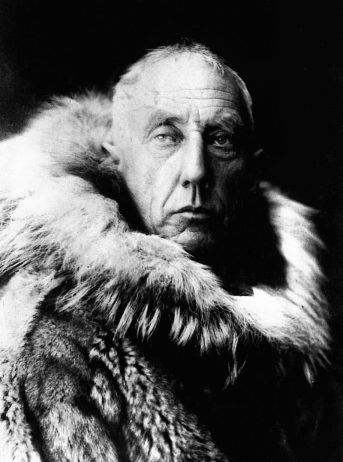
As long as he could remember, Roald Amundsen wanted to be an explorer. As a boy in Norway, he would read about the doomed Franklin Expedition to the Arctic, in 1848. As a sixteen-year-old, Amundsen was captivated by Fridtjof Nansen’s epic crossing of Greenland, in 1888.
The period would come to be known as the “Heroic Age” of polar exploration. Roald Amundsen was born to take part.
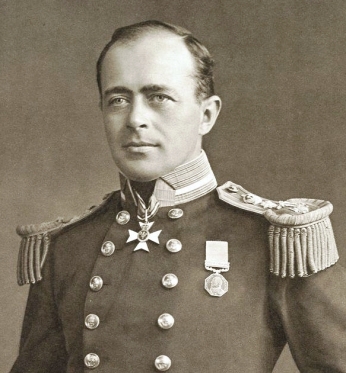
Not so, Robert Falcon Scott. A career officer with the British Royal Navy, Scott would take a different path to this story.
Clements Markham, President of the British Royal Geographical Society (RGS), was known to “collect” promising young naval officers with an eye toward future polar exploration. The two first met on March 1, 1887, when the eighteen-year old midshipman’s cutter won a sailing race, across St. Kitt’s Bay.
In 1894, Scott’s father John made a disastrous mistake, selling the family brewery and investing the proceeds, badly. The elder Scott’s death of heart disease three years later brought on fresh family crisis, leaving John’s widow Hannah and her two unmarried daughters, dependent on Robert and his younger brother, Archie.
Now more than ever, Scott was eager to distinguish himself with an eye toward promotion, and the increase in income to be expected, with it.
In the Royal Navy, limited opportunities for career advancement were aggressively sought after, by any number of ambitious officers. Home on leave in 1899, Scott chanced once again to meet the now-knighted “Sir” Clements Markham, and learned of an impending RGS expedition to the Antarctic, aboard the barque-rigged auxiliary steamship, RRS Discovery.
What passed between the two went unrecorded but, a few days later, Scott showed up at the Markham residence and volunteered to lead the expedition.
The Discovery expedition of 1901-’04 was one of science as well as exploration. Despite a combined polar experience of near-zero, the fifty officers and men under Robert Falcon Scott made a number of important biological, zoological and geological findings, proving the world’s southernmost continent was at one time, forested. Though later criticized as clumsy and amateurish, a journey south in the direction of the pole discovered the polar plateau, establishing the southernmost record for this time at 82° 17′ S. Only 530 miles short of the pole.
Discovery returned in September 1904, the expedition hailed by one writer as “one of the great polar journeys”, of its time. Once an obscure naval officer, Scott now entered Edwardian society, moving among the higher social and economic circles, of the day.
A brief but stormy relationship ensued with Kathleen Bruce, a sculptress who studied under Auguste Rodin and counted among her personal friends, the likes of Pablo Picasso, Aleister Crowley and Isadora Duncan. The couple was married on September 2, 1908 and the marriage produced one child. Peter Markham Scott would grow up to found the World Wide Fund for Nature (WWF).
Kathleen Bruce Scott
The elder Scott would never live to see it.
The “Great Southern Journey” of Scott’s Discovery officer Ernest Shackleton, arrived 112 miles short of the pole on January 9, 1909, providing Scott with the impetus for a second attempt, the following year. Scott was still fundraising for the expedition when the old converted whaler Terra Nova departed Cardiff, in South Wales. Scott joined the ship in South Africa and arrived in Melbourne Australia in October, 1910.
Meanwhile, and unbeknownst to Scott, Roald Amundsen was preparing for his own drive on the south pole, aboard the sailing vessel, “Fram” (Forward).
Scott was in Melbourne when he received the telegram: “Beg leave to inform you Fram proceeding Antarctic Amundsen“. Robert Falcon Scott now faced a race to the pole.
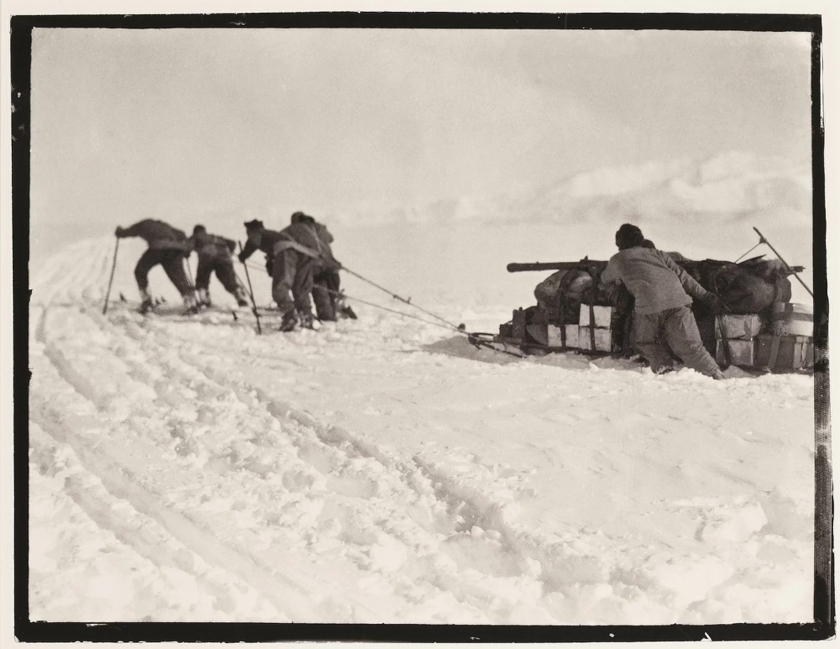
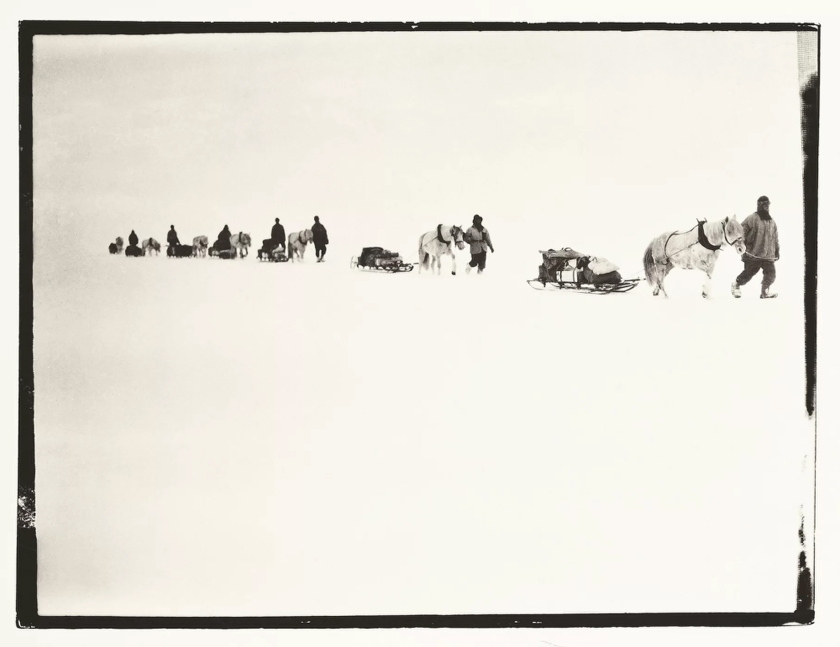
Unlike Amundsen who adopted the lighter fur-skins of the Inuit, the Scott expedition wore heavy wool clothing, depending on motorized and horse-drawn transport and man-hauling sledges for the final drive across the polar plateau. Dog teams were expected to meet them only on the way out, on March 1.
Ponies, poorly acclimatized and weakened by the wretched conditions of Antarctica, slowed the depot-laying part of the Scott expedition. Four horses died of cold or had to be shot, because they slowed the team.
Expedition member Lawrence “Titus” Oates warned Scott against the decision to locate “One-Ton Depot” at 80°, 35-miles short of the planned location. “Sir, I’m afraid you’ll come to regret not taking my advice.” Titus’ words would prove prophetic.
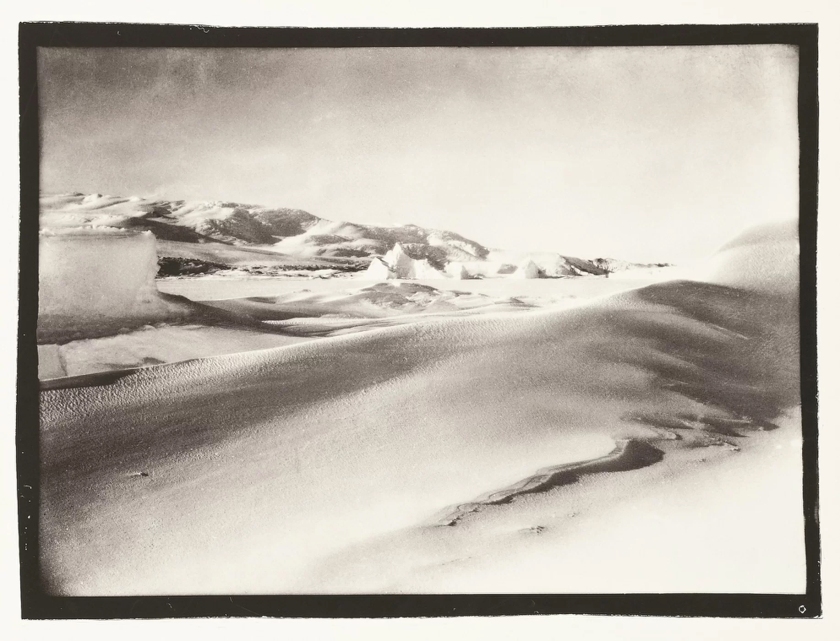
Mount Erebus, the southernmost active volcano, in the world. Robert Falcon Scott took this photograph in 1911
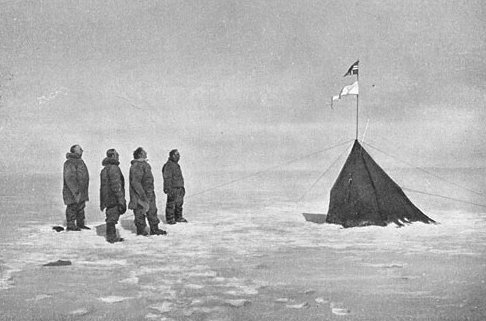
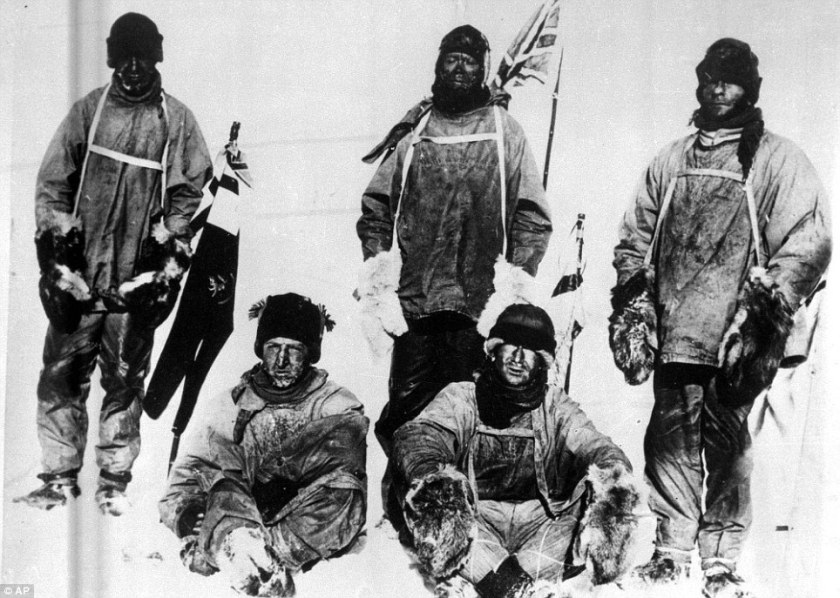
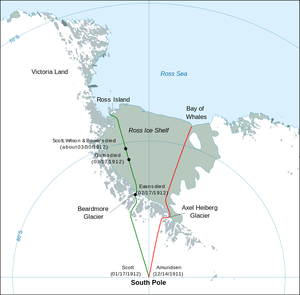
Unlike the earlier attempt, Robert Falcon Scott made it to the pole this time. Amundsen’s Norwegian team had beat him. By a mere five weeks. A century later you can still feel the man’s anguish, by the words in his diary: “The worst has happened…All the day dreams must go…Great God! This is an awful place”.
Norwegian flag at the South Pole
Utterly Defeated, the five-man Scott party turned to begin the 800-mile, frozen slog back from the Pole on January 19, 1912. By the 23rd, the condition of Petty Officer Edgar “Taff” Evans, began to deteriorate . On February 4, a bad fall on Beardmore Glacier left the man concussed, “dull and incapable”. A second fall two weeks later left the man dead at the foot of the glacier.
Defeated by only weeks, the Scott party spends a moment at the south pole, before turning for the frozen, 800-mile slog, back.
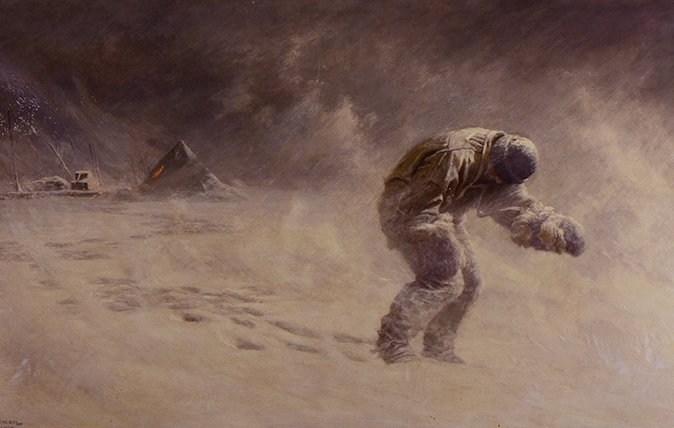
The appointed time came and went in early March and the dog teams, failed to materialize. Severely frostbitten, Lawrence Oates struggled on. Soldier, explorer, he was “No Surrender Oates”, a moniker earned years before when he refused to surrender before a superior force in the Boer Wars. In the end, it was impossible to go on.
A Very Gallant Gentleman, 1913, by John Charles Dollman (1851–1934), 70in by 40in, The Cavalry and Guards Club, London
Lawrence Oates knew he was holding up the team. There was but one option and leaving that tent, was a deliberate act. Final. Suicidal.
Let Robert Falcon Scott’s diary tells us the story, in his own words:
March 16, 1912 “He was a brave soul. This was the end. He slept through the night before last, hoping not to wake; but he woke in the morning – yesterday. It was blowing a blizzard. He said, ‘I am just going outside and may be some time.’ He went out into the blizzard and we have not seen him since.”
His body was never found.
The last three made final camp on March 19, with 11 miles to go before the next food and supply cache. A howling blizzard descended on the tents and lasted for days as Scott, Henry “Birdie” Bowers and Dr. Edward Wilson wrote good-bye letters to mothers, wives, and others.
March 22, 1912 “Blizzard bad as ever. Wilson and Bowers unable to start. Tomorrow last chance. No fuel and only one or two of food left — must be near the end. Have decided it shall be natural. We shall march for the depot with or without our effects and die in our tracks.”
Starving, frostbitten, Robert Falcon Scott wrote to his diary during the final hours of his life.
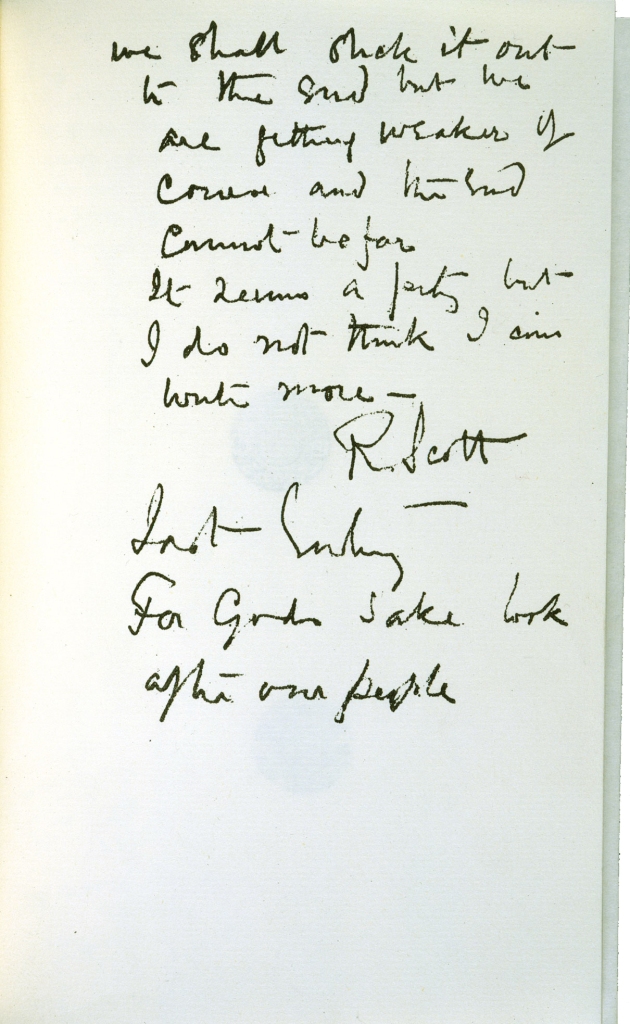
March 29, 1912 “We had fuel to make two cups of tea apiece and bare food for two days on the 20th. Every day we have been ready to start for our depot 11 miles away, but outside the door of the tent it remains a scene of whirling drift. I do not think we can hope for any better things now. We shall stick it out to the end, but we are getting weaker, of course, and the end cannot be far.
It seems a pity, but I do not think I can write more.
R. SCOTT.
The frozen corpses of Robert Falcon Scott and his comrades were found on November 12, 1912. You can almost feel his frozen, dying fingers writing final words on that final page:
“Last entry. For God’s sake look after our people”.
Meteorological conditions for those last days in the Scott camp went unrecorded, and must only be imagined. The lowest ground level temperature ever recorded was measured in 1983, at the Soviet Vostok Antarctic Station: −128.6° Fahrenheit.
There are places in this world no human was meant to go. Places so inhospitable, so savage, the visitor is lucky to get out alive. Where returning with the body of one not so lucky, is not possible. The frozen side of Everest is such a place where no fewer than 300 climbers have perished in the last six decades. A third of those will spend eternity on the frozen slopes where they perished.
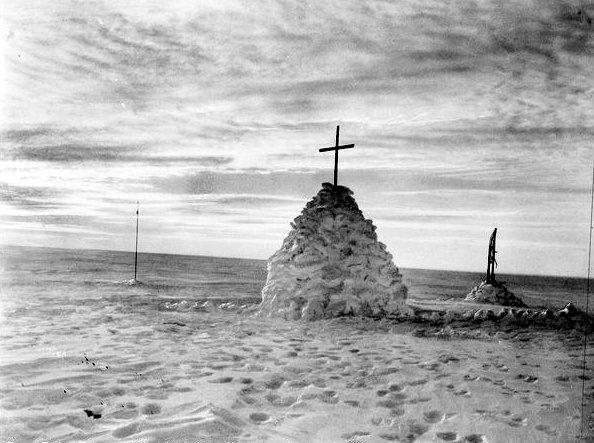
The final camp of the Scott expedition is such a place. A high cairn of snow was erected over it all, that final camp becoming the three men’s tomb. Ship’s carpenters built a wooden cross, inscribing on it the names of those lost: Scott, Edward Wilson, Henry Bowers, Lawrence Oates and Edgar Evans. A line from Alfred Lord Tennyson’s poem, Ulysses, was carved into the cross:
“To strive, to seek, to find, and not to yield”.
The grave of the southern party
If only they had made it that next eleven miles.
Amundsen said on hearing the fate of his rival, “I would gladly forgo any honor or money if thereby I could have saved Scott his terrible death”.
A continental glacier or “ice sheet” covers a minimum of 50,000 square kilometers (19,000 square miles). Today there are two, Greenland and Antarctica , comprising some 99% of the planet’s fresh water supply. (Hat tip National Geographic).
An ice sheet is anything but the stable mass it first appears. Annual snowfall and cycles of freezing and partial thaw converts surface snow into a dense, grainy snow called “firn”, as the weight of new snowfall compresses that of earlier years, into the glacier. Firn layers compress ever downward with each fall of snow, forming a solid ice mass at a depth of 50 meters.
Taken as a whole, the ice sheet behaves as a fluid. Driven by its own weight, the mass spreads ever outward, in places moving as fast as .7 miles in a year.
So it is that, more than a century later, the last camp of the southern party now lies deep within the heart of the glacier. Pressed ever downward, their corpses are now some 75 deep in the Ross Ice Shelf and inching their way outward, toward the sea.
One day in a distant future none alive today will ever see, the Scott party will break off and float away at the heart of some nameless iceberg
In an alternate history, the June 1914 assassinationof the heir-apparent to the Habsburg Empire may have led to nothing more, than a regional squabble. Wiser heads could have prevailed, the diplomatic crisis of July resulting in nothing more than a policing action in the Balkans.
As it was, mutual distrust and entangling alliances combined with slavish obedience to mobilization timetables, to draw the Great Powers of Europe into the vortex. On August 3, the “War to End All Wars” exploded across the European continent.
Many of the soldiers who went off to war in those days, viewed the conflict as some kind of grand adventure. Many of them sang patriotic songs as the young men and boys of Russia, Germany, Austria and France stole last kisses from wives and sweethearts, and boarded their ships and trains.
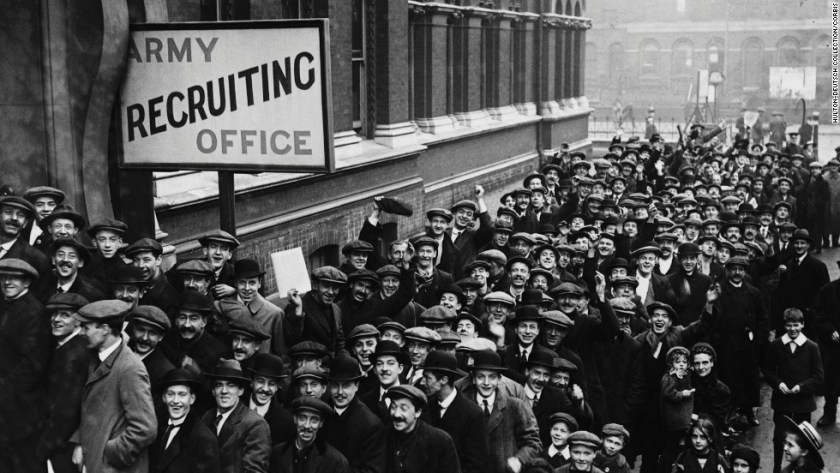
Believing overwhelming manpower to be the key to victory, British Secretary of State for War Lord Horatio Kitchener recruited friends and neighbors by the tens of thousands into “Pal’s Battalions”, to fight for King and country.
The signs could have been written in any number of languages, in the early phase of the war
Over the next four years a generation would be chewed up and spit out, in pieces.
Many single day’s fighting of the great battles of 1916 produced more casualties than every European war of the preceding 100 years, civilian and military, combined.
6,503 Americans lost their lives during the savage, month-long battle for Iwo Jima, in 1945. The first day’s fighting during the 1916 Battle of the Somme killed three times that number on the British and Commonwealth side, alone.
Over 1.5 million shells were fired in the days leading to the battle of the Somme
Over 16 million were killed and another 20 million wounded while vast stretches of the European countryside were literally, torn to pieces. Tens of thousands remain missing, to this day.
Had you found yourself in the mud and the blood, the rats and the lice of the trenches during the New Year of 1917-’18, you could have heard a plaintive refrain drifting across the barbed wire and frozen wastes of no man’s land, sung to the tune of “Auld Lang Syne”.
We’re here, because we’re here, because we’re here, because we’re here, we’re here, because we’re here, because we’re here, because we’re here.
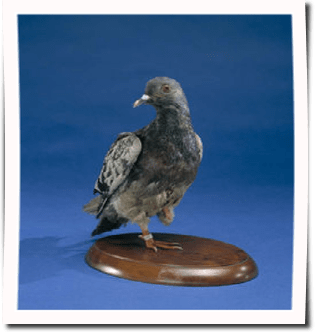
Cher Ami
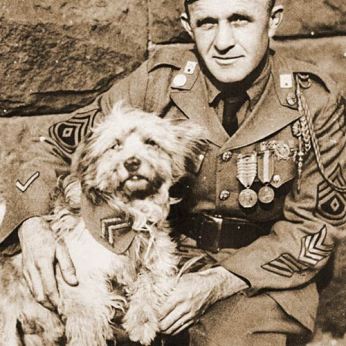
Those who fought the “Great War”, were not always human. The carrier pigeon Cher Ami escaped a hail of bullets and returned twenty-five miles to her coop despite a sucking chest wound, the loss of an eye and a leg that hung on, by a single tendon. The message she’d been given to carry, saved the lives of 190 men.
“Warrior” was the thoroughbred mount to General “Galloper” Jack Seely, arriving in August 1914 and serving four years “over there”. “The horse the Germans can’t kill” survived snipers, poison gas and shellfire to be twice buried alive in great explosions, only to return home to the Isle of Wight, and live to the ripe old age of 33.
First division Rags
“First Division Rags” ran through a torrent of shells, gassed and blinded in one eye, a shell fragment damaging his front paw, yet still, he got his message through.
Jackiethe baboon lost a leg during heavy bombardment from German guns while frantically building a protective rock wall to shelter himself from what the German soldier Ernst Jünger later called, the “Storm of Steel”.
Tirpitz the German pig jumped clear of the sinking light cruiser SMS Dresden and would serve out the war not in a frying pan but as mascot to the HMS Glasgow.
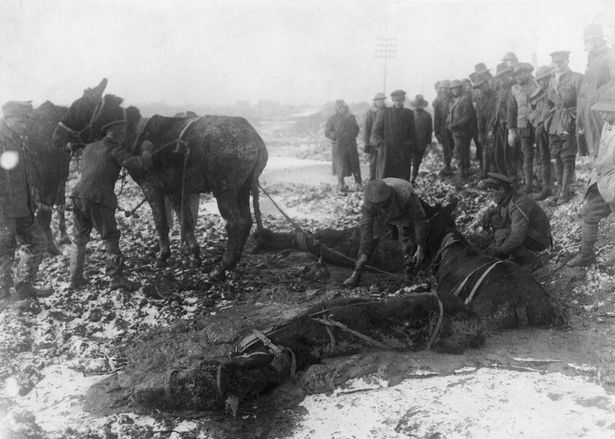
Sixteen million animals served on all sides and in all theaters of WW1: from cats to canaries, to pigeons and mules, camels, donkeys and dogs. As “dumb animals”, none were given the choice to “volunteer”. And yet serve they did, some nine million animals making the supreme sacrifice.
British Army mules in the mud of the western front, 1918
In the end, starvation and malnutrition stalked the land at home as well as the front with riots at home and mutiny, in the trenches. The Russian Empire of the Czars had collapsed into a Bolshevik hellhole, never to return. Nearly every combatant saw the disintegration of its domestic economy, or teetering on the brink.
A strange bugle call came out of the night of November 7, 1918. French soldiers of the 171st Régiment d’Infanterie, stationed near Haudroy, advanced into the fog and the darkness, expecting that they were about to be attacked. Instead, they were shocked to see the apparitions of three sedans, their sides displaying the German Imperial Eagle.
Imperial Germany, its army disintegrating in the field and threatened with revolution at home had sent a peace delegation, headed by the 43-year-old politician Matthias Erzberger.
The delegation was escorted to the Compiegne Forest near Paris, to a conference room fashioned from a railroad dining car. There they were met by a delegation headed by Ferdinand Foch, Marshall of France.
Adolf Hitler would gleefully accept French surrender in the same rail car, some twenty-two years later.
The German delegation was shocked at the words that came out of Foch’s mouth. ‘Ask these gentlemen what they want,’ he said to his interpreter. Stunned, Erzberger responded. The Germans believed they were there to discuss terms of an armistice. Foch dropped the hammer: “Tell these gentlemen that I have no proposals to make”.
Ferdinand Foch had seen his country destroyed by war. He had vowed “to pursue the Feldgrauen (Field Grays) with a sword at their backs”. He had no intention of letting up.
Marshall Foch now produced a list of thirty-four demands, each one a sledgehammer blow on the German delegation. Germany was to divest herself of all means of self-defense, from her high seas fleet to the last machine gun. She was to withdraw from all lands occupied since 1870. With the German population at home facing starvation, the allies were to confiscate 5,000 locomotives, 150,000 rail cars and 5,000 trucks.
With 2,250 dying every day on the Western Front, Foch informed Erzberger he had 72 hours in which to respond. “For God’s sake, Monsieur le Marechal”, responded the German, “do not wait for those 72 hours. Stop the hostilities this very day”. Even so, the plea fell on deaf ears. Fighting would continue until the last minute, of the last day.
The German King, Kaiser Wilhelm, abdicated on the 10th as riots broke out in the streets of Germany. The final surrender was signed at 5:10am on November 11 and back-timed to 5:00am Paris time, scheduled to go into effect later that morning. The 11th hour, of the 11th day, of the 11th month.
The order went out to that effect. The war would be over in hours, but there were no other instructions.
Some field commanders ordered their men to stand down. Why fight and die over ground they could walk over in just a few hours?
The last six hours
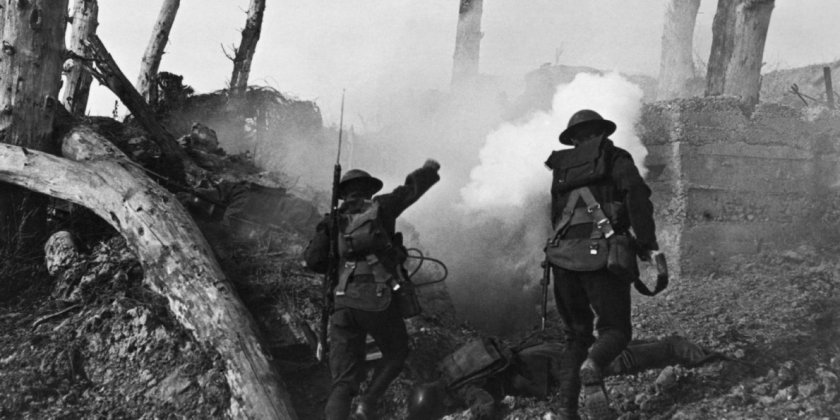
Many continued the attack, believing that Germany had to be well and truly beaten. Others saw their last chance at glory or promotion. An artillery captain named Harry S Truman, kept his battery firing until only minutes before 11:00.
English teacher turned Major General Charles Summerall had a fondness for the turn of phrase. Ordering his subordinates across the Meuse River in those final hours, Summerall said “We are swinging the door by its hinges. It has got to move…Get into action and get across. I don’t expect to see any of you again…”
No fewer than 320 Americans were killed in those final six hours, another 3,240 seriously wounded.
Still smarting from the disastrous defeat at Mons back in 1914, British High Command was determined to take the place back, on the final day of the war. The British Empire lost more than 2,400 in those last 6 hours.
The French 80th Régiment d’Infanterie received two orders that morning – to launch an attack at 9:00, and cease-fire at 11:00. French losses for the final day amounted to 1,170. The already retreating Germans suffered 4,120.
One-hundred-five years ago today, all sides suffered over 11,000 dead, wounded, and missing in those final six hours. Some have estimated that more men died per hour after the signing of the armistice, than during the D-Day invasion, 26 years later.
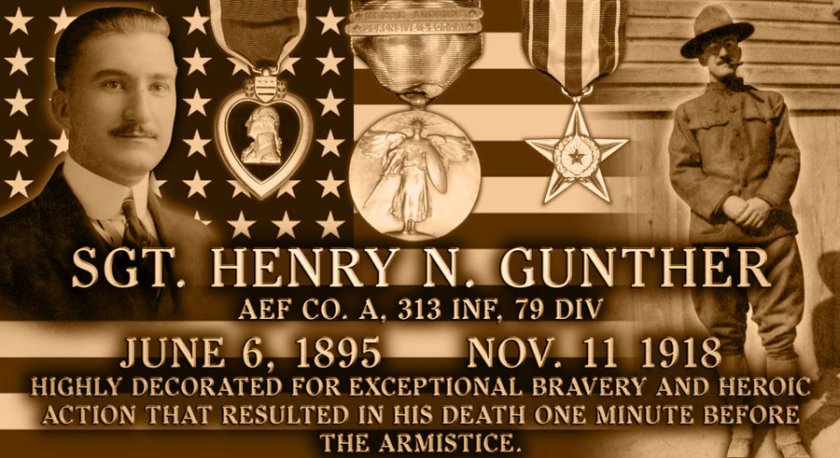
Over in the Meuse-Argonne sector, Henry Gunther was “visibly angry”. Perhaps this American grandson of German immigrants felt he had something to prove. Anti-German bias had not reached levels of the next war, when President Roosevelt interned Americans of Japanese descent. Yet, such bias was very real. Gunther’s fiancé had already broken up with him. He’d recently been busted in rank, after writing home complaining about conditions at the front.
Bayonet fixed, Gunther charged the enemy machine gun position, as German soldiers frantically waved and yelled for him, to go back. He got off a “shot or two”, before the five round burst tore into his head. Henry Nicholas John Gunther of Baltimore Maryland was the last man to die in combat, in the Great War. It was 10:59am. The war would be over, in sixty seconds.
After eight months on the front lines Corporal Joe Rodier of Worcester Massachusetts, was jubilant. “Another day of days“. Rodier wrote in his diary. “Armistice signed with Germany to take effect at 11 a.m. this date. Great manifestations. Town lighted up at night. Everybody drunk, even to the dog. Moonlight, cool night & not a shot heard“.
Matthias Erzberger was assassinated in 1921, for his role in the surrender. The “Stab in the Back” mythology destined to become Nazi propaganda, had already begun.
AEF Commander General John “Black Jack” Pershing believed the armistice to be a grave error. He believed that Germany had been defeated but not beaten, and that failure to smash the German homeland meant that the war would have to be fought, all over again. Ferdinand Foch agreed. On reading the Versailles treaty in 1919, Foch remarked “This isn’t peace! This is a truce that will last for 20 years”.
The man got it wrong, by 36 days.
Afterward
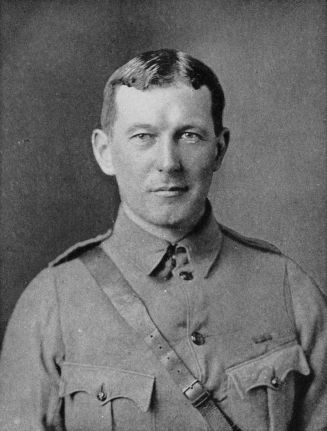
Dr. John McCrae
John McCrae was a physician and amateur poet from Guelph, Ontario. Following the outbreak of the “Great War” in 1914, he enlisted in the Canadian Expeditionary Force at the age of 41.
Based on his age and training, Dr. McCrae could have joined the medical corps, but volunteered instead to join a fighting unit as gunner and medical officer.
McCrae had previously served in the Boer War. This was to be his second tour of duty in the Canadian military.
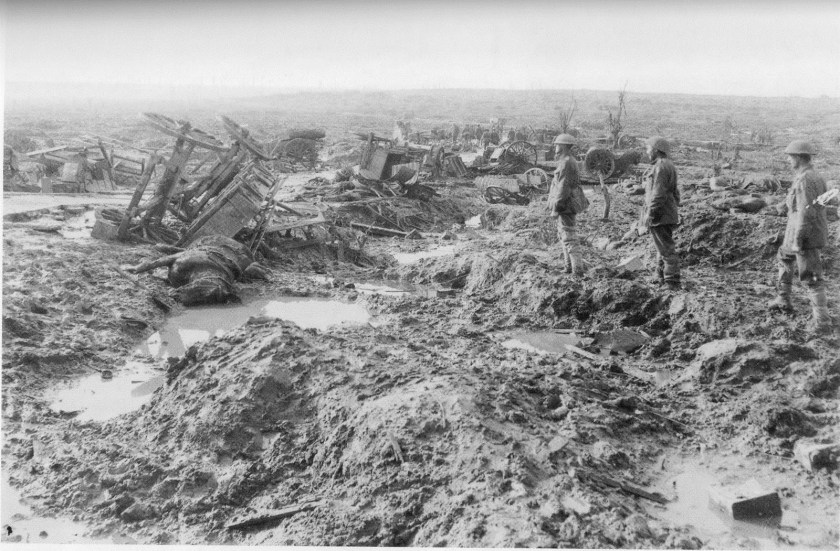
Dr. McCrae fought in one of the most horrendous battles of the Great War, the second battle of Ypres, in the Flanders region of Belgium. Imperial Germany launched the first mass chemical attack in history at Ypres, attacking the Canadian position with chlorine gas on April 22, 1915. The Canadian line was broken but quickly reformed in an apocalyptic bloodletting lasting more than two full weeks.
Dr. McCrae later described the ordeal, in a letter to his mother:
“For seventeen days and seventeen nights”, he wrote, “none of us have had our clothes off, nor our boots even, except occasionally. In all that time while I was awake, gunfire and rifle fire never ceased for sixty seconds … and behind it all was the constant background of the sights of the dead, the wounded, the maimed, and a terrible anxiety lest the line should give way”.
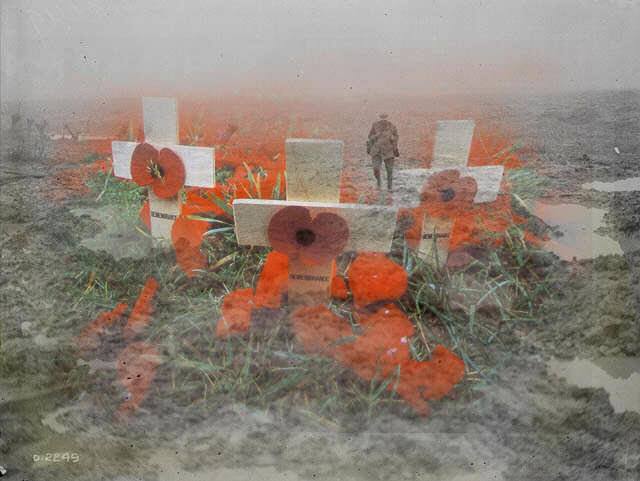
Stop and imagine for a moment please, what this looked like, what this horror smelled like, in color.
Dr. McCrae presided over the funeral of friend on May 3, fellow soldier Alexis Helmer, who had died in the battle. McCrae performed the burial service himself when he noted how quickly the red poppies grew on the graves of the fallen. Sitting in the back of a medical field ambulance just north of Ypres, he composed this poem, the following day. He called the verse, “We Shall Not Sleep”.
Today we remember Dr. McCrae’s work as:
In Flanders Fields
In Flanders fields the poppies blow Between the crosses, row on row, That mark our place; and in the sky The larks, still bravely singing, fly Scarce heard amid the guns below.
We are the Dead. Short days ago We lived, felt dawn, saw sunset glow, Loved and were loved, and now we lie In Flanders fields.
Take up our quarrel with the foe: To you from failing hands we throw The torch; be yours to hold it high. If ye break faith with us who die We shall not sleep, though poppies grow In Flanders fields.
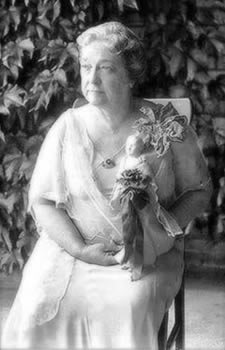
Moina Michael
Moina Belle Michael was born August 15, 1869 near Good Hope Georgia, about an hour’s drive east of Atlanta. She began teaching at age fifteen. Over a long career Michael worked in nearly every part of the Peach State’s education system.
In 1918 she was working at the YMCA Overseas War Secretaries headquarters, in New York. Browsing through the November Ladies Home Journal Moina came across Dr. McCrae’s poem. It was Saturday morning, November 9, 1918.
Two days before the armistice.
John McCrae lay in his own grave by this time, having succumbed to pneumonia while serving in the No. 3 Canadian General Hospital, in Boulogne. He was buried with full military honors at the Wimereux cemetery where his gravestone lies flat, due to the sandy, unstable soil.
Michael had seen McCrae’s poem before but it got to her this time, especially that last part:
“If ye break faith with us who die We shall not sleep, though poppies grow In Flanders fields”
Michael was so moved she made a personal pledge to “keep the faith”, vowing always to wear a red poppy, in honor of the dead. She scribbled a response, an act of remembrance on the back of a used envelope. She called this:
We Shall Keep the Faith
Oh! you who sleep in Flanders Fields, Sleep sweet – to rise anew! We caught the torch you threw And holding high, we keep the Faith With All who died.
We cherish, too, the poppy red That grows on fields where valor led; It seems to signal to the skies That blood of heroes never dies, But lends a luster to the red Of the flower that blooms above the dead In Flanders Fields.
And now the Torch and Poppy Red We wear in honor of our dead. Fear not that ye have died for naught; We’ll teach the lesson that ye wrought In Flanders Fields.
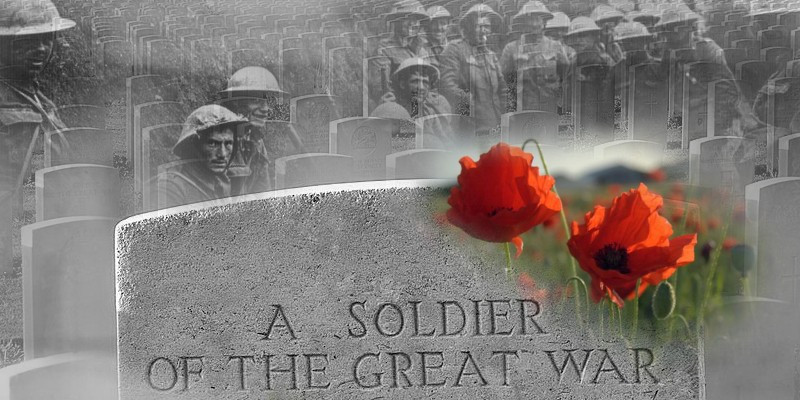
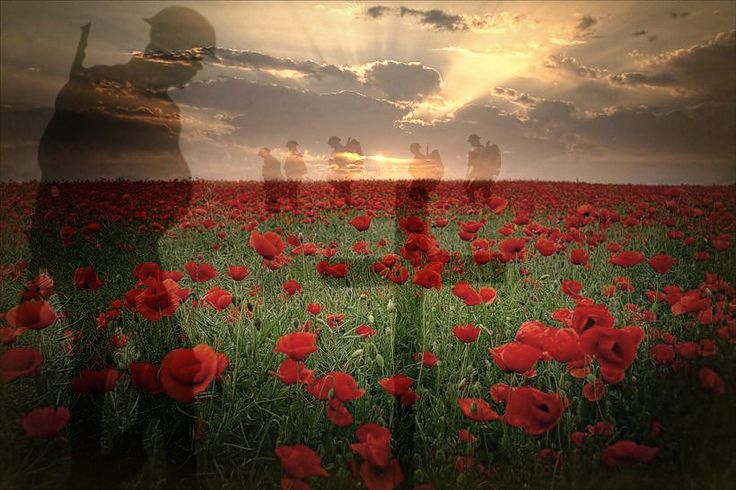
The vivid red flower blooming on the battlefields of Belgium, France and Gallipoli came to symbolize the staggering loss of life brought about by the Great War, the “War to End all Wars”. Before they had numbers, this was a war where the death toll from many single day’s fighting exceeded that of every war of the preceding century, military and civilian, combined.
A century and more has come and gone since the events related in this story. The red poppy is now an internationally recognized symbol of remembrance, lest we neglect to remember the lives lost in All wars. I keep one Always, pinned to the visor in my car. A reminder of where we come from, the prices paid to bring us to this place and to always keep the faith, with those who have come before.































 Historical Easter Eggs - Today in History
You must be logged in to post a comment.