

There are a handful of men who were indispensable to the American Revolution, men without whom the war effort would have been doomed to fail.
One, of course is George Washington, who became commander in chief before he had an army. Before he even had a country. Knowing full well that the penalty for high treason against the British Crown was death, Washington took command of an army with enough powder for an average 9 rounds per man, in a contest against the most powerful military of its time.
Another indispensable man has to be Benjamin Franklin, whose diplomatic skills and unassuming charm all but single-handedly turned France into an indispensable ally.
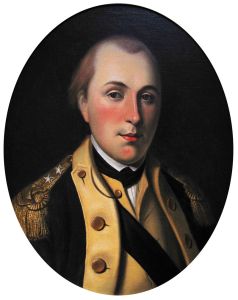 A third would arguably be Marie-Joseph Paul Yves Roch Gilbert du Motier, better known as the Marquis de Lafayette.
Lafayette was all of nineteen when he landed on North Island South Carolina on June 13, 1777.
The French King had forbidden his coming to America, fearing his capture by British agents. Lafayette wanted none of it. His own father, also the Marquis de Lafayette, was killed fighting the British when the boy was only two. The man was determined to take part in this contest, even if he had to defy his King to do so. Lafayette disguised himself on departure, and purchased the entire ship’s cargo, rather than landing in Barbados and thus exposing himself to capture.
Franklin had written to Washington asking him to take on Lafayette, in hopes that it would secure an increase in French aid to the American war effort. The two men bonded almost immediately, forming a relationship that closely resembled that of father and son. The fatherless young French officer, and the father of his country who went to his grave, childless.

Lafayette wrote home to his wife Marie Adrienne in 1778, from Valley Forge. “In the place he occupies, he is surrounded by flatterers and secret enemies. He finds in me a trustworthy friend in whom he can confide and who will always tell him the truth. Not a day goes by without his talking to me at length or writing long letters to me. And he is willing to consult me on most interesting points.”
Lafayette served without pay, spending the equivalent of $200,000 of his own money for the salaries and uniforms of staff, aides and junior officers. He participated in several Revolutionary War battles, being shot in the leg at Brandywine, going on to serve at Barren Hill, Monmouth Courthouse, Rhode Island, and the final siege at Yorktown. All the while, Lafayette periodically returned to France to work with Franklin in securing thousands of additional troops and several warships to aid in the war effort.
Adrienne gave birth to their first child on one such visit, a boy they named Georges Washington Lafayette.
It was a small force under Lafayette that took a position on Malvern Hill in 1781, hemming in much larger British forces under Lord Cornwallis at the Yorktown peninsula.

The trap was sprung that September with the arrival of the main French and American armies under Marshal Jean-Baptiste Donatien de Vimeur, comte de Rochambeau & General George Washington, and the French fleet’s arrival in the Chesapeake under Lieutenant Général des Armées Navales François-Joseph Paul, comte de Grasse.
Cornwallis surrendered on October 19, 1781, after which Lafayette returned to France.
The Marquis played an important role in his own country’s revolution, becoming a Commander of the French National Guard. When the Bastille was stormed by an angry mob in 1789, Lafayette was handed the key.
Lafayette sent the key to the Bastille to George Washington, as a “token of victory by Liberty over Despotism”. Today that key hangs in the main hallway at Washington’s mansion at Mount Vernon.
There came a time when the French Revolution morphed into the Reign of Terror, and began to eat its young. The Marquis de Lafayette was captured by Austria in 1792 and imprisoned under verminous conditions, while his wife was taken into custody by the French Republic.
 Secretary of State Thomas Jefferson found a loophole that allowed Lafayette to be paid, with interest, for his services in the late Revolution. An act was rushed through Congress and signed by President Washington, the resulting funds allowing both Lafayettes some of the few privileges permitted them, during their five years’ captivity.
Georges Washington Lafayette was smuggled to America out of France in 1795, while his father was held prisoner. Adrienne was released after four, and persuaded Emperor Francis to permit her and her two daughters to join her husband in prison. After a brutal year in solitary confinement, Lafeyette’s cell door opened on October 15, 1795. He must have been astonished to see his wife and daughters walk in. The four would spend his last year in captivity, together.
Adrienne died on Christmas day, 1807. She had slipped into delirium the night before, her final words spoken to her husband: “Je suis toute à vous“. I am all yours.
Lafayette remained staunchly opposed to both the Napoleonic regime and the restoration of the Bourbon dynasty, feeling that both had come to power by undemocratic means.

In 1824, President James Monroe and Congress invited Lafayette to visit the United States, for the nation’s upcoming 50th birthday. Crowds of cheering citizens greeted the French Marquis and his son Georges Washington on their return to Boston, Philadelphia and New York.
Harlow Giles Unger wrote in his 2003 book Lafayette, “It was a mystical experience they would relate to their heirs through generations to come. Lafayette had materialized from a distant age, the last leader and hero at the nation’s defining moment. They knew they and the world would never see his kind again.”
Marie-Joseph Paul Yves Roch Gilbert du Motier died in Paris on May 20, 1834, and was buried next to his wife at the Picpus Cemetery. He was seventy-six. President Andrew Jackson ordered that he be accorded the same funeral honors which President John Adams had bestowed on George Washington himself, in 1799. John Quincy Adams delivered a three-hour eulogy in Congress, saying “The name of Lafayette shall stand enrolled upon the annals of our race high on the list of the pure and disinterested benefactors of mankind.”
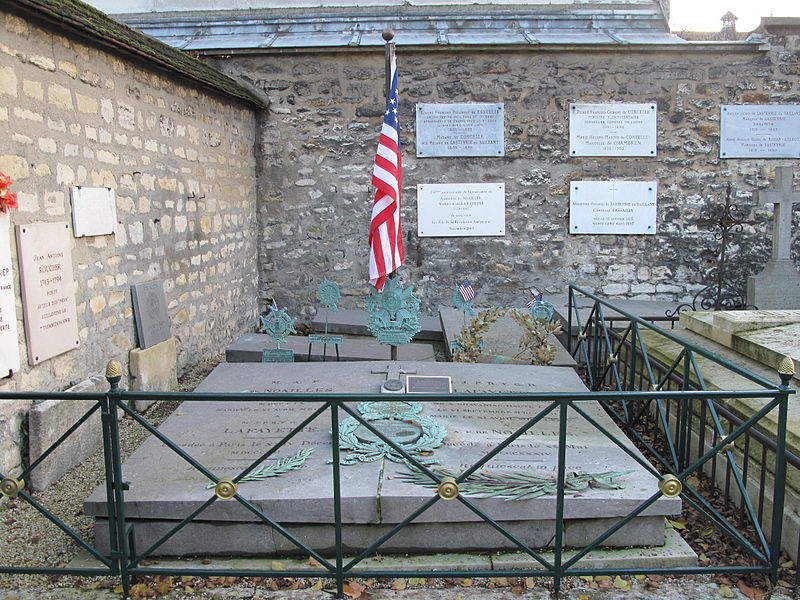
In obedience to his one of his last wishes, several feet of earth were dug up from Bunker Hill, and shipped to France. The man had always wanted to be buried under American soil.

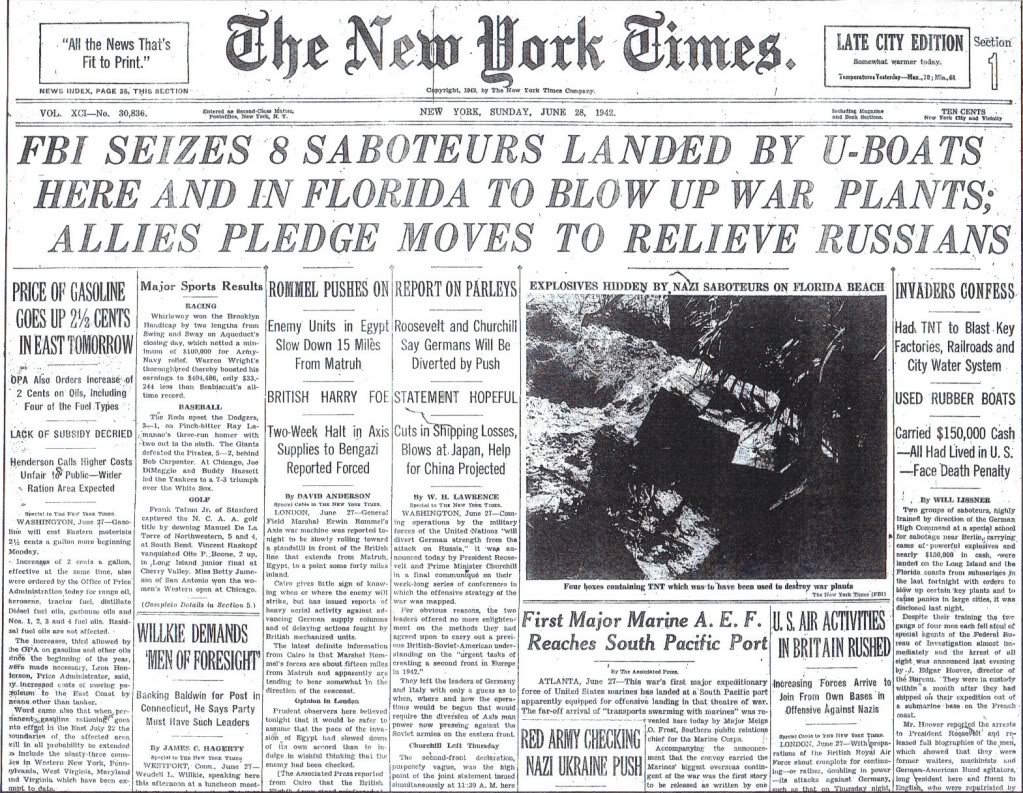




 It was D+4 in the invasion of


 Several measures were taken in the 1760’s to collect these revenues. In one 12-month period, Parliament passed the Stamp Act, the Quartering Act, and the Declaratory Act, and deputized the Royal Navy’s Sea Officers to help enforce customs laws in colonial ports.
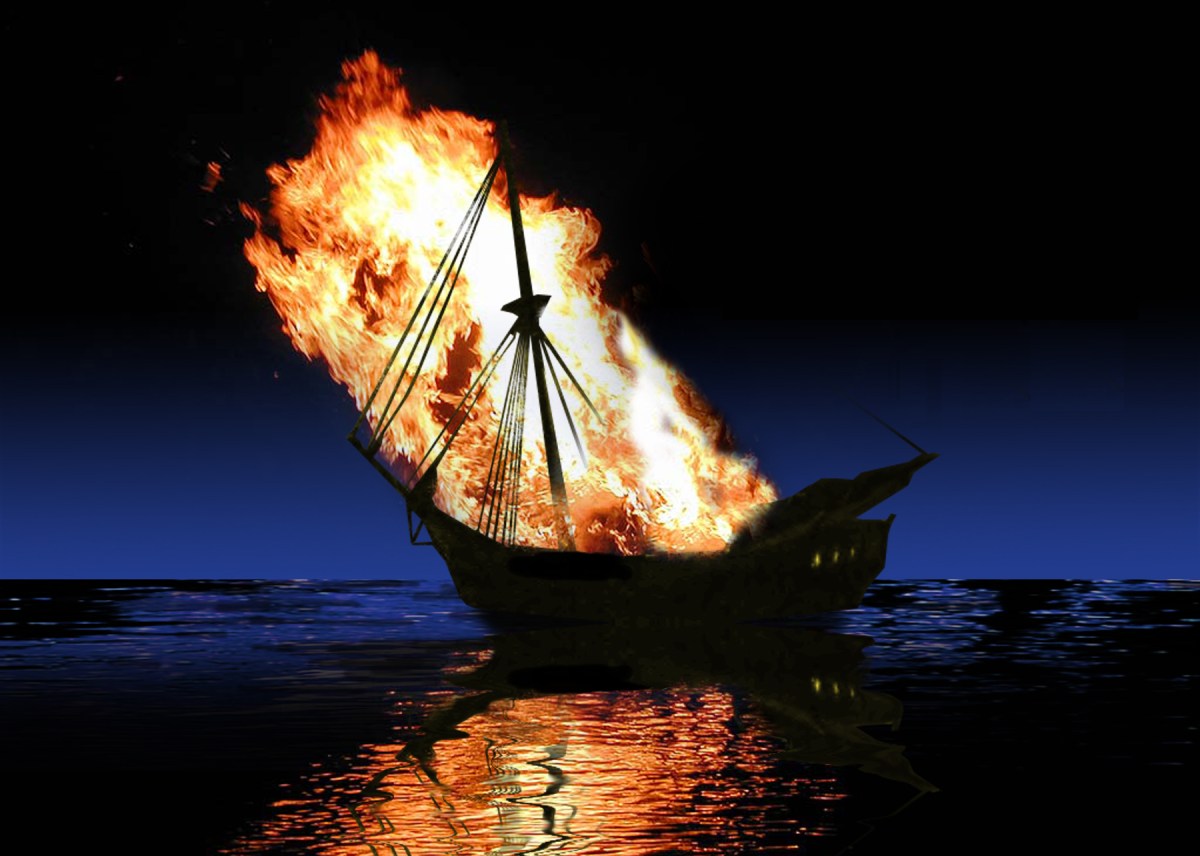
 A few days later, a visiting minister in Boston, John Allen, used the Gaspée incident in a 2nd Baptist Church sermon. His sermon was printed seven times in four colonial cities, one of the most widely read pamphlets in Colonial British America.
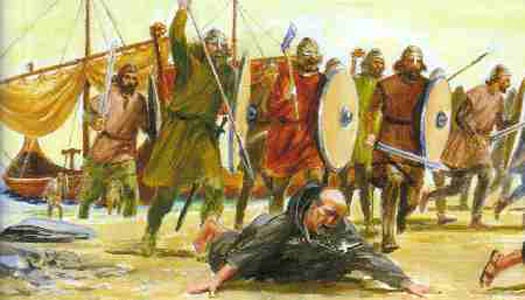
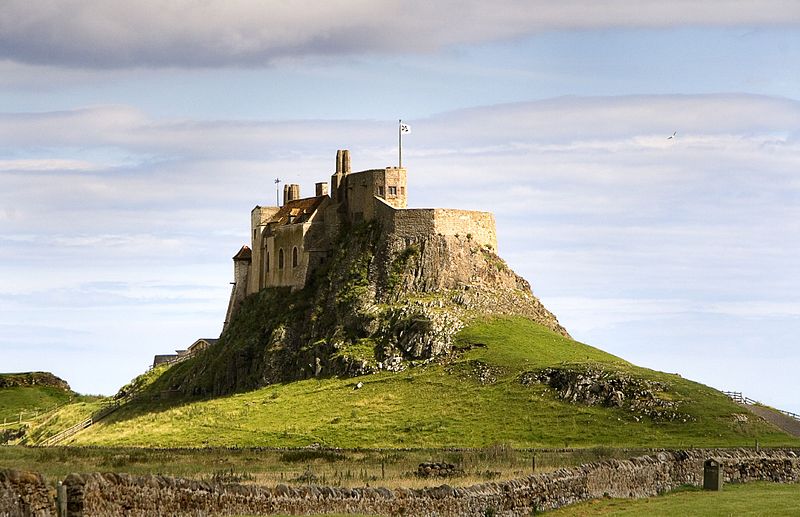
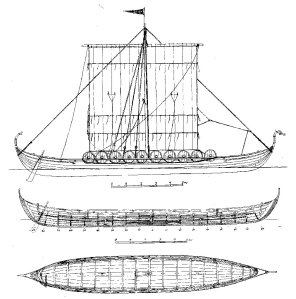 Any question you had as to their purpose would have been immediately answered, as these strangers sprinted up the beach and chased down everyone in sight. These they murdered with axe or spear, or dragged them down to the ocean and drowned them. Most of the island’s inhabitants were dead when it was over, or taken off to the ships to be sold into slavery. All of those precious objects were bagged, and tossed into the boats.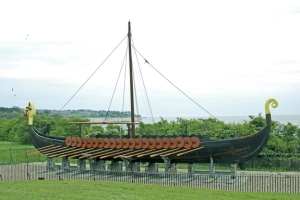
 Viking travel was not all done with murderous intent; they are well known for colonizing westward as they farmed Iceland and possibly North America.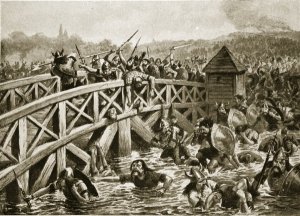


 Fenians invaded Canada no fewer than five times between 1866 and 1871. The idea was to bring pressure on Britain to withdraw from Ireland, so these attacks were directed toward British army forts, customs posts and other targets in Canada.


 It was impossible to assemble the pieces of such a massive undertaking in secret, so an elaborate ruse called “Operation Fortitude” was launched to divert attention from the real objective. Fake field armies were assembled in Edinburgh, Scotland and the south coast of England, threatening attack on the coasts of Norway and the Pas de Calais. The real General George S. Patton was put in charge of the fake First US Army Group (FUSAG). The allied “Twenty Committee”, represented by its roman numerals “XX”, controlled a network of double agents, making the deception so complete that Hitler personally withheld critical reinforcements until long after they would have made a difference. It’s where we get the term “Double Cross”.


 Most of the political and military establishment lined up against Dreyfus, but the public outcry became furious after writer Émile Zola published his vehement open letter “J’accuse” (I accuse) in the Paris press in January 1898.


 So it was that a vacation cruise to freedom became the “Voyage of the Damned”. MS St. Louis returned to Europe. Captain Schröder negotiated and schemed to find safe haven for his 907 passengers. Anything but return them to Nazi Germany. At one point, Schröder contemplated intentionally running aground off the coast of England. In the end, they all found refuge in Europe. 288 passengers were admitted by Great Britain, and 224 by France. 214 were accepted into Belgium and another 181 by the Netherlands.
 Historical Easter Eggs - Today in History
You must be logged in to post a comment.