239 years ago today this Republic to which we owe so much, was about to die before it was born. All but for one magnificent man with an actor’s sense of timing. And a new pair of spectacles.
While no one knew it at that time, Lord Cornwallis’ October 1781 surrender at Yorktown effectively brought the great rebellion, to an end. Eight years after the “shot heard round the world“, the American Revolution had now ground to a standoff.
King George III remained personally in favor of prosecuting the war even after the Patriot victory at Yorktown while opinion in Parliament, was split. Across the water, some 26,000 British troops remained in occupation in Charleston, Savannah and New York and backed up, be a mighty fleet of warships.
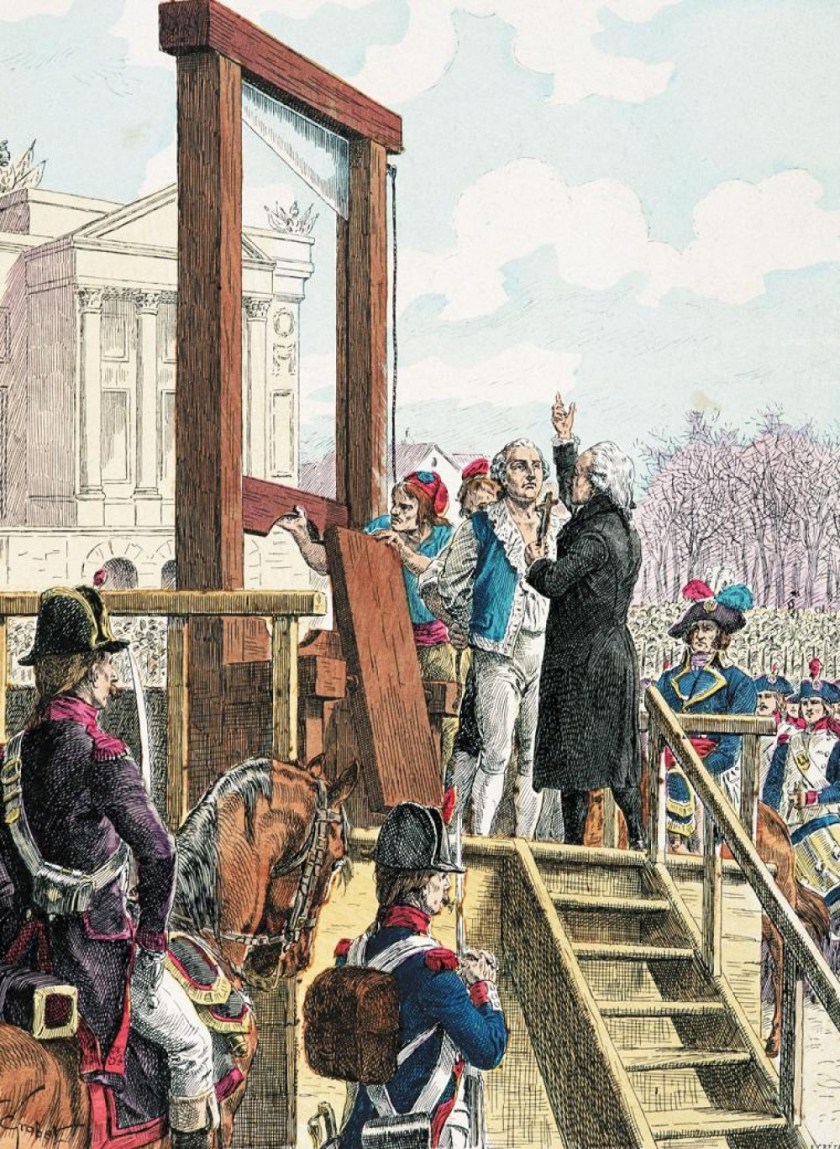
The Americans’ greatest ally departed in 1782, never to return. With state finances already prostrate with debt, l’Ancien régime (French: “the old order”) would be overthrown by its own revolution inside the next ten years, the French King Louis XVI and Queen Consort Marie Antoinette executed, by guillotine.
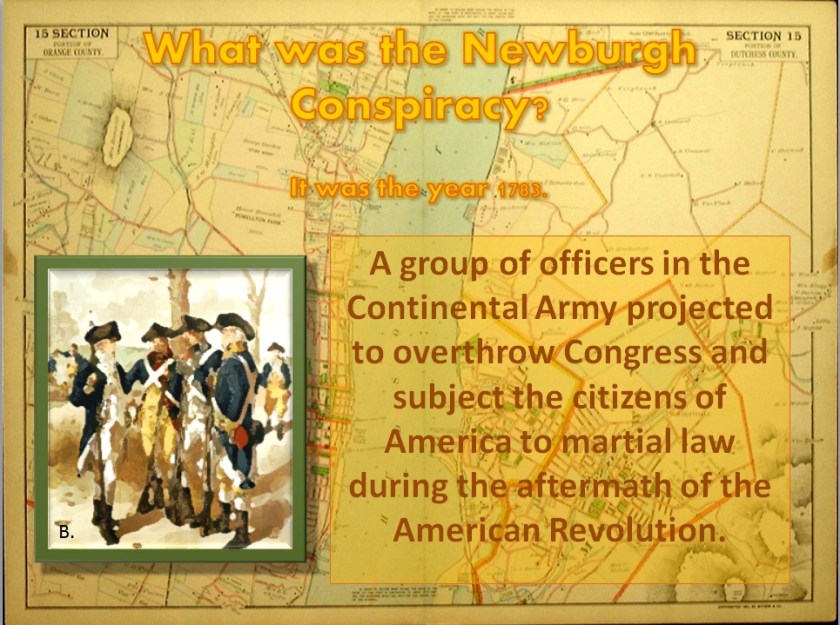
Negotiations carried on in Paris for nearly three years while, an hour’s drive north of New York by modern highway, the Continental Army waited at Newburgh.
France wasn’t the only nation ruined by this war. The American Revolution debilitated the finances of all three principle belligerents, none more so than the new-born American Republic, itself. In fact, the fledgling United States nearly died on this day in 1783, by the very hands which had given it birth.
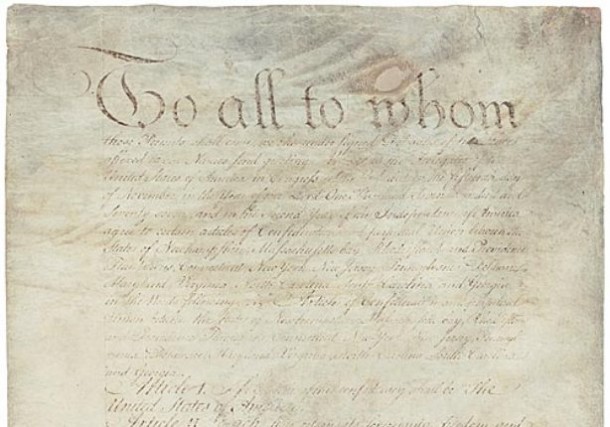
The Articles of Confederation, ratified by the states in March 1781, provided for a loose alliance of sovereign states. In theory, Congress possessed the authority to govern foreign affairs, conduct war and regulate currency. In practice, these powers were limited to a national body with no authority to enforce its own will on the states.
In 1780, Congress promised Continental officers a lifetime pension, equal to half-pay upon discharge. The government in Philadelphia attempted to amend the Articles, to allow a new import duty or “impost”. States were divided against the measure. Two years later, the cupboard was bare. Forget the bonus, Continental soldiers weren’t being paid, at all.
It wasn’t even possible to borrow. That required evidence of an income stream.
The politician who alienates a battle hardened army in the field walks on dangerous ground. Don’t pay for their services, that’s a good way to do it. At the outset of war, these guys had left homes and fields and families. They had risked their lives on behalf of the dream of Liberty, to say nothing of the hardships endured by those left at home. Many among their number had given all in service to that dream.
There was little to do but wait during those long winter months of 1782-’83. Each man concerned with his own financial hardship every man worried his promised compensation, would never come. The rumor mill worked overtime: The Army would be disbanded. Promised pensions would remain, unfunded.
The vague unease of rumor turned to a fury of near certainty through the late winter months, as one overture after another met with defeat, in Congress. On March 10, an unsigned letter believed to be written by Major John Armstrong, aide to General Horatio Gates, urged unspecified action against the Continental Congress. Another called for a meeting on the morning of the 11th. Events were inexorably building toward military insurrection.
General Washington reacted quickly, objecting in his general orders of March 11 to the “disorderly” and “irregular” nature of such a meeting. Washington specified the morning of March 15 for an officer’s meeting and requested a report implying that he himself, would be absent.
The mood was one of surprise and anger the morning of March 15, 1783, when the Commander-in-Chief himself walked into the room. Hard men had been pushed past the point of patience and were now determined, to take action. Now this.
The General urged patience in a brief and impassioned speech remembered as the Newburgh address. Washington’s words may as well have fallen on deaf ears. There was little of the usual deference in this room.
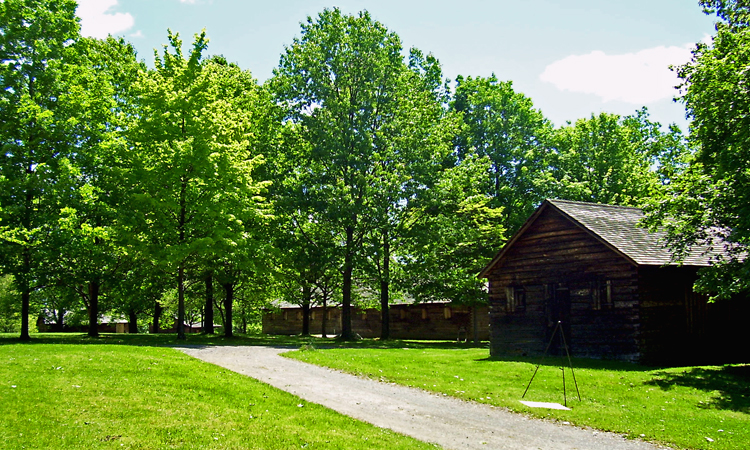
Reconstructed Temple at the New Windsor Cantonment State Historic Site, where the critical meeting took place on March 15, 1783
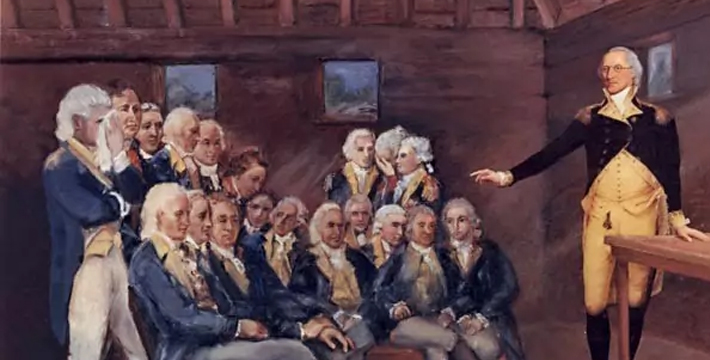
The future President of the United States then produced a letter from a member of Congress, to read to his officers. The content of the letter is unimportant. The man we remember as the father of the nation gazed at the letter in his hands, without speaking. Fumbling in his pocket, the general came up with a pair of reading glasses. This was something new. Few in the room even knew the man required glasses.
Washington spoke:
Gentlemen, you will permit me to put on my spectacles, for I have not only grown gray but almost blind in the service of my country.
The words were as a physical blow on the men assembled in that room. Obstinate and unheeding only moments earlier, the realization dawned on all at once. This man had been at their head and by their sides. General Washington had personally endured every bit of the hardship, as men now bent on mutiny.
There was hardly a dry eye in the place. The moment was broken, never to return. Bent on mutiny only moment before, the cream of the continental army now determined, to wait.
On this day 239 years ago this Republic to which we owe so much, nearly died before it was born. All but for one magnificent man with an actor’s sense of timing. And a new pair of spectacles.
A Trivial Matter
At age 26, George Washington married Martha Dandridge Custis, a widow with two children: Jacky and Patsy. The Father of the Nation never had any children of his own. At 6 feet, 3½ inches and 200-pounds, George Washington towered above the Continental soldier who stood an average 5-feet 8-inches, in height.
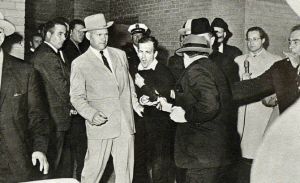
The camera captured the shock and surprise on the victim’s face, similar I’m sure to that which crossed the faces of four musicians watching it all , on TV. The shooter was the same man they had worked for just a few months earlier, at that burned out dive bar, called the Skyline lounge.
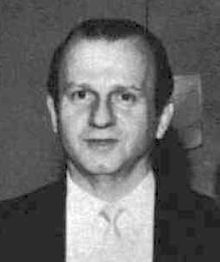
Jacob Leon Rubenstein was a troubled child, growing up on the west side of Chicago. Marked a juvenile delinquent from his earliest adolescence, Rubenstein was arrested for truancy at age 11, eventually skipping enough school to spend time at the Institute of Juvenile Research.
Many who knew Jacob Rubenstein called him “Sparky”, a nickname shared with Peanuts creator, Charles M Shulz. Any similarity between the two ended there. Some say the sobriquet came from an uncanny resemblance to “Sparkplug”, the old nag with the patchwork blanket, from the Snuffy Smith cartoon strip. Be that as it may Rubenstein hated the nickname and was quick to fight anyone who called him that. It may have been that quick temper, that made the hated name stick.
Rubinstein spent the early 40s at racetracks in Chicago and California, until being drafted into the Army Air Forces, in 1943. Honorably discharged in 1946, he returned to Chicago, before moving to Dallas the following year.
Rubenstein managed a series of seedy Dallas nightclubs and strip joints, featuring ladies like “Candy Barr” and “Chris Colt and her ’45’s”. Somewhere along the line this towering figure from the early 1960s Dallas hospitality scene shortened his name, to “Ruby”.
Ruby dabbled in all manner of underworld activities such as gambling, narcotics and prostitution. There were even rumored associations with Mafia boss Santo Trafficante. The lower crust of the Dallas police force knew Ruby was always good for free booze, prostitutes, and other favors. This was one unsavory guy.
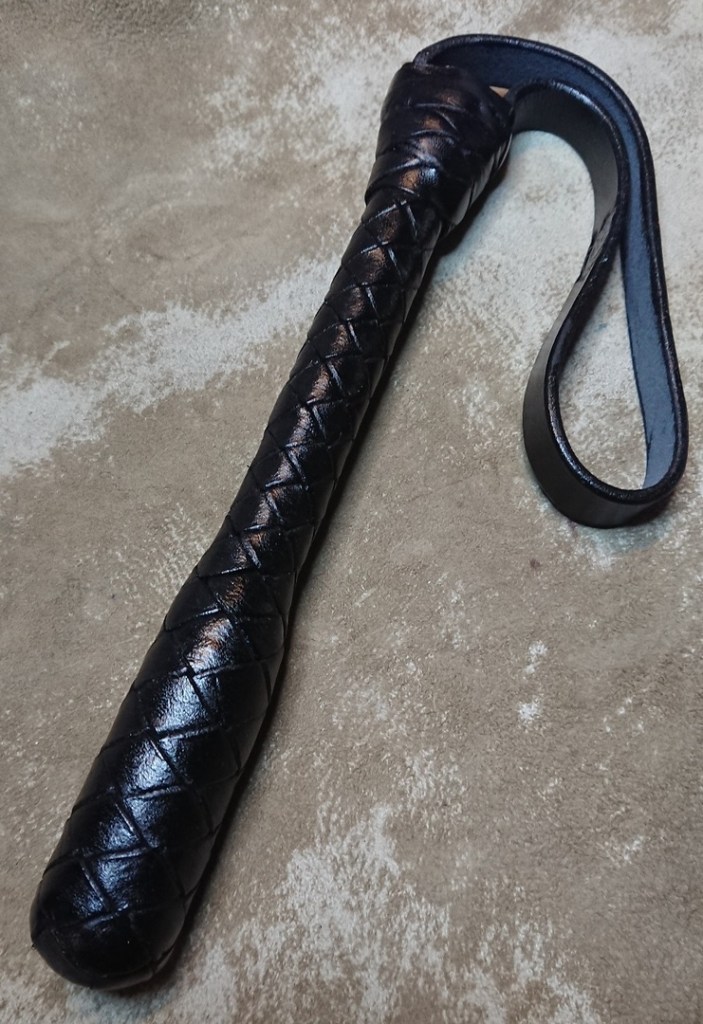
A typical blackjack
Today, you may know Rick Danko, Levon Helm, Garth Hudson and Robbie Robertson as musicians touring with Bob Dylan in 1965 who later morphed into “The Band”, and performed such rock & roll standards as “The Night they Drove Old Dixie Down”, “Up on Cripple Creek” and “The Weight”.
In early days, the joints these guys played were so rough they performed with blackjacks, hidden in special pockets sewn into their coats.
In 1963, they played a week in a Fort Worth nightclub. It was a huge venue but no one was there that first night save for two couples, a couple of drunk waiters and a one-armed go-go dancer. The band wasn’t through their first set before a fight broke out, and someone was tear-gassed. The band played on, coughing and choking with teargas wafting across the stage, faces wet with tears.
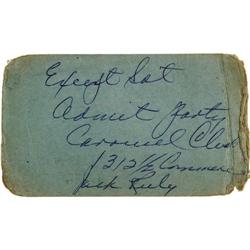
Part of the roof had either blown off this joint, or burned off, depending on which version you accept. Jack, the owner, tore off the rest of it and kept the insurance money calling this fine establishment , the “Skyline Lounge”.
Even without the roof Jack saw no need to pay for security. He told the musicians “Boys, this building ain’t exactly secure enough for you to leave your musical equipment unattended.” Band members were told they’d best stay overnight, with guns, lest anyone come over the wall. Problem solved.
Months later, the country was stunned at the first Presidential assassination in over a half-century. I was 5½ at the time and I remember it, to this day. An hour after the shooting, former marine and defector to the Soviet Union Lee Harvey Oswald killed Dallas police officer J.D. Tippit, who had stopped him for questioning. Thirty minutes later, Oswald was arrested in a movie theater.
By Sunday, November 24, Oswald was formally charged with the murders of President John F. Kennedy and Dallas police officer J. D. Tippit. He was taken to the basement of Dallas police headquarters where an armored car awaited, to transport the prisoner to a more secure county jail. It was never meant to be.
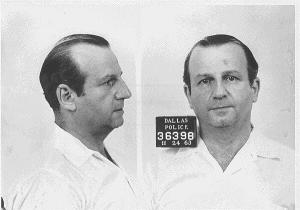
The scene was crowded with press and police. If you were alive that day you probably remember, half the country watched it on live TV. A lone man came out of the crowd and fired a single bullet from his .38 revolver into the belly of Lee Harvey Oswald.
The camera captured the shock and surprise on Oswald’s face, similar I’m sure to that which crossed the faces of four musicians watching it all, on TV. The shooter was the same man they had worked for just a few months earlier, at that burned out dive bar, called the Skyline lounge. Jack Ruby.
Oswald was transported unconscious to Parkland Memorial Hospital, the same hospital where John F. Kennedy had died, only two days earlier. He was dead in two hours.
Jack Ruby was sentenced to death in the murder of Lee Harvey Oswald, on March 14, 1964. The Texas Court of Criminal Appeals overturned the conviction in October 1966, on the grounds that the trial should have taken place in a different county from where his high profile crime had taken place.
Ruby died of lung cancer the following January, while awaiting retrial. The Warren Commission found no evidence linking Jack Ruby’s murder of Lee Harvey Oswald, to any broader conspiracy to assassinate the President.
In 1973 the Jack Ruby inspired a thoroughly forgettable band to take the same name unless that happens to be, your “thing”. Whatever became of Jacob Leon “Sparky” Rubenstein’s fine Dallas establishment will be left left to the more scandalous bits, of our imagination.
What began as a publicity stunt quickly became an overwhelming media event. 200 newspaper reporters from all over the country arrived in Dayton. Two come all the way from London. Twenty-two telegraphers sent out 165,000 words a day over thousands of miles of telegraph wires, specifically hung for the purpose.
On January 28, 1925, a measure prohibiting the teaching of evolution or denying the biblical account of the origin of man, passed the Tennesse House of Representatives, 71 to five. The Tennessee senate passed the so-called “Butler bill” named after Representative John Washington Butler on March 13, the measure signed into law that same month by Governor Austin Peay.
It was now illegal to teach the theory of evolution in Tennessee public schools, colleges and universities.
The American Civil Liberties Union (ACLU) immediately announced an intention to sue, offering to defend anyone accused of violating the act. Local businessman George Rappleyea arranged a meeting with the county superintendent of schools and local attorney Sue Kerr Hicks, possibly the inspiration for Shel Silverstein’s “A Boy Named Sue” everyone remembers from the Johnny Cash song, of 1969.
The three met at Robinson’s Drug Store and agreed their little town of Dayton could use the publicity. The trio summoned 24-year-old High School football coach John Scopes, asking the part-time substitute teacher to plead guilty to teaching the theory of evolution. Scopes replied he couldn’t recall if he had done so or not, but he’d be more than happy to be the defendant if anyone could prove that he had.
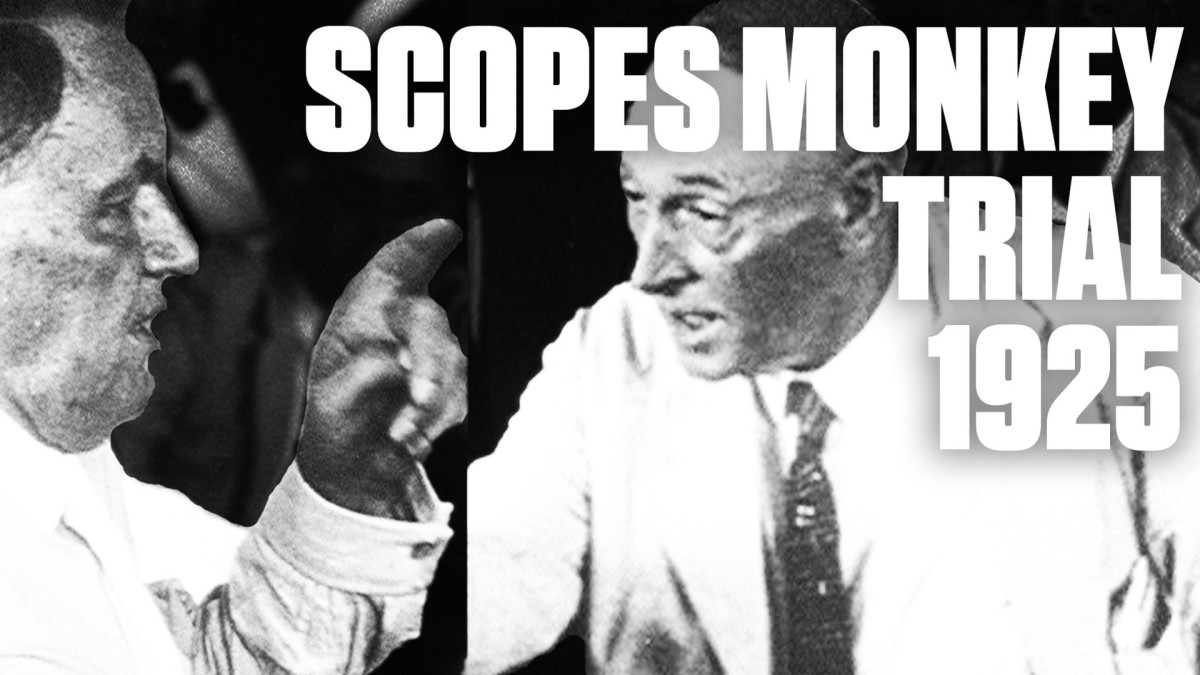
Scopes stepped into legal history barely two months later. According to charging documents Scopes had used the textbook “Civic Biology” to describe the theory of evolution, race and eugenics. The prosecution brought in William Jennings Bryan to try the case. The defense hired Clarence Darrow.
Two of the heaviest of jurisprudential heavy hitters of the day were now lined up in what promised to be, the “Trial of the Century”.
Bryan complained that evolution taught children that humans were no more than one among 35,000 mammals. He rejected the idea that humans were descended from apes. “Not even from American monkeys, but from old world monkeys”. The ACLU wanted to oppose the Butler Act on grounds that it violated the teacher’s individual rights and academic freedom, but it was Darrow who shaped the case, taking the position that theistic and evolutionary views were not mutually exclusive.
What began as a publicity stunt quickly became an overwhelming media event. 200 newspaper reporters from all over the country arrived in Dayton. Two come all the way from London. Twenty-two telegraphers sent out 165,000 words a day over thousands of miles of telegraph wires, specifically hung for the purpose.
Trained chimpanzees performed on the courthouse lawn. Chicago radio personality Quin Ryan broadcast the nation’s first on-the-scene coverage of a criminal trial. A specially constructed airstrip was prepared from which two movie cameramen had their newsreel footage flown out, daily.
H.L. Mencken, writing for the Baltimore Sun, mocked the prosecution and the jury as “unanimously hot for Genesis.” Mencken labeled the town’s inhabitants “yokels” and “morons”. Bryan was a “buffoon” he claimed, his speeches “theologic bilge”. It was Mencken who dubbed the proceedings, “Monkey Trial”. The defense, on the other hand, was “eloquent” and “magnificent”.
Or so he claimed. Not the least little bit of media bias, there.
After eight days of trial, the jury took only nine minutes to deliberate finding Scopes guilty on July 21. The gym teacher was ordered to pay a $100 fine, equivalent to something like $1,300, today. Scopes’ conviction was overturned by the Tennessee Supreme Court, on the basis that state law required fines over $50 to be decided by a jury, and not by the judge presiding.
To this day you can find American creationists who believe that media reports turned public opinion, against the religious view.
Today, the Evolution vs Creation debate has faded to the background, but never really ended. Such discussions may be reasonably expected to continue. Neither view seems supportable by anything more than the faith, of its own adherents.
“I am not what I ought to be, I am not what I want to be, I am not what I hope to be in another world; but still I am not what I once used to be, and by the grace of God I am what I am” ― John Newton
It was the Golden Age of Greek history, a time when “[Men] lived like gods without sorrow of heart, remote and free from toil and grief…” according to the Greek poet, Hesiod. A time of Confucius and the Buddha in the east while the Olmec peoples ruled over much of South and Central America, a time when the Italian city-state of Rome overthrew a Monarch, to form a Republic.
2,500 years ago, Bantu farmers on the African continent fanned out across the land as the first Africans penetrated the dense rain forests of the equator, to take up a new life on the west African coast.
The Islamic crusades of the 7th and 8th centuries turned much of the Maghreb (northwest Africa) to Islam and displaced the Sahelian kingdoms of the sub-Saharan grasslands. The hunters, farmers and traders of Coastal Africa remained free to make their own way, isolated by those same rain forests from the jihads and other violence of the interior.
Sahelian Kingdoms of Sub-Saharan Africa
The first European contact came around 1462 when the Portuguese explorer Pedro de Sintra mapped the hills surrounding modern Freetown Harbour, naming an oddly shaped formation Serra Lyoa (Lioness Mountain).
Home to one of the few safe harbors on the surf-battered “windward coast”, Sierra Leone soon became a favorite of European mariners, some of whom remained for a time while others came to stay, intermarrying with local women.
From the 6th century to a peak of around 1350, Arab slave traders conducted a rich trans-Saharan trade in human beings.
According to the Guyanese historian Walter Rodney, slavery among and between the African peoples of Sierra Leone appears to be rare at this time. Portuguese mariners kept detailed records and would have described such a thing though there was a particular kind of “slavery” in the region: “A person in trouble in one kingdom could go to another and place himself under the protection of its king, whereupon he became a “slave” of that king, obliged to provide free labour and liable for sale“.While this type of “slave” retained rudimentary rights at this time, those unfortunate enough to be captured by Dutch, English and French slavers, did not.
It wasn’t long before coastal kidnapping raids gave way to more lucrative opportunities. Some chieftains were more than happy to “sell” the less desirable members of their own tribes while others made a business out of war, taking prisoners to be traded for a fortune in European goods, including muskets.
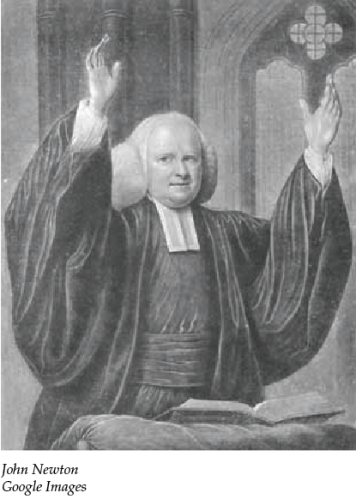
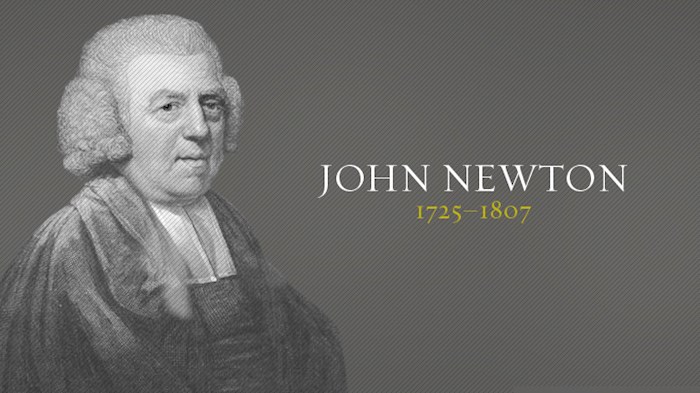
While slave “owners” were near-exclusively white and foreign at this time, the late 18th century was a time of rich and powerful African chieftains, many of whom owned large numbers of slaves, of their own.This was the world of John Newton, born July 24 (old style) 1725 and destined for a life, in the slave trade.
The son of a London shipmaster in the Mediterranean service, Newton first went to sea with his father at age 11 and logged six such voyages before the elder Newton retired, in 1742.
His was a wild youth, the life of a sailor bent on drinking and raising hell. That was all brought up short in 1743, when Newton was captured and “pressed” into service with the 50-gun HMS Harwich and given the rank, of midshipman.
The teenager hated everything about the naval service and tried to desert, earning himself a flogging for his trouble.
Eight. Dozen. Lashes. Imagine for a moment, enduring something like that.
Reduced to the rank of common seaman Newton was disgraced, wounded and humiliated. He vowed to murder the captain and hurl himself overboard but it wasn’t meant to be. The wounds healed over in time and, with the Harwich enroute to India, Newton transferred to the slave ship Pegasus, bound for West Africa.
Pegasus would trade goods for slaves in Sierra Leone to be shipped to colonies in the Caribbean and North America.Newton hated life on the Pegasus as much as his shipmates, hated him. In 1745 he was abandoned in West Africa with a slave trader, named Amos Clowe. Newton was now himself a slave, given by Clowe to his wife Princess Peye of the Sherbro tribe, of Sierra Leone. Peye treated Newton as badly as she treated any of her other slaves, treatment as wretched as that meted out to the human beings who had fallen into his own hands, as a slave trader. Newton himself later described these three years as “once an infidel and a libertine, [now] a servant of slaves in West Africa”.
Rescued in 1748 by his father’s request, Newton was returning to England aboard the merchant ship Greyhound when he experienced a spiritual awakening. Caught in a dreadful storm off Donegal, Greyhound seemed doomed when a great hole opened in her hull. Newton prayed for the mercy of God when a load somehow shifted, party blocking the hole. With pumps operating around the clock, the storm died down. Greyhound made port in Lough Swilly, Ireland, four weeks later.
With this conversion, John Newton had come to accept the doctrines of Evangelical Christianity. On March 10, 1748 he swore off liquor, gambling and profanity. For the rest of this life he would regard this day, as a turning point.
There’s a popular story that Newton’s life was changed then and there but it didn’t work out that way. Those hours of despair on board the Greyhound were an awakening, yes, but Newton would return to the slave trade. Even after the 1754 stroke which ended his seafaring career, he still invested in slaving operations.
His was a gradual conversion. “I cannot consider myself to have been a believer in the full sense of the word” he later said, “until a considerable time afterwards.”
While working as tax collector in the Port of Liverpool, Newton studied Greek, Hebrew and Syriac, preparing himself for serious religious studies. In 1757 he applied to become an ordained minister, of the Anglican Church. Seven years would come and go when the lay minister applied with Methodists, Independents and Presbyterians. He was ordained a priest of the Anglican church on April 29, 1764.
Moving to London in 1780 as the Rector of St. Mary Woolnoth church, Newton became involved with the Committee for the Abolition of the Slave Trade.
In 1788 he broke a long silence on the subject to take a forceful stand, against the “peculiar institution“.
In his Thoughts Upon the African Slave Trade, Newton writes: “So much light has been thrown upon the subject…for the suppression of a traffic, which contradicts the feelings of humanity; that it is hoped, this stain of our National character will soon be wiped out.”
Newton apologized for his past in “a confession, which … comes too late … It will always be a subject of humiliating reflection to me, that I was once an active instrument in a business at which my heart now shudders.”
The tract went on to two printings, describing the hideous conditions on board the slave ships and leading to an act of Parliament abolishing the slave trade, in 1807.William Cowper was an English poet and hymnist who came to worship in Newton’s church, in 1767. The pair collaborated on a book of Newton’s hymns including “Glorious Things of Thee Are Spoken,” “How Sweet the Name of Jesus Sounds!,” “Come, My Soul, Thy Suit Prepare” and others.
“I am still in the land of the dying; I shall be in the land of the living soon”. His last words
John Newton was a drunk, a carousing sailor and a slave trader who saw the light and left us one of the great hymns, of the last quarter-millennium.
Amazing grace, how sweet the sound, that saved a wretch like me. I once was lost, but now am found, Was blind but now I see.
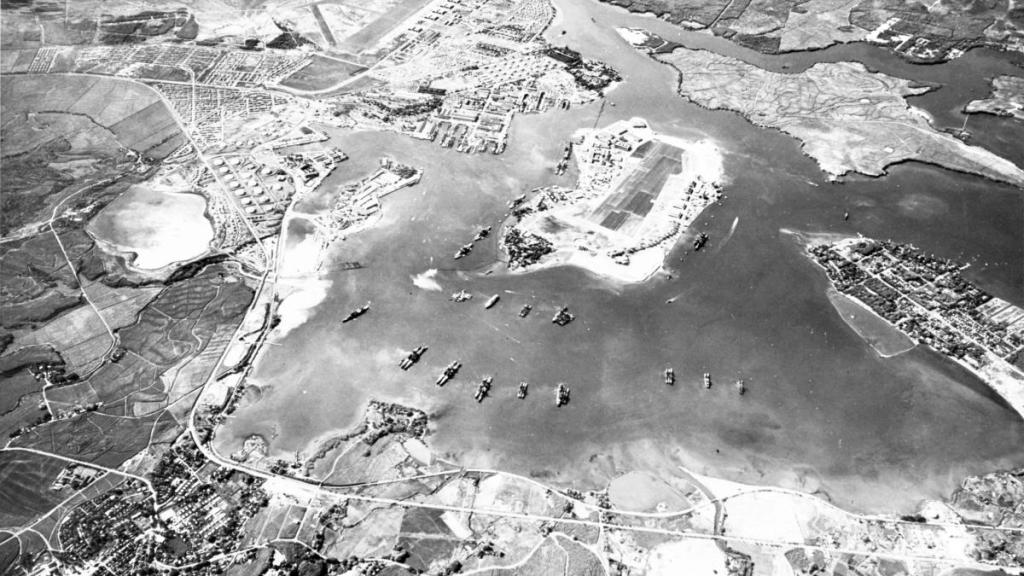
In the months following the Japanese raid on Pearl Harbor the US ramped up its war fighting capacity, significantly. Realizing this but having little idea of the specifics, the Imperial Japanese Navy (IJN) determined to visit Pearl Harbor once again, to have a look around.
On December 7, 1941, forces of the Imperial Japanese Navy attacked the United States’ Pacific naval Anchorage, at Pearl Harbor. President Franklin Delano Roosevelt addressed a joint session of Congress the following day, requesting a declaration that, since the attack, a state of war had existed between the United States, and Japan. Three days later, Nazi Germany declared war on the United States, reciprocated by an American declaration against Nazi Germany, and its Italian allies. Two years of conflict in Europe, had become a World War.
In the following months, the United States ramped up its war capacity. Significantly. Realizing this but having little idea of the specifics, the Imperial Japanese Navy (IJN) determined to visit Pearl Harbor once again, to have a look around.
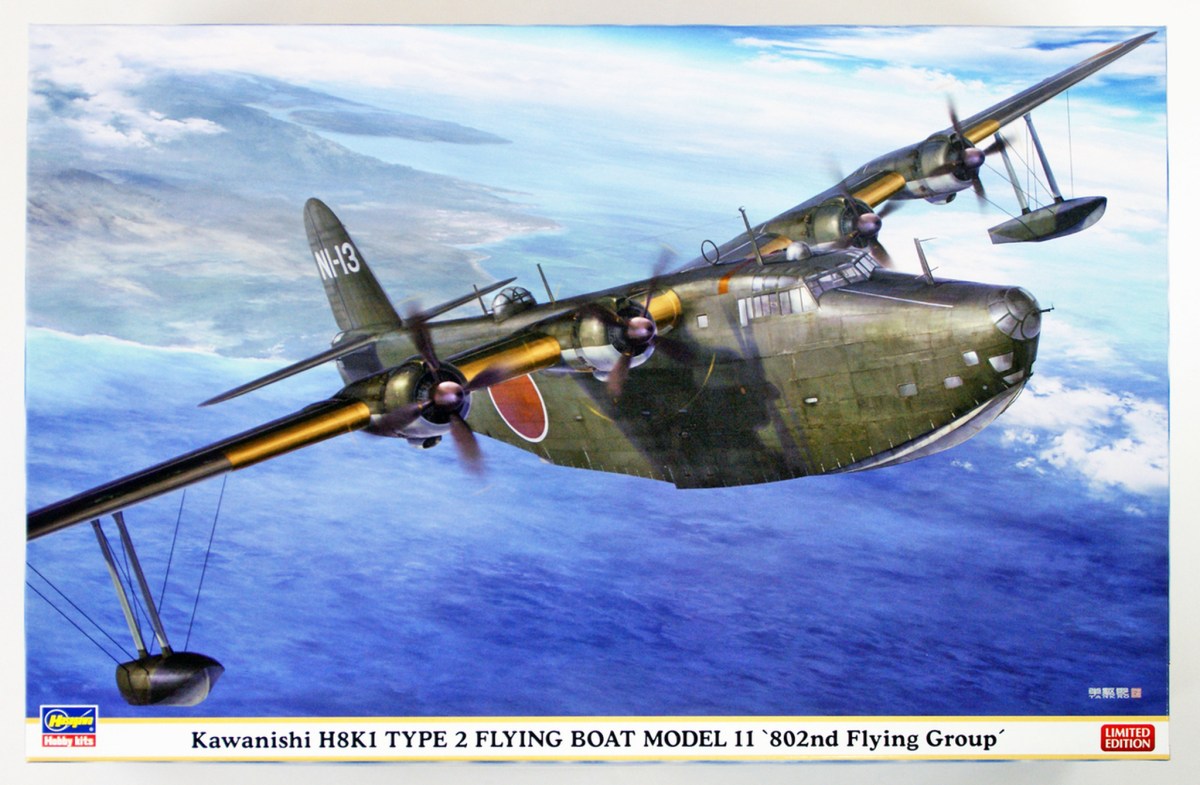
For the IJN, this was an opportunity to test the new Kawanishi H8K1 “Emily” flying boat, an amphibious bomber designed to carry out long distance bombing raids. So it was that a second albeit smaller attack was launched against Pearl Harbor.
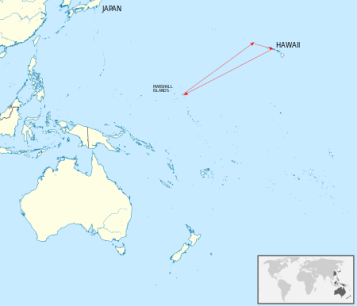
The IJN plan was complex. This, the first Kawanishi H8K1 operation in Japanese military service, involved a small formation of flying boats to be sent to Wotje Atoll in the Marshall Islands, from there to stage the long-range attack. The five flying boats would be loaded with four 550-pound bombs apiece and flown to French Frigate Shoals northwest of Oahu, there to refuel with the help of three Japanese submarines, already waiting.
Ten miles south of Oahu, the 356-foot diesel-powered submarine I-23 was to hold watch over the operation, reporting weather and acting as “lifeguard” in case any aircraft had to ditch in the ocean.
“A Kawanishi H8K1 of the 802nd Kokutai is lifted out of the water onto the decks of the HIJMS Akitsushima, 1942, off Shortland Island”. H/T fly.historicwings.com, for this image
After refueling, the bomber – reconnaissance mission would approach Pearl Harbor and attack the “10-10 dock”, so-called because it was 1,010 feet long and a key naval asset for the US Pacific Fleet.
If successful, this would be an endurance mission, one of the longest bombing raids ever attempted and carried out entirely without fighter escort. The mission was designated “Operation K” and scheduled for March 4, 1942.
As it turned out, the raid was a “comedy of errors”, on both sides.
Things began to go wrong, almost from the beginning. I-23 vanished. To this day nobody knows where the submarine went. American forces reported several engagements with possible subs during this time frame. Maybe one of those depth charges did its job. It’s also possible that, unknown to the Imperial Japanese Navy, I-23 was involved in an accident and lost at sea, with all hands.
As it was, only two of the new flying boats were ready for the operation, the lead plane (Y-71) flown by Lieutenant Hisao Hashizume with his “wingman” Ensign Shosuke Sasao flying the second aircraft, Y-72.
The staging and refueling parts of the operation were carried out but, absent weather intelligence from the missing I-23, the two-aircraft bombing formation was ignorant of weather conditions, over the target. As it was, a thick cloud cover would render the Japanese pilots all but blind.
Captain Joseph J. Rochefort, USN
On the American side, Captain Joseph J. Rochefort, USN, worked in the Combat Intelligence Unit, tasked with intercepting enemy communications and breaking Japanese codes. Four months earlier US code breakers had intercepted and decoded Japanese radio communications, but urgent warnings were ignored by naval authorities at Pearl Harbor.
As before, Rochefort’s team did its job. Urgent warnings were sent to Commander in Chief Pacific (CINCPAC) and to Com-14. Incredibly, these warnings too, fell on deaf ears. Captain Rochefort was incredulous. Years later, he would describe his reaction, at the time “I just threw up my hands and said it might be a good idea to remind everybody concerned that this nation was at war.”
American radar stations on Kauai picked up and tracked the incoming aircraft, but that same cloud cover prevented defenders from spotting them. Curtiss P-40 Warhawk fighters were scrambled to search for the attackers, while Consolidated PBY Catalina flying boats were sent to look for non-existent Japanese aircraft carriers, assumed to have launched the two bombers.
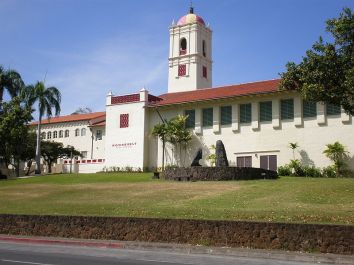
Meanwhile, the two Japanese pilots became confused, and separated. Hashizume dropped his bombs on the side of Mt. Tantalus, about 1,000 ft. from nearby Roosevelt High School. Hashizume’s bombs left craters 6-10 ft deep and 20-30 ft across on the side of the extinct volcano. Sasao is presumed to have dropped his bombs, over the ocean.
President Theodore Roosevelt High School, Honolulu
Ever anxious to rent a rapt audience to a sponsor the media, were off and running. One Los Angeles radio station reported “considerable damage to Pearl Harbor”, with 30 dead sailors and civilians, and 70 wounded. Japanese military authorities took the broadcast to heart and considered the operation to have been a great success. Talk about ‘fake news’. As it was, the damage was limited to those craters on Mt. Tantalus and a few broken windows, at Roosevelt High.
Th Army and the Navy blamed each other for the explosions, each accusing the other of jettisoning munitions over the volcano.
The IJN planned another such armed reconnaissance mission for the 6th or 7th of March, but rescheduled for the 10th due to damage to Hashizume’s aircraft, and exhaustion of the air crew. The second raid was carried out on March 10 but Hashizume was shot down and killed near Midway atoll, by Brewster F2A “Buffalo” fighters.
The results of the second Japanese raid on Pearl Harbor, carried out on March 4, 1942, were limited to four craters on the side of an extinct volcano.
A follow-up to Operation K was scheduled for May 30 but by that time, US military intelligence had gotten wise to the IJN meet-up point. Japanese submarines arriving at French Frigate Shoals found the place mined, and swarming with American warships.
In the end, the Imperial Japanese Navy was unable to observe US Navy activity, or to keep track of American aircraft carriers. Days later, this blindness would bring the Japanese war effort to a terrible crossroads at a place, called Midway.
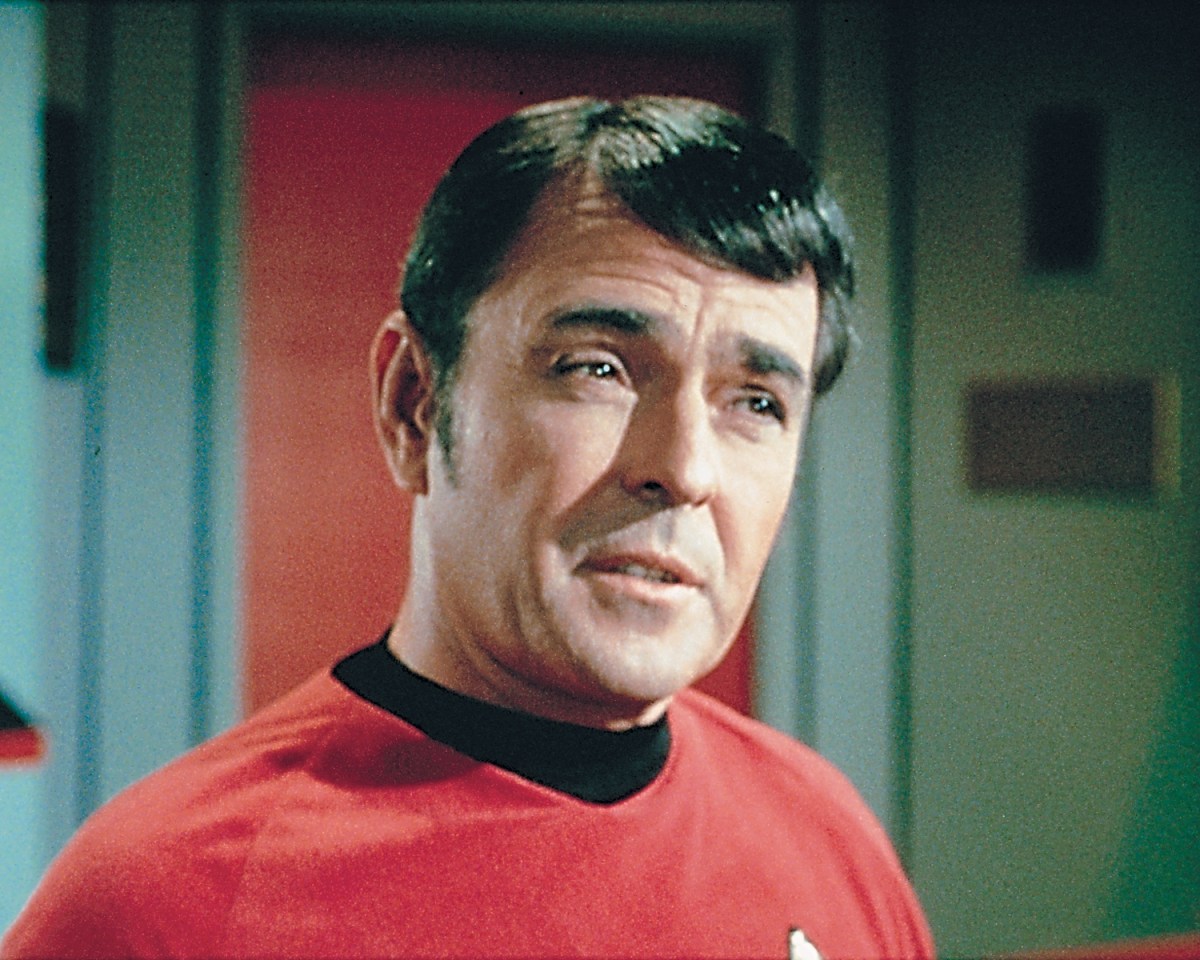
The phrase “Beam me up Scotty” is so iconic even someone who never saw one Star Trek episode, can tell you where it comes from. And yet, the line was never delivered. “Beam us up Mr. Scott” or “Scotty, beam us up’ are common enough but, like “play it again Sam” and “elementary dear Watson” the line, was never spoken.
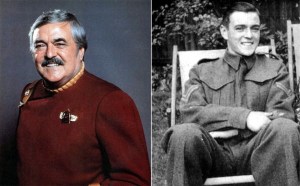
Born March 3, 1920 in Vancouver, British Columbia, James Montgomery Doohan enrolled in the 102nd Royal Canadian Army Cadet Corps in 1938. By the outbreak of WWII “Jimmy” was a Lieutenant in the 14th Field Artillery Regiment of the 3rd Canadian Infantry Division.
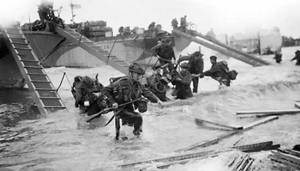
Doohan’s first taste of combat took place on D-Day, on the Normandy beach Canadian landing forces remember, as “Juno”. Crossing through a field of anti-tank mines, the Canadian’s luck held. None of them were heavy enough to set one off. Leading his men to higher ground, Lieutenant Doohan personally shot two German snipers before taking up positions for the night.
That night, Doohan had just finished a cigarette and was walking back to his command post. A nervous sentry opened up with a Bren light machine gun, striking the Lieutenant four times in the leg, once in the chest and again on the middle finger of his right hand. Fortunately, the chest shot lost much of its punch when the bullet hit a cigarette case his brother had given him, for luck. Doctors were able to save his life but not, the finger. That had to be amputated.
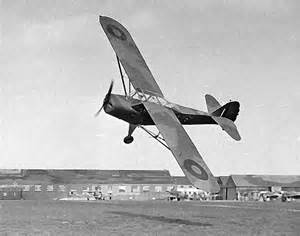
Following a convalescent period Doohan served as courier and artillery spotter aboard a Taylorcraft Auster Mark IV. In spring 1945 he wove his aircraft through telegraph poles like a slalom skier, just to prove it could be done. The man never was a formal member of the CAF, but the stunt forever marked his reputation as “the craziest pilot in the Canadian Air Force”.
Doohan was always interested in voices and accents which he practiced, since he was a kid. He became good at it too, a skill which would serve him well in his later career, as an actor.
After the war, Doohan listened to a radio drama. Knowing he could do it better, he recorded his voice at a local radio station, winning a two year scholarship to study at the Neighborhood Playhouse in New York. There he studied voice and acting with the likes of Leslie Nielsen, Tony Randall, and Richard Boone.
Doohan appeared in over 4,000 radio programs and 450 television shows throughout the 1940s and ’50s. He played “Timber Tom” the northern version of Buffalo Bob, the Canadian production of Howdy Doody. Around this time a young actor named William Shatner was playing Ranger Bill in the American version. In the 1950s, the two would appear together on the Canadian science fiction series “Space Command”. It wasn’t the last time the two would appear together.
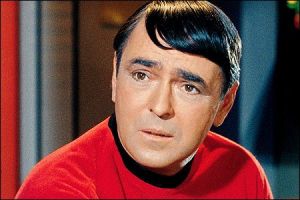
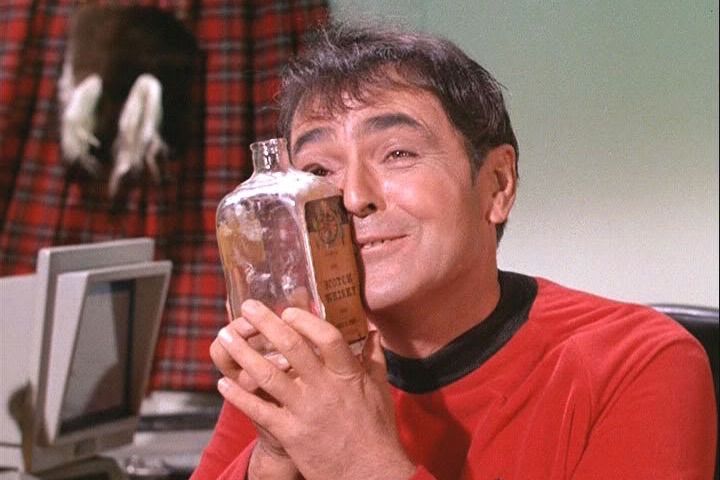
Auditioning before Gene Roddenberry in 1965, Doohan performed several accents. Asked which he preferred, he responded “If you want an engineer, in my experience the best engineers are Scotsmen.” He chose the name “Montgomery Scott”, after his grandfather.
Chief Engineer aboard the Starship Enterprise was supposed to be an occasional role. Roddenberry actually considered killing the character off in episode two but Doohan’s agent, intervened. In the end it was Doohan himself who proved the character, irresistible.
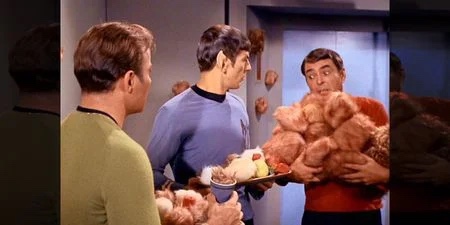
“Scotty” soon became #3 in command, a regular cast member playing alongside William Shatner (Captain James T. Kirk), Leonard Nimoy (Spock) and DeForest Kelley (Dr. McCoy). Doohan’s voice talents helped behind the scenes as well, developing the Klingon and Vulcan “languages”.
Star Trek was canceled in 1969 due to poor ratings but returned to broadcast syndication in the 70s. The series has since become a cult classic. There is hardly a woman, man, puppy boy or girl among us who isn’t steeped and marinated in the program.
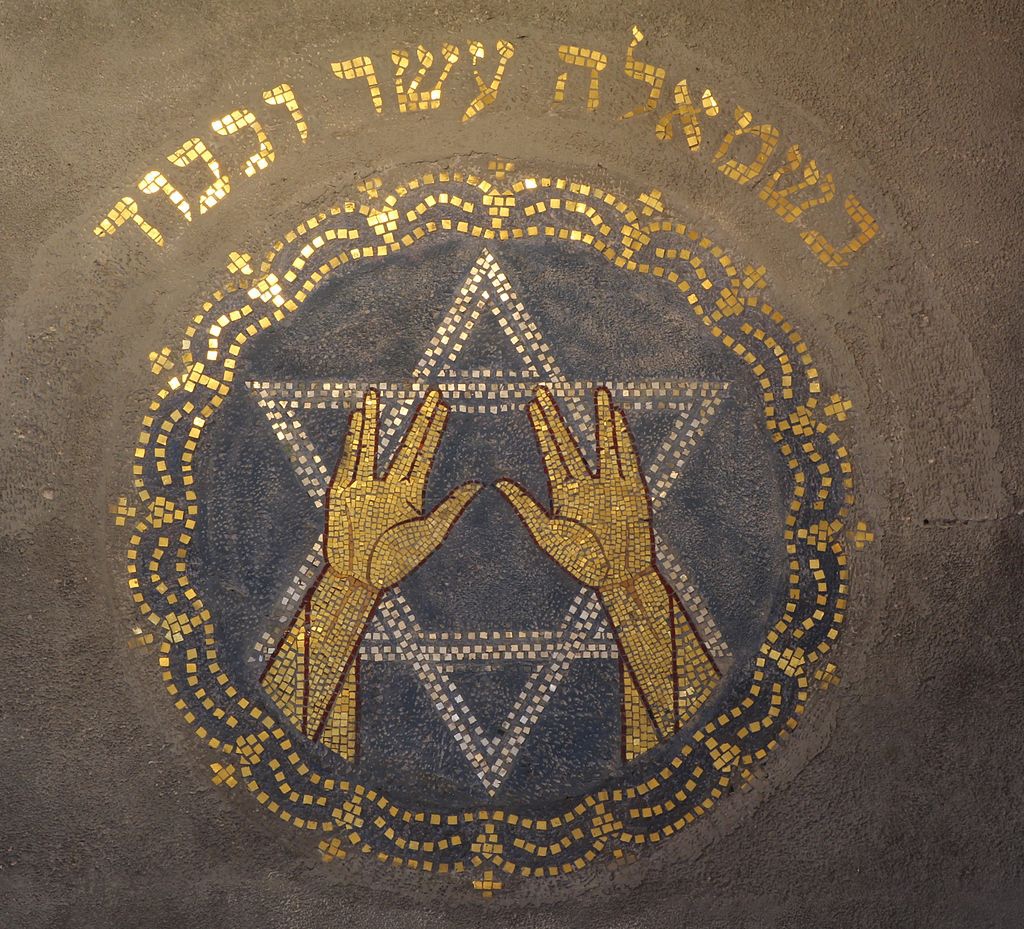
Fun fact: The Vulcan Salute, a hand gesture the New York Times once described as a “double-fingered version of Churchill’s victory sign” comes from a Hebrew blessing Leonard Nimoy witnessed as a child, at an orthodox religious ceremony.
Doohan’s character was so iconic many fans credit him with sparking an interest in the technical fields. Among these was the engineer-turned-astronaut Neil Armstrong, who personally thanked the actor in 2004. Another was a female fan who once mailed the actor, a suicide note. Alarmed, Doohan invited her to a Star Trek convention. The pair stayed in touch for two years before she cut off contact. 8 years later she reached out once again to inform him she had completed a degree in electrical engineering. And to say it was he, who had saved her life.
Doohan learned to hide his injury from the war. For years it was rare to spot the missing digit in the early episodes, a fact which never fails to amuse hard-core “Trekkies“.
It’s a singular part of our electronic age that we live in, isn’t it? We come to know these people sometimes quite well, at least we think we do, and yet they wouldn’t know us, from Adam’s off ox.
In his later years, Doohan’s health began to decline. He developed Parkinson’s disease and diabetes along with fibrosis of the lung, a condition blamed on exposure to noxious chemicals during WWII. By 2004 he’d experienced symptoms of Alzheimer’s, though he was still able to attend the ceremony in his honor marking his star on the Hollywood Walk of Fame.
James Montgomery Doohan passed away on July 20, 2005, survived by his third wife Wende, the couple’s three children, his four adult children from a previous marriage and several grandchildren and great-grandchildren. Doohan’s youngest daughter Sarah was five, at the time of his death.
The actor long wished for his ashes to travel into space and “rest among the stars”. In 2007 a portion of the ashes were launched on a suborbital flight which failed, and fell back to earth. It was three weeks before the capsule containing the ashes, was recovered. In 2008 a second attempt, failed..Christopher Barrett Doohan, an actor who has followed in his father’s footsteps and himself played the “Scotty” character, had an idea. The American video game developer and entrepreneur Richard Garriott was at this time preparing for a voyage to the International Space Station and under quarantine, in Kazakhstan.
It was all quite clandestine at the time but a portion of the ashes was smuggled in and laminated to the back of a card, bearing the actor’s likeness. Everything that goes up there is carefully catalogued and inventoried but the card, made it. So it is the fictional astronaut Montgomery Scott found his way to the stars where he remains to this day, somewhere on board the ISS. Garriott got the last word on the story twelve years later when the truth, could finally be told. “James Doohan got his resting place among the stars.”
At a 1981 news conference President Ronald Reagan once quipped, “The nine most terrifying words in the English language are: I’m from the Government, and I’m here to help”.
In 1775, Connecticut Governor Jonathan Trumbull proposed a fortification at the port of New London, situated on the Thames River and overlooking Long Island Sound. The fort was completed two years later. In 1781 Fort Trumbull was attacked and occupied by British forces under the command of the turncoat American General, Benedict Arnold. Barely a month later the Marquis de Lafayette exhorted American troops at a place called Yorktown, to “Remember New London”.
By the early 20th century, the Fort Trumbull neighborhood consisted of 90 or so single and multi-family working class dwellings, situated on a peninsula along the fringes of a mostly industrialized city center.
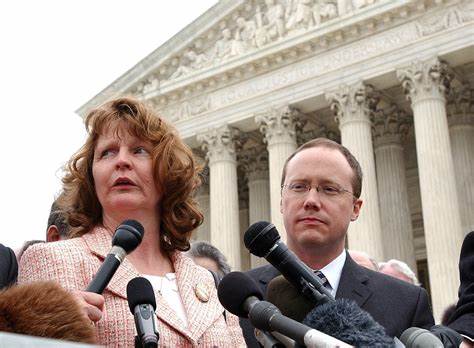
In 2000, Susette Kelo became the main plaintiff in the Supreme Court eminent domain case, “Kelo v. New London”
In 1996, chemists working at Pfizer Corporation’s research facility in England were studying compound UK-92, 480 or “Sildenafil Citrate”, synthesized for the treatment of thoracic circulatory conditions.
Study subjects were expected to return unused medication at the end of the trial. Women showed no objection but a significant number of male subjects refused to give it back. It didn’t take long to figure out what was happening. The chemical compound had revealed itself to be useful in other ways, a substance we now know by the trade name, “Viagra”
For the newly divorced paramedic Susette Kelo, the house overlooking the Fort Trumbull waterfront was the home of her dreams. Long abandoned and overgrown with vines, the little Victorian cottage needed a lot of work, but where else was she going to find a waterfront view at such a price?
The year was 1997. Republican governor John Rowland was eager for a victory in deep blue Connecticut and looked to New London, to shore up his political base. Reluctant to share the limelight with New London democrats the administration helped to resurrect the long-dormant New London Development Corporation (NLDC) to revitalize the city’s waterfront.
Meanwhile on her days off, Susette Kelo sanded her floors on hands and knees as Pfizer Corporation, already occupying the largest office complex in the city, eagerly anticipated a cataract of new business based on this latest chemical compound.
The NLDC recruited the company to become the principal tenant in a new “World Class” multi-use waterfront campus overlooking the harbor including high-income housing, hotels, shopping and restaurants, all of it centered around a 750,000 sq. ft. corporate research facility.
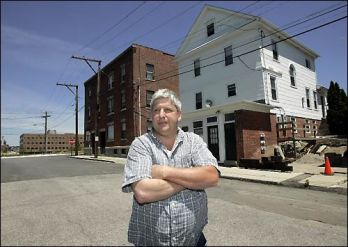
Bill von Winkle stands in front of two properties he owns in the Fort Trumbull neighborhood of New London, CT
Connecticut College professor and NLDC President Dr. Claire Gaudiani liked to talk about her “hip” new development project. Fort Trumbull residents were convinced that stood for “High Income People”. With an average income of $22,500, that didn’t include themselves.
Most property owners agreed to sell, though not exactly “voluntarily”. The reluctant ones were harassed including late-night phone calls, waste dumped on properties and tenants locked out of apartments during cold winter weather.
Seven homeowners holding fifteen properties refused to sell, at any price. Wilhelmina Dery was in her eighties. She was born in her house and she wanted to die there. The Cristofaro family had lost another New London home in the 1970s, taken by eminent domain during yet another “urban renewal” program. They didn’t want to lose this one, too.
Susette Kelo in front of her “little pink house”
In 2000 the New London city council voted to authorize the NLDC to use eminent domain to condemn the property, of those who refused to sell. The day before Thanksgiving, Susette Kelo came home from work to find an eviction notice taped to her door.
Letters were written to editors and protest rallies were held, as NLDC and state officials literally began to bulldoze homes. Holdout property owners were left trying to prevent personal injury and property damage, from flying demolition debris.
Facing a prolonged legal battle which none of the homeowners could afford, the group got a boost when the Libertarian law firm Institute for Justice took their case, pro bono. There was cause for hope. Retired homeowner Vera Coking had faced a similar fight against the future President Donald Trump’s development corporation back in 1993 when the developer and Atlantic City New Jersey authorities attempted to get her house condemned, to build a limo lot.
Eminent domain exists for a purpose, but the most extreme care should be taken in its use. Plaintiffs argued that this was not a “public use”, but rather a private corporation using the power of government to take their homes for economic development, a violation of both the takings clause of the 5th amendment and the due process clause of the 14th.
Vera Coking won her case against the developer, and the municipality. The casino itself later failed and closed its doors. New London District Court, with Susette Kelo lead plaintiff “split the baby”, ruling that 11 out of 15 takings were illegal and unconstitutional. At that point, the ruling wasn’t good enough for the seven homeowners. They had been through too much. They would all remain, or they would all go.
Connecticut’s highest court reversed the decision, throwing out the baby AND the bathwater in a 3-4 decision. By this time Governor Rowland had been removed from office, convicted of corruption and sentenced to a year and a day in prison plus four months of house arrest, three years probation and community service.
No matter, Rowland had served his purpose. The case was now beyond Connecticut politics. Seven justices of the United States Supreme Court then in attendance heard the case on February 22, 2005.
Chief Justice William Rehnquist was then recuperating at home from medical treatment and Associate Justice John Paul Stevens was delayed in Florida and unable to return to return to Washington, DC. All nine justices would weigh in on the final decision.
SCOTUSruled in favor of the city in a 5-4 decision, Justices Stevens, Kennedy, Souter, Breyer and even that celebrated social justice warrior Ruth Bader Ginsburg concurring in a vote to throw a working class woman, out of her home.
Seeing the decision as a reverse Robin Hood scheme which would steal from the poor to give to the rich, Sandra Day O’Connor wrote “Any property may now be taken for the benefit of another private party, but the fallout from this decision will not be random. The beneficiaries are likely to be those citizens with disproportionate influence and power in the political process, including large corporations and development firms“.
Clarence Thomas took an originalist view stating that the majority opinion had confused “Public Use” with “Public Purpose”. “Something has gone seriously awry with this Court’s interpretation of the Constitution“, Thomas wrote. “Though citizens are safe from the government in their homes, the homes themselves are not“. Antonin Scalia concurred, seeing any tax advantage to the municipality as secondary to the taking itself.
In the end, most of the homes were destroyed or relocated. State and city governments spent $78 million and bulldozed 70 acres. The 3,169 new jobs and $1.2 million in new tax revenue anticipated from the waterfront development, never materialized. Pfizer backed out of the project moving 1,400 existing jobs to a campus it owns in nearby Groton. The move was completed around the time when tax breaks were set to expire, raising the company’s tax bill by 500%.
Susette Kelo sold her home for a dollar to Avner Gregory, a preservationist who dismantled the little pink house and moved it across town. A monument to what Ambrose Bierce once called “A strife of interests masquerading as a contest of principles. The conduct of public affairs for private advantage”.
Movie Trailer and feature image from the film “Little Pink House” released in April, 2018.
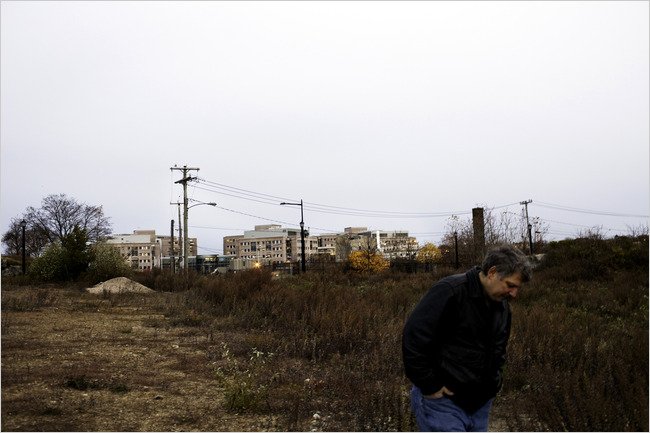
By 2011, the now-closed redevelopment area had become a dumping ground for debris left by Hurricane Irene. The only residents were weeds, and feral cats.
“Michael Cristofaro in the field in New London, Conn., where his parents lived. The city seized the land for a private “urban village” that was never built. Pfizer’s complex is in the background”. Credit Christopher Capozziello for The New York Times
Ten years after the debacle the company is in the news, yet again. The December 2021 CNBC headline informs us: “Pfizer CEO says fourth Covid vaccine doses may be needed sooner than expected due to omicron“. Two months later the same outlet reported “Pfizer expects $54 billion in 2022 sales on Covid vaccine and treatment pill“. That’s pretty good work. If you can get it.
In the decade since it all began revitalization amounted to the cube root, of zero. In 2019, local wags took to planting fruit trees and vegetables where working class homes, once stood. A sign posted on social media read, “A gift to the people, reclaiming land stolen by corporate greed.” These latter-day daughters and sons of liberty might have added the two words, “…and government“.
Eddie was a mob lawyer who testified against his boss and paid for it, with his life. Eddie’s son Butch went on to be the first Ace of WW2 and recipient, of the Medal of Honor.
We’ve all heard the story of the mob lawyer who had everything but a good name, and gave it all up to show his son. That personal integrity is more important than all the riches of the underworld. His name was “Easy Eddie”. Eddie went on to testify against Al Capone, the most notorious gangster in the history of the underworld. Eddie paid for it with his life. Eddie’s son “Butch” learned the lesson his father taught from beyond the grave and went on to become a world War 2 WWII flying ace, and recipient of the Medal of Honor.
Eddie O’Hare
The story is true more or less, but it does lays on the morality, a little thick.
Edward Joseph O’Hare, “EJ” to friends and family, passed the Missouri bar exam in 1923 and joined a law firm. Operating dog tracks in Chicago, Boston and Miami, O’Hare made a considerable fortune working for Owen Smith, the high commissioner for the International Greyhound Racing Association. He’s the guy who patented the mechanical rabbit used in dog racing. EJ and Selma Anna (Lauth) O’Hare had three children together between 1914 and 1924, – Edward (“Butch”), Patricia, and Marilyn.
EJ developed an interest in flying in the 1920s, once even hitching a ride on Charles Lindbergh’s mail plane. For a time he worked as pilot for Robertson Aircraft, occasionally giving his teenage son a turn at the controls.
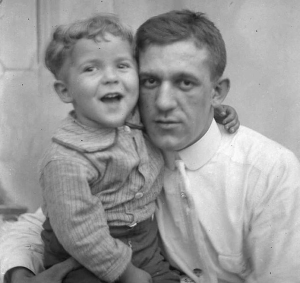
Eddie and Butch O’Hare
One day, EJ came home to find 13-year -old Butch sprawled on the couch, munching on donuts and banana layer cake. He enrolled the boy in the Western Military Academy in Alton, Illinois. The kid was getting way too lazy.
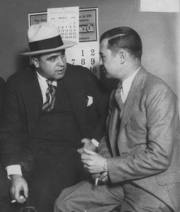
EJ and Selma divorced in 1927. Eddie left St. Louis for good moving to Chicago while Butch stayed with his mother, attending WMA. It was there the elder O’Hare met Al Capone and later earned his second fortune working as the gangster’s business manager and lawyer.
In 1930, O’Hare approached John Rogers, a reporter for the St. Louis Post-Dispatch, asking that he arrange a meeting with the Internal Revenue Service, then in pursuit of Capone on grounds of tax evasion.
It all could have been to restore his good name, or maybe Eddie saw the writing on the wall. Some will tell you he HAD to get right since no Congressman would nominate the son of a gangster, to the nation’s premier naval academy.
Who knows, maybe it’s all of the above. None of them are mutually exclusive. Whatever the motivation, IRS Agent Wilson later said of EJ “On the inside of the gang I had one of the best undercover men I have ever known: Eddie O’Hare.”
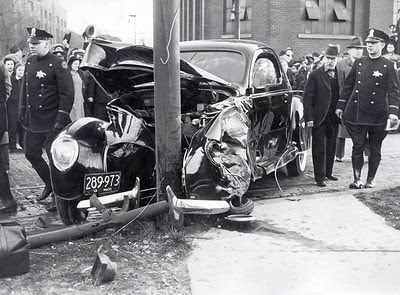
Al Capone was convicted of tax evasion in 1931 and sentenced to Alcatraz, becoming eligible for early release in 1939 due to syphilitic dementia. A week before the gangster’s release, EJ left his office at Sportsman’s Park racetrack in Cicero, driving his black ’39 Lincoln Zephyr. Two shotgun wielding gunmen pulled alongside, firing a volley of big game slugs and killing O’Hare, instantly. No arrest was ever made.
Butch had graduated from the Naval Academy at Annapolis by this time, receiving his duty assignment aboard the USS New Mexico. Shortly after his father’s assassination, the younger O’Hare began flight training at Naval Air Station in Pensacola.
Assigned to the USS Saratoga’s Fighting Squadron, Butch O’Hare made his first carrier landing in 1940, describing the experience as “just about the most exciting thing a pilot can do in peacetime.”
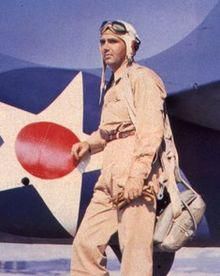
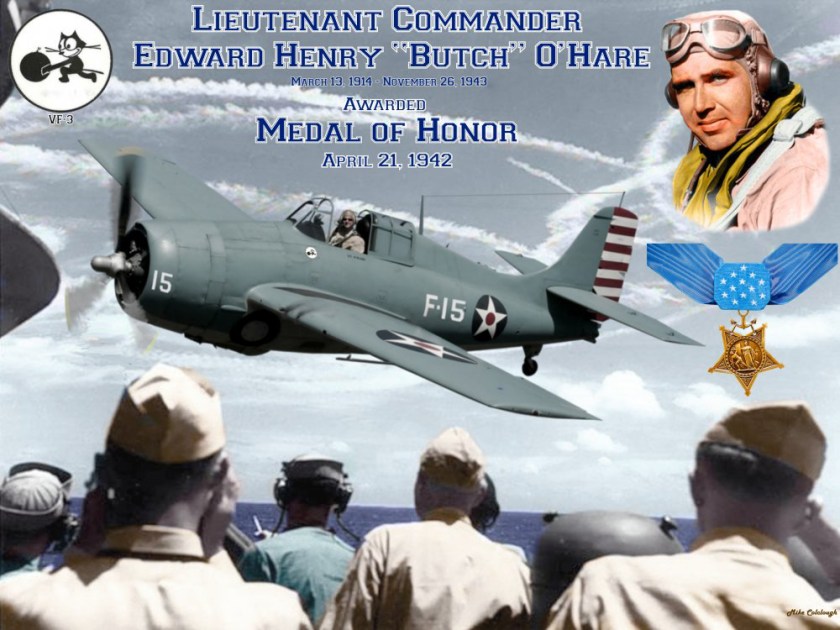
Butch O’Hare became the first American flying Ace of WWII on February 20, 1942.
The carrier Lexington was discovered by Japanese reconnaissance aircraft, 450 miles outside of Rabaul. Six Grumman F4F Wildcat fighters and Lexington’s anti-aircraft guns were engaged with an incoming formation of nine Japanese bombers when nine more bombers were reported incoming.
Six more Wildcats roared off the flight deck of the Lexington, one piloted by Butch O’Hare. He and his wingman Marion William “Duff” Dufilho were the first to spot the V formation, diving to the intercept and leaving the other four fighters too far away to affect the outcome. Dufilho’s guns jammed, leaving Butch O’Hare alone on the unprotected side of his flotilla. One fighter against nine enemy bombers flying in tight V formation, mutually protecting one another with rear-facing machine guns.
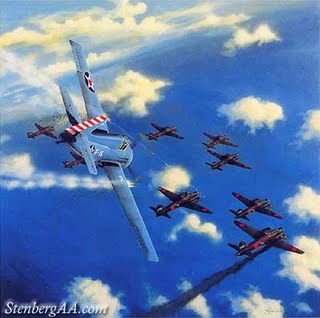
O’Hare’s Wildcat had four 50-caliber guns with 450 rounds apiece, enough to fire for about 34 seconds. What followed was so close to the Lexington, that pilots could hear the carrier’s AA guns. Full throttle and diving from the high side, O’Hare fired short, accurate bursts, the outermost bomber’s right-hand engine literally jumping from its mount. Ducking to the other side and smashing the port engine on another “Betty”, O’Hare’s Wildcat attacked one bomber after another, single handedly taking out five bombers with an average of only 60 rounds apiece.
O’Hare’s Medal of Honor citation calls the performance “…one of the most daring, if not the most daring, single action in the history of combat aviation…”
In a confused night action in the darkness of November 26, 1943, Butch O’Hare stepped from the pages of history. Some say he was cut down by friendly fire, mistakenly shot down by TBF Avenger gunner Alvin B. Kernan. Others say it was a lucky shot by a gunner aboard his old adversary, a Rikko (Betty) bomber. Yet another theory was that O’Hare’s Hellcat caught a wingtip on a wave and cartwheeled into the ocean.
On September 19, 1949, the Orchard Depot Airport in Chicago was renamed in tribute to the fallen Ace. O’Hare International Airport. Neither his body nor his aircraft were ever recovered.
With new postal regulations now in effect, people tested the limits. Bricks were mailed as were snakes and any number of small animals, as long as they didn’t require food or water on the trip. The first parcel mailed from St. Louis Missouri to Edwardsville Illinois contained six eggs. Seven hours later the eggs came back to St. Louis, baked in a cake.
At one time, nations paired up to negotiate postal treaties providing for the direct exchange of mail. The US signed such a treaty with Prussia, in 1853. Germany wasn’t a country in those days in the sense that it is today, more of a collection of independent city-states. Some states in southern Germany sent US-bound mail through France but, there being no Franco-American treaty, mail was forced to travel on British or Belgian cargo vessels. France and the United States wrangled over a postal treaty from 1852 until July 1874 leading the exasperated Minister to France Elihu Washburne to groan: “There is no nation in the world more difficult to make treaties with than France.”
The German Empire was formed in 1871 following victory, in the Franco-Prussian War. The German Reichspost was now free to enact uniform postal regulations within the new nation. Even so, US-bound letters required differing amounts of postage, depending on which ship the letter traveled on. Something had to change.
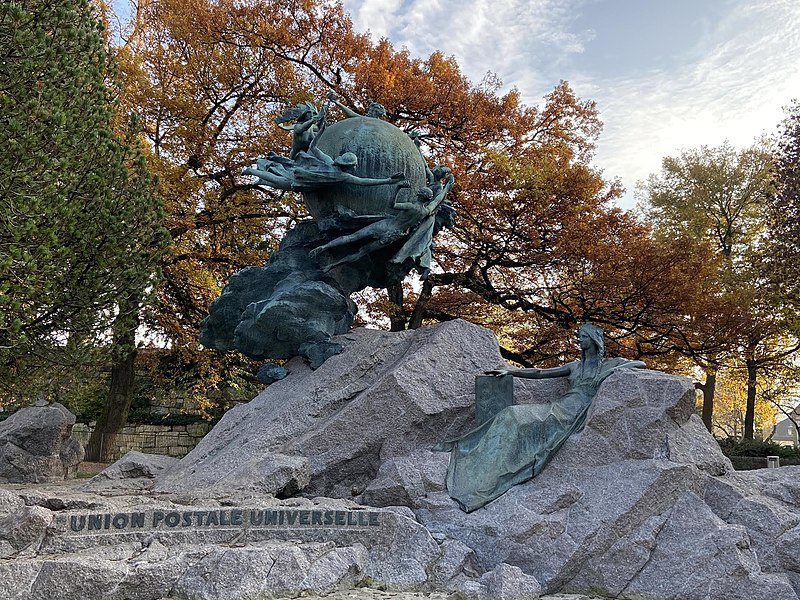
German Postmaster-General Heinrich von Stephan called for an International Postal Congress in 1874. The Treaty of Bern signed on October 9 resulted in a uniform system of postage between nations. That, and a very nice statue in granite and bronze in memory of the new, Universal Postal Union.
All was well between nations but here in the US, the postal service was barely out of diapers. The mail didn’t even go to the “country”. Rural residents were forced to travel days to distant post offices or hire private express companies, to deliver the mail. For years, the National Grange and other farmers’ welfare organizations lobbied Congress for inclusion in the national mail service. The Rural Free Delivery (RFD) act of 1896 opened new worlds to farmers who soon clamored for exotic foodstuffs and tobacco unavailable in rural districts.
Unsurprisingly, rural merchants and express delivery companies fought the measure tooth and nail but they were destined to fail. Parcel post service began on January 1, 1913.
Overnight, parcel limits increased from 4 pounds to fifty. During the first five days alone 1,594 post offices handled over 4 million packages.
People tested the limits. Bricks were mailed as were snakes and any number of small animals, as long as they didn’t require food or water on the trip. The first parcel mailed from St. Louis Missouri to Edwardsville Illinois contained six eggs. Seven hours later the eggs came back to St. Louis, baked in a cake.
You know where this is going, right?
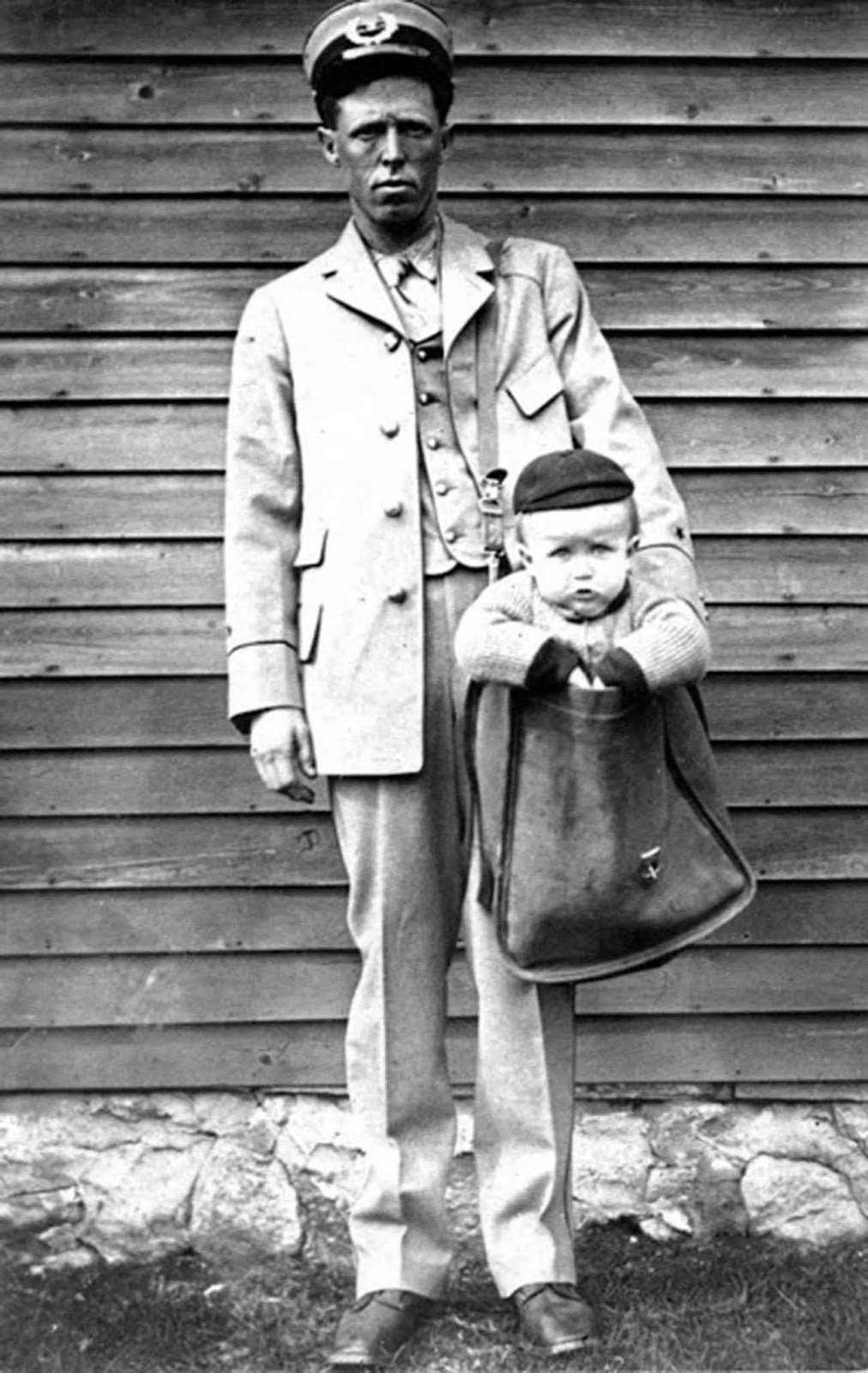
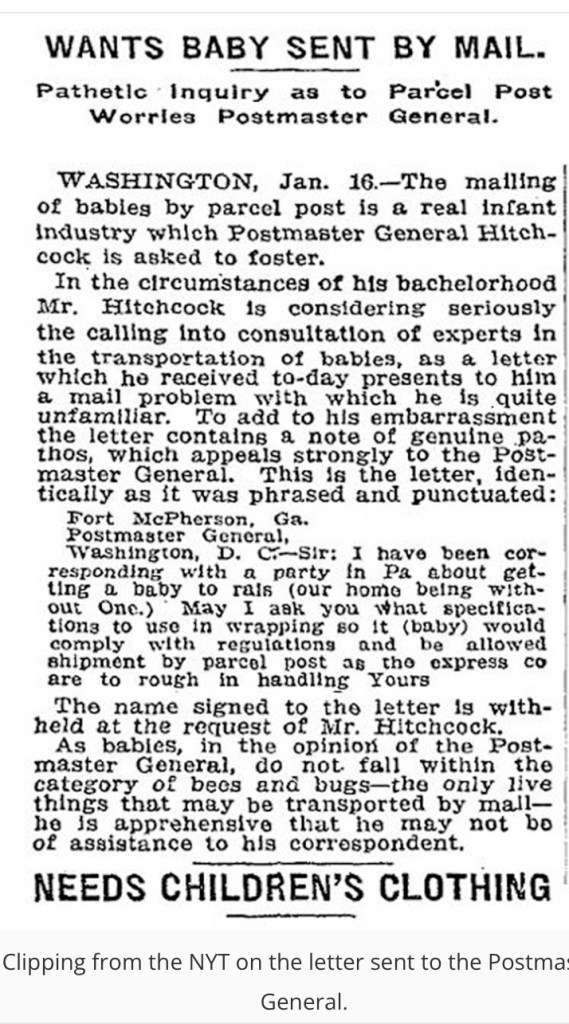
In 1913, Mr. and Mrs. Jesse Beauge of Glen Este, Ohio mailed their baby boy. Seriously. The couple mailed their ten-pound son off to his grandmother’s house a mile away at a cost, of 15¢ postage. History fails to record whether the kid was left in the mailbox or stuffed through a slot in the door, but these people were no cheapskates. The pair popped for 50 bucks’ insurance, “just in case“.
5-year-old May Pierstorff came in just under the weight limit at 48½ pounds. On February 19, 1914, little May was mailed to visit her grandmother in Lewiston Idaho with 53¢ postage, pinned to her coat. She rode the whole way in the postage compartment but hey, postage was cheaper than train fare. Leonard Mochel, the mail clerk on duty delivered the kid to her grandmother’s house, personally.
Six-year old Edna Neff was mailed 720 miles away from Pensacola, Florida to Christiansberg, Virginia, to visit her father.
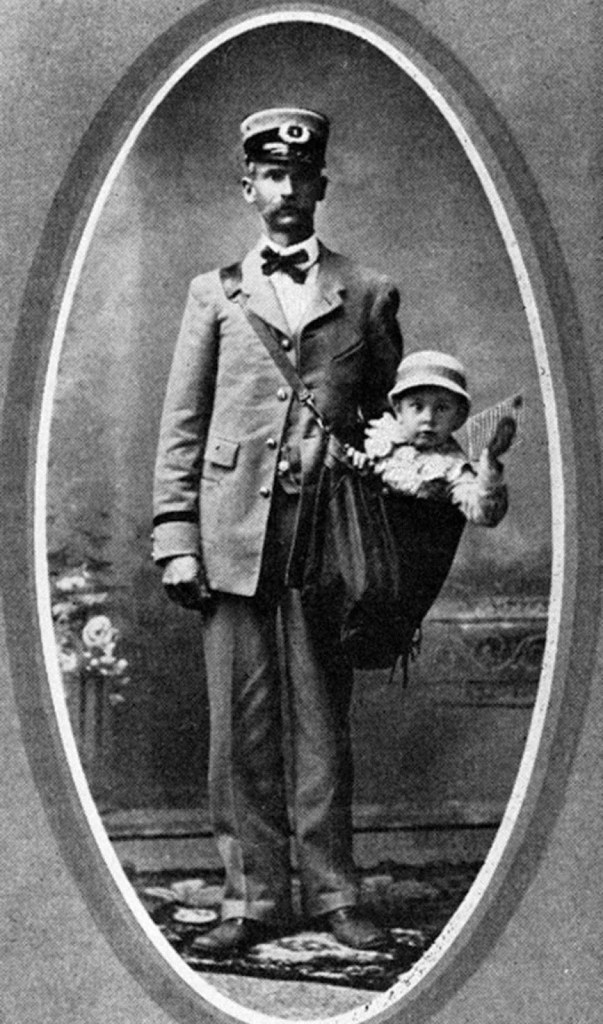
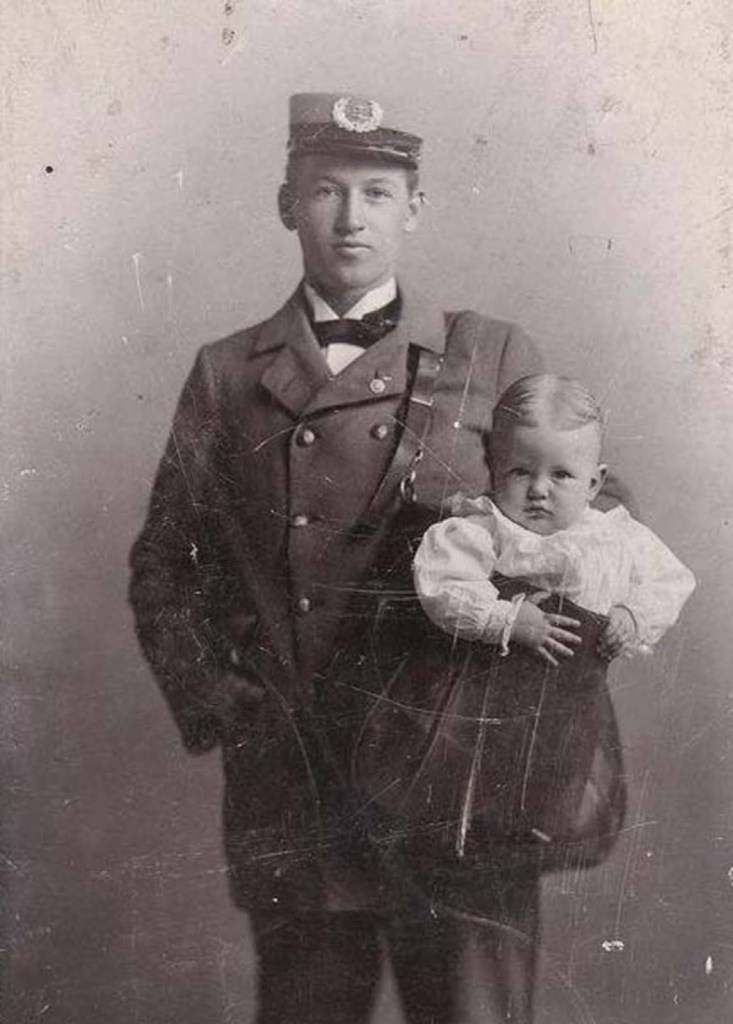
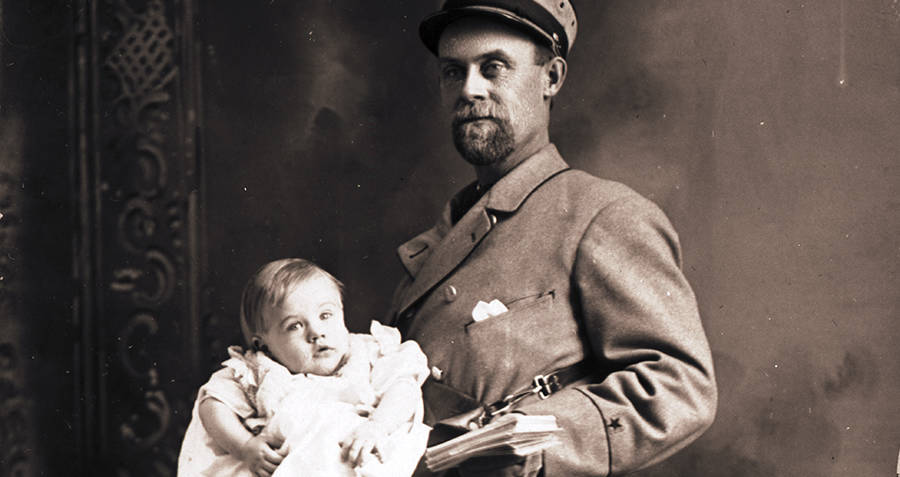
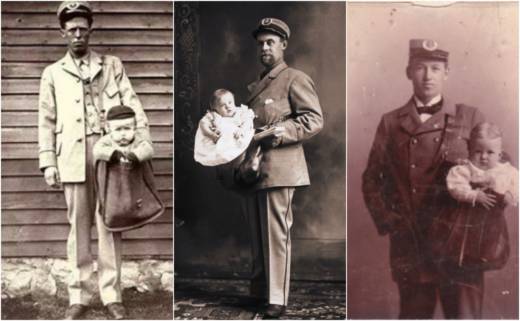
.If you have read thus far with horror permit me to assure you that mailing babies might not be as bad as it sounds. In the rural America of this period the mail carrier was no stranger but a well known and trusted member of a close-knit community. In the case of little May Pierstorff the postal worker who took her by rail, was a relative. No one ever put a child wearing diapers in a mailbox. The photographs above were staged, the sepia-toned faces grinning back over the years at those of us, they have punked.
Be that as it may, Postmaster General Albert S. Burleson heard of the Pierstorff incident and put his foot down. The practice of mailing humans was officially prohibited. The golden age of baby mail had come to an end. Sort of.
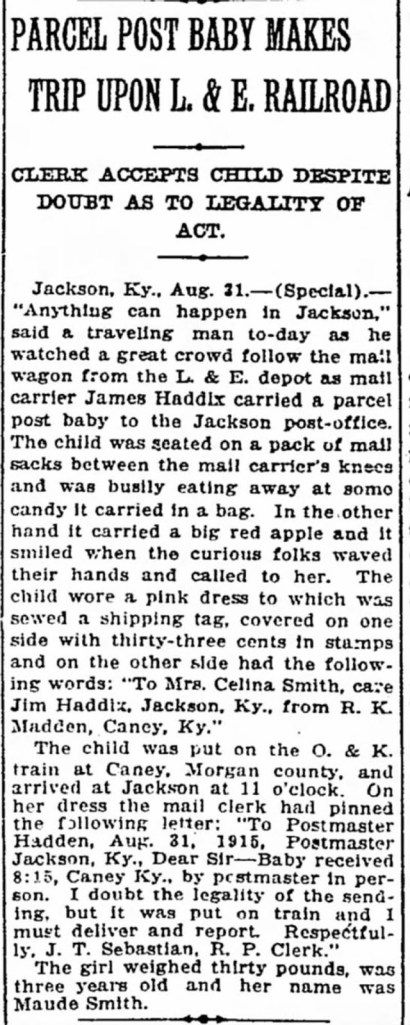
In August 1915 three-year old Maud Smith was mailed forty miles across Kentucky by her grandparents, to visit her sick mother. Hers may be the last human journey by US mail and the postmaster in Caney Kentucky, had some explaining to do.
In June 1920 1st Assistant Postmaster General John C. Coons rejected two applications to mail live children stating they could no longer be classified, as ‘harmless live animals”.
“Success is not final, failure is not fatal: it is the courage to continue that counts.” ― Winston S. Churchill
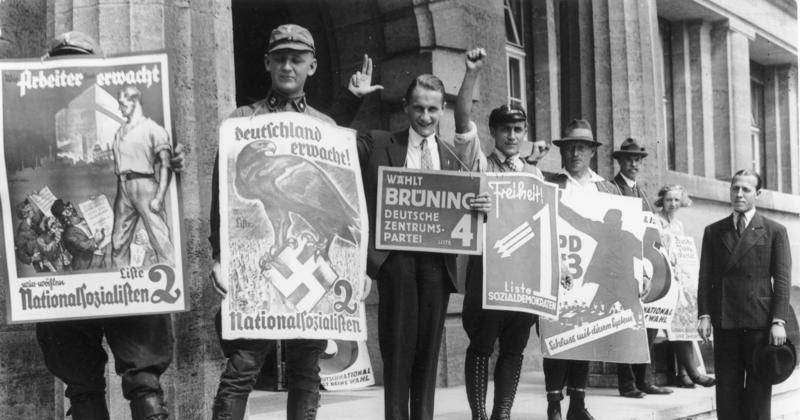
With Hitler’s appointment as chancellor on January 30, 1933, the Nazi party lost little time in eliminating opposition. Two days later, the 876-member democratically elected deliberative body, the “Reichstag”, was dissolved.
As the 1930s wore on it was increasingly dangerous to oppose the Nazi party. History fails to record many of the names of those who simply…disappeared. Forget for a moment the idiocy of our age and the ease with which the word Nazi, is thrown around. Then imagine having the courage to oppose those monsters alone, in the 1930s and ’40s. Many who did so would pay with their lives: Bernhard Lichtenberg. Martin Niemöller. Claus von Stauffenberg. Franz Jägerstätter. Dietrich Bonhoeffer. There were others. Too many to count.
Campaigners outside a polling place during the federal elections, of 1932
Some survived to tell the tale. One such was the Württemberg politician Robert Scholl who criticized the ruling party before, during and after World War 2. Scholl was one of the lucky ones. He lived to tell the story, but not without spending some of the intervening years, behind bars.
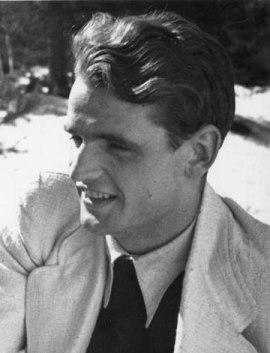
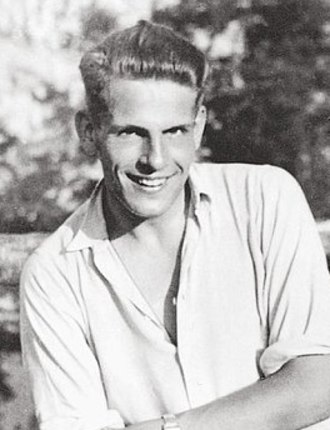
Robert and Magdalena (Müller) Scholl had six children together, four girls and two boys. The older of the two brothers, Hans, joined the Hitler youth, against the express will of his father.
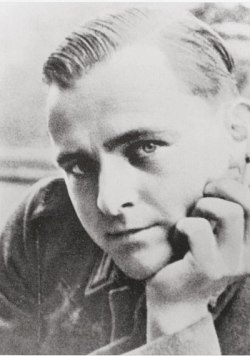
Hans Scholl
Hans even held a leadership position in the Deutsches Jungvolk in der Hitler Jugend (“German Youngsters in the Hitler Youth”), a section of the Hitler Youth aimed at indoctrinating boys, 10-14.
In 1935, Hans was selected to carry the flag at the 1935 Nazi party rally in Nuremberg, one of three standard-bearers, from Ulm.
He joined the Reich Labor Service for two years before beginning medical school, in Munich. During a semester break, Scholl was drafted as a medic in the French campaign. Back at school, Scholl began to meet teachers and students, critical of the regime. Theirs was a Christian-ethical world view. One of them was Alexander Schmorrell.
Hugo Schmorell was a German-born doctor, living and working in Russia. He married Natalia Vedenskaya, the daughter of a Russian Orthodox priest. Alexander Schmorell was born to the couple in Orenberg Russia and baptized, in the Russian Orthodox church.
Hugo remarried after Natalia died of typhus, this time to a German woman who, like himself, grew up in Russia. Alexander grew up bilingual, able to speak German and Russian, like a native.
Following the Russian Revolution, the family moved to Weimar Germany . In later interrogations by the Gestapo, Alexander described himself as a German-Russian Tsarist who hated Bolsheviks.
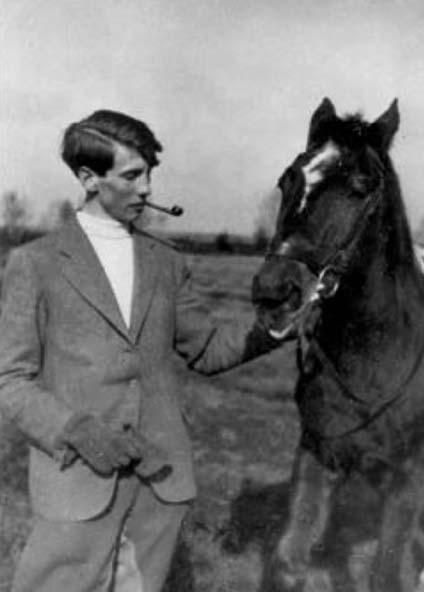
Alexander Schmorell
In the Nazi world view, slavs are part of a great horde of Untermenschen, people considered racially or socially, inferior. Alexander Schmorell believed no such thing about himself. He was proud of both his German and his Russian side.
In religion class, Schmorell displayed a stubborn refusal to bend to the will of others, crossing himself right-to-left in the manner of the Russian church and not left to right. Alexander joined the Scharnhorst youth as a boy, mostly for the love of horseback riding. Once the organization was absorbed into the Hitler Youth movement he gradually stopped attending. Like Scholl, Schmorell joined the Wehrmacht, participating in the Anschluss and eventual invasion, of Czechoslovakia.
In 1941, Scholl and Schmorrell were drafted as medical auxiliaries, for service in the east. There the two witnessed the dark underbelly of the regime in whose service, they risked their lives. The Warsaw ghetto. The savage treatment of Russian prisoners. The endless deportations and dark rumors of extermination centers.
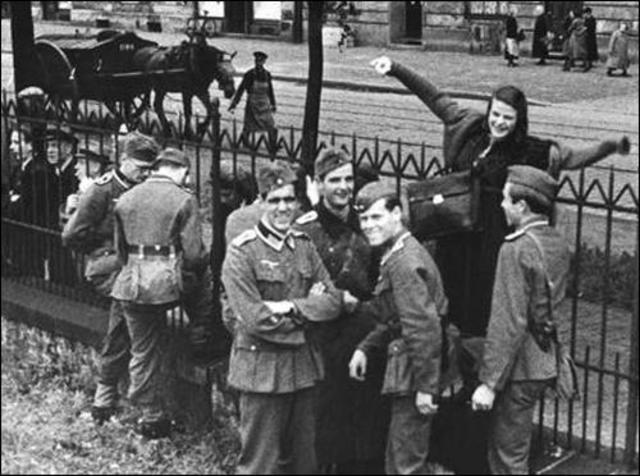
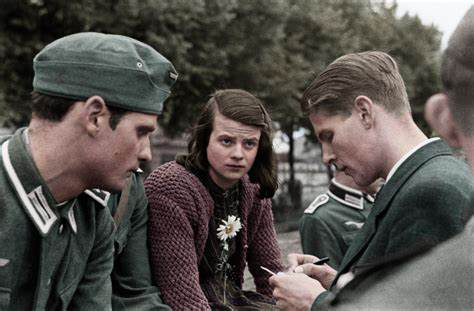
Members of the German resistance “White Rose, in 1942
Scholl and Schmorrell wanted better. Back in school the pair discussed this growing dissatisfaction with the regime with Kurt Huber, professor of music and a vocal anti-Nazi. By June 1942 the pair had begun to write pamphlets and calling themselves, the “White Rose”.
“Isn’t it true that every honest German is ashamed of his government these days? Who among us has any conception of the dimensions of shame that will befall us and our children when one day the veil has fallen from our eyes and the most horrible of crimes—crimes that infinitely outdistance every human measure—reach the light of day?”— 1st leaflet of the White Rose
Hans and Sophie Scholl with Christoph Probst
During later gestapo interrogations, Scholl gave differing stories as to the origin of the name. A poem of the same name by the German poet, Clemens Brentano. A work by the Cuban poet, José Martí. Perhaps it was nothing more than the purity of the white rose, in the face of evil. Or maybe Scholl meant to throw his Nazi tormenters off the scent of Josef Söhngen, the anti-Nazi bookseller who had helped them, in so many ways.
Willi Graf
“Since the conquest of Poland, 300,000 Jews have been murdered in this country in the most bestial way … The German people slumber on in dull, stupid sleep and encourage the fascist criminals. Each wants to be exonerated of guilt, each one continues on his way with the most placid, calm conscience. But he cannot be exonerated; he is guilty, guilty, guilty!”— 2nd leaflet of the White Rose
The group added members and supporters. Willi Graf who, unlike the founding members hated the Hitler Youth movement, from the beginning. Christoph Probst whose step-mother was Jewish and considered the Nuremberg laws an affront to human dignity. Hans’ sister Sophie who joined, despite her older brother’s protestations. Like her brother, Sophie detested what the Nazis stood for.
“Why do you allow these men who are in power to rob you step by step, openly and in secret, of one domain of your rights after another, until one day nothing, nothing at all will be left but a mechanised state system presided over by criminals and drunks? Is your spirit already so crushed by abuse that you forget it is your right—or rather, your moral duty—to eliminate this system?”— 3rd leaflet of the White Rose
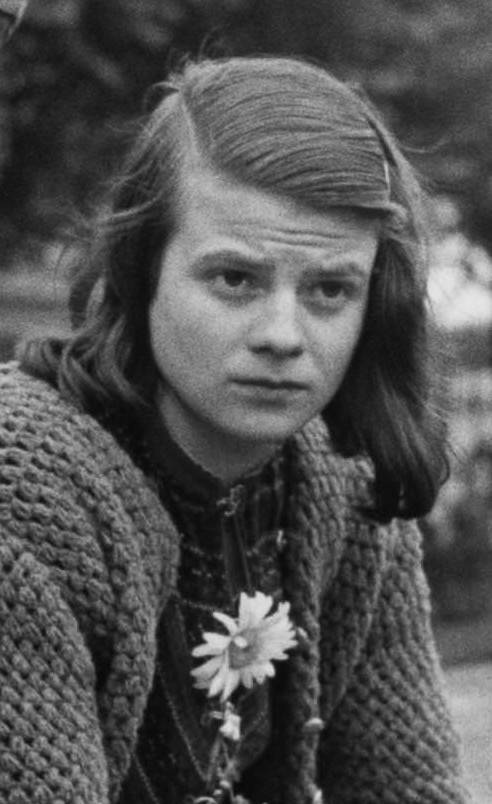
Sophie Scholl
“The government—or rather, the party—controlled everything: the news media, arms, police, the armed forces, the judiciary system, communications, travel, all levels of education from kindergarten to universities, all cultural and religious institutions. Political indoctrination started at a very early age, and continued by means of the Hitler Youth with the ultimate goal of complete mind control. Children were exhorted in school to denounce even their own parents for derogatory remarks about Hitler or Nazi ideology”.
Surviving White Rose member George J. Wittenstein, M.D., “Memories of the White Rose”, 1979
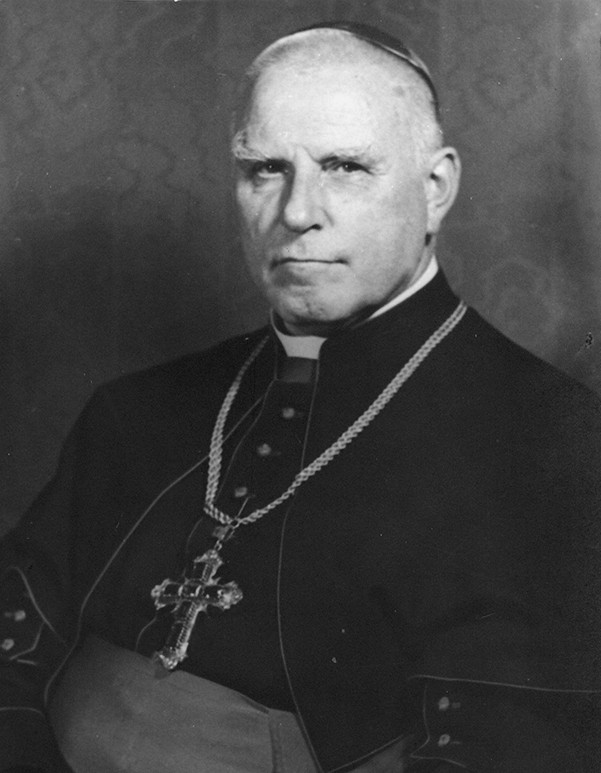
Bishop Clemens August Graf von Galen was critical of the Nazi movement from the beginning, denouncing Hitler’s “Worship of Race” as early as 1934.
Galen excoriated the Nazi euthanization program from the Catholic pulpits of Münster and across the German empire, condemning “the innocent and defenseless mentally handicapped and mentally ill, the incurably infirm and fatally wounded, innocent hostages and disarmed prisoners of war and criminal offenders, people of a foreign race or descent”.
Bishop Galen’s sermons were seminal in the formation of the White Rose. One of his sermons formed the basis for the first pamphlet.
Hand copied leaflets were inserted into phone books or mailed directly, to teachers and students.
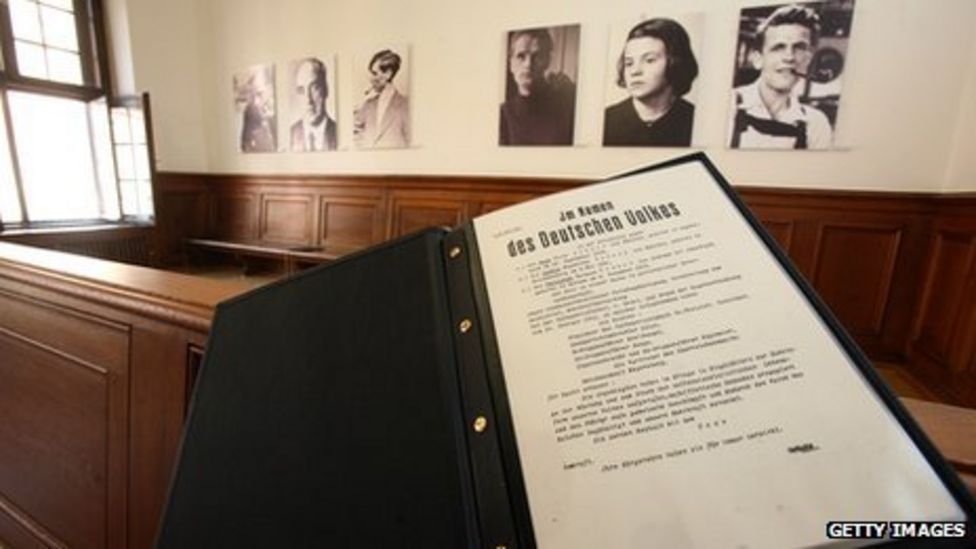
The grotesque sham trials conducted by Hitler’s “Blood Judge” Roland Feisler made short work of any who would oppose “Der Fuhrer”. Today, the “People’s Court” of Nazi Germany is best remembered in the wake of the July 20, 1944 plot to assassinate Adolf Hitler. In reality, this perversion of justice had been around for ten years, handing out death sentences, in the hundreds. This video gives a pretty good idea of “justice” meted out, in Roland Feisler’s court.
“The ultimate test of a moral society is the kind of world that it leaves to its children.”
Dietrich Bonhoeffer
There were Germans throughout the war who objected to the murder of millions, but theirs was a forlorn hope. Clergymen Dietrich Bonhoeffer would state “the ultimate question for a responsible man to ask is not how he is to extricate himself heroically from the affair, but how the coming generation shall continue to live.” For his opposition to the Reich, Bonhoeffer would pay with his life.
Helmuth James Graf von Moltke, great grand-nephew of the famous Helmut von Moltke would lead 28 dissidents of the “Kreisau Circle”, against this “outrage of the Christian conscience.” These too would pay with their lives.
The most successful German opposition party came from the universities of Munich, with connections in Berlin, Hamburg, Stuttgart and Vienna, including the White Rose. These were a surprise to Nazi leaders as Universities had long been stalwart supporters of Nazi ideology.
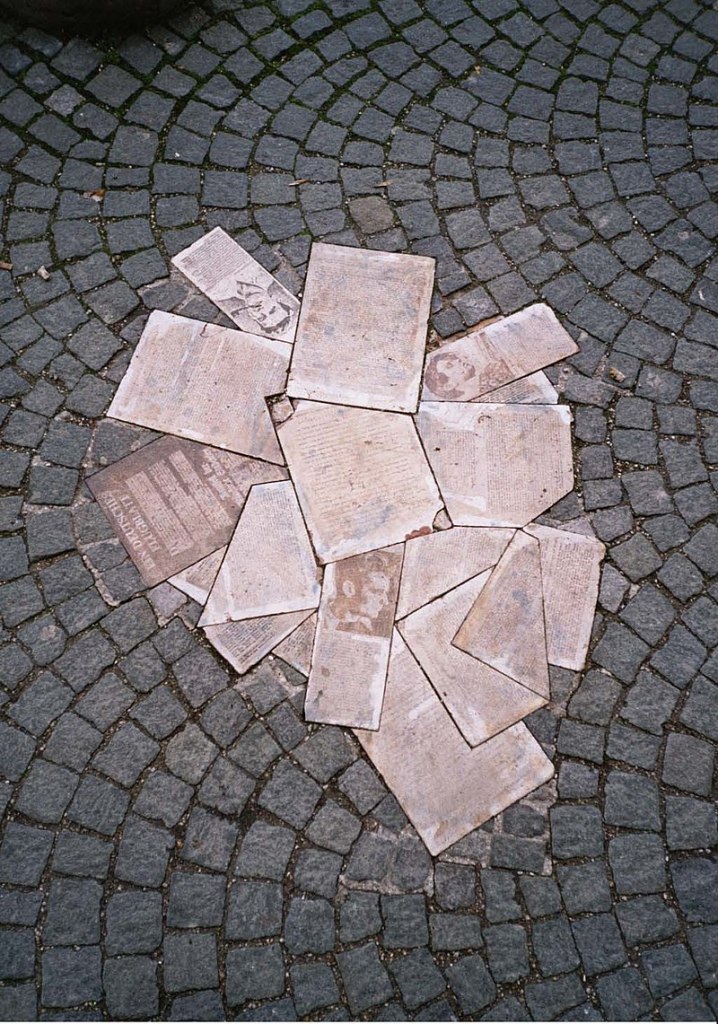
Hans and Sophie arrived on campus with a suitcase full of pamphlets, on February 18. This was their 6th. Hurriedly moving through the campus the Scholls left stacks of leaflets outside of full lecture halls: Memorial to the “Weiße Rose” in front of the Ludwig Maximilian University of Munich
Today, the “People’s Court” of the schweinhund Feisler is a district court, in Munich.
“…Fellow Fighters in the Resistance!Shaken and broken, our people behold the loss of the men of Stalingrad. Three hundred and thirty thousand German men have been senselessly and irresponsibly driven to death and destruction by the inspired strategy of our World War I Private First Class. Fuhrer, we thank you!…” – Excerpt from pamphlet 6
Their task complete, the pair realized they still had a few. From the upper floor of the atrium, Sophie tossed them into the air and watched them flutter to the ground. It was a reckless and stupid act.
If this story is about heroism it also about the opposite, the sort of loathesome toady without who no Nazi regime, would have thrived. One such was the custodian Jakob Schmid, who scurried to the top of the stairs and grasped the two by the collar.
Christoph Probst
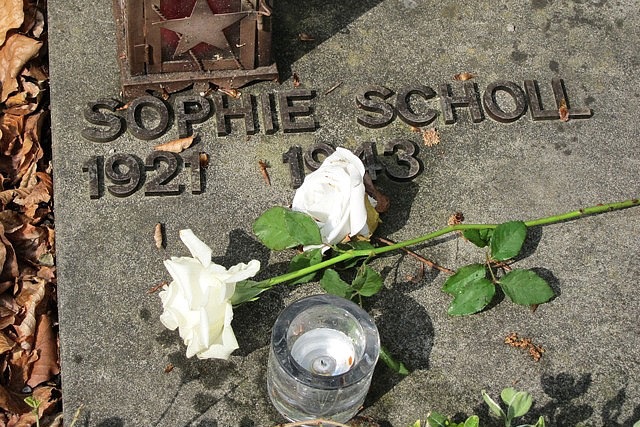
The Scholl siblings were quickly arrested. Hans had on his person the draft of another pamphlet: #7, written by Christoph Probst. He tried to eat it but the Gestapo was too fast. Probst was arrested within hours, eighty more over the following days. On February 22, 1943, all three were tried before judge Feisler’s People’s Court. All three were sentenced to death by guillotine, the execution carried out, the same day.
Hans Scholl’s last words are recorded as Es lebe die Freiheit! (Let Freedom live!)
Graf, Schmorrell, Huber and 11 others were tried on April 13. All three received the same sentence, death by decapitation. All but one of the others received prison sentences, between 6 months and 10 years.
The last member to be executed was Hans Conrad Leipelt on January 29, 1945.
Despite the execution of the group’s leaders, the White Rose had the last word. That last pamphlet was smuggled out of Germany and copied, by the allies. Millions of copies rained down from the sky, dropped, by allied bombers.
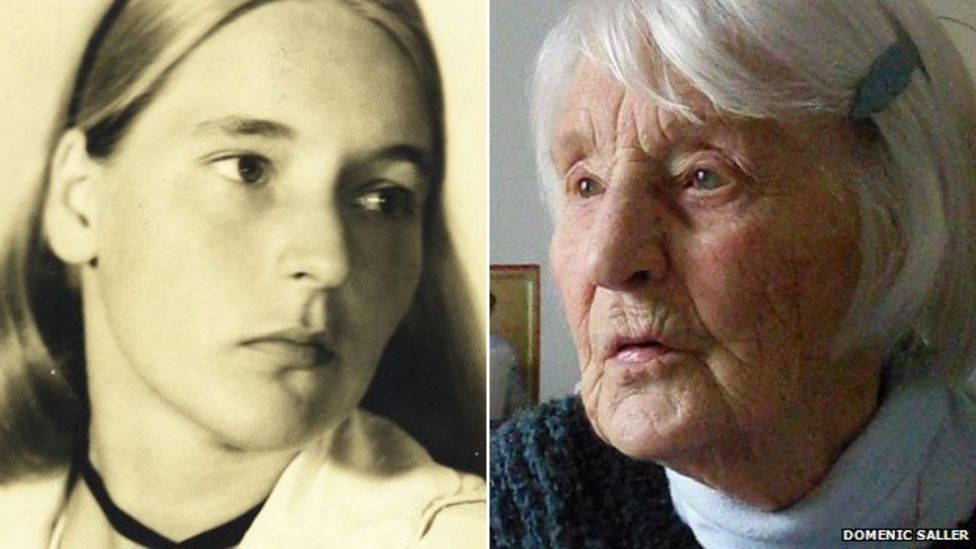
Lieselotte ″Lilo″ Fürst-Ramdohr was a war widow at 29 when she joined the White Rose, hiding pamphlets in an apartment closet and helping to make stencils, for graffiti. In 2013 she gave an interview for BBC Worldwide. It was three months before she died, at the age of 99.
Lieselotte ″Lilo″ Fürst-Ramdohr
Lieselotte was arrested and interrogated for a month by the Gestapo, and released. She thinks they’d hoped she would lead them, to fellow conspirators.
In 2012, Lilo’s friend Alexander Schmorell was awarded sainthood by the Russian Orthodox church. She thought it was all too amusing. “He would have laughed out loud” she said, “if he had known. He wasn’t a saint. He was just a normal person.”







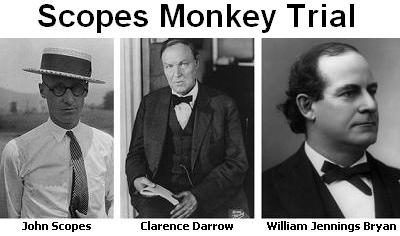 Bryan complained that evolution taught children that humans were no more than one among 35,000 mammals. He rejected the idea that humans were descended from apes. “Not even from American monkeys, but from old world monkeys”. The ACLU wanted to oppose the Butler Act on grounds that it violated the teacher’s individual rights and academic freedom, but it was Darrow who shaped the case, taking the position that theistic and evolutionary views were not mutually exclusive.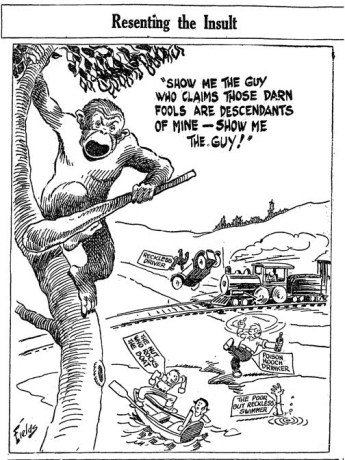



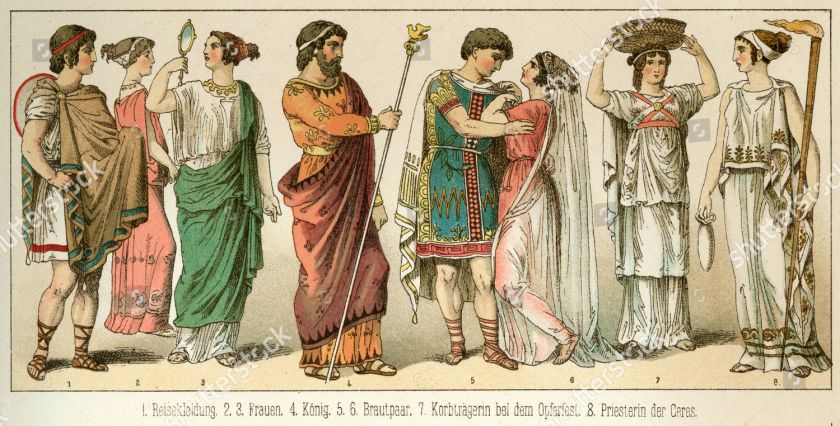 2,500 years ago, Bantu farmers on the African continent fanned out across the land as the first Africans penetrated the dense rain forests of the equator, to take up a new life on the west African coast.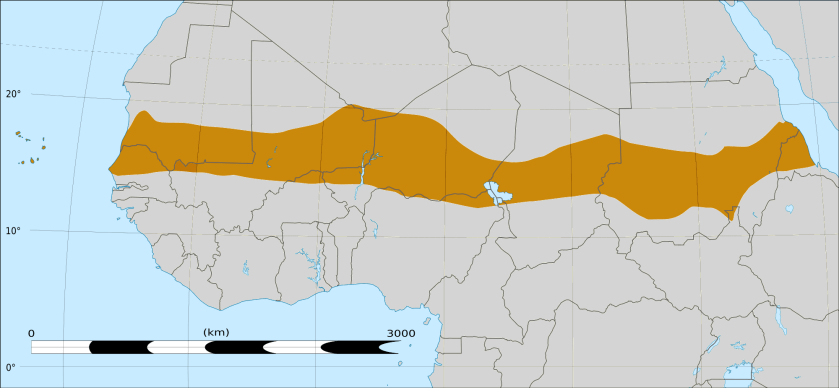
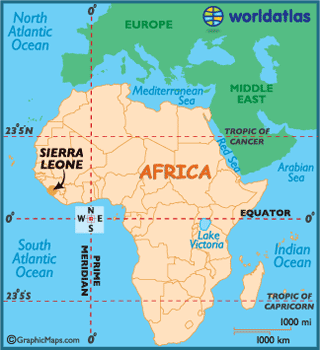
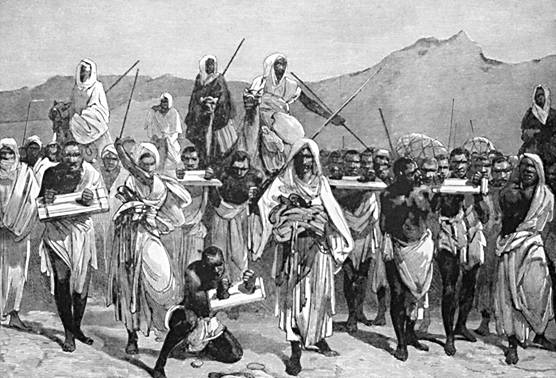 While this type of “slave” retained rudimentary rights at this time, those unfortunate enough to be captured by Dutch, English and French slavers, did not.
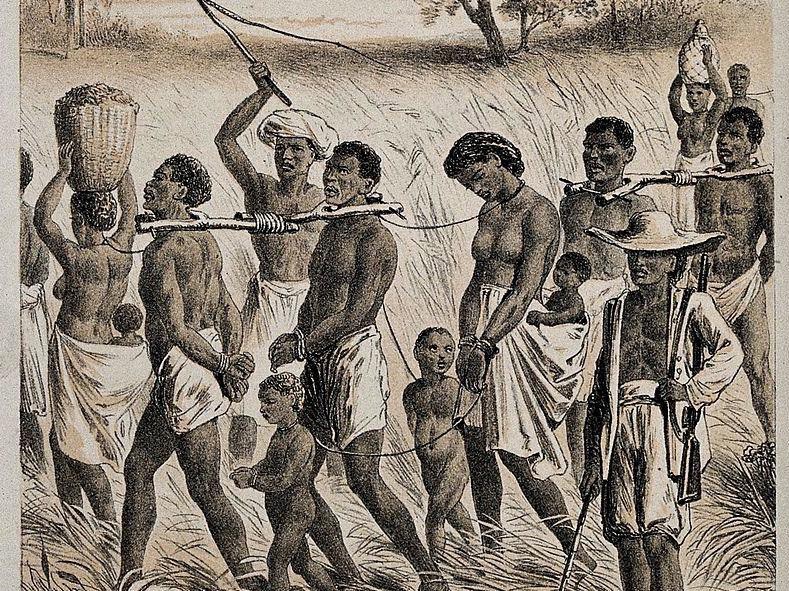 This was the world of John Newton, born July 24 (old style) 1725 and destined for a life, in the slave trade.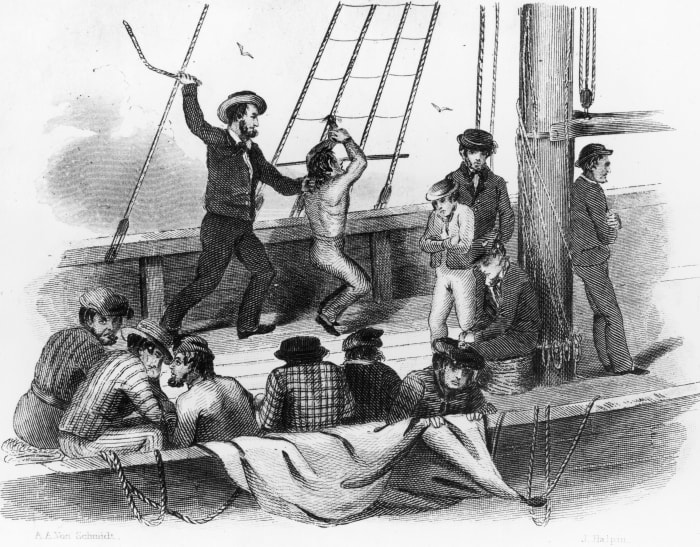
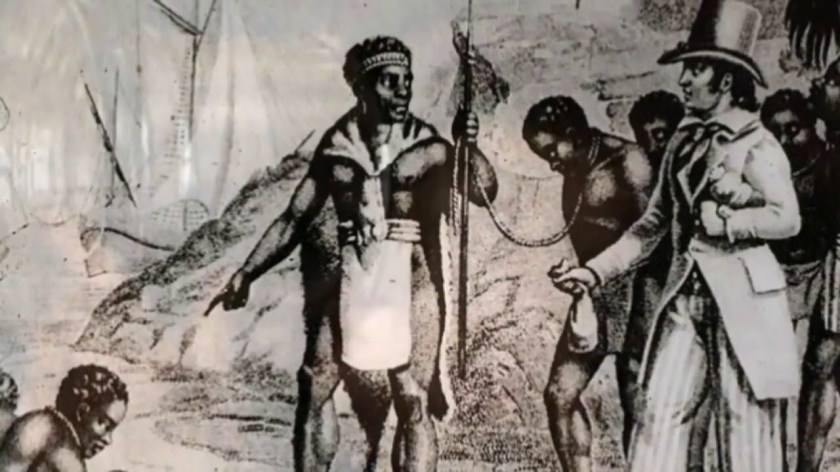 Newton hated life on the Pegasus as much as his shipmates, hated him. In 1745 he was abandoned in West Africa with a slave trader, named Amos Clowe. Newton was now himself a slave, given by Clowe to his wife Princess Peye of the Sherbro tribe, of Sierra Leone. Peye treated Newton as badly as she treated any of her other slaves, treatment as wretched as that meted out to the human beings who had fallen into his own hands, as a slave trader. Newton himself later described these three years as “once an infidel and a libertine, [now] a servant of slaves in West Africa”.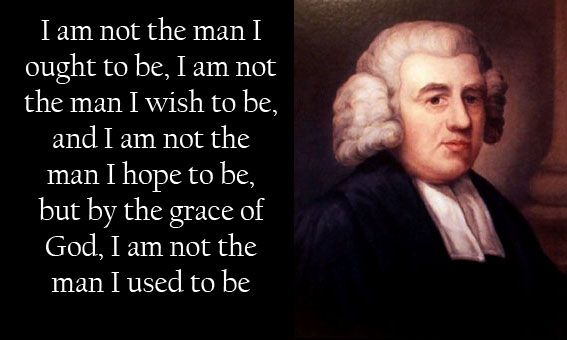
 William Cowper was an English poet and hymnist who came to worship in Newton’s church, in 1767. The pair collaborated on a book of Newton’s hymns including “Glorious Things of Thee Are Spoken,” “How Sweet the Name of Jesus Sounds!,” “Come, My Soul, Thy Suit Prepare” and others.
















 Historical Easter Eggs - Today in History
You must be logged in to post a comment.