

Dan Aykroyd developed his musical talents during the late fifties and early sixties at an Ottowa club called Le Hibou, (French for ‘the owl’). “I actually jammed behind Muddy Waters”, he once said. “S. P. Leary left the drum kit one night, and Muddy said ‘anybody out there play drums? I don’t have a drummer.’ And I walked on stage and we started, I don’t know, Little Red Rooster, something. He said ‘keep that beat going, you make Muddy feel good.’
Eric Idle of Monty Python once guest hosted, for Saturday Night Live. Idle paid the greatest tribute to Aykroyd’s comedic talent, saying he was “the only member of the SNL cast capable of being a Python”.
John Belushi joined The Second City comedy troupe in 1971, playing off-Broadway in “National Lampoon’s Lemmings”. He played The National Lampoon Radio Hour from 1973 to 1975, a half-hour comedy program syndicated on over 600 stations.
Belushi appeared from 1973 to 1975 on The National Lampoon Radio Hour, along with future SNL regulars Gilda Radner, Chevy Chase and Bill Murray. A number of their radio segments went on to become SNL sketches in the show’s first couple seasons. Dan Ackroyd tells a story about long days of rehearsals on the SNL set. An exhausted John Belushi would wander off and let himself into the house of a friend or a stranger, scrounging around for food before falling asleep in the house, unable to be found for the next day’s work. These outings were the inspiration for the SNL horror-spoof sketch “The Thing That Wouldn’t Leave”.
Lead vocalist “Joliet Jake” Blues (John Belushi) and harmonica player/backing vocalist Elwood Blues (Dan Aykroyd) had their musical debut on January 17, 1976 in a comedy sketch on Saturday Night Live. “The Blues Brothers” appeared twice more on SNL sketches, both in 1978, before releasing their first album that same year: Briefcase Full of Blues. The Blues Brothers film premiered in Chicago on this day in 1980, four days before general release. Set in the windy city and sprawling across the Midwest, the musical/comedy film tells the story of a paroled convict and his brother, and their mission to save the Catholic orphanage in which they were raised from foreclosure. The Blues Brothers’ “Mission from God” needs to raise $5,000 to pay the orphanage’s property tax bill. To do so, the pair sets out to reignite their old R&B band, pursued by the police and wrecking 103 cars along the way, a world record for that time.
While filming one of the night scenes, Belushi disappeared and couldn’t be found. Looking around, Dan Ackroyd found a single house with the lights on and knocked on the door. Before he could ask, the homeowner smiled and said “You’re here for John Belushi, aren’t you?” The man told his visitor that Belushi had entered the house, asked if he could have a glass of milk and a sandwich, and crashed on their couch.
To some, John Belushi may have been a real-life Thing that Wouldn’t Leave. To Dan Ackroyd, the man would always be “America’s Guest”.
John Belushi died in his hotel room on March 5, 1982 of a “Speedball”, a combined injection of heroin and cocaine. The cause of death was originally ruled accidental overdose, but Catherine Evelyn Smith was extradited and tried on first degree murder charges after her National Enquirer interview, in which she admitted giving Belushi the shot. A plea bargain reduced the charge to involuntary manslaughter. She served fifteen months in prison.
Belushi’s wife Judith arranged for a traditional Orthodox Christian funeral in which he was interred, twice. The first was in Abel’s Hill Cemetery in the Chilmark section of Martha’s Vineyard. A classic New England slate tombstone complete with skull and crossbones, marks the location. The inscription reads, “I may be gone but Rock and Roll lives on.” “Fans” repeatedly felt the need to desecrate the grave. The body was removed at Mrs. Belushi’s request and reburied in an undisclosed location. An unmarked tombstone in an undisclosed location marks the final burial location, where the man can at last rest in peace.
John Belushi is remembered on the family marker at his mother’s grave at Elmwood Cemetery in River Grove, Illinois. The stone reads, “HE GAVE US LAUGHTER”.


 One day, the United States Supreme Court would rule the act an unlawful taking and compensate Lee family descendants, but that must be a story for another day. As 1863 drew to a close, the property was destined to become the nation’s most hallowed ground and known to posterity, as Arlington National Cemetery.
 And yet, this is no lifeless “garden of stone”. The final resting place for over 400,000 honored dead is itself a living memorial, combining tens of thousands of native and exotic plants in a unique blending of landscapes, combined with formal and informal gardens.
 Three of these trees are Virginia state champions and one is state co-champion, including the Royal Paulownia, (Paulownia tomentosa) at the top of this page. State champion trees are those having the greatest height, crown spread and trunk circumference, for their species.
 The cemetery also has 24 Chinese Redbuds, a strain native to central China. These are only two of Arlington’s hundreds of varieties of flowering trees.
 The Cemetery’s horticulture division recently installed 297 tree labels, identifying many of the cemetery’s noteworthy specimens. Thirty-six of them form a right angle along Farragut & Wilson Drive, lending a sense of history as each is a direct descendant of a famous ancestor, each a living memorial to recipients of the Medal of Honor.
 Ancestors of these “tree descendants” include the Cottonwood of Delta Colorado, which shaded the peace meetings between settlers and Ute tribes in 1879. The Sweetgum of the Westmoreland, Virginia home of four generations of the Lee family, including Richard Henry and Francis “Lightfoot” Lee. The only brothers to have signed the Declaration of Independence. The great Charter Oak of Connecticut is represented there, a specimen sprouted sometime in the 12th or 13th century. There is the American Sycamore descended from a “witness tree” at Gettysburg. There is the Red Maple from Walden Woods, outside of Boston, and the Sycamore Maple, witness to George Washington’s crossing of the Delaware.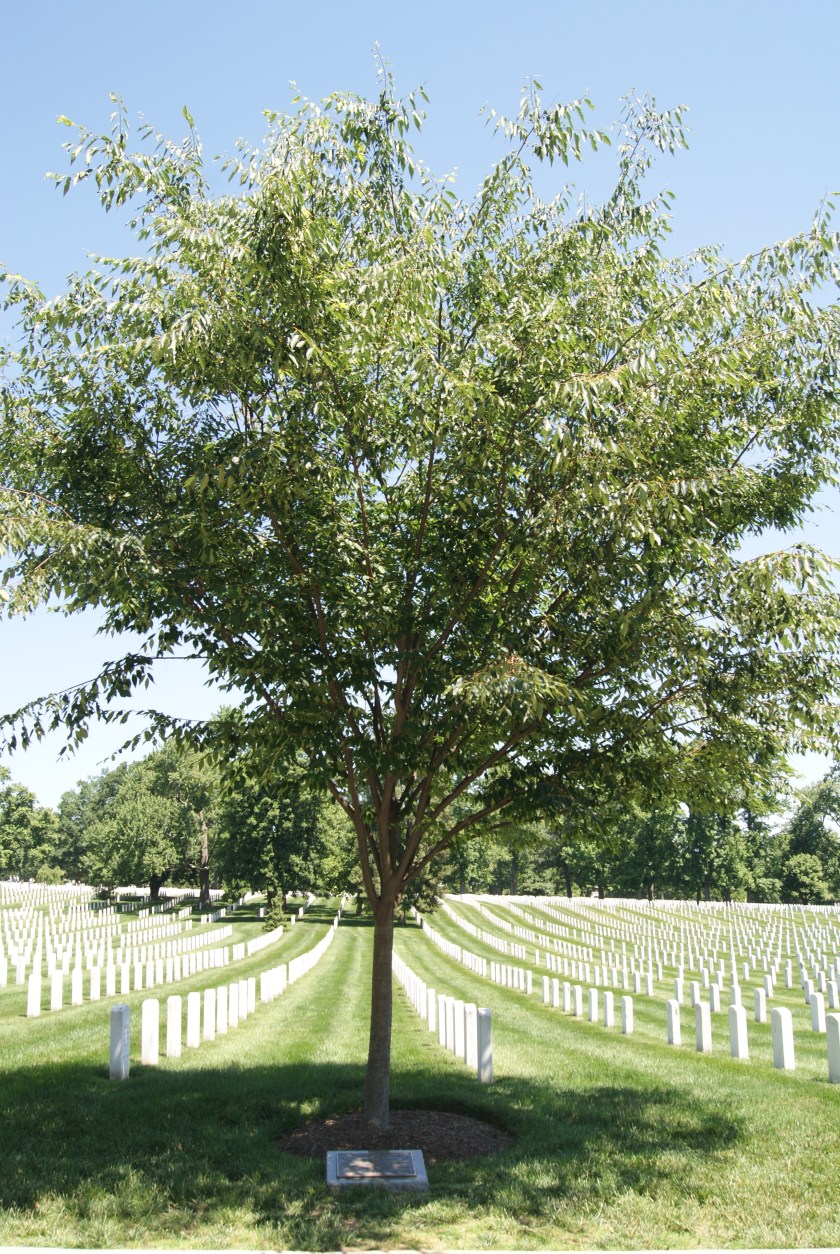


 Historical Easter Eggs - Today in History
You must be logged in to post a comment.