March 11, 1958 The Day the US, Nuked Itself

This particular nuke was unarmed that day but three tons of conventional explosives can ruin your whole day.   The weapon scored a direct hit on a playhouse built for the Gregg children, the explosion leaving a crater 70-feet wide and 35-feet deep and destroying the Gregg home, the farmhouse, workshop and several outbuildings.  Buildings within a five-mile radius were damaged, including a local church.

If you’re ever in South Carolina, stop and enjoy the historical delights of the Pee Dee region. About a half-hour from Pedro’s “South of the Border”, there you will find the “All-American City” of Florence, according to the National Civic League of 1965. With a population of about 38,000, Florence describes itself as a regional center for business, medicine, culture and finance.

Oh.  And the Federal Government dropped a Nuke on the place. Sixty-two years ago, today.

maxresdefault (29)To anyone under the age of 40, the Cold War must seem a strange and incomprehensible time.  Those of us who lived through it, feel the same way.

The Air Force Boeing Stratojet bomber left Hunter Air Force Base in Savannah, on a routine flight to Africa via the United Kingdom.  Just in case thermonuclear war was to break out with the Soviet Union, the B47 carried a 10-foot 8-inch, 7,600-pound, Mark 4, atomic bomb.

The Atlantic Coastline Railroad conductor, WWII veteran & former paratrooper Walter Gregg Sr. was in the workshop next to his home in the Mars Bluff neighborhood of Florence, South Carolina while his wife, Ethel Mae “Effie” Gregg, was inside, sewing. The Gregg sisters Helen and Frances, ages 6 and 9, were playing in the woods with their nine-year-old cousin Ella Davies as the B47 Stratojet bomber lumbered overhead.b47-7aAt 15,000-feet, a warning light came on in the cockpit, indicating the load wasn’t properly secured.   Not wanting a thing like that rattling around in the back, Captain Earl E. Koehler sent navigator Bruce M. Kulka, to investigate.  Kulka slipped and grabbed out for something, to steady himself.  That “something” just happened to be, the emergency release.

Bomb bay doors alone are woefully inadequate to hold back a 4-ton bomb. The thing came free and began a 15,000-foot descent, straight into the Gregg’s back yard.
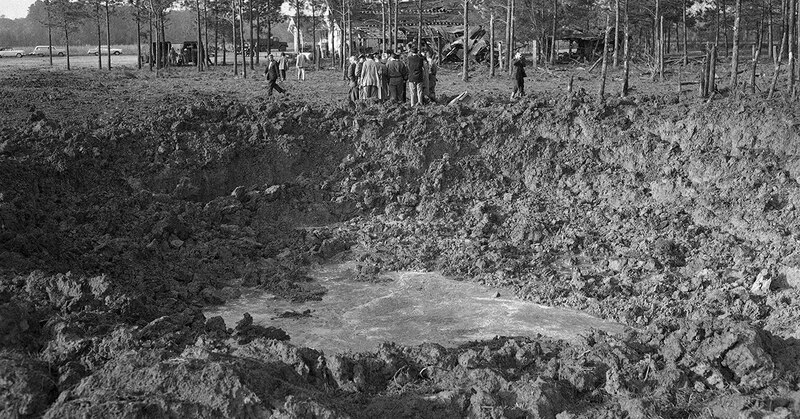
PUEBBB3QPFAQPDWDVU5VCLXD2A
This hole 50 feet wide and 20 feet deep was made after an Air Force nuclear weapon accidentally fell from a B-47 and exploded in Florence, South Carolina, March 12, 1958. The home of Walter Gregg (background) was almost destroyed. Several members of his family were treated for injuries. (AP Photo) H/T Military Times

The Mark 4 atom bomb employs an IFI (in-flight insertion) safety, whereby composite uranium and plutonium fissile pits are inserted into the bomb core, thus arming the weapon. When deployed, a 6,000-pound. conventional explosion super-compresses the fissile core, beginning a nuclear chain reaction. In the first millisecond, (one millionth of a second), plasma expands to a size of several meters as temperatures rise into the tens of millions of degrees, Celsius. Thermal electromagnetic “Black-body” radiation in the X-Ray spectrum is absorbed into the surrounding air, producing a fireball. The kinetic energy imparted by the reaction produces an initial explosive force of about 7,500 miles, per second.

This particular nuke was unarmed that day but three tons of conventional explosives can ruin your whole day.   The weapon scored a direct hit on a playhouse built for the Gregg children, the explosion leaving a crater 70-feet wide and 35-feet deep and destroying the Gregg home, the farmhouse, workshop and several outbuildings.  Buildings within a five-mile radius were damaged, including a local church.  Effie gashed her head when the walls blew in but miraculously, no one was killed except for a couple chickens.  Not even the cat.
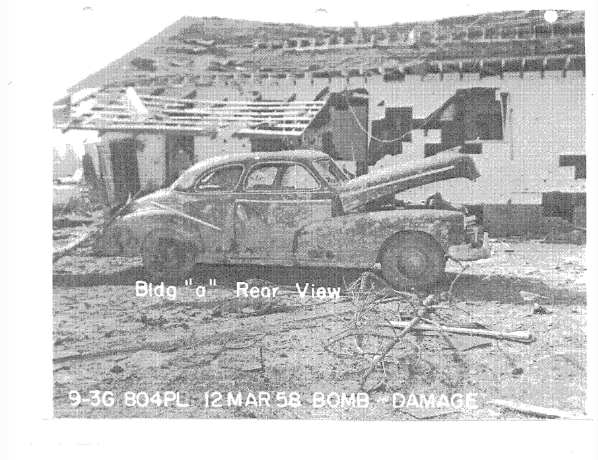
screen_shot_2016-05-11_at_60319_pmThree years later, a B-52 Stratofortress carrying two Mark 39 thermonuclear bombs broke up in the air over Goldsboro, North Carolina. Five crew members ejected from the aircraft at 9,000-feet and landed safely, another ejected but did not survive the landing. Two others died in the crash.

In this incident, both weapons were fully nuclear-enabled.  A single switch out of four, is all that prevented at least one of the things, from going off.
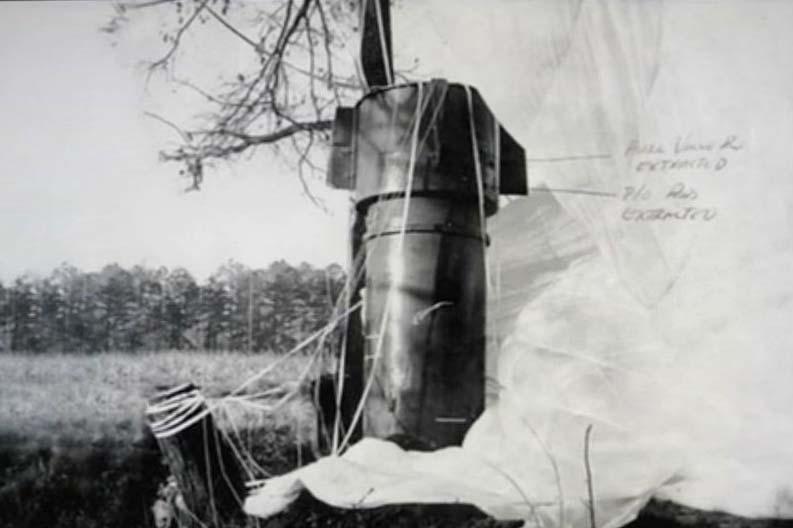
goldsboro_bomb_0
One Mk 39 nuclear weapon from the Goldsboro incident remained largely intact, with parachute still attached. The second plunged into a muddy field at about 700mph, and disintegrated.

Walter Gregg described the Mars Bluff incident in 2001, in director Peter Kuran’s documentary “Nuclear 911”. “It just came like a bolt of lightning”, he said. “Boom! And it was all over. The concussion …caved the roof in.” Left with little but the clothes on their backs, the Greggs eventually sued the Federal Government.

The family was awarded $36,000 by the United States Air force.  It wasn’t enough to rebuild the house let alone, replace their possessions.  Walter Gregg resented it, for the rest of his life.

download - 2020-03-11T083015.786Over the years, members of the flight crew stopped by to apologize for the episode.

The land remains in private hands but it’s federally protected, so it can’t be developed.   They even made a path back in 2008 and installed a few signs,  but those were mostly stolen by college kids.

You can check it out for yourself if you want to amuse the locals.  They’ll know what you’re doing as soon as you drive through the neighborhood, the second time.  Crater Rd/4776 Lucius Circle, Mars Bluff, SC (Hat tip roadsideamerica.com)

A month before the Mars Bluff incident, a hydrogen bomb was accidentally dropped in the ocean, off Tybee Island, Georgia.  Incidents involving the loss or accidental detonation of nuclear weapons are called “Broken Arrows“.  There have been 32 such incidents, since 1950.  As of this date, six atomic weapons remain unaccounted for, including that one off the Georgia coast.

Feature image top of page;  “C. B. Gregg looks at the bomb damaged home of his brother Walter Gregg who was injured after an Air Force bomb hit about 100 yards away on March 12, 1958, in Florence, S.C. (AP Photo) H/T Military Times

March 10, 1748 Amazing Grace

“I endeavored to renounce society, that I might avoid temptation. But it was a poor religion; so far as it prevailed, only tended to make me gloomy, stupid, unsociable, and useless”. John Newton

It was the Golden Age of Greek history, a time when “[Men] lived like gods without sorrow of heart, remote and free from toil and grief…”, according to the Greek poet Hesiod. A time of Confucius and the Buddha in the east while the Olmec peoples ruled over much of South and Central America, a time when the Italian city-state of Rome overthrew a Monarch, to form a Republic.

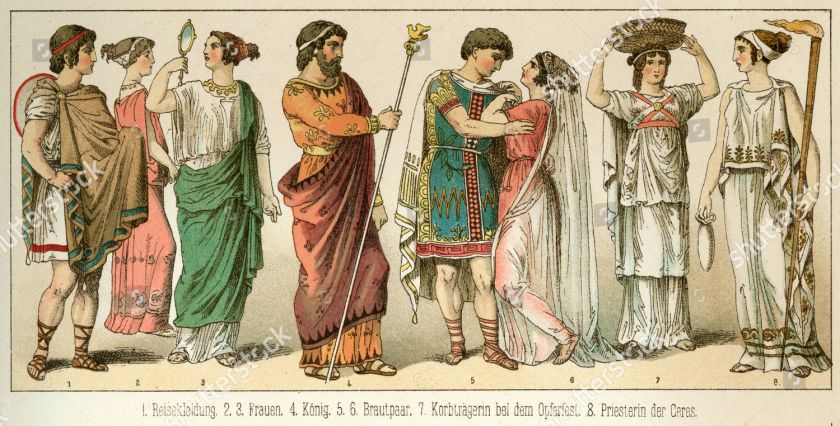
Ancient Greece Costume - circa 500 BC2,500 years ago, Bantu farmers on the African continent began to spread out across the land as the first Africans penetrated the dense rain forests of the equator, to take up a new life on the west African coast.
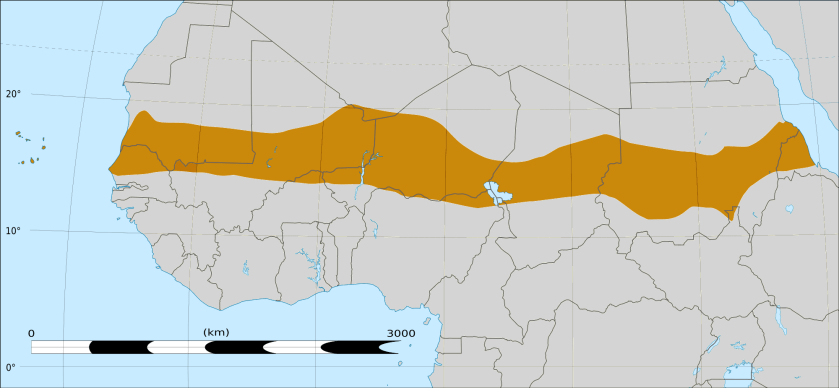
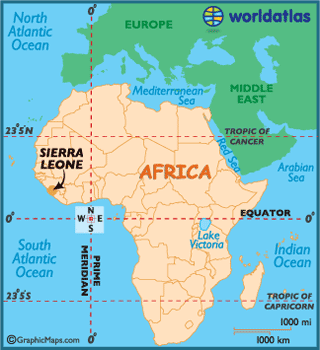
The Islamic crusades of the 7th and 8th centuries turned much of the Maghreb (northwest Africa) to Islam and displaced the Sahelian kingdoms of the sub-Saharan grasslands.   The hunters, farmers and traders of Coastal Africa remained free to make their own way, isolated by those same rain forests from the jihads and other violence of the interior.

Sahel_Map-Africa_rough
Sahelian Kingdoms of Sub-Saharan Africa

The first European contact came around 1462 when the Portuguese explorer Pedro de Sintra mapped the hills surrounding modern Freetown Harbour, naming an oddly shaped formation Serra Lyoa (Lioness Mountain).

ded91e87f93966f1ffcbc100d634a97dHome to one of the few safe harbors on the surf-battered “windward coast”, Sierra Leone soon became a favorite of European mariners, some of whom remained for a time while others came to stay, intermarrying with local women.
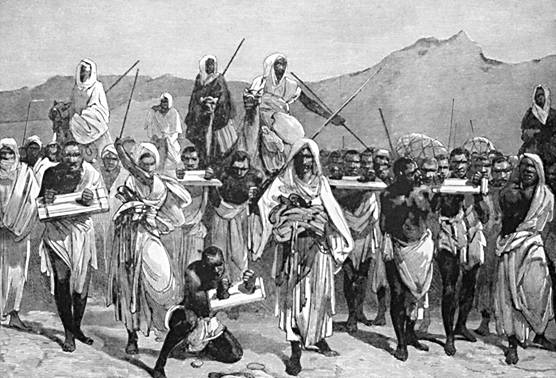
From the 6th century to a peak of around 1350, Arab slave traders conducted a rich trans-Saharan trade in human beings.

According to the Guyanese historian Walter Rodney, slavery among and between the African peoples of Sierra Leone appears to be rare at this time. Portuguese mariners kept detailed records and would have described such a thing though there was a particular kind of “slavery” in the region: “A person in trouble in one kingdom could go to another and place himself under the protection of its king, whereupon he became a “slave” of that king, obliged to provide free labour and liable for sale“.Arabslavers (1)While this type of “slave” retained rudimentary rights at this time, those unfortunate enough to be captured by Dutch, English and French slavers, did not.
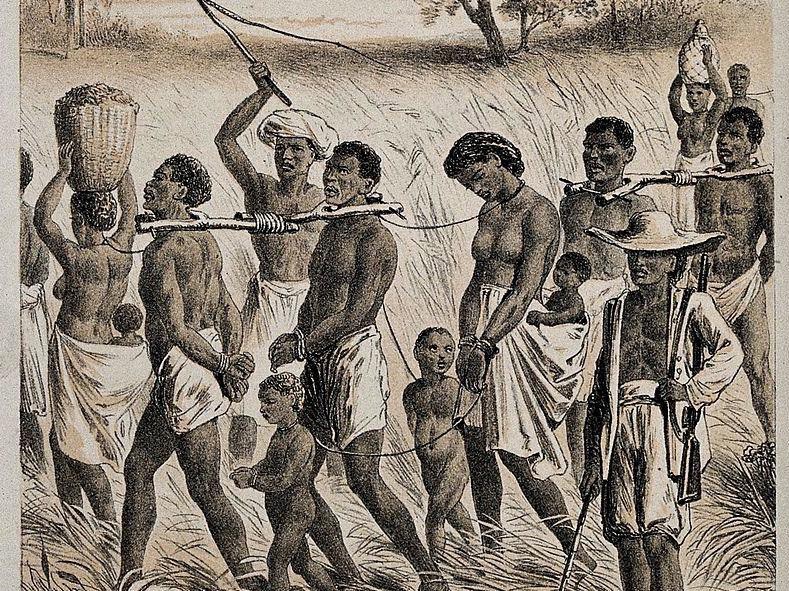
It wasn’t long before coastal kidnapping raids gave way to more lucrative opportunities.  Some chiefs were more than happy to “sell” the less desirable members of their own tribes while others made a business out of war, taking prisoners to be traded for a fortune in European goods, including muskets.

While slave “owners” were near-exclusively white and foreign at this time, the late 18th century was a time of rich and powerful African chieftains, many of whom owned large numbers of slaves, of their own.1_bUM2OMXstOAZukyNAc8oFgThis was the world of John Newton, born July 24 (old style) 1725 and destined to a life, in the slave trade.
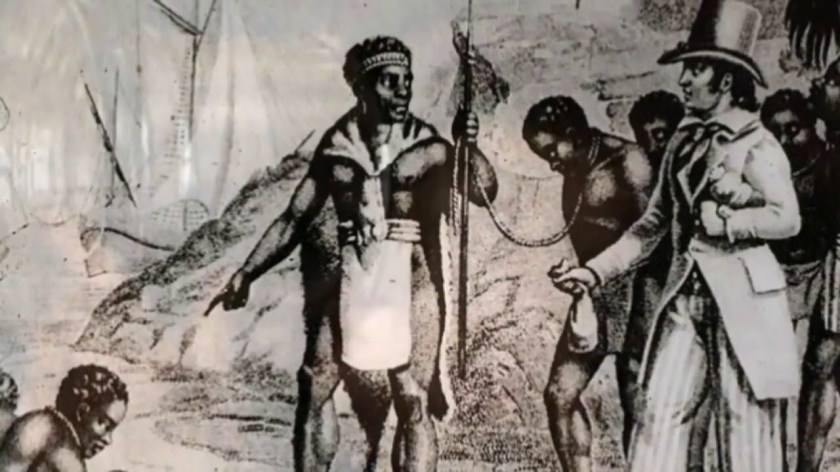
The son of a London shipmaster in the Mediterranean service, Newton first went to sea with his father at age 11 and logged six such voyages before the elder Newton retired, in 1742.

His was a wild youth, the life of a sailor bent on drinking and carousing and raising hell. That was all brought up short in 1743, when Newton was captured and “pressed” into service with the 50-gun HMS Harwich, given the rank of midshipman.

The teenager hated everything about it and tried to desert, earning himself a flogging for his troubles. Eight. Dozen. Lashes. Imagine enduring something like that.

Reduced to the rank of common seaman Newton was disgraced, wounded and humiliated. He plotted to murder the captain and hurl himself overboard but it wasn’t meant to be. His wounds healed over in time and, with the Harwich en route to India, Newton transferred to the slave ship Pegasus, bound for West Africa.

Pegasus would trade goods for slaves in Sierra Leone to be shipped to colonies in the Caribbean and North America.maxresdefault (28)Newton hated life on the Pegasus as much as they, hated him. In 1745, they left him in West Africa with slave trader Amos Clowe. Newton was now himself a slave, given by Clowe to his wife Princess Peye of the Sherbro tribe.  Peye treated Newton as horribly as any of her other slaves. Newton himself later described these three years as “once an infidel and a libertine, [now] a servant of slaves in West Africa”.
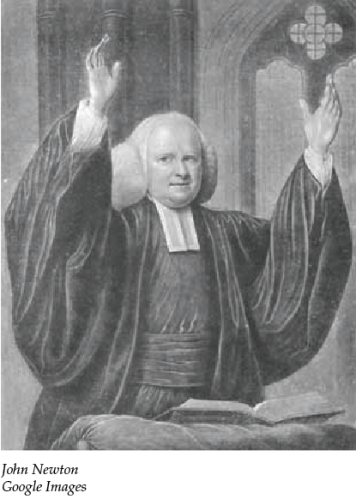
Rescued in 1748 at the request of his father, Newton was returning to England aboard the merchant ship Greyhound, when he experienced a spiritual awakening. Caught in a dreadful storm off Donegal, Greyhound seemed doomed when a great hole opened in her hull. He prayed for the mercy of God when a load somehow shifted, partially blocking the hole. In time, the storm died down. Greyhound made port in Lough Swilly, Ireland, four weeks later.

With this conversion, John Newton had come to accept the doctrines of Evangelical Christianity.  On March 10, 1748 he swore off liquor, gambling and profanity.  He would remember this day as a turning point, for the rest of his life.

There’s a popular story that Newton’s life was changed then and there but it didn’t work out that way. Those hours of despair on board the Greyhound were an awakening, yes, but Newton would return to the slave trade. Even after the 1754 stroke which ended his seafaring career, he still invested in slaving operations.

His was a gradual conversion.  “I cannot consider myself to have been a believer in the full sense of the word” he later said, “until a considerable time afterwards.”

While working as tax collector in the Port of Liverpool, Newton studied Greek, Hebrew, and Syriac, preparing himself for serious religious studies. He applied to become an ordained minister of the Anglican Church in 1757. Seven years would come and go when the lay minister applied with Methodists, Independents and Presbyterians.  He was ordained a priest of the Anglican church on April 29, 1764.

Screen shot 2013-11-21 at 11.02.31 PMMoving to London in 1780 as the Rector of St. Mary Woolnoth church, Newton became involved with the Committee for the Abolition of the Slave Trade.
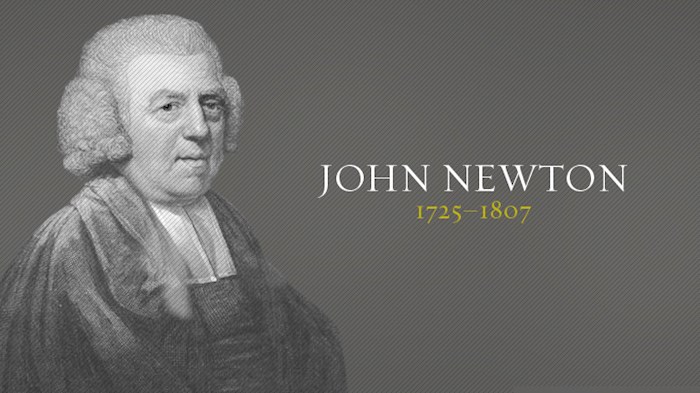
In 1788, Newton broke a long silence on the subject to take a forceful stand, against the “peculiar institution“.  In his Thoughts Upon the African Slave Trade, Newton writes:

“So much light has been thrown upon the subject…for the suppression of a traffic, which contradicts the feelings of humanity; that it is hoped, this stain of our National character will soon be wiped out.”

Newton apologized for his past in “a confession, which … comes too late … It will always be a subject of humiliating reflection to me, that I was once an active instrument in a business at which my heart now shudders.

The tract went on to two printings, describing the hideous conditions on board the slave ships and leading to the abolition of the slave trade, in 1807.67452William Cowper was an English poet and hymnist who came to worship in Newton’s church, in 1767.  The pair collaborated on a book of Newton’s hymns including “Glorious Things of Thee Are Spoken,” “How Sweet the Name of Jesus Sounds!,” “Come, My Soul, Thy Suit Prepare” and others.

“I am still in the land of the dying; I shall be in the land of the living soon”.  His last words

Today, the carousing sailor and slave trader-turned English clergyman John Newton is remembered the world over for his 1772 work, the most famous hymn in history… “Amazing Grace“.

Amazing grace, how sweet the sound,
that saved a wretch like me.
I once was lost, but now am found,
Was blind but now I see.

March 9, 1942 Alcan

Following the Japanese attack on Pearl Harbor it was never more clear. The Pacific coast was vulnerable to foreign attack.

Discussions concerning a road to Alaska began as early as 1865, when Western Union contemplated plans to install a telegraph wire from the United States to Siberia. The concept picked up steam with the proliferation of automobiles in the 1920s but the idea was a hard sell for Canadian authorities. Such a road would necessarily pass through their territory, and the Canadian government believed the project would have little impact, benefiting no more than a few thousand people in the Yukon.

As the first wave of Japanese aircraft descended to the final attack on Pearl Harbor, a force of some 5,900 soldiers and marines under Lieutenant General Tomitarō Horii invaded the American garrison on Guam, some 4,000 miles to the west.   American forces on Wake Island held out a bit longer but, by the 23rd it was over.

Priorities were changing for both the United States, and Canada.   It was never more clear that the Pacific coast, was vulnerable to foreign attack.

The Alaska Territory was particularly exposed. Situated only 750 miles from the nearest Japanese base, the Aleutian Island chain had but 12 medium bombers, 20 pursuit planes and fewer than 22,000 troops to defend an area four times the size of Texas.

Colonel Simon Bolivar Buckner Jr., son of the Confederate commander who famously received Ulysses S. Grant’s “Unconditional Surrender” ultimatum at Fort Donelson (“I propose to move immediately, upon your works”), was in charge of the Alaska Defense Command.  Buckner made his made point, succinctly. “If the Japanese come here, I can’t defend Alaska. I don’t have the resources.”

The Army approved construction of the Alaska Highway in February 1942, the project receiving the blessings of Congress and President Roosevelt within the week. Canada agreed to allow the project, provided that the United States pay the full cost, and the roadway and other facilities be turned over to Canadian authorities at the end of the war.

Construction began on  March 9 as trains moved hundreds of pieces of construction equipment to Dawson Creek, the last stop on the Northern Alberta Railway. At the other end, 10,670 American troops arrived in Alaska that spring, to begin what their officers called “the biggest and hardest job since the Panama Canal.”

In-between lay over 1,500 miles of unmapped, hostile, wilderness.

The project received a new sense of urgency on June 7, when a Japanese force of 1,140 took control of Attu Island and murdering Charles Jones, a ham radio operator and weather reporter from Ohio, and taking his wife Etta prisoner, along with 45 Aleuts.  Adding to the urgency was the fact that the Alaskan winter permits no more than an eight-month construction window.  That period was already well underway.

Construction began at both ends and the middle at once, with nothing but the most rudimentary engineering sketches. A route through the Rocky Mountains had yet to be identified.

Radios of the age didn’t work across the Rockies, and the mail was erratic.  The only passenger service available was run by the Yukon Southern airline, a run which locals called the “Yukon Seldom”.  For construction battalions at Dawson Creek, Delta Junction and Whitehorse, it was faster to talk to each other through military officials in Washington, DC.

Moving men to assigned locations was one thing.  Transporting 11,000 pieces of heavy equipment, to say nothing of supplies needed by man and machine, was quite another.

alcan-hwyTent pegs were useless in the permafrost, while the body heat of sleeping soldiers meant waking up in mud. Partially thawed lakes meant that supply planes could use neither pontoon nor ski, as Black flies swarmed the troops by day.  Hungry bears raided camps at night, looking for food.

Engines had to run around the clock, as it was impossible to restart them in the cold. Engineers waded up to their chests building pontoons across freezing lakes, battling mosquitoes in the mud and the moss laden arctic bog. Ground which had been frozen for thousands of years was scraped bare and exposed to sunlight, creating a deadly layer of muddy quicksand in which bulldozers sank in what seemed like stable roadbed.

Alaska Highway Black SoldiersThat October, Refines Sims Jr. of Philadelphia, with the all-black 97th Engineers, was driving a bulldozer 20 miles east of the Alaska-Yukon line when the trees in front of him toppled to the ground. Sims slammed his machine into reverse as a second bulldozer came into view, driven by Kennedy, Texas Private Alfred Jalufka. North had met south, and the two men jumped off their machines, grinning. Their triumphant handshake was photographed by a fellow soldier and published in newspapers across the country, becoming an unintended first step toward desegregating the US military.

24SOLD-popupA gathering at Soldier’s Summit on November 21, 1942 celebrated “completion” of the route, though the “highway” remained impassable for most vehicles, until 1943.NPR ran an interview about this story sometime in the eighties, in which an Inupiaq elder was recounting his memories. He had grown up in a world as it existed for hundreds of years, without so much as an idea of internal combustion. He spoke of the day that he first heard the sound of an engine, and went out to see a giant bulldozer making its way over the permafrost. The bulldozer was being driven by a black operator, probably one of the 97th Engineers Battalion soldiers.  The old man’s comment, as best I can remember it, was a classic. “It turned out”, he said, “that the first white person I ever saw, was a black man”.


March 8, 1917 A Political Plague

British historian Edward Crankshaw writes, the German government saw “in this obscure fanatic one more bacillus to let loose in tottering and exhausted Russia to spread infection”.

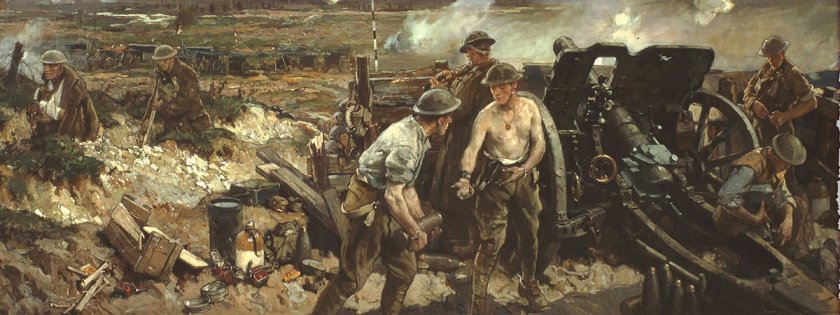
The “War to End all Wars” dragged into its third dismal year in 1917, seeming as though it would go on forever.   Like two exhausted prize fighters, neither side could muster the strength to deliver the killing blow.  Many single days of the great battles of 1916 alone  produced more casualties than every European war of the preceding 100 years, combined.  At home, the social fabric of the combatant nations was unraveling.

WW1-Timeline-1917By 1916 it was generally understood in Germany that the war effort was “shackled to a corpse”, referring the Austro-Hungarian Empire where the war had started, in the first place.  Italy, the third member of the “Triple Alliance”, was little better.  On the “Triple Entente” side, the French countryside was literally torn to pieces, the English economy close to collapse. The Russian Empire, the largest nation on the planet, was teetering on the edge of the precipice.
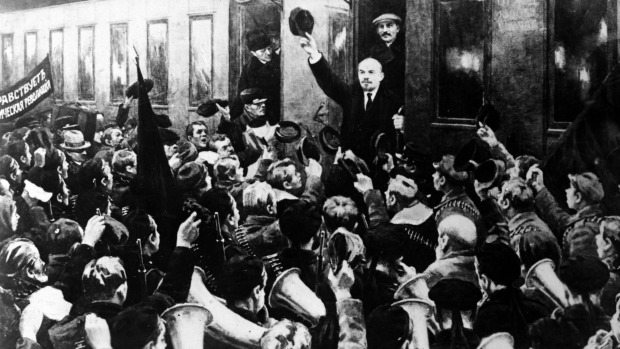
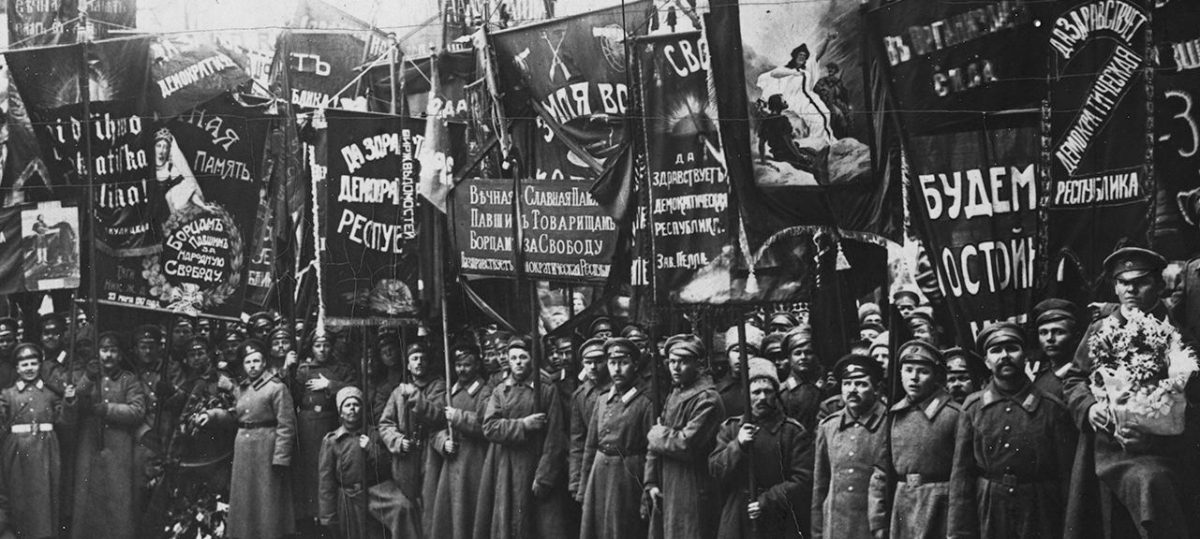
The first of two Revolutions that year began on February 23 according the “Old Style” calendar, March 8, “New Style”. Long-standing resentments over food rationing turned to mass protests in and around the Russian capital of Petrograd (modern-day Saint Petersburg). Eight days of violent demonstrations pitted Revolutionaries against police and “gendarmes”, that medieval remnant combining military units with the power of law enforcement.

By March 12 (new style), mutinous units of the Russian military had switched sides and joined with the revolutionaries. Three days later, Car Nicholas abdicated the Imperial throne.

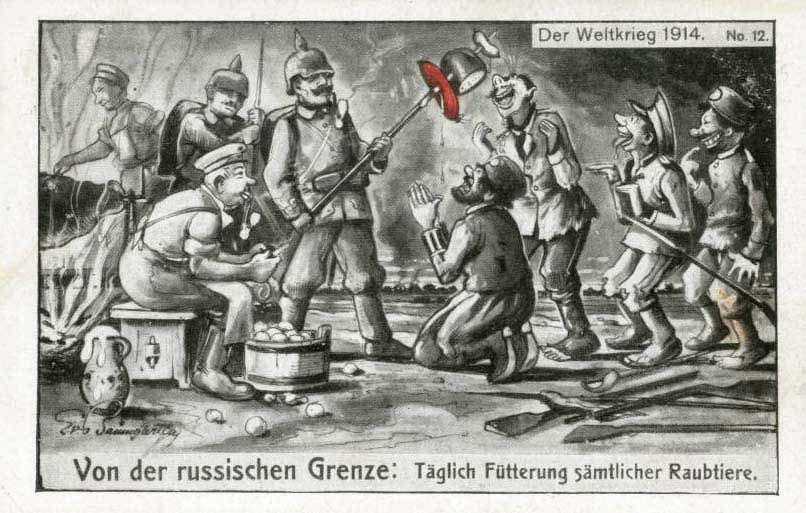
ww1-d-727-russians.jpg
German propaganda postcard depicting Russian peasants begging for food. With the size of the Russian empire and the difficulty in transportation, the propaganda wasn’t far from the truth.

Amidst all this chaos, Kaiser Wilhelm calculated that all he had to do was “kick the door in” and his largest adversary would collapse. He was right.

Following the overthrow of the Romanov dynasty, the more moderate Menshevik “Whites” vowed to continue the war effort. The split which had begun with the failed revolution of 1905 was more pronounced by this time with the radical Bolsheviks (“Reds”) taking the more extreme road. While Reds and Whites both wanted to bring socialism to the Russian people, Mensheviks argued for predominantly legal methods and trade union activism, while Bolsheviks favored armed violence.

In 1901, Vladimir Ilyich Ulyanov adopted the pseudonym “Lenin” after the River Lena, the easternmost of the three great Siberian rivers flowing into the arctic ocean. The middle-class son of a professor of mathematics and physics and the daughter of a well-to-do physician, Ulyanov became radicalized after the 1887 execution of his brother, for plotting to murder the Czar.

images (61)
Vladimir Ilyich Lenin

The man was soon convinced that capitalist society was bound to give way to socialist society with a natural transition to communism, not far behind.

Lenin was in exile when the war broke out, arrested and briefly imprisoned for his Russian citizenship. The radical revolutionary was released due to his anti-czarist sentiments when he and his wife, settled in Switzerland.

British historian Edward Crankshaw writes, the German government saw “in this obscure fanatic one more bacillus to let loose in tottering and exhausted Russia to spread infection”.

Lurching toward food riots of his own and loathe to unleash such a bacterium against his own homeland, a “Sealed Train” carrying Vladimir Ilyich Lenin and 31 dissidents departed from exile in Switzerland on April 9, complements of the Kaiser. Leaving Zurich Station amid the jeers and the insults of 100 or so assembled Russians shouting “Spies!” “Traitors!” “Pigs!” “Provocateurs!” Lenin turned to a friend and said. “Either we’ll be swinging from the gallows in three months, or we shall be in power.”

North through Germany and across the Baltic Sea, this political plague bacillus traveled the length of Sweden arriving in Petrograd on the evening of April 16, 1917.  Like the handful of termites that brought down the mighty oak, this small faction inserted into the body politic that April, would help to radicalize the population and consolidate Bolshevik power.Sealed TrainBy October, Russia would experience its second revolution of the year. The German Empire could breathe easier. The “Russian Steamroller” was out of the war.  And none too soon, too.  With the Americans entering the war that April, Chief of the General Staff Paul von Hindenburg and his deputy Erich Ludendorff could now move their divisions westward, in time to face the arrival of the American Expeditionary Force.
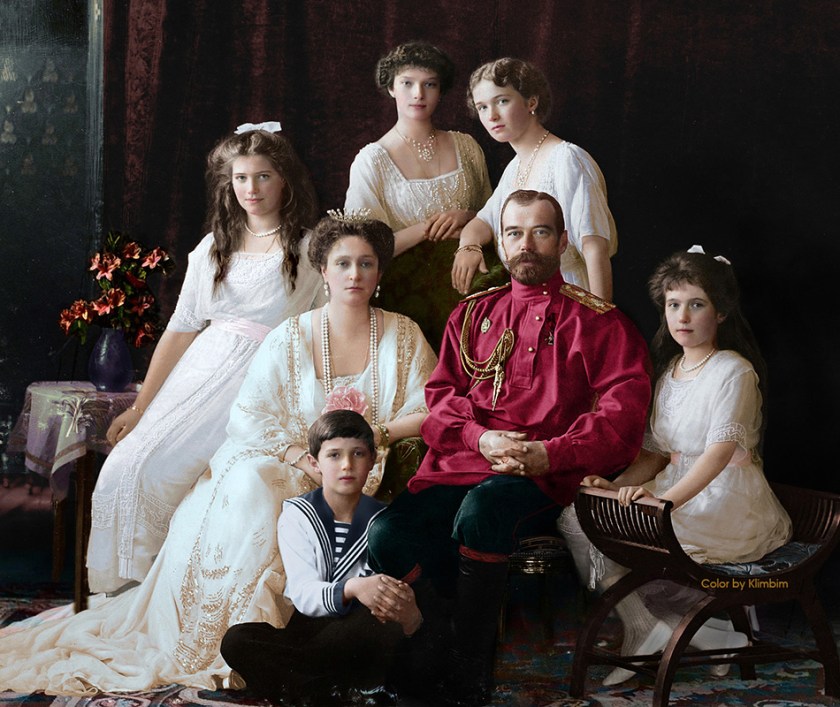
On July 17, 1918, an assassination squad from the Ural Soviet of Workers’ Deputies murdered Czar Nicholas along with his wife and children, family physician, servants and dogs.   It was the end of the Romanov Dynasty, the end of Czarist Russia.  The citizens murdered by the totalitarian system of government which would rise in its place, has been estimated as high as sixty million.

Romanov
Czar Nicholas II & family, colorized by the Russian artist Olga Shirnina, also known as ‘klimbim’

March 7, AD321 The Colossus of Nero

Suetonius described the complex as “ruinously prodigal”.  Nero himself would say nothing further on the palace’s dedication, save to say that he “had at last begun to live like a human being”.

tumblr_ml8frcaVTI1so9sc2o1_400
The cithara or kithara (Greek: κιθάρα, kithāra, Latin: cithara) was an ancient Greek musical instrument in the lyra family of instruments

A story comes down to us from two thousand years.  A tale of Emperor Nero, playing the fiddle while Rome burned.

Far be it for me to leap to the defense of a man who ordered the murder of his own wife and mother, except in the name of historical accuracy. The viol class of musical instruments to which the fiddle belongs, didn’t come along until the 11th century. If Nero played anything it was probably a Cithara, a heavy wooden instrument with four to seven strings.

No fewer than five versions come down to us about the Great Fire of 64AD, and the Emperor’s role in it. The Roman historian Tacitus tells us that Nero sang about the fall of Troy while the city burned, but admits to having no witnesses.

Cassius Dio and Suetonius ask us to believe, each in their turn, that Nero secretly sent guys out to burn the city, or, openly did so and watched from the tower of Maecenas while singing and playing the lyre, or, the fire was started by an obscure religious sect called “Christians”, or, Nero sent his guys out after all, but sang and played his lyre from a private stage or, the fire started by accident while Nero was away at Antium, rushing back 35 miles to help the now-homeless people of Rome.nero_fiddled_while_rome_burnedBe that as it may, three things are certain. First, The fire burned for six days, utterly destroying three of the 14 districts of Rome and severely damaging seven others.  Second, Nero used the excuse of the fire to go after Christians, having many of them arrested and executed. Third, the Domus Aurea (“Golden Palace”) and surrounding “Pleasure Gardens” emperor Nero built on the ruins, would be the death of him.

Over the next three years, Emperor Nero built a vast palace complex over an area of more than 200 acres, linking existing buildings on the Palatine Hill with the Gardens of Maecenas and other imperial properties on the Esquiline hills and adding a grand colonnaded approach and vestibule surrounding an artificial lake.

Reconstruction_3D_Domus_Aurea_Nero_Golden_House_5
Reconstruction of the Domus Aurea, of Nero

One of the Great Wonders of antiquity, Nero’s “Golden house” was ruinously expensive, 300 rooms of dazzling white marble with pools in the floors and fountains splashing in corridors. There were jewel-encrusted walls and ivory clad columns.  An enormous vaulted ceiling completing the dome of the main dining room.  Slaves cranked an ingenious mechanism causing the ceiling to revolve like the heavens, as rose petals fluttered to the floor and atomized perfume spritzed on the assembled diners.

Suetonius described the complex as “ruinously prodigal”.  Nero himself would say nothing further on the palace’s dedication, save to say that he “had at last begun to live like a human being”.

300px-El_Coloso_de_Nerón
Artist’s rendering of the Colossus of Nero holds a rudder on the globe, symbolizing his dominion over land and sea

At the center of it all was the Colossus Neronis, the Colossus of Nero, a giant gilded bronze statue…of himself.  Sources describe the thing as standing between 99′ and 121′ tall, roughly equivalent to the distance from the feet to the crown, of the Statue of Liberty.

With all of Italy “thoroughly exhausted by contributions of money” and “the provinces ruined”, the Emperor himself was universally hated.  In June 68, a runner arrived to inform the emperor.  He’d been tried in absentia and declared an enemy of the Roman people, sentenced to be returned to the Forum, and beaten to death.

Preparing himself for suicide, Nero paced up and down, muttering “Qualis artifex pereo”.  “What an artist dies in me”.   In the end, Nero was unable to take his own life.  He forced his private secretary Epaphroditos, to do the deed.

Ironically, Nero’s demise may have been unnecessary.  Notwithstanding the sentence of death, this was the end of Julio-Claudian dynasty.  The Senate was reluctant to put an end to a deified bloodline, even in the form of such a reviled individual.  Frantic negotiations were ongoing even as the emperor lay dying, to at least keep the man around, until he could produce an heir.

Nero’s days of being put out to stud, were never meant to be.  For his successors, the  profligate spending and outrageous lifestyle was a severe embarrassment.  Within a decade, the palace and surrounding complex was stripped of its marble, jewels, and ivory embellishments.domus_aurea_tour-tSa-1479X424Within forty years, most of the grounds were filled with earth and built over, replaced by the Baths of Titus and the Temple of Venus and Rome. Vespasian drained the lake and built the Flavian Amphitheatre.

And still, the Colossus of Nero lived on.

In 69, Emperor Vespasian added a sun-ray crown and renamed the thing Colossus Solis, a dedication to the Roman sun god Sol Invictus (“Unconquered Sun”), patron of the legions and official Sun God of the late Roman Empire.

Around 128, Emperor Hadrian moved the statue from the Domus Aurea to just outside of the Colosseum, with a little help from the architect Decrianus and 24 elephants. Emperor Commodus removed the head and replaced it with a likeness of his own, but the head was restored after the death of Commodus, and so it remained.800px-RomeConstantine'sArch03The Arch of Constantine, the last and largest of the Triumphal Arches of Rome and dedicated in AD315, was carefully positioned to align with Sol Invictus, so that the Colossus formed the dominant backdrop when approaching the Colosseum via the main arch.

Six years later, March 7, AD321, Constantine I “The Great” decreed Dies Solis – Day of the Sun or “Sun-day” – as the Roman day of rest (Codex Justinianus 3.12.2):

On the venerable day of the Sun let the magistrates and people residing in cities rest, and let all workshops be closed. In the country however persons engaged in agriculture may freely and lawfully continue their pursuits because it often happens that another day is not suitable for grain-sowing or vine planting; lest by neglecting the proper moment for such operations the bounty of heaven should be lost”.\

Constantine’s day of rest remains all these 2,000 years later but the colossus of the Unconquered Sun, is gone.  Where the thing went, nobody knows.  The last known reference in antiquity dates back to the Calendar of 354, the earliest illuminated manuscript containing full page illustrations.

Saint Bede of northumbria

Nero’s Colossus may have been destroyed during the Sack of Rome, in 410.  Perhaps it toppled in one of a series of 5th century earthquakes, the metal collected for scrap.

There is evidence that Sol Invictus outlived the western Roman Empire and survived into the early middle ages. Bede the Venerable, an English monk from the monastery of St. Peter in Northumbria, wrote sometime circa 672–735: “As long as the Colossus stands, Rome will stand, when the Colossus falls, Rome will also fall, when Rome falls, so falls the world“.

Nothing remains of the Colossus of Nero, save for the foundations of a pedestal at the second location, near the ruins of the Colosseum.

March 6, 1857 A Simple Man Who Wanted To Be Free

“We are now told, in tones of lofty exultation, that the day is lost all lost and that we might as well give up the struggle. The highest authority has spoken. The voice of the Supreme Court has gone out over the troubled waves of the National Conscience, saying peace, be still . . . The Supreme Court of the United States is not the only power in this world. It is very great, but the Supreme Court of the Almighty is greater”. – Frederick Douglass

Dred Scott.  His given name may have been “Etheldred”.  He was born into slavery in Southampton County, Virginia sometime in the late 1790s, home of Nat Turner’s rebelion, some 70 years before..  In 1818, Scott belonged to Peter Blow, who moved his family and six slaves to Alabama, to attempt a life of farming. The farm near Huntsville was unsuccessful and the Blow family gave up the effort, moving to St. Louis Missouri in 1830 to run a boarding house.

Blow died in 1832 and Dred Scott was sold to Dr. John Emerson, a surgeon serving in the United States Army.

dred__harriet_scott_quarters
Dred & Harriet Scott’s restored quarters, at Ft. Snelling

As an army officer, Dr. Emerson moved about frequently, bringing Scott with him. In 1837, Emerson moved to Fort Snelling in the free territory of Wisconsin, now Minnesota. There, Scott met and married Harriet Robinson, a slave belonging to fellow army doctor and Justice of the Peace, Lawrence Taliaferro.

Taliaferro, who presided over the ceremony, transferred Harriet to Emerson, who continued to regard the couple as his slaves. Emerson moved away later that year, leaving the Scotts behind to be leased by other officers.

The following year, Dr. Emerson married Eliza Irene Sanford, and sent for the Scotts to rejoin him in Fort Jesup, in Louisiana. Harriett gave birth to a daughter while on a steamboat on the Mississippi, between the free state of Illinois and the Iowa district of the Wisconsin Territory.

images (25)Dr. Emerson died in 1842, leaving his estate to his wife Eliza, who continued to lease the Scotts out as hired slaves.

Four years later, Scott attempted to buy his freedom for the sum of $300, equivalent to about $10,000 in 2020. Mrs. Emerson declined the offer and Scott took legal recourse. By this time, Dred and Harriett Scott had two daughters who were approaching an age where their value would be greatly increased, should they be sold as slaves. Wanting to keep his family together, Scott sued.

Ironically, Dred Scott’s suit in state court, Scott v. Emerson, was financially backed by three now-adult Blow children, who had since become abolitionists.

The legal position stood on solid ground, based on the doctrine “Once free, always free”. The Scott family had resided in free states and territories for two years and their eldest daughter was born on the Mississippi River, between a free state and a free territory.

The verdict went against Scott but the judge ordered a retrial, which was held in January, 1850. This time, the jury ruled in favor of Dred Scott’s freedom. Emerson appealed and the Missouri supreme court struck down the lower court ruling, along with 28 years of Missouri precedent.

By 1853, Eliza Emerson had remarried and moved to Massachusetts, transferring ownership of the Scott family to her brother, John Sanford. Scott sued in federal district court, on the legal theory that the federal courts held “diversity jurisdiction”, since Sanford lived in one state (New York), and Scott in another (Missouri). Dred Scott lost once again and appealed to the United States Supreme Court, a clerical misspelling erroneously recording the case as Dred Scott v. Sandford.

On March 6, 1857, Chief Justice Roger B. Taney delivered the 7-2 majority opinion, enunciating one of the stupidest decisions, in the history of American jurisprudence:
“[Americans of African ancestry] had for more than a century before been regarded as beings of an inferior order, and altogether unfit to associate with the white race, either in social or political relations; and so far inferior, that they had no rights which the white man was bound to respect; and that the negro might justly and lawfully be reduced to slavery for his benefit. He was bought and sold, and treated as an ordinary article of merchandise and traffic, whenever a profit could be made by it”.

download (18)
Frederick Douglass

The highest court in the land had ruled that slaves were private property and not citizens, with no right to legal recourse. Furthermore, the United States Congress had erred in attempting to regulate slavery in the territories and had no right to revoke the property rights of a slave owner, based on his place of residence.

Response to the SCOTUS decision was immediate, and vehement. Rather than settle the issue once and for all, the ruling inflamed public opinion, further dividing an already fractured nation. Frederick Douglass assailed Chief Justice Taney’s opinion, noting that:

“We are now told, in tones of lofty exultation, that the day is lost all lost and that we might as well give up the struggle. The highest authority has spoken. The voice of the Supreme Court has gone out over the troubled waves of the National Conscience, saying peace, be still . . . The Supreme Court of the United States is not the only power in this world. It is very great, but the Supreme Court of the Almighty is greater”.

220px-Dred_Scott_photograph_(circa_1857)
Dred Scott, photograph circa 1857

The Supreme Court had spoken, but Dred Scott’s story was far from over.  Eliza Irene Emerson’s new husband was Calvin C. Chaffee, an influential member of the United States Congress.  And an abolitionist.

Following the Dred Scott decision, the Chaffees deeded the Scott family over to Henry Taylor Blow, now a member of the United States House of Representatives from Missouri’s 2nd Congressional district, who manumitted the family on May 26.

Dred Scott had lost at virtually every turn, only to win his freedom at the hands of the family who once held him enslaved.

For Harriett and the two Scott daughters, it was the best of all possible outcomes.  For Scott himself, freedom was short-lived.  Dred Scott died of tuberculosis, the following year.

Slaves Issues Plague the Democratic Party

Nationally, the Dred Scott decision had the affect of hardening enmities already nearing white-hot, increasing animosities within and between pro- and anti-slavery factions in North and South, alike. Politically, the Democratic party was broken into factions and severely weakened while the fledgling Republican party was strengthened, as the nation was inexorably drawn to Civil War.

The issue of Black citizenship was settled in 1868, via Section 1 of the 14th Amendment, which states: “All persons born or naturalized in the United States, and subject to the jurisdiction thereof, are citizens of the United States and of the State wherein they reside …”

Dred Scott is buried in the Calvary Cemetery in St. Louis, Missouri. The marker next to his headstone reads: “In Memory Of A Simple Man Who Wanted To Be Free.”

dredscottmarker

March 5, 1770 Blood on the Snow

On this day in 1770, the insults of a cocky 13-year-old led to one of the seminal events, of the American Revolution.

In living memory, France and Great Britain have always been allies.  In war and peace from the Great War to World War 2 to the present day, but such was not always the case.  Between the Norman Invasion of 1066 and the Napoleonic Wars of 1802-1815, the two allies have found themselves in a state of war no fewer than forty times.

Throughout most of that history, the two sides would clash until one or the other ran out of money, when yet another treaty would be trotted out and signed.

New taxes would be levied to bolster the King’s treasury, and one or the other would be back for another round. The cycle began to change in the late 17th century for reasons which may be summed up with a single word.  Debt.

In the time of Henry VIII, British military outlays as a percentage of central government expenses averaged 29.4%. By 1694 the Nine Years’ War had left the English Government’s finances in tatters. £1.2 million were borrowed by the national treasury at a rate of 8 percent from the newly formed Bank of England.

The age of national deficit financing, had arrived.

In one of the earliest known debt issues in history, Prime Minister Henry Pelham converted the entire national debt into consolidated annuities known as “consols”, in 1752.  Consols paid interest like regular bonds, with no requirement that the government ever repay the face value.  18th century British debt soared as high as 74.6%, and never dropped below 55%.

The Seven Years’ War alone, fought on a global scale between 1756 to 1763, saw British debt double to the unprecedented sum of £150 million, straining the national economy.

American colonists experienced the conflict in the form of the French and Indian War, for which the Crown laid out £70,000,000.  The British government saw its American colonies as beneficiaries of their expense, while the tax burden on the colonists themselves remained comparatively light.  townsend

For American colonists, the never ending succession of English wars had accustomed them to running their own affairs.

The “Townshend Revenue Acts” of 1767 sought to force American colonies to pick up the tab for their own administration, a perfectly reasonable idea in the British mind. The colonists had other ideas.  Few objected to the amount of taxation as much as whether the British had the right to tax them at all. They were deeply suspicious of the motives behind these new taxes, and were not about to be subjugated by a distant monarch.

The political atmosphere was brittle in 1768, as troops were sent to Boston to enforce the will of the King. Rioters ransacked the home of a newly appointed stamp commissioner, who resigned the post following day. No stamp commissioner was actually tarred and feathered, a barbarity which had been around since the days of Richard III “Lionheart”, though several such incidents occurred at New England seaports.  More than a few loyalists were ridden out of town on the backs of mules.

The Massachusetts House of Representatives sent a petition to King George III asking for the repeal of the Townshend Act.  A Circular Letter sent to the other colonial assemblies, called for a boycott of merchants importing those goods affected by the act.  Lord Hillsborough responded with a letter of his own, instructing colonial governors in America to dissolve those assemblies which responded to the Massachusetts body.

tea-act-gettyimages-53071471The fifty gun HMS Romney arrived in May, 1769.  Customs officials seized John Hancock’s merchant sloop “Liberty” the following month, on allegations the vessel was involved in smuggling.  Already agitated over Romney’s impressment of local sailors, Bostonians began to riot. By October, the first of four regular British army regiments arrived in Boston.

On February 22, 1770, 11-year-old Christopher Seider joined a mob outside the shop of loyalist Theophilus Lillie.  Customs official Ebenezer Richardson attempted to disperse the crowd.  Soon the mob was outside his North End home.  Rocks were thrown and windows broken.  One hit Richardson’s wife.  Ebenezer Richardson fired into the crowd, striking Christopher Seider.  By nightfall, the boy was dead.  2,000 locals attended the funeral of this, the first victim of the American Revolution.

bostonmassacrebychampneyEdward Garrick was a wigmaker’s apprentice, who worked each day to grease and powder and curl the long hair of the soldier’s wigs.

Weeks earlier, the wigmaker had given British Captain-Lieutenant John Goldfinch, a shave.

A cocky 13-year old, Garrick spotted the officer and taunted the man, yelling “There goes the fellow that won’t pay my master!”

Goldfinch had paid the man the day before.  The officer wasn’t about to respond to an insult from some snotty kid but private Hugh White, on guard outside the State House on King Street, took the bait.  White said the boy should be more respectful and struck him on the head, with his musket.  Garrick’s buddy and fellow wigmaker’s apprentice Bartholomew Broaders began to argue with White, as a crowd gathered ’round to watch.

As the evening pressed on, church bells began to ring.  The crowd, now fifty and growing and led by the mixed-race former slave-turned sailor Crispus Attucks threw taunts and insults, spitting and daring Private White to fire his weapon.   The swelling mob turned from boisterous to angry as White took a more defensible position, against the State House steps.  Runners alerted Officer of the Watch Captain Thomas Preston to the situation, who dispatched a non-commissioned officer and six privates of the 29th Regiment of Foot, to back up Private White.

Bayonets fixed, the eight took a semi-circular defensive position with Preston himself, in the lead.  The crowd, now numbering in the hundreds, began to throw snowballs.  Then stones and other objects.  Private Hugh Montgomery was knocked to the ground and, infuriated, came up shooting.

2009_BostonMassacre_site_3658174192The two sides stopped for a few seconds to two minutes, depending on the witness.  Then they all fired.  A ragged, ill-disciplined volley.  There was no order, just the flash and roar of gunpowder on the cold late afternoon streets of a Winter’s day.  It was March 5.  When the smoke cleared, three were dead.  Two more lay mortally wounded and another six, seriously injured.

The mob moved away from the spot on King Street, now State Street, but continued to grow in the nearby streets.  Speaking from a balcony, acting Governor Thomas Hutchinson was able to restore some semblance of order, only by promising a full and fair inquiry.

Future President John Adams defended the troopers assisted by Josiah Quincy and Loyalist Robert Auchmuty.  Massachusetts Solicitor General Samuel Quincy and private attorney Robert Treat Paine handled the prosecution in two separate trials, one for Captain Preston, the other for the eight enlisted soldiers.

Two were convicted but escaped hanging, by invoking a medieval legal remnant called “benefit of clergy”. Each would be branded on the thumb in open court with “M” for murder.  The others were acquitted, leaving both sides complaining of unfair treatment.  It was the first time a judge used the phrase “reasonable doubt.”

6923394409_1e71688405_b
Boston Massacre–A Battle for Liberty. Murals of the Capitol, by Constantino Brumidi

The only conservative revolution in history, was fewer than six years in the future.

There is a circle of stones in front of the Old State House on what is now State Street, marking the site of the Boston Massacre.  British taxpayers continue to this day, to pay interest on the debt left to them, by the decisions of their ancestors.

bostonmassacre21

March 3, 1817 Land of the Vine and Olive

Thus begins one of the more romanticized chapters in Alabama folklore.  The noble heroes of the Napoleonic wars, carving a new world of French language and culture from the wild frontier.

In the Treaty of Paris in 1783,  the British Crown formally recognized American Independence, ceding vast territories east of the Mississippi, effectively doubling the size of the fledgling United States and paving the way for westward expansion. north_america_1670Those first ten years of independence was a time of increasing unrest for the American’s French ally, of the late revolution.  The famous Storming of the Bastille of July 1789 led to the Women’s March and the abolition of the French monarchy the following year.  King Louis XVI was beheaded by guillotine in January 1793 followed ten months later by the execution of the Queen Consort of France, Marie Antoinette.

The orgy of violence known as “The Reign of Terror” killed nearly twice as many Frenchmen over the next two years, as that of Americans killed during the entire seven years of the Revolution.

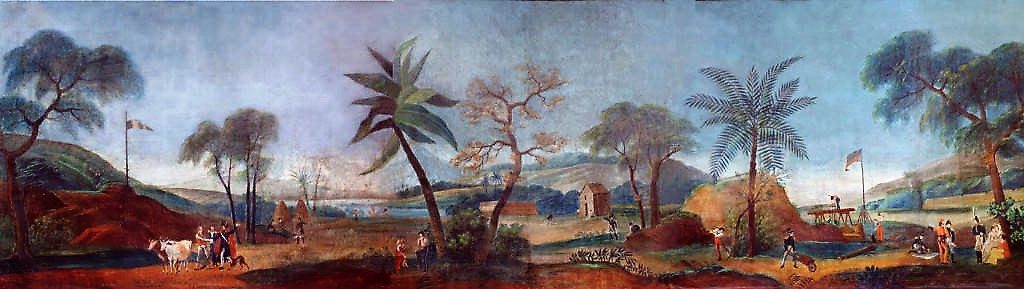
A certain Corsican corporal emerged from this mess, with designs on La Louisiane.  Napoleon envisioned a vast north American empire stretching from the gulf of Mexico to the modern state of Montana and east to the Great Lakes, all of it centered on a vast trade in Caribbean sugar.napoleon_bonaparte_promoIt wasn’t meant to be. The slave insurrection of Toussaint Louverture in the French colony of Saint-Domingue (modern-day Haiti) put a strain on French finances, to say nothing of the never-ending series of wars on the European landmass.  By 1803, Bonaparte needed to cash his chips and move away from the American table.

Robert R. Livingston, one of the committee of five who drafted the Declaration of Independence, was minister to the French Republic.  President Thomas Jefferson instructed Livingstone to open the way for commerce on the western frontier, authorizing the diplomat to pay up to $2 million for the city of New Orleans and lands on the east bank of the Mississippi river.

French Foreign Minister Talleyrand surprised the American diplomat, asking how much the Americans would pay for the Entire Louisiana territory.  The Louisiana Purchase of 1803 added 828,000 square miles of new territory at a cost of fifteen million dollars.louisiana-purchaseNapoleon Bonaparte, crowned Emperor the following year, would fight (and win) more battles than Julius Caesar, Hannibal, Alexander the Great and Frederick the Great, combined.

It was all for nothing.  The first fall of the Napoleonic dynasty brought about the restoration of the Bourbon monarchs in 1814, leading to the “100 days” and Napoleon’s final defeat in 1815, at a place called Waterloo.

Philadelphia and New Orleans both, would soon become sanctuaries for French refugees of the Napoleonic wars, and the Haitian Revolution.

download - 2020-03-04T061100.354 Jean-Simon Chaudron founded the Abeille Américaine in 1815 (The American Bee), Philadelphia’s leading French language newspaper.  Himself a refugee of Santo Domingo (Saint-Domingue), Chaudron catered to French merchants, emigres and former military figures of the Napoleonic era and the Haitian revolution.

The idea of a French agricultural colony in the old southwest (now the central southeastern states) first came about in 1816 and Chaudron used his newspaper to promote the project.

The Colonial Society came about that November (later renamed the Society for the Cultivation of the Vine and Olive), with General Charles Lefebvre-Desnouettes, at its head.

Congress soon took an interest in the project as did important politicians of the era including Thomas Jefferson, James Madison, and James Monroe.

The project made sense.  Many viewed these French refugees as fellow republicans, oppressed by a monarchy.  What better way to consolidate hold on western territories while at the same time building a domestic wine-making industry.  Furthermore, the work would prevent these people from forming yet another hotbed, of Napoleonic military insurrection.

m-5392In January 1817, the Society for the Vine and Olive selected a site near the Tombigbee and Black Warrior Rivers in west-central Alabama, on former Choctaw lands.  On March 3, 1817, Congress passed an act “disposing of a tract of land to embrace four townships, on favorable terms to the emigrants, to enable them successfully to introduce the cultivation of the vine and olive.”

The act granted 92,000 acres, specifying a 14-year grace period in which to dedicate a ‘reasonable’ portion of the land to cultivation at a deferred cost of $2.00 per acre.

Thus began one of the more romanticized chapters in Alabama folklore.  The noble heroes of the Napoleonic wars, carving a new world of French language and culture from the wild frontier.

The reality wasn’t quite so romantic.  Grape vines and olive saplings were ordered from Europe but many of the plants, died en route.  The grape varieties selected were a poor match for the hot and humid climate of the region, the olive trees, a dismal failure.  Congressional stipulations were relaxed over time and farmlands converted, to cotton.

m-5391General Charles Lallemand, who joined the French army in 1791, replaced Lefebvre-Desnouettes as President of the Colonial Society. A man better suited to the life of an adventurer than that of the plow, Lallemand was more interested in the wars of Latin American independence, than grapes and olives.  By the fall of 1817, Lallemand and 69 loyalists had concocted a plan to sell the land they hadn’t yet paid for, to raise funds for the invasion of Texas.

In the end, only 150 of 347 original grantees ever came to Alabama. Some died, many fled.  Most were unwilling to trade comfortable lives in Philadelphia and New Orleans, for the hardship of life on the frontier. By the planting season of 1818, there were only 69 settlers in the colony.

583b24b42a4c7_115727bLittle is left of the Vine and Olive Colony but the French Emperor lives on, in western Alabama.  Marengo County commemorates Napoleon’s June 14, 1800 victory over Austrian forces at the Battle of Marengo.  The county seat, also known as Marengo, was later renamed Linden.  Shortened from the Napoleonic victory over Bavarian forces led by Archduke John of Austria, at the 1800 battle of Hohenlinden.


Hat tip Rafe Blaufarb of Florida State University, for a great write-up of this subject. http://www.encyclopediaofalabama.org


March 2, 1864 A Civil War Story

“As we entered the place, a spectacle met our eyes that almost froze our blood with horror, and made our hearts fail within us. Before us were forms that had once been active and erect;—stalwart men, now nothing but mere walking skeletons, covered with filth and vermin. Many of our men, in the heat and intensity of their feeling, exclaimed with earnestness. ‘Can this be hell?’”.

In the early days of the Civil War, the government in Washington refused to recognize the Confederate states’ government, believing such recognition tantamount to legitimizing an illegal entity.  Accordingly, the Union refused formal agreement regarding the exchange of prisoners. Following the capture of over a thousand federal troops at the first battle of Bull Run (1st Manassas), a joint resolution in Congress called for President Lincoln to establish a prisoner exchange agreement.

In July 1862, Union Major General John Dix and Confederate Major General D. H. Hill met under flag of truce to draw up an exchange formula, regarding the return of prisoners. The “Dix-Hill Cartel” determined that Confederate and Union Army soldiers were exchanged at a prescribed rate:  captives of equivalent ranks were exchanged as equals.  Corporals and Sergeants were worth two privates.  Lieutenants were four and Colonels fifteen, all the way up to Commanding General, equivalent to sixty private soldiers.

Similar exchange rates were established for Naval personnel.ECWCTOPICPrisonerExchangeandParolePICParoledocumentsmall

President Lincoln’s emancipation proclamation of September 1862 not only freed those enslaved in Confederate territories, but also provided for the enlistment of black soldiers.  The government in Richmond responded that such would be regarded as runaway slaves and not soldiers.  Their white officers would be treated as criminals, for inciting servile insurrection.

The policy was made clear in July 1863, following the Union defeat at Fort Wagner, an action depicted in the 1989 film, Glory.  The Dix-Hill protocol was formally abandoned on July 30.  Neither side was ready for the tide of humanity, about to come.

The US Army began construction the following month on the Rock Island Prison, built on an Island between Davenport Iowa and Rock Island, Illinois. In time, Rock Island would become one of the most infamous POW camps of the north, housing some 12,000 Confederate prisoners, seventeen per cent of whom, died in captivity.illinois-1864-rock-island-bird-s-eye-view-114349732-5b6e3d7b4cedfd0025fd2c3d

On this day in 1864, the first prisoners had barely moved into the most notorious POW camp of the Civil War, the first Federal soldiers arriving on February 28.

This was Camp Sumter, better known as Andersonville.  Conditions in this place defy description. Sergeant Major Robert H. Kellogg of the 16th Regiment Connecticut Volunteers, entered this hell hole on May 2:

“As we entered the place, a spectacle met our eyes that almost froze our blood with horror, and made our hearts fail within us. Before us were forms that had once been active and erect;—stalwart men, now nothing but mere walking skeletons, covered with filth and vermin. Many of our men, in the heat and intensity of their feeling, exclaimed with earnestness. ‘Can this be hell?’”.

Over 45,000 Union troops would pass through the verminous open sewer known as Andersonville. Nearly 13,000 died there.

Andersonville1
Andersonville

Now all but forgotten, the ‘Eighty acres of Hell’ located in the Bronzeville neighborhood of Chicago was home to some forty thousand Confederate POWs between 1862 and 1865, seventeen per cent of whom, never left.  No southern soldier was equipped for the winters at Camp Douglas, nor the filth, or the disease.

Nearby Oak Woods Cemetery is home to the largest mass grave, in the western hemisphere.

f650dbc6-e197-4967-a27f-84606382b639
Camp Douglas of Chicago, known to many as “The Andersonville of the North’

Union and Confederate governments established 150 such camps between 1861 and 1865, makeshift installations of rickety wooden buildings and primitive sewage systems, often little more than tent cities.   Some 347,000 human beings languished in these places, victims of catastrophically poor hygiene, harsh summary justice, starvation, disease and swarming vermin.

The training depot designated camp Rathbun near Elmira New York became the most notorious camp in the north, in 1864.  12,213 Confederate prisoners were held there, often three men to a tent.  Nearly 25% of them died there, only slightly less, than Andersonville.   The death rate in “Hellmira” was double that of any other camp in the north.

Hellmira
Hellmira

Historians debate the degree to which such brutality resulted from deliberate mistreatment, or economic necessity.

The Union had more experience being a “country” at this time, with well established banking systems and means of commerce and transportation.  For the south, the war was an economic catastrophe.  The Union blockade starved southern ports of even the basic necessities, while farmers abandoned fields to take up arms. Most of the fighting of the Civil War took place on southern soil, destroying incalculable acres of rich farm lands.

The capital at Richmond saw bread riots as early as 1862.  Southern Armies subsisted on corn meal and peanuts.  The Confederate government responded by printing currency, about a billion dollars worth.  By 1864, a Confederate dollar was worth 5¢ in gold.  Southern inflation climbed past 6000 percent, by 1865.POW StoryCaptain Henry Wirz, commandant of the stockade at Camp Sumter, was tried and executed after the war, only one of two men to be hanged for war crimes.  Captain Wirz appeared at trial reclined on a couch, advanced gangrene preventing him from sitting up.  To some, the man was a scapegoat. A victim of circumstances beyond his control. To others he is a demon, personally responsible for the hell of Andersonville prison.

I make no pretense of answering such a question.  The subject is capable of inciting white-hot passion, from that day to this.

A personal note:

Six generations from his immigrant ancestor, James Tyner could trace his lineage through veterans of the Indian wars, the Revolution and the War of 1812.  One of those farmers who left the soil to fight for his country, Tyner died in captivity in “Hellmira”, about a month before General Robert E. Lee met General Ulysses Grant, at Appomattox.

Corporal Jacob Deppen of the 128th PA Infantry was captured and held prisoner for a time, before being paroled.  Deppen re-enlisted with the Army of the James.  He and the sole surviving member of the four Tyner brothers, Nicholas Tyner, would lay down their weapons at Appomattox.  Former enemies turned countrymen, if they could only figure out how to do it.

William Christian Long, the first to ‘anglicize’ his name from Wilhelm Lang, was Blacksmith to the 17th Pennsylvania Cavalry.  Long survived the war, his name may be found on the Pennsylvania monument, at Gettysburg.

Archibald Blue of Drowning Creek North Carolina wanted no part of what he saw as a “rich man’s war” and ordered his five sons away.  He was murdered for his politics in 1865.  The killer was never found.

Four men who played a part in the most destructive war, in American history.  Without any of these four, I wouldn’t be here to tell their story.

Rick Long

Family Plot
Family cemetery, Scotland County, North Carolina


March 1, 1420 Reformation

A popular story has Martin Luther nailing the document to the door of the Wittenberg Palace Church, but it may never have happened that way. Luther had no intention of confronting the Church at this time. This was an academic work, 95 topics offered for scholarly debate. 

Hans Luder sent his son Martin to a series of Latin schools beginning in 1497.  There the boy learned the so-called “trivium”: grammar, rhetoric, and logic. He entered the University of Erfurt in 1501 at the age of 19, receiving his master’s degree in 1505. The elder Luder (“Luther”) intended that his son become a lawyer. Years later, the younger Luther described his Latin school education as time spent in purgatory, his University a “beerhouse” and a “whorehouse”.

Martin Luther was not cut out for that world.

He entered Law School in 1505 and dropped out almost immediately. His father was furious over what he saw as a wasted education. Martin entered an Augustinian cloister that July, saying “This day you see me, and then, not ever again.”

download - 2020-03-01T075128.41316th century Church doctrine taught that the Saints built a surplus of good works over a lifetime, sort of a moral bank account.  Like “carbon credits” today, positive acts of faith and charity could expiate sin. Monetary contributions to the church could, so it was believed, “buy” the benefits of the saint’s good works, for the sinner.

As he studied the bible, Luther came to believe that the church had lost sight of the central truths of Christianity. The Grace of God wasn’t traded as a medium of exchange, he believed, but rather through faith in Jesus Christ, as the Messiah. “This one and firm rock”, he wrote, “which we call the doctrine of justification, is the chief article of the whole Christian doctrine, which comprehends the understanding of all godliness”.

Papal “commissioner for indulgences” Johann Tetzel came to Wittenberg in 1516, selling expiation to raise money to rebuild St. Peter’s Basilica, in Rome.  A saying attributed to the Dominican friar, went “As soon as the coin in the coffer rings, the soul from purgatory springs.”

Martin Luther wrote to Archbishop Albrecht on October 31, 1517, objecting to this sale of indulgences. He enclosed a copy of his “Disputation of Martin Luther on the Power and Efficacy of Indulgences”, a document which came to be known as his “95 Theses”.

cc-1509034747-1xk2ppowve-snap-imageA popular story has Martin Luther nailing the document to the door of the Wittenberg Palace Church, but it may never have happened that way. Luther had no intention of confronting the Church at this time. This was an academic work, 95 topics offered for scholarly debate.
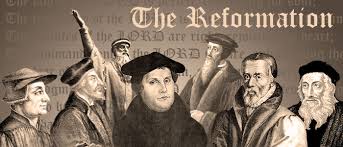
Be that as it may.  Luther’s ideas would rock the Christian world.

What seems to the modern mind as mere doctrinal differences, were life and death matters in the late middle and early modern ages. Archbishop Albrecht forwarded Luther’s note to Pope Leo X, who responded slowly and “with great care as is proper”.

Three theologians drafted heresy cases against Luther. In 1520, the papal bull (edict) “Exsurge Domine” commanded Luther to recant under pain of excommunication.

download - 2020-03-01T073858.558Luther stood on dangerous ground. Jan Hus had been burned at the stake for such heresy, back in 1415. On this day in 1420, Pope Martinus I called for a crusade against the followers of the Czech priest, the “Hussieten”.

The Italian reformer Girolamo Savonarola confessed under torture to any number of inventions and then recanted, and confessed again. Savonarola was ritually stripped of his Dominican garments and hanged in 1498, while fire was ignited from below to consume his body.  Henry VIII’s famous break with the church over his divorce from Catherine of Aragon was still years in the future in 1521, the year Henry was named “Fidei Defensor” (“Defender of the Faith”). Nine years later, French theologian Jean Calvin would be forced to flee a deadly outbreak of violence against Protestant Christians. Jan Matthias, Bernhard Rothmann and Bernhard Knipperdolling would be tortured to death with white-hot pliers in the Münster marketplace in 1535, their corpses placed in cages and hanged from the steeple of St. Lambert’s Church.

The bones of the three were later removed but those three cages remain there, to this day.lambert-cages-700x438The papal bull had the effect of hardening Luther’s positions. He publicly burned it, on December 10. Twenty-four days later, Luther was excommunicated. A general assembly of the secular authorities of the Holy Roman Empire summoned Luther to appear before them in April, in the upper-Rhine city of Worms. The “Edict of Worms” of May 25, 1521, declared Luther an outlaw, stating “We want him to be apprehended and punished as a notorious heretic”. Anyone killing Luther was permitted to do so without legal consequence.

Luther went into hiding at Wartburg Castle. In 1516, Erasmus had expressed the wish that the holy text should be available in every language, “so that even Scots and Irishmen might read it”. It was there that Luther translated the New Testament from Greek into German, laying the foundation for other vernacular translations and, for the first time, making the bible accessible to the common man.

Radical sects took Luther’s teaching far beyond his intent.  Luther found himself in the odd position of defending the faith against more radical reformers. The Zwickau Prophets rejected holy scripture in favor of direct revelations from the holy spirit. The Anabaptists took the “equality of man” in radical egalitarian directions, sounding more like the principles Karl Marx would write about, in 1848.

Martin Luther’s reformations plunged Europe into a series of wars. The Peasant’s War of 1524-25 alone killed more Europeans than any conflict prior to the 1789 French Revolution. The established church would respond with counter-reformation, but the idea that Christian faith was more than the exclusive province of a special, segregated order of men, was here to stay.

On October 31, 1999, 482 years to the day from Martin Luther’s letter to Archbishop Albrecht, leaders of the Roman Catholic and Lutheran Churches signed the “Joint Declaration on the Doctrine of Justification”, ending the half-millennium old doctrinal dispute, once and for all.