February 6, 1788 Founding Documents

That original 2nd amendment, which read “No law, varying the compensation for the services of the Senators and Representatives, shall take effect, until an election of Representatives shall have intervened”, took effect in 1992 as the 27th amendment, following a ratification period stretching out 202 years, 7 months, and 12 days.

Early discussions of the American experiment in self-government began almost 20 years before the Revolution, with the Albany Congress of 1754, and Benjamin Franklin’s proposed Albany Plan of Union. The 2nd Continental Congress appointed a drafting committee to write our first constitution in 1776, the work beginning on July 12. The finished document was sent to the states for ratification on November 15 of the following year.
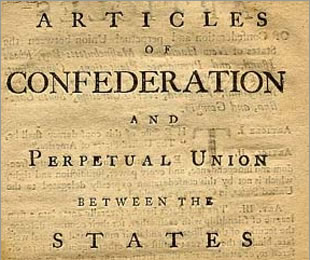
ArticlesOfConfederationTwelve of the original thirteen states ratified these “Articles of Confederation” by February, 1779. Maryland held out for another two years, over land claims west of the Ohio River. In 1781, seven months before Cornwallis’ surrender at Yorktown, the 2nd Continental Congress formally ratified the Articles of Confederation. The young nation’s first governing document.

The document provided for a loose confederation of sovereign states. At the center stood a congress, a unicameral legislature, and that’s about it. There was no Executive, there was no Judiciary.

In theory, Congress had the authority to govern foreign affairs, conduct war, and to regulate currency. In practice, these powers were limited since Congress had no authority to enforce requests made on the states, for either money or manpower.
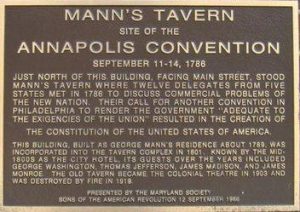
Manns-Tavern-300x212The Union would probably have broken up, had not the Articles of Confederation been amended or replaced. Twelve delegates from five states met at Mann’s Tavern in Annapolis Maryland in September 1786, to discuss the issue. The decision of the Annapolis Convention was unanimous. Representatives from all the states were invited to send delegates to a constitutional convention in Philadelphia, the following May.

The United States won its independence from England four years earlier, when 55 state delegates convened in Philadelphia to compose a new Constitution.

Delegates from 12 of the 13 original colonies, only Rhode Island abstaining, met at Philadelphia’s Pennsylvania State House on May images (19)25, 1787. The building is now known as Independence Hall, the same place where the Declaration of Independence and the Articles of Confederation were drafted.
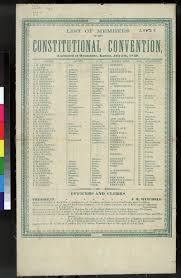
The assembly immediately discarded amending the Articles, crafting in their stead a brilliant Federal system of checks and balances over three months of debate. The Federal Republic envisioned by the framers delegates specific, limited powers to the Federal Government, with authority outside those specific powers devolving to the states.

Even at the convention, there was concern about the larger, more populous states governing at the expense of the smaller ones. The “Connecticut Compromise” solved the problem, creating a bicameral legislature with proportional representation in the lower house (House of Representatives) and equal representation of the states themselves in the upper house (Senate).

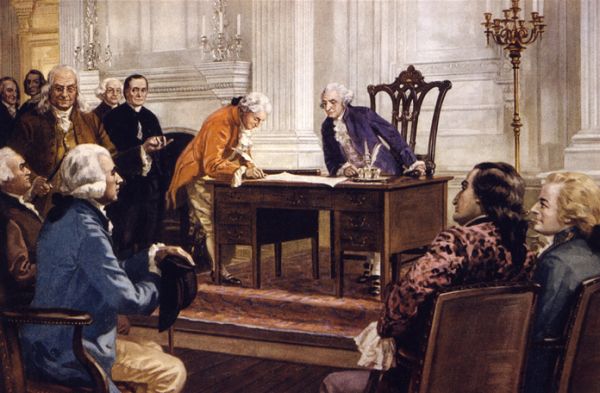
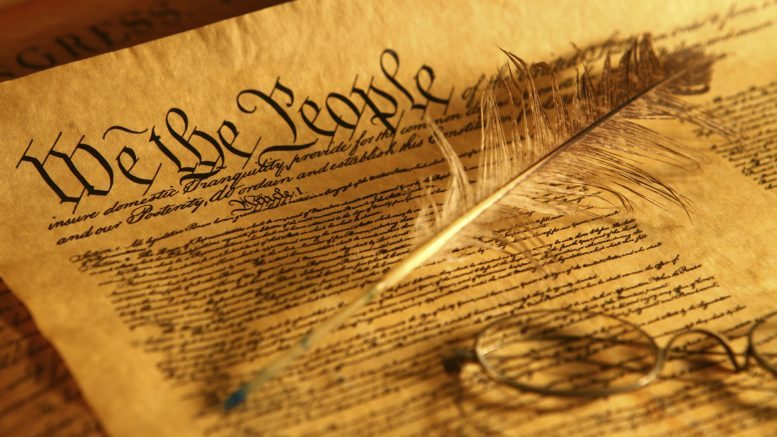
The Constitution was signed by 38 of 41 delegates on September 17, 1787. As dictated by Article VII, the document would become binding following ratifiication by nine of the 13 states.
US-Constitution-777x437

Five states: Delaware, Pennsylvania, New Jersey, Georgia, and Connecticut, ratified the document in quick succession. Some states objected to the new Constitution, especially Massachusetts, which wanted more protection for basic political rights such as freedom of speech, religion, and of the press. These wanted the document to specify, that those powers left undelegated to the Federal government, were reserved to the states.

A compromise was reached in February, 1788 whereby Massachusetts and other states would ratify the document, with the assurance that such amendments would be immediately proposed.

With these assurances, Massachusetts ratified the Constitution by a two-vote margin on this day in 1788, followed by Maryland and South Carolina. New Hampshire became the ninth state on June 21. The new Constitutional Government would take effect on March 4 of the following year.
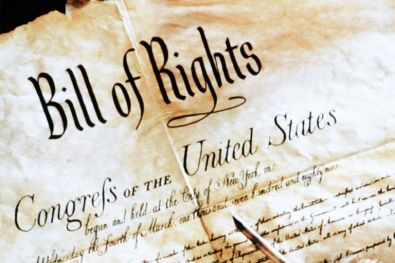
82638952-56a9aadd5f9b58b7d0fdcec6On September 25, the first Congress adopted 12 amendments, sending them to the states for ratification.

The states got rid of the first two, so it is that the Congress’ original 3rd amendment became 1st, of what we now call the “Bill of Rights”. Today, the United States Constitution is the oldest written national constitution in operation, in the world.

It’s interesting to note the priorities of that first Congress, as expressed in their original 1st and 2nd amendments. The ones that were thrown out. The first had to do with proportional representation, and would have led us to a 6,000 member House of Representatives, instead of the 435 we currently have. The second most important thing in the world, judging by the priorities of that first Congress, was that any future Congress could not change their own salaries. Any such change could effect only future Congresses.

That original 2nd amendment, stating that “No law, varying the compensation for the services of the Senators and Representatives, shall take effect, until an election of Representatives shall have intervened”, took effect in 1992 as the 27th amendment, following a ratification period stretching out 202 years, 7 months, and 12 days. One must not not be too hasty about these things.


February 4, 2012 Have a Nice Day

From Betty Boop to the hula hoop, popular culture is always primed and ready to dive into the latest fad.

medals_silver_star_100x200If you were to keyword search “United States Army”, “Silver Star” and “World War II”, you’ll find among a long list of recipients the name of “Ball, Harvey A. HQ, 45th Infantry Division, G.O. No. 281”.
Harvey Ball earned the silver star medal “for Conspicuous Gallantry in Action” in 1945, during the battle for Okinawa. He went on to serve most of his life in the United States Army Reserve, retiring with the rank of Colonel, in 1979.

Twenty years later, Colonel Ball was awarded the “Veteran of the Year” award from the Veterans Council of his home town of Worcester, Massachusetts. Yet, if we think of Harvey Ball, it is probably not for his military service.

Harvey Ross Ball worked for a sign painter while attending Worcester South High School, and went on to study fine arts at the Worcester Art Museum School.

After the war, Ball came home to Worcester and worked for a local advertising firm, later opening his own ad agency, Harvey Ball Advertising, in 1959.

In 1963, Worcester’s State Mutual Life Assurance Company (now Hanover Insurance) bought out the Guarantee Mutual Company of Ohio.  Employee morale had plummeted at the new acquisition, and Director of Promotions Joy Young was tasked with solving the problem.  She hired Harvey Ball as a freelance artist to create a visual icon. A pin to be worn as part of the company’s ‘friendship campaign’.

Harvey_Ball
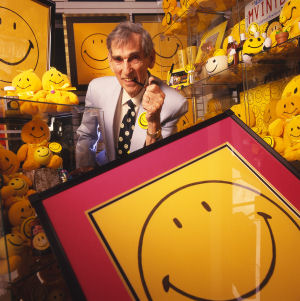
Harvey Ball, surrounded by his own creation

First came that silly grin. The pair quickly realized that the button could be inverted, and we can’t have “frowny” faces walking about, can we. Ball added eyes, the left drawn slightly smaller than the right, to “humanize” the design.

The work took about ten minutes and the artist was paid $45, equivalent to $330 today.  Neither Ball nor State Mutual Felt it necessary to copyright the graphic.

From Betty Boop to the hula hoop, popular culture is always primed and ready to dive into the latest fad. State Mutual ordered 100 buttons.  Before  Long, manufacturers were taking orders for thousands at a time.

Philadelphia brothers Bernard and Murray Spain seized on the image seven years later, producing millions of coffee mugs, t-shirts, watches and bumper stickers, emblazoned with the happy face and the slogan “Have a happy day”, later revised to the ever present, “Have a nice day”.

The image was everywhere, second only to the ubiquitous “Peace Sign”.

Frenchman Franklin Loufrani copyrighted the image in France in 1972, using it to highlight the “good news” section of the newspaper France Soir.

WMCA_good_guys_sweatshirt_1962
WMCA “good guys” sweatshirt, 1962

Loufrani’s son Nicolas took over the family business, launching The Smiley Company in 1996.  The younger Loufrani is skeptical of Harvey Ball’s claim to have created such a simple design, pointing to cave paintings found in France dated to 2500BC, and a similar graphic used in radio ad campaigns, of the early ’60s.

Of course, that didn’t prevent the company from seeking US trademark rights to the image, kicking off a years-long legal battle with retail giant Wal-Mart, which had been using the happy face in its “Rolling Back Prices” campaign.

The Smiley Company is one of the 100 largest licensing corporations in the world with revenues of $167 million in 2012, the year that BBC Radio produced the documentary “Smiley’s People”, broadcast on February 4.

GalleMartianCrater
Martian Crater

The artist didn’t seem to mind, that he never copyrighted his Smiley Face. Harvey Ball is gone now, but his son Charles says his father never was a money driven kind of guy. “Hey”, he would say, “I can only eat one steak at a time. drive one car at a time”.

In the 2009 film “Watchmen” characters fly to Mars, landing in a crater that looks like a Smiley Face. The red planet really does have such a place. It’s called the Galle crater.

In June of 2010, Wal-Mart and the Smiley Company settled their 10-year-old legal dispute in Chicago federal court. The terms of the settlement are confidential, and the judges words as he lowered the gavel, are unknown to this writer.  I so want to believe he told all those lawyers, to “have a nice day”.

If you enjoyed this “Today in History”, please feel free to re-blog, “like” & share on social media, so that others may find and enjoy it too. Please click the “follow” button on the right, to receive email updates on new articles.  Thank you for your interest, in the history we all share.

February 3, 1943  Greater Love Hath No Man Than This

As the ship upended and went down by the bow, survivors floating nearby could see the four chaplains.  With arms linked and leaning against the slanting deck, their voices offered prayers and sang hymns for the dead and for those about to die.

The Troop Transport USAT Dorchester sailed out of New York Harbor on January 23, 1943, carrying 904 service members, merchant seamen and civilian workers.  They were headed for the  the Army Command Base at Narsarsuaq in southern Greenland, part of a six-ship convoy designated SG-19, together with two merchant ships and escorted by the Coast Guard Cutters Comanche, Escanaba and Tampa.

Built as a coastal liner in 1926, Dorchester was anything but graceful, bouncing and shuddering her way through the rough seas of the North Atlantic.

German U-Boats had already sunk several ships in these waters.  One of the Cutters detected a submarine late on February 2, flashing the light signal “we’re being followed”.  Dorchester Captain Hans Danielson ordered his ship on high alert that night.  Men were ordered to sleep in their clothes with their life jackets on, but many disregarded the order.  It was too hot down there in the holds, and those life jackets were anything but comfortable.

Dorchester-facta-nautica-1000

Some of those off-duty tried to sleep that night, while others played cards or threw dice, well into the night.  Nerves were understandably on edge, especially among new recruits, as four Army chaplains passed among them with words of encouragement.

They were the Jewish rabbi Alexander David Goode, the Catholic priest John Patrick Washington, the Reformed Church in America (RCA) minister Clark Vandersail Poling, and the Methodist minister George Lansing Fox.

At 12:55am on February 3rd, the German submarine U-223 fired a spread of three torpedoes.  One struck Dorchester amidships, deep below the water line.  A hundred or more were killed in the blast, or in the clouds of steam and ammonia vapor billowing from ruptured boilers.  Suddenly pitched into darkness, untold numbers were trapped below decks.  With boiler power lost, there was no longer enough steam to blow the full 6 whistle signal to abandon ship, while loss of power prevented a radio distress signal.  For reasons not entirely clear, there never were any signal flares.

druidartThose who could escape scrambled onto the deck, injured, disoriented, many still in their underwear as they emerged into the cold and darkness.

The four chaplains must have been a welcome sight, guiding the disoriented and the wounded, offering prayers and words of courage.  They opened a storage locker and handed out life preservers, until there were no more.  “Padre,” said one young soldier, “I’ve lost my life jacket and I can’t swim!”  Witnesses differ as to which of the four it was who gave this man his life jacket, but they all followed suit.  One survivor, John Ladd, said “It was the finest thing I have seen or hope to see this side of heaven.” Rabbi Goode gave his gloves to Petty Officer John Mahoney, saying “Never mind.  I have two pairs”.  It was only later that Mahoney realized, Rabbi Goode intended to stay with the ship.

size0Dorchester was listing hard to starboard and taking on water fast, with only 20 minutes to live.  Port side lifeboats were inoperable due to the ship’s angle.  Men jumped across the void into those on the starboard side, overcrowding them to the point of capsize.  Only two of fourteen lifeboats launched successfully.

Private William Bednar found himself floating in 34° water, surrounded by dead bodies and debris. “I could hear men crying, pleading, praying,” he recalled. “I could also hear the chaplains preaching courage. Their voices were the only thing that kept me going.”

As the ship upended and went down by the bow, survivors floating nearby could see the four chaplains.  With arms linked and leaning against the slanting deck, their voices offered prayers and sang hymns for the dead and for those about to die.

images (17)Rushing back to the scene, coast guard cutters found themselves in a sea of bobbing red lights, the water-activated emergency strobe lights of individual life jackets.  Most marked the location of corpses.  Of the 904 on board, the Coast Guard plucked 230 from the water, alive.

The United States Congress attempted to confer the Medal of Honor on the four chaplains for their selfless act of courage, but strict requirements for “heroism under fire” prevented it from doing so.  Congress authorized a one time, posthumous “Chaplain’s Medal for Heroism”, awarded to the next of kin by Secretary of the Army Wilber M. Brucker at Fort Myer, Virginia on January 18, 1961.

chaplains_medalJohn 15:13 says “Greater love hath no man than this, that a man lay down his life for his friends”.  Rabbi Goode did not call out for a Jew when he gave away his only hope for survival, Father Washington did not ask for a Catholic. Neither minister Fox nor Poling asked for a Protestant.  Each gave his life jacket to the nearest man.

Carl Sandburg once said that “Valor is a gift.  Those having it never know for sure whether they have it until the test comes.”  If I were ever so tested, I hope that I would prove myself half the man, as any of those four chaplains.

four-chaplainsUSSDorchester

February 2, 1887 Groundhog Day

Midway between Winter Solstice and Spring Equinox and well before the first crocus of spring has peered out across the frozen tundra, there is a moment of insanity which helps those of us living in northern climes get through to that brief, blessed moment of warmth when the mosquitoes once again have their way with us.

Here on sunny Cape Cod, there is a joke about the four seasons. We have “Almost Winter”, “Winter”, “Still Winter” and “Bridge Construction”.

images (16)Midway between Winter Solstice and Spring Equinox and well before the first crocus of spring has peered out across the frozen tundra, there is a moment of insanity which helps those of us living in northern climes get through to that brief, blessed moment of warmth when the mosquitoes once again have their way with us.

The ancient Romans observed their mid-season festival on February 5, the pagan Irish on February 1. For Christians, it was February 2, Candlemas day, a Christian holiday celebrating the ritual purification of Mary. For reasons not entirely clear, early Christians believed that there would be six more weeks of winter if the sun came out on Candlemas Day.

Clergy would bless and distribute candles needed for winter, their length representing how long and cold the winter was expected to be. Germans expanded on the idea by selecting an animal, a hedgehog, as a means of predicting weather. Once a suitable number of Germans had come to America, they switched over to a more local rodent: Marmota monax.  The common Groundhog.

groundhogpuppetGroundhogs hibernate for the winter, an ability held in great envy by some people I know. During that time, their heart rate drops from 80 beats per minute to 5, and they live off their stored body fat.  Another ability some of us would appreciate, very much.
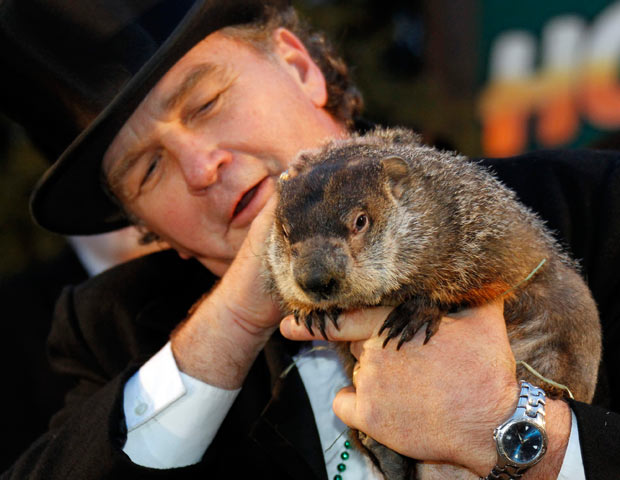

The male couldn’t care less about the weather.  He comes out of his burrow in February, in search of a date.  If uninterrupted, he will fulfill his groundhog mission of love and return to earth, not coming out for good until sometime in March.

But then there is the amorous woodchuck’s worst nightmare in a top hat.  The groundhog hunter.

In 1887, there was a group of groundhog hunters in Punxsutawney, Pennsylvania, imaginatively calling themselves the Punxsutawney Groundhog Club. One of them, a newspaper editor, declared on February 2, 1887, that their groundhog “Phil” was the only True weather forecasting rodent.

Groundhog-Day-1

There are those who would dispute the Gobbler’s Knob crowd and their claims to Punxsutawney Phil’s weather forecasting prowess. Alabama has “Birmingham Bill”, and Canada has Shubenacadie Sam. New York can’t seem to decide between Staten Island Chuck and New York City’s very own official groundhog, “Pothole Pete”.  North Carolinians look to “Queen Charlotte” and “Sir Walter Wally”, and Georgia folks can take their choice between “Gus”, and “General Beauregard Lee”.

Since the eponymously named Bill Murray film from 1993, nothing seems to rise to the appropriate level of insanity, more than Groundhog Day drinking games. For the seasoned Groundhog enthusiast, “beer breakfasts” welcome the end of winter, across the fruited plain. If you’re in the Quaker state, you can attend the Groundhog day “Hawaiian Shirt Beer Breakfast”, at Philadelphia’s own Grey Lodge Public House. If you’re in Des Moines, stop by the The High Life Lounge, where free Miller High Life beers will be served from 6am, to eleven. And for the late sleeper, there is the annual screening of the Bill Murray Masterpiece, at the Alamo Drafthouse Cinema Beer Dinner.

Fun fact: Bill Murray was bitten, not once but twice, by the groundhog used on the set.

groundhog-day-driving

It appears that there is no word for groundhog in Arabic, accounts of this day in the Arab press translate the word as جرذ الأرض.  “Ground Rat”.  I was pretty excited to learn that before al Jazeera gets carted off, toe tag first.

If anyone were to bend down and ask Mr. Ground Rat his considered opinion on the matter, he would probably cast a pox on all their houses. It’s been a long winter. Mr. Ground Rat’s all dressed up for a date.  He has other things on his mind.

If you enjoyed this “Today in History”, please feel free to re-blog, “like” & share on social media, so that others may find and enjoy it too. Please click the “follow” button on the right, to receive email updates on new articles.  Thank you for your interest, in the history we all share.

February 1, 1968 A Moment in Time

Eddie Adams won his Pulitzer in 1969, but came to regret that he had ever taken the picture. Years later he wrote in Time Magazine. ‘The general killed the Viet Cong; I killed the general with my camera. Still photographs are the most powerful weapon in the world. People believe them, but photographs do lie, even without manipulation. They are only half-truths”.

During WW2, the average infantry soldier saw 40 days of combat, in 4 years.  In Vietnam, the average combat infantryman saw 240 days of combat, in a year.

pr070711ii
Gallup poll, 1965 – 1971

By 1967, the Johnson administration was coming under increasing criticism, for what many of the American public saw as an endless and pointless stalemate in Vietnam.

Opinion polls revealed an increasing percentage believed it was a mistake to send more troops into Vietnam, their number rising from 25% in 1965, to 45% by December, 1967.

The Johnson administration responded with a “success offensive”, emphasizing “kill ratios” and “body counts” of North Vietnamese and Viet Cong fighters.  Vice President Hubert Humphrey stated on NBC’s Today show that November, that “We are on the offensive. Territory is being gained. We are making steady progress.”

download (9)In Communist North Vietnam, the massive battlefield losses of 1966-’67 combined with the economic devastation wrought by US Aerial bombing, causing moderate factions to push for peaceful coexistence with the south.  More radical factions favoring military reunification on the Indochina peninsula, needed to throw a “hail Mary” pass.  Plans for a winter/spring offensive began, in early 1967.  By the New Year, some 80,000 Communist fighters had quietly infiltrated the length and breadth of South Vietnam.
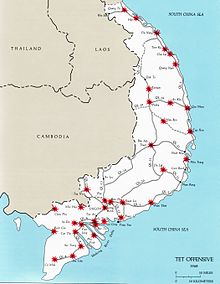
One of the largest military operations of the war launched on January 30, 1968, coinciding with the Tết holiday, the Vietnamese New Year.  In the first wave of attacks, North Vietnamese troops and Viet Cong Guerillas struck over 100 cities and towns, including Saigon, the South Vietnamese capitol.

TetMapInitially taken off-guard, US and South Vietnamese forces regrouped and beat back the attacks, inflicting heavy losses on North Vietnamese forces.  The month-long battle for Huế (“Hway”) uncovered the massacre of as many as 6,000 South Vietnamese by Communist forces, 5-10% of the entire city.  Fighting continued for over two months at the US combat base at Khe Sanh.

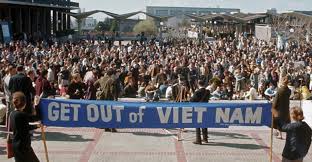
While the Tết offensive was a military defeat for the forces of North Vietnam, the political effects on the American public, were profound.  Support for the war effort plummeted, leading to demonstrations.  Jeers could be heard in the streets.  “Hey! Hey! LBJ! How many kids did you kill today?

Lyndon Johnson’s Presidency, was finished.  The following month, Johnson appeared before the nation in a televised address, saying “I shall not seek, and I will not accept, the nomination of my party for another term as your president.”

In the early morning darkness of February 1, 1968, Nguyễn Văn Lém led a Viet Cong sabotage unit in an assault on the Armor base in Go Vap.  After taking control of the camp, Nguyễn arrested Lieutenant Colonel Nguyen Tuan with his family, demanding that the officer show his guerillas how to drive tanks.  The officer refused, and the Viet Cong slit his throat, along with those of his wife and six children, and his 80-year-old mother.

The only survivor was a grievously injured 10-year-old boy.

Nguyễn was captured later that morning, near the mass grave of 34 civilians.  He said he was “proud” to have carried out orders to kill them.

AP photographer Eddie Adams was out on the street with NBC News television cameraman Võ Sửu, looking for something interesting.  The pair saw a group of South Vietnamese soldiers dragging what appeared to be an ordinary man into the road, and filmed the event.

Adams “…followed the three of them as they walked towards us, making an occasional picture. When they were close – maybe five feet away – the soldiers stopped and backed away. I saw a man walk into my camera viewfinder from the left. He took a pistol out of his holster and raised it. I had no idea he would shoot. It was common to hold a pistol to the head of prisoners during questioning. So I prepared to make that picture – the threat, the interrogation. But it didn’t happen. The man just pulled a pistol out of his holster, raised it to the VC’s head and shot him in the temple. I made a picture at the same time.”

vietnam-execution-arrest

The man with the pistol was Nguyễn Ngọc Loan, Chief of the national police.  Loan had personally witnessed the murder of one of his officers, along with the man’s wife and three small children.

Nguyễn Văn Lém was guilty of major war crimes.  He was out of uniform and not involved in combat, when he murdered the General’s own subordinates and their families.  The man was a war criminal and terrorist with no protections under the Geneva Conventions, legally eligible for summary execution.

Loan drew his .38 Special Smith & Wesson “Bodyguard” revolver and fired.  The execution was barely a blip on his radar screen.

vietnam-execution-after-shooting

General Nguyễn was a devoted Patriot and South Vietnamese Nationalist.  An accomplished pilot who led an airstrike on Việt Cộng forces at Bo Duc in 1967, Loan was loved and admired by his soldiers.

In February 1968, hard fighting yet remained to retake the capitol.  As always, Nguyễn Ngọc Loan was leading from the front, when a machine gun burst tore into his leg.

Meanwhile, Adams’ “Saigon Execution” photograph and Võ’s footage made their way into countless papers and news broadcasts.  Stripped of context, General Nguyễn came to be seen as a “bloodthirsty sadist”, the Viet Cong terrorist his “innocent victim”.

di_05292
Composite sequence published by the Dolph Briscoe Center for American History of the University of Texas, at Austin.

Adams was well on his way to winning a Pulitzer prize for that photograph, while an already impassioned anti-war movement, lost the power of reason.

The political outcry reached all the way to Australia, where General Nguyễn was recuperating from his amputation.  An Australian hospital refused him treatment, and he traveled to America, to recover.

American politics looked inward in the years to come, as the Nixon administration sought the “Vietnamization” of the war. By January 1973, direct US involvement in the war, had come to an end.

Military aid to South Vietnam was $2.8 billion in fiscal year 1973. The US Congress placed a Billion dollar ceiling on the number the following year, cutting that to $300 million, in 1975.  The Republic of Vietnam collapsed, some fifty-five days later.

d182757927d3e71bd2be3c3ce011ff94
Scenes from the final evacuation of Saigon, April, 1975

General Nguyễn was forced to flee the country he had served.  American immigration authorities sought deportation on his arrival, in part because of Eddie Adams’ picture.  The photographer was recruited to testify against the General, but Adams spoke on his behalf.

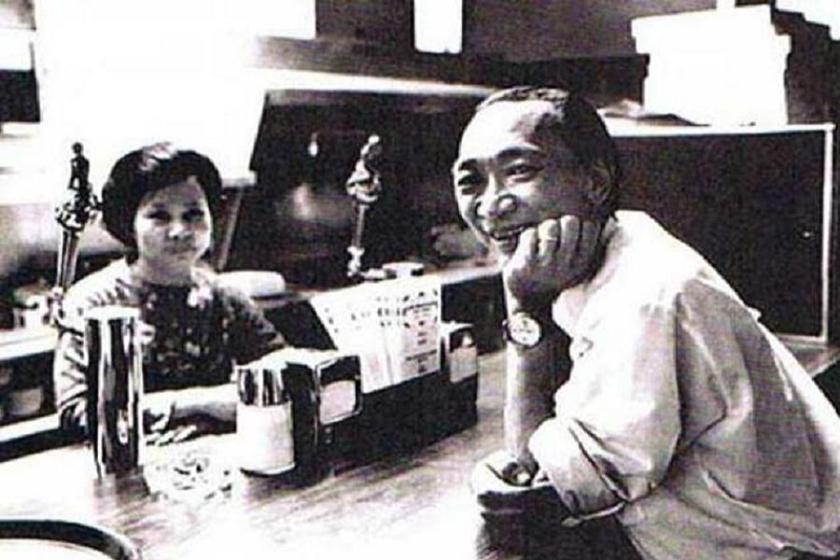
Nguyễn was permitted to stay.  He and his wife opened a pizza shop in the Rolling Valley Mall of Virginia, “Les Trois Continents”.  The restaurant was a success for a time, until word got out about the owner’s identity.  Knowing nothing about Nguyễn except for that image, locals began to make trouble.  Business plummeted as the owner was assaulted in his own restaurant, his life threatened.

The last time Adams visited Nguyễn’s pizza parlor, the words “We know who you are, fucker“, were scrawled across a toilet wall.

vietnam-execution-loan-restaurant

The couple was forced to close the restaurant in 1991.  Nguyễn Ngọc Loan died of cancer, seven years later.

Eddie Adams won his Pulitzer in 1969, but came to regret that he had ever taken the picture. Years later he wrote in Time Magazine. ‘The general killed the Viet Cong; I killed the general with my camera. Still photographs are the most powerful weapon in the world. People believe them, but photographs do lie, even without manipulation. They are only half-truths. What the photograph didn’t say was, “What would you do if you were the general at that time and place on that hot day, and you caught the so-called bad guy after he blew away one, two or three American soldiers?”‘

Before Nguyễn died, Adams apologized to the General and his family, for what that image had done to the man’s reputation. “The guy was a hero”, he said, after his death. “America should be crying. I just hate to see him go this way, without people knowing anything about him.”

January 31, 1945 Deserter

“They’re not shooting me for deserting the United States Army”, he said, “thousands of guys have done that. They just need to make an example out of somebody and I’m it because I’m an ex-con”.

When Eddie Slovik was little, his neighbors must have considered him a bad kid. His first arrest came at the age of 12, when he and some friends were caught stealing brass from a foundry. There were other episodes between 1932 and ’37:  petty theft, breaking & entering, and disturbing the peace. In 1939 he was sent to prison, for stealing a car.

306e1a79104ddd52b3b29ec4c5bee167--eddie-slovik-art-vintageEdward Donald “Eddie” Slovik was paroled in 1942, his criminal record making him 4F. “Registrant not acceptable for military service”. He took a job at the Montella Plumbing and Heating company in Dearborn, Michigan, where he met bookkeeper Antoinette Wisniewski, the woman who would later become his wife.

There they might have ridden out WWII, but the war was consuming manpower at a rate unprecedented in history. Shortly after the couple’s first anniversary, Slovik was re-classified 1A, fit for service, and drafted into the Army. Arriving in France on August 20, 1944, he was part of a 12-man replacement detachment, assigned to Company G of the 109th Infantry Regiment, US 28th Infantry Division.

Slovik and a buddy from basic training, Private John Tankey, became separated from their detachment during an artillery attack, and spent the next six weeks with Canadian MPs. It was around this time that Private Slovik decided he “wasn’t cut out for combat”.

Eddie_SlovikThe rapid movement of the army during this period caused difficulty for many replacements, in finding their units. Edward Slovik and John Tankey finally caught up with the 109th on October 7. The following day, Slovik asked his company commander Captain Ralph Grotte for reassignment to a rear unit, saying he was “too scared” to be part of a rifle company. Grotte refused, confirming that, were he to run away, such an act would constitute desertion.

That, he did. Eddie Slovik deserted his unit on October 9, despite Private Tankey’s protestations that he should stay. “My mind is made up”, he said. Slovik walked several miles until he found an enlisted cook, to whom he presented the following note.

Slovik-note“I, Pvt. Eddie D. Slovik, 36896415, confess to the desertion of the United States Army. At the time of my desertion we were in Albuff [Elbeuf] in France. I came to Albuff as a replacement. They were shelling the town and we were told to dig in for the night. The following morning they were shelling us again. I was so scared, nerves and trembling, that at the time the other replacements moved out, I couldn’t move. I stayed there in my fox hole till it was quiet and I was able to move. I then walked into town. Not seeing any of our troops, so I stayed over night at a French hospital. The next morning I turned myself over to the Canadian Provost Corp. After being with them six weeks I was turned over to American M.P. They turned me loose. I told my commanding officer my story. I said that if I had to go out there again I’d run away. He said there was nothing he could do for me so I ran away again AND I’LL RUN AWAY AGAIN IF I HAVE TO GO OUT THERE. — Signed Pvt. Eddie D. Slovik A.S.N. 36896415”.

Slovik was repeatedly ordered to tear up the note and rejoin his unit, and there would be no consequences. Each time, he refused. The stockade didn’t scare him. He’d been in prison before, and it was better than the front lines. Beside that, he was already an ex-con. A dishonorable discharge was hardly going to change anything, in a life he expected to be filled with manual labor.  “I’ve made up my mind”, he said. “I’ll take my court martial”.

Finally, instructed to write a second note on the back of the first acknowledging the legal consequences of his actions, Eddie Slovik was taken into custody.

eddie-slovik-soldier-army-life-dont-agree-with1.7 million courts-martial were held during WWII, 1/3rd of all the criminal cases tried in the United States during the same period. The death penalty was rarely imposed. When it was, it was almost always in cases of rape or murder.
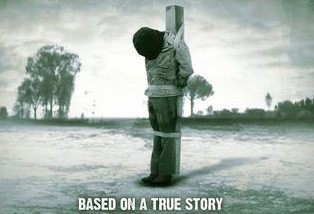
2,864 US Army personnel were tried for desertion between January 1942 and June 1948. Courts-martial handed down death sentences to 49 of them, including Eddie Slovik. Division commander Major General Norman Cota approved the sentence. “Given the situation as I knew it in November, 1944,” Cota said, “I thought it was my duty to this country to approve that sentence. If I hadn’t approved it–if I had let Slovik accomplish his purpose–I don’t know how I could have gone up to the line and looked a good soldier in the face.”

On December 9, Slovik wrote to Supreme Allied Commander Dwight D. Eisenhower, pleading for clemency. Desertion was a systemic problem at this time. Particularly after the surprise German offensive coming out of the frozen Ardennes Forest on December 16, an action that went into history as the Battle of the Bulge. Eisenhower approved the execution order on December 23, believing it to be the only way to discourage further desertions.

72541363
Movie poster – “The Execution of Private Slovik”

His uniform stripped of all insignia with an army blanket draped over his shoulders, Slovik was brought to the place of execution near the Vosges Mountains of eastern France. “They’re not shooting me for deserting the United States Army”, he said, “thousands of guys have done that. They just need to make an example out of somebody and I’m it because I’m an ex-con. I used to steal things when I was a kid, and that’s what they are shooting me for. They’re shooting me for the bread and chewing gum I stole when I was 12 years old.”

Army Chaplain Father Carl Patrick Cummings said, “Eddie, when you get up there, say a little prayer for me.” Slovik said, “Okay, Father. I’ll pray that you don’t follow me too soon”. Those were his last words. A soldier placed the black hood over his head. The execution was carried out by firing squad. It was 10:04am local time, January 31, 1945.

Edward Donald Slovik was buried in Plot E of the Oise-Aisne American Cemetery, his marker bearing a number instead of his name. Antoinette Slovik received a telegram informing her that her husband had died in the European Theater of war, and a letter instructing her to return a $55 allotment check. She would not learn about the execution for nine years.

grave2
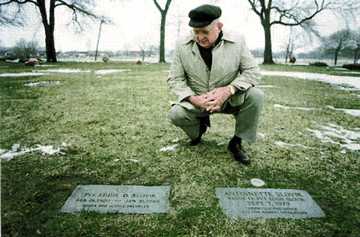
“Bernard Calka, a former Macomb County commissioner, fought to have Pvt. Eddie Slovik’s remains brought back from France to be reburied next to his wife” Detroit News Blog

In 1987, President Ronald Reagan ordered the repatriation of Slovik’s remains. He was re-interred at Detroit’s Woodmere Cemetery next to Antoinette, who had gone to her final rest eight years earlier.

In all theaters of WWII, the United States military executed 102 of its own, almost always for the unprovoked rape and/or murder of civilians. From the Civil War to this day, Eddie Slovik’s death sentence remains the only one ever carried out for the crime of desertion. At least one member of the tribunal which condemned him to death, would come to see it as a miscarriage of justice.

Nick Gozik of Pittsburg passed away in 2015, at the age of 95. He was there in 1945, a fellow soldier called to witness the execution. “Justice or legal murder”, he said, “I don’t know, but I want you to know I think he was the bravest man in that courtyard that day…All I could see was a young soldier, blond-haired, walking as straight as a soldier ever walked. I thought he was the bravest soldier I ever saw.”

January 30, 1948 Madame, I Think You’re Missing a Monkey

The Confucian maxim may have crossed from China to Japan with a Tendai-Buddhist legend, sometime around the 8th century. At the time, the story had nothing to do with monkeys.

The Analects of Confucius is a written record of the sayings of the philosopher and his contemporaries, compiled between 475 and 221BC. In it, a follower named Yen Yüan asked the Master about perfect virtue. Confucius said, “To subdue one’s self and return to propriety, is perfect virtue. If a man can for one day subdue himself and return to propriety, all under heaven will ascribe perfect virtue to him”.

220px-Commentaries_of_the_Analects_of_Confucius“I beg to ask the steps of that process”, asked the student.  Confucius replied, “Look not at what is contrary to propriety. Listen not to what is contrary to propriety. Speak not what is contrary to propriety. Make no movement which is contrary to propriety”.
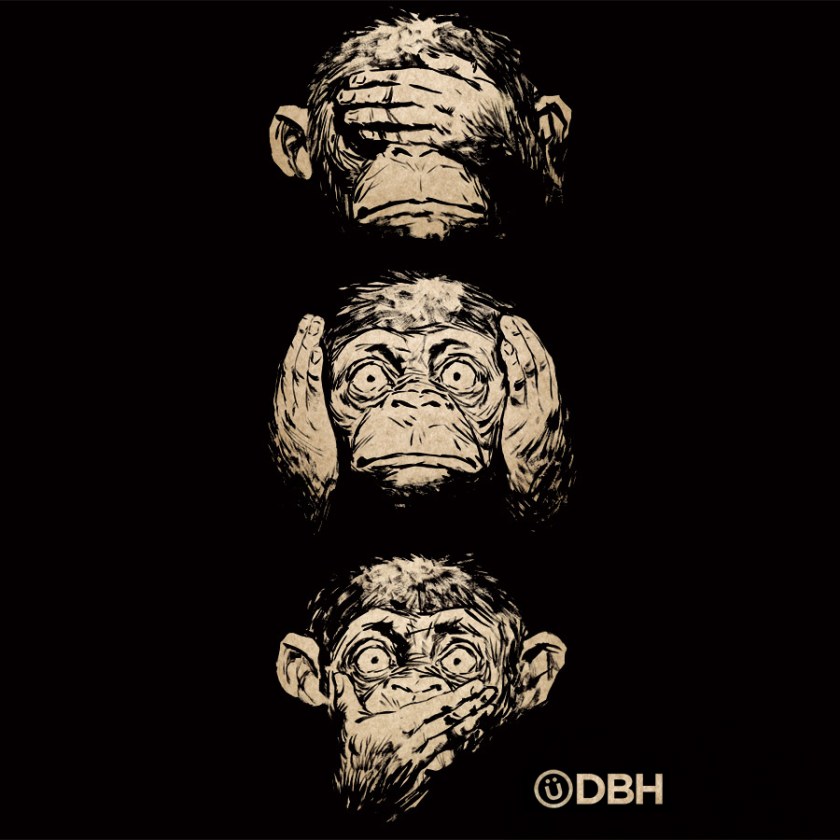
It was an ancient idea, even then. Zarathrusta, also known as Zoroaster, is in some respects the father of the world’s first monotheistic religion. It was sometime around 1200BC when Zoroaster taught his followers on the high Iranian Plateau “Humata, Hukhta, Hvarshta”.  “Good Thoughts, Good Words, Good Deeds”.

The Confucian maxim may have crossed from China to Japan with a Tendai-Buddhist legend, sometime around the 8th century. At the time, the story had nothing to do with monkeys.

3_wise_monkeys_by_yannickbouchard-d5mdz46
3 Wise Monkeys by Yannick Bouchard

In medieval Japanese, mi-zaru, kika-zaru, and iwa-zaru translate as “don’t see, don’t hear, and don’t speak”, -zaru being an archaic negative verb conjugation and pronounced similarly to “saru”, the word for monkey.

download (8)The visual play on words, then, depicts Iwazaru covering his mouth, Kikazaru covering his ears, and Mizaru covering his eyes.
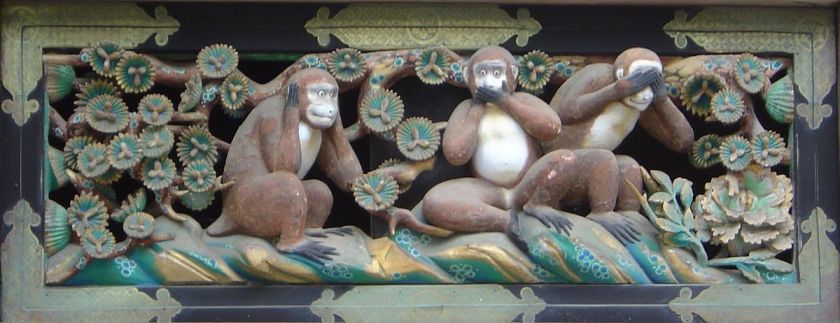

Though it’s unusual to see him anymore, there is a fourth monkey.  Shizaru is generally depicted with his arms crossed or covering his privates, his name variously translated as “do no evil”, or “know no evil”.

The first known depiction of the “Three Mystic Apes” appears over the doors of the Tōshō-gū shrine in Nikkō, Japan, carved sometime in the 17th century.

1200px-Hear_speak_see_no_evil_Toshogu

Mohandas Karamchand Gandhi was a Hindu lawyer, member of the merchant caste from coastal Gujarat, in western India. Today he is known by the honorific “Mahatma”, from Gandhithe Sanskrit “high-souled”, or “venerable”.

Ghandi is recognized as the Father of modern India, who brought Independence to his country through non-violent protest. Mohandas Gandhi lived a life of poverty and simplicity, owning almost no material possessions at the time of his assassination by Hindu nationalist Nathuram Vinayak Godse on January 30, 1948.

Beside the clothes on his back, Gandhi owned a tin cup and a spoon, a pair of sandals, his spectacles and a set of three carved monkeys, reminding him to hear no evil, see no evil and speak no evil.

maxresdefault (3)

If you enjoyed this “Today in History”, please feel free to re-blog, “like” & share on social media, so that others may find and enjoy it too. Please click the “follow” button on the right, to receive email updates on new articles.  Thank you for your interest, in the history we all share.

January 29, 1944 Operation Pied Piper

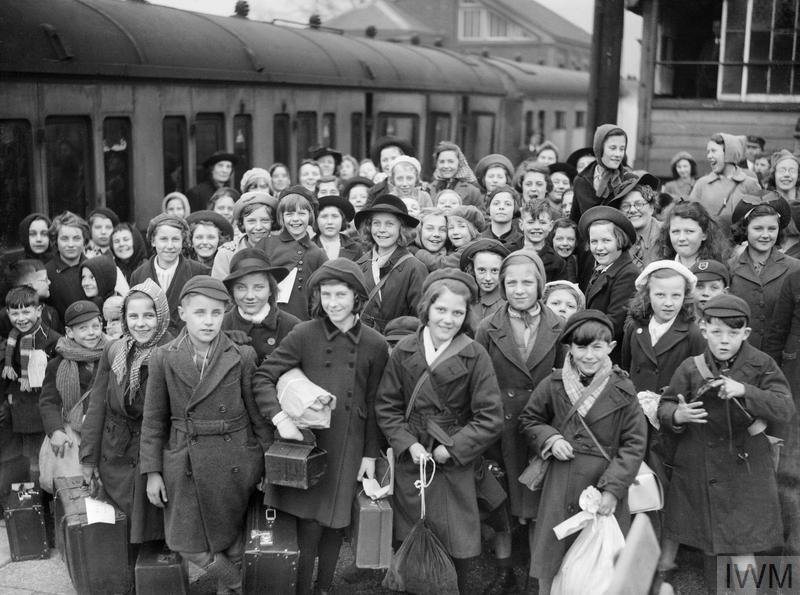
In the summer of 1938, the horrors of the Great War were a mere twenty years in the past.  Hitler had swallowed up Austria, only six months earlier.   Authorities divided the British Isles into “risk zones”, identified as “evacuation,” “neutral,” and “reception.”  In some of the most gut wrenching decisions of the age, these people were planning “Operation Pied Piper”, the evacuation of millions of their own children, in the event of war.

For the people of the modern Czech Republic, the Munich agreement of 1938 was a betrayal. “O nás bez nás!” “About us, without us!”

431768
Nazi propaganda depicting German Anschluss with Austria

Intent on avoiding war with Nazi Germany, Italy, France and Great Britain had convened in Munich that September, to resolve German claims on western Czechoslovakia.  The “Sudetenland”.  Representatives of the Czech and Slovak peoples, were not invited.

On September 30, British Prime Minister Neville Chamberlain returned to London, declaring “Peace in Our Time”.  The piece of paper Chamberlain held in his hand bore the signatures of Adolf Hitler, Benito Mussolini and Édouard Daladier as well as his own, annexing the Sudetenland, to Nazi Germany.

To Winston Churchill, it was an act of appeasement.  Feeding the crocodile (Hitler), in hopes that he will eat you last.  For much of Great Britain, the sense of relief was palpable.

In the summer of 1938, the horrors of the Great War were a mere twenty years in the past.  Hitler had swallowed up Austria, only six months earlier.   British authorities divided the home islands into “risk zones”, identified as “Evacuation,” “Neutral,” and “Reception.”  In some of the most gut wrenching decisions of the age, these people were planning “Operation Pied Piper”, the evacuation of millions of their own children, in the event of war.

94330When Nazi Germany invaded Poland the following September, London mayor Herbert Morrison was at 10 Downing Street, meeting with Chamberlain’s aide, Sir Horace Wilson.  Morrison believed that the time had come for Operation Pied Piper.  A year to the day from the Prime Minister’s “Peace in our Time” declaration, Wilson protested.  “But we’re not at war yet, and we wouldn’t want to do anything to upset delicate negotiations, would we?”
Morrison was done with the Prime Minister’s dilatory response to Hitler’s aggression, practically snarling in his thick, East London accent “Look, ’Orace, go in there and tell Neville this from me: If I don’t get the order to evacuate the children from London this morning, I’m going to give it myself – and tell the papers why I’m doing it. ’Ow will ’is nibs like that?”

Thirty minutes later, Morrison had the document. The evacuation, had begun.

large_000000

Next weekend, Superbowl 52 will be played at U.S. Bank Stadium, in front of a crowd of 66,655. In 1938, forty-five times that number were mobilized in the first four days of the evacuation, primarily children, relocated from cities and towns across Great Britain to the relative safety of the countryside. What must that have sounded like?

Operation_Pied_Piper-PosterBBC History reported that, “within a week, a quarter of the population of Britain would have a new address”.

Zeppelin raids had killed 1,500 civilians in London alone, during the ‘Great War’.  Since then, governments had gotten so much better at killing each other’s citizens.  As early as 1922, Prime Minister Lord Arthur Balfour had spoken of ‘unremitting bombardment of a kind that no other city has ever had to endure.’  As many as 4,000,000 civilian casualties were predicted, in London alone.

BBC History describes the man in charge of the evacuation, Sir John Anderson, as a “cold, inhuman character with little understanding of the emotional upheaval that might be created by evacuation”.

Children were labeled ‘like luggage’, and sent off with gas masks, toothbrushes and fresh socks & underwear. None of them knew to where, or for how long.

thumbnail_ww2evacueesThe evacuation of all that humanity ran relatively smoothly, considering.  James Roffey, founder of the Evacuees Reunion Association, recalls ‘We marched to Waterloo Station behind our head teacher carrying a banner with our school’s name on it. We all thought it was a holiday, but the only thing we couldn’t work out was why the women and girls were crying.’

Arrivals at the billeting areas, were another matter.  Many kids were shipped off to the wrong places, and rations were insufficient.  Geoffrey Barfoot, billeting officer in the seaside town of Weston-super-Mare, said ‘The trains were coming in thick and fast. It was soon obvious that we just didn’t have the bed space.’

Kids were lined up against walls and on stages, and potential hosts were invited to “take their pick”.

For many, the terrors and confusion of those first few days grew into love and friendships, that lasted a lifetime.  Others entered a hell of physical or sexual abuse, or worse.

For the first time, “city kids” and country folks were finding out how the “other half” lived, with sometimes amusing results.  One boy wrinkled his nose on seeing carrots pulled out of muddy fields, saying “Ours come in tins”.  Richard Singleton recalled the first time he asked his Welsh ‘foster mother’ for directions to the toilet.  “She took me into a shed and pointed to the ground. Surprised, I asked her for some paper to wipe our bums.  She walked away and came back with a bunch of leaves.”

John Abbot, evacuated from Bristol, had his rations stolen by his host family. He was horsewhipped for speaking out while they enjoyed his food, and he was given nothing more than mashed potatoes. Terri McNeil was locked in a birdcage and left with a piece of bread and a bowl of water.

an-evac-killed-by-bus-near-blackpoolIn the 2003 BBC Radio documentary “Evacuation: The True Story,” clinical psychologist Steve Davis described the worst cases, as “little more than a pedophile’s charter.”

Eighty years later, the words “I’ll take that one”, are seared into the memories of more than a few.

Hundreds of evacuees were killed because of relocation, while en route or during their stays at “safe havens”.  Two boys were killed on a Cornish beach, mined to defend against German amphibious assault. Apparently, no one had thought to put up a sign.

Irene Wells, age 8, was standing in a church doorway, when she was crushed by an army truck.  One MP from the house of Commons said “There have been cases of evacuees dying in the evacuation areas. Fancy that type of news coming to the father of children who have been evacuated”.

When German air raids failed to materialize, many parents decided to bring the kids back home.  By January 1940, almost half of evacuees had returned.

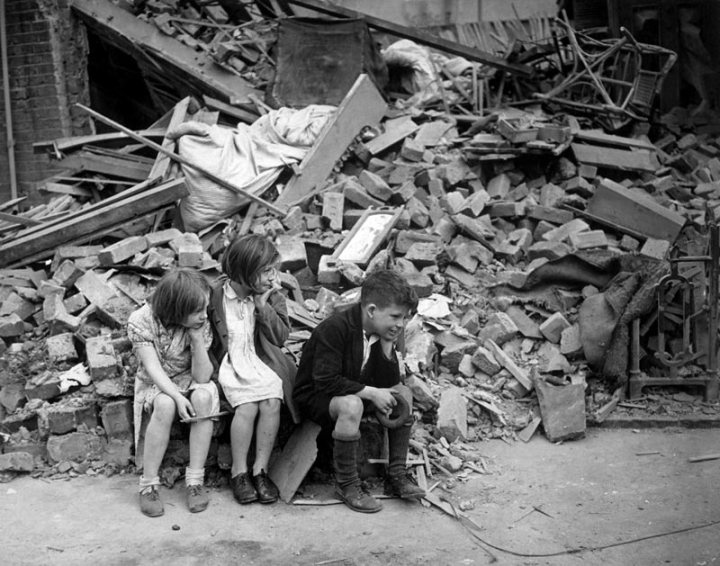
980xAuthorities produced posters urging parents to leave the kids where they were, and a good thing, too. The Blitz against London itself began on September 7. The city experienced the most devastating attack to-date on December 29, in a blanket fire-bombing that killed almost 3,600 civilians.

Sometimes, refugees from relatively safe locations were shipped into high-risk target areas. Hundreds of refugees from Gibraltar were sent into London, in the early days of the Blitz. None of them could have been happy to leave London Station, to see hundreds of locals pushing past them, hurrying to get out.

This story doesn’t only involve the British home islands, either.  American Companies like Hoover and Eastman Kodak took thousands of children in, from employees of British subsidiaries.  Thousands of English women and children were evacuated to Australia, following the Japanese attack on Singapore.

62d70d4914a701b66b42480e66c82105By October 1940, the “Battle of Britain” had devolved into a mutually devastating battle of attrition, in which neither side was capable of striking the death blow. Hitler cast his gaze eastward the following June, with a surprise attack on his “ally”, Josef Stalin.

“Operation Steinbock”, the Luftwaffe’s last large-scale strategic bombing campaign of the war against southern England, was carried out three years later.  285 German bombers attacked London on this day in 1944, in what the Brits called the “Baby Blitz”. You’ve got to be some tough cookie, to call 245 bombers a Baby Blitz.

WWII_London_Blitz_East_London-Children

Late in the war, the subsonic “Doodle Bug” or V1 “flying bomb” was replaced by the terrifying supersonic V2.  1,000 or more of these, the world’s first rocket, were unleashed against southern England, primarily London, killing or wounding 115,000. With a terminal velocity of 2,386mph, you never saw or heard this thing coming, until the weapon had done its work.

15092_0In the end, many family ‘reunions’ were as emotionally bruising as the original breakup.   Years had come and gone and new relationships had formed.  The war had turned biological family members, into all but strangers.

Richard Singleton remembers the day his mother came, to take him home to Liverpool.  “I had been happily living with ‘Aunty Liz and Uncle Moses’ for four years,” he recalled. “I told Mam that I didn’t want to go home. I was so upset because I was leaving and might never again see aunty and uncle and everything that I loved on the farm.”

Douglas Wood tells a similar story.  “During my evacuation I had only seen my mother twice and my father once,” he recalls. “On the day that they visited me together, they had walked past me in the street as they did not recognise me. I no longer had a Birmingham accent and this was the subject of much ridicule. I had lost all affinity with my family so there was no love or affection.”

The Austrian-British psychoanalyst Anna Freud, daughter of Sigmund Freud, commissioned an examination of the psychological effects of the separation. After a 12-month study, she concluded that “separation from their parents is a worse shock for children than a bombing.”

January 28, 1521 A Scholarly Debate

A popular story has Martin Luther nailing his “95 theses” to the door of the Wittenberg Palace Church, but it likely never happened that way. Luther had no intention of confronting Church authorities. This was intended to be an academic work, 95 topics offered for scholarly debate. 

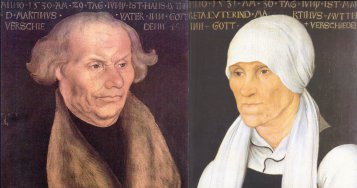
Hans Luder sent his son Martin to a series of Latin schools beginning in 1497, where the boy learned the so-called “trivium” – grammar, rhetoric, and logic. He entered the University of Erfurt in 1501 at age 19, receiving his master’s degree in 1505. The elder Luder (“Luther”) intended that his son become a lawyer, but the boy wanted none of it.

hans_and_margarethe_luther_by_lucas_cranach_the_elder
Hans & Margarethe Luder by Lucas Cranach, the Elder

Years later, the younger Luther described his Latin school education as time spent in purgatory, and his University as a “beerhouse” and a “whorehouse”.  Martin Luther was cut out for different things.

Luther entered Law School in 1505 and dropped out, almost immediately.  His father was furious over what he saw as a wasted education. Martin entered an Augustinian cloister that July, saying “This day you see me, and then, not ever again.”

16th century Church doctrine taught that the Saints built up a surplus of good deeds, over a lifetime.  Sort of a moral bank account.  Like “carbon credits” today, positive acts of faith and charity could expiate sin. Monetary contributions to the church could, it was believed, “buy” the benefits of the saint’s good works, for the sinner.

Luther came to believe that the church had lost sight of the central truths of Christianity. The Grace of God wasn’t a medium to be exchanged, he believed.  Rather, such grace was attained through faith in Jesus Christ, as the Messiah. “This one and firm rock”, he wrote, “which we call the doctrine of justification, is the chief article of the whole Christian doctrine, which comprehends the understanding of all godliness”.

Papal “Commissioner for Indulgences” Johann Tetzel came to Wittenberg in 1516, selling expiation to raise money to rebuild St. Peter’s Basilica, in Rome. A saying attributed to the Dominican friar went “As soon as the coin in the coffer rings, the soul from purgatory springs.”

0531f24949Martin Luther wrote to Archbishop Albrecht on October 31, 1517, objecting to this sale of indulgences. He enclosed a copy of his “Disputation of Martin Luther on the Power and Efficacy of Indulgences”, a document which came to be known as his “95 Theses”.
A popular story has Martin Luther nailing the document to the door of the Wittenberg Palace Church, but it likely never happened. Luther had no intention of confronting the Church.  This was intended to be an academic work, 95 topics offered for scholarly debate.

Martin Luther’s ideas would rock the Christian world.

What seems to the modern mind as mere doctrinal differences, were life and death matters in the late middle and early modern ages. Archbishop Albrecht forwarded Luther’s note to Pope Leo X, who responded slowly and “with great care as is proper”.

Three theologians drafted heresy cases against Martin Luther.  In 1520, the Papal Bull (edict) “Exsurge Domine” commanded the Professor of Theology to recant under pain of excommunication.

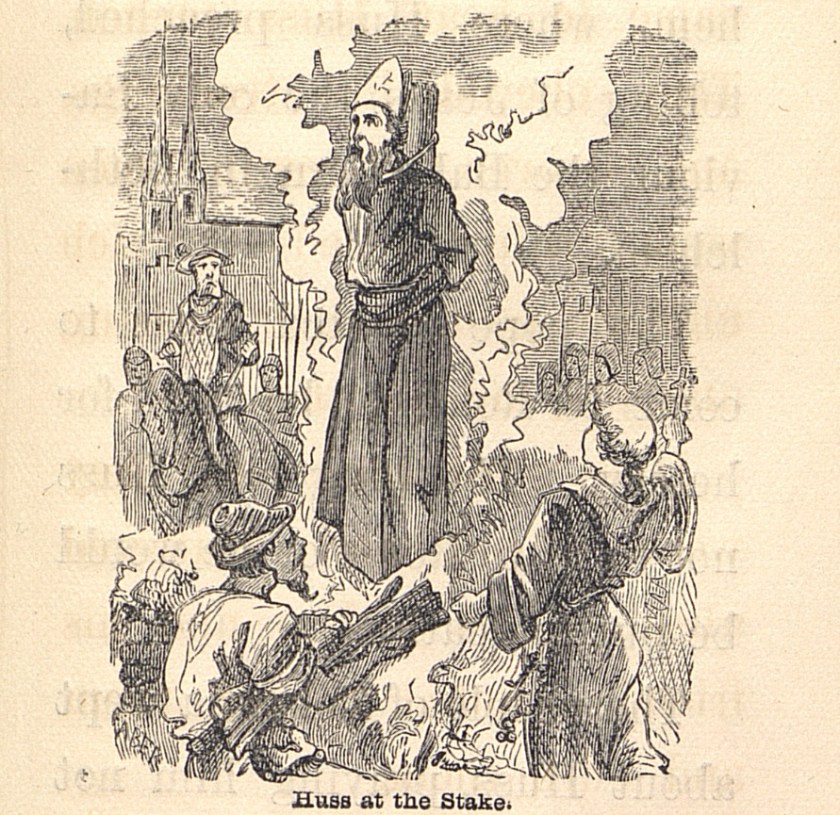
Luther stood on dangerous ground. In 1415, the Czech priest Jan Hus had been burned at the stake for such heresy.  Pope Martinus I called for a crusade against his followers, the “Hussieten”, five years later.

ds4768_Hus_at_stakeCrop

King Henry VIII’s famous break with the church over his divorce from Catherine of Aragon was still years in the future in 1521, the year Pope Leo X named Henry “Fidei Defensor”.  “Defender of the Faith”. Nine years later, French theologian Jean Calvin was forced to flee for his life, from a deadly outbreak of violence against Protestant Christians.

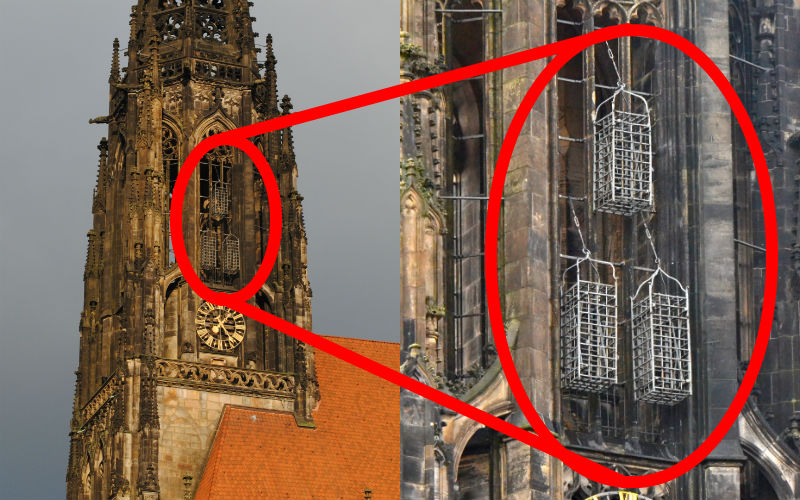
Anabaptists Jan van Leiden, Bernhard Knipperdolling and Bernhard Krechting were tortured in the public square for their heresies, with white-hot pliers.  Their corpses were placed in cages and hanged from the steeple of St. Lambert’s Church, in Münster. The bones were removed some fifty years later, but those three cages remain there, to this day.

lambert-cages

The Papal edict had the effect of hardening Luther’s positions, and he publicly burned the document. Twenty-four days later, Martin Luther was excommunicated.

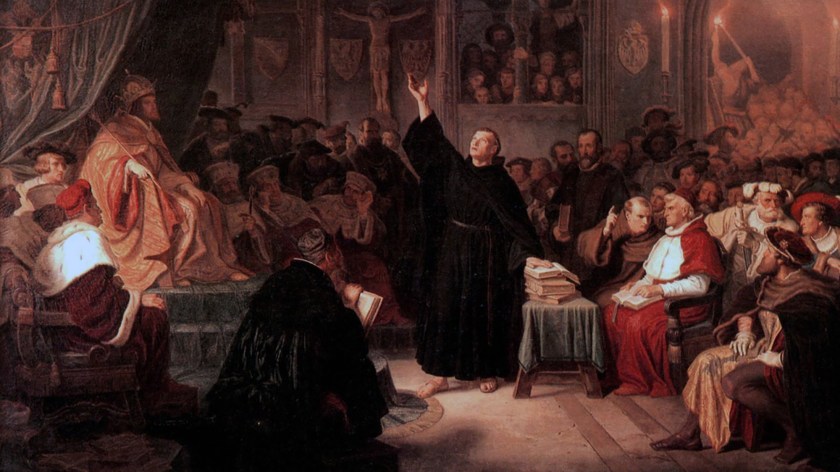
On this day in 1521, Emperor Charles V convened the Diet, the deliberative assembly of the Holy Roman Empire, in the upper-Rhine city of Worms.  Luther was summoned to defend himself in April.

With copies of his writings laid before him on a table, Luther was asked if the books were his, and if he stood by their contents.  He affirmed that yes, they were his, but asked time to consider his second answer.

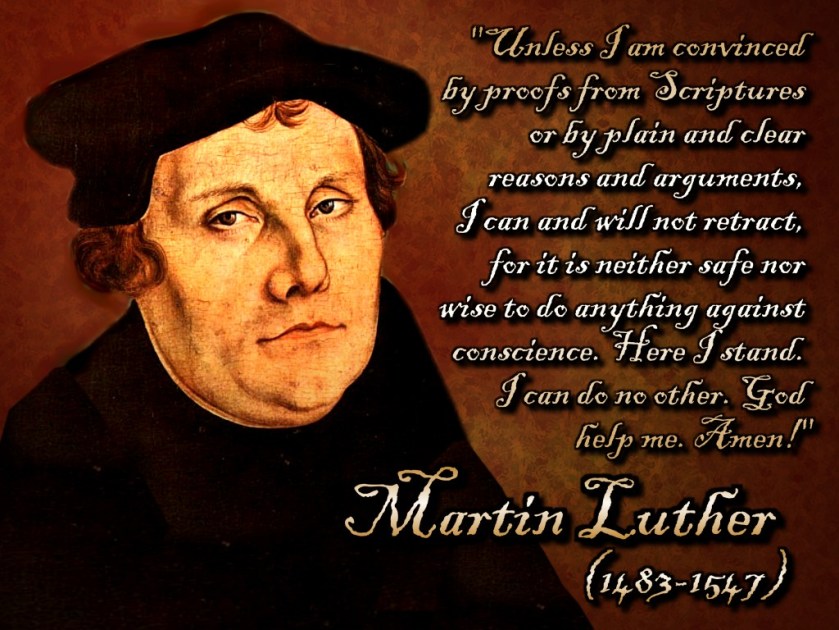
The following day, Luther gave his response.  “Unless I am convinced by the testimony of the Scriptures or by clear reason (for I do not trust either in the Pope or in councils alone, since it is well known that they have often erred and contradicted themselves), I am bound by the Scriptures I have quoted and my conscience is captive to the Word of God. I cannot and will not recant anything, since it is neither safe nor right to go against conscience. May God help me. Amen”.

luthertestifying
Martin Luther testifies before the Diet of Worms, 1521

The “Edict of Worms” of the following month declared Luther an outlaw, ordering that he “be apprehended and punished as a notorious heretic”.  Anyone who wished to do so was now permitted to kill the monk, without legal consequence.

Five years earlier, Erasmus of Rotterdam had expressed the wish that the holy text should be available in every language, “so that even Scots and Irishmen might read it”.  Luther went into hiding at Wartburg Castle.  It was there that he translated the New Testament from Greek into German, laying the foundation for other vernacular translations and, for the first time, making the bible accessible to the common man.

Radical sects took Luther’s teachings far beyond his intentions, and Luther found himself in the odd position of defending the faith against more radical reformers. The Zwickau Prophets rejected holy scripture in favor of direct revelations from the Holy Spirit. The Anabaptists took the “equality of man” in radical egalitarian directions, sounding very much like the principles Karl Marx would write about, in 1848.

luther

The Protestant Reformation launched by Martin Luther plunged Europe into a series of wars. The Peasant’s War of 1524-’25 alone killed more Europeans than any conflict prior to the 1789 French Revolution. The established church would respond with counter-reformation, but the idea that Christian faith was more than the exclusive province of a special, segregated order of men, was here to stay.

On October 31, 1999, 482 years to the day from Martin Luther’s letter to Archbishop Albrecht, leaders of the Roman Catholic and Lutheran Churches signed the “Joint Declaration on the Doctrine of Justification”, ending the half-century old doctrinal dispute, once and for all.

If you enjoyed this “Today in History”, please feel free to re-blog, “like” & share on social media, so that others may find and enjoy it too. Please click the “follow” button on the right, to receive email updates on new articles.  Thank you for your interest, in the history we all share.

January 27, 1945 Cabanatuan

The Japanese atrocity at Palawan sparked a series of raids at Santo Tomas Internment Camp, Bilibid Prison, Los Baños and others.  The first such behind-enemy-lines rescue, was Cabanatuan.

Today, Cabanatuan calls itself the “Tricycle Capital of the Philippines”, with about 30,000 motorized “auto rickshaws”.  Seventy-three years ago, the place was home to one of the worst POW camps of WWII.

15918-cabanatuan-city-locator-map

1942 was a dreadful year for the allied war effort in the Pacific.  The Battle of Bataan alone resulted in 72,000 prisoners being taken by the Japanese, marched off to POW camps designed for ten to twenty-five thousand.

pows-cabanatuan20,000 died from sickness or hunger, or were murdered by Japanese guards on the 60 mile “death march” from Bataan, into captivity at Cabanatuan prison and others.

Cabanatuan held 8,000 prisoners at its peak, though the number dropped considerably as the able-bodied were shipped out to work in Japanese slave labor camps.

Cabanatuan-prisoncamp-report_555Two rice rations per day, fewer than 800 calories, were supplemented by the occasional animal or insect caught and killed inside camp walls, or by the rare food items smuggled in by civilian visitors.

2,400 died in the first eight months at Cabanatuan, animated skeletons brought to “hospital wards”, nothing more than 2’x6′ patches of floor, where prisoners waited to die.

A Master Sergeant Gaston saw one of these wards in July 1942, saying: “The men in the ward were practically nothing but skin and bones and they had open ulcers on their hips, on their knees and on their shoulders…maggots were eating on the open wounds. There were blow flies…by the millions…men were unable to get off the floor to go to the latrine and their bowels moved as they lay there”.

The war was going badly for the Japanese by October 1944, as Imperial Japanese High Command ordered able bodied POWs removed to Japan.  1,600 were taken from Cabanatuan, leaving 500 weak and disabled prisoners.  The guards abandoned camp shortly after, though Japanese soldiers continued to pass through.  POWs were able to steal food from abandoned Japanese quarters; some even captured two water buffalo called “Carabao”, which were killed and eaten.  Many feared a trick and never dared to leave the camp.  Most were too sick and weak to leave in any case, though the extra rations would help them through what was to come.

Palawan_Massacre_POW_Burial_Site_1945On December 14, some fifty to sixty soldiers of the Japanese 14th Area Army in Palawan doused 150 prisoners with gasoline and set them on fire, machine gunning or clubbing any who tried to escape the flames.   Some thirty to forty managed to escape the killing zone, only to be hunted down and murdered, one by one.  Eleven managed to escape the slaughter, and lived to tell the tale.  139 were burned, clubbed or machine gunned to death.
The atrocity at Palawan sparked a series of raids at Santo Tomas Internment Camp, Bilibid Prison, Los Baños and others.  The first such behind-enemy-lines rescue, was Cabanatuan.

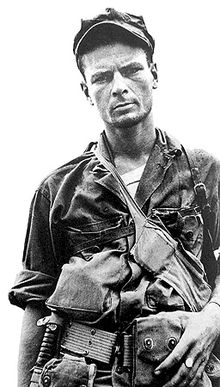
Lieutenant Colonel Henry Mucci of the United States Army’s elite 6th Ranger Battalion selected Captain Robert Prince to plan the rescue. “We couldn’t rehearse this”, Prince said. “Anything of this nature, you’d ordinarily want to practice it over and over for weeks in advance. Get more information, build models, and discuss all of the contingencies. Work out all of the kinks. We didn’t have time for any of that. It was now, or not”.

220px-Robert_Prince
6th Ranger Battalion Capt. Robert Prince

On the evening of January 27, 1945, a 14-man advance team formed from the 6th Ranger Battalion and a special reconnaissance group called the “Alamo Scouts”, separated into two groups and began the 30-mile march behind enemy lines to liberate Cabanatuan.

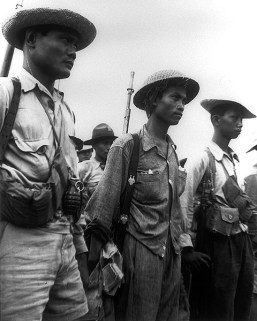
The main force of 121 Rangers moved out the following day, meeting up with 200 Filipino guerrillas, serving as guides and helping in the rescue.

Other guerrillas assisted along the way, muzzling dogs and corralling chickens so that Japanese occupiers would hear nothing of their approach.  Japanese soldiers once again occupied the camp, with 1,000 more camped across the Cabo River outside the prison.  As many as 7,000 more were deployed, just a few miles away.

On the night of the 30th, a P-61 Black Widow piloted by Captain Kenneth Schrieber and 1st Lt. Bonnie Rucks staged a ruse.  For 45 minutes, the pair conducted a series of aerial acrobatics, cutting and restarting engines with loud backfires while seeming to struggle to maintain altitude. Thousands of Japanese soldiers watched the show, as Rangers belly crawled into positions around the camp.

Pajota's_Guerrillas
Filipino Guerilla fighters of Captain Juan Pajota

Guard towers and pillboxes were wiped out in the first fifteen seconds of the assault.  Filipino guerrillas blew the bridge and ambushed the large force across the river while one, trained to use a bazooka only hours earlier, took out four Japanese tanks.

In the camp, all was pandemonium as some prisoners came out and others hid, suspecting some trick to bring them out in the open.  They were so emaciated that Rangers carried them out two at a time.

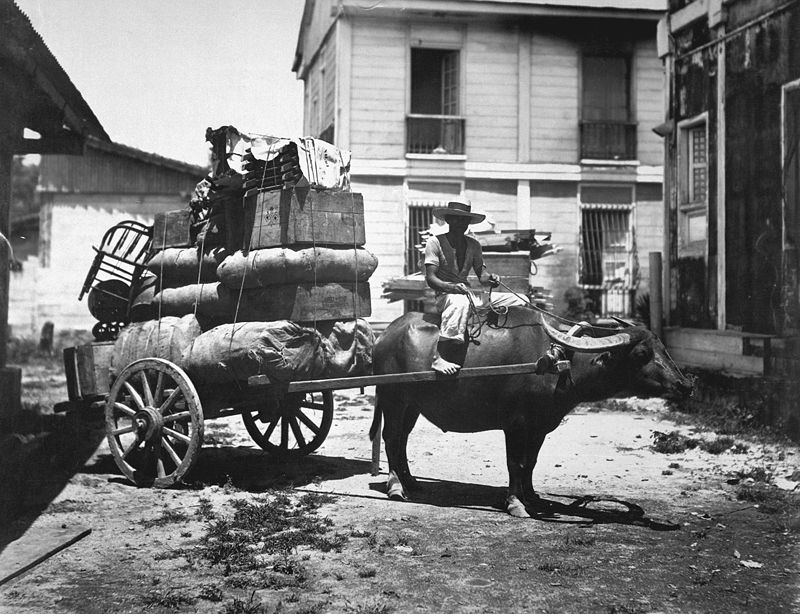
The raid was over in 35 minutes, POWs brought to pre-arranged meet-up places with dozens of carabao carts.   A long trek yet remained, one POW said “I made the Death March from Bataan, so I can certainly make this one!”  Over three days, up to 106 carts joined the procession, their plodding 2 MPH progress covered by strafing American aircraft.

Two American Rangers were killed in the raid, another 4 Americans and 21 Filipinos wounded, compared with 500-1,000 Japanese killed and four tanks put out of action.  One prisoner died in the arms of a Ranger, before leaving the gate.  Another died of illness on the long trip back.  464 American soldiers were liberated, along with 22 British and 3 Dutch soldiers, 28 American civilians, 2 Norwegians and one civilian each of British, Canadian and Filipino nationalities.

800px-Carabao_Cart
Carabao cart, similar to the ones used after the raid on Cabanatuan

Edwin Rose was a civilian, a purser on a ship plying the Singapore – Hong Kong run, when the war broke out.  He was caught in Manila and spent 929 days in captivity.  One of the longest-held POWs of the war in the Pacific. Rose awoke the night of the raid, and “heard all the shooting”.  He “knew the Americans had arrived” but he rolled over and went back to sleep, thinking they were there to stay. On awakening the following morning, Rose found he had “Cabanatuan all my own.”

POWs_celebrateHe dressed and shaved, put on his best clothes, and walked out of camp.  Passing guerrillas found him and passed him to a tank destroyer.  Give the man points for style.  A few days later, Edwin Rose strolled into 6th army headquarters, a cane tucked under his arm.

The Cabanatuan raid of January 30, 1945 liberated over 500 allied prisoners, the Americans among them representing virtually every state in the Union. Begging pardon for any mistakes in rank and/or spelling, the following represents those from my home state of Massachusetts:

  • Lieutenant Commander Robert Strong, Jr., Arlington
  • Captain John Dugan, Milton
  • 2nd Lieutenant John Temple, Pittsfield
  • Sergeant Richard Neault, Adams
  • Sergeant Stanislaus Malor, Salem
  • Private, 1st Class Joseph Thibeault, Lawrence
  • Private Edward Searkey, Lynn
  • USN C/QM Martin Seliga, Fitchburg
  • USN 1/C PO J.E.A. Morin, Danvers
  • USN AC MM Carl Silverman, Wareham

I hope I didn’t leave anyone out.  These guys have earned the right to be remembered.

If you enjoyed this “Today in History”, please feel free to re-blog, “like” & share on social media, so that others may find and enjoy it too. Please click the “follow” button on the right, to receive email updates on new articles.  Thank you for your interest, in the history we all share.