The Chicago Times described Lincoln’s remarks as “silly, flat and dish-watery utterances”, but it all came out in the end. Lincoln’s address went into history as one of the finest pieces of English language prose since Henry V’s St. Crispin’s Day speech, at Agincourt. The names of the haters at the Chicago Times, are all but forgotten.
154 years ago today, Abraham Lincoln boarded a train in Washington. He’d been asked to make “a few dedicatory remarks” on the following day, dedicating the new National Cemetery at Gettysburg where, even now, workmen labored to re-inter the dead from the carnage of July.
Lincoln was the President of a country torn by Civil War, a war so terrible that, before it was over, would kill more Americans than all the wars from the Declaration of Independence to the Global War on Terror, combined.
Lincoln had been feeling poorly the day of the train ride, telling his secretary, John Hay, that he was feeling weak. He would feel worse over the course of that day, and Hay noted that Lincoln’s face was ‘a ghastly color’ the day of the address. No one knew it at the time, but Lincoln was in the early stages of smallpox.
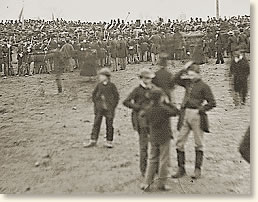
“A rare photo of the ceremonies. A group of boys stand at the fringe of a crowd. In the distance, several men wearing sashes can be seen standing on the speakers’ platform. Analysis of an enlargement of this photo reveals the image of Lincoln sitting to the left of these men”. Tip of the hat to http://www.eyewitnesstohistory.com, for this image
His was not the keynote address. That would be a 13,607 word, two-hour oration delivered by Boston politician Edward Everett.
After Everett’s speech, photographers thought they had all the time in the world to prepare and set their glass plates. They did not, and no photograph exists of Lincoln delivering the Gettysburg address.
The 16th President of the United States stepped to the rostrum and delivered 271 words, in ten sentences. In just over two minutes, Lincoln captured an entire vision of where the country was at that moment in time, where it had been, and where it was going.
Lincoln himself thought his speech a flop, but Everett later wrote to him, saying “I wish that I could flatter myself that I had come as near to the central idea of the occasion in two hours as you did in two minutes.”
There were haters then, as now, as always prepared to fire their little spitballs. The Chicago Times described Lincoln’s remarks as “silly, flat and dish-watery utterances”, but it all came out in the end. Lincoln’s address went into history as one of the finest pieces of English language prose since Henry V’s St. Crispin’s Day speech, at Agincourt. The names of the haters at the Chicago Times, are all but forgotten.
Oddly, we do not know the precise form in which the President delivered his address. Lincoln wrote his own speeches, lining out words and writing into margins as he developed his thought process. That working copy is lost.
“The only known image of Abraham Lincoln at Gettysburg was uncovered in 1952 at the National Archives. It was taken by photographer Mathew Brady. (Library of Congress)” H/T Smithsonian.com, for this image
There are five known copies of the Gettysburg address, written in Lincoln’s own hand, each varying slightly in wording and punctuation. He wrote two after the address, giving them to his two personal secretaries, John Hay and John Nicolay. He sent one to Edward Everett early in 1864, and another to George Bancroft, the former Secretary of the Navy turned historian. Lincoln wrote a fifth copy, known as the Bliss copy, for Colonel Alexander Bliss, in February, upon learning that the Bancroft version was unsuitable for publication, due to its having been written on both sides of the same page.
Lincoln signed, dated and titled the Bliss copy. This is the version inscribed on the South wall of the Lincoln Memorial.
One of my stranger childhood notions, was the idea that sounds never went away, they just diminished as they spread outward, like ripples on a pond. If that was true (thought my nine-year-old self), could we not somehow capture and listen to the Gettysburg address, as it was actually delivered?
It’s a funny thing how some ideas, even the goofy ones, never completely die away.
For the terminal history geek, the full text of all five copies may be discovered atwww.abrahamlincolnonline.org
Cleopatra bathed in the milk of donkeys, as did the 12th century Queen Isabeau of France, who followed it up by rubbing her skin with crocodile glands and the brains of boars. Mary, Queen of Scots, bathed in wine. Strange beauty rituals weren’t limited to women, either. Novelist George Sands used to soak himself in cow’s milk (3 quarts) and honey (3 pounds).
Popular ideas of what is beautiful have changed with time and place, but strange beauty secrets are as old as history itself.
In ancient Greece, blond hair was perceived as beautiful, probably because it was unusual. Women would lighten their hair using a mixture of ashes, olive oil & water, and sometimes arsenic.
Cleopatra bathed in the milk of donkeys, as did the 12th century Queen Isabeau of France, who followed it up by rubbing her skin with crocodile glands and the brains of boars.
During the Heian period in Japan, 794 to 1185AD, a woman’s beauty was judged by the length of her hair. The ideal was considered to be about two feet below her waist.
“Blood Countess Erzsébet Báthory
The Hungarian “Blood Countess” Erzsébet Báthory, who lived from August 7, 1560 – August 21, 1614, may have been the most prolific female serial killer in history, bathing in the blood of as many as 650 virgins, to keep herself looking young. Her four cohorts were convicted of killing 80, while Erzsébet herself was neither tried nor convicted due to her rank. She was simply thrown in jail on her arrest in December, 1610, and left there to die, four years later.
On a considerably less macabre note, Mary, Queen of Scots, bathed in wine. Strange beauty rituals weren’t limited to women, either. Novelist George Sands used to soak himself in cow’s milk (3 quarts) and honey (3 pounds).
Queen Elizabeth, I
Elizabeth I, daughter of Anne Boleyn and Henry VIII, was crowned this day, November 17, 1588. As queen, Elizabeth followed a path taken by women for thousands of years, sporting the high forehead and daubing her face with a powder makeup called ceruse. High lead content made the practice deadly enough, but they would top it off with a rouge containing mercury, leading to an untold number of birth defects and miscarriages. It’s all but certain that the combination of lead and mercury led to her complete loss of hair. Little wonder that she was the “Virgin Queen”.
The quest for the perfect, porcelain complexion would last well into the 19th century, for which some women ate clay. Marie Antoinette and other ladies of the French Court obsessed over flawless, alabaster skin, until the end of the 18th century. They would fake it with thick layers of white powder, made from white lead, or talcum powder, or pulverized bone, whatever they could get hold of. Combined with wax, whale blubber, or vegetable oil, it had a nice, greasy consistency that stayed where they put it.
This was a time of big hair, when hair was piled high on top of the head, powdered, and augmented with the hair of servants and pets. The do was often adorned with fabric, ribbons or fruit, sometimes holding props like birdcages complete with stuffed birds, and even miniature frigates, under sail.
It wasn’t just women’s hair, either. Fashionable European men of the 18th century wore wigs made of both animal and human hair, a practice which spread across the pond into North America. The wealthy wore longer wigs, often powdered and curled, while those who couldn’t afford them wore shorter versions, often styled into a braided ponytail.
George Edward Pickett, he of the famous charge at Gettysburg, was acclaimed for his oiled and perfumed locks. Same with the “Boy General”, the youngest Civil War General in the Union Army: George Armstrong Custer, who would anoint his hair with cinnamon oil.
George Pickett
Well into the 20th century, women chose between slicking their hair down with a greasy brilliantine, or spraying it with shellac dissolved in an admixture of water and alcohol.
Weird beauty tips are easy to find on-line, and I have to believe that each has its adherents. Some say that Preparation H under the eyes reduces puffiness (I hear it works), hot pepper sauce applied to the roots of your hair will help it grow, (the jury’s out on this one). Some believe that urine works as an astringent to clear up acne, (it doesn’t), and rubbing your face with a potato dries up oily skin (that one’s false as well).
Today, we look on past practices as bizarre, but maybe we shouldn’t. If those people from the past were to peer into their own future, they’d see spray tanning, teeth bleaching, and Brazilian bikini wax. They’d see people injecting the neurotoxic output of Clostridium Botulinum into their faces, and sticking metal objects through all manner of body parts.
You have to wonder what our own future will bring. Not even Nostradamus foretold tattooed grandmothers.
Governor de Graaff ordered an 11-gun return salute fired from the guns of Fort Oranje, making Sint Eustatius the first nation in history to acknowledge the independence of the United States.
Sint Eustatius, known to locals as “Statia”, is a Caribbean island of 8.1 sq. miles in the northern Leeward Islands. Formerly part of the Netherlands Antilles, the island lies southeast of the Virgin Islands, immediately to the northwest of Saint Kitts.
The island had close ties with North America throughout the 18th century, becoming wealthy from the trade in a variety of goods. Sugar, molasses, gin, rum and cotton were only a few of the goods shipped from, or through, Sint Eustatius. Colonial ports from Maine to Virginia shipped products to the island in return, including barrel staves, beans, flour, cod, horses, lumber and tobacco.
At its peak, the island was handling over 3,000 ships per year, making St. Eustatius the “Golden Rock” of the Caribbean.
Sint Eustatius was a Dutch Colony, and should have remained neutral during the American Revolution. The government in Holland warned Governor Johannes de Graaff to stay away from the rebels fighting for independence, but the Governor would have none of it. The trade in powder, ammunition and arms continued throughout the revolutionary period, with covert support smuggled from Spain, France and dissident interests in Holland. For a time, Sint Eustatius was the only link between Europe and the fledgling American colonies.
On the 16th of November, 1776, the Brig Andrew Doria sailed into Sint Eustatius’ principle anchorage in Oranje Bay. Flying the Continental Colors of the fledgling United States and commanded by Captain Isaiah Robinson, the Brig was there to obtain munitions and military supplies. Andrew Doria also carried a precious cargo, a copy of the Declaration of Independence.
It was the Americans’ second attempt to send the Declaration to their Dutch associates, the first having been captured on the way to Holland. Seemingly wrapped in papers containing some obscure espionage code, British investigators labored in vain to unlock this strange new cipher. They could have spared themselves the effort: they were personal notes in Yiddish, greetings to some of the Jewish merchants of Holland.
It was traditional in those days, that vessels approaching a foreign harbor would fire a gun salute upon entering. Captain Robinson fired a 13 gun volley on entering the bay, representing the 13 American colonies. The commander at Fort Oranje, overlooking the anchorage, wasn’t sure how to respond.
Tradition dictated the firing of a salute in return, typically two guns fewer than that fired by the incoming vessel. Such an act carried meaning. The firing of a return salute was the overt recognition that a sovereign state had entered the harbor. Such a salute amounted to formal recognition of the independence of the 13 American colonies.
Governor de Graaff ordered an 11-gun return salute fired from the guns of Fort Oranje, making Sint Eustatius the first nation in history to acknowledge the independence of the United States.
Playing the role of the tattle-tale younger sibling, nearby Saint Kitts immediately dispatched a vessel to England to inform the British government of the event. The British were furious, of course. The trade between St. Eustatius and the American Colonies became the principal cause of the fourth Anglo-Dutch war, begun on December 12, 1780.
Admiral George Bridges Rodney forced the surrender of Sint Eustatius in February of the following year, saying that “This rock, of only six miles in length and three in breadth, has done England more harm than all the arms of her most potent enemies, and alone supported the infamous rebellion. When I leave the island of St. Eustatius, it will be as barren a rock as the day it erupted from the sea. Instead of one of the greatest emporiums on earth, it will be a mere desert and known only by report.”
Rodney pretty much had his way. The census of 1790 shows 8,124 on the Dutch island nation. In 1950, the population stood at 790. It would take 150 years from Rodney’s departure, before tourism even began to restore the economic well-being of the tiny island.
Today, Sint Eustatius celebrates the 16th of November as “Statia America Day”, in recognition of that first salute.
An official coat of arms was designed by Walter Hellebrand, and adopted on this day in 2004. On the left is a Golden Rock, in memory of the trade which made the island rich. On the right is Fort Oranje, Sint Eustatius’ most important landmark. The angel fish of St. Eustatius is at the bottom, symbolizing the island’s future. Below that is the Latin motto, “SUPERBA ET CONFIDENS”. Proud and Confident.
For two years, FBI investigators interviewed witnesses. They listened to the song at varying speeds, backward and forward, but the relentless search for bawdy material came up empty. In the end, the song was ruled “unintelligible at any speed”.
In 1955, Richard Berry wrote a song about a Jamaican sailor returning to his island to see his lady love. It’s a ballad, a conversation in the first person singular, with a bartender. The bartender’s name is Louie.
The song was covered in Latin and R&B styles in the fifties, but was never more than a regional hit on the west coast.
“Mainstream” white artists of the fifties and sixties often covered songs written by black artists. On April 6, 1963, an obscure rock & roll group out of Portland, Oregon covered the song, renting a recording studio for $50. They were The Kingsmen.
Lead singer Jack Ely showed the band how he wanted it played. Berry’s easy 1-2-3-4, 1-2, 1-2-3-4 ballad would be changed to a raucous 1-2-3, 1-2, 1-2-3 beat.
The guitar work could only be described as anarchic, the lyrics unintelligible. The Kingsmen recorded the song in a single take. It was released by a small label in May and re-released by Wand Records in October, 1963. Sales of the single increased through the 15th of November, the song entering the Billboard Top 100 chart on December 7.
Rock & Roll music is so mainstream now, that it’s hard to remember how subversive and decadent it was considered to be.
Louie Louie’s impenetrable lyrics led to all kinds of speculation about what was being said. More than a few imaginations ran wild. Fabricated lyrics ranging from mildly raunchy to pornographic were written out on slips of paper and exchanged between teenagers, spurring interest in the song and driving record sales through the roof.
Concerned parents contacted government authorities to see what could be done. One parent, a Sarasota, Florida junior high school teacher, wrote to Attorney General Bobby Kennedy. “Who do you turn to when your teen age daughter buys and brings home pornographic or obscene materials being sold along with objects directed and aimed at the teenage market in every City, Village and Record shop in this Nation?” The letter ends with a plea, complete with four punctuation marks: “How can we stamp out this menace????”
The FBI took up the investigation in 1964 under the ITOM statute, a federal law regulating the Interstate Transportation of Obscene Material. There are 119 pages in the FBI’s archival website, covering the case.
For two years, FBI investigators interviewed witnesses. They listened to the song at varying speeds, backward and forward, but the relentless search for bawdy material came up empty. In the end, the song was ruled “unintelligible at any speed”.
Strangely, the feds never interviewed Kingsmen lead singer Jack Ely, who probably could have saved them a lot of time.
The song has been covered by numerous artists over the years, including Paul Revere & the Raiders, Otis Redding, Motorhead, Black Flag and Young MC. The best version ever, has got to be the Delta Tau Chi fraternity version from John Landis’ 1978 movie, Animal House.
In 1972, the weekly journal of the British veterinary profession, the Veterinary Record, ran an article in their April 1st edition. It described the diseases common to “Brunus Edwardii”, a species “commonly kept in homes in the United Kingdom and other countries in Europe and North America”. The article reported that “Pet ownership surveys have shown that 63.8% of households are inhabited by one or more of these animals, and there is a statistically significant relationship between their population and the number of children in a household”.
Theodore Roosevelt was in Mississippi in November 1902, helping local authorities settle a border dispute with Louisiana. There was some downtime on the 14th, when Governor Andrew Longino invited Roosevelt and some other dignitaries on a bear hunt.
Holt Collier
The hunt was a high profile affair, attended by a number of reporters, and led by a former slave and Confederate Cavalryman, the famous bear tracker Holt Collier: a man who had killed more bears than Davy Crockett and Daniel Boone, combined. Yes, I meant to say that. He was a black man who fought, in uniform and by his own choice, for the Confederate States of America. Real history is so much more interesting than the political or pop culture varieties.
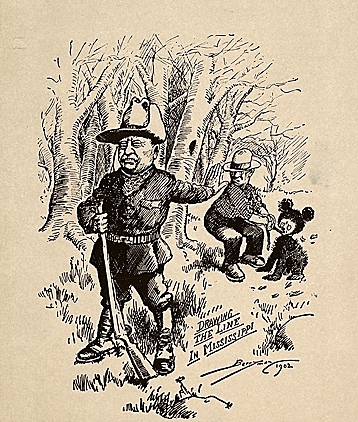
Late in the afternoon, Collier and his tracking dogs cornered a large female black bear. Roosevelt hadn’t “bagged” one yet, and Collier bugled for the President to join him. He would have ordinarily shot the bear when it killed one of his dogs, but Collier wanted the president to get this one. He busted the bear over the head with his rifle, hard enough to bend the barrel, and tied it to a willow tree.
Roosevelt declined to shoot the animal, calling it “unsportsmanlike” to shoot a bound and wounded animal. Instead, he ordered the bear put down, putting an end to its pain.
The Washington Post ran an editorial cartoon, “Drawing the Line in Mississippi”, by Clifford K. Berryman, depicting both the state line dispute and the hunting incident. Berryman first drew the animal as a large, fierce killer, but later redrew the bear, making it into a cute, cuddly cub.
Morris Michtom owned a small novelty and candy store in Brooklyn, New York. Michtom’s wife Rose had been making toy bears for sale in their store, when Michtom sent one of them to Roosevelt, asking permission to call it “Teddy’s Bear”. Roosevelt detested that nickname, but he said yes. Michtom’s bear became so popular that he went on to start what would become the Ideal Toy Company.
In 1972, the weekly journal of the British veterinary profession, the Veterinary Record, ran an article in their April 1st edition. It described the diseases common to “Brunus Edwardii”, a species “commonly kept in homes in the United Kingdom and other countries in Europe and North America”. The article reported that “Pet ownership surveys have shown that 63.8% of households are inhabited by one or more of these animals, and there is a statistically significant relationship between their population and the number of children in a household”.
It went on to describe some of them medical afflictions, common to this creature. The article was overwhelmingly popular, except for the usual curmudgeonly contingent, who seem to experience life as a need to complain, in search of a target.
One such was A. Noel Smith, a zany funster if there ever was one, who sniffed, “I have been practising veterinary medicine for the past 12 years or more “across the pond” and my Veterinary Records arrive a month or more late. However, I still open them with interest and read what is going on “at home”. April 1st’s edition thoroughly soured my interest. How three members holding sets of impressive degrees can waste their time writing such garbage in a journal that is the official publication of the B.V.A. is beyond my comprehension, as is your effrontery to publish it under “Clinical Papers”.
I’ll bet he’d be a hoot to have a beer with.
For the record,”Brunus Edwardii”, is latin for Edward Brown. The internet dictionary etymologyonline.com explains the origins of “Brown” as, among others, Dutch, for “Bruin”.
Edward Bruin. Edward Bear. Author A.A. Milne’s proper name, for Winnie-the-Pooh.
The names begin at the center and travel outward, the east wing ending on May 25, 1968. The same day continues at the far end of the west wing, moving back toward the center at panel 1W. The last name on the wall, the last casualty of the war, meets the first, and the circle is closed.
A couple of years ago, my brother was working in Washington, DC. I was passing through, and it was a great chance to spend some time together. There were a few things we needed to see while we were there. The grave of our grandfather, at Arlington. The Tomb of the Unknown. The Korean and WW2 memorials. Before the day was over, we wanted to see the Vietnam Veteran’s memorial.
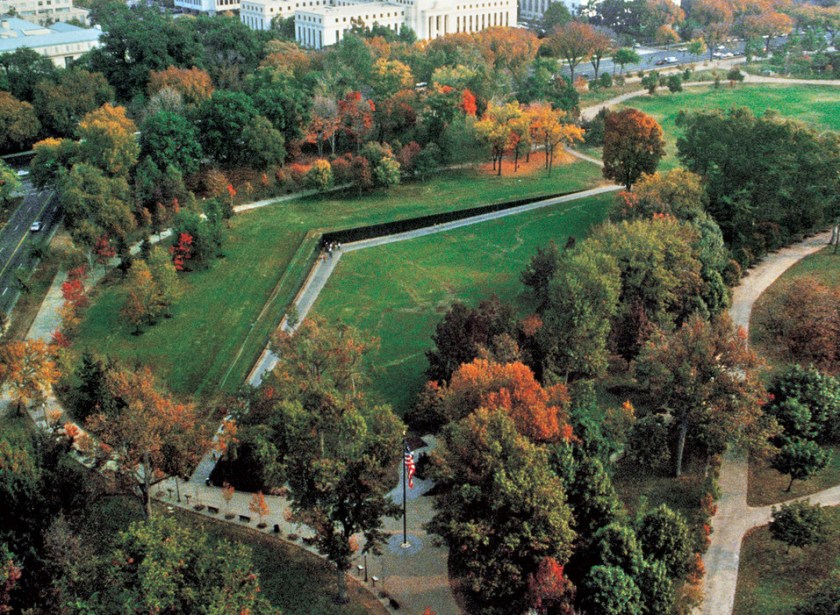
“The Wall” was dedicated on this day, November 13, 1982. 31 years later, we had come to pay respects to our Uncle Gary’s shipmates, their names inscribed on panel 24E, the 134 lost in the disaster aboard the Supercarrier USS Forrestal, in 1967.
We were soon absorbed in the majesty, and the solemnity, of the memorial.
It’s a black granite wall, 493’6″ long and 10’3″ high at its peak, laid out in a great wedge of stone which seems to rise from the earth and return to it. The name of every person lost in the war in Vietnam is engraved on that wall, appearing in the order in which they were lost.
Lance Cpl. Richard B. Fitzgibbon, Jr
Go to the highest point of the memorial, panel 1E, the very first name is that of Air Force Tech Sgt. Richard B. Fitzgibbon, Jr., of Stoneham, Massachusetts, killed on June 8, 1956. Some distance to his right you will find the name of Marine Corps Lance Cpl. Richard B. Fitzgibbon III, killed on Sept. 7, 1965. They are one of three Father/Son pairs who are so remembered.
The names begin at the center and travel outward, the east wing ending on May 25, 1968. The same day continues at the far end of the west wing, moving back toward the center at panel 1W. The last name on the wall, the last casualty of the war, meets the first, and the circle is closed.
There, you will find the name of Kelton Rena Turner of Los Angeles, an 18-year old Marine, killed in action on May 15, 1975, in the “Mayaguez incident”, two weeks after the evacuation of Saigon. Most sources list Gary L. Hall, Joseph N. Hargrove and Danny G. Marshall as the last to die in Vietnam, though their fate is unknown. These three were United States Marines, an M-60 machine gun squad mistakenly left behind while covering the beach evacuation of Koh Tang Island. Their names appear along with Turner’s, on panel 1W, lines 130-131.
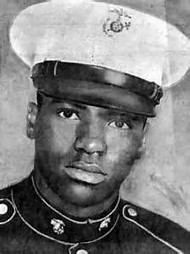
PFC Dan Bullock
There were 57,939 names when the Memorial opened in 1982. 39,996 died at the age of 22 or younger, 8,283 were 19 years old. The 18-year-olds are the largest age group, with 33,103. Twelve of them were 17 on their last day on earth. Five were 16. There is one name on panel 23W, line 096. That of PFC Dan Bullock, United States Marine Corps. He was 15 years old. Eight names are those of women, killed while nursing the wounded. 997 soldiers were killed on their first day in Vietnam. 1,448 died on their last. There are 31 pairs of brothers on the Wall: 62 parents who lost two of their sons.
As of Memorial Day 2015, there are 58,307, as the names of military personnel who succumbed to wounds sustained in the war, were added to the wall.
I was nine years old in May 1968, the single deadliest month of that war, with 2,415 killed. I remember the rancid political atmosphere of the time, and the national disgrace that was the way these people were treated on returning home.
I once thanked a business associate for his service in Vietnam. It stunned me to learn that in 40 years, no one had ever said that to him.
Today, I can only hope that Vietnam veterans know and understand how many of us appreciate their service. And I wish to advance the idea that, if anyone has an issue with our country’s war policy, they need to take it up with a politician. Not with the Armed Services member who is doing what his country asked him to do.
No one knew what to do with an 8-ton dead whale, washed up on the beach, but there happened to be an ex-military guy around who had explosives training. He tried to tell them that 20 sticks of dynamite would do it, if they were placed correctly. No one seemed to want his advice. Someone had decided to use a half-ton of the stuff, and that’s what they were going to do. It was a bad idea.
It was November 12, 1970, when a 45 foot, 8 ton, dead sperm whale washed up on the beaches near Florence, Oregon. State beaches came under the jurisdiction of the Department of Transportation at that time, and they came down to have a look.
Officials discussed the matter with the Navy (it wasn’t every day that they had to remove 16,000 lbs of rotting whale meat) and someone came up with a bright idea. They would remove the carcass the same way they’d remove a huge boulder. They’d blow it up.
They figured the gulls and the crabs would take care of things if they got the pieces small enough. The trick was to use enough dynamite.
No one could know it at the time, but the incident had already reached its high water mark. From there, it would all be downhill.
By sheer coincidence, there happened to be an ex-military guy around, Walter Umenhofer, who had explosives training. He tried to tell them that 20 sticks of dynamite would do it, if they were placed correctly, but no one seemed to want his advice.
Someone had decided to use a half a ton of the stuff, and that’s what they were going to do.
That might have been the worst idea, since Rudolph Hess flew that plane to Scotland.
Crowds lined the beach the day of the explosion, and TV cameras were rolling. No one had ever seen a whale explode.
The detonation tore through the whale, like a bullet passes through a pane of glass. Thousands of chunks of dead whale, large and small, soared through the air, landing on nearby buildings, houses and streets.
Umenhofer was among the crowd that day, and had a great slab of blubber come down from the sky and destroy his brand new Olds 88. He had just bought the car from a dealer who was running a “Whale of a Sale” deal. You can’t make this stuff up.
It turns out that exploding whales aren’t even that unusual. Iceland, Australia and South African authorities routinely blow up whale carcasses to avoid hazards to navigation, though they are usually towed out to sea, first.
There have even been spontaneously exploding whales, when gasses built to a point of ripeness that can no longer be contained. It happened on Salt Spring Island, British Columbia, where the locals reported that blubber “hung in the trees for weeks”.
A whale washed ashore in Denmark sometime in 1991, when someone decided that a careful poke here and a prod there would release the highly pressurized gasses of decomposition. That one didn’t exactly work out as planned, either.
Exploding whale, 1991
Another spontaneous whale explosion occurred on January 26, 2004, in Tainan City, Taiwan. That time, they had managed to get the thing onto a truck, and were hauling it through town went off. It must have been a memorable experience for passing pedestrians, traffic and nearby shop keepers.
Forty-seven years ago today, the folks from Florence learned an important lesson about what to do with dead whales. Nine years later, 41 dead sperm whales washed ashore on nearby beaches. This time, they were burned and buried where they lay.
All sides combined suffered over 11,000 dead, wounded, and missing in those final six hours, between the signing and the cease-fire. Some have estimated that more men died per hour on that final day of the “Great War”, than during the D-Day invasion, 26 years later.
103 years ago this June, the Great War began with the assassination of an Archduke, the heir apparent to the dual monarchy of Austria-Hungary. The resulting conflict could have remained little more than a regional squabble, a police action in the Balkans.
It became anything but.
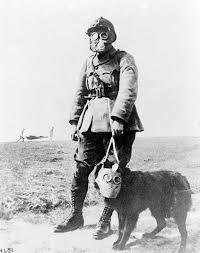
Many of the soldiers who went off in the early days, viewed the war as some kind of grand adventure. Many of them singing patriotic songs, the young men and boys of Russia, Germany, Austria and France stole last kisses from wives and sweethearts, and boarded their ships and trains. Believing overwhelming manpower to be the key to victory, British Secretary of State for War Lord Kitchener recruited friends and neighbors by the tens of thousands into “pal’s battalions”, to fight for King and country.
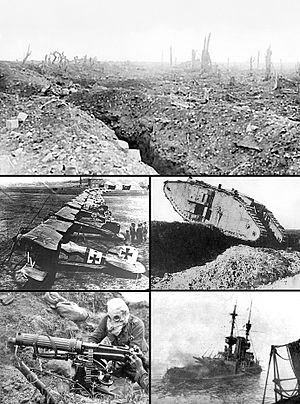
Four years later, an entire generation had been chewed up and spit out in pieces.
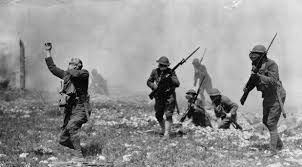
The camera captures the last moments of a dying soldier, caught out in the open without a gas mask.
Any single day’s fighting in the great battles of 1916 produced more casualties than every European war of the preceding 100 years, civilian and military, combined.
6,503 Americans lost their lives during the month-long battle for Iwo Jima, in 1945. The first day of fighting during the 1916 Battle of the Somme killed three times that number on the British and Commonwealth side, alone.
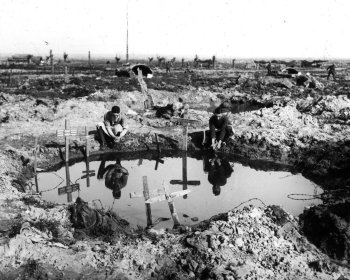
Over 16 million were killed and another 20 million wounded, while vast stretches of the European countryside were literally torn to shreds. Tens of thousands remain missing, to this day.
Had you found yourself in the mud and the blood of the trenches during the New Year of 1916-’17, you could have heard a plaintive refrain drifting across the barbed wire and the frozen wastes of no man’s land, sung to the tune of ‘Auld Lang Syne”.
We’re here, because we’re here, because we’re here, because we’re here, we’re here, because we’re here, because we’re here, because we’re here.
Starvation and malnutrition stalked the countryside, with riots on the home front and mutiny in the trenches. Nearly every combatant saw the collapse of its national economy, or teetering on the verge of collapse.
A strange bugle call came out of the night of November 7, 1918. French soldiers of the 171st Régiment d’Infanterie, stationed near Haudroy, advanced into the fog and the darkness, expecting that they were about to be attacked. Instead, they were shocked to see the apparitions of three sedans, their sides displaying the German Imperial Eagle.
Imperial Germany, its army disintegrating in the field and threatened with revolution at home, had sent a peace delegation, headed by the 43-year-old German politician Matthias Erzberger.
The delegation was escorted to the Compiegne Forest near Paris, to a conference room fashioned out of a railroad dining car. There they were met by a delegation headed by Ferdinand Foch, Marshall of France.
The Germans were shocked at the words that came out of his mouth. ‘Ask these gentlemen what they want,’ he said to his interpreter. Stunned, Erzberger responded. The German believed that they were there to discuss terms of an armistice. Foch dropped the hammer: “Tell these gentlemen that I have no proposals to make”.
Ferdinand Foch had seen his country destroyed by war, and had vowed “to pursue the Feldgrauen (Field Grays) with a sword at their backs”. He had no intention of letting up.
Foch now produced 34 demands, each one a sledgehammer blow on the German delegation. Germany was to divest herself of all means of self-defense, from her high seas fleet to the last machine gun. They were to withdraw from all lands occupied since 1870. With the German population at home facing starvation, the allies were to confiscate 5,000 locomotives, 150,000 railroad cars, and 5,000 trucks.
Foch informed Ertzberger that he had 72 hours in which to respond. “For God’s sake, Monsieur le Marechal”, responded the German, “do not wait for those 72 hours. Stop the hostilities this very day”. By this time, 2,250 were dying every day on the Western Front, yet the plea fell on deaf ears. Fighting would continue until the last minute of the last day.
The German King, Kaiser Wilhelm, abdicated on the 10th, as riots broke out in the streets of Germany. The final surrender was signed at 5:10am on November 11, and back-timed to 5:00am Paris time, scheduled to go into effect later that morning. The 11th hour, of the 11th day, of the 11th month.
The order went out to that effect. The war would be over in hours, but there were no other instructions.
Some field commanders ordered their men to stand down. Why fight and die over ground that they could walk over in a few hours?
Others continued the attack, many believing that Germany had to be well and truly beaten. Others saw their last chance at glory or promotion. An artillery captain named Harry S Truman, kept his battery firing until minutes before 11:00.
English teacher turned Major General Charles Summerall had a fondness for the turn of phrase. Ordering his subordinates across the Meuse River in those final hours, Summerall said “We are swinging the door by its hinges. It has got to move…Get into action and get across. I don’t expect to see any of you again…”
At least 320 Americans were killed in those final six hours, 3,240 seriously wounded.
Still smarting from their disastrous defeat at Mons back in 1914, British High Command was determined to take the place back on the final day of the war. The British Empire lost more than 2,400 in those last 6 hours.
The French 80th Régiment d’Infanterie received two orders that morning – to launch an attack at 9:00, and cease-fire at 11:00. French losses for the final day amounted to 1,170. The already retreating Germans suffered 4,120 casualties.
All sides combined suffered over 11,000 dead, wounded, and missing in those final six hours. Some have estimated that more men died per hour on that final day of the “Great War”, than during the D-Day invasion, 26 years later.
Over in the Meuse-Argonne sector, Henry Gunther was “visibly angry”. Maybe it was his recent reduction in rank, or maybe this American grandson of German immigrants felt he had something to prove. Bayonet fixed, Gunther charged the enemy machine gun position, as German soldiers yelled for him to go back. He got off a “shot or two”, before the five round burst tore into his head. Henry Nicholas John Gunther of Baltimore Maryland, was the last man to die in the Great War. The time was 10:59am.
Matthias Erzberger was assassinated in 1921, for his role in the surrender. The “Stab in the Back” mythology destined to become Nazi propaganda, had already begun.
AEF Commander General John “Black Jack” Pershing believed the armistice to be a grave mistake. He believed that Germany had been defeated but not beaten, and that failure to smash the German homeland meant that the war would have to be fought all over again. Ferdinand Foch agreed. On reading the Versailles treaty in 1919, he said “This isn’t peace! This is a truce that will last for 20 years”.
He got it wrong, by 36 days.
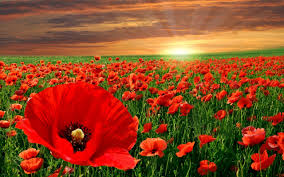
The red poppy of remembrance, surrounds the Tower of London.
Historians differ on the location of the first recruiting station. Some will tell you that it was the “Conestoga Waggon” tavern in Philadelphia. Tradition holds it to have been the “Tun Tavern”, a name coming from the Olde English “Tun”, meaning a barrel or a keg of beer.
The Navy had been in existence for less than a month and the Battles of Lexington and Concord a mere seven months in the past, when the Continental Marines were formed by an act of the 2nd Continental Congress, convened on November 10, 1775.
“Resolved, That two Battalions of Marines be raised, consisting of one Colonel, two Lieutenant Colonels, two Majors, and other officers as usual in other regiments; and that they consist of an equal number of privates with other battalions; that particular care be taken, that no persons be appointed to office, or inlisted into said Battalion, but such are good seamen, or so acquainted with maritime affairs as to be able to serve to advantage by sea when required: that they be inlisted and commissioned to serve for and during the present war between Great Britain and the colonies, unless dismissed by order of Congress: that they be distinguished by the names of the first and second battalion of American Marines, and that they be considered as part of the number which the continental Army before Boston is ordered to consist of.”
“The First Recruits” by Col Charles Waterhouse, USMCR (Ret)
Historians differ on the location of the first recruiting station. Some will tell you that it was the “Conestoga Waggon” tavern in Philadelphia. Tradition holds it to have been the “Tun Tavern”, a name coming from the Olde English “Tun”, meaning a barrel or a keg of beer.
Continental Marines served a number of important functions during the Revolution, including ship-board security, amphibious assault and ship-to-ship combat. Then as now, Marines were riflemen first. During naval engagements they could be found in the masts and rigging, their sharpshooters’ skills taking out opposing helmsmen, gunners and ship’s officers.
No less a figure than Admiral David G. Farragut wrote in 1862, “A ship without Marines is like a garment without buttons.”
The first Marine landing on a hostile shore took place in March 1776, when a Marine force under the former Quaker, Captain Samuel Nicholas, captured New Province Island in the Bahamas. Nicholas was the first commissioned officer in the Continental Marines, and is now remembered as the first commandant of the Marine Corps.
The Continental Congress disbanded the Marines in 1783, following their help in winning American independence. Increasing conflict and the coming “quasi-war” with revolutionary France would soon bring them back.
President John Adams signed a bill establishing the United States Marine Corps as a permanent military force under Navy jurisdiction on July 11, 1798.
The most famous action of the early period occurred during the Tripolitan War of 1801–’05, against the Barbary states of Tripoli, Algiers, Tunis, and the independent Sultanate of Morocco. US Army Lieutenant William Eaton and United States Marine Corps 1st Lieutenant Presley O’Bannon led eight Marines and 500 mercenaries on a 600-mile forced march through the desert, against a much larger force defending the city of Derna, in Libya. Ottoman viceroy Prince Hamet awarded a Mameluke sword to O’Bannon on December 8, 1805, in a gesture of respect for the Marines’ conduct. That curved, cross-hilted scimitar became the model for swords worn by Marine officers to this day, the victory at Derna memorialized in a line from the Marine Corps Hymn “From the halls of Montezuma, to the shores of Tripoli”.
Since then, the Marine Corps has participated in virtually every conflict ever fought by the United States. They’re usually the first ones in. To date, United States Marines have executed over 300 landings on foreign shores.
The USMC has 182,000 active duty members as of 2016, with 38,500 in reserve. They are separated into three divisions, headquartered at Camp Lejeune, North Carolina, Camp Pendleton in California; and Okinawa, Japan. Each division maintains one or more expeditionary units, prepared for major operations anywhere in the world on two weeks’ notice.
The original Tun Tavern burned down in 1781, shortly before the end of the Revolution. Today, the site is part of Interstate 95, where it passes Penn’s landing. You can still visit the Tun Tavern styled restaurant at the National Marine Corps Museum in Quantico, where a beer and a bread pudding is always part of the lunch menu.
Happy 241st birthday, United States Marine Corps. Thank you.
Semper Fidelis.
Camp Lejeune celebrated the 233rd Marine Corps birthday with its annual Joint Daytime Ceremony at Liversedge Field, Friday. Pageant Marines wore period uniforms representing major conflicts. Attendees were reminded that throughout history, Marines continue to distinguish themselves on battlefields and foreign shores, in both war and peace.
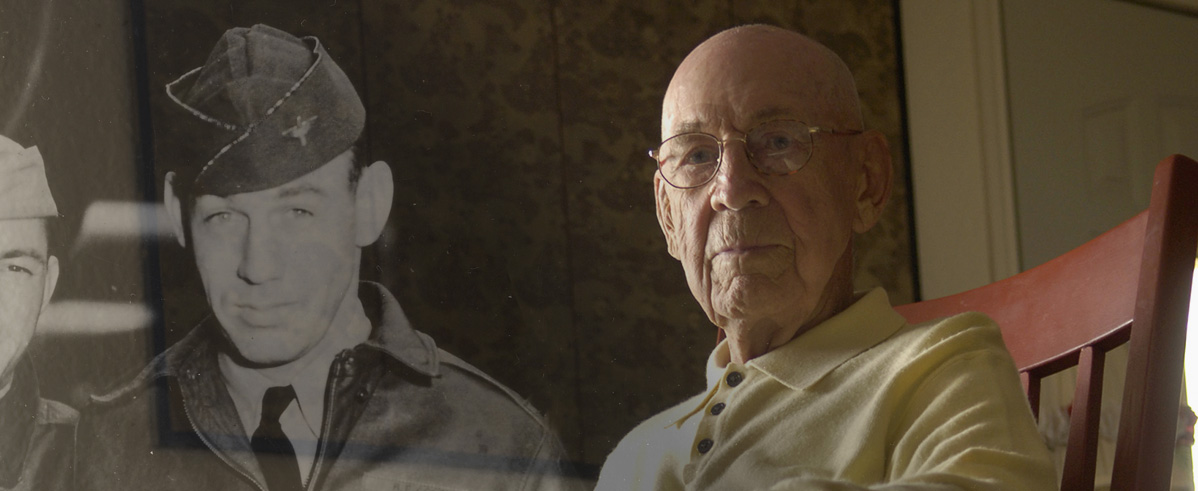
On April 18, 2015, Richard Cole and David Thatcher fulfilled their original bargain, as the last two surviving members of the Doolittle raid. Staff Sergeant Thatcher passed in June of last year, at the age of 94. As I write this, Lieutenant Colonel Richard Cole age 102, Jimmy Doolittle’s co-pilot, is the only man in the world who has earned the right to open that bottle.
On November 9, 2013, there occurred a gathering of four, a tribute to fallen heroes. These four are themselves heroes, and worthy of tribute. It was to be their last such gathering.
This story begins on April 18, 1942, when a flight of 16 Mitchell B25 medium bombers took off from the deck of the carrier USS Hornet. It was a retaliatory raid on Japan, planned and led by Lieutenant Colonel James “Jimmy” Doolittle of the U.S. Army Air Forces. It was payback for the sneak attack on Pearl Harbor, seven months earlier. A demonstration that the Japanese home islands were not immune from attack.
Launching such large aircraft from the decks of a carrier had never been attempted, and there were no means of bringing them back. This was to be a one-way mission, into enemy occupied territory.
Fearing a breach in operational security, the mission was forced to launch 200 miles before the intended departure spot. The range now made fighter escort impossible, and left the bombers themselves with the slimmest margin of error.
Japanese Premier Hideki Tojo was inspecting military bases at the time of the raid. One B-25 came so close that he could see the pilot, though the American bomber never fired a shot.
After dropping their bombs, all but one aircraft was able to continue west into Japanese occupied China. That one landed in Vladivostok, where the pilot and crew were interned for a year by our Soviet “allies”.
A quarter of a million Chinese were murdered by Japanese soldiers, as they hunted for Doolittle’s raiders. Eight of them were captured, three were executed and one died in captivity, but most of the 80 who began the mission survived the war.
There was little serious damage done to the Japanese home islands, but the raid had a decisive effect. Japan withdrew its powerful aircraft carrier force to protect the home islands. Admiral Isoroku Yamamoto attacked Midway, thinking it to have been the jump-off point for the raid. Described by military historian John Keegan as “the most stunning and decisive blow in the history of naval warfare”, the battle of Midway would be a major strategic defeat for Imperial Japan.
The Doolittle raiders have held a reunion every year, from the late 40’s, until 2013. In 1959, the city of Tucson presented them with 80 silver goblets, each engraved with the name of one of their number. They are on display at the National Museum of the Air Force, in Dayton Ohio.
With those goblets is a fine bottle of vintage Cognac, 1896, the year Jimmy Doolittle was born. There’s been a bargain among the Doolittle raid survivors that, one day, the last two of their number would open that bottle, and toast their comrades.
In 2013 they changed their bargain, just a bit. Jimmy Doolittle himself passed away in 1993. Twenty years later, 76 goblets had been turned over, each signifying a man who had passed on. The last four were Lieutenant Colonel Richard E. Cole, co-pilot of crew No. 1; Lieutenant Colonel Robert L. Hite, co-pilot of crew No. 16; Lieutenant Colonel Edward J. Saylor, engineer-gunner of crew No. 15; and Staff Sergeant David J. Thatcher, engineer-gunner of crew No. 7. These four agreed that they would gather one last time. It would be they who would finally open that bottle.
Robert Hite, 93, was too frail to travel, so his son stood in for him. So it was that a 117 year-old bottle of cognac was cracked open on this date in 2013, and enjoyed in the company of heroes. If there is a more magnificent act of tribute, I cannot at this moment think of what it might be.
On April 18, 2015, Richard Cole and David Thatcher fulfilled their original bargain, as the last two surviving members of the Doolittle raid. Staff Sergeant Thatcher passed in June of last year, at the age of 94. As I write this, Lieutenant Colonel Richard Cole age 102, Jimmy Doolittle’s co-pilot, is the only man in the world who has earned the right to open that bottle.



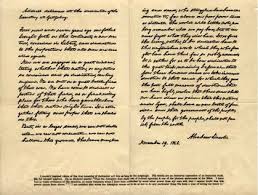 Lincoln signed, dated and titled the Bliss copy. This is the version inscribed on the South wall of the Lincoln Memorial.


 This was a time of big hair, when hair was piled high on top of the head, powdered, and augmented with the hair of servants and pets. The do was often adorned with fabric, ribbons or fruit, sometimes holding props like birdcages complete with stuffed birds, and even miniature frigates, under sail.


 Sint Eustatius, known to locals as “Statia”, is a Caribbean island of 8.1 sq. miles in the northern Leeward Islands. Formerly part of the Netherlands Antilles, the island lies southeast of the Virgin Islands, immediately to the northwest of Saint Kitts.
 On the 16th of November, 1776, the Brig Andrew Doria sailed into Sint Eustatius’ principle anchorage in Oranje Bay. Flying the Continental Colors of the fledgling United States and commanded by Captain Isaiah Robinson, the Brig was there to obtain munitions and military supplies. Andrew Doria also carried a precious cargo, a copy of the Declaration of Independence.
 Tradition dictated the firing of a salute in return, typically two guns fewer than that fired by the incoming vessel. Such an act carried meaning. The firing of a return salute was the overt recognition that a sovereign state had entered the harbor. Such a salute amounted to formal recognition of the independence of the 13 American colonies.
 Rodney pretty much had his way. The census of 1790 shows 8,124 on the Dutch island nation. In 1950, the population stood at 790. It would take 150 years from Rodney’s departure, before tourism even began to restore the economic well-being of the tiny island.

 “Mainstream” white artists of the fifties and sixties often covered songs written by black artists. On April 6, 1963, an obscure rock & roll group out of Portland, Oregon covered the song, renting a recording studio for $50. They were The Kingsmen.
 Strangely, the feds never interviewed Kingsmen lead singer Jack Ely, who probably could have saved them a lot of time.


 Roosevelt declined to shoot the animal, calling it “unsportsmanlike” to shoot a bound and wounded animal. Instead, he ordered the bear put down, putting an end to its pain.


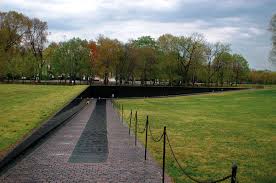 “The Wall” was dedicated on this day, November 13, 1982. 31 years later, we had come to pay respects to our Uncle Gary’s shipmates, their names inscribed on panel 24E, the 134 lost in the disaster aboard the Supercarrier USS


 Officials discussed the matter with the Navy (it wasn’t every day that they had to remove 16,000 lbs of rotting whale meat) and someone came up with a bright idea. They would remove the carcass the same way they’d remove a huge boulder. They’d blow it up.
 The detonation tore through the whale, like a bullet passes through a pane of glass. Thousands of chunks of dead whale, large and small, soared through the air, landing on nearby buildings, houses and streets.


 Imperial Germany, its army disintegrating in the field and threatened with revolution at home, had sent a peace delegation, headed by the 43-year-old German politician Matthias Erzberger.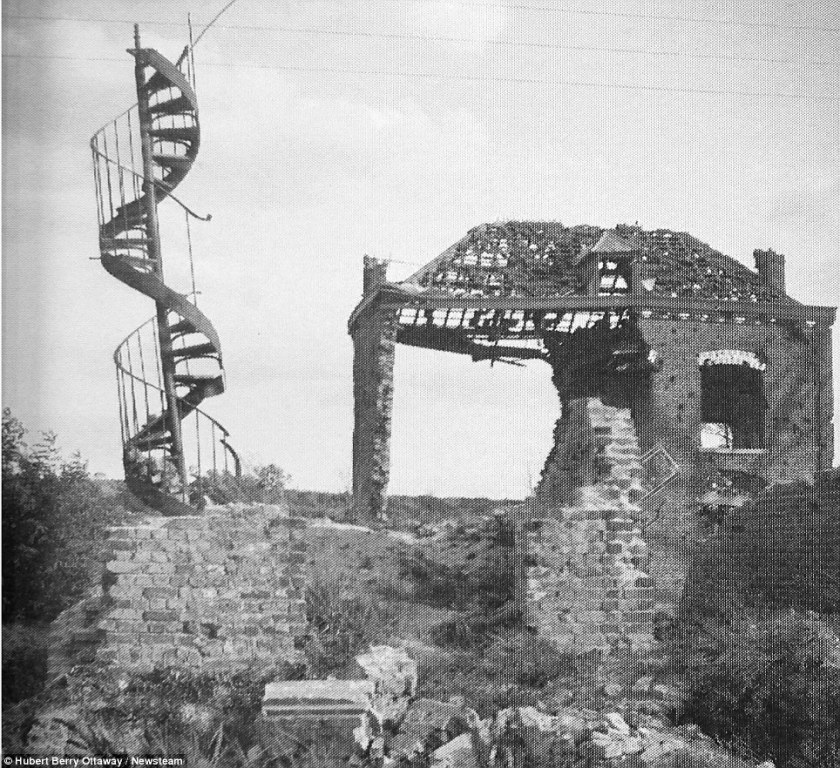
 Foch informed Ertzberger that he had 72 hours in which to respond. “For God’s sake, Monsieur le Marechal”, responded the German, “do not wait for those 72 hours. Stop the hostilities this very day”. By this time, 2,250 were dying every day on the Western Front, yet the plea fell on deaf ears. Fighting would continue until the last minute of the last day.
 At least 320 Americans were killed in those final six hours, 3,240 seriously wounded.
 Matthias Erzberger was assassinated in 1921, for his role in the surrender. The “Stab in the Back” mythology destined to become Nazi propaganda, had already begun.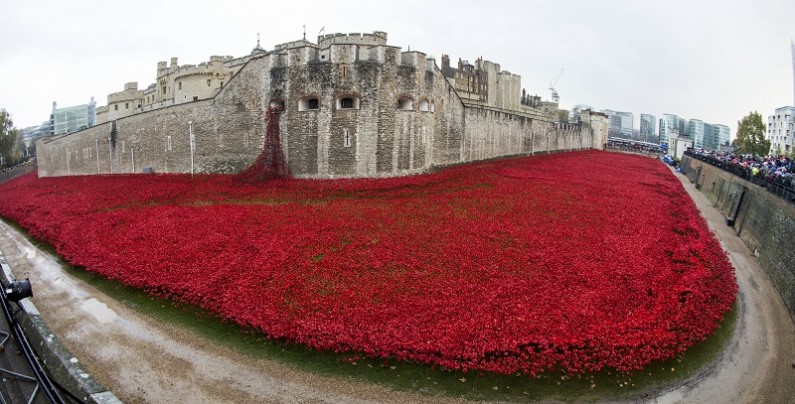


 President John Adams signed a bill establishing the United States Marine Corps as a permanent military force under Navy jurisdiction on July 11, 1798.
 Since then, the Marine Corps has participated in virtually every conflict ever fought by the United States. They’re usually the first ones in. To date, United States Marines have executed over 300 landings on foreign shores.



 Historical Easter Eggs - Today in History
You must be logged in to post a comment.