December 3, 1586, Spuds

ICYMI – Today, potatoes are the 5th largest crop on the planet, following rice, wheat, maize and sugar cane.  Almost 5,000 varieties are preserved in the International Potato Center in Peru.

The expedition which would end in the Lost Colony of Roanoke began in 1585, financed by Sir Walter Raleigh and led by Sir Ralph Lane. On board was the Oxford trained mathematician and astronomer Sir Thomas Herriot, the man who would introduce the potato to England on this day, the following year.

The Inca of Peru seem to have been the first to cultivate potatoes, around 8,000BC.
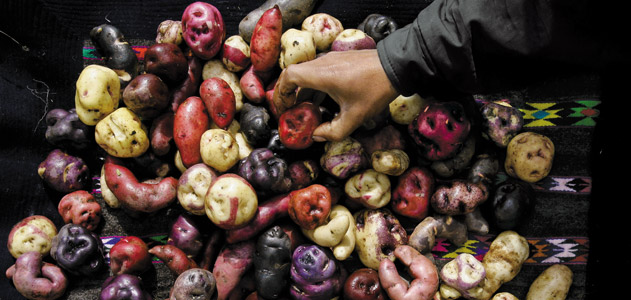
Inca foodWild potatoes contain toxins to defend themselves against fungi and bacteria, toxins unaffected by the heat of cooking.  In the Andes, mountain people learned to imitate the wild guanaco and vicuña, licking clay before eating the poisonous plants. In this manner, toxins pass harmlessly through the digestive system. Mountain people dunk wild potatoes in “gravy” made of clay and water, accompanied with coarse salt. Eventually, growers developed less toxic tubers, though the poisonous varieties are still favored for their frost resistance.  Clay dust is sold in Peruvian and Bolivian markets, to this day.

Spanish Conquistadors who arrived in Peru in 1532 eventually brought potatoes home to Spain.  The first written mention of the potato comes from a delivery receipt dated November 28, 1567, between the Grand Canaries and Antwerp.

Among its other virtues, the potato provides more caloric energy per acre of cultivation than either maize or grain and, being below ground, is likely to survive calamities that would flatten other crops.  Taters quickly became staple foods in northern and eastern Europe, while in other areas remaining the food of peasants and livestock.

parmentier_louis
Louis XVI placing a potato blossom in his buttonhole, 1737

French army pharmacist Antoine-Augustin Parmentier was captured by Prussians during the seven years war, learning to appreciate the gustatorial delights of the potato while in captivity.

Primarily used as hog feed in his native France, Parmentier was determined to bring respectability to the lowly tuber.  It must have been a tough sell, as many believed that potatoes caused leprosy.  The Paris Faculty of Medicine declared them edible in 1772, thanks largely to Parmentier’s efforts.  He would host dinners featuring multiple potato dishes, inviting such luminaries as Benjamin Franklin and Antoine Lavoisier.  Franklin was enormously popular among the French nobility.  Before long Louis XVI was wearing a purple potato flower in his lapel.  Marie Antoinette wore them in her hair.

Sir Walter Raleigh first introduced potatoes to Ireland in 1589.  By mid-19th century, the crop occupied one third of arable land in Ireland. This was due entirely to landless laborers, renting tiny plots from landowners interested only in raising cattle or producing grain for market. An acre of potatoes and the milk of a single cow was enough to sustain a family.  Even poor families could grow enough surplus to feed a pig, which could then be sold for cash.
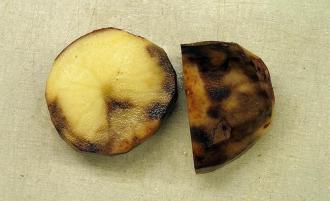
potato-late-blightCalamity struck Ireland in 1845, in the form of a blight so horrific that US military authorities once considered stockpiling the stuff as a biological weapon.  Seemingly overnight, Ireland’s staple food crop was reduced to a black, stinking ooze.

There followed the seven years’ “an Gorta Mór”, “the Great Hunger”, killing over a million Irish and reducing the population by 20-25% through death and emigration.  Throughout the Irish potato famine, the country continued to produce and export thirty to fifty shiploads per day of food produce, more than enough to feed the population.

Today, many see the effects of the absentee landlord system and the penal codes as a form of genocide.  At the time, already strained relations with England were broken, giving rise to Irish republicanism and leading to Irish independence in the following century.

Until Nazis tore it down, there was a statue of Sir Francis Drake in Offenburg, Germany, giving him credit for introducing the potato. His right hand rested on the hilt of his sword, his left gripping a potato plant. The inscription read “Sir Francis Drake, disseminator of the potato in Europe in the Year of Our Lord 1586. Millions of people who cultivate the earth bless his immortal memory”.

Today, potatoes are the 5th largest crop on the planet, following rice, wheat, maize and sugar cane.  Almost 5,000 varieties are preserved in the International Potato Center in Peru.

In the Star Wars movie “The Empire Strikes Back”, there’s a chase sequence through an “asteroid” field in which some of the asteroids are, in fact, potatoes.

Scientists have created genetically modified potatoes to ward off pests.  The “New Leaf”, approved in 1995, incorporated a bacterial gene rendering it resistant to the Colorado potato beetle, an “international superpest” so voracious that some credit the creature for creating the modern pesticide industry.  Other varieties were genetically modified to resist phytophthora infestans, the cause the Irish potato famine.

Seeming to prefer insecticides and anti-fungal sprays, “food activists” decry such varieties as “Frankenfoods”.  Each time, the improved variety has been hounded out of business.
potato-infographic

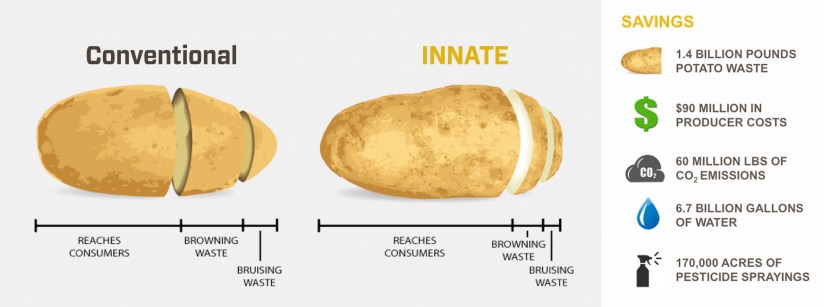
In 2014, Idaho-based J.R. Simplot Co. introduced the “innate” potato.  Rather than “transgenic” gene splicing, the introduction of genome sequences from unrelated species, the innate variety uses a “silencing” technique on the tuber’s own genes, to resist the bruising and browning that results in 400 million pounds of waste and a cost to consumers of $90 million.

In October 2016, NBC news reported that “The U.S. Department of Agriculture has approved commercial planting of two types of potatoes that are genetically engineered to resist the pathogen that caused the Irish potato famine. The potatoes next must clear a voluntary review process through the Food and Drug Administration as well as get the OK from the U.S. Environmental Protection Agency“.

GMO HystericsThe Innate potato produces less acrylamide, a known carcinogen produced by normal potatoes in the high heat of fryers.

This might actually be the first genetically modified variety to succeed in the marketplace, but McDonald’s, possibly the largest potato user on the planet, has already announced that “McDonald’s USA does not source GMO potatoes, nor do we have current plans to change our sourcing practices.”

You can never underestimate the power of hysterical people, in large groups.


If you enjoyed this “Today in History”, please feel free to re-blog, “like” & share on social media, so that others may find and enjoy the same. Please click the “follow” button on the right, to receive email updates on new articles.  Thank you for your interest, in the history we all share.

December 1, 2013 Sacred Soil

ICYMI – I can’t think of anything more fitting than that it was children, our future and posterity, who retrieved the sacred soil of Flanders and installed it at that garden. It is now for that posterity to keep our history alive, and to never let it fade, into some sepia-toned and forgotten past.

November 11, nineteen short days ago, marked the 99-year anniversary of the end of World War One.

Before they had numbers, this was “The Great War”.  The “War to end all Wars”.

There is barely a piece of 20th or 21st century history, which cannot be traced back to it.

International Communism was borne of the Great War, without which there would have been no cold war, no Korean War, no war in Vietnam. The killing fields of Cambodia would have remained mere rice fields.  The spiritual descendants of Chiang Kai-shek’s brand of capitalism would be running all of China, instead of only Taiwan.

In Flanders Fields

The current boundaries of the Middle East arose from the Great War. While the region’s tribal alliances and religious strife is nothing new, those conditions would have taken a very different form, had it not been for those boundaries.

World War II, a conflagration which left more dead, wounded or missing than any conflict in world history (WWI is only #5), was little more than the Great War, part II. A Marshall of France, on looking at the Versailles Treaty formally ending WWI, said “This isn’t peace. This is a cease-fire that will last for 20 years”. He was off, by something like 36 days.

I’ve long believed that we can’t be participating citizens of a self-governing Republic, we can’t know where we want our country to go, if we don’t understand where it’s been.  It’s one of the principle reasons for examining history.  It’s why I think something wonderful happened four years ago, and I don’t think many of us heard about it.

In the summer of 2013, over 1,000 British and Belgian schoolchildren visited 70 battlefields of the Great War.  Ypres.  Passchendaele.  Verdun.  The Somme.  All over Northern France and Belgium, the region known as “Flanders”.  There these children collected samples of the sacred soil of those fields of conflict.

_77985394_020167620-1

The soil from those battlefields was placed in seventy WWI-style burlap sandbags, each stenciled with a red poppy, where it came from, and the dates.  Those sandbags were transported to London, and installed with great care at Wellington Barracks, the central London home of the Grenadier Guards, Coldstream Guards and Scots Guards.

There the soil of the Great War will nourish and support a garden.  Ready for the following year, a solemn remembrance of the centenary of that war.

That day, December 1, 2013, was for the Flanders Fields Memorial Garden, the first full day of forever.

I can’t think of anything more fitting than that it was children, our future and posterity, who retrieved the sacred soil of Flanders and installed it at that garden. It is now for that posterity to keep our history alive, and never to let it fade, into some sepia-toned and forgotten past.


If you enjoyed this “Today in History”, please feel free to re-blog, “like” & share on social media, so that others may find and enjoy the same. Please click the “follow” button on the right, to receive email updates on new articles.

Thank you for your interest, in the history we all share.

November 30, 1953 Dien Bien Phu

ICYMI – Under the command of Colonel Christian de Castries, French forces built seven fortified positions to defend the base, each allegedly named after one of his mistresses. 10,800 French troops were committed, with another 16,000 in reserve.

If you speak of France, most of us think of the five-sided country between Spain and Germany. That would be partly correct, but “la Métropole” or “Metropolitan France” today accounts for only 82.2% of the landmass and 95.9% of the population, of la République Française. The overseas departments and territories which make up “la France d’outre-mer”, “Overseas France”, account for the rest.

That overseas percentage would have been higher in the mid-20th century, with many former colonial territories added in, among them Laos, Cambodia and Vietnam.

Japanese occupation of southeast Asia caused the Europeans to leave French Indochina during WWII. Within a year of re-occupation, the French faced virulent opposition from the Nationalist-Communist Viet Minh, led by Ho Chi Minh and Vo Nguyen Giap. Theirs was a low level, rural insurgency at first, later becoming a full-scale modern war when Chinese Communists entered the fray in 1949.

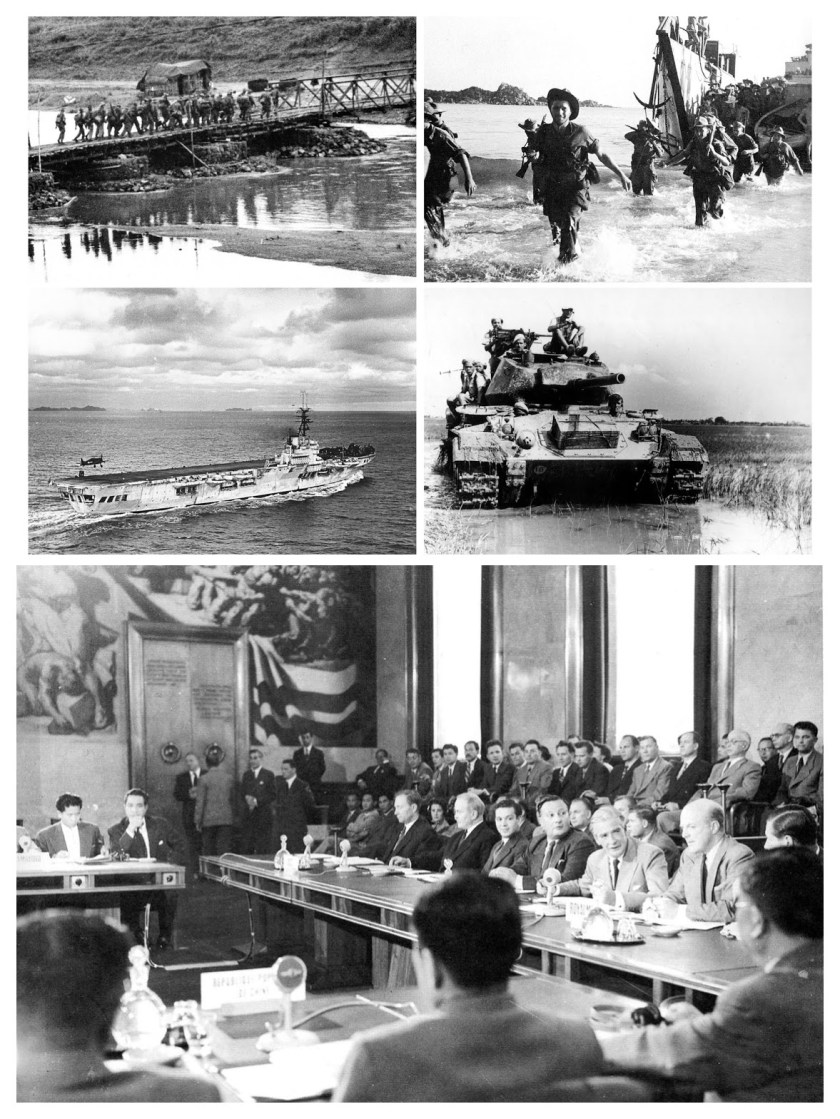
First_Indochina_War_COLLAGEWhat historians call the First Indochina War, many contemporaries called “la sale guerre”, or “dirty war”. The government forbade the use of metropolitan recruits, fearing that that would make the war more unpopular than it already was. Instead, French professional soldiers and units of the French Foreign Legion were augmented with colonial troops, including Moroccan, Algerian, Tunisian, Laotian, Cambodian, and Vietnamese ethnic minorities.

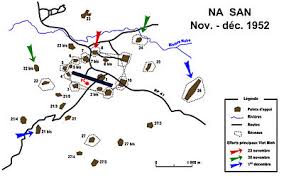
Na SanThe war went poorly for the French.  By 1952 they were looking for a way out. Premier René Mayer appointed Henri Navarre to take command of French Union Forces in May of that year, with a single order. Navarre was to create military conditions which would lead to an “honorable political solution”.

In November and December of the previous year, the French army had air lifted soldiers into a fortified position at Na San, adjacent to a key Viet Minh supply line to Laos. Superior French fire power, armor and air resources had driven Vo Nguyen Giap’s forces back with heavy losses, in what French planners called the “hérisson” or “hedgehog” strategy.

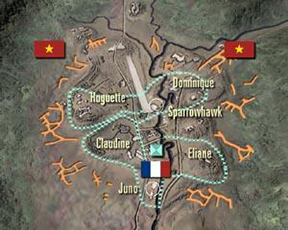
Dien_Bien_Phu, baseIn June, Major General René Cogny proposed a “mooring point” at Dien Bien Phu, creating a lightly defended point from which to launch raids. Navarre wanted to replicate the Na San strategy, and ordered that Dien Bien Phu be taken and converted into a heavily fortified base.

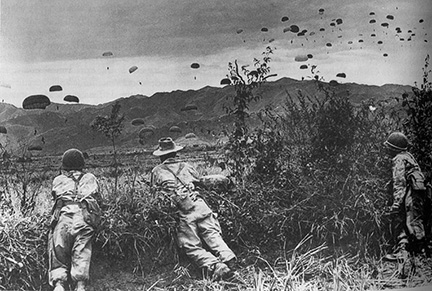
“Operation Castor” began on the 20th of November, with three parachute infantry battalions dropping into Dien Bien Phu. The operation was completed with minimal French casualties on November 30, as they continued to land supplies, troops, and engineering equipment into the isolated base.

Under the command of Colonel Christian de Castries, French forces built seven fortified positions to defend the base, each allegedly named after one of his mistresses. 10,800 French troops were committed, with another 16,000 in reserve.

Vo felt that he had made a serious mistake at Na San, rushing his troops in piecemeal against French defenses. This time, he carefully prepared his positions, moving 50,000 men into position around the valley, meticulously stockpiling ammunition and placing his anti-aircraft and heavy artillery, with which he was well supplied.

dien_bien_phu-resupplyThe French staff made their battle plan, based on the assumption that it was impossible for the Viet Minh to place enough artillery on the surrounding high ground, due to the rugged terrain. The communists didn’t possess enough artillery to do serious damage anyway, or so they thought.

French officers quickly learned how mistaken they had been. The first sporadic artillery fire began on January 31, around the time that patrols discovered the enemy’s presence in every direction. Heavy artillery virtually ringed the valley in which they found themselves, and air support was quickly nullified by the enemy’s well placed anti-aircraft fire.

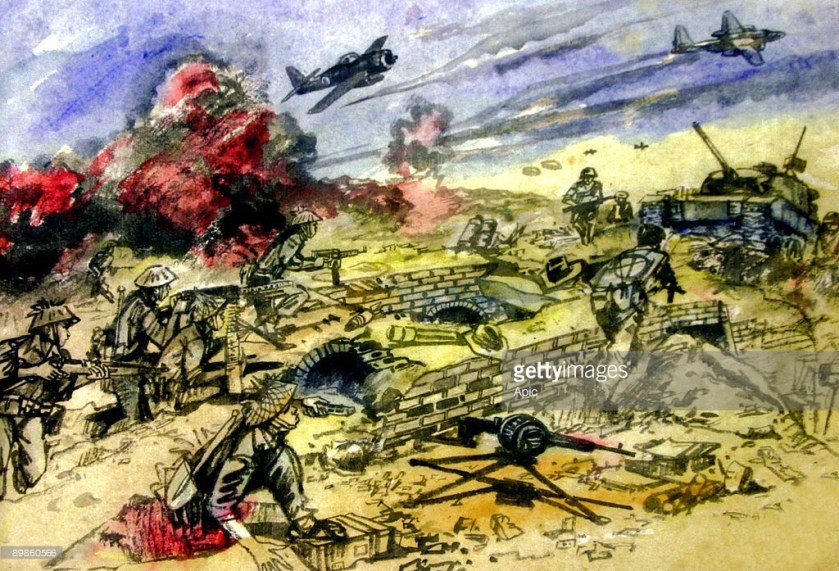
The Viet Minh assault began in earnest on March 13, when several outposts came under furious artillery barrage. Air support became next to impossible, and counter-battery fire was next to useless against Giap’s fortifications.

Lieutenant Colonel Charles Piroth commanded the French artillery at Dien Bien Phu. He was a professional soldier and no lightweight, having had his arm amputated in 1946 with no anesthesia. When it became clear how wrong his assumptions had been, Piroth circled the camp making apologies to his officers, returned to his tent, and killed himself with a hand grenade.

Last moments
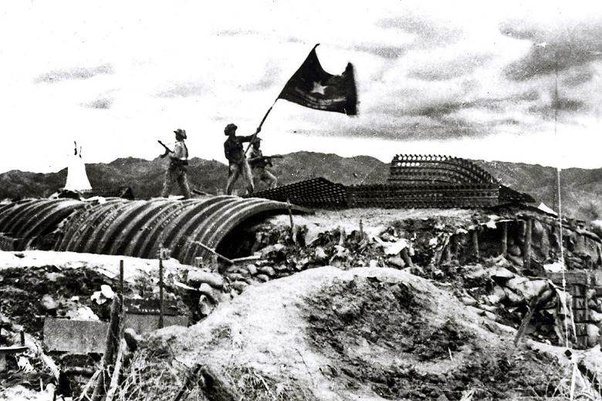
Last moments of the Battle of Dien Bien Phu, 1954, as depicted by North Vietnamese artist Huy Toan

“Beatrice” was the first fire base to fall, then “Gabrielle” and “Anne-Marie”. Viet Minh controlled 90% of the airfield by the 22nd of April, making even parachute drops next to impossible. On May 7, Vo ordered an all-out assault of 25,000 troops against the 3,000 remaining in garrison. By nightfall, it was over.  The last words from the last radio man were “The enemy has overrun us. We are blowing up everything. Vive la France!”

Military historian Martin Windrow wrote that Dien Bien Phu was “the first time that a non-European colonial independence movement had evolved through all the stages from guerrilla bands to a conventionally organized and equipped army able to defeat a modern Western occupier in pitched battle”.

The Geneva conference opened the following day, resulting in a Vietnam partitioned into two parts. In the north was the “Democratic Republic of Vietnam” administered by the communists, and the State of Vietnam in the south, under Emperor Bao Dai and Prime Minister Ngo Dinh Diem. The North was supported by both the People’s Republic of China and the Soviet Union, and continued to terrorize patriots in the north and south alike.

US support for the south increased as the French withdrew theirs.  By the late 50s, the US was sending technical and financial aid in expectation of social and land reform. By 1960, the National Front for the Liberation of South Vietnam (NLF, or “Viet Cong”) had taken to murdering Diem-supported village leaders.  President John F. Kennedy responded in 1961, sending 1,364 American advisers into South Vietnam.

The next war in Indochina, had begun.


If you enjoyed this “Today in History”, please feel free to re-blog, “like” & share on social media, so that others may find and enjoy the same. Please click the “follow” button on the right, to receive email updates on new articles.

Thank you for your interest, in the history we all share.
November 27, 1942 Scuttled

While many considered the Vichy government to be a puppet state, the officers and men of the French fleet had no love for their German occupiers.  This was a French fleet and would remain so if they could help it, even if they had to sink it to the bottom of the ocean.

The Battle of France began on May 10, 1940, with the German invasion of France and the Low Countries of Belgium, Luxembourg and the Netherlands. By the end of May, German Panzers had hurled the shattered remnants of the allied armies into the sea, at a place called Dunkirk.

The speed and ferocity of the German Blitzkrieg left the French people in shock in the wake of their June surrender.  All those years their government had told them, that the strength of the French army combined with the Maginot line, was more than enough to counter German aggression.

France had fallen in six weeks.

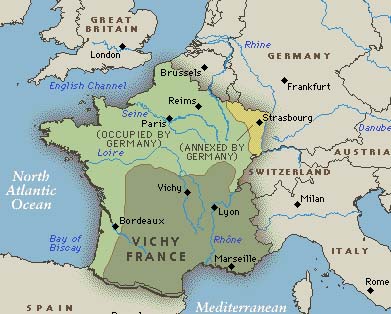
Vichy-FranceGermany installed a Nazi-approved French government in the south of France, headed by WW1 hero Henri Pétain.  Though mostly toothless, the self-described “French state” in Vichy was left relatively free to run its own affairs, compared with the Nazi occupied regions to the west and north.

That changed in November 1942, with the joint British/American invasion of Morocco, Tunisia and Algeria.  At the time, the north African provinces were nominally under the control of the Vichy regime.  Hitler gave orders for the immediate occupation of all of France.

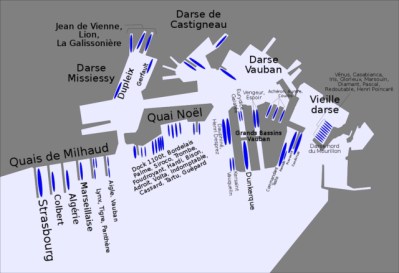
Scuttled, 2With the armistice of June 1940, much of the French naval fleet was confined to the Mediterranean port of Toulon.  Confined but not disarmed, and the French fleet possessed some of the most advanced naval technologies of the age, enough to shift the balance of military power in the Mediterranean.

While many considered the Vichy government to be a puppet state, the officers and men of the French fleet had no love for their German occupiers.  This was a French fleet and would remain so if they could help it, even if they had to sink it to the bottom of the ocean.

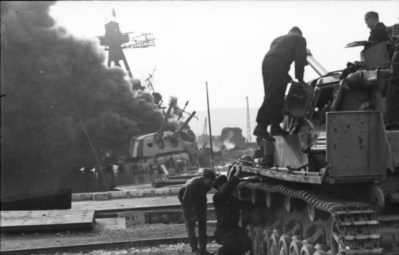
Scuttled, 1In November 1942, the Nazi government came to take control of that fleet. The motorized 7th Panzer column of German tanks, armored cars and armored personnel carriers descended on Toulon with an SS motorcycle battalion, taking over port defenses to either side of the harbor. German officers entered fleet headquarters and arrested French officers, but not before word of what was happening was relayed to French Admiral Jean de Laborde, aboard the flagship Strasbourg.

The order went out across the base at Toulon.  Prepare to scuttle the fleet, and resist the advance of German troops, by any means necessary.

The German column approached the main gate to the harbor facility in the small hours of November 27, demanding access.  ‘Of course,’ smiled the French guard. ‘Do you have your access paperwork?’

Toulon, französisches KriegsschiffUnder orders to take the harbor without bloodshed, the Nazi commander was dismayed. Was he being denied access by this, his defeated adversary?  Minutes seemed like hours in the tense wrangling which followed.  Germans gesticulated and argued with French guards, who stalled and prevaricated at the closed gate.

The Germans produced documentation, only to be thanked, asked to wait, and left standing at the gate.

Meanwhile, thousands of French seamen worked in grim silence throughout the early morning hours, preparing to scuttle their own fleet.  Valves and watertight doors were opened, incendiary and demolition charges were prepared and placed.

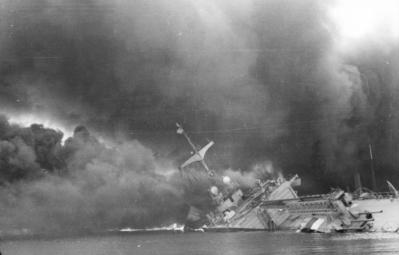
27_toulonFinally, the Panzer column could be stalled no more.  German tanks rumbled through the main gate at 5:25am, even as the order to scuttle passed throughout the fleet.  Dull explosions sounded across the harbor, as fighting broke out between the German column, and French sailors pouring out of their ships in the early dawn light.  Lead German tanks broke for the Strasbourg, even now pouring greasy, black smoke from its superstructure, as she settled to the bottom.

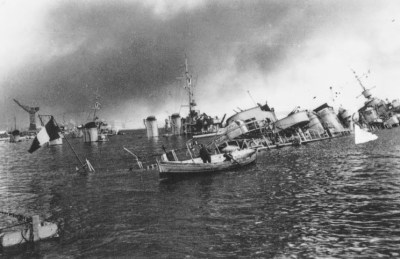
The Germans could only look on, helpless, as a dying fleet escaped their grasp.  In the end, 3 battleships, 7 cruisers, 15 destroyers, 13 torpedo boats, 6 sloops, 12 submarines, 9 patrol boats, 19 auxiliary ships, 28 tugs, 4 cranes and a school ship, were destroyed.  39 smaller vessels of negligible military value fell into German hands along with twelve fleet vessels, all of them damaged.

The fires would burn, for weeks.  The harbor at Toulon would remain fouled and polluted, for years.

The French Navy lost 12 men killed and 26 wounded on that day, 75 years ago, today.  The loss to the Nazi war effort, is incalculable.  How many lives could have been lost can never be known, had Nazi Germany come into possession of all that naval power.  But for the bravery of a vanquished, but still unbeaten, foe.

If you enjoyed this “Today in History”, please feel free to re-blog, “like” & share on social media, so that others may find and enjoy the same. Please click the “follow” button on the right, to receive email updates on new articles.

Thank you for your interest, in the history we all share.
November 26, 1941 Franksgiving

The next two years, thirty-two states and the District of Columbia celebrated what came to be called “Franksgiving” on the third Thursday of the month, while the remainder observed a more traditional “Republican Thanksgiving”, on the last.  FDR quipped “Two years ago, or three years ago, I discovered I was particularly fond of turkey! So we started two Thanksgivings. I don’t know how many we ought to have next year. I’m open to suggestion.”

In 1863, President Abraham Lincoln declared a general day of Thanksgiving to be observed on the last Thursday of November.  The date seemed to work out OK and the tradition stuck, until 1939.

Roughly two in seven Novembers contain five Thursdays, and that year was one.

In those days, it was considered poor form for retailers to put up Christmas displays or run Christmas sales, before Thanksgiving.  Lew Hahn, General Manager of the Retail Dry Goods Association, was afraid that extra week was going to cut into Christmas sales.

Roosevelt ButtonTen years into the Great Depression with unemployment standing at 17.2%, the Federal government was afraid of the same thing. Never afraid to tinker with precedent, President Franklin Roosevelt decided to deviate from the customary last Thursday, and declared the fourth Thursday, November 23, to be a national day of prayer and thanksgiving.

Opposition to the plan was quick in forming.  Alf Landon, Roosevelt’s Republican challenger in the earlier election, complained of Roosevelt’s impulsiveness, and the confusion resulting from it.  “more time should have been taken working it out” Landon complained, “instead of springing it upon an unprepared country with the omnipotence of a Hitler.”

In Plymouth Massachusetts, home of the first Thanksgiving, Chairman of the Board of Selectmen James Frasier, “heartily disapproved”.  The headline from the New York Times, trumpeted “Roosevelt to Move Thanksgiving: Retailers for It, Plymouth Is Not.”

The short-notice change in holiday schedule disrupted the holiday plans of millions of Americans, to say nothing of traditional high school and college Thanksgiving day football rivalries, across the nation.

Unsurprisingly, support for Roosevelt’s plan split across ideological lines.  A late 1939 Gallup poll reported Democrats favoring the change 52% to 48%, with Republicans opposing it 79% to 21%.

Franksgiving calendar

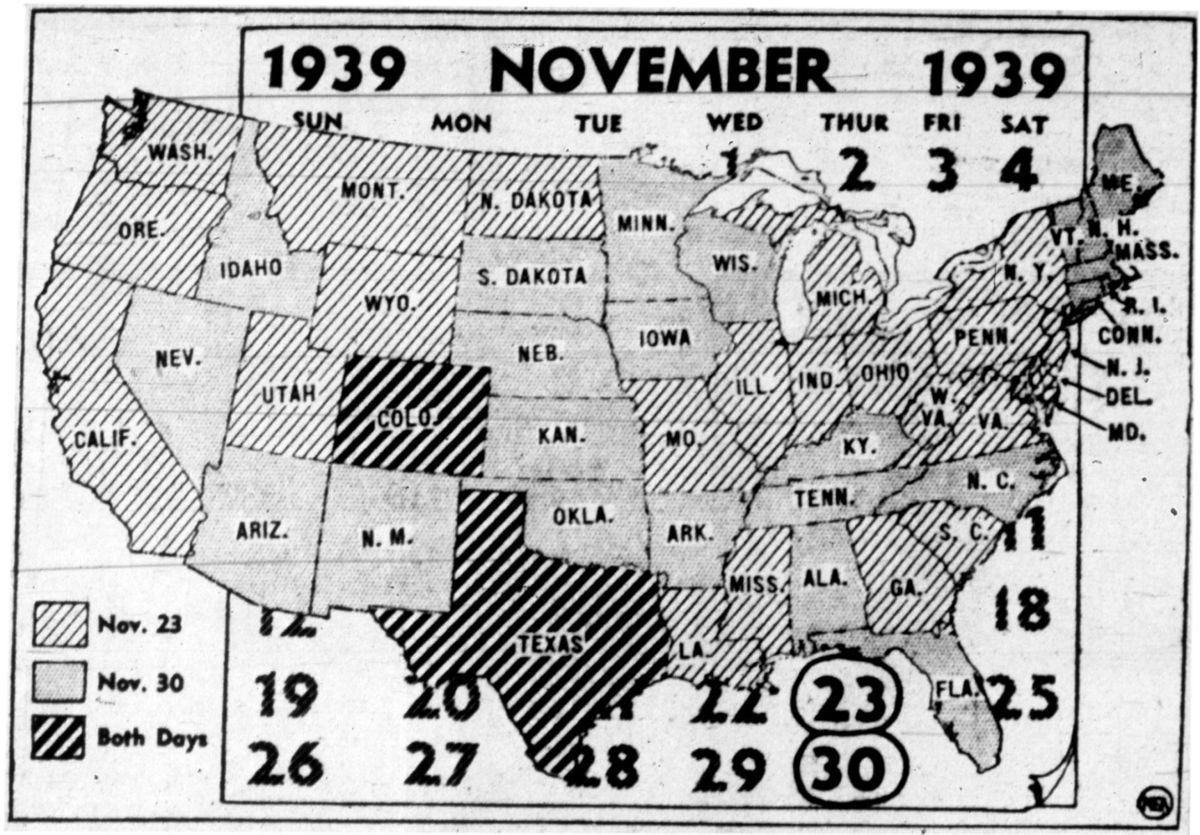
Such proclamations represent little more than the “’moral authority” of the Presidency, and states are free to do as they pleased.  Twenty-three states and the District of Columbia observed Thanksgiving day on the non-traditional date, and twenty-two kept Thanksgiving on the 27th.  Colorado, Mississippi and Texas, did both.

The next two years, thirty-two states and the District of Columbia celebrated what came to be called “Franksgiving” on the third Thursday of the month, while the remainder observed a more traditional “Republican Thanksgiving”, on the last.  FDR quipped “Two years ago, or three years ago, I discovered I was particularly fond of turkey! So we started two Thanksgivings. I don’t know how many we ought to have next year. I’m open to suggestion.”

In 1941, a Commerce Department survey demonstrated little difference in Christmas sales between those states observing Franksgiving, and those observing the more traditional date.  A joint resolution of Congress declared the fourth Thursday beginning the following year to be a national day of Thanksgiving, President Roosevelt signing the measure into law November 26.

Franksgiving banner

Interestingly, the phrase “Thanksgiving Day” had been used only once in the 20th century prior to the 1941 resolution, that in President Calvin Coolidge’s first of six such proclamations.

Most state legislatures followed suit with the Federal fourth-Thursday approach, but not all.  In 1945, the next year with five Thursdays in November, Arkansas, Florida, Georgia, Idaho, Nebraska, Tennessee, Texas, and Virginia reverted to the last Thursday.  Texas would hold out the longest, celebrating its fifth-Thursday Thanksgiving for the last time in 1956.

To this day, the years 1939, ’40 and ’41 remain the only outliers, outside the fourth-Thursday tradition.

The Three StoogesPopular comedians of the day got a lot of laughs out of it, including Burns & Allen and Jack Benny.

One 1940 Warner Brothers cartoon shows two Thanksgivings, one “for Democrats” and one a week later “for Republicans.”

The Three Stooges short film “No Census, No Feeling” of the same year, has Moe questioning Curly, why he put the fourth of July in October.  Larry: Where is everybody?  Curly: Maybe it’s the Fourth of July.  Moe: The Fourth of July in October?  Curly: You never can tell… Look what they did to Thanksgiving!

Joe Toye, the “Easy Company” character in the 2001 HBO miniseries “A Band of Brothers”, may have had the last word on Franksgiving.  Explaining his plan to get the war over quickly, the paratrooper quips “Hitler gets one of these [knives] right across the windpipe, Roosevelt changes Thanksgiving to Joe Toye Day, [and] pays me ten grand a year for the rest of my f*****g life.”

Sounds like a plan.

If you enjoyed this “Today in History”, please feel free to re-blog, “like” & share on social media, so that others may find and enjoy the same. Please click the “follow” button on the right, to receive email updates on new articles.

Thank you for your interest, in the history we all share.

November 25, 1841 Amistad

ICYMI – A former President and son of a Founding Father, John Quincy Adams, argued the case, in a trial beginning on George Washington’s birthday, 1841.

By 1839, the international slave trade was illegal in most countries, though the “peculiar institution” itself, was not. In April of that year, five or six hundred Africans were illegally purchased by a Portuguese slave trader, and shipped to Havana aboard the brig Tecora.

Fifty-three members of the Mende tribe, of the modern-day country of Sierra Leone, were sold to Joseph Ruiz and Pedro Montez, who planned to use them on their Cuban sugar plantation. The Mendians were given Spanish names and designated “black ladinos,” fraudulently documenting them to have always lived as slaves, in Cuba. In June, Ruiz and Montez placed the Africans on board the schooner la Amistad, (“Friendship”), and set sail down the Cuban coast to Puerto del Principe.

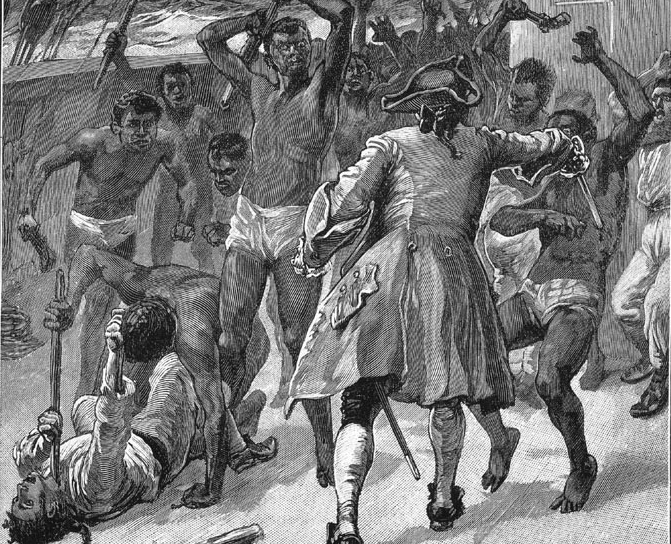
On the fourth night at sea, Joseph Cinqué, also known as Sengbe Pieh, led a number of captives in breaking free of their chains and seizing control of the ship. They killed two of their captors, losing two of their own in the struggle, while two others escaped in a boat. The cabin boy, who really was a black ladino, was spared and used as translator.

Revolt-Aboard-Ship

The Mendians forced the two remaining crew to return them to Africa, which they pretended to do by day. But they were betrayed, the two slavers would steer the ship north by night, when the position of the sun couldn’t be seen. Amistad was apprehended off Long Island by a U.S. Coastal Survey brig and taken to New London, Connecticut, where the Africans were put in prison. Connecticut was still a slave state at that time.

The Spanish Ambassador demanded that Ruiz’ and Montez’ “property” be returned and the matter settled under Spanish law. President Martin van Buren agreed, but the matter had already fallen under the jurisdiction of the courts.

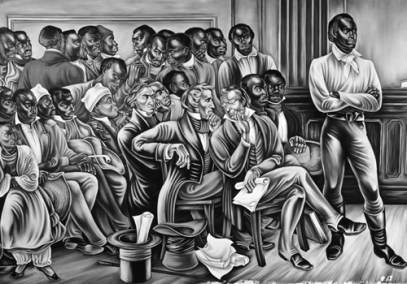
amistad-trial-1841The district court trial which followed in Hartford determined that the Mendians’ papers were forged, and they should be returned to Africa. The cabin boy was ruled to be a slave and ordered returned to the Cubans, however he fled to New York with the help of abolitionists. He would live out the rest of his life as a free man.

Fearing the loss of pro-slavery political support, President van Buren ordered government lawyers to appeal the case up to the United States Supreme Court.  The government case depended on the anti-piracy provision of a treaty then in effect between Spain and the United States,

Joseph_Cinque
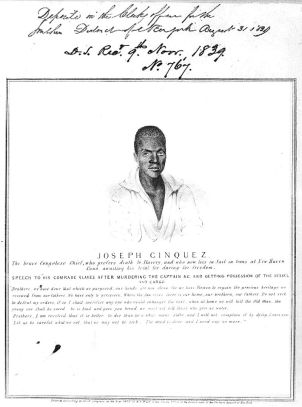
A print of Joseph Cinqué appeared in The New York Sun newspaper, August 31, 1839

A former President and son of a Founding Father, John Quincy Adams, argued the case, in a trial beginning on George Washington’s birthday, 1841.

In United States v. Schooner Amistad, SCOTUS upheld the decision of the lower court 8-1, ruling that the Africans had been detained illegally,  ordering them returned to their home. John Tyler, a pro slavery Whig, was President by this time. Tyler refused to provide a ship or fund the repatriation, so abolitionists and missionaries did so, returning 35 surviving Mendians to Africa on November 25, 1841.

In arguing the case, President Adams took the position that no man, woman, or child in the United States could ever be sure of the “blessing of freedom”, if the President could hand over free men on the demand of a foreign government.

152 years later, Bill Clinton, Eric Holder and Janet Reno kidnapped six-year-old Elian Gonzalez at gunpoint, sending him back to Cuba over the body of the mother who died bringing him to freedom.

amistad replica
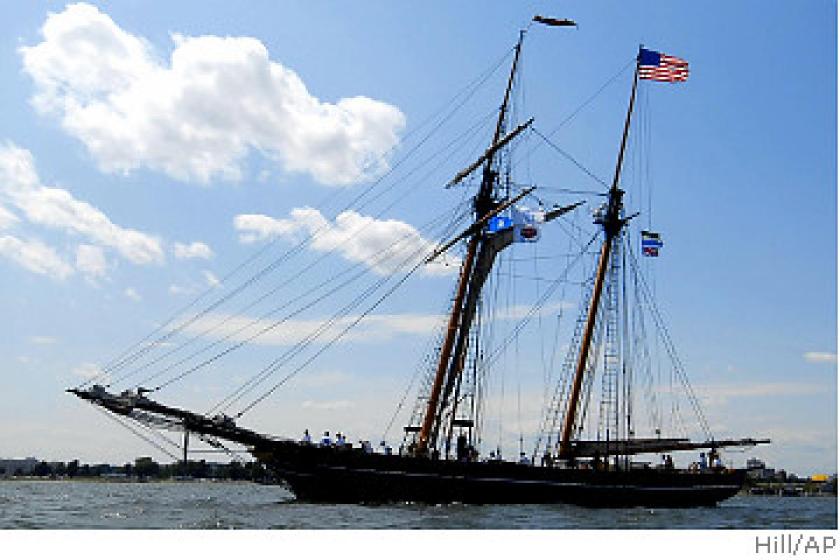
In 2007, a near-replica of the Amistad left its home port in Connecticut, on a 16-month, 14,000-mile voyage to Nova Scotia, Britain and Africa.

November 24, 1962 Kilroy was Here

When Truman, Stalin, and Churchill met at Potsdam, a VIP latrine was built for their exclusive use.  Stalin was the first in, emerging from the outhouse and asking his aide, in Russian, “Who is Kilroy?”

The Fore River Shipyard began operations in 1883 in Braintree, Massachusetts, moving to its current location on the Weymouth Fore River on Quincy Point, in 1901. In 1913, the yard was purchased by Bethlehem Steel, and operated under the Bethlehem Shipbuilding Corporation.

Most ships at Fore River were built for the United States Navy, including early submarines built for Electric Boat, the Battleship USS Massachusetts, and the Navy’s first carrier, the USS Lexington. In the years before WW2, non-US Navy customers included the United States Merchant Marine, the Argentine Navy, the Royal Navy of Great Britain, and the Imperial Japanese Navy.

Kilroy-7
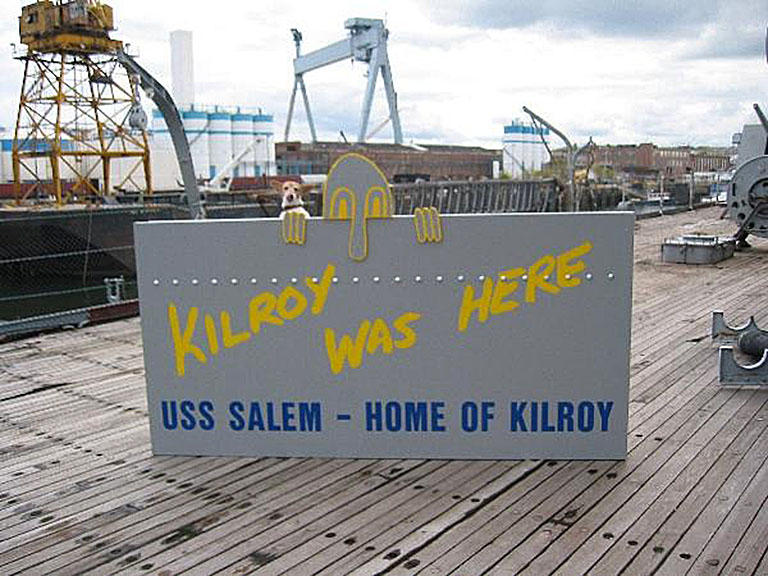
USS Salem CA-139 museum ship, Fore River Shipyard, Quincy

The Navy Act of 1938 mandated a 20% increase in American Naval strength. Much of that increase came through Fore River. The Shipyard employed 17,000 the day that Imperial Japan invaded the American Pacific anchorage at Pearl Harbor. That number increased to 32,000 by 1943, with a payroll equivalent to $9.69 Billion, in today’s dollars.

Kilroy-3Necessity became the mother of invention, and the needs of war led to prodigious increases in speed.  No sooner was USS Massachusetts launched, than the keel of USS Vincennes began to be laid. By the end of the war, Fore River had completed ninety-two vessels of eleven different classes.

Builders at the yard were paid by the number of rivets installed. Riveters would mark the end of their shift with a chalk mark, but dishonest co-workers could erase their marks, marking a new spot a few places back on the same seam.

Shipyard inspector James Kilroy ended the practice, writing “Kilroy was Here”, next to each chalk mark.

With hulls leaving the yard so fast there was no time to paint the interiors, Kilroy’s name achieved mythic proportions. The man literally seemed to be everywhere, his name written in every cramped and sealed space in the United States Navy.

For the troops inside of those ships, Kilroy always seemed to have “been there”, first.

Kilroy-1Kilroy was Here became a kind of protective talisman, and soldiers began to write it on newly captured areas and landings.  He was the “Super GI”, showing up for every combat, training and occupation operation of the WW2 and Korean war era.  The scribbled cartoon face was there before you arrived, and he was still there when you left.

Germans thought Kilroy was some kind of  “super spook”, able to go anywhere he liked, with ease.

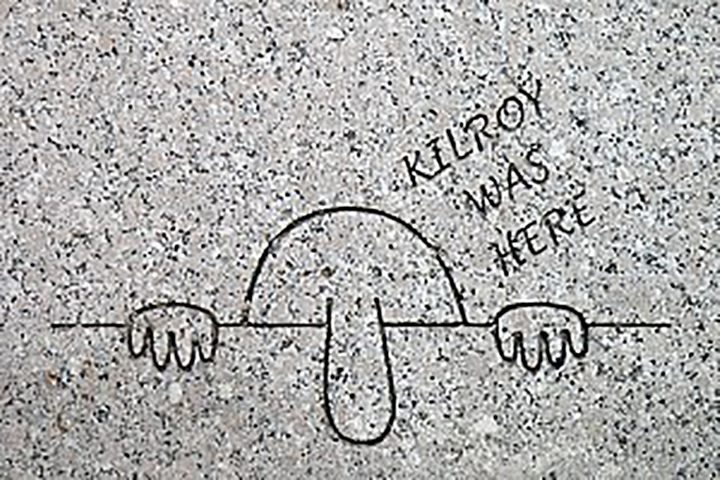
Kilroy-6The challenge became, who could put the Kilroy graffiti in the most difficult and surprising place.  I’ve never been there, but I’ve heard that Kilroy occupies the top of  Mt. Everest.  His likeness is scribbled in the dust of the moon.  There’s one on the Statue of Liberty, and another on the underside of the Arc of Triumph, in Paris.  There are two of them engraved in the granite of the WW2 Memorial, in Washington, DC.

Under Water Demolition teams, the guys who later became US Navy SEALs, swam ashore on Japanese-held Pacific islands, preparing the way for amphibious landings.  More than once, UDT divers found that Kilroy had already been there, the silly cartoon nose scribbled on makeshift signs, and even enemy pillboxes.

When Truman, Stalin, and Churchill met at Potsdam, a VIP latrine was built for their exclusive use.  Stalin was the first in, emerging from the outhouse and asking his aide, in Russian, “Who is Kilroy?”

kilroy_no_spamA Brit will tell you that “Mr. Chad” came first, cartoonist George Chatterton’s response to war rationing.  “Wot, no tea”?

The cartoon appeared in every theater of the war, but few knew the mythical Kilroy’s true identity.

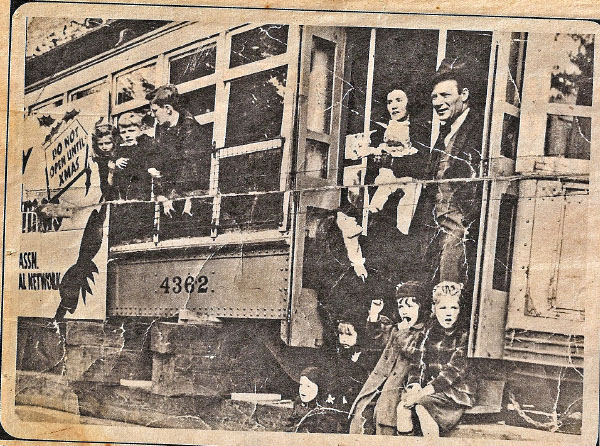
In 1946, the Transit Company of America held a contest, asking the “real” Kilroy to come forward.  Close to forty guys showed up to claim the prize, a real trolley car.  Doubtless they all felt they had legitimate claims, but James Kilroy brought a few riveters and some shipyard officials along, to prove his authenticity.  That was it.

That Christmas the Kilroy kids, all nine of them, got the coolest playhouse in all of Boston.

James Kilroy went on to serve as Boston City Council member and member of the Massachusetts house of Representatives before passing away on this day, November 24, 1962.

trolleycar2
Boston American, December 23, 1946 Image thanks to Kilroy grandson, Brian Fitzgerald

Feature image:  Kilroy, engraved on the granite of the WWII Memorial, Washington DC.

November 23, 2013 Holodomor

Successful farmers, the “Kulaks”, were branded as “class enemies”, an early example of the “fix and ridicule” technique Saul Alinsky would write about years later, in his “Rules for Radicals”.

In the 18th century, our Founding Fathers gave us a self-governing Republic, where authority is delegated upward from an informed electorate, and centered on individual liberty, diffuse authority, and checks & balances. Without such a system of self-government, we’d be left with a political game of chance, in which our future depends on the character of a small and too often self-dealing ruling class.

The 20th century was a time when one malignant governing model after another would assert itself, often leaving death and misery along its path to self-destruction.

These were the top down, authoritarian ideologies, where individual liberty was subsumed by the collective, and cosmic chance was all that separated benign governance from murderous authoritarianism.

Always what comes first is the Balkanization, the identification and ostracizing of one group or another as separate and apart. The Untermenschen. The Other.

You saw this principle take shape during the Chinese Communist regime of the forties through the sixties, when the “cultural revolution” killed between 40 and 70 million of its own citizens.

You’re really playing in the big leagues, when they can’t get your body count any closer than the nearest 30 million.

killing fieldsIn the “Killing Fields” of 1975-’79 Cambodia, Pol Pot and a cadre of nine or so individuals, the Ang-Ka, led the Khmer Rouge in the extermination of between 1.7 and 2.5 million, in a country of barely 8 million.

The ideological underpinnings of this kind of madness vary between regimes, but they tend to have more in common than they do of what separates them. Communism is a murderous, authoritarian, collectivist ideology with international aspirations and class obsessions. Naziism is a likewise murderous, authoritarian, and collectivist ideology, this one having nationalist aspirations and ethnic obsessions.

The Nazi holocaust of the thirties and forties is well documented, the 1914 genocide of Armenian Christians by the Ottoman Empire, less so. One of the least well known in this parade of horribles is the policy of extermination by starvation carried out by the Soviet Union under Josef Stalin, against the population of Ukraine.  Some called it “Famine-Genocide”, or the “Terror-Famine”.   In time, the deliberate starvation of millions by their own government, came to be known as the “Holodomor”.

Bolsheviks, led by Vladimir Ilyich Lenin, took power in Russia before the end of WWI. By 1922 they had formed the Union of Soviet Socialist Republics.

In 1928, Josef Stalin introduced a program of agricultural collectivization in Ukraine, the “Bread Basket” of the region, forcing family farmers off their land and into state-owned collective farms. Stalin claimed that these factory collectives would not only feed industrial workers in the cities, but would also provide a surplus to be sold abroad, raising money to further his industrialization plans.

holodomor-3Many Ukrainian farmers refused to join the collectives, regarding them as a return to the serfdom of earlier centuries. Stalin introduced “class warfare”, that age old bugaboo of the Left, to break down resistance to collectivization.

Successful farmers, the “Kulaks”, were branded as “class enemies”, an early example of the “fix and ridicule” technique Saul Alinsky would write about years later, in his “Rules for Radicals”.

Armed dekulakization brigades confiscated land, livestock and other property by force, evicting entire families. Almost half a million individuals were dragged from their homes in 1930-31, packed into freight trains and shipped off to remote areas like Siberia, where they were often left without food or shelter. Many of these, especially children, died in transit or soon after arrival.

Resistance continued, which the Soviet government could not abide. Ukraine’s production quotas were sharply increased in 1932-’33, making it impossible for farmers to simultaneously meet quota and feed themselves. Starvation became widespread, as the Soviet government decreed that any person, even a child, would be arrested for taking as little as a few stalks of wheat from the fields in which they worked. Military blockades were erected around villages preventing the transportation of food, while brigades of young activists were brought in from other regions to sweep through villages and confiscate hidden grain.

Holodomor-BoysEventually all food was confiscated from farmers’ homes, as Stalin determined to “teach a lesson through famine” to the backbone of the region, the rural population of Ukraine.

At the height of this political famine, Ukrainians were dying at the rate of 22,000 a day, almost a third of them children 10 and under. When it was done, an estimated 6 to 10 million Ukrainian citizens were murdered by their own government, through starvation, deportation, and outright execution.

Millions of tons of grain were exported during this time, more than enough to have saved every starving man, woman and child. Stalin denied to the world that there was any famine in Ukraine, the first use of what historian Robert Conquest called the “Big Lie” technique of Soviet propaganda.

Stalin had willing and complicit support in his lies, from leftists like Louis Fischer reporting for “The Nation”, and Walter Duranty of the New York Times. Duranty would go on to win the Pulitzer Prize for his “coverage”, with contributions like “any report of a famine in Russia is today an exaggeration or malignant propaganda”.

To this day, the New York Times has failed to repudiate Duranty’s Pulitzer.

holodomor_memorial__kiev__ukraine_by_kaitou_ace-d4ia95f
“Bitter memories of childhood”, Kyiv, Ukraine

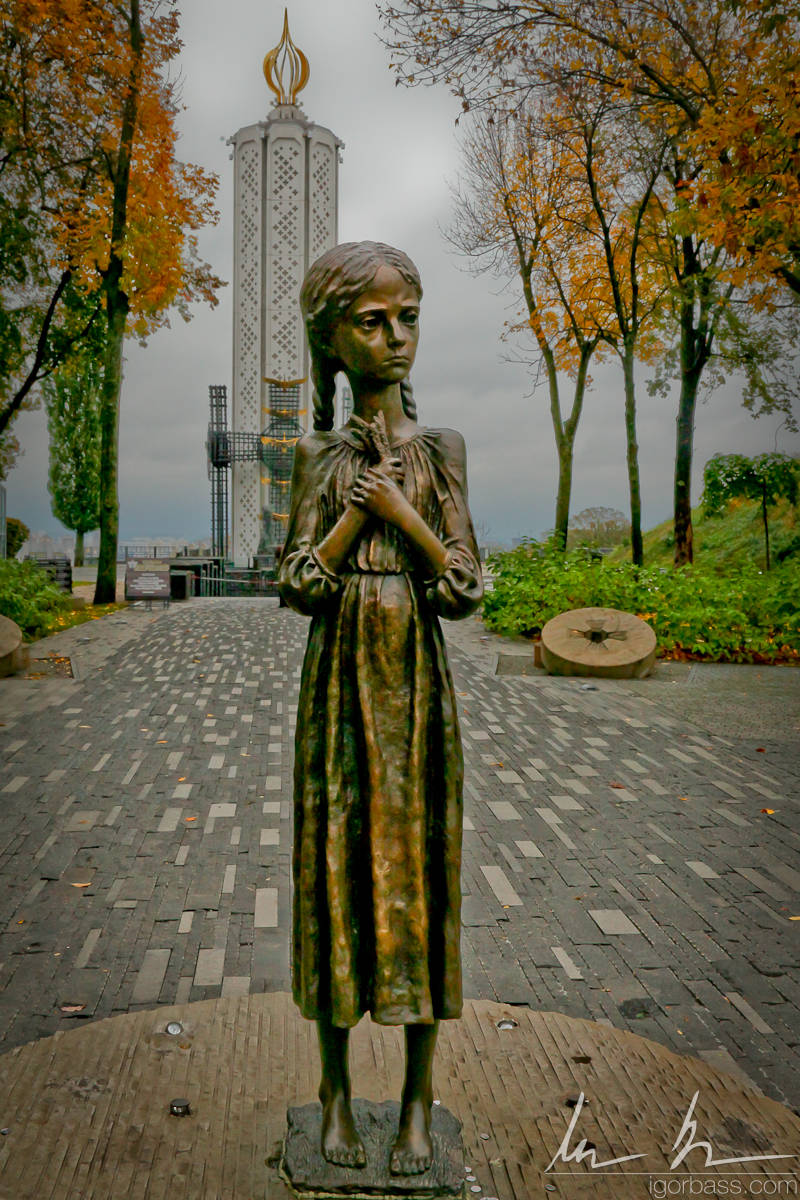
Ukrainians recognize November 23 as Holodomor Memorial Day, symbolized by a simple statue in Kiev.  A little girl, gaunt and hollow eyed, clutches a handful of wheat stalks.  On this day in 2013, Ukrainian President Viktor Yanukovych addressed his people, marking the 80th anniversary of the Holodomor.  “Today, a little candle flame unites us in a prayer for the souls of the Holodomor victims. We also remember those who shared the last piece of bread and saved the lives of compatriots. Our duty is to carry the memory of those dreadful events forever in our hearts. We also must do everything to prevent such a tragedy in the future.”

Here in the United States, you could question 100 randomly selected individuals.  I don’t believe that five of them could tell you what Holodomor means.  We are a self-governing Republic.  All 100 should be conversant with the term.

ukraine-bitter-harvest-film-holodomor-russia-21st-century-aggression
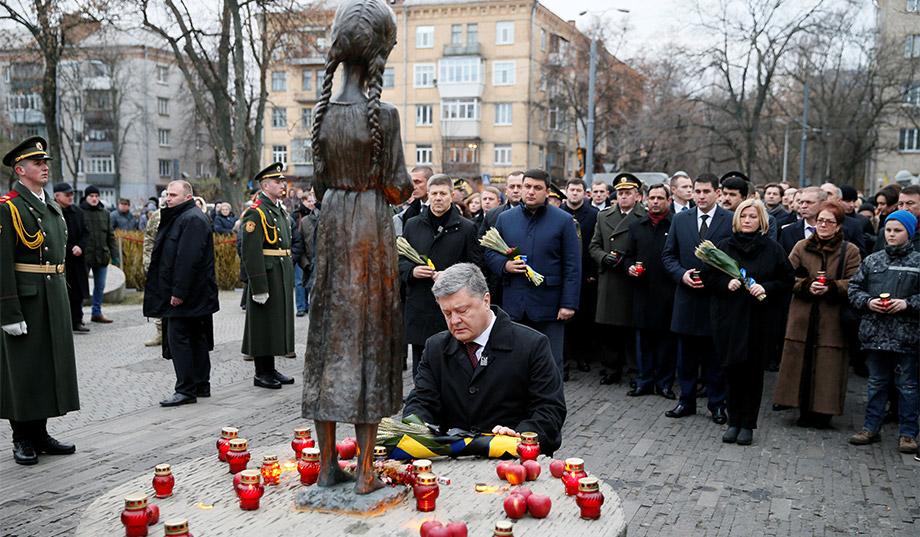
Ukranian president Petro Poroshenko vists a monument to Holodomor victims in Kiev, November 2016. (Reuters photo: Valentyn Ogirenko)

If you enjoyed this “Today in History”, please feel free to re-blog, “like” & share on social media, so that others may find and enjoy the same. Please click the “follow” button on the right, to receive email updates on new articles.

Thank you for your interest, in the history we all share.

November 21, 1942 The Alcan Highway

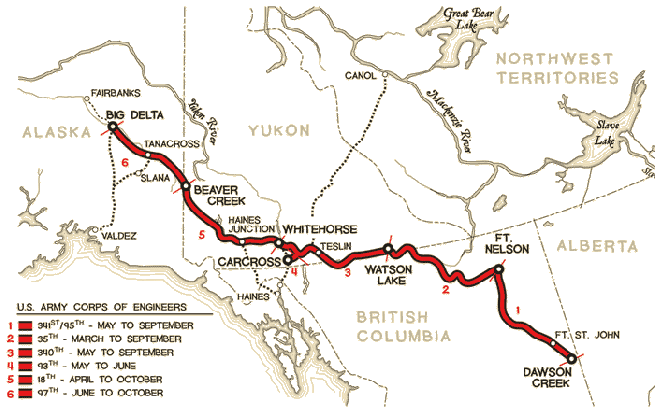
Construction began in March as trains moved hundreds of pieces of construction equipment to Dawson Creek, the last stop on the Northern Alberta Railway. At the other end, 10,670 American troops arrived in Alaska that spring, to begin what their officers called “the biggest and hardest job since the Panama Canal.”

In-between lay over 1,500 miles of unmapped, inhospitable wilderness.

Discussions of a road to Alaska began as early as 1865, when Western Union contemplated plans to install a telegraph wire from the United States to Siberia. The idea picked up steam with the proliferation of automobiles in the 1920s, but it was a hard sell for Canadian authorities. Such a road would necessarily pass through their territory, but the Canadian government felt the project would have little impact, benefiting no more than a few thousand people in the Yukon.

In the days following the attack on Pearl Harbor, Guam and Wake Island fell to Imperial Japanese forces , making it clear that parts of the Pacific coast were vulnerable.

Priorities were changing for both the United States and Canada.

alcan-highway

The Alaska Territory was particularly exposed.  Situated only 750 miles from the nearest Japanese base, the Aleutian Island chain had only 12 medium bombers, 20 pursuit planes, and fewer than 22,000 troops in the entire territory, an area four times the size of Texas. Colonel Simon Bolivar Buckner Jr., the officer in charge of the Alaska Defense Command, made the point succinctly. “If the Japanese come here, I can’t defend Alaska. I don’t have the resources.”

Alcan Lake

The US Army approved construction of the Alaska Highway in February, the project receiving the blessing of Congress and President Roosevelt within the week. Canada agreed to allow the project, provided that the US pay the full cost, and the roadway and other facilities be turned over to Canadian authorities at the end of the war.

Alcan_constructionConstruction began in March as trains moved hundreds of pieces of construction equipment to Dawson Creek, the last stop on the Northern Alberta Railway. At the other end, 10,670 American troops arrived in Alaska that spring, to begin what their officers called “the biggest and hardest job since the Panama Canal.”

In-between lay over 1,500 miles of unmapped, inhospitable wilderness.

Alcan BridgeThe project had a new sense of urgency in June, when Japanese forces landed on Kiska and Attu Islands, in the Aleutian chain. Adding to that urgency was that there is no more than an eight month construction window, before the return of the deadly Alaskan winter.

Construction began at both ends and the middle at once, with nothing but the most rudimentary engineering sketches. A route through the Rockies had not even been identified yet.

Radios didn’t work across the Rockies and there was only erratic mail and passenger service on the Yukon Southern airline, a run that locals called the “Yukon Seldom”. It was faster for construction battalions at Dawson Creek, Delta Junction and Whitehorse to talk to each other through military officials in Washington, DC.

Moving men to their assigned locations was one thing, moving 11,000 pieces of construction equipment, to say nothing of the supplies needed by man and machine, was another.

Tent pegs were useless in the permafrost, while the body heat of sleeping soldiers meant they woke up in mud. Partially thawed lakes meant that supply planes could use neither pontoon nor ski, as Black flies swarmed the troops by day, and bears raided camps at night, looking for food.

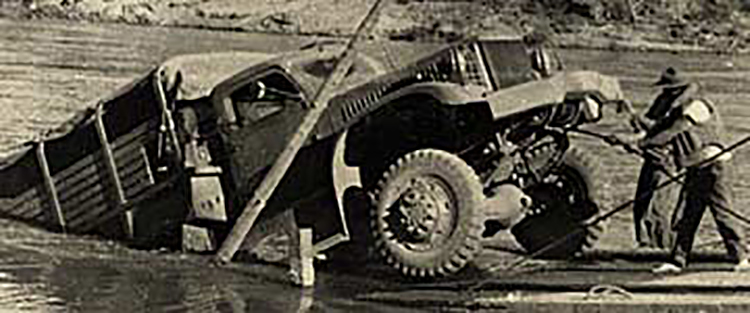
Alcan TerrainEngines had to run around the clock, as it was impossible to restart them in the cold. Engineers waded up to their chests building pontoons across freezing lakes, battling mosquitoes in the mud and the moss laden arctic bog. Ground that had been frozen for thousands of years was scraped bare and exposed to sunlight, creating a deadly layer of muddy quicksand in which bulldozers sank in what seemed like stable roadbed.
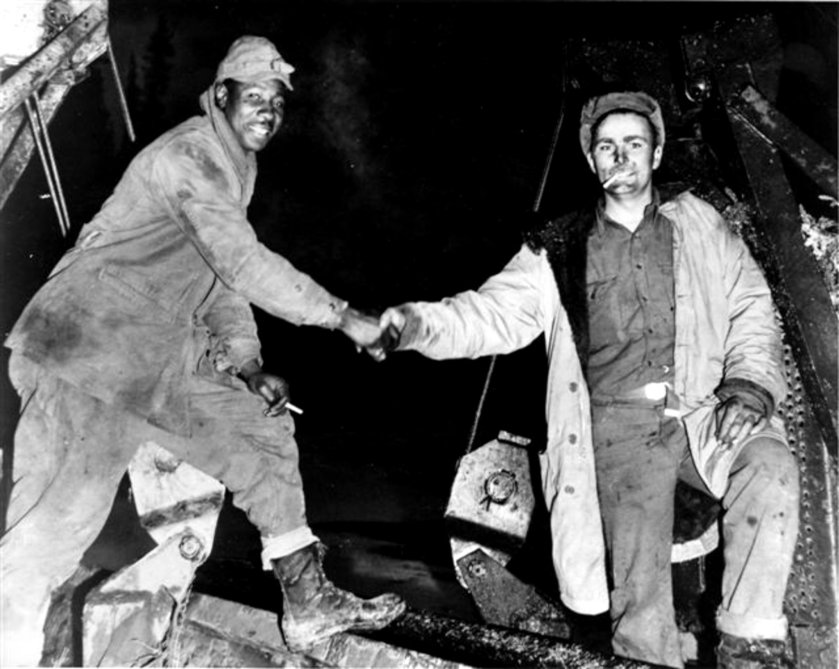
On October 25, Refines Sims Jr. of Philadelphia, with the all-black 97th Engineers was driving a bulldozer 20 miles east of the Alaska-Yukon line, when the trees in front of him toppled to the ground. He slammed his machine into reverse as a second bulldozer came into view, driven by Kennedy, Texas Private Alfred Jalufka. North had met south, and the two men jumped off their machines, grinning. Their triumphant handshake was photographed by a fellow soldier and published in newspapers across the country, becoming an unintended first step toward desegregating the US military.

Sims, Jalufka

They celebrated the route’s completion at Soldier’s Summit on November 21, 1942, though the “highway” remained unusable by most vehicles, until 1943.

NPR ran an interview about this story back in the eighties, in which an Inupiaq elder was recounting his memories. He had grown up in a world as it existed for hundreds of years, without so much as an idea of internal combustion. He spoke of the day that he first heard the sound of an engine, and went out to see a giant bulldozer making its way over the permafrost. The bulldozer was being driven by a black operator, probably one of the 97th Engineers Battalion soldiers. I thought the old man’s comment was a classic. “It turned out”, he said, “that the first white person I ever saw, was a black man”.

November 20, 1820  The Real Moby Dick

Never in the history of the whale fishery had a whale been known to attack a ship unprovoked.  This one hit the port side so hard that it shook the ship.

The whaleship Essex set sail from Nantucket in August 1819, the month when Herman Melville was born.  The 21 man crew expected to spend 2-3 years hunting sperm whales, filling the ship’s hold with oil before returning to split the profits of the voyage.

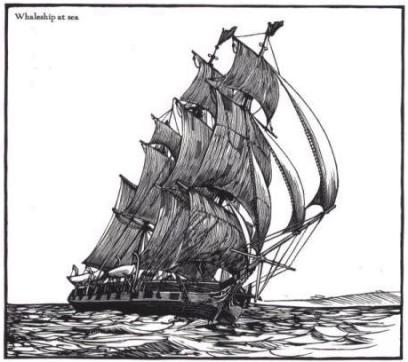
Whaleship at seaEssex sailed down the coast of South America, rounding the Horn and entering the Pacific Ocean.  They heard that the whaling grounds near Chile and Peru were exhausted, so they sailed for the “offshore grounds”, almost 2,000 miles from the nearest land.
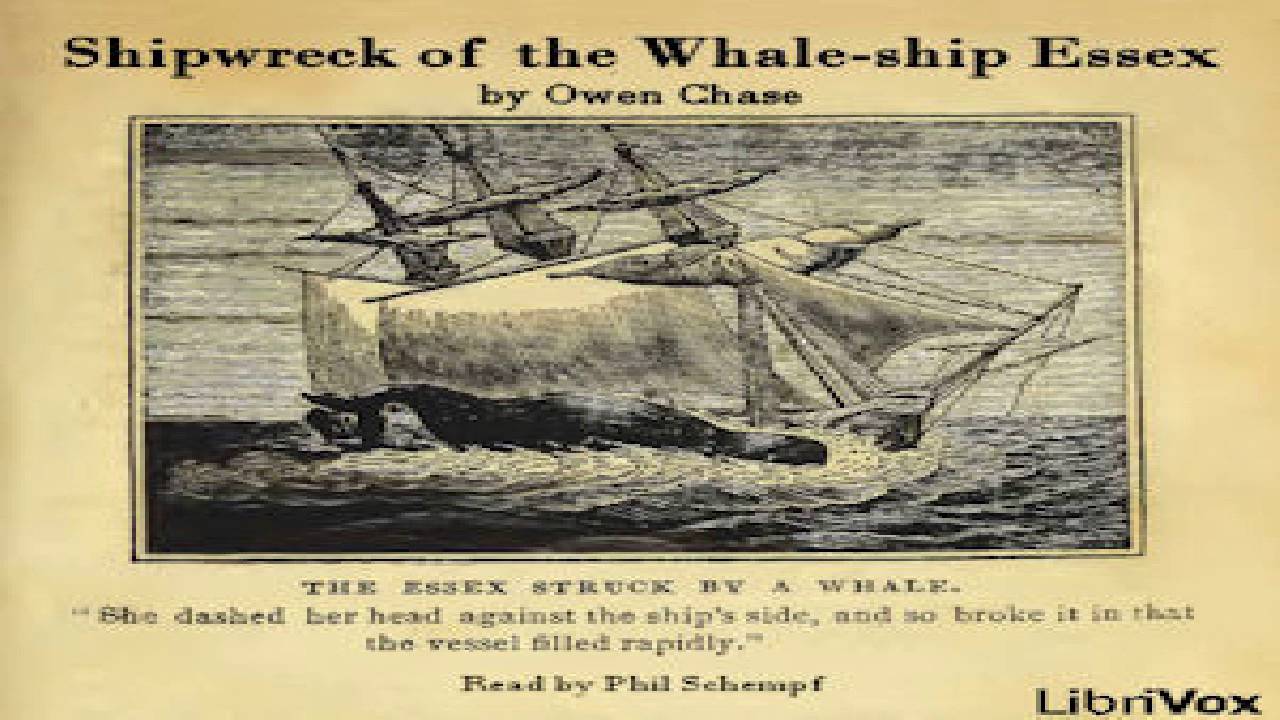
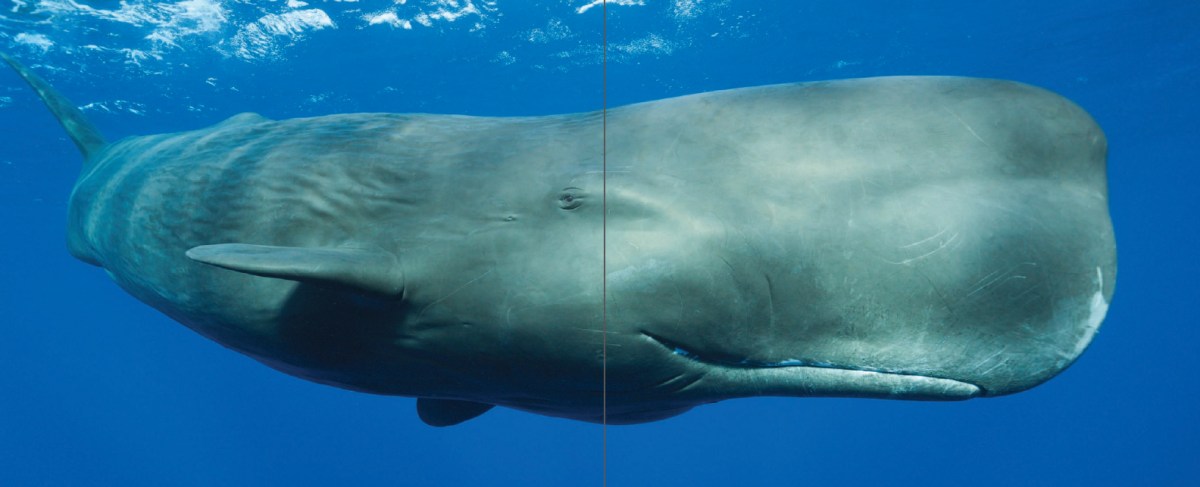
They were there on November 20, 1820, with two of their three boats out hunting whales.  The lookout spotted a huge bull sperm whale, much larger than normal, estimated at 85 feet long and 80 tons.  He was behaving oddly, lying motionless on the surface with his head facing the ship.  In moments the whale began to move, picking up speed as he charged the ship.  Never in the history of the whale fishery had a whale been known to attack a ship unprovoked.  This one hit the port side so hard that it shook the ship.

Wreck of the whale ship Essex

The huge animal seemed dazed by the impact, floating to the surface and resting by the ship’s side.  He then turned and swam away for several hundred yards, before turning to resume his attack.  He came in at the great speed of 24 knots according to First Mate Owen Chase, ramming the port bow and driving the stern into the water.  Oak planking cracked and splintered as the whale worked his tail up and down, driving the 238-ton vessel backward.  Essex had already started to go down when the whale broke off his attack, diving below the surface, never to return.

Essex_photoCaptain George Pollard’s boat was the first to make it back, and he stared in disbelief.  “My God, Mr. Chase, what is the matter?”  he asked.  “We have been stove by a whale” came the reply.
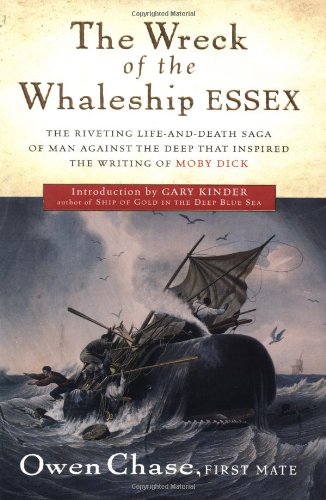
No force on earth could save the stricken whale ship. The crew divided into groups of seven and boarded the three boats.  It wasn’t long before Essex sank out of sight and they were alone, stranded in 28′ open boats, and about as far from land as it was mathematically possible to be.

The whalers believed that cannibals inhabited the Marquesa islands, 1,200 miles to the west, so they headed south, parallel to the coast of South America.  Before their ordeal was over, they themselves would become the cannibals.

With good winds, they might reach the coast of Chile in 56 days.  They had taken enough rations to last 60, provided they were distributed at starvation levels, but most of it had been ruined by salt water.  There was a brief reprieve in December, when the three small boats landed on a small island in the Pitcairn chain.  There they were able to get their fill of birds, eggs, crabs, and peppergrass, but within a week the island was stripped clean.  They decided to move on, except for three who refused to get back in the boats.

EssexThey never knew that this was Henderson Island, only 104 miles from Pitcairn Island, where survivors from the 1789 Mutiny on HMS Bounty had managed to survive for the past 36 years.

After two months at sea, the boats had long separated from one another.  Starving men were beginning to die, and the survivors came to an unthinkable conclusion.  They would have to eat their own dead.

When those were gone, the survivors drew lots to see who would die, that the others might live.  Captain Pollard’s 17-year-old cousin Owen Coffin, whom he had sworn to protect, drew the black spot.   Pollard protested, offering to take his place, but the boy declined. “No”, he said, “I like my lot as well as any other.”  Again, lots were drawn to see who would be Coffin’s executioner.  Owen’s friend, Charles Ramsdell, drew the black spot.

On February 18, the British whaleship Indian spotted a boat containing Owen Chase, Benjamin Lawrence and Thomas Nickerson.  It was 90 days after Essex’ sinking.  Five days later, the Nantucket whaleship Dauphin pulled alongside another boat, to find Captain Pollard and Charles Ramsdell inside.  The pair was so far gone that they didn’t notice at first, gnawing on the bones of their comrades.

The three who were left on Henderson Island were later rescued.  The third whaleboat was found beached on a Pacific island several years later, with four skeletons on board.

The Essex was the first ship recorded to have been sunk by a whale, though it would not be the last.  The Pusie Hall was attacked in 1835. The Lydia and the Two Generals were both attacked by whales a year later, and the Pocahontas and the Ann Alexander were sunk by whales in 1850 and 1851.

31 years after the Essex sinking, a sailor turned novelist published his sixth volume, beginning it with the words, “Call me Ishmael”.