March 15, 44BC  The Ides of March

The Roman calendar tracked the phases of the moon (or tried to), and didn’t count the days from first to last. Instead, Romans counted backward from three fixed points: the Nones (5th or 7th, depending on the length of the month), the Ides (13th or 15th), and the Kalends (1st of the following month).

The history of Rome may be drawn into two parts, the Republic and the Imperium. Since the overthrow of the Monarchy in 509BC, the Republic operated based on a separation of powers, checks and balances, and a strong aversion to the concentration of power. Except in times of national emergency, no single individual could wield absolute power over his fellow citizens.

A series of civil wars and other events changed that in the 1st century, BC.  The Republic was dead by the 30s BC, leaving Imperial Rome in its wake, a period best remembered for its long line of Emperors.

liste
Proscriptions of Sulla

Gaius Julius Caesar was born into this chaos, a son of the prestigious Julian Clan. In 82BC, the 18-year-old Caesar survived the “proscriptions” of the Dictator Sulla, in which the names of as many as 4,700 “enemies of the state” were nailed to the wall of the Roman Forum. Any proscribed man was immediately stripped of citizenship and all its protections. Anyone killing a proscribed man was entitled to keep part of his estate, the rest going to the government.  Rewards were paid for information leading to the death of anyone thus proscribed.

At the age of 25, Caesar was kidnapped and held for ransom by Cilician pirates, a group which may be described as the Isis of its time. Caesar laughed on learning that his ransom was set at only 20 talents of silver, and demanded his kidnappers hold out for 50.  He would yell at this band of killers for talking too loud while he was trying to sleep. He’d write poetry and read it to them, calling them “savages” if they were insufficiently appreciative of his work.
caesar

For 38 days, Caesar joined in their games and exercises.  As if he were their leader, instead of their prisoner.  Caesar promised these pirates that he would come back and crucify them all, and he said it with a smile.

376493_10_o

The pirates thought it uproariously funny, but Caesar was as good as his word. The fifty talents were raised, and the captive was released.  He made good on his promise, raising a force sufficient to enforce his will and bringing his former captors to Rome.  There he had them all crucified, but not without a moment of kindness.  Caesar style.  He slit their throats, ending the ordeal of crucifixion by hours, if not days.

Caesar lost his hair at an early age, about which he seems to have been self-conscious. It’s probably why we see him depicted with the wreath on his head, but baldness didn’t seem to bother the women in his life.

julius-caesarjpg

Caesar seems to have been quite the ladies’ man, having a son with none other than Queen Cleopatra of Egypt. One story has him being handed a note while speaking at the Senate. Caesar’s arch rival Cato (the younger) demanded to know the contents of the letter, loudly accusing him of complicity in the “Catiline Conspiracy” to overthrow the government. At last Caesar relented, reading out loud what turned out to be a love letter – a graphic one – written to him by Cato’s own half-sister Servilia Caepionis.

agrippinaCaesar rose through the ranks, organizing a coalition of three to rule the Republic. It was the first such “Triumvirate”, combining the popular general Pompey “The Great”, Crassus, the wealthiest man in all of Rome, and the rising young general and politician, Julius Caesar himself.

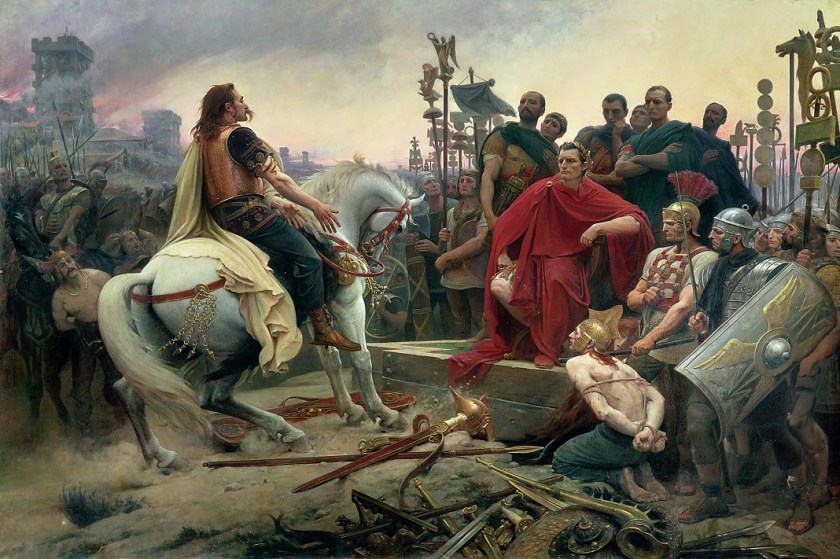
The partnership was doomed to fail, given the egos and animosities of the three. Crassus was killed on campaign in 52BC as Pompey became increasingly hostile to his co-ruler, then on campaign in Gaul.  A string of military successes against Celtic and native Germanic tribes caused Caesar’s popularity to soar, posing a threat to the power of the Senate and to Pompey himself.

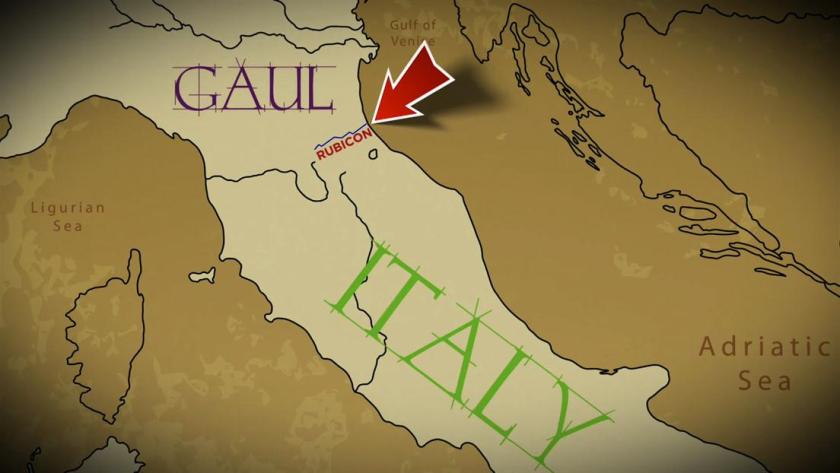
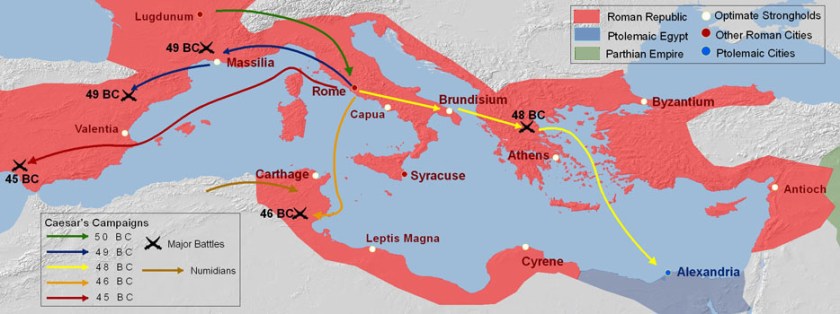
The Senate ordered Caesar to resign his command and disband the army, or become an enemy of the state.  Everyone knew what it meant when Caesar crossed the Rubicon River at the head of that army, in 49BC. It meant Civil War. To this day, to “Cross the Rubicon” means to take a step which cannot be reversed.
History_Ask_History_Crossing_the_Rubicon_SF_HD_1104x622-16x9

Shortly before his assassination in BC 44, Caesar was named dictator perpetuo rei publicae constituendae, the first time such a title had ever been made permanent. Nothing was more repugnant to traditional Roman sensibilities, than the idea of a dictator for life.   Caesar’s days were numbered.
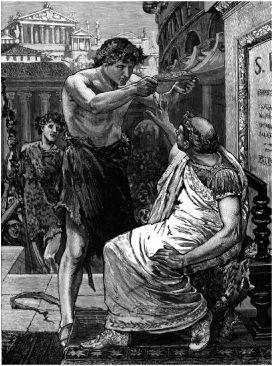
image062
“Lupercalia Incident”, February, BC 44.

In BC 44, Marcus Antonius (Mark Antony) was elected co-consul with Caesar, the highest elected political office of the Roman Republic.  During the festival of Lupercalia, Antony twice attempted to place the laurel wreath on Caesar’s head, twice to be rejected.  “The people give this to you though me” Antony said, as the stunned crowd stood silent.  Twice, Caesar removed the crown, saying “Jupiter alone of the Romans is King.”

Many believed the episode to have been a “trial balloon”, engineered to assess the public’s reaction.

A month earlier, the soothsayer Spurinna had “predicted the future by examining the internal organs of sacrificial animals.” Spurinna said that Caesar’s life “might come to a bad end,” warning that “his life would be in danger for the next 30 days.”

Roman-calendar
The Roman calendar tracked the phases of the moon (or tried to), and didn’t count the days from first to last. Instead, Romans counted backward from three fixed points: the Nones (5th or 7th, depending on the length of the month), the Ides (13th or 15th), and the Kalends (1st of the following month).

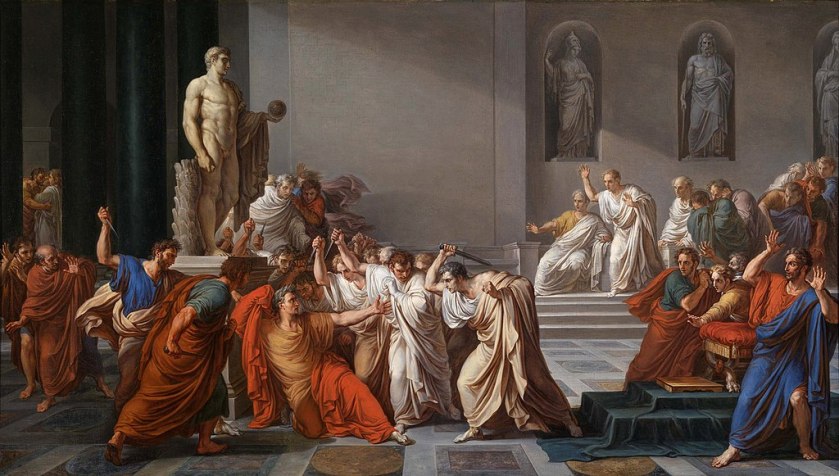
According to Plutarch, Julius Caesar arrived at the Senate on March 15, 44BC. Tillius Cimber presented him with a petition, as Senators crowded around. Cimber grabbed the Emperor’s shoulders and pulled down his tunic. “Ista quidem vis est!” said the Dictator for Life, “Why, this is violence!” Casca pulled a dagger and stabbed at Caesar’s neck. Caesar turned and caught him by the arm. “Casca, you villain, what are you doing?” Frightened, the Senator shouted “Help, brother!” in Greek “adelphe, boethei!” In seconds the entire group was striking at the dictator. Caesar attempted to get away but, blinded by his own blood, he tripped and fell. The men continued stabbing at him as he lay defenseless on the steps of the portico. According to Eutropius, 60 men participated in the assassination. Caesar was stabbed 23 times, though only one wound would prove fatal.
1024px-Vincenzo_Camuccini_-_La_morte_di_Cesare

Here’s where the story becomes Really interesting. Like the warning to “Beware the Ides of March”, Caesar’s last words, “Et tu Brute” were first introduced by William Shakespeare, 1,643 years after the fact. No eyewitness account of the assassination survives today, though a more contemporary source recorded the Greek words “Kai su, teknon?” as Brutus plunged the dagger in. “And you, my child?”

Marcus Junius Brutus (the younger) was the son of the same Servilia Caepionis, above. Brutus was 41 at the time of the assassination, Caesar 56. It is unlikely though not impossible, that Brutus killed his father that day. The affair between Brutus’ mother and Caesar, had carried on for years.
RomeCaesar
Military campaigns of the General Caesar
If you enjoyed this “Today in History”, please feel free to re-blog, “like” & share on social media, so that others may find and enjoy it as well. Please click the “follow” button on the right, to receive email updates on new articles.  Thank you for your interest, in the history we all share.

March 14, 1743 Town Meeting

The 19th century naturalist Henry David Thoreau captured the spirit of the age, in comparing town meeting to more top-down styles of government.  “On any moral question”, he said, “I would rather have the opinion of Boxboro than of Boston and New York put together…

When it comes to American politics, it has often been said that “All politics is local”.  The saying is commonly associated with former Speaker Tip O’Neill, but the notion goes back, long before his time.  When it comes to self-governance, it’s hard to know what could be more local, than the body known as Town Meeting.

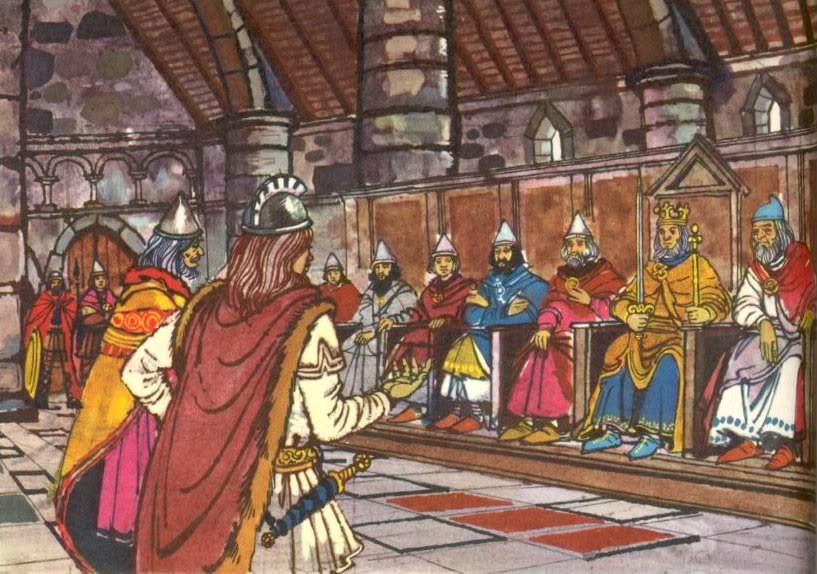
The town meeting form of local government is found in parts of the United States, where some localities elect town meeting members, and others where citizens who simply “show up”.  The roots go back to 11th century Anglo Saxon England and before, the Old English “moot” or “mot,” deriving from the same root which gave us “meet”.  Most often used in “gemot,” meaning “community meeting to discuss public affairs and policies”, this parliamentary forebear was known as the “Witenagemot,” literally “meeting of wise men”.

dignitaries
Foreign dignitaries appearing before an Anglo-Saxon King and the Witenagemot

The Basque region of northern Spain has held Town Meeting since the middle ages. Residents of a town would meet at the “Anteiglesia” (“in front of the church”) to vote on local matters, and to elect representatives to the regional assembly. All but the largest 10% of municipalities in Switzerland still use town meetings for their usual legislative body.

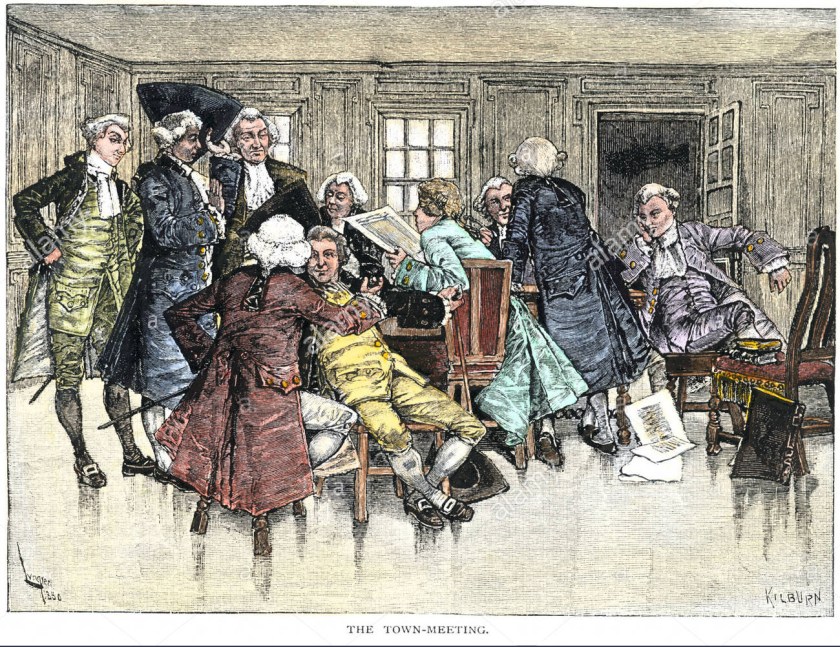
Southern American populations were more widely scattered in colonial America, where in New England, shorter distances encouraged regular town meetings, instilling in our forebears the belief that they could (and should) govern themselves.

town-meeting-in-colonial-america-A8FDJ3
Town Meeting in Colonial America

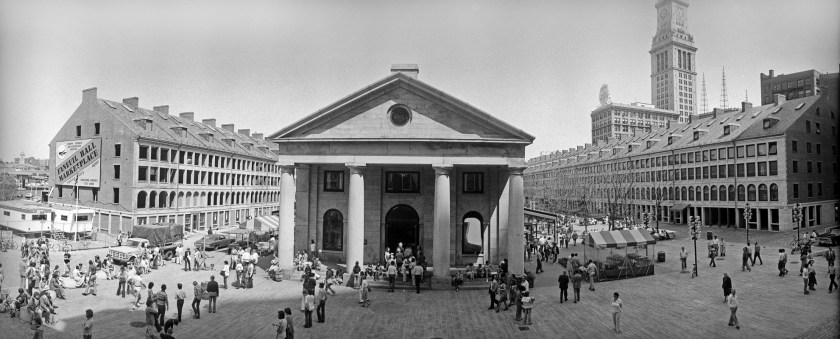
The 1st American town meeting took place on March 14, 1743 in Faneuil Hall, Boston. Faneuil Hall was given to the city by the merchant Peter Faneuil in 1742.  Destroyed by fire in 1761, the place was rebuilt the following year.  It was here that colonists gathered to protest the Sugar Act in 1764, and here where you may have first heard the protest, “no taxation without representation.”  Faneuil Hall became the scene of Revolutionary meetings, today this Birthplace of the Revolution is described by many as “the cradle of liberty.” Charles Bulfinch enlarged the hall in 1806, and the building is still in use today as a market, gathering place, meeting hall, and living museum.

11_07_000245
Faneuil Hall Marketplace in 1944

The southern part of Burlington Vermont was re-chartered in 1971 as the City of South Burlington, the new charter providing that only budget increases of 10% or more annually be placed before town meeting. The results have been predictable and it’s unlikely that there will be any such exceptions in the future.

320px-Walden_ThoreauTown meetings have been more prevalent in New England states, but not exclusively.  Michigan was the first Midwestern state to adopt the system, and Minnesota townships of more than 25 regularly hold town meeting.

The town meeting continues today as a form of direct democratic rule, in which members of a community come together to legislate and direct policy and budgets for local government.

The 19th century naturalist Henry David Thoreau captured the spirit of the age, in comparing town meeting to more top-down styles of government.  “On any moral question”, he said, “I would rather have the opinion of Boxboro than of Boston and New York put together… When, in some obscure country town, the farmers come together to a special town-meeting, to express their opinion on some subject which is vexing the land, that, I think, is the true Congress, and the most respectable one that is ever assembled in the United States”.

William F. Buckley, Jr., was rather more pithy, when he said “I am obliged to confess I should sooner live in a society governed by the first two thousand names in the Boston telephone directory than in a society governed by the two thousand faculty members of Harvard University”.

Feature image, top of page:  41 men sign the Mayflower Compact off Provincetown Harbor, the first written framework of self-government, in the New World.  November 11, 1620.

If you enjoyed this “Today in History”, please feel free to re-blog, “like” & share on social media, so that others may find and enjoy it as well. Please click the “follow” button on the right, to receive email updates on new articles.  Thank you for your interest, in the history we all share.

March 13, 1942  Dogs of War

WWII-era Military Working Dogs (MWDs) served on sentry, scout and patrol missions, in addition to performing messenger and mine-detection work. The keen senses of scout dogs saved countless lives, by alerting to the approach of enemy forces, incoming fire, and hidden booby traps & mines.

The history of dogs in war is as old as history itself.  The dogs of King Alyattes of Lydia killed many of his Cimmerian adversaries and routed the rest around 600BC, permanently driving the invader from Asia Minor in the earliest known use of war dogs in battle.

The Molossians of Epirus, descended from King Molossus, grandson of the mighty Achilles according to Greek mythology, used large, powerfully built dogs specifically trained for battle. Today, “molosser” describes a body type more than any specific breed.  Modern molossers include the Mastiff, Bernese Mountain Dog, Newfoundland and Saint Bernard.

Ancient Greeks, Romans and Egyptians used dogs as sentries or on patrol. In late antiquity, Xerxes I, the Persian King who faced the Spartan King Leonidas across the pass at Thermopylae, was accompanied by a pack of Indian hounds.

Attila the Hun went to war with a pack of hounds, as did the Spanish Conquistadors of the 1500s.

Sallie
Only known photo of Sallie

The Staffordshire Bull Terrier Sallie “joined up” in 1861, serving throughout the Civil War with the 11th Pennsylvania Volunteer Infantry.  At Cedar Mountain, Antietam, Fredericksburg, Chancellorsville, and Spotsylvania, Sallie’d take her position along with the colors, barking ferociously at the adversary.

Abraham Lincoln spotted Sallie once from a reviewing stand, and tipped his hat.

Sallie was killed at Hatcher’s Run in February, 1865.  Several of “her” men laid down their arms and buried her then and there, despite being under Confederate fire.

Dogs performed a variety of roles in WWI, from ratters in the trenches, to sentries, scouts and runners. “Mercy” dogs were trained to seek out the wounded on battlefields, carrying medical supplies with which the stricken could treat themselves.

DOG 19 [1600x1200] (4).jpg.opt897x579o0,0s897x579
Patriotic French ambulance‑dog expressing his dislike for the German Army on this propaganda postcard from WW1.
Sometimes, these dogs simply provided the comfort of another living soul, so that the gravely wounded should not die alone.

By the end of the “Great War”, France, Great Britain and Belgium had at least 20,000 dogs on the battlefield, Imperial Germany over 30,000. Some sources report that over a million dogs served over the course of the war.

The famous Rin Tin Tin canine movie star of the 1920s was rescued as a puppy, from the bombed out remains of a German Army kennel, in 1917.

Messenger dog in action in World War I, 1917
WW1 messenger dog

In the spring of 1918, GHQ of the American Expeditionary Force recommended using dogs as sentries, messengers and draft animals, however the war was over before US forces put together any kind of a War Dog program.

America’s first war dog, “Sgt. Stubby”, went “Over There” by accident, serving 18 months on the Western Front before coming home to a well-earned retirement.

On March 13, 1942, the Quartermaster Corps began training dogs for the US Army “K-9 Corps.” In the beginning, the owners of healthy dogs were encouraged to “loan” their dogs to the Quartermaster Corps, where they were trained for service with the Army, Navy, Marine Corps and Coast Guard.

The program initially accepted over 30 breeds of dog, but the list soon narrowed to German Shepherds, Belgian Sheep Dogs, Doberman Pinschers, Collies, Siberian Huskies, Malamutes and Eskimo Dogs.

patton-willy2_large
General George S. Patton Jr’s faithful friend Willie mourns the death of his owner, in 1946

WWII-era Military Working Dogs (MWDs) served on sentry, scout and patrol missions, in addition to performing messenger and mine-detection work. The keen senses of scout dogs saved countless lives, by alerting to the approach of enemy forces, incoming fire, and hidden booby traps & mines.

The most famous MWD of WWII was “Chips“, a German Shepherd/Husky mix assigned to the 3rd Infantry Division in Italy. Trained as a sentry dog, Chips broke away from his handler and attacked an enemy machine gun nest. Wounded in the process, his singed fur demonstrated the point-blank fire with which the enemy fought back.  To no avail.  Chips single-handedly forced the surrender of the entire gun crew.

Chips
Chips

Chips was awarded the Distinguished Service Cross, Silver Star and Purple Heart, the honors later revoked due to an Army policy against the commendation of animals. It makes me wonder if the author of such a policy ever saw service beyond his own desk.

Smoky
Smoky, the Littlest War Dog

Smoky, the littlest war dog, once ran a communication wire through a small culvert in Lingayen Gulf, Luzon, a task which would have otherwise taken an airstrip out of service for three days, and exposed an entire construction battalion to enemy fire.

Of the 549 dogs who returned from service in WWII, all but four were able to return to civilian life.

Over 500 dogs died on the battlefields of Vietnam, of injuries, illnesses, and combat wounds. 10,000 servicemen served as dog handlers during the war, with an estimated 4,000 Military Working Dogs.  261 handlers paid the ultimate price.  K9 units are estimated to have saved over 10,000 human lives.

patton-willy2_large
General George S. Patton Jr’s faithful friend Willie mourns the death of his owner, in 1946

It’s only a guess but, having a handler and a retired MWD in the family, I believe I’m right: hell would freeze before any handler walked away from his dog. The military bureaucracy, is another matter. The vast majority of MWDs were left behind during the Vietnam era. Only about 200 dogs survived the war to be assigned to other bases. The remaining dogs were either euthanized or left behind as “surplus equipment”.

dogs-cairo1
In 2011, a Belgian Malinois named “Cairo” accompanied the Navy SEAL “Neptune Spear” operation that took out Osama bin Laden.

Today there are about 2,500 dogs in active service.  Approximately 700 deployed overseas. The American Humane Association estimates that each MWD saves an average 150-200 human lives over the course of its career.

In 2015, Congressman Frank LoBiondo (R-NJ) and Senator Claire McCaskill (D-MO) introduced language in their respective bodies, mandating that MWDs be returned to American soil upon retirement, and that their handlers and/or handlers’ families be given first right of adoption.

LoBiondo’s & McCaskill’s language became law on November 25, when the President signed the 2016 National Defense Authorization Act (NDAA). It’s a small step in recognizing what we owe to those who have stepped up in defense of our nation, both two-legged and four.

If you enjoyed this “Today in History”, please feel free to re-blog, “like” & share on social media, so that others may find and enjoy it as well. Please click the “follow” button on the right, to receive email updates on new articles.  Thank you for your interest, in the history we all share.

March 12, 1901 A Two-Team Town

1901 saw no series at all, as the startup American League fought the National League for control of the business. The following year, the top two major league baseball teams switched sports, opting instead to compete in a football championship.

The first all-professional team in baseball history was established in 1869:  ten salaried  teammates, playing to a perfect 65-0 record as the Cincinnati Red Stockings.  To date, it’s the only perfect season in major league baseball history.  The club voted to dissolve after the 1870 season, when player-manager Harry Wright went to Boston, at the invitation of Ashburnham businessman and Boston Red Stockings founder, Ivers Whitney Adams.

Old_Hoss_Radbourn_finger
Boston Beaneater Pitcher Charles Gardner “Old Hoss” Radbourn, standing, far left, giving the cameraman “the finger” in 1886, the earliest known photograph of the gesture.

Eight previously amateur clubs went pro for the 1871 season, including the Cubs organization, playing at that time as the “Chicago White stockings”, and not to be confused with the later American League franchise, Chicago White Sox.  Today, these are the only two left of the original nine, though the Red Stockings and successor organizations are the oldest continuously playing professional team in American sports, since the Cubbies missed two years, following the great Chicago fire of 1871.

Club names were more fluid in the 19th century than today, and teams were likely to be known by nicknames.  When the new Cincinnati Red Stockings formed in 1876, the Boston club was sometimes called the “Red Caps” and later, the “Beaneaters”.

40CF8A8B00000578-0-image-a-1_1495788770713
“Squad: A team photo of the now defunct Boston Reds. In its one and only year in the Players’ National League of Professional Base Ball Clubs the Reds won the 1890 title after accruing 81 wins fending off competition from the New York Giants. The Reds didn’t join the newly formed National League at the end of the season after the Boston Braves, soon to become the famous Atlanta Braves, were ushered into the new league and officials didn’t want the two Boston teams to face each other” H/T DailyMail.com

In those days, the National Association of Professional Base Ball Players and its National League successor represented the pinnacle of professional baseball.  There was no post-season, championships were awarded based on the best record at the end of regular season.

Precursors to the modern World Series began with the formation of a second league in 1882, the American Association, but the series themselves were haphazard.  Terms of post-season play were negotiated between club owners, with as few as three games in 1884 when the Providence Grays defeated the New York Metropolitans 3-0, and as many as fifteen, when the Detroit Wolverines defeated the St. Louis Browns, 10 to 5.

Boston_Americans_Baseball_Team,_1902
Boston Americans, 1902

With the collapse of the American Association in 1891, major league baseball entered an eight-year single-league “monopoly”, where half-season winners squared off in a championship series called the Temple Cup.

1901 saw no series at all, as the startup American League fought the National League for business supremacy.  The two top teams in baseball changed sports in 1902, opting instead to compete in a football championship.

Boston_Americans_logo
Boston Americans logo, 1901-1907

The Red Caps/Beaneaters roster was decimated in 1901, with the formation of Boston’s American League franchise, the “Americans”.  Many stars jumped ship to the new AL club, which was offering contracts that it’s NL competitor couldn’t hope to match.

On this day in 1901, ground was broken for Boston’s 1st American League ballpark, the Huntington Avenue Grounds.  The stadium was the site of the first modern World Series in 1903, when the Boston Americans defeated the Pittsburgh Pirates in a best-of-nine series, five to three. The stadium saw the first perfect game of the modern era, thrown by Cy Young on May 5, 1904.

The playing field was built on what used to be a circus lot and was large by current standards: 530′ to center field, later expanded to 635′ in 1908. It had many quirks not seen in modern baseball stadia, including patches of sand in the outfield where grass wouldn’t grow, and a tool shed in play in deep center field.

WorldSeries1903-640
1903 World Series photograph, believed to be taken from the roof of a nearby warehouse

During the 1907 season, manager Fred Tenney removed the last bit of red from Red Caps/Beaneaters uniforms, believing that red dyes could cause injuries to become infected.  The all-white uniforms gave rise to the unfortunate sobriquet – “Doves”, while Americans’ owner John Taylor was quick to cash in with a name change of his own, a reference to the uniform hose worn by his franchise, since the beginning.  The Boston Red Sox, were born.

Fred-snodgrassIn 1912, the Doves adopted an official name of their own. National League franchise owner James Gaffney was a member of Tammany Hall, the political machine that ruled New York, between 1789 and 1967.  Tammany Hall’s symbol was an Indian chief, its headquarters called a “wigwam”. So it was that, the oldest franchise in major league baseball, came to be called “the Braves”.

The Boston Red Sox moved to their new stadium home that same year, ending the season in a dramatic victory over the New York Giants, four games to three.  Frederick “Snow” Snodgrass, one of the best outfielders of his day, dropped a routine fly ball in the 10th inning of the deciding game, allowing the winning run to stay on base, much to the dismay of generations of Giants fans.

Fred Snodgrass went on to become a successful banker, elected city councilman, and a popular mayor and rancher in Oxnard CA, but “Snodgrass’s Muff” would follow him, for the rest of his days. When the man died in April, 1974, the New York Times obituary was headlined “Fred Snodgrass, 86, Dead; Ball Player Muffed 1912 Fly.” Move over, Billy Buckner.

1912_Boston_Red_Sox.jpeg

A Boston team won five out of six consecutive World Series championships between 1912-’18, with the NL franchise advancing from dead last to World Champions in 1914, and the Red Sox winning in 1912, ,15, ’16 and ’18.

It was the Golden Era of Boston baseball, and it all came to a halt in 1919.  On December 26, theater enthusiast and Red Sox franchise owner Harry Frazee sold Babe Ruth to the arch-rival New York Yankees, to open a play called My Lady Friends, opening on Broadway that same month. Years later, My Lady Friends would become a musical, called No, No, Nanette.  The musical wouldn’t open until five years after Frazee’s infamous trade, but indeed, the forerunner was financed by the Ruth sale, to the Yankees.

1914 Miracle Braves

There ensued one of the longest championship droughts in baseball history, an 86-year period called the “Curse of the Bambino” before the Red Sox’ sixth Championship, in 2004.

With Braves Field under construction in 1914, the Miracle Braves played in the Red Sox’ home field at Fenway Park.  The Braves returned the favor the next two years, as Braves Field was the larger of the two.

il_340x270.893955742_3w451915 ushered in a 20-year losing streak for the Braves.  Ironically, it was Babe Ruth who was expected to pull it all together, when Braves President Emil Fuchs brought the Bambino back to Boston in 1935.

Things were looking up that opening day, with a 4-2 win over the Giants, and Ruth had something to do with all four runs.  Later that month, Ruth hit three home runs in a single game but, no one could know those were the last of his career.   Years of high living had done their work.  The Bambino’s best years were behind him.  The man couldn’t run, and his fielding was so bad that three Braves pitchers threatened to strike, if he remained in the lineup.  Babe Ruth retired on June 1, a short six days after one of the finest performances, of his career.

1948 almost saw an all-Boston World Series, but for a single game playoff loss to the Indians.

Boston remained a two-team town until March 13, 1953, when the Braves left, for good. The longest-running franchise in MLB history went to Milwaukee for a time before moving to Atlanta.  Brave’s Field was sold to Boston University.

The old Huntington Grounds were demolished in 1912, later replaced with the Cabot Center, an indoor athletic venue belonging to Northeastern University. A plaque and a statue of Cy Young were erected on the campus in 1993, where the pitchers mound and home plate used to be. A plaque on the side of the Cabot building marks the former location of the left field foul pole, about ¼ mile from Matthews Arena, the oldest multi-purpose athletic building still in use in the world, and the original home to the Boston Bruins.  But that must be a story, for another day.

Feature image, top of page: Fenway Park, October 12, 1914, third game of the 1914 World Series

If you enjoyed this “Today in History”, please feel free to re-blog, “like” & share on social media, so that others may find and enjoy it as well. Please click the “follow” button on the right, to receive email updates on new articles.  Thank you for your interest, in the history we all share.

March 10, 1876  The Speed of Sound

For all of Mark Twain’s abilities, he wasn’t much of an investor.  The man turned down a ground-floor opportunity to invest in the telephone, in favor of a typesetting machine which actually made setting type more complicated, than the age-old printer’s method of setting type, by hand.

As the son of a speech pathologist and husband to a deaf wife, Alexander Melville Bell was always interested in sound. Since the profoundly deaf can’t hear their own pronunciation, Bell developed a system he called Visible Speech in 1864, to help the deaf learn and improve elocution.

220px-VisibleSpeech-illustrationsÉdouard Séguin, the Paris-born physician and educator best known for his work with the developmentally disabled and a major inspiration to Italian educator Maria Montessori, called the elder Bell’s work “…a greater invention than the telephone by his son, Alexander Graham Bell”.

As a boy, the younger Bell developed a method of carefully modulating his speech and speaking into his mother’s forehead, a method which allowed her to “hear” him, fairly clearly.  The boy followed in his father’s footsteps, mastering his elder’s work to the point of improving on it and teaching the system at the Boston School for Deaf Mutes (which operates today as the Horace Mann School for the Deaf), the American Asylum for Deaf-mutes in Hartford, Connecticut, and the Clarke School for the Deaf in Northampton, Massachusetts.

539001It was Alexander Graham Bell who first broke through to Helen Keller, a year before Anne Sullivan.  The two developed a life-long relationship closely resembling that of father and daughter.  Bell made it possible for Keller to attend Radcliffe and graduate in 1904, the first deaf/blind person, ever to do so.

Keller used a braille typewriter to write her first autobiography in 1903, dedicating The Story of My Life, to her life-long friend, benefactor and mentor:  “To Alexander Graham Bell, who has taught the deaf to speak and enabled the listening ear to hear speech from the Atlantic to the Rockies.”

aa_keller_radcliffe_1_e
CREDIT: “[Alexander Graham Bell with Helen Keller and Annie Sullivan at the meeting of the American Association to Promote the Teaching of Speech to the Deaf, July 1894, in Chautauqua, N.Y.]” [1894, printed later]. Prints and Photographs Division of the Library of Congress.
A natural inventor, it was Bell’s 1875 work on electrical telegraphy, which led to the telephone.  Bell heard a “twang” on the line while working , leading him to investigate the possibility of using electrical wires, to transmit sound.

Rival Elisha Gray was working on a similar concept, and filed a caveat (statement of concept) on February 14, 1876, mere hours after Bell applied for patent.

Bell’s device first produced intelligible speech on March 10, that same year.  His diary entry describes the event: “I then shouted into M [the mouthpiece] the following sentence: “Mr. Watson, come here – I want to see you.” To my delight he came and declared that he had heard and understood what I said.  I asked him to repeat the words. He answered, “You said ‘Mr. Watson – come here – I want to see you.'” We then changed places and I listened at S [the speaker] while Mr. Watson read a few passages from a book into the mouthpiece M. It was certainly the case that articulate sounds proceeded from S. The effect was loud but indistinct and muffled”.

Alexander-Graham-Bell-3

Many of Bell’s innovations came about, much earlier than you might expect.  One of his first inventions after the telephone was the “photophone,” a device enabling sound to be transmitted on a beam of light. Bell and his assistant, Charles Sumner Tainter, developed the photophone using a sensitive selenium crystal and a mirror which would vibrate in response to sound. In 1881, the pair successfully sent a photophone message from one building to another, a distance of over 200 yards.

Several innovations would later build on this accomplishment to produce the modern laser.

0bcb9e63f5In September 1881, Alexander Graham Bell hurriedly invented the first metal detector, as President James Garfield lay dying from an assassin’s bullet. The device was unsuccessful in saving the President, but credited with saving many lives during the Boer War and WW1.

That was the year in which Bell’s infant son Edward died of respiratory problems, leading the bereaved father to design a metal vacuum jacket which would facilitate breathing. This apparatus was a forerunner of the iron lung used in the ’40s and ’50s to aid polio victims.  As many as 39 people still used an iron lung to breathe, as late as 2004.

The telephone was a commercial success, but that wasn’t a foregone conclusion. Looking for investors for his new enterprise, Bell approached Samuel Clemens in 1877, as a potential investor.  Better known as Mark Twain, the author declined the opportunity, believing the market to be confined to bridge-to-engine room communications, onboard maritime vessels.

download (19)
Mark Twain

One of the towering figures of American literature, Samuel Clemens achieved considerable financial success during his lifetime but, for all his abilities, didn’t have much of an eye for opportunity.  Mark Twain turned down a ground-floor invitation to invest in the telephone, choosing instead to buy into a typesetting machine which complicated the setting of type, compared with the age-old printer’s method of setting type, by hand.

Alexander Graham Bell’s creation would change the world but, to the end of his days, his work with the deaf gave him greatest satisfaction.

Bell would sell his invention, to finance his work on devices to aid the hearing-impaired.  He didn’t keep a phone on his desk, considering the thing to be an interruption and a nuisance.

Later in life, Alexander Graham Bell described his work with the deaf, as “more pleasing to me than even recognition of my work with the telephone.”

Alexander-Graham-Bell-1

If you enjoyed this “Today in History”, please feel free to re-blog, “like” & share on social media, so that others may find and enjoy it as well. Please click the “follow” button on the right, to receive email updates on new articles.  Thank you for your interest, in the history we all share.

March 9, 1910 Brown Dog

In the five years I’ve been writing “Today in History”, I’ve written about 450 of these stories.  A father isn’t supposed to have favorites among his “children”, but I have to confess.  I do.  This is not one of those.  This one, I detest.

In the five years I’ve been writing “Today in History”, I’ve written about 450 of these stories.  A father isn’t supposed to have favorites among his “children”, but I have to confess.  I do.  This is not one of those.  This one, I detest.

The Oxford on-line Dictionary defines vivisection as: “noun – the practice of performing operations on live animals for the purpose of experimentation or scientific research”.

During the reign of Queen Victoria, British monarch from June 20, 1837 to January 22, 1901, a powerful opposition arose in Great Britain to the dissection of live animals. Labeled as “vivisection” by opponents of the practice, experiments were often performed in front of audiences of medical students, with or without anesthesia.

Ernest_Starling
Ernest Starling

The Cruelty to Animals Act of 1876 stipulated that subject animals must be anesthetized, unless anesthesia would interfere with the point of the experiment. The measure further required that each animal could only be used once, though multiple procedures were permitted so long as each was part of the same experiment.

In the end, the subject animal had to be killed when the study was over.

In 1902, about the time when Russian physiologist Ivan Petrovich Pavlov was doing his conditioning experiments om dogs, Ernest Starling performed his first “experiment” on a small brown terrier.  Whether a stray or someone’s pet, is unclear.  A further “demonstration” was performed on the same animal by William Bayliss on February 2, 1903, at the end of which the dog was killed with a knife to the heart.

William_Bayliss_1918b
William Bayliss

I don’t care to linger on the details of what was done to this dog.  It was difficult enough, to read about it.  Suffice it to say that Bayliss and Starling’s classes were infiltrated by two Swedish anti-vivisection activists, Lizzy Lind and Leisa Katherine Schartau.

The two women had attended 50 such classes at University College, keeping a diary throughout and later publishing observations in “The Shambles of Science: Extracts from the Diary of Two Students of Physiology”. In it, the pair disputed that the brown dog had been anesthetized, reporting that “The dog struggled forcibly during the whole experiment and seemed to suffer extremely during the stimulation. No anesthetic had been administered in my presence, and the lecturer said nothing about any attempts to anesthetize the animal having previously been made”.

Stephen_Coleridge,_Vanity_Fair,_July_1910_(cropped)
Stephen Coleridge,, Vanity Fair,, July 1910

Stephen Coleridge, secretary of the National Anti-Vivisection Society heard the two women’s story, and spoke angrily on behalf of the terrier.  “If this is not torture”, the barrister asked, “let Mr. Bayliss and his friends … tell us in Heaven’s name what torture is“.

There was little doubt that either professor if not both, would sue for libel.  Bayliss did and the jury retired for 25 minutes, returning with a unanimous verdict.  Bayliss was awarded £2,000 with £3,000 in court costs, equivalent to about £250,000 today, the verdict read to the applause of physicians in the public gallery.

On September 15, 1906, the World League against Vivisection unveiled a statue in Battersea’s Latchmere Recreation Ground, bearing the inscription “In Memory of the Brown Terrier Dog Done to Death in the Laboratories of University College in February 1903 after having endured Vivisection extending over more than Two Months and having been handed over from one Vivisector to Another Till Death came to his Release. Also in Memory of the 232 dogs Vivisected at the same place during the year 1902. Men and Women of England how long shall these Things be?”

Irish playwright George Bernard Shaw and Anglo-Irish suffragist Charlotte Despard spoke at the event, but medical students were outraged.

Brown_Dog_statue,_Battersea,_London(2)London’s teaching hospitals at first explored quiet means of taking down what they regarded as an insult to the profession.  By November, medical students were crossing the Thames with sledge hammers and crow bars, intending to take matters into their own hands.

Riots ensued, the worst nights occurring in London on December 10, 1907, when 1,000 medical students tried to pull the statue down, battling over the memorial with suffragettes, trade unionists and over 400 police officers.

More riots and brawls broke out in the weeks that followed.  Before long, the authorities were looking for a quiet way to make the statue go away.  Four workmen and 120 police officers quietly removed the Brown Dog Memorial over the night of March 9-10, 1910, hiding it in a bicycle shed. 3,000 anti-vivisectionists gathered in Trafalgar Square to demand its return, but to no avail.  The statue never reappeared, later to be broken up and melted down.

dsc04730Seventy-five years would come and go, before a new Brown Dog memorial was commissioned by the National Anti-Vivisection Society and the British Union for the Abolition of Vivisection.

For all the fuss, it hardly made a difference. There were something like 300 experiments on live animals, in the year 1875.  By the time of the brown terrier’s live dissection, the number was 19,084.  In 2005 the figure had increased to 2.81 million, and that’s just the vertebrates. 7,306 of those, were dogs.

Image – top ofpage.  Original brown dog statue, from 1906

March 8, 1863  The Gray Ghost

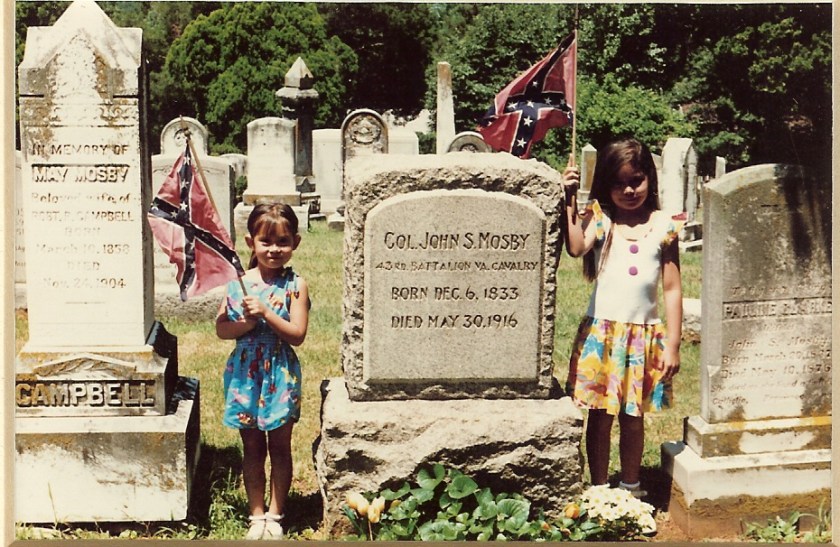
Late on the night of March 8, 1863, a light rain was falling when Mosby’s Rangers formed up for a raid on Fairfax Virginia, known at that time as Fairfax Courthouse. 

Like fellow Virginian Robert E. Lee, the Howardsville lawyer John Singleton Mosby opposed the destruction of the Union but, when secession came, he stayed with his state.  Small and frail as a boy, Mosby was often the target of much larger bullies.  Years later in his memoirs, he’d write that he never won a fight.  It seems that John Singleton Mosby never backed down from one, either.

Mosby participated in the 1st Battle of Manassas (1st Bull Run) as a member of the Virginia Volunteers Mounted Rifles, later joining James Ewell Brown “J.E.B.” Stuart as a Cavalry Scout.  A gifted horseman and natural tactician, information gathered by Mosby aided Stuart in his humiliating ride around McLellan’s Army of the Potomac in June, 1862.

tumblr_mxvjev4IY21t8ultdo1_1280

The following year, Stuart authorized Mosby to form and take command of the 43rd Battalion of Virginia Cavalry, a regiment-sized unit operating out of north central Virginia.  These “Partisan Rangers”, 1,900 of whom served between January 1863 and April ’65, were under the command of Stuart and Lee and subject to their authority, but were not a traditional army unit.  Mosby’s Rangers shared in the spoils of war but had no camp duties, and lived scattered among civilian populations.

Known for lightning raids of the Virginia countryside, Mosby’s 43rd Cavalry would be called together to strike specific targets, dispersing afterward and making themselves next to impossible to run aground.  So successful were they that, to this day, parts of Virginia’s Piedmont region are known as “Mosby’s Confederacy”.

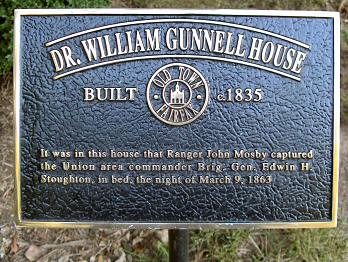
Late on the night of March 8, 1863, a light rain was falling when Mosby’s Rangers formed up for a raid on Fairfax Virginia, known at the time as Fairfax Courthouse.  Deep in the midst of several thousand Federal soldiers and only fifteen miles from the White House, Union Brigadier General Edwin H. Stoughton was sleeping in his headquarters.  Some sources indicate that he was “sleeping it off”.  The “Gray Ghost” entered the Union General’s quarters in the small hours of March 9, his rangers quickly overpowering a handful of sleepy guards.

mar8map

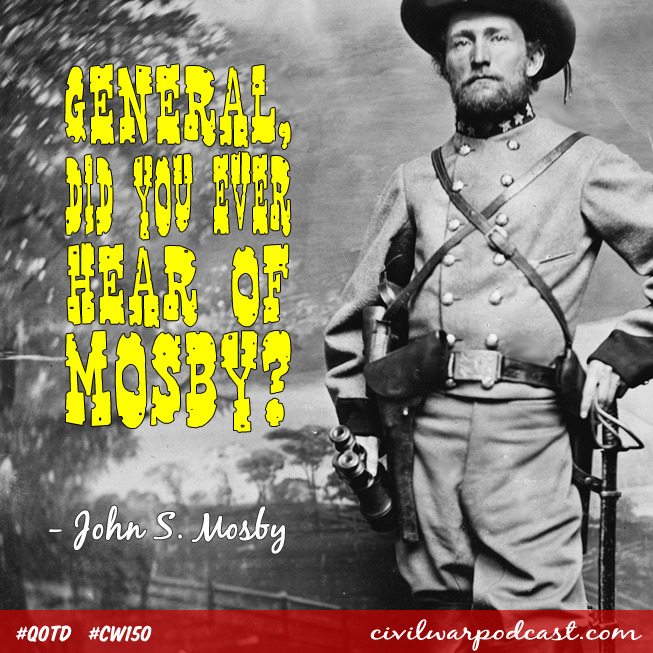
Entering the bed chamber as others went to the stables and gathered horses, Mosby lifted the General’s nightshirt and slapped his bare backside with a sword. General Stoughton sputtered awake, demanding “What is the meaning of this!?” “General, did you ever hear of Mosby“, came the question.

Mosby himself later recalled, “There was no time for ceremony, so I drew up the bedclothes, pulled up the general’s shirt, and gave him a spank on his bare back, and told him to get up”.  Stoughton replied, “Yes, have you caught him?” “I AM Mosby,” said the Gray Ghost, “and I have caught You. Stuart’s cavalry has possession of the Courthouse; be quick and dress.

mosby73

As prisoners came to the realization that they’d been captured by such a puny force, many melted into the woods, and escaped.  In the end, Mosby and his 29 rangers had captured a Union General, two Captains, 30 enlisted men and 58 horses, without firing a shot.  On hearing the story the next day, President Lincoln lamented:  “I can make another Brigadier in 5 minutes, but I can’t replace those horses”.

Mosby_Monument

If you enjoyed this “Today in History”, please feel free to re-blog, “like” & share on social media, so that others may find and enjoy it as well. Please click the “follow” button on the right, to receive email updates on new articles.  Thank you for your interest, in the history we all share.

March 7, AD321 The Unconquered Sun

On March 7, AD321, Constantine I “The Great” decreed Dies Solis – Day of the Sun or “Sun-day”:  “On the venerable day of the Sun let the magistrates and people residing in cities rest, and let all workshops be closed”.

Kitara
The cithara or kithara (Greek: κιθάρα, kithāra, Latin: cithara) was an ancient Greek musical instrument in the lyra family of instruments

For two thousand years, a popular story has told the tale of Emperor Nero, playing the fiddle while Rome burned. Far be it for me to leap to the defense of a man who ordered the murder of his own wife and mother, except in the name of historical accuracy. The viol class of musical instruments, to which the fiddle belongs, didn’t come along until the 11th century. If Nero played anything it was probably a Cithara, a heavy wooden instrument with four to seven strings.

At least five versions come down to us about the Great Fire of 64AD, and the Emperor’s role in it. The Roman historian Tacitus tells us that Nero sang about the fall of Troy while the city burned, but admits there were no witnesses.

Cassius Dio and Suetonius ask us to believe, in their turn, that Nero a) secretly sent guys out to burn the city, b) openly did so and watched from the tower of Maecenas while singing and playing the lyre, c) the fire was started by an obscure religious sect called “Christians”, d) Nero sent his guys out after all, but sang and played his lyre from a private stage and e) the fire started by accident while Nero was thirty-five miles away at Antium, and the emperor rushed back to help the now-homeless people of Rome.

images (26)Be that as it may, three things are certain. First, The fire burned for six days, utterly destroying three of the 14 districts of Rome, and severely damaging seven others.  Next, Nero used the excuse of the fire to go after the Christians, having many of them arrested and executed. Last, the Domus Aurea (“Golden Palace”) and surrounding “Pleasure Gardens” which the emperor built on the ruins, would be the death of Emperor Nero.
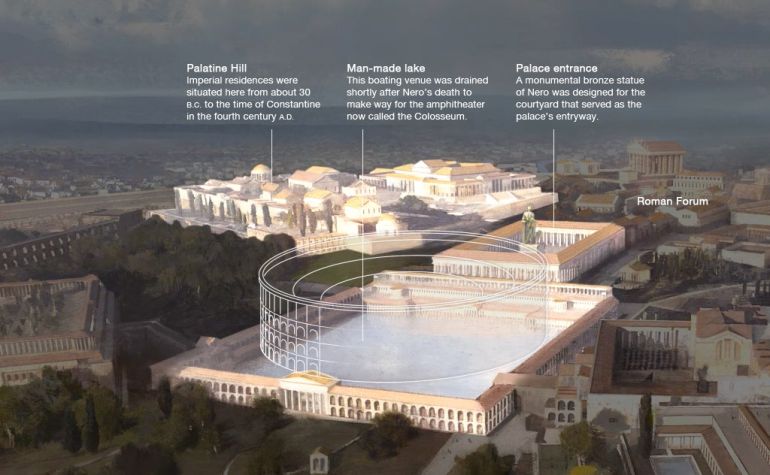
Between AD65 and 68, Emperor Nero built a vast palace complex over an area of more than 200 acres, linking existing buildings on the Palatine Hill with the Gardens of Maecenas and other imperial properties on the Esquiline hills, and adding a grand colonnaded approach and vestibule surrounding an artificial lake.

Reconstruction_3D_Domus_Aurea_Nero_Golden_House_5
Reconstruction of the Domus Aurea, of Nero

One of the Great Wonders of antiquity, Nero’s “Golden house” was ruinously expensive, 300 rooms of dazzling white marble with pools in the floors and fountains splashing in corridors. There were jewel-encrusted walls and ivory clad columns.  An enormous vaulted ceiling lay underneath the dome of the main dining room, with an ingenious mechanism cranked by slaves, making the ceiling revolve like the heavens, as  rose petals dropped and perfume was sprayed on assembled diners.

Suetonius described the complex as “ruinously prodigal”. Nero himself would say nothing further on the palace’ dedication, save to say that he “had at last begun to live like a human being”.

450px-El_Coloso_de_Nerón
Artist’s rendering of the Colossus of Nero holds a rudder on the globe, symbolizing his dominion over land and sea.

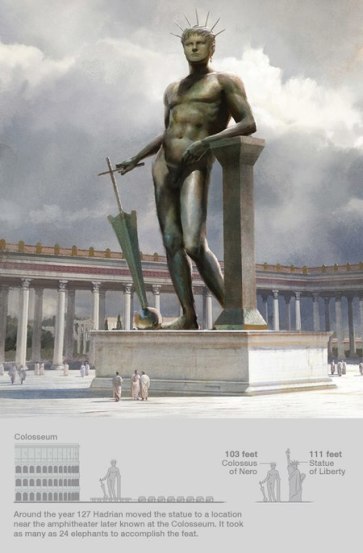
At the center of it all, Nero built his Colossus Neronis, a giant gilded bronze statue – of himself.  Sources place the thing at 98′ to 121′ tall, roughly equal to the statue of liberty, from her feet to her crown.

With all of Italy “thoroughly exhausted by contributions of money” and “the provinces ruined”, the Emperor himself was roundly hated.  In June AD68, Nero learned that he’d been tried in absentia, and condemned to death as an enemy of the Roman people. Preparing himself for suicide, Nero muttered “Qualis artifex pereo” (“What an artist dies in me”).

Nero’s profligacy was a severe embarrassment to his successors.  Within a decade, the palace and its complex was stripped of its marble, jewels, and ivory embellishments.

Within forty years, most of the grounds were filled with earth and built over, replaced by the Baths of Titus, and the Temple of Venus and Rome. Vespasian drained the lake and built the Flavian Amphitheatre, but Nero’s Colossus, lived on.

In 69, Emperor Vespasian added a sun-ray crown and renamed the thing Colossus Solis, a dedication to the Roman sun god Sol Invictus (“Unconquered Sun”), patron of the legions and official Sun God of the later Roman Empire.

Around 128, Emperor Hadrian moved the statue from the Domus Aurea to just outside of the Colosseum, with a little help from the architect Decrianus, and 24 elephants. Emperor Commodus removed the head and replaced it with a likeness of his own, but the head was restored after Commodus’ death, and so it remained.

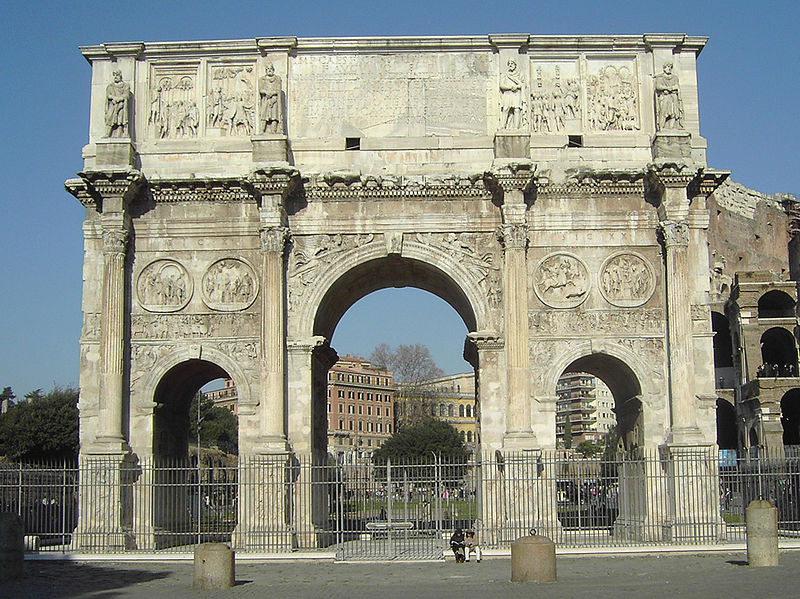
800px-RomeConstantine'sArch03

The Arch of Constantine, the last and largest of the Triumphal Arches of Rome and dedicated in AD315, was carefully positioned to align with Sol Invictus, so that the Colossus formed the dominant backdrop when approaching the Colosseum via the main arch.

Six years later, March 7, AD321, Constantine I “The Great” decreed Dies Solis – Day of the Sun or “Sun-day” – as the Roman day of rest (Codex Justinianus 3.12.2):  “On the venerable day of the Sun let the magistrates and people residing in cities rest, and let all workshops be closed. In the country however persons engaged in agriculture may freely and lawfully continue their pursuits because it often happens that another day is not suitable for grain-sowing or vine planting; lest by neglecting the proper moment for such operations the bounty of heaven should be lost”.\

2000 years later Constantine’s day of rest remains, but the colossus of the Unconquered Sun is gone. The last known reference in antiquity dates back to the Calendar of 354, the earliest illuminated manuscript containing full page illustrations.

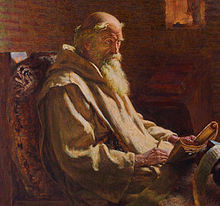
220px-The_Venerable_Bede_translates_John_1902
Saint Bede of northumbria

It may have been destroyed during the Sack of Rome in 410, or perhaps it toppled in one of a series of 5th century earthquakes, its metal scavenged. There is evidence that Sol Invictus outlived the western Roman Empire and survived into the early middle ages. Bede the Venerable, an English monk from the monastery of St. Peter in Northumbria, wrote sometime circa 672–735: “As long as the Colossus stands, Rome will stand, when the Colossus falls, Rome will also fall, when Rome falls, so falls the world“.

Today, nothing remains of the Colossus of Nero, save for the foundations of its pedestal at the second location, near the ruins of the Colosseum.

6197120816_242b162d66_b

March 6, 1857 Dred Scott

Dred Scott had lost at virtually every turn, only to win his freedom at the hands of the family which had once held him enslaved.

Dred Scott, his full name may have been “Etheldred”, was born into slavery in Southampton County, Virginia, sometime in the late 1790s.  In 1818, Scott belonged to Peter Blow, who moved his family and six slaves to Alabama, to attempt a life of farming. The farm near Huntsville was unsuccessful and the Blow family gave up the effort, moving to St. Louis Missouri in 1830, to run a boarding house. Around this time, Dred Scott was sold to Dr. John Emerson, a surgeon serving in the United States Army.

Dred_&_Harriet_Scott_Quarters
Dred & Harriet Scott’s restored quarters, at Ft. Snelling

As an army officer, Dr. Emerson moved about frequently, bringing Scott with him. In 1837, Emerson moved to Fort Snelling in the free territory of Wisconsin, now Minnesota. There, Scott met and married Harriet Robinson, a slave belonging to fellow army doctor and Justice of the Peace, Lawrence Taliaferro. Taliaferro, who presided over the ceremony, transferred Harriet to Emerson, who continued to regard the couple as his slaves. Emerson moved away later that year, leaving the Scotts behind to be leased by other officers.

The following year, Dr. Emerson married Eliza Irene Sanford, and sent for the Scotts to rejoin him in Fort Jesup, in Louisiana. Harriett gave birth to a daughter while on a steamboat on the Mississippi, between the free state of Illinois and the Iowa district of the Wisconsin Territory.

images (25)Dr. Emerson died in 1842, leaving his estate to his wife Eliza, who continued to lease the Scotts out as hired slaves.
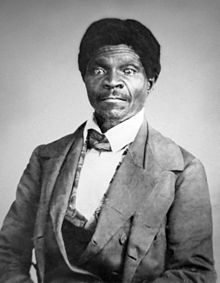
Four years later, Scott attempted to buy his freedom for the sum of $300, equivalent to about $8,000 today. Mrs. Emerson declined the offer and Scott took legal recourse. By this time, Dred and Harriett Scott had two daughters, who were approaching an age where their value would be greatly increased, should they be sold as slaves. Wanting to keep his family together, Scott sued.

Ironically, Dred Scott’s suit in state court, Scott v. Emerson, was financially backed by three now-adult Blow children, who had since become abolitionists. The legal position stood on solid ground, based on the doctrine “Once free, always free”. The Scott family had resided in free states and territories for two years, and their eldest daughter was born on the Mississippi River, between a free state and a free territory.

The verdict went against Scott but the judge ordered a retrial, which was held in January, 1850. This time, the jury ruled in favor of Dred Scott’s freedom. Emerson appealed and the Missouri supreme court struck down the lower court ruling, along with 28 years of Missouri precedent.

By 1853, Eliza Emerson had remarried and moved to Massachusetts, transferring ownership of the Scott family to her brother, John Sanford. Scott sued in federal district court, on the legal basis that the federal courts held “diversity jurisdiction”, since Sanford lived in one state (New York), and Scott in another (Missouri). Dred Scott lost once again and appealed to the United States Supreme Court, a clerical misspelling erroneously recording the case as Dred Scott v. Sandford.

On March 6, 1857, Chief Justice Roger B. Taney delivered the 7-2 majority opinion, enunciating one of the stupidest decisions, in the history of American jurisprudence:
“[Americans of African ancestry] had for more than a century before been regarded as beings of an inferior order, and altogether unfit to associate with the white race, either in social or political relations; and so far inferior, that they had no rights which the white man was bound to respect; and that the negro might justly and lawfully be reduced to slavery for his benefit. He was bought and sold, and treated as an ordinary article of merchandise and traffic, whenever a profit could be made by it”.

download (18)
Frederick Douglass

The highest court in the land had ruled that slaves were private property and not citizens, with no right to legal recourse. Furthermore, the United States Congress had erred in attempting to regulate slavery in the territories, and had no right to revoke the property rights of a slave owner, based on his place of residence.

The response to the SCOTUS opinion was immediate, and vehement. Rather than settle the issue of slavery, the decision inflamed public opinion, dividing an already fractured country, further. Frederick Douglass assailed Chief Justice Taney’s opinion, noting that:

“We are now told, in tones of lofty exultation, that the day is lost all lost and that we might as well give up the struggle. The highest authority has spoken. The voice of the Supreme Court has gone out over the troubled waves of the National Conscience, saying peace, be still . . . The Supreme Court of the United States is not the only power in this world. It is very great, but the Supreme Court of the Almighty is greater”.

220px-Dred_Scott_photograph_(circa_1857)
Dred Scott, photograph circa 1857

The Supreme Court had spoken, but the Dred Scott story was far from over.  Eliza Irene Emerson’s new husband was Calvin C. Chaffee, a member of the United States Congress, and an abolitionist.

Following the Dred Scott decision, the Chaffees deeded the Scott family over to Henry Taylor Blow, now a member of the United States House of Representatives from Missouri’s 2nd Congressional district, who manumitted the family on May 26. Dred Scott had lost at virtually every turn, only to win his freedom at the hands of the family which had once held him enslaved.

For Harriett and the two Scott daughters, it was the best of all possible outcomes.  For Scott himself, freedom was short-lived.  Dred Scott died of tuberculosis, the following year.

Nationally, the Dred Scott decision had the effect of hardening enmities already nearing white-hot, increasing animosities within and between pro- and anti-slavery factions in North and South, alike. Politically, the Democratic party was broken into factions and severely weakened,  while the fledgling Republican party was strengthened, as the nation was inexorably drawn to Civil War.

Slaves Issues Plague the Democratic Party

The issue of Black citizenship was settled in 1868, via Section 1 of the 14th Amendment, which states: “All persons born or naturalized in the United States, and subject to the jurisdiction thereof, are citizens of the United States and of the State wherein they reside …”

Dred Scott is buried in the Calvary Cemetery in St. Louis, Missouri. The marker next to his headstone reads: “In Memory Of A Simple Man Who Wanted To Be Free.”

112973396-H

If you enjoyed this “Today in History”, please feel free to re-blog, “like” & share on social media, so that others may find and enjoy it as well. Please click the “follow” button on the right, to receive email updates on new articles.  Thank you for your interest, in the history we all share.

March 5, 1776 Head Fake

General Howe was stunned on awakening, to the morning of March 5.  The British garrison in Boston and the fleet in harbor, were now under the muzzles of Patriot guns.  “The rebels have done more in one night”, he said, “than my whole army would have done in a month.”

Over the night and the following day of April 18-19, 1775, individual British soldiers marched 36 miles or more, on a round-trip expedition from Boston.  Following the early morning battles at Lexington and Concord, armed colonial militia from as far away as Worcester swarmed over the column, forcing the regulars into a fighting retreat.

2b38d80b603c96328378781e9fb45c3dIn those days, Boston was a virtual island, connected to the mainland by a narrow “neck” of land.  More than 20,000 armed men converged from all over New England in the weeks that followed, gathering in buildings and encampments from Cambridge to Roxbury.

A man who should have gone into history among the top tier of American Founding Fathers, the future turncoat Benedict Arnold, arrived with Connecticut militia to support the siege.  Arnold informed the Massachusetts Committee of Safety that Fort Ticonderoga, located along the southern end of Lake Champlain in upstate New York, was bristling with cannon and other military stores.  Better yet, the place was lightly defended.

The committee commissioned Arnold a colonel on May 3, authorizing him to raise troops and lead a mission to capture the fort.  Seven days later, Colonel Arnold and militia forces from Connecticut and western Massachusetts in conjunction with Ethan Allen and his “Green Mountain Boys” captured the fort, and all its armaments.

800px-Flag_of_the_United_States_(1776-1777).svg
Flag flown by George Washington, during the siege of Boston

The Continental Congress created the Army that June, appointing General George Washington to lead it.  When General Washington took command of that army in July, it was a force with an average of nine rounds’ shot and powder, per man.  The British garrison occupying Boston, was effectively penned up by forces too weak to do anything about it.

The stalemate dragged on for months, when a 25-year-old bookseller came to General Washington with a plan. His name was Henry Knox.  Knox proposed a 300-mile, round trip slog into a New England winter, to retrieve the guns of Fort Ticonderoga:  brass and iron cannon, howitzers, and mortars.  59 pieces in all.  Washington’s advisors derided the idea as hopeless, but the General approved.

henry-knox-moving-canning-from-fort-ticonderoga

Knox set out with a column of men in late November, 1775.  For nearly two months, he and his team wrestled 60 tons of cannons and other armaments by boat, animal & man-hauled sledges along roads little better than foot trails.  Across two barely frozen rivers, and through the forests and swamps of western Massachusetts, over the Berkshire mountains and on to Cambridge, historian Victor Brooks called it “one of the most stupendous feats of logistics”, of the age.

colonel-knox-bringing-the-cannons-from-fort-ticonderoga (2)

It must have been a sight that January 24, when Knox returned at the head of that “Noble Train of Artillery”.

Bunker_Hill
Bunker Hill

For British military leadership in Boston, headed by General William Howe, the only option for resupply was by water, via Boston Harbor.  Both sides of the siege understood the strategic importance of the twin prominences overlooking the harbor, the hills of Charlestown to the north, and Dorchester heights to the south.  It’s why British forces had nearly spent themselves on Farmer Breed’s hillside that June, in an engagement that went into history as the battle of Bunker Hill.

With Howe’s forces in possession of the Charlestown peninsula, Washington had long considered occupying Dorchester Heights, but considered his forces too weak.  That changed with the guns of Ticonderoga.

Siege_of_Boston.Dean.USMA.edu.history

In the first days of March, Washington placed several heavy cannons at Lechmere’s Point and Cobble Hill in Cambridge, and on Lamb’s Dam in Roxbury.  The batteries opened fire on the night of March 2, and again on the following night and the night after that.  British attention thus diverted, American General John Thomas and a force of some 2,000 made plans to take the heights.

As the ground was frozen and digging impossible, fortifications and cannon placements were fashioned out of heavy 10′ timbers.  With the path to the top lined with hay bales to muffle their sounds, pre-built fortifications were manhandled to the top of Dorchester heights over the night of March 4-5, along with the bulk of Knox’ cannons.

6055534625_65297500c9_b
Boston as seen from Dorchester heights

General Howe was stunned on awakening, to the morning of March 5.  The British garrison in Boston and the fleet in harbor, were now under the muzzles of Patriot guns.  “The rebels have done more in one night”, he said, “than my whole army would have done in a month.”

Plans were laid for an immediate assault on the hill, as American reinforcements poured into the position.  By day’s end, Howe faced the dismal prospect of another Bunker Hill, this time against a force of 6,000 in possession of heavy artillery.

SiegeBoston
Engraving depicts the British evacuation of Boston

A heavy snowstorm descended late in the day, interrupting British plans for the assault.  A few days later, Howe had thought better of it.  Washington received an unsigned note on March 8, informing him that the city would not be put to the torch, if the King’s Regulars were permitted to leave unmolested.

British forces departed Boston by sea on March 17 with about 1,000 civilian loyalists, resulting in a peculiar Massachusetts institution which exists to this day:  “Evacuation Day”.

It’s doubtful whether Washington possessed sufficient powder or shot for a sustained campaign, but British forces occupying Boston didn’t know that. The mere presence of those guns moved General Howe to weigh anchor and sail for Nova Scotia. The whole episode may have been one of the greatest head fakes, in all military history.

siege-banner

If you enjoyed this “Today in History”, please feel free to re-blog, “like” & share on social media, so that others may find and enjoy it as well. Please click the “follow” button on the right, to receive email updates on new articles.  Thank you for your interest, in the history we all share.