December 2, 1859 John Brown

To some, the man was a hero.  To others he was a kook. The devil incarnate.


Following the war for independence, American politics split between those supporting a strong federal government and those favoring greater self-determination for the states. In the South, climate conditions led to dependence on agriculture, the rural economy of the southern states producing cotton, rice, sugar, indigo and tobacco. Colder states to the north tended to develop manufacturing economies, urban centers growing up in service to hubs of transportation and the production of manufactured goods.

During the first half of the 19th century, 90% of federal government revenue came from tariffs on foreign manufactured goods. Most of this revenue was collected in the South, with the region’s greater dependence on imported goods.  Much of federal spending was directed toward the North, toward the construction of roads, canals and other infrastructure.

The debate over economic issues and rights of self-determination, so-called ‘state’s rights’, grew and sharpened in 1828 with the threatened secession of South Carolina and the “nullification crisis” of 1832-33. South Carolina declared such tariffs unconstitutional and therefore null and void within the state. A Cartoon from the era says it all – Northern domestic manufacturers getting fat at the expense of impoverishing the South under protective tariffs.

Chattel slavery came to the Americas well before the colonial era, from Canada to Mexico to Brazil and around the world. Moral objections to what was clearly a repugnant practice could be found throughout, but economic forces had as much to do with ending the practice as any other. The “peculiar institution” died out first in the colder regions of the US and may have done so in warmer climes as well, but for Eli Whitney’s invention of a cotton engine (‘gin’) in 1792.
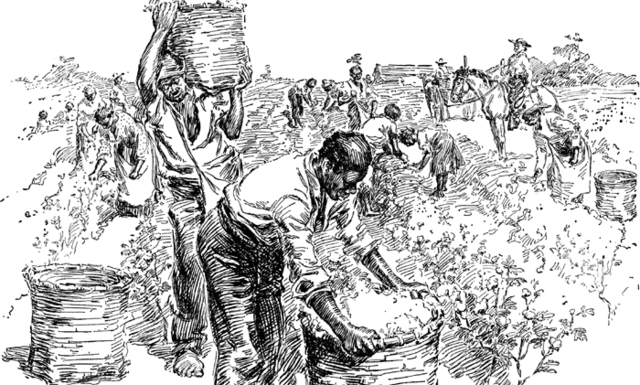
Removing cotton seeds by hand requires ten man-hours to remove the seeds from a single pound of cotton. By comparison, a cotton gin can process about a thousand pounds a day at comparatively little expense.

The year of Whitney’s invention, the South exported 138,000 pounds a year to Europe and the northern colonies. Sixty years later, Britain alone was importing 600 million pounds a year of the stuff, from the American south. Cotton was King, and with good reason.  The crop is easily grown, is more easily transportable and can be stored indefinitely, compared with food crops.  The southern economy turned overwhelmingly to this one crop and with it, the need for cheap, plentiful labor.

By then the issue of slavery was so joined and intertwined with ideas of self-determination, as to be indistinguishable.
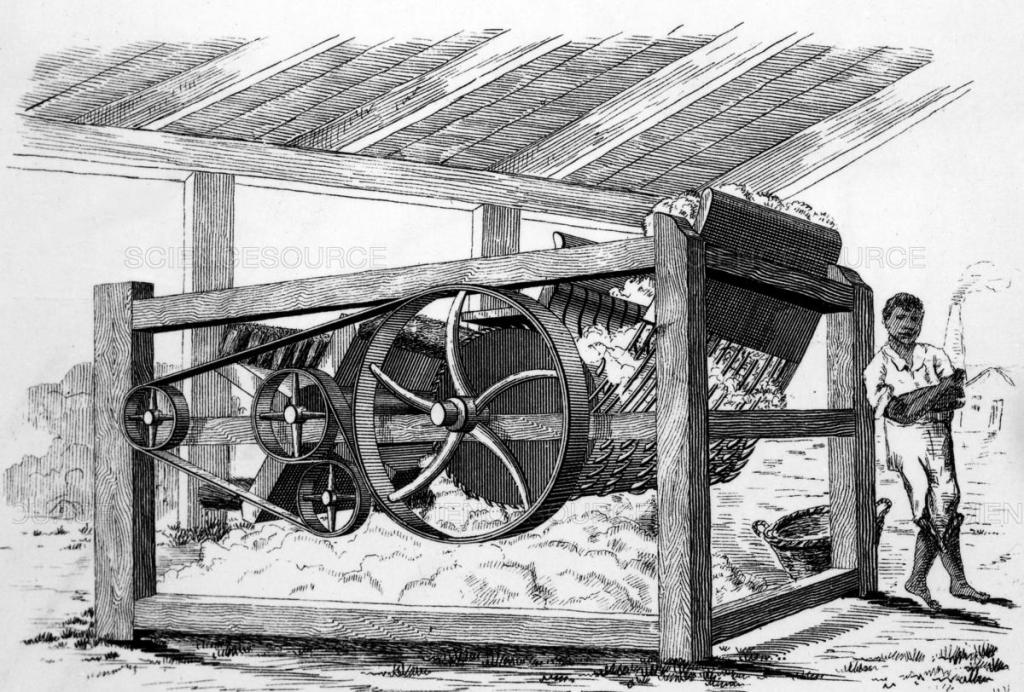
The Cotton Gin

The short-lived “Wilmot Proviso” of 1846 sought to ban slavery in new territories, after which the Compromise of 1850 attempted to strike a balance.  The Kansas Nebraska Act of 1854 created the territories of Kansas and Nebraska, basically repealing the Missouri Compromise and allowing settlers to determine their own way through popular sovereignty.
John_Brown
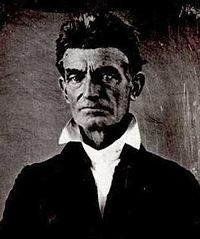
John Brown

This attempt to democratize the issue instead had the effect of drawing up battle lines.  Pro-slavery forces established a territorial capital in Lecompton, while “antis” set up an alternative government in Topeka.

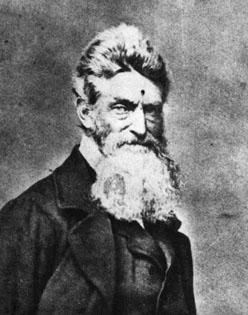
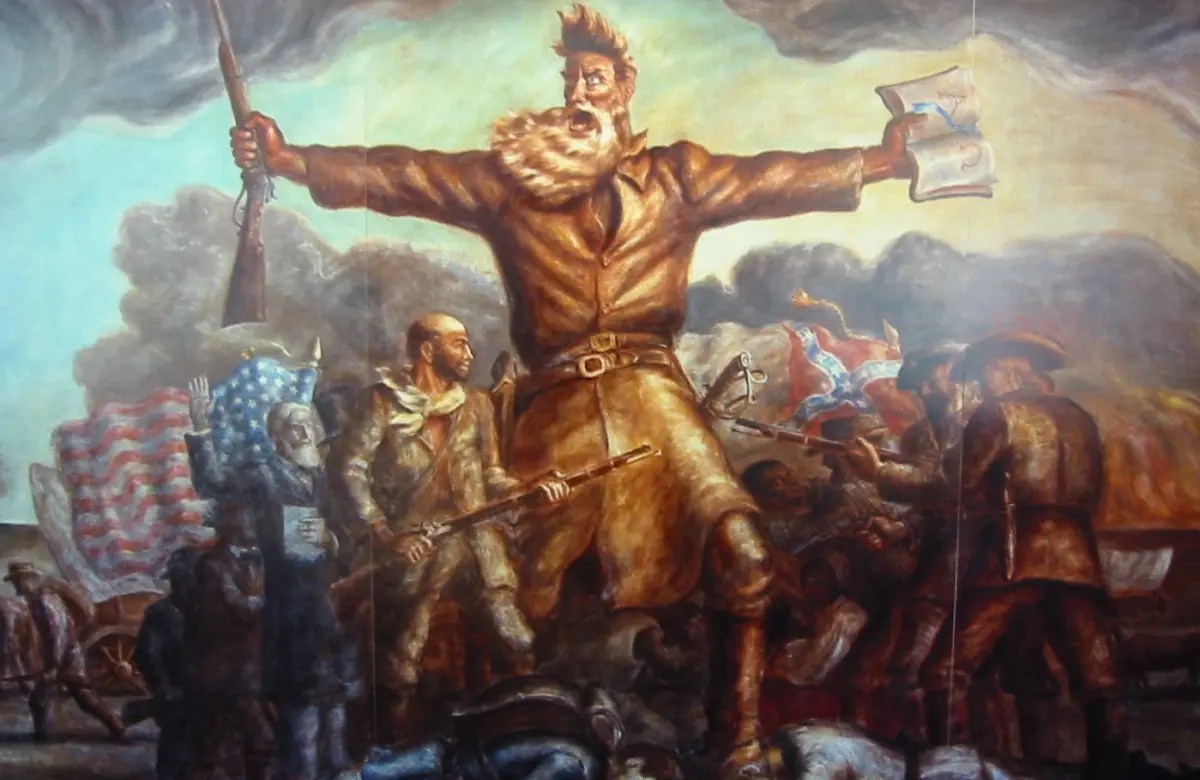
John Brown Sr. came to the Kansas Territory as a result of violence, sparked by the expansion of slavery into the Kansas-Nebraska territories between 1854 and 1861, a period known as “Bleeding Kansas”.  To some, the man was a hero.  To others he was a kook. The devil incarnate.  A radical abolitionist and unwavering opponent of the “peculiar institution” of slavery, John Brown believed that armed confrontation was the only way to bring it to an end.

BleedingKansasFight

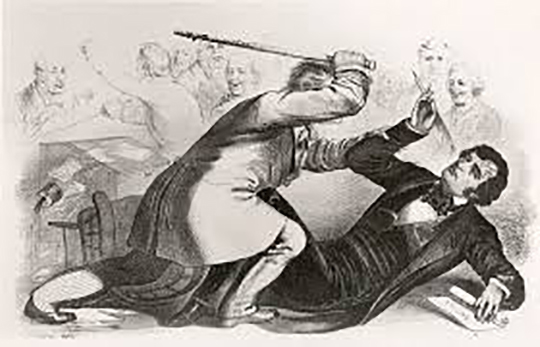
In Washington DC, a United states Senator was beaten nearly to death on the floor of the Senate, by a member of the House of Representatives. The following day Brown and four of his sons: Frederick, Owen, Salmon, and Oliver, along with Thomas Weiner and James Townsley, set out on a “secret expedition”.

The group camped between two deep ravines off the road that night, remaining in hiding until sometime after dark on the 24th. Late that night, they stopped at the house of James P. Doyle, ordering him and his two adult sons, William and Drury, to go with them as prisoners. Doyle’s wife pleaded for the life of her 16 year old son John, whom the Brown party left behind. The other three, all former slave catchers, were led into the darkness.  Owen Brown and one of his brothers murdered the brothers with broadswords. John Brown, Sr. fired the coup de grace into James Doyle’s head to ensure that he was dead.
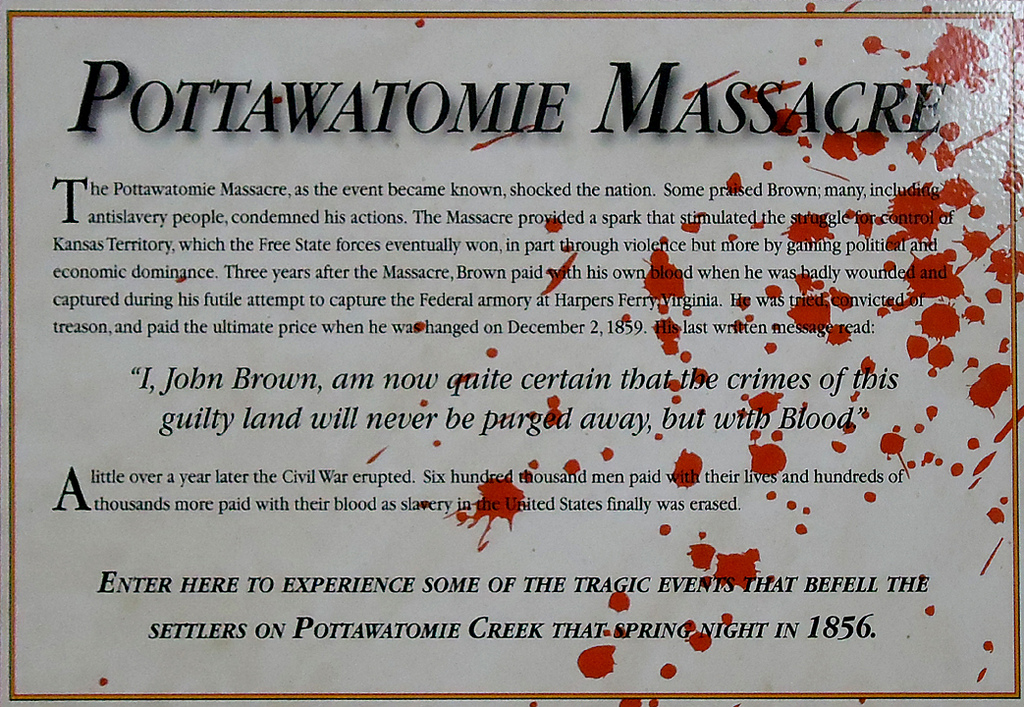
The group went on to the house of Allen Wilkinson, where he too was brought out into the darkness and murdered with broadswords. Sometime after midnight, the group forced their way into the cabin of James Harris. His two house guests were spared after interrogation, but Wilkinson was led to the banks of Pottawatomie Creek where he too was slaughtered.

There had been 8 killings to date in the Kansas Territory; Brown and his party had just murdered five in a single night. The massacre lit a powder keg of violence in the days that followed.  Twenty-nine people died on both sides in the next three months alone.
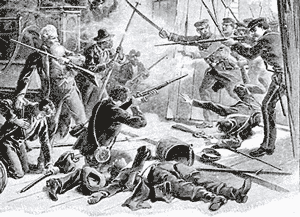
Harper's Ferry

Brown would go on to participate in the Battle of Black Jack and the Battle of Osawatomie in the Kansas Territory.  Brown lead a group to the armory in Harper’s Ferry Virginia in a hare brained scheme to capture the weapons contained there and trigger a slave revolt. The raid was ended by a US Army force under Colonel Robert E. Lee, and a young Army lieutenant named James Ewell Brown (JEB) Stuart.

Brown supporters blamed the 1856 massacre on everything from defending the honor of the Brown family women, to self defense, to a response to threats of violence from pro slavery forces. Free Stater and future Kansas Governor Charles Robinson may have had the last word when he said, “Had all men been killed in Kansas who indulged in such threats, there would have been none left to bury the dead.”

John Brown was hanged on December 2, 1859.

The 80-year-old nation forged inexorably onward, toward a Civil War that would kill more Americans than every conflict from the American Revolution to the War on Terror, combined.

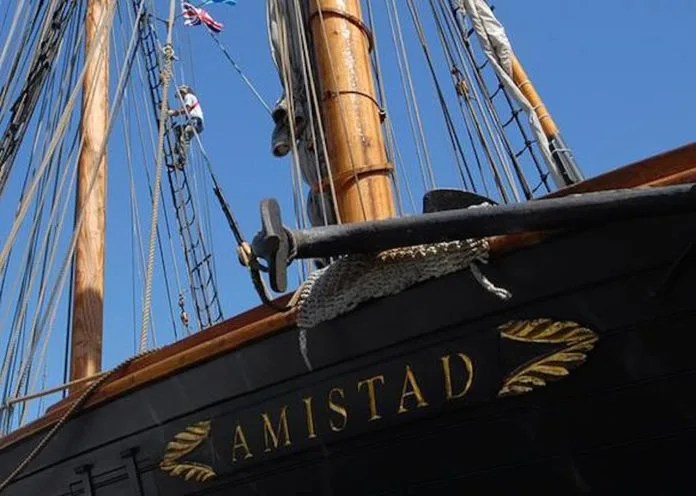
November 25, 1841 Amistad

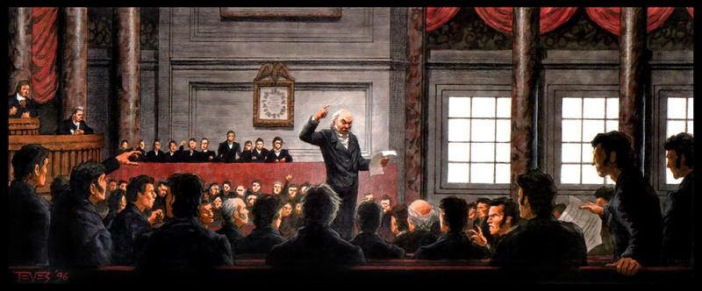
In arguing the case before the Supreme Court former President John Quincy Adams took the position that no man, woman, or child in the United States could ever be sure of the “blessing of freedom”, if the President could hand over free men on the demand of a foreign government.

The international slave trade was illegal in most countries by 1839 while the “peculiar institution” of slavery remained legal. In April of that year, a Portuguese slave trader illegally purchased some 500 Africans and shipped them to Havana aboard the slave ship Teçora.

Conditions were so horrific aboard Teçora that fully one-third of its “cargo”, presumably healthy individuals, died on the journey. Once in Cuba, sugar cane producers Joseph Ruiz and Pedro Montez purchased 49 members of the Mende people, 49 adults and four children, for use on the plantation.

The Mendians were given Spanish names and designated “black ladinos,” fraudulently documenting the 53 to have always lived as slaves in Cuba. In June of 1841 Ruiz and Montez placed the Africans on board the schooner la Amistad, (“Friendship”), and set sail down the Cuban coast to Puerto del Principe.

jul-02-amistad
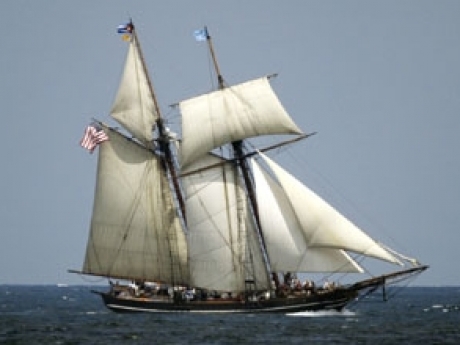
Replica of the slave ship, Amistad

Africans had been chained onboard Teçora but chains were judged unnecessary for the short coastal trip aboard Amistad.  On the second day at sea, two Mendians were whipped for an unauthorized trip to the water cask.  One of them asked where they were being taken.  The ship’s cook responded, they were to be killed and eaten.

The cook’s mocking response would cost him his life.

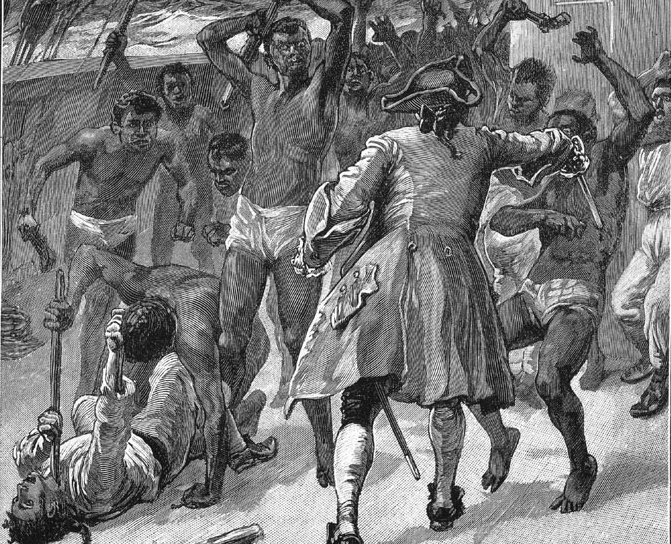
That night, captives armed with cane knives seized control of the ship. Their leader was Sengbe Pieh, also known as Joseph Cinqué. Africans killed the ship’s Captain and the cook losing two of their own in the struggle.  Montez was seriously injured while Ruiz and a cabin boy named Antonio, were captured and bound.  The rest of the crew escaped in a boat.

The mulatto cabin boy who really was a black ladino, would be used as translator.

Revolt-Aboard-Ship

Mendians forced the two to return them to their homeland, but the Africans were betrayed.  By day the two would steer east, toward the African coast.  By night when the position of the sun could not be determined, the pair would turn north.  Toward the United States.

After 60 days at sea, Amistad came aground off Montauk on Long Island Sound. Several Africans came ashore for water when Amistad was apprehended by the US Coastal Survey brig Washington, under the command of Thomas Gedney and Richard Meade.  Meanwhile on shore, Henry Green and Pelatiah Fordham (the two having nothing to do with the Washington) captured the Africans who had come ashore.

Joseph_Cinque
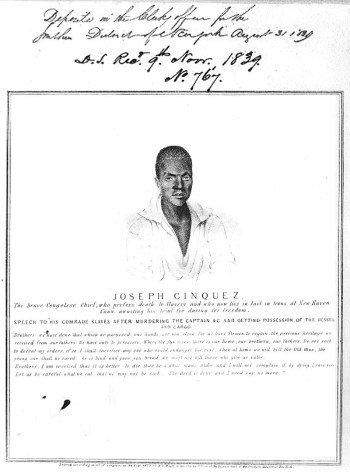
This print depicting Joseph Cinqué appeared in The New York Sun newspaper, August 31, 1839

Amistad was piloted to New London Connecticut, still a slave state at that time.  The Mendians were placed under the custody of United States marshals.

Both the slave trade and slavery itself were legal at this time according to Spanish law while the former was illegal in the United States.   The Spanish Ambassador demanded the return of Ruiz’ and Montez’ “property”, asserting the matter should be settled under Spanish law.  American President Martin van Buren agreed, but, by that time, the matter had fallen under court jurisdiction.

Gedney and Meade of the Washington sued under salvage laws for a portion of the Amistad’s cargo, as did Green and Fordham.  Ruiz and Montez sued separately.  The district court trial in Hartford determined the Mendians’ papers to be forged.  These were now former slaves  entitled to be returned to Africa.

Antonio was ruled to have been a slave all along and ordered returned to Cuba.  He fled to New York with the help of white abolitionists and lived out the rest of his days as a free man.

Fearing the loss of pro-slavery political support, President van Buren ordered government lawyers to appeal the case up to the United States Supreme Court.  The government’s case depended on the anti-piracy provision of a treaty then in effect between the United States, and Spain.

A former President, son of a Founding Father and eloquent opponent of ‘peculiar institution’ John Quincy Adams argued the case in a trial beginning on George Washington’s birthday, 1841.

img_3917.jpg

In United States v. Schooner Amistad, the Supreme Court upheld the decision of the lower court 8-1, ruling that the Africans had been detained illegally  and ordering them returned to their homeland.

Pro slavery Whig John Tyler was President by this time, refusing to provide a ship or to fund the repatriation.  Abolitionists and Christian missionaries stepped in, 34 surviving Mendians departing for Sierra Leone on November 25, 1841 aboard the ship, Gentleman.

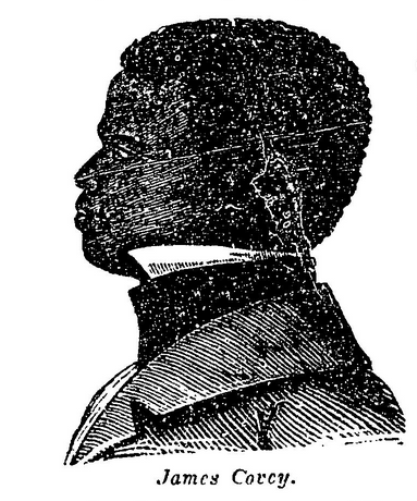
The Amistad story has been told in books and in movies and is familiar to many. One name perhaps not so familiar is that of James Benjamin Covey. James Covey was born Kaweli sometime around 1825, in what is now the the border region between of Sierra Leone, Guinea and Liberia. Kidnapped in 1833 and taken aboard the Segundo Socorro, Kaweli was an illegal slave when the vessel was seized by the Royal Navy.

Kaweli went to school for five years in Bathurst, Sierra Leone, where he took the name of James Benjamin Covey. Joining the Royal Navy, Covey participated in the capture of several illegal slave ships.

Hired on as live interpreter, James Covey was to play a crucial role in the Medians’ trial before the Supreme Court. He would also accompany the 34 on their return to the African continent.

James Covey, aka Kaweli, was going home.

‘They all have Mendi names and their names all mean something… They speak of rivers which I know. They sailed from Lomboko… two or three speak different language from the others, the Timone language… They all agree on where they sailed from. I have no doubt they are Africans.’ – James Benjamin Covey

Gentleman landed in Sierra Leone in January 1842, where some of the Africans helped establish a Christian mission.  Most including Joseph Cinque himself returned to homelands in the African interior. One survivor, a little girl when it all started by the name of Margru, returned to the United States where she studied at Ohio’s integrated Oberlin College, returning to Sierra Leone as the Christian missionary Sara Margru Kinson.

In arguing the case, President Adams took the position that no man, woman or child in the United States could ever be sure of the “blessing of freedom” if the President could hand over free men on the demand of a foreign government.

A century and a half later later President Bill Clinton, Deputy Attorney General Eric Holder and AG Janet Reno orchestrated the kidnap of six-year-old Elián González at gunpoint, returning him to Cuba over the body of the mother who had drowned bringing her boy to freedom.

March 6, 1857 A Simple Man Who Wanted To Be Free

“We are now told, in tones of lofty exultation, that the day is lost all lost and that we might as well give up the struggle. The highest authority has spoken. The voice of the Supreme Court has gone out over the troubled waves of the National Conscience, saying peace, be still . . . The Supreme Court of the United States is not the only power in this world. It is very great, but the Supreme Court of the Almighty is greater”. – Frederick Douglass

Dred Scott.  His given name may have been “Etheldred”.  He was born into slavery in Southampton County, Virginia sometime in the late 1790s, home of Nat Turner’s rebelion, some 70 years before..  In 1818, Scott belonged to Peter Blow, who moved his family and six slaves to Alabama, to attempt a life of farming. The farm near Huntsville was unsuccessful and the Blow family gave up the effort, moving to St. Louis Missouri in 1830 to run a boarding house.

Blow died in 1832 and Dred Scott was sold to Dr. John Emerson, a surgeon serving in the United States Army.

dred__harriet_scott_quarters
Dred & Harriet Scott’s restored quarters, at Ft. Snelling

As an army officer, Dr. Emerson moved about frequently, bringing Scott with him. In 1837, Emerson moved to Fort Snelling in the free territory of Wisconsin, now Minnesota. There, Scott met and married Harriet Robinson, a slave belonging to fellow army doctor and Justice of the Peace, Lawrence Taliaferro.

Taliaferro, who presided over the ceremony, transferred Harriet to Emerson, who continued to regard the couple as his slaves. Emerson moved away later that year, leaving the Scotts behind to be leased by other officers.

The following year, Dr. Emerson married Eliza Irene Sanford, and sent for the Scotts to rejoin him in Fort Jesup, in Louisiana. Harriett gave birth to a daughter while on a steamboat on the Mississippi, between the free state of Illinois and the Iowa district of the Wisconsin Territory.

images (25)Dr. Emerson died in 1842, leaving his estate to his wife Eliza, who continued to lease the Scotts out as hired slaves.
Four years later, Scott attempted to buy his freedom for the sum of $300, equivalent to about $10,000 in 2020. Mrs. Emerson declined the offer and Scott took legal recourse. By this time, Dred and Harriett Scott had two daughters who were approaching an age where their value would be greatly increased, should they be sold as slaves. Wanting to keep his family together, Scott sued.

Ironically, Dred Scott’s suit in state court, Scott v. Emerson, was financially backed by three now-adult Blow children, who had since become abolitionists.

The legal position stood on solid ground, based on the doctrine “Once free, always free”. The Scott family had resided in free states and territories for two years and their eldest daughter was born on the Mississippi River, between a free state and a free territory.

The verdict went against Scott but the judge ordered a retrial, which was held in January, 1850. This time, the jury ruled in favor of Dred Scott’s freedom. Emerson appealed and the Missouri supreme court struck down the lower court ruling, along with 28 years of Missouri precedent.

By 1853, Eliza Emerson had remarried and moved to Massachusetts, transferring ownership of the Scott family to her brother, John Sanford. Scott sued in federal district court, on the legal theory that the federal courts held “diversity jurisdiction”, since Sanford lived in one state (New York), and Scott in another (Missouri). Dred Scott lost once again and appealed to the United States Supreme Court, a clerical misspelling erroneously recording the case as Dred Scott v. Sandford.

On March 6, 1857, Chief Justice Roger B. Taney delivered the 7-2 majority opinion, enunciating one of the stupidest decisions, in the history of American jurisprudence:
“[Americans of African ancestry] had for more than a century before been regarded as beings of an inferior order, and altogether unfit to associate with the white race, either in social or political relations; and so far inferior, that they had no rights which the white man was bound to respect; and that the negro might justly and lawfully be reduced to slavery for his benefit. He was bought and sold, and treated as an ordinary article of merchandise and traffic, whenever a profit could be made by it”.

download (18)
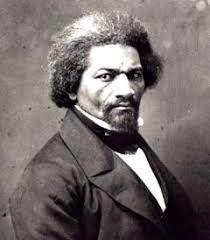
Frederick Douglass

The highest court in the land had ruled that slaves were private property and not citizens, with no right to legal recourse. Furthermore, the United States Congress had erred in attempting to regulate slavery in the territories and had no right to revoke the property rights of a slave owner, based on his place of residence.

Response to the SCOTUS decision was immediate, and vehement. Rather than settle the issue once and for all, the ruling inflamed public opinion, further dividing an already fractured nation. Frederick Douglass assailed Chief Justice Taney’s opinion, noting that:

“We are now told, in tones of lofty exultation, that the day is lost all lost and that we might as well give up the struggle. The highest authority has spoken. The voice of the Supreme Court has gone out over the troubled waves of the National Conscience, saying peace, be still . . . The Supreme Court of the United States is not the only power in this world. It is very great, but the Supreme Court of the Almighty is greater”.

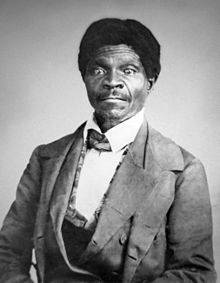
220px-Dred_Scott_photograph_(circa_1857)
Dred Scott, photograph circa 1857

The Supreme Court had spoken, but Dred Scott’s story was far from over.  Eliza Irene Emerson’s new husband was Calvin C. Chaffee, an influential member of the United States Congress.  And an abolitionist.

Following the Dred Scott decision, the Chaffees deeded the Scott family over to Henry Taylor Blow, now a member of the United States House of Representatives from Missouri’s 2nd Congressional district, who manumitted the family on May 26.

Dred Scott had lost at virtually every turn, only to win his freedom at the hands of the family who once held him enslaved.

For Harriett and the two Scott daughters, it was the best of all possible outcomes.  For Scott himself, freedom was short-lived.  Dred Scott died of tuberculosis, the following year.

Slaves Issues Plague the Democratic Party

Nationally, the Dred Scott decision had the affect of hardening enmities already nearing white-hot, increasing animosities within and between pro- and anti-slavery factions in North and South, alike. Politically, the Democratic party was broken into factions and severely weakened while the fledgling Republican party was strengthened, as the nation was inexorably drawn to Civil War.

The issue of Black citizenship was settled in 1868, via Section 1 of the 14th Amendment, which states: “All persons born or naturalized in the United States, and subject to the jurisdiction thereof, are citizens of the United States and of the State wherein they reside …”

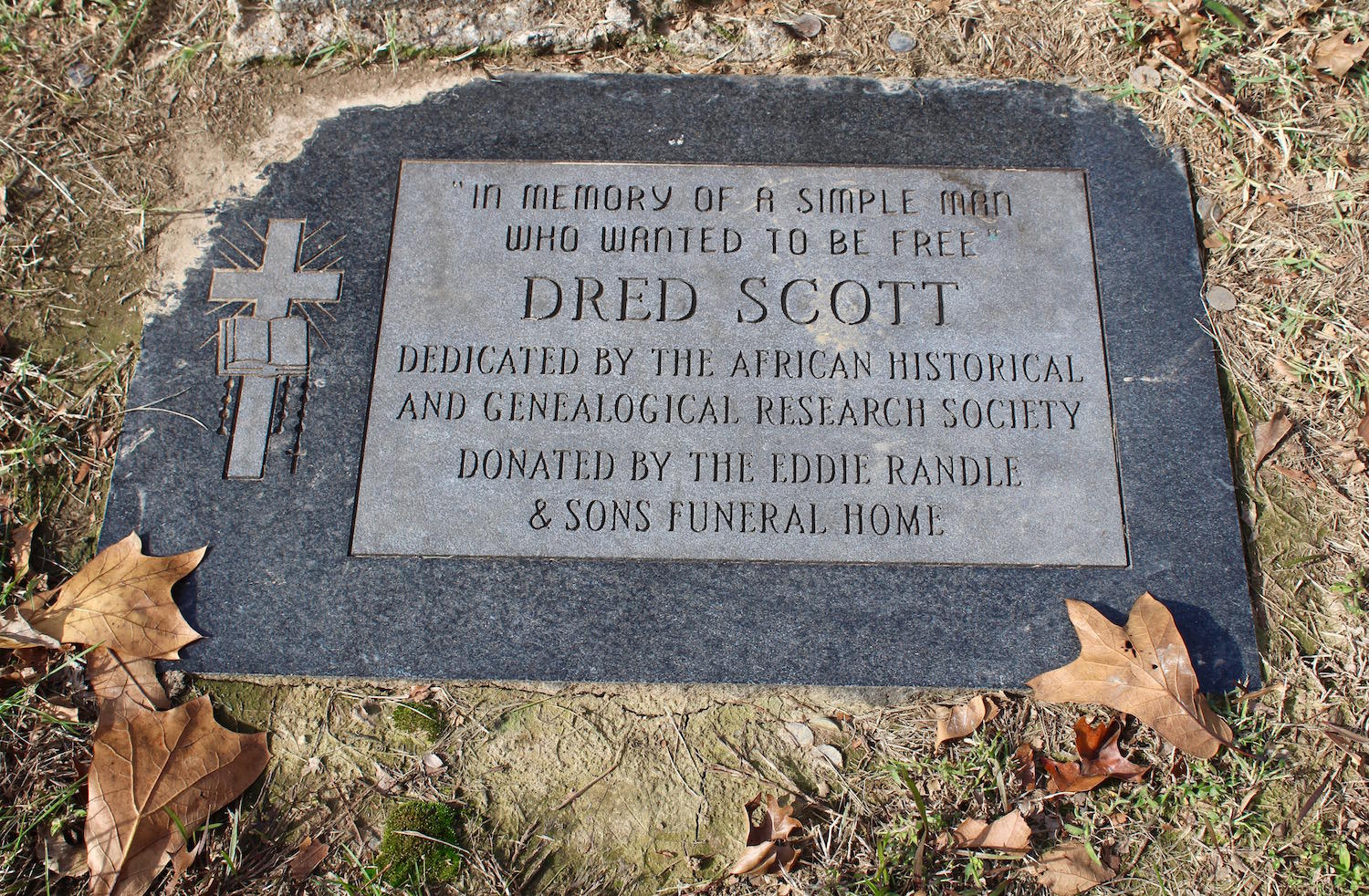
Dred Scott is buried in the Calvary Cemetery in St. Louis, Missouri. The marker next to his headstone reads: “In Memory Of A Simple Man Who Wanted To Be Free.”

dredscottmarker

November 6, 1860 A Peculiar Institution

From the earliest years of the “new world”, every economy from Canada to Argentina was, to varying degrees, involved with slavery.  Spanish and Portuguese settlers brought the first African slaves to the new world in 1501, establishing the new world’s first international slave port in Santo Domingo, modern capital city of the Dominican Republic.

From the earliest years of the “new world”, every economy from Canada to Argentina was, to varying degrees, involved with slavery.  Spanish and Portuguese settlers brought the first African slaves to the new world in 1501, establishing the new world’s first international slave port in Santo Domingo, modern capital city of the Dominican Republic.

Hundreds of thousands of African slaves entered the Americas through the sister ports of Veracruz, Mexico, and Portobelo, Panama, “products” of the “Asiento” system, wherein the contractor (asientista) was awarded a monopoly in the slave trade to Spanish colonies, in exchange for royalties paid to the crown.

The first such contractor was a Genoese company who agreed to supply 1,000 slaves over an 8-year period, beginning in 1517.  A German company entered into such a contract eight years later, with a pledge of 4,000.

Richard Schlecht
Painting by Richard Schlecht, National Geographic

By 1590, as many as 1.1 million Africans had come through the port of Cartagena, Colombia, sorted and surnamed under the “casta de nación” classification system.  To this day, black residents of the Colombian interior bear names like Kulango & Fanti, indicating their origins on the Ivory Coast or Ghana:  Musorongo, Loango & Congo, (Congo Region), or Matamba, Anchico & Ambuila (Angola).

In the American colonies, 17th century racial attitudes appear to have been more fluid than they would later become.  The first black Africans, 19 of them, came to the Virginia Colony in 1619 not as slaves, but as indentured servants. Their passage, involuntary as it was,  was paid for by a term of indenture, a sort of ‘temporary slavery’, usually lasting seven years.

John Punch ran away from his term of indenture in 1640, along with two Europeans. The trio was captured in Maryland and sentenced to extended terms of indenture. Alone among the three, Punch was punished with indenture for life, effectively making him the first ‘slave’ in the American colonies.

Born in Angola in 1600, Anthony Johnson was one of that original 19, captured by an enemy tribe and sold to an Arab slave trader.  Johnson was sold to a Virginia planter at the age of 21, paying off the cost of his passage with a seven-year term of indenture.  As a free man, Johnson himself became a successful planter, going on to “own” indentured servants of his own.

One of them, John Casor, sued for his freedom in 1655, claiming to have completed his indenture of “seaven or Eight years”, plus seven more.  The court ruled that Casor himself was considered “property” and not his contract, making him the first person arbitrarily ruled a slave for life.

Map-of-Slave-Trade

The unthinking view of history holds American slavery to have been a strictly southern-states phenomenon, but it isn’t so.  As late as the eve of the Civil War, “northern” slavery was more widespread than you might expect. The 1860 census reported 236 slaves in New Jersey, 90,368 in Maryland, 2,290 in Delaware, and 3,680 in Washington, DC. There were slaves as far north as New Hampshire as late as 1840. New York wouldn’t legally emancipate its last slave until the following year.

Massachusetts became the first American colony to legalize slavery in 1641, with the passage of the ironically named “Massachusetts Body of Liberties”.  Slavery was legal at one time or another, in all 13 original colonies and even before, when slavery of and by native Americans, was commonplace.

In 1637, the Pequot tribe of southeastern Connecticut was all but wiped out in a bloody war with an alliance of English colonists from the Massachusetts Bay, Plymouth and Saybrook colonies, and their native American allies of the Narragansett, Mohegan, Niantic and Montauk tribes. Surviving Pequots were forced to become slaves in English households, or shipped to Bermuda or the West Indies, and exchanged for Africans.

Indigenous and African slave populations in northern climates were small compared with the more agricultural economies of the south, which were themselves a drop in a bucket compared with the slave economies of central and south America.

An essay from the New York Public Library (nypl.org) gives a sense of scale to the transatlantic slave trade. “As a whole, the transatlantic slave trade displaced an estimated 12.5 million people, with about 10,650,000 surviving the Atlantic crossing. Thus, even though a substantial number of Africans actually reached the United States, they were only a small proportion, about 3.6 percent, of the total number of Africans who were brought to the Americas. More Africans went to Barbados (435,000), while almost three times as many went to Jamaica (1,020,000). The number of Africans arriving in North America was considerably less than those who were taken to Brazil (4,810,000)“.

The Louisiana Purchase of 1803 opened vast new territories. The fight for which would be free and which would permit slavery, would go on for years.

The philosophical underpinnings of southern secession was borne of the Hartford Convention of December 1814 – January 1815.  There, delegates from Massachusetts, Connecticut and Rhode Island, along with “unofficial” delegates from New Hampshire and Vermont, met to discuss New England’s secession over the War of 1812. The convention reported that New England had a “duty” to assert its authority over unconstitutional infringements on its sovereignty, putting forth a legal position very similar to the later nullification position taken by South Carolina.

reynolds-political-map

Protective tariffs were instituted in the wake of the War of 1812, intending to help domestic manufacturers compete with foreign imported goods. Instead, they tended to help northern manufacturing economies, while increasing the cost of manufactured goods to the southern states, and making it more difficult to export cotton.

By this time, cotton was becoming the chief cash crop in most southern economies, and tariffs hit South Carolina particularly hard. Throughout the colonial and early national periods, the Palmetto state climate sustained a strong agricultural economy. South Carolina’s fortunes were hit hard with the panic of 1819, and slow to recover as the gulf states increasingly entered the cotton markets.

The Tariffs of 1828 – ’32 lead to a nullification crisis in South Carolina, where the state told the federal government to pound sand, and mobilized military assets to defend itself against federal enforcement measures sure to follow.

That time the crisis was averted, but a pattern had been established for events to come.

CaningSectional differences grew and sharpened in the years that followed. A member of Congress from Kentucky killed a fellow congressman from Maine.  A Congressman from South Carolina all but beat a Massachusetts Senator to death with a cane, on the floor of the Senate. A fist fight involving at least 30 Congressman broke out on the floor of the US House of Representatives.

Southern states talked about secession as early as 1850. Senator Stephen A Douglas proposed the Kansas-Nebraska Bill, in theory allowing a territory to determine its own free or slave status. This effort to “democratize” the issue led to the brutality of the “Bleeding Kansas” period, where pro-slavery Missouri “Border Ruffians” and anti-slavery Kansas “Jayhawkers” crossed one another’s borders, primarily to murder each others civilians and burn out one another’s towns.

Abraham Lincoln delivered his “House Divided” speech on June 16, 1858, in which he said “A house divided against itself cannot stand”.  A year later, John Brown was holed up at Harper’s Ferry, trying to start a slave insurrection.

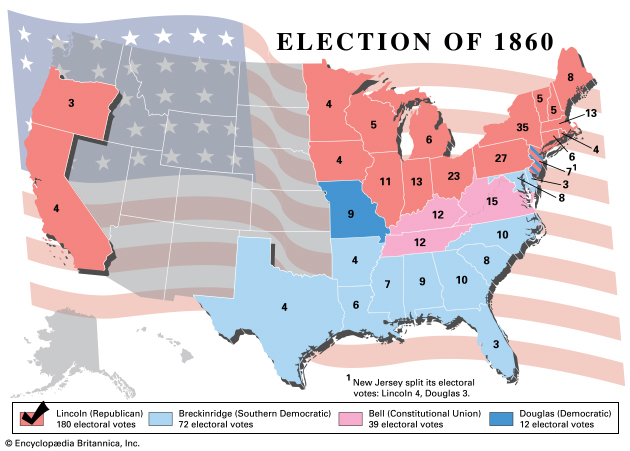
After 57 ballots, the Democrat’s convention of 1859 adjourned without selecting a candidate for the Presidential election. Northern Democrats nominated Stephen A Douglas, while southern Democrats nominated John Breckenridge.

Republican Abraham Lincoln was elected 16th President of the United States on November 6, 1860, on a platform confusingly specifying “That all men are created equal”, an “abhorrence of all schemes of disunion”, and “The maintenance inviolate of the rights of the states, and especially the right of each state to order and control its own domestic institutions according to its own judgment exclusively”.

One year later, to the day, former United States Senator and Secretary of War Jefferson Davis was elected to a six-year term as the first President of the Confederate States of America.


May 21, 1856 Bleeding Kansas

The first half of the 19th century was one of westward expansion in the United States, generating frequent and sharp conflicts between pro and anti-slavery factions.

Lines of conflict had existed since the time of the Revolution, between those supporting federal government leadership of the young nation, and those in favor of greater self-determination by the states. In the South, climate conditions led to dependence on agriculture, the rural economy of the southern states producing cotton, rice, sugar, indigo and tobacco. Colder states to the north tended to develop manufacturing economies, urban centers growing up in service to hubs of transportation and the production of manufactured goods.

In the first half of the 19th century, 90% of federal government revenue came from tariffs on foreign manufactured goods. Most of this revenue was collected in the South, with the region’s greater dependence on imported goods.  Much of this federal largesse was spent in the North, with the construction of railroads, canals and other infrastructure.domestic-tariffs-at-the-souths-expense

This debate over economic issues and rights of self-determination, so-called ‘state’s rights’, grew and sharpened in 1828 with the threatened secession of South Carolina, and the “nullification crisis” of 1832-33, when South Carolina declared such tariffs unconstitutional, and therefore null and void within the state. The Encyclopedia Britannica entry in the subject includes a Cartoon from the time depicting “Northern domestic manufacturers getting fat at the expense of impoverishing the South under protective tariffs.”

Chattel slavery existed from the earliest days of the colonial era, from Canada to Mexico, and around the world. Moral objections to what was really a repugnant practice could be found throughout, but economic forces had as much to do with ending the practice, as any other. The “peculiar institution” died out first in the colder regions of the US and may have done so in warmer climes as well, but for Eli Whitney’s invention of a cotton engine (‘gin’) in 1792.

It takes ten man-hours to remove the seeds to produce a single pound of cotton. By comparison, a cotton gin can process about a thousand pounds a day, at comparatively little expense.Cotton-gin

The year of Whitney’s invention, the South exported 138,000 pounds a year to Europe and the northern colonies. Sixty years later, Britain alone was importing 600 million pounds a year, from the American south. Cotton was King, and with good reason.  The stuff is easily grown, is more easily transportable, and can be stored indefinitely, compared with food crops.  The southern economy turned overwhelmingly to this one crop, and its need for plentiful, cheap labor. The issue of slavery had joined and become so intertwined with ideas of self-determination, as to be indistinguishable.

The first half of the 19th century was one of westward expansion in the United States, generating frequent and sharp conflicts between pro and anti-slavery factions. The Missouri compromise of 1820 was the first attempt to reconcile these factions, defining which territories would be slave states, and which would be “free”.

The short-lived “Wilmot Proviso” of 1846 sought to ban slavery in new territories, after which the Compromise of 1850 attempted to strike a balance.  The Kansas Nebraska Act of 1854 created the territories of Kansas and Nebraska, basically repealing the Missouri Compromise and allowing settlers to determine their own way through popular sovereignty.

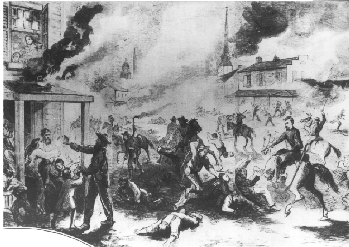
This attempt to democratize the issue instead had the effect of drawing up battle lines.  Pro-slavery forces established a territorial capital in Lecompton, while “antis” set up an alternative government in Topeka. BleedingKansasFight

In Washington, Republicans backed the anti-slavery forces, while Democrats generally supported their opponents.  The standoff resulting was soon to escalate to violence. Upwards of a hundred or more would be killed between 1854 – 1861, in a period known as “Bleeding Kansas”.

The town of Lawrence, Kansas was established by anti-slavery settlers in 1854, and soon became the focal point of pro-slavery violence. Emotions were at the boiling point when Douglas County Sheriff Samuel Jones was shot trying to arrest free-state settlers on April 23, 1856. Jones was driven out of town but he would return.

On this day in 1856, a posse of 800 pro-slavery forces closed around the town, led by Sheriff Jones. Cannon was positioned to cover the town, and detachments of troops were posted to prevent escape. They commandeered the home of the first governor of Kansas, Charles L. Robinson, and used it as their headquarters.kansas

The town’s two printing offices were sacked, the presses destroyed, and the type thrown into the river. The posse next set about to destroy the Free State Hotel, which they believed had been built to serve more as a fort than a hotel.

They may have been right, because it took the entire day with cannon shot, kegs of gunpowder and incendiary devices, before the hotel was finally reduced to a roofless, smoldering ruin.

There was looting and a few robberies as the men left town, burning Robinson’s home on the way out. There was only one fatality; a slavery proponent who was killed by falling masonry.

john-brownIn the next few days, a group of unarmed men will be hacked to pieces by anti-slavery radicals. Four months of partisan violence and depredation ensued. Small armies formed up across eastern Kansas, clashing at Black Jack, Franklin, Fort Saunders, Hickory Point, Slough Creek, and Osawatomie

A United States Senator will be beaten nearly to death on the floor of the Senate, by a member of the House of Representatives. The 80-year-old nation would forge inexorably onward, to the Civil War that would kill more Americans than every war from the American Revolution to the War on Terror, combined.