October 27, 1962 Archipov

Anyone alive on or after this day in 1962, probably owes their life to one man. I wonder how many remember his name.

Come join me for a moment, in a thought experiment.  A theater of the mind.

Imagine. Two nuclear superpowers, diametrically opposed, armed to the teeth and each deeply distrustful of the other. We’re talking here, about October 1962. The Cuban Missile Crisis. Now imagine at the height of the standoff, a misunderstanding leads some fool to push the button. The nuclear first strike is met with counterattack and response in a series of ever-escalating retaliatory launches.

You’ve seen enough of human nature. Counterattacks are all but inevitable, right? Like some nightmare shootout at the OK corral, only this one is fought with kiloton-sized weapons. Cities the world over evaporate in fireballs. Survivors are left to deal with a shattered, toxic countryside and nuclear winter, without end.

Are we talking about an extinction event? Possibly. Terrible as it is, it’s not so hard to imagine, is it?

In 1947, members of the Science and Security Board of the Bulletin of Atomic Scientists envisioned a “Doomsday Clock”. A symbolic clock face, dramatizing the threat of global nuclear catastrophe.  Initially set at seven minutes to midnight, the “time” has varied from seventeen minutes to two.

The Cuban Missile Crisis of October 1962 didn’t make it onto the doomsday clock. Those 13 days went by far too quickly to be properly assessed. And yet, the events of 62 years ago brought us closer to extinction than at any time before or since.

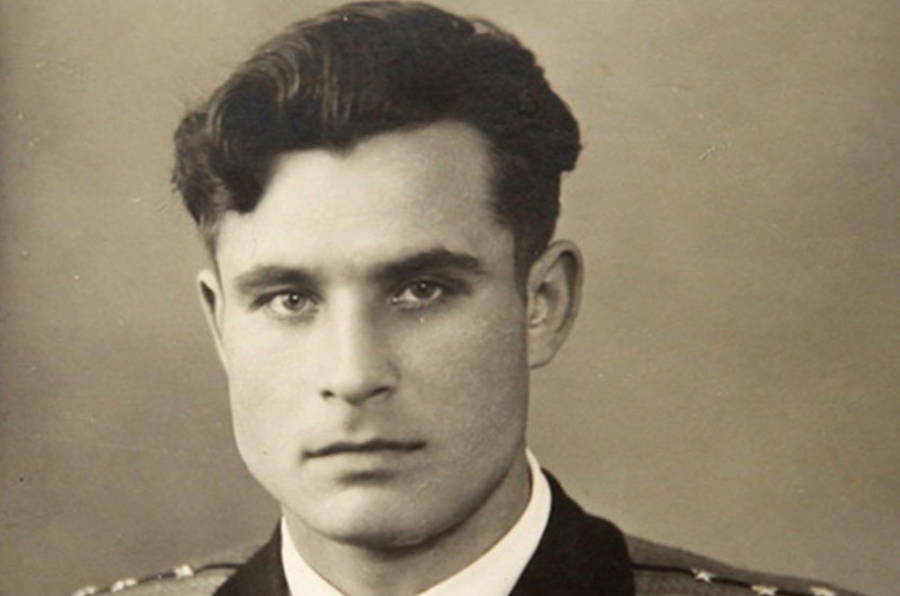
On this day in 1962, an unsuspecting world stood seconds away from the abyss. The fact that we’re here to talk about it came down to one man, Vasili Arkhipov. Many among us have never heard his name. Chances are very good that we can thank him for our lives.

As WW2 gave way to the nuclear age, Cold War military planners adopted a policy of “Deterrence”. “Mutually Assured Destruction” (MAD). Soviet nuclear facilities proliferated across the “Eastern Bloc”, while US nuclear weapons dispersed across the NATO alliance. By 1961 some 500 US nuclear warheads were installed in Europe, from West Germany to Turkey, Italy to Great Britain.

Judging President Kennedy weak and ineffective, communist leaders made their move in 1962, signing a secret arms agreement in July. Medium-range ballistic missiles with a range of 2,000 miles were headed to the Caribbean basin.

By mid- October, US reconnaissance aircraft revealed Soviet ballistic nuclear missile sites under construction Cuba. 90 miles from American shores. President John F. Kennedy warned of the “gravest consequences”, ordering a blockade of the island nation. Relations turned to ice as Soviet military vessels joined the standoff.

Tensions dialed up to 11 on October 27, when USAF Major Rudolph Anderson’s U-2 reconnaissance aircraft was shot down over the village of Veguitas. His body still stapped into his ejection seat.

Wreckage of Major Rudolf Anderson Jr.’s U2 at the Museo del Aire, Havana, Cuba H/T theaviationgeekclub.com

The US Navy practiced a submarine attack protocol at that time, called “hunt to exhaustion”. Anatoly Andreev described what it was like to be on the receiving end:

“For the last four days, they didn’t even let us come up to the periscope depth … My head is bursting from the stuffy air. … Today three sailors fainted from overheating again … The regeneration of air works poorly, the carbon dioxide content [is] rising, and the electric power reserves are dropping. Those who are free from their shifts, are sitting immobile, staring at one spot. … Temperature in the sections is above 50 [122ºF].”

I’m not sure I could think straight under conditions like that.

On the 27th, US Navy destroyers began to drop depth charges. This was not a lethal attack, intending only to bring the sub to the surface. Deep under the water, captain and crew had no way of knowing that. B-59 had not been in contact with Moscow for several days. Now depth charges were exploding to the left and right. Captain Valentin Savitsky made his decision. Convinced that war had begun, the time had come for the “special weapon”. “We’re gonna blast them now!,” he reportedly said. “We will die, but we will sink them all – we will not become the shame of the fleet.” Political officer Ivan Maslennikov concurred. Send it.

On most nuclear-armed Soviet submarines, two signatures were all that was needed. With Chief of (submarine fleet) Staff officer Vasili Archipov on board, the decision required approval by all three senior officers. To Archipov, this didn’t feel like a “real” attack. What if they’re only trying to get us to the surface?

Archipov said no.
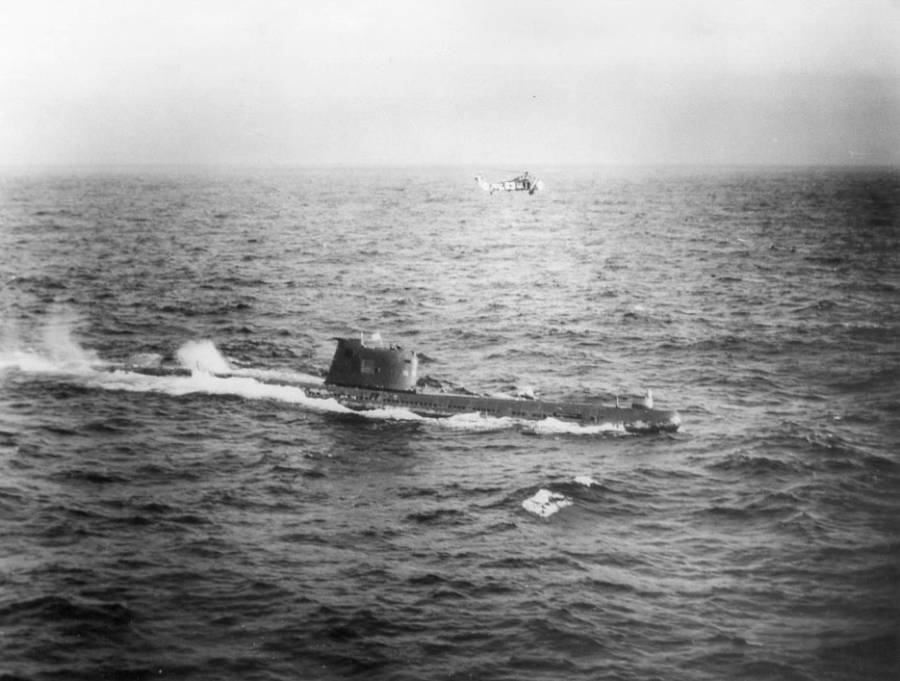
Perhaps it was his role in averting disaster aboard the nuclear-powered submarine K-19, the year before. Maybe it was his calm, unflappable demeanor when Captain Savitsky had clearly “lost his temper”. Somehow, Archipov was able to keep his head together under unimaginable circumstances and convince the other two. B-59 came to the surface to learn that, no. World War III had not begun after all.

The submarine went quietly on its way. Kruschev announced the withdrawal of Soviet missiles the following day. The Cuban Missile Crisis was over.
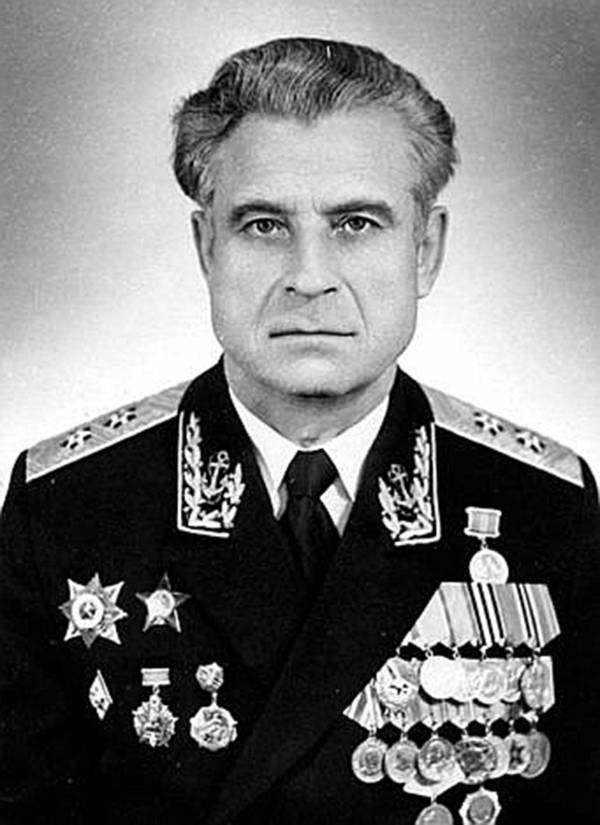
Vasily Aleksandrovich Arkhipov

These events wouldn’t come to light for another 40 years.

B-59 crewmembers were criticized on returning to the Soviet Union. One admiral told them “It would have been better if you’d gone down with your ship.”

Vasily Aleksandrovich Arkhipov retired from the submarine service in 1988 and died, ten years later. Cause of death was kidney cancer, likely the result of radiation exposure sustained during the K-19 incident, back in 1961.

Lieutenant Vadim Orlov was an intelligence officer back in 1962, onboard the B-59. In 2002, then Commander Orlov (retired) gave Archipov full credit for averting nuclear war. Former U.S. Defense Secretary Robert McNamara said in 2002 “We came very, very close, closer than we knew at the time.” Historian Arthur Schlesinger Jr. was an advisor to President Kennedy. “This was not only the most dangerous moment of the Cold War”, he said. “It was the most dangerous moment in human history.”

December 2, 1859 John Brown

To some, the man was a hero.  To others he was a kook. The devil incarnate.


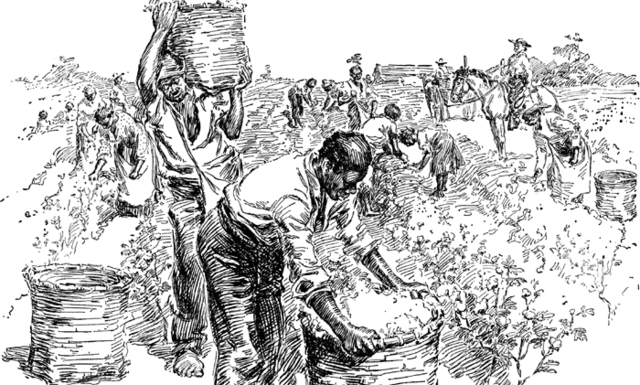
Following the war for independence, American politics split between those supporting a strong federal government and those favoring greater self-determination for the states. In the South, climate conditions led to dependence on agriculture, the rural economy of the southern states producing cotton, rice, sugar, indigo and tobacco. Colder states to the north tended to develop manufacturing economies, urban centers growing up in service to hubs of transportation and the production of manufactured goods.

During the first half of the 19th century, 90% of federal government revenue came from tariffs on foreign manufactured goods. Most of this revenue was collected in the South, with the region’s greater dependence on imported goods.  Much of federal spending was directed toward the North, toward the construction of roads, canals and other infrastructure.

The debate over economic issues and rights of self-determination, so-called ‘state’s rights’, grew and sharpened in 1828 with the threatened secession of South Carolina and the “nullification crisis” of 1832-33. South Carolina declared such tariffs unconstitutional and therefore null and void within the state. A Cartoon from the era says it all – Northern domestic manufacturers getting fat at the expense of impoverishing the South under protective tariffs.

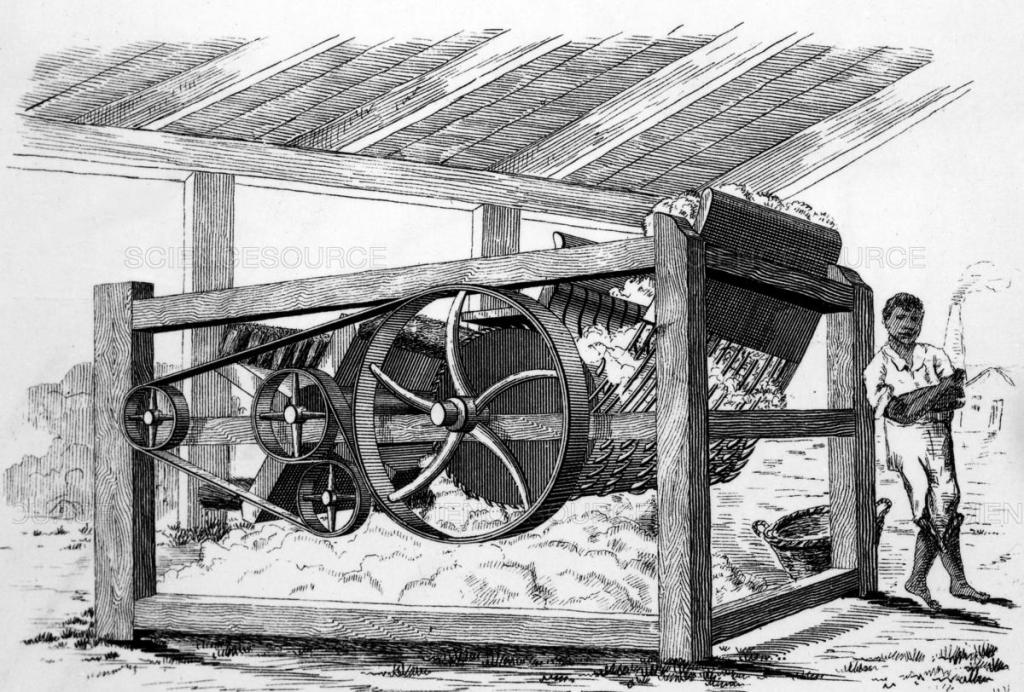
Chattel slavery came to the Americas well before the colonial era, from Canada to Mexico to Brazil and around the world. Moral objections to what was clearly a repugnant practice could be found throughout, but economic forces had as much to do with ending the practice as any other. The “peculiar institution” died out first in the colder regions of the US and may have done so in warmer climes as well, but for Eli Whitney’s invention of a cotton engine (‘gin’) in 1792.

Removing cotton seeds by hand requires ten man-hours to remove the seeds from a single pound of cotton. By comparison, a cotton gin can process about a thousand pounds a day at comparatively little expense.

The year of Whitney’s invention, the South exported 138,000 pounds a year to Europe and the northern colonies. Sixty years later, Britain alone was importing 600 million pounds a year of the stuff, from the American south. Cotton was King, and with good reason.  The crop is easily grown, is more easily transportable and can be stored indefinitely, compared with food crops.  The southern economy turned overwhelmingly to this one crop and with it, the need for cheap, plentiful labor.

By then the issue of slavery was so joined and intertwined with ideas of self-determination, as to be indistinguishable.

The Cotton Gin

The short-lived “Wilmot Proviso” of 1846 sought to ban slavery in new territories, after which the Compromise of 1850 attempted to strike a balance.  The Kansas Nebraska Act of 1854 created the territories of Kansas and Nebraska, basically repealing the Missouri Compromise and allowing settlers to determine their own way through popular sovereignty.

John_Brown
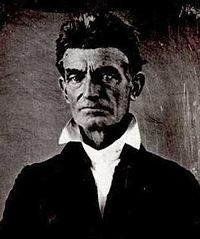
John Brown

This attempt to democratize the issue instead had the effect of drawing up battle lines.  Pro-slavery forces established a territorial capital in Lecompton, while “antis” set up an alternative government in Topeka.

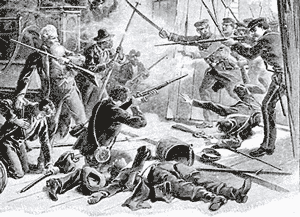
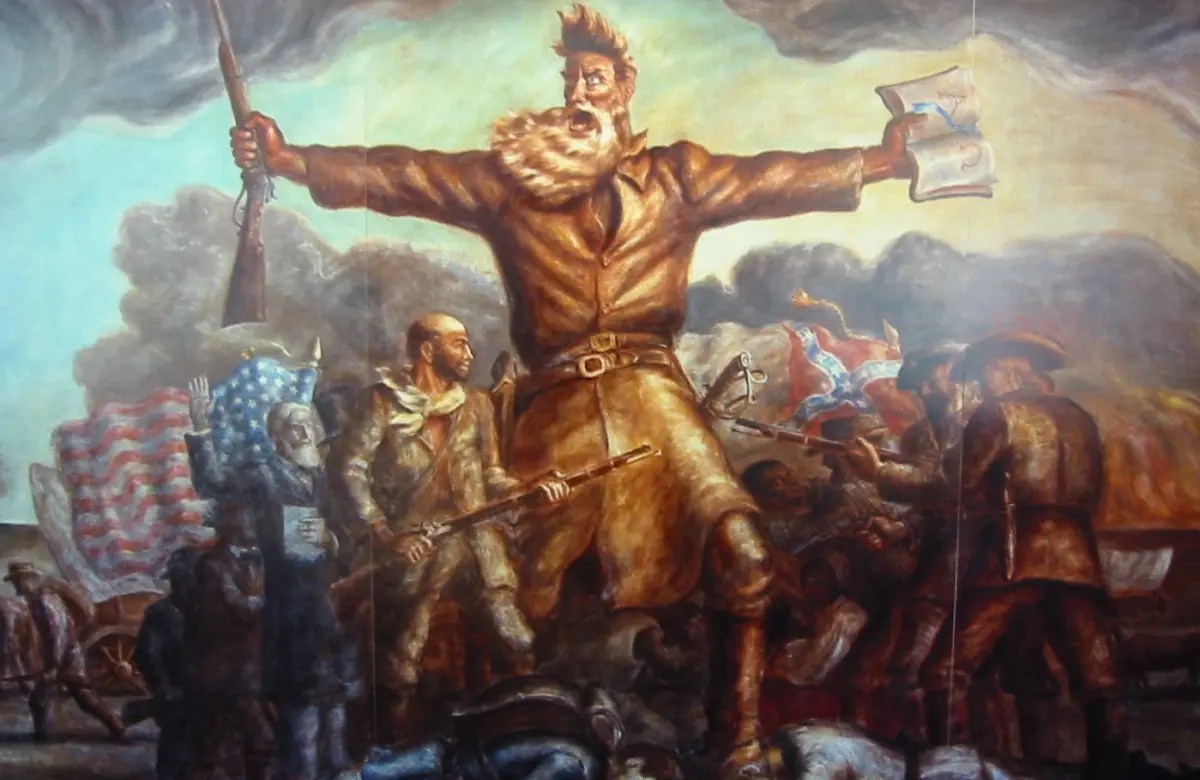
John Brown Sr. came to the Kansas Territory as a result of violence, sparked by the expansion of slavery into the Kansas-Nebraska territories between 1854 and 1861, a period known as “Bleeding Kansas”.  To some, the man was a hero.  To others he was a kook. The devil incarnate.  A radical abolitionist and unwavering opponent of the “peculiar institution” of slavery, John Brown believed that armed confrontation was the only way to bring it to an end.

BleedingKansasFight

In Washington DC, a United states Senator was beaten nearly to death on the floor of the Senate, by a member of the House of Representatives. The following day Brown and four of his sons: Frederick, Owen, Salmon, and Oliver, along with Thomas Weiner and James Townsley, set out on a “secret expedition”.

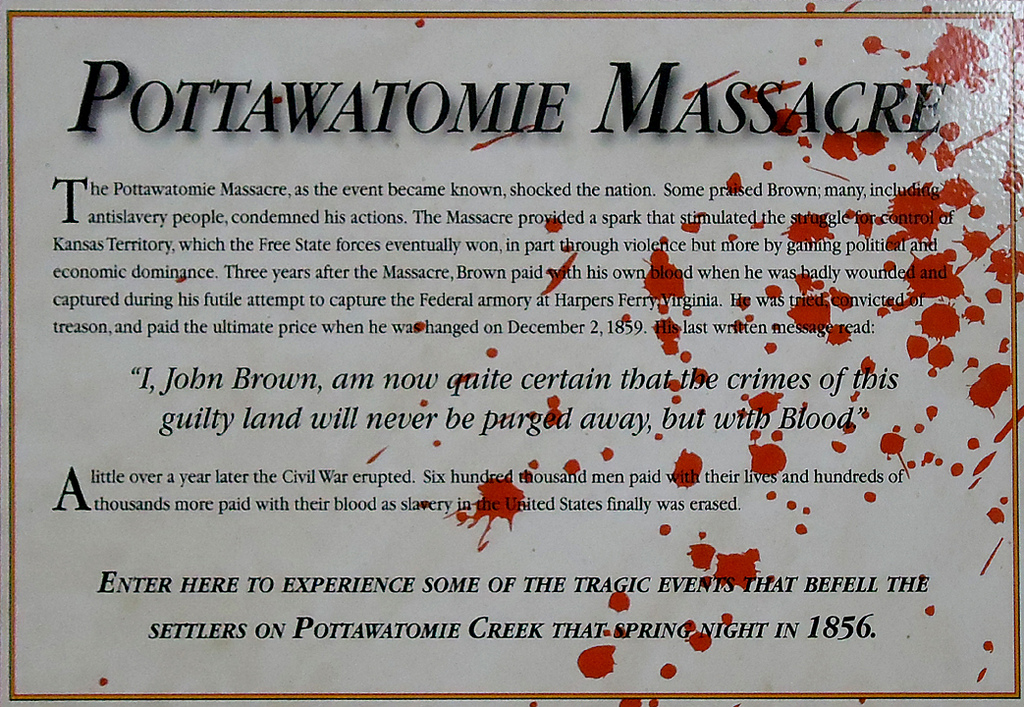
The group camped between two deep ravines off the road that night, remaining in hiding until sometime after dark on the 24th. Late that night, they stopped at the house of James P. Doyle, ordering him and his two adult sons, William and Drury, to go with them as prisoners. Doyle’s wife pleaded for the life of her 16 year old son John, whom the Brown party left behind. The other three, all former slave catchers, were led into the darkness.  Owen Brown and one of his brothers murdered the brothers with broadswords. John Brown, Sr. fired the coup de grace into James Doyle’s head to ensure that he was dead.

The group went on to the house of Allen Wilkinson, where he too was brought out into the darkness and murdered with broadswords. Sometime after midnight, the group forced their way into the cabin of James Harris. His two house guests were spared after interrogation, but Wilkinson was led to the banks of Pottawatomie Creek where he too was slaughtered.

There had been 8 killings to date in the Kansas Territory; Brown and his party had just murdered five in a single night. The massacre lit a powder keg of violence in the days that followed.  Twenty-nine people died on both sides in the next three months alone.

Harper's Ferry

Brown would go on to participate in the Battle of Black Jack and the Battle of Osawatomie in the Kansas Territory.  Brown lead a group to the armory in Harper’s Ferry Virginia in a hare brained scheme to capture the weapons contained there and trigger a slave revolt. The raid was ended by a US Army force under Colonel Robert E. Lee, and a young Army lieutenant named James Ewell Brown (JEB) Stuart.

Brown supporters blamed the 1856 massacre on everything from defending the honor of the Brown family women, to self defense, to a response to threats of violence from pro slavery forces. Free Stater and future Kansas Governor Charles Robinson may have had the last word when he said, “Had all men been killed in Kansas who indulged in such threats, there would have been none left to bury the dead.”

John Brown was hanged on December 2, 1859.

The 80-year-old nation forged inexorably onward, toward a Civil War that would kill more Americans than every conflict from the American Revolution to the War on Terror, combined.