
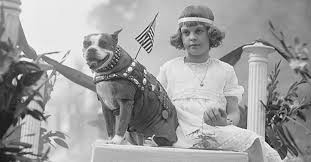
By the last year of WW1, the French, British and Belgians had at least 20,000 dogs on the battlefield, the Germans 30,000. General Headquarters of the American Expeditionary Forces recommended the use of dogs as sentries, messengers and draft animals in the spring of 1918. However, with the exception of a few sled dogs in Alaska, the US was the only country to take part in World War I with virtually no service dogs in its military.
 America’s first war dog, “Stubby”, got there by accident, and served 18 months ‘over there’, participating in seventeen battles on the Western Front.
Stubby looked like a terrier of some kind, similar to a pit bull. Nobody knows anything more about him. He showed up a stray one day, at Yale Field in New Haven Connecticut, where a group of soldiers were training. The dog hung around as the men drilled. One soldier, Corporal Robert Conroy, began to take care of him. when Conroy’s outfit shipped out in 1917, Stubby was hidden on board.
Stubby saved his regiment from surprise mustard gas attacks, located and comforted the wounded, and even once caught a German spy by the seat of his pants. The Hun, who’d been sneaking around behind allied lines at the time, was mapping trenches for artillery bombardment. The Bosch was found spinning in circles with a large, muscular terrier affixed to his behind. He was easily disarmed, but it took a considerable amount of coaxing before Stubby could be persuaded to let go of that German’s rear end.
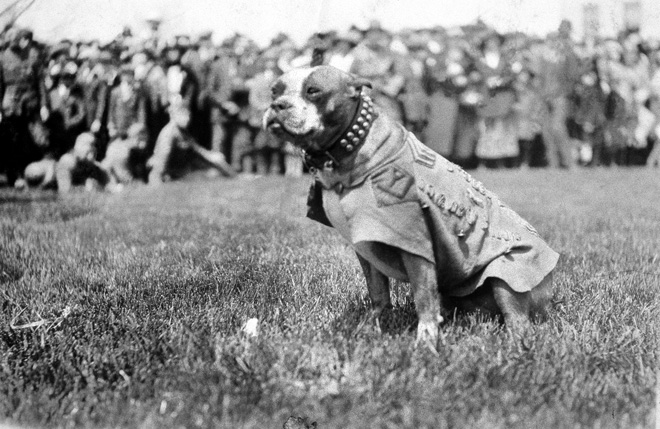 Stubby saw his first action at Chemin des Dames. Since the boom of artillery fire didn’t faze him, he learned to follow the example of ducking when the big ones came close. It became a great game to see who could hit the dugout, first. After a few days, the guys were watching him for a signal. Stubby was always the first to hear incoming fire. We can only guess how many lives were spared by his early warning.
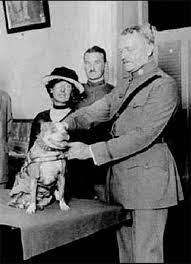 After the Armistice, Stubby returned home a nationally acclaimed hero, eventually received by both Presidents Harding and Coolidge. Even General John “Black Jack” Pershing, who commanded the AEF during the war, presented Stubby with a gold medal made by the Humane Society, declaring him to be a “hero of the highest caliber.”
Stubby toured the country by invitation and probably led more parades than any dog in American history: he was promoted to honorary Sergeant by the Legion, becoming the highest ranking dog to ever serve in the Army.
Old age finally caught up with the small warrior on April 4th, 1926, as he took ill and died in his master’s arms.
Sergeant Stubby and a few of his contemporaries were instrumental in inspiring the creation of the US K-9 Corps, just in time for World War ll.


 On March 1, 2011, L/Cpl Tasker was killed by a Taliban sniper while on patrol in Helmand Province, and brought back to base by his fellow soldiers. Theo suffered a seizure after returning to base and never recovered. He died that afternoon. It was believed that Theo’s seizure was brought on by the stresses of Tasker’s death, but the autopsy proved inconclusive. Liam’s mother Jane Duffy later said, “I think Theo died of a broken heart, nobody will convince me any different.”
 On a more upbeat note, and this story needs one, our daughter Carolyn and son-in-law Nate transferred to Savannah in 2013, where Nate deployed to the Wardak province of Afghanistan as a TEDD handler and paired with “MWD Zino”, a four-year-old German Shepherd trained to detect up to 64 explosive compounds.

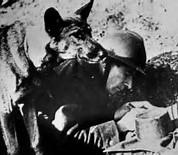 During the landing phase, private Rowell and Chips were pinned down by an Italian machine gun team. The dog broke free from his handler, running across the beach and jumping into the pillbox. Chips attacked the four Italians manning the machine gun, single-handedly forcing their surrender to American troops. The dog sustained a scalp wound and powder burns in the process, demonstrating that they had tried to shoot him during the brawl. In the end, the score was Chips 4, Italians Zero. He helped to capture ten more later that same day.
 Historical Easter Eggs - Today in History
You must be logged in to post a comment.