December 17, 1900 The Search for Extraterrestrial Intelligence

On December 17, 1900, the French Academy of Science offered a prize of 100,000 francs to the first person to make contact with an alien civilization, provided that it was anything but Martian. That was considered too easy

In the 5th century BC, the Greek philosopher Democritus taught that the world was made of atoms.  Physically indestructible and always in motion, these atoms are infinite in number, differing only in shape and size.  Democritus taught that everything around us is the result of physical laws without reasoning or purpose.  He asked only “what earlier circumstances caused this event?” Philosophers like Aristotle and Socrates took a less mechanistic approach, asking “What purpose did this event serve?”, while Plato disliked him so much he wanted to burn all his books.

Democritus also taught that there are an infinite number of worlds with inhabitants like us, though the prevailing view in antiquity was that the Earth was special, that we are alone.

In the time of Copernicus in the 1600s, it became widely believed that there is life on other planets.  Astronomers saw several features of the moon as evidence, if not of life, then at least that intelligence had at one time paid a visit.

Interest in Mars began to develop in the 1870s, when the Italian astronomer Giovanni Virginio Schiaparelli described physical features of the red planet as “canali”.  The word means “channels” in Italian, but it was mis-translated as “canals”.  The English speaking world was off to the races.extraterrestrial-life

Speculation and folklore about intelligent life on Mars was soon replaced by the popular concept that canals had been excavated by intelligent Martians.

The idea was near universal by the turn of the century.  On this day, December 17, 1900, the French Academy of Science offered a prize of 100,000 francs to the first person to make contact with an alien civilization, provided that it was anything but Martian.  That was considered too easy.
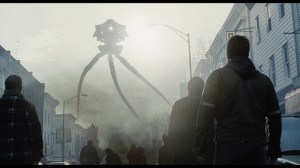
war-of-the-worlds-alien-tripod-attackingThe British author H. G. Wells wrote The War of the Worlds in 1897, telling the story of an alien invasion of earth by Martians fleeing from the desiccation of their planet.  The story was adapted to a radio drama broadcast on Halloween, 1938, so realistic that many listeners sued the network for “mental anguish” and “personal injury”.

The idea of life on Mars persisted until the 1960s, when close observations of the Martian surface were made possible by the Mariner series of spacecraft.

While much of “mainstream” science seems to steer clear of the subject, the University ofis-anybody-out-there California at Berkeley is running a “distributed computing effort” to identify extraterrestrial life, called SETI@home.   With an original objective of 50,000-100,000 home computers, SETI@home currently operates on over 5.2 million computers.  With the introduction of the Berkeley Open Infrastructure for Network Computing, or “BOINC” (I didn’t make that up), SETI@home users can even compete with one another, to see who can process the maximum number of “work units”.

http://www.dreamstime.com/stock-photography-alien-portrait-stars-image14135012The website explains their mission:  “SETI@home is a scientific experiment that uses Internet-connected computers in the Search for Extraterrestrial Intelligence (SETI). You can participate by running a free program that downloads and analyzes radio telescope data”.

You, too can participate at http://setiathome.berkeley.edu/, on your Windows, Apple or Network PC, or your Sony PlayStation 3.  Please feel free to insert the “there-is-no-intelligent-life-here” joke of your choice HERE.

December 16, 1773 Boston Tea Party

The Tea Act actually reduced the price of tea, but Colonists saw it as an effort to buy popular support for taxes already in force

In the time of Henry VIII, British military outlays as a percentage of central government expenses averaged 29.4%.   That number skyrocketed to 74.6% in the 18th century, and never dropped below 55%.

The Seven Years’ War alone, fought on a global scale from 1756 – ‘63, saw England borrow the unprecedented sum of £58 million, doubling the national debt and straining the British economy.

For the American colonies, the conflict took the form of the French and Indian War.  The British government saw its American colonies as the beneficiary of much of their expense, and wanted to be reimbursed.  For the colonists, the never-ending succession of English wars meant that they were largely left alone to run their own affairs.

Several measures were taken to collect revenues, as colonists bristled at the heavy handed taxation policies of the 1760s.. The Sugar Act, the Currency Act:  in one 12-month period, Parliament passed the Stamp Act, Quartering Act, and the Declaratory Act, and deputized Royal Navy Sea Officers to enforce customs laws in colonial ports.

The merchants and traders of Boston specifically cited “the late war” and the expenses related to it, concluding the Boston Non-Importation Agreement of August 1, 1768. The agreement prohibited the importation of a long list of goods, ending with the statement ”That we will not, from and after the 1st of January 1769, import into this province any tea, paper, glass, or painters colours, until the act imposing duties on those articles shall be repealed”.

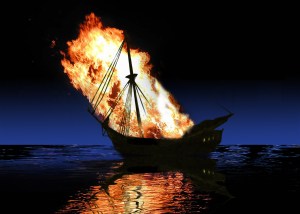
The ‘Boston Massacre’ of 1770 was a direct result of the tensions between colonists andgaspee-shippey the “Regulars” sent to enforce the will of the Crown.  Two years later, Sons of Liberty looted and burned the HMS Gaspee in Narragansett Bay, RI.
The Tea Act, passed by Parliament on May 10, 1773, was less a revenue measure than it was an effort to prop up the British East India Company, by that time burdened with debt and holding eighteen million pounds of unsold tea.  The measure actually reduced the price of tea, but Colonists saw it as an effort to buy popular support for taxes already in force, and refused the cargo.  In Philadelphia and New York, tea ships were turned away and sent back to Britain while in Charleston, the cargo was left to rot on the docks.

British law required a tea ship to offload and pay customs duty within 20 days, or the cargo was forfeit.  The Dartmouth arrived in Boston at the end of November with a cargo of tea, followed by the tea ships Eleanor and Beaver.  Sam Adams called for a meeting at Faneuil Hall on the 29th, which then moved to Old South Meeting House to accommodate the crowd.  25 men were assigned to watch Dartmouth, making sure it didn’t unload.

7,000 gathered at Old South Meeting House on December 16th, 1773, the last day of Dartmouth’s deadline.  Royal Governor Hutchinson held his ground, refusing Dartmouth permission to leave.  Adams announced that “This meeting can do nothing further to save the country.”

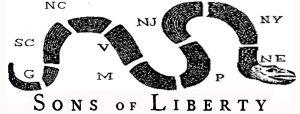
sons-of-libertyThat night, somewhere between 30 and 130 Sons of Liberty, some dressed as Mohawk Indians, boarded the three ships in Boston Harbor.  There they threw 342 chests of tea, 90,000 pounds in all, into Boston Harbor.  £9,000 worth of tea was destroyed, worth about $1.5 million in today’s dollars.

In the following months, other protesters staged their own “Tea Parties”, destroying imported British tea in New York, Philadelphia, Charleston, and Greenwich, NJ.  There was even a second Boston Tea Party on March 7, 1774, when 60 Sons of Liberty, again dressed as Mohawks, boarded the “Fortune”.  This time they dumped 3,000lbs of the stuff into the harbor.  That October in Annapolis Maryland, the Peggy Stewart was burned to the water line.

For decades to come, the December 16 incident in Boston Harbor was blithely referred to as “the destruction of the tea.” The earliest newspaper reference to “tea party” wouldn’t come to us until 1826.

John Crane of Braintree is one of the few original tea partiers ever identified, and the only man injured in the event. An original member of the Massachusetts Society of the Cincinnati and early member of the Sons of Liberty, Crane was struck on the head by a tea crate and thought to be dead.  His body was carried away and hidden under a pile of shavings at a Boston cabinet maker’s shop.  It must have been a sight when John Crane “rose from the dead”, the following morning.

Great Britain responded with the “Intolerable Acts” of 1774, including the occupation of intolerable-actsBoston by British troops.    Minutemen clashed with “Lobster backs” a few months later, on April 19, 1775.  No one alive today knows who fired the first shot at Lexington Green. History would record it as “The shot heard ’round the world”.
December 15, 1256 Stronghold of the Assassins

Possessed of all the physical prowess of youth, the individual assassin was also intelligent and well-read, highly trained in combat tactics, the art of disguise and the skills of the expert horseman

For the Islamic world, the 11th century was a time of political instability. The Fatimid Caliphate, established in 909 and by this time headquartered in Cairo, was in sharp decline by 1090.  The Fatimids were destined to disappear within the next 100 years, eclipsed by the Abbasid Caliphate of An-Nasir Salah ad-Din Yusuf ibn Ayyub, better known to anyone familiar with the story of Richard the Lionheart, as Saladin.

To the east lay the Great Seljuk Empire, the Turko-Persian, Sunni Muslim state established in 1037 and stretching from the former Sassanid domains of modern-day Iran and Iraq, to the Hindu Kush.  An “appanage” or “family federation” state, the Seljuk empire was itself in flux after a series of succession contests, and destined to disappear in 1194.

Into the gap stepped the “Old Man of the Mountain”, Hassan-i Sabbah, and his fanatically loyal, secret sect of “Nizari Ismaili” followers, the Assassins.

The name derives from the Arabic “Hashashin”, meaning “those faithful to the foundation”.  Marco Polo reported a story that the old man of the mountain got such fervent loyalty from his young followers, by drugging and leading them to a “paradise” of earthly delights, to which only he could return them.  The story is probably apocryphal, there is little evidence that hashish was ever used by the Assassins’ sect.  Sabbah’s followers believed him to be divine, personally selected by Allah.  The man didn’t need to drug his “Fida’i” (self-sacrificing agents), he was infallible.  His every whim would be obeyed, as the literal Word of God.

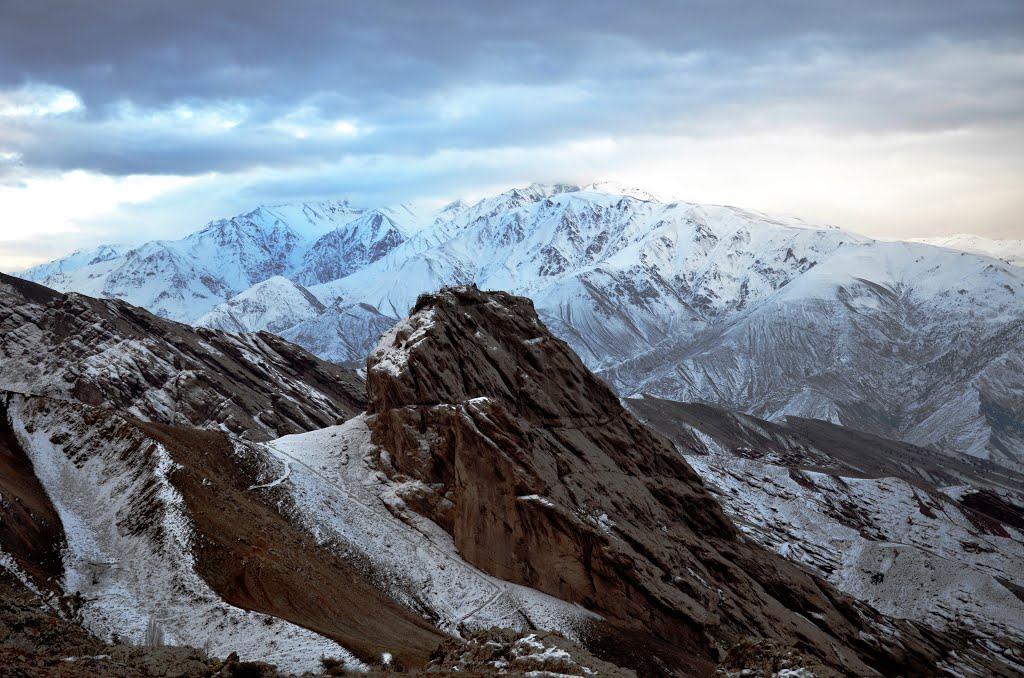
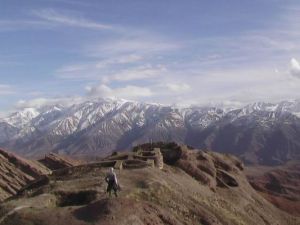
assassin-fortification-at-alamut-northern-iran
Alamut Fortress, Nortwest Iran

The mountain fortification of Alamut in northern Persia was probably impervious to defeat by military means, but not to the two-years long campaign of stealth and pretend friendship practiced by Sabbah and his followers.  In 1090, Alamut fell in a virtually bloodless takeover, becoming the headquarters of the Nizari Ismaili state.


Why Sabbah would have founded such an order is unclear, if not in pursuit of his own personal and political goals.  By the time of the first Crusade, 1095-1099, he found himself pitted against rival Muslims and invading Christian forces, alike.

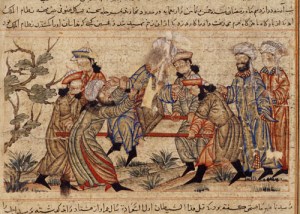
Sabbah would order the elimination of rivals, usually up close, with the dagger.  From

assassination_of_the_seljuk_vizier_nizam_al-mulk
Assassination of the Seljuk Vizier Nizam al-Mulk

religious figures to politicians and great generals, assassinations were preferably performed in broad daylight, in as public a manner as possible.  It was important that everyone absorb the intended message.


Though the “Fida’in” occupied the lowest rank of the order, great care was devoted to their education and training.  Possessed of all the physical prowess of youth, the individual assassin was also intelligent and well-read, highly trained in combat tactics, the art of disguise and the skills of the expert horseman.  All the necessary traits, for anyone who would penetrate enemy territory, insinuate himself into their ranks, and murder the victim who had learned to trust him.

Sometimes, a credible threat of assassination was as effective as an actual killing.  When the new Seljuk Sultan Ahmad Sanjar rebuffed Hashashin diplomatic overtures in 1097, he awoke one morning to find a dagger stuck into the ground, next to his bed.  A messenger arrived sometime later from the old man of the mountain.  “Did I not wish the sultan well” he said, “that the dagger which was struck in the hard ground would have been planted on your soft breast?”  The technique worked nicely.  For the rest of his days, Sanjar was happy to allow the Hashashin to collect tolls from travelers.  The Sultan even provided them with a pension, collected from the inhabitants of the lands they occupied.

Saladin himself awoke one morning, to find a note resting on his breast, along with a poisoned cake.  The message was clear.  Sultan of all Egypt and Syria though he was, Saladin made an alliance with the rebel sect.  There were no more attempts on his life.

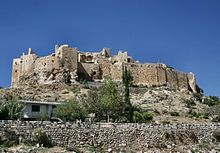
assassin-fortification-at-masyaf-in-northern-syria
Assassin stronghold at Masyaf, in Northern Syria

In the 200+ years of its existence, the Assassins occupied scores of mountain redoubts, though Alamut would remain its principle quarters.

It’s impossible to know how many of the hundreds of political assassinations of this period, were attributable to the followers of Hassan-i Sabbah.  Without a doubt, their fearsome reputation ascribed more political murder to the sect, than they were actually responsible for.

The Fida’in of Hassan-i Sabbah were some of the most feared killers of the middle ages.   Scary as they were, there came a time when the order of the Assassins tangled with someone far scarier than themselves.

The Grand Master dispatched his killers to Karakorum in the early 1250s, to murder the grandson of Genghis Khan, the Great Khan of the “Golden Horde”, Möngke.  It was a bad idea.

The Nestorian Christian ally of the Mongol Empire Kitbuqa Noyan, was ordered to destroy several Hashashin fortresses in 1253.  Möngke’s brother Hulagu rode out at the head of the largest Mongol army ever seen in 1255, with no fewer than 1,000 Chinese engineer squads.  Their orders were to treat those who submitted with kindness, and to utterly destroy those who did not.

That he did. Rukn al-Dīn Khurshāh, fifth and final Imam who ruled at Alamut, submitted after four days of preliminary bombardment.  Mongol forces under the command of Hulagu Khan entered and destroyed the Hashshashin stronghold at Alamut Castle on December 15, 1256.

Hulagu went on to subjugate the 5+ million Lurs people of western and southwestern Iran, the Abbasid Caliphate in Baghdad, the Ayyubid state of Damascus, and the Bahri Mamluke Sultanate of Egypt.  Mongol and Muslim accounts alike, agree that the Caliph of Baghdad was rolled up in a Persian rug, and the horsemen of Hulagu rode over him, because Mongols believed that the earth was offended if touched by royal blood.

Some people are not to be trifled with.

December 14, 1862 Angel of Marye’s Heights

No one will ever know how many lives were saved by his courage, and his kindness, this day in 1862

One of the bloodiest battles of the Civil War began on the 11th of December, 1862, when nearly 200,000 combatants collided in the town of Fredericksburg, Virginia.

The Union crossing of the Rappahannock was intended to be a surprise, depending on pontoons coming down from Washington to meet up with General Ambrose Burnside’s Union army in Falmouth, across the river from Fredericksburg.  The army of the Potomac arrived on November 19, with no sign of pontoons.  When they finally arrived, heavy snows slowed military operations for an additional week.  Lt. General James Longstreet and Lt. General Thomas “Stonewall” Jackson had more than enough time to prepare their defenses.

Burnside’s crossing began on the morning of December 11, as engineer battalions constructed bridges in the face of determined Confederate fire. Several groups of soldiers had to row across the river, the battle moving through the streets and buildings of Fredericksburg, as Union and Confederate troops fought the first urban combat of the Civil War.

On the morning of the 13th, Robert E. Lee’s Confederate forces occupied a seven mile long curving line, with the five divisions of Longstreet’s Corps on the left along Marye’s Heights, west of town.  Fighting began on both ends of the Confederate position, more or less simultaneously.  George Meade had some early successes against Stonewall Jackson’s dug-in positions on the right, but requested reinforcements never arrived.  By the end of the day, the old farmer’s expression “slaughter pen”, had taken on a whole new meaning.

In contrast to the swampy approaches on the Confederate right, 5,000 soldiers under James Longstreet looked out from behind the stone wall on Marye’s Heights to an open plain, crossed from left to right by a mill run, 5′ deep, 15′ wide and filled with 3′ of freezing water.

Confederate artillery commander Edward Porter Alexander looked out on that field, and said “a chicken could not live on that field when we open on it”.  He was right.  For six hours, the Union army threw one attack after another against the rebels behind the wall.  Fourteen assaults, in all.  As the sun went down on the evening of December 13, the ground before Marye’s Heights was carpeted with the mangled, dead and dying bodies of Union soldiers.

The Army of the Potomac suffered over 13,000 casualties, about two-thirds of them in front of that wall.  Lee’s army, by comparison, had suffered around 4,500 losses.  Watching the great Confederate victory unfold from his hilltop command post, Robert E. Lee said “It is well that war is so terrible, or we should grow too fond of it.”

Union ambulance corps had all they could do to remove their wounded from the plains, but dared not enter within the Confederate’s range of fire in front of that wall.  All through the night of the 13-14th, the moans of mangled and dying Union soldiers could be heard along the heights.

I don’t doubt that some Confederate soldiers reveled in all this carnage, but I’m sure that the moans and cries of agony were difficult for most to hear.  There wasn’t a man among them who didn’t understand that, but for the grace of God, that could be himself.  For Sergeant Richard Kirkland, Company G, Second South Carolina Infantry, it wasn’t good enough to sit and listen.  He could no longer stand to hear “those poor people crying for water”.  Kirkland left his position and made his way to General Joseph Kershaw’s headquarters, asking permission to help.

On the morning of December 14, 1862, Richard Kirkland took as many canteens as he could carry, and stepped into the no man’s land between two watching armies.  No one fired, nor even moved.  Sgt. Kirkland worked his way alone from one wounded man to the next, straightening out a shattered leg here, there spreading out an overcoat, always with a quiet word of encouragement and a drink of water.

Kirkland was out there for no less than 1½ hours.  Alone in no man’s land, he never left until he had helped every fallen soldier, Federal and Confederate, on that part of the battlefield.

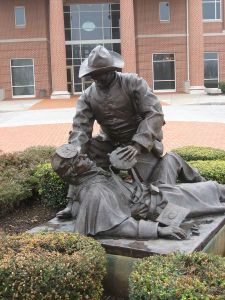
moment_of_mercy
Moment of Mercy, by Felix de Weldon. 1965, Fredericksburg, VA. Photo credit Claire H. New York

General Kershaw later gave this account:  “Unharmed he reached the nearest sufferer. He knelt beside him, tenderly raised the drooping head, rested it gently upon his own noble breast, and poured the precious life-giving fluid down the fever scorched throat. This done, he laid him tenderly down, placed his knapsack under his head, straightened out his broken limb, spread his overcoat over him, replaced his empty canteen with a full one, and turned to another sufferer.”

Kirkland would not survive the war.  He met his end while leading an infantry charge the following September, at a place called Chickamauga. No one will ever know how many lives were saved by his courage, and his kindness,  this day in 1862.  Richard Rowland Kirkland will forever remain, the Angel of Marye’s Heights.

December 13, 1577 El Draque

Historians argue whether this was a voyage of exploration, of piracy, or merely an effort to poke the Spanish King Phillip II in the eye

The “Pelican” left Plymouth, England on November 15, 1577, with four other ships and 164 men.  The weather was so rotten that they soon had to turn back, seeking shelter in Falmouth, before finally returning to Plymouth, where they started.  The flotilla set out again on December 13 after making repairs, soon to be joined by a sixth ship, the captured Portuguese merchant ship Santa Maria, renamed “Mary”.

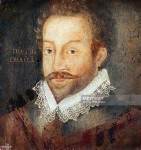
Historians argue whether this was a voyage of exploration, of piracy, or merely an effort to poke the Spanish King Phillip II in the eye.  Before it was over, Sir Francis Drake would be the first to circumnavigate the globe in continuous command of the expedition.

He was the third, actually, depending on how you count them.  Portuguese explorer Ferdinand Magellan set out with 5 ships and 250 men back in 1519, becoming the first about 58 years earlier.  Magellan himself didn’t make it though, he died in the Battle of Mactan on a Philippine beach, in 1521.  19 men and a single ship under the command of Juan Sebastián Elcano, was all that remained on the expedition’s return in 1522.

The Spanish explorer García Jofre de Loaísa was the second, leaving in 1525 with 450 men on seven ships.  None of his ships ever made it back.  25 of his men would return in 1536, under Portuguese guard.

Drake had crossed the Atlantic and made it to Patagonia, when it seems one of his captains got on his last nerve.  Thomas Doughty had been in command of the Mary, when he caught Drake’s brother Thomas stealing from the vessel’s cargo.  One thing led to another and Doughty found himself accused as “a conjurer and a seditious person”.   He was brought before a shipboard trial for treason and witchcraft, establishing the idea that lasts to this day, that a ship’s captain is its absolute ruler, regardless of the rank or social class of that ship’s passengers.

Doughty lost his head, in the end, in the shadow of the weathered and sun bleached skeletons and the bleak, Spanish gibbets where Magellan had put his own mutineers to death, a half century earlier.

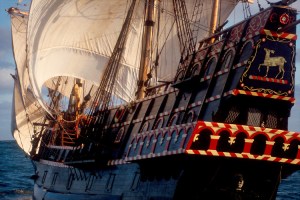
golden-hind-replica
Golden Hind Replica

It may have been to smooth over the Doughty episode, that Drake renamed his flagship the “Golden Hind”, (a female deer of 3 years or more), after the coat of arms of Sir Christopher Hatton, one of the expedition’s prime sponsors. Soon reduced to three ships, Drake made the straits of Magellan by August of 1578, emerging alone into the Pacific in September.

Drake captured a Spanish ship laden with 25,000 pesos of Peruvian gold near Lima, when he heard about the galleon Nuestra Señora de la Concepción, sailing west toward Manila.  Nicknamed “Cacafuego”, translating as “Fireshitter” (I wouldn’t make that up), the ship carried 80 pounds of gold, a golden crucifix, jewels, 13 chests full of “royals of plate” (silver coins) and 26 tons of silver.  It was the richest prize of the voyage.

After a fine dinner with Cacafuego’s captured officers and gentlemen passengers, Drakedrake offloaded his captives, each with a gift appropriate to his rank, and a letter of safe conduct.
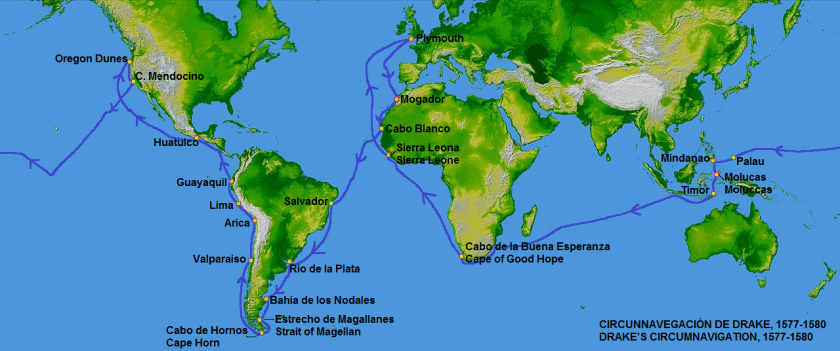
Drake landed near Alta, California in June 1579, where he repaired and restocked his vessel.  He claimed the land for the English Crown, calling it Nova Albion:  “New Britain”.   The precise location was carefully guarded to keep it secret from the Spanish, who by this time had a bounty of 20,000 ducats ($6.5 million in today’s money) on the head of “El Draque”.

The Golden Hind sailed into Plymouth, England with Drake and 59 remaining crew onboard, on September 26, 1580.  The half share owed to the queen surpassed the crown’s income for the entire year.  Drake himself was hailed as the first Englishman to circumnavigate the earth.drake_1577-1580

Drake’s seafaring career ended in January 1596, when he died of dysentery, anchored off the central American coast.  There he was dressed in his armor and buried at sea in a lead coffin, off the Portobelo District of Panama.  Divers search for his coffin, to this day.

December 10, 1917 Halifax Explosion

French sailors abandoned ship as fast as they could, warning everyone who would listen of what was about to happen

As “The Great War” dragged itself to the end of its third year in Europe, Halifax harbor in Nova Scotia, was the bustling scene of supply, munition, and troop ships destined for “over there”.  With a population of 50,000 at the time, Halifax was the busiest port in Atlantic Canada.

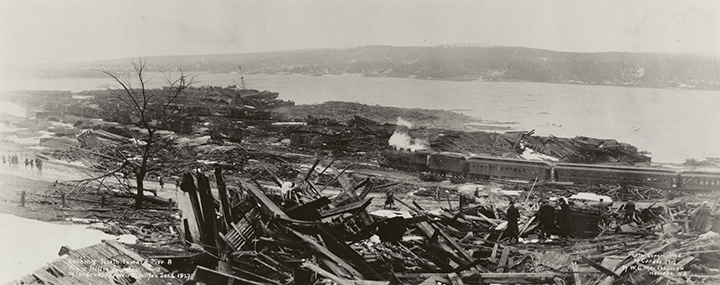
The Norwegian vessel Imo left its mooring in Halifax harbor on the morning of December 6, destined for New York City.   The French ship Mont Blanc was entering the harbor at this time, intending to join the convoy which would form her North Atlantic escort.  In her holds, Mont Blanc carried 200 tons of Trinitrotoluene (TNT), and 2,300 tons of TNP – Trinitrophenol or “Picric Acid”, a substance then in use as a high explosive.  In addition, the freighter carried 35 tons of high octane gasoline and 20,000 lbs of gun cotton.  Not wanting to draw the attention of pro-German saboteurs, the freighter flew no flags warning of its cargo.  Mont Blanc was a floating bomb

Somehow, signals became crossed as the two ships passed, colliding in the narrows at the harbor entrance and igniting the TNP onboard Mont Blanc.  French sailors abandoned ship as fast as they could, warning everyone who would listen of what was about to happen.

Meanwhile, the spectacle of a flaming ship was too much to resist, as crowds gathered around the harbor.  The high-pitched whine emitted by picric acid under combustion remains a feature of fireworks displays to this day.  You can only imagine the scene as the burning freighter brushed the harbor pier, setting it ablaze, before running aground.

The explosion and resulting fires killed over 1,800, flattening the north end of Halifax and shattering windows as far as 50 miles away.  With over 1,600 homes flattened, it was one of the largest non-nuclear explosions in history.  Mont Blanc’s anchor landed two miles away, one of her gun barrels, three.  Later analysis estimated the explosive output at 2.9 kilotons, a force greater than many tactical nuclear weapons.

9,000 were wounded on the morning of December 7, as a blizzard descended across Nova Scotia.  Boston Mayor James Michael Curley wrote to the US Representative in Halifax “The city of Boston has stood first in every movement of similar character since 1822, and will not be found wanting in this instance. I am, awaiting Your Honor’s kind instruction.”

Curley was as good as his word.  He and Massachusetts Governor Samuel McCall composed a Halifax Relief Committee to raise funds and organize aid.  McCall reported that the effort raised $100,000 in its first hour alone. President Woodrow Wilson authorized a $30,000 carload of Army blankets sent to Halifax.  Within 12 hours of the explosion, the Boston Globe reported on the first train leaving North Station, with “30 of Boston’s leading physicians and surgeons, 70 nurses, a completely equipped 500-bed base hospital unit and a vast amount of hospital supplies”.

Delayed by deep snow drifts, the train arrived on the morning of December 8, the first non-Canadian relief train on the scene.

There was strong sentiment at the time, that German sabotage lay behind the disaster.  A front-page headline on the December 10 Halifax Herald Newspaper proclaimed “Practically All the Germans in Halifax Are to Be Arrested”.

$750,000 in relief aid would arrive from Massachusetts alone, equivalent to more than $15 million today.  Canadian Prime Minister Robert Borden would write to Governor McCall on December 9, “On behalf of the Government of Canada, I desire to convey to Your Excellency our very sincere and warm thanks for your sympathy and aid in the appalling calamity which has befallen Halifax”.

The following year, Nova Scotia sent the city of Boston a gift of gratitude, a very large Christmas tree.

In 1971, the Lunenburg County Christmas Tree Producers Association sent Boston another tree, to promote their Christmas tree exports, and to once again acknowledge the support of the people and government of Boston after the 1917 disaster. The Nova Scotia government later took over the annual gift of the Christmas tree, to promote trade and tourism.

And so it is that, every year, the people of Nova Scotia send the people of Boston their official Christmas tree.  More recently, the principle tree is joined by two smaller trees, donated to Rosie’s Place and the Pine Street Inn, two of Boston’s homeless shelters.

This is no Charlie Brown shrub we’re talking about. The 1998 tree required 3,200 man-hours to decorate:  17,000 lights connected by 4½ miles of wire, and decorated with 8,000 bulbs.

In 2013, the tree was accompanied by a group of runners, in recognition of the Boston Marathon bombing earlier that year.2016-boston-christmas-tree

This year’s tree stands just short of 46′, for the first time selected from the Cape Breton area. It takes two men a day and a half to prepare for cutting, a crane holding the tree upright while the chainsaw does its work.  It’s a major media event, as the tree is paraded through Halifax on a 53’ flatbed, before boarding the ferry across the Bay of Fundy to begin its 750-mile journey south.

For a small Canadian province, it’s been no small commitment.  Last year Nova Scotia spent $242,000 on the program, including transportation, cutting & lighting ceremonies, and all the promotions that went with it.  Premier Stephen McNeil says the program is well worth the expense. “(It) gives us a chance to showcase our beautiful part of the world to a global community”.  Tim Whynot, manager of stewardship and outreach for the provincial Department of Natural Resources, may have the last word.  “With the Tree for Boston, obviously the history of why we do it is pretty significant…we don’t want that to be forgotten”.

December 9, 536 Byzantium

Most histories of the Roman Empire end with some event along the 476-586 timeline, but the Roman Empire in the east would live for another thousand years

Politicians love nothing more than to divide us against one another for their own benefit, but that’s nothing new. The tyrant Theagenes of Megara destroyed the livestock of the wealthy in the late 7th century BC, in an effort to increase his support among the poor. It may have been this tactic which drove Byzas, son of the Greek King Nisos, to set out in 657BC to found the new colony of Byzantion.

The Oracle at Delphi had advised him to build his city “opposite the land of the blind”. Arriving at the Bosphorus Strait (“boos poros”, Greek for cow-ford), the narrow channel which divides Europe from Asia, they judged the inhabitants of the eastern bank city of Chalcedon to be blind if not stupid, not to recognize the advantages two miles away on the European side. There they set down the roots of what is today the second largest city on the planet, based on population living within city limits.

Byzantium city leaders made the mistake of siding with Pescennius Niger, a pretender to the Roman throne during the “Year of the Five Emperors”, 193-194AD. Laid siege and virtually destroyed in 196 by the victorious Septimius Severus, the city was rebuilt and quickly regained the wealth and status it had formerly enjoyed as a center of trade.at the crossroads of east and west,

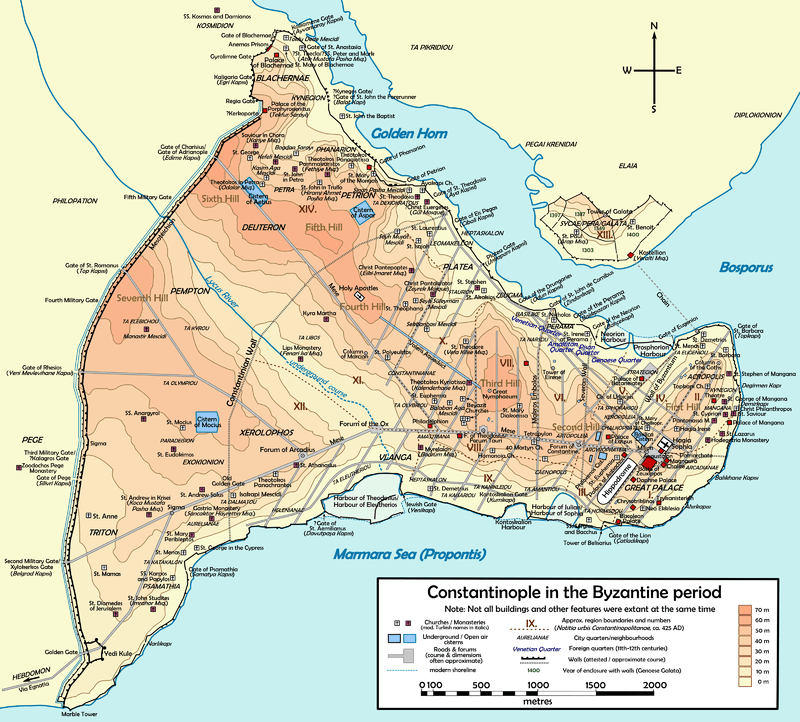
Constantine the Great, Roman Emperor from 306 to 337, established a second residence at Byzantium in 330, officially establishing the city as “Nove Roma” – New Rome. Later renamed in his honor, “Constantinople” became the capital of the Byzantine Empire and seat of the Eastern Roman Empire.byzantine_constantinople

The Roman empires of the east and west would separate and reunite in a succession of civil wars and usurpations throughout the 4th century, permanently dividing in two with the death of Emperor Theodosius I in 395. The Western and Eastern Empires would co-exist for about 80 years.  Increasing barbarian invasions and internal revolts finally brought the western empire to an end when Romulus Augustulus was deposed in 476.

The Ostrogothic Kingdom which came to rule all of Italy was briefly deposed, when the Byzantine General Belisarius entered Rome on December 9, 536. The Ostrogothic garrison left the city peacefully, briefly returning the old capital to its Empire. Fifty years later, there would be too little to defend against the invasion of the Lombards.  By 586, the Western Roman Empire had permanently ceased to exist.

Most histories of the Roman Empire end with some event along this 476-586 timeline, but the Roman Empire in the east would live for another thousand years. With traditions, customs and language drawn more heavily from the Greek than those of the Latin, the Byzantine Empire would last almost until the age of Columbus and the discovery of the New World.  Most of that time it remained one of the most powerful economic, cultural, and military forces in all of Europe.

In 413, construction began on a formidable system of defensive walls, protecting Constantinople against attack by land or sea. Called the “Theodosian Walls” after reigning Emperor Theodosius II, they were built on the orders of the Roman Prefect of the East, Anthemius, as a defensive measure against the Huns. One of the most elaborate defensive fortifications ever built, the Theodosian Walls warded off sieges by the Avars, Arabs, Rus’, Bulgars and others. This, the last great fortification of anitiquity, would fall only twice. First amidst the chaos of the 4th Crusade in 1203, and finally to the age of gunpowder.

Constantinople, one of the most heavily fortified cities on the planet, fell after a 50-day siege to an army of 150,000, and the siege cannon of Sultan Mehmed II, ruler of the Ottoman Turks.

It was May 29, 1453.  Constantinople, now Istanbul, remains under Muslim rule to this day.

December 7, 1941 USS Oklahoma

The Oklahoma turned turtle during the attack, trapping hundreds of sailors within her hull

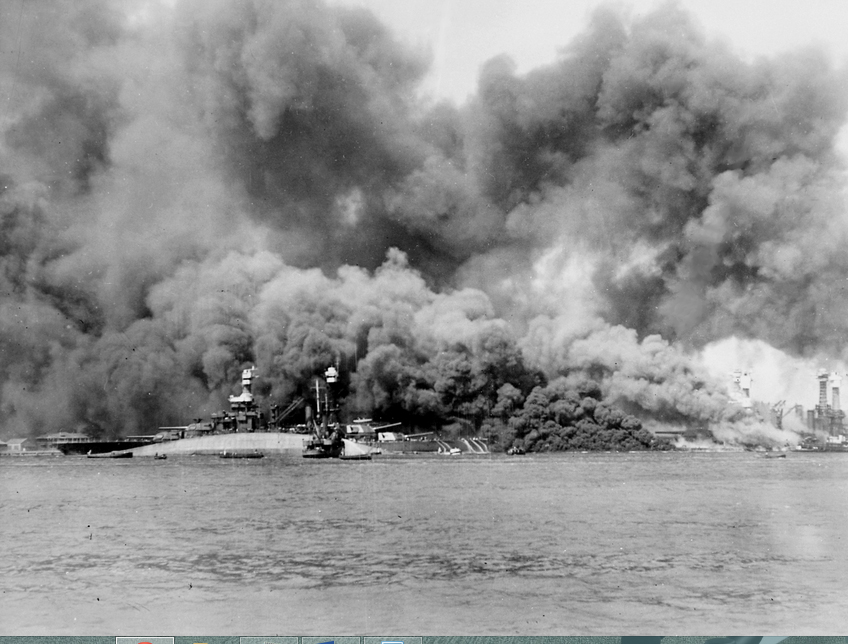
Air forces of the Imperial Government of Japan attacked the US Navy anchorage at Pearl Harbor, 75 years ago, today. The attack killed 2,403 and wounded another 1,178.  All eight battleships then in harbor were damaged.  Four sank to the bottom along with a number of smaller ships. 188 aircraft were destroyed, most while still on the ground.

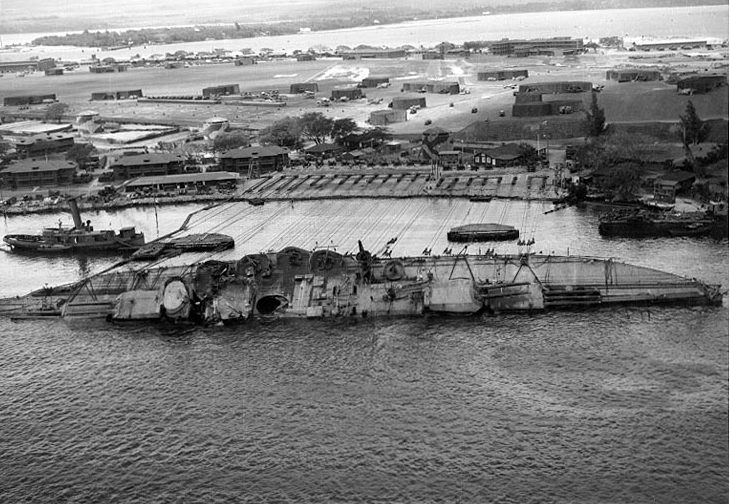
Most would be re-floated and some returned to service, but not all. The Nevada-class righting-of-the-uss-oklahomabattleship USS Oklahoma was raised from the bottom, but was never repaired. In 1947 she would sink under tow to the mainland, very nearly taking two ocean going tugs to the bottom, with her.

The Pennsylvania-class battleship USS Arizona remains on the bottom, a monument to the event and to the 1,102-honored dead who remain entombed within her hull.

The hulk of the Arizona is such a prominent part of the memorial today, that it’s easy to believe it’s the only ship still lying at the bottom of Pearl Harbor.  But Arizona is not alone.

Less well known is the Florida-class dreadnought USS Utah, which defied salvage efforts. Now a War Grave, 64 honored dead remain within her hull, lying at the bottom not far from the Arizona.

Likewise, little remembered, is the fate of the 429 killed aboard the battleship USS Oklahoma. The Oklahoma turned turtle during the attack, trapping hundreds of sailors within her hull. Faint tapping sounds came from within.  Frantic around the clock rescue efforts resulted in the deliverance of 32 sailors.

Bulkhead markings would later reveal that, at least some of the doomed would live for another seventeen days.

Seventeen days alone in that black, upside down place, they died waiting and hoping for the rescue that would come too late. The last mark was drawn by the last survivor on Christmas Eve, 1941.

December 6, 1240 Golden Horde

Imagine an army of circus riders, equipped with composite bows and a minimum of 60 arrows apiece, each capable of hitting a bird in flight

The Eurasian Steppe is a vast region of grasslands and savannas, extending thousands of miles east from the mouth of the Danube, almost to the Pacific Ocean. There’s no clearly defined southern boundary, as the land becomes increasingly dry as you move south. To the north are the impenetrable forests of Russia and Siberia.
The 12th century steppe was a land of inter-tribal rivalry, immersed in a poverty so profound that many of its inhabitants went about clad in the skins of field mice. Ongoing acts of warfare and revenge were carried out between a kaleidoscope of ever changing tribal confederations, compounded and egged on by interference from foreign powers such as the Chinese dynasties to the south.
Into this land was born the son of the Mongol chieftain Yesügei, born with a blood clot grasped in his fist. It was a sign, they said, that he was destined to become a great leader. By 1197 the boy would unite the nomadic tribes of northeast Asia into the largest contiguous empire in history, extending from Korea in the east, through Baghdad and Syria all the way into eastern Europe. His name was Temujin. He is known to history as the Great Leader of the Mongol Empire, Genghis Khan.
natgeo-cover-afghan-girl  The Steppes have long been a genetic crossroad, the physical features of its inhabitants as diverse as any in the world. The word “Rus”, from which we get Russia, was the name given to Viking invaders from earlier centuries. History does not record what Genghis himself looked like, though he’s often depicted with Asian features. There is evidence suggesting he had red hair and green eyes. Think of that beautiful young Afghan girl, the one with those killer eyes on that National Geographic cover, a few years back.
The Mongols called themselves “Tata”, while others called them after the people of Tartarus, the Hell of Roman mythology. They were the “Tatars” to the people they terrorized: “Demons from Hell”.
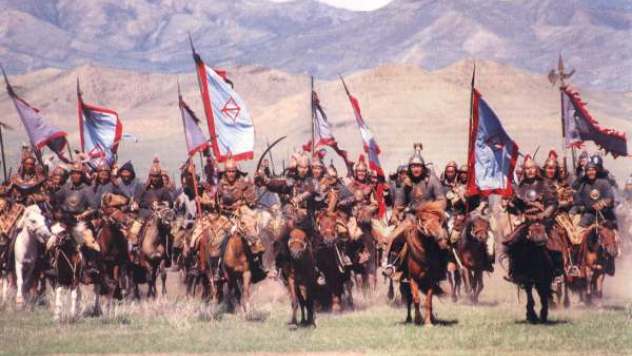
The two most prominent weapons in the Mongol arsenal can be found in the words “Horse Archer”. Imagine an army of circus riders, equipped with composite bows and a minimum of 60 arrows apiece, each capable of hitting a bird in flight. They have no fewer than 3-4 small, fast horses apiece, and are able to transfer mounts in mid-gallop in order to keep their horses fresh. In this way, riders could cover 100 miles and more in a day. Stirrups allowed them to fire in any direction, including backward. The bow, a laminated composite of wood, horn and sinew, combined the compression of the interior horn lamina with stretching animal sinews glued to the exterior. The weapon was capable of aimed shots at five times the length of a football field. Ballistic shots into large groups were common as far as 2½ times that distance. The average draw of an English longbow is 70-80 lbs. The Mongol composite bow ranged from 100 to 160 lbs.
After the death of Genghis’ eldest son Jochi, who pre-deceased his father, the Great Khan installed his grandson Batu as Chief of state (Khan) of the Kipchak Khanate to the north. In 1235, the Great Khan Ögedei, who had succeeded his father on Genghis’ death in 1229, ordered his nephew Batu and an army of 130,000 circus riders to conquer Europe, beginning with the Rus.
13th century Russia was more a collection of principalities than it was a single nation. One by one they fell to the army of Batu, known as the “Golden Horde”. Ryazan, Kolomna and Moscow. Vladimir, Rostov, Uglich, Yaroslavl, and a dozen others. Some of the names are familiar today, others were extinguished for all time. All fell to the Golden Horde.     Smolensk alone escaped, having agreed to submit and pay tribute. The city of Kitezh, as the story goes, submerged itself into a lake along with its inhabitants, at the approach of the Horde. It was this day, December 6, 1240, when Mongols under Batu Khan occupied & destroyed Kiev after several days’ struggle.
The violence of the age was so vast and horrific that it’s hard to get your head around. WWII, the deadliest conflict in human history, was a time of industrialized mass slaughter from the battlefields to the death camps. WWII ended the lives of roughly 3% of the inhabitants of earth, 40 to 72 million souls dead in a few short years. By comparison, the Mongol conquests killed 30 million over 162 years, mostly one by one by edged or pointed weapons. When it was over, 17% of the entire world’s population, had vanished.
By the end of 1241, Mongol armies had crushed opposing forces from the Plains of mongolsHungary, to parts of Austria, to Eastern Persia.   Plans were being laid for the invasion of Germany, Austria and Italy in December, 1241, when news arrived informing them of the death of the Great Khan. Ögedei and Batu wanted to continue, but the Law of Yassa required that all Princes of the Blood return to Karakorum and the Kurultai, the meeting of Mongol Chieftains.
The Celtic warrior Calgacus once said of the Roman conquests that “They make a desert, and they call it peace”. It was likewise for the Mongol Empire; a time of peace for those who would submit and pay tribute. A time when “A maiden bearing a nugget of gold on her head could wander safely throughout the realm.” This “Pax Mongolica” lasted through the reign of the Great Khan and his several successors, making way for the travels of Marco Polo. The 4,000 mile long “Spice Roads”, the overland trade routes between Europe and China, flourished throughout the 14th and 15th centuries, entirely under Mongol control. The “Black Death” of the 14th century would begin to change that. 100 years later, the fall of Byzantium and marauding bands of   Muslim brigands were making the east-west overland trade routes increasingly dangerous. In 1492, the Spanish Crown hired an Italian explorer to find a water route to the east.
The Mongols would never regain the lost high ground of December 1241, as they fell to squabbling over bloodlines. Berke, grandson of Ghenghis and brother of Batu, converted to Islam, creating a permanent division among the descendants of the Great Khan. Timur-i-leng, “Timur the Lame”, or “Tamerlane”, professed to be a good Muslim, but had no qualms about destroying the capitals of Islamic learning of his day. Damascus, Khiva, Baghdad and more, have never entirely recovered. Best known for the pyramids of skulls left behind, as many as 19 million fell to Tamerlane’s murderous regime.
The Golden Horde ruled over parts of Russia until the time of Ivan IV “Grozny” (The Terrible) in the 1550s.
The Mongol hordes never went away, not entirely. Modern DNA testing reveals that up to 8% of certain populations across the Asian subcontinent, about .5% of the world’s population, descends directly from that baby holding the blood clot, Genghis Khan.

December 5, 63BC The Catiline Conspiracy

Lucius Sergius Catilina was an unsavory character, having murdered first his brother in law and later his wife and son, before being tried for adultery with a vestal virgin

Ever since the overthrow of the Roman Monarchy in 509BC, Rome governed itself as a Republic.  The government was headed by two consuls, annually elected by the citizens and advised by a Senate.  The Republic operated on the principle of a separation of powers with checks and balances, and a strong aversion to the concentration of power.  Except in times of national emergency, no single individual was allowed to wield absolute power over his fellow citizens.

A series of civil wars and other events took place during the first century BC, ending the Republican period and leaving in its wake an Imperium, best remembered for its conga line of dictators.

Lucius Sergius Catilina was a Roman Senator during this period, best remembered for his attempt to overthrow the Republic.  In particular the power of the aristocratic Senate.  He seems to have been an unsavory character, having murdered first his brother in law and later his wife and son, before being tried for adultery with a vestal virgin.

The first of two conspiracies bearing his name began in 65BC.  Catilina was supposed to have conspired to murder a number of Senators on their entering office, and making himself, Consul.  He may or may not have been involved at this stage, but he certainly would be for the second.

In 63BC, Catilina and a group of heavily indebted aristocrats concocted a plan with a number of disaffected veterans, to overthrow the Republic. On the night of October 18, Crassus brought letters to Consul Marcus Tullius Cicero warning of the plot.  Cicero read the letters in the Senate the following day, later giving a series of four speeches:  the Catiline Orations, considered by many to be his best political oratory.

In his last speech, delivered in the Temple of Concordia on December 5, 63BC, Cicero established a basis for other speakers to take up the cause.  As Consul, Cicero was not allowed to voice an opinion on the execution of conspirators, but this speech laid the groundwork for others to do so, primarily Cato the Younger.

The actual Senate debates are lost to history, leaving only Cicero’s four orations, but there was considerable resistance in the Senate to executing the conspirators.  They were, after all, fellow aristocrats.

Armed forces of the conspirators were ambushed at the Milvian Bridge, where the Via Flaminia crosses the Tiber River.  The rest were executed by the end of December.  Cicero’s actions had saved the Republic.  For now.

At one point during this period, then-Senator Julius Caesar stepped to the rostrum to have his say. He was handed a paper and, reading it, stuck the note in his toga and resumed his speech. Cato, Caesar’s implacable foe, stood in the senate and demanded that Caesar read the note. It’s nothing, replied the future emperor, but Cato thought he had caught the hated Caesar red handed. “I demand you read that note”, he said, or words to that effect.  He wouldn’t let it go.  Finally, Caesar relented. With an actor’s timing, he pulled out the note and read it to a hushed senate.

It turned out to be a love letter, a graphic one, wherein Servilia Caepionis described in detail what she wanted to do with Caesar when she got him alone. As if the scene wasn’t bad enough, Servilia just happened to be Cato’s half-sister.

Here’s where the story becomes Very interesting. Caesar was a well-known lady’s man.

Vincenzo Camuccini, "Morte di Cesare", 1798,
The Emperor’s dying words are supposed to have been “Et tu, Brute?”, as Brutus plunged the dagger in. “And you, Brutus?” But that’s not what he said

By the time of his assassination, he had carried on with Servilia for years.  Servilia Caepionis had a son, called Marcus Brutus.  He was 41 on the 15th of March, 44BC.  The “Ides of March”.  Caesar was 56. The Emperor’s dying words are supposed to have been “Et tu, Brute?”, as Brutus plunged the dagger in.  “And you, Brutus?”  But that’s not what he said.  Those words were put in his mouth 1,643 years later, by William Shakespeare.

Eyewitness accounts to Caesar’s last words are lost to history, but more contemporary sources recorded his dying words as “Kai su, Teknon?”  In Greek, it means “And you, my child?”

I’m not convinced that Brutus murdered his father on the Ides of March, in fact I believe it to be unlikely.  Still, it makes you wonder…