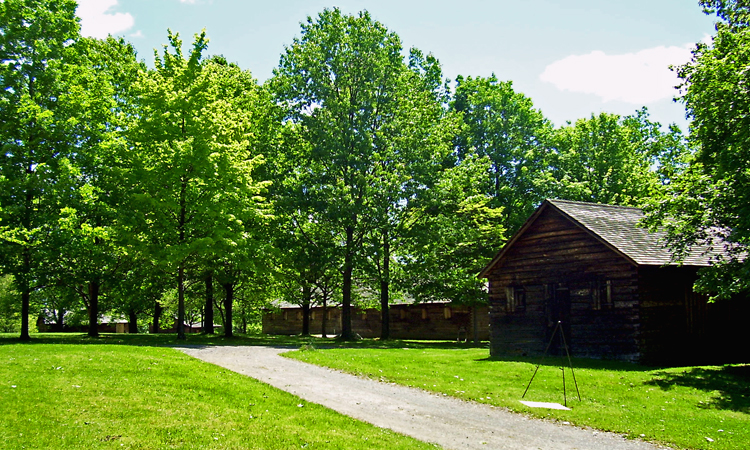
March 5, 1770 Blood on the Snow

On this day in 1770, the insults of a cocky 13-year-old led to one of the seminal events, of the American Revolution.

In living memory, France and Great Britain have always been allies.  In war and peace from the Great War to World War 2 to the present day, but such was not always the case.  Between the Norman Invasion of 1066 and the Napoleonic Wars of 1802-1815, the two allies have found themselves in a state of war no fewer than forty times.

Throughout most of that history, the two sides would clash until one or the other ran out of money, when yet another treaty would be trotted out and signed.

New taxes would be levied to bolster the King’s treasury, and one or the other would be back for another round. The cycle began to change in the late 17th century for reasons which may be summed up with a single word.  Debt.

In the time of Henry VIII, British military outlays as a percentage of central government expenses averaged 29.4%. By 1694 the Nine Years’ War had left the English Government’s finances in tatters. £1.2 million were borrowed by the national treasury at a rate of 8 percent from the newly formed Bank of England.

The age of national deficit financing, had arrived.

In one of the earliest known debt issues in history, Prime Minister Henry Pelham converted the entire national debt into consolidated annuities known as “consols”, in 1752.  Consols paid interest like regular bonds, with no requirement that the government ever repay the face value.  18th century British debt soared as high as 74.6%, and never dropped below 55%.

The Seven Years’ War alone, fought on a global scale between 1756 to 1763, saw British debt double to the unprecedented sum of £150 million, straining the national economy.

American colonists experienced the conflict in the form of the French and Indian War, for which the Crown laid out £70,000,000.  The British government saw its American colonies as beneficiaries of their expense, while the tax burden on the colonists themselves remained comparatively light.  townsend

For American colonists, the never ending succession of English wars had accustomed them to running their own affairs.

The “Townshend Revenue Acts” of 1767 sought to force American colonies to pick up the tab for their own administration, a perfectly reasonable idea in the British mind. The colonists had other ideas.  Few objected to the amount of taxation as much as whether the British had the right to tax them at all. They were deeply suspicious of the motives behind these new taxes, and were not about to be subjugated by a distant monarch.

The political atmosphere was brittle in 1768, as troops were sent to Boston to enforce the will of the King. Rioters ransacked the home of a newly appointed stamp commissioner, who resigned the post following day. No stamp commissioner was actually tarred and feathered, a barbarity which had been around since the days of Richard III “Lionheart”, though several such incidents occurred at New England seaports.  More than a few loyalists were ridden out of town on the backs of mules.

The Massachusetts House of Representatives sent a petition to King George III asking for the repeal of the Townshend Act.  A Circular Letter sent to the other colonial assemblies, called for a boycott of merchants importing those goods affected by the act.  Lord Hillsborough responded with a letter of his own, instructing colonial governors in America to dissolve those assemblies which responded to the Massachusetts body.

tea-act-gettyimages-53071471The fifty gun HMS Romney arrived in May, 1769.  Customs officials seized John Hancock’s merchant sloop “Liberty” the following month, on allegations the vessel was involved in smuggling.  Already agitated over Romney’s impressment of local sailors, Bostonians began to riot. By October, the first of four regular British army regiments arrived in Boston.

On February 22, 1770, 11-year-old Christopher Seider joined a mob outside the shop of loyalist Theophilus Lillie.  Customs official Ebenezer Richardson attempted to disperse the crowd.  Soon the mob was outside his North End home.  Rocks were thrown and windows broken.  One hit Richardson’s wife.  Ebenezer Richardson fired into the crowd, striking Christopher Seider.  By nightfall, the boy was dead.  2,000 locals attended the funeral of this, the first victim of the American Revolution.

bostonmassacrebychampneyEdward Garrick was a wigmaker’s apprentice, who worked each day to grease and powder and curl the long hair of the soldier’s wigs.

Weeks earlier, the wigmaker had given British Captain-Lieutenant John Goldfinch, a shave.

A cocky 13-year old, Garrick spotted the officer and taunted the man, yelling “There goes the fellow that won’t pay my master!”

Goldfinch had paid the man the day before.  The officer wasn’t about to respond to an insult from some snotty kid but private Hugh White, on guard outside the State House on King Street, took the bait.  White said the boy should be more respectful and struck him on the head, with his musket.  Garrick’s buddy and fellow wigmaker’s apprentice Bartholomew Broaders began to argue with White, as a crowd gathered ’round to watch.

As the evening pressed on, church bells began to ring.  The crowd, now fifty and growing and led by the mixed-race former slave-turned sailor Crispus Attucks threw taunts and insults, spitting and daring Private White to fire his weapon.   The swelling mob turned from boisterous to angry as White took a more defensible position, against the State House steps.  Runners alerted Officer of the Watch Captain Thomas Preston to the situation, who dispatched a non-commissioned officer and six privates of the 29th Regiment of Foot, to back up Private White.

Bayonets fixed, the eight took a semi-circular defensive position with Preston himself, in the lead.  The crowd, now numbering in the hundreds, began to throw snowballs.  Then stones and other objects.  Private Hugh Montgomery was knocked to the ground and, infuriated, came up shooting.

2009_BostonMassacre_site_3658174192The two sides stopped for a few seconds to two minutes, depending on the witness.  Then they all fired.  A ragged, ill-disciplined volley.  There was no order, just the flash and roar of gunpowder on the cold late afternoon streets of a Winter’s day.  It was March 5.  When the smoke cleared, three were dead.  Two more lay mortally wounded and another six, seriously injured.

The mob moved away from the spot on King Street, now State Street, but continued to grow in the nearby streets.  Speaking from a balcony, acting Governor Thomas Hutchinson was able to restore some semblance of order, only by promising a full and fair inquiry.

Future President John Adams defended the troopers assisted by Josiah Quincy and Loyalist Robert Auchmuty.  Massachusetts Solicitor General Samuel Quincy and private attorney Robert Treat Paine handled the prosecution in two separate trials, one for Captain Preston, the other for the eight enlisted soldiers.

Two were convicted but escaped hanging, by invoking a medieval legal remnant called “benefit of clergy”. Each would be branded on the thumb in open court with “M” for murder.  The others were acquitted, leaving both sides complaining of unfair treatment.  It was the first time a judge used the phrase “reasonable doubt.”

6923394409_1e71688405_b
Boston Massacre–A Battle for Liberty. Murals of the Capitol, by Constantino Brumidi

The only conservative revolution in history, was fewer than six years in the future.

There is a circle of stones in front of the Old State House on what is now State Street, marking the site of the Boston Massacre.  British taxpayers continue to this day, to pay interest on the debt left to them, by the decisions of their ancestors.

bostonmassacre21

October 11, 1776 Buying Time. The Battle of Valcour Island

It was a hastily built and in some cases incomplete fleet that slipped into the water in the summer and autumn of 1776. In just over two months, the American shipbuilding effort produced eight 54-foot Gondolas (gunboats), and four 72-foot′ Galleys. Upon completion, each hull was rowed to Fort Ticonderoga, there to be fitted with masts, rigging, guns, and supplies. By October 1776, the American fleet numbered 16 vessels, determined to stop the British fleet heading south.

In the early days of the American Revolution, the 2nd Continental Congress looked north, to the Province of Quebec. The region was lightly defended at the time.  Congress was alarmed at the potential of a British base from which to attack and divide the colonies.

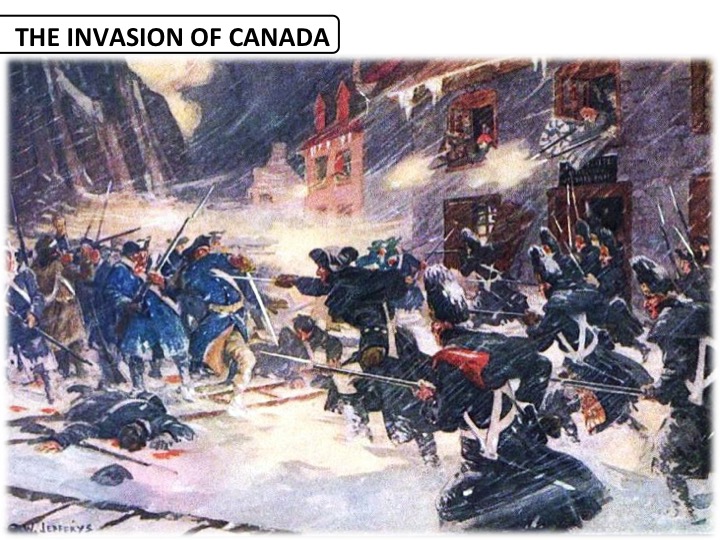
The Continental army’s expedition to Quebec ended in disaster on December 31, as General Benedict Arnold was severely injured with a bullet wound to his left leg. Major General Richard Montgomery was killed and Colonel Daniel Morgan captured, along with some 400 fellow Patriots.

000-War-of-Independence-Invasion-of-Canada-1.jpg

The nightmare took on a life of its own in the String of 1776, with the massive reinforcement of Quebec.   10,000 British and Hessian soldiers. By June, the remnants of the Continental army were driven south to Fort Ticonderoga and Fort Crown Point.

The continental Congress was correct about the British intention of splitting the colonies. General Sir Guy Carleton, provincial Governor of Quebec, set about doing so, almost immediately.

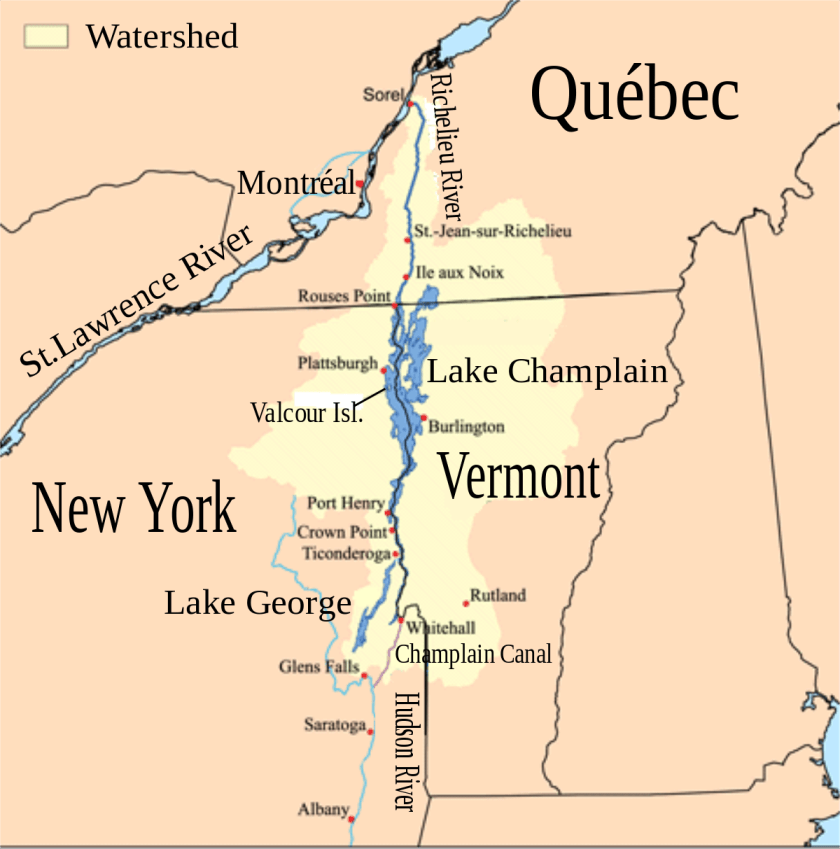
Retreating colonials took with them or destroyed nearly every boat along the way, capturing and arming four vessels in 1775: the Liberty, Enterprise, Royal Savage, and Revenge. Determined to take back the crucial waterway, the British set about disassembling warships along the St. Lawrence and moving them overland to Fort Saint-Jean on the uppermost navigable waters leading to Lake Champlain, the 125-mile long lake dividing upstate New York from Vermont.

1200px-Champlainmap.svg.png

There they spent the summer and early fall of 1776, literally building a fleet of warships along the upper reaches of the lake. 120 miles to the south, colonials were doing the same.

The Americans possessed a small fleet of shallow draft bateaux used for lake transport, but needed something larger and heavier to sustain naval combat.

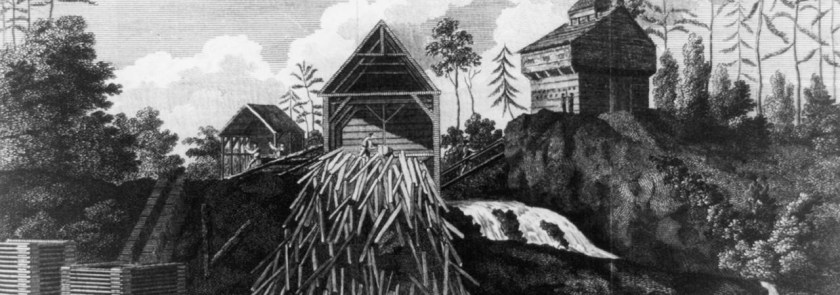
In 1759, British Army Captain Philip Skene founded a settlement on the New York side of Lake Champlain, built around saw mills, grist mills, and an iron foundry.  Today, the former village of Skenesborough is known as “Whitehall”, considered by many to be the birthplace of the United States Navy.  In 1776, Major General Horatio Gates put the American ship building operation into motion on the banks of Skenesborough Harbor.

Skenesborough Sawmill.jpgHermanus Schuyler oversaw the effort, while military engineer Jeduthan Baldwin was in charge of outfitting. Gates asked General Benedict Arnold, an experienced ship’s captain, to spearhead the effort, explaining “I am intirely uninform’d as to Marine Affairs”.
200 carpenters and shipwrights were recruited to the wilderness of upstate New York. So inhospitable was this duty that workmen were paid more than anyone else in the Navy, with the sole exception of Commodore Esek Hopkins. Meanwhile, foraging parties scoured the countryside looking for guns.  There was going to be a fight on Lake Champlain.

It is not widely known, that the American Revolution was fought in the midst of a smallpox pandemic. General George Washington was an early proponent of vaccination, an untold benefit to the American war effort. Notwithstanding, a fever broke out among the shipbuilders of Skenesborough, which almost brought their work to a halt.

It was a hastily built and in some cases incomplete fleet that slipped into the water in the summer and autumn of 1776. In just over two months, the American shipbuilding effort produced eight 54-foot Gondolas (gunboats), and four 72-foot′ Galleys. Upon completion, each hull was rowed to Fort Ticonderoga, there to be fitted with masts, rigging, guns, and supplies. By October 1776, the American fleet numbered 16 vessels, determined to stop the British fleet heading south.

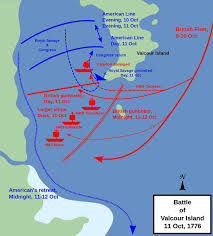
download - 2019-10-11T070000.649.jpgAs the two sides closed in the early days of October, General Arnold knew he was at a disadvantage. The element of surprise was going to be critical. Arnold chose a small strait to the west of Valcour Island, where he was hidden from the main part of the lake. There he drew his small fleet into a crescent formation, and waited.
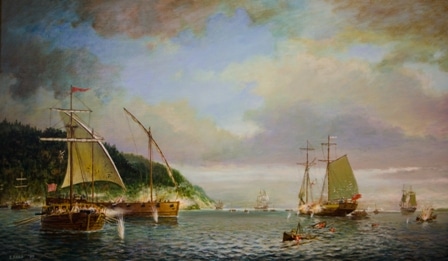
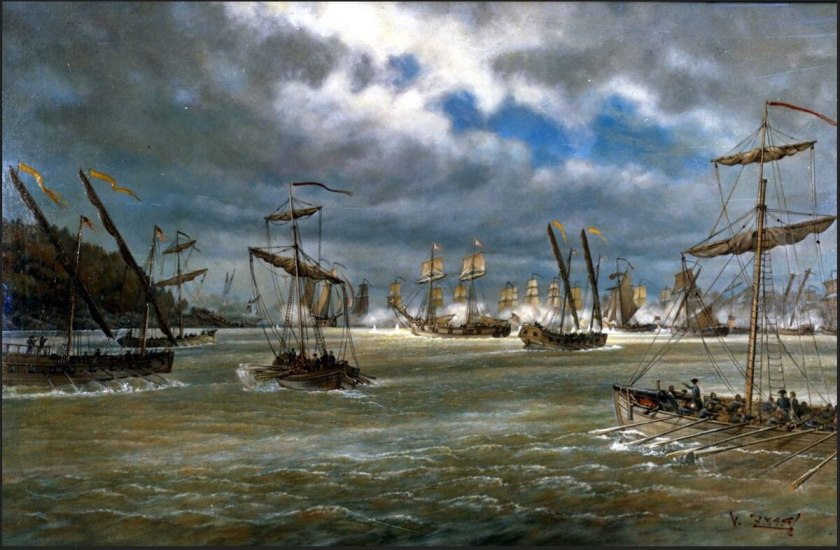
Carleton’s fleet, commanded by Captain Thomas Pringle, entered the northern end of Lake Champlain on October 9.

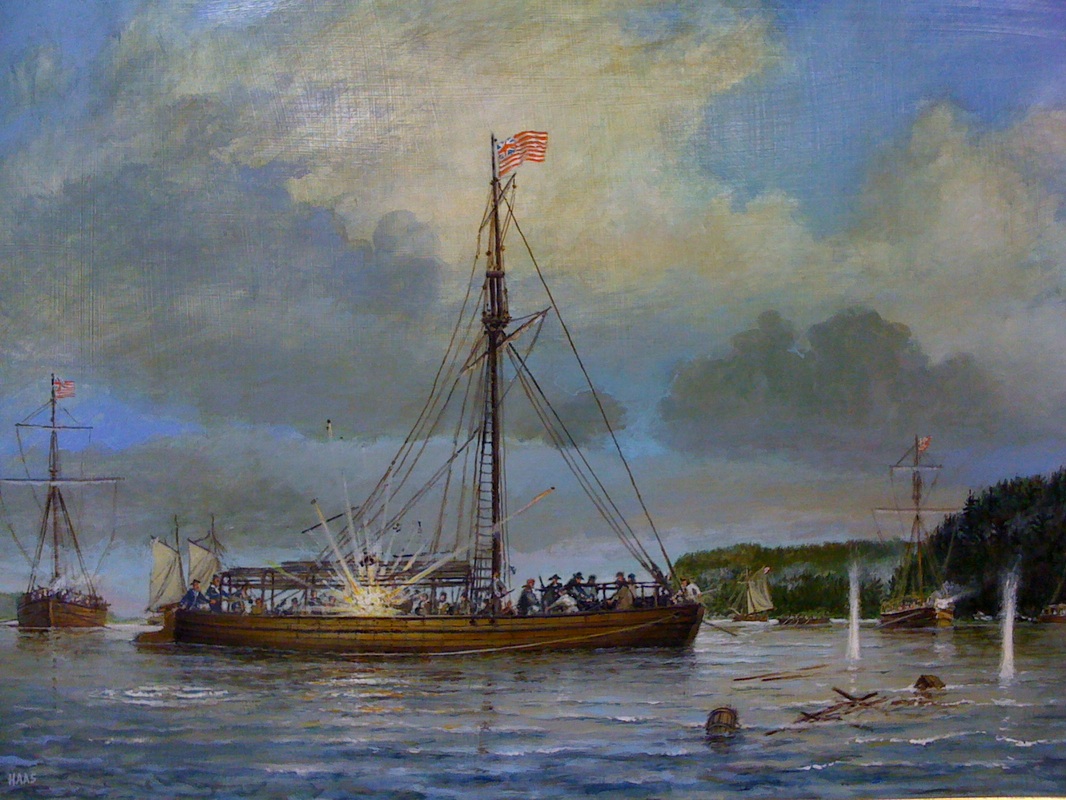
Sailing south on the 11th under favorable winds, some of the British ships had already passed the American position behind Valcour island, before realizing they were there. Some of the British warships were able to turn and give battle, but the largest ones were unable to turn into the wind.

Fighting continued for several hours until dark.  Both sides did some damage. On the American side, Royal Savage ran aground and burned. The gondola Philadelphia was sunk. On the British side, one gunboat blew up. The two sides lost about 60 men, each. In the end, the larger ships and more experienced seamanship of the English, made it an uneven fight.

Battle-of-Valcour-Island-Painting-by-Ernie-Haas.jpg

Only a third of the British fleet was engaged that day, but the battle went badly for the Patriot side. That night, the battered remnants of the American fleet slipped through a gap in the lines, limping down the lake on muffled oars. British commanders were surprised to find them gone the next morning, and gave chase.

One vessel after another was overtaken and destroyed on the 12th, or else, too damaged to go on, abandoned. The cutter Lee was run aground by its crew, who then escaped through the woods. Four of sixteen American vessels escaped north to Ticonderoga, only to be captured or destroyed by British forces, the following year.

YJGPQUCAKJAPPN7X2N4G76WCMA.jpg

On the third day, the last four gunboats and Benedict Arnold’s flagship Congress were run aground in Ferris Bay on the Vermont side, following a 2½-hour running gun battle. Today, the small harbor is called Arnold’s Bay.

200 escaped to shore, the last of whom was Benedict Arnold himself, personally torching his own flagship before leaving her for the last time, flag still flying.

Benedict-Arnold-Valcour-memorial.jpg

British forces would retain control of Lake Champlain, through the end of the war.
The American fleet never had a chance and everyone knew it. Yet it had been able to inflict enough damage at a point late enough in the year, that Carlton’s fleet was left with no choice but to return north for the winter.

One day, Benedict Arnold would enter history as turncoat.  A traitor to his country.  For now, the General had bought his infant nation, another year in which to fight.


Afterward

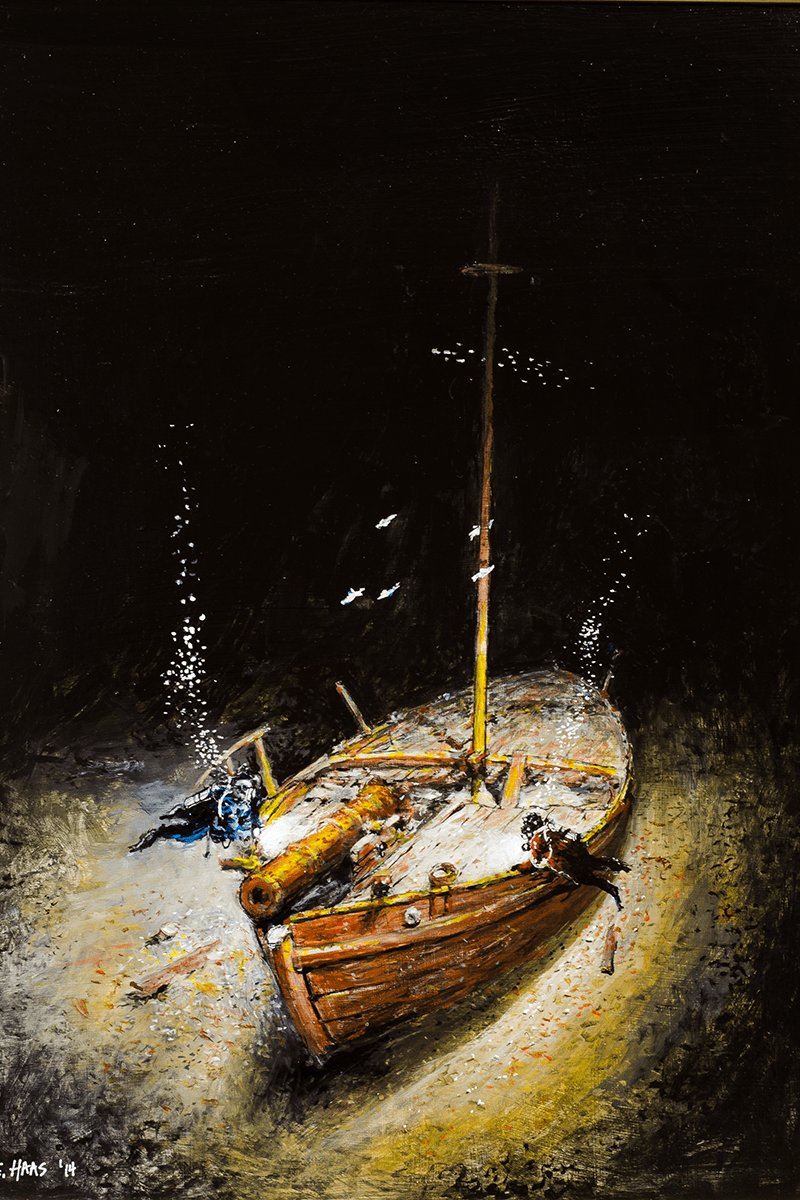
221 years later, maritime surveyors from the Survey Team of the Lake Champlain Maritime Museum located the last vessel left unaccounted for, from the October 11, 1776 Battle of Valcour Island.  With mast yet standing and her bow gun at the ready, the wreck lies upright at a depth inaccessible to recreational divers, protected and preserved by the cold, dark, fresh waters of Lake Champlain.

Over the next two years, careful examination of source documents eliminated one patriot gunboat after another from consideration as the identity of the “missing gunboat”. In the end, the Pristine wreck was identified as the Spitfire, sister ship to Benedict Arnold’s seven other 54-foot gunboats constructed over the Summer of 1776, in the wilderness of Skenesborough.

Today, the Spitfire site is protected by the Sunken Military Craft Act, providing that “No person may possess, disturb, remove, or injure” any part of this precious underwater shrine, to our shared American history.

Haas-Spitfire-2014-800x1200.png

Painting of the Spitfire by Ernie Haas.  Hat tip https://www.lcmm.org/explore/shipwrecks/revolutionary-war-gunboat-spitfire/


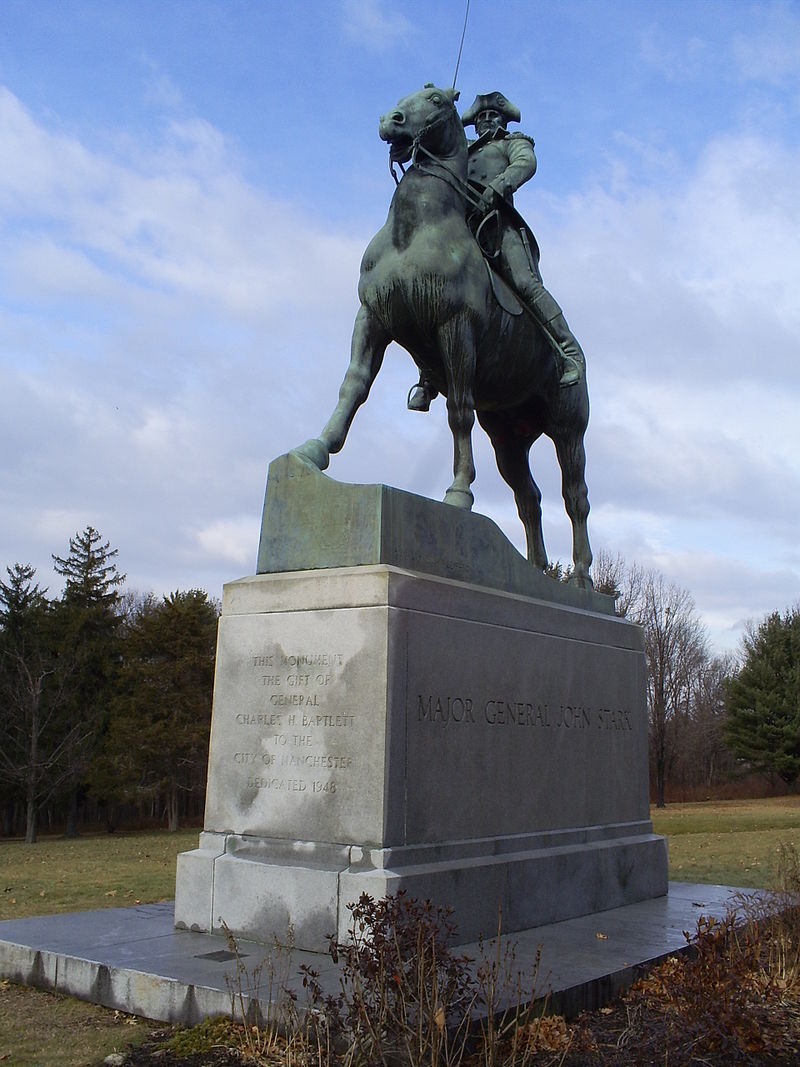
April 28, 1752 John Stark, American Cincinnatus

Of all the General officers who fought for American Independence, there is but one true Cincinnatus. A man who risked his life in the cause of Liberty, and truly retired from public life.

The Roman Republic of antiquity operated on the basis of separation of powers with checks and balances, and a strong aversion to the concentration of authority. Except in times of national emergency, no single individual was allowed to wield absolute power over his fellow citizens.

The retired patrician and military leader Lucius Quinctius Cincinnatus was called from his farm in 458BC to assume the mantle of Dictator and, despite his old age, again, twenty years later. With the crisis averted, Cincinnatus relinquished all power and the perks which came with it, and returned to his plow.

The man’s name remains symbolic, from that day to this. A synonym for outstanding leadership, selfless service and civic virtue.

Of all the General officers who fought for American Independence, there is but one true Cincinnatus. A man who risked his life in the cause of Liberty, and truly retired from public life.

800px-Starksgravesite

Outside of his native New Hampshire, few remember the name of John Stark.  Born August 28, 1728 in Londonderry (modern day Derry), the family moved up the road when the boy was eight, to Derryfield. Today we know it as Manchester.

On April 28, 1752, 23-year-old John Stark was out trapping and fishing with his brother William, and a couple of buddies. The small group was set upon by a much larger party of Abenaki warriors. David Stinson was killed in the struggle, as John was able to warn his brother away. William escaped, in a canoe.

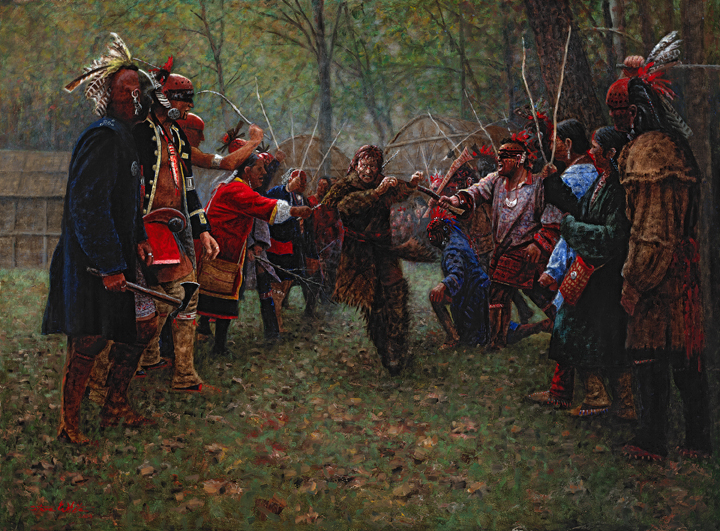
John was captured along with Amos Eastman.  267 years ago today, the hostages were heading north, all the way to Quebec, where the pair were subjected to a ritual torture known as “running the gauntlet”.

Simon-Kenton-Running-the-Gauntlet
Frontiersman Simon Kenton, running the gauntlet

In the eastern woodlands of the United States and southern Quebec and Ontario, captives in the colonial and pre-European era often faced death by ritual torture at the hands of indigenous peoples, a process which could last, for days.  In running the gauntlet, the condemned is forced between two opposing rows, where warriors strike out with clubs, whips and bladed weapons.

Eastman barely got out alive, but Stark wasn’t playing by the same rules.  He hit the first man at a dead run, wrenching the man’s club from his grasp and striking out, at both lines.  The scene was pandemonium, as the tormented captive gave as good as he got. To the chief of the Abenaki, it may have been the funniest thing, ever. He was so amused, he adopted the pair into the tribe.  Eastman and Stark lived as tribal members for the rest of that year and into the following Spring, when a Massachusetts Bay agent bought their freedom. Sixty Spanish dollars for Amos and $103, for John Stark.

3590100173_0a6114e466_bSeven years later during the French & Indian War, Rogers’ Rangers were ordered to  attack the Abenaki village with John Stark, second in command.  Stark refused to accompany the attacking force out of respect for his Indian foster family, returning instead to Derryfield and his wife Molly, whom he had married the year before.
John Stark returned to military service in 1775 following the Battles of Lexington and Concord, accepting a Colonelcy with the 1st Regiment of the New Hampshire militia.

During the early phase of the Battle of Bunker Hill, American Colonel William Prescott knew he was outgunned and outnumbered, and sent out a desperate call for reinforcements. The British warship HMS Lively was raining accurate fire down on Charlestown Neck, the narrow causeway linking the city with the rebel positions. Several companies were milling about just out of range, when Stark ordered them to step aside. Colonel Stark and his New Hampshire men then calmly marched to Prescott’s position on Breed’s Hill, without a single casualty.

Stark and his men formed the left flank of the rebel position, leading down to the beach at Mystic River.  The Battle of Bunker Hill was a British victory, in that they held the ground, when it was over. It was a costly win which could scarcely be repeated. At the place in the line held by John Stark’s New Hampshire men, British dead were piled up like cord wood.

John Stark’s service record reads like a timeline of the American Revolution. The doomed invasion of Canada in the Spring of 1776. The famous crossing of the Delaware and the victorious battles at Trenton, and Princeton New Jersey. Lieutenant Colonel Friedrich Baum and his Brunswick mercenaries ran into a buzz saw in Bennington Vermont, in the form of Seth Warner’s Green Mountain Boys and John Stark, rallying his New Hampshire militia with the cry, “There are your enemies, the Red Coats and the Tories. They are ours, or this night Molly Stark sleeps a widow!”  When it was over, Stark reported 14 dead and 42 wounded. Of Lt. Col. Baum’s 374 professional soldiers, only nine walked away.

battle-of-bennington-frederick-coffay-yohn-1
Battle of Bennington

The loss of his German ally led in no small part to “Gentleman Johnny” Burgoyne’s defeat, at Saratoga.  Stark served with distinction for the remainder of the war and, like Cincinnatus before him, returned home to his farm.

In 1809, a group of Bennington veterans gathered for a reunion. Stark was 81 at this time and not well enough to travel. Instead, he wrote his comrades a letter, closing with these words:

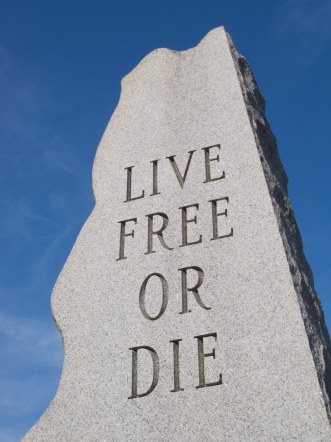
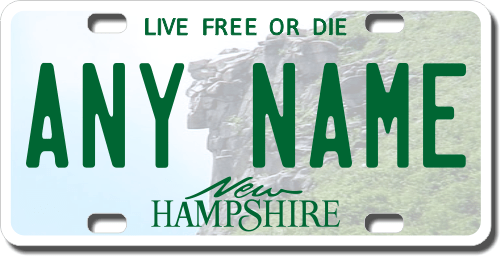
“Live free or die: Death is not the worst of evils.”

The name of the American Cincinnatus is all but forgotten today but his words live on, imprinted on every license plate, in New Hampshire.  “Live Free or Die”.

NEW-HAMPSIRE-LICENSE-PLATE-VER1-TEAMLOGO

A Trivial Matter
Neither George Washington nor Samuel Adams liked political parties, believing that such “factions” would splinter the Congress and divide the nation.

April 19, 1775 Lexington and Concord

The conflict that afternoon at the Old North Bridge in Concord was the first instance of the American Revolution, when colonists fired to deadly effect on British regulars.

The column of British soldiers moved out from Boston in the late night hours of April 18, with the mission of confiscating the American arsenal at Concord and  capturing the Patriot leaders Sam Adams and John Hancock, known to be hiding in Lexington.

Patriots had been preparing for such an event.  Sexton Robert John Newman and Captain John Pulling carried two lanterns to the steeple of the Old North church, signaling the Regulars were crossing the Charles River to Cambridge.

Dr. Joseph Warren ordered Paul Revere and Samuel Dawes to ride out and warn surrounding villages and towns, the two soon joined by a third rider, Samuel Prescott. Prescott alone would make it as far as Concord, though hundreds of riders would fan out across the countryside before the night was through.

paul-revere (1)

The column arrived in Lexington with the first moments of sunrise on April 19, bayonets gleaming in the early morning light.  Armed with a sorry assortment of weapons, colonial militia poured out of Buckman Tavern and fanned out across the town square.   Some weapons were hand made by village gunsmiths and blacksmiths, some decades old, but all were in good working order.   Taking positions across the village green to block the soldiers’ line of march, eighty “minutemen” turned and faced seven hundred of the most powerful military, on the planet.

Words were exchanged and no one knows who fired the first shot.  When it was over, eight Lexington men lay dead or dying, another ten wounded. One British soldier was wounded.

If you’ve never see the dawn reenactment of the Battle of Lexington, I highly recommend it.  It’s a regular feature of the Patriot’s Day festivities around the city of Boston, and well worth getting up early.  Hat tip Gethin Coolbaugh for this film of the 2018 event

Vastly outnumbered, the militia soon gave way as word spread and militia gathered from Concord to Cambridge.   The King’s Regulars never did find the weapons for which they had come, nor did they find Adams or Hancock.  There had been too much warning for that.

Regulars clashed with colonial subjects two more times that day, first at Concord Bridge and then in a running fight at a point in the road called “The Bloody Angle”.  Finally, hearing that militia was coming from as far away as Worcester, the column turned to the east and began their return march to Boston.

Hat tip DiscerningHistory.com, for this brief video on the Battle of Concord Bridge.

Some British soldiers marched 35 miles over those two days, their final retreat coming under increasing attack from militia members firing from behind stone walls, buildings and trees.

One taking up such a firing position was Samuel Whittemore of Menotomy Village, now Arlington Massachusetts. At eighty years old, he was the oldest known combatant of the Revolution.

Whittemore took his position by the road armed with his ancient musket, two dueling pistols and the old cutlass captured years earlier from a French officer whom he had once explained had “died suddenly”.

Waiting until the last possible moment, Whittemore rose and fired his musket at the oncoming Redcoats.  One shot, one kill. Several charged him from only feet away as he drew his pistols.  Two more shots, one dead and one mortally wounded. He had barely drawn his sword when they were on him, a .69 caliber ball fired almost point blank tearing part of his face off, as the butt of a rifle smashed down on his head. Whittemore tried to fend off the bayonet strokes with his sword but he didn’t have a chance.  He was run through thirteen times before he lay still.  One for each American colony.

Hat tip, The History Guy, for this presentation on Sam Whittemore. The ages given vary slightly from that engraved on his memorial but, age 78 or 80 at the time of this story, it seems a small matter.

The people who came out of their homes to clean up the mess afterward found Whittemore, up on one knee and trying to reload his old musket.

Doctor Nathaniel Tufts treated the old man’s wounds as best he could, but felt there was nothing anyone could do. Sam Whittemore was taken home to die in the company of his loved ones, and that’s what he did.  Eighteen years later, at the age of ninety-eight.

samuel_whittemore


A Trivial Matter
Just after midnight, April 19, 1775 , William Dawes, Dr. Samuel Prescott and Paul Revere were intercepted by a British patrol, just outside of Lexington. Prescott and Dawes bolted but Revere was captured, held through the small hours and interrogated. Revere was finally released, without his horse. The “Midnight Ride of Paul Revere” made famous by Henry Wadsworth Longfellow, humiliatingly ended on foot.  Revere arrived in Lexington just in time to witness the last moments on Lexington Green.  The conflict that afternoon at the Old North Bridge in Concord was the first instance of the American Revolution, when colonists fired to deadly effect on British regulars. In the 1837 classic “Concord Hymn”, American poet Ralph Waldo Emerson called it the “shot heard round the world”.

March 15, 1783 A Pair of Spectacles

The politician who alienates a battle hardened army in the field walks on dangerous ground.  Don’t pay for their services, that’s a good way to do it.

The great rebellion effectively came to an end in October 1781 with Lord Cornwallis’ surrender at Yorktown, though no one knew it at that time.  Eight years after the “shot heard round the world“, the American Revolution had slowed to a standoff.

King George III remained personally in favor of prosecuting the war even after the Patriot victory at Yorktown, while opinion in Parliament, was split.  Across the water, some 26,000 British troops remained in occupation in Charleston, Savannah and New York, backed up be a mighty fleet.

the-execution-of-king-louis-e1269752616856

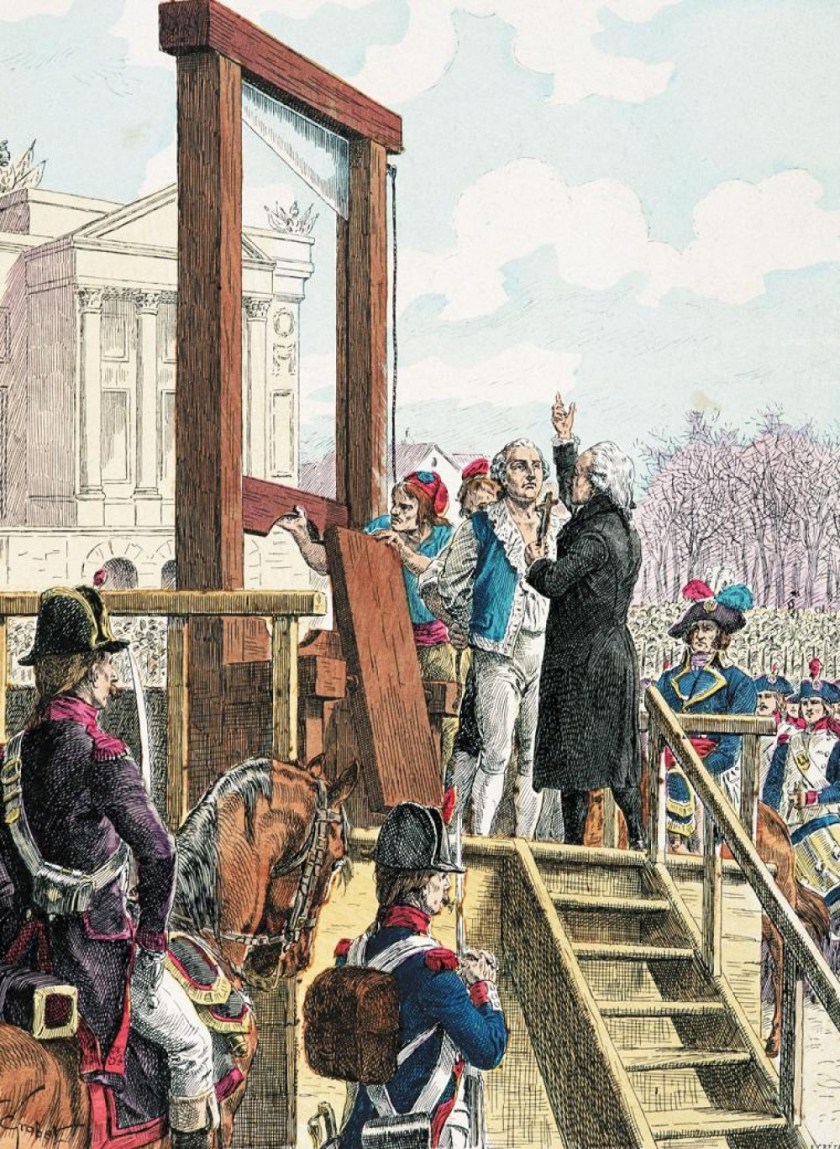
The Americans’ greatest ally departed in 1782, never to return.  With state finances already prostrate with debt, l’Ancien régime (French: “the old order”) would be overthrown by its own revolution inside the next ten years, the French King Louis XVI and Queen Consort Marie Antoinette executed, by guillotine.

Negotiations carried on for nearly three years in Paris while, an hour’s drive north by modern highway from the British occupation of New York, the Continental Army waited at Newburgh.

France wasn’t the only one, ruined by this war.  The American Revolution debilitated the finances of all three principle belligerents, none more so than the new-born American Republic, itself.  In fact, the fledgling United States nearly died on this day in 1783, by the very hands which had given them birth.

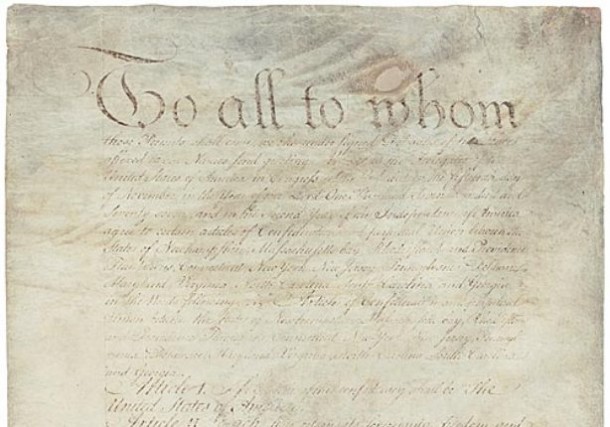
The Articles of Confederation, ratified by the states in March 1781, provided for a loose alliance of sovereign states. In theory, Congress possessed the authority to govern foreign affairs, conduct war and regulate currency.  In practice, these powers were limited to a national body with no authority to enforce its will on the states.

ArticlesConfederation-610x427

In 1780, Congress promised Continental officers a lifetime pension, equal to half-pay upon discharge.  The government in Philadelphia attempted to amend the Articles, to allow a new import duty or “impost”.  States were divided against the measure.  Two years later, the cupboard was bare.  Continental soldiers weren’t being paid at all.   

It wasn’t even possible to borrow.  That required evidence, of an income stream.

The politician who alienates a battle hardened army in the field walks on dangerous ground.  Don’t pay for their services, that’s a good way to do it.  At the outset of war, these guys left homes and fields and families, to risk their lives on behalf of the dream of Liberty.  Many among their number, had given all in service to that dream.

There was little to do during those long winter months of 1782-’83, but wait.  Each with his own financial hardship waiting at home, every man worried that his promised compensation, would not come.  The rumor mill worked overtime:  The Army would be disbanded.  The promised pensions would remain, unfunded.

4

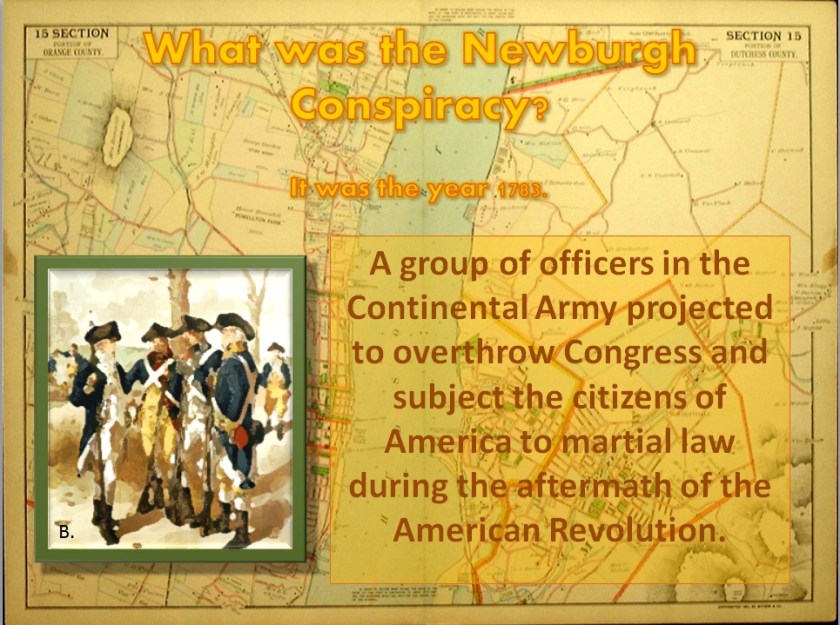
The vague unease of rumor turned to a fury of near certainty through the late winter months, as one overture after another met with defeat, in Congress.  On March 10, an unsigned letter believed to have been written by Major John Armstrong, aide to General Horatio Gates, urged unspecified action against the Continental Congress.  Another called for a meeting on the morning of March 11.  Events were building toward armed insurrection.  A coup d’état.

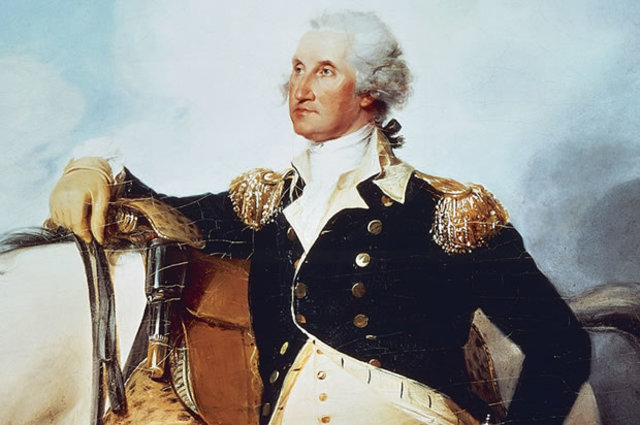
General George Washington reacted quickly, objecting in his General Orders of March 11 to the “disorderly” and “irregular” nature of such a meeting.  Washington specified the morning of March 15 for an officer’s meeting and requested a report, implying that he himself, would not be present.

The mood was one of surprise and anger when the Commander-in-Chief himself walked into the room, hard men pushed past the point of patience, and now determined to take action.  The General urged patience in a brief and impassioned speech remembered as the Newburgh address.

Washington’s words may as well have fallen on deaf ears.  There was little of the usual deference, in this room.

New_Windsor_Cantonment
Reconstructed Temple at the New Windsor Cantonment State Historic Site, where the critical meeting took place on March 15, 1783

The future President of the United States then produced a letter from a member of Congress, to read to his officers. The content is unimportant. George Washington gazed on the letter in his hands without speaking and, fumbling in his pocket, came up with a pair of reading glasses. These were new.  Few men in the room even knew the man required glasses.

Washington spoke:

Gentlemen, you will permit me to put on my spectacles, for I have not only grown gray but almost blind in the service of my country.

The words were as a physical blow, on the men assembled in that room.  Obstinate and unheeding mere moments before, the realization dawned on all at once.  This man had been at their head and by their sides.  Washington had personally endured every bit of the hardship, as these men bent on mutiny.

washington1795-456

There was hardly a dry eye in the place.  The moment was broken for all time.  Bent on mutiny a mere moment before, the cream of the continental army now determined, to wait.  This Republic to which we owe so much may have died before it was born, two hundred thirty-six years ago on this day.  All but for one magnificent man with an actor’s sense of timing.  And a new pair of spectacles.


A Trivial Matter
At age twenty-six, George Washington married Martha Dandridge Custis, a widow with two children: Jacky and Patsy. The Father of the Nation never had any children of his own. At 6 feet, 3½ inches and 200-pounds, George Washington towered above his fellow Continental soldier, with an average height of 5-feet, 8-inches in height.


March 5, 1776 Head Fake

It’s doubtful whether Washington possessed either powder or shot for a sustained campaign, but British forces occupying Boston didn’t know that.

Over the night and the following day of April 18-19, 1775, individual British soldiers marched 36 miles or more, on the round-trip expedition from Boston.  Following the early morning battles at Lexington and Concord, armed colonial militia from as far away as Worcester swarmed over the column, forcing the regulars into a fighting retreat.

In those days, Boston was a virtual island, connected to the mainland by a narrow “neck” of land.  More than 20,000 armed men converged from all over New England in the weeks that followed, gathering in buildings and encampments from Cambridge to Roxbury.

siege-of-boston-1775-1776-grangerA man who should have gone into history among the top tier of American Founding Fathers, the future turncoat Benedict Arnold, arrived with Connecticut militia to support the siege.  Arnold informed the Massachusetts Committee of Safety that Fort Ticonderoga, located along the southern end of Lake Champlain in northern New York, was bristling with cannon and other military stores.  Furthermore, the place was lightly defended.

The committee commissioned Arnold a colonel on May 3, authorizing him to raise troops and lead a mission to capture the fort.  Seven days later, Colonel Arnold and militia forces from Connecticut and western Massachusetts in conjunction with Ethan Allen and his “Green Mountain Boys” captured the fort, and all its armaments.

The Continental Congress created the Army that June, appointing General George Washington to lead it.  When General Washington took command of that army in July, it was a force with an average of nine rounds-worth of shot and powder, per man.  British forces occupying Boston, were effectively penned up by forces too weak to do anything about it.

The stalemate dragged on for months, when a 25-year-old bookseller came to General Washington with a plan. His name was Henry Knox. His plan was a 300-mile, round trip slog into a New England winter, to retrieve the guns of Ticonderoga:  brass and iron cannon, howitzers, and mortars.  59 pieces in all.  Washington’s advisors derided the idea as hopeless, but the General approved.

Henry-Knox-moving-canning-from-Fort-Ticonderoga

Knox set out with a column of men in late November, 1775.  For nearly two months, he and his team wrestled 60 tons of cannons and other armaments by boat, animal & man-hauled sledges along roads little better than foot trails.  Across two barely frozen rivers, and through the forests and swamps of the Berkshires to Cambridge, historian Victor Brooks called it “one of the most stupendous feats of logistics” of the Revolution.  It must have been a sight on January 24, 1776, when Knox returned at the head of that “Noble Train of Artillery”.

For British military leadership in Boston, headed by General William Howe, the only option for resupply was by water, via Boston Harbor.  Both sides of the siege understood the strategic importance of the twin prominences overlooking the harbor, the hills of Charlestown to the north, and Dorchester heights to the south.  It’s why British forces had nearly spent themselves on Farmer Breed’s hillside that June, an engagement that went into history as the Battle of Bunker Hill.

e716f0fbb9

With Howe’s forces in possession of the Charlestown peninsula, Washington had long considered occupying Dorchester Heights, but considered his forces too weak.  That changed with the guns of Ticonderoga.

In the first days of March, Washington placed several heavy cannon at Lechmere’s Point and Cobble Hill in Cambridge, and on Lamb’s Dam in Roxbury.  The batteries opened fire on the night of March 2, and again on the following night and the night after that.  With British attention thus diverted, American General John Thomas and a force of some 2,000 made plans to take the heights.

As the ground was frozen and digging impossible, fortifications and cannon placements were fashioned from heavy 10′ timbers.  With the path to the top lined with hay bales to muffle their sounds, these fortifications were manhandled to the top of Dorchester heights over the night of March 4-5, along with the bulk of Knox’ cannons.

General Howe was stunned on awakening, on the morning of March 5.  The British garrison in Boston and the fleet in harbor, were now under the muzzles of Patriot guns.  “The rebels have done more in one night”, he said, “than my whole army would have done in a month.”

Plans were laid for an immediate British assault on the hill, as reinforcements poured into the position.  By day’s end, Howe faced the prospect of another bunker Hill, this time against a force of 6,000 in possession of heavy artillery.

A heavy snowstorm descended late in the day, interrupting Howe’s plan for the assault.  A few days later, he had thought better of it.  A tacit cease-fire settled in over the next two weeks, with Washington’s side declining to open fire, and Howe’s side refraining from destroying the town, in the course of withdrawing from Boston.

British forces departed Boston by sea on March 17 with about 1,000 civilian loyalists, resulting in a peculiar Massachusetts institution which exists to this day. “Evacuation Day”:

evacuation-day
British evacuation of Boston. March 17, 1776

It’s doubtful whether Washington possessed either powder or shot for a sustained campaign, but British forces occupying Boston didn’t know that. The mere presence of those guns moved General Howe to weigh anchor and sail for Nova Scotia. The episode may be the greatest head fake, in military history.

If you enjoyed this “Today in History”, please feel free to re-blog, “like” & share on social media, so that others may find and enjoy it as well. Please click the “follow” button on the right, to receive email updates on new articles.  Thank you for your interest, in the history we all share.

January 30, 1752 Founding Philanderer

Not that he could’ve have done anything about it, even if the husband did find out.  Morris walked with a peg, his left leg severed below the knee in a carriage accident, lost while running from an angry husband.

nyc-pdf-manhattan-street-map-printable-street-guide-4
Midtown Street Grid

To drive the streets of Manhattan is to realize that someone had a plan for this place. You might not be able to get there for the congestion, but you can figure out how to do it. Not like the rabbit warren that is her sister city of Boston, that all but unnavigable melange of neighborhoods, grown together as the city expanded into former marshlands and harbor.

In grade school, we all learned the preamble to the Constitution. “We the People of the United States, in Order to form a more perfect Union…” It’s considerably snappier than the original version:

We the people of the states of New-Hampshire, Massachusetts, Rhode-Island and Providence Plantations, Connecticut, New-York, New-Jersey, Pennsylvania, Delaware, Maryland, Virginia, North-Carolina, South-Carolina, and Georgia, do ordain, declare and establish the following constitution for the government of ourselves and our posterity.”

us-constitution

That West 53rd leads to East 53rd and runs next to 54th may be attributed to a committee of three, who fought (and won) the battle against the wide circles and grand plazas, once envisioned for “The City”. That we may be spared that stultifying recitation of our founding document may be laid at the feet of one member of that committee.

Today, his life is all but lost to history, among the familiar constellation of founding fathers.  If he’s remembered at all it’s for that funny name.  Gouverneur Morris.  And what a life it was.

morris_g
Gouverneur Morris

Gouverneur Morris was born this day in 1752, the son of Lewis Morris, Jr. and his second wife Sarah (Gouverneur) Morris. Abigail Adams informs us the name was pronounced “Governeer”.

Born to a wealthy New York land owning family, Morris was destined to a place among the founders. His half-brother Lewis signed the Declaration of Independence.  Nephew Lewis Richard served in the Vermont legislature and the US Congress.

As a member of the Continental Congress, Morris helped General George Washington secure funding, to keep the Continental Army in the field. A staunch ally of the Commander-in-Chief, Morris defended Washington against the “Conway Cabal“, the only serious effort to have the General unseated, as commander-in-chief.

gouverneur_morris_1789
Gouverneur Morris 1789

A staunch opponent of slavery, Morris derided the “peculiar institution” as “the curse of heaven on the states where it prevailed.”  Morris mocked the “3/5ths compromise”, that cynical effort to increase congressional representation based on “property”, who had no right to vote.

Upon what principle”, Morris asked, “is it that the slaves shall be computed in the representation? Are they men? Then make them citizens, and let them vote. Are they property? Why, then, is no other property included?”

And did I mention, Gouverneur Morris was a first-class Rake?

“Rake” is such a great word, short for “Rakehell” or Hellraiser’.  It’s a shame it’s fallen out of usage.  This isn’t the tool shed variety.  An 18th century Rake is a man habituated to dissolute conduct, a chronic libertine devoted to wine, women and song.  Emphasis on the Women and, no problem if they just happened to be married.

At a time when sexual attitudes were “buttoned up” to say the least, Gouverneur Morris was all but addicted to sex in public, given over to the excitement, of the risk at being caught.

As Minister Plenipotentiary to France in the wake of the American Revolution, Morris writes of one such dalliance in the hallway at the Louvre, then a Royal Residence.

wooden-leg-of-gouverneur-morris-new-york-historical-society-photo-by-the_adverse_possessors-cc-by-sa-2-5-426x640
Gouverneur Morris’ wooden leg

“Go to the Louvre… we take the Chance of Interruption and celebrate in the Passage while Mademoiselle (the woman’s daughter) is at the Harpsichord in the Drawing Room. The husband is below. Visitors are hourly expected. The Doors are all open.”

“Celebrate” was Morris’ code word for…well…you know.

Not that he could’ve done anything about it, even if the husband did find out.  Morris walked with a peg, his left leg severed below the knee in a carriage accident, lost while running from an angry husband.

That wooden leg actually helped him one time, as the French Revolution spiraled downward toward the homicidal madness  known as the “Reign of Terror“. While riding in a carriage, a sign of the aristocracy, a horde of sans coulotte attempted to seize the vehicle.  It may have cost Morris, his head.  Gouverneur Morris leaned out the window and shook the leg at them, momentarily shocking the mob into stunned silence. Whether the mob thought him a war veteran or just plain crazy is unknown, but the driver had just enough time, to get away.

800px-william_hogarth_027
18th century painting “A Rake’s Progress”, by English artist William Hogarth

Morris tried to raise enough to bribe the guards, to release King Louis XVI and Marie Antoinette.  When that didn’t work out he bought the Queen’s furniture, and brought it home as a keepsake.

Morris finally “settled down” at age 57, but even that was a scandal.  That Anne Gary (“Nancy”) Randolph was twenty-two years younger than he was not so unusual, but marrying his housekeeper, was.  Worse still, the blushing bride had become pregnant by her own brother-in-law at age seventeen, and was tried for killing the baby.  On a plantation named “Bizarre’, no less.

Anne was acquitted of the charge of infanticide, but the scandal followed her, all her days.  Morris announced his marriage to her at his Christmas party.  In his diary, Gouverneur writes “I marry this day Anne Gary Randolph. No small surprise to my guests.”

1_bvbmve3hyozqr_ety3gckw
Whalebone

Toward the end of his life, Gouverneur Morris experienced problems with his urinary tract, probably the result of prostate cancer.  Believing there to be some blockage in his pipes, Morris tried the “Do-it-Yourself” approach to fixing the problem, with a piece of whalebone.

Unsurprisingly, the method caused himself considerable damage and massive infection.  The man who brought the Erie Canal to upstate New York died on November 6, 1813.  Six days later, the Columbian Centinal newspaper of Boston reported his death following “a short but distressing illness.”

I should say so.

If you enjoyed this “Today in History”, please feel free to re-blog, “like” & share on social media, so that others may find and enjoy it as well. Please click the “follow” button on the right, to receive email updates on new articles.  Thank you for your interest, in the history we all share.


January 29, 1820  An Ass for a Lion

“One of the strongest natural proofs of the folly of hereditary right in kings, is, that nature disapproves it, otherwise she would not so frequently turn it into ridicule by giving mankind an ass for a lion”.  – Thomas Paine, Common Sense

The Declaration of Independence, the birth certificate of the nation, begins with this preamble: “When in the Course of human events, it becomes necessary for one people to dissolve the political bands which have connected them with another...”.

The next paragraph leads with the phrase most commonly cited:

“We hold these truths to be self-evident, that all men are created equal, that they are endowed by their Creator with certain unalienable Rights, that among these are Life, Liberty and the pursuit of Happiness”. 

The paragraph ends with a personal indictment of one man, followed by a 27-item Bill of Particulars against him.  “The history of the present King of Great Britain is a history of repeated injuries and usurpations, all having in direct object the establishment of an absolute Tyranny over these States. To prove this, let Facts be submitted to a candid world“.

The word “He” appears 19 times in the document.  “Tyrant” is used twice and “ruler”, only once:  “A Prince whose character is thus marked by every act which may define a Tyrant, is unfit to be the ruler of a free people”.

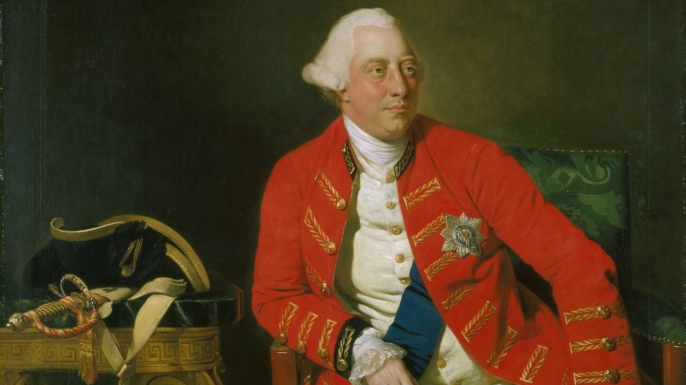
king_george_iii_of_england_by_johann_zoffany-e

King George III of England, by Johann Zoffany

The overall tenor of the document is a personal indictment of one man, George III, King of England.  Thomas Paine wrote of the King in “Common Sense”, the pamphlet which inspired a people to rise up in the summer of 1776:  “One of the strongest natural proofs of the folly of hereditary right in kings, is, that nature disapproves it, otherwise she would not so frequently turn it into ridicule by giving mankind an ass for a lion”.

George III became something of a lighting rod for colonial discontent, held personally responsible for policies brought forth by the British legislative body. The Stamp Act of 1765, the Townshend duties on tea, paper and other products in 1767;  these came from Parliament, as did the “Coercive Acts” of 1774, referred to by the Patriots of Massachusetts and others as “The Intolerable Acts”.

intolerable
The “Intolerable Acts” were a series of bills passed by Parliament, to punish American colonists for The Boston Tea Party.

These policies were a result of the financial burdens of garrisoning and administering the huge territories of the American colonies, the never-ending wars with France and Spain, and the loans given to the East India Company, then responsible for administering India.

The third King of the House of Hanover was himself a creature of Parliament, his lineage having been invited to rule over Great Britain in 1714, after the fall of the House of Stuart.  What Parliament gives, Parliament may take away.

George III is the longest reigning of any English King, ruling from 1760 until his death on January 29, 1820.  He is exceeded in office only by his Granddaughter Victoria, the last monarch of the House of the Hanoverian Dynasty and Elizabeth II, reigning Queen of the United Kingdom and the other Commonwealth realms.

Medical historians have long believed that George III suffered from a genetic blood disorder called Porphyria, a term from the Greek meaning “purple pigment”.  This refers to a blue discoloration in the urine of those suffering from the condition, along with symptoms primarily involving the central nervous system, and accompanied by severe abdominal pain, vomiting and mental disturbances.

king-george-iii_1_The illness seems to have afflicted George III alone however, casting doubt on an hereditary condition.  George III’s medical records cast further doubt on the porphyria diagnosis, showing that he was prescribed medicine based on gentian, a plant with deep blue flowers which may turn the urine blue. He seems to have been afflicted with some kind of mental illness, suffering bouts which occurred with increasing severity and for increasing periods of time.  At times he would talk until he foamed at the mouth or go into convulsions where pages had to sit on him to keep the King from injuring himself.
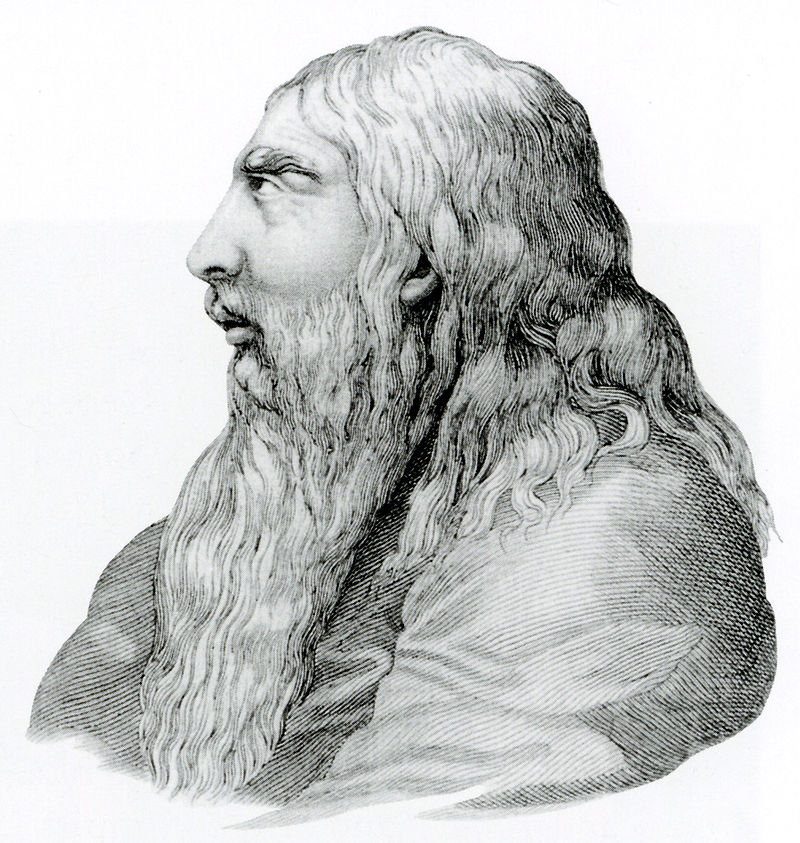
An ongoing research project at St George’s, University of London, has looked at thousands of King George III’s handwritten letters, and concluded that the King suffered from mental illness.  His writing was erratic at times coinciding with his “spells”, with run-on sentences of 400 words or more and as many as 8 verbs with no punctuation.  These are features seen today in the writing and speech of patients as they experience the manic phase of bipolar disorder.  This manic phase stands at one end of a spectrum of mood disorders, with an overwhelming sadness or depression at the other.  Research is ongoing, but these types of mood swings are consistent with contemporary witnesses to George’s behavior, as well as the written record.

All but blind from cataracts and suffering a painful rheumatic disorder, George’s final descent was triggered by the death of his youngest and favorite daughter Princess Amelia, at age 27.  In November 1810, the Princess’s nurse reported “scenes of distress and crying every day …  melancholy beyond description.”

George himself accepted the Regent Act of 1811, appointing his eldest son the Prince of Wales and future King George IV, Prince Regent.  Britannica.com describes the last ten years as a “living death”, a period of violent insanity interspersed with “intervals of senile lucidity”.

The King neither knew nor would he have understood when he was appointed King of Hanover in 1814, nor when his wife died in 1818. On Christmas 1819, George spoke for fifty-eight hours straight, all of it, gibberish.

800px-george_iii_by_henry_meyer

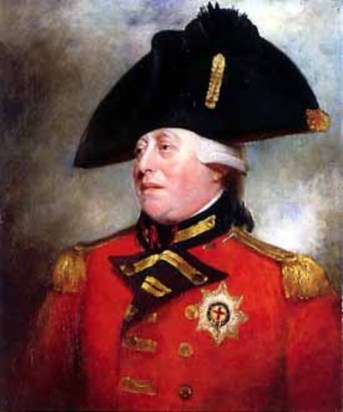
Engraving of George III in later life, by Henry Meyer

Today, George III is remembered for two things:  losing the American colonies, and going mad.

There is an historic lesson in this story.  If the country ruled by a King (or Queen) wins the lottery and gets a good and fair monarch, then that country may experience a period of peace and prosperity.  If that nation draws the cosmic short straw and gets a bad one, the results can be catastrophic.  In the end, it’s the most powerful argument I can think of for a governmental system of specified authority, diffuse power, and checks & balances.

January 24, 1776 Seven Weeks in Winter

It must have been a sight when that noble train of artillery entered Cambridge on this day in 1776. By March, Henry Knox’ cannon would be manhandled to the top of Dorchester Heights, resulting in the British evacuation of Boston and a peculiar Massachusetts institution which exists to this day, known as “Evacuation Day”:  March 17.

The American Revolution began with the Shot Heard Round the World” on the morning of April 19, 1775. Within days of the Battles at Lexington and Concord and subsequent British withdrawal to Boston, over 20,000 men poured into Cambridge from all over New England. Abandoned Tory homes and the empty Christ Church became temporary barracks and field hospitals.  Even Harvard College shut down, its buildings becoming quarters for some 1,600 Patriots.

The Continental Congress appointed George Washington General of this “Army” on June 15, two days before the British assault on Farmer Breed’s hill. The action would take its name from that of a neighboring farmer, and went into history as the Battle of Bunker Hill.

battle-of-bunker-hill

Shortly after arriving in July, General Washington discovered that his army had enough gunpowder for nine rounds per man, and then they’d be done.

At the time, Boston was a virtual island, connected to the mainland by a narrow strip of land.  British forces were effectively penned up in Boston, by a force too weak to do anything about it.

The stalemate dragged on for months, when a 25-year-old bookseller came to General Washington with a plan. His name was Henry Knox. His plan was a 300-mile, round trip slog into a New England winter, to retrieve the guns of Forts Ticonderoga, and Crown Point.

fort ticonderoga artillery (fort ti photo)

Washington’s advisers derided the idea as hopeless, but the General approved. Henry Knox set out with a column of men on December 1.

Located on the New York banks of Lake Champlain, Fort Ticonderoga was captured by a small force led by Ethan Allen and Colonel Benedict Arnold, in May of that year. In it were brass and iron cannon, howitzers, coehorns and mortars, 30 pieces in all and another 29, from Fort Crown Point.  Arriving on December 5, Knox and his men set about disassembling the artillery, making it ready for transport. A flotilla of flat bottom boats was scavenged from all over the countryside, the guns loaded and rowed the length of Lake George, arriving barely before the water began to freeze over.

colonel-knox-bringing-the-cannons-from-fort-ticonderoga (2)Local farmers were enlisted to help and by December 17, Knox was able to report to General Washington “I have had made forty two exceedingly strong sleds & have provided eighty yoke of oxen to drag them as far as Springfield where I shall get fresh cattle to carry them to camp. . . . I hope in 16 or 17 days to be able to present your Excellency a noble train of artillery.”

Bare ground prevented the sleds from moving until Christmas morning, when a heavy snow fell and the column set out for Albany. Two attempts to cross the Hudson River on January 5 each resulted in cannon being lost to the river, but finally Knox was able to write “Went on the ice about 8 o’clock in the morning & proceeded so carefully that before night we got over 23 sleds & were so lucky as to get the Cannon out of the River, owing to the assistance the good people of the City of Albany gave.”

henry-knox-moving-canning-from-fort-ticonderoga

Continuing east, Knox and his men crossed into Massachusetts, over the Berkshires, and on to Springfield. With 80 fresh yoke of oxen, the 5,400lb sleds moved along much of what are modern-day Routes 9 and 20, passing through Brookfield, Spencer, Leicester, Worcester, Shrewsbury, Northborough, Marlborough, Southborough, Framingham, Wayland, Weston, Waltham, and Watertown.

It must have been a sight when that noble train of artillery entered Cambridge on this day in 1776. By March, Henry Knox’ cannon would be manhandled to the top of Dorchester Heights, resulting in the British evacuation of Boston and a peculiar Massachusetts institution which exists to this day:  “Evacuation Day”, March 17.

800px-henry_knox_artillery_handover_to_george_washington_marker

It is doubtful whether Washington possessed either powder or shot in quantities sufficient for a sustained campaign, but British forces occupying Boston didn’t know that. The mere presence of those guns moved British General Howe to weigh anchor and sail for Nova Scotia, but that must be a story for another day.

Afterward

During WW1, Winthrop Massachusetts artist and bronze foundry operator Henry L. Norton served with the Canadian army “over there” where he was wounded, seven times. In 1926, 150 years after Knox’s march through New York and Massachusetts, Norton and Albany sculptor Henry James Albright designed commemorative plaques to be installed on 56 stone monuments, marking the path of that noble train of artillery. The project was completed in 1927.

knoxtrailmap

Marker locations were updated in 1975 to reflect new research, concerning Knox’s route between Kinderhook New York and Alford, Massachusetts,

50581448_2298075013536100_5233603815533445120_n
Henry Knox Trail marker. Tip of the hat to Aaron Altice, for this image

A new marker was added in 2009, adjacent to a house owned by General John Thomas at the Roxbury Heritage State Park, in Boston. It was he who guided the weapons from Cambridge to their final placement on Dorchester Heights.

photo94269

If you enjoyed this “Today in History”, please feel free to re-blog, “like” & share on social media, so that others may find and enjoy it as well. Please click the “follow” button on the right, to receive email updates on new articles.  Thank you for your interest, in the history we all share.


December 29, 1778 The Siege of Savannah

For the Americans and their allies, the frontal assault of October 9 was one of the bloodiest engagements, of the Revolution.  It could have been worse.  As battered American and French soldiers fell back, 500 free men of color known as the Chasseurs Volontaires de Saint-Domingue stepped up, to cover their retreat.

Many of these Haitian soldiers went on to win their own war of independence, and credited their military experience, to Savannah.

As 1778 drew to a close, British military planners could look back on five years of trying to suppress rebellion in the American colonies, with little to show for it.   In March of that year, the British defeat at Saratoga had brought France into the war, on the side of the Rebels.

Two years of open warfare had centered mostly on the north.   Now, a “southern strategy” was devised to conquer rebellious colonies in the south, while isolating those to the north. Key to the Southern Strategy was Georgia and the colonial capital at Savannah, the southernmost commercial port of the thirteen Colonies.

General sir Henry Clinton dispatched a force of some 3,100 from New York under Lieutenant Colonel Archibald Campbell, along with an unknown quantity of artillery. Campbell arrived outside Tybee Island on December 23.

Georgia was defended by two separate forces at this time, units of the Continental Army under the command of General Robert Howe, and state militia under the command of Governor John Houstoun.  The two men had a history of squabbling for control and most of their troops, had yet to be tried.

ArchibaldCampbell-by-George-Romney-239x300
Lieutenant Colonel Archibald Campbell, British commander at the capture of Savannah in December 1778

The 850 under General Howe never really had a chance, against the battle hardened Regulars, Hessian auxiliaries and Loyalist militia, coming ashore on December 29.  Defeat turned to rout when Howe’s forces threw down their weapons and ran.  Campbell reported that “It was scarcely possible to come up with them, their retreat was rapid beyond conception.

Patriot forces suffered 83 killed, 11 wounded and 453 captured. Campbell suffered 7 killed and 17 wounded.

Howe was court-marshaled for the disaster, while Campbell bragged about being “the first British officer to [rend] a star and stripe from the flag of Congress

Brigadier General Augustine Prevost arrived from St. Augustine Florida two weeks later, with a mixed force of Regulars and Creek and Cherokee allies.   Campbell and a force of 1,000 would take the provisional capital at Augusta that February but soon retreated to Savannah, citing insufficient support among Loyalist and Native American populations.

American hopes soon fell back on their new-found alliance with France. During the following summer, French Admiral Count Charles-Hector Theodat d’Estaing captured St. Vincent and Grenada in the British West Indies, clearing the way to the Georgia coast. The powerful 47-ship French fleet arrived with 4,000 troops on September 1, surprising and capturing several British ships outside the mouth of the Savannah River.

french-shipsD’Estaing sent an ultimatum to British Commander Augustine Prevost on September 16, 1779. He was to surrender the city “To the arms of his Majesty the King of France”, or he would be personally answerable for what was about to happen. It could not have pleased General Benjamin Lincoln or his Patriot allies when d’Estaing added “I have not been able to refuse the army of the United States uniting itself with that of the King. The junction will probably be effected this day. If I have not an answer therefore immediately, you must confer with General Lincoln and me”.

“Bullet Head Prevost”, so called because of a circular scar on his temple, stalled for 24 hours, using the time in furiously building up his defenses and calling up 800 reinforcements from South Carolina.

Lincoln joined d’Estaing on September 23 with an army of 3,000 militia and Continental soldiers, laying siege to Savannah and the 2,500 British and Loyalist troops in occupation.

On October 1, a British relief column under one Captain French was coming to the city’s aid, camped on the banks of the Ogeechee River. Georgia Continental Colonel John White had two officers, a sergeant and three privates with him, when he tricked French into surrendering. These guys ran through the woods lighting so many fires that the British thought the entire continental Army was bivouacked around them. Captain French was unavailable for comment but, it must be a special feeling, knowing that you just surrendered 111 guys to six, without firing a shot.

Scene-of-Savannah
View of the siege works against the town at the Siege of Savannah September and October 1779 in the American Revolutionary War: contemporary picture by a French officer

Lack of horses and artillery carriages delayed the allies’ moving their cannon ashore, so French warships bombarded the city from the sea. At one point shortly after Midnight on October 3, with rum rations flowing far too freely, fire from French gunners became more dangerous to themselves than to the city itself.

For the Americans and their allies, the frontal assault of October 9 was one of the bloodiest engagements, of the Revolution.  It could have been worse.  As battered American and French soldiers fell back, 500 free men of color known as the Chasseurs Volontaires de Saint-Domingue stepped up, to cover their retreat.

Many of these Haitian soldiers went on to win their own war of independence, and credited their military experience, to Savannah.

Franklin-Sq-Monument
Franklin Square Monument remembers the contributions of the Haitian militia, in the Siege of Savannah

 The siege of Savannah inflicted untold misery among the population, but Patriot forces and their French allies, never did break the city’s defenses. The siege broke a short time later, amidst recriminations on both sides.   D’Estaing returned to France, where he lost his head to the guillotine in 1794.

Savannah would remain in British hands until the end of the war, finally evacuated on July 11, 1782. A coquina marker in a small Savannah park; that soft, seashell limestone common throughout the Caribbean basin to Florida and beyond, bears a small brass plaque, darkened with the patina of age.

COMMEMORATIVE OF THE BRITISH EVACUATION OF SAVANNAH 1782
PRESENTED TO THE CITY OF SAVANNAH
BY THE
LACHLAN McINTOSH CHAPTER
DAUGHTERS OF THE AMERICAN REVOLUTION
1904

british-attack-on-american-forces-in-savannah-georgia-in-the-revolutionary-adw8m3-1
Attack of 2nd South Carolina Continentals on the Spring Hill Redoubt at the Siege of Savannah on 9th October 1779 in the American Revolutionary War: picture by A.I. Keller